


Abstract
Nanoparticles (NPs) of urban dust can be hazardous to human health due to the possibility of a high accumulation of potentially toxic elements (PTEs), high penetration ability into organisms, and their ability to cause injury to cells, tissues, and organs. The composition of NPs of urban dust may vary during the year; however, there are so far no studies on the seasonal changes in their elemental composition and related ecological and health risks. The current work was carried out using samples of urban dust from Moscow, the largest megacity in Europe, collected in spring, summer, and autumn. It was found that NPs of urban dust are polluted by PTEs, namely W, Bi, Hg, P, S, Sn, Mo, Cu, Cd, Pb, Sb, and Zn. The highest pollution and ecological risks were found in NPs of urban dust collected in summer (RI = 592) as compared to autumn (RI = 399) and spring (RI = 231). The same regularity was observed for health risks. The highest possible cancerogenic risk was found in summer NPs (CTCR = 3.0 × 10⁻⁴) followed by autumn NPs (CTCR = 2.5 × 10⁻⁴) and spring NPs (CTCR = 3.5 × 10⁻⁵). However, the difference between mean values obtained for the three seasons was not statistically significant. Additionally, it was demonstrated that vehicle emissions are one of the main sources of pollution of NPs, and their intensity does not significantly change throughout the year in Moscow. The results obtained offer new insights into the regularities of seasonal variations in elemental composition, pollution, and related ecological and health risks of NPs of urban dust.
1. Introduction
Micro- and nanoparticles (NPs) are ubiquitous in urban areas and permanently affect the local population [1]. The sources of NPs are diverse and include natural and anthropogenic ones. Lithogenic and pedogenic processes, e.g., the weathering of rocks and soils, are the main natural sources of NPs. Anthropogenic NPs can be divided into two groups: engineered and incidental ones [2]. Engineered NPs are widely applied in various fields of science and industry and can be considered an integral part of everyday consumer products. Engineered NPs mainly enter environments as a result of the use of products containing theses NPs, for instance, sunscreen and toothpaste [2]. In turn, almost all anthropogenic processes in urban areas lead to the release of incidental NPs into environments, for instance, vehicle and industry emissions [3]. NPs have high mobility in urban environments and can be easily transported between compartments of urban environments: water, air, and soil [2]. Regardless of their source, NPs settle and accumulate in urban dust deposited on impervious surfaces. Therefore, urban dust can be considered a reservoir for environmental NPs and can be used for their investigation [4].
NPs of urban dust are considered an emerging contaminant. NPs of urban dust can contain potentially toxic elements (e.g., Sb, As, Cu, Zn, Pb, Cr, W, Hg) and penetrate into living organisms causing negative effects [5]. After penetration, NPs can reach organs and their components. For example, it has been found that NPs cross biological barriers, entering and accumulating within brain tissues. NPs can lead to irreversible cellular damage through oxidative stress generation and direct physical damage of cellular components [5]. It is shown that NPs of urban dust stimulate inflammatory reactions of neutrophils and macrophages in the tissues of the respiratory tract [6,7]. The adverse health effects of NPs may contribute to the pathogenesis of various diseases (cardiovascular diseases, diseases of the nervous system, lung cancer, Parkinson’s disease, etc.) [8].
Studies on NPs of urban dust are being carried out all over the world, for example, in Los Angeles (USA) [9], Moscow and Krasnoyarsk (Russia) [1,10], Shanghai (China) [11], Zabrze (Poland) [12], Hat Yai (Thailand) [3], and Toronto (Canada) [13]. NPs containing Fe, Pb, Zn, and Ba have been found in the urban dust of Shanghai (China), and their possible sources are being discussed [11]. NPs containing various metals and metalloids (e.g., Cu, Zn, V, Cr, Ba, Pb, Sb, Ce, As) were determined in the urban dust of Toronto (Canada) and Shanghai (China) [13,14]. The elemental composition, sources, and related risks of NPs of Moscow (Russia) have been thoroughly studied [1,4].
It should be noted that there are a number of studies on the seasonal variability of the elemental composition and related risks of urban dust microparticles [14]. These studies enable fluctuations in degree of pollution and related risks of urban dust microparticles to be assessed. The found seasonal variabilities highlight pollution patterns and the need for a comprehensive assessment of the risks associated with urban dust [14]. For instance, the highest degree of risks related to the accumulation of Cd, Hg, and Zn in road dust from Datong city has been observed during winter as compared to summer, spring, and autumn [15]. However, to the best of our knowledge, the seasonal variability of the elemental composition of NPs accumulated in urban dust has not been studied so far.
The current study is aimed at seasonal changes in elemental composition of urban dust NPs and associated ecological and health risks. This work is carried out using urban dust samples collected in Moscow, the largest megacity in Europe. The contents of B, Li, Be, Na, Al, P, S, K, Ca, Sc, Ti, V, Cr, Mn, Mg, Co, Ba, Ni, Cu, Zn, Ga, Ge, As, Se, Br, Rb, Sr, Y, Zr, Nb, Mo, Ru, Rh, Pd, Ag, Cd, In, Sn, Sb, Te, Cs, Ba, La, Ce, Pr, Nd, Sm, Eu, Gd, Tb, Dy, Ho, Er, Tm, Yb, Lu, Hf, Ta, W, Re, Os, Ir, Pt, Au, Hg, Tl, Pb, Bi, Th, and U are determined in NPs recovered from urban dust samples collected in the spring, summer, and autumn. The sources of elements in NPs of urban dust are also assessed.
2. Materials and Methods
2.1. Sample Collection and Study Area
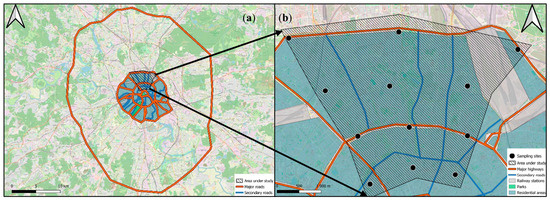
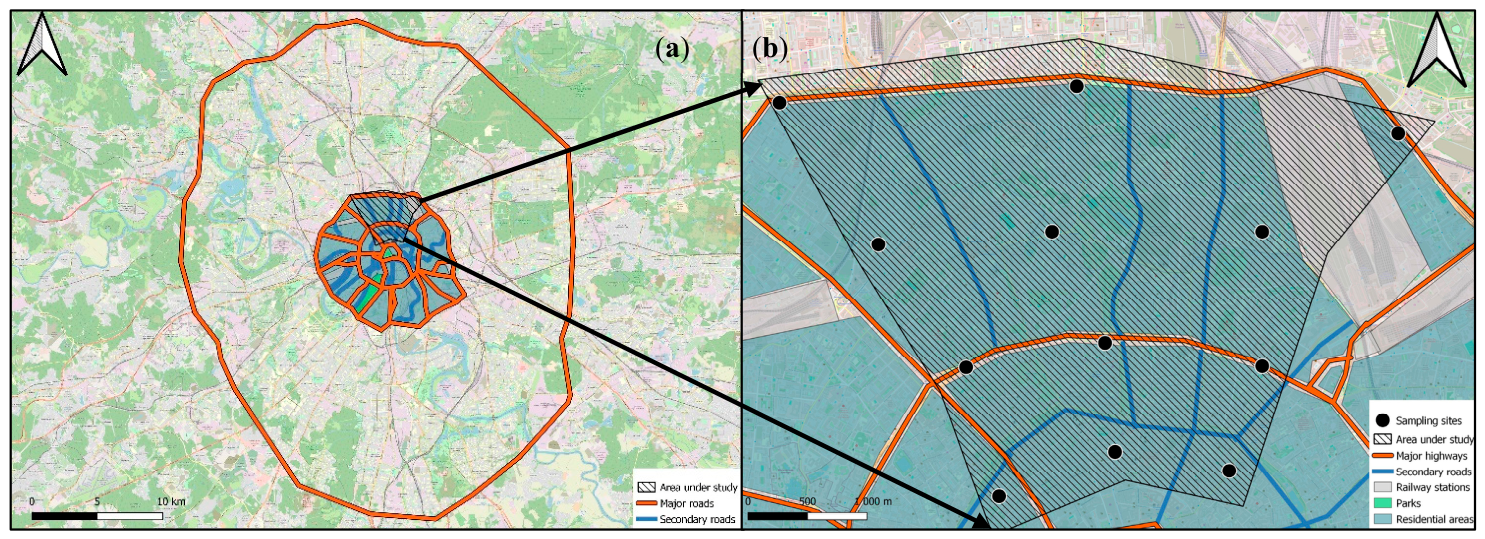
Dust samples were collected in the downtown area of Moscow megacity (Figure 1). The population in Moscow agglomeration is about 17 million, while the number of vehicles exceeds 4.5 million. The road network density reaches a maximum value of 6 km−2 in the city center (inside the Third Ring Road (TRR)) and gradually decreases up to 3–5 km−2 in urban areas located on the territory from the TRR to the Moscow Ring Road (MRR), in some places reaching values of 1–2 km−2 [16]. Thus, the central district of Moscow is characterized by the highest traffic. Dust samples were collected in different seasons: spring, summer, and autumn. The lack of dust sampling during the winter season is related to weather conditions accompanied by the formation of snow cover. NPs during the winter are accumulated in the snow cover rather than in urban dust deposited on various construction surfaces (e.g., roads and buildings). In each season under study, 12 samples of urban dust were collected. Six samples of urban dust were collected along the major highways (from four to six lines in one direction) while the remaining six samples were collected in residential areas. Traffic jams are common within the area under study, which leads to increasing vehicle emissions. There is a well-developed railway network within and close to the area under study. It should be noted that almost all industrial zones are located outside the area under study (in the southern and southeastern parts of the city close to its border) [17]. Many small-scale production sites including metal and plastic processing, pump manufacturing, and car repair are close to the study area in the north and northwest. However, their contribution to the pollution of Moscow urban dust is insignificant. It was found earlier that vehicle emissions are the main source of the pollution of Moscow urban dust [16,18].
Figure 1.
Moscow megacity (a) and the area under study (b) with sampling sites of urban dust. The map was constructed via QGIS (v. 3.34.1) and OpenStreetMap data.
The sampling locations were the same in each season. In spring, sampling was carried out on 11 April 2024. Precipitation in the territory under study was not observed during one week prior to the period of sampling, air temperature was +17 °C, atmospheric pressure was on average 750 mm Hg, air humidity was in the range of 40–60%, and wind direction was predominantly west with an average speed of 1–2 m s−1. In summer, sampling was carried out on 27 July 2024, under the following conditions: precipitation was not observed during two weeks prior to the period of sample collection; temperature—+27 °C; atmospheric pressure—747 mm Hg; air humidity—40–60%; wind—west 1 m s−1. In autumn, sampling was carried out on 20 October 2024, under the following conditions: precipitation was not observed during one week prior to the period of sample collection; temperature—+11 °C; atmospheric pressure—759 mm Hg; air humidity—60–80%; wind—northwest 1 m s−1. Thus, the period between each sampling of urban dust was on average 3 months.
In each sampling site, four subsamples of urban dust were collected. The sampling procedure has been previously applied in various studies of urban dust settled on impervious urban surfaces [15]. Samples were gently collected with a polypropylene brush, avoiding resuspension of dust particles in the atmosphere from four different surfaces of roads and sidewalks covered by asphalt or tiles with an area of 1 m2 at a distance of 5–15 m from each other. Thus, for each sampling site the mixed sample consisted of four subsamples. Collected samples were weighed and sieved (100 μm) to remove coarse particles, and after sieving the samples were weighed again. Average mass of samples collected in spring, summer, and autumn was 165 ± 60 g, 195 ± 60 g, and 140 ± 60 g, respectively. Average mass of samples after sieving was 43 ± 24 g for spring, 25 ± 12 g for summer, and 21 ± 6 g for autumn, which is 26%, 14%, and 17% of the initial mass of the collected samples, respectively. The results of elemental analysis of bulk dust samples are given in Table S1 and described in detail in our previous study [19].
2.2. Separation, Characterization, and Analysis of Nanoparticles of Urban Dust
The methodology of investigating NPs of urban dust is described in detail in our previous study [1]. Briefly, the methodology includes three main steps, namely separation, characterization, and analysis. The main difficulty in studying NPs of urban dust is related to their separation from collected bulk samples for further elemental analysis [20]. Thus, for isolation of NPs from bulk samples of urban dust, coiled tube field-flow fractionation (CTFFF) was used. Suspension prepared with 1 g of bulk urban dust sample and 10 mL of deionized water was introduced into CTFFF. The fraction of urban dust NPs was isolated using a rotation speed of 800 rpm and a constant flow rate of 0.3 mL min−1. Immediately after separation, each NP fraction was characterized by laser diffraction (LD, SALD-7500 nano, Shimadzu, Japan) [1]. Then, separated nanoparticulate fractions of urban dust were trapped on 50 nm cellulose filters (Millipore, Germany, Darmstadt) using a filtration cell under a pressure of 3 bars. Membranes with NPs were dried, weighed, digested, and analyzed by inductively coupled plasma mass spectrometry and atomic emission (ICP-MS and ICP-AES). The digestion of membranes with NPs was carried out using an autoclave system in a mixture of acids (HNO3 (nitric acid 65%; GR, ISO, Merck, Darmstadt, Germany) and HCl (hydrochloric acid 37%; PA-ACS-ISO; Panreac, Barcelona, Spain)). For the calibration in ICP-MS analysis, the solutions of single- and multielement standards (High-Purity Standards, USA, SC, North Charleston) were used. The concentrations of B, Li, Be, Al, Sc, Ti, V, Cr, Mn, Co, Ni, Cu, Zn, Ga, Ge, As, Se, Br, Rb, Sr, Y, Zr, Nb, Mo, Ru, Rh, Pd, Ag, Cd, In, Sn, Sb, Te, Cs, Ba, La, Ce, Pr, Nd, Sm, Eu, Gd, Tb, Dy, Ho, Er, Tm, Yb, Lu, Hf, Ta, W, Re, Os, Ir, Pt, Au, Hg, Tl, Pb, Bi, Th, and U in NPs of urban dust under study were analyzed using ICP-MS (X-7, Thermo Scientific, USA, MA, Waltham). In turn, the concentrations of Li, B, Na, Mg, Al, Si, P, S, K, Ca, Ti, V, Mn, Fe, Cu, Zn, Sr, and Ba were analyzed using ICP-OES (iCAP-6500 Duo, Thermo Scientific, USA, MA, Waltham). The values of limit of detection (LOD) are in Table S2.
2.3. Assessment of Contamination of Nanoparticles of Urban Dust
Concentration factor (CF) was calculated for the evaluation of the degree of accumulation of elements in urban dust NPs relative to bulk samples. The equation of CF is as follows [1]:
where is the concentration of element i determined in separated NPs, and is the concentration of element i determined in bulk samples. The CF has the following classifications: (1) <2—minimum accumulation; (2) 2–5—moderate accumulation; (3) 5–20—significant accumulation; (4) 20–40—very high accumulation; and (5) >40—extremely high accumulation [1].
Enrichment factor (EF) was used for assessment of the degree of pollution of urban dust under study. The concentrations of elements in Earth’s upper continental crust were used as background values [21] for calculation of EF [22]. EF was calculated as follows:
where is the concentration of element i measured in NPs of urban dust under study, and is the concentration of the reference element(s), which is applied for normalization. was calculated as the summary concentrations of the most common rare earth elements (REEs), namely Y, La, Ce, and Nd (). The EF has following classification: (1) <2, minimum enrichment; (2) 2–5, moderate enrichment; (3) 5–20, significant enrichment; (4) 20–40, very high enrichment; and (5) >40, extremely high enrichment [23].
Geoaccumulation index was calculated for investigation of the environmental risks caused by NPs of urban dust under study [24]. Igeo is calculated as follows:
where is the geochemical background value of element i in the upper continental crust [21]. The Igeo has the following classifications: (1) ≤0—unpolluted; (2) 0–1—unpolluted to moderately polluted; (3) 1–2—moderately polluted; (4) 2–3—moderately to heavily polluted; (5) 3–4—heavily polluted; (6) 4–5—heavily to extremely polluted; and (7) >5—extremely polluted [24].
2.4. Evaluation of Ecological and Health Risks of Nanoparticles of Urban Dust
The potential ecological risk factor (Er) and potential ecological risk index (RI) were used for the investigation of the degree of ecological risks caused by urban NPs. Er illustrates the ecological risk of a single element in dust NPs [25]. Er was calculated as follows:
where is the reference concentration of element i in pre-industrial soils. is the biological toxic response factor of element i. The mean concentrations of trace elements in urban soils were taken as pre-industrial reference concentrations [26]. The values of for Zn, Fe, Cr, Cu, Co, Pb, Ni, As, Sb, Tl, Mo, Cd, and Hg were 1, 1, 2, 5, 5, 5, 5, 10, 13, 17, 18, 30, and 40 [1]. The Er classes are as follows: <40—low potential ecological risk; 40–80—moderate potential ecological risk; 80–160—considerable potential ecological risk; 160–320—high potential ecological risk; ≥320—very high potential ecological risk [25].
RI was used for the evaluation of the degree of the ecological risk caused by all the trace elements in the NPs of urban dust under study. RI was calculated as the sum of Er [25].
The values of RI classes are as follow: <150—low ecological risk; 150–300—moderate ecological risk; 300–600—considerable ecological risk; ≥600—very high ecological risk [25].
The health risks assessment of urban dust NPs for residents was carried out using a model proposed by the Environmental Protection Agency (EPA) of the USA. The EPA model is widely applied to the assessment of both non- and cancerogenic health risks caused by toxic elements associated with dust particles settled on urban surfaces. In the EPA health risk assessment model, there are three main ways toxic matters are incorporated into the human body, namely ingestion, inhalation, and dermal contact. Carcinogenic and noncarcinogenic risks associated with trace elements in NPs of urban dust collected in Moscow through these pathways were evaluated for both types of residents: adults and children [27]. The values of hazard quotient (HQ) and carcinogenic risk (CR) related to the toxic substances in the urban dust in Moscow were calculated. The carcinogenic risks were calculated only for Cr, Ni, Co, As, and Cd, because these elements are the main inorganic pollutants of urban dust, which pose risks of carcinogenic disease [28].
The noncarcinogenic risks or hazard quotients (HQs) were calculated as follows [29]:
The total noncarcinogenic risk or hazard index (HI) was calculated as a sum of noncarcinogenic risks [29]:
The total noncarcinogenic risk (CHI) was calculated as a sum of total noncarcinogenic indices obtained for element i [29]:
The carcinogenic risks (CRs) were calculated using the following formulas [29]:
where
The total carcinogenic risk (TCR) was calculated using the following formula [29]:
The summary carcinogenic risk (CTCR) was calculated as a sum of total carcinogenic risks (TCRs), obtained for element i [29]:
The description and values of variables used in Formulas (6)–(18) are listed in Tables S3 and S4 in the Supplementary Materials.
It is accepted that noncarcinogenic health effects are not expected if values of HQ and HI are <1. If values are >1, adverse noncarcinogenic effects may occur [30]. In turn, if values of carcinogenic risks do not exceed the range from 10−4 to 10−6, the adverse effects are not expected [31].
It should be highlighted that the values of ecological and health risks were obtained only on the basis of the concentrations of toxic elements in urban dust NPs from Moscow megacity without considering the properties of nanoparticles (size and surface). Therefore, the results of health risks assessment may be underestimated.
2.5. Statistical Analysis
For the identification of the sources of NPs of urban dust collected in Moscow megacity during different seasons, principal component analysis (PCA), Ward Method Linkage Distance, and Pearson correlation analysis were used. The z-scale transformation was applied for standardization of data sets. The varimax normalized rotation method was employed for PCA. Factors obtained were classified by the magnitude of factor loadings: factor loadings above 0.7 indicated a strong relationship, while loadings that varied from 0.5 to 0.7 showed a moderate relationship [32]. The Ward Method was applied for additional cluster analysis [33]. Pearson correlation analysis was performed for the evaluation of relationships between trace elements accumulated in RDS nanoparticles. The significance of correlation between the elements was determined from the value of Pearson correlation coefficient: <0.2, weak correlation; 0.2–0.6, moderate correlation; and >0.6, strong correlation. The comparison of mean values was carried out using the t-test. The data under investigation were tested for normal distribution using the Shapiro–Wilk method.
3. Result and Discussion
3.1. Mass and Elemental Composition of Nanoparticles of Urban Dust
The mean mass of NPs separated from 1 g of urban dust collected in Moscow in spring, summer, and autumn was 0.30 ± 0.23, 0.75 ± 0.46, and 0.74 ± 0.60 mg, respectively. The particle size distribution of recovered NPs (Figure S1) was similar for all the samples irrespective of sampling season. The mean size of recovered NPs was 110 nm.
The elemental composition of NPs of urban dust in Moscow collected in spring, summer, and autumn is given in Table 1. The concentrations of elements in upper continental crust are also given in Table 1 for comparison. It should be noted that the concentrations of PTEs (V, Cr, Cu, Zn, Mo, Cd, Sn, Sb, W, Hg, Pb, and Bi) in spring NPs were more than LOD in just 45% of samples, while for summer and autumn NPs their concentrations were determined in almost all samples. Thus, it can be assumed that urban dust NPs of Moscow are less affected by anthropogenic processes in spring as compared to summer and autumn. This is also confirmed by the mass of spring NPs, which is two times lower as compared to summer and autumn NPs. Probably, urban dust NPs with associated PTEs migrate in spring to urban runoff as a result of melting of snow cover.
Table 1.
The concentrations of elements in NPs separated from the urban dust in Moscow collected in spring, summer, and autumn as measured by ICP-AES and ICP-MS.
It was found that, regardless of the season, the concentrations of most elements are below the corresponding concentration in the upper continental crust, so these elements evidently have a natural origin. However, the concentrations of P, S, Ca, V, Cr, Cu, Zn, Mo, Ag, Cd, Sn, Sb, W, Hg, Pb, and Bi were higher than in the upper continental crust, indicating that these elements are probably accumulated in NPs of urban dust as a result of anthropogenic processes. High accumulation of potentially toxic elements (PTEs) in NPs of urban dust was also observed for Krasnoyarsk, Russia [10], as well as for airborne NPs from Hat Yai, Thailand [3], Buenos Aires, Argentina [34], Zabrze, Poland [12], and Los Angeles, CA, USA [9,35].
The concentrations of elements below corresponding concentrations in the upper continental crust are not dependent on the seasons under study, while for anthropogenic elements the dependence between concentrations and season was found. The highest concentrations of P, Ca, Cu, Zn, Sb, W, and Hg were found in summer NPs, S and Mo in spring NPs, and Cd in autumn NPs. The concentrations of Cr, Fe, Pb, and Bi were the highest in summer and autumn NPs and Sn in spring and summer NPs. The concentrations of V in NPs of urban dust were the same regardless of the season under study. Obviously, the seasonal change in elemental composition of urban dust NPs is associated with the change in the anthropogenic activities of the city. It should be noted that there is no difference in concentrations of elements in urban dust NPs from different functional zones (highways and residential areas) for all the seasons under study.
The concentrations of PTEs in summer NPs under study (2024) were compared with corresponding concentrations in urban dust NPs collected in Moscow in 2021 [1] and 2017 [4], for illustrating the changes in accumulation of PTEs in urban dust for a period of 7 years (Table S3). It was found that concentrations of Li, Co, Cu, As, Mo, Cd, Sn, Tl, Pb, and Bi in NPs of urban dust did not change from 2017 to 2024. Therefore, it may be assumed that the anthropogenic load on Moscow’s urban environments has remained the same over the last decade. However, the concentrations of Cr and Ni in NPs of 2017 were about three times higher as compared to NPs of 2024. In contrast, the concentrations of Zn and Sb slightly increased from 2017 and 2021 to 2024. This couple of elements is accepted to be a marker of non-exhaust traffic emissions. Thus, the increase in their accumulation in urban dust NPs can be explained by the increase in traffic load. The number of vehicles in Moscow agglomeration increased from 7.7 to 8.7 million from 2015 to 2024, which led to an increase in non-exhaust traffic emissions (wear of car tires, brake pads, and other parts).
3.2. Contamination of Nanoparticles of Urban Dust
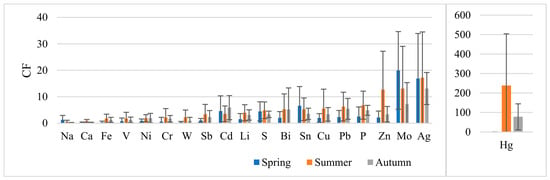
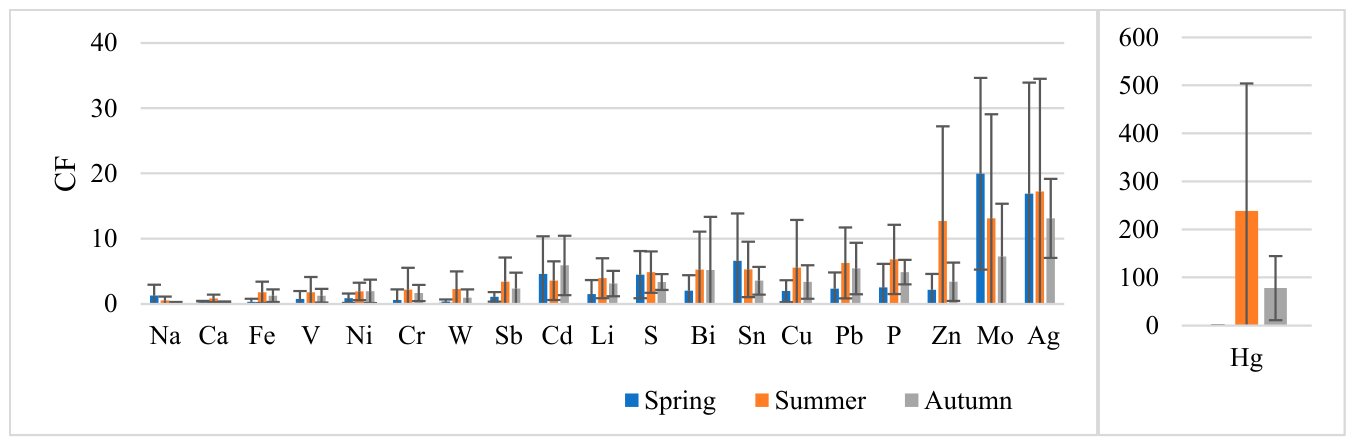
CF, EF, and Igeo were calculated for Li, Na, Li, Na, P, S, Ca, V, Cr, Fe, Gd, Cu, Zn, Mo, Ag, Cd, Sn, Sb, W, Hg, Pb, and Bi since the concentrations of these elements in dust NPs were higher than in upper continental crust. The obtained values of CF illustrate the degree of accumulation of elements in NPs as compared to the bulk samples (Figure 2). For the crustal elements, the values of CF do not exceed 2, illustrating the absence of their accumulation in NPs of urban dust. For Cr, W, Sb, Cd, Li, S, Bi, Sn, Cu, Pb, P, Zn, Mo, and Ag, the values of CF vary from 2 to 20, indicating moderate and significant degrees of accumulation. CF obtained for Hg were 78 and 238 for autumn and summer NPs, respectively, showing the extremely high accumulation of Hg in urban dust NPs. The obtained values of CF demonstrated that degree of contamination. The values of ecological and health risks assessed for the NPs under study were up to 20 times higher compared to bulk samples.
Figure 2.
The concentration factor (CF) for elements in NPs of urban dust collected in Moscow megacity.
The highest accumulation of most PTEs (W, Sb, Li, Cu, Pb, P, Zn, and Hg) was observed for summer NPs. The highest accumulation of Sn and Mo was found for spring NPs. Autumn NPs have the highest accumulation of Cd. The highest accumulation of Ni, Cr, and Bi was found both for summer and autumn NPs; S and Ag—for spring and summer NPs. The regularities obtained show that summer NPs have the highest accumulation of PTEs among the seasons under study.
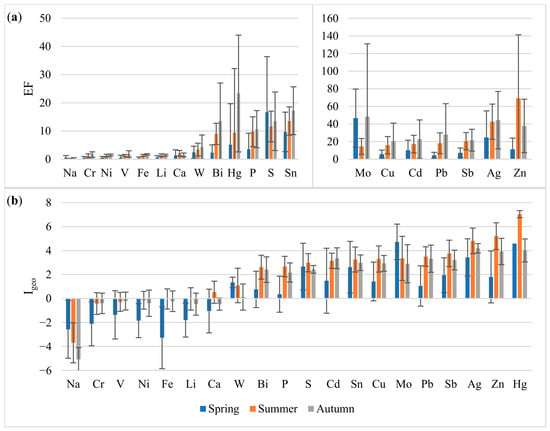
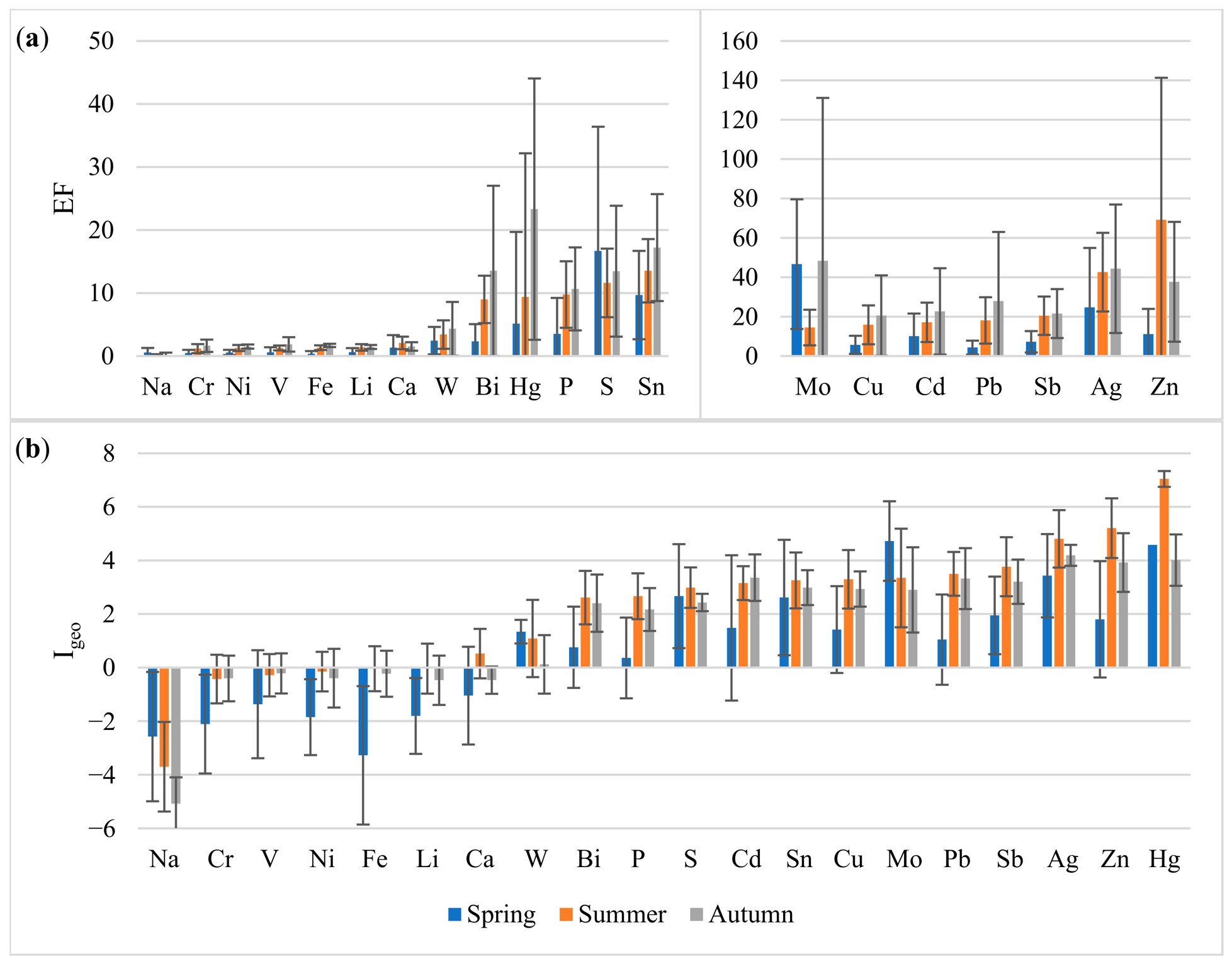
The values of EF and Igeo illustrating the contamination of the urban dust NPs of Moscow are given in Figure 3. The obtained values of EF demonstrate that urban dust NPs are not enriched by Na, Cr, Ni, V, Fe, Li, and Ca (EF < 2). However, for W, Bi, Hg, P, S, Sn, Mo, Cu, Cd, Pb, Sb, Ag, and Zn, the values of EF varied from 2 to 69, showing the enrichment of NPs by these elements. For spring NPs, EF values increase in the following order: W = Bi < P = Pb < Hg < Cu < Sb < Sn = Cd < Zn < S < Ag < Mo. For summer NPs, the order is as follows: W < Bi = Hg < P < S < Sn < Mo < Cu < Cd < Pb < Sb < Ag < Zn; and for autumn NPs: W < P < S < Bi < Sn < Cu < Sb < Cd < Hg < Pb < Zn < Ag < Mo. Thus, spring NPs are significantly enriched by Cu, Sb, Sn, Cd, Zn, and S, very highly enriched by Ag, and extremely highly enriched by Mo. Summer NPs are significantly enriched by Bi, Hg, P, S, Sn, Mo, Cu, Cd, and Pb, very highly enriched by Sb, and extremely highly enriched by Ag and Zn. Autumn NPs are significantly enriched by P, S, Bi, and Sn, very highly enriched by Cu, Sb, Cd, Hg, Pb, and Zn, and extremely highly enriched by Ag and Mo.
Figure 3.
EF (a) and Igeo (b) values of PTEs in NPs of urban dust in Moscow megacity.
The same regularities were found for the values of Igeo. Regardless of the season, NPs were not polluted by Na, Cr, V, Ni, Fe, Li, and Ca, while they were polluted by W, Bi, P, S, Cd, Sn, Cu, Mo, Pb, Sb, Ag, Zn, and Hg. For spring NPs, Igeo values increase in the following order: P < Bi < Pb < W < Cu < Cd < Zn < Sb < Sn < S < Ag < Hg < Mo. For summer NPs, the order is as follows: W < Bi < P < S < Cd < Sn = Cu = Mo < Pb < Sb < Ag < Zn < Hg; and for autumn NPs: W < P < Bi = S < Mo = Cu < Sn < Sb < Pb < Cd < Zn < Hg < Ag. Thus, spring NPs were moderately polluted by W, Cu, Cd, Zn, and Sb, from moderately to heavily polluted by Sn and S, heavily polluted by Ag, and from heavily to extremely polluted by Hg and Mo. Summer NPs were moderately polluted by W, from moderately to heavily polluted by Bi and P, heavily polluted by S, Cd, Sn, Cu, Mo, Pb, and Sb, from heavily to extremely polluted by Ag, and extremely polluted by Zn and Hg. Autumn NPs were from moderately to heavily polluted by P, Bi, S, Mo, and Cu, heavily polluted by Sn, Sb, Pb, Cd, and Zn, from heavily to extremely polluted by Hg and Ag.
The results of pollution assessment based on EF and Igeo are in good agreement. The highest values of EF and Igeo for potentially toxic elements were obtained for summer NPs followed by autumn NPs and spring NPs. Thus, it has been found that pollution of NPs depends on the season; hence, it can be dependent on the anthropogenic activities of the city, the peak of which in Moscow probably occurs in summer. However, the found variability of seasonal pollution may also be attributed to natural phenomena that occur in Moscow, namely wind and rainfall, which can mobilize NPs accumulated by PTEs from urban dust.
3.3. Ecological and Health Risks of Nanoparticles of Urban Dust
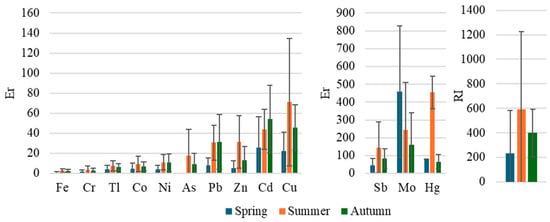
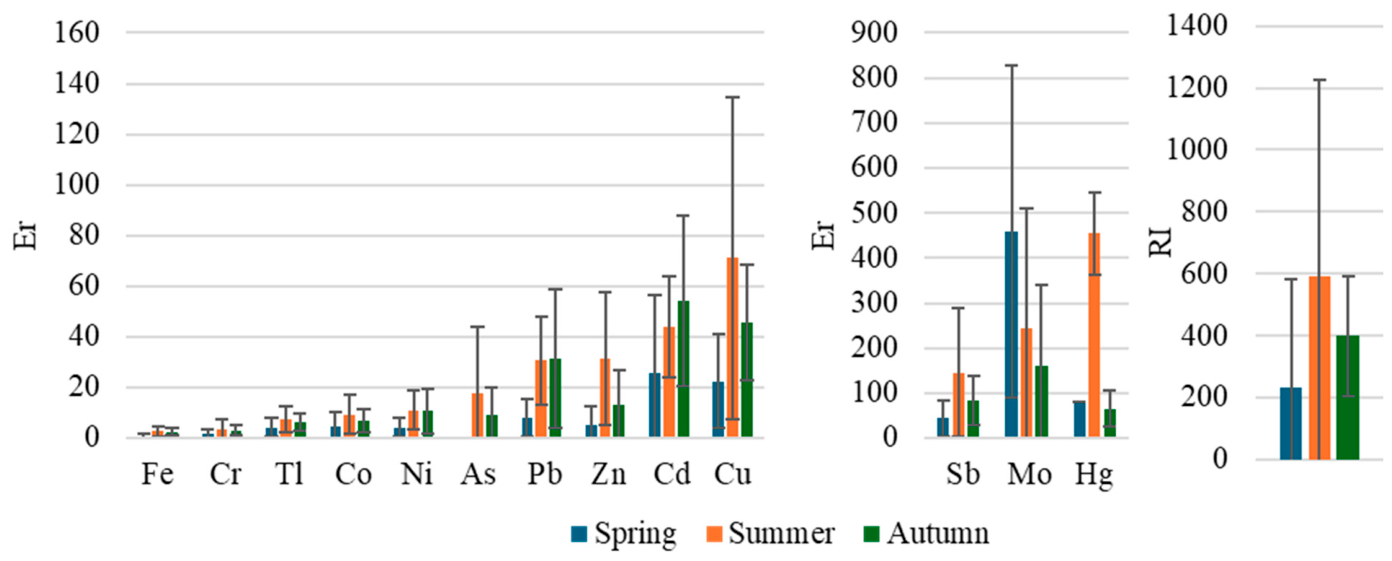
The obtained values of Er and RI of PTEs in NPs of urban dust in Moscow collected in spring, summer, and autumn are given in Figure 4. For spring NPs, the potential ecological risk was found to be associated with Sb and Hg, while very high potential ecological risk was associated with Mo. In the case of summer NPs, moderate potential ecological risk was associated with Cd and Cu, considerable potential ecological risk was associated with Sb, high potential ecological risk with Mo, and very high potential ecological risks with Hg. In turn, Cu, Cd, and Hg accumulated in autumn NPs correspond to moderate ecological risk and Sb and Mo considerable ecological risk. The highest mean RI value was obtained for summer NPs (RI = 592 illustrated the cumulative considerable potential ecological risk) followed by autumn NPs (RI = 399, considerable ecological risk) and then spring NPs (RI = 231, moderate ecological risk). However, the t-test results demonstrate that there is no significant difference between degree of pollution and potential ecological risk for urban dust NPs of spring, summer, and autumn in Moscow. Consequently, it can be assumed that anthropogenic activities resulting in the accumulation of PTEs in NPs of urban dust have similar intensity during spring, summer, and autumn. However, it should be noted that the revealed risks associated with spring NPs can be considered negligible since the concentrations of PTEs in spring NPs are determined only in about 40% of samples. It should be noted that regularities of seasonal change in potential ecological risk related to NPs of urban dust and regularities of bulk samples are different. In cases of bulk samples, the highest degree of pollution was found for summer samples, followed by autumn samples and then by spring samples of urban dust [19]. Furthermore, the potential ecological risks for NPs were on average 10 times higher as compared to the bulk samples.
Figure 4.
Values of Er and RI assessed for potentially toxic elements in NPs of urban dust in Moscow megacity collected in spring, summer, and autumn.
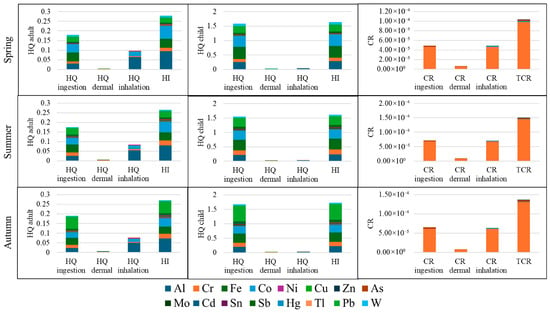
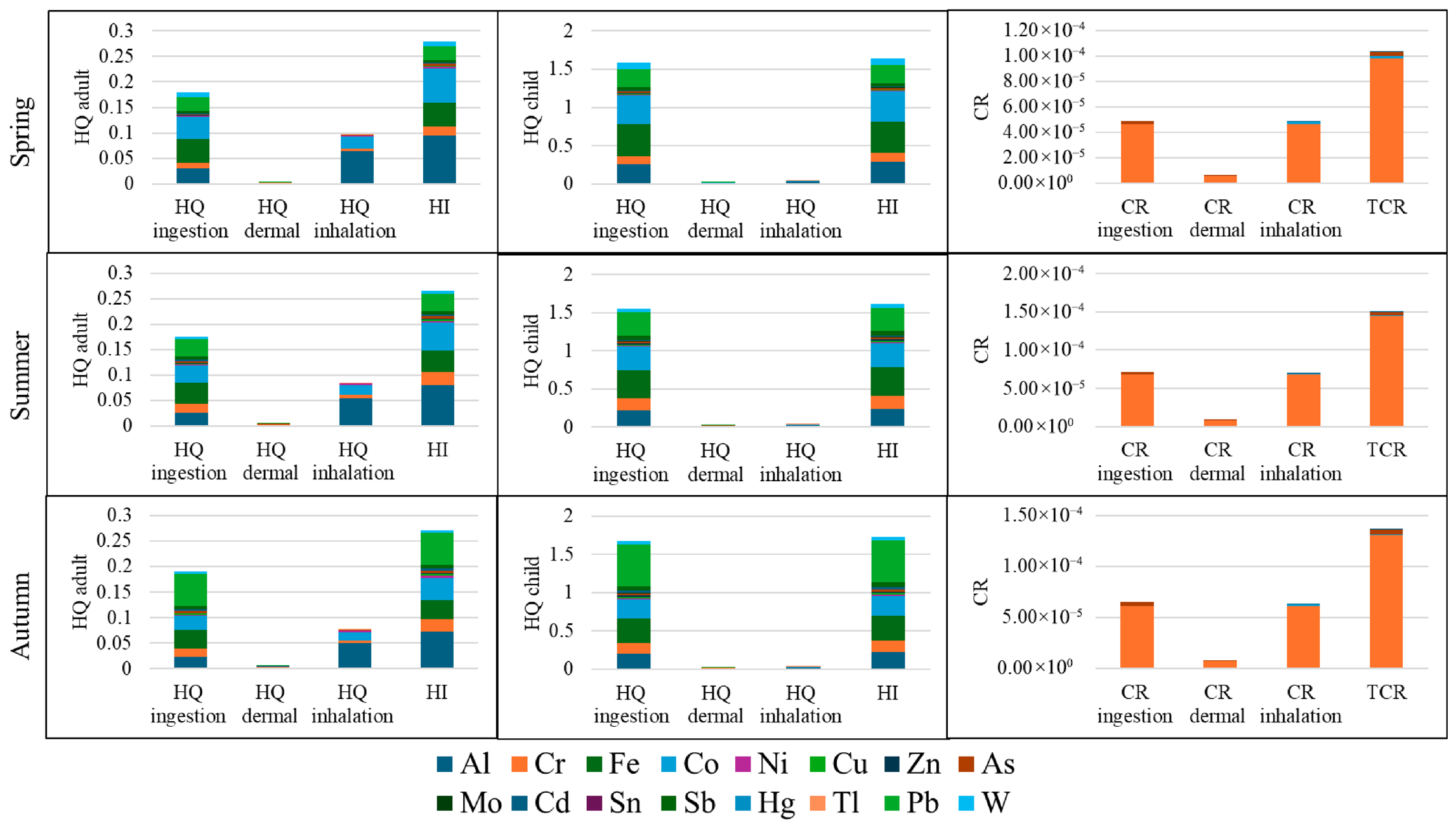
The results of health risk assessment are given in Figure 5. Both non-cancerogenic and cancerogenic risks for all the seasons under study have the same regularity. The values of HQ and THI calculated for adults were not more than 0.3, showing the absence of possible non-cancerogenic risks for adults caused by PTEs in urban dust NPs in Moscow. In turn, the possible non-cancerogenic risks may occur for children; the value of HQingestion was above 1.5. It should be noted that for both adults and children the highest non-cancerogenic risks are caused by the ingestion pathway. The highest noncarcinogenic risks caused by spring NPs mostly relate to Al, Fe, Co, Ni, and Pb, summer NPs to Al, Cr, Fe, Co, Zn, As, Sb, and Pb, and autumn NPs to Al, Cr, Fe, Co, As, Cd, Sb, and Pb.
Figure 5.
The results of health risk assessment of potentially toxic elements accumulated in NPs of urban dust in Moscow collected in spring, summer, and autumn.
In turn, the possibility of carcinogenic risks related to Moscow urban dust NPs was found. The mean value of CTCR for spring NPs was 3.5 × 10⁻⁵, for summer NPs was 3.0 × 10⁻⁴, and for autumn NPs was 2.5 × 10⁻⁴. However, according to the t-test the difference in CTCR between the seasons is statistically insignificant. CR values of Cr and Co accumulated in urban dust NPs also exceed the accepted values of carcinogenic risks, illustrating the possible carcinogenic risks related individually to Cr and Co. Regardless of the season under study, the highest CCR values were found for the ingestion and inhalation pathways (on average, 50 and 40% of CTCR, respectively), while for the dermal contact pathway the CCR value was 10% of CTCR.
Thus, the seasonal variability of noncarcinogenic health risks was not revealed. For both adults and children, the values of noncarcinogenic risks are similar. In general, carcinogenic risks for summer and autumn NPs are higher than for spring NPs; however, this difference is statistically insignificant. It is important to note that values of noncarcinogenic risks for NPs and bulk samples are similar, while values of CTCR for summer and autumn NPs are three times higher than corresponding values for summer and autumn bulk samples [19]. Thus, it can be assumed that NPs may pose a significant carcinogenic risk to human health.
3.4. Sources of Nanoparticles of Urban Dust
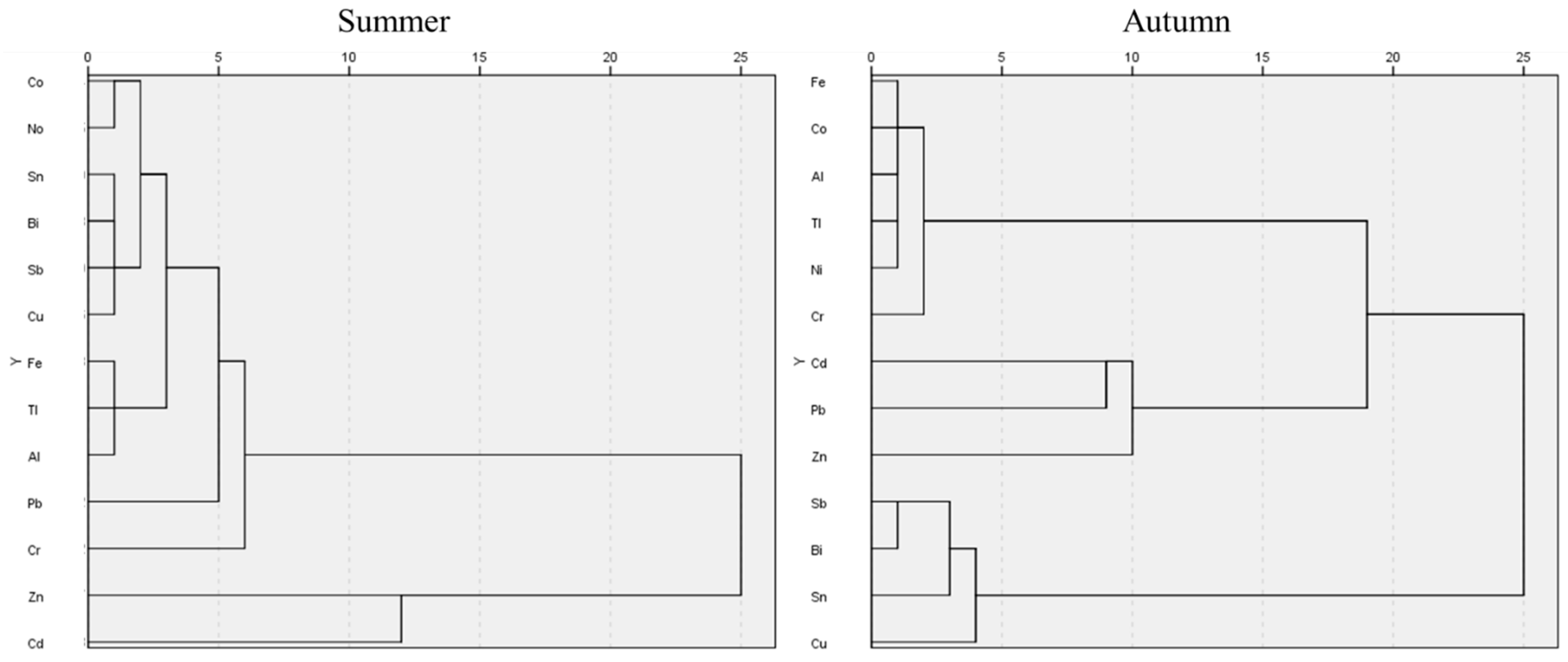
The source identification was carried out on the basis of the concentrations of Al, Cr, Fe, Co, Ni, Cu, Zn, Cd, Sn, Sb, Tl, Pb, and Bi in NPs. The enumerated elements are accumulated in the NPs under study and served as markers of both natural and anthropogenic sources of NPs. Other anthropogenic elements under study are not considered since their concentrations are below LOD in more than 20% of samples of NPs. Moreover, it should be noted that source apportionment was not performed for spring NPs due to the absence of accumulation of PTEs in 55% of samples. For summer and autumn NPs, three principal components (PCs) with eigenvalues more than 1 were unveiled (Table 2). The plot of PCA loadings for the listed elements in NPs of urban dust is given in Figure S2. The dendrogram obtained using Ward Method Linkage Distance (Figure 6) enabled two and three clusters of elements for summer and autumn NPs, respectively, to be revealed. The obtained Pearson correlation matrix describing the relationships between PTEs in NPs of urban dust are given in Tables S6 and S7.
Table 2.
Principal component loadings with their eigenvalue, explained variance, and cumulative variance as identified for the main sources of potentially toxic elements associated with nanoparticles recovered from urban dust in Moscow. Loadings below 0.4 are not given in the table.
Figure 6.
Dendrogram of cluster analysis (Ward Method Linkage Distance) for potentially toxic elements associated with nanoparticles of urban dust collected in Moscow megacity in summer and autumn.
For summer NPs, the first principal component (PC1) accounted for 73% of variance and included Al, Cr, Fe, Co, Ni, Cu, Sn, Sb, Tl, Pb, and Bi. In the case of autumn NPs, PC1 described 53% of variance and comprised Al, Cr, Fe, Co, Ni, Cd, Sn, and Tl. For both summer and autumn NPs, Al, Cr, Fe, Co, Ni, and Tl are not accumulated in the NPs under investigation; hence, they are markers of natural sources, namely soil erosion [1]. In turn, Cu, Sn, Sb, Pb, and Bi pollute summer NPs, while Cd and Sn pollute autumn NPs. The results of Pearson correlation analysis showed that elements of natural origin had strong relationships, while for anthropogenic elements moderate relationships were found in both summer and autumn NPs. In Moscow, Cu, Sn, Sb, Cd Pb, Cd, and Bi can be sourced from vehicle-related emissions, including abrasion of brake pads, oil pumps, tires, and catalytic converters, weathering of various metallic constructions, and from industrial activities [36]. Thus, it can be assumed that Cu, Sn, Sb, Cd Pb, Cd, and Bi from anthropogenic sources can be accumulated in urban soils and then transfer to NPs of urban dust during soil erosion. Polluted soil particles entering into urban dust in Moscow megacity have been reported on previously [17]. Therefore, the PC1 in summer and autumn NPs can be considered erosion of urban soils.
The PC2 and PC3 in summer NPs included two pairs of elements, namely Zn, Pb and Cr, Cd, respectively. Zn–Pb and Cr–Cd pairs had moderate relationships according to the results of Pearson correlation analysis. Zn and Pb are likely released into the urban dust NPs of Moscow as a result of metal constructions wearing down [37]. Zn and Pb can enter NPs of urban dust as a result of railway traffic emissions; there are two large railway stations close to the studied area [38]. The sources of Cr and Cd can be road marking paints and polymer materials, such as fiberglass, which are widely used in various vehicles [39]. Thus, PC2 can be attributed to metallic constructions wearing down and railway traffic emissions, while PC3 is vehicle traffic emissions. In the case of autumn NPs, PC2 described a 20% variance and united Cr, Cu, Sn, Sb, and Bi. The PC3 accounted 9% of variance and comprised Zn, Cd, and Pb. The Pearson correlation analysis showed that pairs of these elements had strong relationships. Cr, Cu, Sn, Sb, and Bi are indicators of wearing brake pads, tires, and other vehicle parts. Zn, Cd, and Pb are indicators of the weathering of metallic constructions, railway traffic, road marking paints, and polymer material. Thus, PC2 and PC3 can be mainly attributed to traffic emissions, including vehicle and railway ones. Previous studies have shown that vehicle emissions are one of the main sources of urban dust pollution in Moscow megacity [1,16].
The results of cluster analysis by Ward Method Linkage Distance showed two groups of elements for summer NPs: (i) Co, Mo, Sn, Bi, Sb, Ci, Fe, Tl, Al, Pb, and Cr and (ii) Zn and Cd. In the case of autumn NPs, three groups of elements were found: (i) Fe, Co, Al, Tl, Ni, and Cr, (ii) Cd, Pb, and Zn, and (iii) Sb, Bi, Sn, and Cu. Both groups’ results of the multivariate analysis by PCA and Ward Method coincide, confirming their reliability despite the number of samples under study in each season (n = 12) [33].
Based on the results of pollution assessment and source apportionment, regularities of the changes in different anthropogenic activities that occur in the territory of Moscow megacity can be proposed. It can be assumed that the contributions of soil erosion to NPs during spring, summer, and autumn do not change since the contents of the cluster elements are similar. However, soil erosion during summer contributes more polluted particles to NPs of urban dust as compared to soil erosion in spring and autumn seasons. The degree of pollution by Cu, Sb, Bi, Sn, and Cd in summer and autumn NPs is similar; hence, it can be assumed that the effect of the intensity of traffic load on NPs of urban dust does not change significantly in summer and autumn. It can be assumed that traffic emissions are one of the main sources of pollution of urban dust NPs in Moscow megacity. The assessment of the effect of intensity of traffic load on spring NPs is complicated due to the migration of NPs into urban soils and waters as a result of snow melting. Moreover, NPs containing PTEs can be also mobilized from urban dust with rain [4]. The Moscow weather monitoring service reported that 82 mm of precipitation fell in spring, 284 mm in summer, and 165 mm in autumn. Thus, the relationship between degree of pollution and volume of precipitation was not found. In contrast, the pollution of Zn in summer NPs was higher compared to autumn NPs. It should be noted that summer in Moscow is accompanied by intense construction and renovation of public utilities and road infrastructure. These anthropogenic activities can affect the pollution of summer NPs by Zn. It is interesting to note that degree of pollution by W in NPs of urban dust decreases from spring to summer. This may indicate that the main source of W in urban dust is the abrasion of winter tire studs, which contain W and Co [40].
4. Conclusions
For the first time, the seasonal variations in the elemental composition of NPs of urban dust and related ecological and health risks have been studied. It has been found that NPs of urban dust collected in Moscow in spring, summer, and autumn are contaminated with PTEs, namely W, Bi, Hg, P, S, Sn, Mo, Cu, Cd, Pb, Sb, Ag, and Zn. Igeo values of PTEs increase in the following orders: P < Bi < Pb < W < Cu < Cd < Zn < Sb < Sn < S < Ag < Hg < Mo for spring NPs, W < Bi < P < S < Cd < Sn = Cu = Mo < Pb < Sb < Ag < Zn < Hg for summer NPs, and W < P < Bi = S < Mo = Cu < Sn < Sb < Pb < Cd < Zn < Hg < Ag for autumn NPs. Thus, spring NPs were most polluted by Sn, S, Ag, Hg, and Mo, summer NPs by S, Cd, Sn, Cu, Mo, Pb, Sb, Ag, Zn, and Hg, and autumn NPs by Sn, Sb, Pb, Cd, Zn, Hg, and Ag.
The highest ecological risk was found for summer NPs (RI = 592), followed by autumn NPs (RI = 399) and spring NPs (RI = 231). The highest potential ecological risk of NPs is related to Sb, Hg, and Mo for all seasons. In turn, the results of health risk assessment showed the absence of possible non-cancerogenic risks for adults caused by PTEs in NPs of urban dust in Moscow. Possible non-cancerogenic risks may occur for children. It should be noted that values of non-cancerogenic risks were the same regardless of the seasons under study. The highest cancerogenic risk was found for summer NPs (CTCR = 3.0 × 10⁻⁴) followed by autumn NPs with slight differences (CTCR = 2.5 × 10⁻⁴) and spring NPs (CTCR = 3.5 × 10⁻⁵). However, the difference in mean values of both ecological and health risks obtained for different seasons is statistically insignificant.
The results of multivariate statistical analysis enable traffic emissions to be identified as one of the main sources of pollution of NPs of urban dust collected in Moscow megacity. It may be assumed that the effect of the intensity of traffic load on NPs of urban dust does not significantly change in summer and autumn.
The results obtained may offer new insights into risk assessment of NPs of urban dust and highlight the necessity of regular monitoring of urban dust NPs, especially in large cities.
Supplementary Materials
The following supporting information can be downloaded at https://www.mdpi.com/article/10.3390/environments13050240/s1, Table S1: The elemental composition of bulk urban dust samples collected in Moscow megacity during spring, summer, and autumn. Table S2: Limits of detection (LOD) of element contents in nanoparticles of urban dust from Moscow megacity determined by ICP-MS and ICP-AES. For the elements that were analyzed by both methods, LOD of ICP-MS is given. Table S3: Variables with their descriptions, units, and values used for the health risk assessment of trace elements in dust NPs [29,31,41,42,43,44,45,46]. Table S4: Relative bioavailability factor, dermal absorption fraction, oral reference dose, oral slope factor, gastrointestinal absorption, inhalation reference concentration, particulate emission factor, and inhalation unit risk values for each trace element [29,46]. Table S5: Concentrations µg·g−1 of potentially toxic elements in nanoparticles of urban dust collected in Moscow in 2024, 2021, and 2017. Table S6: Pearson correlation matrix as obtained for potentially toxic elements in nanoparticles recovered from urban dust collected in Moscow in summer. Table S7: Pearson correlation matrix as obtained for potentially toxic elements in nanoparticles recovered from urban dust collected in Moscow in autumn. Figure S1: Mean particle size distribution of nanoparticles of urban dust collected in Moscow in spring, summer, and autumn as measured by laser diffraction. Figure S2: 3D Plot of principal component loadings as obtained for elements associated with nanoparticles isolated from urban dust collected in Moscow in spring and autumn.
Author Contributions
A.I.: conceptualization, investigation, field and laboratory work, formal analysis, writing—original draft, writing—review and editing, visualization, funding acquisition, and project administration; A.B.: field and laboratory work; V.K.: investigation; M.E.: conceptualization and writing—review and editing; P.F.: conceptualization, writing—review and editing, and supervision. All authors have read and agreed to the published version of the manuscript.
Funding
This study was supported by the Russian Science Foundation (project no. 24-77-00026).
Data Availability Statement
The data are available either in the main manuscript or in the Supplementary Materials.
Conflicts of Interest
The authors declare no conflicts of interest.
References
- Ivaneev, A.; Brzhezinskiy, A.; Karandashev, V.; Fedyunina, N.; Ermolin, M.; Fedotov, P. Nanoparticles of Dust as an Emerging Contaminant in Urban Environments. Environ. Geochem. Health 2024, 46, 367. [Google Scholar] [CrossRef] [Scilit]
- Lespes, G.; Faucher, S.; Slaveykova, V.I. Natural Nanoparticles, Anthropogenic Nanoparticles, Where Is the Frontier? Front. Environ. Sci. 2020, 8, 71. [Google Scholar] [CrossRef] [Scilit]
- Phairuang, W.; Inerb, M.; Hata, M.; Furuuchi, M. Characteristics of Trace Elements Bound to Ambient Nanoparticles (PM0.1) and a Health Risk Assessment in Southern Thailand. J. Hazard. Mater. 2022, 425, 127986. [Google Scholar] [CrossRef] [Scilit] [PubMed]
- Ermolin, M.S.; Fedotov, P.S.; Ivaneev, A.I.; Karandashev, V.K.; Fedyunina, N.N.; Burmistrov, A.A. A Contribution of Nanoscale Particles of Road-Deposited Sediments to the Pollution of Urban Runoff by Heavy Metals. Chemosphere 2018, 210, 65–75. [Google Scholar] [CrossRef] [Scilit] [PubMed]
- Armand, L.; Tarantini, A.; Beal, D.; Biola-Clier, M.; Bobyk, L.; Sorieul, S.; Pernet-Gallay, K.; Marie-Desvergne, C.; Lynch, I.; Herlin-Boime, N.; et al. Long-Term Exposure of A549 Cells to Titanium Dioxide Nanoparticles Induces DNA Damage and Sensitizes Cells towards Genotoxic Agents. Nanotoxicology 2016, 10, 913–923. [Google Scholar] [CrossRef] [Scilit]
- Ivaneev, A.I.; Ermolin, M.S.; Zinovkin, R.A.; Dashkevich, A.A.; Zinovkina, L.A.; Chernyak, B.V.; Fedotov, P.S. Separation and Preparation of Nanoparticles of Urban Dust for Biological Studies. Anal. Methods 2024, 17, 440–449. [Google Scholar] [CrossRef] [Scilit]
- Pavlyuchenkova, A.N.; Vorobjeva, N.V.; Ivaneev, A.I.; Ermolin, M.S.; Fedotov, P.S.; Zinovkin, R.A.; Chelombitko, M.A.; Chernyak, B.V. Urban Dust Nanoparticles Drive Inflammatory Activation of Human Neutrophils and Macrophages in Vitro. Environ. Sci. Pollut. Res. 2025, 32, 26541–26553. [Google Scholar] [CrossRef] [Scilit] [PubMed]
- Buzea, C.; Pacheco, I.I.; Robbie, K. Nanomaterials and Nanoparticles: Sources and Toxicity. Biointerphases 2007, 2, MR17–MR71. [Google Scholar] [CrossRef] [Scilit]
- Shirmohammadi, F.; Lovett, C.; Sowlat, M.H.; Mousavi, A.; Verma, V.; Shafer, M.M.; Schauer, J.J.; Sioutas, C. Chemical Composition and Redox Activity of PM0.25 near Los Angeles International Airport and Comparisons to an Urban Traffic Site. Sci. Total Environ. 2018, 610–611, 1336–1346. [Google Scholar] [CrossRef] [Scilit]
- Ivaneev, A.; Brzhezinskiy, A.; Karandashev, V.; Fedyunina, N.; Ermolin, M.; Fedotov, P. Insights into Elemental Composition and Spatial Distribution of Nanoparticles of Road-Deposited Sediments in an Industrial City. Sci. Total Environ. 2025, 1009, 181081. [Google Scholar] [CrossRef] [Scilit]
- Yang, Y.; Vance, M.; Tou, F.; Tiwari, A.; Liu, M.; Hochella, M.F. Nanoparticles in Road Dust from Impervious Urban Surfaces: Distribution, Identification, and Environmental Implications. Environ. Sci. Nano 2016, 3, 534–544. [Google Scholar] [CrossRef] [Scilit]
- Rogula-Kozłowska, W.; Majewski, G.; Czechowski, P.O. The Size Distribution and Origin of Elements Bound to Ambient Particles: A Case Study of a Polish Urban Area. Environ. Monit. Assess. 2015, 187, 240. [Google Scholar] [CrossRef] [Scilit] [PubMed]
- Avramescu, M.L.; Casey, K.; Levesque, C.; Chen, J.; Wiseman, C.; Beauchemin, S. Identification and Quantification of Trace Metal(Loid)s in Water-Extractable Road Dust Nanoparticles Using SP-ICP-MS. Sci. Total Environ. 2024, 924, 171720. [Google Scholar] [CrossRef] [Scilit]
- Peng, B.; Cai, Q.; Shi, X.; Wang, Z.; Yan, J.; Xu, M.; Wang, M.; Shi, Z.; Niu, Z.; Guo, X.; et al. Metal-Containing Nanoparticles in Road Dust from a Chinese Megacity over the Last Decade: Spatiotemporal Variation and Driving Factors. J. Hazard. Mater. 2024, 476, 134970. [Google Scholar] [CrossRef] [Scilit]
- Yang, Y.; Lu, X.; Yu, B.; Wang, Z.; Wang, L.; Lei, K.; Zuo, L.; Fan, P.; Liang, T. Exploring the Environmental Risks and Seasonal Variations of Potentially Toxic Elements (PTEs) in Fine Road Dust in Resource-Based Cities Based on Monte Carlo Simulation, Geo-Detector and Random Forest Model. J. Hazard. Mater. 2024, 473, 134708. [Google Scholar] [CrossRef] [Scilit]
- Vlasov, D.; Kosheleva, N.; Shinkareva, G.; Kasimov, N. Contamination Assessment and Source Identification of Metals and Metalloids in Submicron Road Dust (PM1) in Moscow Megacity. Environ. Sci. Pollut. Res. 2025, 32, 2085–2106. [Google Scholar] [CrossRef] [Scilit] [PubMed]
- Vlasov, D.; Kosheleva, N.; Kasimov, N. Spatial Distribution and Sources of Potentially Toxic Elements in Road Dust and Its PM10 Fraction of Moscow Megacity. Sci. Total Environ. 2021, 761, 143267. [Google Scholar] [CrossRef] [Scilit]
- Ivaneev, A.I.; Brzhezinskiy, A.S.; Karandashev, V.K.; Ermolin, M.S.; Fedotov, P.S. Assessment of Sources, Environmental, Ecological, and Health Risks of Potentially Toxic Elements in Urban Dust of Moscow Megacity, Russia. Chemosphere 2023, 321, 138142. [Google Scholar] [CrossRef] [Scilit]
- Ivaneev, A.I.; Brzhezinskiy, A.S.; Karandashev, V.K.; Ermolin, M.S.; Fedotov, P.S. Seasonal Variability of the Elemental Composition and Ecological Risks of Urban Dust of Moscow Megacity. Geochem. Int. 2026, 64, 220–235. [Google Scholar] [CrossRef] [Scilit]
- Ivaneev, A.I.; Ermolin, M.S.; Fedotov, P.S. Separation, Characterization, and Analysis of Environmental Nano- and Microparticles: State-of-the-Art Methods and Approaches. J. Anal. Chem. 2021, 76, 413–429. [Google Scholar] [CrossRef] [Scilit]
- Rudnick, R.L.; Gao, S. Composition of the Continental Crust. In Treatise on Geochemistry, 2nd ed.; Elsevier: Amsterdam, The Netherlands, 2014; Volume 4, pp. 1–51. [Google Scholar] [CrossRef] [Scilit]
- Konstantinova, E.; Minkina, T.; Konstantinov, A.; Sushkova, S.; Antonenko, E.; Kurasova, A.; Loiko, S. Pollution Status and Human Health Risk Assessment of Potentially Toxic Elements and Polycyclic Aromatic Hydrocarbons in Urban Street Dust of Tyumen City, Russia. Environ. Geochem. Health 2020, 44, 409–432. [Google Scholar] [CrossRef] [Scilit] [PubMed]
- Sutherland, R.A. Bed Sediment-Associated Trace Metals in an Urban Stream, Oahu, Hawaii. Environ. Geol. 2000, 39, 611–627. [Google Scholar] [CrossRef] [Scilit]
- Muller, G. Index of Geoaccumulation in Sediments of the Rhine River. GeoJournal 1969, 2, 108–118. [Google Scholar]
- Hakanson, L. An Ecological Risk Index for Aquatic Pollution Control.a Sedimentological Approach. Water Res. 1980, 14, 975–1001. [Google Scholar] [CrossRef] [Scilit]
- Alekseenko, V.; Alekseenko, A. The Abundances of Chemical Elements in Urban Soils. J. Geochem. Explor. 2014, 147, 245–249. [Google Scholar] [CrossRef] [Scilit]
- US EPA. USEPA Exposure Assessment Tools by Media—Soil and Dust; US EPA: Washington, DC, USA, 2022.
- Wang, J.; Yu, J.; Gong, Y.; Wu, L.; Yu, Z.; Wang, J.; Gao, R.; Liu, W. Pollution Characteristics, Sources and Health Risk of Metals in Urban Dust from Different Functional Areas in Nanjing, China. Environ. Res. 2021, 201, 111607. [Google Scholar] [CrossRef] [Scilit]
- USEPA. Regional Screening Levels (RSLs)—Equations; US EPA: Washington, DC, USA, 2022.
- USEPA. Risk Assessment Guidance for Superfund (RAGS); Volume I. Human Health Evaluation Manual (HHEM); Part E. Supplemental Guidance for Dermal Risk Assessment; US EPA: Washington, DC, USA, 2004; Volume 1.
- USEPA. Human Health Evaluation Manual, Supplemental Guidance: Standard Default Exposure Factors; US EPA: Washington, DC, USA, 1991; Volume I, pp. 1–68.
- Hopke, P.K. Review of Receptor Modeling Methods for Source Apportionment. J. Air Waste Manag. Assoc. 2016, 66, 237–259. [Google Scholar] [CrossRef] [Scilit] [PubMed]
- Tume, P.; Acevedo, V.; Roca, N.; Ferraro, F.X.; Bech, J. Potentially Toxic Elements Concentrations in Schoolyard Soils in the City of Coronel, Chile. Environ. Geochem. Health 2022, 44, 1521–1535. [Google Scholar] [CrossRef] [Scilit]
- Constantin, J.G.; Londonio, A.; Bajano, H.; Smichowski, P.; Gómez, D.R. Plasma-Based Technique Applied to the Determination of 21 Elements in Ten Size Fractions of Atmospheric Aerosols. Microchem. J. 2021, 160, 105736. [Google Scholar] [CrossRef] [Scilit]
- Saffari, A.; Daher, N.; Shafer, M.M.; Schauer, J.J.; Sioutas, C. Seasonal and Spatial Variation of Trace Elements and Metals in Quasi-Ultrafine (PM0.25) Particles in the Los Angeles Metropolitan Area and Characterization of Their Sources. Environ. Pollut. 2013, 181, 14–23. [Google Scholar] [CrossRef] [Scilit]
- Thorpe, A.; Harrison, R.M. Sources and Properties of Non-Exhaust Particulate Matter from Road Traffic: A Review. Sci. Total Environ. 2008, 400, 270–282. [Google Scholar] [CrossRef] [Scilit] [PubMed]
- Okuda, T.; Nakao, S.; Katsuno, M.; Tanaka, S. Source Identification of Nickel in TSP and PM2.5 in Tokyo, Japan. Atmos. Environ. 2007, 41, 7642–7648. [Google Scholar] [CrossRef] [Scilit]
- Vaiškūnaitė, R.; Jasiūnienė, V. The Analysis of Heavy Metal Pollutants Emitted by Railway Transport. Transport 2020, 35, 213–223. [Google Scholar] [CrossRef] [Scilit]
- Moskovchenko, D.; Pozhitkov, R.; Soromotin, A.; Tyurin, V. The Content and Sources of Potentially Toxic Elements in the Road Dust of Surgut (Russia). Atmosphere 2022, 13, 30. [Google Scholar] [CrossRef] [Scilit]
- Olofsson, U.; Holmström, E.; Lyu, Y. A Study on the Particle Emission from Cobalt-Free Studded Tires against Road Materials. Tribol. Int. 2025, 202, 110365. [Google Scholar] [CrossRef] [Scilit]
- Ferreira-Baptista, L.; de Miguel, E. Geochemistry and risk assessment of street dust in Luanda, Angola: A tropical urban environment. Atmos. Env. 2005, 39, 4501–4512. [Google Scholar] [CrossRef] [Scilit]
- Lu, X.; Wu, X.; Wang, Y.; Chen, H.; Gao, P.; Fu, Y. Risk assessment of toxic metals in street dust from a medium-sized industrial city of China. Ecotoxicol. Env. Saf. 2014, 106, 154–163. [Google Scholar] [CrossRef] [Scilit]
- USEPA. Exposure Factors Handbook: 2011 Edition; U.S. Environmental Protection Agency: Washington, DC, USA, 2011; EPA/600/R-; pp. 1–1466.
- USEPA. Supplemental Guidance for Developing Soil Screening Levels for Superfund Sites; United States Environmental Protection Agency: Washington, DC, USA, 2002; pp. 1–187.
- USEPA. Risk Assessment Guidance for Superfund. Volume I Human Health Evaluation Manual (Part A); USEPA: Washington, DC, USA, 1989.
- van den Berg, R. Human Exposure to Soil Contamination: A Qualitative and Quantative Analysis Towards Proposals for Human Toxicological Intervention Values. 1994. Available online: https://www.researchgate.net/publication/27453281_Human_exposure_to_soil_contamination_a_qualitative_and_quantitative_analysis_towards_proposals_for_human_toxicological_intervention_values_partly_revised_edition (accessed on 20 April 2026).

Disclaimer/Publisher’s Note: The statements, opinions and data contained in all publications are solely those of the individual author(s) and contributor(s) and not of MDPI and/or the editor(s). MDPI and/or the editor(s) disclaim responsibility for any injury to people or property resulting from any ideas, methods, instructions or products referred to in the content. |
© 2026 by the authors. Licensee MDPI, Basel, Switzerland. This article is an open access article distributed under the terms and conditions of the Creative Commons Attribution (CC BY) license.