


Abstract
Land use practices are a key driver of soil nitrogen (N) dynamics, yet their influence on N accumulation within distinct soil organic matter (SOM) fractions remains insufficiently understood. This study aimed to elucidate the responses of N accrual in different SOM fractions to contrasting land uses. To achieve this purpose, soil samples were collected from seven representative land uses: forest, pasture, corn plantation, sugarcane plantation, cassava plantation, orchard, and abandoned land. Subsequently, soil samples were fractionated into free particulate SOM (fSOM), occluded light SOM (oSOM), weakly bound form SOM (wSOM), and strongly bound form SOM (sSOM) fractions, and N contents were quantified for each fraction. The results showed pronounced land use effects on both the magnitude and distribution of N among SOM fractions. The forest land use consistently promoted greater N accumulation in fSOM (0.15 g N kg−1 soil), oSOM (0.14 g N kg−1 soil), and wSOM fractions (0.29 g N kg−1 soil), reflecting high organic inputs and low disturbance intensity. The pasture land use exhibited the highest N accumulation in the sSOM fraction (1.01 g N kg−1 soil), indicating enhanced stabilization of N through strong organo-mineral associations. Intensively managed croplands and abandoned land generally displayed lower N storage across SOM fractions. Overall, these findings highlight the critical role of land use in regulating N partitioning and stabilization within SOM fractions and underscore the importance of low-disturbance, perennial vegetation systems for improving long-term soil N retention.
1. Introduction
Soil organic matter (SOM) is a central component of soil systems, governing a wide range of physical, chemical, and biological processes that underpin soil fertility and ecosystem functioning [1,2,3]. In addition to its role in improving soil structure, water retention, and nutrient buffering capacity [4,5], SOM serves as the primary reservoir of soil organic nitrogen (SON) [6,7]. The mineralization of SON through microbial processes supplies inorganic N forms that sustain plant growth and agricultural productivity, particularly in systems with limited external N inputs [8,9]. Whereas, the stabilization of SON, e.g., via adsorption with clays and iron oxides and occlusion within an aggregate or spatial separation from microbial decomposers, plays a crucial role in regulating long-term N supply, reducing N losses through leaching and gaseous emissions, and enhancing ecosystem resilience [10,11,12,13]. Therefore, understanding how SON is stored, transformed, and stabilized within SOM is essential for improving N use efficiency and developing sustainable soil management and land use strategies.
Land use practices are among the most influential drivers of soil N cycling, affecting both the quantity and quality of SOM and SON pools [14,15,16]. The conversion of forest to cropland often results in substantial declines in total soil N stocks [17,18]. On the other hand, perennial cropping systems, pastures, and agroforestry practices generally support greater SOM and SON retention than annual cropping systems [19,20,21,22]. Although these studies indicate that land use effects on total N in soil have been widely documented, less is known about how different land uses influence the accumulation of SON within distinct SOM fractions. Such information is critical since the availability of N forms depends on different N conversion reactions, which are mediated by a complex network of microorganisms with a variety of metabolic functions [23,24,25,26].
Since SOM is not a homogeneous entity but rather a complex assemblage of organic compounds differing in origin, chemical composition, and degree of stabilization [27,28], fractionation techniques have been widely employed to separate SOM into operationally defined pools that differ in their turnover rates and stabilization mechanisms. Among the various approaches, density fractionation has proven particularly useful for distinguishing between free particulate organic matter, occluded organic matter protected within aggregates, and mineral-associated organic matter [29,30,31]. This technique enables a more nuanced understanding of soil N dynamics by isolating SOM pools with contrasting degrees of microbial accessibility and mineral protection [15,32]. Applying SOM fractionation may offer a promising avenue for elucidating the accumulation of SON within distinct SOM fractions as influenced by the contrasting land uses.
The objective of this study was to elucidate the responses of N accumulation within different SOM fractions to contrasting land uses, utilizing a density fractionation. For this purpose, soil samples were collected from seven divergent land uses and subjected to density fractionation. The amount of SON stored in each isolated SOM fraction was then analyzed. We further hypothesized that land uses characterized by perennial vegetation and lower disturbance intensity would promote greater accumulation of SON in physically and chemically stabilized SOM fractions compared with intensively managed croplands.
2. Materials and Methods
2.1. Study Location and Land Use Selection
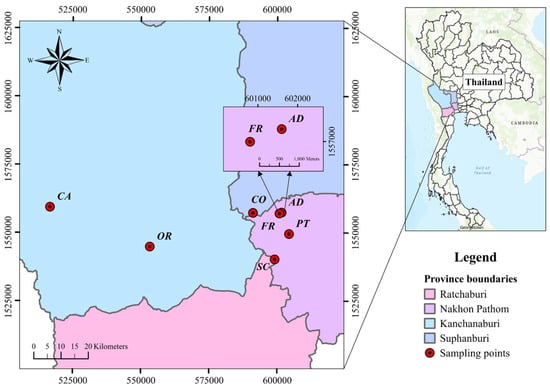
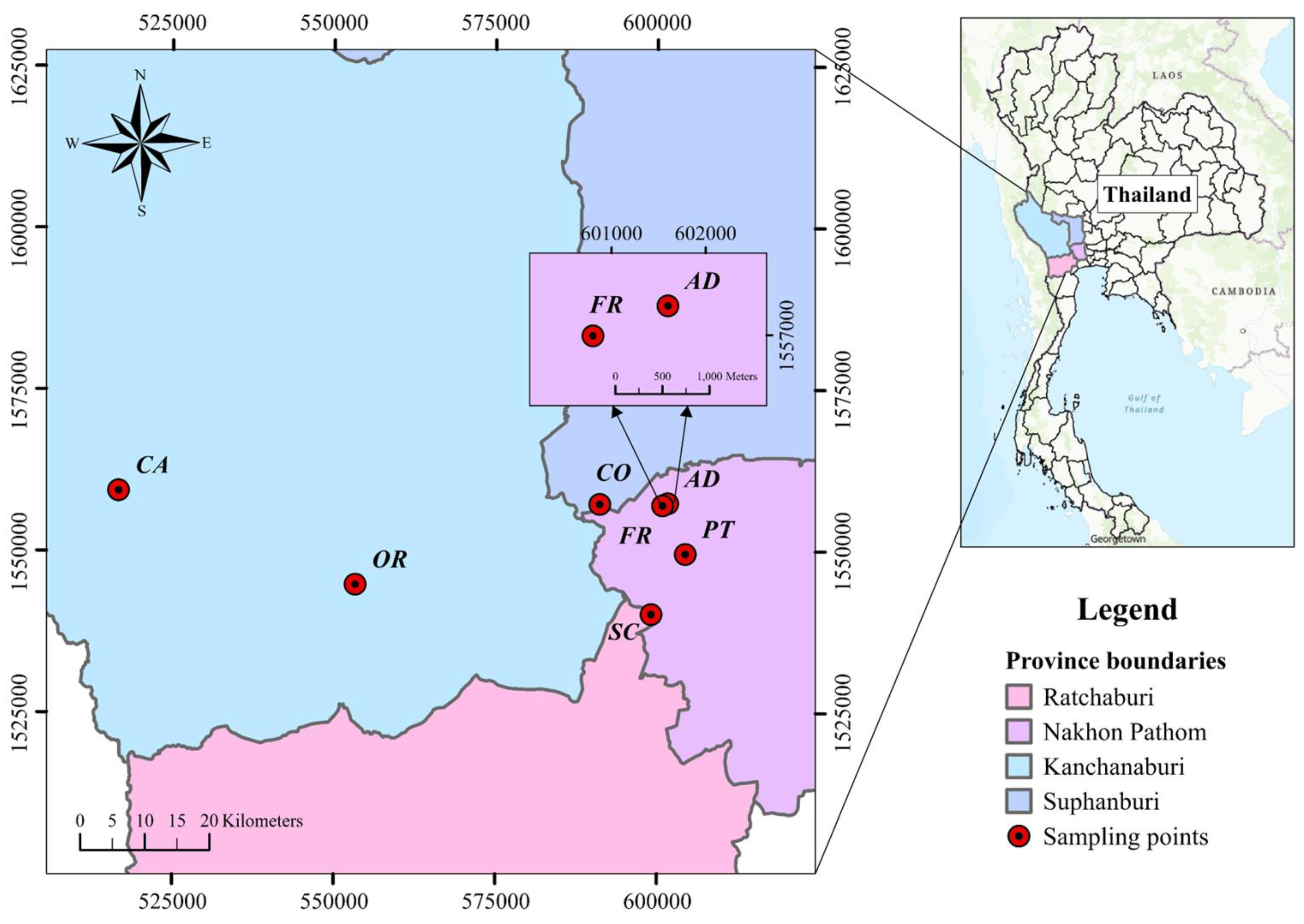
The study site encompassed Nakhon Pathom, Suphan Buri, Kanchanaburi, and Ratchaburi provinces (47 516637–605523 E and 1540177–1559481 N), which are located in Central and Western Thailand (Figure 1). All study sites are characterized by a tropical savanna climate [33], with mean annual temperatures ranging from 27 to 30 °C. The average annual precipitation is approximately 903 mm, with the majority of rainfall occurring between May and October [34,35].
Figure 1.
Map showing the study locations with contrasting land uses. Notation: FR, forest; PT, pasture; CO, corn plantation; SC, sugarcane plantation; CA, cassava plantation; OR, orchard; and AD, abandoned land.
To assess the effects of land use, soils across all study sites were selected to ensure comparable pedogenic development, originating from the same parent material, namely, alluvium deposited on a semi-recent terrace or semi-recent terrace on an alluvial fan [36], having flat relief, and similar soil taxonomy, i.e., Typic Haplustalfs [37]. The areas with contrasting land uses were preliminarily conducted using the base maps, the satellite imagery, and the LDD On Farm tool developed by the Land Development Department, Thailand. This developed tool included the data of soil series and land uses across Thailand territory. Subsequently, the detailed field surveys were performed for validating site suitability and delineating representative land uses. Eventually, seven representative dominant land uses were chosen to examine in this present research: (1) forest (FR), (2) pasture (PT), (3) corn plantation (CO), (4) sugarcane plantation (SC), (5) cassava plantation (CA), (6) orchard (OR), and (7) abandoned land (AD) (Figure 1). Each land use has been in place for more than ten years. The FR, PT, OR, and AD land uses had no till, while the CO, CA, and SC had undergone tillage twice a year, once a year, and once every three years (after harvesting the second ratoon sugarcane), respectively. The FR, PT, OR, and AD land uses had no fertilizer application. In crop cultivation land uses, fertilizers were applied as follows: in the CO land use (46-0-0, 160 kg ha−1; 15-15-15, 160 kg ha−1; and 21-0-0, 310 kg ha−1); in the SC land use (16-8-8, 250 kg ha−1; 21-0-0, 310 kg ha−1; and 46-0-0, 40 kg ha−1); and in the CA land use (46-0-0, 60 kg ha−1 combined with chicken manure at 10 Mg ha−1). The OR land use involved the return of leaf and branch litter from cultivated crops to the soil surface (Table S1).
2.2. Soil Sampling and Preparation
Before soil sampling in each representative land use, three randomly distributed standard sampling plots (20 m × 20 m) were established, with the distance between plots exceeding the commonly reported spatial dependence range (<13.5 m) for soil C and N, ensuring that plots within each land use could be regarded as independent replicates [38,39]. Afterward, soil samples in each sampling plot were randomly collected at a depth of 0–20 cm and subsequently placed in sample bags. The collected soil samples were air-dried in a designated storage room, subsequently pulverized to achieve homogeneity, and passed through a 2 mm sieve. The visible plant-derived residues and fine gravel were carefully removed from the soil samples using tweezers.
2.3. Analysis of Soil Physical and Chemical Properties
Soil particle size distribution was analyzed using a combination of sieving and pipette analysis [40]. Soil bulk density was measured using the core method [41]. Soil pH was measured in a 1:1 soil-to-water suspension using a pH meter (FiveEasy F20, Mettler-Toledo, Greifensee, Switzerland). Organic matter (OM) was determined by oxidation with 1 M potassium dichromate and back titration with 1 M ferrous ammonium [42]. Total N was determined by dry combustion using a CHN analyzer (CHN628, LECO Corporation, St. Joseph, MI, USA). Available phosphorus (P) was assessed by Bray II extraction [43]. Exchangeable potassium (K) was extracted using 1 M ammonium acetate at pH 7 [44] and measured by the atomic absorption spectrophotometer (240FS AA, Agilent Technologies, Santa Clara, CA, USA).
2.4. Density Fractionation of Soil Organic Matter
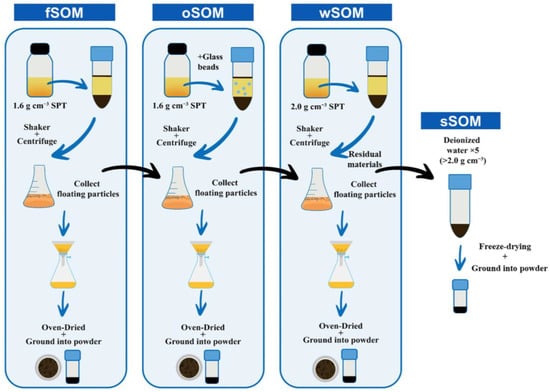
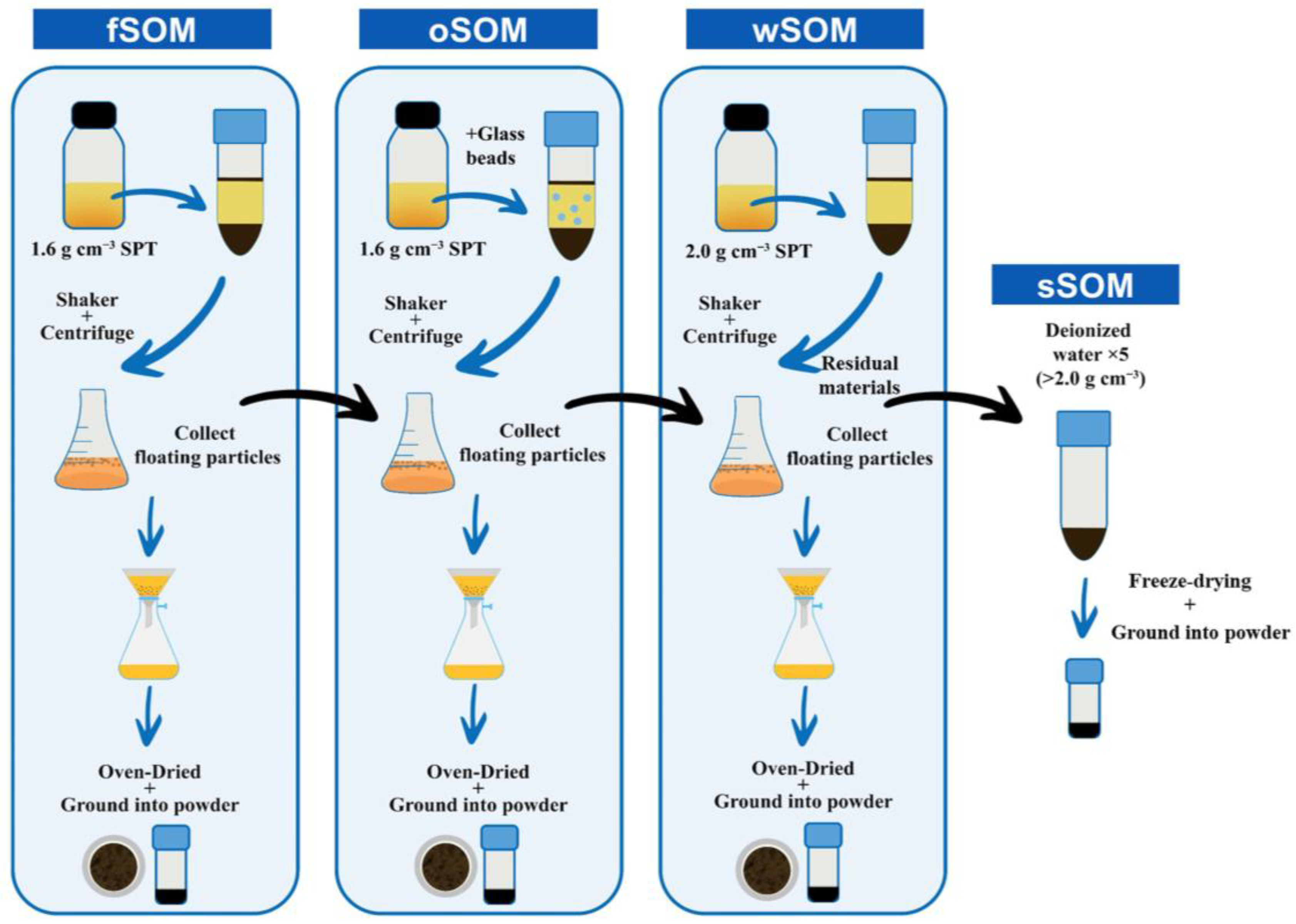
The fractionation procedure of SOM was performed according the previous studies [31,45,46] based on their specific gravity (s.g.) into four fractions (Figure 2), each reflecting a distinct level of stabilization: (1) the free SOM fraction (fSOM), comprising particulate organic matter not associated with mineral surfaces; (2) the occluded light SOM fraction (oSOM), consisting of particulate organic matter physically protected inside macro- or microaggregates; (3) the weakly bound form SOM fraction (wSOM), made up of organic matter loosely associated with mineral surfaces as a result of a high organic matter-to-mineral ratio; and (4) the strongly bound form SOM fraction (sSOM), defined by a close and persistent association with soil minerals, largely attributable to a low organic matter-to-mineral ratio.
Figure 2.
Sequential density fractionation scheme of soil organic matter (SOM). Notation: SPT, sodium polytungstate; fSOM, free SOM fraction; oSOM, occluded light SOM fraction; wSOM, weakly bound form SOM fraction; and sSOM, strongly bound form SOM fraction.
Four grams of soil were weighed and transferred into a 50-mL centrifuge tube, after which 20 mL of sodium polytungstate (SPT; ThermoFisher Scientific, Waltham, MA, USA) solution, adjusted to a density of 1.6 g cm−3, was added. The tubes were repeatedly inverted and gently agitated to ensure thorough mixing, and any residual soil adhering to the tube walls or caps was rinsed with an additional 5 mL of SPT solution (s.g. 1.6 g cm−3). The samples were then centrifuged at 2000× g for 20 min. Following centrifugation, the floating particulate matter was carefully recovered, and the remaining residue was resuspended in 10 mL of SPT solution (s.g. 1.6 g cm−3), shaken at 120 rpm for 10 min, and centrifuged at 2000× g for 20 min. The floating particulate matter was collected following the procedure described above. To achieve complete fractionation, the extraction steps were repeated a total of three times. The entire floating fraction was recovered on a hydrophilic polytetrafluoroethylene (PTFE) membrane filter (0.22 μm pore size), thoroughly rinsed with deionized water to remove residual SPT until the filtrate electrical conductivity (EC) decreased to below 50 μS cm−1, oven-dried at 60 °C for 24 h, weighed, and gently ground to obtain a homogeneous powder, designated as fSOM fraction. The remaining soil was resuspended in 20 mL of SPT solution (s.g. 1.6 g cm−3) and shaken with five glass beads (5 mm diameter) at 100 rpm for 16 h to destroy soil aggregates. The suspension was centrifuged at 2000× g for 20 min, after which the floating particulate material was recovered following the previously described procedure, thereby yielding the oSOM fraction. The residual precipitate was subsequently resuspended in 20 mL of SPT solution (s.g. 2.0 g cm−3), and the floating material was collected using the same procedure as described above to obtain the wSOM fraction. Finally, the residual materials (s.g. >2.0 g cm−3) were thoroughly rinsed five times with deionized water by centrifugation, followed by freeze-drying and gentle grinding to obtain the sSOM fraction. All fractions were stored until further analysis.
2.5. Determination of Nitrogen Content
The content of N in whole soil samples and isolated SOM fractions was measured using a CHN analyzer (CHN628, LECO Corporation, St. Joseph, MI, USA) or an elemental analyzer (FlashSmart, ThermoFisher Scientific, Waltham, MA, USA).
2.6. Statistical Analysis
Analysis of variance (ANOVA) was performed to test the effects of contrasting land uses on the mass distribution, as well as the proportion and content of N in isolated SOM fractions. The comparisons of means were conducted using Tukey’s honestly significant difference (HSD) test at a significance level of p < 0.05. Correlation analysis was carried out to examine the relationships between the N content in various SOM fractions and the physicochemical properties of soils.
3. Results
3.1. Soil Physical and Chemical Properties Under Different Land Uses
The physical and chemical properties of soils under contrasting land uses are presented in Table 1. The particle size distribution revealed that these soils mainly consisted of sand and silt particles. Soil bulk density, 1.22–1.49 Mg m−3, was highest under the AD land use and lowest under the FR land use. Soil pH, ranging between 5.46 and 8.06, was highest under the OR land use, compared to the other land uses. The OM was higher in the FR (2.30%) and PT (2.23%) land uses, relative to the other land uses (0.84–1.99%). Total N, varying from 0.47–1.24 g kg−1, was highest under the PT land use, followed by the FR land use. The available P and exchangeable K were highest under the CA land use (62.77 mg kg−1) and FR land use (208.02 mg kg−1), respectively, compared to the other land uses (Table 1).
Table 1.
Physical and chemical properties of soils under contrasting land uses.
3.2. Mass Distribution of Soil Organic Matter Fractions Under Different Land Uses
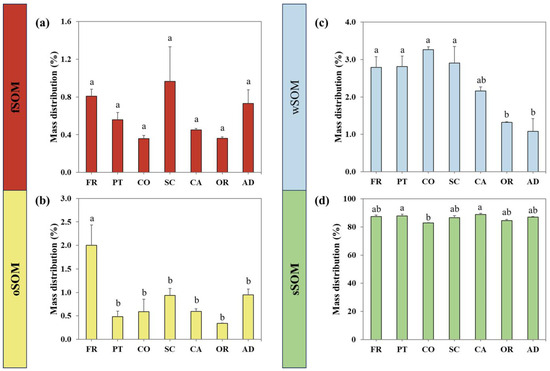
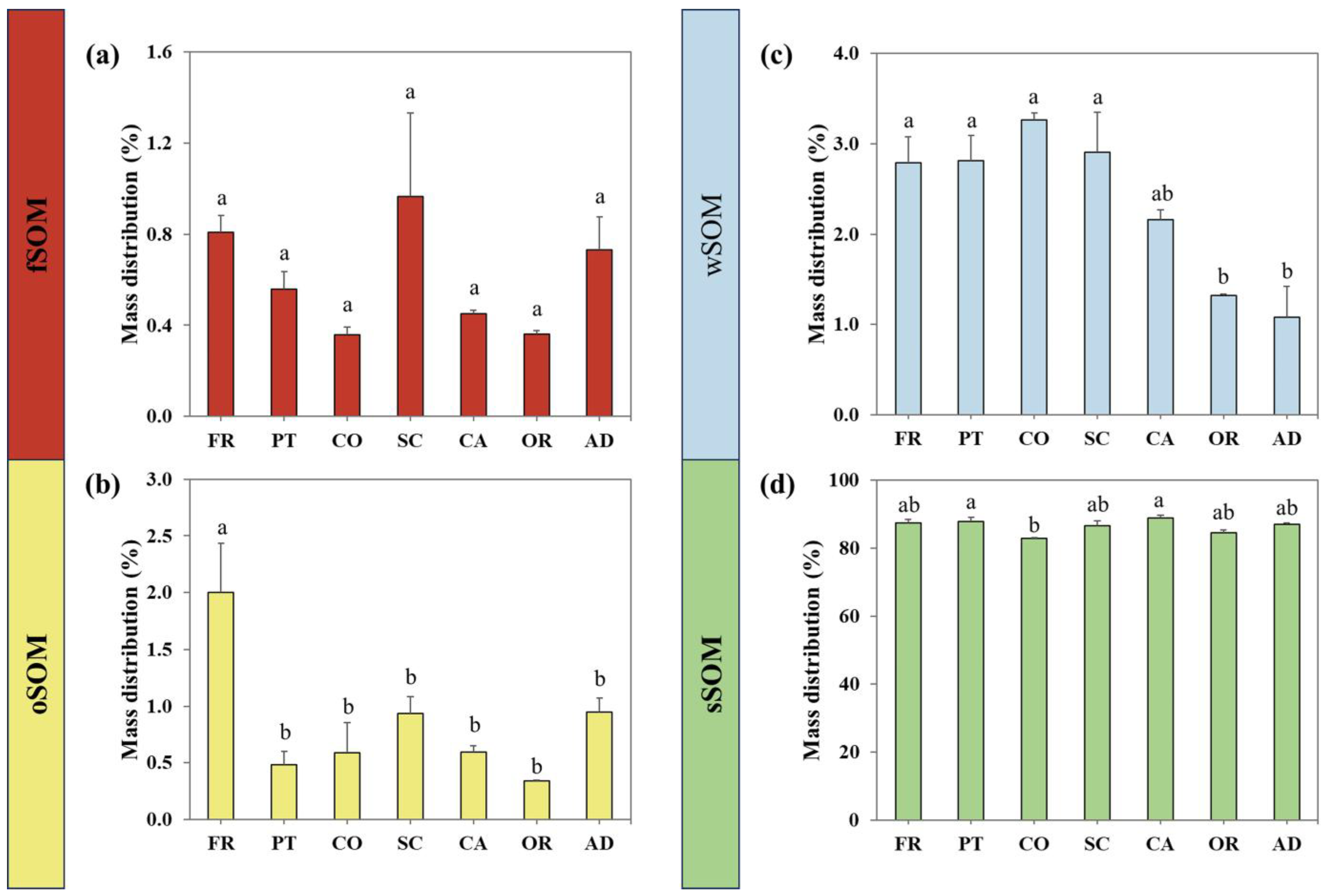
Figure 3 shows the mass contribution of various SOM fractions. The total mass recovery of all land uses was on average 90.2% of the pre-fractionated sample mass. The mass proportion of the SOM fractions under divergent land uses was predominated by the sSOM fraction, 82.9–88.8% (Figure 3d), followed by the wSOM fraction. Among the land uses, the mass contribution of the oSOM fraction, 0.3–2.0%, was significantly higher in the FR (p < 0.05), relative to the other land uses (Figure 3b). The mass proportion of the wSOM fraction, 1.1–3.3%, was significantly higher in the CO, FR, PT, and SC (p < 0.05), compared to the OR and AD (Figure 3c). The contribution of the sSOM fraction mass was significantly higher in the CA and PT (p < 0.05), relative to the CO (Figure 3d). Nevertheless, no significant difference was observed for the mass contribution of the fSOM fraction among the land uses (Figure 3a).
Figure 3.
Mass contribution of soil organic matter (SOM) fraction under different land uses. (a) Free SOM fraction (fSOM); (b) Occluded light SOM fraction (oSOM); (c) weakly bound form SOM fraction (wSOM); and (d) strongly bound form SOM fraction (sSOM). Error bars denote the standard error (n = 3). Different lowercase letters indicate the presence of statistically significant differences among the land uses at p < 0.05. Notation: FR, forest; PT, pasture; CO, corn plantation; SC, sugarcane plantation; CA, cassava plantation; OR, orchard; and AD, abandoned land.
3.3. Nitrogen Distribution and Content in Various Soil Organic Matter Fractions Under Different Land Uses
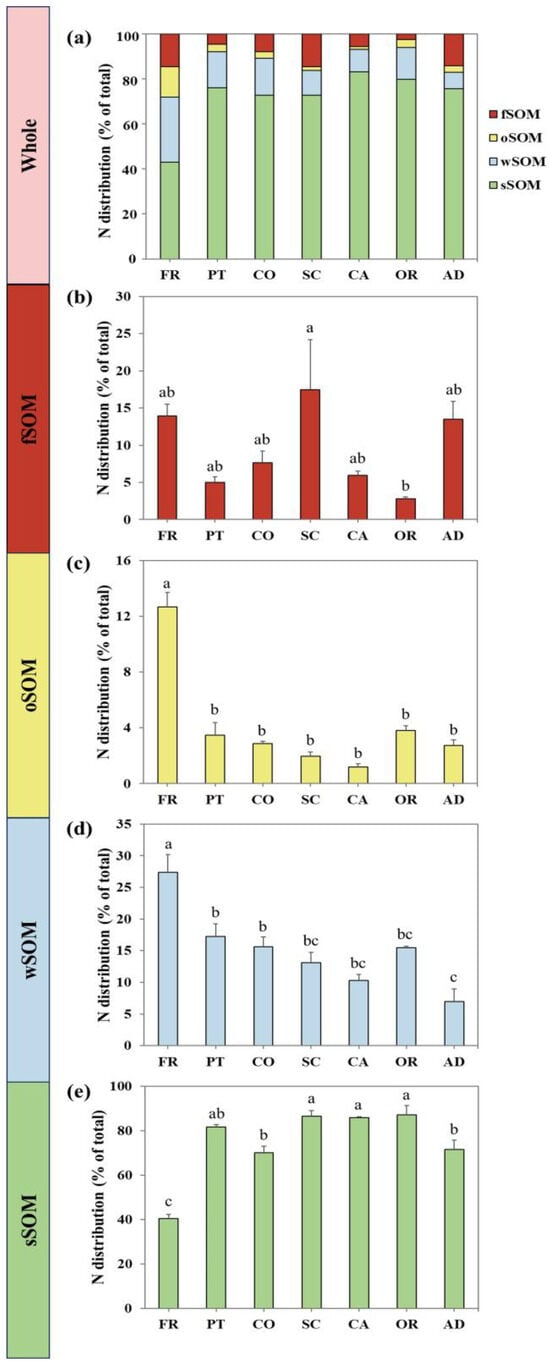
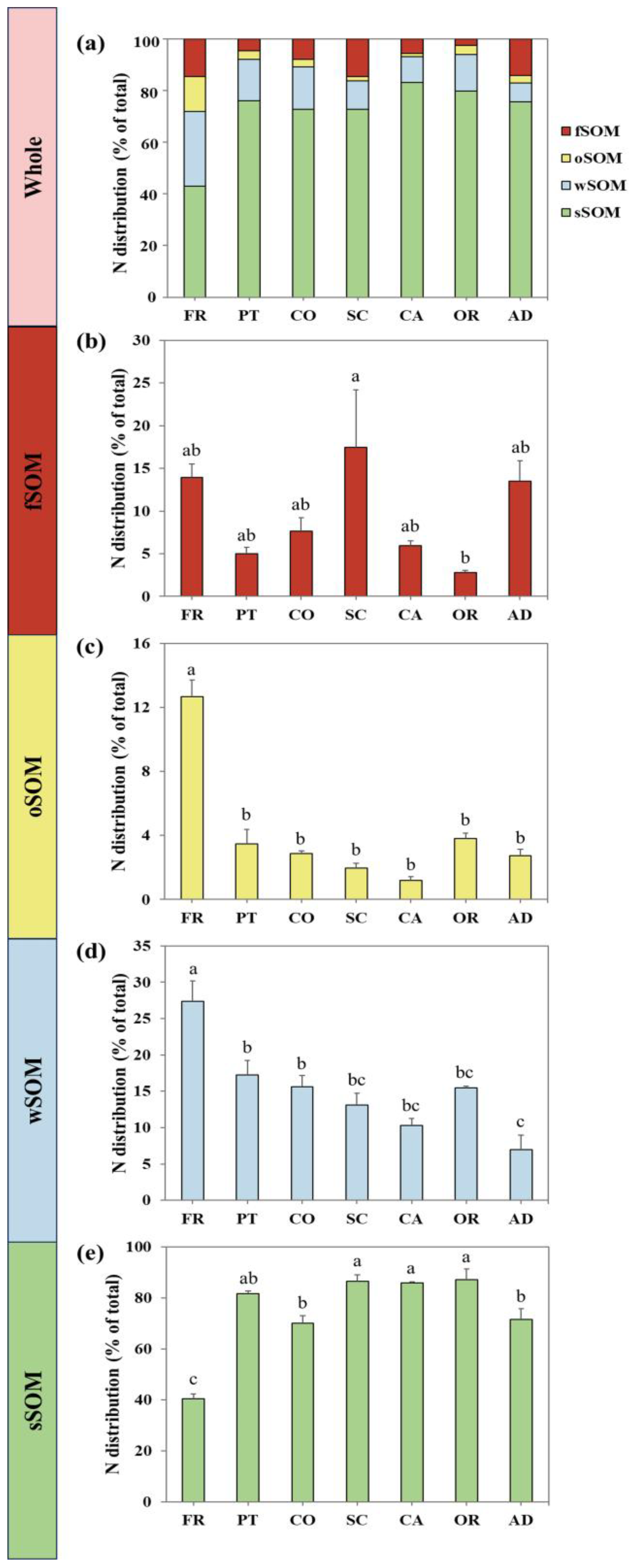
The distribution of N into four SOM fractions under different land uses is exhibited in Figure 4. Among the SOM fractions, the majority of N was detected in the sSOM fraction, accounting for 41–87% (Figure 4a). On the other hand, its distribution was the smallest in the oSOM fraction. Across the contrasting land uses, the proportion of N stored in the fSOM fraction, 3–17%, was highest in the SC (p < 0.05; Figure 4b). In the oSOM fraction, the proportion of N, 1–13%, was highest in the FR, compared to the other land uses (p < 0.05; Figure 4c). Similarly, the proportion of N in the wSOM fraction, amounting to 7–27%, was also highest in the FR, relative to the other land uses (p < 0.05; Figure 4d). In the sSOM fraction, the proportion of N in the OR, CA, and PT was higher than that in the FR, CO, and AD (p < 0.05; Figure 4e).
Figure 4.
Distribution of nitrogen (N) into divergent soil organic matter (SOM) fractions under different land uses. (a) All SOM fractions; (b) Free SOM fraction (fSOM); (c) Occluded light SOM fraction (oSOM); (d) weakly bound form SOM fraction (wSOM); and (e) strongly bound form SOM fraction (sSOM). Error bars denote the standard error (n = 3). Different lowercase letters indicate the presence of statistically significant differences among the land uses at p < 0.05. Notation: FR, forest; PT, pasture; CO, corn plantation; SC, sugarcane plantation; CA, cassava plantation; OR, orchard; and AD, abandoned land.
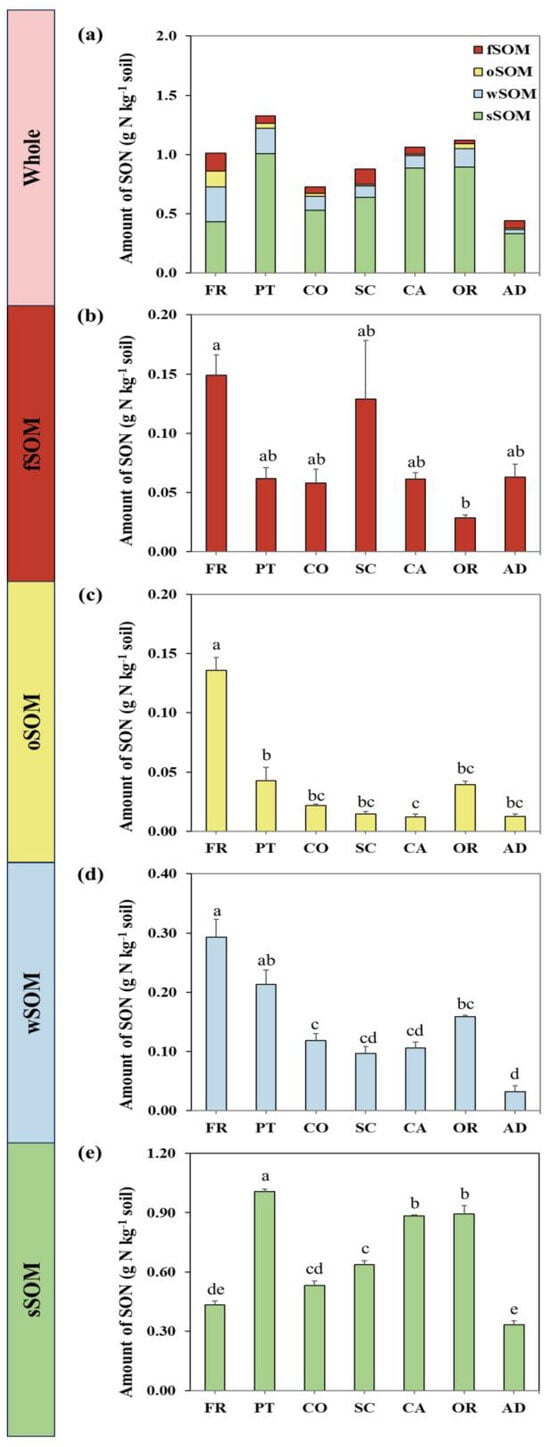
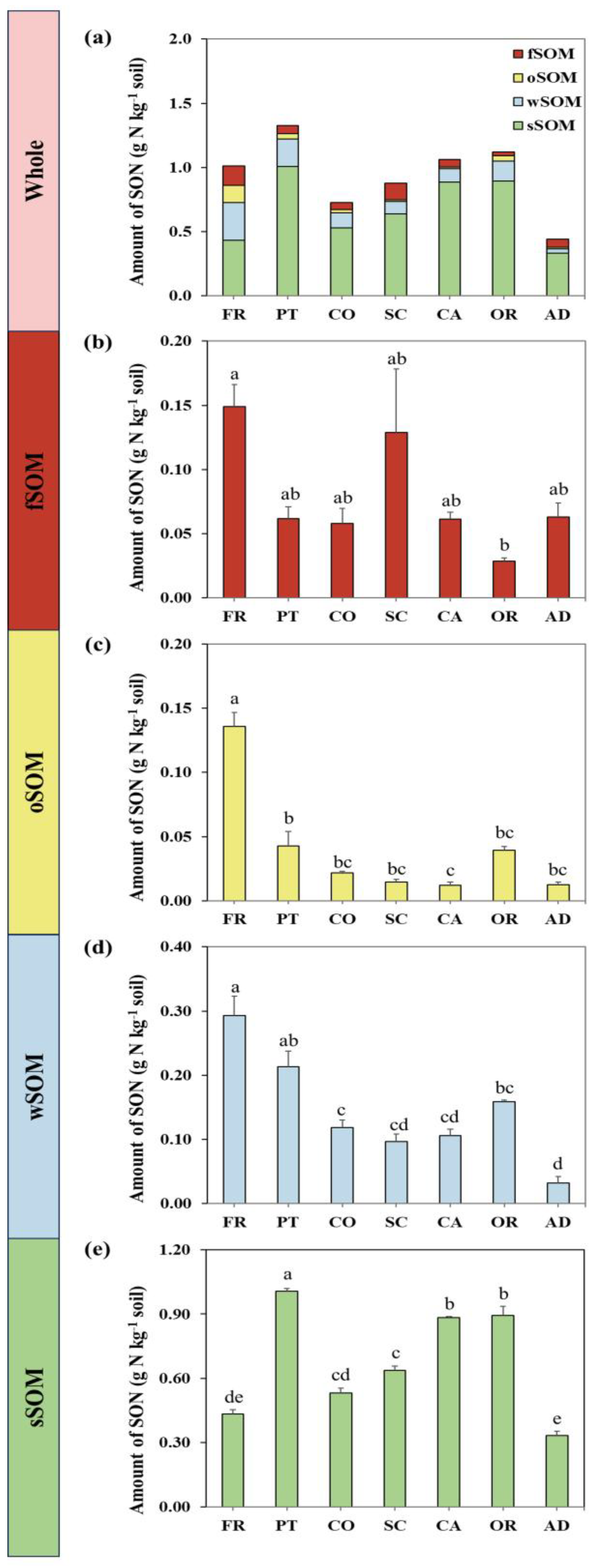
Figure 5 illustrates the amount of N content across the SOM fraction under different land uses. The major content of N was stored in the sSOM fraction, 0.33–1.01 g N kg−1 soil (Figure 5a). Among the divergent land uses, the N content accumulated in the fSOM fraction, 0.03–0.15 g N kg−1 soil, was highest in the FR, followed by the SC (Figure 5b). Even the N content stored in the oSOM fraction was the smallest among the SOM fractions, 0.01–0.14 g N kg−1 soil, a significant difference among the land uses was still observed (p < 0.05), with the highest content in the FR, followed by the PT, relative to the other land uses (Figure 5c). In the wSOM fraction, the N content accumulated in this fraction, accounting for 0.03–0.29 g N kg−1 soil, was highest in the FR (p < 0.05), followed by the PT, compared to the other land uses (Figure 5d). The N content stored in the sSOM fraction was higher in the PT (1.01 g N kg−1 soil) than in the other land uses (p < 0.05; Figure 5e).
Figure 5.
Amount of nitrogen (N) content accumulated in divergent soil organic matter (SOM) fractions under different land uses. (a) All SOM fractions; (b) Free SOM fraction (fSOM); (c) Occluded light SOM fraction (oSOM); (d) weakly bound form SOM fraction (wSOM); and (e) strongly bound form SOM fraction (sSOM). Error bars denote the standard error (n = 3). Different lowercase letters indicate the presence of statistically significant differences among the land uses at p < 0.05. Notation: FR, forest; PT, pasture; CO, corn plantation; SC, sugarcane plantation; CA, cassava plantation; OR, orchard; and AD, abandoned land.
3.4. Relationships Between Nitrogen Content in Various Soil Organic Matter Fractions and Soil Physicochemical Properties
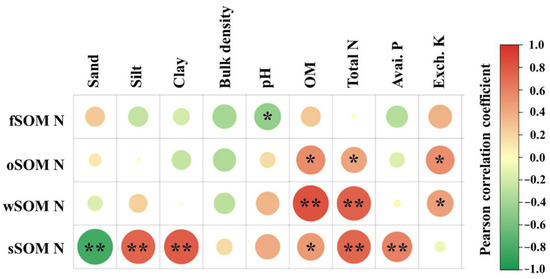
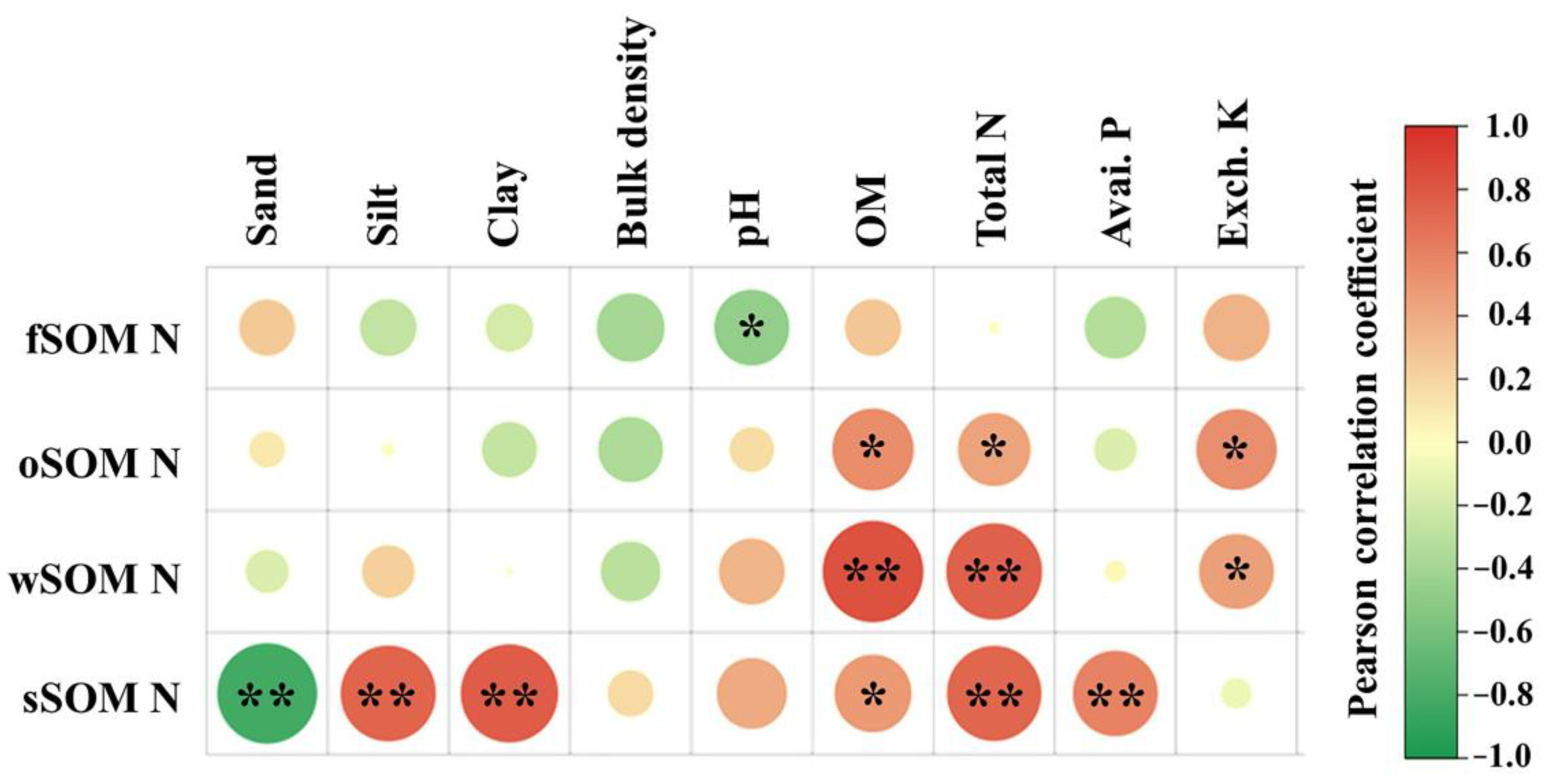
The correlations between the N content accumulated in isolated SOM fractions and the physicochemical properties of soils under different land uses are presented in Figure 6. The amount of N stored in the fSOM fraction was correlated negatively with soil pH (p < 0.05). The N content accumulated in the oSOM fraction was correlated positively with OM content, total N, and exchangeable K (p < 0.05). In the wSOM fraction, the N content was also correlated positively with OM content (p < 0.01), total N (p < 0.01), and exchangeable K (p < 0.05). The amount of N accumulated in the sSOM fraction was correlated positively with silt and clay particles (p < 0.01), OM content (p < 0.05), total N (p < 0.01), available P (p < 0.01). Conversely, it was correlated negatively with sand particles (p < 0.01).
Figure 6.
Correlation matrix heatmap between the nitrogen (N) content accumulated in each soil organic matter (SOM) fraction and the physical and chemical properties of soils, including sand, silt, and clay particles (%), bulk density, pH, organic matter (OM), total N, available phosphorus (Avai. P), and exchangeable potassium (Exch. K), under different land uses. Asterisks (* and **) denote the presence of significant correlation at p < 0.05 and <0.01, respectively. Notation: fSOM, free SOM fraction; oSOM, occluded light SOM fraction; wSOM, weakly bound form SOM fraction; and sSOM, strongly bound form SOM fraction.
4. Discussion
4.1. Response of Nitrogen Accumulation in Free Particulate Soil Organic Matter Fraction to Different Land Uses
The present findings demonstrate that the FR land use consistently promoted greater N accumulation in the fSOM fraction compared with other land uses (Figure 5b). The fSOM fraction represents relatively unprotected, labile organic material derived largely from recent plant litter inputs and partially decomposed residues that are not yet strongly associated with mineral surfaces [47,48,49]. Forest ecosystems typically sustain continuous and diverse organic inputs through leaf litter, woody debris, fine roots, and root exudates, which collectively contribute substantial amounts of SON to surface soils [50,51]. In contrast to cultivated systems, forest soils experience minimal mechanical disturbance, allowing freshly incorporated organic residues to accumulate in particulate forms rather than being rapidly decomposed or redistributed into mineral-associated pools. The higher N content observed in the fSOM fraction under FR land use therefore reflects both enhanced organic N inputs and reduced disruption of soil structure, which together favor the persistence of free particulate organic matter rich in nitrogenous compounds such as proteins, amino acids, and microbial residues [52,53]. In addition to greater organic inputs, forest microclimatic conditions may play a critical role in regulating N retention within the fSOM fraction. Shaded forest floors often exhibit moderated temperature fluctuations [54], which possibly slow decomposition rates relative to exposed agricultural soils [55,56], thereby allowing N-rich free particulate organic matter to persist for longer periods. In addition to FR land use, the SC land use exhibited a greater proportion of N stored in the fSOM fraction, relative to the other land uses (Figure 4b). This may be attributable to the lowest soil pH in the SC land use, compared to the other land uses (Table 1). Soil pH is widely regarded as a key factor governing microbial activity and shaping the structure and composition of soil microbial communities [57,58]. A strongly acidic soil pH can inhibit the activity and diversity of decomposer microorganisms, especially bacteria, which are highly sensitive to acidic conditions, thereby slowing or even limiting the mineralization of organic inputs [59,60]. This reduced mineralization presumably promotes the short- to medium-term accumulation of organic N in labile pools, including the fSOM fraction. The negative correlation between the N accumulated in the fSOM fraction and soil pH (Figure 6) also suggests that lower soil pH is crucial for greater N accumulation in the fSOM fraction.
4.2. Response of Nitrogen Accumulation in Soil Organic Matter Fraction Occluded Inside Soil Aggregates to Different Land Uses
Across the contrasting land uses, the FR land use promotes significantly greater N accumulation in the oSOM fraction (Figure 5c). The oSOM fraction consists of particulate organic matter physically protected within macroaggregates or microaggregates, where organic substrates are shielded from microbial attack and enzymatic degradation [30,61]. Forest ecosystems provide favorable conditions for the formation and stabilization of soil aggregates through continuous organic matter inputs, extensive root systems, and minimal mechanical disturbance. Leaf litter, woody debris, and fine-root turnover supply N-rich organic materials that become incorporated into aggregates during aggregate formation processes driven by fungal hyphae, roots, and microbial exudates [62,63]. The occlusion of these materials inside soil aggregates is effectively isolated from rapid decomposition [64], contributing to the N accumulation and persistence in the oSOM fraction.
Beyond physical protection, forest soils exhibit biological characteristics that may favor N accumulation in the oSOM. Forest floors typically support diverse microbial communities, including fungi and mycorrhizal networks [65,66], which contribute microbial residues rich in N-containing compounds such as amino sugars and peptides [52,67]. These microbial products play a crucial role in aggregate formation and are preferentially incorporated into occluded SOM pools within soil aggregates [68,69]. In contrast to the forest, cropland, e.g., CA, CO, and SC, in the present study (Figure 5c) often experiences accelerated soil aggregate turnover due to soil disturbance, e.g., tillage, and reduced residues [70]. These conditions presumably limit the accumulation of N in the oSOM fraction by reducing both aggregate stability and the residence time of the oSOM pool.
4.3. Response of Nitrogen Accumulation in Mineral-Associated Soil Organic Matter Fractions to Different Land Uses
Mineral-associated SOM fractions represent more stabilized pools of organic matter compared with particulate fractions, as organic compounds are retained through physicochemical interactions with mineral surfaces [71,72]. The present study demonstrates clear land use-dependent differences in N accumulation within mineral-associated SOM pools, with the FR land use promoting higher N accumulation in the wSOM fraction (Figure 5d), while the PT land use favored greater N storage in the sSOM fraction (Figure 5e) across contrasting land uses. The wSOM fraction, characterized by relatively weak organo-mineral associations, is presumably sensitive to variations in organic inputs and microbial processing [45,73]. Forest ecosystems typically supply continuous and chemically diverse organic inputs through litterfall, root turnover, and rhizodeposition, which possibly enhance microbial activity [74], and thereby promote the formation of mineral-associated SOM at early stabilization stages. The higher N accumulation observed in the wSOM fraction under the FR likely reflects the incorporation of microbially processed and other labile N-containing molecules onto mineral surfaces without yet forming strong or irreversible bonds. The positive correlations observed between N accumulation in the wSOM fraction and both organic matter content and total N (Figure 6) may further support the interpretation that wSOM-associated N is closely linked to the overall availability of organic substrates and biologically mediated N inputs in forest soils.
The PT land use promoted greater N accumulation in the sSOM fraction, which is considered the most stable SOM pool due to its intimate association with fine mineral particles, particularly silt and clay. The sSOM fraction is dominated by organic compounds that are either selectively preserved or strongly sorbed onto mineral surfaces through ligand exchange, cation bridging, and polyvalent metal interactions [10,75]. Pasture systems often maintain permanent vegetation cover and extensive root systems that continuously supply belowground organic inputs while minimizing soil disturbance [76,77]. A key mechanism by which roots contribute to the formation of mineral-associated SOM involves the direct adsorption of low molecular weight organic compounds, including organic acids, amino acids, and sugars, onto mineral surfaces [78]. Root-derived inputs, particularly fine roots and rhizodeposits, are generally more effective than aboveground residues in promoting this process, as they can associate directly with mineral surfaces without requiring prior microbial transformation [79,80]. Thus, the pasture, with continuous root development and limited physical disturbance, appears particularly effective in promoting the transfer of N into highly stable pools binding with mineral surfaces. The strong positive correlations observed between N accumulation in the sSOM fraction and silt and clay particles (Figure 6) indicate that mineral surface availability and fine particle abundance play a critical role in controlling long-term N stabilization.
In conventional agricultural systems, fertilizers are typically applied during crop cultivation, as was the case with the CA and SC land uses. This practice may also have contributed crucially to the greater N proportion in the sSOM fraction under the CA and SC land uses (Figure 4a,e). Previous work by Rusyn et al. [81] demonstrated that the fertilizer application stimulated the growth and abundance of microorganisms. As a consequence, the biosynthesis of new SOM, a source of N, by microorganisms may become stabilized within the mineral soil matrix through microbial in vivo turnover processes [82].
Taken together, these findings highlight that different land uses regulate N stabilization through distinct but complementary pathways within mineral-associated SOM fractions. The FR land use primarily enhances N accumulation in the wSOM fraction by sustaining high organic matter inputs and microbial processing, resulting in a dynamic yet partially stabilized N pool that remains responsive to changes in organic inputs. The PT, by contrast, favors the long-term sequestration of N in the sSOM fraction through strong organo-mineral associations mediated by fine soil particles and persistent root-derived inputs. The fertilizer application in crop cultivation, e.g., the CA and SC land uses, may be another crucial determinant of enhancing microbial growth and abundance, thereby further contributing to N proportion in the sSOM pool.
5. Conclusions
The results of this study enhance understanding of how contrasting land uses regulate N accumulation across different SOM fractions and substantiate our hypothesis that land uses characterized by perennial vegetation and low disturbance intensity promote greater N accrual within physically and chemically stabilized SOM pools compared with intensively managed cropland systems. The FR land use substantially enhances higher N accumulation in free particulate SOM (1.2 to 5.2-fold), physically protected SOM (3.2 to 11.2-fold), and weakly mineral-associated SOM pools (1.4 to 9.1-fold), relative to the other land uses. The PT land use, characterized by abundant root-derived inputs, especially fine roots and rhizodeposition, appears particularly effective in facilitating the accumulation of N within a strongly mineral-associated SOM pool (1.1 to 3.0-fold), compared to the other land uses. Although this study revealed explicit response of N partitioning within SOM fractions to contrasting land uses, the soil N cycle is highly complex and coupled with inorganic N pools through microbially mediated mineralization and immobilization processes, including microbial biomass turnover. Future research incorporating inorganic N forms, microbial biomass N, and process-based measurements, e.g., net mineralization and immobilization rates, would provide a more comprehensive understanding of N dynamics under contrasting land uses. In addition, the present study assessed N accumulation in various SOM fractions only in the 0–20 cm soil layer. Even if this surface horizon is generally the most biologically active and most responsive to land uses, soil biochemical properties are often vertically stratified. Therefore, future studies should adopt a multi-depth sampling approach (e.g., 0–20, 20–40, and deeper horizons), along with integrating depth-resolved density fractionation with advanced analytical techniques, which would enable a more comprehensive understanding of the vertical pattern of N accumulation in different SOM fractions, including the relevant mechanisms, throughout the soil profile. This would further strengthen the interpretation of ecosystem-scale biogeochemical processes.
Supplementary Materials
The following supporting information can be downloaded at: https://www.mdpi.com/article/10.3390/environments13040186/s1, Table S1: Details of land use practices in each study location.
Author Contributions
B.J.: Conceptualization, Investigation, Formal analysis, Data curation, Software, Writing—original draft, Visualization. N.P.: Resources, Validation, Supervision, Writing—review & editing, Visualization. K.S.: Conceptualization, Methodology, Investigation, Formal analysis, Data curation, Resources, Software, Funding acquisition, Project administration, Validation, Supervision, Writing—original draft, Writing—review & editing, Visualization. All authors have read and agreed to the published version of the manuscript.
Funding
The APC was funded by Kasetsart University Research and Development Institute (KURDI).
Data Availability Statement
The data presented in this study are available upon reasonable request from the corresponding author.
Acknowledgments
This research was funded by Kasetsart University through the Graduate School Fellowship Program. This research project was also funded by the National Research Council of Thailand (NRCT) (Contract number N42A670127).
Conflicts of Interest
The authors declare no conflicts of interest.
References
- Aoyama, M. Functional roles of soil organic matter. Humic Subst. Res. 2015, 12, 21–28. [Google Scholar]
- Hoffland, E.; Kuyper, T.W.; Comans, R.N.; Creamer, R.E. Eco-functionality of organic matter in soils. Plant Soil 2020, 455, 1–22. [Google Scholar] [CrossRef] [Scilit]
- Sonsri, K.; Naruse, H.; Watanabe, A. Contribution of distinct components in divergent organic amendments to long-term accumulation of soil organic matter in agricultural soils: Evidence from thermally assisted hydrolysis and methylation-GC/MS. Environ. Sci. Pollut. Res. 2024, 31, 59190–59201. [Google Scholar] [CrossRef] [Scilit] [PubMed]
- Fageria, N.K. Role of soil organic matter in maintaining sustainability of cropping systems. Commun. Soil Sci. Plant Anal. 2012, 43, 2063–2113. [Google Scholar] [CrossRef] [Scilit]
- Varga, T.; Wietsma, T.W.; DiDonato, N.; Duckworth, S.C.; Zhao, Q.; Sconzo, N.A.; Battu, A.K.; Zheng, J.; He, X.; Rippner, D.A.; et al. Soil porous microstructure control over soil organic matter mobility: A multimethod workflow for understanding chemistry-dependent organic matter binding in soil. Environ. Technol. Innov. 2025, 40, 104609. [Google Scholar] [CrossRef] [Scilit]
- Schulten, H.-R.; Schnitzer, M. The chemistry of soil organic nitrogen: A review. Biol. Fertil. Soils 1998, 26, 1–15. [Google Scholar] [CrossRef] [Scilit]
- Bingham, A.H.; Cotrufo, M.F. Organic nitrogen storage in mineral soil: Implications for policy and management. Sci. Total Environ. 2016, 551–552, 116–126. [Google Scholar] [CrossRef] [Scilit]
- Chen, S.; Jiang, C.; Wang, H.; Bai, Y.; Jiang, C. Trends in research on soil organic nitrogen over the past 20 years. Forests 2023, 14, 1883. [Google Scholar] [CrossRef] [Scilit]
- Mgolozeli, S.; Nciizah, A.D.; Wakindiki, I.I.C.; Mudau, F.N. Nitrogen mineralization of selected organic materials and their combined effects with nitrogen fertilizer on spinach yield. Plants 2024, 13, 1974. [Google Scholar] [CrossRef] [Scilit]
- von Lützow, M.; Kögel-Knabner, I.; Ekschmitt, K.; Matzner, E.; Guggenberger, G.; Marschner, B.; Flessa, H. Stabilization of organic matter in temperate soils: Mechanisms and their relevance under different soil conditions—A review. Eur. J. Soil Sci. 2006, 57, 426–445. [Google Scholar] [CrossRef] [Scilit]
- Kögel-Knabner, I.; Guggenberger, G.; Kleber, M.; Kandeler, E.; Kalbitz, K.; Scheu, S.; Eusterhues, K.; Leinweber, P. Organo-mineral associations in temperate soils: Integrating biology, mineralogy, and organic matter chemistry. J. Plant Nutr. Soil Sci. 2008, 171, 61–82. [Google Scholar] [CrossRef] [Scilit]
- Dippold, M.; Biryukov, M.; Kuzyakov, Y. Sorption affects amino acid pathways in soil: Implications from position-specific labeling of alanine. Soil Biol. Biochem. 2014, 72, 180–192. [Google Scholar] [CrossRef] [Scilit]
- Liu, Y.; Liang, F.; Yan, S.; Tu, T.; Shi, Z.; Pezzuolo, A.; Feng, Q. Optimizing fertilization strategies for low-carbon agriculture: Balancing greenhouse gas mitigation, soil health, and productivity. Results Eng. 2025, 27, 107094. [Google Scholar] [CrossRef] [Scilit]
- Zhou, Y.; Hartemink, A.E.; Shi, Z.; Liang, Z.; Lu, Y. Land use and climate change effects on soil organic carbon in North and Northeast China. Sci. Total Environ. 2019, 647, 1230–1238. [Google Scholar] [CrossRef] [Scilit]
- Shoumik, B.A.A.; Khan, M.Z.; Błońska, E.; Lasota, J. Dynamics of soil organic carbon and total nitrogen in particulate and mineral-associated organic matter fractions under different continuous land use patterns across Europe. Agric. Ecosyst. Environ. 2025, 381, 109411. [Google Scholar] [CrossRef] [Scilit]
- Wang, J.; Uwiragiye, Y.; Cao, M.; Chen, M.; Fallah, N.; Huang, Y.; Huang, Y.; Cheng, Y.; Cai, Z.; Xu, M.; et al. Global land use change impacts on soil nitrogen availability and environmental losses. Environ. Sci. Technol. 2025, 59, 17595–17605. [Google Scholar] [CrossRef] [Scilit]
- Kim, D.-G.; Kirschbaum, M.U.F.; Eichler-Löbermann, B.; Gifford, R.M.; Liáng, L.L. The effect of land-use change on soil C, N, P, and their stoichiometries: A global synthesis. Agric. Ecosyst. Environ. 2023, 348, 108402. [Google Scholar] [CrossRef] [Scilit]
- Solórzano-Acosta, R.; Cruz-Luis, J.; Chuchon-Remon, R.; Romero-Chávez, L.E.; Lozano, A.; Gaona-Jimenez, N.; Vallejos-Torres, G. The conversion of forests to agricultural croplands significantly depletes soil organic carbon reserves, total nitrogen, and available potassium, reaching critical thresholds in the Peruvian Amazon. Front. Soil Sci. 2025, 5, 1662180. [Google Scholar] [CrossRef] [Scilit]
- Augarten, A.J.; Malone, L.C.; Richardson, G.S.; Jackson, R.D.; Wattiaux, M.A.; Conley, S.P.; Radatz, A.M.; Cooley, E.T.; Ruark, M.D. Cropping systems with perennial vegetation and livestock integration promote soil health. Agric. Environ. Lett. 2023, 8, e20100. [Google Scholar] [CrossRef] [Scilit]
- Rolo, V.; Rivest, D.; Maillard, É.; Moreno, G. Agroforestry potential for adaptation to climate change: A soil-based perspective. Soil Use Manag. 2023, 39, 1006–1032. [Google Scholar] [CrossRef] [Scilit]
- Oelbermann, M.; Chang, S.X.; Pulleman, M.; Whalen, J.K. Transitioning to soil health and carbon sequestration with agroforestry and perennial crop systems. Geoderma Reg. 2024, 39, e00895. [Google Scholar] [CrossRef] [Scilit]
- Shang, Y.; Olesen, J.E.; Lærke, P.E.; Manevski, K.; Chen, J. Perennial cropping systems increased topsoil carbon and nitrogen stocks over annual systems—A nine-year field study. Agric. Ecosyst. Environ. 2024, 365, 108925. [Google Scholar] [CrossRef] [Scilit]
- Torres, M.J.; Simon, J.; Rowley, G.; Bedmar, E.J.; Richardson, D.J.; Gates, A.J.; Delgado, M.J. Nitrous oxide metabolism in nitrate-reducing bacteria: Physiology and regulatory mechanisms. Adv. Microb. Physiol. 2016, 68, 353–432. [Google Scholar] [PubMed]
- Khan, A.; Tan, D.K.Y.; Munsif, F.; Afridi, M.Z.; Shah, F.; Wei, F.; Fahad, S.; Zhou, R. Nitrogen nutrition in cotton and control strategies for greenhouse gas emissions: A review. Environ. Sci. Pollut. Res. 2017, 24, 23471–23487. [Google Scholar] [CrossRef] [Scilit]
- Anas, M.; Liao, F.; Verma, K.K.; Sarwar, M.A.; Mahmood, A.; Chen, Z.-L.; Li, Q.; Zeng, X.-P.; Liu, Y.; Li, Y.-R. Fate of nitrogen in agriculture and environment: Agronomic, eco-physiological and molecular approaches to improve nitrogen use efficiency. Biol. Res. 2020, 53, 47. [Google Scholar] [CrossRef] [Scilit]
- Tiong, J.; Sharma, N.; Sampath, R.; MacKenzie, N.; Watanabe, S.; Metot, C.; Lu, Z.; Skinner, W.; Lu, Y.; Kridl, J.; et al. Improving nitrogen use efficiency through overexpression of alanine aminotransferase in rice, wheat, and barley. Front. Plant Sci. 2021, 12, 628521. [Google Scholar] [CrossRef] [Scilit]
- Paul, E.A. The nature and dynamics of soil organic matter: Plant inputs, microbial transformations, and organic matter stabilization. Soil Biol. Biochem. 2016, 98, 109–126. [Google Scholar] [CrossRef] [Scilit]
- Zhao, Z.; Dong, P.; Fu, B.; Wu, D.; Zhao, Z. Soil organic carbon distribution and factors affecting carbon accumulation in natural and plantation forests in tropical China. Ecol. Indic. 2023, 148, 110127. [Google Scholar] [CrossRef] [Scilit]
- Courtier-Murias, D.; Simpson, A.J.; Marzadori, C.; Baldoni, G.; Ciavatta, C.; Fernández, J.M.; López-de-Sá, E.G.; Plaza, C. Unraveling the long-term stabilization mechanisms of organic materials in soils by physical fractionation and NMR spectroscopy. Agric. Ecosyst. Environ. 2013, 171, 9–18. [Google Scholar] [CrossRef] [Scilit]
- Cao, H.; Xie, J.; Hong, J.; Wang, X.; Hu, W.; Hong, J. Organic matter fractions within macroaggregates in response to long-term fertilization in calcareous soil after reclamation. J. Integr. Agric. 2021, 20, 1636–1648. [Google Scholar] [CrossRef] [Scilit]
- Sonsri, K.; Mitsuboshi, M.; Watanabe, A. Stabilization mechanisms of organic matter in Andosols under long-term fertilization as revealed from structural, molecular, and stable isotopic signatures. J. Soils Sediments 2024, 24, 47–59. [Google Scholar] [CrossRef] [Scilit]
- Jilling, A.; Kane, D.; Williams, A.; Yannarell, A.C.; Davis, A.; Jordan, N.R.; Koide, R.T.; Mortensen, D.A.; Smith, R.G.; Snapp, S.S.; et al. Rapid and distinct responses of particulate and mineral-associated organic nitrogen to conservation tillage and cover crops. Geoderma 2020, 359, 114001. [Google Scholar] [CrossRef] [Scilit]
- Köppen, W. Grundriss der Klimakunde; Walter de Gruyter: Berlin, Germany, 1931. [Google Scholar]
- Sukitprapanon, T.; Suddhiprakarn, A.; Kheoruenromne, I.; Gilkes, R.J. Partitioning and potential mobilization of aluminum, arsenic, iron, and heavy metals in tropical active and post-active acid sulfate soils: Influence of long-term paddy rice cultivation. Chemosphere 2018, 197, 691–702. [Google Scholar] [CrossRef] [Scilit] [PubMed]
- Phankamolsil, N.; Sonsri, K.; Phankamolsil, Y. Consequence of seawater intrusion on soil properties in agricultural areas of Nonthaburi province, Thailand. Appl. Environ. Res. 2021, 43, 77–92. [Google Scholar] [CrossRef] [Scilit]
- Phankamolsil, N.; Tengprasert, T.; Kheoruenromne, I.; Phankamolsil, Y.; Gilkes, R.J.; Sonsri, K. Interactive influences of salinity and sodicity levels on depth-wise soil organic matter and micronutrient elements in Thailand. Environ. Res. Commun. 2024, 6, 045008. [Google Scholar] [CrossRef] [Scilit]
- Soil Survey Staff. Keys to Soil Taxonomy; USDA Natural Resources Conservation Service: Washington, DC, USA, 2014.
- Marriott, C.A.; Hudson, G.; Hamilton, D.; Neilson, R.; Boag, B.; Handley, L.L.; Wishart, J.; Scrimgeour, C.M.; Robinson, D. Spatial variability of soil total C and N and their stable isotopes in an upland Scottish grassland. Plant Soil 1997, 196, 151–162. [Google Scholar] [CrossRef] [Scilit]
- Zhong, Z.; Wu, S.; Lu, X.; Ren, Z.; Wu, Q.; Xu, M.; Ren, C.; Yang, G.; Han, X. Organic carbon, nitrogen accumulation, and soil aggregate dynamics as affected by vegetation restoration patterns in the Loess Plateau of China. Catena 2021, 196, 104867. [Google Scholar] [CrossRef] [Scilit]
- Gee, G.W.; Bauder, J.W. Particle-size analysis. In Methods of Soil Analysis, Part 1—Physical and Mineralogical Methods; Klute, A., Ed.; American Society of Agronomy—Soil Science Society of America: Madison, WI, USA, 1986; pp. 383–411. [Google Scholar]
- Blake, G.R.; Hartge, K.H. Bulk density. In Methods of Soil Analysis, Part 1—Physical and Mineralogical Methods; Klute, A., Ed.; American Society of Agronomy—Soil Science Society of America: Madison, WI, USA, 1986; pp. 363–382. [Google Scholar]
- Nelson, D.W.; Sommers, L.E. Total carbon, organic carbon, and organic matter. In Methods of Soil Analysis: Part 3 Chemical Methods; Sparks, D.L., Page, A.L., Helmke, P.A., Loeppert, R.H., Soltanpour, P.N., Tabatabai, M.A., Johnston, C.T., Sumner, M.E., Eds.; American Society of Agronomy—Soil Science Society of America: Madison, WI, USA, 1996; pp. 961–1010. [Google Scholar]
- Bray, R.A.; Kurtz, L.T. Determination of total organic and available form of phosphorus in soil. Soil Sci. 1945, 59, 39–45. [Google Scholar] [CrossRef] [Scilit]
- Thomas, G.W. Exchangeable cations. In Methods of Soil Analysis: Part 2 Chemical and Microbiological Properties; Page, A.L., Ed.; American Society of Agronomy—Soil Science Society of America: Madison, WI, USA, 1982; pp. 159–165. [Google Scholar]
- Sonsri, K.; Naruse, H.; Watanabe, A. Mechanisms controlling the stabilization of soil organic matter in agricultural soils as amended with contrasting organic amendments: Insights based on physical fractionation coupled with 13C NMR spectroscopy. Sci. Total Environ. 2022, 825, 153853. [Google Scholar] [CrossRef] [Scilit]
- Sonsri, K.; Limmalai, A.; Phayaban, N.; Janplang, B.; Poolsab, P.; Phankamolsil, Y.; Tengprasert, T.; Phankamolsil, N. Insights into the accumulation and chemical composition of soil organic matter influenced by saltwater intrusion in agricultural areas. Sci. Total Environ. 2026, 1014, 181309. [Google Scholar] [CrossRef] [Scilit]
- Six, J.; Conant, R.T.; Paul, E.A.; Paustian, K. Stabilization mechanisms of soil organic matter: Implications for C-saturation of soils. Plant Soil 2002, 241, 155–176. [Google Scholar] [CrossRef] [Scilit]
- Zeller, B.; Dambrine, E. Coarse particulate organic matter is the primary source of mineral N in the topsoil of three beech forests. Soil Biol. Biochem. 2011, 43, 542–550. [Google Scholar] [CrossRef] [Scilit]
- Antisari, L.V.; Feudis, M.D.; Trenti, W.; Falsone, G.; Puliga, F.; Zambonelli, A.; Tabanelli, G.; Gardini, F. Pedodiversity and organic matter dynamics in the North Apennines (Italy): Relationships among soil types, biodiversity, and ecological functionality. Forests 2024, 15, 353. [Google Scholar] [CrossRef] [Scilit]
- Krishna, M.P.; Mohan, M. Litter decomposition in forest ecosystems: A review. Energy Ecol. Environ. 2017, 2, 236–249. [Google Scholar] [CrossRef] [Scilit]
- Stutz, K.P. Perspectives of the Fritz-Scheffer Awardee 2021: Profile- to ecosystem-scale perspectives on soil organic matter formation as demonstrated by woody debris in forest dynamics. J. Plant Nutr. Soil Sci. 2023, 186, 241–252. [Google Scholar] [CrossRef] [Scilit]
- Kögel-Knabner, I. The macromolecular organic composition of plant and microbial residues as inputs to soil organic matter. Soil Biol. Biochem. 2002, 34, 139–162. [Google Scholar] [CrossRef] [Scilit]
- Prescott, C.E.; Vesterdal, L. Decomposition and transformations along the continuum from litter to soil organic matter in forest soils. For. Ecol. Manag. 2021, 498, 119522. [Google Scholar] [CrossRef] [Scilit]
- Greiser, C.; Hederová, L.; Vico, G.; Wild, J.; Macek, M.; Kopecký, M. Higher soil moisture increases microclimate temperature buffering in temperate broadleaf forests. Agric. For. Meteorol. 2024, 345, 109828. [Google Scholar] [CrossRef] [Scilit]
- Sierra, C.A.; Trumbore, S.E.; Davidson, E.A.; Vicca, S.; Janssens, I. Sensitivity of decomposition rates of soil organic matter with respect to simultaneous changes in temperature and moisture. J. Adv. Model. Earth Syst. 2015, 7, 335–356. [Google Scholar] [CrossRef] [Scilit]
- Fang, X.; Zhu, Y.-L.; Liu, J.-D.; Lin, X.-P.; Sun, H.-Z.; Tang, X.-H.; Hu, Y.-L.; Huang, Y.-P.; Yi, Z.-G. Effects of moisture and temperature on soil organic carbon decomposition along a vegetation restoration gradient of subtropical China. Forests 2022, 13, 578. [Google Scholar] [CrossRef] [Scilit]
- Curtin, D.; Campbell, C.A.; Jalil, A. Effects of acidity on mineralization: pH-dependence of organic matter mineralization in weakly acidic soils. Soil Biol. Biochem. 1998, 30, 57–64. [Google Scholar] [CrossRef] [Scilit]
- Wang, A.S.; Angle, J.S.; Chaney, R.L.; Delorme, T.A.; McIntosh, M. Changes in soil biological activities under reduced soil pH during Thlaspi caerulescens phytoextraction. Soil Biol. Biochem. 2006, 38, 1451–1461. [Google Scholar] [CrossRef] [Scilit]
- Khare, E.; Arora, N.K. Effects of soil environment on field efficacy of microbial inoculants. In Plant Microbes Symbiosis: Applied Facets; Arora, N.K., Ed.; Springer: New Delhi, India, 2015; pp. 353–381. [Google Scholar]
- Naz, M.; Dai, Z.; Hussain, S.; Tariq, M.; Danish, S.; Khan, I.U.; Qi, S.; Du, D. The soil pH and heavy metals revealed their impact on soil microbial community. J. Environ. Manag. 2022, 321, 115770. [Google Scholar] [CrossRef] [Scilit] [PubMed]
- Six, J.; Elliott, E.T.; Paustian, K. Soil macroaggregate turnover and microaggregate formation: A mechanism for C sequestration under no-tillage agriculture. Soil Biol. Biochem. 2000, 32, 2099–2103. [Google Scholar] [CrossRef] [Scilit]
- Agnihotri, R.; Sharma, M.P.; Prakash, A.; Ramesh, A.; Bhattacharjya, S.; Patra, A.K.; Manna, M.C.; Kurganova, I.; Kuzyakov, Y. Glycoproteins of arbuscular mycorrhiza for soil carbon sequestration: Review of mechanisms and controls. Sci. Total Environ. 2022, 806, 150571. [Google Scholar] [CrossRef] [Scilit]
- Shi, K.; Liao, J.; Zou, X.; Chen, H.Y.H.; Delgado-Baquerizo, M.; Wanek, W.; Ni, J.; Ren, T.; Zhang, C.; Yan, Z.; et al. Forest development induces soil aggregate formation and stabilization: Implications for sequestration of soil carbon and nitrogen. Catena 2024, 246, 108363. [Google Scholar] [CrossRef] [Scilit]
- Ponyane, P.; Ebouel, F.J.D.; Eze, P.N. Formation pathways, ecosystem functions, and the impacts of land use and environmental stressors on soil aggregates. Front. Environ. Sci. 2025, 13, 1628746. [Google Scholar] [CrossRef] [Scilit]
- Prescott, C.E.; Grayston, S.J. TAMM review: Continuous root forestry—Living roots sustain the belowground ecosystem and soil carbon in managed forests. For. Ecol. Manag. 2023, 532, 120848. [Google Scholar] [CrossRef] [Scilit]
- Kitagami, Y.; Matsuda, Y. Forest types matter for the community and co-occurrence network patterns of soil bacteria, fungi, and nematodes. Pedobiologia 2024, 107, 151004. [Google Scholar] [CrossRef] [Scilit]
- Anning, D.K.; Li, Z.; Qiu, H.; Deng, D.; Zhang, C.; Ghanney, P.; Shen, Q. Divergent accumulation of microbial residues and amino sugars in loess soil after six years of different inorganic nitrogen enrichment scenarios. Appl. Sci. 2021, 11, 5788. [Google Scholar] [CrossRef] [Scilit]
- Guggenberger, G.; Frey, S.D.; Six, J.; Paustian, K.; Elliott, E.T. Bacterial and fungal cell-wall residues in conventional and no-tillage agroecosystems. Soil Sci. Soc. Am. J. 1999, 63, 1188–1198. [Google Scholar] [CrossRef] [Scilit]
- Li, L.; Wilson, C.B.; He, H.; Zhang, X.; Zhou, F.; Schaeffer, S.M. Physical, biochemical, and microbial controls on amino sugar accumulation in soils under long-term cover cropping and no-tillage farming. Soil Biol. Biochem. 2019, 135, 369–378. [Google Scholar] [CrossRef] [Scilit]
- Li, Y.; Ma, Z.; Liu, Y.; Cui, Z.; Mo, Q.; Zhang, C.; Sheng, H.; Wang, W.; Zhang, Y. Variation in soil aggregate stability due to land use changes from alpine grassland in a high-altitude watershed. Land 2023, 12, 393. [Google Scholar] [CrossRef] [Scilit]
- Kleber, M.; Eusterhues, K.; Keiluweit, M.; Mikutta, C.; Mikutta, R.; Nico, P.S. Mineral–organic associations: Formation, properties, and relevance in soil environments. Adv. Agron. 2015, 130, 1–140. [Google Scholar]
- Cotrufo, M.F.; Lavallee, J.M. Soil organic matter formation, persistence, and functioning: A synthesis of current understanding to inform its conservation and regeneration. Adv. Agron. 2022, 172, 1–66. [Google Scholar]
- Samson, M.-E.; Chantigny, M.H.; Vanasse, A.; Menasseri-Aubry, S.; Royer, I.; Angers, D.A. Management practices differently affect particulate and mineral-associated organic matter and their precursors in arable soils. Soil Biol. Biochem. 2020, 148, 107867. [Google Scholar] [CrossRef] [Scilit]
- Sun, D.; Qiu, X.; Feng, J.; Ru, J.; Song, J.; Wan, S. Forest types control the contribution of litter and roots to labile and persistent soil organic carbon. Biogeochemistry 2024, 167, 1609–1617. [Google Scholar] [CrossRef] [Scilit]
- Kaiser, K.; Guggenberger, G. The role of DOM sorption to mineral surfaces in the preservation of organic matter in soils. Org. Geochem. 2000, 31, 711–725. [Google Scholar] [CrossRef] [Scilit]
- Hoogsteen, M.J.J.; Bakker, E.-J.; van Eekeren, N.; Tittonell, P.A.; Groot, J.C.J.; van Ittersum, M.K.; Lantinga, E.A. Do grazing systems and species composition affect root biomass and soil organic matter dynamics in temperate grassland swards? Sustainability 2020, 12, 1260. [Google Scholar] [CrossRef] [Scilit]
- Martin, G.; Durand, J.-L.; Duru, M.; Gastal, F.; Julier, B.; Litrico, I.; Louarn, G.; Médiène, S.; Moreau, D.; Valentin-Morison, M.; et al. Role of ley pastures in tomorrow’s cropping systems. A review. Agron. Sustain. Dev. 2020, 40, 17. [Google Scholar] [CrossRef] [Scilit]
- Lehmann, J.; Kleber, M. The contentious nature of soil organic matter. Nature 2015, 528, 60–68. [Google Scholar] [CrossRef] [Scilit]
- Kaštovská, E.; Choma, M.; Angst, G.; Remus, R.; Augustin, J.; Kolb, S.; Wirth, S. Root but not shoot litter fostered the formation of mineral-associated organic matter in eroded arable soils. Soil Tillage Res. 2024, 235, 105871. [Google Scholar] [CrossRef] [Scilit]
- Inagaki, T.M.; Bøe, F.; Sturite, I.; Budai, A.; Aas, A.; Rasse, D. Root development as a driver of mineral-associated organic matter formation in cover crop systems of high-latitude agriculture. Agric. Ecosyst. Environ. 2026, 396, 109968. [Google Scholar] [CrossRef] [Scilit]
- Rusyn, I.; Malovanyy, M.; Tymchuk, I.; Synelnikov, S. Effect of mineral fertilizer encapsulated with zeolite and polyethylene terephthalate on the soil microbiota, pH and plant germination. Ecol. Quest. 2021, 32, 1–12. [Google Scholar] [CrossRef] [Scilit]
- Liang, C.; Schimel, J.P.; Jastrow, J.D. The importance of anabolism in microbial control over soil carbon storage. Nat. Microbiol. 2017, 2, 17105. [Google Scholar] [CrossRef] [Scilit]

Disclaimer/Publisher’s Note: The statements, opinions and data contained in all publications are solely those of the individual author(s) and contributor(s) and not of MDPI and/or the editor(s). MDPI and/or the editor(s) disclaim responsibility for any injury to people or property resulting from any ideas, methods, instructions or products referred to in the content. |
© 2026 by the authors. Licensee MDPI, Basel, Switzerland. This article is an open access article distributed under the terms and conditions of the Creative Commons Attribution (CC BY) license.