


Abstract
Titanium–manganese oxide materials have attracted considerable attention as multifunctional catalysts owing to their tunable redox properties and catalytic performance. In particular, these materials have shown promising potential for methanol decomposition, a reaction of interest for both environmental catalysis and processes related to synthesis gas production. The synthesized materials were characterized by low-temperature N2 physisorption, X-ray diffraction (XRD), scanning electron microscopy (SEM), transmission electron microscopy (TEM), X-ray photoelectron spectroscopy (XPS), and H2 temperature-programmed reduction (H2-TPR). Variation in the Ti/Mn ratio resulted in pronounced changes in the textural, structural, surface, and redox properties of the binary oxide materials, which were reflected in their catalytic activity and product selectivity during methanol decomposition. Among the mixed oxides, the 2Ti8Mn material exhibited the highest BET surface area-normalized specific activity, whereas the highest CO selectivity (87% at 700 K) was achieved over the 5Ti5Mn sample. The catalytic performance of 2Ti8Mn can be associated with the presence of manganese oxide phases with different crystallite sizes and oxidation states, together with their spatial association with TiO2-containing regions. The coexistence of different manganese oxidation states, reduced titanium species, and oxygen-deficient surface sites suggests that interactions between the two oxide components influence the surface redox properties and contribute to the observed catalytic behavior. Overall, the results demonstrate that the Ti/Mn ratio plays a key role in determining the catalytic activity and product selectivity of TiO2–MnxOᵧ mixed oxides.
1. Introduction
Renewable energy sources, including solar energy, geothermal energy, hydroelectric power, biofuels, and biomass, represent important alternatives to fossil fuels and can contribute to reducing greenhouse gas emissions and dependence on volatile oil and gas markets [1]. Among alternative energy carriers, methanol is particularly attractive because of its high versatility and ease of conversion through different catalytic routes into industrially valuable chemicals and fuels [2]. Moreover, methanol can be produced using well-established technologies from a wide range of feedstocks, including renewable sources [1,3]. Its catalytic decomposition provides a potential route for the production of gas mixtures containing CO, H2, and CH4, which can be utilized as fuels in internal combustion engines [4], fuel cells [5], and gas turbines [6]. The implementation of methanol decomposition, particularly in mobile and portable energy systems, requires the development of inexpensive and highly efficient catalysts capable of operating at relatively low temperatures. Such catalysts should exhibit high methanol conversion and selectivity over a broad temperature range, together with good thermal stability and mechanical strength.
Substantial research efforts have focused on identifying the catalytically active sites responsible for methanol decomposition into synthesis gas over mono- [7], bi- [8,9], and multicomponent [10] metal oxide catalysts. The catalytic behavior of transition metal oxides is determined by the interplay of various surface properties, including the coordination of surface atoms [11], the redox behavior of the oxide and the oxidation states of surface cations [12], as well as its acid–base characteristics [13]. These properties are intrinsically linked to the chemical composition and structural features of the oxide. In general, metal cations serve as Lewis acid sites, while lattice oxygen species exhibit basic properties. Surface hydroxyl groups, on the other hand, can act as either Brønsted acid or base sites, depending on their chemical environment. The Lewis acidic properties of surface cations are influenced by their charge and ionic radius, whereas the basicity of lattice oxygen species is associated with the ionic character of the metal–oxygen bonds [12]. In addition, surface interactions with adsorbed species and variations in reaction conditions can substantially alter the properties of metal oxides. For instance, elevated temperatures can induce dehydroxylation, resulting in the generation of more accessible cationic Lewis acid sites. Therefore, establishing a clear correlation between the structural characteristics, acid–base properties, and redox behavior of oxide surfaces is crucial for gaining a deeper understanding of their catalytic performance.
Among transition metal oxides, titanium dioxide (TiO2) has emerged as a material of significant scientific interest due to its high chemical stability, relatively low toxicity, cost-effectiveness, and broad range of physicochemical characteristics [13]. These properties have enabled its application in diverse fields, including white pigment production, gas sensing, antireflective coatings, biomaterials, and heterogeneous catalysis, where TiO2 can function as either a catalyst or a catalyst support/promoter [14]. In addition, TiO2 has been widely studied in oxidation and reduction processes, with its catalytic performance being closely related to several material properties, such as crystal phase, specific surface area, pore structure, particle size distribution, and surface hydroxyl concentration [15,16,17]. Manganese-based oxides have likewise attracted substantial attention owing to their ability to undergo reversible redox transformations and their broad applicability in selective oxidation reactions. Their catalytic behavior is generally linked to the presence of multiple manganese oxidation states, particularly the Mn2+/Mn4+ and Mn3+/Mn4+ redox couples, as well as the involvement of lattice oxygen in oxidation–reduction mechanisms [18,19,20,21]. The integration of manganese oxides with TiO2 offers an opportunity to modify and control the structural, acid–base, and redox characteristics of the resulting catalytic system, potentially influencing its performance in methanol conversion.
The decomposition of methanol has been extensively investigated as a model reaction for elucidating the nature of catalytically active sites and exploring the relationship between the structural, acid–base, and redox properties of oxide catalysts and their catalytic performance. Tsoncheva and co-workers [8,9,22] have extensively investigated mesoporous mixed-oxide systems containing Ce, Ti, Zr, Fe, Ni, and Cu for methanol decomposition. Their studies demonstrated that the dispersion and oxidation state of the active metal species, the interaction between the individual oxide components, and structural transformations occurring under reaction conditions can strongly influence catalytic behavior. In particular, Ni-decorated Ce–Fe oxides showed that the Fe–Ce support can stabilize highly dispersed Ni species and affect the formation of surface intermediates during methanol decomposition [22]. Cu-modified Ce–Ti mixed oxides further demonstrated the importance of finely dispersed CuO species and electron transfer within interfacial Ti–Ce–Cu redox centers, while reductive transformations induced by the reaction medium significantly affected the catalytic performance [23]. In addition, mesoporous Ce–Ti mixed oxides exhibited catalytic activity for methanol decomposition to CO and H2, with their performance being strongly influenced by the Ce/Ti ratio and hydrothermal treatment temperature [18]. The intimate interaction between the Ce and Ti oxide components resulted in the formation of distinct active sites and significant variations in the textural features, surface chemistry, and redox behavior of the samples [18]. Papavasiliou and co-authors [24] reported that Cu–Mn spinel oxide catalysts exhibited high activity for H2 production via methanol steam reforming despite their relatively low surface areas. Their catalytic performance was strongly influenced by the Cu/Mn ratio and the evolution of the Cu1.5Mn1.5O4 spinel phase under reaction conditions, emphasizing the importance of metal–metal interactions and the oxidation states of the active species. M. Šťastný and co-authors [25] synthesized manganese oxide catalysts by varying the synthesis conditions and investigated their catalytic performance in methanol decomposition to CO and H2. The catalytic behavior of the resulting MnOx materials was found to depend strongly on the synthesis parameters, which influenced the distribution of redox-active Mn2+/Mn3+/Mn4+ surface species, the abundance of reactive oxygen species, and the dispersion and morphology of the oxide particles. Bonelli and co-authors [26] reported that MnOx–TiO2 catalysts prepared by a reverse micelle-assisted sol–gel method exhibited enhanced NH3-SCR activity as a result of improved Mn dispersion and stronger interactions between the manganese species and the TiO2 support. Similarly, Blankenship and co-authors [27] investigated Mn/TiO2 catalysts with different physical and redox properties and found that their catalytic activity was partially correlated with the reducibility of the manganese species. These results highlight the importance of Mn distribution, metal–support interactions, and redox properties in determining the catalytic behavior of Mn/TiO2 systems.
Despite the progress achieved in the development of Mn- and Ti-containing oxide catalysts, a systematic understanding of the relationship between the Ti/Mn molar ratio, physicochemical properties, and catalytic performance in methanol decomposition remains limited. In particular, the influence of the preparation method on phase formation, manganese dispersion, surface oxidation states, and redox behavior of binary TiO2–MnOx materials requires further investigation. The present study employs a homogeneous coprecipitation approach to prepare mixed oxides with different Ti/Mn ratios (8:2, 5:5, and 2:8). The specific contribution of this work is to shed more light on the above-mentioned aspects by systematically correlating the prepared materials’ phase composition, textural and morphological characteristics, surface chemical states, and reducibility with their catalytic activity and selectivity in methanol decomposition to CO and H2. By combining complementary characterization techniques, the study provides insights into how the relative content of TiO2 and MnOx influences the formation of oxide phases, the interaction between the two components, and the resulting catalytic behavior.
In the present study, a series of nanosized mesoporous binary TiO2–MnOx materials with different Ti/Mn ratios were synthesized by a co-precipitation method. The materials were systematically characterized by N2 physisorption, X-ray diffraction (XRD), scanning and transmission electron microscopy (SEM and TEM), X-ray photoelectron spectroscopy (XPS), and H2 temperature-programmed reduction (H2-TPR) to elucidate their textural, structural, surface, and redox properties. Particular attention was paid to the effect of the Ti/Mn ratio and the intimate interaction between the individual oxide components on the formation of catalytically active sites and their relationship with catalytic activity and selectivity in methanol decomposition.
2. Materials and Methods
2.1. Catalyst Preparation
Titanium–manganese mixed oxide samples with Ti/Mn molar ratios of 2:8, 5:5, and 8:2 were synthesized via homogeneous coprecipitation. Initially, titanium oxysulfate (TiOSO4, 99%, Sigma-Aldrich, St. Louis, MO, USA) was dissolved in 100 mL of distilled water containing 1.5 mL of 35% hydrochloric acid (HCl, Sigma-Aldrich). The solution was subsequently brought to a final volume of 1 L with distilled water. The required amount of potassium permanganate (KMnO4, 95%, Sigma-Aldrich) was then introduced, followed by the addition of 15 g of acetamide (99%, Sigma-Aldrich), which served as the homogeneous precipitation agent. The resulting mixture was heated to 363 K under continuous stirring and kept at this temperature for 5 h. After precipitation, the solid products were separated by decantation, washed thoroughly with distilled water, and collected by filtration. The obtained materials were dried at 378 K and finally calcined in air at 773 K for 2 h.
For comparison, individual TiO2 and MnxOᵧ reference oxides were prepared using the same synthesis procedure as that employed for the bicomponent TiO2–MnxOᵧ catalysts, with the appropriate modification to obtain each individual oxide.
2.2. Characterization of the Samples
The textural properties of the synthesized samples were examined through nitrogen adsorption–desorption analysis using a Quantachrome NOVA 1200e analyzer (Quantachrome Instruments, Boynton Beach, FL, USA) at 77 K. Pore size distributions were calculated according to the Barrett–Joyner–Halenda (BJH) model, based on the desorption branch of the corresponding isotherms. Prior to N2 adsorption–desorption measurements, the catalyst samples were degassed at 150 °C for 15 h under vacuum to remove adsorbed moisture and other surface species. X-ray diffraction (XRD) analysis was performed using a Bruker D8 Advance diffractometer (Bruker AXS SE, Karlsruhe, Germany) fitted with a Cu Kα radiation source and a LynxEye detector. The crystallite sizes were determined by X-ray diffraction analysis using TOPAS 4.2 software. The SEM images were acquired using an FEI Nova NanoSEM 450 microscope (FEI Company, Hillsboro, OR, USA) operating in high-vacuum mode at an accelerating voltage of 5 kV, without prior metal coating of the samples. The microstructural features of the prepared samples were examined using a FEI Talos F200X transmission electron microscope (TEM, FEI Company, Hillsboro, OR, USA). X-ray photoelectron spectroscopy (XPS) was employed to determine the surface chemical composition of the samples. The analyses were carried out using a SPECS PHOIBOS 100 hemispherical analyzer (SPECS GmbH, Berlin, Germany) equipped with a five-channel detector and an achromatic SPECS XR50 X-ray source featuring dual Al/Mg anodes. Al Kα radiation was used for data acquisition, with pass energy values of 40 eV for the survey scans and 10 eV for the high-resolution spectra. All spectra were recorded in the normal emission geometry, without applying charge compensation to the samples. The analyzer operated in Fixed Analyzer Transmission (FAT) mode using the Medium Area configuration (magnification M = 5), an entrance slit of 7 × 20 mm, and an iris diameter of 35 mm. Under these conditions, the analyzed surface area was approximately 1.4 × 4 mm. The pressure in the analysis chamber was maintained below 7 × 10⁻⁷ Pa throughout the measurements. Data processing was performed using CasaXPS software (Casa Software Ltd., Devon, UK, https://www.casaxps.com/). Shirley-type background subtraction was applied, while elemental concentrations were determined using the software’s built-in relative sensitivity factors (RSFs). The binding energy scale was calibrated against the C–C component of the high-resolution C 1s spectrum, set at 284.5 ± 0.2 eV. Temperature-programmed reduction coupled with thermogravimetric analysis (TPR/TG) was conducted using a Setaram TG92 instrument (Setaram Instrumentation, Caluire-et-Cuire, France). The measurements were carried out under a continuous flow of 50 vol.% H2 in Ar at a total flow rate of 100 cm3 min−1, while the temperature was increased at a constant rate of 5 K min−1.
2.3. Catalytic Activity Measurement
Methanol decomposition was investigated using a flow-through microreactor operated under temperature-programmed conditions. Methanol vapor, maintained at a partial pressure of 1.57 kPa, was introduced into the reactor with argon as the carrier gas. The gaseous products were analyzed using an HP gas chromatographic system equipped with flame ionization (FID) and thermal conductivity (TCD) detectors and a PLOT Q column. Quantitative analysis was based on absolute calibration, while the carbon balance was used to determine the distribution of the reaction products. Product selectivity (Si) at 700 K was expressed as the ratio of the yield of an individual product (Yi) to the methanol conversion (X), according to the following equation: Si = Yi/X*100, where Yi is the product (i) yield and X is the conversion. The specific catalytic activity (SA) was calculated as X/SBET, where X is the conversion at the selected temperature and SBET is the specific surface area.
3. Results and Discussion
3.1. XRD Analysis
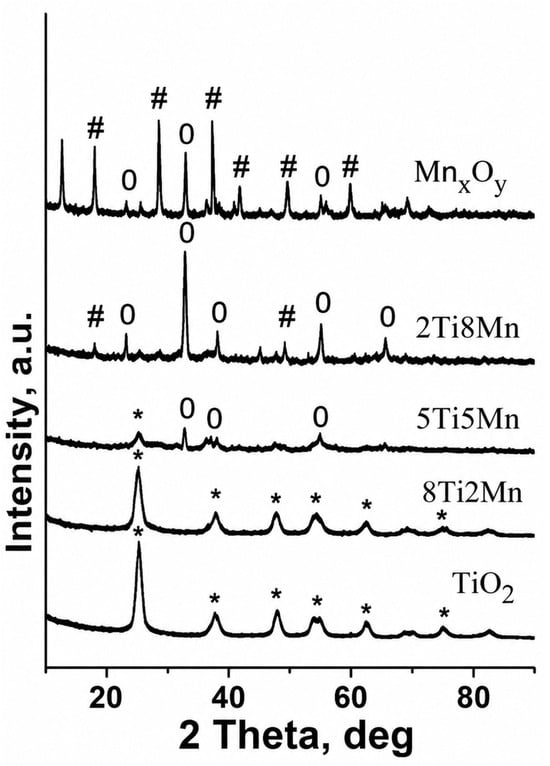
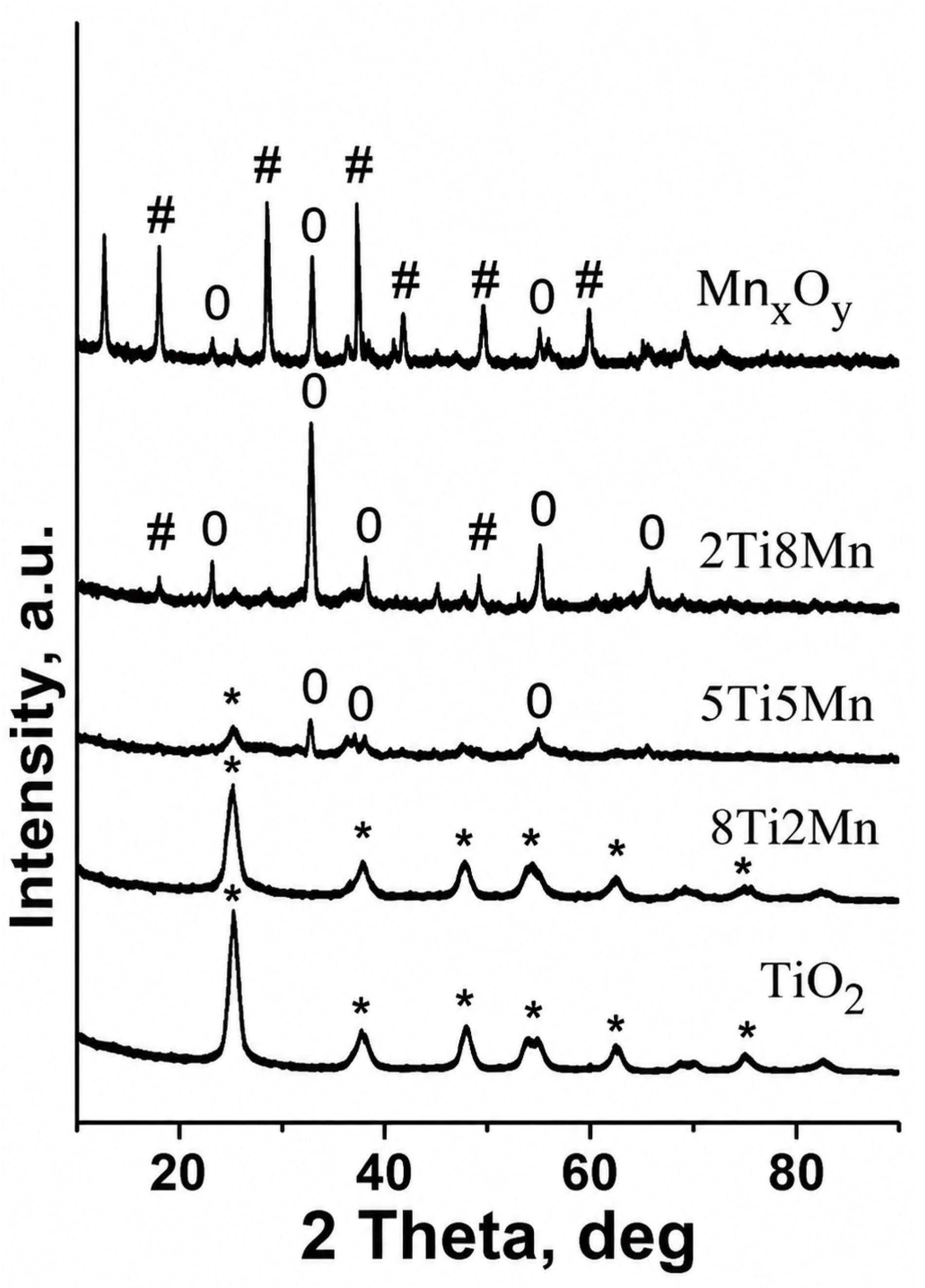
The XRD patterns of the investigated samples are presented in Figure 1, and the corresponding phase composition, TiO2 lattice parameters, and average crystallite sizes are compiled in Table 1. For the TiO2 sample, the diffraction peaks located at 2θ = 25.5°, 38.1°, 47.8°, 54.3°, and 62.8° are characteristic of the anatase structure (Figure 1). The calculated average crystallite size is approximately 10 nm (Table 1), in agreement with the reported data [28,29]. In contrast, the XRD pattern of the manganese oxide sample is characterized by pronounced reflections at 2θ = 23.1°, 33.1°, 38.2°, 55.2°, and 65.9°. These reflections can be associated with well-crystallized Mn2O3 and MnO2 phases, with an average crystallite size of about 46 nm [30,31,32].
Figure 1.
XRD patterns of titanium and manganese oxide materials. The symbols *, 0, and # indicate the diffraction peaks corresponding to TiO2, Mn2O3, and Mn5O8, respectively.
Table 1.
Phase composition, titania unit cell parameters, average crystallite size, BET surface area, and total pore volume for all titanium and manganese oxide materials.
The phase composition of the mixed Ti–Mn oxide samples varies with their Ti/Mn ratio. For the 8Ti2Mn sample, the diffraction pattern contains only the reflections assigned to anatase TiO2. No separate crystalline manganese oxide phases can be identified, which may indicate that manganese is present as highly dispersed species and/or in an amorphous form. Increasing the manganese content leads to the appearance of additional crystalline phases. Thus, the 5Ti5Mn sample shows reflections attributable to both anatase TiO2 and Mn2O3, whereas the 2Ti8Mn sample contains anatase together with manganese oxide phases in which manganese occurs in different oxidation states and with different crystallite sizes. The possibility of Mn incorporation into the TiO2 lattice can also be considered based on the ionic radii of the corresponding cations. The ionic radii of Ti4+, Mn4+, Mn3+, and Mn2+ are 0.074, 0.083, 0.064, and 0.083 nm, respectively [33,34]. Since Mn4+ has a slightly larger ionic radius than Ti4+, its partial substitution for Ti4+ in the anatase lattice would be expected to cause a slight expansion of the unit cell. The relatively minor variations in the calculated a and c lattice parameters observed with changes in the Ti/Mn ratio (Table 1) may therefore be indicative of partial Mn4+ incorporation into the TiO2 structure [34,35]. Overall, the XRD results demonstrate that the Ti/Mn ratio has a significant influence on the phase composition and structural characteristics of the resulting binary oxide materials.
3.2. Nitrogen Physisorption
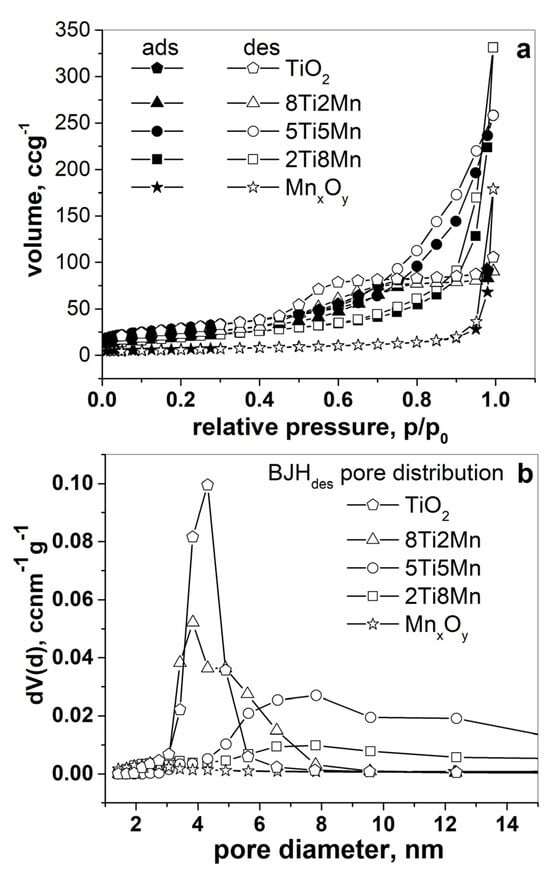
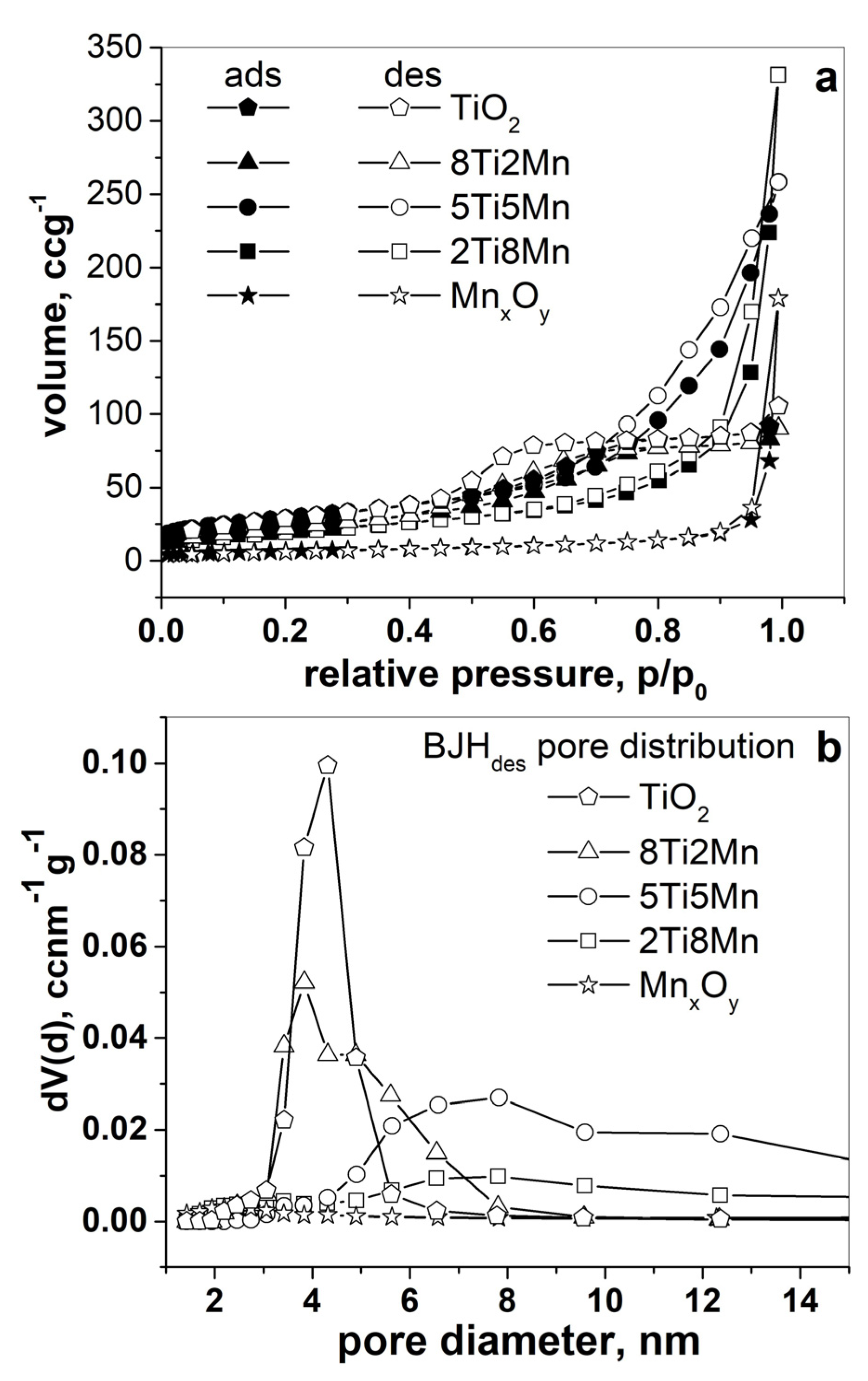
The N2 adsorption–desorption isotherms and the corresponding pore size distributions calculated using the BJH method are shown in Figure 2, while the textural properties, including the specific surface area and pore volume, are summarized in Table 1. According to the IUPAC classification, only the pure titania sample exhibits a type IV isotherm characteristic of mesoporous materials, with an H2(b) hysteresis loop indicating pore blocking due to the large size distribution of neck widths [36]. At the same time, all the other samples show reversible type II isotherms characteristic of more complex pore structures with an H3 hysteresis loop due to networks of meso-macropores. Their isotherms are characterized by a pronounced increase in nitrogen uptake at relative pressures of p/p0 = 0.8–1.0. The shape and extent of the hysteresis loops vary depending on the composition of the samples, suggesting changes in the pore structure upon incorporation of the second oxide component. The introduction of a relatively small amount of TiO2 into the MnxOᵧ material results in a pronounced increase in both the BET-specific surface area and the pore volume (Table 1). Among the mixed oxide samples, the highest specific surface area is observed for the material containing approximately equal amounts of Ti and Mn. The BJH analysis further indicates that the pore size distributions are relatively broad and heterogeneous. This heterogeneity becomes more pronounced with increasing manganese content in the binary oxide materials, suggesting that the Ti/Mn ratio has a significant influence on the development and distribution of the porous structure (Figure 2).
Figure 2.
Nitrogen physisorption isotherms (a) and pore size distribution obtained by BJH method (b) of titanium and manganese oxide materials.
3.3. SEM and TEM Analysis
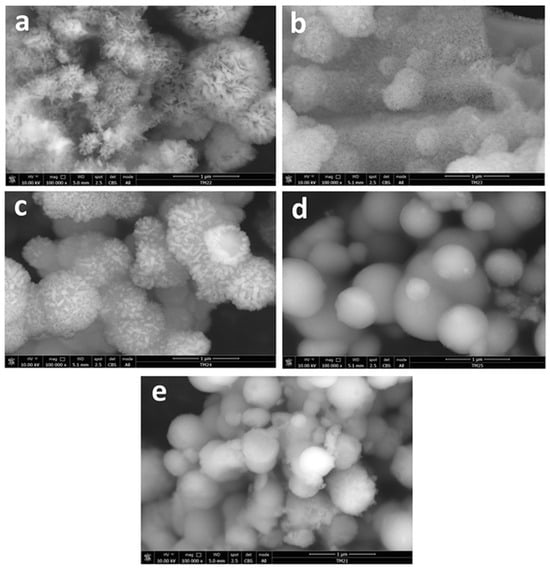
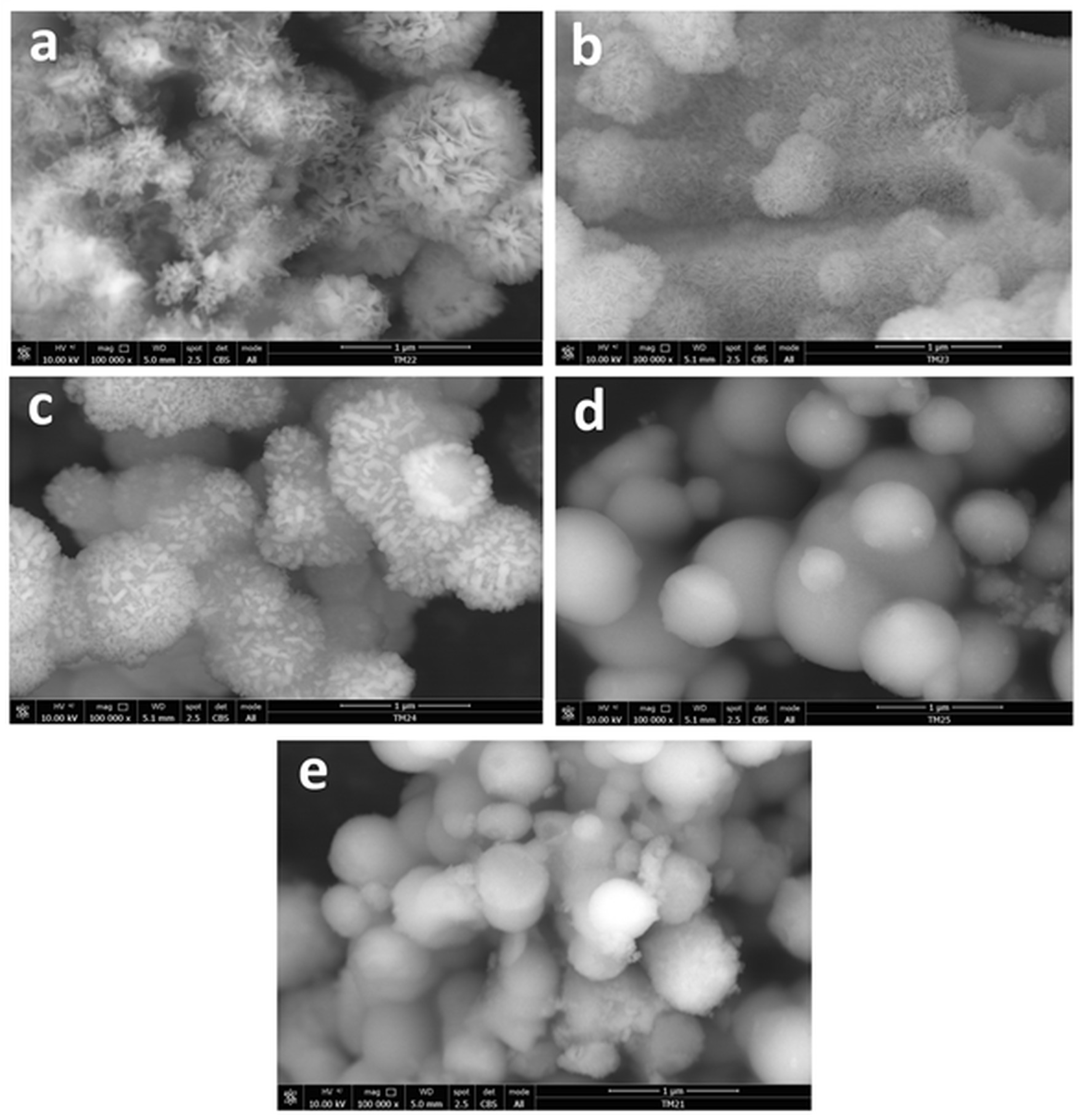
The SEM images of the titanium–manganese oxide samples (Figure 3) reveal relatively uniform, spherical particles in both the monocomponent and bicomponent materials. Upon the incorporation of manganese oxide into TiO2, smaller surface features can be observed on the titania spheres (Figure 3b–d), possibly indicating the presence of MnOx-rich domains distributed over the TiO2 surface. These morphological observations are consistent with the XRD results (Table 1), which indicate changes in the phase composition and crystallite size depending on the Ti/Mn ratio. Furthermore, SEM micrographs (a) and (c) reveal irregular aggregates and visible voids between adjacent particles, while similar features appear less pronounced in image (b). These voids may reflect larger interparticle spaces with macropore sizes arising from particle aggregation.
Figure 3.
SEM micrographs of the MnxOᵧ (a), 2Ti8Mn (b), 5Ti5Mn (c), 8Ti2Mn (d), and TiO2 (e) samples. Scale bars: 1 µm.
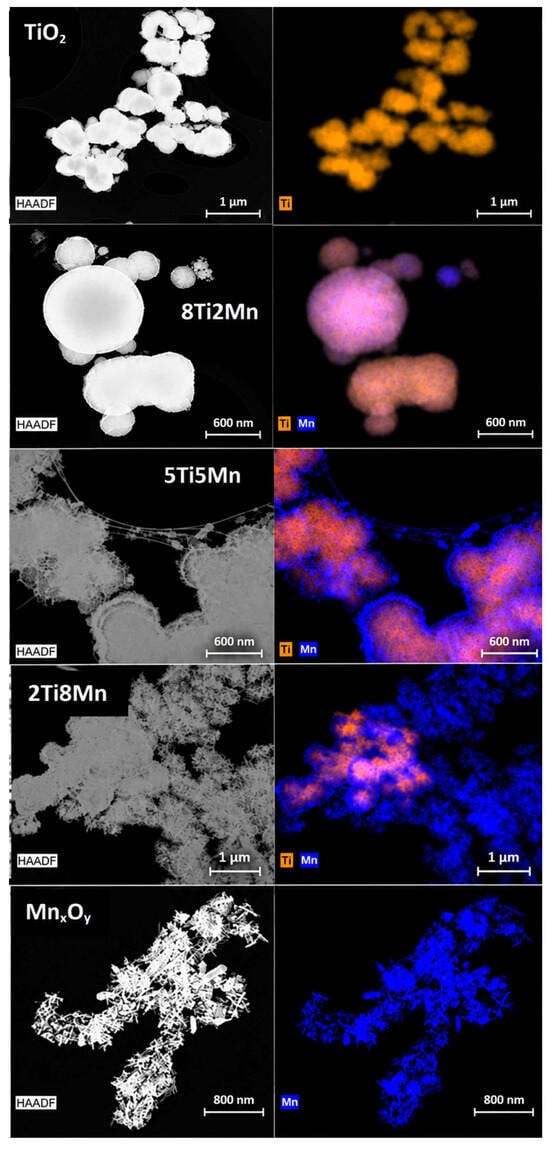
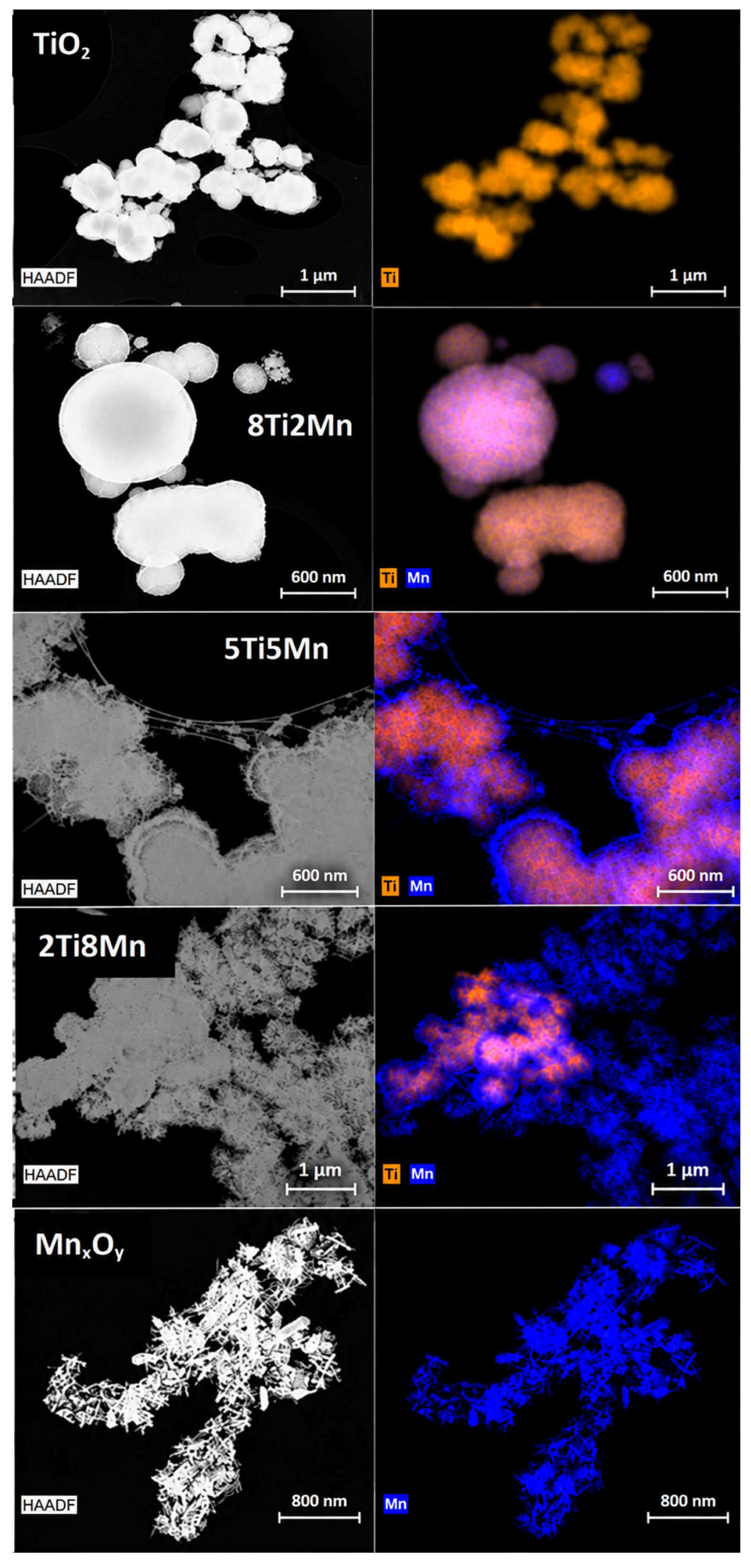
The HAADF-TEM images and corresponding EDS elemental mappings are presented in Figure 4. For the sample with a high titanium content (8Ti2Mn), the images reveal particles in which Ti and Mn are spatially distributed within the same regions, suggesting the formation of mixed Ti–Mn oxide domains as a result of interactions between the two components. At the same time, particles dominated by the anatase phase can also be identified, which can be attributed to the significantly higher Ti content in this sample. With increasing manganese content, the microstructure becomes more heterogeneous. In addition to particles containing mixed Ti–Mn oxide regions, Mn-rich domains spatially associated with TiO2 particles are observed, together with particles corresponding predominantly to manganese oxide phases. Thus, the EDS maps indicate that increasing the Mn content promotes a gradual transition from predominantly TiO2-containing particles toward a more heterogeneous distribution of Ti-rich, Mn-rich, and mixed Ti–Mn oxide regions. These observations are consistent with the SEM results and are in good agreement with the phase composition identified by XRD analysis (Table 1).
Figure 4.
HAADF TEM (left) with EDS mapping (right) images for all Ti-Mn oxide materials.
The obtained results suggest that the Mn-containing species are not uniformly dispersed over the TiO2 surface. Rather, the microstructure comprises mixed Ti–Mn oxide regions, Mn-rich domains in close spatial association with TiO2 particles, and particles predominantly composed of manganese oxide. In particular, for the Mn-rich 2Ti8Mn sample, the available microscopy data suggest a heterogeneous arrangement of manganese-rich and TiO2-containing regions, rather than a uniform MnOx coating on the TiO2 particles.
3.4. XPS Analyses
The surface chemical composition and electronic states of the investigated materials were further examined by X-ray photoelectron spectroscopy (XPS). The O 1s spectra of the samples were fitted with two components, as shown in Figure S1. In accordance with the literature [37], the component centered at approximately 529.9 eV can be assigned to oxygen species associated with the metal oxide lattice. For the mixed Ti–Mn oxide samples, this component exhibits a slight shift toward lower binding energies compared with the corresponding individual oxides. Such a shift may be related to changes in the local chemical environment of lattice oxygen resulting from the interaction between Ti- and Mn-containing species and the formation of Ti–O–Mn linkages [26]. The observed changes in the binding energy therefore provide additional evidence for electronic and structural interactions between the two oxide components. The second O 1s component, located at approximately 531.4 eV, is generally attributed to surface oxygen species with a lower degree of coordination, including chemisorbed oxygen, surface hydroxyl groups, and oxygen species such as O22− and O− [38,39]. The relative contribution of this component reflects changes in the surface oxygen environment induced by the combination of TiO2 and manganese oxide. In particular, the formation of interfacial regions between the two oxides can modify the coordination and mobility of oxygen species and may facilitate the generation of oxygen-deficient sites, including oxygen vacancies. These structural features are potentially important for the redox behavior of the mixed oxides, as oxygen vacancies and mobile surface oxygen species can participate in oxidation–reduction processes and contribute to the transfer of oxygen between the catalyst surface and the reacting molecules [40,41]. Thus, the XPS results suggest that the formation of Ti–Mn oxide interfaces modifies not only the chemical environment of lattice oxygen but also the population of surface oxygen species, which may contribute to the catalytic behavior of the bicomponent materials. The Ti 2p spectrum of the individual TiO2 sample is characterized by two intense components at approximately 458.5 and 464.1 eV, corresponding to the Ti 2p3/2 and Ti 2p1/2 levels, respectively (Figure S2). The measured binding energies are characteristic of Ti4+ species in TiO2 and are consistent with previously reported values [41]. The presence of Ti predominantly in the +4 oxidation state indicates that the anatase phase retains its characteristic titanium chemical environment, while any changes in the Ti 2p binding energies observed for the mixed oxides can be considered in relation to the interaction between Ti and Mn species (Table 2, Figure S2).
Table 2.
Surface area elemental composition from XPS analyses for titanium and magnesium oxide materials. The used photoelectrons are indicated, and RSF were utilized from the CasaXPS library.
The Mn 2p3/2 XPS spectra exhibit a characteristic multiplet structure, indicating the coexistence of Mn3+ and Mn4+ species (Figure S3). According to the literature [42,43], Mn3+ is characterized by components at approximately 640.8, 641.9, 643.1, 644.6, and 646.2 eV, with relative contributions of 18.9, 44.5, 25.3, 8.5, and 3.1%, respectively, while the Mn4+ multiplet consists of components at approximately 641.9, 642.7, 643.4, 644.2, 645.0, and 646.0 eV, with relative contributions of 41.7, 26.5, 15.5, 9.1, 4.9, and 2.5%, respectively. These results are consistent with the XRD data (Table 1). Ti4+ is the predominant titanium species in all binary materials (Table S4), while the Ti3+ contribution is approximately 10% and remains nearly unchanged with variation in the Ti/Mn ratio. A small contribution from Ti3O5 is also detected. The Ti3+ species are identified by components at approximately 455.9 and 461.4 eV, whereas the components at 457.5 and 463.0 eV are attributed to partially reduced Ti2·5+ species [38,41]. For all mixed materials, the Mn 2p3/2 spectra indicate the presence of Mn2+ species, characterized by a multiplet structure with components at approximately 640.2, 641.1, 642.1, 643.0, 644.2, and 645.9 eV, with relative contributions of 24.0, 27.8, 22.1, 12.5, 4.7, and 9.1%, respectively [44]. The relative contribution of Mn2+ is highest for the sample with the lowest manganese content. With increasing Mn content, particularly for the 5Ti5Mn sample, the fraction of Mn2+ decreases, accompanied by a higher contribution of Mn3+ and Mn4+ species. For the sample with the highest Mn content, the distribution changes again, with Mn2+ representing the most abundant oxidation state (Table 2). This non-monotonic behavior suggests that the distribution of Mn oxidation states depends not only on the Mn content but also on changes in the local chemical environment and charge compensation associated with the formation of Ti–O–Mn interfacial linkages. Taken together, the XPS (Table 2) and XRD results (Table 1) suggest that the close interaction between TiO2 and MnxOᵧ promotes partial incorporation of Mn species into the TiO2 structure, together with the stabilization of manganese in lower oxidation states and an increased concentration of oxygen-deficient surface sites. These changes are particularly relevant to the formation of Ti–O–Mn interfacial bonds and the modification of the local coordination environment of both Ti and Mn species. According to the literature [45,46], the stabilization of metal ions in lower oxidation states may result from improved dispersion of the oxide phase, changes in metal–oxygen coordination, and charge redistribution associated with the formation of Ti–O–Mn bonds. Such structural and electronic modifications may also contribute to the enhanced oxygen mobility and redox properties of the mixed oxide materials.
3.5. Temperature-Programmed Reduction with Hydrogen
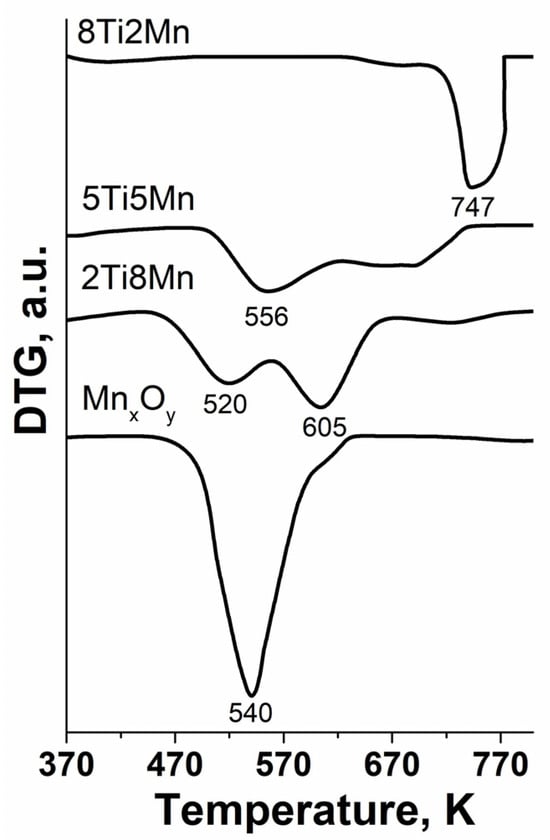
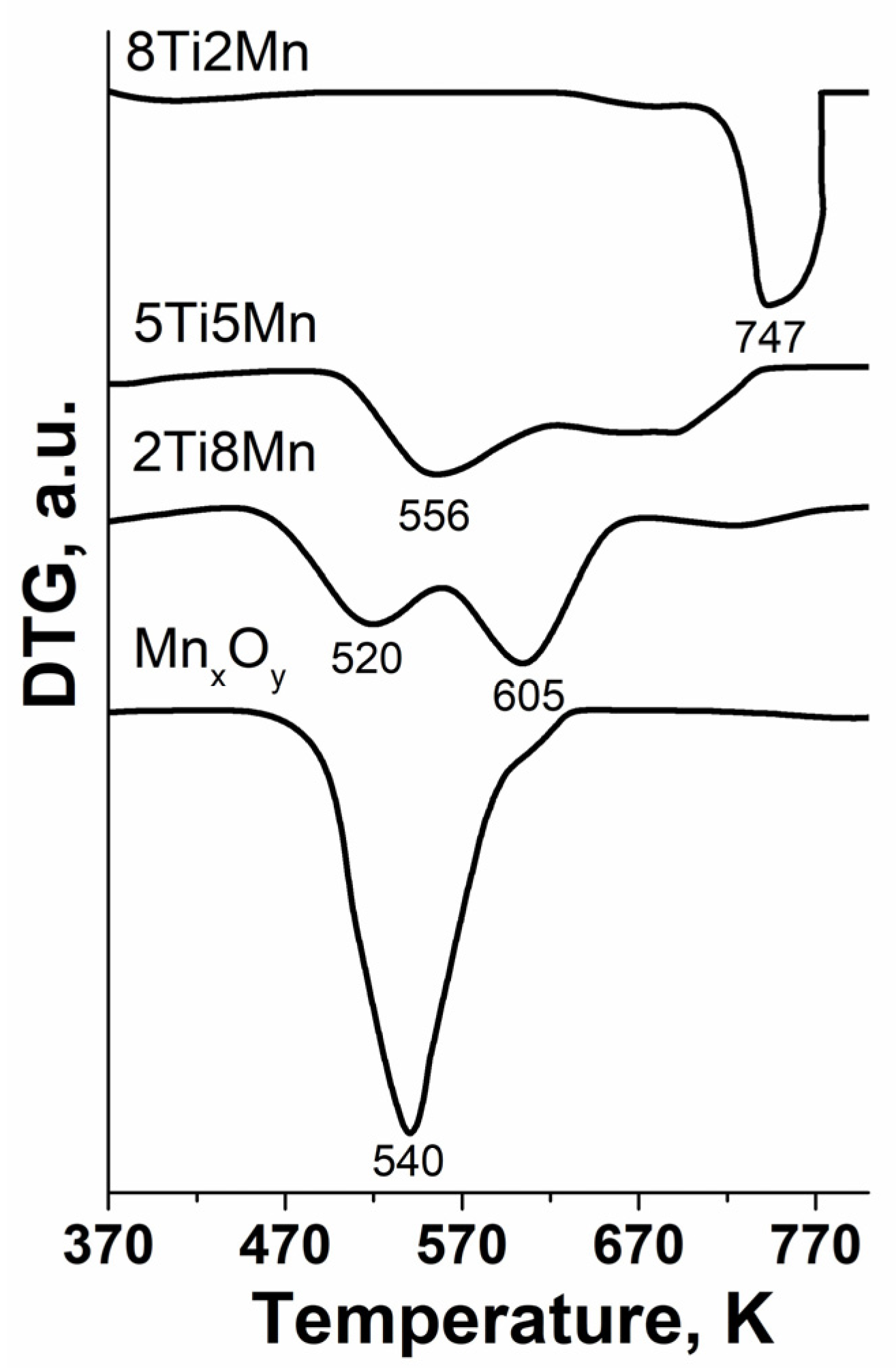
Figure 5 presents the H2 temperature-programmed reduction profiles of the titanium and manganese oxide materials. Pure TiO2 was not included in the TPR/DTG comparison because it exhibits negligible reduction under the experimental conditions employed. In accordance with the literature [47,48], the pure manganese oxide sample, containing Mn2O3 (Ia-3) and MnO2 (I4/m) phases (Table 1), exhibits two distinct reduction effects with maxima at approximately 585 and 663 K. The first peak can be attributed to the reduction of Mn3+ and Mn4+ species toward lower-valence Mn states, while the high-temperature peak is associated with the further reduction of Mn3O4 to MnO. In contrast, the manganese oxide predominantly exhibits a single reduction step centered at approximately 540 K, indicating a considerably higher reducibility of this material. The introduction of TiO2 into the manganese oxide system, as observed for the 2Ti8Mn sample, results in the appearance of a second reduction feature characteristic of manganese oxide, which is shifted toward lower temperatures. The intensity of this feature gradually decreases with decreasing Mn content in the mixed oxides. Considering the XRD and other physicochemical characterization results, the low-temperature reduction effect can be associated with the removal of relatively labile oxygen species from the oxide lattice, including oxygen located in the interfacial regions between Mn- and Ti-containing species. This interpretation is also supported by the XPS results (Table 2), which demonstrate the presence of a considerable fraction of Mn2+ species and oxygen-deficient sites in the mixed oxide samples. With increasing TiO2 content, the reduction effects progressively shift toward higher temperatures. For the 8Ti2Mn sample, only one well-defined high-temperature reduction feature is observed, which may be related to highly dispersed manganese oxide species strongly interacting with the TiO2 matrix. The stronger interaction between the two oxide components appears to stabilize the manganese species and consequently increase their reduction temperature. Further evidence for this interpretation is provided by the formation of a MnTiO3 phase after reduction, as identified by XRD, with a crystallite size of approximately 39 nm (PDF 01-077-1858; Table 1). Overall, the H2-TPR results demonstrate that the Ti/Mn ratio strongly influences the reducibility of the mixed oxides, reflecting changes in the dispersion, local environment, and interaction of Mn species with the TiO2 component.
Figure 5.
TPR-DTG for the titania and manganese oxide materials.
3.6. Methanol Decomposition
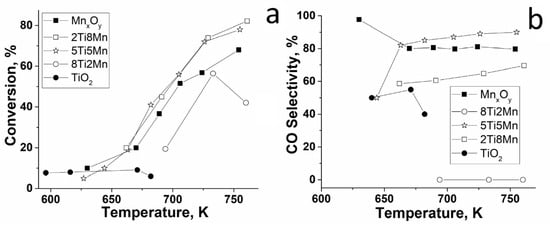
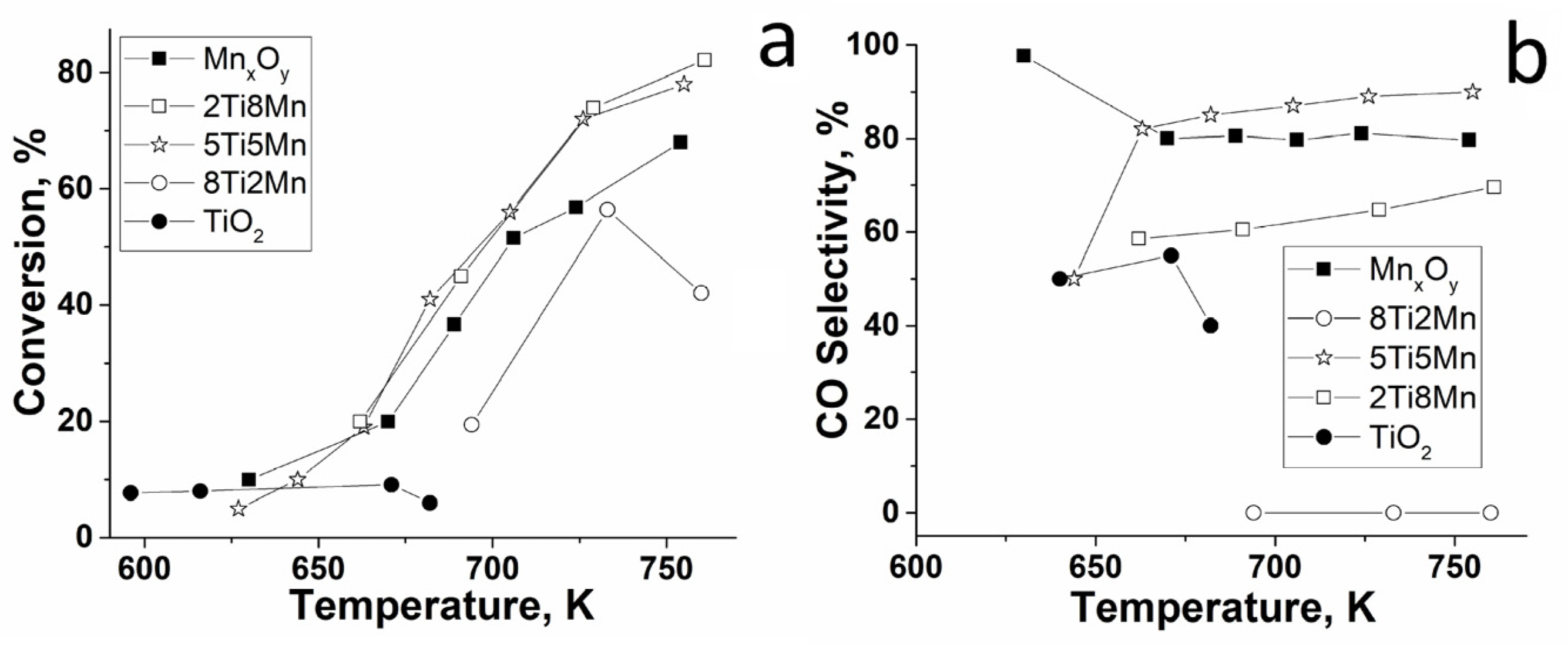
Figure 6 presents the temperature-dependent catalytic performance of the Ti–Mn oxide materials in methanol decomposition. The product distribution includes methane (CH4), carbon monoxide (CO), carbon dioxide (CO2), and dimethyl ether (DME), with their relative proportions depending on the catalyst composition and reaction temperature (Table 3). The monocomponent TiO2 exhibits the lowest catalytic activity over the investigated temperature range and a pronounced tendency toward rapid deactivation. At 700 K, the main carbon-containing products over TiO2 are CH4 (41%), CO (30%), and DME (20%) (Table 3), indicating a relatively low contribution to the selective formation of synthesis gas. In contrast, the monocomponent manganese oxide exhibits considerably higher activity and CO selectivity than TiO2. The incorporation of TiO2 into manganese oxide significantly affects the catalytic behavior of the resulting materials. The Mn-rich bicomponent samples, particularly 2Ti8Mn and 5Ti5Mn, exhibit higher activity than the individual oxide components. The highest CO selectivity among the investigated materials is observed for 5Ti5Mn (Table 3), with a value close to that of the monocomponent MnxOᵧ material (Figure 6). This behavior indicates that an appropriate combination of Ti and Mn species favors the reaction pathways leading to CO formation and synthesis gas production. In contrast, the 8Ti2Mn sample exhibits the lowest activity and CO selectivity among the mixed oxides, with a pronounced decrease in activity above 720 K. This behavior is consistent with its relatively low reducibility observed by H2-TPR (Figure 5) and can be associated with the formation of a well-crystallized MnTiO3 phase with an average crystallite size of approximately 39 nm (Table 1). The formation of this mixed phase under reducing conditions appears to suppress the pathways leading to CO formation, while favoring CH4 (40%) and DME (26%) formation. To provide an additional comparison of the catalysts while accounting for differences in their textural properties, the methanol conversion was also normalized to the BET specific surface area (X/SBET), and the resulting values are reported in Table 3. This parameter is used as a comparative descriptor rather than as a direct measure of intrinsic catalytic activity, since the BET surface area does not necessarily represent the surface area of catalytically active sites. The highest SA values are obtained for the monocomponent manganese oxide and 2Ti8Mn, followed by 5Ti5Mn, whereas the lowest values are observed for 8Ti2Mn and TiO2. The decrease in SA with decreasing manganese content further emphasizes the important contribution of the Mn-containing phase to methanol decomposition.
Figure 6.
Methanol decomposition (a) and CO selectivity (b) vs. temperature for various titania and manganese oxide catalysts.
Table 3.
Specific activity SA (per unit BET, T = 700K) and selectivity to various products at 700K of methanol decomposition reaction.
The product distribution can be interpreted in terms of the different reaction pathways available on the oxide surfaces. According to [8], methanol initially interacts with oxide surfaces through the formation of surface methoxy species following O–H bond cleavage. These intermediates can subsequently undergo dehydrogenation on basic and redox-active sites, favoring CO and H2 formation, or dehydration on acidic sites, leading to DME. The higher DME formation observed for TiO2 and particularly for 8Ti2Mn is consistent with a greater contribution of acidic sites and the lower reducibility of the manganese species. In contrast, the higher CO selectivity of the Mn-containing materials suggests that accessible MnxOᵧ species and Ti–O–Mn environments favor the dehydrogenation pathway. Methane formation may additionally proceed through C–O bond cleavage of methanol on acid–base sites [8,9]. Thus, the observed differences in product distribution may be associated with variations in the redox and surface chemical properties of the catalysts. The structure–activity relationship is further supported by the combined physicochemical characterization results. In the Mn-rich materials, particularly 2Ti8Mn and 5Ti5Mn, relatively large MnxOᵧ particles containing Mn in different oxidation states are predominantly distributed over the TiO2 surface (Table 1 and Table 2). These Mn-rich regions provide accessible manganese-containing sites and maintain a high degree of redox flexibility, which is favorable for methanol decomposition. In contrast, the Ti-rich 8Ti2Mn sample contains a higher contribution of Mn2+ species and exhibits lower reducibility, suggesting a higher degree of dispersion and/or stronger interaction of Mn species with the TiO2 matrix. The formation of Ti–O–Mn linkages and a relatively difficult-to-reduce mixed oxide phase may stabilize these species and decrease their accessibility. The presence of anatase-rich regions may further contribute to the lower availability of Mn-containing sites.
Importantly, the catalytic results indicate that a high fraction of manganese species in lower oxidation states does not necessarily result in the highest catalytic performance. Although 2Ti8Mn exhibits the highest specific activity among the mixed oxides (0.69 mol m−2 at 700 K), its activity remains lower than that of the monocomponent MnxOᵧ catalyst. This suggests that the oxidation-state distribution alone cannot explain the catalytic behavior; the accessibility of manganese-containing active sites, their local chemical environment, and their interaction with TiO2 must also be considered. Furthermore, the highest CO selectivity observed for 5Ti5Mn (87% at 700 K), compared with the substantial CH4 formation over 2Ti8Mn, indicates that the relative contribution of the different reaction pathways depends on the balance between the redox and acid–base properties of the mixed oxide surface. Overall, the catalytic behavior of the TiO2–MnxOᵧ materials is governed by the combined effects of manganese dispersion, phase composition, oxidation-state distribution, active-site accessibility, and the strength of the Ti–Mn interaction.
The catalytic behavior of the TiO2–MnxOᵧ materials depends on the surface acid–base properties, manganese oxidation states, and interactions between the two oxide components. Methanol decomposition generally proceeds through surface methoxy intermediates, which can undergo dehydrogenation to form CO and H2 or dehydration to form DME [8]. The XPS results (Table 2) and H2-TPR profiles (Figure 5) indicate that the Ti/Mn ratio influences the oxidation-state distribution and reducibility of the catalysts. Interfacial Ti–O–Mn linkages may modify the electronic properties and redox behavior of the oxide species, thereby affecting the catalytic pathways. The higher CO selectivity of the Mn-containing materials suggests a greater contribution of the dehydrogenation pathway, whereas the lower CO selectivity and higher DME formation over 8Ti2Mn are consistent with its lower reducibility and stronger interaction between Mn species and the TiO2 matrix. Among the mixed oxides, 2Ti8Mn exhibits the highest specific catalytic activity, highlighting the importance of Mn content and its interaction with TiO2.
The role of TiO2 in the mixed oxide catalysts extends beyond that of a simple structural support. Interactions between TiO2 and MnOx may lead to the formation of interfacial Ti–O–Mn linkages, which modify the local coordination environment and electronic properties of manganese species. Such interactions may influence the dispersion and crystallite size of Mn-containing domains, limit their aggregation, and affect the stabilization of different manganese oxidation states. The coexistence of Mn2+, Mn3+, and Mn4+ species, together with reduced Ti species detected by XPS, suggests the presence of electronic interactions between the two oxide components. In addition, Ti3+ centers and associated oxygen-deficient sites may contribute to electron transfer and surface oxygen mobility, thereby influencing the redox transformations of manganese species during methanol decomposition. The structural modifications of the anatase phase and the formation of mixed Ti–Mn oxide regions further highlight the role of Ti–Mn interactions in shaping the catalytic properties of the mixed oxides.
The catalytic performance of the most active 2Ti8Mn catalyst is consistent with previous reports on Mn- and Ti-containing oxide catalysts for methanol decomposition. Similar to the Ce–Ti and Zr–Ti mixed oxides reported by Tsoncheva et al. [8,9] and the MnOx catalysts described by Šťastný et al. [25], the catalytic behavior of the present material appears to be governed by the redox properties of manganese species and the interaction between the oxide components. The high specific activity of 2Ti8Mn (0.69 mol m−2 at 700 K) further supports the beneficial role of Mn-containing species associated with the TiO2 component in promoting methanol decomposition. Although direct quantitative comparison with previously reported catalysts is complicated by differences in catalyst composition and experimental conditions, the present results are consistent with the previously established importance of manganese redox properties and metal–oxide interactions.
The catalytic stability of the investigated TiO2–MnxOᵧ catalysts was evaluated during methanol decomposition at 680 K over approximately 30 min. Methanol conversion remained essentially constant over the monitoring period, while product selectivity showed no significant changes, indicating stable catalytic performance under the investigated reaction conditions.
4. Conclusions
In summary, nanostructured TiO2–MnxOᵧ catalysts with different Ti/Mn ratios were successfully synthesized by the homogeneous co-precipitation method. The materials exhibited composition-dependent textural, structural, surface, and redox properties, reflecting differences in phase composition, manganese dispersion, and interactions between the two oxide components. Their catalytic performance in methanol decomposition was strongly influenced by the Ti/Mn ratio, with the Mn-rich compositions, particularly 2Ti8Mn and 5Ti5Mn, exhibiting enhanced catalytic activity compared with the Ti-rich material. Among the mixed oxides, 2Ti8Mn showed the highest BET surface area-normalized specific activity (0.69 mol m−2 at 700 K), whereas 5Ti5Mn exhibited the highest CO selectivity (87% at 700 K), highlighting the distinct influence of catalyst composition on activity and product distribution. The results indicate that the catalytic behavior is closely related to the distribution, oxidation state, and accessibility of the manganese-containing species. Increasing the manganese content promotes the formation of Mn-rich oxide domains in close spatial association with TiO2-containing regions, whereas higher titanium content favors stronger Ti–Mn interactions, the formation of mixed oxide domains, and lower reducibility. Furthermore, the coexistence of Mn2+, Mn3+, and Mn4+ species, together with reduced titanium species and oxygen-deficient surface sites, suggests that interfacial interactions between the oxide components modify the surface electronic and redox properties. Overall, the findings demonstrate that the catalytic behavior of TiO2–MnxOᵧ mixed oxides is governed by the combined effects of phase composition, manganese dispersion, oxidation-state distribution, active-site accessibility, and Ti–Mn interactions, emphasizing the importance of controlling the Ti/Mn ratio to tailor catalytic activity and product selectivity.
Supplementary Materials
The following supporting information can be downloaded at https://www.mdpi.com/article/10.3390/environments13110630/s1. Figure S1: O 1s XPS spectra of titanium and manganese oxide catalysts; Figure S2: Ti2p XPS spectra of titanium and manganese oxide catalysts; Figure S3: Mn2p XPS spectra of titanium and manganese oxide catalysts.
Author Contributions
Conceptualization, G.I., M.D. and I.S.; methodology, I.S. and G.I.; investigation, G.I.; I.S.; D.K.; B.P.; M.D.; M.K., N.B. and M.O.; writing—original draft preparation, G.I., I.S. and M.D.; writing—review and editing, G.I., I.S. and M.D.; funding acquisition, G.I. All authors have read and agreed to the published version of the manuscript.
Funding
This research was funded by the Bulgarian National Scientific Fund, grant number KП-06-H97/14/2025.
Data Availability Statement
The data presented in this study are available on request from the corresponding author.
Acknowledgments
Research equipment of the project № BG16RFPR002-1.014-0006 “National Centre of Excellence Mechatronics and Clean Technologies” was used for experimental work financially supported by the European Regional Development Fund under the “Research Innovation and Digitization for Smart Transformation” program 2021-2027. The authors gratefully acknowledge Martin Šťastný, Jiří Henych, and Jakub Tolasz from the Institute of Inorganic Chemistry of the Czech Academy of Sciences for their assistance with the TEM and SEM analyses and for their valuable contributions to the interpretation of the physicochemical characterization results.
Conflicts of Interest
The authors declare no conflicts of interest.
Abbreviations
| XRD | X-ray diffraction |
| TEM | Transmission electron microscopy |
| SEM | Scanning Electron Microscope |
| XPS | X-ray photoelectron spectroscopy |
| TPR–TG | Temperature-programmed reduction–thermo-gravimetric experiments |
References
- Al Mubarak, F.; Rezaee, R.; Wood, D.A. Economic, Societal, and Environmental Impacts of Available Energy Sources: A Review. Eng 2024, 5, 1232–1265. [Google Scholar] [CrossRef] [Scilit]
- Elwalily, A.; Verkama, E.; Mantei, F.; Kaliyeva, A.; Pounder, A.; Sauer, J.; Nestler, F. Sustainable aviation fuel production via the methanol pathway: A technical review. Sustain. Energy Fuels 2025, 9, 5151–5180, Correction in Sustain. Energy Fuel 2025, 9, 5386. [Google Scholar] [CrossRef] [Scilit]
- Li, H.; Ma, C.; Zou, X.; Li, A.; Huang, Z.; Zhu, L. On-board methanol catalytic reforming for hydrogen Production-A review. Int. J. Hydrogen Energy 2021, 46, 22303–22327. [Google Scholar] [CrossRef] [Scilit]
- McKinlay, C.J.; Turnock, S.R.; Hudson, D.A. Route to zero emission shipping: Hydrogen, ammonia or methanol. Int. J. Hydrogen Energy 2021, 46, 28282–28297. [Google Scholar] [CrossRef] [Scilit]
- Perry, M.L.; Fuller, T.F. A Historical Perspective of Fuel Cell Technology in the 20th Century. Electrochem. Soc. 2002, 149, S59–S67. [Google Scholar] [CrossRef] [Scilit]
- Lapuerta, M.; Armas, O.; Rodríguez-Fernández, J. Effect of biodiesel fuels on diesel engine emissions. Prog. Ener. Comb. Sci. 2008, 34, 198–223, Correction in Prog. Ener. Comb. Sci. 2009, 35, 383. [Google Scholar] [CrossRef] [Scilit]
- Dey, S.; Mehta, N.S. Selection of Manganese oxide catalysts for catalytic oxidation of Carbon monoxide at ambient conditions. Environ. Sustain. 2020, 1, 100003. [Google Scholar] [CrossRef] [Scilit]
- Tsoncheva, T.; Mileva, A.; Issa, G.; Dimitrov, M.; Kovacheva, D.; Henych, J.; Scotti, N.; Kormunda, M.; Atanasova, G.; Štengl, V. Template-assisted hydrothermally obtained titania-ceria composites and their application as catalysts in ethyl acetate oxidation and methanol decomposition with a potential for sustainable environment protection. Appl. Surf. Sci. 2017, 396, 1289–1302. [Google Scholar] [CrossRef] [Scilit]
- Tsoncheva, T.; Mileva, A.; Issa, G.; Dimitrov, M.; Kovacheva, D.; Henych, J.; Kormunda, M.; Scotti, N.; Slušná, M.; Tolasz, J.; et al. Titania and zirconia binary oxides as catalysts for total oxidation of ethyl acetate and methanol decomposition. J. Environ. Chem. Eng. 2018, 6, 2540–2550. [Google Scholar] [CrossRef] [Scilit]
- Tsoncheva, T.; Sarkadi-Priboczki, E.; Dimitrov, M.; Genova, I. Nanostructured copper, chromium, and tin oxide multicomponent materials as catalysts for methanol decomposition: 11C-radiolabeling study. J. Colloid Interface Sci. 2013, 389, 244. [Google Scholar] [CrossRef] [Scilit]
- Oveisi, H.; Jiang, X.; Nemoto, Y.; Beitollahi, A.; Yamauchi, Y. Cerium-doped mesoporous TiO2 thin films: Controlled crystallization of anatase with retention of highly ordered mesostructure. Micro. Mesoporous Mater. 2011, 139, 38–44. [Google Scholar] [CrossRef] [Scilit]
- Lin, J.; Yu, J.C. An investigation on photocatalytic activities of mixed TiO2-rare earth oxides for the oxidation of acetone in air. J. Photochem. Photobiol. A Chem. 1998, 116, 63–67. [Google Scholar] [CrossRef] [Scilit]
- Hu, Y.; Liu, T.; Shen, M.; Zhu, H.; Wei, S.; Hong, X.; Ding, W.; Dong, L.; Chen, Y. Influence of titanium oxide on the surface interactions of MO (M = Cu and Ni)/γ-Al2O3 catalysts. J. Solid State Chem. 2003, 170, 58–67. [Google Scholar] [CrossRef] [Scilit]
- Hadjiivanov, K.I.; Klissurski, D.G. Surface chemistry of titania (anatase) and titania-supported catalysts. Chem. Soc. Rev. 1996, 25, 61–69. [Google Scholar] [CrossRef] [Scilit]
- Recio-Poo, M.; Morales-García, Á.; Illas, F.; Bromley, S.T. Crystal properties without crystallinity? Influence of surface hydroxylation on the structure and properties of small TiO2 nanoparticles. Nanoscale 2023, 15, 4809–4820. [Google Scholar] [CrossRef] [Scilit]
- Zhong, Y.; Wang, R.; Chen, J.; Duan, C.; Huang, Z.; Yu, S. Surface-Terminated Hydroxyl Groups for Deciphering the Facet-Dependent Photocatalysis of Anatase TiO2. ACS Appl. Mater. Interfaces 2022, 14, 17601–17609. [Google Scholar] [CrossRef] [Scilit]
- Paunović, V.; Rellán-Piñeiro, M.; López, N.; Pérez-Ramírez, J. Activity differences of rutile and anatase TiO2 polymorphs in catalytic HBr oxidation. Catal. Today 2021, 369, 221–226. [Google Scholar] [CrossRef] [Scilit]
- Carja, G.; Kameshima, Y.; Okada, K.; Madhusoodana, C.D. Mn–Ce/ZSM5 as a new superior catalyst for NO reduction with NH3. Appl. Catal. B Environ. Energy 2007, 73, 60–64. [Google Scholar] [CrossRef] [Scilit]
- Xu, Y.H.; Lei, B.; Guo, L.; Zhou, W.; Liu, Y. Preparation, characterization and photocatalytic activity of manganese doped TiO2 immobilized on silica gel. J. Hazard. Mater. 2008, 160, 78–82. [Google Scholar] [CrossRef] [Scilit]
- Koo, S.; Lee, J.; Lee, J.; Yoon, S.; Kim, D. Importance of metal–oxygen bond for stable oxygen-redox reaction in Li-excess layered oxides. Energy Storage Mater. 2021, 42, 645–772. [Google Scholar] [CrossRef] [Scilit]
- Le, M.-L.-P.; Strobel, P.; Colin, C.V.; Pagnier, T.; Alloin, F. Spinel-type solid solutions involving Mn4+ and Ti4+: Crystal chemistry, magnetic and electrochemical properties. J. Phys. Chem. Solids 2011, 72, 124–135. [Google Scholar] [CrossRef] [Scilit]
- Tsoncheva, T.; Rosmini, C.; Mihaylov, M.; Henych, J.; Chakarova, K.; Velinov, N.; Kovacheva, D.; Němečková, Z.; Kormunda, M.; Ivanova, R.; et al. Nickel-Decorated Mesoporous Iron–Cerium Mixed Oxides: Microstructure and Catalytic Activity in Methanol Decomposition. ACS Appl. Mater. Interfaces 2022, 14, 873–890. [Google Scholar] [CrossRef] [Scilit]
- Tsoncheva, T.; Mileva, A.; Issa, G.; Henych, J.; Tolasz, J.; Dimitrov, M.; Kovacheva, D.; Atanasova, G.; Štengl, V. Mesoporous copper-ceria-titania ternary oxides as catalysts for environmental protection: Impact of Ce/Ti ratio and preparation procedure. Appl. Catal. A Gen. 2020, 595, 117487. [Google Scholar] [CrossRef] [Scilit]
- Papavasiliou, J.; Avgouropoulos, G.; Ioannides, T. Combined steam reforming of methanol over Cu–Mn spinel oxide catalysts. J. Catal. 2007, 251, 7–20. [Google Scholar] [CrossRef] [Scilit]
- Šťastný, M.; Issa, G.; Popelková, D.; Ederer, J.; Kormunda, M.; Kříženecká, S.; Henych, J. Nanostructured manganese oxides as highly active catalysts for enhanced hydrolysis of bis(4-nitrophenyl)phosphate and catalytic decomposition of methanol. Catal. Sci. Technol. 2021, 11, 1766–1779. [Google Scholar] [CrossRef] [Scilit]
- Bonelli, B.; Tammaro, O.; Martinovic, F.; Nasi, R.; Dell’Agli, G.; Rivolo, P.; Giorgis, F.; Ditaranto, N.; Deorsola, F.A.; Esposito, S. Reverse Micelle Strategy for the Synthesis of MnOx–TiO2 Active Catalysts for NH3-Selective Catalytic Reduction of NOx at Both Low Temperature and Low Mn Content. ACS Omega 2021, 6, 24562–24574. [Google Scholar] [CrossRef] [Scilit]
- Blankenship, A.N.; Toderașc, A.-T.; Paunović, V.; van Bokhoven, J.A. Mn/TiO2 Catalysts for the High-Yield Partial Oxidation of Methane with Molecular Oxygen to a Methyl Ester. Angew. Chem. Int. Ed. 2025, 64, e202508465. [Google Scholar] [CrossRef] [Scilit]
- Damkale, S.R.; Arbuj, S.S.; Umarji, G.G.; Rane, S.B.; Kale, B.B. Highly crystalline anatase TiO2 nanocuboids as an efficient photocatalyst for hydrogen generation. RSC Adv. 2021, 11, 7587–7599. [Google Scholar] [CrossRef] [Scilit]
- Kunthakudee, N.; Ramakul, P.; Serivalsatit, K.; Hunsom, M. Photosynthesis of Au/TiO2 nanoparticles for photocatalytic gold recovery from industrial gold-cyanide plating wastewater. Sci. Rep. 2022, 12, 21956. [Google Scholar] [CrossRef] [Scilit]
- Li, J.; Smith, R.L.; Xu, S.; Li, D.; Yang, J.; Zhang, K.; Shen, F. Manganese oxide as an alternative to vanadium-based catalysts for effective conversion of glucose to formic acid in water. Green Chem. 2022, 24, 315–324. [Google Scholar] [CrossRef] [Scilit]
- Liu, W.; Men, Y.; Ji, F.; Shi, F.; Wang, J.; Liu, S.; Magkoev, T.T.; An, W. Boosting Catalytic Combustion of Ethanol by Tuning Morphologies and Exposed Crystal Facets of α-Mn2O3. Catalysts 2023, 13, 865. [Google Scholar] [CrossRef] [Scilit]
- Dong, X.; Wang, H.; Wang, J.; He, Y.; Yang, P.; Wang, S.; Chen, X.; Yang, C.; Lu, F. The effects of calcination on the electrochemical properties of manganese oxides. Nanoscale Adv. 2023, 5, 5309–5321. [Google Scholar] [CrossRef] [Scilit]
- Fujishima, A.; Zhang, X. Titanium dioxide photocatalysis: Present situation and future approaches. C. R. Chim. 2006, 9, 750–760. [Google Scholar] [CrossRef] [Scilit]
- Koduri, R.; Lopez, M. Influence of Mn on dielectric and piezoelectric properties of A-site and B-site modified PLZT nano-ceramics for sensor and actuator applications. J. Mater. Sci. Mater. Electron. 2008, 19, 669–675. [Google Scholar] [CrossRef] [Scilit]
- Štengl, V.; Bludská, J.; Opluštil, F.; Němec, T. Mesoporous titanium–manganese dioxide for sulphur mustard and soman decontamination. Mater. Res. Bull. 2011, 46, 2050–2056. [Google Scholar] [CrossRef] [Scilit]
- Thommes, M.; Kaneko, K.; Neimark, A.V.; Olivier, J.P.; Rodriguez-Reinoso, F.; Rouquerol, J.; Sing, K.S.W. Physisorption of gases, with special reference to the evaluation of surface area and pore size distribution (IUPAC Technical Report). Pure Appl. Chem. 2015, 87, 1051–1069. [Google Scholar] [CrossRef] [Scilit]
- Niemann, F.; Abdiaziz, K.; Heidelmann, M.; Yang, Y.; Tong, Y.; Fechtelkord, M.; Schmidt, T.C.; Schnegg, A.; Campen, R.K.; Peng, B.; et al. Differentiating between acidic and basic surface hydroxyls on metal oxides by fluoride substitution: A case study on blue TiO2 from laser defect engineering. Angew. Chem. Int. Ed. 2023, 62, e202213968. [Google Scholar] [CrossRef] [Scilit]
- Swapna, B.; Barnabas, M.B.; Gogoi, P.M.; Bharali, P.; Madras, G.; Sudarsanam, P. Morphology-tuned MnOx/TiO2 nanocatalysts for recycling PET plastic waste using biomass-derived ethylene glycol. Nanoscale 2025, 17, 10620–10631. [Google Scholar] [CrossRef] [Scilit]
- Ettireddy, P.R.; Ettireddy, N.; Mamedov, S.; Boolchand, P.; Smirniotis, P.G. Surface characterization studies of TiO2 supported manganese oxide catalysts for low temperature SCR of NO with NH3. Appl. Catal. B Environ. Energy 2007, 76, 123–134. [Google Scholar] [CrossRef] [Scilit]
- Li, P.; Xin, Y.; Li, Q.; Wang, Z.; Zhang, Z.; Zheng, L. Ce–Ti Amorphous Oxides for Selective Catalytic Reduction of NO with NH3: Confirmation of Ce–O–Ti Active Sites. Environ. Sci. Technol. 2012, 46, 9600–9605. [Google Scholar] [CrossRef] [Scilit]
- Wu, Z.; Jiang, B.; Liu, Y. Effect of transition metals addition on the catalyst of manganese/titania for low-temperature selective catalytic reduction of nitric oxide with ammonia. Appl. Catal. B Environ. Energy 2008, 79, 347–355. [Google Scholar] [CrossRef] [Scilit]
- Alves, A.C.; Correira, J.P.; Silva, T.M.; Montemor, M.F.; Taryba, M. In situ localized studies to unveil the charge storage mechanism of manganese oxide in aqueous media. Electrochim. Acta 2025, 519, 145840. [Google Scholar] [CrossRef] [Scilit]
- Rajagopal, K.; Kathiresan, M.; Rajaram, A.; Natarajan, A.; Natesan, K. Development of robust noble-metal free lanthanum, neodymium doped Li1.05Ni0.5Mn1.5O4 as a bifunctional electrocatalyst for electrochemical water splitting. RSC Adv. 2023, 13, 23829–23840. [Google Scholar] [CrossRef] [Scilit]
- Dahamni, M.A.; Ghamnia, M.; Naceri, S.E.; Fauquet, C.; Tonneau, D.; Pireaux, J.-J.; Bouadi, A. Spray Pyrolysis Synthesis of Pure and Mg-Doped Manganese Oxide Thin Films. Coatings 2021, 11, 598. [Google Scholar] [CrossRef] [Scilit]
- Zhao, T.; Zhang, G.; Huang, X.; Cui, R.; Feng, C.; Tang, Z. Insight Into the Origins of N2O Byproduct on Confinement Structure TiO2/MnSm Catalyst Through Sulfation Pre-Treatment for Low-Temperature NH3-SCR Reaction. EcoEnergy 2026, 4, e70055. [Google Scholar] [CrossRef] [Scilit]
- Jin, Q.; Arimoto, H.; Fujishima, M.; Tada, H. Manganese Oxide-Surface Modified Titanium (IV) Dioxide as Environmental Catalyst. Catalysts 2013, 3, 445–454. [Google Scholar] [CrossRef] [Scilit]
- Yang, Y.; Hu, Z.; Mi, R.; Li, D.; Yong, X.; Yang, H.; Liu, K. Effect of initial support particle size of MnOx/TiO2 catalysts in the selective catalytic reduction of NO with NH3. RSC Adv. 2019, 9, 4682–4692. [Google Scholar] [CrossRef] [Scilit]
- Lima, T.M.; Rodrigues, E.M.; Lima, C.G.S.; Pereira, C.A.; Varma, R.S.; Urquieta-González, E.A. Manganese and manganese–molybdenum catalysts supported on SBA-15: Effect of synthesis method on structure, redox properties, and CO oxidation performance under harsh conditions. Appl. Catal. A Gen. 2026, 715, 120858. [Google Scholar] [CrossRef] [Scilit]

Disclaimer/Publisher’s Note: The statements, opinions and data contained in all publications are solely those of the individual author(s) and contributor(s) and not of MDPI and/or the editor(s). MDPI and/or the editor(s) disclaim responsibility for any injury to people or property resulting from any ideas, methods, instructions or products referred to in the content. |
© 2026 by the authors. Licensee MDPI, Basel, Switzerland. This article is an open access article distributed under the terms and conditions of the Creative Commons Attribution (CC BY) license.