


Abstract
Soybean is a widely cultivated leguminous crop valued as a significant source of high-quality protein. Sustainable strategies to improve soybean productivity and seed quality are therefore of increasing interest. Although arbuscular mycorrhizal fungi (AMF) and mycorrhiza helper bacteria (MHB) play important roles in enhancing plant growth and bioactive compound accumulation, information regarding their combined effects on soybean remains limited. This study investigated the combined effects of AMF and MHB on soybean growth and seed quality. A greenhouse experiment was conducted with seven treatments. Soybean plants were inoculated with AMF, MHB, or their combination under greenhouse conditions and compared with uninoculated and chemical fertilizer controls. Among all treatments, co-inoculation with Acaulospora delicata AG-KKU-01 and Acinetobacter baumannii SK-G-3-2 was the most effective, significantly enhancing growth performance and productivity; moreover, this treatment resulted in the highest protein content and maintained high antioxidant activity and phenolic content compared with the chemical fertilizer treatment. Notably, both single and co-inoculation with AMF and MHB significantly improved seed quality, comparable to the chemical fertilizer treatment. Multivariate analyses further confirmed strong positive associations among growth, yield, root morphology, and seed quality traits. These findings provide new evidence for the synergistic interaction between AMF and MHB in soybean. In particular, co-inoculation with A. delicata AG-KKU-01 and Ac. baumannii SK-G-3-2 showed great potential as a sustainable microbial consortium for improving soybean productivity and seed quality.
1. Introduction
As a globally significant leguminous crop, soybean (Glycine max (L.) Merr.) is widely cultivated and recognized as an important source of dietary protein. Soybean seeds are highly nutritious, containing approximately 35–45% protein, 15–25% oil, and about 33% carbohydrates, of which up to 16.6% are soluble sugars [1]. In addition, soybean seeds contain various bioactive compounds, including phenolic compounds [2] and antioxidants [3], which contribute to their nutritional and functional value and may provide health-promoting effects [4]. However, soybean production is increasingly challenged by climate change and other environmental constraints, which can negatively affect plant growth and productivity and hinder efforts to improve crop quality and production efficiency [5]. Soil nutrient imbalances and variations in agricultural management practices are among the major factors that can adversely affect soybean yield and quality. Several approaches have been developed to increase the quality of soybeans through the application of chemical fertilizers and other agricultural inputs; however, these approaches may be costly and environmentally unsustainable [6,7]. One of the most promising biological approaches is the use of plant growth-promoting microorganisms (PGPMs), which can reduce reliance on synthetic fertilizers while promoting the growth and yield of soybean [8,9]. Among these beneficial microorganisms, arbuscular mycorrhizal fungi (AMF) and mycorrhiza helper bacteria (MHB) have received considerable attention due to their beneficial interactions with plants and their potential as environmentally friendly alternatives to conventional agricultural inputs.
AMF are beneficial soil microorganisms that commonly establish symbiotic associations with the roots of most terrestrial plants [10]. Through these associations, AMF facilitate nutrient acquisition and transfer, thereby improving plant nutritional status [11]. In addition, their extensive extraradical hyphal networks enhance nutrient and water uptake, contributing to improved plant growth, biomass, bioactive compound accumulation, and crop productivity [12]. Furthermore, the establishment and functioning of AMF–plant symbioses can also be influenced by interactions with associated soil microorganisms. Among these microorganisms, MHB are a functional group of soil bacteria associated with mycorrhizal fungi that can stimulate fungal development and enhance root–mycorrhizal fungi interactions. These bacteria can facilitate the germination and growth of AMF spores, hyphal growth, root colonization, and nutrient acquisition [13]. In addition, many MHB exhibit plant growth-promoting characteristics [14] and can also control plant diseases by secreting antibiotics or inducing systemic resistance [15,16].
Although numerous studies have reported benefits of AMF and MHB inoculation for soybean growth and seed functionality, comprehensive evaluations of the effects of co-inoculating AMF and MHB on plant growth and the enhancement of total protein and phenolic compounds are still limited. Therefore, this study aimed to evaluate the effects of single and combined inoculation with AMF (Acaulospora delicata AG-KKU-01) and two MHB strains (Enterobacter cloacae SK-G-3-1 and Acinetobacter baumannii SK-G-3-2) on soybean growth, yield, protein content, phenolic compounds, and antioxidant activity under greenhouse conditions. The findings provide evidence of the beneficial interactions between AMF and MHB, demonstrating their potential as an environmentally friendly approach to enhance the accumulation of proteins and antioxidant activity in soybean. The findings also support their potential application as sustainable biofertilizer agents and can help add more value to soybean cultivation in the future.
2. Materials and Methods
2.1. Isolation of AMF Spores
AMF spores were isolated from rhizosphere soils collected from soybean fields at the Department of Agronomy, Faculty of Agriculture, Khon Kaen University, Khon Kaen, Thailand. Spore separation was performed using the wet-sieving and decanting technique [17]. Briefly, 50 g of soil sample was suspended in 500 mL of water, thoroughly mixed, and allowed to settle. The suspension was subsequently passed through 250-, 125-, and 90-μm sieves. The retained material was then rinsed with tap water and collected using Whatman No. 1 filter paper (Whatman, Marlborough, MA, USA). Individual spores were carefully selected under a stereomicroscope (Nikon model C-LEDS, Jiaxing, China).
2.2. Propagation of AMF Spores
AMF spores were propagated using pot-based cultivation according to Boonlue et al. [18]. Prior to use, the soil substrate was sterilized twice in an autoclave at 121 °C for 2 h per cycle. The sterilized soil was transferred into plastic pots with a diameter of 20 cm, and maize (Zea mays L.) was selected as the host plant. Surface disinfection was performed by immersing the seeds in a 10% sodium hypochlorite solution for 30 min. The seeds were subsequently rinsed several times with sterile distilled water. Individual AMF spores belonging to different morphotypes were then carefully placed into separate cultivation pots. Throughout the experimental period, greenhouse-grown plants received daily irrigation using tap water. After 3 months, watering was suspended to complete AMF sporulation under drying conditions. The soil samples were then air-dried, gently crushed, and sieved through a 0.2 mm sieve. AMF spore density was quantified using the sucrose gradient centrifugation technique [19]. A combination of AMF propagules, comprising spores, hyphae, and colonized root fragments, was prepared and subsequently used as the inoculum for the pot experiment.
2.3. Identification of AMF
The AMF isolate exhibiting the highest level of spore production was selected for morphological characterization. Identification was based on several diagnostic features of the spores, including spore color, size, shape, wall structure, bulbous suspensor, and the arrangement of spores in the sporocarps. Morphological identification was performed using the International Culture Collection of Vesicular and Arbuscular Mycorrhizal Fungi (INVAM) website (https://invam.ku.edu/classification (accessed on 24 April 2025)) and the AMF identification manual described by Schenck and Pérez [20]. For molecular identification, AMF fungal DNA was amplified from a single spore using a nested PCR method. Amplification of the rRNA region was carried out with the Thermo Scientific Phire Plant Direct PCR Kit (Thermo Scientific, Waltham, MA, USA) using the primer pairs SSUmAf/LSUmAr and SSUmCf/LSUmBr, according to Krüger et al. [21]. Each PCR reaction was prepared in a total volume of 20 μL containing Phire Hot Start II DNA polymerase (0.02 U μL−1), 1X Phire Plant PCR buffer (1.5 mM of MgCl2 and 200 μM of each dNTP), and 0.5 μM of each primer. The first PCR amplification consisted of initial denaturation at 98 °C for 5 min, followed by 40 cycles of 98 °C for 5 s, 60 °C for 5 s, and 72 °C for 30 s, with a final extension at 72 °C for 1 min. The second PCR was conducted under the same conditions, except that the annealing temperature was adjusted to 63 °C and the number of cycles was reduced to 30. Then, the PCR products were purified using the GeneJET™ PCR purification kit (Fermentas, Toronto, ON, Canada) prior to sequencing by the company U2Bio (Seoul, Republic of Korea). Sequence similarity was analyzed using the BLAST tool through the NCBI web-based platform (http://blast.ncbi.nlm.nih.gov/Blast.cgi (accessed on 6 August 2025)). Sequence datasets were aligned using ClustalW implemented in MEGA 11 [22]. A phylogenetic tree was subsequently constructed using the maximum likelihood (ML) approach, with nodal support estimated from 1000 bootstrap iterations.
2.4. Extraction and Isolation of MHB
MHB were isolated from the spores of the dominant AMF species following the method of Seemakram et al. [23]. Five spores of the AMF species were surface-sterilized with 2% chloramine-T in a microcentrifuge tube and rinsed four to five times with sterile distilled water. The spores were then crushed in 200 μL of 0.1 M of NaCl using a sterile pipette tip under a stereomicroscope. The crushed spore suspension was subsequently inoculated into a tube containing 2 mL of nutrient broth (NB) and incubated at 30 °C for 24 h under agitation at 150 rpm. Following enrichment, the bacterial suspension was serially diluted and spread onto nutrient agar (NA) plates. The inoculated plates were maintained at 30 °C for 24 h, after which individual colonies were transferred to fresh NA plates for purification. Pure bacterial cultures were then preserved on NA slants at 4 °C until required for subsequent experiments.
2.5. Identification of MHB
MHB isolates were identified by the analysis of 16S rRNA gene sequencing. Genomic DNA was extracted from MHB cultures previously cultivated in NB for 24 h following a modified version of the method of Salo & Novero [24]. DNA concentration and purity were determined using a NanoDrop spectrophotometer (DS-C Cuvette Spectrophotometer, DeNovix Inc., Wilmington, DE, USA). The integrity of the extracted DNA was evaluated through agarose gel electrophoresis. Amplification of the bacterial 16S rRNA gene was performed using the universal primer pair 27F (5′-AGAGTTTGATCCTGGCTCAG-3′) and 1492R (5′-GGTTACCTTGTTACGACTT-3′). The PCR procedure followed the conditions established by Weisburg et al. [25]. Then, following amplification, the resulting PCR products were purified with the GeneJET™ PCR purification kit (Fermentas, Toronto, ON, Canada). Sequence similarity was analyzed via comparison with sequences in the GenBank database using the BLAST program available in the NCBI database. The phylogenetic tree was constructed using the ML method, with the reliability of the inferred branches assessed through 1000 bootstrap replicates.
2.6. The Effect of AMF and MHB on the Growth of Soybean
2.6.1. Preparation of AMF and MHB Inocula
An AMF inoculum was obtained from propagated cultures described in Section 2.2 and applied at transplanting using 200 spores per pot, suspended in their original carrier substrate. For MHB inoculum preparation, MHB isolates were cultured in NB medium at 35 °C for 24 h under continuous agitation at 150 rpm for 24 h. The resulting bacterial suspension was standardized to a final concentration of 1 × 10⁸ CFU mL−1 and used as the inoculum for subsequent experiments.
2.6.2. Preparation of Soybean Seedling
Soybean seeds (cultivar Morkhor 60) were obtained through the courtesy of Assist. Prof. Dr. Sompong Chankaew, Department of Agronomy, Faculty of Agriculture, Khon Kaen University, Thailand. This cultivar was developed by the Plant Breeding Research Center for Sustainable Agriculture, Khon Kaen University, from the breeding line 35*sj-32. Morkhor 60 is classified as an intermediate-maturity cultivar, with an approximate maturity period of 90–110 days [26]. Soybean seeds were surface-sterilized by soaking in 1% sodium hypochlorite solution for 5 min and subsequently rinsed with sterile distilled water three times. Following sterilization, the seeds were transferred to a sterile Petri dish and incubated under dark conditions for 48 h at 37 °C and 85% relative humidity to promote germination prior to the subsequent experiments [27].
2.7. Experimental Design and Treatments
The pot experiment was conducted in a completely randomized design (CRD). The seven treatments were as follows: uninoculated control (T1); chemical fertilizer (15–15–15 NPK) (T2); single inoculation with AMF, A. delicata AG-KKU-01 (T3); single inoculation with MHB, E. cloacae SK-G-3-1 (T4); single inoculation with MHB, Ac. baumannii SK-G-3-2 (T5); co-inoculation of A. delicata and E. cloacae SK-G-3-1 (T6); and co-inoculation of A. delicata and Ac. baumannii SK-G-3-2 (T7). Sterilized soil (3.5 kg pot−1) was placed in plastic pots with a diameter of 20 cm. One soybean seedling was maintained per pot, with six replicates assigned to each treatment throughout the experimental period. Chemical fertilizer NPK (15–15–15) was applied at 156.25 kg ha−1 15 days after seed germination. The soil utilized in this study was characterized based on the following physical and chemical parameters: pH 6.06, 1.09% organic matter, 0.07% total N, 4.50 mg of available P, 93.85 mg·kg−1 of available K, 136.02 mg·kg−1 of available Na, 652.16 mg·kg−1 of available Ca, and 141.02 mg·kg−1 of available Mg. Soybean plants were grown under greenhouse conditions and irrigated daily with tap water. Plants were harvested at the R6 growth stage (full seed stage), approximately 90 days after planting.
2.8. Determination of Plant Growth and Pod Yield
Soybean plants were examined at 90 days after germination, corresponding to the R6 growth stage. Plant height, stem diameter, and biomass were evaluated. Plant height was measured using a standard ruler, while stem diameter was determined 2.5 cm above the soil surface using a vernier caliper (Mitutoyo, Kanagawa, Japan). Shoots and roots were dried at 60 °C for 72 h before biomass determination. Yield parameters, including pod number and total seed weight, were also recorded.
2.9. Determination of Seed Quality Parameters
2.9.1. Total Protein Content
Total protein was extracted from soybean seeds following the procedure described by Bello et al. [28]. Briefly, soybean powder was suspended in 0.5% NH4OH at a solid-to-liquid ratio of 1:10 (w/v), and the suspension was maintained at 52 °C with continuous agitation at 150 rpm for 12 h. After extraction, the extract was subjected to centrifugation at 10,000 rpm for 5 min at 4 °C. The resulting supernatant was acidified to pH 4.5 using 7.5% HCl and centrifuged again under the same conditions. The recovered pellet was rinsed with distilled water and oven-dried at 60 °C for 24 h. Total protein content was determined using Lowry’s method [29]. For this determination, 0.1 g of soybean sample was dispersed in 10 mL of distilled water. An aliquot (200 μL) of the extract was mixed with 200 μL of reagent A:B (50:1, v/v) and incubated at 30 °C for 10 min. Subsequently, 100 µL of diluted Folin–Ciocalteu phenol reagent (1:1, v/v with distilled water) was added, and the mixture was allowed to react at 30 °C for a further 30 min, after which absorbance was recorded at 770 nm.
2.9.2. Antioxidant Activity (DPPH Assay) and Total Phenolic Content
Dried soybean seeds were ground into a fine powder prior to extraction. Briefly, 1.0 g of powdered sample was extracted with 10 mL of methanol and agitated for 2 h. The resulting mixture was centrifuged at 6000 rpm for 10 min under refrigerated conditions (4 °C). Following filtration through Whatman No. 1 filter paper, the filtrate was kept at −40 °C under dark conditions until required for subsequent analyses.
Antioxidant capacity was assessed using the 2,2-diphenyl-1-picrylhydrazyl (DPPH) radical scavenging assay, according to the method reported by Seemakram et al. [30]. For the analysis, a 0.1 mM DPPH solution was freshly prepared in methanol immediately before use. An aliquot (100 μL) of each sample extract was mixed with 4.0 mL of DPPH solution and incubated in the dark at room temperature for 30 min. Absorbance was subsequently measured at 517 nm using a spectrophotometer. The DPPH radical scavenging activity was calculated as follows:
Total phenolic content was determined using the Folin–Ciocalteu method described by Nacoon et al. [31]. Briefly, 125 μL of sample extract was mixed with 250 μL of Folin–Ciocalteu reagent and 3 mL of distilled water. After standing for 6 min, 2.5 mL of 7% sodium carbonate (Na2CO3) solution was introduced into the mixture. The resulting solution was maintained at room temperature for 90 min before its absorbance was recorded at 760 nm using a spectrophotometer (Hitachi High-Tech Science Corporation, Tokyo, Japan). Gallic acid was used to establish the calibration curve, and the total phenolic content was quantified as milligrams of gallic acid equivalents per 100 g of sample.
2.10. Determination of AMF Root Colonization and Spore Density
Soybean root samples were randomly collected from each treatment for the assessment of AMF colonization and gently washed with tap water to remove adhering soil particles. The roots were first cleared in 10% KOH at 95 °C for 5 min and subsequently immersed in 2% HCl overnight for acidification. The cleared roots were then stained with 0.05% trypan blue before being cut into segments of approximately 1 cm in length. The extent of root colonization by AMF was determined following the procedure described by Trouvelot et al. [32]. Microscopic observations of fungal structures, including intracellular hyphae, vesicles, and arbuscules, were performed under a microscope (SMZ745T Nikon, Tokyo, Japan) at 40× magnification.
AMF spore density was determined using the sucrose centrifugation method described by Daniels et al. [19]. Soil from each treatment (5 g) was first suspended in distilled water and centrifuged at 4000 rpm for 5 min. The collected supernatant was subsequently combined with a 50% sucrose solution, followed by a second centrifugation at 3000 rpm for 2 min to recover the AMF spores. The suspension was then passed through a 45 μm sieve, and retained spores were rinsed thoroughly with distilled water to remove residual sucrose. Spores were collected onto filter paper and counted under a stereomicroscope (Nikon model L C-LEDS, Tokyo, Japan). Four replicate counts were performed for each sample.
2.11. Statistical Analysis
Statistical analyses were conducted using Statistix software (version 10). Treatment effects were examined by analysis of variance (ANOVA), with differences between means determined using Fisher’s least significant difference (LSD) procedure at a significance threshold of p ≤ 0.05. Relationships among the measured variables were examined by calculating Pearson’s correlation coefficients in GraphPad Prism (version 11.0.0). In addition, principal component analysis (PCA) and hierarchical clustering heatmap analysis were carried out using R software (version 4.6.0) to explore patterns of variation and associations among the variables.
3. Results
3.1. Identification of AMF and MHB
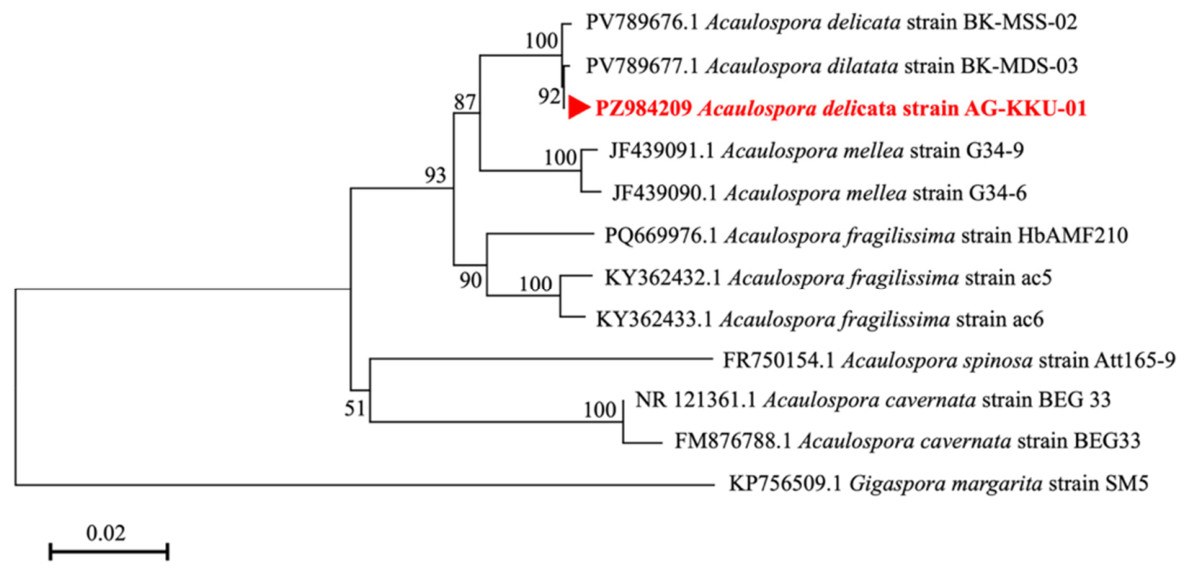
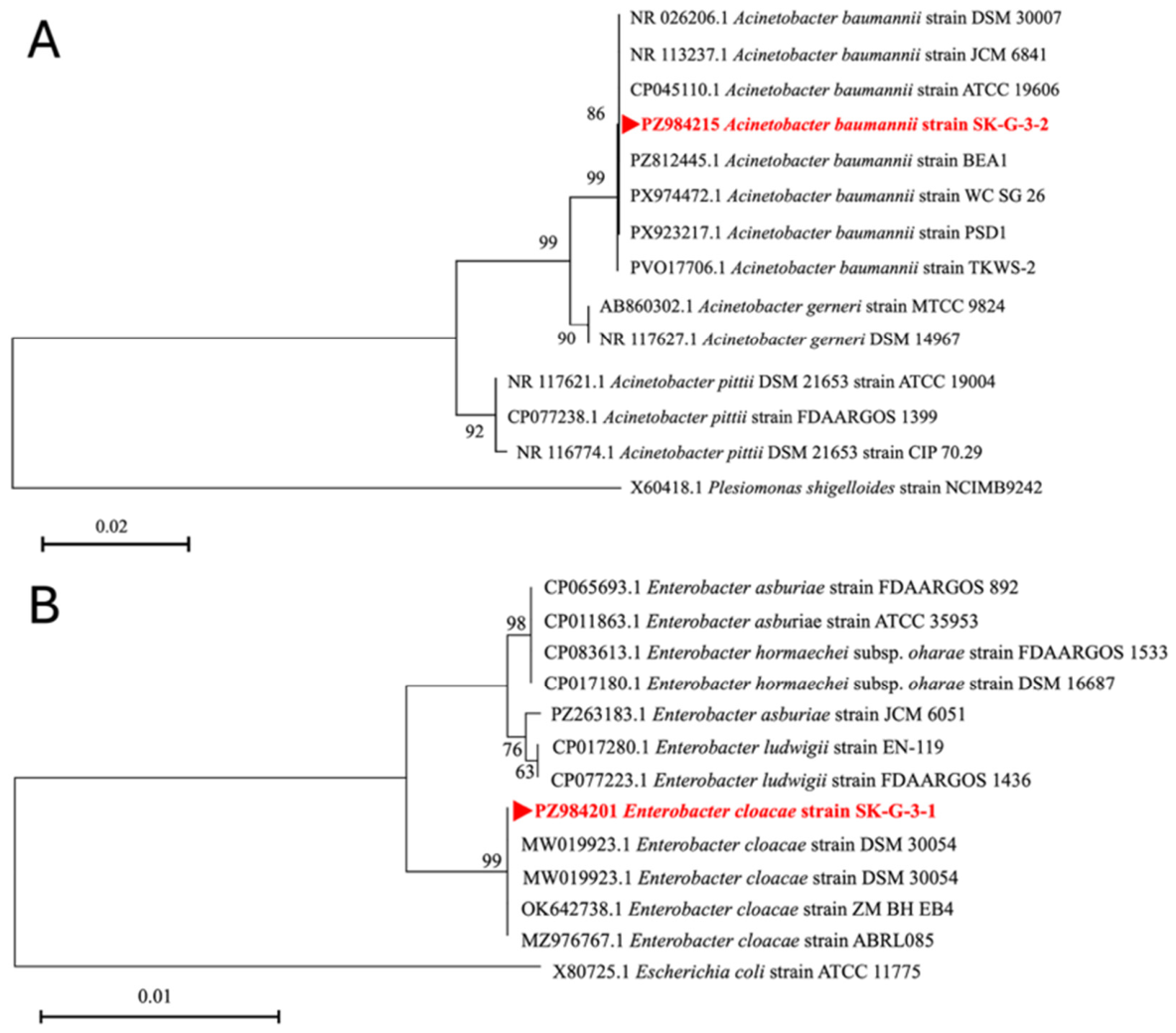
A total of four AMFs were isolated from soybean rhizosphere soil. Among the AMF isolates tested, AG-KKU-01 showed the highest root colonization (73.25%) and spore density (40 spores g−1 soil), and was therefore selected for further characterization. Molecular identification based on SSU-ITS-LSU rDNA sequencing revealed that the AMF isolate AG-KKU-01 was identified as A. delicata (Accession No. PZ984209), showing 99.58% sequence similarity to the reference sequence. Based on 16S rRNA gene sequence analysis, two MHB isolates were identified and assigned the designations SK-G-3-1 and SK-G-3-2. BLAST analysis showed 100% sequence similarity to reference sequences in the GenBank database. Isolates SK-G-3-1 and SK-G-3-2 were assigned to E. cloacae (Accession No. PZ984201) and Ac. baumannii (Accession No. PZ984215), respectively (Table 1). Phylogenetic analysis further supported the taxonomic placement of the AMF and MHB isolates with their corresponding reference strains (Figure 1 and Figure 2).
Table 1.
Molecular identification of AMF and MHB isolates used in this study based on sequence analysis.
Figure 1.
Maximum likelihood phylogenetic tree relationships of A. delicata AG-KKU-01 01 inferred from combined SSU-ITS-LSU rDNA sequences. Node labels represent bootstrap values exceeding 70%, calculated from 1000 replicates. The sequence generated in this study is shown in bold red.
Figure 2.
Maximum likelihood phylogenetic trees: Ac. baumannii isolate SK-G-3-2 (A) and E. cloacae isolate SK-G-3-1 (B). These are inferred from the 16S rRNA gene sequences. Node labels represent bootstrap values exceeding 50%, calculated from 1000 replicates. The sequences generated in this study are shown in bold red.
3.2. Effect of AMF and MHB Inoculation on Soybean Growth
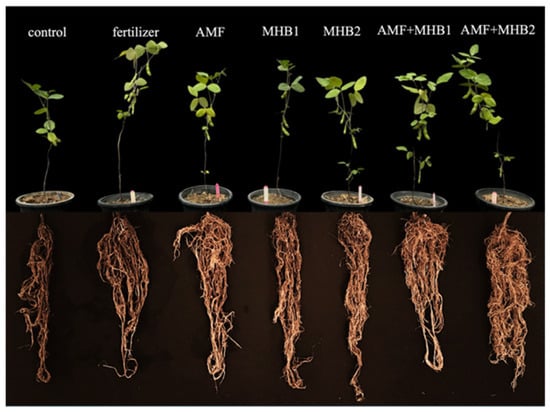
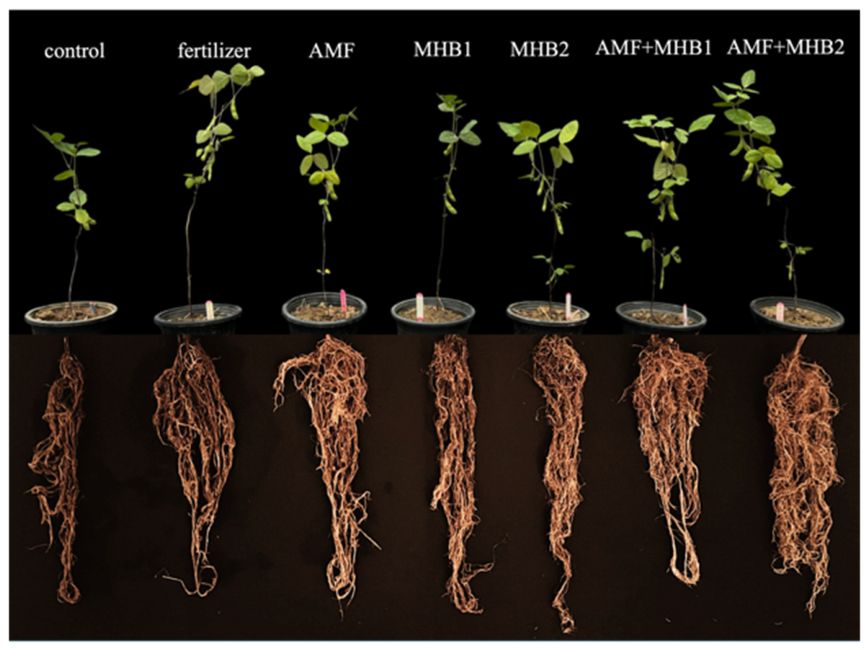
The AMF and MHB inoculation treatments exerted significant effects on soybean growth, as reflected by changes in plant height, stem diameter, and shoot and root dry weights (p ≤ 0.05) (Table 2). Among the inoculated treatments, co-inoculation generally resulted in greater plant growth than single inoculation and uninoculated control treatments. Single inoculation with AMF, MHB1, and MHB2 also significantly improved the growth parameters. In contrast, the uninoculated control exhibited the lowest values for all measured parameters. Notably, the growth performance of soybean plants receiving the co-inoculation AMF + MHB2 treatment was statistically comparable to that obtained with chemical fertilizer application (Figure 3). These results suggest a positive interaction between AMF and MHB2 in promoting soybean growth and biomass production.
Table 2.
Plant growth parameters, including plant height, stem diameter, and shoot and root dry weights, of soybean at 90 days after planting.
Figure 3.
Effects of AMF and MHB on soybean growth. The experimental treatments included an uninoculated control, chemical fertilizer, AMF, MHB1, MHB2, AMF + MHB1, and AMF + MHB2. AMF = A. delicata AG-KKU-01; MHB1 = E. cloacae SK-G-3-1; MHB2 = Ac. baumannii SK-G-3-2.
3.3. Effects of AMF and MHB on Yield Performance
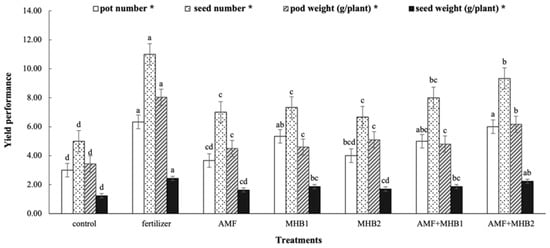
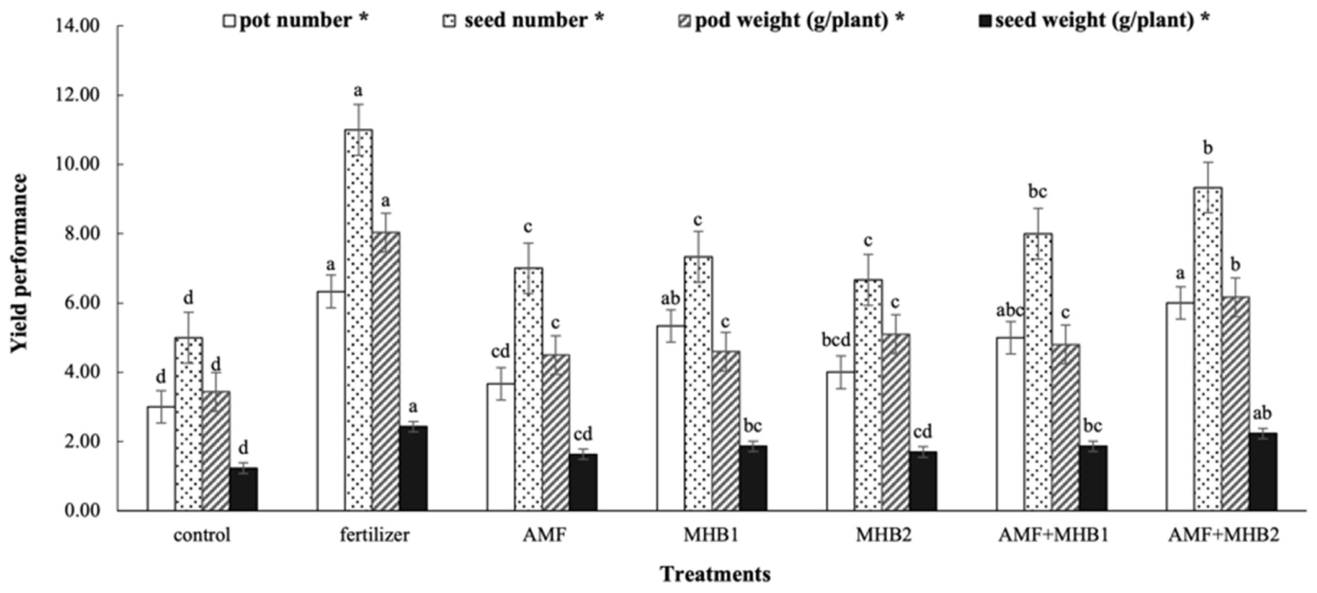
The number of pods and seeds, pod weight, and fresh seed weight of soybean were significantly (p ≤ 0.05) influenced by the microbial inoculation treatments (Figure 4). Co-inoculation of AMF and MHB improved yield-related parameters compared with single inoculation treatments. In particular, the AMF + MHB2 treatment produced the highest pod number and seed weight among all microbial treatments and showed values comparable to those obtained with chemical fertilizer application.
Figure 4.
Yield performance, including the number of pods and seeds, pod weight, and fresh seed weight of soybean 90 days after planting. Different letters denote statistically significant differences among values within the same column analyzed using the LSD test. An asterisk (*) denotes a significant difference at p ≤ 0.05. AMF = A. delicata AG-KKU-01; MHB1 = E. cloacae SK-G-3-1; MHB2 = Ac. baumannii SK-G-3-2.
3.4. Root Colonization and AMF Spore Density
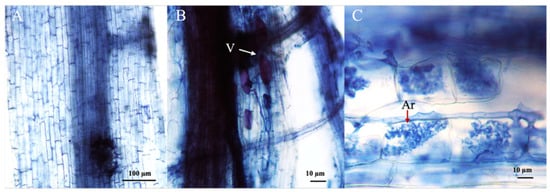
AMF root colonization and spore density varied significantly among treatments (Table 3). AMF structures, including hyphae, vesicles, and arbuscules, were clearly observed in inoculated soybean roots. The highest root colonization and spore density were recorded in AMF + MHB2, followed by AMF + MHB1 and single AMF inoculation. In contrast, very low or no colonization was detected in the uninoculated control and single bacterial inoculation treatments. Representative AMF structures observed in soybean roots, including arbuscules and vesicles, are shown in Figure 5.
Table 3.
Root colonization and AMF spore density in response to the AMF and MHB inoculation treatments.
Figure 5.
Colonization structures of arbuscular mycorrhizal fungi. Uninoculated control (A), representative of AMF, AMF + MHB1, and AMF + MHB2 treatments (B,C). V: vesicles; Ar: arbuscule. Magnification was 100× for (A) and 400× for (B,C).
3.5. Effects of AMF and MHB on Root Growth
Table 4 presents the root morphology, including root length, root surface area, and root volume, of soybean at the harvest stage. AMF and MHB inoculation treatments generally promoted greater root development than the uninoculated control. The chemical fertilizer treatment showed the highest values for root length and root surface area. However, the AMF + MHB2 treatment exhibited root morphological characteristics comparable to those of the chemical fertilizer treatment and produced the greatest root volume among the microbial treatments. In contrast, the uninoculated control showed the lowest values for all measured root traits. These findings indicate that co-inoculation of AMF and MHB2 enhanced soybean root development and achieved root characteristics comparable to those obtained with chemical fertilizer application.
Table 4.
Root growth parameters, including length, surface area, diameter, and volume, of soybean at 90 days after planting.
3.6. Seed Quality Parameters
Seed quality parameters, including total protein content, total phenolic content, and antioxidant activity, were significantly influenced by microbial inoculation (p ≤ 0.01) (Table 5). Among the treatments, co-inoculation treatments generally resulted in higher protein content than single inoculation treatments. AMF inoculation alone produced the greatest total phenolic content and DPPH radical scavenging activity. Interestingly, both co-inoculation treatments (AMF + MHB1 and AMF + MHB2) maintained relatively high values for all seed quality parameters compared with the uninoculated control and chemical fertilizer treatment. In contrast, the lowest values for all seed quality traits were recorded in the uninoculated control. Overall, the AMF + MHB2 treatment showed superior seed quality performance, particularly in terms of protein accumulation.
Table 5.
Quality of the total protein content, total phenolic content, and antioxidant activity in soybean seed at 90 days after planting.
3.7. Multivariate Analysis of Growth, Yield, Root Morphological, and Seed Quality Parameters
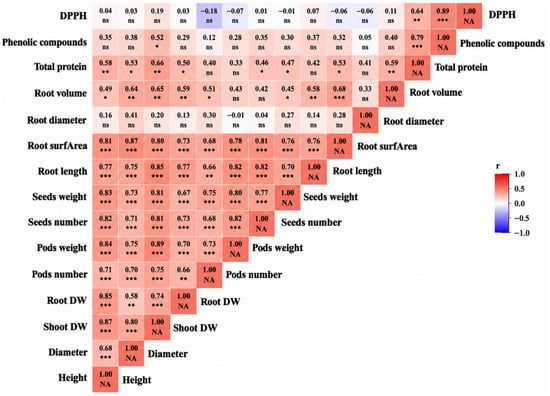
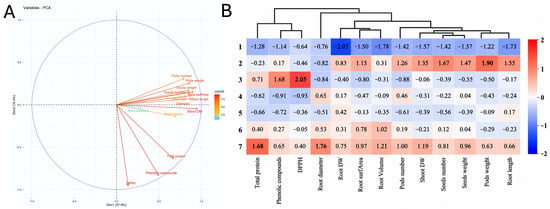
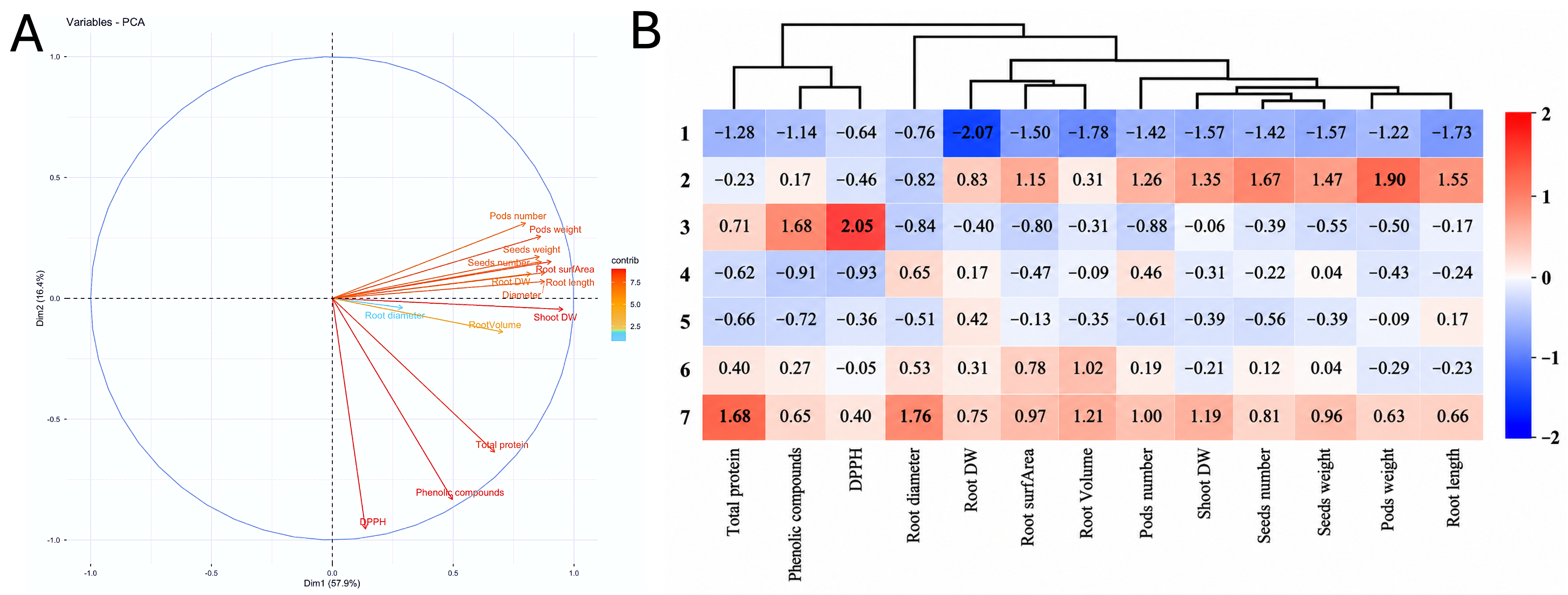
Pearson’s correlation analysis indicated that most growth, yield, root morphological, and seed quality traits were positively correlated (Figure 6). Root-related traits were closely associated with biomass accumulation and yield components, while seed quality traits were positively related to plant growth and productivity. The PCA accounted for 74.3% of the total variance, of which PC1 and PC2 contributed 57.9% and 16.4%, respectively. (Figure 7A). Growth, yield, root morphological, and seed quality traits were grouped in a similar direction, indicating strong relationships among these variables. The hierarchical clustering heatmap further separated co-inoculation treatments from the uninoculated control according to their overall performance across the measured parameters (Figure 7B).
Figure 6.
Pearson’s correlation analysis among the growth, yield, root morphological, and seed quality parameters in soybean at the harvest stage. ns = not significant; NA = not applicable; * = significant at p ≤ 0.05; ** = significant at p ≤ 0.01; and *** = significant at p ≤ 0.001.
Figure 7.
Multivariate analysis of soybean responses to AMF and MHB inoculation. (A) Principal component analysis (PCA) and (B) hierarchical clustering heatmap of growth traits, root morphological characteristics, yield components, and seed quality parameters in soybean. Treatment codes: 1 = control; 2 = chemical fertilizer; 3 = AMF; 4 = MHB1; 5 = MHB2; 6 = AMF + MHB1; and 7 = AMF + MHB2.
4. Discussion
Generally, AMF are fungi that exist in most natural habitats and form symbiotic relationships with the roots of a broad range of terrestrial plants. Through these interactions, they enhance plant nutrient acquisition and contribute to the functioning and sustainability of agricultural ecosystems [33,34]. A significant type of microorganism, known as MHB, is commonly found in the mycorrhizosphere and hyphosphere, where they facilitate the establishment and functioning of plant–AMF symbioses [16]. In this study, four AMF isolates were obtained from the soybean rhizosphere and propagated for subsequent isolation of associated MHB, resulting in two bacterial isolates. Molecular identification based on SSU–ITS–LSU rDNA sequences for AMF and 16S rRNA gene sequences for MHB identified the isolates as A. delicata AG-KKU-01, E. cloacae SK-G-3-1, and Ac. baumannii SK-G-3-2. These bacterial species have previously been reported as common members of the mycorrhizosphere and have been associated with AMF development, plant–microbe interactions, and plant growth promotion (PGP) [35,36,37,38]. Although Ac. baumannii is widely recognized as an opportunistic clinical pathogen, environmental isolates from rhizosphere soils have increasingly been reported to possess plant growth-promoting traits, including indole-3-acetic acid and siderophore production and mineral solubilization [39,40,41]. However, the virulence and antimicrobial resistance profiles of non-clinical Ac. baumannii appear to be highly strain-dependent, and some environmental isolates have been shown to harbor virulence-associated genes or exhibit pathogenic potential comparable to clinical strains [42,43]. Therefore, comprehensive biosafety assessments, including screening for virulence-associated factors and antimicrobial resistance profiles, are essential before such strains can be considered for practical or commercial agricultural applications.
Our investigation examined AMF and MHB inoculation to promote plant growth and enhance seed quality in soybean. The present study demonstrated that inoculation treatment significantly improved soybean growth and biomass when compared with the uninoculated control. In particular, the co-inoculation of AMF + MHB2 (A. delicata AG-KKU-01 + Ac. baumannii SK-G-3-2) produced growth responses comparable to those obtained with chemical fertilizer application. These findings suggest that the positive interaction between AMF and MHB enhanced plant performance more effectively than single inoculation. The observed biomass production is consistent with the findings of Mungsachat et al. [44], who reported that co-inoculation of AMF (Funneliformis mosseae) with MHB (Bacillus methylotrophicus) showed a significant increase in rice height under a hydroponic cultivation system. Improved yield-related traits were observed following AMF and MHB inoculation. Co-inoculation treatments increased the pod and seed numbers and weights compared with the uninoculated control and most single inoculation treatments. This improved yield performance is likely associated with enhanced nutrient uptake and photosynthate production resulting from better root development and AMF functionality. Similar findings have been reported by Seemakram et al. [30], who observed increased pod number and seed weight in soybean inoculated with A. delicata. In addition, species of Enterobacter and Acinetobacter have been reported to promote plant growth and yield in plant crops through plant growth-promoting activities [45]. The comparable performance of the AMF + MHB2 treatment to chemical fertilizer application further highlights the potential of this microbial consortium as a sustainable alternative for soybean production. The improved growth and yield performance observed in co-inoculated plants may be closely linked to changes in root system architecture and AMF establishment. Indeed, root length, root surface area, and root volume were markedly increased following AMF and MHB inoculation, particularly in the AMF + MHB2 treatment. A more developed root system can access deeper soil layers and increase the capacity for water and nutrient uptake more efficiently, which is particularly vital in regions with limited soil fertility or water availability [46]. Previous studies have reported that AMF-associated hyphal networks and MHB also contribute substantially to nutrient acquisition processes; for instance, Severo et al. [47] demonstrated that co-inoculation of Rhizophagus clarus or Claroideoglomus etunicatum with Bacillus subtilis significantly enhanced root growth and development in maize. Therefore, the enhanced root morphology observed in co-inoculated plants is consistent with the improved nutrient acquisition capacity associated with AMF and MHB inoculation. The superior growth observed in the co-inoculation treatments may be associated with enhanced AMF establishment in the rhizosphere. Co-inoculated plants showed greater root colonization and spore density than AMF inoculation alone, particularly in the AMF + MHB2 treatment. A similar trend was reported by Wilmowicz et al. [48], who observed increased AMF colonization in maize following co-inoculation with Glomus spp. and B. subtilis. MHBs may also indirectly enhance AMF colonization by stimulating plant root exudation, including flavonoids, which act as signaling compounds involved in plant–microbe interactions [49]. In addition, MHB can directly stimulate AMF development by enhancing hyphal elongation and branching, thereby increasing fungal infectivity and root colonization efficiency [50].
Interestingly, AMF and MHB inoculation not only improved soybean growth but also enhanced seed quality. Co-inoculation treatments promoted greater protein accumulation and maintained higher phenolic content and antioxidant activity than the chemical fertilizer treatment. These improvements may be related to enhanced nutrient acquisition and metabolic activity resulting from plant–microbe interactions. Members of the genera Enterobacter and Acinetobacter have been reported to exhibit plant growth-promoting activities, including nitrogen fixation and nutrient solubilization [39,51,52], which may contribute to increased nitrogen availability and protein biosynthesis in plants [53]. Previous studies have suggested that AMF-mediated phosphorus acquisition enhances energy metabolism [54,55] and supports nitrogen assimilation processes, including nitrate reduction and amino acid biosynthesis [56]. Therefore, improved nitrogen and phosphorus nutrition may promote protein accumulation in developing soybean seeds. In addition, the enhanced nutrient status and metabolic activity of inoculated plants may stimulate the synthesis of secondary metabolites, including phenolic compounds, which contribute to antioxidant capacity and overall seed quality [57]. However, the physiological mechanisms underlying protein accumulation were not investigated in the present study and warrant further research. These relationships were further supported by multivariate analyses. Positive correlations among these parameters suggest that enhanced root development contributed to improved plant productivity and seed quality, indicating coordinated responses among these parameters. Likewise, the PCA and heatmap results further supported these findings by demonstrating coordinated responses among the measured variables, particularly in co-inoculation treatments. The close association between seed quality traits and plant performance variables further suggests that improvements in growth and root development were accompanied by enhanced seed nutritional quality. Overall, the present study provides new insights into the synergistic interaction between Acaulospora delicata and the mycorrhiza helper bacterium Ac. baumannii SK-G-3-2 in soybean. Co-inoculation significantly improved plant growth, yield, root development, AMF establishment, and seed quality, demonstrating the potential of AMF + MHB consortia to enhance crop performance. As studies investigating AMF + MHB interactions in soybean remain limited, these findings expand the current knowledge of beneficial plant–microbe interactions and provide a foundation for the development of sustainable microbial inoculants for soybean production. Nevertheless, further studies involving field trials and different levels of reduced chemical fertilizer combined with AMF–MHB inoculation are necessary to validate the effectiveness of these microbial combinations under practical agricultural conditions and identify suitable fertilizer rates that sustain soybean productivity while reducing the reliance on chemical fertilizers.
5. Conclusions
A. delicata AG-KKU-01 isolates obtained from soybean rhizosphere soil were identified based on SSU–ITS–LSU rDNA sequence analysis. Two associated MHB isolates were identified as E. cloacae SK-G-3-1 and Ac. baumannii SK-G-3-2 using 16S rRNA gene sequencing. An experiment was conducted under greenhouse conditions, and the results demonstrate that inoculation with AMF and MHB positively affected soybean growth, yield, root development, AMF colonization, and seed quality. Remarkably, co-inoculation of A. delicata AG-KKU-01 and Ac. baumannii SK-G-3-2 showed the best performance, resulting in superior plant growth, root colonization, spore density, protein accumulation, and overall productivity. This study provides new evidence for the synergistic interaction between AMF and MHB in soybean and highlights the potential of A. delicata AG-KKU-01 and Ac. baumannii SK-G-3-2 as a sustainable microbial consortium for enhancing soybean productivity and seed quality while reducing dependence on chemical fertilizers.
Author Contributions
Conceptualization, S.C., T.G., W.S., W.Y. and S.B.; methodology, S.C., T.G., W.S., W.Y. and S.B.; software, S.C., T.G., W.Y., U.K. and S.B.; validation, S.C., T.G., W.Y. and S.B.; formal analysis, S.C., T.G., W.Y. and S.B.; investigation, S.C., T.G., W.Y. and S.B.; resources, S.C., T.G., W.S., T.S., W.Y. and S.B.; data curation, S.C., T.G., W.Y. and S.B.; writing—original draft preparation, S.C. and T.G.; writing—review and editing, W.S., T.S., U.K. and S.B.; visualization, S.C., T.G., W.Y. and S.B.; supervision, S.B.; project administration, S.B.; funding acquisition, S.B. All authors have read and agreed to the published version of the manuscript.
Funding
This research received no external funding.
Data Availability Statement
The datasets obtained and analyzed in the current study are available from the corresponding author upon reasonable request.
Conflicts of Interest
The authors declare no conflicts of interest.
References
- Hou, A.; Chen, P.; Alloatti, J.; Li, D.; Mozzoni, L.; Zhang, B.; Shi, A. Genetic variability of seed sugar content in worldwide soybean germplasm collections. Crop Sci. 2009, 49, 903–912. [Google Scholar] [CrossRef] [Scilit]
- Król-Grzymała, A.; Amarowicz, R. Phenolic compounds of soybean seeds from two European countries and their antioxidant properties. Molecules 2020, 25, 2075. [Google Scholar] [CrossRef] [Scilit] [PubMed]
- Choi, Y.M.; Yoon, H.; Shin, M.J.; Lee, Y.; Hur, O.S.; Lee, B.C.; Ha, B.K.; Wang, X.; Desta, K.T. Metabolite contents and antioxidant activities of soybean (Glycine max (L.) Merr.) seeds of different seed coat colors. Antioxidants 2021, 10, 1210. [Google Scholar] [CrossRef] [Scilit] [PubMed]
- Liu, X.; Gao, Y.; Zhao, X.; Zhang, X.; Ben, L.; Li, Z.; Dong, G.; Zhou, J.; Huang, J.; Yao, Y. Validation of novel reference genes in different rice plant tissues through mining RNA-seq datasets. Plants 2023, 12, 3946. [Google Scholar] [CrossRef] [Scilit] [PubMed]
- Janni, M.; Maestri, E.; Gullì, M.; Marmiroli, M.; Marmiroli, N. Plant responses to climate change: How global warming may impact food security: A critical review. Front. Plant Sci. 2023, 14, 1297569. [Google Scholar] [CrossRef] [Scilit] [PubMed]
- Alom, K.; Akbar, D.; Xu, C.Y.; Dong, T.H. Assessing environmental impacts of chemical fertilizers consumption in Australia: State-level evidence. Environ. Sustain. Indic. 2025, 28, 101053. [Google Scholar] [CrossRef] [Scilit]
- Camargo, J.A.; Alonso, Á. Ecological and toxicological effects of inorganic nitrogen pollution in aquatic ecosystems: A global assessment. Environ. Int. 2006, 32, 831–849. [Google Scholar] [CrossRef] [Scilit] [PubMed]
- Ajeethan, N.; Abbey, L.; Yurgel, S.N. Role of plant growth-promoting microbes in plant growth and development. Appl. Microbiol. 2026, 6, 34. [Google Scholar] [CrossRef] [Scilit]
- Sakthivel, A.; Balasubramaniam, S.; Eswaran, S.P.; Ganeshan, S.; Jesudass, J.S.; Gnanajothi, K.; Yin, C.; Chiuta, N.E.; Chang, S.W.; Balasubramani, R.; et al. Implication of plant growth-promoting microorganisms and nanofertilizer in millets: A review on growth promotion and crop improvement. Cogent Food Agric. 2026, 12, 1. [Google Scholar] [CrossRef] [Scilit]
- Samanta, I.; Ghosh, K.; Saikia, R.; Savita; Maity, P.J.; Chowdhary, G. Arbuscular mycorrhizal fungi—A natural tool to impart abiotic stress tolerance in plants. Plant Signal. Behav. 2025, 20, 2525843. [Google Scholar] [CrossRef] [Scilit] [PubMed]
- Lee, E.H.; Eo, J.K.; Ka, K.H.; Eom, A.H. Diversity of arbuscular mycorrhizal fungi and their roles in ecosystems. Mycobiology 2013, 41, 121–125. [Google Scholar] [CrossRef] [Scilit] [PubMed]
- Ahmed, N.; Li, J.; Li, Y.; Deng, L.; Deng, L.; Chachar, M.; Chachar, Z.; Chachar, S.; Hayat, F.; Raza, A.; et al. Symbiotic synergy: How arbuscular mycorrhizal fungi enhance nutrient uptake, stress tolerance, and soil health through molecular mechanisms and hormonal regulation. IMA Fungus 2025, 16, e144989. [Google Scholar] [CrossRef] [Scilit] [PubMed]
- Pennesi, A.; Mello, A.; Acquaviva, M.; Ranocchi, B.; Amicucci, A. Mycorrhiza helper bacteria as stage-specific modulators of fungal development. Front. Plant Sci. 2026, 17, 1913714. [Google Scholar] [CrossRef] [Scilit] [PubMed]
- Guan, S.; Shao, X.; Liu, R.; Ge, J.; Song, G.; Yang, Z. Interactions between mycorrhizal fungi and mycorrhiza helper bacteria: Mechanisms, ecological functions, and potential applications in sustainable agriculture and ecological restoration. Sustainability 2026, 18, 5643. [Google Scholar] [CrossRef] [Scilit]
- Jiang, M.; Delgado-Baquerizo, M.; Yuan, M.M.; Ding, J.; Yergeau, E.; Zhou, J.; Crowther, T.W.; Liang, Y. Home-based microbial solution to boost crop growth in low-fertility soil. New Phytol. 2023, 239, 752–765. [Google Scholar] [CrossRef] [Scilit] [PubMed]
- Nasslahsen, B.; Prin, Y.; Ferhout, H.; Smouni, A.; Duponnois, R. Mycorrhizae helper bacteria for managing the mycorrhizal soil infectivity. Front. Soil Sci. 2022, 2, 979246. [Google Scholar] [CrossRef] [Scilit]
- Gerdemann, J.W.; Nicolson, T.H. Spores of mycorrhizal Endogone species extracted from soil by wet sieving and decanting. Trans. Br. Mycol. Soc. 1963, 46, 235–244. [Google Scholar] [CrossRef] [Scilit]
- Boonlue, S.; Surapat, W.; Pukahuta, C.; Suwanarit, P.; Suwanarit, A.; Morinaga, T. Diversity and efficiency of arbuscular mycorrhizal fungi in soils from organic chili (Capsicum frutescens) farms. Mycoscience 2012, 53, 10–16. [Google Scholar] [CrossRef] [Scilit]
- Daniels, B.A.; Skipper, H.D. Methods for the Recovery and Quantitative Estimation of Propagules from Soil [Vesicular-Arbuscular Mycorrhizal Fungi]. In Methods and Principles of Mycorrhizal Research; Schenck, N.C., Ed.; American Phytopathological Society: St. Paul, MN, USA, 1982; pp. 29–35. [Google Scholar]
- Schenck, N.C.; Pérez, Y. Manual for the Identification of VA Mycorrhizal Fungi, 3rd ed.; Synergistic Publications: Gainesville, FL, USA, 1990; Available online: https://books.google.co.th/books?id=AdKKPQAACAAJ (accessed on 24 April 2025).
- Krüger, M.; Stockinger, H.; Krüger, C.; Schüßler, A. DNA-based species level detection of Glomeromycota: One PCR primer set for all arbuscular mycorrhizal fungi. New Phytol. 2009, 183, 212–223. [Google Scholar] [CrossRef] [Scilit] [PubMed]
- Tamura, K.; Stecher, G.; Kumar, S. MEGA11: Molecular evolutionary genetics analysis version 11. Mol. Biol. Evol. 2021, 38, 3022–3027. [Google Scholar] [CrossRef] [Scilit]
- Seemakram, W.; Suebrasri, T.; Khaekhum, S.; Ekprasert, J.; Aimi, T.; Boonlue, S. Growth enhancement of the highly prized tropical trees Siamese rosewood and Burma padauk. Rhizosphere 2021, 19, 100363. [Google Scholar] [CrossRef] [Scilit]
- Salo, E.N.; Novero, A. Identification and characterisation of endophytic bacteria from coconut (Cocos nucifera) tissue culture. Trop. Life Sci. Res. 2020, 31, 57–68. [Google Scholar] [CrossRef] [Scilit] [PubMed]
- Weisburg, W.G.; Barns, S.M.; Pelletier, D.A.; Lane, D.J. 16S ribosomal DNA amplification for phylogenetic study. J. Bacteriol. 1991, 173, 697–703. [Google Scholar] [CrossRef] [Scilit] [PubMed]
- Taiyawong, A.; Monkham, T.; Sanitchon, J.; Choenkwan, S.; Srisawangwong, S.; Khodphuwiang, J.; Reewarabundit, S.; Chankaew, S. Yield Stability of Soybean Variety Morkhor 60 in Integrated Rotation Systems of Northeastern Thailand. Plants 2025, 14, 2503. [Google Scholar] [CrossRef] [Scilit] [PubMed]
- Zhang, Z.; Li, B.; Liu, Y.; He, L.; Pang, T.; Chen, Z.; Shohag, M.J.I.; Miao, X.; Li, X.; Gu, M.; et al. Arbuscular mycorrhizal fungal inoculation increases organic selenium accumulation in soybean (Glycine max (L.) Merr.) growing in selenite-spiked soils. Toxics 2022, 10, 565. [Google Scholar] [CrossRef] [Scilit] [PubMed]
- Bello, I.; Adeniyi, A.; Mukaila, T.; Hammed, A. Optimization of soybean protein extraction with ammonium hydroxide (NH4OH) using response surface methodology. Foods 2023, 12, 1515. [Google Scholar] [CrossRef] [Scilit] [PubMed]
- Lowry, O.H.; Rosebrough, N.J.; Farr, A.L.; Randall, R.J. Protein measurement with the Folin phenol reagent. J. Biol. Chem. 1951, 193, 265–275. [Google Scholar] [CrossRef] [Scilit]
- Seemakram, W.; Suebrasri, T.; Chankaew, S.; Boonlue, S. Influence of arbuscular mycorrhizal fungi on soybean growth and yield: A metabarcoding approach. Plants 2026, 15, 131. [Google Scholar] [CrossRef] [Scilit] [PubMed]
- Nacoon, S.; Seemakram, W.; Gateta, T.; Theerakulpisut, P.; Sanitchon, J.; Kuyper, T.W.; Boonlue, S. Accumulation of health-promoting compounds in upland black rice by interacting mycorrhizal and endophytic fungi. J. Fungi 2023, 9, 1152. [Google Scholar] [CrossRef] [Scilit] [PubMed]
- Trouvelot, A.; Kough, J.L.; Gianinazzi-Pearson, V. Evaluation of VA infection levels. Research for estimation methods having a functional significance. In Physiological and Genetical Aspect of Mycorrhiza; Gianinazzi-Pearson, V., Gianinazzi, S., Eds.; INRA Edition: Paris, France, 1986; pp. 217–221. [Google Scholar]
- Peng, Y.; Wang, H.; Zhang, M.; Ge, J.; Ping, W.; Jie, W. Synergistic effects of arbuscular mycorrhizal fungi and mycorrhiza helper bacteria on soybean growth, carbendazim residues and the composition of the bacterial community in soybean rhizosphere soil. Ind. Crops Prod. 2026, 247, 123457. [Google Scholar] [CrossRef] [Scilit]
- Pan, X.; Ibrahim, M.; Zhou, L.; Ullah, A.; Ali, A.; Gao, D. Synergistic effects of arbuscular mycorrhizal fungi and mycorrhiza helper bacteria alter cucumber rhizosphere fungal community and reduce soil cadmium contamination. J. Fungi 2026, 12, 129. [Google Scholar] [CrossRef] [Scilit] [PubMed]
- Jie, W.; Tan, Y.; Lin, H.; Zhang, M.; Kan, L. Effectiveness of Rhizophagus intraradices and Acinetobacter calcoaceticus on soybean growth and thiram residues in soybean grains and rhizosphere soil. PeerJ 2025, 13, e19701. [Google Scholar] [CrossRef] [Scilit] [PubMed]
- Li, Y.; Zeng, J.; Wang, S.; Lin, Q.; Ruan, D.; Chi, H.; Zheng, M.; Chao, Y.; Qiu, R.; Yang, Y. Effects of cadmium-resistant plant growth-promoting rhizobacteria and Funneliformis mosseae on the cadmium tolerance of tomato (Lycopersicon esculentum L.). Int. J. Phytoremediat. 2020, 22, 451–458. [Google Scholar] [CrossRef] [Scilit] [PubMed]
- Kim, K.Y.; Jordan, D.; McDonald, G.A. Effect of phosphate-solubilizing bacteria and vesicular-arbuscular mycorrhizae on tomato growth and soil microbial activity. Biol. Fertil. Soils 1998, 26, 79–87. [Google Scholar] [CrossRef] [Scilit]
- Sagar, A.; Rathore, P.; Ramteke, P.W.; Ramakrishna, W.; Reddy, M.S.; Pecoraro, L. Plant growth-promoting rhizobacteria, arbuscular mycorrhizal fungi and their synergistic interactions to counteract the negative effects of saline soil on agriculture: Key macromolecules and mechanisms. Microorganisms 2021, 9, 1491. [Google Scholar] [CrossRef] [Scilit] [PubMed]
- Farokh, R.Z.; Sachdev, D.; Pour, N.K.; Engineer, A.; Pardesi, K.R.; Zinjarde, S.; Dhakephalkar, P.K.; Chopade, B.A. Characterization of plant-growth-promoting traits of Acinetobacter species isolated from rhizosphere of Pennisetum glaucum. J. Microbiol. Biotechnol. 2011, 21, 556–566. [Google Scholar] [CrossRef] [Scilit]
- Lin, H.R.; Shu, H.Y.; Lin, G.H. Biological roles of indole-3-acetic acid in Acinetobacter baumannii. Microbiol. Res. 2018, 216, 30–39. [Google Scholar] [CrossRef] [Scilit] [PubMed]
- Singh, T.B.; Sahai, V.; Goyal, D.; Prasad, M.; Yadav, A.; Shrivastav, P.; Ali, A.; Dantu, P.K. Identification, characterization and evaluation of multifaceted traits of plant growth-promoting rhizobacteria from soil for sustainable approach to agriculture. Curr. Microbiol. 2020, 77, 3633–3642. [Google Scholar] [CrossRef] [Scilit] [PubMed]
- Tobin, L.A.; Jarocki, V.M.; Kenyon, J.; Drigo, B.; Donner, E.; Djordjevic, S.P.; Hamidian, M. Genomic analysis of diverse environmental Acinetobacter isolates identifies plasmids, antibiotic resistance genes, and capsular polysaccharides shared with clinical strains. Appl. Environ. Microbiol. 2024, 90, e01654-23. [Google Scholar] [CrossRef] [Scilit] [PubMed]
- Hamidian, M.; Maharjan, R.P.; Farrugia, D.N.; Delgado, N.N.; Dinh, H.; Short, F.L.; Kostoulias, X.; Peleg, A.Y.; Paulsen, I.T.; Cain, A.K. Genomic and phenotypic analyses of diverse non-clinical Acinetobacter baumannii strains reveals strain-specific virulence and resistance capacity. Microb. Genom. 2022, 8, 000765. [Google Scholar] [CrossRef] [Scilit] [PubMed]
- Mungsachat, A.; Kalee, H.H.H.A.; Daud, M.F.; Suchitwarasan, S. Effects of Funneliformis mosseae and mycorrhiza helper bacteria on growth enhancement of rice (Oryza sativa L.) under a hydroponic cultivation system. J. Pure Appl. Microbiol. 2026, 20, 2333. [Google Scholar] [CrossRef] [Scilit]
- Prodhan, M.Y.; Rahman, M.B.; Rahman, A.; Akbor, M.A.; Ghosh, S.; Nahar, M.N.E.N.; Simo; Shamsuzzoha, M.; Cho, K.M.; Haque, M.A. Characterization of growth-promoting activities of consortia of chlorpyrifos-mineralizing endophytic bacteria naturally harboring in rice plants—A potential biostimulant to develop safe and sustainable agriculture. Microorganisms 2023, 11, 1821. [Google Scholar] [CrossRef] [Scilit] [PubMed]
- Anbarasan, S.; Ramesh, S. The role of plant roots in nutrient uptake and soil health. Plant Sci. Arch. 2021, 6, 5–8. [Google Scholar] [CrossRef] [Scilit]
- de Andrade Rodrigues Severo, H.C.; de Santana Arauco, A.M.; Nunes, R.W.F.; Monteiro, G.N.; Duarte, M.H.F.; da Silva, A.P.M.; de Castro Ferreira, A.; Luz, M.R.; de Souza Miranda, R.; de Araújo, A.S.F.; et al. Co-inoculation of arbuscular mycorrhizal fungi and Bacillus subtilis enhances morphological traits, growth, and nutrient uptake in maize under limited phosphorus availability. Sci. Rep. 2025, 15, 25448. [Google Scholar] [CrossRef] [Scilit] [PubMed]
- Wilmowicz, E.; Kućko, A.; Bogati, K.; Wolska, M.; Świdziński, M.; Burkowska-But, A.; Walczak, M. Glomus sp. and Bacillus sp. strains mitigate the adverse effects of drought on maize (Zea mays L.). Front. Plant Sci. 2022, 13, 958004. [Google Scholar] [CrossRef] [Scilit] [PubMed]
- Frey-Klett, P.; Garbaye, J.; Tarkka, M. The mycorrhiza helper bacteria revisited. New Phytol. 2007, 176, 22–36. [Google Scholar] [CrossRef] [Scilit] [PubMed]
- Wang, Y.H.; Hou, L.L.; Wu, X.Q.; Zhu, M.L.; Dai, Y.; Zhao, Y.J. Mycorrhiza helper bacterium Bacillus pumilus HR10 improves growth and nutritional status of Pinus thunbergii by promoting mycorrhizal proliferation. Tree Physiol. 2022, 42, 907–918. [Google Scholar] [CrossRef] [Scilit] [PubMed]
- Lin, L.; Li, Z.; Hu, C.; Zhang, X.; Chang, S.; Yang, L.; Li, Y.; An, Q. Plant growth-promoting nitrogen-fixing enterobacteria are in association with sugarcane plants growing in Guangxi, China. Microbes Environ. 2012, 27, 391–398. [Google Scholar] [CrossRef] [Scilit] [PubMed]
- Lee, S.Y.; Cho, K.S. Acinetobacter sp. ME1: A multifunctional bacterium for phytoremediation utilizing melanin production, heavy metal tolerance, and plant growth promotion. J. Zhejiang Univ. Sci. B 2025, 26, 1103–1120. [Google Scholar] [CrossRef] [Scilit] [PubMed]
- He, R.; Liu, W.; Shao, X.; Zhu, Z.; Sun, K.; Liu, Y.; Jiang, H.; Liu, D. Nitrogen availability influences biomass composition in Yarrowia lipolytica grown on acetate. Fermentation 2026, 12, 315. [Google Scholar] [CrossRef] [Scilit]
- Chiu, C.H.; Paszkowski, U. Mechanisms and impact of symbiotic phosphate acquisition. Cold Spring Harb. Perspect. Biol. 2019, 11, a034603. [Google Scholar] [CrossRef] [Scilit] [PubMed]
- Tang, X.; Chen, M.; Meng, P.; Song, J. Arbuscular mycorrhizal fungi-mediated reconfiguration of poplar leaf C-N-P metabolic networks: Environment-dependent synergies and nutrient interactions. J. Fungi 2026, 12, 105. [Google Scholar] [CrossRef] [Scilit] [PubMed]
- Wu, X.L.; Hao, Y.; Lu, W.; Liu, C.Y.; He, J.D. Arbuscular mycorrhizal fungi enhance nitrogen assimilation and drought adaptability in tea plants by promoting amino acid accumulation. Front. Plant Sci. 2024, 15, 1450999. [Google Scholar] [CrossRef] [Scilit] [PubMed]
- Sawicki, T.; Jabłońska, M.; Danielewicz, A.; Przybyłowicz, K.E. Phenolic compounds profile and antioxidant capacity of plant-based protein supplements. Molecules 2024, 29, 2101. [Google Scholar] [CrossRef] [Scilit] [PubMed]

Disclaimer/Publisher’s Note: The statements, opinions and data contained in all publications are solely those of the individual author(s) and contributor(s) and not of MDPI and/or the editor(s). MDPI and/or the editor(s) disclaim responsibility for any injury to people or property resulting from any ideas, methods, instructions or products referred to in the content. |
© 2026 by the authors. Licensee MDPI, Basel, Switzerland. This article is an open access article distributed under the terms and conditions of the Creative Commons Attribution (CC BY) license.