Article

An Agricultural Hybrid Carbon Model for National-Scale SOC Stock Spatial Estimation

by
Nikiforos Samarinas
1,
Nikolaos L. Tsakiridis
1,
Eleni Kalopesa
1 and
Nikolaos Tziolas
2,*
1
Laboratory of Hydraulic Works and Environmental Management, Department of Rural and Surveying Engineering, Aristotle University of Thessaloniki, 54124 Thessaloniki, Greece
2
Southwest Florida Research and Education Center, Department of Soil, Water and Ecosystem Sciences, Institute of Food and Agricultural Sciences, University of Florida, 2685 State Rd 29N, Immokalee, FL 34142, USA
*
Author to whom correspondence should be addressed.
Environments 2025, 12(12), 477; https://doi.org/10.3390/environments12120477 (registering DOI)
Submission received: 17 October 2025 / Revised: 25 November 2025 / Accepted: 1 December 2025 / Published: 6 December 2025

Abstract

Soil Organic Carbon (SOC) stocks in croplands play a key role for climate change mitigation and soil sustainability, with proper management techniques enhancing carbon storage to support these goals. This study focuses on the development of a hybrid carbon modeling approach for the simulation of topsoil SOC stocks across the entire agricultural area of Lithuania. In essence, the proposed hybrid approach combines a custom cloud-based Soil Data Cube (SDC) and the RothC process-based model. High-resolution annual soil layers produced via the SDC (developed using Earth Observation and Copernicus datasets processed through AI-based methodologies) were incorporated into the RothC model to achieve reliable and detailed spatial estimations of SOC stocks. Moreover, 20-year projections into the future were conducted for (i) the business as usual scenario, and (ii) two different IPCC climate change scenarios (RCP 4.5 and 8.5) for the estimation of the SOC stock changes. The initial SOC stock varies from 15 to over 80 t C / h a while the projections present an average SOC loss of 0.14 t C / h a / yr   f or the business-as-usual scenario and an average SOC sequestration of 0.24 and 0.34 t C / h a / yr under RCP 4.5 and RCP 8.5, respectively. The framework aims to provide a robust and cost-effective solution for estimating SOC stocks under climate pressures, supporting EU policies such as the Common Agricultural Policy.

1. Introduction

Approximately two-thirds of the total terrestrial carbon (C) is stored in soils, making it one of the biggest ecosystem carbon pools [1,2], which strongly interact with atmospheric composition, climate, and land management [3] and are influenced to a large extent by climate change [4]. A key indicator of soil health is Soil Organic Carbon (SOC), playing a crucial role in enhancing soil aggregate stability, as well as improving water infiltration and retention in the soil [5].
In the context of global change, whether the net impact of erosion on C cycling acts as a carbon source or sink has been a subject of intense debate in the scientific literature [6,7]. However, more recently, Panagos et al. (2022) [8] found that 70% of EU soils are estimated to be in an unhealthy condition, while De Rosa et al. (2023) [9] indicated a Δ SOC of 0.75 % in the period 2009–2018 in EU croplands and grasslands. Additionally, Padarian et al. [10] estimated annual global SOC losses at 1.9 Pg C/yr. To address this pressing issue, substantial efforts and investments have been proposed in the European Union for SOC enrichment (e.g., through carbon farming [11]), such as the Common Agricultural Policy (CAP), the Soil Deal for Europe, and the European Union (EU) Soil Strategy for 2030, while the new EU Soil Monitoring Law is an action taken to put the EU on a pathway to healthy soils by 2050, by collecting data on soil health at a field level and providing it to farmers and other soil managers [12].
Understanding how SOC stocks change in croplands is important for mitigating climate change, as a positive change indicates that carbon is sequestered from the atmosphere into the soil whereas a negative change signifies a release of carbon to the atmosphere [13]. Most of these changes are driven by climate and land management changes, which are considered key to understanding future SOC status [14,15]. De Rosa et al. (2023) [9] indicated that SOC sequestration rates are driven by environmental factors like rainfall and temperature, as well as site-specific factors such as soil clay content. Given the above, it is important to develop robust methods for quantifying carbon sequestration at the field level, encouraging the wider adoption of carbon farming practices amidst climate pressures.
In this context, the Intergovernmental Panel on Climate Change (IPCC) assesses scientific information on climate change and its potential impacts and risks to support climate-related decisions, including the agricultural sector. At the top of the pyramid of the IPCC Tier approach stands Tier 3, which addresses the limitations of the lower tiers. Tier 3 relies on measurement-based methods, such as high-spatial-resolution soil-monitoring systems and validated process-based models to accurately assess SOC changes [9]. In addition, Land Use, Land-Use Change, and Forestry (LULUCF) regulations encourage countries to develop methodologies that take into account national characteristics and data. However, implementing advanced approaches with highly detailed data is very challenging at national scales due to the significant technical expertise and economic costs required to maintain a soil-monitoring system with high spatiotemporal resolution [16,17]. Moreover, comparative studies [18,19,20] highlighted the absence of a universally superior model, making the selection of appropriate physical-process-based models for SOC stock simulation pivotal and challenging. Although these models are widely employed in scientific and monitoring contexts at different scales [21,22,23,24], they are designed to cater to a limited number of land-use classes and provide highly detailed representations of only a restricted set of land surface processes.
Hybrid approaches, which synergistically use both process-based models and AI-driven techniques, could be considered as a cost-effective and accurate alternative compared to using either one alone [25,26,27]. For example, the work by Xie et al. (2022) [28] incorporates the predictions of the process-based RothC model into a digital soil mapping approach, improving the space-time modeling of SOC in intensively human-impacted areas. Similarly, the study by Zhang et al. (2024) [29] proposes a novel hybrid modeling framework that first runs a physical process-based model and then uses its output to optimize a machine learning algorithm for SOC stock predictions. Nonetheless, the development of hybrid models combining process-based models and machine learning methods for the spatiotemporal modeling of SOC is still scarce. What is more, hybrid approaches that simultaneously combine Earth Observation (EO) data and artificial intelligence (AI) architectures with high-performance computing and physical-process-based models are still undeveloped.
The aim of this work is to develop a scalable, robust, transparent, and cost-effective solution for SOC stock estimation at a national scale that could be applied to other EU countries. Bearing in mind that there is no one-size-fits-all modeling approach for the prediction of the SOC stock changes due to climate change and anthropogenic activities, we chose the RothC model due to its wide usage and its ability to bridge the gap between lower tiers and the advanced Tier 3 approach. To this end, we utilized a powerful cloud-based custom Soil Data Cube (SDC) capable of generating high-spatial-resolution soil layers using remote sensing and AI. The generated enhanced input soil layers are then used as inputs to the RothC model. To provide field-level products, we leveraged the European Integrated Administration and Control System (IACS) dataset, which is freely available for some EU countries. As a case study, we focused on the croplands of Lithuania due to the availability of the IACS data. Thus, the main novelty of this work is that our proposed hybrid approach uses higher-resolution input layers to improve the reliability and spatial accuracy of the final SOC stock maps, which can be provided as annually updated products at national or higher levels.

2. Materials and Methods

2.1. Study Area

Lithuania, situated in the heart of the Baltic region in Northern Europe, presents a diverse and dynamic landscape that significantly influences its agricultural sector. Covering an area of approximately 65.300 km2 and characterized mainly by flat topography, Lithuania’s geography includes fertile plains, forests, grasslands, and a coastline along the Baltic Sea.
The agricultural sector plays a crucial role in Lithuania’s economy, accounting for about 3% of the country’s GDP [30], characterized by a mix of crop production and livestock farming. Figure 1 presents the Lithuania territory, with the total agricultural area estimated to be 29.058 km2. We leverage the IACS 2022 dataset, which also provides the actual area covered by each of the seven dominant crop classes.

2.2. The Hybrid AI-Driven Physical Process-Based Modeling Approach

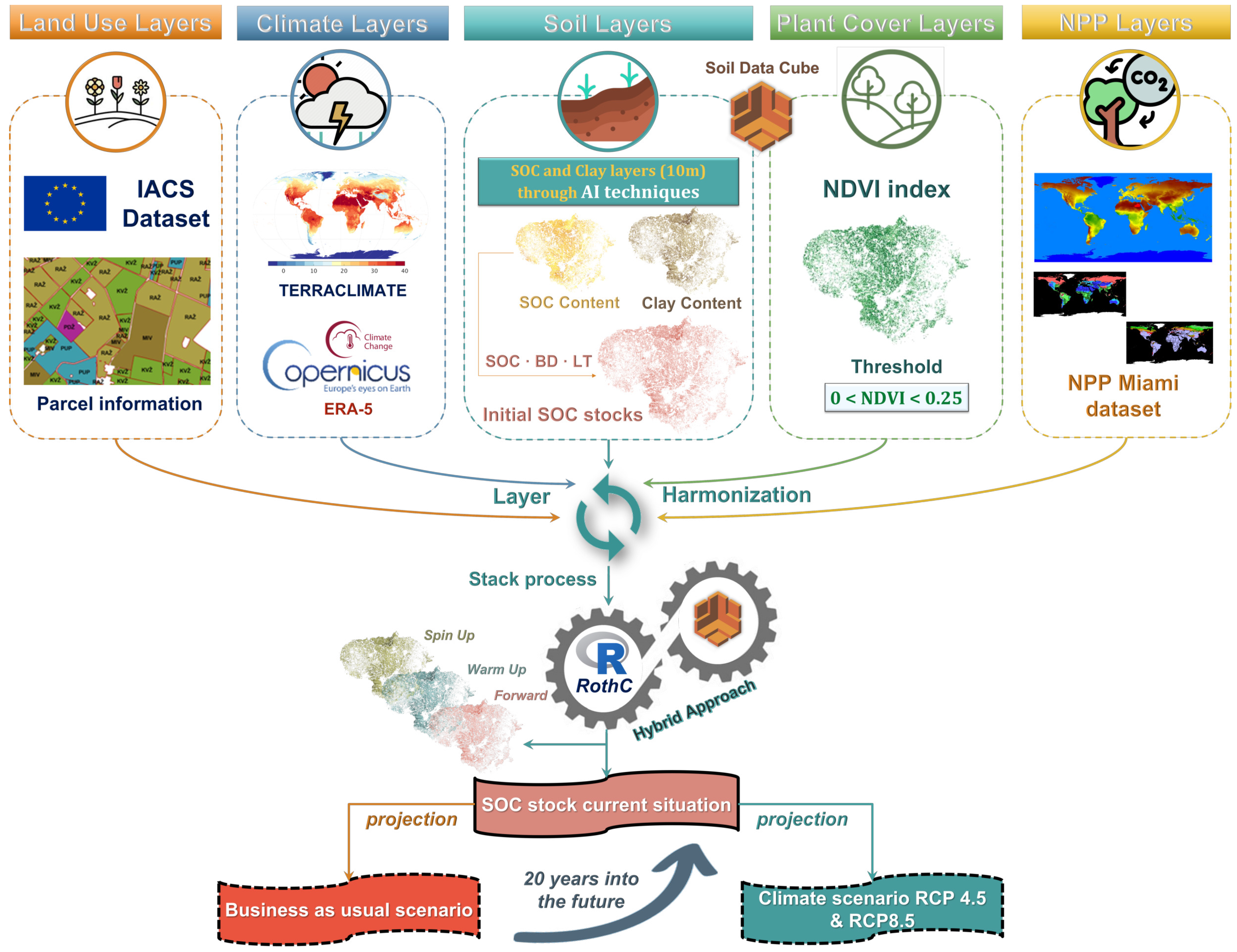
The proposed hybrid approach is based on the parallel use of the RothC model with the SDC. To enhance the final RothC outputs, high-resolution geospatial input layers of SOC and soil clay content, generated through the SDC, are integrated into the RothC model. This hybrid approach is hypothesized to improve the spatial resolution of the SOC output maps while also increasing prediction reliability by incorporating more detailed and accurate input data. A schematic representation of the proposed framework is provided in Figure 2.
Among several physical process-based models for SOC dynamics simulation, the RothC [31], originally developed at Rothamsted Experimental Station in the United Kingdom (UK), is widely used and well-studied in the scientific community. The RothC model can simulate SOC changes in agricultural soil under several environmental conditions and management practices, where SOC is partitioned into five conceptual pools—namely, decomposable plant material (DPM), resistant plant material (RPM), microbial biomass (BIO), humified organic matter (HUM), and inert organic matter (IOM) [32].
RothC has mainly low input data requirements, with the minimum input data being Land Use Land Cover (LULC), climate, soil, and land management datasets [31,33]. Two specific soil layers are necessary as input data, namely, the initial SOC stock and soil clay content. Despite their importance for indicating changes driven by management practices at the field level, these layers are usually provided at a coarse resolution. In the current study, the initial SOC stocks were calculated via Equation (1) (see Section 2.3.3), which uses as inputs the soil bulk density (BD), the layer thickness, and the SOC content. In order to provide enhanced soil layers with high spatial resolution into the model, the SOC and clay content that were generated in a previous study at a national scale [34] were used. These specific soil layers were produced via the cloud-based SDC custom tool, used in order to manage, store, and process the large amount of geospatial data involved in the approach. The LULC information was extracted from the open-access IACS dataset in Lithuania. To integrate all layers into the RothC model, the Soil R package [35,36] was used.
To demonstrate the efficacy of the proposed approach, we performed comparisons between low- and high-spatial-resolution datasets. To that end, multiple datasets on LULC, climate, and soil were used, as detailed below.

2.3. Input Data Sources

2.3.1. Land Use Land Cover Dataset

Data related to land use and management are required by the RothC to determine the carbon inputs to the soil. This may include information about the crop type, land-use changes, and management practices. In this work, the European IACS dataset was used, which is an open dataset for Lithuania. This product is marked by exceptional spatial resolution and reliability, stemming from its census-derived nature, which undergoes annual updates, ensuring its contemporary relevance. It covers the entire Lithuanian territory, spanning more than 1,000,000 parcels per year. According to the 2022 IACS dataset, the four most-common land-use classes are winter wheat (area covered 41%), winter rape (12%), spring wheat (8%), and spring barley (7%). The average parcel size is approximately 3 ha, with the minimum and maximum sizes around 0.01 and 120 ha, respectively. Finally, for comparison reasons, the lower-resolution CORINE LULC dataset was used.

2.3.2. Climate Dataset

Monthly average air temperature (°C), monthly precipitation (mm), and monthly potential evapotranspiration (PET) (mm) are also essential inputs for the RothC model. As suggested by the Technical Manual for the Global Soil Organic Carbon Sequestration Potential Map GSOCseq developed by the Food and Agriculture Organization (FAO) [36], for the initial run, the TerraClimate dataset [37] was used to cover climate data requirements. This dataset offers monthly climate and climatic water balance information for global terrestrial surfaces spanning from 1958 to 2022. With a monthly temporal resolution and a spatial resolution of approximately 4 × 4 km, TerraClimate combines high-spatial resolution climatological normals from the WorldClim data set with coarser, but time-varying, data from CRU Ts4.0 and the Japanese 55-year Reanalysis (JRA55). However, for comparison reasons, the ERA5 dataset provided by ECMWF (European Centre for Medium-Range Weather Forecasts) was also used. This is a state-of-the-art global atmospheric reanalysis that offers comprehensive climate data [38].
It is important to note that irrigation is not a common practice in Lithuania, due to several factors. The country’s temperate climate, with consistent rainfall throughout the year, generally provides adequate water for agricultural needs, reducing the necessity of irrigation for most farmers. Additionally, Lithuania is rich in water resources, including rivers, lakes, and aquifers, which further support the natural water availability for crops, particularly in rain-fed agriculture. Furthermore, it should be mentioned that irrigation is not a common practice in Lithuania because long-term climate conditions provide sufficient precipitation for most crops, and only a very small fraction of the cropland area is irrigated. The majority of agricultural production relies on rain-fed conditions, and crops grown are selected to match the local climate. Therefore, we did not include additional irrigation water inputs in the RothC simulations.

2.3.3. Soil Dataset

The inclusion of SOC stocks and clay content is crucial for the RothC model’s comprehensive simulation of organic carbon turnover and dynamics in the soil. The model requires the initial SOC stocks as a baseline for its simulations. By having the initial SOC stocks, the model can accurately track changes in carbon content in every conceptual pool over time, providing valuable insights into SOC sequestration, losses, and fluxes. In this context, to generate the baseline SOC stock layer, the following equation was used at the pixel level:
SOC stock = SOC content × BD × LT
where SOC content is the SOC concentration map (%), BD is the soil bulk density ( g   cm 3 ) , and LT is the layer thickness; in this study, SOC stocks were explicitly modeled for the 0–20 cm topsoil layer, following LUCAS protocols.
To enhance the reliability and spatial resolution of the final SOC stock map generated via RothC, this study utilized the annual products developed by Samarinas et al. (2023) [34]. These products, covering the entire Lithuanian cropland area at a spatial resolution of 10 m for the years 2020, 2021, and 2022, provide data on SOC and clay content. They were derived from LUCAS 2018 point data, correlated with Sentinel-2 imagery through a Convolutional Neural Network (CNN) model, and are accompanied by prediction uncertainties. Moreover, for the soil BD and for all the examined years (2020–2022), the open-layer OpenLandMap Soil Bulk Density [39] was employed. This is a product of the OpenGeoHub that was generated by using mainly the LUCAS dataset, GEMAS (Geochemical Mapping of Agricultural and Grazing Land Soil in Europe), and national soil profile databases, providing a layer with 250 m resolution. In addition, the SOC and clay content products, provided by SoilGrids 2.0 [40] with 250 m , were also used for comparison reasons and to demonstrate the efficacy of the higher-resolution spatial layers.

2.3.4. Plant Cover and Carbon Input Dataset

For accurate simulations of carbon turnover with RothC, it is essential to outline the annual distribution of monthly average vegetation cover. In this work, vegetation cover data was derived through Sentinel-2 timeseries (2020–2022) satellite imagery normalized difference vegetation (NDVI) index values [41]. Specifically, the acceptable range requires NDVI values to be strictly greater than 0 and less than 0.25.
Net Primary Productivity (NPP) values serve as sources for estimating carbon input in the RothC model. They represent the photosynthetically fixed carbon by plants and are converted to reflect biomass production and stored carbon. In the current work, the average values from 1981–2000 were used from the NPP Miami dataset, which is a dataset with around 55 km of spatial resolution [42].

2.4. The Projected SOC Stocks and Climate Change Scenario Design

Initially, considering the availability of the SOC and clay content products for three different years (2020 to 2022), it is possible to produce the initial SOC stock maps (in t C / h a ) at a national scale, providing the current situation of the Lithuanian croplands related to SOC stocks. For the needs of the comparative analysis, the last year (2022) is used as the current SOC stock at the base period ( t 0 ).
Regarding the projected SOC stocks, a final product under business-as-usual scenario (BAU) represents the projected SOC stocks after 20 years of BAU management, which refers to the land use, land management and production, or technologies that are currently being implemented in Lithuanian croplands. In the BAU scenario, the climatic characteristics of the area are considered the same as the climate in the base period (2022).
Additionally, two climate change scenarios (CCS) were implemented, based on the IPCC Representative Concentration Pathways (RCP): an intermediate scenario (RCP 4.5) and a pessimistic scenario (RCP 8.5) in terms of greenhouse gas emissions [43]. These scenarios align with recent studies [14,44,45] that have explored their impacts. Such studies examine the influence of land management and climate change on SOC, acknowledging that the combined effects of carbon inputs, land-use changes, and climate on SOC turnover remain largely unclear due to their inherent complexity. In the current study, the climate changes were projected over the next 20 years, based on the CORDEX (Coordinated Regional Climate Downscaling) regional climate model (RCM) [46]. To estimate SOC sequestration following the adoption of CCS, the methodological approach proposed by [36] and implemented in the GSOCseq map was chosen in our study. In this context, two types of SOC sequestration are defined as follows:
  • Absolute SOC sequestration (ASR)
    ASR is expressed as the change in SOC stocks over time relative to a baseline period t 0 . It can be calculated for both BAU and CCS scenarios and may be either positive or negative:
    Δ SOC stock = SOC C C S / B A U SOC t 0
    where SOC C C S / B A U refers to the final SOC stocks after the defined period of 20 years and SOC t 0 represents the SOC stocks at the baseline period.
  • Relative SOC sequestration (RCR)
    RCR is expressed as the change in SOC stocks over time relative to the BAU scenario. Similar to ASR, it can be either positive or negative and is determined by
    Δ SOC s t o c k = SOC C C S SOC B A U
    where SOC C C S refers to the final SOC stocks after the defined period of 20 years and SOC B A U refers to the final SOC stocks under the BAU management at the end of the considered period of 20 years.
In addition, it should be highlighted that, in the present study, land use and crop type were held constant at the parcel level over the 20-year simulation horizon for all scenarios. In other words, we did not simulate explicit land-use transitions or crop rotations over time. Each parcel is assumed to maintain its 2022 IACS crop class and management type throughout the projection period.

3. Results

3.1. The Current Situation of Lithuanian Croplands Related to SOC Stock

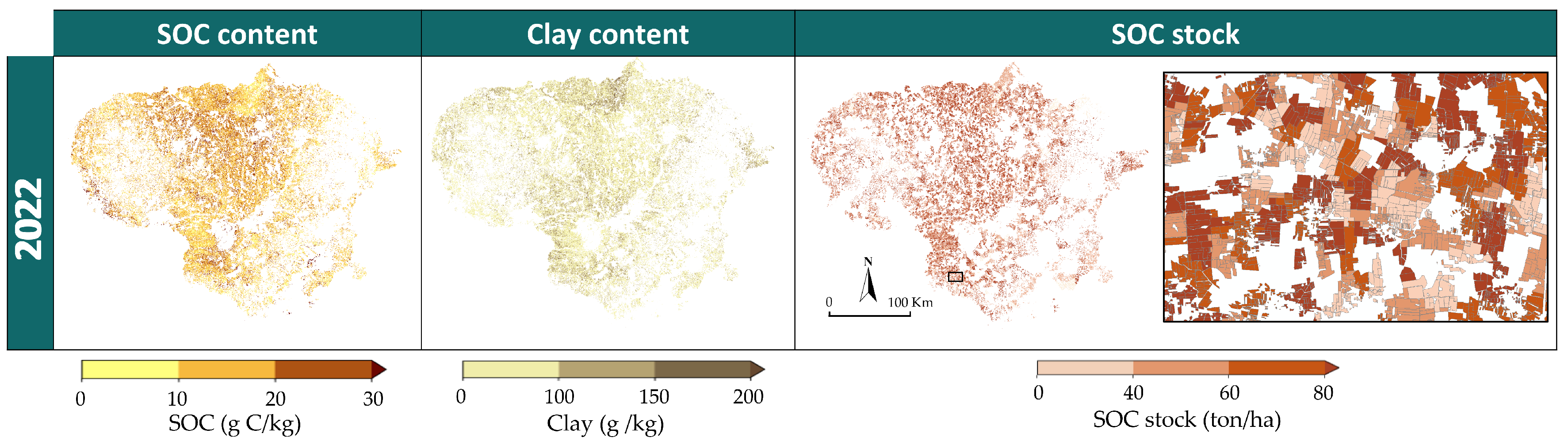
To effectively present the results on the current status of SOC stocks, it is essential to provide detailed information about the enhanced soil data layers integrated into the RothC model, as this will support drawing informed conclusions. Figure 3 presents the high-spatial-resolution soil indicators (Clay and SOC) generated using the proposed AI multi-temporal approach. Specifically, this approach incorporates bare soil reflectance composites, averaged over a rolling three-year period, as input layers. These composites vary annually, as each layer reflects data from a different three-year period. Additionally, annual SOC stock changes were modeled using the RothC, allowing for a dynamic evaluation of soil property evolution over time.
Despite variations in input data, cropland coverage remains consistent across all years, with a similar spatial pattern observed in areas with high SOC values, ranging from 5 to over 30 g C/kg, particularly in the northern and central regions of Lithuania and along the western border. Similar trends are evident for the clay product, which ranges from 45 to over 200 g/kg. In additon, the SOC stock ranges from 15 to over 80 t C / h a , exhibiting a consistent spatial pattern over the three years, as also indicated from the selected detailed area at the southern part of the country. Higher values of SOC stock can be identified in the central part of the country follow the same pattern of SOC content. However, overall, it should be mentioned that the maps in Figure 3 are presented primarily to illustrate spatial consistency and the dynamic mapping capability, rather than to infer strict short-term trends in the soil indicators.
To facilitate a more detailed comparison with current state-of-the-art soil maps and demonstrate the advantages of enhanced spatial layers in the modeling approach, this study compared the results of two RothC simulations. These simulations, using geospatial layers with different spatial resolutions, were employed to estimate SOC stocks at a national scale across three different years. The simulations are defined as follows:
  • 1st simulation: low-resolution input layers
    This simulation utilized coarse-spatial-resolution input data, including SOC and clay content at 250m resolution from SoilGrids, LULC data from the Corine dataset, and climate data from the ERA-5 dataset.
  • 2nd simulation: high-resolution input layers
    In this simulation, the high-spatial-resolution input data layers were employed, namely, the 10m for SOC and clay content, LULC data from the IACS dataset, and climate data from TerraClimate dataset.
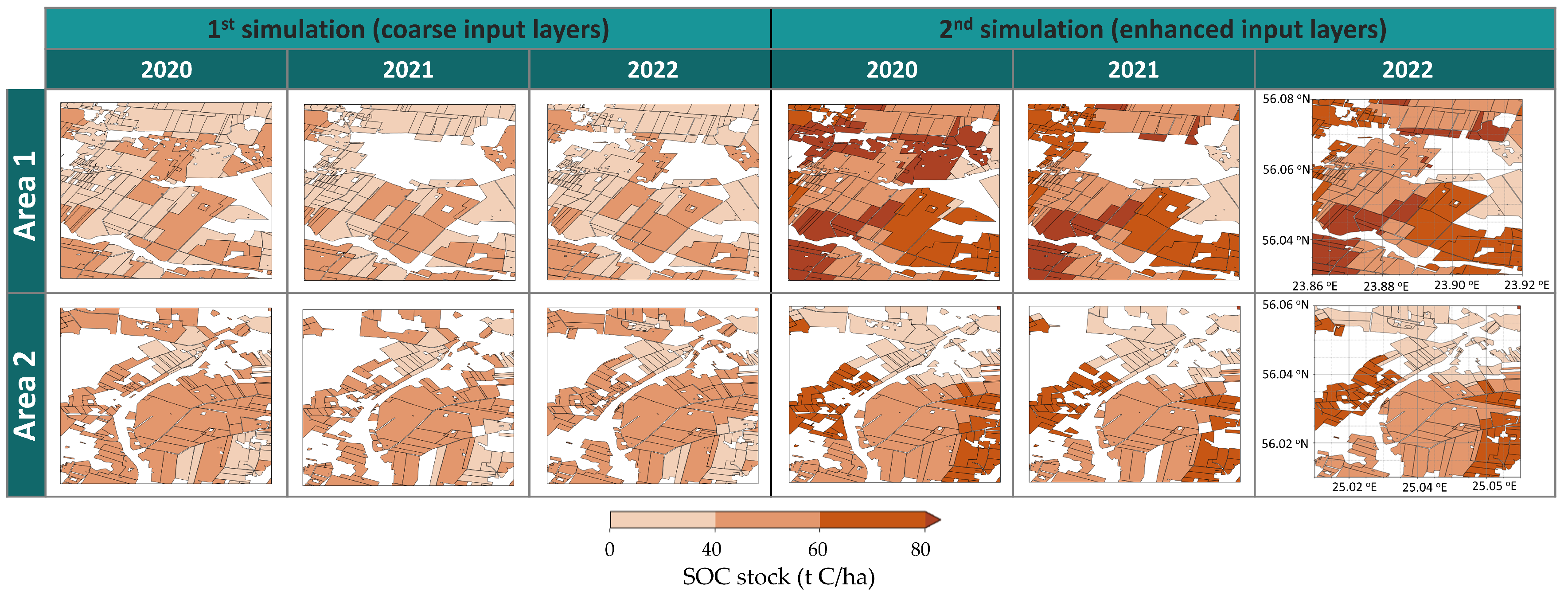
To visualize the model outputs, Figure 4 illustrates two areas with simulated SOC stocks and over three different years (2020–2022). Although the visualization is at parcel level, the comparison revealed noticeable difference in the estimated SOC stocks across various regions, highlighting the significant influence of spatial resolution on SOC modeling accuracy. It is also important to note that differences between selected cropland polygons across years can be justified, as the IACS system varies annually based on farmers’ declarations.
The coarse-resolution soil layers in the first simulation produced more generalized results, smoothing out spatial variability and leading to a less detailed depiction of SOC distribution. This is particularly evident in heterogeneous landscapes with complex land-use patterns and varying soil properties over short distances, resulting in some cases in underestimations of SOC stocks. Based on Figure 4, SOC stock values with the coarser data range from 20 to 60 t C / h a , while the finer-resolution maps reveal values exceeding 80 t C / h a in some cases.
In contrast, the second simulation, which incorporated higher-resolution layers for SOC and clay content, provided a more refined and detailed representation of the spatial distribution of SOC stocks. The improved resolution allowed for a better capture of local soil variability, leading to more accurate predictions, especially in regions with pronounced environmental heterogeneity. The use of high-resolution clay content data in the second simulation further enhanced the realism of the SOC estimates, as clay plays a critical role in the stabilization and storage of organic carbon in soils. Areas with higher clay content tend to have higher SOC stocks [9,47,48], and the improved clay data facilitated a more precise quantification of this relationship. Moreover, the use of the IACS dataset for land-use classification contributed significantly to the improvement in SOC stock estimations. Unlike the Corine LULC dataset, which provides land-use information at a coarser scale, the IACS dataset offers more detailed and up-to-date data, particularly with regard to agricultural land use, thus enabling the more precise modeling of SOC dynamics.

3.2. The Spatial Projections of SOC Sequestration Under the Climate Change Scenarios

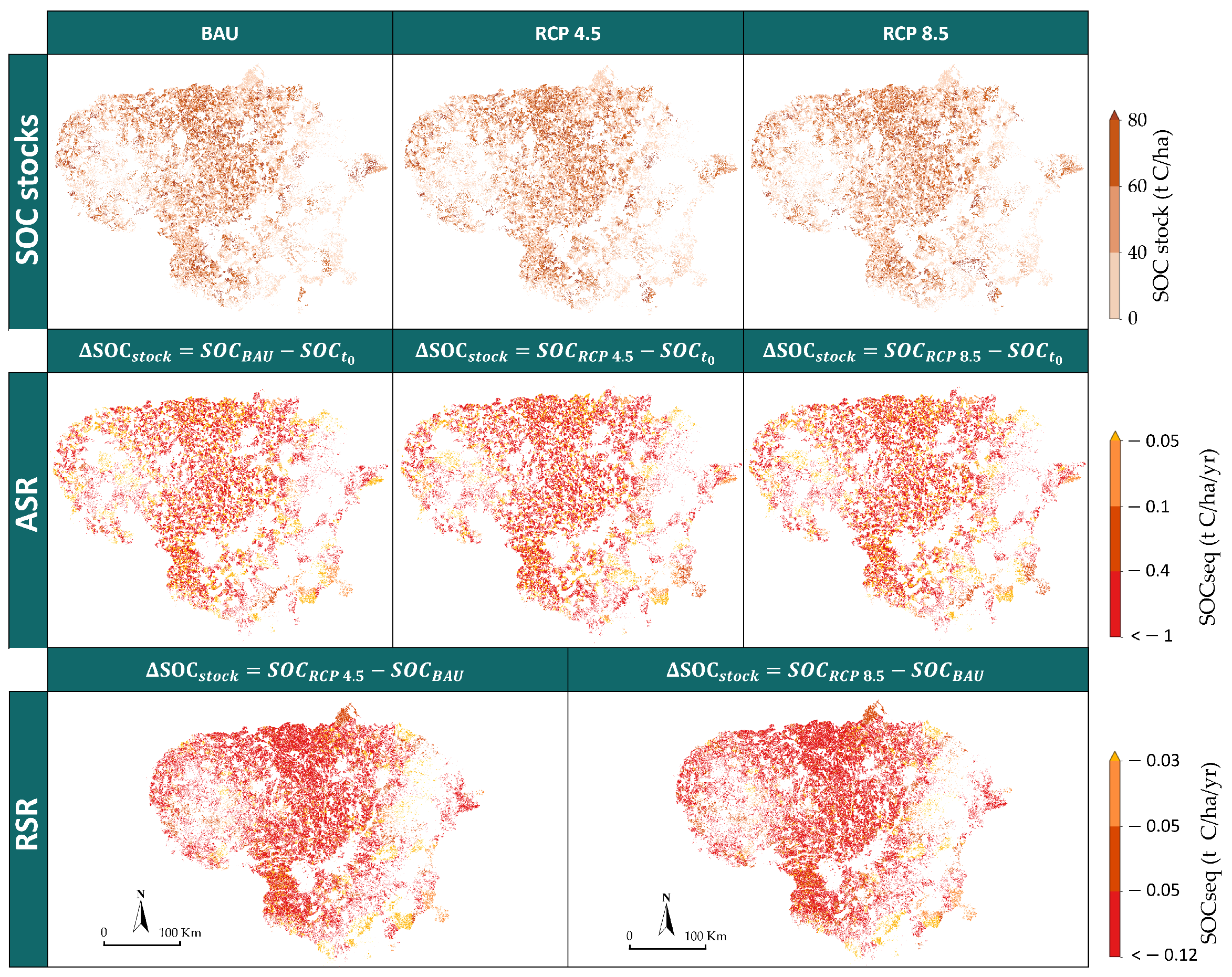
In our analysis, we also present SOC stock predictions under three distinct scenarios: (i) the BAU scenario, and two climate change scenarios based on (ii) RCP 4.5 and (iii) RCP 8.5 (Figure 5). We provide spatial representations of the SOC stock changes by comparing these projections to the time t 0 (year), which is used as the reference period. The results illustrate that the differences in SOC stock changes, when subtracting the baseline t 0 from the climate scenarios, are more significant compared to the differences observed under the BAU scenario. Furthermore, when evaluating the differences between the BAU scenario and the RCP 4.5 and RCP 8.5 projections, we observe larger deviations under the RCP 8.5 scenario. This suggests that the BAU scenario exhibits greater variability in SOC stock changes, underscoring the impact of climate change mitigation strategies as represented by the RCP 4.5 and RCP 8.5 pathways.
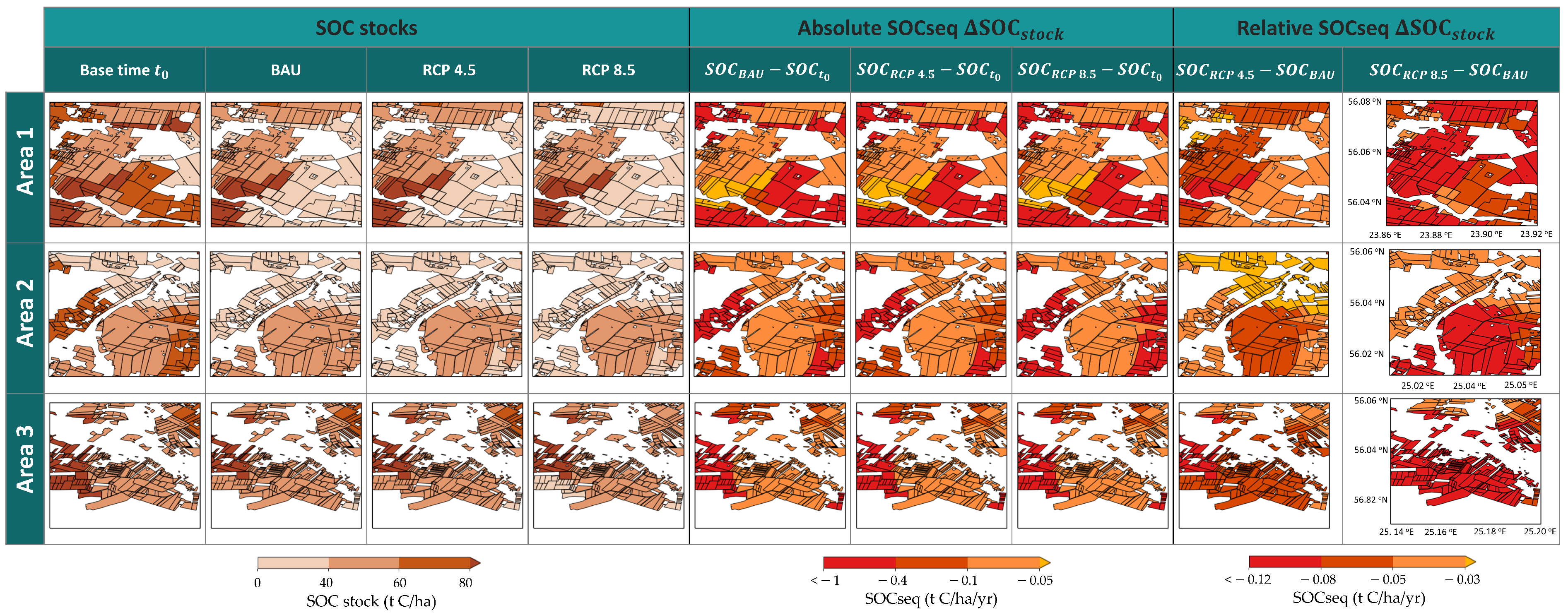
Table 1 provides information related to trends in SOC stocks across various crop classes, while a closer look can be achieved through zooming into three specific areas that have been selected as representative regions within the Lithuanian territory (Figure 6).
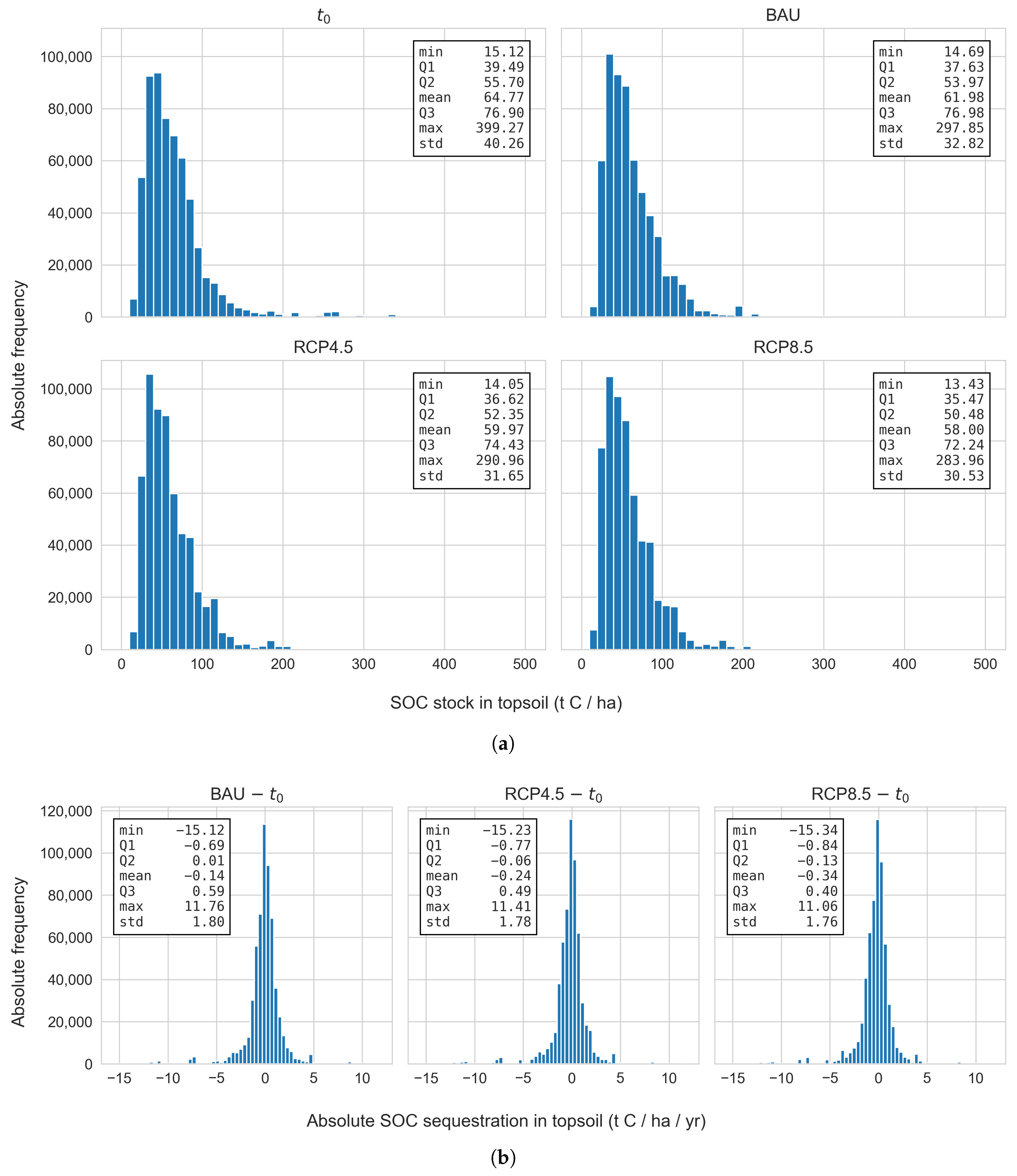
Moreover, Figure 7 presents the distribution of SOC stocks across all agricultural parcels for the baseline year and the three future scenarios, as well as the corresponding absolute SOC sequestration rates (scenario − t 0 ). The SOC stock histograms show a right-skewed distribution, with most parcels clustering between 20–80 t C / h a / yr and a long tail of higher-SOC soils. Future scenarios exhibit a progressive leftward shift in the distribution, reflecting decreasing SOC stocks under warmer and drier conditions. The sequestration rate histograms illustrate that most parcels experience small SOC declines (centered around 0.1 to 0.3 t C / h a / yr ) , while a smaller number gain carbon. These plots highlight the substantial spatial heterogeneity of SOC dynamics across Lithuania and the sensitivity of parcel-level SOC trajectories to different climate scenarios.
Overall, the total cropland area exhibits an average SOC stock of 64.77 t C / h a , with winter rape showing the highest average at 68.38 t C / h a , while oats have the lowest at 60.44 t C / h a , at t 0 . In terms of average ASR, we can notice that all crop classes displayed negative values compared to the baseline ( t 0 ), recording a decline in SOC stocks. It is worthy to mention that the total cropland area shows an ASR of 0.14   t C / h a / yr , with the most significant decrease recorded for spring wheat, with 0.18   t C / h a / yr . The average RSR also reflects negative trends, reinforcing the decline in SOC. The total cropland area records an RSR of 0.10   t C / h a / yr considering RCP 4.5 and 0.2   t C / h a / yr for RCP 8.5. Crop-specific insights reveal that winter wheat and spring barley maintain moderate SOC stocks but experience similar declines in both ASR and RSR. Peas and black fallow also show declines, although their SOC stocks remain relatively stable compared to other crops. Overall, these findings initiated a significant trend of decreasing SOC stocks across the diverse crop classes, highlighting the need for specific interventions to enhance SOC retention and mitigate losses in the face of changing environmental conditions.
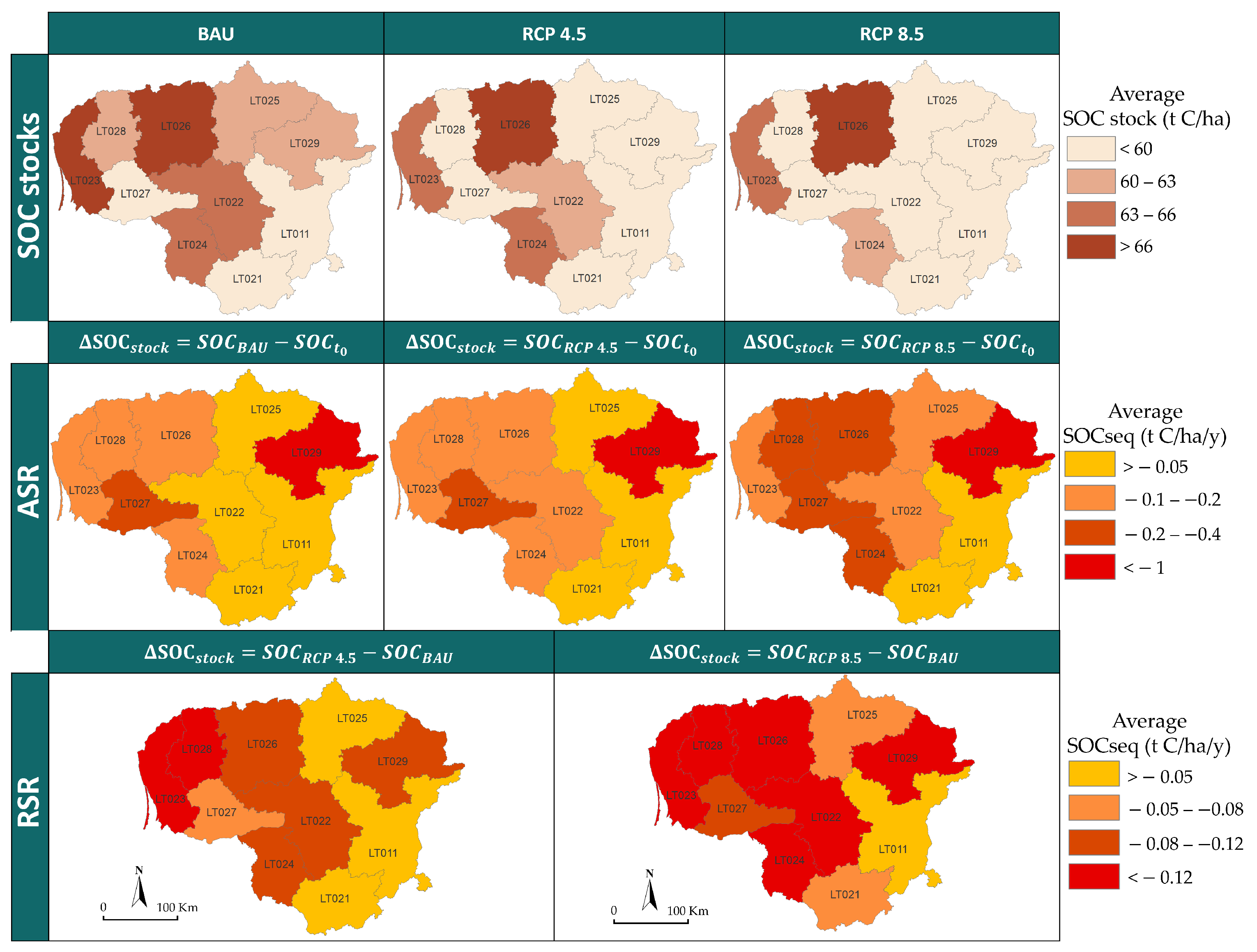
In addition, Figure 8 illustrates the spatial projections using the NUTS-3-level polygons. This process was carried out by calculating the average value of the parcels within each of the polygons. By aggregating the data at this regional level, a broader view of the spatial distribution is provided, helping to highlight trends across larger areas. This approach also allows for the identification of regions that exhibit the most significant differences in SOC stocks, enabling a more detailed understanding of spatial variability and pinpointing areas where the greatest changes or disparities occur.

4. Discussion

4.1. The Rationale for RothC Selection and the Importance of Hybrid Approaches Incorporating High-Resolution Input Layers

In order to move to higher Tiers (i.e., Tier 3), a combination of country-specific approaches is considered necessary, which may include and utilize various dynamic physical-based models such as, for example, ORCHIDEE [49], EPIC [50], ECOSSE [51], CENTURY [52], APSIM [53], YASSO [54], and ARMOSA [55], which are supported by inventory measurements of SOC emissions and/or stocks.
In light of the above, the absence of a one-size-fits-all solution can lead to significant uncertainties in estimations when using meta-modeling approaches. The selection of a specific model must be carefully considered, taking into account the context and data availability. Using any model without acknowledging its limitations could result in either an overestimation or an underestimation of the results. Therefore, a thorough understanding of the model’s capabilities and potential biases is essential for making reliable predictions in carbon modeling and related fields. Furthermore, it is worth noting that the FAO [56] recommends using less data-demanding models, such as RothC, which parameterizes soil processes primarily through empirical and conceptual functions [31,57]. Due to its low input data requirements and its proven suitability for simulating SOC in various LULC areas with limited data availability [33,58], the RothC model was selected for use in this study.
Based on the findings in this research, the spatial resolution of input data layers is considered critically important for the carbon stock spatial estimation, particularly when hybrid approaches are utilized. The high variability in the soil properties, such as SOC and clay content, particularly in agricultural areas due to climate or anthropogenic activities, can significantly impact carbon dynamics. Thus, the integration of fine-resolution soil input layers to the RothC model accurately reflects localized differences in SOC stocks. Overall, high-resolution input layers combined with the IACS dataset ensure that both the process-based models and the advanced AI-driven techniques used in hybrid approaches can operate at their full potential, resulting in better spatial predictions and more effective applications in carbon management, addressing also in that way challenges for the future of pedometrics [59].

4.2. Understanding the Impact of Climate Change Scenarios on SOC Estimation

The results of our study indicate a significant impact of climate change on SOC stocks in the agricultural landscape of Lithuania. To the best of our knowledge, no other studies have investigated changes in SOC stocks across the agricultural landscape with this level of detail. While some previous research has focused on SOC stocks in afforested agricultural land within the Lithuanian hemiboreal forest zone or in grassland systems [60], our study provides a more comprehensive analysis (Table 1). Furthermore, through the implementation of a hybrid modeling approach that integrates high-resolution spatial data with the RothC process-based model, we have been able to project SOC changes under varying climate scenarios. Our results indicate an average SOC loss of greater than 60 t C / h a in a business-as-usual scenario, with further sequestration losses under the RCP 4.5 and RCP 8.5 scenarios (Table 1). Although we cannot make a direct comparison with other regions [61] or countries [57], this aligns with previous research in the USA, and specifically in Vermont [62], where it was emphasized that the detrimental effects of rising temperatures on SOC stocks yield losses in a range of 10% to 20%, even when considering various management scenarios of regenerative farming practices. In this context, we can justify that, while climate-smart farming practices (e.g., rotational grazing, no-tillage) show promise as alternatives to mitigate SOC losses, there is a clear trend indicating that without proactive actions to address climate change, maintaining or enhancing SOC stocks will be challenging. Additionally, the global analysis of SOC dynamics highlights the persistent decline in agricultural soils attributed to historical climate changes, further complicating the challenge of SOC management. The modeling results from the FAO framework indicate a potential average loss of 2.5 Mg C / ha globally, with regional variability dependent on specific climatic factors and initial SOC conditions [63]. These findings underscore the necessity for soil health reporting and accounting frameworks to consider historical climate impacts and current management practices. As our projections demonstrate, ensuring SOC sustainability will require not only the adoption of regenerative agricultural practices but also broader policy initiatives aimed at mitigating climate change effects. By understanding the historical context and future impacts of climate on SOC, stakeholders can develop more effective strategies for preserving soil health and its essential role in mitigating climate change. Our research supports this goal by offering a monitoring system that delivers automated updates to relevant stakeholders through the use of satellite data, enabling them to make informed decisions about soil management practices. A similar approach proposed by Padarian et al. [10] involved developing a two-step semi-mechanistic model to monitor global SOC stocks, concluding an estimation of annual losses around 1.9 Pg SOC/yr.

4.3. Operational Relevance for National Soil-Carbon Monitoring

Targeting a climate-neutral agriculture sector is nowadays a priority at global scale, reflected in a set of policies and converging frameworks that are all based on credible carbon-soil evidence. The carbon removal and carbon farming certification framework defines rules for the voluntary, independent verification of carbon removals, while eco-schemes from common agricultural policy (CAP) and the Land Use, Land-Use Change, and Forestry (LULUCF) regulation require comparable SOC information for incentives and national reporting. In this context, the recently adopted EU’s Soil Monitoring Law [64] further underscores the need for scalable systems able to track SOC change consistently across space and time [65]. In the light of the above, soil-carbon credit programs show that hybrid monitoring, reporting, and verification systems should work on a scale. For example, Brummitt et al. [66] combined statistically designed soil sampling with DayCent modeling across U.S. croplands, approximately 550,000 ha, issuing multiple credit rounds and delivering conservative, registry-compliant SOC estimates. In their work, remote sensing was used mainly for management monitoring and permanence checks, rather than being integrated directly into SOC prediction, to produce national SOC estimates towards verification. Our proposed hybrid framework advances this next step by embedding Earth Observation and AI-generated covariates within the modeling layer, enabling continuous national coverage and annually repeatable SOC stock reporting, resulting in a scalable monitoring capability, as is needed to support CAP evaluation and robust LULUCF soil-carbon accounting. For instance, national paying agencies could deploy these annually updated SOC maps to verify CAP eco-scheme outcomes and target payments where measured gains are observed, and to populate Tier 3 LULUCF inventory factors instead of relying on generic defaults. A remaining limitation is that robust annual detection still requires harmonized, long-term ground sampling, such as the LUCAS topsoil database, to keep uncertainty comparable across regions and years.

4.4. Limitations and Future Directions

In this study, we present a hybrid method for SOC stock spatial modeling that leverages ML pipelines for high-resolution data generation and incorporating it into RothC physical process models, facilitating a paradigm shift in both fields towards improved accuracy (Figure 4).
Recently, the concept of hybrid physics-aware ML has gained traction in the literature, with four key categories emerging: physical data-guided ML, physics-informed ML, physics-embedded ML, and physics-aware hybrid learning [67]. While these approaches have shown promise in domains like hydrology, there is significant potential for applying and further testing these hybrid methods in SOC stock changes modeling. In this context, previous studies proposed the use of knowledge-guided machine learning to model Earth systems with well-understood dynamic processes, such as hydrology and atmospheric sciences; however, they face challenges in capturing the complexities of biogeochemical cycles and indirect soil interactions within agroecosystems [68]. Recently, Liu et al. [69] proposed a knowledge-guided machine learning framework, KGML-ag-Carbon, which integrates prior biogeochemical knowledge with a deep learning model to provide accurate predictions of agricultural soil-carbon stock changes. Despite the valuable data offered for land managers, the coarse resolution of 250m can result in substantial uncertainties due to the small field scale in countries such as Lithuania, and simultaneously could be computationally prohibitive when applied at high spatial-temporal resolutions, such as the Sentinel-2 pixel size.
In the light of the above, we conclude that limitations still exist in developing a hybrid physics-aware ML approach capable of being applied in diverse scales. This requires integrating both EO and in situ data, such as flux measurements, to enhance model transferability and generalization beyond regions like Lithuania. Another critical component is the proper parameterization and calibration of these models. Effective process calibration can be achieved using methods such as physics-discovery neural networks and data-physics-driven parameter discovery [70].
Additionally, uncertainty quantification must be considered by integrating prior physics knowledge into ML for better uncertainty characterization in soil-carbon sequestration modeling [71]. Future models should integrate physics-based and data-driven approaches through innovative frameworks and interdisciplinary collaborations. This integration will enhance the causality of artificial general intelligence and advance the generalization and realization of a soil digital twin [72], defined as a a dynamic, data-driven virtual replica that continuously integrates observations and simulations to monitor, predict, and assess soil conditions.
Moreover, in our study, we also acknowledge the limitations of the Miami NPP dataset, particularly its general approach, which does not account for specific crop types or management practices. Considering the IACS dataset, which provides detailed information on crop types, we can potentially overcome these limitations and improve the accuracy of NPP estimations. In future studies, this crop-specific data could allow us to tailor NPP calculations based on individual crop growth characteristics, thereby improving the spatial and temporal precision of our productivity assessments.
It should be also mentioned that spatial variability in humus depth is not represented in the current work and that this can lead to an under- or overestimation of SOC stocks in soils with substantially thicker or thinner organic horizons. We note that incorporating spatially explicit humus thickness information (e.g. from detailed national soil maps and field surveys) would be an important improvement for future work.
In the end, it should also be mentioned that this study compares coarse- vs. high-spatial-resolution input datasets into the model. However, a key limitation is the lack of independent, national-scale in situ measurements of SOC stock that could be used to directly validate the final SOC stock maps. As a result, the SOC stock estimates presented here inherently reflect the uncertainties in the underlying input layers. These uncertainties propagate through the RothC simulations and may affect the absolute magnitude of SOC stocks at the parcel level. Therefore, the results should be viewed mainly as indicators of relative spatial patterns and general trends over time, rather than precise absolute values. Future work would benefit from considering national sampling campaigns for various parameters such as SOC, BD, and clay content, which could support the more robust calibration and validation of hybrid SOC stock estimation frameworks.

5. Conclusions

In conclusion, this study presents an innovative approach that is based on a hybrid methodology with an automated pipeline to streamline the generation of final estimations effectively. More specifically, it combines cloud-based SDC technology with AI-driven soil maps derived from remote sensing data and integrates these with the RothC process-based model to estimate SOC stocks across Lithuania’s agricultural areas at high spatial resolution. This approach enables precise, field-level SOC stock estimations, which are critical for monitoring soil health and guiding land management policies. By providing projections under various scenarios, this framework reveals key differences in SOC dynamics, emphasizing the critical role of climate adaptation and mitigation strategies in SOC preservation. The BAU scenario projects an average decline of 4% in SOC stocks over 20 years, while, under the RCP climate change scenarios, it suggests average SOC sequestration rates of 0.24   t C / h a / yr for the intermediate scenario RCP 4.5 and 0.34 t C / h a / yr for the pessimistic scenario RCP 8.5, indicating a greater rate of SOC loss under conditions of amplifying climate change associated with RCP 8.5.
This work contributes a novel methodological framework for SOC stock estimation with potential applications across diverse spatial and temporal settings, significantly enhancing the capability of soil-carbon monitoring to inform EU policies, including CAP and LULUCF, and supporting the monitoring, reporting, and verification (MRV) framework. By advancing SOC mapping methodologies, this study supports a more informed approach to soil management, crucial for improving land resilience, meeting climate targets, and safeguarding agricultural productivity. Future research could broaden the model’s application by incorporating additional soil and climate parameters and adjusting for region-specific conditions, thereby enabling more accurate SOC estimations and offering a valuable tool for sustainable agricultural practices and climate resilience efforts.

Author Contributions

Conceptualization, E.K. and N.T.; methodology, N.S. and E.K.; software, N.L.T., N.S., and N.T.; validation, N.S. and N.T.; investigation, N.S.; data curation, N.S.; writing—original draft preparation, N.S. and N.T.; writing—review and editing, N.S., N.L.T., and N.T.; visualization, N.S.; supervision, N.T. All authors have read and agreed to the published version of the manuscript.

Funding

This research received no external funding.

Data Availability Statement

All data employed in this research are available on the GEO Knowledge Hub Platform https://gkhub.earthobservations.org/accessed on 6 August 2025.

Conflicts of Interest

The authors declare no conflicts of interest.

Abbreviations

The following abbreviations are used in this manuscript:
AIArtificial Intelligence
BAUBuisiness as Usual
CORDEXCoordinated Regional Climate Downscaling
CCSClimate Change Scenarios
CNNConvolutional Neural Network
ECMWFEuropean Centre for Medium-Range Weather Forecast
EOEarth Observation
EUEuropean Union
FAOFood and Agriculture Organization
IACSIntegrated Administration Control System
IPCCIntergovernmental Panel on Climate Change
LULCLand Use Land Cover
LULUCFLand Use, Land-Use Change, and Forestry
NPPNet Primary Productivity
RCPRepresentative Concectration Pathways
SDCSoil Data Cube
SOCSoil Organic Carbon

References

  1. Batjes, N. Total carbon and nitrogen in the soils of the world. Eur. J. Soil Sci. 1996, 47, 151–163. [Google Scholar] [CrossRef]
  2. Lal, R. Carbon sequestration. Philos. Trans. R. Soc. B Biol. Sci. 2007, 363, 815–830. [Google Scholar] [CrossRef]
  3. Yigini, Y.; Panagos, P. Assessment of soil organic carbon stocks under future climate and land cover changes in Europe. Sci. Total Environ. 2016, 557–558, 838–850. [Google Scholar] [CrossRef]
  4. Jordan, N.; Boody, G.; Broussard, W.; Glover, J.D.; Keeney, D.; McCown, B.H.; McIsaac, G.; Muller, M.; Murray, H.; Neal, J.; et al. Sustainable Development of the Agricultural Bio-Economy. Science 2007, 316, 1570–1571. [Google Scholar] [CrossRef]
  5. Jones, C.; McConnell, C.; Coleman, K.; Cox, P.; Falloon, P.; Jenkinson, D.; Powlson, D. Global climate change and soil carbon stocks; predictions from two contrasting models for the turnover of organic carbon in soil. Glob. Change Biol. 2004, 11, 154–166. [Google Scholar] [CrossRef]
  6. Kirkels, F.; Cammeraat, L.; Kuhn, N. The fate of soil organic carbon upon erosion, transport and deposition in agricultural landscapes — A review of different concepts. Geomorphology 2014, 226, 94–105. [Google Scholar] [CrossRef]
  7. Doetterl, S.; Berhe, A.A.; Nadeu, E.; Wang, Z.; Sommer, M.; Fiener, P. Erosion, deposition and soil carbon: A review of process-level controls, experimental tools and models to address C cycling in dynamic landscapes. Earth-Sci. Rev. 2016, 154, 102–122. [Google Scholar] [CrossRef]
  8. Panagos, P.; Montanarella, L.; Barbero, M.; Schneegans, A.; Aguglia, L.; Jones, A. Soil priorities in the European Union. Geoderma Reg. 2022, 29, e00510. [Google Scholar] [CrossRef]
  9. De Rosa, D.; Ballabio, C.; Lugato, E.; Fasiolo, M.; Jones, A.; Panagos, P. Soil organic carbon stocks in European croplands and grasslands: How much have we lost in the past decade? Glob. Change Biol. 2023, 30, 16992. [Google Scholar] [CrossRef] [PubMed]
  10. Padarian, J.; Stockmann, U.; Minasny, B.; McBratney, A. Monitoring changes in global soil organic carbon stocks from space. Remote Sens. Environ. 2022, 281, 113260. [Google Scholar] [CrossRef]
  11. European Parliament: Directorate-General for Internal Policies of the Union; McDonald, H.; Frelih-Larsen, A.; Lóránt, A.; Duin, L.; Pyndt Andersen, S.; Costa, G.; Bradley, H. Carbon Farming – Making Agriculture Fit For 2030; Publications Office of the European Parliament: Luxembourg, 2021. [Google Scholar] [CrossRef]
  12. Panagos, P.; Broothaerts, N.; Ballabio, C.; Orgiazzi, A.; De Rosa, D.; Borrelli, P.; Liakos, L.; Vieira, D.; Van Eynde, E.; Arias Navarro, C.; et al. How the EU Soil Observatory is providing solid science for healthy soils. Eur. J. Soil Sci. 2024, 75, 13507. [Google Scholar] [CrossRef]
  13. Lal, R.; Monger, C.; Nave, L.; Smith, P. The role of soil in regulation of climate. Philos. Trans. R. Soc. B Biol. Sci. 2021, 376, 20210084. [Google Scholar] [CrossRef] [PubMed]
  14. Mesfin, S.; Gebresamuel, G.; Haile, M.; Zenebe, A. Modelling spatial and temporal soil organic carbon dynamics under climate and land management change scenarios, northern Ethiopia. Eur. J. Soil Sci. 2020, 72, 1298–1311. [Google Scholar] [CrossRef]
  15. Beillouin, D.; Corbeels, M.; Demenois, J.; Berre, D.; Boyer, A.; Fallot, A.; Feder, F.; Cardinael, R. A global meta-analysis of soil organic carbon in the Anthropocene. Nat. Commun. 2023, 14, 3700. [Google Scholar] [CrossRef]
  16. Paustian, K.; Lehmann, J.; Ogle, S.; Reay, D.; Robertson, G.P.; Smith, P. Climate-smart soils. Nature 2016, 532, 49–57. [Google Scholar] [CrossRef]
  17. Smith, P.; Soussana, J.; Angers, D.; Schipper, L.; Chenu, C.; Rasse, D.P.; Batjes, N.H.; van Egmond, F.; McNeill, S.; Kuhnert, M.; et al. How to measure, report and verify soil carbon change to realize the potential of soil carbon sequestration for atmospheric greenhouse gas removal. Glob. Change Biol. 2019, 26, 219–241. [Google Scholar] [CrossRef]
  18. Smith, P.; Smith, J.; Powlson, D.; McGill, W.; Arah, J.; Chertov, O.; Coleman, K.; Franko, U.; Frolking, S.; Jenkinson, D.; et al. A comparison of the performance of nine soil organic matter models using datasets from seven long-term experiments. Geoderma 1997, 81, 153–225. [Google Scholar] [CrossRef]
  19. Huang, Y.; Guenet, B.; Wang, Y.L.; Ciais, P. Global simulation and evaluation of soil organic matter and microbial carbon and nitrogen stocks using the microbial decomposition model ORCHIMIC v2.0. Glob. Biogeochem. Cycles 2021, 35, e2020GB006836. [Google Scholar] [CrossRef]
  20. Müller, C.; Elliott, J.; Kelly, D.; Arneth, A.; Balkovic, J.; Ciais, P.; Deryng, D.; Folberth, C.; Hoek, S.; Izaurralde, R.C.; et al. The Global Gridded Crop Model Intercomparison phase 1 simulation dataset. Sci. Data 2019, 6, 50. [Google Scholar] [CrossRef]
  21. Lugato, E.; Berti, A. Potential carbon sequestration in a cultivated soil under different climate change scenarios: A modelling approach for evaluating promising management practices in north-east Italy. Agric. Ecosyst. Environ. 2008, 128, 97–103. [Google Scholar] [CrossRef]
  22. Falloon, P.; Smith, P.; Bradley, R.I.; Milne, R.; Tomlinson, R.; Viner, D.; Livermore, M.; Brown, T. RothCUK –A dynamic modelling system for estimating changes in soil C from mineral soils at 1-km resolution in the UK. Soil Use Manag. 2006, 22, 274–288. [Google Scholar] [CrossRef]
  23. Witing, F.; Gebel, M.; Kurzer, H.J.; Friese, H.; Franko, U. Large-scale integrated assessment of soil carbon and organic matter-related nitrogen fluxes in Saxony (Germany). J. Environ. Manag. 2019, 237, 272–280. [Google Scholar] [CrossRef]
  24. Hinge, G.; Surampalli, R.Y.; Goyal, M.K.; Gupta, B.B.; Chang, X. Soil carbon and its associate resilience using big data analytics: For food Security and environmental management. Technol. Forecast. Soc. Change 2021, 169, 120823. [Google Scholar] [CrossRef]
  25. Samarinas, N.; Tziolas, N.; Zalidis, G. Improved Estimations of Nitrate and Sediment Concentrations Based on SWAT Simulations and Annual Updated Land Cover Products from a Deep Learning Classification Algorithm. Isprs Int. J. -Geo-Inf. 2020, 9, 576. [Google Scholar] [CrossRef]
  26. Zhang, X.; Xie, E.; Chen, J.; Peng, Y.; Yan, G.; Zhao, Y. Modelling the spatiotemporal dynamics of cropland soil organic carbon by integrating process-based models differing in structures with machine learning. J. Soils Sediments 2023, 23, 2816–2831. [Google Scholar] [CrossRef]
  27. Samarinas, N.; Tsakiridis, N.; Kalopesa, E.; Zalidis, G. Soil Loss Estimation by Water Erosion in Agricultural Areas Introducing Artificial Intelligence Geospatial Layers into the RUSLE Model. Land 2024, 13, 174. [Google Scholar] [CrossRef]
  28. Xie, E.; Zhang, X.; Lu, F.; Peng, Y.; Chen, J.; Zhao, Y. Integration of a process-based model into the digital soil mapping improves the space-time soil organic carbon modelling in intensively human-impacted area. Geoderma 2022, 409, 115599. [Google Scholar] [CrossRef]
  29. Zhang, L.; Heuvelink, G.B.; Mulder, V.L.; Chen, S.; Deng, X.; Yang, L. Using process-oriented model output to enhance machine learning-based soil organic carbon prediction in space and time. Sci. Total Environ. 2024, 922, 170778. [Google Scholar] [CrossRef]
  30. Eurostat. Gross Value Added and Income by A*10 Industry Breakdowns. 2023. Available online: https://ec.europa.eu/eurostat/databrowser/bookmark/fa6f7d3f-f0e2-4b49-8aaf-0f5049fa699f?lang=en (accessed on 6 August 2025).
  31. Coleman, K.; Jenkinson, D.S. RothC-26.3–A Model for the turnover of carbon in soil. In Evaluation of Soil Organic Matter Models; Springer: Berlin/Heidelberg, Germany, 1996; pp. 237–246. [Google Scholar] [CrossRef]
  32. Mondini, C.; Cayuela, M.L.; Sinicco, T.; Fornasier, F.; Galvez, A.; Sánchez-Monedero, M.A. Modification of the RothC model to simulate soil C mineralization of exogenous organic matter. Biogeosciences 2017, 14, 3253–3274. [Google Scholar] [CrossRef]
  33. Wiltshire, S.; Beckage, B. Soil carbon sequestration through regenerative agriculture in the U.S. state of Vermont. PLoS Clim. 2022, 1, e0000021. [Google Scholar] [CrossRef]
  34. Samarinas, N.; Tsakiridis, N.L.; Kokkas, S.; Kalopesa, E.; Zalidis, G.C. Soil Data Cube and Artificial Intelligence Techniques for Generating National-Scale Topsoil Thematic Maps: A Case Study in Lithuanian Croplands. Remote Sens. 2023, 15, 5304. [Google Scholar] [CrossRef]
  35. Sierra, C.A.; Mueller, M.; Trumbore, S.E. Models of soil organic matter decomposition: The SoilR package, version 1.0. Geosci. Model Dev. 2012, 5, 1045–1060. [Google Scholar] [CrossRef]
  36. Peralta, G.; Di Paolo, L.; Luotto, I.; Omuto, C.; Mainka, M.; Viatkin, K.; Yigini, Y. Global Soil Organic Carbon Sequestration Potential Map (GSOCseq v1.1) – Technical Manual; FAO: Rome, Italy, 2022. [Google Scholar] [CrossRef]
  37. Abatzoglou, J.; Dobrowski, S.; Parks, S.; Hegewisch, K. TerraClimate, a high-resolution global dataset of monthly climate and climatic water balance from 1958–2015. Sci. Data 2018, 5, 170191. [Google Scholar] [CrossRef]
  38. Hersbach, H.; Bell, B.; Berrisford, P.; Hirahara, S.; Horányi, A.; Muñoz-Sabater, J.; Nicolas, J.; Peubey, C.; Radu, R.; Schepers, D.; et al. The ERA5 global reanalysis. Q. J. R. Meteorol. Soc. 2020, 146, 1999–2049. [Google Scholar] [CrossRef]
  39. Hengl, T. Soil bulk density (fine earth) 10 x kg / m-cubic at 6 standard depths (0, 10, 30, 60, 100 and 200 cm) at 250 m resolution. 2018. [CrossRef]
  40. Poggio, L.; de Sousa, L.M.; Batjes, N.H.; Heuvelink, G.B.M.; Kempen, B.; Ribeiro, E.; Rossiter, D. SoilGrids 2.0: Producing soil information for the globe with quantified spatial uncertainty. SOIL 2021, 7, 217–240. [Google Scholar] [CrossRef]
  41. Song, W.; Mu, X.; Ruan, G.; Gao, Z.; Li, L.; Yan, G. Estimating fractional vegetation cover and the vegetation index of bare soil and highly dense vegetation with a physically based method. Int. J. Appl. Earth Obs. Geoinf. 2017, 58, 168–176. [Google Scholar] [CrossRef]
  42. Lieth, H. Modeling the Primary Productivity of the World. In Primary Productivity of the Biosphere; Springer: Berlin/Heidelberg, Germany, 1975; pp. 237–263. [Google Scholar] [CrossRef]
  43. Pachauri, R.K.; Allen, M.R.; Barros, V.R.; Broome, J.; Cramer, W.; Christ, R.; Church, J.A.; Clarke, L.; Dahe, Q.; Dasgupta, P.; et al. Climate Change 2014: Synthesis Report. Contribution of Working Groups I, II and III to the Fifth Assessment Report of the Intergovernmental Panel on Climate Change; IPCC: Geneva, Switzerland, 2014; p. 151. [Google Scholar]
  44. Ma, Y.; Minasny, B.; Viaud, V.; Walter, C.; Malone, B.; McBratney, A. Modelling the Whole Profile Soil Organic Carbon Dynamics Considering Soil Redistribution under Future Climate Change and Landscape Projections over the Lower Hunter Valley, Australia. Land 2023, 12, 255. [Google Scholar] [CrossRef]
  45. Gutierrez, S.; Grados, D.; Møller, A.B.; de Carvalho Gomes, L.; Beucher, A.M.; Giannini-Kurina, F.; de Jonge, L.W.; Greve, M.H. Unleashing the sequestration potential of soil organic carbon under climate and land use change scenarios in Danish agroecosystems. Sci. Total Environ. 2023, 905, 166921. [Google Scholar] [CrossRef]
  46. Copernicus Climate Change Service. CORDEX Regional Climate Model Data on Single Levels. 2019. [Google Scholar] [CrossRef]
  47. Johannes, A.; Sauzet, O.; Matter, A.; Boivin, P. Soil organic carbon content and soil structure quality of clayey cropland soils: A large-scale study in the Swiss Jura region. Soil Use Manag. 2023, 39, 707–716. [Google Scholar] [CrossRef]
  48. Zhong, Z.; Chen, Z.; Xu, Y.; Ren, C.; Yang, G.; Han, X.; Ren, G.; Feng, Y. Relationship between Soil Organic Carbon Stocks and Clay Content under Different Climatic Conditions in Central China. Forests 2018, 9, 598. [Google Scholar] [CrossRef]
  49. Krinner, G.; Viovy, N.; de Noblet-Ducoudré, N.; Ogée, J.; Polcher, J.; Friedlingstein, P.; Ciais, P.; Sitch, S.; Prentice, I.C. A dynamic global vegetation model for studies of the coupled atmosphere-biosphere system. Glob. Biogeochem. Cycles 2005, 19, 2199. [Google Scholar] [CrossRef]
  50. Wang, X.; Williams, J.R.; Gassman, P.W.; Baffaut, C.; Izaurralde, R.C.; Jeong, J.; Kiniry, J.R. EPIC and APEX: Model Use, Calibration, and Validation. Trans. Asabe 2012, 55, 1447–1462. [Google Scholar] [CrossRef]
  51. Smith, J.; Gottschalk, P.; Bellarby, J.; Chapman, S.; Lilly, A.; Towers, W.; Bell, J.; Coleman, K.; Nayak, D.; Richards, M.; et al. Estimating changes in Scottish soil carbon stocks using ECOSSE. I. Model description and uncertainties. Clim. Res. 2010, 45, 179–192. [Google Scholar] [CrossRef]
  52. Parton, W.J. The CENTURY model. In Evaluation of Soil Organic Matter Models; Springer: Berlin/Heidelberg, Germany, 1996; pp. 283–291. [Google Scholar] [CrossRef]
  53. McCown, R.; Hammer, G.; Hargreaves, J.; Holzworth, D.; Freebairn, D. APSIM: A novel software system for model development, model testing and simulation in agricultural systems research. Agric. Syst. 1996, 50, 255–271. [Google Scholar] [CrossRef]
  54. Liski, J.; Palosuo, T.; Peltoniemi, M.; Sievänen, R. Carbon and decomposition model Yasso for forest soils. Ecol. Model. 2005, 189, 168–182. [Google Scholar] [CrossRef]
  55. Perego, A.; Giussani, A.; Sanna, M.; Fumagalli, M.; Carozzi, M.; Lodovico; Alfieri; Brenna, S.; Acutis, M. The ARMOSA simulation crop model: Overall features, calibration and validation results. Ital. J. Agrometeorol. 2013, 3, 23–38. [Google Scholar]
  56. Goglio, P.; Smith, W.N.; Grant, B.B.; Desjardins, R.L.; McConkey, B.G.; Campbell, C.A.; Nemecek, T. Accounting for soil carbon changes in agricultural life cycle assessment (LCA): A review. J. Clean. Prod. 2015, 104, 23–39. [Google Scholar] [CrossRef]
  57. Geremew, B.; Tadesse, T.; Bedadi, B.; Gollany, H.T.; Tesfaye, K.; Aschalew, A.; Tilaye, A.; Abera, W. Evaluation of RothC model for predicting soil organic carbon stock in north-west Ethiopia. Environ. Challenges 2024, 15, 100909. [Google Scholar] [CrossRef]
  58. Mishra, G.; Jangir, A.; Francaviglia, R. Modeling soil organic carbon dynamics under shifting cultivation and forests using Rothc model. Ecol. Model. 2019, 396, 33–41. [Google Scholar] [CrossRef]
  59. Wadoux, A.M.C.; Heuvelink, G.B.; Lark, R.M.; Lagacherie, P.; Bouma, J.; Mulder, V.L.; Libohova, Z.; Yang, L.; McBratney, A.B. Ten challenges for the future of pedometrics. Geoderma 2021, 401, 115155. [Google Scholar] [CrossRef]
  60. Jebari, A.; Álvaro Fuentes, J.; Pardo, G.; Almagro, M.; del Prado, A. Estimating soil organic carbon changes in managed temperate moist grasslands with RothC. PLoS ONE 2021, 16, 1–23. [Google Scholar] [CrossRef]
  61. Afzali, S.F.; Azad, B.; Golabi, M.H.; Francaviglia, R. Using RothC Model to Simulate Soil Organic Carbon Stocks under Different Climate Change Scenarios for the Rangelands of the Arid Regions of Southern Iran. Water 2019, 11, 2107. [Google Scholar] [CrossRef]
  62. Varnagirytė-Kabašinskienė, I.; Žemaitis, P.; Armolaitis, K.; Stakėnas, V.; Urbaitis, G. Soil Organic Carbon Stocks in Afforested Agricultural Land in Lithuanian Hemiboreal Forest Zone. Forests 2021, 12, 1562. [Google Scholar] [CrossRef]
  63. Poeplau, C.; Dechow, R. The legacy of one hundred years of climate change for organic carbon stocks in global agricultural topsoils. Sci. Rep. 2023, 13, 7483. [Google Scholar] [CrossRef] [PubMed]
  64. European Economic and Social Committee. Opinion of the European Economic and Social Committee on the proposal for a Directive of the European Parliament and of the Council on Soil Monitoring and Resilience (Soil Monitoring Law) (COM(2023) 416 final — 2023/0232 (COD)). The Official Journal of the European Union. OJ C, C/2024/887, 2024. EESC 2023/03275; CELEX: 52023AE3275. 2024. Available online: http://data.europa.eu/eli/C/2024/887/oj (accessed on 6 August 2025).
  65. Batjes, N.H.; Ceschia, E.; Heuvelink, G.B.; Demenois, J.; le Maire, G.; Cardinael, R.; Arias-Navarro, C.; van Egmond, F. Towards a modular, multi-ecosystem monitoring, reporting and verification (MRV) framework for soil organic carbon stock change assessment. Carbon Manag. 2024, 15, 2410812. [Google Scholar] [CrossRef]
  66. Brummitt, C.D.; Mathers, C.A.; Keating, R.A.; O’Leary, K.; Easter, M.; Friedl, M.A.; DuBuisson, M.; Campbell, E.E.; Pape, R.; Peters, S.J.; et al. Solutions and insights for agricultural monitoring, reporting, and verification (MRV) from three consecutive issuances of soil carbon credits. J. Environ. Manag. 2024, 369, 122284. [Google Scholar] [CrossRef]
  67. Ge, Y.; Zhang, X.; Atkinson, P.M.; Stein, A.; Li, L. Geoscience-aware deep learning: A new paradigm for remote sensing. Sci. Remote Sens. 2022, 5, 100047. [Google Scholar] [CrossRef]
  68. Willard, J.; Jia, X.; Xu, S.; Steinbach, M.; Kumar, V. Integrating Scientific Knowledge with Machine Learning for Engineering and Environmental Systems. ACM Comput. Surv. 2022, 55, 1–37. [Google Scholar] [CrossRef]
  69. Liu, L.; Zhou, W.; Guan, K.; Peng, B.; Xu, S.; Tang, J.; Zhu, Q.; Till, J.; Jia, X.; Jiang, C.; et al. Knowledge-guided machine learning can improve carbon cycle quantification in agroecosystems. Nat. Commun. 2024, 15, 357. [Google Scholar] [CrossRef]
  70. Raissi, M.; Perdikaris, P.; Karniadakis, G.E. Physics Informed Deep Learning (Part II): Data-driven Discovery of Nonlinear Partial Differential Equations. arXiv 2017, arXiv:cs.AI/1711.10566. [Google Scholar] [CrossRef]
  71. Shi, Z.; Crowell, S.; Luo, Y.; Moore, B., III. Model structures amplify uncertainty in predicted soil carbon responses to climate change. Nat. Commun. 2018, 9, 2171. [Google Scholar] [CrossRef] [PubMed]
  72. Tsakiridis, N.; Samarinas, N.; Kalopesa, E.; Zalidis, G. Cognitive Soil Digital Twin for Monitoring the Soil Ecosystem: A Conceptual Framework. Soil Syst. 2023, 7, 88. [Google Scholar] [CrossRef]
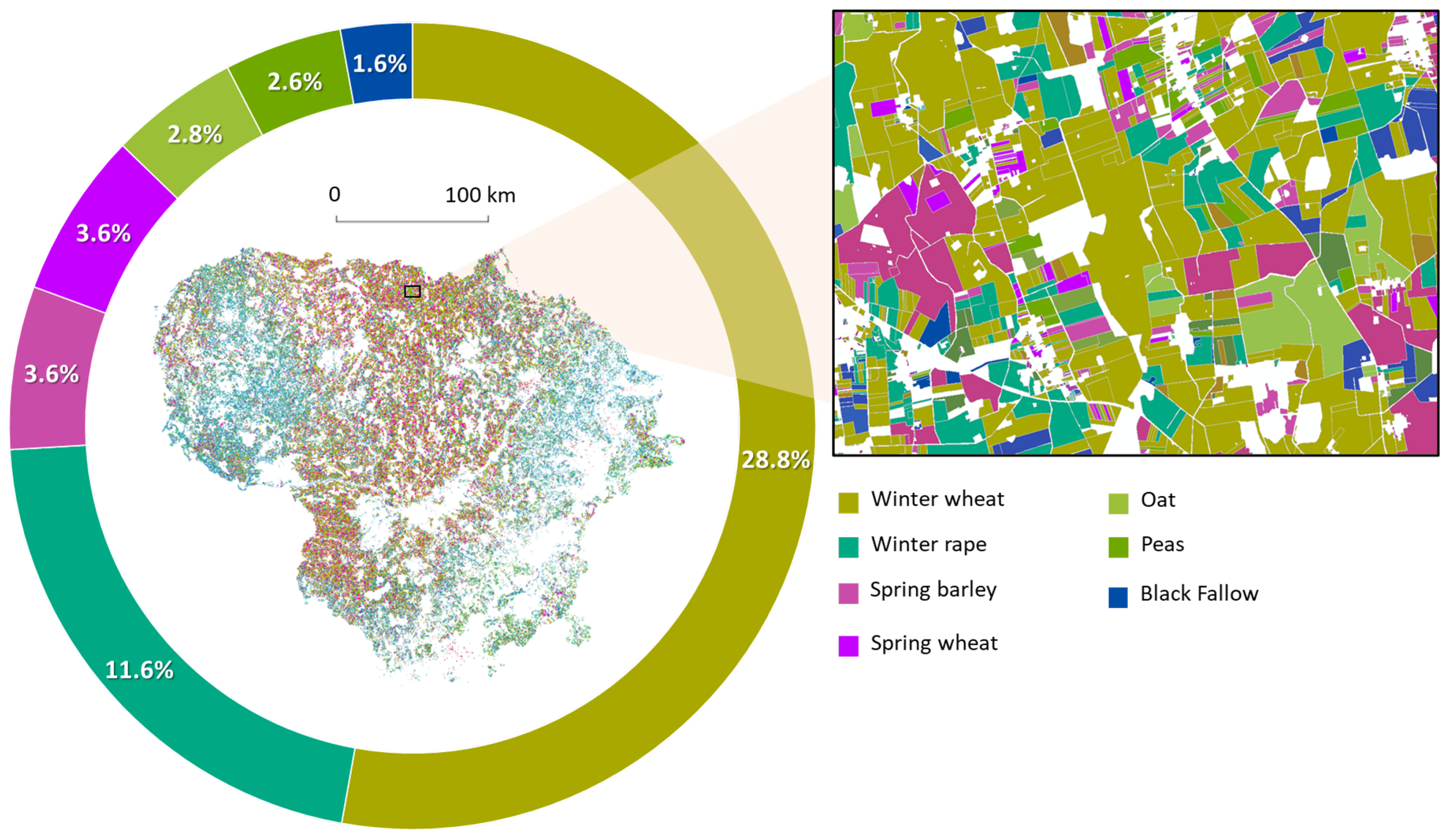
Figure 1. Study area, with the percentage of the 7 most-prominent crop classes and their distribution, obtained by leveraging the IACS 2022 dataset. The percentages are related to the actual area covered by each class in km2.
Environments 12 00477 g001
Figure 2. Schematic representation of the proposed hybrid framework, integrating AI-driven soil layers and other geospatial layers serving as RothC inputs and their respective sources, outlining the necessary steps for executing final simulations under the BAU and climate change scenarios. The framework highlights data flows, resource connections, and procedural stages essential for accurate modeling and scenario implementation.
Environments 12 00477 g002
Figure 3. National-scale spatial layers of SOC, clay content, and SOC stock for 2022 at parcel-level resolution.
Environments 12 00477 g003
Figure 4. Comparison of simulated SOC stock using coarse- and fine-spatial-resolution input layers in the RothC model.
Environments 12 00477 g004
Figure 5. National-scale spatial projections of SOC stocks/sequestration under the BAU and climate change scenarios at parcel-level resolution.
Environments 12 00477 g005
Figure 6. Spatial projections of initial SOC stocks, final SOC stocks (20 years simulations), ASR, and RSR in three different demonstration areas at parcel-level resolution.
Environments 12 00477 g006
Figure 7. Histograms for (a) t 0 , BAU, RCP 4.5, and RCP 8.5 and (b) BAU − t 0 , RCP 4.5 − t 0 , and RCP 8.5 − t 0 .
Environments 12 00477 g007
Figure 8. Average values in NUTS-3-level polygons of SOC stocks/sequestration under the BAU and climate change scenarios at a national scale.
Environments 12 00477 g008
Table 1. Average values of SOC stock/sequestration for the total cropland area and for the 7 dominant crop classes.
Average SOC Stocks ( t C / h a ) Average ASR ( t C / h a / yr ) Average RSR ( t C / h a / yr )
Crop ClassN Parcels t 0 BAURCP 4.5RCP 8.5BAU t 0 RCP 4.5 t 0 RCP 8.5 t 0 RCP 4.5–BAURCP 8.5–BAU
All598,46064.7761.9859.9758.00 0.14 0.24 0.34 0.10 0.20
Winter wheat163,85365.4563.8861.8259.79 0.08 0.18 0.28 0.10 0.20
Winter rape52,35468.3866.7264.6362.57 0.08 0.19 0.29 0.10 0.21
Spring barley30,10166.4364.6562.5860.53 0.09 0.19 0.29 0.10 0.21
Spring wheat35,19963.9960.4258.4556.52 0.18 0.28 0.37 0.10 0.19
Oat29,22260.4457.5455.6653.81 0.14 0.24 0.33 0.09 0.19
Peas19,45665.5963.0461.0259.02 0.13 0.23 0.33 0.10 0.20
Black fallow18,91163.8561.1559.1457.16 0.13 0.24 0.33 0.10 0.20
Disclaimer/Publisher’s Note: The statements, opinions and data contained in all publications are solely those of the individual author(s) and contributor(s) and not of MDPI and/or the editor(s). MDPI and/or the editor(s) disclaim responsibility for any injury to people or property resulting from any ideas, methods, instructions or products referred to in the content.