Family Cohesion and Preschool Children’s Prosocial Behaviour in China: The Mediating Effects of Parent–Child Relationships and Parenting Sense of Competence
Abstract
1. Introduction
1.1. The Development of Prosocial Behaviour in Preschool Children
1.2. Relationship Between Family Cohesion and the Prosocial Behaviour of Preschool Children
1.3. The Parent–Child Relationship and Parenting Sense of Competence as Mediators
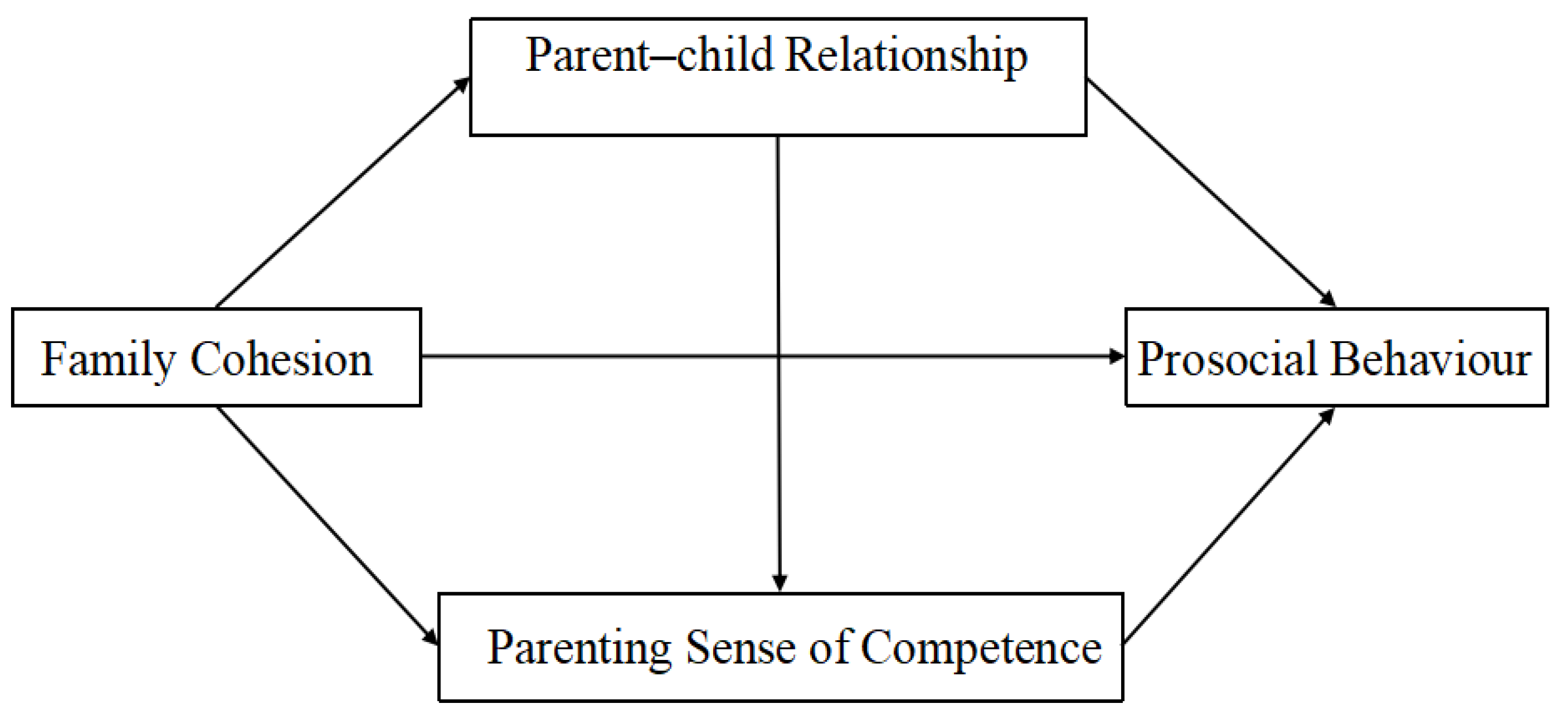
1.4. Current Research
2. Materials and Methods
2.1. Research Participants
2.2. Measurement Tools
2.3. Data Processing
3. Results
3.1. Analysis of the Family Characteristics of Chinese Children’s Prosocial Behaviour
3.2. Correlations Between Family Cohesion, Parenting Sense of Competence, the Parent–Child Relationship and Preschool Children’s Prosocial Behaviour
3.3. Model Validation Results
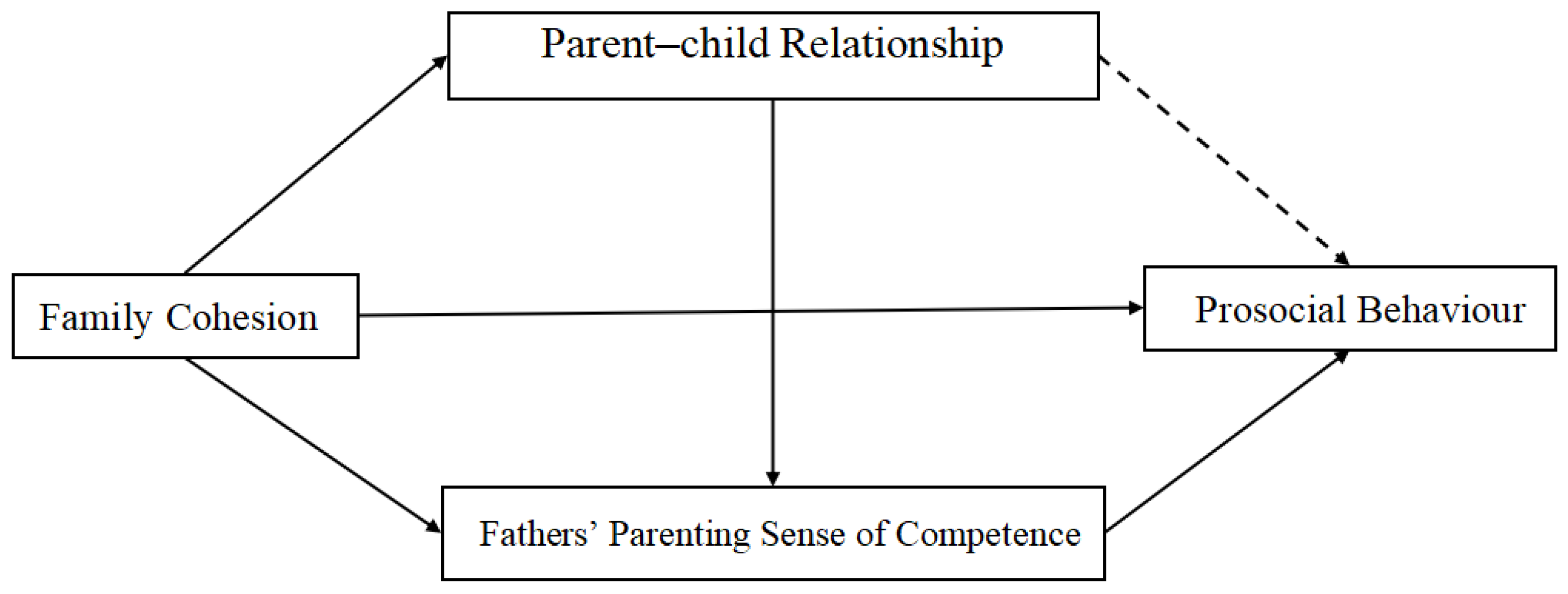
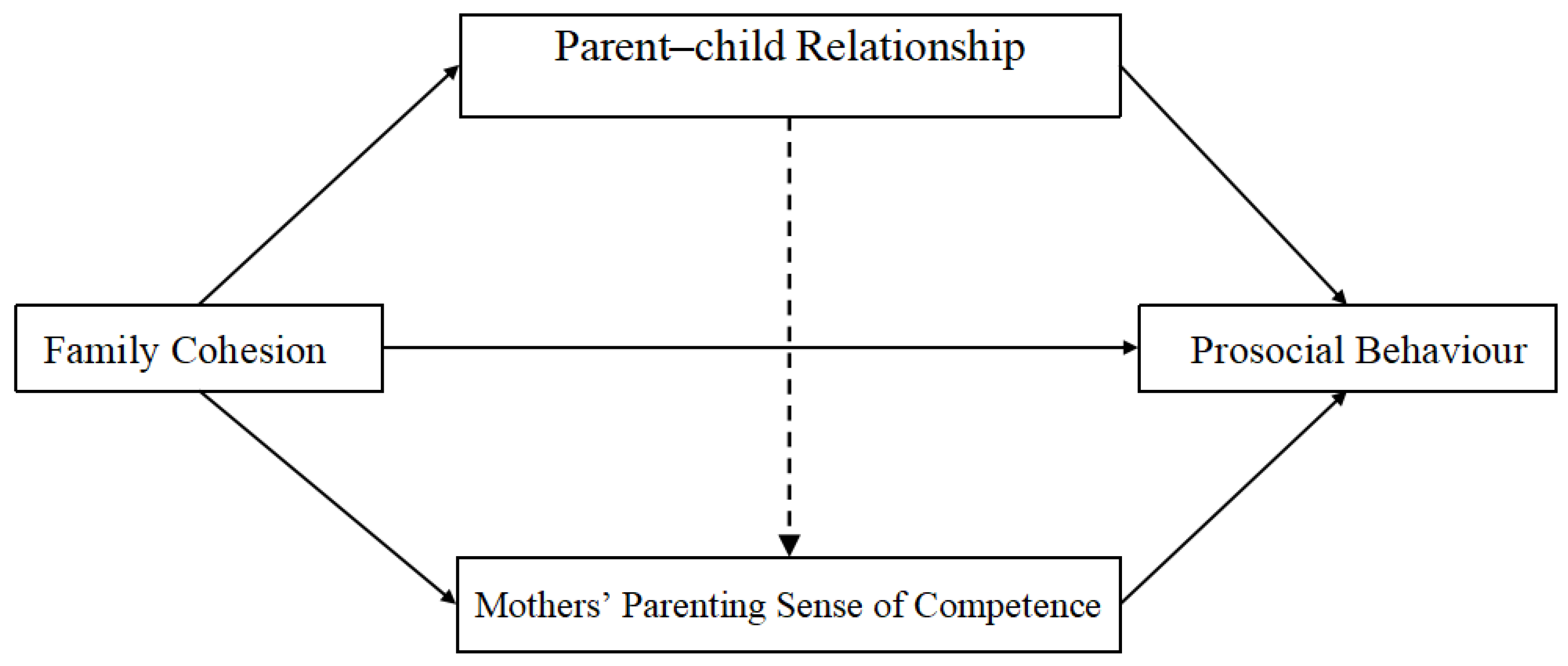
3.4. Results of the Cross-Group Test for the Father and Mother Groups
4. Discussion
4.1. The Effect of Family Cohesion on the Prosocial Behaviour of Chinese Preschool Children
4.2. Mediating Effects of the Parent–Child Relationship and Parenting Sense of Competence
4.3. Differences in Parental Roles
4.4. Research Significance and Limitations
5. Conclusions
Author Contributions
Funding
Institutional Review Board Statement
Informed Consent Statement
Data Availability Statement
Acknowledgments
Conflicts of Interest
Abbreviation
| PSOC | Parenting Sense of Competence |
References
- Albanese, A. M., Russo, G. R., & Geller, P. A. (2019). The role of parental self-efficacy in parent and child well-being: A systematic review of associated outcomes. Child: Care, Health and Development, 45(3), 333–363. [Google Scholar] [CrossRef] [Scilit]
- Armstrong-Carter, E., Miller, J. G., Hill, L. J. B., & Domingue, B. W. (2021). Preschool children’s prosocial behavior protects against academic risk in neighborhoods with low socioeconomic status. Child Development, 92(4), 1509–1522. [Google Scholar] [CrossRef] [Scilit]
- Bronfenbrenner, U., & Ceci, S. J. (1994). Nature-nurture reconceptualized in developmental perspective: A bioecological model. Psychological Review, 101(4), 568–586. [Google Scholar] [CrossRef]
- Bronfenbrenner, U., & Evans, G. W. (2000). Developmental science in the 21st century: Emerging questions, theoretical models, research designs and empirical findings. Social Development, 9(1), 115–125. [Google Scholar] [CrossRef] [Scilit]
- Campis, L. K., Lyman, R. D., & Prentice-Dunn, S. (1986). The Parental Locus of Control Scale: Development and validation. Journal of Clinical Child Psychology, 15(3), 260–267. [Google Scholar] [CrossRef] [Scilit]
- Chen, C. B., & Chen, J. (2017). A review of psychometric properties of the Chinese version of the Strengths and Difficulties Questionnaire. Chinese Journal of Public Health, 33(4), 685–688. [Google Scholar] [CrossRef]
- Chen, W., Li, X., Huebner, E. S., & Tian, L. (2022). Parent–child cohesion, loneliness, and prosocial behavior: Longitudinal relations in children. Journal of Social and Personal Relationships, 39(9), 2939–2963. [Google Scholar] [CrossRef] [Scilit]
- Eisenberg, N., Spinrad, T. L., & Knafo-Noam, A. (2015). Prosocial development. In Handbook of child psychology and developmental science. Wiley. [Google Scholar] [CrossRef] [Scilit]
- Fang, Y., Boelens, M., Windhorst, D. A., Raat, H., & van Grieken, A. (2021). Factors associated with parenting self-efficacy: A systematic review. Journal of Advanced Nursing, 77(6), 2641–2661. [Google Scholar] [CrossRef] [Scilit]
- Ferreira, T., Cadima, J., Matias, M., Vieira, J., Leal, T., & Matos, P. (2016). Preschool children’s prosocial behavior: The role of mother-child, father-child and teacher-child relationships. Journal of Child & Family Studies, 25(6), 1829–1839. [Google Scholar] [CrossRef] [Scilit]
- Giner Torréns, M., & Krtner, J. (2019). Affiliation motivates children’s prosocial behaviors: Relating helping and comforting to imitation. Review of Social Development, 28(3), 501–513. [Google Scholar] [CrossRef] [Scilit]
- Goodman, R. (2010). The strengths and difficulties questionnaire: A research note. Journal of Child Psychology & Psychiatry, 38(5), 581–586. [Google Scholar] [CrossRef] [Scilit]
- Grueneisen, S., & Warneken, F. (2022). The development of prosocial behavior-from sympathy to strategy. Current Opinion in Psychology, 43, 323–328. [Google Scholar] [CrossRef] [Scilit]
- Hashim, N., Fischer, N. L., Kim, E. B., Yeung, W. J. J., & Yu, R. (2023). The influence of socioeconomic status and appearance-reality understanding on pre-schoolers’ sharing and generosity. British Journal of Developmental Psychology, 41(4), 325–342. [Google Scholar] [CrossRef] [Scilit]
- Hay, D. F., Paine, A. L., Perra, O., Cook, K. V., & Fyfield, R. (2021). Prosocial and aggressive behavior: A longitudinal study. Monographs of the Society for Research in Child Development, 86(2), 7–103. [Google Scholar] [CrossRef] [Scilit]
- Herke, M., Knchelmann, A., & Richter, M. (2020). Health and well-being of adolescents in different family structures in germany and the importance of family climate. International Journal of Environmental Research and Public Health, 17(18), 6470. [Google Scholar] [CrossRef] [Scilit]
- Hur, Y. M., Taylor, J., Jeong, H. U., Park, M. S., & Haberstick, B. C. (2017). Perceived family cohesion moderates environmental influences on prosocial behavior in nigerian adolescent twins. Twin Research & Human Genetics, 20(03), 226–235. [Google Scholar] [CrossRef] [Scilit]
- Institute of Social Science Survey, Peking University. (2018). China Family Panel Studies 2018 consolidated questionnaire. Available online: https://www.isss.pku.edu.cn/cfps/docs/20210807104343791093.pdf (accessed on 1 January 2026).
- Jambon, M., & Malti, T. (2022). Developmental relations between childrens peer relationship quality and prosocial behavior: The mediating role of trust. The Journal of Genetic Psychology, 183(3), 197–210. [Google Scholar] [CrossRef] [Scilit]
- Jegatheeswaran, C., Burns, S., Jenkins, J. M., & Perlman, M. (2023). Influence of maternal cognitions on child mental health and educational experiences at home during COVID-19. Early Education and Development, 34, 900–913. [Google Scholar] [CrossRef] [Scilit]
- Jiménez, L., Hidalgo, V., Baena, S., León, A., & Lorence, B. (2019). Effectiveness of structural-strategic family therapy in the treatment of adolescents with mental health problems and their families. International Journal of Environmental Research and Public Health, 16(7), 1255. [Google Scholar] [CrossRef] [Scilit]
- Johnston, C., & Mash, E. J. (1989). A Measure of Parenting Satisfaction and Efficacy. Journal of Clinical Child Psychology, 18(2), 167–175. [Google Scholar] [CrossRef] [Scilit]
- Lansford, J. E., Odgers, C. L., Bradley, R. H., Godwin, J., Copeland, W. E., Rothenberg, W. A., & Dodge, K. A. (2023). The home-21: A revised measure of the home environment for the 21st century tested in two independent samples. Psychological assessment, 35(1), 1–11. [Google Scholar] [CrossRef] [Scilit]
- Lee, J. (2018). Prosocial parent-to-peer path model for South Korean school-aged children. Child Indicators Research, 11, 1867–1888. [Google Scholar] [CrossRef] [Scilit]
- Li, A., Wang, S., & Liu, X. (2023). Parent involvement in schools as ecological assets, prosocial behaviors and problem behaviors among chinese middle school students: Mediating role of positive coping. Current Psychology, 42, 16061–16069. [Google Scholar] [CrossRef] [Scilit]
- Li, L. J., Zhang, J., Zhang, N., Chen, Q., & Wang, C. X. (2024). The impact of family cohesion and family conflict on sleep duration among preschoolers. Chinese Journal of Behavioral Medicine and Brain Science, 33(7), 624–629. Available online: https://rs.yiigle.com/cmaid/1510251 (accessed on 1 January 2026).
- Li, X. Y., Mao, K. N., Mi, X. Y., Gao, L. L., Yang, X., Tao, H. F., Zhang, Y. W., Chen, J., Wang, X., Shen, L. J., Yuan, J. L., Miao, M., & Zhou, H. (2021). Psychometric evaluation of the Parenting Sense of Competence Scale among mothers of preschool children. Journal of Peking University (Health Sciences), 53(3), 479–484. [Google Scholar] [CrossRef] [PubMed]
- Li, Z., Yu, C., Cao, Y., Nie, Y., Tu, W., Liu, B., Ning, Z., & Chen, P. (2024). The association between parent–child attachment and prosocial behavior: A longitudinal study. Current Psychology, 43(3), 2432–2441. [Google Scholar] [CrossRef] [Scilit]
- Liu, Y., Haslam, D. M., Dittman, C. K., Guo, M., & Morawska, A. (2022). Predicting Chinese father involvement: Parental role beliefs, fathering self-efficacy and maternal gatekeeping. Frontiers in Psychology, 13, 1066876. [Google Scholar] [CrossRef] [Scilit] [PubMed]
- Ma, M., Li, D., & Zhang, L. (2021). Longitudinal prediction of children’s math anxiety from parent-child relationships. Learning and Individual Differences, 88(4), 102016. [Google Scholar] [CrossRef] [Scilit]
- Manyeruke, G., Erkez, Y., Kiraz, A., & Akc, E. (2021). Attachment, psychological wellbeing, and educational development among child members of transnational families. Alpha Psychiatry, 22, 49–55. [Google Scholar] [CrossRef] [Scilit]
- Miller-Graff, L. E., Scheid, C. R., Guzmán, D. B., & Grein, K. (2020). Caregiver and family factors promoting child resilience in at-risk families living in Lima, Peru. Child Abuse & Neglect, 108(2), 104639. [Google Scholar] [CrossRef] [Scilit]
- Moen, P. E., Elder, G. H., Jr., & Lüscher, K. E. (1995). Examining lives in context: Perspectives on the ecology of human development. American Psychological Association. [Google Scholar] [CrossRef] [Scilit]
- Ngai, F. W., Wai-Chi Chan, S., & Holroyd, E. (2007). Translation and validation of a chinese version of the parenting sense of competence scale in chinese mothers. Nursing Research, 56(5), 348–354. [Google Scholar] [CrossRef] [Scilit] [PubMed]
- Nunes, C., Jiménez, L., Menéndez, S., Ayala-Nunes, L., & Hidalgo, V. (2016). Psychometric properties of an adapted version of the parental sense of competence (psoc) scale for portuguese at-risk parents. Child & Family Social Work, 21(4), 433–441. [Google Scholar] [CrossRef] [Scilit]
- Olson, D. H., Russell, C. S., & Sprenkle, D. H. (2010). Circumplex model of marital and family systems: Vi. theoretical update. Family Process, 22(1), 144–167. [Google Scholar] [CrossRef] [Scilit]
- Oltra-Benavent, P., Cano-Climent, A., Oliver-Roig, A., Cabrero-García, J., & Richart-Martínez, M. (2020). Spanish version of the parenting sense of competence scale: Evidence of reliability and validity. Child & Family Social Work, 25(2), 373–383. [Google Scholar] [CrossRef] [Scilit]
- Pelletier, J., & Brent, J. M. (2002). Parent participation in children’ school readiness: The effects of parental self-efficacy, cultural diversity and teacher strategies. International Journal of Early Childhood, 34(1), 45–60. [Google Scholar] [CrossRef] [Scilit]
- Poulain, T., Ludwig, J., Hiemisch, A., Hilbert, A., & Kiess, W. (2019). Media use of mothers, media use of children, and parent–child interaction are related to behavioral difficulties and strengths of children. International Journal of Environmental Research and Public Health, 16(23), 4651. [Google Scholar] [CrossRef] [Scilit]
- Puccioni, J., Froiland, J. M., & Moeyaert, M. (2020). Preschool teachers’ transition practices and parents’ perceptions as predictors of involvement and children’s school readiness. Children and Youth Services Review, 109, 104742. [Google Scholar] [CrossRef] [Scilit]
- Salo, A. E., Junttila, N., & Vauras, M. (2022). Parental self-efficacy and intra- and extra-familial relationships. Journal of Child and Family Studies, 31(10), 2714–2729. [Google Scholar] [CrossRef] [Scilit]
- Shah, S., Choi, M., Miller, M., Halgunseth, L. C., Schaik, S. D. M. V., & Brenick, A. (2021). Family cohesion and school belongingness: Protective factors for immigrant youth against bias-based bullying. New Directions for Child and Adolescent Development, 2021(177), 199–217. [Google Scholar] [CrossRef] [Scilit] [PubMed]
- Slagt, M., Deković, M., de Haan, A. D., Van Den Akker, A. L., & Prinzie, P. (2012). Longitudinal associations between mothers’ and fathers’ sense of competence and children’s externalizing problems: The mediating role of parenting. Developmental psychology, 48(6), 1554–1562. [Google Scholar] [CrossRef] [Scilit] [PubMed]
- Stacy, T. A. (2020). Temperamental shyness, effortful control, and psychosocial adjustment in chinese children (order No. 28259503). ProQuest Dissertations & Theses. Available online: https://www.proquest.com/dissertations-theses/temperamental-shyness-effortful-control/docview/2494896041/se-2 (accessed on 1 January 2026).
- Stengelin, R., Ball, R., Maurits, L., Kanngiesser, P., & Haun, D. B. M. (2023). Children over-imitate adults and peers more than puppets. Developmental Science, 26(2), 13303. [Google Scholar] [CrossRef] [Scilit] [PubMed]
- Tong, Z. Y. (2008). On the Unique Influence of Fathers in Children’s Education and Its Optimization. Journal of Yichun University, 30(03), 55–57. [Google Scholar]
- Trahan, M. H. (2017). Paternal self-efficacy and father involvement: A bi-directional relationship. Psychology of Men & Masculinity, 19(4), 624–634. [Google Scholar] [CrossRef] [Scilit]
- Trecca, F., Bleses, D., Hjen, A., & Laursen, B. (2022). Direct and indirect effects from parenting self-efficacy and parenting practices to social-emotional adjustment in 3-to 5-year-old children. Acta Psychologica, 229, 103673. [Google Scholar] [CrossRef] [Scilit]
- Vanderbilt, K. E., Rizzo, M. T., & Blankenship, J. (2023). Preschoolers selectively trust and selectively share with others based on their past accuracy and intentions. Journal of Experimental Child Psychology, 228, 105610. [Google Scholar] [CrossRef] [Scilit]
- Wang, D. (2025). Paternal involvement in parenting and prosocial risk-taking behavior of junior high school students: The chain mediating role of self-esteem and moral disengagement [Master’s thesis, Kashgar University]. [Google Scholar] [CrossRef]
- Xu, Y., Xu, D., Simpkins, S., & Warschauer, M. (2019). Does it matter which parent is absent? Labor migration, parenting, and adolescent development in China. Journal of Child and Family Studies, 28(1), 1635–1649. [Google Scholar] [CrossRef] [Scilit]
- Yang, X., Gao, L. L., Zhang, Z. X., Wu, D. H., & Zhang, Y. (2014). Chinese version of the Parenting Competency Scale in parturients: Reliability and validity testing of applications. Chinese Journal of Nursing, 49(7), 881–885. (In Chinese) [Google Scholar]
- Zhang, R., Guo, Y., Bai, B., Wang, Y., Gao, L., & Cheng, L. (2022). The association between parental marital satisfaction and adolescent prosocial behavior in China: A moderated serial mediation model. International Journal of Environmental Research and Public Health, 19(9), 5630. [Google Scholar] [CrossRef] [Scilit]
- Zhao, F., Liu, M., & Li, S. (2020). Paternal coparenting behavior and adolescent prosocial behaviors: Roles of parent-child attachment, peer attachment, and gender. Children and Youth Services Review, 119, 105629. [Google Scholar] [CrossRef] [Scilit]
- Zhao, J., Zhang, Y., Jiang, F., Ip, P., Ho, F. K. W., Zhang, Y., & Huang, H. (2018). Excessive screen time and psychosocial well-being: The mediating role of body mass index, sleep duration, and parent-child interaction. Journal of Pediatrics, 202, 157–162. [Google Scholar] [CrossRef] [Scilit]



| 1 | 2 | 3 | 4 | |
|---|---|---|---|---|
| 1 Family cohesion | 1 | |||
| 2 Parenting sense of competence | 0.50 ** | 1 | ||
| 3 Parent–child relationship | 0.23 ** | 0.24 ** | 1 | |
| 4 Prosocial behaviours | 0.45 ** | 0.37 ** | 0.29 ** | 1 |
| Path | β | 95% Confidence Interval |
|---|---|---|
| Direct effect | ||
| Family cohesion → prosocial behaviour | 0.31 | [0.22, 0.40] |
| Mediating effect | ||
| Family cohesion → parent–child relationship→ prosocial behaviour | 0.04 | [0.02, 0.06] |
| Family cohesion → PSOC → prosocial behaviour | 0.07 | [0.03, 0.11] |
| Family cohesion → parent–child relationship → PSOC → prosocial behaviour | 0.01 | [0.00, 0.01] |
Disclaimer/Publisher’s Note: The statements, opinions and data contained in all publications are solely those of the individual author(s) and contributor(s) and not of MDPI and/or the editor(s). MDPI and/or the editor(s) disclaim responsibility for any injury to people or property resulting from any ideas, methods, instructions or products referred to in the content. |
© 2026 by the authors. Licensee MDPI, Basel, Switzerland. This article is an open access article distributed under the terms and conditions of the Creative Commons Attribution (CC BY) license.
Share and Cite
Chen, X.; Chen, J.; Gao, X. Family Cohesion and Preschool Children’s Prosocial Behaviour in China: The Mediating Effects of Parent–Child Relationships and Parenting Sense of Competence. Behav. Sci. 2026, 16, 347. https://doi.org/10.3390/bs16030347
Chen X, Chen J, Gao X. Family Cohesion and Preschool Children’s Prosocial Behaviour in China: The Mediating Effects of Parent–Child Relationships and Parenting Sense of Competence. Behavioral Sciences. 2026; 16(3):347. https://doi.org/10.3390/bs16030347
Chicago/Turabian StyleChen, Xu, Jing Chen, and Xin Gao. 2026. "Family Cohesion and Preschool Children’s Prosocial Behaviour in China: The Mediating Effects of Parent–Child Relationships and Parenting Sense of Competence" Behavioral Sciences 16, no. 3: 347. https://doi.org/10.3390/bs16030347
APA StyleChen, X., Chen, J., & Gao, X. (2026). Family Cohesion and Preschool Children’s Prosocial Behaviour in China: The Mediating Effects of Parent–Child Relationships and Parenting Sense of Competence. Behavioral Sciences, 16(3), 347. https://doi.org/10.3390/bs16030347