


Abstract
Pediatric traumatic brain injury (TBI), including mild TBI (mTBI), is associated with sleep–wake disturbances that may affect cognitive and psychosocial functioning. This exploratory cross-sectional study integrated objective actigraphy-based sleep assessment with standardized cognitive and psychosocial measures to compare sleep–wake disturbances (SWDs) and explore associations with cognitive and psychosocial outcomes in children aged 6–16 years with mTBI (n = 14), moderate-to-severe TBI (msTBI; n = 6), and typically developing children (TDC; n = 12). Actigraphy-derived measures showed reduced sleep efficiency (SE) and increased wake after sleep onset (WASO) in both TBI groups compared with TDC. No significant associations emerged between actigraphy-derived sleep metrics and global cognitive performance (WISC-FSIQ) or overall psychosocial outcomes. The limited sample size, particularly within the msTBI group, likely constrained statistical power. Furthermore, the absence of prospectively collected pre-injury sleep data and the cross-sectional design prevent causal attribution of the observed group differences to TBI. These findings highlight objective sleep continuity as a clinically relevant consideration in pediatric TBI follow-up and support further investigation of sleep-focused interventions. Larger longitudinal and intervention studies are needed to determine whether improving sleep continuity contributes to better cognitive, psychosocial, and functional recovery.
1. Introduction
Sleep plays a vital role in typical brain development and neural recovery post-injury (Williams et al., 2018), as it facilitates synaptic regulation and cellular homeostasis during critical rest periods (Tononi & Cirelli, 2014).
Long-term sleep disturbances, especially difficulties with falling asleep and staying asleep, have been reported to persist for several years after a traumatic brain injury (TBI) (Gagner et al., 2015; Luther et al., 2020; Williams et al., 2020). Sleep–wake disturbances (SWDs) following pediatric TBI, including mild TBI (mTBI), have been associated with difficulties in sleep initiation and maintenance, excessive daytime sleepiness, and fatigue (Gagner et al., 2015; Luther et al., 2020). Previous findings have also demonstrated associations between SWDs and reduced quality of life (QoL) among affected children (Luther et al., 2020). In adolescents with mTBI, subjective sleep difficulties and objectively measured alterations in sleep duration, sleep efficiency, and nocturnal wakefulness have been documented several months post-injury (Tham et al., 2015).
These symptoms can be evaluated through self- or parent-reported questionnaires, or via objective methods such as actigraphy (Meltzer et al., 2012; Tham et al., 2015). Actigraphy is an increasingly popular, accessible, and non-invasive method for assessing sleep metrics, valued for its practicality, suitability for long-term monitoring, and ability to capture ecologically valid data in natural, home-based environments (Sadeh, 2011; Meltzer et al., 2012). Despite its lower sensitivity in detecting nocturnal wakefulness, actigraphy provides estimates of essential sleep parameters, including sleep latency (SL) (i.e., time to fall asleep), wake after sleep onset (WASO), and sleep efficiency (SE) (i.e., the ratio of total sleep time to total time spent in bed) (Sadeh, 2011; Meltzer et al., 2012). Combining objective and subjective sleep assessment may provide complementary information regarding sleep–wake characteristics following pediatric TBI (Tham et al., 2015).
Although research on pediatric mTBI has expanded recently, relatively few studies have examined objective sleep metrics alongside cognitive and psychosocial functioning across different TBI severity levels and developmental stages. Tham et al. (2015) examined subjective and objective sleep characteristics in adolescents with mTBI, while Lah et al. (2022) investigated parent-reported sleep difficulties and actigraphy-derived sleep measures in children with moderate-to-severe TBI. Similarly, Landry-Roy et al. (2018) examined the relationship between objective sleep parameters and executive functioning in children aged 18–60 months with mTBI, limiting the generalizability of findings across broader developmental stages. Comprehensive investigations that concurrently assess objective and subjective sleep characteristics, standardized cognitive performance, and psychosocial outcomes across the pediatric TBI spectrum remain limited.
Hence, the present study employs an integrated approach, combining self- and parent-reported sleep assessments, actigraphy-based sleep monitoring, standardized cognitive assessment, and validated psychosocial measures. Within an exploratory cross-sectional design, the study aimed to (1) compare sleep–wake characteristics and sleep metrics across children with mTBI, moderate-to-severe TBI (msTBI), and typically developing children (TDC) using subjective and objective (actigraphy-derived measures) sleep–wake assessment tools, and (2) explore associations between objective sleep metrics, cognitive performance, and psychosocial outcomes as secondary, exploratory analyses. Based on prior findings, it was hypothesized that the severity of TBI would be associated with the frequency and severity of SWDs.
2. Materials and Methods
2.1. Participants
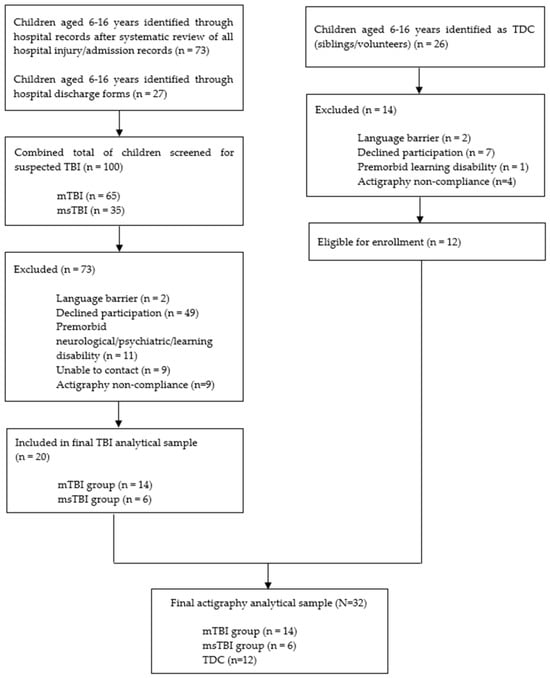
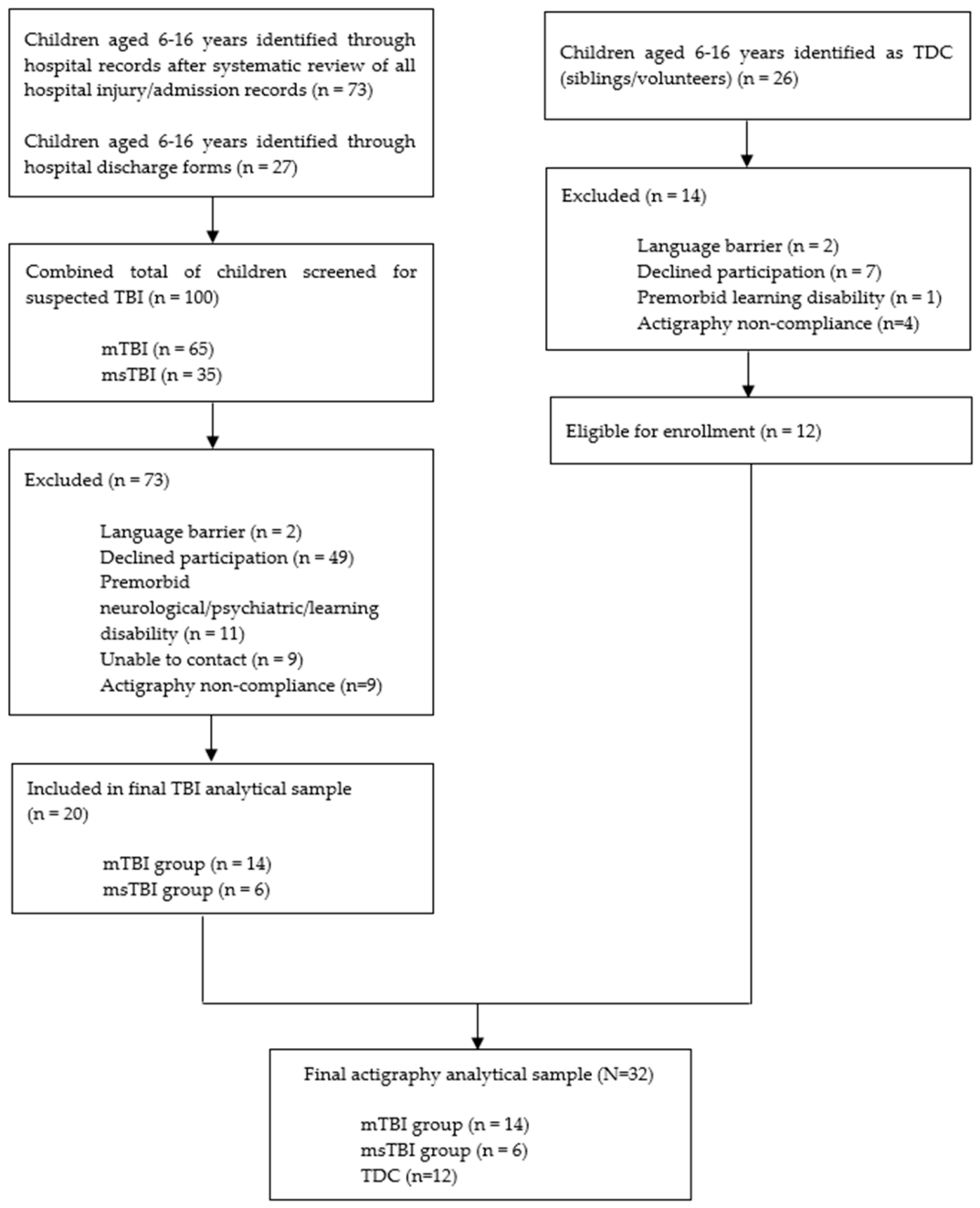
Initial screening included 21,989 children manually reviewed from the Emergency and Accident Department records of Nicosia General Hospital for all injury types during the period November 2022–September 2024. A total of 100 children were initially identified as potential TBI cases through hospital records in Cyprus and were subsequently contacted following the approved recruitment procedures (see Figure 1 for the flow chart with full details). Hospital records of all children aged 6–16 years who presented to Nicosia General Hospital during this period were systematically reviewed by the research team in collaboration with clinical staff, irrespective of injury type, to ensure comprehensive identification of all potential TBI cases. The minimum age of 6 years was selected to ensure participants could reliably understand instructions and tolerate wrist-worn actigraphy, thereby maximizing data quality and compliance during sleep monitoring. Discharge forms from Archbishop Makarios III Hospital during the same period were also examined to capture any additional TBI cases. In accordance with the guidelines and protocols of the State Health Services Organisation (SHSO), the initial approach to families was made exclusively by the attending pediatrician or an authorized hospital physician. The main researcher (KL) was present alongside Dr. Haris Achilleos, Consultant in Pediatric Emergency Medicine and Head of the Pediatric Accident and Emergency Department at Nicosia General Hospital, during this initial stage, assisting her in the review and identification of eligible cases, but did not contact families directly until after clinical contact was established.
Figure 1.
Study recruitment flow chart. Note. Children aged 6–16 years were identified via hospital records (n = 73) and Archbishop Makarios III Hospital discharge forms (n = 27), yielding 100 children screened for suspected TBI. After eligibility screening, 80 children were excluded due to language barrier (n = 2), declining participation (n = 49), pre-existing neurological, psychiatric, or learning disability (n = 11), inability to contact (n = 9), or actigraphy non-compliance (n = 9). Of the 20 children included in the final TBI analytical sample, 14 had mild TBI (mTBI) and 6 had moderate/severe TBI (msTBI). An additional 26 children were identified as potential controls, of whom 14 were excluded (language barrier n = 2, declined participation n = 7, premorbid learning disability n = 1, actigraphy non-compliance n = 4), resulting in 12 eligible typically developing children (TDC).
Recruitment and participant contact occurred between April 2024 and April 2025. Children were eligible for inclusion if their injury had occurred at least three months—but no more than two years—prior to participation in the study, and if they used oral communication as their primary mode of communication. For the 100 children initially identified as potential TBI cases, the main researcher subsequently attempted to contact parents or legal guardians to conduct further eligibility screening and to schedule research assessments. The final sample included 32 participants: 14 children with mTBI, 6 with msTBI, and 12 TDC. The TDC group was recruited from siblings and volunteers, and medical and developmental histories were collected through parental reports. Of the 26 potential controls, 12 were included in the final analytical sample (Figure 1). Participants ranged from 6 to 16 years old, with similar mean ages across groups but an unequal sex distribution, particularly in the msTBI group. All were Greek-speaking and predominantly came from middle-to-upper-middle socioeconomic backgrounds, as determined by parental education and parents’ self-reported socioeconomic status.
Exclusion criteria for children in the mTBI and msTBI groups included a history of chronic neurological or psychiatric conditions, sleep problems or diagnosed sleep disorders that were present before the injury, learning disabilities, or neurodevelopmental disorders. Sleep difficulties that emerged after the injury were not considered exclusionary. This criterion was applied to reduce the potential influence of pre-existing sleep difficulties on the assessment of post-injury sleep characteristics. TBI severity was determined based on clinical records using the Pediatric Glasgow Coma Scale (PGCS), which is specifically designed for children. The diagnosis of mTBI was defined by one or more of the following criteria: medical records showing a PGCS score between 13 and 15, hospitalization not exceeding 24 h, posttraumatic amnesia (PTA) of no more than 24 h, loss of consciousness lasting 30 min or less, neuroimaging evidence of trauma, alterations in mental state at the time of injury (e.g., disorientation, somnolence, irritability), or any other transient neurological abnormalities (Osmond et al., 2010; Gagnon, 2019; Silverberg et al., 2023). The msTBI group was identified based on at least three of the following: PGCS ≤ 12, loss of consciousness > 30 min, hospitalization > 24 h, PTA > 24 h, neuroimaging-confirmed central nervous system abnormalities, or persistent cognitive/motor deficits (Kennedy et al., 2022; Popernack et al., 2015; McCrory et al., 2009).
Mean ages were similar across groups, as presented in Table 1. Participants were recruited from Limassol General Hospital, Nicosia General Hospital, and Archbishop Makarios III Hospital in Cyprus. Written informed consent was obtained from parents or legal guardians. The study received ethical approval from the Cyprus National Bioethics Committee and the SHSO (ΕΕΒΚ/ΕΠ/2023/43).
Table 1.
Demographic characteristics of participants.
2.2. Measures
2.2.1. Demographics
Demographic and clinical information was collected at baseline using a structured parent-report questionnaire. Data included the child’s age, sex, handedness, date of birth, date of injury, and time since injury (TSI). Injury-specific variables, such as mechanism of injury (e.g., fall, motor vehicle collision, sport-related injury), were also recorded. Socioeconomic status (SES) was assessed based on parental education, occupation, and a subjective rating of the family’s financial situation (categorized as low, middle, or high). The current marital status of the parents and overall family composition were documented to provide contextual information about the home environment.
Medical history screening included any pre-existing neurological, psychiatric, or developmental conditions, as well as sensory impairments (vision or hearing). Sleep history was gathered to assess both pre- and post-injury sleep patterns, including symptoms of insomnia, excessive daytime sleepiness, frequent night awakenings, and other sleep disturbances. Cognitive and behavioral functioning was assessed via parent report, with a focus on post-injury changes in attention, memory, executive functioning, and emotional or behavioral regulation. Educational information included the child’s current school year, any school-related difficulties following the injury, and the implementation of special educational services or accommodations. Parents also provided information about their child’s typical daily activities, hobbies, and social functioning.
2.2.2. Neuropsychological Assessment
Cognitive functioning was assessed using the Wechsler Intelligence Scale for Children–Fifth Edition (WISC-V; Wechsler, 2014), a widely used and standardized measure of intellectual ability in children. The WISC-V is validated for use in the Greek population and is frequently employed in the assessment of pediatric TBI. It provides a comprehensive profile of a child’s cognitive strengths and weaknesses across multiple domains. Prior research has shown that several WISC-V subtests and index scores are particularly sensitive to TBI-related deficits, especially in visuo-spatial reasoning, constructional ability, and processing speed (Donders & Kim, 2019; Williams et al., 2022).
In the present study, all ten primary subtests were administered: Similarities and Vocabulary for verbal comprehension, Block Design and Visual Puzzles for visual–spatial ability, Matrix Reasoning and Figure Weights for fluid reasoning, Digit Span and Picture Span for working memory, and Coding and Symbol Search for processing speed. These subtests were used to derive the five primary index scores and the Full Scale Intelligence Quotient (FSIQ).
2.2.3. Psychosocial Assessment
The psychosocial functioning of participants was evaluated using a combination of standardized parent- and child-report measures designed to assess behavioral, emotional, and QoL outcomes following pediatric TBI. These tools were selected to capture a broad spectrum of psychosocial domains commonly impacted by brain injury and to provide complementary perspectives on child well-being.
Behavioral and emotional functioning was assessed using the Child Behavior Checklist (CBCL) for ages 6–18, a widely utilized clinical measure that evaluates a range of narrow-band behavioral problems (Achenbach & Rescorla, 2001). These include attention problems, aggressive behavior, delinquency, withdrawal, somatic complaints, anxiety, depression, thought problems, and social difficulties. Each domain yields scores that are categorized as being within the normal, borderline, or clinical range, allowing for identification of children at elevated risk for psychological or behavioral concerns.
Health-related QoL was assessed using the Pediatric Quality of Life Inventory 4.0 Short Form (PedsQL SF15; Chan et al., 2005). The SF15 comprises 15 items assessing physical, emotional, social, and school functioning. Both child self-report and parent proxy-report versions were administered. For the present analyses, the parent-proxy Total Scale Score was used. Raw item responses were reverse-scored and transformed to a 0–100 scale, with higher scores indicating better health-related QoL.
Functional outcomes and overall disability level were evaluated using the Pediatric Glasgow Outcome Scale-Extended (GOS-E Peds) (Beers et al., 2012). This measure assesses key domains, such as cognitive and physical abilities, emotional functioning, and social participation. The scale is completed by parents or caregivers who are familiar with the child’s current condition and functional capabilities, offering valuable insight into the long-term effects of injury on everyday life.
2.2.4. Sleep Assessment
Subjective SWDs were evaluated using the Sleep Disturbance Scale for Children (SDSC), a validated instrument designed to assess common sleep difficulties in pediatric populations (Bruni et al., 1996). The SDSC comprises 26 Likert-type items and yields both a total score and subscale scores across six domains: disorders of initiating and maintaining sleep, sleep breathing disorders, disorders of arousal (including nightmares), sleep–wake transition disorders, disorders of excessive somnolence, and sleep hyperhidrosis (nighttime sweating). This instrument has been widely utilized in both clinical and research settings for the screening of sleep-related problems in children and adolescents.
In addition to the SDSC, daily sleep patterns were monitored via a digital sleep diary, administered and completed electronically using the REDCap (Research Electronic Data Capture; Vanderbilt University, Nashville, TN, USA) platform (Harris et al., 2009). The sleep diary was filled in each morning following a night when the child wore the actigraphy device. In most cases, the diary was filled in by parents or caregivers. However, for some adolescents, self-reporting was permitted when both the adolescent and their parent agreed the child could reliably report their sleep. All diary entries—including bedtime, estimated sleep onset time, nighttime awakenings, wake-up time, and any relevant environmental or physical factors—were securely stored within REDCap, allowing real-time cross-verification with actigraphy data and improving data accuracy.
Objective sleep parameters were assessed using the SOMNOwatch™ Plus (SOMNOmedics GmbH, Randersacker, Germany), a wrist-worn actigraphy device worn on the non-dominant hand. Actigraphy monitoring was scheduled over a 7-day period, during which children were instructed to wear the device only during nighttime sleep (Tétreault et al., 2018). Data were collected at a sampling rate of 16 Hz for activity (X, Y, Z axes: 64 Hz), 1/30 Hz for light, and ½ Hz for body position. The actigraphy signal was analyzed using DOMINO Light software, version 1.5.0.15 (SOMNOmedics GmbH, Randersacker, Germany), applying the “SOW+ actigraphy” activity analysis template. Data were cross-validated using the corresponding sleep diary entries completed each morning after the night of recording.
For consistency, three valid nights of actigraphy data were included in the analysis. A night was considered valid when a complete overnight actigraphy recording and a corresponding completed sleep diary were available. Nights with device non-wear or removal, incomplete recordings, or missing diary data were excluded. When more than three nights met these criteria, the first three valid nights in chronological order were selected. The use of three nights was informed by previous pediatric actigraphy research showing acceptable reliability with three nights of assessment and by pediatric concussion studies using three-night actigraphy periods (Tétreault et al., 2018; Wilson et al., 2021). Actigraphy recording commenced no later than three weeks following the initial assessment, ensuring that data reflected the immediate post-assessment period without excessive delay. Missing or incomplete recordings were primarily attributable to refusal to wear the device or device removal during sleep.
The actigraphy-derived sleep parameters included in the present analyses were total sleep time (TST), time in bed (TIB), SL, WASO, and SE. SE was calculated as the ratio of TST to TIB (TST/TIB × 100) and was analyzed as a continuous variable. All data were scored by the main researcher (KL), a trained sleep researcher, under the supervision of a certified sleep specialist (PB), ensuring consistency and data integrity. The use of actigraphy for assessing sleep–wake characteristics is supported by previous research in pediatric populations and in individuals with a history of childhood TBI (Botchway et al., 2020a; Sadeh, 2011).
2.3. Statistical Analyses
All statistical analyses were conducted using Python 3.11.8 (Python Software Foundation, Beaverton, OR, USA), incorporating relevant packages such as pandas, numpy, scipy.stats, and statsmodels. Given the modest sample size and the non-normal distribution of several variables, non-parametric methods were employed throughout the analysis.
Kruskal–Wallis H tests were used to examine between-group differences in actigraphy-derived sleep metrics (i.e., TIB, TST, WASO, SE, and objective SL), sleep diary-reported SL, SDSC Total Score, WISC-FSIQ, CBCL Affective Problems, and PedsQL parent-proxy Total Score. The main analyses focused on objective and subjective sleep characteristics, while cognitive and psychosocial analyses were exploratory. CBCL Affective Problems was included as a focused measure of affective symptoms. GOS-E Peds outcomes were summarized descriptively for the TBI groups. Where significant group differences emerged, post-hoc comparisons were conducted using Dunn’s tests with Bonferroni correction to adjust for multiple comparisons. Effect sizes were estimated using eta squared based on the Kruskal–Wallis H statistic (η2H). Negative estimates were reported as zero. Continuous outcome variables are summarized using medians and first and third quartiles (Q1–Q3).
Associations between sleep parameters and neuropsychological or psychosocial functioning were explored using Spearman’s rho. Correlations were interpreted only when pairwise sample size met the recommended minimum threshold (N ≥ 10), consistent with best-practice guidelines (Bonett & Wright, 2000). Given the exploratory nature of the correlation analyses, unadjusted p values are reported. Additionally, 95% confidence intervals for Kruskal–Wallis effect sizes and Spearman correlation coefficients were estimated using percentile bootstrap resampling.
3. Results
3.1. Demographic Information
The demographic characteristics of the sample are presented in Table 1. Mean ages were similar across groups, although sex distribution was unequal, particularly in the msTBI group, which included five males and one female. TSI was comparable between the mTBI and msTBI groups, averaging approximately 10–11 months. Mechanisms of injury varied: accidental bumps were most frequently reported in the mTBI group, while the msTBI group exhibited a more even distribution across injury types. SES was broadly similar across groups, with most participants classified as middle income and three participants identified as high income. As expected, no injury-related or TSI data were applicable to the TDC group.
3.2. Group Differences in Objective Sleep Parameters Assessed by Actigraphy
Actigraphy data were analyzed using non-parametric Kruskal–Wallis tests to assess group differences across five sleep parameters: TIB, TST, SE, sleep latency (objective and subjective), and WASO. Effect sizes are reported using eta squared based on the Kruskal–Wallis H statistic (η2H).
No significant group differences were found for TIB, H(2) = 3.76, p = 0.153, η2H = 0.061, or in either objective or sleep diary-reported latency, H(2) = 0.56, p = 0.756, η2H = 0.000, and H(2) = 0.29, p = 0.866, η2H = 0.000, respectively.
A significant group difference emerged for TST, H(2) = 14.01, p = 0.001, η2H = 0.414. Post-hoc pairwise comparisons using Dunn’s tests with Bonferroni correction indicated that the TDC group slept significantly more than both the mTBI group (p = 0.0028) and the msTBI group (p = 0.0239). No significant difference was observed between the two TBI groups (p = 0.9958).
SE also differed significantly by group, H(2) = 20.12, p < 0.001, η2H = 0.625. Post hoc analyses revealed that the TDC group had significantly higher efficiency than both the mTBI group (p = 0.0001) and the msTBI group (p = 0.0002). No significant difference was found between the mTBI and msTBI groups (p = 0.8115).
A significant group difference was observed for WASO, H(2) = 18.35, p < 0.001, η2H = 0.564. The TDC group had significantly less WASO than the mTBI group (p = 0.0119) and the msTBI group (p < 0.001). Additionally, WASO was significantly higher in the msTBI group compared to the mTBI group (p = 0.0056).
Descriptive statistics for all actigraphy-derived sleep variables by group are presented in Table 2.
Table 2.
Descriptive Statistics and Kruskal–Wallis Test Results for Actigraphy-Based Sleep Measures Across Groups.
3.3. Correlations Between Sleep, Cognition, and Psychosocial Functioning
Spearman’s rho correlations were computed across the full sample (N = 32) to examine associations among actigraphy-based sleep variables, cognitive scores, and psychosocial outcomes. No statistically significant correlations were found between sleep measures and WISC-FSIQ, SDSC scores, CBCL Affective Problems, or PedsQL scores. These findings should be interpreted with caution, given the modest sample size and the exploratory nature of the analyses.
Subjective SL was not significantly associated with WISC-FSIQ (ρ = 0.31, p = 0.086). Within the combined TBI sample (n = 20), a moderate positive correlation was observed between WISC working memory scores and parent-reported QoL (ρ = 0.47, 95% CI [−0.020, 0.834], p = 0.036). This association was interpreted as exploratory, given the limited sample size and the use of unadjusted p values for multiple correlation analyses.
To complement the correlational analyses, group-level comparisons for cognitive and psychosocial outcomes are summarized in Table 3. No significant group differences were observed in SDSC Total Score, H(2) = 2.13, p = 0.345, η2H = 0.004, although the msTBI group showed descriptively higher scores compared to the mTBI and TDC groups. Group differences in parent-reported QoL did not reach statistical significance, H(2) = 5.43, p = 0.066, η2H = 0.118. However, the effect size was moderate, with the msTBI group showing descriptively lower parent-reported QoL than the other groups, although this finding should be interpreted with caution given the limited sample size.
Table 3.
Descriptive Statistics and Kruskal–Wallis Test Results for Cognitive and Psychosocial Outcomes Across Groups.
GOS-E Peds outcomes were also examined descriptively for the TBI groups. In the mTBI group, 13 children were classified as Upper Good Recovery and one as Lower Good Recovery. In the msTBI group, three children were classified as Upper Good Recovery, two as Lower Good Recovery, and one as Upper Moderate Disability. Given the small group sizes, these findings were not subjected to further statistical comparisons.
In bivariate analyses (Table 4), neither subjective SL (ρ = 0.308, p = 0.086) nor SDSC Total Score (ρ = −0.252, p = 0.164) was significantly associated with WISC-FSIQ.
Table 4.
Bivariate Correlations Between Subjective Sleep Parameters and Cognitive Performance.
4. Discussion
The present study revealed significant differences in actigraphy-derived sleep parameters between children with TBI and TDC. Specifically, children with mTBI and msTBI exhibited significantly reduced TST and SE, along with elevated WASO, compared to TDC. In contrast, no significant group differences were observed in objective or subjective SL or SDSC Total Scores. Furthermore, no significant associations emerged between actigraphy-derived sleep metrics and global cognitive performance or psychosocial outcomes. These findings highlight differences in objectively measured sleep continuity among children with a history of TBI, although the modest sample size and cross-sectional design limit their interpretation.
4.1. Sleep Disruption in Pediatric TBI
In the present study, time in bed (TIB) did not differ significantly across groups. However, both TBI groups demonstrated significantly reduced TST compared to TDC, resulting in diminished SE. This pattern indicates that while children with TBI spend a comparable amount of TIB as their peers, they obtain substantially less total sleep and show lower sleep efficiency. This aligns with prior findings highlighting discrepancies between sleep opportunity and sleep attainment in pediatric concussion populations (Wilson et al., 2021). Together with elevated WASO, these findings suggest reduced actigraphy-estimated sleep continuity among children with TBI during the chronic post-injury period. However, the cross-sectional design does not allow these differences to be directly attributed to the injury.
Interestingly, no significant differences were observed in either objective or subjective SL across groups, while SDSC Total Scores also did not differ significantly. These findings contrast with the pronounced group differences in actigraphy-derived SE and WASO, suggesting that objective and subjective assessments may capture different aspects of sleep. However, the absence of significant group differences in subjective measures does not necessarily indicate a lack of agreement between assessment methods. While actigraphy offers ecologically valid and quantifiable data on sleep maintenance, it may underestimate nocturnal wakefulness and cannot fully reflect individual distress or perceived sleep quality (Lubas et al., 2022; Sadeh, 2011). Conversely, subjective instruments are sensitive to the personal and functional impacts of sleep disturbances but may be limited by recall bias or lack of insight, particularly in children with cognitive difficulties (Botchway et al., 2020b; Tham et al., 2015).
Notably, WASO was significantly higher in the msTBI group compared to the mTBI group, whereas SE did not differ significantly between the two TBI groups. These findings should be interpreted cautiously, particularly given the small size of the msTBI group and the limitations of actigraphy in distinguishing sleep from wakefulness. Integrating these complementary approaches allows for a more comprehensive and nuanced understanding of SWDs following pediatric TBI. Similarly, Botchway et al. (2020b) reported associations between poorer subjective sleep quality, increased fatigue, depressive symptoms, and reduced perceived general health in young adults with a history of childhood TBI. Although their sample was assessed approximately 20 years post-injury, these findings further highlight the importance of considering subjective sleep complaints alongside objective sleep measures. Future studies may further extend this multimodal approach by incorporating portable home-based sleep EEG, including single-channel systems, to provide additional information on sleep staging and sleep-related arousal in pediatric TBI.
4.2. Sleep, Cognitive, and Psychosocial Functioning
Despite previous research linking SWDs to cognitive and psychosocial challenges in pediatric TBI populations (Beauchamp et al., 2020; Luther et al., 2020; Williams et al., 2022), the present study did not reveal statistically significant associations between actigraphy-derived sleep metrics and global cognitive ability (WISC-FSIQ), affective symptoms, or overall QoL. However, this lack of significant associations should not be interpreted as evidence that such relationships are absent. The relatively modest sample size, particularly in the msTBI group, likely limited the statistical power to detect subtle associations. Similarly, bivariate correlations between subjective sleep variables and cognitive performance did not reach statistical significance.
The use of global cognitive measures may also have limited the detection of domain-specific difficulties potentially associated with SWDs. Furthermore, FSIQ scores were generally within the normative range across groups, which may have limited the ability to detect associations with sleep parameters. Indeed, prior research has not consistently found post-TBI differences in broad cognitive indices. For example, Ware et al. (2023) reported no clinically meaningful differences in FSIQ between children with mTBI and those with orthopedic injuries, approximately two weeks or three months post-injury. An exploratory association between working memory and parent-reported QoL was observed within the combined TBI sample. However, this finding should be interpreted with caution, given the small sample size and the use of unadjusted p values across multiple correlation analyses. Future research would benefit from incorporating more fine-grained neurocognitive measures and larger samples to better examine associations between sleep characteristics and cognitive or psychosocial functioning.
4.3. Clinical and Developmental Implications
The observed differences in actigraphy-derived sleep continuity suggest that sleep assessment may be a relevant consideration in the follow-up of children with a history of TBI, including those with mild injury. Sleep is critical to neurodevelopmental processes that support recovery after TBI, including synaptic remodeling, pruning, and memory consolidation. These processes are dynamically regulated by sleep-dependent modulation of synaptic strength across brain states (Timofeev & Chauvette, 2019; Sun et al., 2020).
From a clinical perspective, combining subjective sleep assessments with objective monitoring may provide complementary information regarding sleep–wake characteristics. However, the present study did not evaluate the effectiveness of screening or sleep-focused interventions. Further research is therefore needed to determine how these assessments may inform clinical follow-up and the development of targeted interventions for pediatric TBI.
4.4. Strengths, Limitations, and Future Directions
This study employed objective sleep tracking via actigraphy, providing ecologically valid, movement-based estimates of sleep well-suited to pediatric populations (Sadeh, 2011). By integrating sleep, cognitive, and psychosocial assessments within a single cohort, the study provides an exploratory, multidimensional characterization of functioning following pediatric TBI. The use of standardized, psychometrically robust instruments across domains, incorporating complementary parent- and child/adolescent-report measures, further strengthens the ecological validity and clinical relevance of the findings.
However, several limitations must be acknowledged. The modest sample size, particularly in the msTBI group, limited statistical power and reduced the generalizability of the results. A key factor contributing to the limited sample size was poor compliance with actigraphy wear-time. Despite parental reports indicating device use, several children removed the actigraphs during the night without their caregivers’ awareness, leading to unusable or incomplete data. Furthermore, only 20 of the 100 potential TBI cases were included in the final analytical sample. Declined participation, difficulties contacting families, and actigraphy non-compliance may have introduced selection bias, although the direction and magnitude of this bias cannot be determined. The exclusion of children with pre-injury sleep difficulties may have further limited the representativeness of the sample, although this criterion was intended to reduce the influence of pre-existing sleep conditions. Consequently, families able to complete the assessments and children who tolerated wrist-worn actigraphy may have been overrepresented in the final sample.
The interpretation of actigraphy-derived sleep parameters should also consider the limitations of movement-based sleep estimation, particularly given the elevated WASO values observed in the TBI groups. Although actigraphy is an established method for assessing sleep–wake characteristics in pediatric populations (Sadeh, 2011), the SOMNOwatch Plus has been evaluated against polysomnography primarily in adults (Zinkhan et al., 2014). To our knowledge, the specific scoring approach used in this study has not been validated in children with TBI. Therefore, the elevated WASO values should be interpreted as actigraphy-derived estimates rather than polysomnographically confirmed durations of nocturnal wakefulness. Furthermore, as the analyses were based on the first three valid nights, the resulting sleep estimates may not fully capture night-to-night variability and may have been influenced by recording order and potential differences in the representation of weekdays and weekends.
Additionally, the absence of prospectively collected pre-injury baseline data and post-injury follow-up assessments limits the ability to track individual recovery trajectories or examine changes in sleep and cognitive outcomes over time. Given the average TSI of approximately 10–11 months, it remains unclear whether earlier sleep-related or cognitive difficulties had resolved or persisted at the time of assessment. In particular, although pre-injury sleep history was obtained retrospectively through parental reports, prospectively collected pre-injury sleep measurements were unavailable, limiting our ability to establish baseline sleep characteristics. Potential confounding factors, including pain, headache, and anxiety, were not systematically controlled in the analyses. Therefore, the observed group differences cannot be causally attributed to TBI.
Additionally, the current analyses primarily focused on a global measure of cognitive functioning (WISC-FSIQ), which, although widely validated, may not capture the more subtle or domain-specific cognitive effects associated with SWDs. Therefore, the absence of significant associations between sleep metrics and FSIQ should not be interpreted as evidence that sleep disturbances are unrelated to specific cognitive domains. Future studies would benefit from the inclusion of more sensitive, targeted neurocognitive tasks that can assess domains such as attention, executive functioning, and working memory more precisely. Addressing this gap is an important direction for future research. Although multi-informant approaches were employed, some outcomes relied on subjective reporting, which may introduce bias or underreporting in certain domains. The limited socioeconomic diversity of the sample may also restrict the generalizability of the findings, particularly regarding cognitive and psychosocial outcomes. Furthermore, the broad developmental age range and unequal sex distribution across groups, particularly within the msTBI group, may have introduced additional confounding that could not be adequately addressed in the present analyses. Additionally, correlations calculated across the full sample may have been influenced by differences between the TDC and TBI groups and should therefore be interpreted cautiously.
Future research should adopt longitudinal designs to track sleep–cognition interactions across different phases of recovery and to distinguish transient from persistent effects (Beauchamp et al., 2020). Larger and more socioeconomically diverse samples, repeated objective and subjective sleep assessments, and targeted neurocognitive measures may help clarify these relationships. A recent systematic review and meta-analysis of sleep interventions in pediatric TBI found that CBT-I was associated with improvements in subjective sleep outcomes and persistent post-concussion symptoms, whereas melatonin showed mixed results and no significant pooled effects on post-concussion symptoms or cognitive outcomes (Lofitou et al., 2026). Future intervention studies are therefore needed to evaluate the effectiveness and safety of individualized, age-appropriate sleep-focused approaches in pediatric TBI populations.
5. Conclusions
The present exploratory cross-sectional study identified differences in actigraphy-derived sleep continuity between children with a history of TBI and TDC, including those with mild injury. Children with both mild and moderate-to-severe TBI showed marked differences in objectively measured sleep continuity, including lower sleep efficiency and greater wake after sleep onset, despite relatively preserved global cognitive performance. The exploratory association between working memory and parent-reported QoL should be interpreted with caution given the limited sample size.
These findings highlight sleep continuity as an important clinical consideration and a potential target for future intervention studies within pediatric TBI rehabilitation. However, the clinical utility of objective sleep assessment and the effectiveness of sleep-focused interventions remain to be established. Future longitudinal and intervention studies are needed to determine whether improving sleep continuity contributes to better cognitive, psychosocial, and functional recovery following pediatric TBI.
Author Contributions
Conceptualization, K.L. and F.C.; methodology, K.L., P.B., E.P. and F.C.; formal analysis, K.L. and P.B.; investigation, K.L.; resources, K.L., P.B. and F.C.; data curation, K.L.; writing—original draft preparation, K.L.; writing—review and editing, P.B., E.P. and F.C.; visualization, K.L.; supervision, P.B. and F.C.; project administration, K.L. All authors have read and agreed to the published version of the manuscript.
Funding
This research received no external funding.
Institutional Review Board Statement
The study was conducted in accordance with the Declaration of Helsinki and received ethical approval from the Cyprus National Bioethics Committee (protocol code ΕΕΒΚ/ΕΠ/2023/43; approval date: 14 June 2024) and the State Health Services Organisation (SHSO) (protocol code 46/23; approval date: 15 April 2024).
Informed Consent Statement
Written informed consent was obtained from parents or legal guardians of all participants involved in the study.
Data Availability Statement
The data are not publicly available due to privacy and ethical restrictions related to research involving minors.
Acknowledgments
The authors would like to thank Haris Achilleos, in the Pediatric Emergency Medicine and the Pediatric Accident and Emergency Department at Nicosia General Hospital, for her assistance with participant recruitment and the identification of eligible cases.
Conflicts of Interest
The authors declare no conflicts of interest.
References
- Achenbach, T. M., & Rescorla, L. A. (2001). Manual for the ASEBA school-age forms & profiles. University of Vermont, Research Center for Children, Youth, & Families. [Google Scholar]
- Beauchamp, M. H., Dégeilh, F., Yeates, K., Gagnon, I., Tang, K., Gravel, J., Stang, A., Burstein, B., Bernier, A., Lebel, C., el Jalbout, R., Lupien, S., de Beaumont, L., Zemek, R., Dehaes, M., & Deschênes, S. (2020). Kids’ Outcomes And Long-term Abilities (KOALA): Protocol for a prospective, longitudinal cohort study of mild traumatic brain injury in children 6 months to 6 years of age. BMJ Open, 10(10), e040603. [Google Scholar] [CrossRef] [Scilit] [PubMed]
- Beers, S. R., Wisniewski, S. R., Garcia-Filion, P., Tian, Y., Hahner, T., Berger, R. P., Bell, M. J., & Adelson, P. D. (2012). Validity of a pediatric version of the Glasgow Outcome Scale-Extended. Journal of Neurotrauma, 29(6), 1126–1139. [Google Scholar] [CrossRef] [Scilit] [PubMed]
- Bonett, D. G., & Wright, T. A. (2000). Sample size requirements for estimating Pearson, Kendall and Spearman correlations. Psychometrika, 65, 23–28. [Google Scholar] [CrossRef] [Scilit]
- Botchway, E. N., Godfrey, C., Nicholas, C. L., Hearps, S., Anderson, V., & Catroppa, C. (2020a). Objective sleep outcomes 20 years after traumatic brain injury in childhood. Disability and Rehabilitation, 42(17), 2393–2401. [Google Scholar] [CrossRef] [Scilit] [PubMed]
- Botchway, E. N., Godfrey, C., Ryan, N. P., Hearps, S., Nicholas, C. L., Anderson, V. A., & Catroppa, C. (2020b). Sleep disturbances in young adults with childhood traumatic brain injury: Relationship with fatigue, depression, and quality of life. Brain Injury, 34(12), 1579–1589. [Google Scholar] [CrossRef] [Scilit] [PubMed]
- Bruni, O., Ottaviano, S., Guidetti, V., Romoli, M., Innocenzi, M., Cortesi, F., & Giannotti, F. (1996). The Sleep Disturbance Scale for Children (SDSC) construct ion and validation of an instrument to evaluate sleep disturbances in childhood and adolescence. Journal of Sleep Research, 5(4), 251–261. [Google Scholar] [CrossRef] [Scilit] [PubMed]
- Chan, K. S., Mangione-Smith, R., Burwinkle, T. M., Rosen, M., & Varni, J. W. (2005). The PedsQL™: Reliability and validity of the short-form generic core scales and asthma module. Medical Care, 43(3), 256–265. [Google Scholar] [CrossRef] [Scilit] [PubMed]
- Donders, J., & Kim, E. (2019). Effect of cognitive reserve on children with traumatic brain injury. Journal of the International Neuropsychological Society: JINS, 25(4), 355–361. [Google Scholar] [CrossRef] [Scilit] [PubMed]
- Gagner, C., Landry-Roy, C., Lainé, F., & Beauchamp, M. H. (2015). Sleep-wake disturbances and fatigue after pediatric traumatic brain injury: A systematic review of the literature. Journal of Neurotrauma, 32(20), 1539–1552. [Google Scholar] [CrossRef] [Scilit] [PubMed]
- Gagnon, I. (2019). Determining outcome in children and adolescents after concussion: Viewing things more holistically. Journal of Orthopaedic & Sports Physical Therapy, 49(11), 855–863. [Google Scholar] [CrossRef] [Scilit] [PubMed]
- Harris, P. A., Taylor, R., Thielke, R., Payne, J., Gonzalez, N., & Conde, J. G. (2009). Research electronic data capture (REDCap)—A metadata-driven methodology and workflow process for providing translational research informatics support. Journal of Biomedical Informatics, 42(2), 377–381. [Google Scholar] [CrossRef] [Scilit] [PubMed]
- Kennedy, L., Nuno, M., Gurkoff, G. G., Nosova, K., & Zwienenberg, M. (2022). Moderate and severe TBI in children and adolescents: The effects of age, sex, and injury severity on patient outcome 6 months after injury. Frontiers in Neurology, 13, 741717. [Google Scholar] [CrossRef] [Scilit] [PubMed]
- Lah, S., Bogdanov, S., Brookes, N., Epps, A., Teng, A., Ocampo, I. M. B., & Naismith, S. (2022). Convergent validity of the child behavior checklist sleep items in children with moderate to severe traumatic brain injury. Brain Injury, 36(6), 750–758. [Google Scholar] [CrossRef] [Scilit] [PubMed]
- Landry-Roy, C., Bernier, A., Gravel, J., & Beauchamp, M. H. (2018). Executive functions and their relation to sleep following mild traumatic brain injury in preschoolers. Journal of the International Neuropsychological Society, 24(8), 769–780, (Erratum in 2018, Journal of the International Neuropsychological Society, 24(8), 889). [Google Scholar] [CrossRef] [Scilit] [PubMed]
- Lofitou, K., Kouki, E. P., Gavriel, C., Achilleos, H., Themistokleous, V., Bargiotas, P., Haarbauer-Krupa, J., Paraskevopoulos, E., & Constantinidou, F. (2026). Sleep-wake disturbances in pediatric traumatic brain injury: A systematic review and meta-analysis of interventions. Brain and Behavior, 16(9), e71556. [Google Scholar] [CrossRef] [Scilit] [PubMed]
- Lubas, M. M., Szklo-Coxe, M., Mandrell, B. N., Howell, C. R., Ness, K. K., Srivastava, D. K., Hudson, M. M., Robison, L. L., Krull, K. R., & Brinkman, T. M. (2022). Concordance between self-reported sleep and actigraphy-assessed sleep in adult survivors of childhood cancer: The impact of psychological and neurocognitive late effects. Supportive Care in Cancer, 30, 1159–1168. [Google Scholar] [CrossRef] [Scilit] [PubMed]
- Luther, M., Poppert Cordts, K. M., & Williams, C. N. (2020). Sleep disturbances after pediatric traumatic brain injury: A systematic review of prevalence, risk factors, and association with recovery. Sleep, 43(10), zsaa083. [Google Scholar] [CrossRef] [Scilit] [PubMed]
- McCrory, P., Meeuwisse, W., Johnston, K., Dvorak, J., Aubry, M., Molloy, M., & Cantu, R. (2009). Consensus statement on concussion in sport-the 3rd international conference on concussion in sport held in Zurich, November 2008. South African Journal of Sports Medicine, 21(2), 36–46. [Google Scholar] [CrossRef] [Scilit]
- Meltzer, L. J., Montgomery-Downs, H. E., Insana, S. P., & Walsh, C. M. (2012). Use of actigraphy for assessment in pediatric sleep research. Sleep Medicine Reviews, 16(5), 463–475. [Google Scholar] [CrossRef] [Scilit] [PubMed]
- Osmond, M. H., Klassen, T. P., Wells, G. A., Correll, R., Jarvis, A., Joubert, G., Bailey, B., Chauvin-Kimoff, L., Pusic, M., McConnell, D., Nijssen-Jordan, C., Silver, N., Taylor, B., Stiell, I. G., & Pediatric Emergency Research Canada (PERC) Head Injury Study Group. (2010). CATCH: A clinical decision rule for the use of computed tomography in children with minor head injury. CMAJ: Canadian Medical Association Journal = Journal de L’Association Medicale Canadienne, 182(4), 341–348. [Google Scholar] [CrossRef] [Scilit] [PubMed]
- Popernack, M. L., Gray, N., & Reuter-Rice, K. (2015). Moderate-to-severe traumatic brain injury in children: Complications and rehabilitation strategies. Journal of Pediatric Health Care: Official Publication of National Association of Pediatric Nurse Associates & Practitioners, 29(3), e1–e7. [Google Scholar] [CrossRef] [Scilit] [PubMed]
- Sadeh, A. (2011). The role and validity of actigraphy in sleep medicine: An update. Sleep Medicine Reviews, 15(4), 259–267. [Google Scholar] [CrossRef] [Scilit] [PubMed]
- Silverberg, N. D., Iverson, G. L., Cogan, A., Dams-O-Connor, K., Delmonico, R., Graf, M. J. P., Iaccarino, M. A., Kajankova, M., Kamins, J., McCulloch, K. L., McKinney, G., Nagele, D., Panenka, W. J., Rabinowitz, A. R., Reed, N., Wethe, J. V., Whitehair, V., Anderson, V., Zasler, N. D., … Zemek, R. (2023). The American congress of rehabilitation medicine diagnostic criteria for mild traumatic brain injury. Archives of Physical Medicine and Rehabilitation, 104(8), 1343–1355. [Google Scholar] [CrossRef] [Scilit] [PubMed]
- Sun, L., Zhou, H., Cichon, J., & Yang, G. (2020). Experience and sleep-dependent synaptic plasticity: From structure to activity. Philosophical Transactions of the Royal Society B, 375(1799), 20190234. [Google Scholar] [CrossRef] [Scilit] [PubMed]
- Tétreault, É., Bélanger, M. È., Bernier, A., & Carrier, J. (2018). Actigraphy data in pediatric research: The role of sleep diaries. Sleep Medicine, 47, 86–92. [Google Scholar] [CrossRef] [Scilit] [PubMed]
- Tham, S. W., Fales, J., & Palermo, T. M. (2015). Subjective and objective assessment of sleep in adolescents with mild traumatic brain injury. Journal of Neurotrauma, 32(11), 847–852. [Google Scholar] [CrossRef] [Scilit] [PubMed]
- Timofeev, I., & Chauvette, S. (2019). Sleep-wake and cortical synaptic plasticity. In Handbook of Behavioral Neuroscience (Vol. 30, pp. 443–454). Elsevier. [Google Scholar]
- Tononi, G., & Cirelli, C. (2014). Sleep and the price of plasticity: From synaptic and cellular homeostasis to memory consolidation and integration. Neuron, 81(1), 12–34. [Google Scholar] [CrossRef] [Scilit] [PubMed]
- Ware, A. L., McLarnon, M. J., Lapointe, A. P., Brooks, B. L., Bacevice, A., Bangert, B. A., Beauchamp, M. H., Bigler, E. D., Bjornson, B., Cohen, D. M., Craig, W., Doan, Q., Freedman, S. B., Goodyear, B. G., Gravel, J., Mihalov, H. L. K., Minich, N. M., Taylor, H. G., Zemek, R., … Pediatric Emergency Research Canada A-CAP Study Group. (2023). IQ after pediatric concussion. Pediatrics, 152(2), e2022060515. [Google Scholar] [PubMed]
- Wechsler, D. (2014). Wechsler intelligence scale for children–fifth edition (WISC-V). Pearson. [Google Scholar]
- Williams, C. N., Hartman, M. E., McEvoy, C. T., Hall, T. A., Lim, M. M., Shea, S. A., Luther, M., Guilliams, K. P., Guerriero, R. M., Bosworth, C. C., & Piantino, J. A. (2020). Sleep-wake disturbances after acquired brain injury in children surviving critical care. Pediatric Neurology, 103, 43–51. [Google Scholar] [CrossRef] [Scilit] [PubMed]
- Williams, C. N., Lim, M. M., & Shea, S. A. (2018). Sleep disturbance after pediatric traumatic brain injury: Critical knowledge gaps remain for the critically injured. Nature and Science of Sleep, 10, 225–228. [Google Scholar] [CrossRef] [Scilit] [PubMed]
- Williams, C. N., McEvoy, C. T., Lim, M. M., Shea, S. A., Kumar, V., Nagarajan, D., Drury, K., Rich-Wimmer, N., & Hall, T. A. (2022). Sleep and executive functioning in pediatric traumatic brain injury survivors after critical care. Children, 9(5), 748. [Google Scholar] [CrossRef] [Scilit] [PubMed]
- Wilson, J. C., Seehusen, C. N., Simon, S. L., & Howell, D. R. (2021). Changes in subjective and objective sleep measures during recovery in pediatric concussion. Orthopaedic Journal of Sports Medicine, 9(7), 2325967121S00060. [Google Scholar] [CrossRef] [Scilit]
- Zinkhan, M., Berger, K., Hense, S., Nagel, M., Obst, A., Koch, B., Penzel, T., Fietze, I., Ahrens, W., Young, P., Happe, S., Kantelhardt, J. W., Kluttig, A., Schmidt-Pokrzywniak, A., Pillmann, F., & Stang, A. (2014). Agreement of different methods for assessing sleep characteristics: A comparison of two actigraphs, wrist and hip placement, and self-report with polysomnography. Sleep Medicine, 15(9), 1107–1114. [Google Scholar] [CrossRef] [Scilit] [PubMed]

Disclaimer/Publisher’s Note: The statements, opinions and data contained in all publications are solely those of the individual author(s) and contributor(s) and not of MDPI and/or the editor(s). MDPI and/or the editor(s) disclaim responsibility for any injury to people or property resulting from any ideas, methods, instructions or products referred to in the content. |
© 2026 by the authors. Licensee MDPI, Basel, Switzerland. This article is an open access article distributed under the terms and conditions of the Creative Commons Attribution (CC BY) license.