


Abstract
Cognitive training is widely delivered in gamified formats, but it remains unclear whether adaptive adjustment of task difficulty contributes to cognitive gains beyond participation in the same training at a fixed level of difficulty. We investigated this question using Pavlov: The Brain Is On, a functional cognitive-training game. In Experiment 1, 107 young adults were randomly assigned to 19 days of adaptive-difficulty training (ADT) or the same training maintained at low difficulty (LDT), with the same games and the same prescribed daily training time. Cognitive performance was assessed before and after training across working memory, mental rotation, attention, inductive reasoning, and response inhibition. ADT showed a suggestive advantage over LDT in the N-back response-time load effect (group × time interaction, p = 0.017, uncorrected), though this result was marginal after FDR correction (pFDR = 0.084) and should not be interpreted as confirmatory. No significant between-group differences emerged for attention, inductive reasoning, or response inhibition; mental rotation showed a similar but non-significant pattern (p = 0.076). In Experiment 2, ADT showed a greater improvement in mental rotation than recreational gaming in the full sample (pFDR = 0.045), and this estimate was unchanged after adjustment for age; no other outcome differed between groups. Because Experiment 2 was non-randomized, this finding is exploratory. These findings suggest that adaptive difficulty may be a candidate active ingredient of gamified cognitive training, particularly for working memory, but the evidence remains preliminary and requires confirmation in preregistered studies.
1. Introduction
Whether cognitive abilities can be improved through training remains a longstanding and unresolved question. Early studies reported that working-memory training could improve broader cognitive abilities, including fluid intelligence (Jaeggi et al., 2008). Subsequent meta-analyses, however, have generally found that training gains are strongest for tasks similar to those practiced and that far transfer to untrained abilities is small or absent (Melby-Lervåg et al., 2016; Sala et al., 2018; Sala & Gobet, 2019). Other reviews suggest that modest benefits may emerge under particular training conditions, including intensive or supervised protocols and, potentially, adaptive training (Hill et al., 2017; Lampit et al., 2014; Fraulini et al., 2025).
Beyond whether cognitive training works in general, an increasingly important question is which features of training determine whether it produces measurable gains. One challenge in answering this question is that many training studies compare an intervention with a passive or no-contact control. Such designs cannot readily distinguish training-specific effects from repeated-testing practice, expectancy, or the general experience of sustained engagement (Smid et al., 2020). To determine whether a particular feature of training contributes to improvement, a more informative approach is to compare two otherwise similar training conditions that differ in that feature while matching exposure and engagement as closely as possible. This logic is particularly useful for studying adaptive difficulty, a widely used but incompletely tested feature of cognitive-training programs.
Adaptive difficulty is intended to keep task demands aligned with an individual’s current performance level, becoming more challenging as performance improves and easier as it declines. The underlying idea is that learning is enhanced when individuals work at a level that is demanding but attainable, rather than at a fixed level that becomes too easy or too difficult. Despite the widespread use of adaptive algorithms, however, direct evidence that adaptation itself improves outcomes remains limited and mixed: a direct comparison of adaptive and self-paced working-memory training, for example, found no clear advantage for adaptivity (von Bastian & Eschen, 2016). Thus, whether adaptive difficulty contributes to cognitive improvement remains an open empirical question.
This open question can be situated within established theories of learning under challenge. Cognitive-load theory emphasizes managing task demands within working-memory capacity (Sweller, 1988), flow theory highlights the balance between challenge and skill (Csikszentmihalyi, 1990; Durcan et al., 2024), and the desirable-difficulties framework proposes that appropriately calibrated challenges can promote durable learning despite short-term performance costs (Bjork, 1994; Pyke et al., 2025). Adaptive-difficulty training (ADT) operationalizes these principles by adjusting task demands to ongoing performance, potentially sustaining appropriate cognitive effort as ability changes. If this practice engages processes that generalize beyond the trained activities, it may also improve performance on untrained tasks, although such transfer requires empirical demonstration. Despite this theoretical rationale, the added benefits of adaptivity over gameplay and repeated practice remain unclear. The present study addresses this gap by comparing ADT with low-difficulty training (LDT), matching game content, training schedule, and prescribed training time while varying whether difficulty adapts to performance. This design helps isolate the contribution of adaptivity, although the groups may differ in their experienced challenge over training.
This question is especially important in gamified cognitive training. Game elements such as points, levels, narratives, and rewards can increase motivation and engagement, but evidence that gamification itself improves cognitive learning is less consistent (Lumsden et al., 2016; Vermeir et al., 2020). Gamification may therefore be particularly useful for sustaining participation in demanding, repeated training rather than serving as a direct mechanism of cognitive improvement.
It is also important to distinguish gamified cognitive training, in which tasks are based on established cognitive paradigms, from conventional commercial video games, whose cognitive demands arise primarily from entertainment-oriented gameplay (Sala et al., 2018; Flores-Gallegos & Mayer, 2022). A gamified training platform can provide a useful setting for testing specific training features because the game elements can be held constant while the cognitive demands imposed by the training are experimentally manipulated. Multi-domain training provides a further context for this question. Most cognitive-training studies have focused on a single cognitive domain, whereas everyday cognition depends on multiple interacting abilities. Multi-domain programs have therefore been proposed as a potentially useful approach for promoting broader cognitive benefits (Tan et al., 2023). At the same time, training across several domains makes it particularly important to determine whether improvements observed on standardized measures reflect effects of the training itself or more general practice effects. It also raises the question of whether the cognitive tasks embedded in such programs correspond meaningfully to the abilities they are intended to train.
The present study used Pavlov: The Brain Is On, a functional cognitive-training game co-developed by Tencent’s interactive Entertainment Group (IEG) Social Value Exploration Center and the Tianqiao and Chrissy Chen Institute (TCCI), as an experimental platform for examining the contribution of adaptive difficulty to cognitive training. The game comprises 18 short, gamified tasks based on established cognitive paradigms spanning five domains: attention, response inhibition, working memory, inductive reasoning, and spatial cognition. Importantly, the platform allows adaptive and fixed-difficulty versions of the training tasks to be implemented while keeping the game content, interface, narrative, schedule, feedback, and prescribed training time constant.
The primary question was whether adaptive difficulty provides cognitive benefits beyond those obtained from engaging in the same gamified training at a fixed low difficulty. To address this question, participants were randomly assigned to adaptive-difficulty training (ADT) or low-difficulty training (LDT). The two conditions used the same games and training schedule and required the same time of training; the principal difference was whether difficulty increased in response to performance. We also examined two secondary questions. First, to provide an ecological reference for the broader question of gamified cognitive training, we compared the ADT group with a separate cohort that engaged in self-selected commercial video games for the same duration. Because this comparison was not randomized, it was treated as a secondary, non-causal comparison rather than as evidence for the specific effect of adaptive difficulty. Second, because the training platform contains tasks based on established cognitive paradigms, we examined whether performance on five designated in-game test tasks was related to performance on corresponding standardized cognitive measures. These analyses were intended to assess convergent validity, rather than transfer, because the standardized measures assessed the same broad cognitive domains targeted during training. Since no outcome or analysis plan was formally preregistered, the study should therefore be regarded as exploratory and hypothesis-generating.
2. Methods
2.1. Cognitive-Training Platform and Experimental Manipulation
Pavlov: The Brain Is On comprises 18 short tasks, each embedding a classic cognitive paradigm within a narrative-based mini-game. The tasks span five cognitive domains: attention, response inhibition, working memory, inductive reasoning, and spatial cognition. The targeted ability, corresponding cognitive paradigm, gameplay characteristics, and difficulty-scaling parameters for each task are detailed in Supplementary Table S1. The task–paradigm correspondences were specified during development and subsequently evaluated through playtesting with psychology researchers.
The study used two versions of the training platform that differed in their difficulty-setting rules. In the adaptive-difficulty training (ADT) version, task difficulty was adjusted according to ongoing performance, allowing participants to progress toward their current performance ceiling. In the low-difficulty training (LDT) version, the same tasks were maintained within a low difficulty range and did not increase in difficulty as performance improved. The two versions were otherwise identical in task content, interface, narrative, scheduling, and feedback. Thus, LDT served as an active control matched for gameplay and prescribed training time, allowing the incremental contribution of difficulty adaptation to be examined. In the ADT version, difficulty was governed by a hidden performance score maintained separately for each task at its current difficulty level. This score was used only by the game algorithm and was not displayed to participants. Each play of a mini-game resulted in one of four graded outcomes, corresponding to 0, 1, 2, or 3 stars. Successful trials increased the score at the current difficulty level by the number of stars earned, whereas a failure initiated the downward-adjustment procedure. Difficulty increased when the accumulated score at the current level reached at least 3 points. Under the normal state, difficulty increased by one level; during the novice state, it increased by two levels. The novice state referred to the period before a participant’s first failure on a given mini-game and was tracked independently for each task. Thus, early error-free performance resulted in more rapid progression. Difficulty was reduced according to a two-strike rule. After a failure, a nonnegative accumulated score was reset to −1; a subsequent failure while the score remained at −1 reduced difficulty by one level. Following either an increase or decrease in difficulty, the score for the new level was reset to 0. This procedure was designed to allow successful participants to progress rapidly toward more challenging levels while requiring repeated failures before reducing difficulty. The task-specific parameters that changed across difficulty levels included features such as the number of items, exposure duration, and board size; the specific scaling parameters for each task are provided in Supplementary Table S1. See Figure S1 for a schematic illustration and worked example of the algorithm. In the LDT version, the training tasks were capped at difficulty level 3 and did not increase beyond this level.
Five of the 18 tasks were designated as in-game test tasks and were administered every third day to provide repeated, process-level measures across the five cognitive domains (Table 1). These tasks—ColorJudgement, Singler, MatchCard, Pack, and Toilet—corresponded to selective attention/inhibitory control, inductive reasoning, visuospatial working memory, spatial planning/mental rotation, and sustained attention, respectively. These five in-game test tasks remained adaptive in both versions and therefore were not part of the ADT–LDT experimental manipulation. The remaining 13 tasks constituted the daily training set. The in-game test tasks were distinct from the five standardized laboratory measures administered before and after training and were analyzed separately.
Table 1.
The five in-game test tasks and their corresponding paradigms.
2.2. Participants and Study Design
A total of 164 college-student volunteers were recruited in two waves (Figure 1). Eligibility criteria included no previous participation in cognitive-training experiments, right-handedness, normal or corrected-to-normal vision, normal hearing, and no severe physical, neurological, psychiatric, or other serious organic illness. All participants provided written informed consent. Participants were excluded from the respective analyses if they did not complete the required cognitive assessments or discontinued the training protocol. The below-80% pre-training accuracy screening criterion applied only in Wave 2, before allocation. The 80% baseline accuracy criterion was applied to ensure adequate understanding of the cognitive-test instructions and to reduce the likelihood that baseline performance reflected misunderstanding of the tasks. The study was approved by the Institutional Review Board of Hangzhou Normal University (No. 2022030) and was conducted in accordance with the Declaration of Helsinki.
Figure 1.
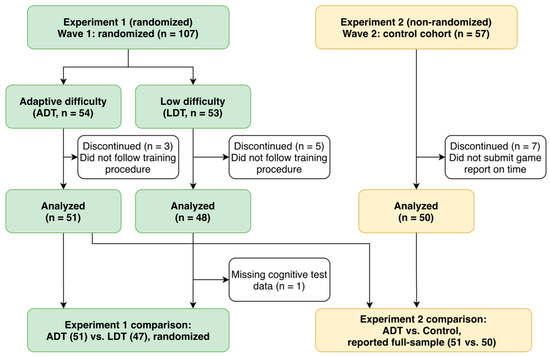
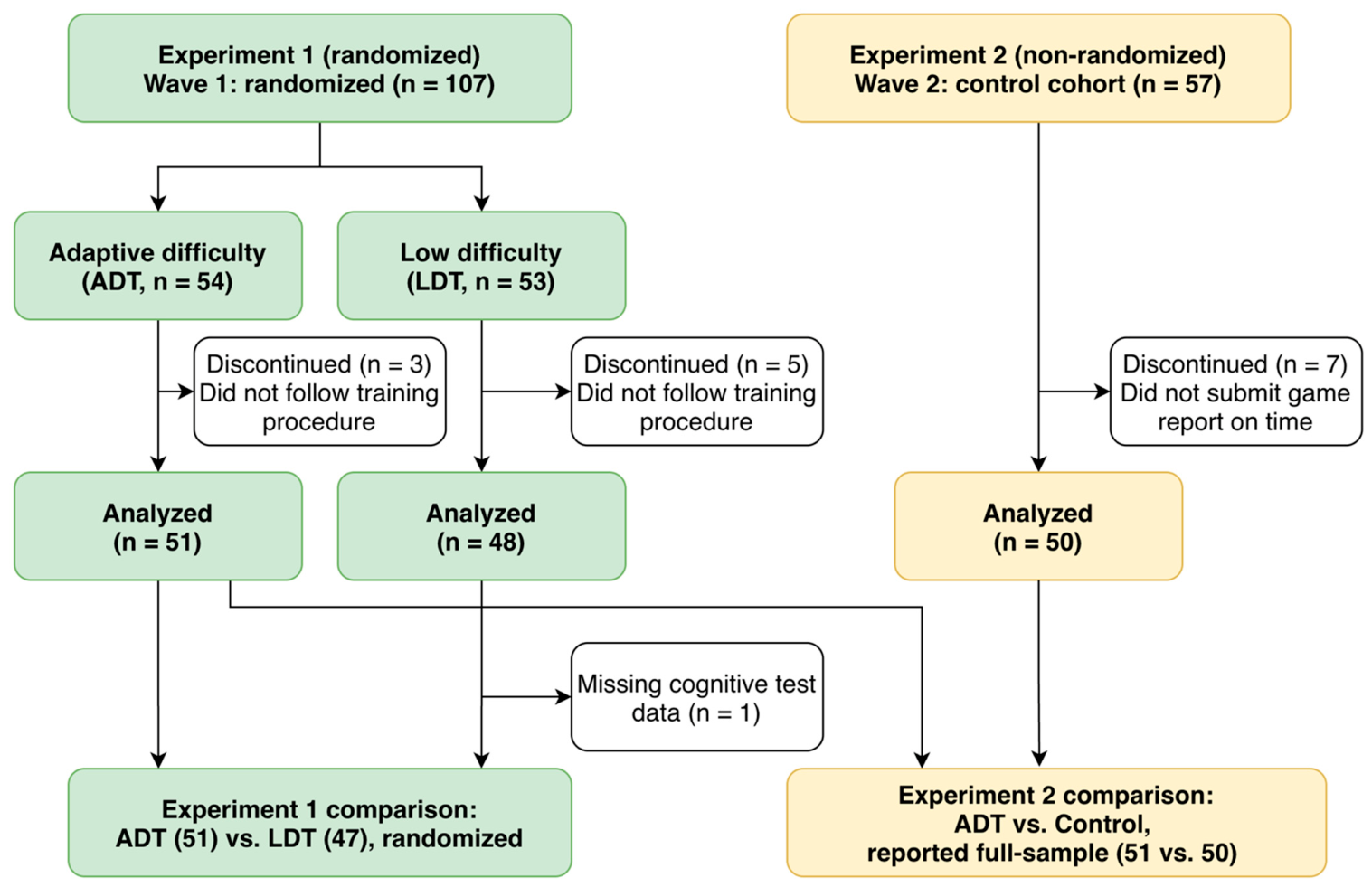
Participant flow. Wave 1: 107 recruited and randomized (ADT 54, LDT 53); 3 ADT and 5 LDT discontinued; 51 ADT and 48 LDT completed training. One LDT completer had no cognitive-test data (analyzed: 51 ADT and 47 LDT). Wave 2: 57 recruited, 7 excluded at pretest screening before allocation, 50 recreational-gaming participants analyzed; no further discontinuations. Outcome-specific samples vary with missingness and outlier screening (see Section 3).
The study comprised two experiments with different purposes. Experiment 1 was the primary randomized comparison and was designed to test the contribution of adaptive difficulty. In Wave 1, all 107 recruited participants were randomly assigned to ADT (n = 54) or LDT (n = 53) after the pretest using stratified randomization: participants were stratified by sex and year of study (first, second or third year), and within each stratum they were assigned to the two conditions using random numbers, so that group sizes were as equal as possible within each stratum. No additional blocking was used. Allocation was carried out by the experimenters who conducted testing and was therefore not concealed. Three ADT and five LDT participants discontinued because they did not follow the training procedure, leaving 99 completers (ADT, n = 51; LDT, n = 48). One LDT participant had no usable cognitive-test record and was therefore excluded from all outcome models, resulting in a maximum analysis sample of 47 participants in the LDT group.
Experiment 2 was a secondary, non-randomized comparison intended to provide an ecological reference for purpose-built gamified cognitive training versus ordinary recreational gaming. In Wave 2, seven of 57 recruited participants were excluded during pretest screening (accuracy below 80% on at least one test), before allocation; the remaining 50 entered the recreational-gaming group, and none discontinued thereafter. Because this comparison was not randomized, it was treated as a reference comparison rather than as a causal test of adaptive difficulty.
Sample Size and Sensitivity
No a priori power analysis was conducted to determine the target sample size; enrollment (107 Experiment-1 participants recruited, all of whom were randomized) was set by feasibility within the funding period rather than a prespecified effect size. Post hoc, an independent-samples comparison with the analyzed sample (ADT n = 51, LDT n = 47; α = 0.05, two-tailed) provides 80% power to detect effects of d ≥ 0.57 and 90% power for d ≥ 0.66.
2.3. Procedure
Participants assigned to the two cognitive-training conditions installed the application with assistance from the research team. On the installation day, participants played each game once or twice at its starting level to become familiar with the program; this familiarization session was not counted as a training day. The program comprised a Training module containing 13 tasks and a Testing module containing the five in-game test tasks. The ADT Training module allowed participants to progress according to the adaptive algorithm described above, whereas the LDT Training module restricted the 13 training tasks to low difficulty. Apart from the difficulty-setting rule, the two conditions were identical in task content, interface, narrative, feedback, scheduling, and prescribed training duration. Participants trained for 19 consecutive days for at least 1.5 h per day, completed in one or two sessions according to a fixed daily schedule. Game logs were collected throughout training, and an experimenter monitored daily completion. The 19-day duration was selected on the basis of previous evidence suggesting that time-dependent changes in cognitive-training performance become more apparent around the third week of training. After the 19-day training period, participants completed the post-training cognitive battery. Participants who could not complete post-testing on day 21 were permitted to continue training for up to two additional days before post-testing. Actual training exposure and adherence are reported in Section 2.7 and Table S7.
2.4. Training Schedule
To provide balanced exposure across the five cognitive domains and minimize self-selection as a source of between-participant variation, participants in both cognitive-training conditions followed a fixed daily task rotation rather than selecting tasks freely. Training days alternated between two task sets, and the five in-game test tasks were administered every third day. On test days, participants completed the scheduled training before the in-game testing, except on day 19, when training preceded testing according to the study protocol. The complete day-by-day schedule is provided in Supplementary Table S2.
2.5. Recreational-Gaming Reference Group
Participants in the recreational-gaming group played self-selected commercial video games for at least 1.5 h per day for 19 days on any device. They were instructed not to play Pavlov: The Brain Is On or other puzzle-oriented games, so that their gaming experience would provide a reference condition distinct from purpose-built cognitive training. Participants submitted daily screenshots documenting the type of game played and the duration of play. Participants who failed to submit game report on time, meet the required duration for two consecutive days, or played prohibited puzzle games were excluded. Because participants were not randomly assigned to recreational gaming, comparisons between ADT and this group were considered secondary and potentially susceptible to baseline differences and selection effects.
2.6. Standard Cognitive Measures
Cognitive performance was assessed before and after the 19-day training period using five standardized computerized tasks implemented in MATLAB (2020a) with Psychtoolbox (Schwarzbach, 2011). Testing was conducted in a dedicated laboratory using consistent hardware. One principal outcome index was defined for each task. Response inhibition: Response inhibition was assessed using a Go/No-Go task. White arrows served as Go stimuli and required a directional key press, whereas blue arrows served as No-Go stimuli and required response withholding. One 16-trial adaptive block preceded three 96-trial test blocks, with one quarter of trials designated as No-Go trials, a 0.5 s inter-trial interval, and a 1.5 s response deadline. Signal-detection sensitivity (d′) was used as the principal outcome. Spatial cognition: Spatial cognition was assessed using a Mental Rotation Test. Participants judged whether pairs of three-dimensional objects were identical or mirror images within a 4 s response window. The task comprised 96 trials involving five objects presented at seven angular orientations, with half of the trials presented at 0°. Response time on correct non-zero-degree rotation trials was used as the principal outcome. Attention: Attention was assessed using the Attentional Network Task (ANT). A cue stage preceded a five-arrow target and included alerting, orienting, and executive-control conditions across 180 trials. Executive-control response time was the principal outcome. Alerting and orienting scores were also calculated as exploratory measures. Because ANT network scores are difference scores and may have modest test–retest reliability, these measures were interpreted cautiously (Fan et al., 2002; MacLeod et al., 2010). Working memory: Working memory was assessed using an N-back task in which digits from 0 to 9 were presented under 0-back, 1-back, and 2-back conditions, with 100 trials per condition and a 0.7 s response deadline. The principal outcome was the response-time difference between the 2-back and 0-back conditions (2-back − 0-back), representing the additional response-time cost associated with increased working-memory load. This contrast was selected to reduce the contribution of baseline stimulus–response speed captured by the 0-back condition. Because the difference score may still contain attention and processing-speed variance, and because the interpretation of N-back performance as a pure measure of working memory has been debated (Kane et al., 2007; Redick & Lindsey, 2013), an accuracy-based load effect was also examined as a complementary measure. Inductive reasoning: Inductive reasoning was assessed using Raven’s Progressive Matrices. Participants completed visual pattern matrices at three difficulty levels, comprising 10, 10, and 30 trials, respectively, without a response deadline. Accuracy on items involving two or more element changes was used as the principal outcome. The N-back load effect was the focal outcome for the adaptive-difficulty question, because working-memory load can be directly manipulated within the task. However, the study did not formally preregister a primary endpoint or analysis plan; consequently, all inferential analyses were treated as exploratory and hypothesis-generating.
2.7. Training Exposure and Game-Log Processing
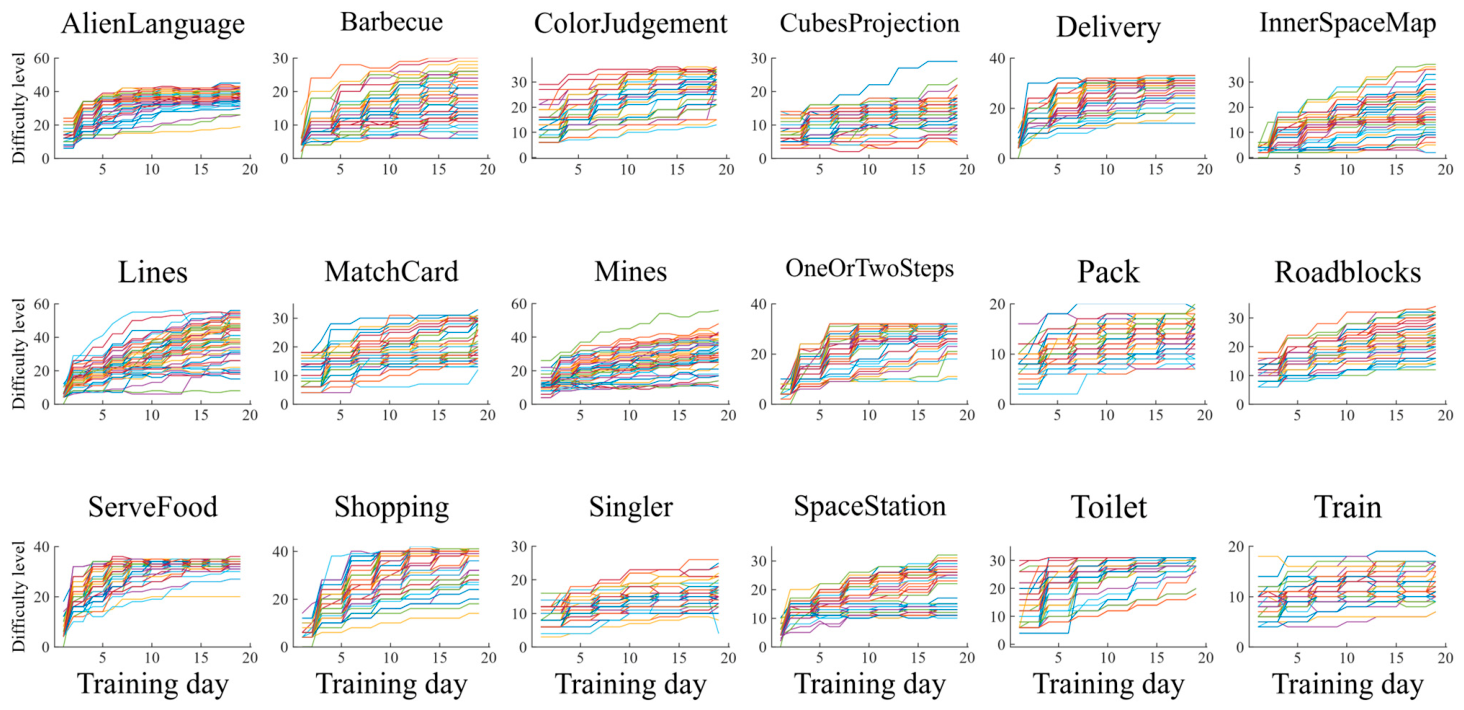
Participants transmitted game logs to the experimenter on the day following each training day. For each session, the logs provided information on difficulty level, session duration, trial-by-trial responses, and session end time. Sessions with zero correct responses or fewer than 50% of the average number of correct responses of other participants at the same difficulty level were classified as passive sessions and excluded from calculations of total active training time. The difficulty level of the last session of each game on each day was used as that day’s measure of training progression (Figure 2). Game-log data were checked against the raw records and screened for potential outliers using box plots.
Figure 2.
Daily difficulty level in each of the 18 games (13 training tasks and 5 in-game test tasks) across the 19 training days (one curve per participant; the value for a day is the difficulty level of the last session of that game played on that day). Values before the first training session show the difficulty level from the familiarization session (day 0). On days a game was not scheduled, the most recent difficulty level is shown. N = 51 ADT participants. As the training progressed, there was a noticeable upward trend in the difficulty levels encountered by the participants, indicating that the adaptive-difficulty manipulation operated as intended.
To verify that the two training conditions received comparable exposure, total active training time, the number of sessions completed and the number of training days played were compared between groups using two-sided Mann–Whitney U tests (ADT, n = 51; LDT, n = 46; of the 48 LDT participants who completed training, one had no cognitive-outcome data and one had a game-log archive containing no recoverable sessions). Total active training time (median 22.3 h vs. 22.9 h, U = 952, p = 0.111) and the number of training days played (median 19 vs. 19, U = 1053.5, p = 0.171) did not differ significantly between groups. LDT participants completed more sessions (median 1739 vs. 872 across all logged days, including the familiarization day; U = 122, p < 0.001) and more trials (median 11,675.5 vs. 8456; U = 579, p < 0.001). This was as expected because sessions at the fixed low difficulty are shorter. The difference in trials arose mainly because ADT participants spent a larger share of active time in the round-based puzzle games, which yield few rounds per minute at high difficulty (Table S7).
Adherence to the daily requirement of at least 1.5 h was assessed from the logged session times. Because the logs record each session’s end time, each session’s start was taken as its end time minus its duration. Within each training day, a new sitting began whenever the next session started more than 15 min after the latest end time of the sessions already in that sitting; a day met the requirement when its sittings summed to at least 90 min. The requirement was met on 88.4% of training days in ADT (976 days) and 86.6% in LDT (887 days), with no difference between groups (participant-level median 94.7% vs. 94.7%, U = 1274, p = 0.449). The passive-session criterion described above was intended to identify sessions in which the participant played without responding attentively; training in such sessions was treated as ineffective. ADT participants had more passive sessions than LDT participants (median 147 vs. 25 per participant, U = 2204.5, p < 0.001; 18.6% vs. 2.5% of all sessions), possibly because ADT participants spent more time at high-difficulty levels, where fewer participants contribute to the same-level average.
2.8. Statistical Analysis
Analyses were conducted in R using the lme4 package (Bates et al., 2015) and independently verified in Python (version 3.11) using statsmodels. For the standardized cognitive outcomes, linear mixed-effects models were fitted with fixed effects of group, time, and their interaction and a participant-level random intercept. The general model specification was as follows: outcome ~ group × time + (1|participant). Models were estimated using maximum likelihood. The group × time interaction was evaluated using a likelihood-ratio test comparing models with and without the interaction term and was reported as χ2(1). Within-group pre–post contrasts were estimated using emmeans with Kenward–Roger degrees of freedom and reported as t statistics. Within-group changes were additionally summarized using paired Cohen’s dz. For two participants (one ADT, one LDT), pre-test values on the N-back, mental rotation, ANT and Raven tasks were unavailable and were treated as missing. Their Go/No-Go and post-test data were retained, and all mixed models were estimated on the available data.
2.8.1. Randomized Comparison of Adaptive- and Low-Difficulty Training
The primary comparison was between ADT and LDT in Experiment 1. The group × time interaction was used to test whether change in standardized cognitive performance differed between the two randomized training conditions. Because the two groups received the same training content, schedule, feedback, and prescribed exposure, with difficulty adaptation as the principal systematic difference, this comparison was designed to isolate the incremental contribution of adaptive difficulty. Although baseline age did not differ significantly between the two groups, age-adjusted mixed-effects models were conducted as a sensitivity analysis. The age-adjusted model included age as an additional fixed-effect covariate while retaining the group × time interaction.
2.8.2. Recreational-Gaming Reference Comparison
For Experiment 2, changes in cognitive performance between the ADT and recreational-gaming groups were examined using the same general mixed-effects framework. The full-sample analysis retained all available participants (51 ADT and 50 recreational-gaming participants) and was treated as the main analysis because it preserved the available sample and avoided selecting participants based on post hoc matching. Because Experiment 2 was non-randomized and the recreational-gaming cohort was tested approximately 10 months after the training cohorts and was therefore older, the full-sample analysis was repeated with age (centered) as a covariate. A demographically matched analysis (1:1 nearest neighbor on age at testing, caliper 0.25 years, exact matching on sex and education stage) yielded only 19 pairs; it is reported in Supplementary Table S5 for transparency but, given its small size, was not used for inference. Results that were sensitive to these analytical choices were interpreted cautiously and were not used as evidence for a causal effect of adaptive difficulty.
2.8.3. Convergent-Validity Analysis
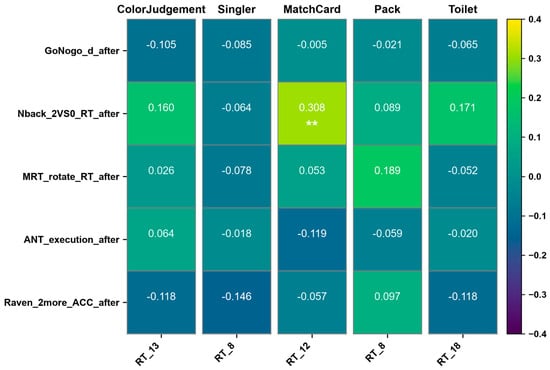
To examine whether the in-game test tasks captured the cognitive abilities they were intended to target, response times on the five in-game test tasks were correlated with corresponding standardized cognitive measures using Spearman rank correlations. Posttest scores on the standardized measures were used. Each in-game task was evaluated at a shared difficulty level (ColorJudgement 13, Singler 8, MatchCard 12, Pack 8, Toilet 18), and in-game RT was the mean per-trial response time across the participant’s non-passive sessions at that level. The analysis included all participants with at least one non-passive session at the shared level of all five tasks (n = 94 of the 97 participants with both game-log and standardized-test data; ADT n = 50, LDT n = 44), and ADT and LDT participants were pooled because the five in-game test tasks operated adaptively in both conditions. Correlations were therefore intended to assess convergent validity rather than transfer to untrained tasks. Fisher z-transformed 95% confidence intervals were calculated for the correlation coefficients.
2.8.4. Multiple-Comparison Correction and Exploratory Inference
Benjamini–Hochberg false-discovery-rate (FDR) correction was applied across the five group × time interaction tests corresponding to the five standardized cognitive outcomes within each comparison. For the convergent-validity analyses, FDR correction was applied across the 25 task–test correlation pairings. Both uncorrected and FDR-corrected p values are reported to provide a transparent assessment of the strength and robustness of the findings. No outcome or analysis plan was formally preregistered, and no hierarchical or gated testing procedure was specified in advance. Accordingly, inferential findings were treated as exploratory rather than confirmatory. The N-back working-memory measure served as the focal outcome motivating the randomized active-control design, but this designation should not be interpreted as a preregistered primary endpoint.
2.8.5. Outlier Handling and Analysis Samples
For each standardized cognitive outcome, observations were screened within each group × time cell using the 1.5× interquartile range (IQR) rule. Outliers identified by this procedure were excluded before model fitting. Because outlier screening and the requirement for paired pre-and post-training observations were applied separately for each outcome, the effective analysis sample could vary across outcomes. The analysis sample size for each outcome is therefore reported separately in the corresponding tables. The numbers of observations excluded in the ADT/LDT/recreational-gaming groups were, respectively, N-back 2/1/2 (total 5), mental rotation 2/4/5 (11), ANT 4/9/7 (20), Raven 4/9/1 (14), and Go/No-Go 0/2/1 (3).
3. Results
3.1. Participants and Baseline Characteristics
In Experiment 1, 107 participants were randomly assigned to adaptive-difficulty training (ADT; n = 54) or low-difficulty training (LDT; n = 53). Eight participants discontinued training, leaving 99 completers (ADT, n = 51; LDT, n = 48). The groups were comparable in sex and education, and they did not differ significantly in age (Table 2; ADT 19.68 ± 0.74 vs. LDT 19.90 ± 0.96 years; t(96) = −1.27, p = 0.21, in the analyzed sample of 51 ADT and 47 LDT participants). Age-adjusted analyses were conducted as a sensitivity analysis. Adding age as a covariate had negligible effects on the group × time interaction for the N-back outcome (Δχ2 < 0.1) or any of the other Experiment 1 outcomes (all Δχ2 < 0.07). In Experiment 2, 57 participants were screened, seven were excluded before allocation, and the remaining 50 entered the recreational-gaming group. The ADT and recreational-gaming groups differed initially in age and education. Age was therefore included as a covariate in a sensitivity analysis of Experiment 2 (Section 2.8.2). For all five primary outcomes, we report both uncorrected p values and Benjamini–Hochberg FDR-corrected values (pFDR); inferences about between-group effects are based on the corrected values, and uncorrected results are described as exploratory.
Table 2.
Demographics: ADT vs. LDT (Experiment 1; analyzed sample).
3.2. Training Progression
Game-log data indicated that the adaptive-difficulty manipulation operated as intended. Following the familiarization session on the installation day, across the 19-day training period, difficulty levels reached by participants in the ADT group increased substantially during the early phase and subsequently increased more slowly, consistent with participants approaching their performance ceiling (Figure 2). In contrast, difficulty in the LDT condition remained capped at level 3 by design.
3.3. Experiment 1: Adaptive vs. Low-Difficulty Training
The primary randomized comparison examined whether cognitive change differed between ADT and LDT. For working memory, the N-back response-time load effect decreased from 0.194 to 0.125 s in the ADT group (within-group dz = 0.73, p < 0.001), whereas it changed only slightly from 0.193 to 0.182 s in the LDT group (dz = 0.06, p = 0.669). The group × time interaction was significant before correction, with χ2(1) = 5.71 and p = 0.017, but it was marginal after FDR correction across the five cognitive outcomes (pFDR = 0.084). Bayes factors computed for the same interaction by two independent methods (BIC approximation, Wagenmakers, 2007: BF10 = 1.26; JZS t-test method, Rouder et al., 2009: BF10 = 2.10) indicate only anecdotal evidence for the effect over the null, and a sensitivity analysis using all available, non-outlier-screened observations weakens the effect further (p = 0.097).
The accuracy-based N-back load effect showed a similar descriptive pattern, with larger within-group improvement in ADT (dz = 0.97) than LDT (dz = 0.63); however, the group × time interaction was not significant, with χ2(1) = 2.92 and p = 0.087. Mental rotation showed a similar but weaker pattern. Response time decreased from 2.292 to 2.032 s in the ADT group (dz = 0.57) and from 2.251 to 2.137 s in the LDT group (dz = 0.21). The group × time interaction did not reach significance, with χ2(1) = 3.14, p = 0.076, and pFDR = 0.191. For attentional executive control, both groups improved substantially: the within-group effect sizes were dz = 0.70 for ADT and 0.62 for LDT. The group × time interaction was essentially null, with χ2(1) < 0.01, p = 0.959, and pFDR = 0.959. Neither the exploratory alerting nor orienting measures showed a significant group × time interaction (alerting: χ2(1) = 0.27, p = 0.60; orienting: χ2(1) = 0.17, p = 0.68). For inductive reasoning, the LDT group showed greater within-group improvement than the ADT group, but the between-group difference in change was not significant, with χ2(1) = 1.52, p = 0.217, and pFDR = 0.362.
Response inhibition likewise showed no significant group × time interaction, with χ2(1) = 0.67, p = 0.414, and pFDR = 0.518. Numerically, Go/No-Go d′ declined from pretest to posttest in both training groups (ADT and LDT), while it improved in the reference comparison; given the non-significant interaction, this pattern should not be over-interpreted, but it is reported here with its correct sign rather than as an unsigned magnitude. Full outcome statistics and outcome-specific analysis samples are provided in Table 3 and Supplementary Table S3.
Table 3.
Experiment 1 (ADT vs. LDT): signed effect sizes and group × time interaction.
3.4. Experiment 2: Adaptive Training vs. Recreational Gaming
Experiment 2 provided a secondary, non-randomized comparison between adaptive training and self-selected recreational gaming. Because participants were not randomly assigned, differences in demographic characteristics could confound between-group comparisons. Accordingly, we repeated the analysis with age as a covariate to address the baseline age difference.
In the full sample, adaptive training was associated with greater improvement in mental rotation than recreational gaming, as indicated by a significant group × time interaction, with χ2(1) = 6.84, p = 0.009, and pFDR = 0.045. No significant group × time interactions were observed for working memory, inductive reasoning, attentional executive control, or response inhibition. Because the recreational-gaming cohort was tested approximately 10 months after the training cohorts and was therefore older, the analysis was repeated with age as a covariate. The mental-rotation interaction was unchanged, with χ2(1) = 6.86, p = 0.009, and pFDR = 0.044, and no other outcome differed between groups. A demographically matched analysis yielded only 19 pairs and is reported in Table S5; in that sample, the mental-rotation effect was in the same direction (p = 0.046) but the analysis was underpowered. Given the non-randomized design, the mental-rotation advantage should be regarded as an exploratory finding rather than causal evidence that adaptive training is superior to recreational gaming. The complete results are presented in Table 4.
Table 4.
Experiment 2 (ADT vs. recreational gaming): group × time interaction under two models.
3.5. Convergent Validity of In-Game Test Tasks
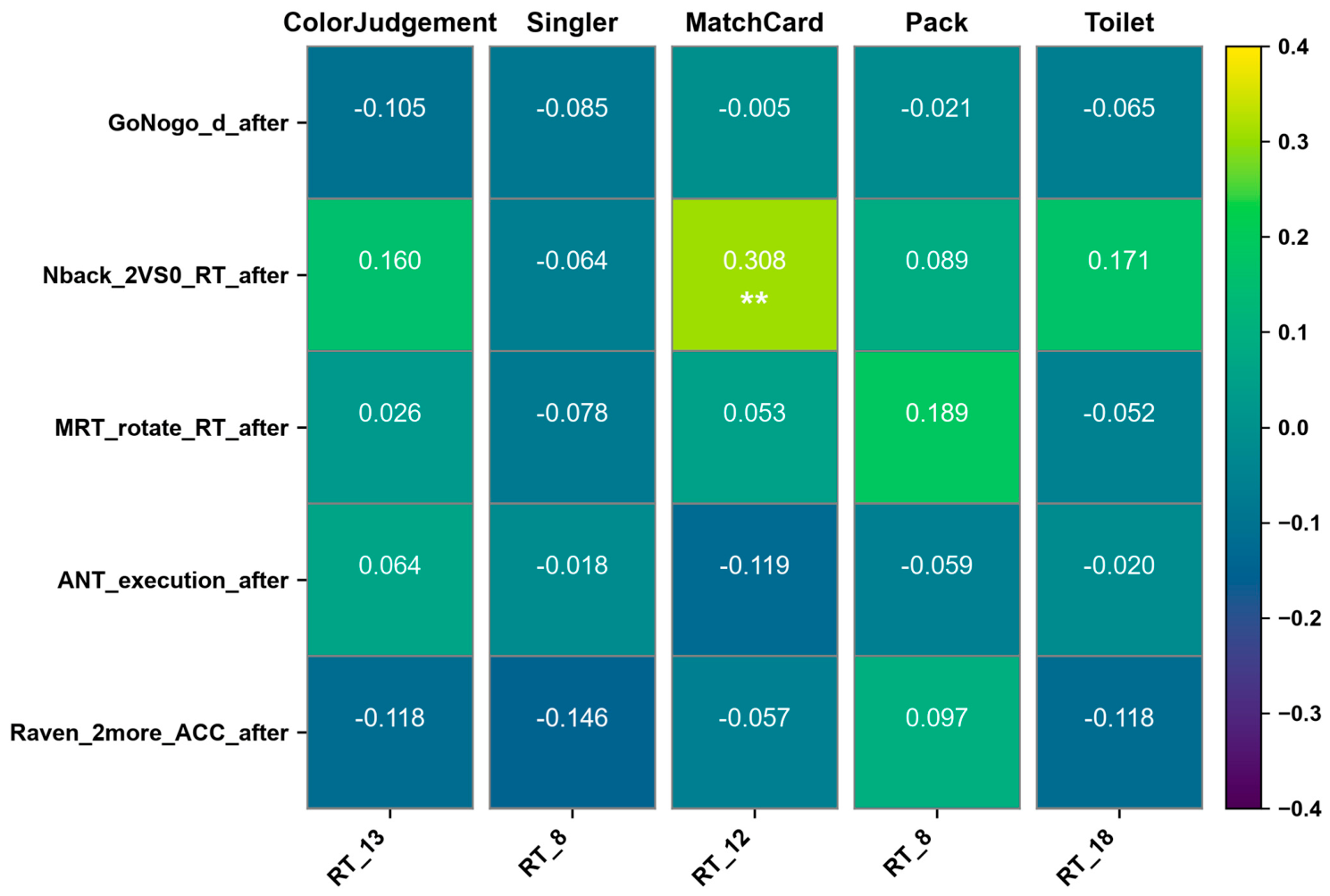
This exploratory analysis included 94 participants and 25 correlation tests (n = 86–93 per pair, depending on outlier screening of the standardized scores). Only one correlation was significant before correction: response time on MatchCard was positively correlated with N-back 2-vs-0 response time (Figure 3; ρ = 0.308, 95% CI [0.111, 0.483], p = 0.003), in the expected direction. No correlation remained significant after FDR correction across the 25 pairings (smallest pFDR = 0.070, for this pair), and all other correlations were small (|ρ| ≤ 0.19). These findings should not be interpreted as evidence that the in-game tasks validly measure their corresponding cognitive domains; larger-sample confirmatory studies are needed. The full correlation matrix is provided in Supplementary Table S4, and correlations for the five domain-matched pairs across difficulty levels are provided in Supplementary Table S8.
Figure 3.
Spearman correlations between response time (RT) on the five in-game test tasks and the standardized cognitive measures at posttest. Each column is one in-game task at its shared difficulty level (ColorJudgement 13, Singler 8, MatchCard 12, Pack 8, Toilet 18); RT is the mean per-trial response time of the participant’s non-passive sessions at that level. The analysis includes the 94 participants with at least one non-passive session at the shared level of all five tasks (n = 86–93 per pair, depending on outlier screening of the standardized scores). Cell values are Spearman ρ; color encodes ρ. Asterisks mark uncorrected p values (** p < 0.01). After Benjamini–Hochberg correction across all 25 pairs, the smallest pFDR is 0.070 (MatchCard–N-back 2-vs-0 RT); no correlation survives FDR correction.
4. Discussion
4.1. Principal Findings
The present study examined whether adaptive difficulty contributes to cognitive-training outcomes beyond participation in the same gamified training at a fixed low level of difficulty. In the randomized active-control experiment, the adaptive-difficulty group showed greater improvement in the N-back response-time load effect than the low-difficulty group. This difference was nominally significant before multiplicity correction and remained unchanged after adjustment for age, but it was marginal after FDR correction. Mental rotation showed a similar but non-significant pattern, whereas attentional executive control improved similarly in both groups and no differential benefit was observed for inductive reasoning or response inhibition. These findings provide preliminary, hypothesis-generating evidence that adaptive difficulty may contribute to working-memory improvement as a candidate active ingredient of gamified cognitive training, rather than evidence for a general cognitive benefit. Because the focal N-back effect did not survive FDR correction (pFDR = 0.084), Bayes factors provided only anecdotal support (BF10 = 1.26 and 2.10) and the unscreened sensitivity analysis weakened the effect (p = 0.097), this interpretation remains provisional pending larger, preregistered studies. This interpretation is consistent with the broader literature, in which cognitive-training effects are often modest and domain-specific, and with the view that training outcomes depend on specific features of the training protocol rather than training exposure alone (Lampit et al., 2014; Hill et al., 2017; Smid et al., 2020).
4.2. Adaptive Difficulty as a Candidate Active Ingredient
Adaptive difficulty is intended to maintain task demands near an individual’s current capacity, providing repeated exposure to challenging but attainable performance levels. Although this principle is widely used in cognitive-training programs, direct evidence that adaptivity itself improves training outcomes remains limited and mixed; for example, von Bastian and Eschen (2016) found no clear advantage of adaptive over self-paced working-memory training. The present study provides a more controlled test of this question because ADT and LDT used the same game content, training schedule, feedback, and prescribed exposure, differing primarily in whether difficulty adapted to performance. The stronger improvement in the ADT group on the N-back load effect therefore cannot readily be attributed to greater exposure to the game itself. At the same time, the evidence was not robust to FDR correction, and the accuracy-based N-back interaction was not significant. The finding should consequently be regarded as hypothesis-generating evidence that adaptive challenge may facilitate working-memory improvement, warranting confirmation in preregistered studies with prespecified outcomes. The domain-specific pattern is also noteworthy. Adaptive difficulty did not produce a consistent advantage across all cognitive measures. Attention improved similarly in both groups, while reasoning and response inhibition showed no evidence of an adaptive-training advantage. This pattern argues against a simple domain-general account and suggests that the effects of difficulty adaptation may depend on the cognitive processes being trained and the sensitivity of the outcome measures.
4.3. Why the Active Control Matters
The similar improvement in attentional executive control across ADT and LDT illustrates the importance of an active control in cognitive-training research. Improvements observed after training can reflect repeated testing, familiarity with task demands, expectancy, or engagement rather than the specific training manipulation of interest (Smid et al., 2020). Because ADT and LDT were matched on the broader gaming experience, their divergence on working memory provides stronger evidence for a training-specific contribution of adaptive difficulty than a comparison with a passive control would have provided. However, the absence of a no-contact group means that the present study cannot determine the absolute extent to which either training condition improved cognition beyond test–retest practice. The appropriate inference is therefore about the incremental effect of adaptive difficulty relative to low-difficulty training, rather than the overall efficacy of the game compared with no training.
One further consideration is that LDT held difficulty fixed at a low level (level 3) throughout the 19-day protocol, despite the tasks being designed for a healthy university-student sample capable of much higher difficulty. It is plausible that remaining at an unchallenging difficulty for this long produced boredom or progressive disengagement in the LDT group, independent of the absence of adaptivity per se. If so, the ADT–LDT contrast reflects not only ‘adaptive vs. non-adaptive difficulty’ but also, potentially, ‘sustained vs. waning motivation’—two mechanisms that our design does not fully disentangle. On the dimensions we did measure, we find no aggregate evidence of reduced engagement during training: total active training time and the number of days played did not significantly differ between LDT and ADT (Section 2.7), suggesting no gross behavioral withdrawal from the training itself. This does not, however, resolve the underlying concern: adherence and time-on-task speak only to whether participants kept showing up and logging time, not to their subjective motivation or effort level while doing so. A decline in engagement that carried over into reduced effort on the post-training outcome assessment—thereby inflating the apparent ADT–LDT difference for reasons unrelated to adaptivity itself—remains a plausible, unmeasured confound that our design cannot rule out. Future work could address this by including an engagement or session-level motivation measure, or by comparing adaptive difficulty against a moderate, non-trivial fixed difficulty rather than a floor-level one.
4.4. Gamified Training and Recreational Gaming
The secondary comparison with recreational gaming provides a complementary perspective on the broader question of whether purpose-built gamified cognitive training differs from ordinary recreational gameplay. Importantly, this comparison was non-randomized. We therefore repeated the full-sample analysis with age as a covariate to address the baseline age difference. The mental-rotation advantage was significant after FDR correction in the full sample (pFDR = 0.045), and its magnitude was unchanged after adjustment for age (pFDR = 0.044) and age × time (pFDR = 0.117), although the latter model widened its confidence interval. However, because participants were not randomly assigned to the two forms of gaming, alternative explanations, including differences in participants’ gaming preferences, prior experience, motivation, or other unmeasured characteristics, cannot be excluded. In the full sample, the working-memory difference was in the same direction as in Experiment 1 but was not significant (p = 0.096), and inductive reasoning did not differ between groups. Because Experiment 2 compared non-randomized cohorts tested about 10 months apart, residual confounding by cohort cannot be excluded, and the mental-rotation finding remains exploratory rather than causal evidence. In particular, they should not be taken as evidence that adaptive training produces broad cognitive advantages over recreational gaming. This distinction is important because recreational video games and purpose-built cognitive-training games differ in their goals and cognitive demands. Commercial video games are designed primarily for entertainment, whereas gamified cognitive-training programs embed experimentally defined cognitive tasks within a game-like environment (Sala et al., 2018; Flores-Gallegos & Mayer, 2022). Thus, the present comparison is best understood as an ecological comparison between two forms of gameplay rather than a controlled test of adaptive difficulty. More broadly, the findings fit with the mixed literature on cognitive benefits and transfer from video-game training. Evidence suggests that cognitive improvements from video games can be relatively specific to trained skills and task characteristics, with limited evidence for broad transfer across cognitive domains (Sala et al., 2018; Sala & Gobet, 2019; Flores-Gallegos & Mayer, 2022). The present results similarly do not support a general claim that one form of gameplay produces superior cognition across domains. Rather, they suggest that the effects of purpose-built gamified training may vary according to the cognitive outcome being assessed. Most importantly, this comparison should remain secondary to the randomized ADT–LDT experiment. The latter provides the more direct test of whether adaptive difficulty itself contributes to cognitive change, whereas the recreational-gaming comparison addresses a broader and inherently less controlled question about purpose-built cognitive training versus ordinary gameplay.
4.5. Measurement and Limitations
Only one in-game task (MatchCard) correlated with its corresponding standardized measure before correction, and no correlation survived correction for multiple comparisons. These exploratory findings do not establish construct convergence or validate the in-game tasks as cognitive measures. The interpretation of the N-back result should likewise remain cautious because N-back performance reflects working memory together with attentional and other executive processes (Kane et al., 2007).
Several limitations further constrain interpretation. First, the study was exploratory and non-preregistered, and the working-memory interaction became marginal after FDR correction. Second, the randomized experiment included only college students and a relatively short 19-day training period, with no follow-up assessment. Third, the randomized comparison lacked a no-contact control and therefore cannot separate absolute training gains from practice effects, and allocation was not concealed from the experimenters who carried out the randomization. Fourth, the recreational-gaming comparison was non-randomized and potentially confounded by cohort age. Finally, the standardized measures assessed the same broad domains targeted by training, so the study does not establish far transfer to untrained cognitive abilities, consistent with the broader literature on cognitive and video-game training (Sala et al., 2018; Sala & Gobet, 2019).
The convergent-validity analysis (Section 3.5) included nearly all participants with both game-log and standardized-test data (94 of 97), so restriction of range through subsample selection is unlikely to account for the weak correlations. With about 90 participants per pair and 25 tests, however, the analysis could reliably detect only moderate correlations, and smaller associations cannot be ruled out.
Relatedly, the study was not powered a priori. With the analyzed sample (ADT n = 51, LDT n = 47), we had 80% power to detect only effects of d ≥ 0.57—larger than the g = 0.28–0.31 near-transfer effect sizes reported for working-memory training against active control groups in the broader literature (Melby-Lervåg et al., 2016). The marginal, FDR-uncorrected N-back finding and the absence of significant effects on other domains should therefore be interpreted with this limited power in mind: null or borderline results in this study cannot be taken as evidence of a true absence of effect at the magnitude typically observed elsewhere.
In addition, although total active training time and the number of training days were comparable between ADT and LDT groups, LDT participants completed more sessions and trials. These differences were expected given the shorter sessions at fixed low difficulty and the greater time ADT participants spent in round-based puzzle games at higher difficulty levels. Thus, the groups were comparable in overall training duration but not identical in the amount of task repetition. This distinction should be considered when interpreting the group contrast, although the differences in sessions and trials arose naturally from the training conditions rather than from differences in scheduled training time.
5. Conclusions
In a randomized active-control comparison, adaptive-difficulty training produced greater improvement in working-memory performance than the same gamified training maintained at low difficulty, although the evidence became marginal after correction for multiple comparisons. No consistent adaptive advantage was observed across the other cognitive domains. A separate non-randomized comparison with recreational gaming provided complementary ecological context but did not permit causal inference. These findings suggest that adaptive difficulty is a promising candidate active ingredient of multi-domain gamified cognitive training, particularly for working memory, while emphasizing that the current evidence is preliminary. Larger, preregistered studies with prespecified outcomes, appropriate active and passive controls, and longer-term follow-up are needed to determine whether adaptive challenge reliably produces cognitive benefits beyond engagement and practice.
Supplementary Materials
The following supporting information can be downloaded at: https://www.mdpi.com/article/10.3390/bs16112105/s1, Table S1: All 18 game tasks: targeted ability, corresponding paradigm, and difficulty scaling; Table S2: Structure of the fixed daily training rotation; Table S3: Descriptive statistics and within-group effect sizes by group; Table S4: Full convergent-validity matrix: in-game test-task RT × standard test (Spearman’s ρ); Table S5: Experiment 2: matched subsample analyses; Table S6: Experiment 2: full-sample age × time terms (ADT vs. recreational gaming); Table S7: Training exposure and adherence by group (Experiment 1); Table S8: Correlations for the five domain-matched in-game task–standard measure pairs across difficulty levels; Figure S1: Decision logic of the adaptive-difficulty algorithm and a worked numerical example.
Author Contributions
Conceptualization, Z.Y., Y.D., X.Z., Z.H. and H.S.; methodology, Z.Y., B.C., Y.D., X.Z. and Z.H.; software, X.Z., Y.D. and Z.H.; formal analysis, B.C., J.C., Y.Z., J.L. and Z.Y.; data curation, B.C., J.C., Y.Z. and J.L.; writing—original draft preparation, B.C., J.C., Y.Z. and J.L.; writing—review and editing, B.C., J.C., Y.Z., J.L., X.C. and Z.Y.; visualization, B.C., J.C., Y.Z., J.L. and Z.Y.; supervision, Z.Y.; project administration, B.C., H.S. and Z.Y.; funding acquisition, H.S. and Z.Y. All authors have read and agreed to the published version of the manuscript.
Funding
This study is funded by Tianqiao and Chrissy Chen Institute (TCCI20200810). The funder was not involved in the study design, collection, analysis, interpretation of data, the writing of this article or the decision to submit it for publication.
Institutional Review Board Statement
The study was conducted in accordance with the Declaration of Helsinki and approved by the Institutional Review Board of Hangzhou Normal University (protocol code 2022030 and date of approval: 9 November 2022).
Informed Consent Statement
Informed consent was obtained from all subjects involved in the study.
Data Availability Statement
De-identified data and analysis code supporting the findings are available at https://github.com/yangzhi-psy/pavlov_training (accessed on 19 October 2026). Correspondence and requests for materials should be addressed to the corresponding author.
Acknowledgments
We thank Jiawei Lin and Weiming Cai for their technical support with the game. We also thank Caidi Zhang for help with implementing the experimental paradigm and Duofu Liu for coordinating the project.
Conflicts of Interest
The authors declare no conflicts of interest.
References
- Bates, D., Mächler, M., Bolker, B., & Walker, S. (2015). Fitting linear mixed-effects models using lme4. Journal of Statistical Software, 67(1), 1–48. [Google Scholar]
- Bjork, R. A. (1994). Memory and metamemory considerations in the training of human beings. In J. Metcalfe, & A. P. Shimamura (Eds.), Metacognition: Knowing about knowing (pp. 185–205). MIT Press. [Google Scholar]
- Csikszentmihalyi, M. (1990). Flow: The psychology of optimal experience. Harper & Row. [Google Scholar]
- Durcan, O., Holland, P., & Bhattacharya, J. (2024). A framework for neurophysiological experiments on flow states. Communications Psychology, 2, 66. [Google Scholar] [CrossRef] [Scilit] [PubMed]
- Fan, J., McCandliss, B. D., Sommer, T., Raz, A., & Posner, M. I. (2002). Testing the efficiency and independence of attentional networks. Journal of Cognitive Neuroscience, 14(3), 340–347. [Google Scholar] [CrossRef] [Scilit] [PubMed]
- Flores-Gallegos, R., & Mayer, R. E. (2022). Learning cognitive skills by playing video games at home: Testing the specific transfer of general skills theory. Journal of Cognitive Enhancement, 6, 485–495. [Google Scholar] [CrossRef] [Scilit]
- Fraulini, N. W., Marraffino, M. D., Garibaldi, A. E., Johnson, C. I., & Whitmer, D. E. (2025). Adaptive training instructional interventions: A meta-analysis. Military Psychology, 37(5), 479–493. [Google Scholar] [CrossRef] [Scilit] [PubMed]
- Hill, N. T. M., Mowszowski, L., Naismith, S. L., Chadwick, V. L., Valenzuela, M., & Lampit, A. (2017). Computerized cognitive training in older adults with mild cognitive impairment or dementia: A systematic review and meta-analysis. American Journal of Psychiatry, 174(4), 329–340. [Google Scholar] [CrossRef] [Scilit] [PubMed]
- Jaeggi, S. M., Buschkuehl, M., Jonides, J., & Perrig, W. J. (2008). Improving fluid intelligence with training on working memory. Proceedings of the National Academy of Sciences of the United States of America, 105(19), 6829–6833. [Google Scholar] [CrossRef] [Scilit] [PubMed]
- Kane, M. J., Conway, A. R. A., Miura, T. K., & Colflesh, G. J. H. (2007). Working memory, attention control, and the n-back task: A question of construct validity. Journal of Experimental Psychology: Learning, Memory, and Cognition, 33(3), 615–622. [Google Scholar] [CrossRef] [Scilit] [PubMed]
- Kirchner, W. K. (1958). Age differences in short-term retention of rapidly changing information. Journal of Experimental Psychology, 55(4), 352–358. [Google Scholar] [CrossRef] [Scilit] [PubMed]
- Lampit, A., Hallock, H., & Valenzuela, M. (2014). Computerized cognitive training in cognitively healthy older adults: A systematic review and meta-analysis of effect modifiers. PLoS Medicine, 11(11), e1001756. [Google Scholar] [CrossRef] [Scilit] [PubMed]
- Leavitt, V. M. (2011). Raven progressive matrices. In J. S. Kreutzer, J. DeLuca, & B. Caplan (Eds.), Encyclopedia of clinical neuropsychology. Springer. [Google Scholar]
- Lumsden, J., Edwards, E. A., Lawrence, N. S., Coyle, D., & Munafò, M. R. (2016). Gamification of cognitive assessment and cognitive training: A systematic review of applications and efficacy. JMIR Serious Games, 4(2), e11. [Google Scholar] [CrossRef] [Scilit] [PubMed]
- MacLeod, J. W., Lawrence, M. A., McConnell, M. M., Eskes, G. A., Klein, R. M., & Shore, D. I. (2010). Appraising the ANT: Psychometric and theoretical considerations of the Attention Network Test. Neuropsychology, 24(5), 637–651. [Google Scholar] [CrossRef] [Scilit] [PubMed]
- Melby-Lervåg, M., Redick, T. S., & Hulme, C. (2016). Working memory training does not improve performance on measures of intelligence or other measures of “far transfer”: Evidence from a meta-analytic review. Perspectives on Psychological Science, 11(4), 512–534. [Google Scholar] [CrossRef] [Scilit] [PubMed]
- Pyke, W., Lunau, J., & Javadi, A. H. (2025). Does difficulty moderate learning? A comparative analysis of the desirable difficulties framework and cognitive load theory. Quarterly Journal of Experimental Psychology, 78(10), 2181–2195. [Google Scholar] [CrossRef] [Scilit] [PubMed]
- Redick, T. S., & Lindsey, D. R. B. (2013). Complex span and n-back measures of working memory: A meta-analysis. Psychonomic Bulletin & Review, 20(6), 1102–1113. [Google Scholar] [CrossRef] [Scilit] [PubMed]
- Rosvold, H. E., Mirsky, A. F., Sarason, I., Bransome, E. D., & Beck, L. H. (1956). A continuous performance test of brain damage. Journal of Consulting Psychology, 20(5), 343–350. [Google Scholar] [CrossRef] [Scilit] [PubMed]
- Rouder, J. N., Speckman, P. L., Sun, D., Morey, R. D., & Iverson, G. (2009). Bayesian t tests for accepting and rejecting the null hypothesis. Psychonomic Bulletin & Review, 16(2), 225–237. [Google Scholar] [CrossRef] [Scilit] [PubMed]
- Sala, G., & Gobet, F. (2019). Cognitive training does not enhance general cognition. Trends in Cognitive Sciences, 23(1), 9–20. [Google Scholar] [CrossRef] [Scilit] [PubMed]
- Sala, G., Tatlidil, K. S., & Gobet, F. (2018). Video game training does not enhance cognitive ability: A comprehensive meta-analytic investigation. Psychological Bulletin, 144(2), 111–139. [Google Scholar] [CrossRef] [Scilit] [PubMed]
- Schwarzbach, J. (2011). A simple framework (ASF) for behavioral and neuroimaging experiments based on the psychophysics toolbox for MATLAB. Behavior Research Methods, 43(4), 1194–1201. [Google Scholar] [CrossRef] [Scilit] [PubMed]
- Shepard, R. N., & Metzler, J. (1971). Mental rotation of three-dimensional objects. Science, 171(3972), 701–703. [Google Scholar] [CrossRef] [Scilit] [PubMed]
- Smid, C. R., Karbach, J., & Steinbeis, N. (2020). Toward a science of effective cognitive training. Current Directions in Psychological Science, 29(6), 531–537. [Google Scholar] [CrossRef] [Scilit]
- Stroop, J. R. (1935). Studies of interference in serial verbal reactions. Journal of Experimental Psychology, 18(6), 643–662. [Google Scholar] [CrossRef] [Scilit]
- Sweller, J. (1988). Cognitive load during problem solving: Effects on learning. Cognitive Science, 12(2), 257–285. [Google Scholar] [CrossRef] [Scilit]
- Tan, S. B., Tan, J., Raczkowska, M. N., Lee, J. C. W., Rai, B., Remus, A., & Ho, D. (2023). Digital game-based interventions for cognitive training in healthy adults and adults with cognitive impairment: Protocol for a two-part systematic review and meta-analysis. BMJ Open, 13(5), e071059. [Google Scholar] [CrossRef] [Scilit] [PubMed]
- Vermeir, J. F., White, M. J., Johnson, D., Crombez, G., & Van Ryckeghem, D. M. L. (2020). The effects of gamification on computerized cognitive training: Systematic review and meta-analysis. JMIR Serious Games, 8(3), e18644. [Google Scholar] [CrossRef] [Scilit] [PubMed]
- von Bastian, C. C., & Eschen, A. (2016). Does working memory training have to be adaptive? Psychological Research, 80(2), 181–194. [Google Scholar] [CrossRef] [Scilit] [PubMed]
- Wagenmakers, E.-J. (2007). A practical solution to the pervasive problems of p values. Psychonomic Bulletin & Review, 14(5), 779–804. [Google Scholar] [CrossRef] [Scilit] [PubMed]

Disclaimer/Publisher’s Note: The statements, opinions and data contained in all publications are solely those of the individual author(s) and contributor(s) and not of MDPI and/or the editor(s). MDPI and/or the editor(s) disclaim responsibility for any injury to people or property resulting from any ideas, methods, instructions or products referred to in the content. |
© 2026 by the authors. Licensee MDPI, Basel, Switzerland. This article is an open access article distributed under the terms and conditions of the Creative Commons Attribution (CC BY) license.