


Abstract
Artificial intelligence (AI) is increasingly embedded in students’ learning and everyday lives, making AI literacy an important competence in K–12 education. However, large-scale evidence remains limited on AI literacy differences, associated factors, and student profiles. This cross-sectional study used survey data from 141,988 students in Grades 6, 9, and 11 in Changchun, Northeast China. The study addressed three research questions: whether AI literacy differed by grade and student background; which family, academic, lifestyle, and media-use factors were associated with it; and whether profiles emerged across AI understanding, use, evaluation, and ethical awareness. Group comparisons, correlation and hierarchical regression analyses, and latent profile analysis were conducted. AI literacy was higher among students in the upper grades, urban students, and students from higher-socioeconomic-status families, while gender differences were small. Family socioeconomic status, academic achievement, discretionary time, sleep duration, physical activity duration and habit, online gaming habit, and mobile phone usage pattern were positively associated with AI literacy. Online gaming time and mobile phone use time were not independently associated with AI literacy. Four latent profiles were identified: overall low-level, overall high-level, high-exposure–low-reflection, and low-exposure–high-reflection. These findings support equitable, stage-appropriate AI literacy education that considers students’ backgrounds and profiles.
1. Introduction
Artificial intelligence (AI) is becoming a common part of K–12 students’ learning and daily lives. Students now encounter AI through school-based digital tools, search engines, generative AI tools, AI tutoring tools, voice assistants, and mobile apps. These technologies affect how students find information, obtain learning support, communicate with others, solve problems, and make daily decisions. Students therefore need more than basic experience with AI tools. They need to understand how AI works and know how to use AI in appropriate ways. They also need to judge AI-generated information carefully and recognize the ethical and social issues related to AI use. For these reasons, AI literacy has become an important competence for students who are learning and living in a society where AI is increasingly common.
AI literacy is generally understood as an ability that includes several related skills. Students need to understand basic AI concepts and how AI works. They also need to know how to use AI tools, judge AI-generated information, and recognize ethical issues such as bias, privacy, fairness, responsibility, and accountability (Long & Magerko, 2020; Ng et al., 2021). For K–12 students, AI literacy should not be judged only by their technical skills or how often they use AI. Students who use AI tools often may still have difficulty judging whether AI-generated content is reliable, biased, or ethically appropriate. In contrast, students who have less experience with AI may still understand its risks and show strong awareness of responsible use. These differences show that AI literacy includes more than AI use itself. It also includes understanding AI, using it appropriately, judging its outputs, and thinking about ethical issues.
A growing body of research has provided an important foundation for AI literacy education. Existing studies have developed frameworks and curricula around core AI concepts, data awareness, algorithmic understanding, ethical responsibility, and human–AI collaboration. Researchers have also used programming, machine learning activities, project-based learning, digital storytelling, gamified learning, and interdisciplinary curricula to improve students’ AI understanding and application (Touretzky et al., 2019; Casal-Otero et al., 2023; Ng et al., 2022; Gong et al., 2026). These studies have strengthened the conceptual and teaching foundations of AI literacy education. However, much of the existing research has focused on conceptual frameworks, curriculum design, or relatively small-scale instructional interventions. Large-scale evidence from real educational settings remains limited regarding how AI literacy varies across grade levels and student backgrounds, which factors are associated with AI literacy, and whether students show distinct AI literacy profiles. A clearer understanding of these issues can help inform more targeted and equitable AI literacy education.
1.1. Developmental and Contextual Differences in AI Literacy
AI literacy may differ across grade levels because students’ cognitive abilities, learning experiences, exposure to digital technologies, information-processing skills, and ability to learn independently may vary across educational stages. Older students may have more opportunities to encounter AI-related technologies. They may also be better able to understand concepts such as data, algorithms, machine learning, and AI-generated content. Studies of digital and ICT literacy have also highlighted developmental differences. Gnambs (2021) suggests that students’ digital competence develops with age and learning experience and is shaped by family and school contexts. However, it is still unclear how AI literacy, as a new form of digital competence, differs across stages of K–12 education. Examining grade-related differences can therefore help clarify how students’ AI literacy varies across educational stages.
AI literacy may also be associated with students’ family and academic contexts. Family socioeconomic status may be an important factor because families with higher socioeconomic status (SES) are often better able to provide digital devices, internet access, learning resources, parental support, and opportunities to engage with AI-related technologies (Guan et al., 2025; Shomotova et al., 2026). Studies of digital and ICT literacy have also shown that family resources are closely related to students’ digital competence and experiences with technology use (Scherer & Siddiq, 2019; Chiao & Chiu, 2018). As generative AI becomes more common, socioeconomic differences may play an even larger role in students’ opportunities to access and understand AI technologies (Zhang et al., 2026). Academic achievement may also be related to AI literacy. Students need information comprehension, logical reasoning, problem-solving, and critical-thinking skills to understand and evaluate AI. Previous studies have reported positive associations between AI literacy, digital literacy, ICT literacy, and academic performance (Y. Wang, 2026; Chun et al., 2025; Li et al., 2025; Lei et al., 2021). Research has also shown that instructional approaches such as design thinking, gamified learning, and problem-based activities can improve both AI literacy and learning outcomes (Hsu & Hsu, 2024; S.-H. Huang & Hsu, 2024).
Students’ daily routines and media use patterns may also be related to AI literacy, although these factors are not direct parts of AI literacy. Discretionary time, sleep duration, and physical activity reflect students’ daily time use, self-management, and general developmental conditions. Previous studies have shown that sleep, physical activity, and healthy lifestyles are related to academic performance, cognitive functioning, and engagement in digital learning (Musshafen et al., 2021; Ni et al., 2025; Marciano & Camerini, 2021; Gonçalves et al., 2025; Faught et al., 2017). Digital media use may also provide students with opportunities to encounter AI-related technologies. However, its role may depend more on how students use digital media than on how much time they spend using it. Recreational or excessive media use may take up learning time and reduce time for sleep and physical activity (Adelantado-Renau et al., 2019; Paterna et al., 2024). In contrast, learning-oriented or efficiency-oriented digital use may provide more opportunities for meaningful engagement with AI-related technologies. Previous research has also suggested that AI interaction and digital gaming may have different effects depending on the context, motivation, and level of self-regulation involved (Sun et al., 2025; Gong et al., 2026). Examining AI literacy together with students’ time use, health-related routines, online gaming, and mobile phone use may therefore help us better understand the conditions related to its development.
1.2. Heterogeneity in AI Literacy and Latent Profiles
AI literacy may vary in ways that cannot be fully captured by a single overall score. Because AI literacy includes several dimensions, students may show different levels of understanding, use, evaluation, and ethical awareness of AI. Some students may have more experience with AI and use AI tools more often, but they may still have difficulty judging AI-generated content or recognizing ethical risks. Other students may have less experience with AI but show stronger awareness of reliability, privacy, risk, and responsibility. These differences suggest that students may show distinct combinations of strengths and weaknesses across AI literacy dimensions. Recent studies have highlighted the multidimensional nature of AI literacy and suggested that a single total score may not fully represent students’ AI literacy (Zhong & Liu, 2025). Therefore, examining AI literacy from multiple dimensions may provide a more detailed understanding of differences among students.
Studies using latent profile analysis have also shown that children may show different AI literacy profiles rather than one uniform pattern (Xiong et al., 2025). This finding suggests that students may differ not only in their overall AI literacy levels but also in the combinations of AI understanding, use, evaluation, and ethical awareness. However, further investigation is needed to understand how AI literacy profiles vary across K–12 grade levels and how these profiles relate to students’ demographic backgrounds, academic achievement, daily routines, and media-use patterns. Identifying these profiles may help reveal differences that are not apparent from overall AI literacy scores alone. Building on this research, the present study used latent profile analysis to identify profiles based on students’ self-reported AI understanding, use, evaluation, and ethical awareness, and examined whether students in different profiles differed in their backgrounds and daily behaviors.
1.3. Research Questions and Hypotheses
Building on the literature reviewed above, this study examined grade-related and contextual differences in AI literacy, factors associated with AI literacy, and heterogeneity in students’ AI literacy profiles. Using large-scale survey data from 141,988 students in Grades 6, 9, and 11 in Changchun, China, the study addressed the following research questions:
Research Question 1. How does AI literacy differ across Grades 6, 9, and 11 and by gender, place of residence, and family socioeconomic status?
Research Question 2. How are family socioeconomic status, academic achievement, discretionary time, sleep duration, physical activity, online gaming, and mobile phone use associated with AI literacy, and does grade level moderate the association between family socioeconomic status and AI literacy?
Research Question 3. What latent profiles emerge across students’ self-reported AI understanding, use, evaluation, and ethical awareness, and how do these profiles differ in demographic, academic, lifestyle, and media-use characteristics?
Based on previous research on digital competence, family resources, academic achievement, and digital-media use, we proposed the following hypotheses:
Hypothesis 1.
Students in higher grades would report higher levels of AI literacy than students in lower grades.
Hypothesis 2.
Urban students and students from families with higher socioeconomic status would report higher levels of AI literacy than their rural peers and those from lower socioeconomic status families.
Hypothesis 3.
Academic achievement, discretionary time, sleep duration, physical activity duration and habits, online gaming habits, and mobile phone usage patterns would be positively associated with AI literacy.
2. Materials and Methods
2.1. Participants
The data for this study were drawn from the Changchun municipal educational monitoring program, which used cluster sampling to survey students in Changchun, Northeast China. The sample included students in Grades 6, 9, and 11, which were predetermined in the original survey design. The survey design was aligned with the national educational monitoring approach. Grade 6 represented the final year of primary education, Grade 9 represented the final year of junior secondary education, and Grade 11 represented upper secondary education. The selection of these grades allowed the study to examine differences in AI literacy across major educational stages. Students completed paper-and-pencil assessments at school. Students were sampled in school-based clusters, so students within the same school or class were not fully independent. The available dataset did not include the school- or class-level identifiers needed to model this nested structure in the statistical analyses. The initial sample included 202,893 students, with 75,833 students in Grade 6, 74,563 in Grade 9, and 52,497 in Grade 11. Data screening was conducted before the main analyses. First, the assessment included seven social desirability items, such as “I never cry,” “I have never used bad language,” and “I never lie.” Students with an average score above 0.3 were retained, and schools with an average score above 0.5 were retained. Second, students with a response rate above 20% were considered valid cases. After data screening, 141,988 students remained in the final sample, including 48,651 students in Grade 6, 53,717 students in Grade 9, and 39,620 students in Grade 11. Overall, 60,905 cases, or 30.0% of the initial responses, were excluded during data screening. Some students in the final sample still had missing values on demographic or study variables. These missing values were handled using available-case analysis, so the number of valid cases varied slightly across analyses. The distribution of participants by grade level, gender, and place of residence is shown in Table 1.
Table 1.
Distribution of participants by grade level, gender, and place of residence.
2.2. Measures
2.2.1. AI Literacy
Students’ AI literacy was assessed using a brief four-item measure developed for this study. The four items were based on the AI literacy framework proposed by Ng et al. (2021). This framework describes AI literacy through four main aspects: knowing and understanding AI, using and applying AI, evaluating and creating AI, and considering ethical issues related to AI. Based on this framework, we developed four items to represent understanding AI, using AI, evaluating AI, and AI ethics. The understanding AI item focused on students’ knowledge of basic AI concepts and applications. The using AI item focused on students’ experience with AI-related products or services. The evaluating AI item focused on students’ ability to judge AI-generated information. The AI ethics item focused on students’ awareness of possible risks, problems, and ethical issues related to AI use. The complete AI literacy questionnaire is provided in Supplementary Table S1.
To make the items understandable for students from different educational stages, the questionnaire used simple language and concrete examples. Before answering the questions, students were instructed to consider their own experiences with AI-related technologies. Each item used three ordered response categories that described increasing levels of AI-related understanding, experience, evaluation, or ethical awareness. Higher scores indicated higher levels on the corresponding AI literacy indicator.
The four AI literacy items showed acceptable internal consistency, with a Cronbach’s α of 0.708. An exploratory factor analysis was then conducted. The Kaiser–Meyer–Olkin value was 0.708, and Bartlett’s test of sphericity was significant, χ2 = 108,619.190, df = 6, p < 0.001. These results indicated that the data were suitable for factor analysis. Principal component analysis extracted one factor with an eigenvalue greater than 1. This factor explained 53.943% of the total variance. The factor loadings ranged from 0.659 to 0.786. These results supported the use of the four items as indicators of an overall AI literacy construct. We therefore calculated the mean of the four items as the overall AI literacy score. We also retained the four individual items as content-specific indicators of understanding, use, evaluation, and ethical awareness.
For data processing, the original score of each item was rescaled to a 0–1 range. A score of 1 was recoded as 0, a score of 2 as 0.5, and a score of 3 as 1. The mean of the four items was then calculated as the total AI literacy score. Higher scores indicated higher levels of AI literacy.
2.2.2. Demographic and Contextual Variables
Demographic variables included gender, grade level, place of residence, and family socioeconomic status. Gender was coded as male or female. Grade level included Grades 6, 9, and 11. Place of residence was classified as urban or rural. Family socioeconomic status was derived from students’ self-reported information on their parents’ occupations and educational levels and was categorized into four levels: low, lower-middle, upper-middle, and high. Demographic and family background information was collected through the same self-report questionnaire completed by the students.
Discretionary time referred to the amount of after-school time that students could arrange on their own. Students reported how much discretionary time they had. “Almost none” was coded as 0, “less than 1 h” as 0.5, “1–2 h” as 1.5, and “more than 2 h” as 2.5. Higher scores indicated more discretionary time.
Sleep duration reflected students’ daily sleep time. Responses were converted into hours based on the original response options. “6 h or less” was coded as 6, “about 7 h” as 7, “about 8 h” as 8, “about 9 h” as 9, and “10 h or more” as 10.5. Higher scores indicated longer sleep duration.
Physical activity was measured in terms of duration and habit. Physical activity duration referred to students’ average daily physical activity time and was converted into approximate hours per day based on the original response options. “Almost none” was coded as 0, “about 1 h” as 1, “about 2 h” as 2, “about 3 h” as 3, and “4 h or more” as 4.5. Physical activity habit was rescaled to a 0–1 range based on the original response options. The lowest score was assigned to “I have rarely thought about physical activity,” while the highest score was assigned to “I have developed a stable physical activity habit and maintained it for more than 6 months.” Higher scores indicated a better physical activity habit.
Online gaming was measured in terms of gaming time and gaming habit. Online gaming time was converted into approximate hours based on students’ reported weekly gaming time. “Almost none” was coded as 0, “about 1 h” as 1, “about 2 h” as 2, “about 3 h” as 3, “about 4 h” as 4, and “5 h or more” as 5.5. Online gaming habit was rescaled to a 0–1 range based on students’ reported gaming behavior. The highest score was assigned to “I often play online games, but I can manage my time reasonably,” while the lowest score was assigned to “I often play online games, and this has had negative effects on my study and daily life.” Higher scores indicated more reasonable and controlled online gaming behavior.
Mobile phone use was measured in terms of use time and usage pattern. Mobile phone use time referred to students’ average daily mobile phone use and was converted into approximate hours per day based on the original response options. “Almost none” was coded as 0, “about 1 h” as 1, “about 2 h” as 2, “about 3 h” as 3, and “4 h or more” as 4.5. Mobile phone usage pattern was coded as 0 or 1 based on students’ main purposes for using their phones. Responses such as “mobile phone use time is very strictly controlled” and “mainly used for online gaming, watching dramas, browsing short videos, or communicating with classmates” were coded as 0. Responses such as “mainly used to support learning” and “mainly used to improve the efficiency and quality of activities such as shopping” were coded as 1. Higher scores indicated that students used their phones more for learning or efficiency-related purposes.
2.2.3. Academic Achievement
Academic achievement reflected students’ performance in school subjects. The study used test scores developed by subject experts according to curriculum standards. For Grade 6 students, Chinese, mathematics, and science scores were used. For Grade 9 and Grade 11 students, Chinese, mathematics, and English scores were used. Students’ scores in each subject were first standardized. The standardized scores from the three subjects were then summed and standardized again. The final standardized scores were converted into T scores with a mean of 100 and a standard deviation of 15. These T scores were used as the measure of academic achievement.
2.3. Data Analysis
Analyses were conducted using SPSS 23.0 and Mplus 8.3. First, descriptive statistics were calculated for the main study variables. Independent-samples t tests and one-way analyses of variance (ANOVAs) were used to examine differences in AI literacy by gender, grade level, place of residence, and family socioeconomic status. Games–Howell post hoc tests were used when the assumption of homogeneity of variance was not met. Second, Pearson correlations were calculated to examine the relationships between AI literacy and the study variables. Hierarchical multiple linear regression was then conducted to examine their independent associations with AI literacy. Gender, grade level, and place of residence were entered as control variables in Step 1, and the remaining study variables were entered in Step 2. In Step 3, two interaction terms (Family socioeconomic status × Grade 9 and Family socioeconomic status × Grade 11) were added to examine whether grade level moderated the association between family socioeconomic status and AI literacy, with Grade 6 as the reference group. Finally, latent profile analysis (LPA) was conducted using the four AI literacy indicators. We used LPA to examine whether students showed different response patterns across AI understanding, use, evaluation, and ethical awareness. The analysis focused on how these four indicators were combined within students rather than on each indicator separately. This person-centered approach allowed us to examine whether students with similar overall AI literacy scores could still show different patterns across the four indicators. Models with two to five profiles were compared using AIC, BIC, aBIC, entropy, LMR, BLRT, profile size, and interpretability. After the optimal profile solution was selected, chi-square tests and one-way ANOVAs were used to compare demographic and study variables across profiles. All tests were two-tailed, with p < 0.05 indicating statistical significance. Analyses were based on the available valid cases for the variables included in each analysis. The analyses treated individual students as the unit of analysis and did not explicitly adjust for clustering within schools or classes.
3. Results
3.1. Common Method Bias
Harman’s single-factor test was used to examine potential common method bias in the self-report measures. The Kaiser–Meyer–Olkin value was 0.751, and Bartlett’s test of sphericity was significant, p < 0.001. In the unrotated factor analysis, the first factor explained 20.35% of the total variance, which was below the commonly used 40% threshold. These results suggested that serious common method bias was unlikely in this study.
3.2. Differences in AI Literacy Across Demographic Groups
AI literacy differed across grade level, gender, place of residence, and family socioeconomic status (Table 2). For gender, Grade 6 boys scored slightly higher than girls, whereas Grade 11 girls scored slightly higher than boys. No significant gender difference was found in Grade 9. Although some gender differences were statistically significant, the mean differences were small.
Table 2.
AI literacy scores across demographic groups by grade level.
Urban students had significantly higher AI literacy scores than rural students in all three grades. AI literacy also differed significantly across family socioeconomic status groups. In general, students from families with higher socioeconomic status had higher AI literacy scores.
AI literacy also differed significantly by grade level, F(2, 141,937) = 142.039, p < 0.001. Post hoc comparisons showed that Grade 11 students scored significantly higher than Grade 9 and Grade 6 students, and Grade 9 students scored significantly higher than Grade 6 students. Overall, the clearest differences were found across grade level, place of residence, and family socioeconomic status, while gender differences were relatively small.
3.3. Correlation Analysis of AI Literacy
Pearson correlations between AI literacy and the study variables are presented in Table 3. AI literacy was positively correlated with family socioeconomic status, academic achievement, discretionary time, sleep duration, physical activity duration, physical activity habit, online gaming habit, and mobile phone usage pattern. Among these variables, the correlations with physical activity habit, family socioeconomic status, mobile phone usage pattern, physical activity duration, and academic achievement were relatively stronger. AI literacy was negatively correlated with online gaming time and mobile phone use time. However, both correlations were small. Overall, higher AI literacy was more often found among students with higher family socioeconomic status, better academic achievement, more positive physical activity patterns, and more learning- or efficiency-oriented mobile phone use.
Table 3.
Correlations among the study variables.
3.4. Hierarchical Regression Analysis
The hierarchical regression results are presented in Table 4. Model 1 included gender, grade level, and place of residence and explained 1.4% of the variance in AI literacy, R2 = 0.014, F = 346.176, p < 0.001. After the study variables were added in Model 2, the explained variance increased to 13.8%, R2 = 0.138, ΔR2 = 0.125, F = 1141.197, p < 0.001.
Table 4.
Hierarchical regression models predicting AI literacy.
In Model 2, family socioeconomic status, academic achievement, discretionary time, sleep duration, physical activity duration, physical activity habit, online gaming habit, and mobile phone usage pattern were positively associated with AI literacy. Physical activity habit and mobile phone usage pattern showed relatively larger standardized coefficients. Online gaming time and mobile phone use time were not significantly associated with AI literacy after the other variables were included in the model. Overall, AI literacy was more closely related to family background, academic achievement, physical activity, online gaming habit, and mobile phone usage pattern than to the amount of time spent on online gaming or mobile phone use.
To examine whether grade level moderated the association between family socioeconomic status and AI literacy, the Family socioeconomic status × Grade 9 and Family socioeconomic status × Grade 11 interaction terms were added in Model 3, with Grade 6 as the reference group. The addition of the interaction terms significantly improved the model, ΔF(2, 99,429) = 20.537, p < 0.001, although the increase in explained variance was very small (ΔR2 < 0.001). The Family socioeconomic status × Grade 9 interaction was positive and significant (B = 0.006, β = 0.013, p = 0.003), whereas the Family socioeconomic status × Grade 11 interaction was negative and significant (B = −0.007, β = −0.014, p = 0.001). These results indicate that the positive association between socioeconomic status and AI literacy was slightly stronger in Grade 9 and slightly weaker in Grade 11 than in Grade 6. However, the interaction coefficients and the additional explained variance were very small, suggesting that the moderating effect of grade level was limited in magnitude.
3.5. Latent Profile Analysis
3.5.1. Model Selection
Latent profile models with two to five profiles were compared using the four AI literacy indicators. The fit indices are presented in Table 5. AIC, BIC, and aBIC decreased as the number of profiles increased. Compared with the three-profile model, the four-profile model had lower AIC, BIC, and aBIC values, and both the LMR and BLRT were significant. The four-profile model also had the highest entropy value among the tested models (Entropy = 0.774). The five-profile model showed further decreases in AIC, BIC, and aBIC, but its entropy decreased slightly to 0.766. The five-profile solution also mainly divided existing profiles into smaller groups and resulted in a more complex profile structure. Based on model fit, classification accuracy, profile size, and interpretability, the four-profile model was selected as the final solution. The average posterior probabilities for the most likely profile membership were 0.889, 0.905, 0.885, and 0.789 for Classes 1–4, respectively. These values indicated acceptable classification quality.
Table 5.
Fit indices for latent profile models with two to five profiles.
3.5.2. Profile Characteristics
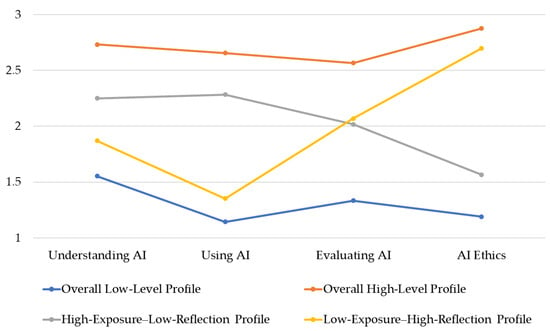
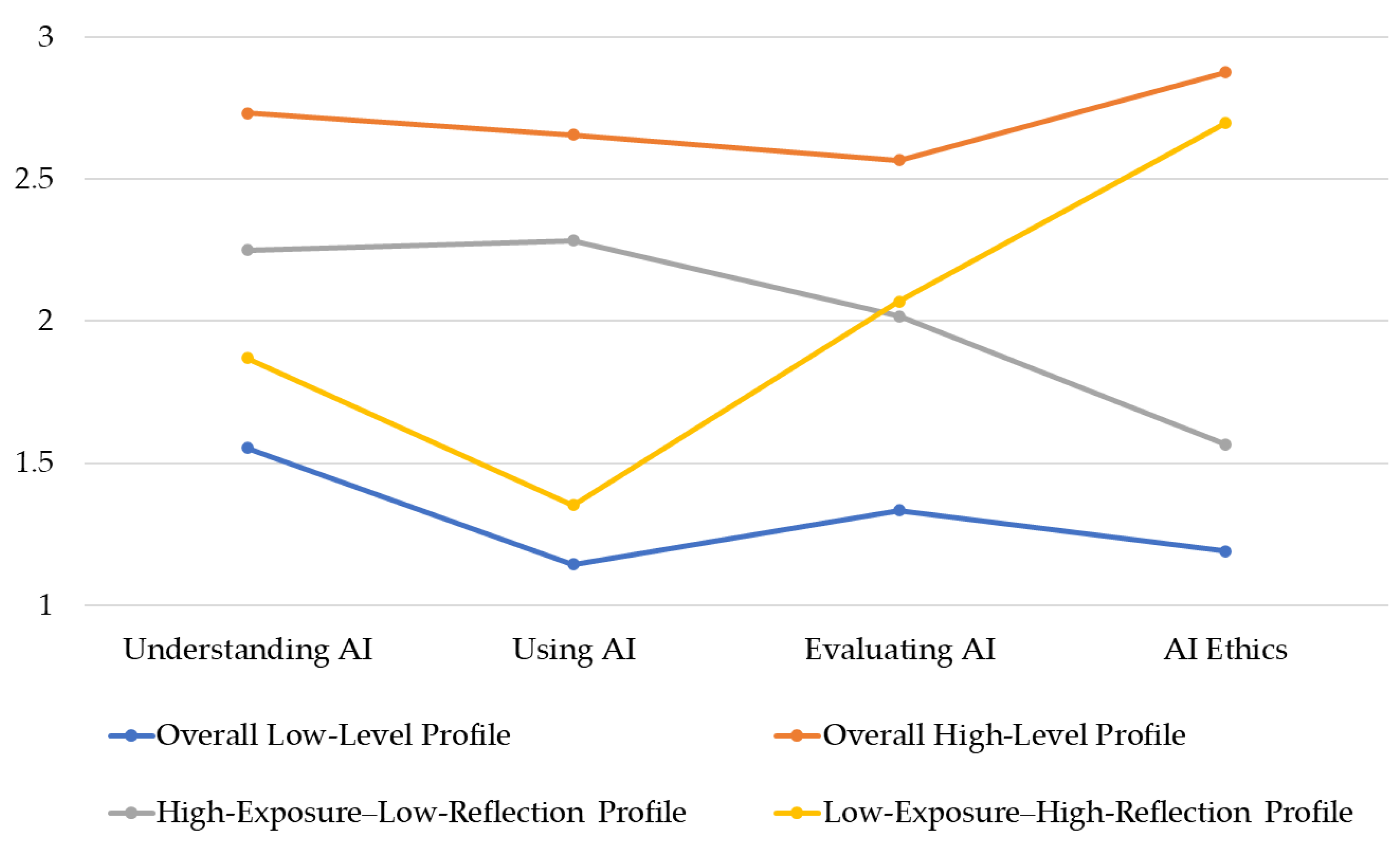
The four-profile solution is shown in Figure 1. The four indicators were understanding AI, using AI, evaluating AI, and AI ethics. Students in the overall low-level profile scored relatively low across all four indicators. In contrast, students in the overall high-level profile scored relatively high across all four indicators.
Figure 1.
Mean scores across the four AI literacy indicators for the four-profile solution (n = 140,130).
Students in the high-exposure–low-reflection profile scored relatively high on understanding AI and using AI but lower on AI ethics. These students reported relatively greater AI exposure and use but weaker awareness of AI-related risks and ethical issues. Students in the low-exposure–high-reflection profile scored relatively low on understanding AI and using AI but relatively high on evaluating AI and AI ethics. These students reported relatively lower AI exposure and use but stronger evaluation and ethical awareness. Overall, the four profiles reflected both differences in the general level of AI literacy and differences in how the four dimensions were combined. Because the profiles were based on self-reported indicators, the profile labels should be understood as descriptive summaries of the observed response patterns rather than as objective classifications of students’ actual AI competence or exposure.
3.5.3. Differences Across Profiles
The demographic characteristics of the four profiles are presented in Table 6. Gender, grade level, place of residence, and family socioeconomic status differed significantly across profiles. Boys were relatively more common in the overall low-level and overall high-level profiles, whereas girls were relatively more common in the high-exposure–low-reflection and low-exposure–high-reflection profiles. However, the association between gender and profile membership was small. Grade-level differences were also significant but small. Grade 11 students were relatively more common in the overall high-level and high-exposure–low-reflection profiles. Differences in place of residence and family socioeconomic status were more noticeable. The overall high-level profile included relatively more urban students and students from higher-SES families, whereas the overall low-level profile included relatively more rural students and students from lower-SES families.
Table 6.
Demographic characteristics across AI literacy profiles.
Differences in the other study variables are presented in Table 7. Students in the overall high-level profile had relatively higher academic achievement, more discretionary time, longer physical activity duration, better physical activity habits, better online gaming habits, and more learning- or efficiency-oriented mobile phone use. Students in the overall low-level profile had relatively lower academic achievement and physical activity levels and spent more time on online gaming. Students in the high-exposure–low-reflection profile spent relatively more time on online gaming and mobile phone use and reported shorter sleep duration. In contrast, students in the low-exposure–high-reflection profile spent relatively less time on online gaming and mobile phone use.
Table 7.
Academic achievement and other study variables across AI literacy profiles.
4. Discussion
4.1. Developmental and Contextual Patterns of AI Literacy
The present study found clear grade-related and contextual differences in K–12 students’ AI literacy. Students in the upper grades reported higher AI literacy than those in the lower grades. Urban students also scored higher than rural students. Students from families with higher socioeconomic status reported higher AI literacy than those from less advantaged families. In contrast, gender differences were small and varied across grade levels. These findings suggest that AI literacy is related not only to students’ educational stage but also to the social and educational contexts in which they learn and use technology.
Students in the upper grades reported higher AI literacy, which may be related to their greater learning experience and broader exposure to digital technologies. As students move through school, they encounter more complex academic content. They also develop stronger skills in information comprehension, abstract reasoning, problem-solving, and independent learning. These skills may help students understand how AI works, recognize its applications, and evaluate AI-generated information. Students in the upper grades may also have more opportunities to encounter search algorithms, recommendation systems, generative AI tools, and other AI-related technologies in school and daily life. Longitudinal research on adolescents’ ICT competence has shown that digital skills change across adolescence and are shaped by individual and contextual factors, including family background and gender (Gnambs, 2021). The present findings follow this broader pattern and suggest that AI literacy, as a newer form of digital competence, also differs across stages of K–12 education.
The study also found a consistent urban–rural difference across all three grades. This pattern may be related to differences in students’ access to digital resources and opportunities to use technology in meaningful ways. Previous research has indicated that urban–rural digital inequalities extend beyond access to devices and internet infrastructure. These inequalities also appear in students’ digital skills, engagement in technology-supported learning, and educational outcomes related to technology use (Zhao et al., 2022). Urban students may have better access to stable digital environments, technology-related courses, extracurricular learning resources, and support from teachers or family members. These resources may give students more opportunities to recognize AI applications, learn related knowledge, and gain experience in using and evaluating AI technologies. The urban–rural difference found in this study may therefore reflect differences in the quality and educational value of students’ digital opportunities.
Family socioeconomic status also showed a consistent relationship with AI literacy. Across all three grades, students from higher-SES families reported higher AI literacy than students from lower-SES families. This finding suggests that family resources may still play an important role in emerging digital competence. Families with greater socioeconomic resources are often better able to provide digital devices, reliable internet access, learning materials, technical support, and opportunities to take part in technology-related activities. Previous research indicates that students with richer family resources tend to have greater access to digital devices, learning support, and AI-related exposure opportunities, which may contribute to better performance across the cognitive, usage, evaluative, and ethical dimensions of AI literacy (Koch et al., 2024; Zhang et al., 2026). From the perspective of family cultural capital, cultural resources, everyday cultural practices, and active parental mediation can significantly predict adolescents’ digital skill levels and patterns of digital media use (Ren et al., 2022). Studies using performance-based assessments of ICT competence have also found that students from more advantaged family backgrounds tend to perform better in digital information processing and higher-order ICT competencies (Aesaert & van Braak, 2015). Socioeconomic differences in AI literacy may therefore be related to several factors, including material resources, learning opportunities, parental support, and technology-related experiences. The present findings add to previous evidence on digital inequality by showing that family background is also related to students’ understanding, use, evaluation, and ethical awareness of AI.
Gender differences were relatively small and did not show a consistent pattern across grade levels. Grade 6 boys reported slightly higher AI literacy than girls, whereas Grade 11 girls reported slightly higher AI literacy than boys. No significant gender difference was found in Grade 9. The direction of the gender difference therefore changed across grades, and the size of the difference remained small. These results suggest that gender alone may not provide a stable explanation for differences in students’ overall AI literacy. This finding is generally consistent with previous research, which indicates that gender differences in digital competence are not stable or uniform. Instead, these differences may change across age groups, learning experiences, and socialization processes, and they may also be shaped by family background and school environment (Wicht & Kleinert, 2025). Gender differences in AI literacy may therefore be better understood as context-dependent rather than as evidence of a fixed advantage for boys or girls.
4.2. Factors Associated with AI Literacy
After controlling for gender, grade level, and place of residence, family socioeconomic status, academic achievement, discretionary time, sleep duration, physical activity duration, physical activity habit, online gaming habit, and mobile phone usage pattern were positively associated with students’ AI literacy. Among these variables, physical activity habit showed the largest standardized association. Mobile phone usage pattern, family socioeconomic status, academic achievement, and physical activity duration also showed relatively strong associations. In contrast, online gaming time and mobile phone use time were not independently associated with AI literacy when the other variables were included in the model. These findings suggest that AI literacy is related to family resources, academic foundations, daily routines, and the ways students use digital technologies.
Family socioeconomic status remained positively associated with AI literacy after the other variables were taken into account. This finding suggests that family resources remain an important part of students’ digital learning environment. Families with higher socioeconomic status are generally better able to provide digital devices, reliable internet access, learning materials, and technical support. These families may also provide more opportunities for students to encounter AI-related information and use AI technologies for learning. Previous research has also found that socioeconomic status is significantly associated with adolescents’ digital maturity, with active parental mediation playing an important role in this relationship (Koch et al., 2024). The present findings suggest that differences in the family digital environment may affect not only students’ access to technology but also their opportunities to understand, evaluate, and use AI.
Academic achievement was also positively associated with AI literacy. Understanding AI applications and evaluating AI-generated information require more than knowing how to use particular tools. These activities also require reading comprehension, information processing, logical reasoning, problem solving, and critical judgment. Students with stronger academic foundations may therefore be better prepared to understand AI-related concepts. They may also be better able to recognize how AI is used in different contexts and judge the reliability of AI-generated information. Previous studies have shown a significant positive relationship between ICT literacy and academic achievement, with higher ICT literacy generally associated with better academic performance (Lei et al., 2021). Digital literacy has also been found to be moderately and positively associated with academic achievement (Li et al., 2025). The present results are consistent with this evidence. AI literacy and academic learning may depend partly on some of the same cognitive and learning skills. These skills may also help students locate, understand, and evaluate information in technology-rich learning environments.
Discretionary time, sleep duration, and physical activity were also associated with AI literacy, although the strength of these associations differed. Discretionary time may give students more opportunities to explore new technologies, use digital learning resources, and learn outside the classroom. Sleep duration showed a smaller but positive association with AI literacy. Adequate sleep may support attention, memory, and learning efficiency. These abilities are important when students learn and apply new knowledge. Previous systematic reviews and meta-analyses have indicated that sleep quality is related to students’ academic performance, and that insufficient sleep may affect students’ cognitive functioning and learning outcomes (Musshafen et al., 2021). These findings suggest that students’ opportunities to learn about AI may depend not only on access to technology but also on the conditions that support learning.
Physical activity habit showed the largest standardized association with AI literacy among the study variables. This result does not mean that physical activity directly increases AI literacy. A stable physical activity habit may instead reflect other characteristics, such as self-regulation, persistence, regular daily routines, and active participation in school life. Students who maintain regular physical activity may also manage their time more effectively and stay more engaged in learning. These students may also be more willing to explore new areas of knowledge. Physical activity duration was also positively associated with AI literacy, but its association was weaker than that of physical activity habit. This difference suggests that regular and stable behavior may be more closely related to AI literacy than the amount of time spent on the activity alone.
A similar pattern appeared in students’ digital media use. Mobile phone usage pattern and online gaming habit were positively associated with AI literacy. In contrast, mobile phone use time and online gaming time were not independently associated with AI literacy. In this study, a higher mobile phone usage pattern score represented phone use that focused more on learning support or improving efficiency. This type of use may expose students to intelligent search, recommendation, information-processing, and learning-support applications. These applications may give students more opportunities to recognize and interact with AI technologies. A higher online gaming habit score represented more reasonable and controlled gaming behavior. Its positive association with AI literacy may therefore reflect students’ ability to manage their digital activities rather than a direct benefit of online gaming. These findings suggest that the role of digital media cannot be understood simply by looking at how much time students spend on mobile phones or online games. Students’ purposes for using digital technologies and their ability to manage their behavior may be more closely related to AI literacy than total usage time. This interpretation is consistent with previous research showing that educational use tends to have positive effects, whereas recreational or problematic use may have negative effects (F. Wang et al., 2024; Paterna et al., 2024). Overall, these findings suggest that AI literacy is associated with family resources, academic foundations, daily routines, and the ways students use digital technologies.
4.3. Profile-Based Patterns of AI Literacy
The latent profile analysis identified four AI literacy profiles: the overall low-level profile, the overall high-level profile, the high-exposure–low-reflection profile, and the low-exposure–high-reflection profile. These profiles show that students’ AI literacy cannot be fully described by a single overall score. Some students showed consistently high or low levels across all four indicators. Other students showed uneven patterns across understanding AI, using AI, evaluating AI, and AI ethics. In particular, the two uneven profiles show that AI exposure and use do not always develop at the same pace as evaluation and ethical awareness. The person-centered approach therefore provides information that cannot be seen from an overall score alone.
This finding is consistent with related research on digital literacy. Previous studies using latent profile analysis have found that adolescents’ digital skills do not develop in the same way. Instead, students may show different patterns in information processing, content creation, communication and interaction, and technical operation (Hietajärvi et al., 2025). The present study shows a similar pattern in AI literacy. Students differ not only in their overall level of AI literacy but also in how their knowledge, practical experience, evaluation, and ethical awareness are combined. This difference is important because students with similar overall scores may still have different strengths and learning needs.
The overall low-level and overall high-level profiles mainly reflected general differences in AI literacy. Students in the overall low-level profile reported relatively low levels of AI understanding, use, evaluation, and ethical awareness. These students were also more likely to come from rural and lower-SES backgrounds. They also showed relatively lower academic achievement and physical activity levels. In contrast, students in the overall high-level profile scored relatively high across all four AI literacy indicators. These students were more likely to come from urban and higher-SES backgrounds. They also had higher academic achievement, more discretionary time, better physical activity patterns, and more learning- or efficiency-oriented mobile phone use. These patterns suggest that balanced AI literacy is related to students’ educational resources, academic foundations, and daily experiences.
Students in the overall low-level profile showed limited development across all four indicators rather than weakness in only one area. These students may need more opportunities to become familiar with common AI applications and build basic AI knowledge through clear and accessible learning activities. Previous research has suggested that AI literacy education for upper primary school students should align with their developmental characteristics. Age-appropriate teaching should guide students in algorithmic reasoning and ethical reflection rather than introduce complex technical principles too early (Thianwan & Srikoon, 2026). Students in the overall high-level profile may need different learning opportunities. Their learning can move beyond basic AI recognition and tool use. Previous research has suggested that AI literacy education should move beyond tool-use training and emphasize students’ comprehensive understanding of AI systems, social impacts, and human–AI relationships (Yim, 2024).
The high-exposure–low-reflection profile showed a clear imbalance. Students in this profile reported relatively high levels of AI understanding and use but weaker ethical awareness and reflection. They also spent relatively more time on online gaming and mobile phone use and reported shorter sleep duration than some other profiles. This pattern suggests that frequent use of digital technologies may increase students’ familiarity with AI-related applications. However, frequent use may not automatically help students evaluate AI outputs or recognize ethical concerns. AI access and practical experience alone therefore do not represent well-developed AI literacy.
This issue is especially important in the context of generative AI and recommendation-based digital environments. Students may quickly learn to use AI tools, search for information, generate content, and interact with recommendation systems. However, they may still have difficulty identifying inaccurate information, algorithmic bias, privacy risks, and responsibility issues. Related research has emphasized that children and adolescents need to develop critical AI literacy. Students should not only be able to use AI but should also question, evaluate, and reflect on its social, cultural, and ethical implications (Veldhuis et al., 2025). Research has also suggested that AI ethics education in K–12 settings remains insufficient and that responsible AI literacy should be integrated into different areas of AI learning (Ma et al., 2025). Schools should therefore give students in the high-exposure–low-reflection profile more opportunities to practice AI output evaluation, information checking, privacy protection, and responsible AI use.
The low-exposure–high-reflection profile showed the opposite pattern. Students in this profile reported relatively low levels of AI understanding and use but stronger evaluation and ethical awareness. They also reported less time spent on online gaming and mobile phone use than students in the high-exposure–low-reflection profile. One possible interpretation is that evaluation and ethical awareness can develop even when students report relatively limited experience with AI. These students may have developed a general awareness of technology-related risks, rules, and responsibilities through school education, family guidance, or other digital citizenship experiences. However, this pattern may also partly reflect differences in self-evaluation. Students with greater knowledge of AI may evaluate their own understanding more conservatively because they are more aware of the complexity and limitations of AI technologies. Therefore, the “low-exposure–high-reflection” label should be interpreted as a description of the observed self-report pattern rather than as evidence that these students objectively have limited AI exposure or understanding.
These students may benefit from more practical opportunities to connect their existing awareness with AI understanding and use. Ethics education may also be more meaningful when students examine ethical issues through concrete cases and activities rather than only learning abstract rules. Research on AI ethics education has emphasized that ethics learning should go beyond conceptual instruction. Case analysis, project-based practice, and collaborative inquiry can support students’ ethical reasoning in real-world contexts (Wiese et al., 2025). Guided practice may therefore help students in the low-exposure–high-reflection profile test their judgments, understand how AI systems work, and apply ethical ideas during actual AI use.
4.4. Implications for K–12 AI Literacy Education
The findings of this study have several implications for K–12 AI literacy education. AI literacy education should follow a clear and gradual learning sequence. Younger students can begin by identifying common AI applications in daily life and learning what AI can and cannot do. Older students can gradually learn about data, algorithms, machine learning, generative AI, and human–AI collaboration. Previous reviews of K–12 AI education have shown that current AI education mainly covers basic AI concepts, types of AI, AI applications, and ethical issues. These reviews have also shown that well-designed AI curricula can improve students’ AI knowledge, problem-solving abilities, and ethical reflection (Lee & Kwon, 2024). Comprehensive reviews have further suggested that K–12 AI education should not focus only on technical tools. It should also support students’ broader understanding of AI systems, learning processes, and social impacts (R. Huang et al., 2026).
The urban–rural and socioeconomic differences found in this study also point to the need for fairer learning opportunities. Schools can provide shared learning resources, accessible AI tools, practical activities, and teacher support. These forms of support may be especially important for students in rural areas and students from lower-SES families. Related research has noted that K–12 AI education should consider possible differences in curriculum implementation across schools, regions, and resource settings (Martin et al., 2024). Shared teaching materials, cooperation between schools, and teacher learning communities may help reduce these differences.
AI literacy may also be easier to develop when students learn through familiar and real-life situations. Previous research has found that digital storytelling can help primary school students apply AI knowledge in real situations, propose AI-based solutions, and develop AI understanding beyond the conceptual level (Ng et al., 2022). Research on machine learning education for secondary school students has also shown that students can develop an understanding of machine learning concepts, ethical issues, and social impacts through well-designed learning activities, even when they have no prior knowledge (Sanusi et al., 2023). Classroom activities can therefore use technologies that students already encounter in daily life. These technologies may include recommendation systems, image recognition, voice assistants, generative AI tools, and intelligent learning applications.
Evaluation and ethics should be included throughout AI learning rather than taught as separate or additional topics. The high-exposure–low-reflection profile found in this study shows that frequent use of AI tools does not always come with the ability to judge AI-generated information or recognize problems related to bias, privacy, and responsibility. Previous classroom-based research has found that current K–12 AI instruction provides limited support for higher-order abilities. It gives relatively little attention to evaluation, creation, and ethical issues (Wu et al., 2024). Children should therefore be encouraged not only to use AI but also to understand it, question it, and take part responsibly in an AI-influenced society (Ali et al., 2021).
AI literacy assessment should examine whether students can explain how AI systems work, evaluate AI-generated outputs, identify possible bias, and make responsible decisions about AI use. Research on AI literacy assessment has highlighted the importance of high-quality measurement tools for understanding and supporting the development of AI literacy (Lintner, 2024). Data-related concepts are also an important foundation for understanding how AI systems work because AI systems depend closely on data collection, processing, and engineering (Olari & Romeike, 2024). School-based assessment may therefore combine knowledge questions with performance tasks, project work, situational judgment activities, and ethical case analysis.
4.5. Limitations and Future Research
This study has several limitations. First, the AI literacy measure included only four self-report items, with one item representing each aspect, and used a three-point response scale. These items provide broad indicators rather than complete measures of AI understanding, use, evaluation, and ethical awareness. The limited item coverage and self-reported nature of the measures may have affected measurement precision and the profiles identified by latent profile analysis. The profile labels should therefore be interpreted as descriptions of self-reported response patterns rather than objective classifications of AI competence. Future studies should use multi-item measures, consider more response options, and combine self-reports with performance-based assessments to examine whether similar profiles can be replicated.
Second, some methodological limitations should be considered. Second, some methodological limitations should be considered. Because this study used a cross-sectional design, it cannot establish causal relationships. The analyses also did not account for clustering within schools or classes because the required identifiers were unavailable. In addition, some missing values remained after data screening and were handled using available-case analysis. These methodological limitations may have affected the estimates or standard errors. Future studies should use longitudinal designs, account for school- and class-level clustering through multilevel models or cluster-robust standard errors, and apply appropriate missing-data methods when relevant information is available.
Third, the participants were recruited from one city in Northeast China and included students in Grades 6, 9, and 11 rather than the entire K–12 population. The findings may therefore not generalize to other regions or grade levels. Future studies should include samples from multiple regions and a wider range of grade levels to examine the generalizability of the findings.
5. Conclusions
This study examined developmental, contextual, and profile-based differences in AI literacy among K–12 students. Students in the upper grades reported higher AI literacy than those in the lower grades. Urban students and students from families with higher socioeconomic status also reported higher levels of AI literacy, while gender differences were small and varied across grades. AI literacy was positively associated with family socioeconomic status, academic achievement, discretionary time, sleep duration, physical activity, online gaming habit, and mobile phone usage pattern. In contrast, online gaming time and mobile phone use time were not independently associated with AI literacy when the other variables were considered. The latent profile analysis identified four profiles: the overall low-level profile, overall high-level profile, high-exposure–low-reflection profile, and low-exposure–high-reflection profile. These profiles show that students can differ not only in their overall level of AI literacy but also in the patterns of AI understanding, use, evaluation, and ethical awareness. Overall, the findings suggest that K–12 AI literacy education should consider students’ developmental stages, family and regional backgrounds, and different AI literacy profiles. Schools may provide more targeted learning opportunities and support the balanced development of AI understanding, use, evaluation, and ethical awareness.
Supplementary Materials
The following supporting information can be downloaded at: https://www.mdpi.com/article/10.3390/bs16112017/s1, Table S1: Original Chinese Items and English Translations of the AI Literacy Measure. The original questionnaire was administered in Chinese. The English translations are provided for readers’ reference.
Author Contributions
Conceptualization, X.G.; methodology, X.G.; validation, H.N.; formal analysis, H.N.; investigation, Y.Y.; data curation, Y.Y.; writing—original draft preparation, H.N.; writing—review and editing, H.N. All authors have read and agreed to the published version of the manuscript.
Funding
This research was funded by the Jilin Provincial Philosophy and Social Science Planning Fund Office under the 2024 Doctoral and Young Scholar Support Project of the Jilin Provincial Social Science Fund (grant number 2024C85).
Institutional Review Board Statement
This study was rigorously reviewed and approved by the Ethics Review and Research Committee of the School of Psychology, Northeast Normal University (202401055). The study was conducted in accordance with the Declaration of Helsinki (as revised in 2013).
Informed Consent Statement
Informed consent was obtained from all subjects involved in the study. Participants were guaranteed confidentiality, and their information would only be used for research purposes.
Data Availability Statement
The data that support the findings of this study are available from the corresponding author upon reasonable request.
Acknowledgments
We sincerely thank all the participants who generously supported this study.
Conflicts of Interest
The authors declare no conflicts of interest.
References
- Adelantado-Renau, M., Moliner-Urdiales, D., Cavero-Redondo, I., Beltran-Valls, M. R., Martínez-Vizcaíno, V., & Álvarez-Bueno, C. (2019). Association between screen media use and academic performance among children and adolescents: A systematic review and meta-analysis. JAMA Pediatrics, 173(11), 1058–1067. [Google Scholar] [CrossRef] [Scilit] [PubMed]
- Aesaert, K., & van Braak, J. (2015). Gender and socioeconomic related differences in performance based ICT competences. Computers & Education, 84, 8–25. [Google Scholar] [CrossRef] [Scilit]
- Ali, S., DiPaola, D., Lee, I., Sindato, V., Kim, G., Blumofe, R., & Breazeal, C. (2021). Children as creators, thinkers and citizens in an AI-driven future. Computers and Education: Artificial Intelligence, 2, 100040. [Google Scholar] [CrossRef] [Scilit]
- Casal-Otero, L., Catala, A., Fernández-Morante, C., Taboada, M., Cebreiro, B., & Barro, S. (2023). AI literacy in K–12: A systematic literature review. International Journal of STEM Education, 10, 29. [Google Scholar] [CrossRef] [Scilit]
- Chiao, C., & Chiu, C.-H. (2018). The mediating effect of ICT usage on the relationship between students’ socioeconomic status and achievement. The Asia-Pacific Education Researcher, 27, 109–121. [Google Scholar] [CrossRef] [Scilit]
- Chun, Z., Ning, Y., Chen, J., & Wijaya, T. T. (2025). Exploring the interplay among artificial intelligence literacy, creativity, self-efficacy, and academic achievement in college students: Findings from PLS-SEM and FsQCA. Education and Information Technologies, 30(15), 21283–21316. [Google Scholar] [CrossRef] [Scilit]
- Faught, E. L., Ekwaru, J. P., Gleddie, D., Storey, K. E., Asbridge, M., & Veugelers, P. J. (2017). The combined impact of diet, physical activity, sleep and screen time on academic achievement: A prospective study of elementary school students in Nova Scotia, Canada. International Journal of Behavioral Nutrition and Physical Activity, 14, 29. [Google Scholar] [CrossRef] [Scilit] [PubMed]
- Gnambs, T. (2021). The development of gender differences in information and communication technology (ICT) literacy in middle adolescence. Computers in Human Behavior, 114, 106533. [Google Scholar] [CrossRef] [Scilit]
- Gonçalves, J. P., Ferreira, G., Lopes, L., Sousa-Sá, E., & Santos, R. (2025). Associations between movement behaviors, cognition, and academic achievement in children and adolescents: A systematic review. Journal of Physical Activity and Health, 22(3), 285–306. [Google Scholar] [CrossRef] [Scilit] [PubMed]
- Gong, Y., Wang, M., He, L., Xu, C., & Yu, Y. (2026). Asking, playing, learning: Investigating large language model-based scaffolding in digital game-based learning for elementary artificial intelligence education. Journal of Educational Computing Research, 64(2), 311–343. [Google Scholar] [CrossRef] [Scilit]
- Guan, Y., Zhang, C., He, H., Zhang, W., Hu, Z., Bi, T., & Jin, X. (2025). AI literacy predicts computational thinking through multidimensional interactions among Chinese high school students. Scientific Reports, 15, 33092. [Google Scholar] [CrossRef] [Scilit] [PubMed]
- Hietajärvi, L., Mascheroni, G., Waechter, N., Järvinen, J., & Salmela-Aro, K. (2025). Latent profiles of adolescents’ digital skills across six European countries. New Media & Society, 27(11), 5915–5937. [Google Scholar] [CrossRef] [Scilit]
- Hsu, T.-P., & Hsu, T.-C. (2024, November 25–29). Iterative problem solving in the integration of design thinking and game-based learning into enhancing computational thinking and AI literacy [Conference paper]. 32nd International Conference on Computers in Education, Quezon City, Philippines. [Google Scholar] [CrossRef] [Scilit]
- Huang, R., Yin, Y., Zhou, N., & Lang, F. (2026). Artificial intelligence in K–12 education: An umbrella review. Computers and Education: Artificial Intelligence, 10, 100519. [Google Scholar] [CrossRef] [Scilit]
- Huang, S.-H., & Hsu, T.-C. (2024, November 25–29). Learning effectiveness and reflections on AI literacy in junior high school students with game-based learning and problem-based learning [Conference paper]. 32nd International Conference on Computers in Education, Quezon City, Philippines. [Google Scholar] [CrossRef] [Scilit]
- Koch, T., Laaber, F., & Florack, A. (2024). Socioeconomic status and young people’s digital maturity: The role of parental mediation. Computers in Human Behavior, 154, 108157. [Google Scholar] [CrossRef] [Scilit]
- Lee, S. J., & Kwon, K. (2024). A systematic review of AI education in K-12 classrooms from 2018 to 2023: Topics, strategies, and learning outcomes. Computers and Education: Artificial Intelligence, 6, 100211. [Google Scholar] [CrossRef] [Scilit]
- Lei, H., Xiong, Y., Chiu, M. M., Zhang, J., & Cai, Z. (2021). The relationship between ICT literacy and academic achievement among students: A meta-analysis. Children and Youth Services Review, 127, 106123. [Google Scholar] [CrossRef] [Scilit]
- Li, F., Cheng, L., Wang, X., Shen, L., Ma, Y., & Islam, A. Y. M. A. (2025). The causal relationship between digital literacy and students’ academic achievement: A meta-analysis. Humanities and Social Sciences Communications, 12, 108. [Google Scholar] [CrossRef] [Scilit]
- Lintner, T. (2024). A systematic review of AI literacy scales. npj Science of Learning, 9, 50. [Google Scholar] [CrossRef] [Scilit] [PubMed]
- Long, D., & Magerko, B. (2020). What is AI literacy? Competencies and design considerations. In Proceedings of the 2020 CHI conference on human factors in computing systems (pp. 1–16). Association for Computing Machinery. [Google Scholar] [CrossRef] [Scilit]
- Ma, M., Ng, D. T. K., Liu, Z., & Wong, G. K. W. (2025). Fostering responsible AI literacy: A systematic review of K–12 AI ethics education. Computers and Education: Artificial Intelligence, 8, 100422. [Google Scholar] [CrossRef] [Scilit]
- Marciano, L., & Camerini, A.-L. (2021). Recommendations on screen time, sleep and physical activity: Associations with academic achievement in Swiss adolescents. Public Health, 198, 211–217. [Google Scholar] [CrossRef] [Scilit] [PubMed]
- Martin, F., Zhuang, M., & Schaefer, D. (2024). Systematic review of research on artificial intelligence in K–12 education (2017–2022). Computers and Education: Artificial Intelligence, 6, 100195. [Google Scholar] [CrossRef] [Scilit]
- Musshafen, L. A., Tyrone, R. S., Abdelaziz, A., Sims-Gomillia, C. E., Pongetti, L. S., Teng, F., Fletcher, L. M., & Reneker, J. C. (2021). Associations between sleep and academic performance in US adolescents: A systematic review and meta-analysis. Sleep Medicine, 83, 71–82. [Google Scholar] [CrossRef] [Scilit] [PubMed]
- Ng, D. T. K., Leung, J. K. L., Chu, S. K. W., & Qiao, M. S. (2021). Conceptualizing AI literacy: An exploratory review. Computers and Education: Artificial Intelligence, 2, 100041. [Google Scholar] [CrossRef] [Scilit]
- Ng, D. T. K., Luo, W., Chan, H. M. Y., & Chu, S. K. W. (2022). Using digital story writing as a pedagogy to develop AI literacy among primary students. Computers and Education: Artificial Intelligence, 3, 100054. [Google Scholar] [CrossRef] [Scilit]
- Ni, J., Cheng, M., Zhang, R., & Wang, Y. (2025). Meta-analysis of a moderate-to-vigorous physical activity intervention for academic achievement in children and adolescents. Physiology & Behavior, 288, 114750. [Google Scholar] [CrossRef] [Scilit] [PubMed]
- Olari, V., & Romeike, R. (2024). Data-related concepts for artificial intelligence education in K–12. Computers and Education Open, 7, 100196. [Google Scholar] [CrossRef] [Scilit]
- Paterna, A., Alcaraz-Ibáñez, M., Aguilar-Parra, J. M., Salavera, C., Demetrovics, Z., & Griffiths, M. D. (2024). Problematic smartphone use and academic achievement: A systematic review and meta-analysis. Journal of Behavioral Addictions, 13(2), 313–326. [Google Scholar] [CrossRef] [Scilit] [PubMed]
- Ren, W., Zhu, X., & Yang, J. (2022). The SES-based difference of adolescents’ digital skills and usages: An explanation from family cultural capital. Computers & Education, 177, 104382. [Google Scholar] [CrossRef] [Scilit]
- Sanusi, I. T., Oyelere, S. S., Vartiainen, H., Suhonen, J., & Tukiainen, M. (2023). Developing middle school students’ understanding of machine learning in an African school. Computers and Education: Artificial Intelligence, 5, 100155. [Google Scholar] [CrossRef] [Scilit]
- Scherer, R., & Siddiq, F. (2019). The relation between students’ socioeconomic status and ICT literacy: Findings from a meta-analysis. Computers & Education, 138, 13–32. [Google Scholar] [CrossRef] [Scilit]
- Shomotova, A., Elsayary, A., & Husain, S. (2026). What shapes students’ AI literacy? Investigating digital competence, student background, and GenAI use in higher education. Education and Information Technologies, 31(2), 387–418. [Google Scholar] [CrossRef] [Scilit]
- Sun, W., Jiang, Z., & Hai, S. (2025). The double-edged sword effect of interaction frequency with AI on college students: The moderating role of peer support. Behavioral Sciences, 15(9), 1267. [Google Scholar] [CrossRef] [Scilit] [PubMed]
- Thianwan, K., & Srikoon, S. (2026). Development of an AI literacy self-assessment questionnaire in upper primary school students. Social Sciences & Humanities Open, 13, 102424. [Google Scholar] [CrossRef] [Scilit]
- Touretzky, D., Gardner-McCune, C., Martin, F., & Seehorn, D. (2019). Envisioning AI for K–12: What should every child know about AI? Proceedings of the AAAI Conference on Artificial Intelligence, 33(01), 9795–9799. [Google Scholar] [CrossRef] [Scilit]
- Veldhuis, A., Lo, P. Y., Kenny, S., & Antle, A. N. (2025). Critical artificial intelligence literacy: A scoping review and framework synthesis. International Journal of Child-Computer Interaction, 43, 100708. [Google Scholar] [CrossRef] [Scilit]
- Wang, F., Ni, X., Zhang, M., & Zhang, J. (2024). Educational digital inequality: A meta-analysis of the relationship between digital device use and academic performance in adolescents. Computers & Education, 213, 105003. [Google Scholar] [CrossRef] [Scilit]
- Wang, Y. (2026). The effect of generative artificial intelligence literacy on academic achievement: The mediating role of academic self-efficacy and the moderating role of critical thinking. Frontiers in Psychology, 17, 1761562. [Google Scholar] [CrossRef] [Scilit] [PubMed]
- Wicht, A., & Kleinert, C. (2025). The development of ICT skills in adolescence at the intersection of gender and family background. Social Science Research, 130, 103202. [Google Scholar] [CrossRef] [Scilit]
- Wiese, L. J., Patil, I., Schiff, D. S., & Magana, A. J. (2025). AI ethics education: A systematic literature review. Computers and Education: Artificial Intelligence, 8, 100405. [Google Scholar] [CrossRef] [Scilit]
- Wu, D., Chen, M., Chen, X., & Liu, X. (2024). Analyzing K–12 AI education: A large language model study of classroom instruction on learning theories, pedagogy, tools, and AI literacy. Computers and Education: Artificial Intelligence, 7, 100295. [Google Scholar] [CrossRef] [Scilit]
- Xiong, X. B., Cao, S., Gao, T., Luo, W., He, H., & Li, H. (2025). AI literacy in Chinese preschoolers: Evidence from scale validation study. Early Education and Development. Advance online publication. [Google Scholar] [CrossRef] [Scilit]
- Yim, I. H. Y. (2024). A critical review of teaching and learning artificial intelligence (AI) literacy: Developing an intelligence-based AI literacy framework for primary school education. Computers and Education: Artificial Intelligence, 7, 100319. [Google Scholar] [CrossRef] [Scilit]
- Zhang, C. X., Rice, R. E., & Wang, L. H. (2026). College students’ literacy, ChatGPT activities, educational outcomes, and trust from a digital divide perspective. New Media & Society, 28(2), 673–695. [Google Scholar] [CrossRef] [Scilit]
- Zhao, L., Cao, C., Li, Y., & Li, Y. (2022). Determinants of the digital outcome divide in E-learning between rural and urban students: Empirical evidence from the COVID-19 pandemic based on capital theory. Computers in Human Behavior, 130, 107177. [Google Scholar] [CrossRef] [Scilit] [PubMed]
- Zhong, B., & Liu, X. (2025). Evaluating AI literacy of secondary students: Framework and scale development. Computers & Education, 227, 105230. [Google Scholar] [CrossRef] [Scilit]

Disclaimer/Publisher’s Note: The statements, opinions and data contained in all publications are solely those of the individual author(s) and contributor(s) and not of MDPI and/or the editor(s). MDPI and/or the editor(s) disclaim responsibility for any injury to people or property resulting from any ideas, methods, instructions or products referred to in the content. |
© 2026 by the authors. Licensee MDPI, Basel, Switzerland. This article is an open access article distributed under the terms and conditions of the Creative Commons Attribution (CC BY) license.