


Abstract
Background: Harsh discipline was associated with problematic media use (PMU) in early childhood. However, few studies have examined the relationship between patterns of maternal harsh discipline and PMU and the underlying mechanism. This study aims to extend previous research by examining the associations among harsh discipline patterns, psychological resilience, and PMU in Chinese preschool children. Methods: Data were collected over a three-wave period spanning approximately two years from 425 preschooler–mother dyads in Wuhu, China. Mothers reported harsh discipline, psychological resilience, and PMU. From a person-centered perspective, latent class analysis was conducted to identify distinct patterns of maternal harsh discipline. PROCESS Model 4 was employed to explore the mediating role of psychological resilience in the relationship between harsh discipline and PMU. Results: Three latent classes of maternal harsh discipline were identified: low group (18.82%), moderate group (51.06%), and high group (30.12%). A statistically significant indirect association between high harsh discipline and PMU through psychological resilience was observed. Preschoolers whose mother was in the high harsh-discipline group tended to exhibit lower psychological resilience and higher problematic media use. Conclusions: Our findings revealed that harsh discipline is heterogeneous and is prospectively associated with preschool children’s problematic media use through psychological resilience, thereby providing valuable guidance for the development of targeted intervention strategies.
1. Background
Harsh discipline refers to coercive acts and hostile emotional reactions caregivers deploy to address children’s misbehavior, among which psychological aggression and physical punishment are the two most common types (Erath et al., 2009; Sheng et al., 2019; M. F. Wang et al., 2016). 73.11% to 88.60% of parents had used psychological aggression and 28.00% to 84.00% had used corporal punishment (Lansford & Deater-Deckard, 2012; M. F. Wang et al., 2016). Prior research has shown that harsh discipline is associated with a range of emotional and behavioral problems that may persist from childhood into adolescence and adulthood (Carr et al., 2013). Harsh discipline can produce a series of adverse consequences, such as depression, anxiety disorders, substance abuse, as well as aggressive and delinquent behaviors in individuals (Dube et al., 2003; Hermenau et al., 2014; Sugaya et al., 2012). Moreover, harsh discipline has been found to result in internalizing problems in children and elevate their susceptibility to media dependence (J. Wang et al., 2023a), as well as problematic media use (D. Wang et al., 2024; S. Li et al., 2018). Psychological resilience may play a mediating role in the relationship between harsh discipline and problematic media use (Qi et al., 2020; J. Wang et al., 2023b; Y. Yang et al., 2024). However, few studies have examined the association of patterns of harsh discipline with problematic media use and the underlying mechanism in preschool children.
1.1. Harsh Discipline and Problematic Media Use
In China, over 70% and 80% of parents had used corporal punishment and psychological aggression, respectively (M. Wang & Liu, 2014). Compared to Western parents, Chinese parents exhibited a higher frequency of harsh discipline (H. Wang et al., 2024). Moreover, harsh discipline is frequently seen as a sign of parental love and responsibility as well as a way to help kids achieve their academic, moral, and social objectives rather than abuse in China (Hou et al., 2011). In Chinese culture, profoundly held convictions—reflected in proverbs like “the finest diamond must be cut” and “spare the rod, spoil the child”—view verbal aggression and physical punishment as a requisite means of helping children succeed, while mistakenly framing these behaviors as gestures of care (J. Liu et al., 2021). Mothers, as primary caregivers, bear the brunt of daily disciplinary encounters and mounting parenting stress (Fang et al., 2012). When the primary caregiver, who should serve as a secure base, becomes a source of threat, the child experiences a rupture in felt security (Ainsworth, 1979). Because young children lack mature cognitive reappraisal skills, they are unable to effectively dissociate harsh discipline from parental love, which amplifies emotional harm (Zhai et al., 2021; J. J. Zhu et al., 2018). According to social-ecological theory, adverse childhood surroundings and traumatic incidents, coupled with caregivers’ inherent attributes and behavioral functioning, negatively shape individuals’ development from early childhood through later life (Bronfenbrenner, 1979; Choi & Becher, 2019). For example, few studies have confirmed that harsh discipline could significantly and positively predict the degree of problematic media use (Qi et al., 2020). Problematic media use characterizes an individual’s excessive reliance on media content that extends beyond their typical demands for pleasure and education, showing up as obsessive behavior that compromises their social and psychological well-being (Starcevic & Aboujaoude, 2017). Langer et al. (2014) and Emond et al. (2024) found that harsh discipline has been linked to excessive screen time in young children, which may lead to PMU. Additionally, Swit et al. (2023) found that parental harsh criticism, which is narrower than harsh discipline but captures its hostile emotional reaction component (i.e., psychological aggression), predicted PMU symptoms in preschoolers.
Most previous studies have adopted a variable-centered approach to linking harsh discipline with problematic media use (PMU), for example, by calculating cumulative harsh discipline scores (Hecker et al., 2016). Variable-centered approaches, however, do not capture individual heterogeneity in how multiple disciplinary practices co-occur within individuals. Latent class analysis (LCA) is a person-centered technique that can be used to examine whether individuals cluster into distinct latent classes on the basis of their response classes. If such classes are empirically supported, they can be interpreted as disciplinary behavior profiles (von Eye & Bogat, 2006). However, few longitudinal studies have examined whether empirically identified profiles of harsh discipline are associated with children’s PMU and its underlying mechanisms among Chinese children and families. In the present study, we use LCA to examine whether distinguishable profiles of maternal harsh discipline—based on dichotomously coded CTSPC items reflecting the occurrence and co-occurrence, rather than the frequency or chronicity, of disciplinary behaviors—emerge and, if so, whether these profiles predict children’s PMU.
1.2. The Mediating Role of Psychological Resilience
Psychological resilience refers to an ability to overcome the detrimental consequences of risk exposure, to effectively deal with traumatic experiences and to avoid unfavorable trajectories linked with risk, and consists of initiative, self-regulation, and attachment (Luthar et al., 2000; Masten, 2001). According to the Interactional Theory of Childhood Problematic Media Use (IT-CPU; Domoff et al., 2020), distal factors such as harsh maternal discipline are early risk factors that increase children’s susceptibility to problematic media use (PMU). These distal factors do not directly cause PMU; rather, they operate in concert with proximal factors to shape the emergence of PMU over time. Within this framework, harsh maternal discipline serves as a distal risk factor, whereas diminished psychological resilience functions as a proximal individual vulnerability.
Evidence indicates that negative parenting styles, including harsh discipline, are associated with lower psychological resilience (Petrowski et al., 2014). According to Ding et al. (2023b), harsh discipline magnifies the threatening attributes and prominence of mistakes, consequently impairing the self-confidence and self-efficacy that underpin psychological resilience. Ogelman (2015) reported that lower psychological resilience in preschoolers is related to mothers who use harsh discipline. Similarly, Al-Yagon et al. (2023) found that preschoolers who experience harsh discipline from their mothers are unable to develop positive external developmental resources or warm and solid maternal connections, which inhibits the development of psychological resilience.
Psychological resilience, as measured by the DECA-P2, comprises three within-child protective factors: initiative, self-regulation, and attachment/relationships. When these proximal resources are depleted, children lack the internal capacity to manage distress adaptively. This deficit may manifest as PMU. The connection between resilience and PMU has been evaluated, revealing a negative relationship between the two variables (Dinc & Topcu, 2021; Öztürk & Kundakçı, 2021; Robertson et al., 2018). Consistent with this view, longitudinal research has shown that better self-regulation skills at 4 years of age predict lower media use at 6 years (Cliff et al., 2018), and toddlers with low self-regulation are more likely to develop behaviors indicative of problematic media use (Radesky et al., 2016). Although studies on older populations have found that individuals may turn to media to relieve psychological strain (Casale et al., 2024; Kardefelt-Winther, 2014b, 2017), direct evidence for this pathway in preschoolers remains limited. Therefore, it is theoretically plausible that psychological resilience mediates the association between maternal harsh discipline and children’s problematic media use.
1.3. The Current Study
The present study is a three-wave design spanning approximately two years from T1 to T3 and a person-centered approach to explore the latent classes of maternal harsh discipline and the influence on problematic media use among Chinese children, and whether psychological resilience plays a mediating role in this relationship. Three questions were examined: (1) Does maternal harsh discipline exhibit distinct latent classes? (2) Do latent classes of maternal harsh discipline have direct effects on children’s PMU? (3) Do latent classes of maternal harsh discipline have indirect effects on children’s PMU via psychological resilience? Given the exploratory nature of the person-centered approach, we did not specify the number or exact configuration of latent classes a priori. If a class characterized by higher harsh discipline emerged, it may be associated with higher PMU and have an indirect association through psychological resilience.
2. Methods
2.1. Participants
We randomly selected 11 kindergartens from Wuhu City, including both rural and urban areas, based on the socioeconomic status and density of children in the area, and recruited their mothers from the selected kindergartens. Within the Chinese traditional culture background, mothers are typically regarded as the children’s primary caregivers (Park & Chesla, 2007). We collected 663 questionnaires from mothers with their 3-year-old children at Time 1 (October 2022). Mothers reported demographic information at Time 1, psychological resilience at Time 2 (October 2023) and children’s problematic media use at Time 3 (October 2024). A total of 238 participants failed to complete all waves of the survey due to reasons including transferring kindergartens and mid-study withdrawal. Among them, 169 had missing data at T2 and 69 had missing data at T3. The final valid sample consisted of 425 questionnaires. There was no significant difference between participants and the lost participants in child sex (χ2(1) = 1.894, p = 0.193) maternal psychological aggression (t = −0.172, p > 0.05) and corporal punishment (t = 0.002, p > 0.05) at time point T1. Using the SPSS 31 program, Little’s MCAR test was utilized to ascertain whether missing data was entirely random. The test confirmed that the missing data followed a random pattern when all measures were taken into account, χ2(75) = 57.11, p = 0.94. Consequently, listwise deletion was applied and a total of 425 mothers (M = 32.92, SD = 3.64) with children (M = 43.11, SD = 3.76) were included in the following data analysis.
The study’s objectives were expressed to the principals of schools and children’s teachers. The parents were given parental consent documents and web-based information. The aims of the study, the procedures to be implemented, and their privilege to discontinue participation at any moment were explained to all parents. Upon receipt of the signed consent documents, a web-based questionnaire hosted on the ‘WenJuanXing’ survey platform was administered. This study was approved by the affiliated university’s ethical committee.
2.2. Measures
2.2.1. Harsh Discipline
Maternal psychological aggression and corporal punishment (T1) were measured using the Chinese version of the Parent–Child Conflict Tactics Scale (CTS-PC) (Straus et al., 1998; Chan, 2008). In the past year, mothers were required to report how frequently these actions were directed towards their kids. There were two subscales used in this study: psychological aggression (5 items, i.e., “yelled, shouted, or screamed at the child”) and corporal punishment (6 items, i.e., “spanked the child on the bottom with your bare hand”). Each item was rated on a 7-point ordinal scale (0 = never, 6 = more than 20 times) to estimate the frequency of corporal punishment and psychological aggression, following L. Liu and Wang (2018). Each of the 11 binary items was entered separately as a categorical indicator (0 = no, 1 = yes) into the latent class analysis (Yoon et al., 2021). These items comprised six corporal punishment items and five psychological aggression items. The resulting latent classes therefore reflect differences in the probability and configuration of endorsed harsh-discipline behaviors. Cronbach’s alpha for the two subscales was 0.64 and 0.71. This lower Cronbach’s alpha (α = 0.64) likely reflects the highly skewed and unequally spaced ordinal response categories rather than poor measurement quality. Because the LCA treated each item as an independent indicator and did not assume the subscale was unidimensional or rely on a summed score, the relatively low alpha did not undermine the classification process.
2.2.2. Psychological Resilience
The Devereux Early Childhood Assessment for Preschoolers, Second Edition (DECA-P2; LeBuffe & Naglieri, 2012) was used to measure preschoolers’ psychological resilience (T2). This tool provides a comprehensive evaluation of children’s protective factors and behavioral concerns, and has been widely applied in Chinese preschool samples (N. Yang et al., 2021). It comprises four subscales: Initiative (9 items, e.g., “keep trying when unsuccessful”, Self-Regulation (9 items, e.g., “handle disappointment well”), Behavioral Concerns (11 items, e.g., “seem depressed or unemotional in a happy situation”), and Attachment/Relationships (9 items, e.g., “looking for support from children/adults when necessary”). The three protective-factor subscales (Initiative, Self-Regulation, and Attachment/Relationships) constitute the Total Protective Factors (TPF) score, which serves as an index of psychological resilience. The Behavioral Concerns subscale assesses emotional and behavioral difficulties and is not part of the TPF score (Zhang et al., 2021). Therefore, in this study, psychological resilience was operationalized as the total score of the three protective factor subscales: Initiative, Self-Regulation, and Attachment/Relationships. Raw scores were converted to T-scores based on the manual, with higher protective factor T-scores indicating greater resilience. Mothers reported on each item using a 5-point Likert scale ranging from 0 (never) to 4 (always). The parent-reported DECA-P2 has demonstrated good reliability and validity in Chinese children (Ding et al., 2023a). In the current sample, Cronbach’s alpha for the protective factor subscales was 0.94.
2.2.3. Problematic Media Use
The short version of the problematic media use measure (PMUM) was used (Domoff et al., 2019) to test children’s PMU (T3). The short version of the PMUM includes 9 items. Mothers responded using a 5-point Likert scale ranging from 1 (never) to 5 (always) according to their child’s behavior in the past month. The total PMUM score was generated by adding scores from the items and dividing them by 9. Higher scores indicate higher levels of PMU. The short version of the PMU has been widely used among Chinese preschool samples, and has shown good validity and reliability (J. Li et al., 2024). Cronbach’s α was 0.92 in this study.
2.3. Data Analysis
All analyses were performed using SPSS 31 and Mplus 8.6. First, Pearson correlation analysis was performed to show the correlations between the main variables. Second, latent class analysis (LCA) was conducted to identify distinct patterns of maternal harsh discipline. Following standard LCA procedures (Collins & Lanza, 2009), model fit was assessed using the AIC, BIC, aBIC, entropy, LMR-LRT, and BLRT, with lower information criteria and significant LMR/BLRT, p-values indicating better fit (Asparouhov & Muthén, 2014). Participants were assigned to latent classes based on their highest posterior membership probability. Third, the PROCESS Model 4 was used to test whether psychological resilience mediated the association between the latent classes of maternal harsh discipline and children’s problematic media use. Indirect effects were evaluated using 5000 bootstrap samples and 95% bias-corrected confidence intervals; an effect was considered significant if the interval did not include zero. Finally, we conducted a sensitivity analysis in Mplus 8.6 using Bolck-Croon-Hagenaars (BCH) weights, which account for classification uncertainty based on posterior probabilities (Bolck et al., 2004). These weights were incorporated into the mediation model as training variables, with the low harsh-discipline class (Class 3) set as the reference group.
3. Results
3.1. Descriptive Information
Table 1 presents the descriptive statistics and bivariate correlations among the main variables. Pearson correlation analysis shows that psychological aggression was positively and strongly correlated with corporal punishment. Psychological aggression and corporal punishment showed significant positive associations with problematic media use. Psychological resilience was negatively correlated with problematic media use but was not significantly associated with either psychological aggression or corporal punishment.
Table 1.
Descriptive and bivariate correlations among the main variables. (N = 425).
3.2. Latent Class Analysis
Table 2 presents the model fit information for the latent class analysis (LCA) of maternal harsh discipline. Models with 1 to 5 latent classes were estimated. The LMR became non-significant at the 5-class solution (p = 0.093), which served as the stopping criterion for class enumeration (Nylund et al., 2007). The 3-class model yielded the lowest BIC, with ΔBIC = 8.22 relative to the 4-class solution, providing strong evidence in its favor (Raftery, 1995). The best log-likelihood value (−1987.66) was replicated in 95 out of 100 runs with 1000 random starts and 100 final-stage optimizations. Additionally, the 3-class model’s classification quality was good, with average posterior probabilities of 0.909, 0.873, and 0.910 for Classes 1–3 respectively (reported in Table 3). Although the LMR test for the 4-class versus 3-class model was significant (p < 0.001) and the BLRT remained significant for all comparisons, the 4-class solution contained one very small class comprising only 8% of the sample, approaching the commonly recommended minimum threshold (5–10%) (Chen et al., 2026) and limiting its substantive utility. This additional class primarily represented a narrow subdivision of the broadly high-endorsement profile, characterized by very high endorsement of PA2 and PA3 but substantially lower endorsement of most other indicators, and several of its conditional probabilities were estimated at or near the boundaries (0 or 1). The best log-likelihood for the 4-class solution was replicated only 78 of 100 times. Therefore, based on a combination of statistical criteria and substantive interpretability, we retained the 3-class solution as the preferred representation of the data.
Table 2.
Model fit information for LCA models.
Table 3.
Average posterior probabilities for the 3-class solution.
Table 4 reports the class-specific conditional endorsement probabilities of maternal harsh discipline items, with endorsement coded as 1 (occurred at least once).
Table 4.
Class-Specific Conditional Endorsement Probabilities of Maternal Harsh Discipline Items.
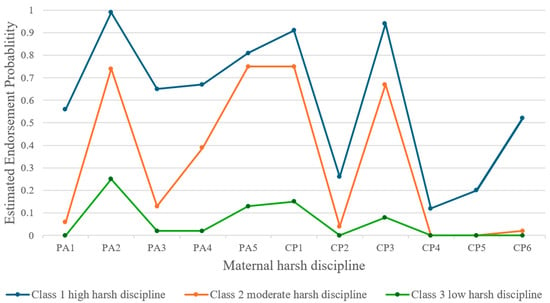
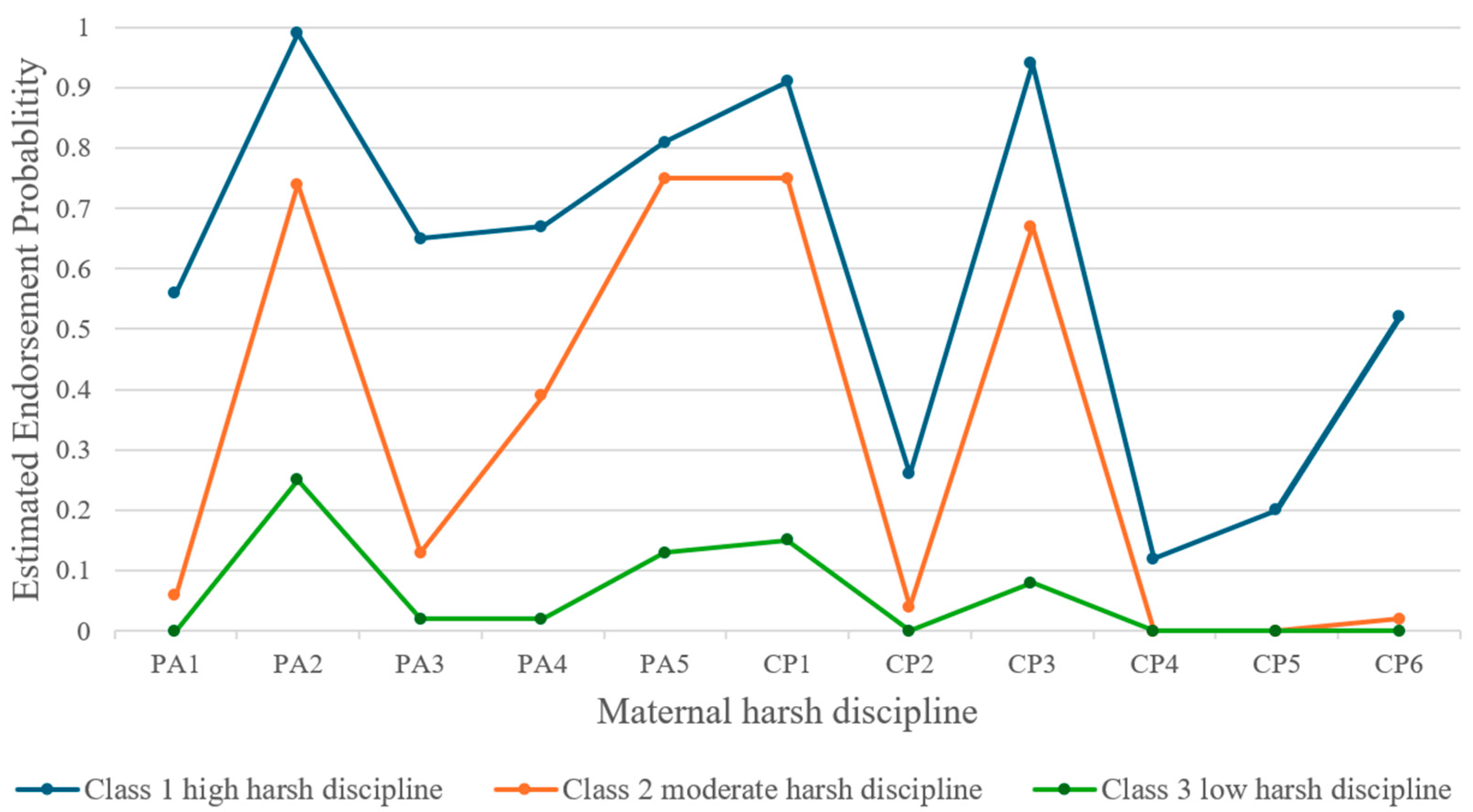
Figure 1 depicts the three identified latent classes of maternal harsh discipline. Latent class 1 was labeled as a “high harsh discipline” class, which contained 128 samples (30.12%) and had high probabilities for most items. Latent class 2, comprising 217 samples (51.06%), was categorized as a “moderate harsh discipline” group. These individuals exhibited relatively high probabilities across psychological aggression indicators, but notably lower probabilities for most corporal punishment items compared to class 1. Latent class 3 was labeled as a “low harsh discipline” class, accounting for 18.82% of the sample (80 samples), with probabilities approaching 0 for almost all harsh discipline behaviors, indicating a pattern of low endorsement across these behaviors.
Figure 1.
Latent classes of maternal harsh discipline. Note: PA = psychological aggression, CP = corporal punishment.
3.3. Mediation Model Analysis
After controlling for child sex and age, maternal age and educational level, paternal educational level, and total household income (reported in Table 5), we constructed a mediation model with latent classes of maternal harsh discipline as the predictor variable, preschool children’s psychological resilience as the mediator, and problematic media use as the outcome variable. The model predicting psychological resilience explained 3% of the variance (R2 = 0.03), while the model predicting PMU explained 4%of the variance (R2 = 0.04).
Table 5.
Descriptive statistics for Demographic Variables (N = 425).
Table 6 shows the results of the mediation model with low harsh discipline as the reference group. For high harsh discipline, the total effect on PMU was significant (b = 0.205, 95% CI [0.020, 0.390]). A significant indirect effect through resilience was observed (b = 0.036, 95% CI [0.006, 0.079]) while the adjusted direct effect was not statistically distinguishable from zero (b = 0.169, 95% CI [−0.017, 0.355]). For moderate harsh discipline, the total effect (b = 0.102, 95% CI [−0.067, 0.270]), direct effect (b = 0.086, 95% CI [−0.082, 0.254]) and the indirect effect did not reach statistical significance (b =0.016, 95% CI [−0.010, 0.050].
Table 6.
Mediation Model of psychological resilience (N = 425).
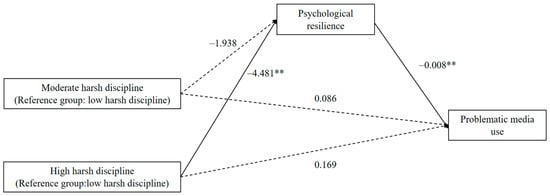
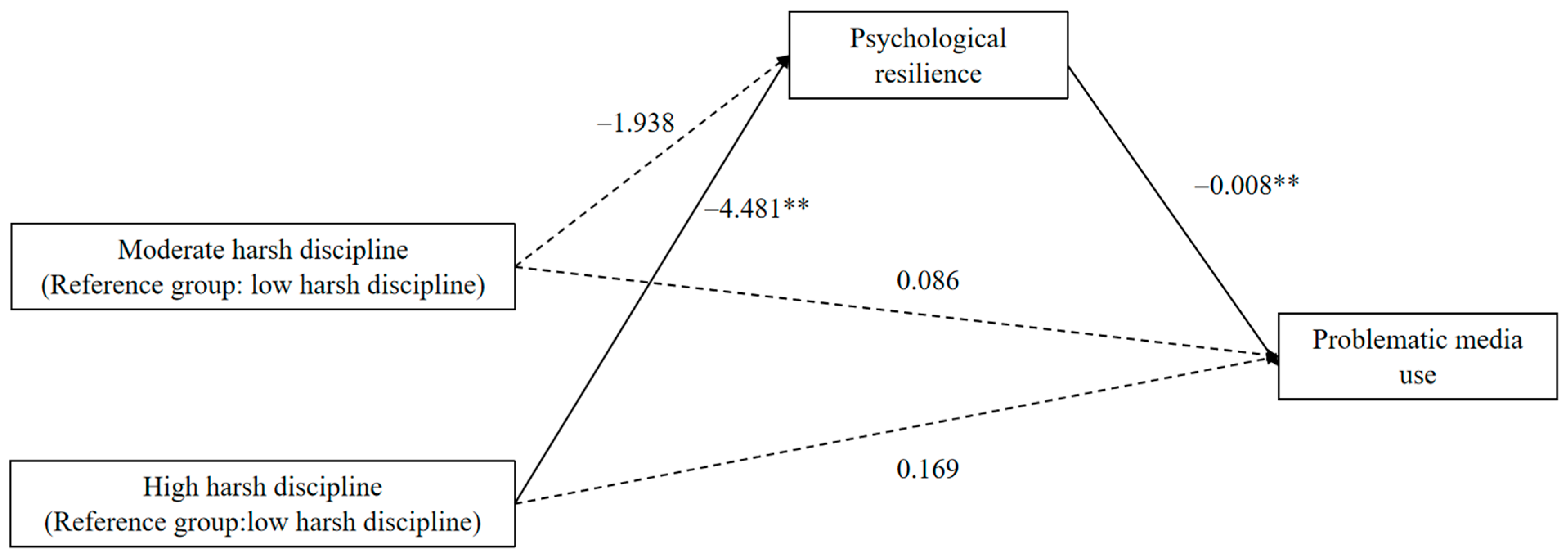
Figure 2 presents the path diagram for the mediation model with low harsh discipline as the reference group. High harsh discipline significantly and negatively predicted psychological resilience (b = −4.481, p < 0.01). Psychological resilience significantly and negatively predicted PMU (b = −0.008, p < 0.01). The direct effect of high harsh discipline on PMU did not reach statistical significance (b = 0.169, p > 0.05). Moderate harsh discipline did not reach statistical significance in predicting psychological resilience (b = −1.938, p > 0.05), nor did its direct effect on PMU reach statistical significance (b = 0.086, p > 0.05).
Figure 2.
Mediation model of psychological resilience, ** p < 0.01. Solid lines indicate statistically significant paths, whereas dashed lines indicate non-significant paths.
3.4. Sensitivity Analysis
The results are consistent with our original findings. Specifically, when explicitly accounting for classification imperfection, the indirect effect of the high harsh discipline class via psychological resilience remained statistically significant (b = 0.042, p = 0.039, 95% CI [0.002, 0.081]), while the adjusted direct effect was not statistically distinguishable from zero (b = 0.160, p = 0.141, 95% CI [−0.053, 0.374]). When comparing the moderate harsh discipline class to the low harsh discipline reference group, neither the indirect effect (b = 0.015, p = 0.351, 95% CI [−0.017, 0.047]) nor the direct effect (b = 0.075, p = 0.484, 95% CI [−0.136, 0.287]) was statistically significant.
4. Discussion
This study aimed to extend previous research by examining the mediating role of psychological resilience in the relationship between latent classes of harsh discipline and PMU in Chinese preschool children. Based on a three-wave longitudinal study spanning approximately two years with a sample of preschool children and their mothers, this study found that a statistically significant indirect association between high harsh discipline and PMU through psychological resilience was observed. The results may assist in the development of targeted and effective interventions to prevent the negative effects of children’s problematic media use.
This study employed LCA to identify three classes of harsh discipline, rather than assuming that its effects are uniform across all levels. Using the low harsh discipline subgroup as the reference, we compared the effects of moderate and high harsh discipline on children’s PMU. Consistent with previous research, harsh discipline is associated with a range of negative child outcomes (Gershoff & Grogan-Kaylor, 2016). In the present study, a statistically significant indirect association between high harsh discipline (Class 1) and PMU was observed. However, Table 1 shows that psychological resilience was not significantly correlated with either harsh-discipline subscale (r = −0.048 and −0.061). This discrepancy is not necessarily contradictory because the analyses address different relationships under different model specifications. The correlations are variable-centered and based on continuous subscale scores, whereas the LCA model is person-centered and compares latent classes (Bergman & Trost, 2006). Specifically, the effect revealed by the LCA reflects a contrast between the high harsh-discipline class (Class 1) and the low harsh-discipline reference group (Class 3), rather than a linear trend across the sample. Consequently, the negative prediction of resilience should be interpreted as specific to the high harsh-discipline class relative to the low group, which may not manifest as a significant overall linear correlation. Whereas a longitudinal study showed that harsh discipline was directly linked to PMU among 3-year-old children (Y. Zhu et al., 2024), our findings indicate that, among preschool children, the direct estimate for the association between high harsh discipline and PMU was not statistically distinguishable from zero; rather, its influence is prospective indirect via psychological resilience. This pattern is consistent with the IT-CPU framework, which posits that distal factors indirectly affect children‘s PMU by creating a climate of heightened risk, whereas proximal factors directly influence and maintain PMU over time (Domoff et al., 2020). One possible explanation, drawing on conservation of resources theory (Hobfoll, 2002) and the compensatory internet use model (Kardefelt-Winther, 2014a), is that high harsh discipline may constitute a resource-depleting context associated with lower psychological resilience, which in turn may be linked to children’s compensatory media use. Another possible explanation is that, from an attachment theory perspective (Bowlby, 1973), the quality of caregiver–child interaction forms the foundation of attachment security; harsh discipline reduces family cohesion (Zhai et al., 2021), thereby depleting children’s psychological resilience. Individuals with high resilience experience more positive emotions, recover quickly from emotional arousal, and thus effectively buffer stress and maintain psychological equilibrium (Klohnen, 1996). In contrast, children with low resilience have poorer self-regulation and tend to adopt maladaptive coping strategies, which heighten the risk of internet addiction (Yilmaz & Yilmaz, 2023), a construct related to but distinct from PMU in that it concerns problematic internet use rather than problematic mobile phone use (Caplan, 2002).
This study enriches the understanding of how patterns of maternal harsh discipline are associated with children’s problematic media use in a representative sample taken from Wuhu City, Anhui Province, China. However, the current study had some limitations. First, all variables, including psychological resilience, PMU, and harsh discipline, were based on a single informant (mother-report), given that the participants are preschoolers. This might introduce common-method variance and inflate associations, and the measures might also be contaminated by social desirability and recall biases. Although the three-wave design reduces some concerns, future studies should use multi-informant and multi-method assessments, such as observational measures of harsh discipline and resilience, to further address this research topic. Second, the findings may have limited generalizability because the sample included parent–child dyads from only one city in China and may not be representative of other cities or regions in China. Future studies should include samples from more areas. Third, although dichotomizing the CTSPC items facilitated the identification of parsimonious and interpretable patterns in the occurrence and co-occurrence of harsh-discipline behaviors, this approach resulted in a loss of frequency information. Specifically, a behavior reported once and the same behavior reported more than 20 times contributed equally to the LCA. Consequently, the identified classes primarily represent differences in the probability and configuration of harsh-discipline behaviors, rather than precise differences in their frequency, chronicity, or intensity. The class labels should therefore be understood as relative descriptions of the response profiles rather than absolute severity categories. Future studies with larger samples should examine whether comparable profiles emerge when the original ordered-frequency responses or a less information-reducing coding scheme is used. Fourth, although the design spans three waves, each construct is measured at only one wave (harsh discipline at T1, resilience at T2, and PMU at T3). Because baseline levels of resilience and PMU were not modeled, the analysis does not provide a sufficiently coherent framework for the mediation process as a whole. Future research should ideally assess all constructs across multiple waves and utilize an autoregressive cross-lagged mediation model with baseline adjustment to provide stronger evidence for the hypothesized directional relationships. Finally, while the entropy of 0.752 in the present study exceeds the 0.6 cutoff for good class separation (Asparouhov & Muthén, 2014), it has been suggested that entropy values greater than 0.8 are preferable (Weller et al., 2020). Nevertheless, the estimated associations between latent classes of harsh discipline and children’s PMU may be subject to misclassification bias, which could attenuate or otherwise distort the observed effects.
In conclusion, a growing body of research has documented the negative associations between harsh discipline and child development, yet little is known about whether these associations differ across co-occurrence patterns of harsh discipline and whether psychological resilience is prospectively associated with these patterns and PMU. This study is the first to use latent class analysis to distinguish low, moderate, and high maternal harsh discipline groups and to examine the prospective associations among maternal harsh discipline, psychological resilience, and PMU among preschool children in China. The findings reveal a statistically significant indirect association between high harsh discipline and PMU through psychological resilience. These findings may point to possible directions for future prevention and intervention research, such as targeting harsh discipline and examining whether enhancing children’s psychological resilience can help weaken the prospective association between harsh discipline and problematic media use.
Author Contributions
Y.L.: Methodology, writing of the original draft, and conceptualization. S.Z.: Writing—Review and editing, data curation, investigation. Y.Z.: Data curation, Formal analysis, editing and review. G.Z.: Visualization, supervision, project administration, and funding acquisition. All authors have read and agreed to the published version of the manuscript.
Funding
This work was supported by the Anhui Province Social Sciences Innovation and Development Research Projects (grant number: 2024CXQ068).
Institutional Review Board Statement
The study was conducted in accordance with the Declaration of Helsinki and approved by the Ethics Committee of Anhui Normal University (protocol code AHNU-ET2021034 and approved on 20 December 2021).
Informed Consent Statement
Informed consent was obtained from all subjects involved in the study.
Data Availability Statement
The data presented in this study are available on request from the corresponding author. The data are not publicly available due to privacy and ethical restrictions.
Conflicts of Interest
The authors declare no conflicts of interest.
References
- Ainsworth, M. S. (1979). Infant-mother attachment. American Psychologist, 34(10), 932–937. [Google Scholar] [CrossRef] [Scilit] [PubMed]
- Al-Yagon, M., Garbi, L., & Rich, Y. (2023). Children’s resilience to ongoing border attacks: The role of father, mother, and child resources. Child Psychiatry & Human Development, 54(4), 1015–1026. [Google Scholar] [CrossRef] [Scilit] [PubMed]
- Asparouhov, T., & Muthén, B. (2014). Auxiliary variables in mixture modeling: Three-step approaches using Mplus. Structural Equation Modeling: A Multidisciplinary Journal, 21(3), 329–341. [Google Scholar] [CrossRef] [Scilit]
- Bergman, L. R., & Trost, K. (2006). The person-oriented versus the variable-oriented approach: Are they complementary, opposites, or exploring different worlds? Merrill-Palmer Quarterly, 52(3), 601–632. [Google Scholar] [CrossRef] [Scilit]
- Bolck, A., Croon, M., & Hagenaars, J. (2004). Estimating latent structure models with categorical variables: One-step versus three-step estimators. Political Analysis, 12(1), 3–27. [Google Scholar] [CrossRef] [Scilit]
- Bowlby, J. (1973). Attachment and loss. In Separation: Anxiety and anger (Vol. 2). Basic Books. [Google Scholar]
- Bronfenbrenner, U. (1979). The ecology of human development: Experiments by nature and design. Harvard University Press. [Google Scholar]
- Caplan, S. E. (2002). Problematic internet use and psychosocial well-being: Development of a teory-based cognitive–behavioral measurement instrument. Computers in Human Behavior, 18(5), 553–575. [Google Scholar] [CrossRef] [Scilit]
- Carr, C. P., Martins, C. M. S., Stingel, A. M., Lemgruber, V. B., & Juruena, M. F. (2013). The role of early life stress in adult psychiatric disorders: A systematic review according to childhood trauma subtypes. Journal of Nervous and Mental Disease, 201, 1007–1020. [Google Scholar] [PubMed]
- Casale, S., Akbari, M., Benucci, S. B., Seydavi, M., & Fioravanti, G. (2024). Interpersonally-based fears and problematic social networking site use: The moderating role of online social support. International Journal of Mental Health and Addiction, 22, 995–1007. [Google Scholar] [CrossRef] [Scilit]
- Chan, K. L. (2008). The Chinese version of the parent-child conflict tactics scale. Child Abuse & Neglect, 32(3), 375–382. [Google Scholar]
- Chen, H. Y., Zhang, W., Li, Z. Y., Ma, Y. Y., Gul, M., Zhou, J., & Ma, F. C. (2026). Association of dietary patterns with overweight and obesity among children and adolescents based on latent class analysis. Chinese Journal of School Health, 47(6), 883–887. [Google Scholar]
- Choi, J.-K., & Becher, E. H. (2019). Supportive coparenting, parenting stress, harsh parenting, and child behavior problems in nonmarital families. Family Process, 58(2), 404–417. [Google Scholar] [CrossRef] [Scilit] [PubMed]
- Cliff, D. P., Howard, S. J., Radesky, J. S., McNeill, J., & Vella, S. A. (2018). Early childhood media exposure and self-regulation: Bidirectional longitudinal associations. Academic Pediatrics, 18(7), 813–819. [Google Scholar] [CrossRef] [Scilit] [PubMed]
- Collins, L. M., & Lanza, S. T. (2009). Latent class and latent transition analysis: With applications in the social, behavioral, and health sciences. Wiley. [Google Scholar]
- Dinc, M., & Topcu, F. (2021). The relation between resilience and problematic internet use among youth. Dusunen Adam: The Journal of Psychiatry and Neurological Sciences, 34, 337–345. [Google Scholar] [CrossRef] [Scilit]
- Ding, X., Liang, M., Song, Q., Su, W., Li, N., Liu, H., Wu, Y., Guo, X., Wang, H., Zhang, J., Qin, Q., Sun, L., Chen, M., & Sun, Y. (2023a). Development of psychological resilience and associations with emotional and behavioral health among preschool left-behind children. Social Psychiatry and Psychiatric Epidemiology, 58(3), 467–476. [Google Scholar] [CrossRef] [Scilit] [PubMed]
- Ding, X., Zheng, L., Liu, Y., Zhang, W., Wang, N., Duan, H., & Wu, J. (2023b). Parenting styles and psychological resilience: The mediating role of error monitoring. Biological Psychology, 180, 108587. [Google Scholar] [CrossRef] [Scilit] [PubMed]
- Domoff, S. E., Borgen, A. L., & Radesky, J. S. (2020). Interactional theory of childhood problematic media use (IT-CPU). Human Behavior and Emerging Technologies, 2(4), 343–353. [Google Scholar] [CrossRef] [Scilit] [PubMed]
- Domoff, S. E., Harrison, K., Gearhardt, A. N., Gentile, D. A., Lumeng, J. C., & Miller, A. L. (2019). Development and validation of the problematic media use measure: A parent report measure of screen media “addiction” in children. Psychology of Popular Media Culture, 8(1), 2–11. [Google Scholar] [PubMed]
- Dube, S. R., Felitti, V. J., Dong, M., Chapman, D. P., Giles, W. H., & Anda, R. F. (2003). Childhood abuse, neglect, and household dysfunction and the risk of illicit drug use: The adverse childhood experiences study. Pediatrics, 111(3), 564–572. [Google Scholar] [CrossRef] [Scilit] [PubMed]
- Emond, J. A., Carlson, D., Ballarino, G., & Domoff, S. E. (2024). Validating the problematic media use measure in preschool-aged children: Associations with children’s screen media use, bothersome pestering to use screen media, and emotional self-regulation. Technology, Mind, and Behavior, 5(3), 137. [Google Scholar] [CrossRef] [Scilit] [PubMed]
- Erath, S. A., El Sheikh, M., & Cummings, E. M. (2009). Harsh parenting and child externalizing behavior: Skin conductance level reactivity as a moderator. Child Development, 80(2), 578–592. [Google Scholar] [CrossRef] [Scilit] [PubMed]
- Fang, H., Wang, M. F., & Xing, X. P. (2012). Relationship between parenting stress and harsh discipline in preschoolers’ parents. Chinese Journal of Clinical Psychology, 20, 835–838. [Google Scholar]
- Gershoff, E. T., & Grogan-Kaylor, A. (2016). Spanking and child outcomes: Old controversies and new meta-analyses. Journal of Family Psychology, 30(4), 453–469. [Google Scholar] [CrossRef] [Scilit] [PubMed]
- Hecker, T., Hermenau, K., Salmen, C., Teicher, M., & Elbert, T. (2016). Harsh discipline relates to internalizing problems and cognitive functioning: Findings from a cross-sectional study with school children in Tanzania. BMC Psychiatry, 16, 118. [Google Scholar] [CrossRef] [Scilit] [PubMed]
- Hermenau, K., Hecker, T., Elbert, T., & Ruf-Leuschner, M. (2014). Maltreatment and mental health in institutional care—comparing early- and late-institutionalized children in Tanzania. Infant Mental Health Journal, 35, 102–110. [Google Scholar] [CrossRef] [Scilit] [PubMed]
- Hobfoll, S. E. (2002). Social and psychological resources and adaptation. Review of General Psychology, 6(4), 307–324. [Google Scholar] [CrossRef] [Scilit]
- Hou, J., Yu, L., Ting, S. M. R., Sze, Y. T., & Fang, X. (2011). The status and characteristics of couple violence in China. Journal of Family Violence, 26(2), 81–92. [Google Scholar] [CrossRef] [Scilit]
- Kardefelt-Winther, D. (2014a). A conceptual and methodological critique of internet addiction research: Towards a model of compensatory internet use. Computers in Human Behavior, 31, 351–354. [Google Scholar] [CrossRef] [Scilit]
- Kardefelt-Winther, D. (2014b). The moderating role of psychosocial well-being on the relationship between escapism and excessive online gaming. Computers in Human Behavior, 38, 68–74. [Google Scholar] [CrossRef] [Scilit]
- Kardefelt-Winther, D. (2017). Conceptualizing internet use disorders: Addiction or coping process? Psychiatry and Clinical Neurosciences, 71(7), 459–466. [Google Scholar] [CrossRef] [Scilit] [PubMed]
- Klohnen, E. C. (1996). Conceptual analysis and measurement of the construct of ego-resiliency. Journal of Personality and Social Psychology, 70(5), 1067–1079. [Google Scholar] [CrossRef] [Scilit] [PubMed]
- Langer, S. L., Crain, A. L., Senso, M. M., Levy, R. L., & Sherwood, N. E. (2014). Predicting child physical activity and screen time: Parental support for physical activity and general parenting styles. Journal of Pediatric Psychology, 39(6), 633–642. [Google Scholar] [CrossRef] [Scilit] [PubMed]
- Lansford, J. E., & Deater-Deckard, K. (2012). Childrearing discipline and violence in developing countries. Child Development, 83(1), 62–75. [Google Scholar] [CrossRef] [Scilit] [PubMed]
- LeBuffe, P. A., & Naglieri, J. A. (2012). Devereux early childhood assessment for preschoolers: User’s guide and technical manual. Kaplan Early Learning Company. [Google Scholar]
- Li, J., Wang, J., Xiao, B., Li, Y., & Li, H. (2024). Translation and validation of the Chinese version of the problematic media use measure. Early Education and Development, 35(1), 26–41. [Google Scholar] [CrossRef] [Scilit]
- Li, S., Lei, H., & Tian, L. (2018). A meta-analysis of the relationship between parenting style and internet addiction among mainland Chinese teenagers. Social Behavior and Personality: An International Journal, 46(9), 1475–1487. [Google Scholar] [CrossRef] [Scilit]
- Liu, J., Liu, X., Wang, H., & Gao, Y. (2021). Harsh parenting and non-suicidal self-injury in adolescence: The mediating effect of depressive symptoms and the moderating effect of the COMT Val158Met polymorphism. Child and Adolescent Psychiatry and Mental Health, 15(1), 70. [Google Scholar] [CrossRef] [Scilit] [PubMed]
- Liu, L., & Wang, M. (2018). Parental harsh discipline and adolescent problem behavior in China: Perceived normativeness as a moderator. Child Abuse & Neglect, 86, 1–9. [Google Scholar] [CrossRef] [Scilit] [PubMed]
- Luthar, S., Cicchetti, D., & Becker, B. (2000). The construct of resilience: A critical evaluation and guidelines for future work. Child Development, 71(3), 543–562. [Google Scholar] [CrossRef] [Scilit] [PubMed]
- Masten, A. (2001). Ordinary magic: Resilience process in development. American Psychologist, 56, 115–139. [Google Scholar] [CrossRef] [Scilit] [PubMed]
- Nylund, K. L., Asparouhov, T., & Muthén, B. O. (2007). Deciding on the number of classes in latent class analysis and growth mixture modeling: A Monte Carlo simulation study. Structural Equation Modeling: A Multidisciplinary Journal, 14(4), 535–569. [Google Scholar] [CrossRef] [Scilit]
- Ogelman, H. G. (2015). Predictor effect of parental acceptance-rejection levels on resilience of preschool children. Procedia—Social and Behavioral Sciences, 174, 622–628. [Google Scholar] [CrossRef] [Scilit]
- Öztürk, A., & Kundakçı, N. (2021). Perceived social support, and psychological resilience as predictors of internet addiction: A cross-sectional study with a sample of Turkish undergraduates. Psychiatry and Clinical Psychopharmacology, 31, 449–456. [Google Scholar] [CrossRef] [Scilit] [PubMed]
- Park, M., & Chesla, C. (2007). Revisiting Confucianism as a conceptual framework for asian family study. Journal of Family Nursing, 13(3), 293–311. [Google Scholar] [CrossRef] [Scilit] [PubMed]
- Petrowski, K., Brähler, E., & Zenger, M. (2014). The relationship of parental rearing behavior and resilience as well as psychological symptoms in a representative sample. Health and Quality of Life Outcomes, 12(1), 1–9. [Google Scholar] [CrossRef] [Scilit] [PubMed]
- Qi, D., Lin, Y., & Liu, Q. (2020). Smartphone addiction out of “beating”? The effect of harsh parenting on smartphone addiction of adolescents. Psychological Development and Education, 36(6), 677–685. [Google Scholar]
- Radesky, J., Peacock-Chambers, E., Zuckerman, B., & Silverstein, M. (2016). Use of mobile technology to calm upset children: Associations with social-emotional development. JAMA Pediatrics, 170(4), 397–399. [Google Scholar] [PubMed]
- Raftery, A. E. (1995). Bayesian model selection in social research. Sociological Methodology, 25, 111–163. [Google Scholar] [CrossRef] [Scilit] [PubMed]
- Robertson, T. W., Yan, Z., & Rapoza, K. A. (2018). Is resilience a protective factor of internet addiction? Computers in Human Behavior, 78, 255–260. [Google Scholar] [CrossRef] [Scilit]
- Sheng, X., Li, J., Niu, H., & Wang, M. (2019). Harsh parental discipline and adolescent externalizing problem behavior: The moderating roles of pubertal timing and gender. Chinese Journal of Clinical Psychology, 27(6), 1199–1204. [Google Scholar]
- Starcevic, V., & Aboujaoude, E. (2017). Internet addiction: Reappraisal of an increasingly inadequate concept. CNS Spectrums, 22(1), 7–13. [Google Scholar] [CrossRef] [Scilit] [PubMed]
- Straus, M. A., Hamby, S. L., Finkelhor, D., Moore, D. W., & Runyan, D. (1998). Identification of child maltreatment with the parent-child conflict tactics scales: Development and psychometric data for a national sample of American parents. Child Abuse & Neglect, 22(4), 249–270. [Google Scholar] [CrossRef] [Scilit] [PubMed]
- Sugaya, L., Hasin, D. S., Olfson, M., Lin, K. H., Grant, B. F., & Blanco, C. (2012). Child physical abuse and adult mental health: A national study. Journal of Traumatic Stress, 25(4), 384–392. [Google Scholar] [CrossRef] [Scilit] [PubMed]
- Swit, C. S., Coyne, S. M., Shawcroft, J., Gath, M., Barr, R., Holmgren, H. G., & Stockdale, L. (2023). Problematic media use in early childhood: The role of parent–child relationships and parental wellbeing in families in New Zealand and the United States. Journal of Children and Media, 17(4), 443–466. [Google Scholar] [CrossRef] [Scilit] [PubMed]
- von Eye, A., & Bogat, G. A. (2006). Person-oriented and variable-oriented research: Concepts, results, and development. Merrill-Palmer Quarterly, 52(3), 390–420. [Google Scholar] [CrossRef] [Scilit]
- Wang, D., Zhou, M., & Hu, Y. (2024). The relationship between harsh parenting and smartphone addiction among adolescents: Serial mediating role of depression and social pain. Psychology Research and Behavior Management, 17, 735–752. [Google Scholar] [CrossRef] [Scilit] [PubMed]
- Wang, H., Liu, H., Zhou, L., Bi, X., Tao, J., Jiang, Y., & Zhang, R. (2024). Harsh parenting and internet addiction: The chain mediating effect of emotional regulation difficulties and maladaptive cognitions. Perspectives in Psychiatric Care, 2024, 7334182. [Google Scholar] [CrossRef] [Scilit]
- Wang, J., Li, M., Geng, J., Wang, H., Nie, J., & Lei, L. (2023a). Meaning in life and self-control mediate the potential contribution of harsh parenting to adolescents‘ problematic smartphone use: Longitudinal multi-group analyses. Journal of Interpersonal Violence, 38(1–2), 2159–2181. [Google Scholar] [CrossRef] [Scilit] [PubMed]
- Wang, J., Wang, M., & Lei, L. (2023b). Longitudinal links among paternal and maternal harsh parenting, adolescent emotional dysregulation and short-form video addiction. Child Abuse & Neglect, 141, 106236. [Google Scholar] [CrossRef] [Scilit] [PubMed]
- Wang, M., & Liu, L. (2014). Parental harsh discipline in mainland China: Prevalence, frequency, and coexistence. Child Abuse & Neglect, 38(6), 1128–1137. [Google Scholar] [CrossRef] [Scilit] [PubMed]
- Wang, M. F., Wang, X. X., & Liu, L. (2016). Paternal and maternal psychological and physical aggression and children’s anxiety in China. Child Abuse & Neglect, 51, 12–20. [Google Scholar] [CrossRef] [Scilit] [PubMed]
- Weller, B. E., Bowen, N. K., & Faubert, S. J. (2020). Latent class analysis: A guide to best practice. Journal of Black Psychology, 46(4), 287–311. [Google Scholar] [CrossRef] [Scilit]
- Yang, N., Qi, Y., Lu, J., Hu, J., & Ren, Y. (2021). Teacher-child relationships, self-concept, resilience, and social withdrawal among Chinese left-behind children: A moderated mediation model. Children and Youth Services Review, 129, 106182. [Google Scholar] [CrossRef] [Scilit]
- Yang, Y., Guo, Y., Wang, W., Cai, B., Ning, H., & Gong, H. (2024). Harsh parenting and smartphone addiction: The mediating role of core self-evaluation and the moderating role of nature connectedness. Computers in Human Behavior, 152, 108049. [Google Scholar] [CrossRef] [Scilit]
- Yilmaz, R., & Yilmaz, F. G. K. (2023). Problematic internet use in adults: The role of happiness, psychological resilience, dispositional hope, and self-control and self-management. Journal of Rational-Emotive & Cognitive-Behavior Therapy, 41(3), 727–745. [Google Scholar] [CrossRef] [Scilit] [PubMed]
- Yoon, D., Shipe, S. L., Park, J., & Yoon, M. (2021). Bullying patterns and their associations with child maltreatment and adolescent psychosocial problems. Children and Youth Services Review, 129, 106178. [Google Scholar] [CrossRef] [Scilit] [PubMed]
- Zhai, P. X., Hu, Y. X., & Liu, L. (2021). Parental harsh discipline and children’s anxiety: The mediating role of family cohesion. Studies of Psychology and Behavior, 19(2), 245–252. [Google Scholar]
- Zhang, J., Wu, Y., Qu, G., Wang, L., Wu, W., Tang, X., Liu, H., Chen, X., Zhao, T., Xuan, K., & Sun, Y. (2021). The relationship between psychological resilience and emotion regulation among preschool left-behind children in rural China. Psychology, Health & Medicine, 26(5), 595–606. [Google Scholar] [CrossRef] [Scilit] [PubMed]
- Zhu, J. J., Zhang, Y., Li, Y., Peng, R. Z., & Feng, M. (2018). Maternal attachment style and child anxiety: The mediating role of parent-child attachment. Chinese Journal of Clinical Psychology, 26(4), 763–766. [Google Scholar]
- Zhu, Y., Zhang, G., Zhan, S., & Anme, T. (2024). Longitudinal effects of parental adverse childhood experiences on offspring problematic media use: The serial mediating role of psychological distress and harsh discipline. Child Abuse & Neglect, 155, 106965. [Google Scholar] [CrossRef] [Scilit] [PubMed]

Disclaimer/Publisher’s Note: The statements, opinions and data contained in all publications are solely those of the individual author(s) and contributor(s) and not of MDPI and/or the editor(s). MDPI and/or the editor(s) disclaim responsibility for any injury to people or property resulting from any ideas, methods, instructions or products referred to in the content. |
© 2026 by the authors. Licensee MDPI, Basel, Switzerland. This article is an open access article distributed under the terms and conditions of the Creative Commons Attribution (CC BY) license.