


Abstract
Using three waves of the Panel Study on Korean Children, this study examined longitudinal associations among media-use frequency at ages 6 and 9, problematic media use (PMU) at age 12, and family-context measures at age 6. The analysis used full information maximum likelihood (FIML) with the original cohort of 2150 children, including those with incomplete observations across waves. Age-6 media use was associated with age-9 media use (β = 0.171, p < 0.001), which was associated with age-12 PMU (β = 0.108, p < 0.001). The standardized indirect association was small (β = 0.0186, 95% percentile bootstrap CI [0.0077, 0.0320]). Neither the direct association (β = 0.034, p = 0.216) nor the total association (β = 0.0529, 95% CI [−0.0015, 0.1078]) was statistically significant. More frequent parent–child interaction (β = −0.078, p = 0.005) and lower parenting stress (β = −0.182, p < 0.001) at age 6 were associated with lower age-12 PMU. In a matched-sample sensitivity analysis, adding age-9 PMU reduced the indirect estimate (β = 0.0100, 95% CI [0.0002, 0.0218]); the interval’s lower limit was close to zero. Results also varied across media-use activities. The observational design does not support causal inference.
1. Introduction
Children now encounter digital media at increasingly early ages. The Organisation for Economic Co-Operation and Development (OECD) (2023) has reported that many children begin using digital devices and engaging in online activities before entering school. Early digital experiences may provide opportunities for learning, communication, and parent–child connectedness, while also raising concerns regarding excessive or dysregulated use. For this reason, children’s media experiences are better understood in terms of the contexts in which media are used and children’s developing capacity to regulate that use than in terms of access or restriction alone.
Recent guidance on young children’s media use reflects a similar view. The World Health Organization (WHO) (2019) conceptualizes young children’s daily activities within a 24 h framework that considers sedentary screen-based behavior alongside physical activity and sleep. Earlier guidance from the American Academy of Pediatrics (AAP) emphasized limits on screen exposure, high-quality content, caregiver co-viewing, and avoiding media use before bedtime (Council on Communications and Media, 2016), whereas more recent guidance has broadened this perspective by situating children’s media experiences within a wider digital ecosystem involving children, caregivers, technology design, and social contexts (Munzer et al., 2026). In both documents, how often children use media is considered together with the relational and environmental conditions of that use.
Much of this context is provided by the family. Previous research has identified associations among maternal distress, parenting stress, parenting-related behaviors, and problematic media use among young children (Wang et al., 2024). Caregivers may rely on digital devices as an immediate means of soothing or managing children’s behavior (Radesky et al., 2016). J. Li et al. (2023) found that maternal COVID-19 distress was associated with preschool children’s problematic media use through parenting stress and negative instrumental use of media. Parents’ emotional resources, their sense of parenting burden, and the ways they use media in parenting may therefore all bear on children’s problematic media use.
The parent–child relationship is a second aspect of the early family context. Higher-quality parent–child relationships have been associated with stronger psychological and self-regulatory resources and lower levels of problematic media use (Liu et al., 2025; Zhu et al., 2022). Self-control has also been identified as an important mechanism linking parenting practices with children’s emotional regulation abilities (D. Li et al., 2023). Both parent–child interaction and parenting stress may therefore be relevant to later media-related outcomes, although they reflect different aspects of family life. Parent–child interaction in the present study refers to the reported frequency of shared activities between parents and children, whereas parenting stress reflects caregivers’ perceived burden associated with parenting. Examining them separately can show whether each relates to later media engagement and problematic media use.
Media engagement may also show longitudinal continuity without representing an invariant behavior across childhood. As children grow, the devices they use, the purposes for which they use them, and the social contexts surrounding media engagement change substantially. Earlier longitudinal research, much of which focused on television viewing, provided initial evidence that childhood media behaviors may be associated with later media engagement and developmental outcomes (Anderson et al., 2001; Pagani et al., 2010). More recent research has likewise suggested some continuity in screen-related behaviors across developmental periods (Gebremariam et al., 2012; Trinh et al., 2020). At the same time, methodological critiques have highlighted substantial heterogeneity in how screen and media use are conceptualized and measured across studies and developmental periods (Kaye et al., 2020). Longitudinal research should therefore account for developmental changes in what media engagement means and how it is measured at each age.
Theories of development that emphasize interactions between children and their proximal environments make a related point. Bronfenbrenner and Morris’s (2006) bioecological model conceptualizes development as occurring through recurring interactions within proximal contexts, particularly the family microsystem. More specifically, the Interactional Theory of Childhood Problematic Media Use (IT-CPU; Domoff et al., 2020) proposes that problematic media use is not simply a consequence of media exposure but develops through interactions among child, family, and contextual factors. From this perspective, parent–child interaction and parenting stress may be considered distinct but related characteristics of the family context in which children’s media engagement develops. The present study draws on these frameworks to examine longitudinal media-use patterns alongside parent–child shared-activity frequency and perceived parenting stress; it does not directly test the proximal or maintaining mechanisms proposed by the IT-CPU.
Previous studies using the Panel Study on Korean Children (PSKC) have examined media-related outcomes and family characteristics in this birth cohort. Song (2022) investigated longitudinal associations among entertainment-related Internet use, executive function problems, and maternal control across waves 9–11. Yun et al. (2022) examined child behavioral characteristics, parenting practices, and peer relationships associated with problematic smartphone use across waves 10–11. Using waves 7–13, Jang (2025) examined the association between parent–child interaction and later media-device addiction, including indirect associations through executive function difficulties.
Building on previous PSKC research, the present study extends the analysis in three ways. First, it distinguishes media-use frequency from problematic media use, rather than treating these outcomes as interchangeable. Second, it examines an indirect longitudinal association linking device-based media-use frequency at age 6, purpose-based media-use frequency at age 9, and problematic media use at age 12. Third, it considers parent–child shared-activity frequency and parenting stress within the same fully adjusted model, allowing their associations with later media-related outcomes to be examined while accounting for child sex, household income, and parental education.
The question is pressing in South Korea, where children grow up in a highly connected digital environment. According to the National Information Society Agency (NIA) (2025), in 2024, approximately 25.9% of children aged 3–9 years and 42.6% of those aged 10–19 years were classified as being at risk of smartphone overdependence. At-risk use is therefore common among Korean children and adolescents, which makes Korean cohort data well suited to examining how media engagement across childhood relates to later problematic use.
Using three waves spanning early childhood (age 6), middle childhood (age 9), and late childhood (age 12), the present study examines whether media-use frequency in early childhood is longitudinally associated with problematic media use at age 12 indirectly through media-use frequency at age 9. In addition, parent–child interaction and parenting stress in early childhood are examined as separate family-context predictors of media-use frequency in middle childhood and problematic media use in late childhood.
The present study focused on the frequency of media engagement, not on the duration of media use. At age 6, media-use frequency was assessed across different devices, whereas at age 9, it was assessed across different purposes. These variables were therefore treated as distinct, age-specific indicators of media engagement.
The following research questions were addressed:
- RQ1. How is media-use frequency in early childhood associated with media-use frequency in middle childhood and problematic media use at age 12?
- RQ2. Is media-use frequency in early childhood indirectly associated with problematic media use at age 12 through media-use frequency in middle childhood?
- RQ3. How are parent–child interaction and parenting stress in early childhood associated with media-use frequency in middle childhood and problematic media use at age 12?
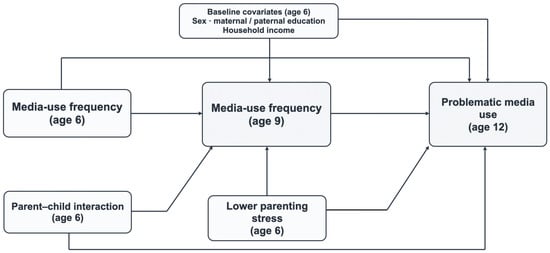
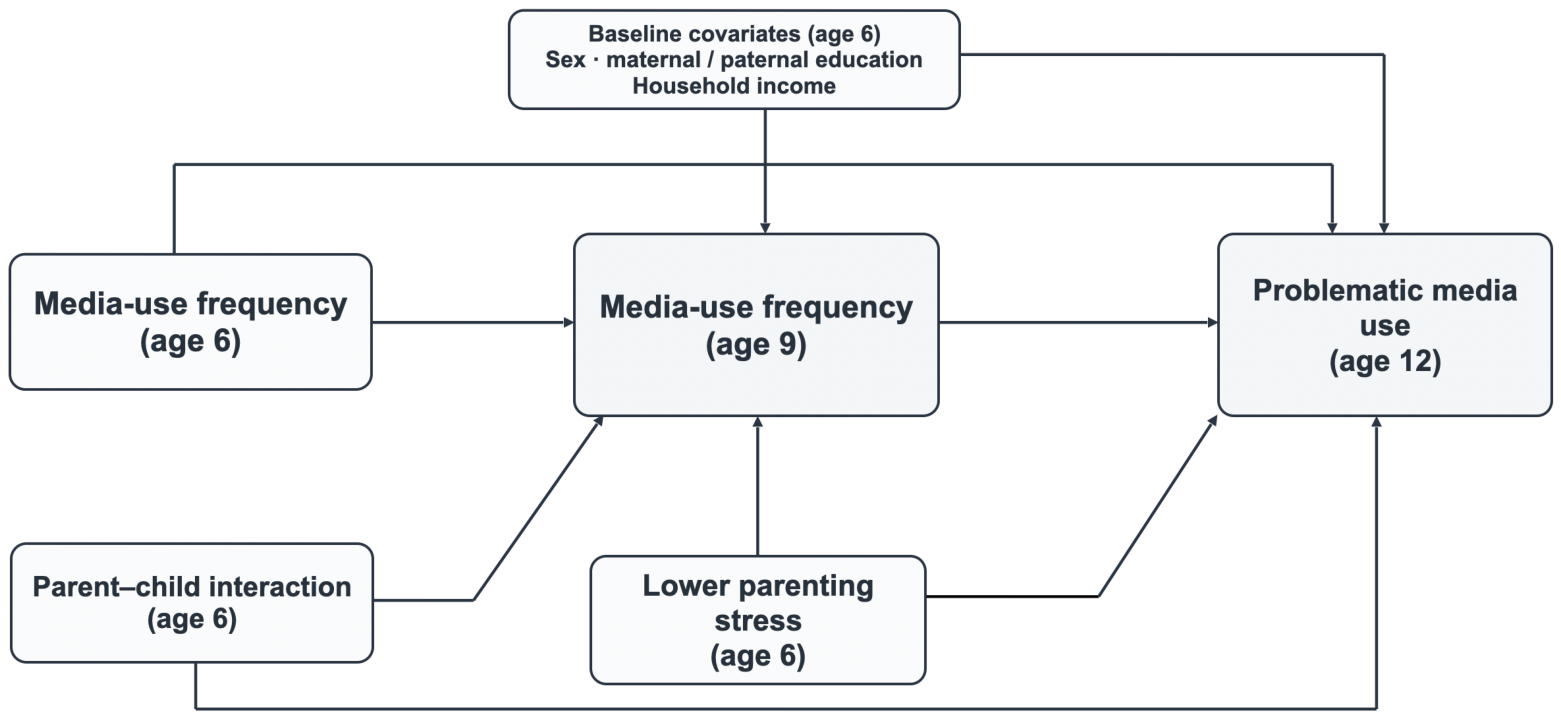
Figure 1 presents the proposed path model, in which age-9 media-use frequency is specified as an intermediate variable, and both family-context variables predict both later outcomes.
Figure 1.
Proposed longitudinal path model. Note. Each sociodemographic covariate is specified as a separate predictor of both outcomes. Covariances among baseline predictors are freely estimated but omitted from the figure.
2. Materials and Methods
2.1. Participants
This study used data from the 7th (2014), 10th (2017), and 13th (2020) waves of the Panel Study on Korean Children (PSKC), conducted by the Korea Institute of Child Care and Education (KICCE; E. Kim et al., 2020). The longitudinal cohort comprised 2150 children, including 1091 boys (50.7%) and 1059 girls (49.3%). The selected waves corresponded approximately to ages 6, 9, and 12 years, respectively. The 13th-wave data were collected between July and November 2020, during the COVID-19 pandemic. Missingness varied across the study variables.
2.2. Analytic Model
The present study employed a longitudinal path model to examine associations among media-use frequency in early childhood, media-use frequency in middle childhood, and problematic media use in late childhood. Specifically, the model examined whether media-use frequency at age 6 was associated with problematic media use at age 12 both directly and indirectly through media-use frequency at age 9.
Parent–child interaction and parenting stress at age 6 were included as separate indicators of the early family context. These two variables were modeled separately because they represent different aspects of the early family context: the frequency of shared parent–child activities and perceived parenting stress.
Child sex, household income, and maternal and paternal education were included as sociodemographic covariates; the full model specification is described in Section 2.4.
Because the media-use measures differed in item content and response format across waves (Section 2.3.1), the model links age-specific indicators of media engagement and does not estimate stability or change in a single construct.
2.3. Measures
Composite scores were calculated according to the scoring procedures described for each measure. Continuous variables included in the structural model were standardized as z-scores after any required reverse coding. Higher scores consistently represented higher levels of the construct described for each variable.
2.3.1. Media Use
Media-use frequency was assessed using developmentally specific items available in the PSKC. At age 6, parents reported how frequently their child had used four types of media devices during the previous week: a computer (Internet), a personal game console, a mobile phone/smartphone/tablet, and television. Each item was rated on a 5-point scale ranging from 1 = never to 5 = very frequently. The age-6 index was calculated as the mean of the four items, and valid responses to all four items were required. Of the original 2150 children, 1524 had valid responses to all four items, and 626 had no valid responses; no child had responses to only one to three items, so no index scores were based on partial responses.
At age 9, parents reported how frequently their child used a smartphone or computer for five purposes: learning, information seeking, gaming, entertainment (e.g., listening to music or watching videos), and social networking services. Each item was rated on a 4-point scale ranging from 1 = never to 4 = every day, and the index was calculated as the mean of available responses. Of the 1362 children with an age-9 score, 35 had responded to one to four of the five items. In a partial-response scoring sensitivity analysis, these 35 scores were treated as missing, and the model was re-estimated; the main estimates were similar (Table S4, Panel C).
Because the age-6 and age-9 items represented heterogeneous forms of media engagement across different devices and purposes, respectively, these variables were treated as composite indices, not as reflective psychometric scales. Internal consistency is most informative when items are intended to function as interchangeable indicators of a common underlying construct, as in a reflective measurement model (Bollen & Lennox, 1991). When items capture heterogeneous facets of a broader behavioral domain, however, strong inter-item correlations are not necessarily expected, and coefficient alpha may provide only limited information about the adequacy of the resulting composite (McNeish, 2018; Sijtsma, 2009). Cronbach’s alpha was 0.448 for the age-6 media-use index and 0.534 for the age-9 media-use index. These relatively low values may partly reflect the heterogeneous content of the component items, which were not designed to measure a single latent construct. Measurement error in these composites may nevertheless attenuate the associations involving them (see Section 4.1).
2.3.2. Problematic Media Use
Problematic media use at age 12 was assessed using the 15-item media-device addiction measure included in the 13th wave of the PSKC. The measure was adapted by the PSKC research team from the observer-rated K-Scale (Internet Addiction Diagnostic Scale) for adolescents (National Information Society Agency (NIA), 2013) and was completed by mothers. The items assess problematic patterns of PC and smartphone use on a 4-point scale ranging from 1 = not at all true to 4 = very true. Example items include “My child frequently argues with family members because of problems related to PC or smartphone use” and “My child often breaks promises and lies because of PC or smartphone use.” Items 10 and 11 were reverse-scored before computing the composite score. In the present study, the continuous composite score is referred to as problematic media use (PMU), with higher scores indicating greater problematic media use. The measure demonstrated good internal consistency in the present data (Cronbach’s α = 0.855). Among the 1393 children with observed PMU scores, all 15 items had valid responses; no partially completed item sets occurred in the analytic data.
2.3.3. Parent–Child Interaction
Parent–child interaction at age 6 was assessed using items adapted by the PSKC research team from the Home Environment, Activities, and Cognitive Stimulation measure of the Early Childhood Longitudinal Study–Kindergarten Cohort (ECLS-K). The measure consisted of nine parent-reported items assessing the frequency of shared activities between parents and children during the previous week.
The activities included reading books, talking with the child, singing songs, engaging in arts and crafts, participating in household activities together, playing games, participating in nature- or science-related activities, engaging in construction play, and participating in sports or physical activities. Each item was rated on a 4-point scale ranging from 1 = never to 4 = every day. Item scores were averaged, with higher scores indicating more frequent parent–child interaction. Internal consistency was good (Cronbach’s α = 0.830). Scores were calculated from complete responses to all nine items (n = 1565); no partially completed item sets occurred in the analytic data.
The measure reflects the frequency of general parent–child activities and does not specifically assess shared digital activities such as co-viewing or co-playing digital media.
2.3.4. Parenting Stress
Parenting stress at age 6 was assessed using the PSKC adaptation of the Parenting Stress Scale developed by K. H. Kim and Kang (1997). The present study used 11 mother-reported items reflecting perceived burden and distress associated with the parenting role.
Items included statements such as “I am not confident that I can raise my child well” and “There are times when I want to run away from my child.” Each item was rated on a 5-point scale ranging from 1 = not at all true to 5 = very true. Item scores were averaged, with higher raw scores indicating greater parenting stress. Internal consistency was good (Cronbach’s α = 0.878). Scores were calculated from complete responses to all 11 items (n = 1565); no partially completed item sets occurred in the analytic data.
For the structural model, the composite was reverse-coded so that higher values represented lower parenting stress and was then standardized. The measure captures perceived distress and burden in the parenting role; it does not assess objective parenting stressors.
2.3.5. Sociodemographic Covariates
Child sex, household income, maternal education, and paternal education were included as sociodemographic covariates. Child sex was coded as 0 = male and 1 = female. Household income and parental education were obtained from the 7th wave of the PSKC, conducted in 2014, corresponding to the age-6 assessment. Monthly household income was reported in units of 10,000 Korean won. Maternal and paternal education were each recorded on a seven-category ordered scale, with higher scores indicating higher levels of educational attainment. For the structural analyses, household income and parental education were treated as continuous covariates and standardized prior to model estimation.
2.3.6. Measures Used in Sensitivity Analyses
Problematic media use at age 9 was assessed using the 15-item mother-reported measure available in the 10th PSKC wave. Responses were recorded on a 4-point scale; items 10 and 11 were reverse-scored before the item mean was calculated. Scores were calculated for 1389 children with complete valid responses to all 15 items. Internal consistency in the present data was Cronbach’s α = 0.839. This measure was used only in the additional age-9 problematic-media-use sensitivity analysis.
Teacher-rated self-control at age 6 was derived from the self-control subscale of the 21-item social competence measure (K-SSRS) administered in the seventh PSKC wave. Seven items (3, 5, 6, 11, 13, 14, and 20) were rated on a 3-point scale, with higher scores indicating greater self-control. The mean of the seven items was calculated for 1203 children with complete responses. The subscale showed good internal consistency (Cronbach’s α = 0.845) and was included only in a separate sensitivity analysis.
2.4. Data Analysis
Data preparation, descriptive statistics, and preliminary analyses were conducted using PASW Statistics 18 (SPSS Inc., Chicago, IL, USA). All structural path models were estimated in R version 4.4.3 (R Core Team, 2025) using lavaan version 0.7-2 (Rosseel, 2012) with maximum-likelihood estimation, a mean structure, and baseline predictors treated as random variables (fixed.x = FALSE). Path coefficients were fully standardized (std.all), including those for the binary sex variable. All path coefficients, confidence intervals, model-comparison statistics, and bootstrap estimates were obtained from lavaan.
Missing data were handled using full information maximum likelihood (FIML), so all 2150 participants contributed to estimation according to the variables they had available. Because the baseline predictors were treated as random variables, participants with missing covariate values were retained in the estimation rather than excluded. To examine the plausibility of the missing-at-random (MAR) assumption, missingness in age-9 media use and age-12 problematic media use was compared across observed baseline characteristics. Missingness at age 9 was associated only with age-6 media-use frequency, whereas missingness at age 12 was not significantly associated with the examined baseline variables. These comparisons informed the assessment of observed correlates of missingness; however, the MAR assumption cannot be verified from the observed data alone.
The structural model specified media-use frequency at age 6 as a predictor of both media-use frequency at age 9 and problematic media use at age 12. Media-use frequency at age 9 was additionally specified as a predictor of problematic media use at age 12, allowing estimation of the longitudinal indirect association from age-6 media use to age-12 problematic media use through age-9 media use. Parent–child interaction and reverse-coded parenting stress at age 6 were entered separately as predictors of both age-9 media use and age-12 problematic media use. Sex, maternal education, paternal education, and household income were included as covariates predicting both age-9 media use and age-12 problematic media use. Covariances among the exogenous predictors were freely estimated.
The direct paths from maternal education, paternal education, and household income to problematic media use at age 12 were retained regardless of statistical significance, because socioeconomic characteristics are theoretically relevant correlates of children’s media environments and problematic media use. With all of these paths freely estimated, the primary (fully adjusted) model was saturated (df = 0). As a sensitivity analysis, a reduced model was estimated in which these three direct socioeconomic paths were fixed to zero (df = 3); the principal estimates from the two models are compared in Appendix A (Table A1).
Because the fully adjusted model was saturated, it reproduces the observed data perfectly by construction, and global fit indices were therefore not used to evaluate it. For the reduced model, the chi-square statistic (χ2), comparative fit index (CFI), Tucker–Lewis index (TLI), and root mean square error of approximation (RMSEA) are reported together with a chi-square difference test against the fully adjusted model. Because the fully adjusted model was saturated, this test is equivalent to the chi-square test of the reduced model and evaluates only the three imposed restrictions. Standardized regression coefficients and their 95% confidence intervals were used to interpret the magnitude and direction of the estimated associations, with statistical significance evaluated at p < 0.05.
The standardized direct, indirect, and total associations between age-6 media use and age-12 problematic media use were evaluated using 5000 nonparametric bootstrap resamples for each of the fully adjusted and reduced models in lavaan while retaining FIML for missing data. The indirect association was defined as the product of the standardized paths from age-6 to age-9 media use and from age-9 media use to age-12 problematic media use. For both models, 95% percentile bootstrap confidence intervals were calculated from the distribution of fully standardized (std.all) effects. An association was considered statistically significant when its 95% bootstrap confidence interval did not include zero.
Several sensitivity analyses were conducted. Unless otherwise noted, each used the fully adjusted model specification. First, the model was re-estimated using complete cases only (n = 1082). Second, in two separate analyses, participants with information on sex only and participants without observations on any of the three focal measures were excluded. Third, the age-9 media-use score was restricted to children who completed all five items rather than averaging available responses. Fourth, age-9 problematic media use was not included in the primary specification because it was measured concurrently with age-9 media-use frequency, the intermediate variable of interest, whereas the primary question concerned the longitudinal association between age-specific media-use frequency and later problematic use. To examine whether the association between age-9 media use and age-12 problematic media use persisted after accounting for problematic use already present at age 9, problematic media use at age 9 was added as a predictor of age-12 problematic media use; it was itself regressed on the age-6 predictors, and its residual was allowed to covary with that of age-9 media use. This model and the matched-sample fully adjusted model without age-9 problematic media use were estimated in the same subsample of children with observed age-9 problematic media use (n = 1389). Because problematic use at age 9 was measured at the same occasion as the intermediate variable, this analysis estimates a conditional association and does not resolve confounding. Fifth, teacher-rated self-control at age 6 was added as a predictor of age-9 media use and age-12 problematic media use, and the models with and without this variable were compared in the same subsample (n = 1203). Sixth, the model was re-estimated using longitudinal sampling weights from the age-12 assessment (wave 13) with robust maximum likelihood (MLR), and the weighted and unweighted estimates were compared in the same subsample (n = 1397). Finally, the composite media-use indices were replaced with television use and use of other devices at age 6 and with learning and information-seeking use, gaming and entertainment use, and social networking use at age 9, estimated in a common subsample (n = 1219). Confidence intervals were based on 5000 percentile bootstrap resamples for the age-9 problematic media use analysis and on the delta method (Wald) for the complete-case, case-exclusion, partial-response scoring, self-control, weighted (robust Wald), and alternative-indicator analyses.
3. Results
3.1. Preliminary Analyses
Descriptive statistics and bivariate correlations are reported in Table 1 and Table 2. Of the original 2150 children, media-use frequency data were available for 1524 at age 6 and 1362 at age 9, while problematic media-use data at age 12 were available for 1393 children. A total of 1132 children (52.7%) had observations on all three focal measures, and 1082 had complete data on all nine variables included in the path model. Among the 476 children with no observations on any of the three focal measures, 464 had only sex information available among the model variables.
Table 1.
Descriptive statistics for study variables.
Table 2.
Bivariate correlations among study variables.
Media-use frequency at age 6 was positively correlated with media-use frequency at age 9 (r = 0.170, p < 0.001) and with problematic media use at age 12 (r = 0.069, p = 0.014). Media-use frequency at age 9 was also positively correlated with problematic media use at age 12 (r = 0.108, p < 0.001).
Both parent–child interaction (r = −0.135, p < 0.001) and lower parenting stress (r = −0.213, p < 0.001) at age 6 were negatively correlated with problematic media use at age 12. Parent–child interaction was positively correlated with the reverse-coded parenting-stress score (r = 0.257, p < 0.001).
Exploratory attrition comparisons showed that children with observed media-use data at age 9 had higher media-use frequency at age 6 than those without age-9 observations (standardized mean difference = 0.239, p < 0.001). No corresponding difference in age-6 media-use frequency was found according to the availability of problematic media-use data at age 12 (p = 0.926). Observation patterns and the full set of attrition comparisons are provided in Table S6.
3.2. Model Specification and Comparison
The fully adjusted model was retained as the primary specification, with all theoretically relevant sociodemographic covariates included as predictors of both age-9 media-use frequency and age-12 problematic media use. This model was saturated (df = 0), so its global fit indices were not informative.
For comparison, a reduced model was estimated by constraining the direct paths from maternal education, paternal education, and household income to age-12 problematic media use to zero. The reduced model showed χ2(3) = 4.311, p = 0.230, CFI = 0.999, TLI = 0.988, and RMSEA = 0.014. The likelihood-ratio comparison indicated no statistically significant difference in fit between the two models, Δχ2(3) = 4.311, p = 0.230.
As the three degrees of freedom in the reduced model arose from these restrictions, its fit indices provide limited evidence regarding the proposed longitudinal relationships. Although the AIC and BIC were lower for the reduced model (Table 3), the fully adjusted model was retained as the primary specification because the socioeconomic covariates were considered theoretically relevant regardless of their statistical significance, while the reduced model was retained for sensitivity comparisons (Appendix A, Table A1).
Table 3.
Comparison of the fully adjusted and reduced longitudinal path models.
3.3. Longitudinal Associations in Media Use
Table 4.
Standardized path coefficients for the fully adjusted longitudinal path model.
Figure 2.
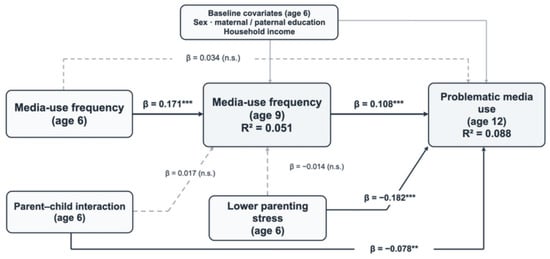
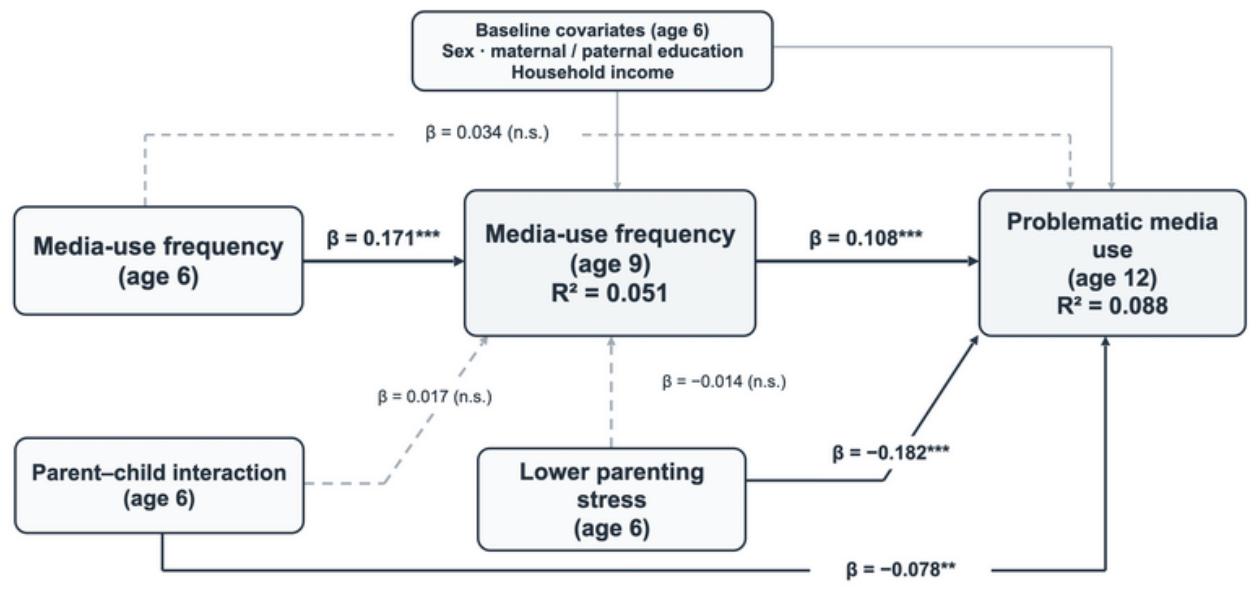
Fully adjusted longitudinal path model. Note. Coefficients label focal media-use and family paths. Dark solid arrows indicate statistically significant focal paths, dashed arrows indicate non-significant focal paths, and light gray solid arrows represent paths from baseline covariates (individual estimates in Table 4). Exogenous covariances are omitted. n.s. = not significant. ** p < 0.01. *** p < 0.001.
Media-use frequency at age 6 was positively associated with media-use frequency at age 9 (β = 0.171, 95% CI [0.118, 0.225], p < 0.001). Media-use frequency at age 9 was also positively associated with problematic media use at age 12 (β = 0.108, 95% CI [0.053, 0.164], p < 0.001). The direct association between age-6 media-use frequency and problematic media use at age 12 was not statistically significant (β = 0.034, 95% CI [−0.020, 0.089], p = 0.216).
3.4. Family Context and Later Media-Related Outcomes
Parent–child interaction at age 6 was not significantly associated with media-use frequency at age 9 (β = 0.017, 95% CI [−0.039, 0.073], p = 0.552). More frequent parent–child interaction was associated with lower problematic media use at age 12 (β = −0.078, 95% CI [−0.132, −0.024], p = 0.005).
Lower parenting stress at age 6 was also not significantly associated with media-use frequency at age 9 (β = −0.014, 95% CI [−0.070, 0.043], p = 0.635). Lower parenting stress was associated with lower problematic media use at age 12 (β = −0.182, 95% CI [−0.235, −0.129], p < 0.001).
3.5. Associations with Sociodemographic Covariates
Child sex was associated with media-use frequency at age 9 (β = 0.082, 95% CI [0.030, 0.134], p = 0.002) and problematic media use at age 12 (β = −0.138, 95% CI [−0.188, −0.088], p < 0.001). With sex coded as 0 = male and 1 = female, girls had slightly higher media-use frequency at age 9 but lower reported problematic media use at age 12 than boys, after adjustment for the other variables in the model.
Maternal education was negatively associated with media-use frequency at age 9 (β = −0.073, p = 0.037), while household income was positively associated with it (β = 0.064, p = 0.035). Paternal education was not significantly associated with age-9 media use (β = −0.062, p = 0.077). None of the three socioeconomic variables showed a statistically significant direct association with problematic media use at age 12: maternal education (β = −0.063, p = 0.064), paternal education (β = 0.009, p = 0.793), or household income (β = 0.017, p = 0.561).
The fully adjusted model accounted for 5.1% of the variance in media-use frequency at age 9 and 8.8% of the variance in problematic media use at age 12.
3.6. Indirect Association
As shown in Table 5, the fully adjusted model showed a positive indirect association between media-use frequency at age 6 and problematic media use at age 12 through media-use frequency at age 9 (β = 0.0186, 95% percentile bootstrap CI [0.0077, 0.0320]). Although the confidence interval excluded zero, the estimated indirect association was small.
The direct association between age-6 media-use frequency and problematic media use at age 12 was not statistically significant (β = 0.0343, 95% percentile bootstrap CI [−0.0201, 0.0891]). The total association was also not statistically significant (β = 0.0529, 95% percentile bootstrap CI [−0.0015, 0.1078]).
Table 5.
Indirect association between age-6 media use and age-12 problematic media use.
3.7. Sensitivity Analyses
Several sensitivity analyses were conducted to examine the stability of the findings across alternative model specifications, measures of media use, and approaches to missing data.
The reduced model, which constrained three socioeconomic direct paths to age-12 problematic media use to zero, yielded an indirect association similar to that of the fully adjusted model (reduced: β = 0.0196, 95% percentile bootstrap CI [0.0088, 0.0328]; fully adjusted: β = 0.0186, 95% CI [0.0077, 0.0320]). Both analyses used 5000 bootstrap resamples (5000 valid in the reduced model and 4994 valid in the fully adjusted model; Table S1 and Appendix A, Table A1). The total association was β = 0.0549 (95% CI [0.0004, 0.1088]) in the reduced model and β = 0.0529 (95% CI [−0.0015, 0.1078]) in the fully adjusted model. The reduced-model interval for the total association excluded zero, and the fully adjusted interval did not, but the two estimates were nearly identical, and both lower limits were close to zero.
Problematic media use at age 9 was examined in a matched subset of 1389 children, with the full socioeconomic adjustment retained in both models. The association between age-9 media-use frequency and age-12 problematic use decreased from β = 0.1004 to β = 0.0557 after age-9 problematic use was included. The indirect estimate decreased from β = 0.0180 to β = 0.0100 (95% percentile bootstrap CI [0.0002, 0.0218] for the model including age-9 problematic use; 4988 valid resamples of 5000). Age-9 problematic media use was positively associated with age-12 problematic media use (β = 0.3639, 95% percentile bootstrap CI [0.3087, 0.4171]). The lower confidence limit of the indirect association was close to zero (Table S2, Panel A).
In a separate analysis of 1203 children with teacher-rated self-control data at age 6, the indirect estimate was similar before (β = 0.019) and after (β = 0.020), including self-control (Table S2, Panel B).
Alternative media-use indicators were examined in a common subset of 1219 children. At age 6, both television use (β = 0.009, 95% Wald CI [0.001, 0.016], p = 0.026) and non-television device use (β = 0.016, 95% Wald CI [0.006, 0.027], p = 0.003) yielded positive indirect associations with age-12 problematic media use through age-9 media-use frequency (Table S3). These exploratory results do not establish a statistically significant difference between the device categories. At age 9, the indirect association was evident for gaming and entertainment use (β = 0.031, 95% Wald CI [0.017, 0.045]), but not for learning and information-seeking use (β ≈ 0.000, 95% Wald CI [−0.001, 0.001]). The corresponding association for social networking use was smaller and did not reach conventional statistical significance (β = 0.008, p = 0.051). These exploratory comparisons suggest that the findings varied according to the activities included in the media-use index. The alternative-indicator estimates are reported in Table S3.
The indirect association was also retained in the complete-case analysis (n = 1082; β = 0.016, 95% Wald CI [0.005, 0.027]), compared with β = 0.019 under FIML. However, the negative association between parent–child interaction and problematic media use was attenuated in the complete-case analysis (β = −0.058, p = 0.056). Excluding participants with only sex information or without observations on any of the three focal measures did not materially change the primary estimates. Similarly, restricting the age-9 media-use score to children who completed all five items, instead of averaging the available responses, produced virtually unchanged indirect estimates. The complete-case comparison, exclusion of minimally informative cases, and age-9 partial-response scoring sensitivity analysis are reported in Table S4 (Panels A–C, respectively).
Finally, longitudinal sampling weights from wave 13 were applied in a supplementary analysis of 1397 children. The indirect association was similar in the unweighted (β = 0.0184) and weighted (β = 0.0199) models. This comparison incorporated longitudinal weights but did not account for the original sampling strata or primary sampling units, which were not identified in the available public-use data. Weighted and unweighted estimates for the matched sample are reported in Table S5.
4. Discussion
The present study examined longitudinal associations among media-use frequency in early childhood, media-use frequency at age 9, and problematic media use at age 12, while also considering parent–child interaction and parenting stress as distinct characteristics of the early family context. Early media-use frequency was positively associated with media-use frequency at age 9, and media-use frequency at age 9 was positively associated with problematic media use at age 12. The bootstrapped indirect association through media use at age 9 was statistically significant (β = 0.019, 95% bootstrap CI [0.008, 0.032]), whereas the direct association between early media use and problematic media use at age 12 was not statistically significant (β = 0.034, p = 0.216). This is a longitudinal indirect association, not evidence of causal mediation. The magnitude of this indirect association was small, and the model accounted for 8.8% of the variance in problematic media use at age 12, leaving most of the variation in this outcome unexplained. Small longitudinal associations can still be informative, but early media-use frequency was not a strong or sufficient predictor of later problematic use.
The sensitivity analyses placed some limits on the interpretation of the main result. In the same subset of 1389 children, adding age-9 problematic media use reduced the age-9 media-frequency coefficient for age-12 problematic use from β = 0.1004 to β = 0.0557. The indirect estimate decreased from β = 0.0180 to β = 0.0100, and its 95% percentile bootstrap confidence interval was close to zero at the lower limit [0.0002, 0.0218]. Because media-use frequency and problematic use at age 9 were measured concurrently, this conditional association cannot establish an independent developmental mechanism. Estimates also varied by media-use activity: a positive indirect association was observed for gaming and entertainment use, but not for learning and information seeking. These exploratory specifications do not establish statistically significant differences between activities. The indirect estimate changed little in the teacher-rated self-control, complete-case, and longitudinal-weight sensitivity analyses.
Because the age-6 index reflected the frequency of use across devices and the age-9 index reflected the frequency of use across purposes, the association between them (β = 0.171) should be understood as a relationship between two age-specific operationalizations of media engagement rather than as evidence of behavioral continuity in a strict psychometric sense. Frequent use of several devices in early childhood may partly reflect household access and family routines, whereas frequent use across several purposes at age 9 may reflect a broader range of motivations, including both educational and recreational activities. With this qualification, the findings are broadly consistent with longitudinal research on screen-media use across childhood (Trinh et al., 2020) and suggest that media engagement during middle childhood, particularly recreational engagement, may be relevant to understanding later problematic use. They do not, however, identify a specific window for intervention.
The family-context analyses identified associations between age-6 parent–child shared-activity frequency, parenting stress, and problematic media use at age 12. More frequent parent–child shared activities at age 6 were associated with lower problematic media use at age 12, as was lower parenting stress. Neither parent–child shared-activity frequency nor parenting stress was significantly associated with media-use frequency at age 9. A significant association with one outcome and a non-significant association with the other do not in themselves show that the two associations differ, especially because the outcomes were measured at different ages. The association involving lower parenting stress was the largest in absolute magnitude among the principal predictors of age-12 problematic media use (β = −0.182). Because parenting stress and later problematic media use were both mother-reported, shared reporting tendencies may have contributed to this association, and its magnitude should be interpreted cautiously. In addition, the association for parent–child interaction was attenuated in the complete-case analysis (β = −0.058, p = 0.056), indicating that this estimate was somewhat sensitive to the handling of missing data.
This pattern agrees with previous research linking parenting stress, parent–child relationships, and parental media-related practices with children’s media behaviors (Beyens & Eggermont, 2014; J. Li et al., 2023; Liu et al., 2025; Radesky et al., 2016). However, the present measures did not directly assess the processes that may underlie these associations. The parent–child interaction index recorded the frequency of shared activities rather than the quality of relational exchanges, and the parenting-stress measure captured mothers’ perceived parenting burden; neither assessed children’s self-regulation or parental mediation of digital-media use. Frequent shared activities and lower parenting burden may coincide with family processes that support children’s self-regulatory development, but the present findings establish associations involving these reported family characteristics and do not demonstrate that relational quality or self-regulation accounts for them. Future research should directly examine whether children’s self-regulation, parental media mediation, and family communication processes account for these longitudinal associations.
Research focusing on older age groups has similarly suggested that technology-related disruptions in parent–child interactions may be associated with problematic digital-media behaviors and psychological adjustment (Vangölü et al., 2026). Although these findings were obtained with adolescents and therefore cannot be directly generalized to the younger children in the present sample, they point to the relevance of family relational processes beyond early childhood.
Sex was associated differently with the two media-related outcomes. Compared with boys, girls were reported by parents to have slightly higher media-use frequency at age 9 but lower levels of problematic media use at age 12. This pattern is consistent with treating media-use frequency and problematic media use as distinct constructs. Previous research has reported sex differences in patterns of digital-media use and in their associations with well-being or problematic use (Arpaci, 2022; Booker et al., 2018; Twenge & Martin, 2020). However, reviews suggest that sex differences in problematic Internet use are not entirely consistent across studies and may vary according to cultural context, media content, and specific forms of digital behavior (Baloğlu et al., 2020). Because the present study did not assess sex-specific media content, motivations, or psychological mechanisms, these sex differences should be interpreted with caution.
The sociodemographic covariates also showed relatively small associations with media-use frequency at age 9. Higher maternal education was associated with slightly lower media-use frequency, whereas higher household income was associated with slightly higher media-use frequency. Paternal education was not significantly associated with age-9 media use. These coefficients were small, suggesting at most a modest contribution of socioeconomic background to children’s media engagement at age 9.
4.1. Limitations
This study has several limitations. First, the three assessments established the temporal order of the measured variables, but the observational design does not permit causal inference. The direct and indirect associations should not be interpreted as causal effects or evidence of a developmental mechanism. The intervals between waves also precluded an examination of shorter-term changes and reciprocal associations.
Second, media-use frequency was operationalized differently at ages 6 and 9. The age-6 index covered use across devices, whereas the age-9 index covered different purposes of use. The two indices had relatively low internal consistency (Cronbach’s α = 0.448 and 0.534, respectively), potentially reflecting their heterogeneous item content. Their association should not be interpreted as stability or change in a single invariant construct, and measurement error may have attenuated the estimates. Associations also differed across the exploratory age-9 activity indicators, although these comparisons were not formal tests of differences between media-use domains.
Third, most measures relied on parental reports. Parenting stress at age 6 and problematic media use at age 12 were both reported by mothers, so common reporting tendencies or relatively stable parental perceptions may have contributed to their negative association. The parent–child interaction measure captured the frequency of shared activities rather than relationship quality or parental mediation of digital-media use. Although teacher-rated self-control was considered in a supplementary analysis, the primary model did not directly test the self-regulatory processes discussed as possible explanations.
Fourth, substantial proportions of the cohort had missing observations. Age-9 media-use missingness was associated with observed age-6 media-use frequency, and the missing-at-random assumption required for FIML could not be verified. Because age-6 and age-9 media-use frequency constitute the first segment of the estimated indirect pathway, selective missingness at age 9 may have influenced the estimated association between these variables and, consequently, the indirect estimate. Of the 2150 children, 476 had no observed data on any of the three focal measures, including 464 with sex information only among the model variables. Excluding these minimally informative cases did not materially change the principal estimates, and the complete-case analysis yielded a similar indirect association. However, the association between parent–child interaction and age-12 problematic media use was attenuated in the complete-case analysis (β = −0.058, p = 0.056). These sensitivity findings do not rule out bias related to unobserved determinants of missingness.
Fifth, the primary model was unweighted and should be interpreted as describing conditional associations in the analytic cohort rather than nationally representative population estimates. A supplementary analysis applying wave-13 longitudinal sampling weights yielded a similar indirect association, but the original sampling strata and primary sampling units were not available in the public-use files. Neither the weighted analysis nor the bootstrap procedure incorporated the complete stratified multistage sampling design. As a result, the uncertainty estimates do not fully account for survey-design effects, and their direction or magnitude cannot be determined from the present analyses.
Finally, problematic media use at age 12 was assessed between July and November 2020, during the COVID-19 pandemic. Changes in schooling, social interactions, and everyday reliance on digital technologies may have affected both children’s media engagement and parental reports of problematic use. The data cannot separate period-specific circumstances from developmental associations, which limits generalization to periods without comparable disruptions.
4.2. Implications
Longitudinal studies of childhood media use need to account for changes in the devices and activities children engage with as they grow. The age-6 and age-9 measures in this study captured different aspects of media engagement, and exploratory estimates at age 9 varied across activity categories. Future studies could assess the frequency, content, and context of media use at each wave, together with repeated measures of problematic use. This would allow closer examination of how everyday media routines relate to later difficulties in regulating use.
The family findings also call for further study. Parent–child interaction and parenting stress at age 6 were associated with problematic media use at age 12, although the association involving parent–child interaction was less consistent in the complete-case analysis. The interaction measure recorded how often parents and children took part in shared activities; it did not assess interaction quality or parental guidance around digital media. Future studies could include direct observations of family interaction, parental media practices, and assessments of children’s self-regulation to examine the processes involved.
Early childhood educators may find these results useful when talking with families about children’s media routines, including how devices are used at home, shared activities, and everyday parenting demands. The findings do not establish that changes in these routines would prevent problematic media use. Evaluations of family-based support and educational interventions are needed before conclusions can be drawn about their effectiveness.
5. Conclusions
This study found a small positive indirect association between media-use frequency at age 6 and problematic media use at age 12 through media-use frequency at age 9. In the primary fully adjusted model, neither the direct nor the total association was statistically significant. The indirect estimate was attenuated after accounting for age-9 problematic media use in a matched-sample sensitivity analysis. The primary model explained 8.8% of the variance in age-12 problematic media use, leaving most of the variation unexplained. The age-6 and age-9 measures covered different aspects of media engagement, and exploratory analyses produced different estimates across age-9 activity indicators.
More frequent parent–child interaction and lower parenting stress at age 6 were associated with lower reported problematic media use at age 12. The association involving parent–child interaction was less consistent in the complete-case analysis. Future longitudinal research could include repeated assessments of problematic use and more detailed measures of media activities and family practices. The observational design and the age-12 assessment during the COVID-19 pandemic limit causal interpretation and generalization.
Supplementary Materials
The following supporting information can be downloaded at: https://www.mdpi.com/article/10.3390/bs16122234/s1, Table S1: Fully adjusted and reduced longitudinal path specifications; Table S2: Sensitivity checks for age-9 problematic media use and teacher-rated age-6 self-control; Table S3: Alternative media-use composite specifications; Table S4: Missing-data and age-9 partial-response scoring sensitivity checks; Table S5: Sensitivity analysis using longitudinal weights from the age-12 assessment (wave 13); Table S6: Observation overlap and exploratory attrition comparisons. Supplementary Code S1 (Supplementary_Code_S1_Lavaan_Analysis.zip) contains the R/lavaan model specifications and scripts for the primary and sensitivity analyses.
Author Contributions
Conceptualization, J.Y.; methodology, S.L.; software, S.L.; formal analysis, S.L.; investigation, J.Y.; writing—original draft preparation, J.Y.; writing—review and editing, J.Y. and S.L.; supervision, S.L. All authors have read and agreed to the published version of the manuscript.
Funding
This research received no external funding.
Institutional Review Board Statement
The present secondary analysis used de-identified PSKC data and was reviewed by the Public Institutional Review Board designated by the Ministry of Health and Welfare, which determined the study to be exempt from full review (Notice Management No. 2025-2002-001; Exemption Confirmation No. P01-202508-01-056). The exemption was granted on 26 August 2025.
Informed Consent Statement
According to the PSKC data-collection procedures, informed consent was obtained from parents or guardians prior to participation. For surveys involving participating children, parental or guardian consent and child assent were obtained before administration of the child survey.
Data Availability Statement
The data analyzed in this study were obtained from the Panel Study on Korean Children (PSKC), conducted by the Korea Institute of Child Care and Education (KICCE). Access to the data is subject to the data-use procedures established by KICCE; the data can be requested through the PSKC website https://panel.kicce.re.kr/ (accessed on 3 November 2026). The R/lavaan model syntax and analysis scripts are provided as Supplementary Code S1. The individual-level PSKC data are not included in the Supplementary Materials.
Acknowledgments
The authors thank the Korea Institute of Child Care and Education (KICCE) for providing access to the Panel Study on Korean Children (PSKC) data.
Conflicts of Interest
The authors declare no conflicts of interest.
Appendix A
Table A1.
Comparison of principal estimates from the fully adjusted and reduced models.
References
- Anderson, D. R., Huston, A. C., Schmitt, K. L., Linebarger, D. L., & Wright, J. C. (2001). Early childhood television viewing and adolescent behavior: The recontact study. Monographs of the Society for Research in Child Development, 66(1), i–viii, 1–147. [Google Scholar] [CrossRef] [Scilit]
- Arpaci, I. (2022). Gender differences in the relationship between problematic internet use and nomophobia. Current Psychology, 41(9), 6558–6567. [Google Scholar] [CrossRef] [Scilit]
- Baloğlu, M., Şahin, R., & Arpaci, I. (2020). A review of recent research in problematic internet use: Gender and cultural differences. Current Opinion in Psychology, 36, 124–129. [Google Scholar] [CrossRef] [Scilit]
- Beyens, I., & Eggermont, S. (2014). Putting young children in front of the television: Antecedents and outcomes of parents’ use of television as a babysitter. Communication Quarterly, 62(1), 57–74. [Google Scholar] [CrossRef] [Scilit]
- Bollen, K., & Lennox, R. (1991). Conventional wisdom on measurement: A structural equation perspective. Psychological Bulletin, 110(2), 305–314. [Google Scholar] [CrossRef]
- Booker, C. L., Kelly, Y. J., & Sacker, A. (2018). Gender differences in the associations between age trends of social media interaction and well-being among 10–15 year olds in the UK. BMC Public Health, 18(1), 321. [Google Scholar] [CrossRef] [Scilit]
- Bronfenbrenner, U., & Morris, P. A. (2006). The bioecological model of human development. In R. M. Lerner (Ed.), Handbook of child psychology (6th ed., Vol. 1, pp. 793–828). John Wiley & Sons. [Google Scholar] [CrossRef] [Scilit]
- Council on Communications and Media. (2016). Media and young minds. Pediatrics, 138(5), e20162591. [Google Scholar] [CrossRef] [Scilit]
- Domoff, S. E., Borgen, A. L., & Radesky, J. S. (2020). Interactional theory of childhood problematic media use. Human Behavior and Emerging Technologies, 2(4), 343–353. [Google Scholar] [CrossRef] [Scilit]
- Gebremariam, M. K., Totland, T. H., Andersen, L. F., Bergh, I. H., Bjelland, M., Grydeland, M., Ommundsen, Y., & Lien, N. (2012). Stability and change in screen-based sedentary behaviours and associated factors among Norwegian children in the transition between childhood and adolescence. BMC Public Health, 12, 104. [Google Scholar] [CrossRef] [Scilit]
- Jang, H. E. (2025). Chodeunghakgyo jeohangnyeon sigiui bumo-janyeo sanghojagyong, jiphaeng gineung gollangwa chodeunghakgyo gohangnyeon sigiui midieo gigi jungdok ganui jongdanjeok gwangye bunseok: Jamjae seongjang mohyeongeul hwaryonghan jongdan maegae hyogwa geomjeung [The mediating role of executive function difficulties in the link between early parent–child interaction and later media device addiction in elementary school: A longitudinal analysis]. Korean Journal of Child Care and Education Policy, 19(1), 1–23. [Google Scholar] [CrossRef]
- Kaye, L. K., Orben, A., Ellis, D. A., Hunter, S. C., & Houghton, S. (2020). The conceptual and methodological mayhem of “screen time”. International Journal of Environmental Research and Public Health, 17(10), 3661. [Google Scholar] [CrossRef] [Scilit]
- Kim, E., Bae, Y., Kim, K. J., Jo, H., & Kim, H. (2020). Hanguk adong seongjang baldal jongdan yeongu 2020 (Hanguk adong paeneol II) [2020 longitudinal study of growth and development of Korean children: Panel study on Korean children II] (Research report 2020-28). Korea Institute of Child Care and Education. [Google Scholar]
- Kim, K. H., & Kang, H. K. (1997). Yangyuk seuteureseu cheokdoui gaebal [Development of the parenting stress scale]. Journal of the Korean Home Economics Association, 35(5), 141–150. [Google Scholar]
- Li, D., Li, W., & Zhu, X. (2023). Parenting style and children emotion management skills among Chinese children aged 3–6: The chain mediation effect of self-control and peer interactions. Frontiers in Psychology, 14, 1231920. [Google Scholar] [CrossRef] [Scilit]
- Li, J., Zhai, Y., Xiao, B., Xia, X., Wang, J., Zhao, Y., Ye, L., & Li, Y. (2023). Maternal COVID-19 distress and Chinese preschool children’s problematic media use: A moderated serial mediation model. Psychology Research and Behavior Management, 16, 2553–2567. [Google Scholar] [CrossRef] [Scilit]
- Liu, X., Ran, F., & Zhang, Y. (2025). The lagged effects of parent–child relationship on internet addiction: Parallel mediation of psychological need frustration and self-esteem. BMC Public Health, 25(1), 1605. [Google Scholar] [CrossRef] [Scilit]
- McNeish, D. (2018). Thanks coefficient alpha, we’ll take it from here. Psychological Methods, 23(3), 412–433. [Google Scholar] [CrossRef] [Scilit]
- Munzer, T., Parga-Belinkie, J., Milkovich, L. M., Tomopoulos, S., Ajumobi, T., Cross, C., Gerwin, R., Madigan, S., & Council on Communications and Media. (2026). Digital ecosystems, children, and adolescents: Policy statement. Pediatrics, 157(2), e2025075320. [Google Scholar] [CrossRef] [Scilit]
- National Information Society Agency (NIA). (2013). Inteonet jungdok jindan cheokdo (K-cheokdo) tadangdo godohwa yeongu [Advanced validation study of the Internet addiction diagnostic scale (K-Scale)]. National Information Society Agency.
- National Information Society Agency (NIA). (2025). 2024nyeon seumateupon gwauijon siltae josa bogoseo [2024 survey on smartphone overdependence]. National Information Society Agency.
- Organisation for Economic Co-Operation and Development (OECD). (2023). Empowering young children in the digital age. OECD Publishing. [Google Scholar] [CrossRef] [Scilit]
- Pagani, L. S., Fitzpatrick, C., Barnett, T. A., & Dubow, E. (2010). Prospective associations between early childhood television exposure and academic, psychosocial, and physical well-being by middle childhood. Archives of Pediatrics & Adolescent Medicine, 164(5), 425–431. [Google Scholar] [CrossRef] [Scilit]
- Radesky, J. S., Peacock-Chambers, E., Zuckerman, B., & Silverstein, M. (2016). Use of mobile technology to calm upset children: Associations with social-emotional development. JAMA Pediatrics, 170(4), 397–399. [Google Scholar] [CrossRef] [Scilit]
- R Core Team. (2025). R: A language and environment for statistical computing (Version 4.4.3) [Computer software]. R Foundation for Statistical Computing. Available online: https://www.R-project.org/ (accessed on 3 November 2026).
- Rosseel, Y. (2012). lavaan: An R package for structural equation modeling. Journal of Statistical Software, 48(2), 1–36. [Google Scholar] [CrossRef] [Scilit]
- Sijtsma, K. (2009). On the use, the misuse, and the very limited usefulness of Cronbach’s alpha. Psychometrika, 74(1), 107–120. [Google Scholar] [CrossRef] [Scilit]
- Song, H. (2022). Longitudinal investigations of autoregressive cross-lagged path models among Internet use, executive function problems, and maternal control in young Korean children. Frontiers in Psychiatry, 13, 846995. [Google Scholar] [CrossRef] [Scilit]
- Trinh, M.-H., Sundaram, R., Robinson, S. L., Lin, T.-C., Bell, E. M., Ghassabian, A., & Yeung, E. H. (2020). Association of trajectory and covariates of children’s screen media time. JAMA Pediatrics, 174(1), 71–78. [Google Scholar] [CrossRef] [Scilit]
- Twenge, J. M., & Martin, G. N. (2020). Gender differences in associations between digital media use and psychological well-being: Evidence from three large datasets. Journal of Adolescence, 79(1), 91–102. [Google Scholar] [CrossRef] [Scilit]
- Vangölü, M. S., Padir, M. A., & Tayiz, V. (2026). The shadow of parental phubbing on adolescents’ psychological adjustment: Roles of problematic social media use and social support. BMC Psychology, 14, 624. [Google Scholar] [CrossRef] [Scilit]
- Wang, J., Wang, S., Xiao, B., Li, J., Feng, Y., & Li, Y. (2024). Maternal distress, parenting stress, maladaptive parenting and children’s problematic media use in China: Evidence from 2022 spring in Shanghai. BMC Public Health, 24(1), 1857. [Google Scholar] [CrossRef] [Scilit]
- World Health Organization (WHO). (2019). Guidelines on physical activity, sedentary behaviour and sleep for children under 5 years of age. Available online: https://iris.who.int/handle/10665/311664 (accessed on 3 November 2026).
- Yun, J., Han, G., & Son, H. (2022). Protective and risk factors of problematic smartphone use in preteens using panel study on Korean children. Frontiers in Psychiatry, 13, 981357. [Google Scholar] [CrossRef] [Scilit]
- Zhu, Y., Deng, L., & Wan, K. (2022). The association between parent-child relationship and problematic internet use among English- and Chinese-language studies: A meta-analysis. Frontiers in Psychology, 13, 885819. [Google Scholar] [CrossRef] [Scilit]

Disclaimer/Publisher’s Note: The statements, opinions and data contained in all publications are solely those of the individual author(s) and contributor(s) and not of MDPI and/or the editor(s). MDPI and/or the editor(s) disclaim responsibility for any injury to people or property resulting from any ideas, methods, instructions or products referred to in the content. |
© 2026 by the authors. Licensee MDPI, Basel, Switzerland. This article is an open access article distributed under the terms and conditions of the Creative Commons Attribution (CC BY) license.