


Abstract
Human performance in the performing arts is a complex, multifaceted experience intertwining technical proficiency, artistic expression, and psychological resilience to anxiety and stress. One key factor influencing a musician’s success and well-being is self-perceived performance quality (SPPQ), which plays a vital role in motivation, confidence, and career longevity. Sport psychology frameworks such as S.F.E.R.A. (Synchrony, Force/Strength, Energy, Rhythm, Activation) support optimal performance by monitoring and improving related mental factors. This study investigated the relationships among SPPQ, music performance anxiety (MPA), and mental skills as assessed by the SFERA model in professional musicians. Eighty-two participants (53% females) completed an online survey including the SFERA questionnaire and the Kenny Music Performance Anxiety Inventory (K-MPAI). We found significant negative correlations between SPPQ and MPA, and significant positive correlations between SPPQ and SFERA (total and subfactor scores). “Force” (i.e., strength of personal resources), proximal somatic anxiety, memory issues, and biological vulnerability emerged as the strongest predictors of SPPQ in the variable importance analysis. In other words, musicians with higher anxiety tended to report lower SPPQ and lower SFERA mental skills. Further mediation analysis showed that SFERA scores mediated approximately 60% (proportion mediated = 0.618, 95% confidence interval [0.148, 1.331]) of the association between MPA and SPPQ. These findings underscore the applicability of sport-based mental skills models to music contexts and highlight the potential protective role of mental skills in mitigating the impact of performance anxiety on performers’ self-perceived quality.
1. Introduction
In professional performance ecosystems, career-defining outcomes are often determined in high-stakes, evaluative settings such as auditions, competitions, and selection trials. These settings impose qualitatively different pressures to routine concerts or matches, including direct peer comparison, expert juries, and minimal tolerance for error. This can heighten vulnerability to performance anxiety and compromise reliability under pressure (Biasutti & Concina, 2014; Eysenck, 1979; Kenny & Ackermann, 2015; Mazzon et al., 2024).
As with other performing arts, music performance is a complex and multifaceted experience that combines technical proficiency, artistic expression and psychological resilience. One of the key psychological factors that influence a musician’s success and well-being is self-perceived performance quality (SPPQ), the personal evaluation of how well one performs, independent of external validation or objective measures. This self-assessment plays a vital role in motivation, confidence, and career longevity, shaping not only a musician’s professional trajectory but also their emotional and mental health (Hewitt, 2011, 2015; Powers et al., 2009; Stoeber & Eismann, 2007). Unlike objective performance evaluations that focus on measurable aspects such as accuracy, tempo control, or intonation, SPPQ is largely subjective, influenced by a musician’s expectations, experiences, and psychological makeup. Musicians continuously judge themselves based on their own internal criteria, which may be shaped by prior experiences, feedback from teachers and peers, personality traits, and perfectionistic tendencies. A positive self-perception can enhance motivation and persistence, encouraging musicians to take creative risks, embrace challenges, and remain engaged in their craft (Bergee & Cecconi-Roberts, 2002; González et al., 2018; Priest, 2006). In contrast, negatively biased SPPQ may lead to performance anxiety, self-doubt, and avoidance behaviors, sometimes resulting in diminished enjoyment of music-making and even career stagnation (Zelenak, 2024).
Several psychological constructs play a significant role in how musicians evaluate their own performances, such as self-efficacy, perfectionism, and music performance anxiety (MPA). MPA, a multidimensional pattern of cognitive worry, somatic arousal, and attentional disruption, is prevalent and consequential in professional musicians, with severe symptomatology common and closely tied to emotion regulation and attentional control demands at the moment of execution (Chang-Arana et al., 2018). MPA is the fear of performing in front of an audience, which can significantly distort self-perception. Musicians experiencing high MPA may focus on errors and imperfections, overlooking their strengths and positive aspects of their playing. Recognizing the impact of MPA on SPPQ is crucial for musicians at all levels; in fact, in music, subjective performance quality has been examined in relation to post-event cognitive processes (Nielsen et al., 2018) and through structured retrospective self-evaluations of multiple performances (Morijiri & Welch, 2022). As highlighted by Rowland et al. (2021), performance anxiety across domains such as sport and music performance, disrupts the automaticity of skilled behaviors by shifting attention toward explicit control, increasing the risk of choking and performance decline. This suggests that, also in musicians, self-perceived performance quality is influenced both by anxiety and by the ability to access automatic cognitive and motor processes under stress. From this perspective, mental skills training may facilitate the restoration of such automaticity, reducing the detrimental effects of anxiety on SPPQ (Rowland et al., 2021).
Strategies for improving SPPQ and managing MPA include developing self-awareness, self-compassion techniques, arousal regulation, seeking positive reinforcement, constructive feedback, practicing mindfulness and mental resilience (Zelenak, 2024). Despite their efficacy, these techniques may address only part of the issue and more holistic approaches are needed. Performance psychology models may provide a viable and practical solution, as they aim at tracking the mental skills most relevant to performance (Aoyagi & Poczwardowski, 2012; Smith & Smoll, 2004). Despite their popularity in the field of sport psychology, these models are still rather unpopular in music and research on their effectiveness is still lacking. A previous study by (Mazzon et al., 2024) explored the use of the S.F.E.R.A. model (SFERA), a popular performance psychology model used in several performance domains, in a sample of musicians. The SFERA model theory (Caputo et al., 2023; Caputo et al., 2026; Vercelli, 2016) is based on a multidimensional performance framework originally developed in sport psychology and subsequently applied to other high-performance domains. The model conceptualizes performance readiness through five interrelated psychological components—Synchrony, Strength, Energy, Rhythm, and Activation—describing attentional alignment, perceived personal resources, regulation of internal energy, temporal organization of action and control, and motivational readiness, respectively. These dimensions show conceptual overlap with established constructs in performance psychology, such as self-efficacy, flow, engagement, and arousal regulation, suggesting that S.F.E.R.A. can be interpreted as an integrative, performance-oriented configuration of psychological resources influencing the performances (Caputo et al., 2023).
The model assesses and identifies five key psychological components that shape performance, named Synchrony, Force (or Point of Strength), Energy, Rhythm, and Activation. Synchrony refers to mental focus and present-moment awareness. A lack of it indicates a disconnection between mind and body. Force encompasses the recognition and use of personal strengths (i.e., physical, technical, and mental) and aligns closely with Bandura’s self-efficacy theory (Bandura, 1997). Energy involves managing emotional and physical resources to reach optimal arousal and enter a flow state, allowing individuals to stay engaged while avoiding fatigue, distraction or excess of arousal activation. Rhythm reflects self-awareness and metacognitive strategies like planning, monitoring, and adjusting routines to maintain control and balance physiological and mental demands during different phases of a performance. Activation captures motivation and passion, driving people to challenge their limits, and is linked to personality traits like intrinsic motivation (Ryan & Deci, 2000) and openness to experience. The framework has been extended beyond traditional sport through context-sensitive adaptations, including applications in esports and music performance. For instance, recent work in esports describes S.F.E.R.A. as a coherent, action-oriented model targeting trainable psychological dimensions associated with self-regulation and perceived performance outcomes (Caputo et al., 2026). In the music domain, a contextualized version of the SFERA questionnaire has been previously applied to professional musicians using minor terminology adaptations while preserving the original structure, showing theoretically coherent associations with music performance anxiety (Mazzon et al., 2024). However, it remains unclear how these mental skill components relate to musicians’ own perceptions of performance quality, an aspect critical to their motivation and confidence. By leveraging the SFERA model in our study, we aim to bridge this gap—examining whether the same mental skills that support athletes can buffer the effects of performance anxiety in musicians.
Similar to athletes, performing artists are exposed to career-specific occupational injuries, including focal dystonia, tendinopathies, and overuse syndromes (Ackermann & Driscoll, 2010; Zaza, 1998). MPA in musicians has been identified as a significant risk factor, with recent research indicating that individuals with higher anxiety levels exhibit increased susceptibility to musculoskeletal problems (Kenny & Ackermann, 2015; Kok et al., 2016). The literature suggests that psychological skills training and interventions based on sport psychology models can enhance coping mechanisms, support mental resilience, and reduce the impact of performance-related stress (Hanin & Hanina, 2009; Jørgensen et al., 2026). In fact, while musicians and athletes face domain-specific constraints, core psychological determinants of skilled performance (e.g., attentional focus, self-talk, imagery, and regulation of arousal) are shared across domains. Sport meta-analyses show that psychological skills training, mindfulness and acceptance approaches, and imagery can yield performance benefits under evaluative pressure (Reinebo et al., 2024). Translational evidence in music indicates that brief, structured performance psychology training adapts these skills to reduce MPA and bolster confidence, concentration, and resilience in conservatoire settings (Osborne et al., 2014). For instance, the results by Mazzon et al. (2024) show a substantial association between mental skills assessed through the SFERA model, its factors and several aspects of MPA. However, it remains unclear how these interventions relate to musicians’ SPPQ. This gap is particularly pronounced in domains of performing arts where objective performance indicators are inherently difficult to quantify (Thompson & Williamon, 2003), highlighting the need for research that integrates psychological skill development and their relationship or influence with SPPQ during performances. While the detrimental relationship between MPA and performance outcomes has been documented in musicians, the potential buffering role of structured mental skills has not been fully explored. The present study aims to investigate whether mental skills (assessed through the SFERA model) can attenuate the negative association between music performance anxiety and self-perceived performance quality. We hypothesized that higher SFERA scores (indicating stronger mental skills) would be associated with higher SPPQ, even in the presence of MPA, and that SFERA would partly mediate (statistically account for) the relationship between MPA and SPPQ.
In our study, we hypothesized that (H1) higher MPA would be associated with lower SPPQ; (H2) higher SFERA total and dimension scores would be associated with higher SPPQ; and (H3) SFERA scores would statistically account for part of the association between MPA and SPPQ in a cross-sectional indirect-effects model.
2. Methods
The study was conducted in 2023 and 2024, and it implemented a cross-sectional design, collecting self-report measures of MPA, mental skills (i.e., SFERA) and retrospective ratings of SPPQ from a sample of professional musicians.
2.1. Participants
Participants were N = 82 professional musicians (44 women and 38 men) with a mean age of 29.9 years (SD = 9.8, range 19–61). All participants were actively engaged in music performance either as working professionals or advanced students (postgraduate level). We recruited volunteers through music conservatories during the academic year 2023/2024, professional orchestras, and online advertisements, resulting in a convenience sampling approach. Inclusion criteria required individuals to be currently performing musicians with no self-reported injuries or health conditions that could impair their performance, with no current diagnosis of a major neurological disorder or severe mental illness. Participants provided informed consent and completed the study measures online. No compensation was offered for participation. Participants were all professional musicians or postgraduates from Italian music universities, with at least 10 years of formal musical training, specializing in different instruments including violinists (17.6%), pianists (7.8%), hornists (7.8%), and singers (7.8%).
Participation was limited to individuals without neurological or psychological conditions, fluent in Italian, able to understand and take part in the study autonomously. Participants participated on a voluntary basis and provided written informed consent at the beginning of the study. They did not receive any monetary compensation. The study was approved by the Central Ethics Committee at Leibniz University Hannover (approval number EV LUH 01/2022, approved in July 2022).
2.2. Materials
Two questionnaires were used in the study, namely S.F.E.R.A. (SFERA) and the Kenny music performance anxiety inventory (KMPAI, Kenny, 2009).
Performance-related psychological skills were assessed using the S.F.E.R.A. music questionnaire, based on the SFERA model (Synchrony, Force, Energy, Rhythm, Activation). The SFERA Music Questionnaire is a music-adapted version of the original SFERA instrument for athletes (Vercelli, 2016), obtained through minor terminology changes while preserving item meaning and the five-dimension structure, as previously described in professional musicians (Mazzon et al., 2024). The Italian version (i.e., the version used in this study) includes 40 items rated on a 5-point Likert scale. Each factor is measured by 8 items (total of 40 items) rated on a 1 (strongly disagree) to 5 (strongly agree) Likert scale.
The KMPAI is a widely used instrument for music performance anxiety, covering symptoms from somatic anxiety to worry and negative cognitions. It consists of 40 items rated on a 7-point Likert scale ranging from 0 (strongly disagree) to 6 (strongly agree). In the present study, the validated Italian translation of the KMPAI was implemented (Antonini Philippe et al., 2023). The questionnaire has been widely used in research across different populations of musicians, including vocalists, instrumentalists, classical and popular musicians, students, and professionals. It measures MPA as a single construct (KMPAI.TOT) as well as 8 different aspects of MPA, represented by its 8 subscales, namely the following:
- Proximal somatic anxiety and worry about performance (11 items), assessing physical symptoms and anticipatory anxiety directly related to performing, such as dry mouth or trembling before or during a performance.
- Negative cognitions (8 items), measuring intrusive and self-defeating thoughts that interfere with performance, especially those related to fear of evaluation.
- Psychological vulnerability (8 items), which captures broader emotional distress, including feelings of hopelessness, low self-worth, and existential pessimism.
- Parental empathy (4 items), which evaluates the degree of emotional support and responsiveness received from parents during formative years.
- Memory (2 items), assessing confidence in memory reliability during performance, particularly when playing without sheet music.
- Generational transmission of anxiety (3 items), which reflects familial patterns of excessive worry and anxiety passed down through generations.
- Anxious apprehension (3 items), which measures uncertainty and anticipatory anxiety about performance outcomes, including doubts about one’s ability to perform well.
- Biological vulnerability (1 item), which indicates early onset of performance-related anxiety symptoms, suggesting a predisposition to anxiety from the beginning of musical training.
Self-perceived performance quality (SPPQ) was operationalized as the mean of three retrospective ratings (0–100) referring to recent important public performances. Participants were instructed to recall three important public performances (most recent first), to provide a brief description of each event to ensure contextual specificity, and to rate their perceived performance quality from 0 (“very poor”) to 100 (“excellent”). Each event was elicited sequentially on separate screens to minimize direct cross-event comparison during rating. Responses not referring to public performances were excluded during data screening; no missing data were observed. We calculated three SPPQ indices for each participant: the mean performance quality (PQ_mean), the range (maximum minus minimum rating; PQ_range), and the trend over time (PQ_slope). The PQ_slope was computed by regressing the three quality ratings onto time (oldest performance coded 0, the next 0.5, and the most recent 1). Subjective post-performance appraisals are widely used across performance domains as psychologically meaningful indicators of perceived effectiveness, including in musicians (Nielsen et al., 2018), professional pianists’ retrospective multi-performance evaluations (Morijiri & Welch, 2022), athletes’ perceived performance and satisfaction ratings (Britton et al., 2019; Almagro et al., 2020), dancers’ global perceived performance (Silva et al., 2020), and cross-domain examinations of anxiety and perceived performance in athletes and musicians (Núñez et al., 2020). In addition, the averaging of retrospective self-ratings of several recent performances is a well-established approach in sports psychology. In this approach, athletes rate their performance in multiple past competitions (Pellizzari et al., 2011; Robazza et al., 2008). This reduces the influence of idiosyncrasies relating to individual events.
2.3. Procedure
After providing written consent to participate in the study, participants filled an online questionnaire and were invited to access it through their mobile phone, tablets, or notebooks, through a dedicated link. Demographic and educational information, such as age, biological sex, and degrees in music and instruments played, was also collected. Participants were allowed to drop out of the study at any time without providing an explanation. All data was collected anonymously. Missing items were not permitted so that the analysis could be relied upon and scale scores could be computed from complete sets of items. To ensure the quality of the data, invalid and duplicate entries were eliminated manually. This was achieved by analysing response patterns, completion time, online survey metadata, and response similarity. No responses were excluded at this preliminary stage.
2.4. Statistical Analysis
Before conducting the study, a power analysis was performed to determine the necessary sample size to detect small-to-moderate correlations between the variables of interest. The results indicated that a sample size of 67 participants were sufficient to detect significant small-to-moderate effect sizes (r = 0.30) for one-sided correlations, with a power of 0.8 and an alpha level of 0.05.
The normality of variable distributions was assessed using the Kolmogorov–Smirnov test (results indicated no significant deviations from normality). The internal consistency of the scales was assessed by computing Cronbach’s alpha coefficients. The association between the KMPAI, the SFERA and the five SFERA factors, and performance quality indices was investigated using correlation matrices (Pearson’s r coefficients). To evaluate the effect of anxiety on performance quality, performance quality indices and SFERA scores were regressed on KMPAI main scores and participants’ age and sex. To evaluate the importance of individual KMPAI and SFERA factors in predicting performance quality indices (i.e., PQ_mean, PQ_slope, PQ_range), Random Forest (RF) models were developed and a hyperparameter tuning procedure was run, to evaluate the optimal mtry and minimum node size values to be used in the analysis. Model performance was evaluated out-of-sample, using a 5-fold cross-validation, and considering R2, RMSE, and MAE performance metrics. Performance indices were computed as off-sample metrics during cross-validation, using data folds that were excluded from model training. Variable importance scores computed through permutation were extracted from the optimal RF model and normalized to a 0–1 scale, with each variable’s importance expressed relative to the most influential predictor. Performance quality indices were analyzed separately, with dedicated RF models and tuning procedures. Variable importance of KMPAI subscales and SFERA factors was evaluated separately, through dedicated RF models. A mediation analysis was conducted to investigate the interdependence between performance quality, anxiety, and mental skills. Note that due to the cross-sectional design of the study, the mediation analysis is intended here as conditional process modeling rather than causal mediation. PQ_mean scores were considered as the dependent variable, KMAPI scores as predictor in the direct effect path, and SFERA scores as mediator in the indirect effect path. Mediation effects coefficients were estimated through 1000 bootstrap iterations. In the analyses, performance quality indices, SFERA factors, KMPAI subscales and age were standardized across participants while sex was coded as −0.5 and 0.5 for female and male participants, respectively.
All statistical analyses were performed using R Studio (RStudio Team, 2023, Version 2023.06.0).
3. Results
Demographics and descriptive statistics are reported in Table 1. All variables appeared normally distributed. The SFERA total score showed excellent internal consistency (Cronbach’s α = 0.94), and subscale reliability values ranged from α = 0.72 to α = 0.85, indicating acceptable to good reliability in each mental skill dimension. KMPAI main scale showed excellent internal consistency (alpha = 0.92) while the alpha value of its subscales was in the acceptable range (alpha > 0.70) with the only exception of par_emp showing questionable consistency (alpha > 0.60). The KMPAI subscale biological vulnerability consists of a single item for which alpha value cannot be computed.
Table 1.
Demographics and descriptive statistics over the entire sample and for each sex group.
Correlation analyses are reported in Table 2. They revealed moderate, significant correlations between performance quality and the KMPAI and SFERA scales and the five SFERA factors. KMPAI was strongly and negatively correlated with SFERA main scale, as well as the S and F subscales.
Table 2.
Correlation between performance quality, KMPAI, SFERA, and its factors.
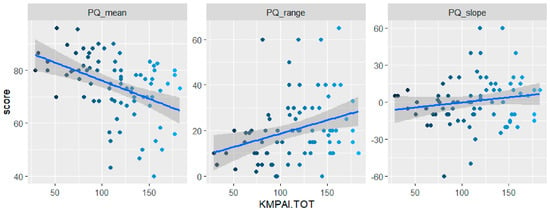
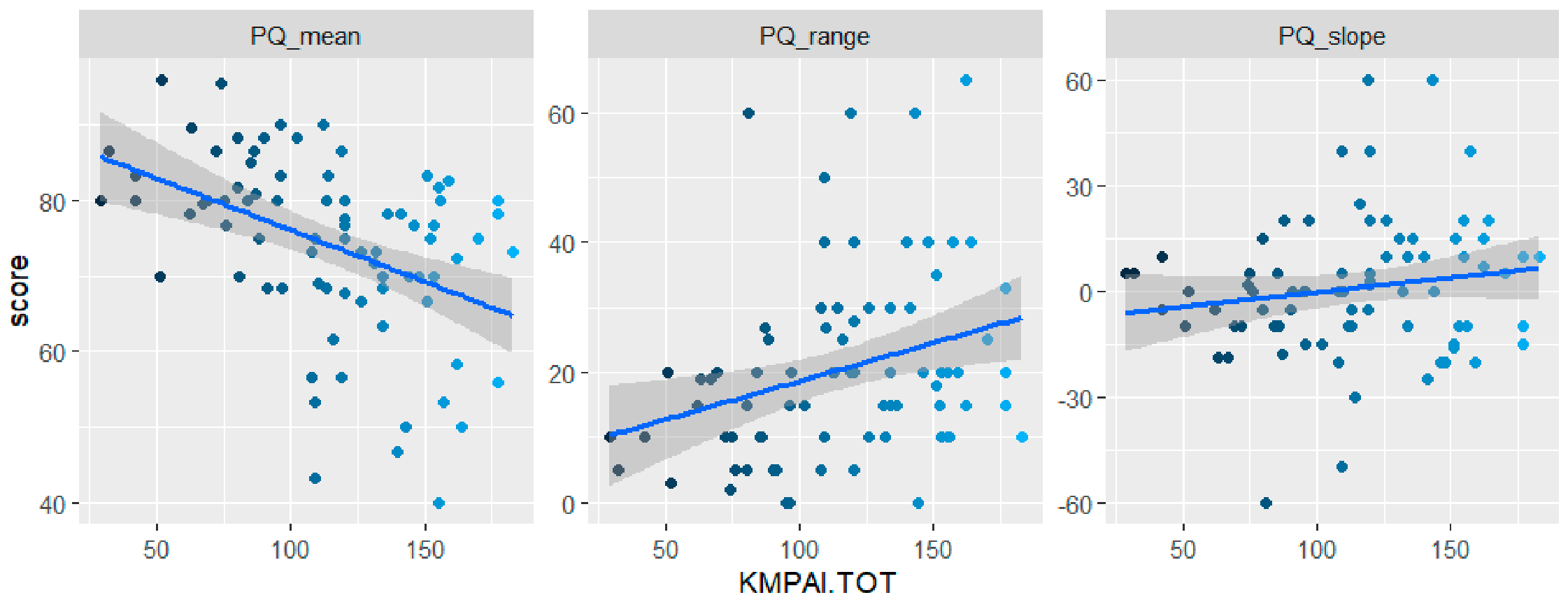
As shown in Figure 1, the results of the linear regression models evidenced significant associations between KMPAI.TOT and PQ_mean (β = −0.401, p < 0.001), PQ_range (β = 0.237, p < 0.05), and SFERA scores, (β = −0.812, p < 0.001). KMPAI.TOT and PQ_slope were not significantly associated, nor did participants’ age and sex have a significant effect on performance quality indices. On average, anxious participants showed significantly lower performance quality and SFERA scores compared to their colleagues. PQ_range values were lower in the participants showing lower anxiety levels, which indicates greater stability in performance quality over time (see Figure 1).
Figure 1.
Association between KMPAI.TOT and performance quality indices. Notes: N = 82. PQ_mean = mean performance quality values, PQ_range = range of performance quality values, PQ_slope = trend of performance quality values over time. The blue lines and shaded areas represent the fitted regression lines and their respective standard errors.
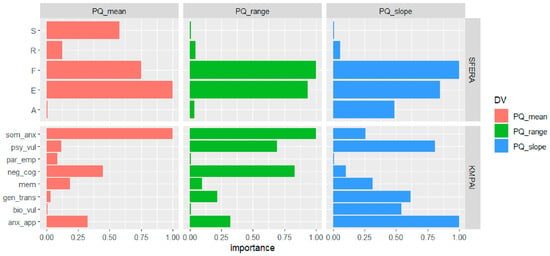
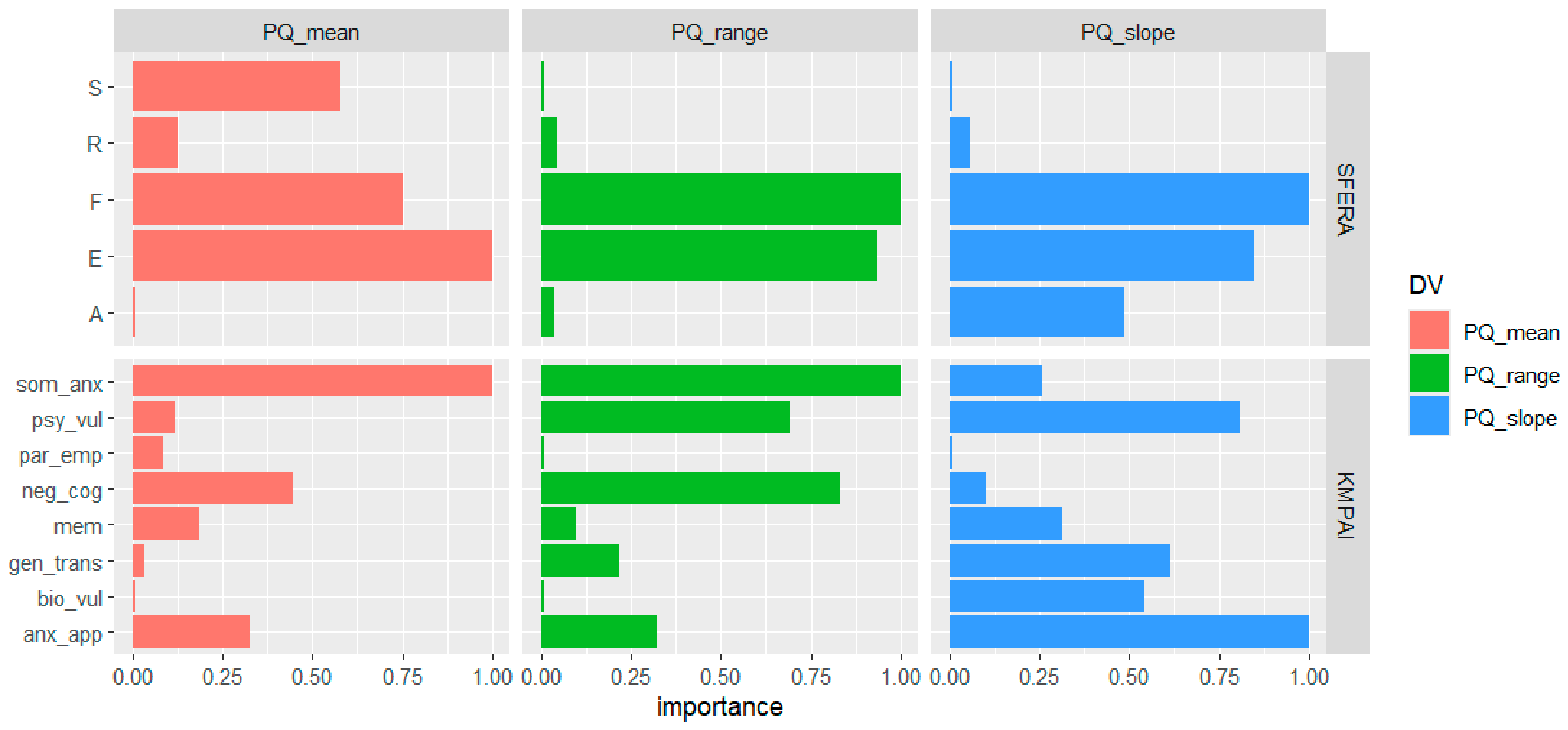
Optimized RF models (mtry = 1, number of trees = 10, minimum node size = 15) predicted substantial amounts of variance in performance quality, with R2 values ranging between 0.41 and 0.88. MAE values ranged between 0.44 and 0.64 while RMSE values ranged between 0.65 and 0.88. As shown in Figure 2, F and E were consistently the most important (importance > 0.5) predictors of performance quality among the SFERA factors while A was influenced by PQ_slope scores only. The relationship between KMPAI subscales and performance quality indices was less clear: proximal somatic anxiety and anxious apprehension were the strongest predictors of PQ_mean, proximal somatic anxiety, negative cognitions and psychological vulnerability were the strongest predictors of PQ_range, while psychological vulnerability, anxious apprehension and biological vulnerability were the strongest predictors of PQ_slope.
Figure 2.
Variable importance of KMPAI and SFERA factors in predicting performance quality. Notes: N = 82. PQ_mean = mean performance quality values, PQ_range = range of performance quality values, PQ_slope = trend of performance quality values over time, som_anx = proximal somatic anxiety, psy_vul = psychological vulnerability, par_emp = parental empathy, neg_cog = negative cognitions, mem = memory, gen_trans = generational transmission of anxiety, bio_vul = biological vulnerability, anx_app = anxious apprehension. The figure shows predictive importance values, where each variable’s importance is expressed relative to the most influential predictor for PQ_mean, PQ_range, and PQ_slope scores. Variable importance of KMPAI subscales and SFERA factors was evaluated separately, through dedicated RF models.
A summary of the mediation analysis is reported in Table 3. VIF < 5 indicated the lack of multicollinearity issues. The results showed that the average indirect effect (AIE) and total effect were significant, while the average direct effect (ADE) was not significant. Thus, approximately 60% of the effect of KMPAI on PQ_mean scores were mediated by SFERA scores.
Table 3.
Mediation analysis of the effect of KMPAI on PQ_mean via SFERA.
4. Discussion
The main aim of this study was to examine how mental skills can buffer the negative influence of performance anxiety on self-perceived performance quality in professional musicians. Specifically, it explored the relationships among the underlying constructs of performance quality, performance anxiety, and mental skills, as assessed through the SFERA model theory framework.
The results largely supported the hypotheses of the study. These indicated moderate significant negative correlations between SPPQ and MPA (H1) and moderate to strong significant positive correlations between SPPQ and SFERA and its five factors (H2). Thus, participants with higher anxiety showed lower performance quality and SFERA scores. F, E, proximal somatic anxiety, anxious apprehension, negative cognition, and depression were the strongest predictors of performance quality. The analyses showed that SFERA scores substantially mediated the relationship between MPA and SPPQ (H3), reducing its negative effects by almost 60%.
The relationship between SPPQ and anxiety has been extensively documented. The results reported in the music performance literature are inconsistent and may depend on the procedure and measurement instruments through which the two are measured (Passarotto et al., 2023). Our results show that high levels of anxiety were associated with poor performance quality, both assessed as self-report measures, with a Pearson’s coefficient value almost identical to that found in previous studies on comparable samples (González et al., 2018; Nielsen et al., 2018). Among the KMPAI subscales, the subscale “proximal somatic anxiety and worry about performance” was the strongest negative predictor of performance quality.
This might be due to the primary relevance of this aspect of MPA to playing a musical instrument, especially compared to the other KMPAI subscales. In fact, severe somatic symptoms of anxiety would directly affect performance more than other MPA aspects, such as anxious apprehension or parental empathy. SFERA and its factors effectively predicted self-rated performance quality, especially the force (F) factor. Force refers to a collection of physical, technical, and mental assets and capabilities that individuals are consciously aware of and use to strive for optimal performance, harnessing these personal strengths (Vercelli, 2016). This dimension is strongly aligned with Bandura’s (1997) concept of self-efficacy, which emphasizes the belief in one’s ability to succeed in specific situations. Thus, the results presented here are consistent with previous evidence showing a positive association between self-efficacy and performance quality in music (González et al., 2018; McPherson & McCormick, 2006; Ritchie & Williamon, 2012). The mental skills measured by SFERA were associated with a 60% reduction in the effect of anxiety on performance quality. This is in line with the literature and intervention studies based on short-term mental skills and coping strategies training, which proved effective in reducing MPA and enhancing performance quality (Clark & Williamon, 2011; Hoffman & Hanrahan, 2012; Niering et al., 2023; Osborne et al., 2014). In addition, the results reported here are complementary to those reported by Mazzon et al. (2024), highlighting the effectiveness of using and adapting sport psychology theories and programs to assess mental skills in musicians. SFERA seems a particularly useful tool in this context, due to its compact item set and simple structure. In our study, proximal somatic anxiety and worry about performance emerged as the strongest negative predictors of SPPQ, underscoring how acute physiological arousal and maladaptive cognition can critically undermine execution in high-stakes performance contexts. SPPQ in music has been shown to depend on the integration of technical accuracy, expressive control, and the capacity to sustain attentional focus under evaluative pressure (Mazzon et al., 2024; Osborne et al., 2014). Proximal somatic symptoms—such as tremor, muscle tension, and cardiorespiratory acceleration—manifesting immediately before or during performance can disrupt fine motor control, impair timing precision, and diminish expressive nuance, particularly in tasks requiring high sensorimotor integration (Kenny, 2009). These symptoms are not only relevant to music performance but can disrupt performance also in other domains such as sports and performing arts (Nordin-Bates, 2012; Rowland et al., 2021), which are often overcome with the use of medications such as beta blockers in musicians but considered doping in other fields (Kuwabara et al., 2024). Proximal somatic symptoms also act as salient internal cues that are correlated with negative self-appraisal and performance-related worry, which, in turn, diverts cognitive resources from task-relevant processing, consistent with Attentional Control Theory and Processing Efficiency Theory (Rowland et al., 2021). Elevated worry has been linked to diminished working memory capacity and reduced capacity for adaptive real-time adjustments, further degrading perceived and objective performance quality (Núñez et al., 2020). Such mechanisms parallel findings in sport, where competitive anxiety predicts decrements in technical execution and decision-making, and where interventions targeting both physiological regulation and cognitive reframing such as mindfulness, imagery, and attentional control training have improved performance stability in elite athletes (Reinebo et al., 2024).
Accordingly, although the present study focuses on professional musicians, its grounding in sport psychology models (e.g., S.F.E.R.A. highlighting “Energy”, emotion and arousal regulation, and “Force/Point of Strength”, related to self-efficacy, as a key predictors of MPA) positions its insights for careful extension to other high-stakes performance contexts that require stable execution under acute evaluation (Mazzon et al., 2024; Núñez et al., 2020). The results of this study resonate with the unified cognitive model proposed by Rowland et al. (2021), as both lines of research emphasize how performance anxiety interferes with automaticity and impairs perceived performance quality. Consistent with their findings, our data suggest that mental skills play a crucial moderating role, helping performers to maintain efficient and fluent execution under pressure. This convergence highlights shared psychological mechanisms across performance domains—such as mind–body connection, attention regulation, control and planning, and arousal management—supporting the value of an interdisciplinary framework that connects sport psychology, performance science, and artistic practice (Rowland et al., 2021).
This study comes with some limitations. First, the sample size is small, which limits the extent to which the findings presented here can be generalized to larger populations of musicians. Second, some measurement scales used in the study showed only moderate internal consistency (i.e., Cronbach’s alpha ≈ 0.70). This may be due to the limited sample size and issues with the measurement instrument itself. Specifically, the factor structure of the KMPAI subscales is currently under debate (i.e., Antonini Philippe et al., 2023). Therefore, we recommend interpreting the results of the KMPAI subscales with caution, given that these subscales are designed to measure complex constructs using only a few items. While internal consistency and predictive regressions for SFERA factors are robust, future work must employ confirmatory factor analysis on larger samples to formally establish measurement invariance and structural equivalence between the athletic and musical versions of the scale. It is important to note that the data presented here are cross-sectional. Therefore, the analysis cannot confirm the direction of effects or causality, especially in the mediation models. Rather, our findings are consistent with the interpretation that strong mental skills are associated with—and may potentially contribute to—reduced impact of anxiety on performance quality. Future studies should build on this project by implementing longitudinal study design and considering complementary measures of performance quality such as behavioral data and multi-perspective assessment protocols (i.e., Passarotto et al., 2023).
In conclusion, this study shows how SPPQ is strongly related to both MPA and mental skills in professional musicians. By bridging sport psychology frameworks with the demands of artistic performance, this study demonstrates that robust mental skills, particularly personal strength and arousal regulation, can substantially buffer the disruptive impact of anxiety on musicians’ self-perceived performance quality. Beyond the domain of music performance, the relationship between self-perceived performance quality, psychological components, and performance anxiety can be explored across different disciplines where performance is not objectively measurable. This interdisciplinary perspective may allow for a deeper understanding of how individuals evaluate their own effectiveness under pressure, and how mental skills contribute to this process. Comparing these dynamics across contexts such as education, clinical practice, or other creative professions could reveal domain-specific differences and common psychological mechanisms underlying perceived performance and anxiety regulation. In addition, this study highlights the role of mental skills in improving performance quality as well as in accounting for the effect of MPA. Integrating the concepts of self-perceived performance quality and performance anxiety management provides a promising framework for developing mental skills training programs and encouraging long-term health among performing artists. These findings underscore the critical value of integrating targeted psychological skills training into formal music education and professional ecosystems, offering a scalable pathway to safeguard performers’ well-being and optimize execution under high-stakes pressure. By incorporating psychological skills training into formal education and professional settings, organizations can support immediate performance optimization and satisfaction, while also promoting the long-term health and resilience of artists’ careers.
Author Contributions
Conceptualization, L.M., G.V. and E.P.; methodology, L.M. and E.P.; software, L.M. and E.P.; validation, G.V. and E.P.; formal analysis, E.P.; investigation, L.M.; resources, G.V.; data curation, L.M.; writing—original draft preparation, L.M. and E.P.; writing—review and editing, L.M., G.V. and E.P.; visualization, E.P.; supervision, G.V. and E.P.; project administration, L.M. and G.V.; funding acquisition, G.V. All authors have read and agreed to the published version of the manuscript.
Funding
This research received no external funding.
Institutional Review Board Statement
The study was conducted in accordance with the Declaration of Helsinki and approved by the Ethics Committee of Leibniz University Hannover and the Hanover University of Music, Drama and Media (approval number EV LUH 01/2022, approved in 17 July 2022).
Informed Consent Statement
Informed consent was obtained from all subjects involved in the study.
Data Availability Statement
Data is available upon reasonable request to the corresponding author.
Conflicts of Interest
The authors declare no conflicts of interest.
References
- Ackermann, B., & Driscoll, T. (2010). Development of a new instrument for measuring the musculoskeletal load and physical health of professional orchestral musicians. Medical Problems of Performing Artists, 25(3), 95–101. [Google Scholar] [CrossRef] [Scilit]
- Almagro, B. J., Sáenz-López, P., Fierro-Suero, S., & Conde, C. (2020). Perceived performance, intrinsic motivation and adherence in athletes. International Journal of Environmental Research and Public Health, 17(24), 9441. [Google Scholar] [CrossRef] [Scilit] [PubMed]
- Antonini Philippe, R., Cruder, C., Biasutti, M., & Crettaz von Roten, F. (2023). The Kenny music performance anxiety inventory-revised (K-MPAI-R): Validation of the Italian version. Psychology of Music, 51(2), 565–578. [Google Scholar] [CrossRef] [Scilit]
- Aoyagi, M. W., & Poczwardowski, A. (2012). Models of sport psychology practice and delivery: A review. In Professional practice in sport psychology. Routledge. [Google Scholar]
- Bandura, A. (1997). Self-efficacy: The exercise of control (pp. ix, 604). W H Freeman; Times Books; Henry Holt & Co. [Google Scholar]
- Bergee, M. J., & Cecconi-Roberts, L. (2002). Effects of small-group peer interaction on self-evaluation of music performance. Journal of Research in Music Education, 50(3), 256–268. [Google Scholar] [CrossRef] [Scilit]
- Biasutti, M., & Concina, E. (2014). The role of coping strategy and experience in predicting music performance anxiety. Musicae Scientiae, 18(2), 189. [Google Scholar] [CrossRef] [Scilit]
- Britton, D. M., Kavanagh, E. J., & Polman, R. C. J. (2019). A path analysis of adolescent athletes’ perceived stress reactivity, competition appraisals, emotions, coping, and performance satisfaction. Frontiers in Psychology, 10, 1151. [Google Scholar] [CrossRef] [Scilit] [PubMed]
- Caputo, A., Drivet, S., Sandretto, R., Vercelli, G., & Cortese, C. G. (2023). The e-S.F.E.R.A. questionnaire: A new tool for sport psychologists working in mental training. The Open Psychology Journal, 16, e187435012302090. [Google Scholar] [CrossRef] [Scilit]
- Caputo, A., Vercelli, G., & Cortese, C. G. (2026). Psychological training in esports: Performance enhancement in professional esports athletes. International Journal of Sports Science & Coaching, 21(3), 1621–1629, (Erratum in 2026, International Journal of Sports Science & Coaching, 21, 1981–1982). [Google Scholar] [CrossRef] [Scilit]
- Chang-Arana, Á. M., Kenny, D. T., & Burga-León, A. A. (2018). Validation of the Kenny music performance anxiety inventory (K-MPAI): A cross-cultural confirmation of its factorial structure. Psychology of Music, 46(4), 551–567. [Google Scholar] [CrossRef] [Scilit]
- Clark, T., & Williamon, A. (2011). Evaluation of a mental skills training program for musicians. Journal of Applied Sport Psychology, 23(3), 342–359. [Google Scholar] [CrossRef] [Scilit]
- Eysenck, M. W. (1979). Anxiety, learning, and memory: A reconceptualization. Journal of Research in Personality, 13(4), 363–385. [Google Scholar] [CrossRef] [Scilit]
- González, A., Blanco-Piñeiro, P., & Díaz-Pereira, M. P. (2018). Music performance anxiety: Exploring structural relations with self-efficacy, boost, and self-rated performance. Psychology of Music, 46(6), 831–847. [Google Scholar] [CrossRef] [Scilit]
- Hanin, Y., & Hanina, M. (2009). Optimization of performance in top-level athletes: An action-focused coping approach. International Journal of Sports Science & Coaching, 4(1), 47–91. [Google Scholar] [CrossRef] [Scilit]
- Hewitt, M. P. (2011). The impact of self-evaluation instruction on student self-evaluation, music performance, and self-evaluation accuracy. Journal of Research in Music Education, 59(1), 6–20. [Google Scholar] [CrossRef] [Scilit]
- Hewitt, M. P. (2015). Self-efficacy, self-evaluation, and music performance of secondary-level band students. Journal of Research in Music Education, 63(3), 298–313. [Google Scholar] [CrossRef] [Scilit]
- Hoffman, S. L., & Hanrahan, S. J. (2012). Mental skills for musicians: Managing music performance anxiety and enhancing performance. Sport, Exercise, and Performance Psychology, 1(1), 17–28. [Google Scholar] [CrossRef] [Scilit]
- Jørgensen, H., Mosewich, A. D., McHugh, T. L. F., & Holt, N. L. (2026). The AHEAD intervention for personal development in high-performance sport: A mixed methods evaluation. The Sport Psychologist, 1, 1–13. [Google Scholar] [CrossRef] [Scilit]
- Kenny, D. (2009, December 15–19). The factor structure of the revised Kenny music performance anxiety inventory. The International Symposium on Performance Science, Auckland, New Zealand. [Google Scholar]
- Kenny, D., & Ackermann, B. (2015). Performance-related musculoskeletal pain, depression and music performance anxiety in professional orchestral musicians: A population study. Psychology of Music, 43(1), 43–60. [Google Scholar] [CrossRef] [Scilit]
- Kok, L. M., Huisstede, B. M., Voorn, V. M., Schoones, J. W., & Nelissen, R. G. (2016). The occurrence of musculoskeletal complaints among professional musicians: A systematic review. International Archives of Occupational and Environmental Health, 89(3), 373–396. [Google Scholar] [CrossRef] [Scilit] [PubMed]
- Kuwabara, A., Miller Olson, E., & Stanek, J. L. (2024). Perceptions and prevalence of anxiolytic medication usage for performance enhancement among musicians. Medical Problems of Performing Artists, 39(4), 155–161. [Google Scholar] [CrossRef] [Scilit] [PubMed]
- Mazzon, L., Passarotto, E., Altenmüller, E., & Vercelli, G. (2024). Music performance anxiety and the Italian sport psychology S.F.E.R.A. model: An explorative study on 77 professional musicians. Psychology of Music, 52(3), 322–339. [Google Scholar] [CrossRef] [Scilit]
- McPherson, G. E., & McCormick, J. (2006). Self-efficacy and music performance. Psychology of Music, 34(3), 322–336. [Google Scholar] [CrossRef] [Scilit]
- Morijiri, Y., & Welch, G. F. (2022). Decisions on the quality of piano performance: Evaluation of self and others. Frontiers in Psychology, 13, 954261. [Google Scholar] [CrossRef] [Scilit] [PubMed]
- Nielsen, C., Studer, R. K., Hildebrandt, H., Nater, U. M., Wild, P., Danuser, B., & Gomez, P. (2018). The relationship between music performance anxiety, subjective performance quality and post-event rumination among music students. Psychology of Music, 46(1), 136–152. [Google Scholar] [CrossRef] [Scilit]
- Niering, M., Monsberger, T., Seifert, J., & Muehlbauer, T. (2023). Effects of psychological interventions on performance anxiety in performing artists and athletes: A systematic review with meta-analysis. Behavioral Sciences, 13(11), 910. [Google Scholar] [CrossRef] [Scilit] [PubMed]
- Nordin-Bates, S. M. (2012). Performance psychology in the performing arts. In S. M. Murphy (Ed.), The Oxford handbook of sport and performance psychology. Oxford University Press. [Google Scholar] [CrossRef] [Scilit]
- Núñez, A., Ponseti, F. X., Sesé, A., & Garcia-Mas, A. (2020). Anxiety and perceived performance in athletes and musicians: Revisiting Martens. Revista de Psicología Del Deporte, 29, 21–28. [Google Scholar]
- Osborne, M. S., Greene, D. J., & Immel, D. T. (2014). Managing performance anxiety and improving mental skills in conservatoire students through performance psychology training: A pilot study. Psychology of Well-Being, 4(1), 18. [Google Scholar] [CrossRef] [Scilit]
- Passarotto, E., Altenmüller, E., & Müllensiefen, D. (2023). Music performance assessment: Noise in judgments and reliability of measurements. Psychology of Aesthetics, Creativity, and the Arts, 19(4), 822–835. [Google Scholar] [CrossRef] [Scilit]
- Pellizzari, M., Bertollo, M., & Robazza, C. (2011). Pre-and post-performance emotions in gymnastics competitions. International Journal of Sport Psychology, 42(3), 278. [Google Scholar]
- Powers, T. A., Koestner, R., Lacaille, N., Kwan, L., & Zuroff, D. C. (2009). Self-criticism, motivation, and goal progress of athletes and musicians: A prospective study. Personality and Individual Differences, 47(4), 279–283. [Google Scholar] [CrossRef] [Scilit]
- Priest, T. (2006). Self-evaluation, creativity, and musical achievement. Psychology of Music, 34(1), 47–61. [Google Scholar] [CrossRef] [Scilit]
- Reinebo, G., Alfonsson, S., Jansson-Fröjmark, M., Rozental, A., & Lundgren, T. (2024). Effects of Psychological Interventions to Enhance Athletic Performance: A Systematic Review and Meta-Analysis. Sports Medicine, 54(2), 347–373. [Google Scholar] [CrossRef] [Scilit] [PubMed]
- Ritchie, L., & Williamon, A. (2012). Self-efficacy as a predictor of musical performance quality. Psychology of Aesthetics, Creativity, and the Arts, 6, 334–340. [Google Scholar] [CrossRef] [Scilit]
- Robazza, C., Bertollo, M., Bertollo, M., & Hanin, Y. L. (2008). Functional impact of emotions on athletic performance: Comparing the IZOF model and the directional perception approach. Journal of Sports Sciences, 26(10), 1033–1047. [Google Scholar] [CrossRef] [Scilit] [PubMed]
- Rowland, D. L., Moyle, G., & Cooper, S. E. (2021). Remediation strategies for performance anxiety across sex, sport and stage: Identifying common approaches and a unified cognitive model. International Journal of Environmental Research and Public Health, 18(19), 10160. [Google Scholar] [CrossRef] [Scilit] [PubMed]
- RStudio Team. (2023). RStudio: Integrated development for R. RStudio (Version 2023.06.0) [Computer software]. PBC. Available online: https://www.rstudio.com/ (accessed on 31 May 2024).
- Ryan, R. M., & Deci, E. L. (2000). Self-determination theory and the facilitation of intrinsic motivation, social development, and well-being. American Psychologist, 55(1), 68. [Google Scholar] [CrossRef] [PubMed]
- Silva, S. E. F., Serassuelo Junior, H., Magatão, M., & Paludo, A. C. (2020). Competition phase affect motivation and perceived performance but not the pre-competitive anxiety on professional dancers. Revista Brasileira de Ciências do Esporte, 42, e2041. [Google Scholar] [CrossRef] [Scilit]
- Smith, R. E., & Smoll, F. L. (2004). Anxiety and coping in sport: Theoretical models and approaches to anxiety reduction. In Sport psychology: Theory, applications and issues (2nd ed., pp. 294–321). John Wiley & Sons Australia. [Google Scholar]
- Stoeber, J., & Eismann, U. (2007). Perfectionism in young musicians: Relations with motivation, effort, achievement, and distress. Personality and Individual Differences, 43(8), 2182–2192. [Google Scholar] [CrossRef] [Scilit]
- Thompson, S., & Williamon, A. (2003). Evaluating evaluation: Musical performance assessment as a research tool. Music Perception, 21(1), 21–41. [Google Scholar] [CrossRef] [Scilit]
- Vercelli, G. (2016). Vincere con la mente. Come si diventa campioni: Lo stato della massima prestazione. Ponte alle Grazie. [Google Scholar]
- Zaza, C. (1998). Playing-related musculoskeletal disorders in musicians: A systematic review of incidence and prevalence. Canadian Medical Association Journal, 158(8), 1019–1025. [Google Scholar] [PubMed]
- Zelenak, M. S. (2024). Self-efficacy and music performance: A meta-analysis. Psychology of Music, 52(6), 649–667. [Google Scholar] [CrossRef] [Scilit]

Disclaimer/Publisher’s Note: The statements, opinions and data contained in all publications are solely those of the individual author(s) and contributor(s) and not of MDPI and/or the editor(s). MDPI and/or the editor(s) disclaim responsibility for any injury to people or property resulting from any ideas, methods, instructions or products referred to in the content. |
© 2026 by the authors. Licensee MDPI, Basel, Switzerland. This article is an open access article distributed under the terms and conditions of the Creative Commons Attribution (CC BY) license.