


Abstract
Socioeconomic differences in adolescents’ school belonging and school loneliness are important concerns for psychological adjustment. As artificial intelligence (AI) becomes increasingly integrated into schoolwork, its associations with students’ school experiences and the moderating roles of relational resources warrant examination. This study used cross-sectional PISA data from adolescents in four Chinese regions. Unweighted multiple linear regression analyses examined economic, social and cultural status (ESCS) and AI use for schoolwork in relation to school loneliness and school belonging. Family support and peer academic help-seeking were examined separately as moderators of the associations between ESCS and each outcome. All models included sex, age, and school fixed effects. Multiple testing was addressed using the Benjamini–Hochberg false discovery rate (FDR) procedure. Higher ESCS and more frequent AI use for schoolwork were associated with lower school loneliness and greater school belonging. Peer academic help-seeking moderated the association between ESCS and school loneliness after FDR correction. The negative association weakened as peer academic help-seeking increased. Family support did not significantly moderate either association, and peer academic help-seeking did not significantly moderate the association between ESCS and school belonging. These findings suggest a limited compensatory role for peer academic help-seeking in socioeconomic differences in school loneliness, providing partial support for the resource compensation perspective.
1. Introduction
1.1. School Belonging and School Loneliness
School is a central social context in adolescents’ daily lives, and students’ social experiences within this setting are closely related to their participation and adjustment at school. These experiences can be considered from two complementary perspectives: school belonging and school loneliness. School belonging reflects students’ feelings of acceptance, inclusion, respect, and support within the school community. School loneliness, in contrast, reflects a perceived lack of meaningful social connection in the school environment. A meta-analytic review of 82 studies involving 208,796 secondary school students found that stronger school belonging was associated with greater academic motivation and engagement, more positive self-perceptions, higher academic achievement, and lower absence and dropout rates (Korpershoek et al., 2020). Complementing these findings, a cross-national study of 518,210 15-year-old students across 75 countries found that greater school loneliness was associated with less favorable perceptions of school climate and poorer academic performance (Jefferson et al., 2023). Taken together, school belonging and school loneliness provide complementary perspectives on adolescents’ social connection to school and are both directly relevant to their educational experiences.
1.2. Socioeconomic Inequality and AI Use for Schoolwork
Although school belonging and school loneliness are subjectively experienced, they develop within unequal social and economic contexts. A particularly important contextual factor is students’ economic, social, and cultural status (ESCS), which reflects the family resources available to support their educational and social development. At a broader level, a meta-analysis of population-representative US cohorts found that lower family socioeconomic status was consistently associated with higher levels of psychopathology among children and adolescents, underscoring the need to identify the processes through which socioeconomic conditions become linked to psychological adjustment (Peverill et al., 2021). Such resources may shape not only students’ access to learning opportunities but also their capacity to participate in school life and establish supportive relationships. PISA 2022 findings showed that socioeconomically disadvantaged students were more likely than their advantaged peers to report having fewer opportunities to form close bonds at school, while socioeconomic disparities in school belonging were smaller in more equitable education systems (OECD, 2023). Similarly, cross-national PISA evidence identified lower socioeconomic status as a correlate of greater school loneliness, even after individual-, school-, and country-level characteristics were considered (Jefferson et al., 2023). Evidence from Chinese adolescents further showed that higher family socioeconomic status was associated with less peer conflict and fewer internalizing problems, with peer conflict partly accounting for this association (Y. Wang et al., 2022). Taken together, these findings suggest that ESCS is associated with both school belonging and school loneliness.
Emerging evidence suggests that artificial intelligence may become part of students’ participation in school learning by supporting content generation, feedback, interaction, and personalized learning; however, its educational value depends on how it is used and on students’ capacity to evaluate its outputs (Chen et al., 2023; Kasneci et al., 2023). AI use for schoolwork reflects how frequently students use AI across academic activities. AI-generated explanations and feedback may help students address learning difficulties and participate in schoolwork. Such participation may create opportunities for interaction with classmates and teachers. These potential links with school belonging and loneliness may vary with students’ purposes and ways of using AI. First, AI use is socially patterned. PISA 2025 showed that students who did not use AI for schoolwork tended to come from more socioeconomically disadvantaged backgrounds, whereas frequent users were generally more advantaged; disadvantaged students were also less likely to report opportunities to evaluate AI-generated information at school (OECD, 2026). Second, AI use has been directly associated with students’ social connectedness. The same report documented a positive association between AI use for schoolwork and sense of belonging at the OECD average, with similar patterns observed in 55 education systems after accounting for student- and school-level socioeconomic profiles (OECD, 2026). Evidence concerning loneliness is more limited and appears to vary by the purpose of AI use. In a preregistered study of 1599 Danish high-school students, adolescents who engaged in socially supportive conversations with chatbots reported greater loneliness than both non-users and utilitarian chatbot users, as well as lower perceived social support than non-users (Herbener & Damholdt, 2025). Similarly, research among university students indicated that obtaining social support from AI, particularly when it substituted for human support, was associated with less favorable social outcomes involving loneliness and belonging than support received from other people (Crawford et al., 2024). Importantly, these latter studies examined socially supportive or human-substituting uses of AI, whereas the PISA measure captures AI use specifically for schoolwork. Taken together, existing evidence suggests associations between socioeconomic resources, AI use for schoolwork, and students’ school experiences. Their adjusted associations with both school outcomes remain to be clarified among adolescents. The present study examined these associations using multiple linear regression.
1.3. Relational Resources and Resource Compensation
Family support and peer academic help-seeking may modify the associations of ESCS with adolescents’ school belonging and school loneliness. The moderation framework contrasts resource compensation with resource reinforcement. Resource compensation corresponds to the resource substitution hypothesis, originally developed in research on education, social status, and health (Mirowsky & Ross, 2003; Ross & Mirowsky, 2006). This hypothesis proposes that resources can partly substitute for one another, making a given resource more consequential when alternative resources are scarce. Resource reinforcement predicts the opposite pattern, in which different resources amplify one another and already advantaged individuals derive greater benefits (Burger & Brack, 2025). Empirically, compensation would be reflected in a weaker association between ESCS and each outcome at higher levels of a relational factor, whereas reinforcement would be reflected in a stronger association.
Applied to the present context, family support can be conceptualized as an available relational resource that may compensate for limited socioeconomic resources. Peer academic help-seeking captures students’ active efforts to obtain academic assistance from classmates. Evidence from Chinese students indicates that school resources attenuate the association between socioeconomic status and social-emotional skills (Shi et al., 2023). However, whether family supports similarly moderate the associations of ESCS with school belonging and school loneliness remains unclear. The framework therefore supports compensatory hypotheses for family support and peer academic help-seeking, with each school outcome examined separately.
Family support represents a relational resource that may modify the extent to which socioeconomic conditions are reflected in adolescents’ social experiences at school. Although family support and socioeconomic resources are related, they are not interchangeable. Longitudinal evidence from the UK Millennium Cohort Study showed that persistent poverty and family adversity were associated with an increased likelihood of receiving low emotional support and experiencing poor parent–adolescent relationships (Adjei et al., 2024). Beyond this socioeconomic patterning, family support is directly relevant to adolescents’ feelings of social connection. In a PISA 2018 study of 4838 15-year-old students in the United States, parental support positively predicted school belonging after different dimensions of classroom interaction were considered (Peng et al., 2024). Similarly, an analysis of 2755 Chinese children and adolescents found that those without family support had a higher likelihood of reporting loneliness than those who received such support (Tian et al., 2025). Evidence also suggests that support may modify socioeconomic disparities in students’ school experiences. Among Slovak adolescents, schoolwork support from within or outside the family moderated the association between family socioeconomic status and school satisfaction, with low- and middle-SES students who lacked such support being particularly likely to feel indifferent toward school and education (Horanicova et al., 2022). Although school satisfaction is not equivalent to school belonging or school loneliness, this finding provides relevant evidence that supportive relationships may alter how socioeconomic circumstances are associated with students’ experiences at school. Taken together, family support may function not only as an independent promotive factor but also as a compensatory resource that weakens the association between socioeconomic disadvantage and unfavorable school social experiences. The present study examined whether family support moderated the associations of ESCS with school belonging and school loneliness.
Peer academic help-seeking represents a specific school-based behavior through which students may mobilize their classmates when they encounter academic difficulty. The PISA item captures students’ tendency to ask classmates for help when they do not fully understand something. Academic help-seeking remains embedded in classroom relationships. A peer-nomination study of 1037 fifth- and sixth-grade students showed that students’ choices of whom to approach for classwork assistance varied according to their friendship ties with potential helpers and those helpers’ academic reputations (Kilday & Ryan, 2023). Asking classmates may therefore be understood as one way of mobilizing peer relationships in response to an academic need. Evidence concerning broader peer support and school social experiences is mixed and may differ across outcomes. Among 2983 Scottish adolescents, greater classmate support was associated with lower loneliness (Zheng et al., 2024). By contrast, a daily study of 90 rural Chinese adolescents found no significant association between general peer support and same-day school belonging; notably, the authors proposed that academically oriented peer support, such as assistance with homework, might be more consequential in the Chinese school context (Zhang & Wang, 2024). Longitudinal evidence that classmate support buffered the association between bullying victimization and later psychological distress also supports the broader possibility that peer relationships can modify the associations between adversity and adolescent adjustment (Healy et al., 2024). Whether peer academic help-seeking modifies the associations of ESCS with school loneliness and school belonging remains an open question. Peer academic help-seeking represents one way of responding when students have difficulty understanding schoolwork. Such behavior may create opportunities for academic clarification and classroom interaction. Its role may differ across socioeconomic contexts because ESCS is associated with differences in family educational resources and learning opportunities. Seeking academic help from classmates may provide opportunities to access learning resources that supplement those available at home. These opportunities may be especially relevant for students with fewer socioeconomic resources. The resource compensation perspective therefore supports the hypothesis that peer academic help-seeking weakens socioeconomic differences in school belonging and school loneliness.
1.4. The Present Study
Against this background, the present study used PISA 2025 data from adolescents in four Chinese regions to examine school belonging and school loneliness. Multiple linear regression was used to examine the associations of ESCS and AI use for schoolwork with each outcome. Higher ESCS was hypothesized to be associated with stronger school belonging and lower school loneliness (H1). More frequent AI use for schoolwork was hypothesized to be associated with stronger school belonging and lower school loneliness (H2).
The potential moderating roles of family support and peer academic help-seeking were also examined. Drawing on the resource compensation perspective, both were expected to attenuate socioeconomic differences in students’ social experiences at school. Family support and peer academic help-seeking were each hypothesized to weaken the negative association between ESCS and school loneliness (H3a). Each was also hypothesized to weaken the positive association between ESCS and school belonging (H3b). The moderating roles of family support and peer academic help-seeking were examined separately for each outcome.
2. Materials and Methods
2.1. Data Source and Participants
Data were obtained from the PISA 2025 student public-use file. The original dataset contained 755,721 student records. The present study focused on students from B-S-J-Z (China), identified by CNT = QCI and CNTRYID = 156. Students from Hong Kong, Macao, and Chinese Taipei were not included.
A total of 12,385 students were identified before applying the analytic eligibility criteria. Students were included if they had valid responses to all 16 focal items, comprising four artificial intelligence use items, five family support items, five school belonging items, one school loneliness item, and one peer academic help-seeking item. ESCS, sex, age, and school-identification data were also required.
The final analytic sample comprised 11,883 students from 374 schools, corresponding to 95.95% of the initially selected B-S-J-Z sample. The sample included 5725 girls (48.18%) and 6158 boys (51.82%). The mean age was 15.765 years (SD = 0.295; range = 15.330–16.250 years).
2.2. Measures
2.2.1. Economic, Social and Cultural Status
Economic, social and cultural status was measured using the official PISA ESCS index. This composite index summarizes information concerning parental education, parental occupational status, and household possessions and educational resources. Higher ESCS scores indicate a more advantaged socioeconomic background.
In the present study, ESCS was treated as a continuous predictor. The original PISA index was retained for descriptive analyses, whereas mean-centered or standardized scores were used where required by the regression and moderation analyses.
2.2.2. Artificial Intelligence Use for Schoolwork
Artificial intelligence use for schoolwork was measured using the mean of four source items. The four questions assessed how often students used artificial intelligence tools to summarize assigned texts, conduct preliminary research, draft written assignments, and support their learning. The original response options ranged from 1 (“never or almost never”) to 5 (“daily or almost daily”). Higher mean scores indicate more frequent use of artificial intelligence for school-related activities. Cronbach’s alpha for the four items was 0.875.
2.2.3. School Loneliness
School loneliness was assessed using item ST034Q06TA: “I feel lonely at school.” The original response scale ranged from 1 (“strongly agree”) to 4 (“strongly disagree”). Responses were reverse-coded so that original scores of 1, 2, 3, and 4 were recoded as 4, 3, 2, and 1, respectively. The resulting score ranged from 1 to 4, with higher scores indicating greater perceived loneliness at school.
2.2.4. School Belonging
School belonging was measured using the mean of five questions concerning students’ perceived acceptance, connectedness, and social inclusion at school (ST034Q01TA–ST034Q05TA). Items ST034Q02TA, ST034Q03TA, and ST034Q05TA were reverse-scored before averaging. Higher scores indicate a stronger overall sense of belonging at school. Scores ranged from 1 to 4, with 1 indicating the lowest and 4 the highest level of school belonging. Cronbach’s alpha for the five items was 0.782.
2.2.5. Family Support
Family support was measured using the mean of five source items. The five questions assessed how often family members discussed the student’s school performance, talked about school-related problems, showed interest in the student’s learning, discussed future education, and asked what the student had done at school. The original response scale ranged from 1 (“never or almost never”) to 5 (“daily or almost daily”). Higher mean scores indicate greater perceived family support. The five items demonstrated high internal consistency, with Cronbach’s alpha of 0.887.
2.2.6. Peer Academic Help-Seeking
Peer academic help-seeking was measured using item ST433Q01DA: “When I do not fully understand something, I ask my classmates.” The original response scale ranged from 1 (“strongly agree”) to 4 (“strongly disagree”). Responses were reverse-coded so that original scores of 1, 2, 3, and 4 were recoded as 4, 3, 2, and 1, respectively. Higher scores therefore indicate a greater tendency to seek academic help from classmates. The resulting score ranged from 1 to 4. For the moderation analyses, the reverse-scored item was entered on its 1–4 scale as a continuous numeric moderator.
2.2.7. Covariates
Sex and age were included as covariates in all regression and moderation models to account for demographic differences in the outcomes. Sex was coded as 0 for girls and 1 for boys. Age was treated as a continuous variable. School membership was included as a categorical fixed effect to account for between-school differences, allowing each school to have its own intercept.
2.3. Data Preparation
Participants were required to have complete, valid responses to all 16 focal items. Artificial intelligence use, family support, and five-item school belonging were calculated as the arithmetic means of their constituent items. All primary analyses used a common complete-case sample.
2.4. Model Estimation and Multiple Testing
All regression and moderation models were estimated using unweighted ordinary least squares with school fixed effects. Conventional OLS standard errors and model residual degrees of freedom were used for two-sided t tests and 95% confidence intervals. Unstandardized coefficients and completely standardized coefficients were reported.
The Benjamini–Hochberg false discovery rate (FDR) procedure was applied separately to the eight substantive predictor coefficients across the two multiple linear regression models and to the four focal interaction tests. The three subsequent simple-slope tests formed a separate secondary testing family. Both unadjusted and FDR-adjusted p-values were reported, with an FDR-adjusted significance threshold of 0.050.
2.5. Statistical Analysis
Analyses were conducted in R version 4.4.2. All statistical tests were two-sided, with the significance level set at 0.050. Means, standard deviations, Pearson correlations, and source-item reliability coefficients were first calculated. Age and sex were included in the correlation table. Correlation coefficients were presented as descriptive effect sizes. Effect sizes were interpreted using the absolute values of the correlation coefficients, with 0.20 and 0.50 as benchmarks for small and medium effects, respectively.
2.5.1. Multiple Linear Regression Analyses
Separate multiple linear regression models were fitted for school loneliness and five-item school belonging. ESCS, AI use for schoolwork, age, and sex were entered simultaneously, together with school fixed effects. Model fit was summarized using R2.
2.5.2. Moderation Analyses
Family support and peer academic help-seeking were examined in separate moderation analyses. For each outcome and moderator, two nested models were fitted. Model 1 included ESCS, the moderator, AI use for schoolwork, age, sex, and school fixed effects. Model 2 additionally included the interaction between ESCS and the moderator. ESCS and the moderator were centered at their arithmetic means before the interaction term was constructed.
Standardized interaction coefficients were estimated using the product of standardized ESCS and moderator scores. Interaction effect sizes were quantified using the additional variance explained by each interaction (ΔR2) and Cohen’s f2. For interactions meeting the FDR-adjusted significance criterion, simple slopes were estimated at the moderator mean and at one standard deviation below and above the mean.
3. Results
3.1. Sample Selection
Of the 12,385 students identified as belonging to B-S-J-Z (China), 502 were excluded because they did not meet one or more of the common analytic eligibility criteria. The resulting analytic sample consisted of 11,883 students nested within 374 schools.
3.2. Descriptive Statistics, Correlations, and Reliability
Descriptive statistics, Pearson correlations, and source-item reliability coefficients were calculated to characterize the focal variables. As shown in Table 1, ESCS was positively associated with artificial intelligence use for schoolwork (r = 0.213), family support (r = 0.212), peer academic help-seeking (r = 0.103), and school belonging (r = 0.127), and negatively associated with school loneliness (r = −0.066). Artificial intelligence use was negatively associated with school loneliness (r = −0.073) and positively associated with school belonging (r = 0.170). Family support and peer academic help-seeking were both negatively associated with school loneliness and positively associated with school belonging. Only the negative correlation between school loneliness and school belonging reached the benchmark for a medium effect (r = −0.636). The remaining correlations were small or below the benchmark for a small effect.
Table 1.
Descriptive statistics and correlations among the study variables.
The source-item reliability coefficients were 0.875 for artificial intelligence use, 0.887 for family support, and 0.782 for school belonging.
3.3. Associations of ESCS and AI Use with School Loneliness and School Belonging
In the school fixed-effects regressions, higher ESCS was associated with lower loneliness and higher school belonging after adjustment for AI use, age, and sex. AI use was independently associated with lower loneliness (B = −0.038, β = −0.054) and higher belonging (B = 0.072, β = 0.138). The standardized ESCS and AI-use associations were small in magnitude. Both AI-use coefficients met the FDR-adjusted significance criterion. Neither age coefficient met this criterion. Total explained variance was 6.32% for loneliness and 12.06% for belonging. Detailed regression results are presented in Table 2.
Table 2.
Multiple linear regression results for school loneliness and five-item school belonging.
3.4. Moderating Roles of Family Support and Peer Academic Help-Seeking
Four moderation analyses examined whether the associations between ESCS and the two outcomes varied with family support or peer academic help-seeking. All models included AI use for schoolwork, age, sex, and school fixed effects. The two-step regression results and interaction effect sizes are presented in Table 3.
Table 3.
Moderation analyses for school loneliness and school belonging.
3.4.1. Moderating Effect of Family Support
The ESCS × family support interaction was not statistically significant for loneliness (B = 0.006, β = 0.007, p = 0.439, FDR-adjusted p = 0.690) or belonging (B = 0.001, β = 0.002, p = 0.800, FDR-adjusted p = 0.800). These interactions each explained less than 0.01% of the total variance in the corresponding outcome.
3.4.2. Moderating Effect of Peer Academic Help-Seeking
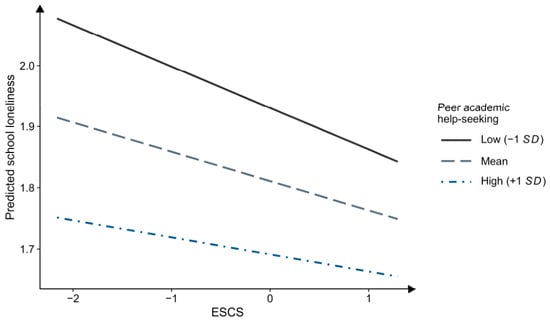
Peer academic help-seeking moderated the association between ESCS and loneliness (B = 0.033, SE = 0.011, 95% CI [0.010, 0.055], β = 0.026, p = 0.004, FDR-adjusted p = 0.016). The interaction explained an additional 0.07% of the total variance. Its effect size was small, with Cohen’s f2 = 0.001. The interaction for school belonging was not statistically significant (p = 0.518, FDR-adjusted p = 0.690).
The negative association between ESCS and loneliness weakened as peer academic help-seeking increased. The conditional slopes remained negative at low, mean, and high levels of help-seeking, with all three tests meeting the FDR-adjusted significance criterion (Table 4; Figure 1).
Table 4.
Conditional associations between ESCS and loneliness at different levels of peer academic help-seeking.
Figure 1.
Moderating role of peer academic help-seeking in the association between ESCS and school loneliness. Note. Lines show model-adjusted predicted loneliness at the mean and one standard deviation below and above the mean of peer academic help-seeking.
4. Discussion
4.1. Principal Findings
The present study examined socioeconomic status, AI use for schoolwork, and school experiences among adolescents in four Chinese regions. Higher ESCS and more frequent AI use were associated with lower school loneliness and greater school belonging after covariate adjustment. Family support did not significantly moderate the association between ESCS and either outcome. However, peer academic help-seeking significantly moderated the association between ESCS and school loneliness, although the effect size was small. The corresponding interaction for school belonging was not statistically significant. These findings supported H1 and H2, provided partial support for H3a, and did not support H3b.
4.2. Socioeconomic Status, AI Use for Schoolwork, and School Experiences
The associations of ESCS with school belonging and loneliness place the present findings within a broader pattern of socioeconomic inequality in adolescents’ school experiences. Higher ESCS was associated with stronger school belonging and lower school loneliness. This pattern is consistent with comparative evidence identifying a positive association between socioeconomic status and school belonging (Brinkmann et al., 2024). It also accords with research linking lower socioeconomic status to greater school loneliness after adjustment for individual characteristics and perceived school climate (Jefferson et al., 2023). Although the associations with both outcomes were small, they suggest that socioeconomic circumstances are relevant to students’ everyday experiences of inclusion and social connection. One possible explanation concerns the opportunities for school participation associated with material and cultural resources. These opportunities may facilitate interaction with classmates and feelings of inclusion within the school community.
AI use for schoolwork was associated with both outcomes after adjustment for ESCS, age, sex, and school fixed effects. Research involving adolescents has documented the perceived usefulness of generative AI for completing schoolwork (Klarin et al., 2024). A meta-analysis also reported greater behavioral, cognitive, and emotional engagement under ChatGPT 3.5-based learning conditions (Heung & Chiu, 2025). Assistance with understanding and completing schoolwork may coincide with fuller participation in learning activities and opportunities for interaction with classmates. Learning engagement and classroom participation therefore offer possible explanations for examination in future research.
The present measure captured the frequency of AI use across schoolwork activities. Such frequency may reflect different purposes, learning needs, and patterns of reliance. Research among Danish adolescents associated socially supportive chatbot conversations with greater loneliness (Herbener & Damholdt, 2025). The purposes and circumstances of AI use may therefore help explain variation in its associations with school experiences, although these associations were small. The relevance of AI use to school experiences may depend on whether it supports participation in learning and interaction with classmates.
4.3. The Roles of Family Support and Peer Academic Help-Seeking
The hypothesized moderation by family support was not supported for either outcome. Family support was correlated with lower school loneliness and greater school belonging. The association with loneliness is consistent with findings linking greater family support to lower loneliness among Polish adolescents (Kleszczewska et al., 2024). These associations concern students’ overall school experiences, whereas moderation concerns whether the association with ESCS varies across levels of support.
One possible explanation concerns the limits of resource substitution within the family. The resource substitution perspective suggests that a resource can be more consequential when alternative resources are scarce (Ross & Mirowsky, 2006). For family support to compensate for socioeconomic disadvantage, it would need to address constraints on students’ educational and social opportunities. Longitudinal evidence links persistent poverty and family adversity to lower perceived emotional support and poorer parent–adolescent relationships (Adjei et al., 2024). Family support may therefore be constrained by the socioeconomic conditions in which it is provided. Supportive family interactions may coexist with restricted access to learning resources and opportunities for school participation. These constraints could limit the extent to which family support attenuates socioeconomic differences in school experiences.
Another possible explanation concerns the aspects of support captured by the measure. The five items assessed the frequency of family interest in learning and communication about school experiences and future education. Horanicova et al. (2022) examined the number of sources providing help with schoolwork within and outside the family and reported moderation of the association between socioeconomic status and school satisfaction. These measures emphasize different aspects of family involvement and assistance. The same frequency of family communication may encompass differences in how adequately the assistance provided addresses students’ learning and social difficulties. Such variation may help explain why a measure of frequent family involvement did not reveal the hypothesized compensatory pattern.
Peer academic help-seeking moderated the association between ESCS and school loneliness, although the effect was small. The negative association weakened as help-seeking increased. This pattern is consistent with a limited compensatory role for peer academic help-seeking, as socioeconomic differences in school loneliness were less pronounced among adolescents who were more inclined to seek academic assistance from classmates. These findings provided partial support for H3a. The corresponding interaction for school belonging was not significant, and H3b was not supported.
From the resource compensation perspective, asking classmates for clarification may provide access to academic assistance that supplements resources available at home. These exchanges may also create opportunities for social interaction around shared learning tasks. A social-network study linked more peer support-seeking ties and greater classroom support density to lower adolescent loneliness (L. Wang et al., 2026). Other studies have similarly associated supportive or positive peer relationships with lower loneliness (Lan et al., 2023; Liu et al., 2024). For adolescents with fewer socioeconomic resources, obtaining assistance through everyday classroom interactions may facilitate participation in learning and connection with classmates. These opportunities offer a possible explanation for the weaker association between ESCS and school loneliness at higher levels of peer academic help-seeking.
4.4. Theoretical and Practical Implications
The present findings connect research on AI use for schoolwork with the study of socioeconomic differences in adolescents’ school experiences. The adjusted associations of AI use with school loneliness and belonging suggest that its relevance to students’ social connection warrants consideration alongside its academic functions. The moderation findings provide partial support for the resource compensation perspective through peer academic help-seeking in relation to school loneliness.
The findings suggest that school support for socioeconomically disadvantaged adolescents should attend to their experiences of connection and inclusion alongside their learning needs. Peer academic help-seeking offers a potential focus for such support within everyday teaching. Teachers could provide regular opportunities for students to ask classmates for explanations, discuss difficulties, and work through learning tasks together. Particular attention could be given to whether students with fewer resources at home can access and participate in these exchanges. Guidance on AI use for schoolwork could complement these opportunities by helping students use explanations to understand learning tasks and identify questions for classroom discussion. These practices would place access to academic assistance and opportunities for peer interaction within the same approach to student support.
4.5. Strengths, Limitations, and Future Directions
The study drew on a large sample of adolescents from multiple schools. The findings provide evidence linking socioeconomic status and AI use for schoolwork to adolescents’ school loneliness and belonging. The peer academic help-seeking finding suggests that everyday academic interactions warrant attention when examining socioeconomic differences in school loneliness.
First, the cross-sectional design limits conclusions about temporal ordering. Unmeasured factors, including prior achievement, mental health, digital resources, and perceived school climate, may also influence the associations. Future longitudinal studies could examine reciprocal relationships with broader covariate adjustment.
Second, self-reported measures may introduce shared-method variance, and single-item assessments of loneliness and peer academic help-seeking provide limited coverage. The AI measure captures use frequency, while continuous coding of help-seeking assumes equal spacing and a linear moderation pattern. Future studies could incorporate multiple informants, assess AI use quality and assistance received from classmates, and examine nonlinear moderation.
Third, the regional sample and unweighted analyses limit population generalizability. Conventional OLS standard errors may also be affected by residual dependence within schools. Replication across populations, using methods that account for sampling design and school clustering, could assess the stability of the small associations and interaction effect.
5. Conclusions
Higher ESCS and more frequent AI use for schoolwork were associated with lower school loneliness and greater school belonging among adolescents in four Chinese regions. Peer academic help-seeking moderated the association between ESCS and school loneliness. Family support showed no significant moderation, and neither moderator significantly moderated the association between ESCS and school belonging.
Author Contributions
Conceptualization, J.X., K.G., A.Z. and J.L.; methodology, J.X., J.L. and K.G.; software, J.X., J.L. and K.G.; validation, J.L. and J.X.; formal analysis, J.X.; investigation, J.L.; resources, K.G. and A.Z.; data curation, K.G.; writing—original draft preparation, J.X. and J.L.; writing—review and editing, J.X. and J.L.; visualization, J.X.; supervision, K.G. and A.Z.; project administration, J.X. All authors have read and agreed to the published version of the manuscript.
Funding
This research received no external funding.
Institutional Review Board Statement
Ethical review and approval were not required for this study because it involved a secondary analysis of publicly available, de-identified data from the OECD Programme for International Student Assessment (PISA) 2025 Public Use Files. The authors did not recruit or interact with participants and had no access to directly identifiable personal information.
Informed Consent Statement
Informed consent was not required for the present secondary analysis because the authors did not recruit participants or collect primary data and used only publicly available, de-identified PISA 2025 data. Participant information, consent, and data protection procedures for the original PISA 2025 data collection were administered by the OECD and participating jurisdictions in accordance with applicable requirements.
Data Availability Statement
The data analyzed in this study are publicly available from the Organisation for Economic Co-operation and Development (OECD) Programme for International Student Assessment (PISA) 2025 database. The PISA 2025 Public Use Files and related documentation can be accessed through the OECD website at https://www.oecd.org/en/data/datasets/pisa-2025-database.html (accessed on 11 September 2026).
Conflicts of Interest
The authors declare no conflicts of interest.
Abbreviations
The following abbreviations are used in this manuscript:
| AI | Artificial Intelligence |
| ESCS | Economic, Social and Cultural Status |
References
- Adjei, N. K., Jonsson, K. R., Straatmann, V. S., Melis, G., McGovern, R., Kaner, E., Wolfe, I., Taylor-Robinson, D. C., & ORACLE Consortium. (2024). Impact of poverty and adversity on perceived family support in adolescence: Findings from the UK millennium cohort study. European Child & Adolescent Psychiatry, 33(9), 3123–3132. [Google Scholar] [CrossRef] [Scilit] [PubMed]
- Brinkmann, M., Huth-Stöckle, N., Schunck, R., & Teltemann, J. (2024). Tracking and social inequalities in school belonging—A difference-in-differences approach. Social Science Research, 124, 103075. [Google Scholar] [CrossRef] [Scilit] [PubMed]
- Burger, K., & Brack, N. (2025). Origins, belonging, and expectations: Assessing resource compensation and reinforcement in academic educational trajectories. Social Forces, 103(3), 905–927. [Google Scholar] [CrossRef] [Scilit]
- Chen, B., Zhu, X., & Díaz del Castillo, H. (2023). Integrating generative AI in knowledge building. Computers and Education: Artificial Intelligence, 5, 100184. [Google Scholar] [CrossRef] [Scilit]
- Crawford, J., Allen, K.-A., Pani, B., & Cowling, M. (2024). When artificial intelligence substitutes humans in higher education: The cost of loneliness, student success, and retention. Studies in Higher Education, 49(5), 883–897. [Google Scholar] [CrossRef] [Scilit]
- Healy, K. L., Scott, J. G., & Thomas, H. J. (2024). The protective role of supportive relationships in mitigating bullying victimization and psychological distress in adolescents. Journal of Child and Family Studies, 33(10), 3211–3228. [Google Scholar] [CrossRef] [Scilit]
- Herbener, A. B., & Damholdt, M. F. (2025). Are lonely youngsters turning to chatbots for companionship? The relationship between chatbot usage and social connectedness in Danish high-school students. International Journal of Human-Computer Studies, 196, 103409. [Google Scholar] [CrossRef] [Scilit]
- Heung, Y. M. E., & Chiu, T. K. F. (2025). How ChatGPT impacts student engagement from a systematic review and meta-analysis study. Computers and Education: Artificial Intelligence, 8, 100361. [Google Scholar] [CrossRef] [Scilit]
- Horanicova, S., Husarova, D., Madarasova Geckova, A., de Winter, A. F., & Reijneveld, S. A. (2022). Family socioeconomic status and adolescent school satisfaction: Does schoolwork support affect this association? Frontiers in Psychology, 13, 841499. [Google Scholar] [CrossRef] [Scilit] [PubMed]
- Jefferson, R., Barreto, M., Jones, F., Conway, J., Chohan, A., Madsen, K. R., Verity, L., Petersen, K. J., & Qualter, P. (2023). Adolescent loneliness across the world and its relation to school climate, national culture and academic performance. British Journal of Educational Psychology, 93(4), 997–1016. [Google Scholar] [CrossRef] [Scilit] [PubMed]
- Kasneci, E., Sessler, K., Küchemann, S., Bannert, M., Dementieva, D., Fischer, F., Gasser, U., Groh, G., Günnemann, S., Hüllermeier, E., Krusche, S., Kutyniok, G., Michaeli, T., Nerdel, C., Pfeffer, J., Poquet, O., Sailer, M., Schmidt, A., Seidel, T., … Kasneci, G. (2023). ChatGPT for good? On opportunities and challenges of large language models for education. Learning and Individual Differences, 103, 102274. [Google Scholar] [CrossRef] [Scilit]
- Kilday, J. E., & Ryan, A. M. (2023). Who do students ask for help with classwork? Sources of help and changes in help-seeking from peers during early adolescence. The Journal of Early Adolescence, 43(6), 746–783. [Google Scholar] [CrossRef] [Scilit]
- Klarin, J., Hoff, E., Larsson, A., & Daukantaitė, D. (2024). Adolescents’ use and perceived usefulness of generative AI for schoolwork: Exploring their relationships with executive functioning and academic achievement. Frontiers in Artificial Intelligence, 7, 1415782. [Google Scholar] [CrossRef] [Scilit] [PubMed]
- Kleszczewska, D., Mazur, J., Dzielska, A., & Małkowska-Szkutnik, A. (2024). Adolescent loneliness in the COVID-19 era: The perspective of health behavior in a study on school-aged children in Poland. Family Medicine & Primary Care Review, 26(2), 193–200. [Google Scholar] [CrossRef] [Scilit]
- Korpershoek, H., Canrinus, E. T., Fokkens-Bruinsma, M., & de Boer, H. (2020). The relationships between school belonging and students’ motivational, social-emotional, behavioural, and academic outcomes in secondary education: A meta-analytic review. Research Papers in Education, 35(6), 641–680. [Google Scholar] [CrossRef] [Scilit]
- Lan, Z., Liu, H., Huang, X., Wang, Q., Deng, F., & Li, J. (2023). The impact of academic pressure and peer support on adolescents’ loneliness: A polynomial regression and response surface analysis. Psychology Research and Behavior Management, 16, 4617–4627. [Google Scholar] [CrossRef] [Scilit] [PubMed]
- Liu, S., Zeng, Z., Qi, Q., Yang, Q., & Hu, Y. (2024). The effect of peer relationships on adolescent loneliness: The role of psychological resilience and the OXTR gene. Psychology Research and Behavior Management, 17, 2477–2489. [Google Scholar] [CrossRef] [Scilit] [PubMed]
- Mirowsky, J., & Ross, C. E. (2003). Education, social status, and health. Aldine de Gruyter. [Google Scholar]
- Organisation for Economic Co-operation and Development. (2023). PISA 2022 results (Volume II): Learning during—and from—Disruption. OECD Publishing. [Google Scholar] [CrossRef] [Scilit]
- Organisation for Economic Co-operation and Development. (2026). PISA 2025 results (Volume I): Future-ready students. OECD Publishing. [Google Scholar] [CrossRef] [Scilit]
- Peng, A., Patterson, M. M., & Joo, S. (2024). What fosters school connectedness? The roles of classroom interactions and parental support. Journal of Youth and Adolescence, 53(4), 955–966. [Google Scholar] [CrossRef] [Scilit] [PubMed]
- Peverill, M., Dirks, M. A., Narvaja, T., Herts, K. L., Comer, J. S., & McLaughlin, K. A. (2021). Socioeconomic status and child psychopathology in the United States: A meta-analysis of population-based studies. Clinical Psychology Review, 83, 101933. [Google Scholar] [CrossRef] [Scilit] [PubMed]
- Ross, C. E., & Mirowsky, J. (2006). Sex differences in the effect of education on depression: Resource multiplication or resource substitution? Social Science & Medicine, 63(5), 1400–1413. [Google Scholar] [CrossRef] [Scilit] [PubMed]
- Shi, J., Qiu, H., & Ni, A. (2023). The moderating role of school resources on the relationship between student socioeconomic status and social-emotional skills: Empirical evidence from China. Applied Research in Quality of Life, 18(5), 2349–2370. [Google Scholar] [CrossRef] [Scilit]
- Tian, G., Wang, J., Zhu, J., Hu, H., & Hao, Y. (2025). Associations of family support and loneliness with underlying depression in Chinese children and adolescents. BMC Public Health, 25, 2524. [Google Scholar] [CrossRef] [Scilit] [PubMed]
- Wang, L., Zhang, H., & Bian, Y. (2026). Individual-level and group-level peer support and adolescent internalizing problems: Based on social network analysis. Journal of Psychological Science, 49(1), 105–120. [Google Scholar] [CrossRef]
- Wang, Y., Xie, T., & Xu, J. (2022). Family socioeconomic status and internalizing problem behavior among Chinese adolescents: The chain mediation effect of academic performance and peer conflict. Frontiers in Psychology, 13, 902545. [Google Scholar] [CrossRef] [Scilit] [PubMed]
- Zhang, Y., & Wang, Y. (2024). Daily social support and school belonging among rural Chinese adolescents: Variations by parental migration. Journal of Research on Adolescence, 34(3), 645–657. [Google Scholar] [CrossRef] [Scilit] [PubMed]
- Zheng, Y., Panayiotou, M., Currie, D., Yang, K., Bagnall, C., Qualter, P., & Inchley, J. (2024). The role of school connectedness and friend contact in adolescent loneliness, and implications for physical health. Child Psychiatry & Human Development, 55(3), 851–860. [Google Scholar] [CrossRef] [Scilit] [PubMed]

Disclaimer/Publisher’s Note: The statements, opinions and data contained in all publications are solely those of the individual author(s) and contributor(s) and not of MDPI and/or the editor(s). MDPI and/or the editor(s) disclaim responsibility for any injury to people or property resulting from any ideas, methods, instructions or products referred to in the content. |
© 2026 by the authors. Licensee MDPI, Basel, Switzerland. This article is an open access article distributed under the terms and conditions of the Creative Commons Attribution (CC BY) license.