


Abstract
Creative thinking tendencies are an important aspect of students’ learning and development, yet how parents’ beliefs about the malleability of their children’s learning abilities are associated with students’ creative thinking tendencies remains unclear. Using cross-sectional data from 3354 matched student–parent dyads across seven provinces in eastern, central, and western China, this study examined the associations between parents’ growth mindset and students’ creative thinking tendencies, as well as the specific and serial indirect pathways involving intrinsic learning motivation and positive academic emotions. Parents reported their growth mindset, whereas students reported their intrinsic learning motivation, positive academic emotions, and creative thinking tendencies. The results showed that parents’ growth mindset was positively associated with students’ creative thinking tendencies (β = 0.068, p < 0.001). Bootstrap analyses further indicated a positive unstandardized direct association (B = 0.102, 95% CI [0.064, 0.141]) and three significant indirect associations: through intrinsic learning motivation (B = 0.037, 95% CI [0.022, 0.055]), through positive academic emotions (B = 0.014, 95% CI [0.001, 0.027]), and sequentially through intrinsic learning motivation and positive academic emotions (B = 0.034, 95% CI [0.019, 0.050]). These findings highlight the relevance of parents’ growth mindset to students’ creative thinking tendencies, provide insights into the associated motivational and emotional pathways, and offer implications for family education practices.
1. Introduction
Creativity, commonly defined as the ability to generate ideas or products that are both novel and appropriate, is an important educational outcome and a key aspect of students’ development (Runco & Jaeger, 2012). Creative thinking, as an important component of creativity, refers to the cognitive processes involved in generating, evaluating, and improving ideas (OECD, 2023). In educational settings, students’ creative thinking tendencies are reflected in their willingness to generate alternative ideas, ask questions, make connections, and explore different solutions. These tendencies are associated with both individual resources and the social environments in which students learn. Among these environments, the family plays an important role. For families seeking to support children’s creative thinking tendencies, a practical question is how parents’ beliefs about children’s capacity to develop relate to these tendencies and to students’ motivational and emotional experiences.
Previous research has linked family expressiveness and independence positively, and family control negatively, with creativity among senior secondary school boys (Kumar & Singh, 2018). International comparative research has also identified positive associations between family support and creativity among primary and secondary school students (Q. Wang & Tang, 2024). Furthermore, a two-wave study of Chinese adolescents found that parental autonomy support and behavioral control were associated with later creativity partly through autonomous motivation (P. Chen et al., 2021). These studies highlight family environments and parenting practices but leave open how parents’ beliefs about ability development relate to students’ creative thinking tendencies. Parents’ growth mindset differs from parental support and autonomy support in that it reflects parents’ beliefs about the malleability of children’s abilities rather than their supportive behaviors or interactions. This distinction is relevant to creative thinking, which involves exploration, experimentation, and learning from unsuccessful attempts. Accordingly, examining parents’ growth mindset may extend existing research by bringing parents’ beliefs about ability development into discussions of family influences on students’ creative thinking tendencies.
A growth mindset is the belief that intelligence and abilities can develop rather than remain fixed (Dweck, 2006). In the family context, parents’ growth mindset refers specifically to their belief that children’s abilities can improve through effort, effective strategies, feedback, and experience. Research has examined the relationship between parents’ ability mindsets and their involvement in children’s learning. Experimental evidence indicates that mothers’ ability mindsets can influence the quality of their involvement in children’s learning (Moorman & Pomerantz, 2010). However, evidence regarding the transmission of parents’ growth mindsets to children is mixed. Haimovitz and Dweck (2016) found that children were more attuned to parents’ responses to failure than to their abstract beliefs about intelligence.
In contrast, Gong and Xiao (2026) reported positive associations between parents’ and children’s multidimensional growth mindsets in a nine-country study. Longitudinal evidence from China further suggests that higher maternal growth mindset is associated with more favorable subsequent developmental patterns of children’s growth mindset, although corresponding associations for fathers were not statistically significant (J. Chen & Liu, 2023). Research on parental involvement has linked parents’ engagement in children’s learning to subsequent academic engagement and achievement, while also identifying cross-cultural differences in its associations with perceived competence and emotional functioning (Cheung & Pomerantz, 2011). In English learning, children’s perceptions of their parents’ growth mindset have been associated with motivation and engagement through perceived autonomy support (Liang et al., 2025). Another study has linked perceived family support to children’s growth mindset through self-efficacy (Peng & Zhang, 2025). Nevertheless, evidence regarding the benefits of growth mindset remains mixed.
Meta-analyses have reported small associations between growth mindset and academic achievement, as well as small effects of growth mindset interventions (Sisk et al., 2018). Moreover, Macnamara and Burgoyne (2023) found that the effect of growth mindset interventions on academic achievement was no longer statistically significant after accounting for potential publication bias. Although these findings concern academic achievement rather than creative thinking tendencies, they underscore the need to examine growth mindset in relation to specific developmental outcomes. Collectively, these findings underscore the relevance of parental beliefs and family experiences to children’s learning and development. However, the motivational and emotional processes associated with the relationship between parents’ growth mindset and students’ creative thinking tendencies remain insufficiently examined.
The Chinese educational context provides a relevant setting for examining the associations between parents’ growth mindset and students’ learning-related outcomes. In China, academic achievement and effort have traditionally been emphasized in family education (Jin, 2024). In response to concerns about excessive academic pressure, China introduced the “Double Reduction” policy in 2021 to reduce homework and off-campus tutoring and strengthen school-based after-school services (General Office of the Communist Party of China Central Committee & General Office of the State Council, 2021). Recent longitudinal evidence suggests that reducing homework and providing school-based after-school services can improve students’ subjective well-being without compromising academic performance, although the effects of regulating private tutoring vary across socioeconomic groups (Zhou & Fan, 2025). Meanwhile, research on Hong Kong Chinese parents has documented the coexistence of beliefs in the malleability and fixedness of personal qualities, alongside capability-ranking practices (Chiu et al., 2023). This context highlights the relevance of examining how parents’ beliefs about children’s ability development are associated with students’ intrinsic learning motivation, positive academic emotions, and creative thinking tendencies.
To address this gap, the present study examines the association between parents’ growth mindset and students’ creative thinking tendencies, together with specific indirect associations through intrinsic learning motivation and positive academic emotions. Self-determination theory (SDT) provides a useful framework for understanding the role of intrinsic learning motivation in students’ creative thinking tendencies. SDT distinguishes among different types of motivation according to their degree of self-determination, including autonomous motivation, controlled motivation, and amotivation. Intrinsic motivation represents an important form of autonomous motivation, characterized by engagement in activities for their inherent interest and satisfaction (Ryan & Deci, 2000; Deci & Ryan, 2008). In the learning context, intrinsic learning motivation refers to students’ interest in exploring new topics, acquiring knowledge, and engaging in learning for its inherent satisfaction. SDT further identifies autonomy, competence, and relatedness as three basic psychological needs that support self-determined motivation. From this perspective, the relationship between parents’ growth mindset and students’ intrinsic learning motivation may be considered in the broader context of family experiences and the satisfaction of basic psychological needs. However, the present study does not directly measure these psychological needs or specific parenting practices; therefore, this theoretical account provides a rationale for the proposed association rather than evidence of the underlying mechanism.
Control–value theory explains how students’ appraisals of learning activities relate to their academic emotions (Pekrun, 2006). Broaden-and-build theory further suggests that positive emotions may facilitate flexible and exploratory thinking relevant to creativity (Fredrickson, 2001). Integrating these perspectives with SDT, the present study proposes that parents’ growth mindset may be associated with students’ creative thinking tendencies through distinct motivational and emotional pathways, as well as a theoretically proposed sequence from intrinsic learning motivation to positive academic emotions. Using matched student–parent data from seven provinces across eastern, central, and western China, this study seeks to provide a more integrated understanding of the motivational and emotional processes associated with the relationship between parents’ growth mindset and students’ creative thinking tendencies.
1.1. Parents’ Growth Mindset and Students’ Creative Thinking Tendencies
Creative activities often involve uncertainty and require individuals to remain open to alternative perspectives and explore different possibilities. Parents’ growth mindset, which emphasizes the malleability of abilities and the potential for continued development, is conceptually relevant to the openness and flexibility involved in creative thinking tendencies. Empirical research provides indirect support for the relevance of family-related factors to students’ creativity. Among Chinese fifth-grade students, parental support was indirectly associated with task-based creativity through creative self-efficacy, while its indirect association with self-rated creativity involved both creative interest and creative self-efficacy (Ma et al., 2024). Although parental support differs conceptually from parents’ growth mindset, these findings highlight the relevance of family-related factors to students’ creative thinking tendencies. However, whether parents’ growth mindset is associated with students’ creative thinking tendencies remains to be examined. Accordingly, we propose the following hypothesis:
H1.
Parents’ growth mindset is positively associated with students’ creative thinking tendencies.
1.2. Intrinsic Learning Motivation as an Indirect Pathway
Self-determination theory distinguishes intrinsic motivation—engaging in an activity for its inherent interest and enjoyment—from other forms of autonomous motivation. Environments that support autonomy, competence, and relatedness can sustain intrinsic motivation (Ryan & Deci, 2017). In this context, parents’ growth mindset represents a family-related belief that may be relevant to students’ intrinsic learning motivation, although the specific family processes underlying this association were not directly examined in the present study. Intrinsic motivation is also central to componential theories of creativity, as it supports sustained engagement, exploration, and experimentation with alternative solutions (Amabile, 1983, 1993). Together, these perspectives suggest that intrinsic learning motivation may constitute an indirect pathway linking parents’ growth mindset with students’ creative thinking tendencies. Accordingly, we propose the following hypothesis:
H2.
Parents’ growth mindset is indirectly associated with students’ creative thinking tendencies through intrinsic learning motivation.
1.3. Positive Academic Emotions as an Indirect Pathway
Control–value theory relates academic emotions to students’ appraisals of control over learning and the value they attach to learning activities and outcomes (Pekrun, 2006). This perspective provides a theoretical basis for examining positive academic emotions as a potential indirect pathway associated with parents’ growth mindset and students’ creative thinking tendencies, although the specific appraisal processes underlying this association were not directly measured. Broaden-and-build theory suggests that positive emotions can broaden attention and cognitive processes, facilitating flexible thinking and exploration (Fredrickson, 2001). Empirical studies have also linked affective experiences to several aspects of creative cognition and performance, including creative performance over time, scientific problem finding, and the evaluation of others’ ideas (Bledow et al., 2013; B. Chen et al., 2016; Mastria et al., 2019). These theoretical and empirical findings suggest that positive academic emotions may represent another indirect pathway between parents’ growth mindset and students’ creative thinking tendencies. Accordingly, we propose the following hypothesis:
H3.
Parents’ growth mindset is indirectly associated with students’ creative thinking tendencies through positive academic emotions.
1.4. A Serial Indirect Pathway Through Intrinsic Learning Motivation and Positive Academic Emotions
Intrinsic learning motivation and positive academic emotions are related but distinct aspects of students’ learning experiences. From the perspective of self-determination theory (SDT), intrinsically motivated students engage in learning because of its inherent interest and satisfaction, which may be accompanied by more positive emotional experiences. Empirical evidence supports an association between these processes. Løvoll et al. (2017) found that pre-established intrinsic motivation positively predicted subsequent positive emotions, while positive emotions also contributed to subsequent intrinsic motivation. Similarly, Grassinger et al. (2024) identified reciprocal longitudinal associations between intrinsic motivation and school well-being among secondary school students, although school well-being is broader than positive academic emotions. Taken together, these findings suggest that motivation and positive emotional experiences may reinforce each other, rather than follow an exclusively unidirectional sequence.
For the present study, intrinsic learning motivation is considered as a theoretically plausible starting point in the proposed sequence, as students’ interest-driven engagement may be associated with more positive emotional experiences during learning. However, given the potential reciprocal relationship between these constructs and the cross-sectional nature of the data, the proposed ordering is examined exploratorily rather than interpreted as an established temporal or causal sequence. Positive academic emotions may, in turn, be associated with flexible thinking and exploration, which are relevant to creative thinking tendencies (Fredrickson, 2001). Accordingly, this study explores whether intrinsic learning motivation and positive academic emotions jointly account for part of the association between parents’ growth mindset and students’ creative thinking tendencies. We propose the following hypothesis:
H4.
There is a serial indirect association between parents’ growth mindset and students’ creative thinking tendencies through intrinsic learning motivation and positive academic emotions.
2. Materials and Methods
2.1. Research Design
This study employed a cross-sectional, quantitative survey design to examine the associations between parents’ growth mindset and students’ creative thinking tendencies, with intrinsic learning motivation and positive academic emotions examined as potential indirect pathways. The study used matched student–parent data from the 2025 Survey of Learning Quality among Primary and Secondary School Students. Parents reported their growth mindset, whereas students reported their intrinsic learning motivation, positive academic emotions, and creative thinking tendencies.
2.2. Participants and Sampling
A multistage sampling procedure was employed, incorporating geographic location and economic development. Seven provinces representing eastern, central, and western China were selected: Guangdong, Jilin, Heilongjiang, Hubei, Jiangxi, Guangxi, and Yunnan. Within each province, three cities were selected based on their levels of economic development, followed by the selection of three counties or county-level districts within each city. Schools in county-seat and township areas were included to capture variation in urban and rural educational contexts. A total of 63 primary and junior secondary schools participated in the survey. The participating schools were selected with consideration of the economic development levels of their respective areas to ensure variation in regional educational contexts.
The student participants were enrolled in Grades 2–9, covering both primary and junior secondary education. This grade range allowed the study to examine the associations between parents’ growth mindset and students’ learning-related outcomes within the context of compulsory education. Within each selected school, student participants were selected by class. At the primary level, one class was selected from lower grades and two classes from upper grades. At the junior secondary level, students were primarily selected from Grades 7 and 8, with only a small number of Grade 9 classes included. Questionnaire wording was adjusted across school levels to improve students’ comprehension, while the underlying constructs and intended meanings of the items were retained.
A total of 4098 paired sets of parent and student questionnaires were distributed. In total, 3820 student–parent questionnaire pairs were returned and successfully matched, yielding a matching rate of 93.22%. The 3820 matched dyads were screened for missing data on the study variables. A total of 466 dyads with missing data were excluded through listwise deletion, resulting in a final analytical sample of 3354 dyads. Thus, 12.20% of the matched dyads were excluded, and 87.80% were retained for analysis. The final sample comprised 50.97% boys and 49.03% girls; 72.12% were primary school students and 27.88% were junior secondary school students. Of the participants, 29.04% attended rural schools and 70.96% attended urban schools. Students were aged 8–16 years (M = 10.866, SD = 1.837).
2.3. Procedure and Ethical Considerations
The survey was conducted in participating schools between October and November 2025. The parent and student questionnaires were distributed as paired sets. Parents completed their questionnaires electronically, whereas students completed paper-based forms on site. According to the aggregate respondent information, approximately 75% of the parent questionnaires were completed by mothers and 25% by fathers. However, the identity of the respondent was not recorded separately for each questionnaire. For students in Grades 2 and 3, teachers provided assistance with both the questionnaire instructions and the meaning of individual items during questionnaire completion. Teachers also checked the completed questionnaires on site for completeness. The two sets of questionnaires were subsequently matched using unique identification codes.
The study was reviewed and approved by the Human Research Subcommittee of the Life Science Ethics Review Committee, Central China Normal University (IRB No. CCNU-IRB-202403046A). Permission to conduct the study was obtained from participating schools. Informed consent was obtained from parents or legal guardians, and assent was obtained from participating students prior to data collection.
2.4. Measures
All four constructs were measured using five-point Likert-type items (1 = strongly disagree, 5 = strongly agree). For each construct, factor scores were estimated using a one-factor exploratory factor analysis (EFA) and rescaled to a 1–100 metric using min–max normalization:
where F is the original factor score, and Fmin and Fmax are the observed minimum and maximum factor scores, respectively. This approach is consistent with previous research that transformed factor scores into a 1–100 scale (Bian & Li, 2000). The normalized scores were used in subsequent analyses, with higher values indicating higher levels of the corresponding constructs.
2.4.1. Parents’ Growth Mindset
Parents’ growth mindset was assessed using three items informed by Dweck’s (2006) implicit theories framework and adapted to the family education context. Dweck’s framework conceptualizes a growth mindset as the belief that abilities are malleable rather than fixed. In the present study, this general belief was operationalized in relation to children’s learning abilities, reflecting parents’ beliefs about whether their children’s learning abilities can develop through effort and experience. This adaptation focused on the educational context relevant to the present study rather than directly measuring parents’ beliefs about intelligence in general.
The three items concerned parents’ beliefs about the malleability of their children’s learning abilities. They were: “I believe my child’s learning ability can be improved through effort,” “I think my child’s ability level in different subject areas can change,” and “I believe my child’s learning ability is not fixed and can change.” Although the items address closely related aspects of ability malleability, they capture beliefs concerning improvement through effort, change across subject areas, and the non-fixed nature of learning ability, respectively. They were therefore treated as indicators of a single underlying construct rather than as separate dimensions. Cronbach’s α was 0.760. Exploratory factor analysis (EFA) yielded an overall KMO value of 0.673, with factor loadings ranging from 0.607 to 0.744. Confirmatory factor analysis (CFA) further showed standardized factor loadings ranging from 0.608 to 0.835 (all p < 0.001). The composite reliability (CR) was 0.766, and the average variance extracted (AVE) was 0.526.
2.4.2. Intrinsic Learning Motivation
Intrinsic learning motivation was measured using the five-item learning-motivation dimension of the Learning Quality Scale developed by Gong and Gao (2024). The scale was developed and evaluated in a research report that has not yet been publicly released. Confirmatory factor analysis (CFA) yielded acceptable model fit indices (CFI = 0.927, NFI = 0.923, IFI = 0.932, and RMSEA = 0.051), providing support for the scale’s construct validity and measurement quality. The items assessed interest in learning, curiosity, and active inquiry (e.g., “I am interested in learning,” “Almost any topic becomes very interesting once I study it in depth,” and “I often study on my own because I want to know more”). Cronbach’s α was 0.837.
2.4.3. Positive Academic Emotions
Positive academic emotions were measured using the five-item learning-affect dimension of the Learning Quality Scale (Gong & Gao, 2024). The scale captures selected positive emotional experiences associated with school and everyday learning, including enjoyment, satisfaction, and pride (e.g., “I feel excited about going to school,” “Progress in learning makes me happy,” and “I am proud of my learning performance”). These items reflect related aspects of positive school- and learning-related emotions rather than distinct academic emotions assessed separately. Consistent with the control–value theory of achievement emotions (Pekrun, 2006), the measure focuses on positive emotional experiences in educational contexts without claiming to cover the full range of discrete academic emotions. Cronbach’s α was 0.843.
2.4.4. Creative Thinking Tendencies
Students’ creative thinking tendencies were assessed using a seven-item creative-thinking scale adapted from Greenstein’s (2012) assessment framework for 21st-century skills. The items covered flexible thinking, knowledge transfer, imagination, willingness to move beyond conventional perspectives, novel learning methods, exploration, and curiosity (e.g., “I answer questions from different perspectives” and “I can use unique and novel methods to learn”). Cronbach’s α was 0.886. In this measure, curiosity and exploration refer to students’ tendencies to explore ideas and consider alternative possibilities, rather than their enjoyment or interest in learning activities. The scale assessed students’ self-reported creative thinking tendencies rather than their demonstrated creative performance.
2.4.5. Covariates
The models included individual, family, school, and regional covariates. These covariates were selected based on their potential relevance to students’ creative thinking tendencies and the family and educational contexts in which these tendencies develop. Previous research has identified individual characteristics, including gender, family socioeconomic status, and educational environments, as factors associated with student creativity (Liu et al., 2021). Individual covariates included sex (0 = female, 1 = male), age, ethnicity (0 = Han, 1 = ethnic minority), left-behind status (0 = no, 1 = yes), only-child status (0 = no, 1 = yes), and self-rated health (1 = very poor to 5 = very good).
Family covariates included household registration type (0 = non-agricultural, 1 = agricultural), maternal years of education, family economic status (1 = low, 2 = middle, 3 = high), and parental involvement. Parental involvement was assessed using two items concerning parents’ checking their homework and discussing school-related matters. Higher scores indicated greater parental involvement. Maternal years of education was included as a family-level indicator of educational background. Parental involvement was considered particularly relevant because previous meta-analytic evidence has identified an association between parental involvement and student creativity (Fan et al., 2024).
School and regional covariates included school location (0 = urban, 1 = rural) and dummy variables for eastern and western China, with central China as the reference category. These variables were included to account for potential differences in educational and socioeconomic contexts across school locations and regions.
2.5. Data Analyses
Analyses were conducted using IBM SPSS Statistics for Windows, Version 27.0 (IBM Corp., Armonk, NY, USA), Mplus Version 8.3 (Muthén & Muthén, Los Angeles, CA, USA), and Stata 18.0 (StataCorp LLC, College Station, TX, USA). First, descriptive statistics and Pearson correlation coefficients were calculated to summarize the study variables and examine their bivariate associations. Pearson correlations among the covariates were also examined, with the results reported in Supplementary Table S1. A four-factor confirmatory factor analysis (CFA) was conducted to evaluate the measurement structure and discriminant validity of parents’ growth mindset, intrinsic learning motivation, positive academic emotions, and creative thinking tendencies. Before conducting the regression and path analyses, distributional characteristics were examined using skewness and kurtosis statistics, with the results reported in Table 1. Multicollinearity was assessed using variance inflation factors (VIFs) for the predictors in the regression equations. The mean VIFs across the regression models ranged from 1.28 to 1.45, and all individual VIF values were below 2.50, indicating no substantial multicollinearity concerns. In addition, Harman’s single-factor test was conducted on the 17 student-reported items. The results indicated that no single factor accounted for the majority of the total variance; however, this test alone cannot rule out potential common method bias.
Second, multiple linear regression models were estimated to examine the associations between parents’ growth mindset and students’ creative thinking tendencies, controlling for individual, family, school, and regional covariates. Third, the min–max-normalized factor scores for the four constructs were entered as observed variables in a serial indirect-effects path model. Bias-corrected bootstrap confidence intervals based on 5000 resamples were used to evaluate the direct, specific indirect, total indirect, and total effects. An indirect effect was considered statistically significant when its 95% bias-corrected confidence interval excluded zero. Table 2 reports standardized path coefficients (β), whereas Table 3 reports unstandardized estimates, bootstrap confidence intervals, and corresponding standardized estimates. Indirect estimates describe associations within the specified model.
Finally, a robustness analysis was conducted to account for potential within-school dependence among the 3354 students nested within 63 schools. To assess the extent of within-school clustering, intraclass correlation coefficients (ICCs) were estimated for the four focal study variables using unconditional random-intercept models. The observed-variable path model was re-estimated in Stata 18.0 using school-clustered robust standard errors, with the same covariates and model specification (McNeish & Stapleton, 2016). The 5000-resample bias-corrected bootstrap procedure was used to assess indirect effects, whereas the school-clustered analysis examined whether the statistical significance of individual path coefficients was maintained after accounting for within-school dependence.
To examine the robustness of the hypothesized ordering, two alternative models were also estimated. The first reversed the sequence of intrinsic learning motivation and positive academic emotions, whereas the second specified these two variables as parallel indirect pathways without a directional path between them. The alternative models retained the same covariates and analytical sample as the hypothesized model.
3. Results
3.1. Descriptive Statistics and Correlations
Table 1 presents the descriptive statistics and Pearson correlations for the four study variables. Parents’ growth mindset was positively correlated with intrinsic learning motivation (r = 0.111, p < 0.001), positive academic emotions (r = 0.119, p < 0.001), and creative thinking tendencies (r = 0.157, p < 0.001). Intrinsic learning motivation was positively correlated with both positive academic emotions (r = 0.764, p < 0.001) and creative thinking tendencies (r = 0.614, p < 0.001). Positive academic emotions were also positively correlated with creative thinking tendencies (r = 0.631, p < 0.001).
Table 1.
Descriptive statistics and Pearson correlations.
3.2. Measurement Model and Discriminant Validity
The four-factor confirmatory factor analysis (CFA) model, comprising parents’ growth mindset, intrinsic learning motivation, positive academic emotions, and self-reported creative thinking tendencies, demonstrated acceptable fit (RMSEA = 0.061, CFI = 0.939, TLI = 0.929, SRMR = 0.036).
The creative thinking tendencies measure demonstrated satisfactory measurement properties, with standardized factor loadings ranging from 0.603 to 0.789 (all p < 0.001), a composite reliability (CR) of 0.889, and an average variance extracted (AVE) of 0.536. Intrinsic learning motivation also demonstrated satisfactory measurement properties, with standardized factor loadings ranging from 0.699 to 0.796, a CR of 0.849, and an AVE of 0.529.
To examine the distinction between creative thinking tendencies and intrinsic learning motivation, we compared one-factor and two-factor measurement models. The two-factor model provided a substantially better fit in terms of information criteria (AIC = 50,357.036; BIC = 50,559.518) than the one-factor model (AIC = 51,383.020; BIC = 51,580.030). Furthermore, the HTMT value was 0.742, with a bias-corrected 95% bootstrap confidence interval of [0.704, 0.779], below the recommended threshold of 0.85. These findings provide additional support for the discriminant validity of creative thinking tendencies and intrinsic learning motivation.
3.3. Intraclass Correlations and School-Level Clustering
Unconditional random-intercept models were used to estimate the intraclass correlation coefficients (ICCs) for the four focal variables based on the final analytical sample of 3354 students nested within 63 schools. The ICCs were 0.065 for parents’ growth mindset, 0.113 for intrinsic learning motivation, 0.124 for positive academic emotions, and 0.119 for creative thinking tendencies. These results indicate that approximately 6.5–12.4% of the total variance in the four variables was attributable to between-school differences, suggesting meaningful within-school clustering. Accordingly, school-clustered robust standard errors were used in the subsequent robustness analysis to account for potential dependence among students from the same school.
3.4. Structural Path Analysis
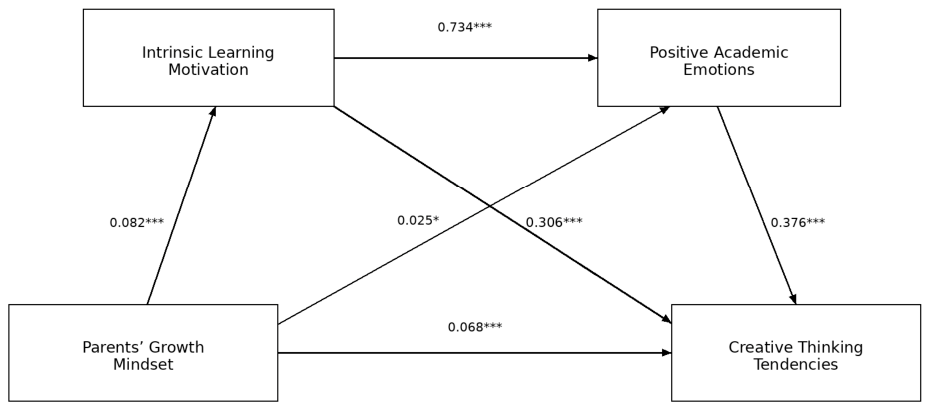
After adjusting for the covariates, parents’ growth mindset was positively associated with intrinsic learning motivation (β = 0.082, p < 0.001), positive academic emotions (β = 0.025, p = 0.033), and students’ creative thinking tendencies (β = 0.068, p < 0.001). Intrinsic learning motivation was positively associated with positive academic emotions (β = 0.734, p < 0.001) and creative thinking tendencies (β = 0.306, p < 0.001), while positive academic emotions were positively associated with creative thinking tendencies (β = 0.376, p < 0.001). Table 2 reports the standardized path coefficients.
As a robustness check, the path model was re-estimated using school-clustered robust standard errors, accounting for the nesting of students within 63 schools. All six focal paths remained positive and statistically significant. Parents’ growth mindset was associated with intrinsic learning motivation (β = 0.082, p = 0.005), positive academic emotions (β = 0.025, p = 0.041), and creative thinking tendencies (β = 0.068, p < 0.001). The remaining three paths also retained their statistical significance. These results suggest that the statistical significance of the focal paths was robust to adjustment for within-school dependence. The corresponding school-clustered estimates for all six focal paths are reported in Supplementary Table S2.
Table 2.
Estimated Path Coefficients of the Serial Mediation Model.
3.5. Bootstrap Tests of Indirect Effects
As shown in Table 3 and Figure 1, the bias-corrected bootstrap analysis yielded three positive specific indirect associations between parents’ growth mindset and students’ creative thinking tendencies. The indirect effect through intrinsic learning motivation was 0.037 (95% CI [0.022, 0.055]), while the indirect effect through positive academic emotions was 0.014 (95% CI [0.001, 0.027]). The serial indirect effect through intrinsic learning motivation followed by positive academic emotions was also statistically significant (effect = 0.034, 95% CI [0.019, 0.050]).
The total indirect effect was 0.085 (95% CI [0.052, 0.119]). The direct effect was 0.102 (95% CI [0.064, 0.141]), while the total effect was 0.187 (95% CI [0.135, 0.241]). Given the 1–100 scoring range, this total effect indicates that a 10-point difference in parents’ growth mindset score corresponds to an estimated 1.87-point difference in students’ creative thinking tendencies score, representing a positive but relatively small association. The corresponding standardized estimates were 0.025, 0.009, and 0.023 for the three specific indirect pathways, respectively, with a standardized total indirect effect of 0.057. The standardized direct and total effects were 0.068 and 0.125, respectively. Overall, the results were consistent with the hypothesized direct and indirect associations (H1–H4). As an additional robustness check, cluster-bootstrap analyses based on 5000 resamples at the school level were conducted. All three specific indirect effects and the total indirect effect remained statistically significant, with bias-corrected 95% confidence intervals excluding zero (Supplementary Table S3).
Table 3.
Bias-corrected bootstrap tests of direct and indirect effects.
Figure 1.
Estimated serial indirect-effects model with standardized path coefficients. * p < 0.05, ** p < 0.01, *** p < 0.001.
3.6. Alternative Model Analyses
To further examine the hypothesized relationships, two alternative models were estimated. In the reverse-order model, positive academic emotions preceded intrinsic learning motivation. Positive academic emotions were positively associated with intrinsic learning motivation (β = 0.748, p < 0.001). Intrinsic learning motivation and positive academic emotions were both positively associated with students’ creative thinking tendencies. Parents’ growth mindset remained positively associated with positive academic emotions and students’ creative thinking tendencies, whereas its direct association with intrinsic learning motivation was not statistically significant (β = 0.021, p = 0.054).
In the parallel indirect-effects model, the directional path between intrinsic learning motivation and positive academic emotions was removed. Both variables remained positively associated with students’ creative thinking tendencies (β = 0.333, p < 0.001; β = 0.409, p < 0.001, respectively). Parents’ growth mindset was positively associated with intrinsic learning motivation (β = 0.093, p < 0.001), positive academic emotions (β = 0.096, p < 0.001), and creative thinking tendencies (β = 0.078, p < 0.001). These findings indicate that the associations of both motivational and emotional factors with creative thinking tendencies remained evident when the directional relationship between the two mediators was removed.
Overall, the alternative models provide additional evidence that intrinsic learning motivation and positive academic emotions are both relevant to students’ creative thinking tendencies. However, the cross-sectional data do not establish the temporal ordering of these processes. Therefore, the hypothesized sequence should be interpreted as a theoretically proposed model rather than a confirmed causal sequence.
4. Discussion
In this sample of Chinese primary and junior secondary school students, parents’ growth mindset was positively associated with students’ creative thinking tendencies, with specific indirect associations through intrinsic learning motivation and positive academic emotions, including a serial association through motivation and then emotion. The positive association between parents’ growth mindset and students’ creative thinking tendencies extends research on family influences by highlighting the relevance of parents’ beliefs about ability development alongside parenting practices and family environments. Previous studies have linked family environments, parental autonomy support, and parental support to students’ creativity (P. Chen et al., 2021; Kumar & Singh, 2018; Ma et al., 2024; Q. Wang & Tang, 2024). Building on this research, the present findings suggest that parents’ growth mindset is one family-related belief associated with students’ creative thinking tendencies. This association should be interpreted in the context of broader family processes, including parental involvement and learning support. Importantly, the positive association between parents’ growth mindset and students’ creative thinking tendencies remained substantively similar after controlling for parental involvement, indicating that it was not fully explained by differences in parental engagement. Nevertheless, other aspects of the home learning environment may also contribute to the development of students’ creative thinking tendencies. This interpretation is consistent with research highlighting the relevance of parents’ beliefs to their involvement in children’s education (Bubić & Tošić, 2016) and the influence of mothers’ ability mindsets on the quality of their involvement in children’s learning (Moorman & Pomerantz, 2010).
The modest correlation (r = 0.157) and adjusted direct association (β = 0.068) indicate that the association between parents’ growth mindset and students’ creative thinking tendencies is small in magnitude. The path from parents’ growth mindset to positive academic emotions was particularly weak (β = 0.025), and its statistical significance should not be interpreted as evidence of a substantial practical association, particularly given the large sample size. These findings suggest that parents’ growth mindset is one of several family-related correlates of students’ creative thinking tendencies rather than a strong standalone predictor. This interpretation is consistent with evidence that growth mindset findings vary across people and contexts (Yeager & Dweck, 2020).
Several alternative explanations should also be considered. Although the analyses controlled for maternal education and family economic status, residual socioeconomic confounding may remain, as other family resources and educational environments may also be associated with children’s cognitive and academic development (Rakesh et al., 2025). In addition, parent–child similarities in educational and developmental outcomes may partly reflect genetic transmission as well as environmentally mediated effects of parental characteristics (B. Wang et al., 2021). Thus, the observed association may reflect the combined contributions of socioeconomic, genetic, and environmental factors rather than the influence of parents’ growth mindset alone.
The two specific indirect pathways provide further insight into the motivational and emotional processes associated with students’ creative thinking tendencies. The pathway through intrinsic learning motivation is compatible with self-determination theory and componential accounts of creativity, which emphasize interest-driven engagement (Amabile, 1983, 1993; Ryan & Deci, 2017). Students with stronger intrinsic learning motivation may engage more deeply with learning tasks and explore alternative approaches, both of which are relevant to creative thinking tendencies. The pathway through positive academic emotions can be interpreted in light of control–value theory and broaden-and-build theory, which highlight the relationships among learning appraisals, positive emotions, and flexible cognitive engagement (Fredrickson, 2001; Pekrun, 2006). Previous research has documented associations between affect and different aspects of creative cognition and performance (Bledow et al., 2013; B. Chen et al., 2016; Mastria et al., 2019). Meta-analytic evidence further indicates that positive mood is generally associated with greater creativity than neutral mood (Baas et al., 2008). Together, these findings suggest that intrinsic learning motivation and positive academic emotions represent distinct but closely related psychological processes associated with students’ creative thinking tendencies.
Although both specific indirect pathways were statistically significant, their estimated magnitudes differed. The indirect association through intrinsic learning motivation (H2) was larger than that through positive academic emotions alone (H3). The latter represented the weakest of the three indirect pathways examined in this study. This suggests that positive academic emotions, although significantly involved in the indirect pathway, showed a relatively smaller specific indirect association with students’ creative thinking tendencies. This difference may reflect the closer conceptual connection between intrinsic learning motivation and the sustained engagement, persistence, and exploration involved in creative thinking. By comparison, positive academic emotions may be more context-dependent and may have a less direct association with creative thinking tendencies.
The significant but relatively small serial indirect association proposed in H4 further connects these motivational and emotional perspectives. Students who engage in learning out of interest and curiosity may experience greater involvement and competence, which may be accompanied by enjoyment and pride and, in turn, be associated with more flexible and exploratory thinking. This proposed sequence is consistent with research documenting associations between intrinsic motivation and positive emotional experiences (Løvoll et al., 2017; Grassinger et al., 2024). The relatively strong positive correlation between intrinsic learning motivation and positive academic emotions (r = 0.764) further indicates that these two psychological processes are closely related in students’ learning experiences, although their temporal ordering remains to be established.
4.1. Theoretical and Practical Implications
This study examines parents’ growth mindset as a belief-level family factor within an integrated motivational and emotional framework of students’ creative thinking tendencies. It complements studies of parenting practices and children’s perceptions of parental beliefs by distinguishing the reporting sources. The identification of two specific indirect associations and a serial indirect association provides a more differentiated account of how parents’ growth mindset may relate to students’ creative thinking tendencies and raises questions for future research concerning the connections among parental beliefs, family interactions, and students’ learning experiences.
These findings also offer implications for family education. Rather than treating a growth mindset as a stand-alone intervention, family-education initiatives may benefit from recognizing parents’ beliefs about the development of abilities as a relevant family-context factor associated with students’ creative thinking tendencies. The findings also highlight the relevance of students’ intrinsic learning motivation and positive academic emotions when considering the associations between family beliefs and creative thinking tendencies. Accordingly, family education may pay greater attention to the relationships among parental beliefs, students’ learning motivation, and academic emotions, rather than assuming that changing parental beliefs alone will directly improve students’ creative thinking tendencies.
4.2. Limitations and Future Directions
Several limitations should be considered when interpreting the findings. First, the cross-sectional design does not establish causal relationships or the temporal ordering of the associations. Longitudinal or experimental research is needed to examine these processes (Maxwell & Cole, 2007).
Second, the measurement of family-related factors was limited. Parents’ growth mindset was assessed using three context-specific items informed by Dweck’s (2006) implicit theories framework. Although the measure demonstrated acceptable internal consistency, its validity has not been established against an established parental growth mindset scale, and its brevity may limit construct coverage and comparability with other studies. The items also focused on beliefs about the malleability of children’s learning abilities rather than broader beliefs about intelligence. Moreover, each matched child record included information from only one parent, preventing separate analyses of maternal and paternal beliefs and potentially overlooking differences between parents. Future research should use more comprehensive measures and collect reports from both parents where feasible.
Third, intrinsic learning motivation, positive academic emotions, and creative thinking tendencies were assessed through student self-reports, which may introduce shared method variance (Podsakoff et al., 2024). Younger students may also experience difficulties with item comprehension, recall, and self-evaluation. Although questionnaire wording was adapted across school levels, these limitations cannot be entirely eliminated. In addition, the positive academic emotions measure covered selected positive learning-related experiences but did not assess individual discrete emotions, such as enjoyment and pride, separately. Creative thinking tendencies were assessed through student self-reports rather than performance-based measures of actual creative thinking. Future research could combine student reports with teacher and parent ratings and performance-based assessments.
Fourth, the structural path model used min–max-normalized factor scores as observed variables rather than directly modeling latent variables. Consequently, measurement error may not have been fully accounted for, potentially affecting path estimates and comparability with studies using latent-variable models. Future research could employ latent-variable structural equation modeling with more extensively validated measures.
Fifth, the sample consisted exclusively of students in China. Cultural values, family beliefs, and educational contexts may influence the relationships examined, limiting generalizability to other countries and cultural settings. Cross-cultural studies are needed to examine whether these associations hold in different contexts.
Finally, intrinsic learning motivation and positive academic emotions may be reciprocally related, and the alternative model analyses suggest that different orderings are plausible. In addition, although school-clustered robust standard errors accounted for within-school dependence, finite-sample bias may remain with 63 school clusters. Longitudinal research and alternative cluster-robust inference procedures could further examine these issues.
5. Conclusions
This study examined the associations between parents’ growth mindset and students’ creative thinking tendencies among 3354 Chinese student–parent dyads. The results showed a small positive direct association between parents’ growth mindset and students’ creative thinking tendencies (β = 0.068). Three specific indirect associations were also identified through intrinsic learning motivation (β = 0.025), positive academic emotions (β = 0.009), and the serial pathway from motivation to emotion (β = 0.023). The standardized total indirect effect was 0.057, indicating that the indirect associations were also modest in magnitude. These findings suggest that parents’ growth mindset is one of several factors associated with students’ creative thinking tendencies. However, given the cross-sectional design, the observed direct and indirect associations should not be interpreted as evidence of causal effects or confirmed temporal processes.
Supplementary Materials
The following supporting information can be downloaded at: https://www.mdpi.com/article/10.3390/bs16112191/s1: Table S1: Pearson Correlations among Control Variables; Table S2: School-clustered robustness analysis of the six focal paths; Table S3: School-level cluster-bootstrap tests of indirect effects.
Author Contributions
Conceptualization, M.P., W.G. and X.G.; methodology, M.P., W.G., and X.G.; software, M.P., W.G. and X.G.; validation, M.P., W.G. and X.G.; formal analysis, M.P.; investigation, M.P., W.G. and X.G.; resources, M.P., W.G. and X.G.; data curation, M.P.; writing—original draft preparation, M.P.; writing—review and editing, M.P. and Y.L.; visualization, M.P.; supervision, W.G. and X.G.; project administration, M.P., W.G. and X.G.; funding acquisition, W.G. and X.G. All authors have read and agreed to the published version of the manuscript.
Funding
This research was funded by the 2024 Central China Normal University Master Teacher Studio Leader and Key Project Incubation Program, “Development of a Standards System for Artificial Intelligence–Enabled Teacher Training and Professional Development” (Grant No. CCNUMS2024-04); the 2024 National Natural Science Foundation of China Young Scientists Fund, “Multidimensional Assessment of Rural Children’s Approaches to Learning and the Mechanisms of Family Investment in the ‘Double Reduction’ Era” (Grant No. 72404100); the Guizhou Provincial Philosophy and Social Sciences Innovation Team Development Program (Grant No. CXTD2026015); and the 2025 Qiannan Normal University for Nationalities University-Level First-Class Teaching Team Project, “Teaching Team for Teacher Education Courses in the National First-Class Preschool Education Major” (Grant No. 2025XJG42).
Institutional Review Board Statement
The study was conducted in accordance with the Declaration of Helsinki and approved by the Human Research Subcommittee of the Life Science Ethics Review Committee, Central China Normal University (Approval Code: CCNU-IRB-202403046A; Approval Date: 15 March 2024).
Informed Consent Statement
Informed consent was obtained from parents or legal guardians, and assent was obtained from participating students prior to data collection.
Data Availability Statement
The data analyzed in this study are available from the corresponding author upon reasonable request, subject to privacy and ethical restrictions.
Acknowledgments
We would like to acknowledge all study participants for contributing to this project.
Conflicts of Interest
The authors declare no conflicts of interest.
References
- Amabile, T. M. (1983). The social psychology of creativity: A componential conceptualization. Journal of Personality and Social Psychology, 45(2), 357–376. [Google Scholar] [CrossRef]
- Amabile, T. M. (1993). Motivational synergy: Toward new conceptualizations of intrinsic and extrinsic motivation in the workplace. Human Resource Management Review, 3(3), 185–201. [Google Scholar] [CrossRef] [Scilit]
- Baas, M., De Dreu, C. K. W., & Nijstad, B. A. (2008). A meta-analysis of 25 years of mood-creativity research: Hedonic tone, activation, or regulatory focus? Psychological Bulletin, 134(6), 779–806. [Google Scholar] [CrossRef] [Scilit] [PubMed]
- Bian, Y., & Li, Y. (2000). Social network capital of urban Chinese families. In Sociology Department of Tsinghua University (Ed.), Tsinghua sociological review (Vol. 2, pp. 12–17). Lujiang Publishing House. (In Chinese) [Google Scholar]
- Bledow, R., Rosing, K., & Frese, M. (2013). A dynamic perspective on affect and creativity. Academy of Management Journal, 56(2), 432–450. [Google Scholar] [CrossRef] [Scilit]
- Bubić, A., & Tošić, A. (2016). The relevance of parents’ beliefs for their involvement in children’s school life. Educational Studies, 42(5), 519–533. [Google Scholar] [CrossRef] [Scilit]
- Chen, B., Hu, W., & Plucker, J. A. (2016). The effect of mood on problem finding in scientific creativity. The Journal of Creative Behavior, 50(4), 308–320. [Google Scholar] [CrossRef] [Scilit]
- Chen, J., & Liu, C. (2023). The longitudinal association between children’s growth mindset in senior primary school and their parents’ growth mindset. Frontiers in Psychology, 14, 1110944. [Google Scholar] [CrossRef] [Scilit] [PubMed]
- Chen, P., Zhang, J., Li, H., & Fu, M. (2021). Relationships between parenting behaviors and adolescents’ creativity in China: The mediating role of autonomous motivation. The Journal of Psychology, 155(5), 457–472. [Google Scholar] [CrossRef] [Scilit] [PubMed]
- Cheung, C. S.-S., & Pomerantz, E. M. (2011). Parents’ involvement in children’s learning in the United States and China: Implications for children’s academic and emotional adjustment. Child Development, 82(3), 932–950. [Google Scholar] [CrossRef] [Scilit] [PubMed]
- Chiu, C.-Y., Tong, Y.-Y., Lee, S.-L., & Chan, H.-S. (2023). Personal qualities are malleable and fixed: Ambivalent mindset, capability ranking reinforcement, and parent–child relationship among Hong Kong Chinese parents. Journal of Pacific Rim Psychology, 17, 1–13. [Google Scholar] [CrossRef] [Scilit]
- Deci, E. L., & Ryan, R. M. (2008). Self-determination theory: A macrotheory of human motivation, development, and health. Canadian Psychology/Psychologie Canadienne, 49(3), 182–185. [Google Scholar] [CrossRef] [Scilit]
- Dweck, C. S. (2006). Mindset: The new psychology of success. Random House. Available online: https://www.penguinrandomhouse.com/books/44330/mindset-by-carol-s-dweck-phd/ (accessed on 14 August 2026).
- Fan, H., Feng, Y., & Zhang, Y. (2024). Parental involvement and student creativity: A three-level meta-analysis. Frontiers in Psychology, 15, 1407279. [Google Scholar] [CrossRef] [Scilit] [PubMed]
- Fredrickson, B. L. (2001). The role of positive emotions in positive psychology: The broaden-and-build theory of positive emotions. American Psychologist, 56(3), 218–226. [Google Scholar] [CrossRef] [PubMed]
- General Office of the Communist Party of China Central Committee & General Office of the State Council. (2021, July 24). Opinions on further reducing the burden of homework and off-campus training for students in compulsory education (关于进一步减轻义务教育阶段学生作业负担和校外培训负担的意见). Available online: https://www.moe.gov.cn/jyb_xxgk/moe_1777/moe_1778/202107/t20210724_546576.html (accessed on 3 November 2026).
- Gong, X., & Gao, W. (2024). Research report on the assessment of learning quality of compulsory education students under the “Double Reduction” policy. [Unpublished research report]. Central China Normal University. (In Chinese) [Google Scholar]
- Gong, X., & Xiao, J. (2026). Do parents’ multidimensional growth mindsets transfer to their children? An empirical analysis based on SSES 2019 data from nine countries. Research on Modern Basic Education, 16(1), 143–149. [Google Scholar]
- Grassinger, R., Landberg, M., Määttä, S., Vasalampi, K., & Bieg, S. (2024). Interplay of intrinsic motivation and well-being at school. Motivation and Emotion, 48, 147–154. [Google Scholar] [CrossRef] [Scilit]
- Greenstein, L. M. (2012). Assessing 21st century skills: A guide to evaluating mastery and authentic learning. Corwin. Available online: https://www.corwin.com/books/assessing-21st-century-skills-237748 (accessed on 15 August 2026).
- Haimovitz, K., & Dweck, C. S. (2016). Parents’ views of failure predict children’s fixed and growth intelligence mind-sets. Psychological Science, 27(6), 859–869. [Google Scholar] [CrossRef] [Scilit] [PubMed]
- Jin, X. (2024). The role of effort in understanding academic achievements: Empirical evidence from China. European Journal of Psychology of Education, 39, 389–409. [Google Scholar] [CrossRef] [Scilit]
- Kumar, J., & Singh, U. (2018). Creativity as related to perceived family environment. International Journal of Indian Psychology, 6(1), 69–80. [Google Scholar] [CrossRef]
- Liang, C., Zhou, N., & Yu, S. (2025). Investigating Chinese parents’ growth mindset and their parenting practices in children’s English learning. European Journal of Education, 60(4), e70227. [Google Scholar] [CrossRef] [Scilit]
- Liu, J., Sun, X., Sun, M., Zhou, Y., Li, X., Cao, J., Liu, Z., & Xu, F. (2021). Factors influencing the creativity of Chinese upper-secondary-school students participating in programming education. Frontiers in Psychology, 12, 732605. [Google Scholar] [CrossRef] [Scilit] [PubMed]
- Løvoll, H. S., Røysamb, E., & Vittersø, J. (2017). Experiences matter: Positive emotions facilitate intrinsic motivation. Cogent Psychology, 4(1), 1340083. [Google Scholar] [CrossRef] [Scilit]
- Ma, Y., Zhang, H., & Wang, M. (2024). The effect of parental support on student self-rated and task-based creativity: The mediating role of creative interest and self-efficacy. Thinking Skills and Creativity, 52, 101512. [Google Scholar] [CrossRef] [Scilit]
- Macnamara, B. N., & Burgoyne, A. P. (2023). Do growth mindset interventions impact students’ academic achievement? A systematic review and meta-analysis with recommendations for best practices. Psychological Bulletin, 149(3–4), 133–173. [Google Scholar] [CrossRef] [Scilit] [PubMed]
- Mastria, S., Agnoli, S., & Corazza, G. E. (2019). How does emotion influence the creativity evaluation of exogenous alternative ideas? PLoS ONE, 14(7), e0219298. [Google Scholar] [CrossRef] [Scilit] [PubMed]
- Maxwell, S. E., & Cole, D. A. (2007). Bias in cross-sectional analyses of longitudinal mediation. Psychological Methods, 12(1), 23–44. [Google Scholar] [CrossRef] [Scilit] [PubMed]
- McNeish, D., & Stapleton, L. M. (2016). Modeling clustered data with very few clusters. Multivariate Behavioral Research, 51(4), 495–518. [Google Scholar] [CrossRef] [Scilit] [PubMed]
- Moorman, E. A., & Pomerantz, E. M. (2010). Ability mindsets influence the quality of mothers’ involvement in children’s learning: An experimental investigation. Developmental Psychology, 46(5), 1354–1362. [Google Scholar] [CrossRef] [Scilit] [PubMed]
- OECD. (2023). PISA 2022 assessment and analytical framework. OECD Publishing. [Google Scholar] [CrossRef] [Scilit]
- Pekrun, R. (2006). The control-value theory of achievement emotions: Assumptions, corollaries, and implications for educational research and practice. Educational Psychology Review, 18, 315–341. [Google Scholar] [CrossRef] [Scilit]
- Peng, W., & Zhang, F. (2025). Longitudinal links between perceived family support, self-efficacy, and growth mindset of intelligence among Chinese children. Behavioral Sciences, 15, 1182. [Google Scholar] [CrossRef] [Scilit] [PubMed]
- Podsakoff, P. M., Podsakoff, N. P., Williams, L. J., Huang, C., & Yang, J. (2024). Common method bias: It’s bad, it’s complex, it’s widespread, and it’s not easy to fix. Annual Review of Organizational Psychology and Organizational Behavior, 11, 17–61. [Google Scholar] [CrossRef] [Scilit]
- Rakesh, D., Lee, P. A., Gaikwad, A., & McLaughlin, K. A. (2025). Annual research review: Associations of socioeconomic status with cognitive function, language ability, and academic achievement in youth: A systematic review of mechanisms and protective factors. Journal of Child Psychology and Psychiatry, 66(4), 417–439. [Google Scholar] [CrossRef] [Scilit] [PubMed]
- Runco, M. A., & Jaeger, G. J. (2012). The standard definition of creativity. Creativity Research Journal, 24(1), 92–96. [Google Scholar] [CrossRef] [Scilit]
- Ryan, R. M., & Deci, E. L. (2000). Self-determination theory and the facilitation of intrinsic motivation, social development, and well-being. American Psychologist, 55(1), 68–78. [Google Scholar] [CrossRef] [PubMed]
- Ryan, R. M., & Deci, E. L. (2017). Self-determination theory: Basic psychological needs in motivation, development, and wellness. Guilford Press. Available online: https://www.guilford.com/books/Self-Determination-Theory/Ryan-Deci/9781462528769 (accessed on 29 September 2026).
- Sisk, V. F., Burgoyne, A. P., Sun, J., Butler, J. L., & Macnamara, B. N. (2018). To what extent and under which circumstances are growth mind-sets important to academic achievement? Two meta-analyses. Psychological Science, 29(4), 549–571. [Google Scholar] [CrossRef] [Scilit] [PubMed]
- Wang, B., Baldwin, J. R., Schoeler, T., Cheesman, R., Barkhuizen, W., Dudbridge, F., Bann, D., Morris, T. T., & Pingault, J.-B. (2021). Robust genetic nurture effects on education: A systematic review and meta-analysis based on 38,654 families across 8 cohorts. The American Journal of Human Genetics, 108(9), 1780–1791. [Google Scholar] [CrossRef] [Scilit] [PubMed]
- Wang, Q., & Tang, Y. (2024). How does the support from family and school affect the creativity of primary and secondary school students? An international comparative analysis based on SSES. Journal of Central China Normal University (Humanities and Social Sciences), 63(2), 179–188. (In Chinese) [Google Scholar] [CrossRef]
- Yeager, D. S., & Dweck, C. S. (2020). What can be learned from growth mindset controversies? American Psychologist, 75(9), 1269–1284. [Google Scholar] [CrossRef] [Scilit] [PubMed]
- Zhou, J., & Fan, A. (2025). The impact of China’s “Double Reduction” policy on primary school students’ subjective well-being and academic achievement. International Journal of Educational Development, 117, 103321. [Google Scholar] [CrossRef] [Scilit]
Disclaimer/Publisher’s Note: The statements, opinions and data contained in all publications are solely those of the individual author(s) and contributor(s) and not of MDPI and/or the editor(s). MDPI and/or the editor(s) disclaim responsibility for any injury to people or property resulting from any ideas, methods, instructions or products referred to in the content. |
© 2026 by the authors. Licensee MDPI, Basel, Switzerland. This article is an open access article distributed under the terms and conditions of the Creative Commons Attribution (CC BY) license.