


Abstract
Grounded in social capital theory, this study investigates the mechanisms through which digital inclusion shapes academic achievement amid the ongoing digitalization of education. Using data from the 2018 PISA China sample, this study first employs inverse probability weighting with regression adjustment (IPWRA) to estimate the average treatment effect (ATE) of family educational background, urban–rural status, and gender on digital inclusion. It then employs a parallel mediation model to examine how digital inclusion inequality influences academic achievement, assessing the mediating roles of peer, family, and teacher social capital, alongside the moderating effect of urban–rural context. Intersectional analyses reveal that children from highly educated families attending urban schools enjoy clear advantages in digital access, usage, and outcomes. Additionally, gender differences may emerge in digital usage and outcomes when family educational background and urban–rural status are identical. Moreover, social capital significantly mediates the relationship between digital inclusion inequality and academic achievement, while urban–rural status moderates the effects of family and teacher social capital on academic achievement. These findings underscore the combined influence of family, gender, and contextual factors in shaping educational inequalities in the digital era.
1. Introduction
The deep integration of digital technologies has driven a systematic restructuring in the education sector, particularly in terms of knowledge production, organizational forms, and learning paradigms. Under the global wave of digitalization, China has also placed significant emphasis on the strategic importance of educational digitalization in promoting high-quality education development and achieving educational equity, elevating the digital transformation of education to a national strategy. Against the backdrop of increased internet coverage and the widespread adoption of information technologies, the digitalization process, although offering new opportunities for educational equity, may also give rise to new forms of inequality, further exacerbating digital inclusion inequality in education.
There has been a growing body of research examining the relationship between digital exclusion and educational outcomes. Numerous studies have demonstrated a strong association between adolescents’ digital skills and their academic performance (Hurwitz & Schmitt, 2020; Shao et al., 2024). Digital inclusion inequality, encompassing both limited access to technology and insufficient digital skills, significantly shapes adolescents’ learning outcomes by reducing their engagement with digital environments and narrowing their learning approaches (Hurwitz & Schmitt, 2020). Overall, digital inclusion inequality has become a significant social issue affecting educational opportunities and learning effectiveness among youth (Eynon & Geniets, 2016; Vermeire & Van den Broeck, 2024). Understanding the mechanisms through which digital inclusion inequality impacts academic achievement is crucial to addressing educational inequality in the digital age.
However, existing studies tend to examine inclusion inequality along single social dimensions (e.g., gender or socioeconomic status), implicitly assuming additive effects and thus overlooking the compounded disadvantages arising from intersecting social positions (Gnambs & Hawrot, 2025; Nordrum & Gracia, 2024; Zheng & Walsham, 2021). Accordingly, this study adopts an intersectional approach to examine differences in the level and structure of digital inclusion across social groups and to investigate its association with adolescents’ academic achievement, with a particular focus on the mediating role of social capital and the moderating role of urban–rural status.
2. Literature Review
2.1. Intersecting Inequalities in Digital Inclusion
Digital transformation has fundamentally reshaped global education, particularly through the widespread integration of information and communication technologies (ICTs) into learning (Timotheou et al., 2023). However, its benefits are not equally distributed. Inequalities in internet access, digital device availability, and digital literacy remain major challenges to digital inclusion (Dewi, 2026). Digital inclusion refers to ensuring that all individuals and communities, especially disadvantaged groups, can access and use ICT (National Digital Inclusion Alliance, 2022). In China, children’s digital inclusion inequality is deeply shaped by social structures. The long-standing urban–rural divide has generated persistent disparities in economic development, educational resources, and digital infrastructure, further influencing children’s access to and use of digital resources (Kong & Yang, 2026). Despite rapid advances in internet penetration and digital infrastructure, rural children remain more vulnerable to digital exclusion due to limited family resources, inadequate school digital facilities, and insufficient parental digital support. Moreover, gender, family educational background, and urban–rural disparities are not independent factors but intersect to jointly shape children’s digital inclusion, resulting in complex structural patterns of digital exclusion.
Regional economic development substantially shapes disparities in children’s digital inclusion. Due to limited resources, rural areas often face inadequate access to digital devices and weaker digital infrastructure, whereas urban areas provide more advanced information infrastructure and greater opportunities for productive digital use (Chen & Tai, 2023; Hannan & Eynon, 2025). Consequently, urban children generally outperform rural children in digital access, use, and outcomes. Although China has implemented policies to reduce the urban–rural digital divide, family-level disparities remain substantial. These findings suggest that urban–rural disparities intersect with family educational background and gender, reinforcing digital inequality and contributing to the multiple disadvantages experienced by rural children. Family educational background is another critical factor influencing children’s digital inclusion inequality in China. Parents with lower educational attainment are more likely to restrict children’s access to digital devices due to economic constraints, thereby widening digital disparities (Liu, 2020). In contrast, highly educated parents tend to emphasize the informational and educational functions of digital media, cultivate better digital practices, and provide greater guidance in online resource use (Van Deursen & Van Dijk, 2015; Friemel, 2016). Thus, children from families with greater educational and cultural capital are more likely to transform digital use into educational benefits, whereas disadvantaged children are more likely to engage in entertainment-oriented digital activities, further reinforcing digital inequality (Zhang & Huang, 2018; L. Li et al., 2024). From the perspective of structural gender inequality, some studies suggest that girls are more likely to engage in learning-oriented digital use and achieve more positive digital outcomes (Jackson et al., 2008), whereas others indicate that girls have lower digital competence than boys (Wang et al., 2022). These inconsistent findings may depend on social contexts. In more economically developed regions, egalitarian gender norms and women’s higher social status may reduce or eliminate gender disparities in digital exclusion (Ueno et al., 2023). Therefore, gender effects are not universal but shaped by broader structural conditions. However, existing studies have largely examined gender, family socioeconomic background, and urban–rural disparities as independent factors, overlooking their intersectional effects. Accordingly, this study adopts an intersectional framework to examine how gender, family socioeconomic background, and urban–rural status interact within specific social structures to shape children’s digital inclusion opportunities and experiences of digital exclusion, thereby revealing the multidimensional mechanisms underlying digital inequality among Chinese children.
2.2. Digital Inclusion and Academic Achievement
Digital inclusion in education encompasses not only the availability of technological infrastructure but also individuals’ capacity to use digital technologies effectively, critically, and creatively to support the learning process and enhance academic achievement (Burns & Gottschalk, 2019). Conceptually, digital inclusion comprises three interrelated dimensions: digital access, digital use, and digital outcomes (Van Deursen et al., 2016; Wilson-Menzfeld et al., 2025). A growing body of empirical research has documented associations between each of these dimensions and academic achievement. At the access level, household and school internet infrastructure has been shown to significantly improve students’ academic performance (Nordrum & Gracia, 2024; Goolsbee & Guryan, 2006). At the usage level, stronger ICT competencies and more pedagogically oriented technology use are linked to better academic outcomes, particularly among low-achieving students (Ben Youssef et al., 2022; Pagani et al., 2016). At the outcome level, however, excessive engagement with non-academic digital activities—such as gaming and social media—has been found to undermine attention and academic performance (Robinson et al., 2018; Camerini et al., 2018; Kates et al., 2018).
Despite these insights, existing studies largely examine the effects of digital inclusion on academic achievement along single dimensions, often treating access, usage, and outcomes as analytically independent (Abdykerimova et al., 2025; Anh et al., 2025; Nordrum & Gracia, 2024). This fragmented approach may obscure how different forms of digital inclusion co-occur and jointly shape learning processes. Moreover, less is known about the mechanisms through which digital inclusion translates into academic disadvantage. Addressing these gaps, the present study adopts an integrated perspective to examine the multidimensional structure of digital inclusion and its association with academic achievement, with particular attention to the mediating role of social capital.
2.3. Social Capital as a Mediator
Social capital refers to the resources individuals can mobilize through their social networks, including social ties, trust, norms of reciprocity, and channels of information exchange. For children and adolescents, social capital is primarily embedded within family, school, and peer contexts, where it functions as a critical support system for academic development and psychosocial adjustment (Bourdieu, 1986; Coleman, 1988). Social capital theory posits that access to resources is contingent upon the structure and quality of social networks, as well as the presence of mutual trust and reciprocal interactions (Coleman, 1988). A growing body of empirical evidence suggests that digital technologies can facilitate the accumulation of social capital among children by improving access to educational information, strengthening student–teacher communication, and expanding peer networks (Lai & Gwung, 2013; S. Feng & Tan, 2024). Conversely, digital exclusion constrains communication with teachers, peers, and parents, thereby weakening social ties and limiting opportunities for social capital formation (Pénard & Poussing, 2009; Zilka, 2019).
Social capital has been consistently linked to children’s academic achievement. Prior research indicates that both the quantity and quality of family- and teacher-related social capital are significant predictors of academic outcomes (Mieziene et al., 2022; Tan & Fang, 2023). Among these sources, family social capital often exerts a stronger influence than school-based social capital (Dufur et al., 2013; Parcel et al., 2010), underscoring the pivotal role of the family context in the transmission of educational resources. Nonetheless, evidence also suggests that in resource-constrained environments, the positive effects of family social capital on academic achievement may be attenuated (Y. Zhao et al., 2023), highlighting the context-dependent nature of social capital processes. Moreover, digital technologies may enable children to broaden their social connections and activate latent support within peer networks, thereby fostering academic development (S. Feng & Tan, 2024; Ryabov, 2009).
Taken together, these findings support the proposition that social capital serves as a key mediating mechanism linking digital inclusion inequality to academic achievement, helping to explain how digital inequalities are translated into educational disparities.
2.4. Urban–Rural Status as a Moderator
Recent research has increasingly drawn on social exclusion theory to examine the relationship between rural–urban status and child development. This framework emphasizes how certain groups are systematically excluded from full participation in social life and from access to resources across political, economic, social, and cultural domains (Room, 1995; Sen, 2000). In the information society, digital exclusion represents a salient form of social exclusion, with rural–urban identity constituting a key structural determinant (Warren, 2007). The rural–urban divide extends beyond geography, reflecting entrenched inequalities in the distribution of resources and opportunities, which in turn shape children’s digital access, usage, and outcomes, thereby reinforcing the marginalization of rural children. Empirical evidence shows that rural–urban status significantly conditions children’s digital opportunities and social capital accumulation (Olson et al., 2025). Compared with urban peers, rural children are more likely to experience digital exclusion, limiting their access to information and online social networks and undermining family, school, and peer social capital (Y. Li & Ranieri, 2013; L. Zhao et al., 2022).
Moreover, rural–urban status may moderate the association between social capital and academic achievement. Prior studies have documented substantial urban–rural differences in the educational returns to social capital (Cueto et al., 2005; Tan & Fang, 2023), with some forms of social capital showing negligible effects in rural contexts (Tan & Fang, 2023). This pattern suggests that constrained educational resources and weaker institutional support in rural areas may limit children’s ability to convert social capital into academic success. Accordingly, examining the moderating role of rural–urban identity is essential for understanding the mechanisms driving digital and educational inequalities.
2.5. The Present Study
Prior research has linked children’s digital inclusion to gender, family educational background, and rural–urban status, but most studies treat these factors independently, overlooking their intersectional effects. In China, where social stratification is shaped by family background and the rural–urban divide, an additive approach may underestimate disparities. Moreover, existing studies rarely integrate all three dimensions of digital inclusion—access, usage, and outcomes—or examine how social capital mediates its impact on academic achievement. Little is known about the concurrent roles of family, school, and peer social capital, and rural–urban status remains underexplored as a contextual moderator. To address these gaps, this study adopts an intersectional perspective to investigate how these factors jointly shape children’s digital inclusion and proposes a moderated mediation model in which digital inclusion influences academic achievement through social capital, with rural–urban status moderating these pathways. The hypotheses are:
H1.
Digital inclusion among children is jointly shaped by gender, family educational background, and rural–urban status.
H2.
Social capital mediates the relationship between digital inclusion and academic achievement.
H3.
Rural–urban status moderates the above pathways.
3. Method
3.1. Participants
This study uses data from the 2018 cycle of the Programme for International Student Assessment (PISA), an international survey assessing 15-year-old students’ proficiency in reading, mathematics, and science, alongside extensive individual, family, and school background information (OECD, 2019). PISA employs a two-stage stratified sampling design. In the first stage, schools are selected from a comprehensive list of eligible institutions using a systematic Probability Proportional to Size (PPS) sampling procedure. To enhance the representativeness of the sample across different educational contexts, schools are stratified by school type (i.e., public and private schools) and school location (i.e., urban and rural areas), with the probability of selection proportional to school size. In the second stage, 35 students are randomly sampled from each selected school to participate in the assessment. Prior to data collection, informed consent was obtained from school principals, teachers, parents, and students, ensuring that the study procedures adhered to relevant ethical standards.
The present analysis focuses on the Chinese mainland sample, covering four high-performing provinces and municipalities—Beijing, Shanghai, Jiangsu, and Zhejiang. Data were collected from 361 schools, yielding valid responses from 12,058 students. Although these regions generally represent areas with relatively advanced economic and educational development in China, substantial socioeconomic and educational heterogeneity remains within them. Firstly, despite their overall high levels of digitalization and educational development, differences persist across families and schools in terms of digital resource access, digital support capacity, and social support conditions. For example, family educational background, school digital resource allocation, and teacher support may shape children’s digital inclusion. Such internal variations provide an important basis for examining how family, teacher, and peer social capital contribute to children’s digital inclusion and subsequently influence academic achievement. Secondly, these regions include both highly urbanized areas and rural areas with varying levels of development, providing an appropriate context for examining the moderating role of urban–rural status. Although cities such as Beijing and Shanghai have more developed digital infrastructure and educational resources, regions such as Jiangsu and Zhejiang still exhibit urban–rural disparities in digital access, digital support, and social capital resources. This heterogeneity enables the present study to explore how digital inclusion influences academic achievement through different forms of social capital and whether these pathways vary across urban and rural contexts. Therefore, these regions provide a suitable setting for investigating the relationships among digital inclusion, social capital, and academic achievement while examining the moderating role of urban–rural status.
3.2. Measures
3.2.1. Digital Inclusion
Digital inclusion consists of three dimensions: digital access, digital use, and digital outcomes. Digital access reflects students’ availability of digital devices and Internet resources and was measured using five items assessing the accessibility of digital resources in students’ households: (1) internet-enabled mobile phones, (2) computers, (3) tablets, (4) e-book readers, and (5) internet access. Responses were recorded on a 4-point scale ranging from 1 (“none”) to 4 (“three or more”), and the mean score across items was computed, with higher scores indicating a higher level of digital access (Cronbach’s α = 0.629).
Digital use reflects students’ frequency of technology use and digital engagement, measured by six items on activities such as reading emails, online chatting, reading news, searching for information, participating in forums, and seeking practical information. Responses were rated on a 5-point scale from 1 (“I do not know what this is”) to 5 (“several times a day”), and the mean score across items was computed, with higher scores indicating a higher level of digital use (Cronbach’s α = 0.774).
Digital outcomes reflect students’ ability to evaluate appropriate responses to digital information. It was measured with five items assessing students’ judgments on the appropriateness of different actions in response to an email, including replying to request more information, verifying the sender’s address, clicking the link immediately, deleting the email without clicking the link, and visiting the mobile operator’s website for verification. Items were rated on a 6-point scale ranging from 1 (“not at all appropriate”) to 6 (“very appropriate”), and the mean score across items was computed, with higher scores indicating better digital outcomes.
3.2.2. Academic Achievement
Academic achievement was assessed using students’ performance in mathematics, reading, and science. Reading literacy reflects students’ ability to understand, use, and evaluate written texts; mathematical literacy captures their capacity to formulate, apply, and interpret mathematical concepts in problem-solving contexts; and scientific literacy represents their ability to understand scientific knowledge and engage in scientific reasoning. For each domain, the ten plausible values were averaged and weighted to construct the final composite measure of academic achievement.
3.2.3. Social Capital
Social Capital comprises three dimensions: Peer Social Capital, Family Social Capital, and Teacher Social Capital. Peer social capital was measured using three items capturing students’ perceived peer relationships at school: (1) “It is easy for me to make friends at school,” (2) “Other students seem to like me,” and (3) “I feel lonely at school.” Responses were recorded on a 4-point Likert scale ranging from 1 (“strongly agree”) to 4 (“strongly disagree”), with the last item reverse-coded so that higher scores consistently reflected higher levels of peer social capital. Family social capital was operationalized based on parental occupational status, which was further converted into the International Socio-Economic Index of Occupational Status (ISEI) following previous studies (Guan et al., 2025; Wu et al., 2022). The ISEI reflects the social prestige associated with parental occupations and the broader socioeconomic resources and opportunities that may be available to families. In this study, the mean ISEI score of both parents was calculated to represent the resource-based dimension of family social capital. Teacher social capital was assessed using four school-level items reflecting teacher and staff resources: (1) shortages of teachers, (2) inadequately qualified or poorly performing teachers, (3) shortages of support staff (e.g., teaching assistants and administrative personnel), and (4) inadequately qualified or poorly performing support staff. Each item was rated on a 4-point scale from 1 (“not at all”) to 4 (“a lot”). All items were reverse-coded such that higher values indicated greater availability and quality of teacher-related resources.
3.2.4. Covariates
The demographic variables included gender (1 = female, 2 = male), rural-urban status (1 = rural, 2 = urban), and family educational background (0 = at least one parent had completed high school or higher education, 1 = both parents had attained no more than a middle school education).
3.3. Data Analysis
All statistical analyses were conducted using SPSS and R 4.4.2. First, descriptive statistics, correlation analyses, and one-way analyses of variance (ANOVAs) were performed in SPSS to examine the distributional characteristics of the study variables, pairwise correlations among key variables, and disparities in digital inclusion across different intersectional strata and dimensions. Subsequently, inverse probability weighting regression adjustment (IPWRA) models with double robustness were estimated in R 4.5.2 to conduct the intersectional analyses and address potential selection bias arising from observed covariates. This approach integrates propensity score weighting with outcome regression adjustment, allowing for more robust estimation of the average treatment effect (ATE) and facilitating more accurate comparisons of outcomes across intersectional strata. For each of the three dimensions of digital inclusion, 28 separate IPWRA models were fitted to compare disparities between each pair of intersectional strata. Given the inflated family-wise error rate resulting from multiple comparisons (76%), the Bonferroni correction was applied to maintain an overall alpha level of 0.05. Accordingly, an ATE estimate was considered statistically significant only when the corresponding p-value was below 0.00179 (0.05/28). Finally, moderated mediation analyses were conducted using PROCESS Model 59 in SPSS to examine the indirect effects of digital inclusion inequality on academic achievement and the moderating role of urban–rural status.
4. Result
4.1. Preliminary Analyses
Table 1 presents the means, standard deviations, and Pearson correlation matrix for the core variables.
Table 1.
Means, standard deviations, and correlation matrix of the core variables.
4.2. Analysis of Intersectional Inequalities
Table 2 reports the results of one-way ANOVA and Kruskal–Wallis tests examining digital exclusion across intersectional strata. Although normality and homogeneity assumptions were not fully met, the large sample size permits ANOVA under the Central Limit Theorem. ANOVA assesses whether significant differences exist among groups by comparing the means of multiple independent groups. The results showed that boys from high-education families attending urban schools exhibited the highest levels of digital inclusion across all three dimensions, whereas girls from low-education families attending rural schools (LRG) experienced the greatest disadvantage across dimensions. Without adjusting for covariates, significant differences were observed among intersectional strata in digital access exclusion, digital usage exclusion, and digital outcome exclusion (p < 0.0001).
Table 2.
One-way analysis of variance and Kruskal–Wallis test.
To further validate these findings, a non-parametric Kruskal–Wallis test, which does not rely on the assumption of normality, was conducted as a robustness check. This test evaluates group differences by comparing medians, and the results were largely consistent with the ANOVA findings. Specifically, children from high-education families attending urban schools showed the highest median levels of digital inclusion across all three dimensions, whereas those from low-education families attending rural schools exhibited the lowest median levels, with significant between-group differences (p < 0.0001).
4.3. Average Treatment Effects (ATEs) for Digital Inclusion Across Intersectional Strata
Table 3, Table 4 and Table 5 present the 28 IPWRA results across three dimensions of digital inclusion. By conducting pairwise comparisons in each model, this study obtained estimates of differences in digital inclusion across eight intersectional strata, along with their statistical significance, independent of grade, school type, and school size. In each table, column groups represent treatment groups and row groups represent control groups. Table 3 shows that, among groups with the same parental educational background and school location, no significant gender differences were found in digital access. However, the remaining 24 comparisons were significantly negative at p = 0.0001. This indicates that parental education and school location, rather than gender, are the primary factors shaping digital access disparities. Students from highly educated families in urban schools showed clear advantages, whereas those from less-educated families in rural schools were disadvantaged. These findings remained significant after Bonferroni correction (p < 0.00179). Table 4 indicates that, after Bonferroni correction, no significant gender differences in digital use were found among groups with the same parental education and school location. However, digital use disparities were more pronounced across intersectional groups. Significant advantages emerged only among students with both highly educated parents and urban school backgrounds, whereas significant disadvantages were observed only among girls with low parental education attending rural schools. Table 5 shows that, after Bonferroni correction, compared with urban students from highly educated families, significant disparities were observed among urban girls, rural boys, and rural girls from less-educated families. Among all groups, rural girls from less-educated families experienced the greatest digital outcome exclusion.
Table 3.
Estimated average treatment effect (ATE) differences in digital access inclusion across intersectional strata.
Table 4.
Estimated average treatment effect (ATE) differences in digital usage inclusion across intersectional strata.
Table 5.
Estimated average treatment effect (ATE) differences in digital outcome inclusion across intersectional strata.
4.4. Mediating Effects of Family, Peer, and Teacher Social Capital on the Association Between Digital Inclusion and Academic Achievement
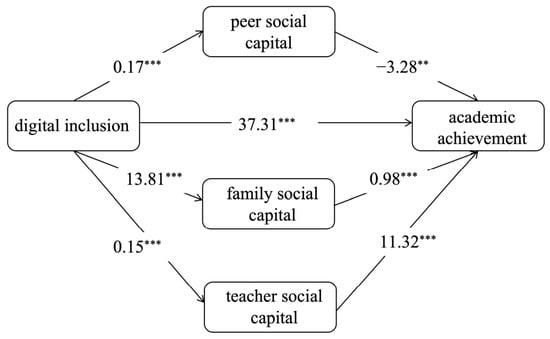
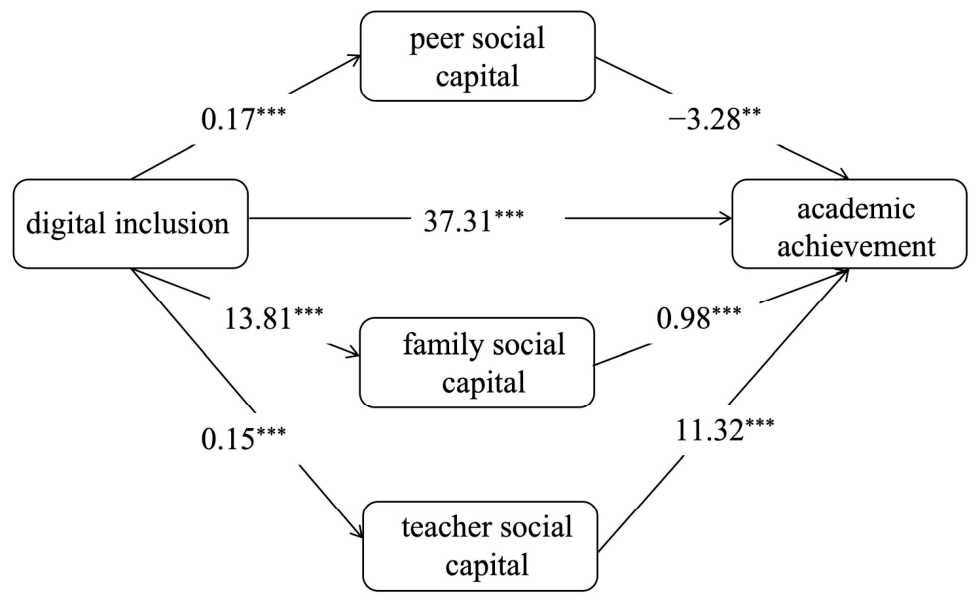
Figure 1 presents the results of the multiple mediation model. As shown in Figure 1, digital inclusion significantly and positively predicted peer social capital (β = 0.17, p < 0.001), family social capital (β = 13.81, p < 0.001), and teacher social capital (β = 0.15, p < 0.001). Digital inclusion also had a significant total effect on academic achievement (β = 51.93, p < 0.001). After incorporating the three types of social capital into the model, peer social capital showed a significant negative association with academic achievement (β = −3.28, p < 0.05), while both family social capital (β = 0.98, p < 0.001) and teacher social capital (β = 11.32, p < 0.001) had significant positive predictive effects. Notably, the direct effect of digital inclusion on academic achievement remained significant (β = 37.31, p < 0.001), indicating that the association between digital inclusion and academic achievement was partially mediated by the three forms of social capital.
Figure 1.
Path diagram of the effect of digital inclusion on academic achievement. Note. *** p < 0.001, ** p < 0.01.
Next, bias-corrected bootstrap confidence intervals were used to further assess the robustness of the mediating effects. The 95% CI for the total effect was [13.33, 16.06]. The 95% CIs for the indirect effects of peer, family, and teacher social capital were [−0.91, −0.13], [12.23, 14.75], and [1.30, 2.16], respectively. As all confidence intervals excluded zero, each mediating pathway was statistically significant.
4.5. Urban–Rural Differences
PROCESS Model 59 in SPSS 27.0 was employed to examine whether rural–urban status moderates the indirect effect of digital inclusion on academic achievement through peer, family, and teacher social capital, with the results presented in Table 6.
Table 6.
Test of the moderated mediation model with social capital as the mediator.
Model 1 showed that digital inclusion (β = 0.06, p = 0.56), rural–urban status (β = −0.19, p = 0.31), and their interaction (β = 0.05, p = 0.32) did not significantly predict peer social capital. In Model 2, digital inclusion (β = 43.54, p < 0.001) and rural–urban status (β = 108.71, p < 0.001) positively predicted academic achievement, whereas their interaction was nonsignificant (β = −3.67, p = 0.58), indicating no moderation of the direct effect. Peer social capital (β = 12.02, p = 0.28) and its interaction with rural–urban status (β = −7.68, p = 0.17) also showed no significant effects on academic achievement.
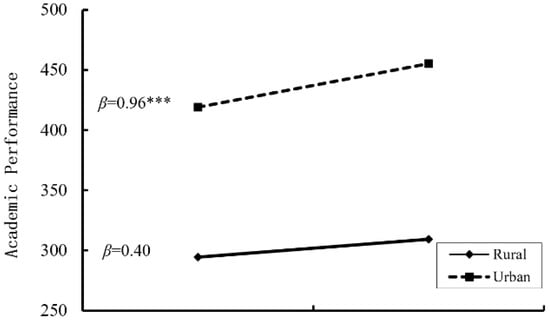
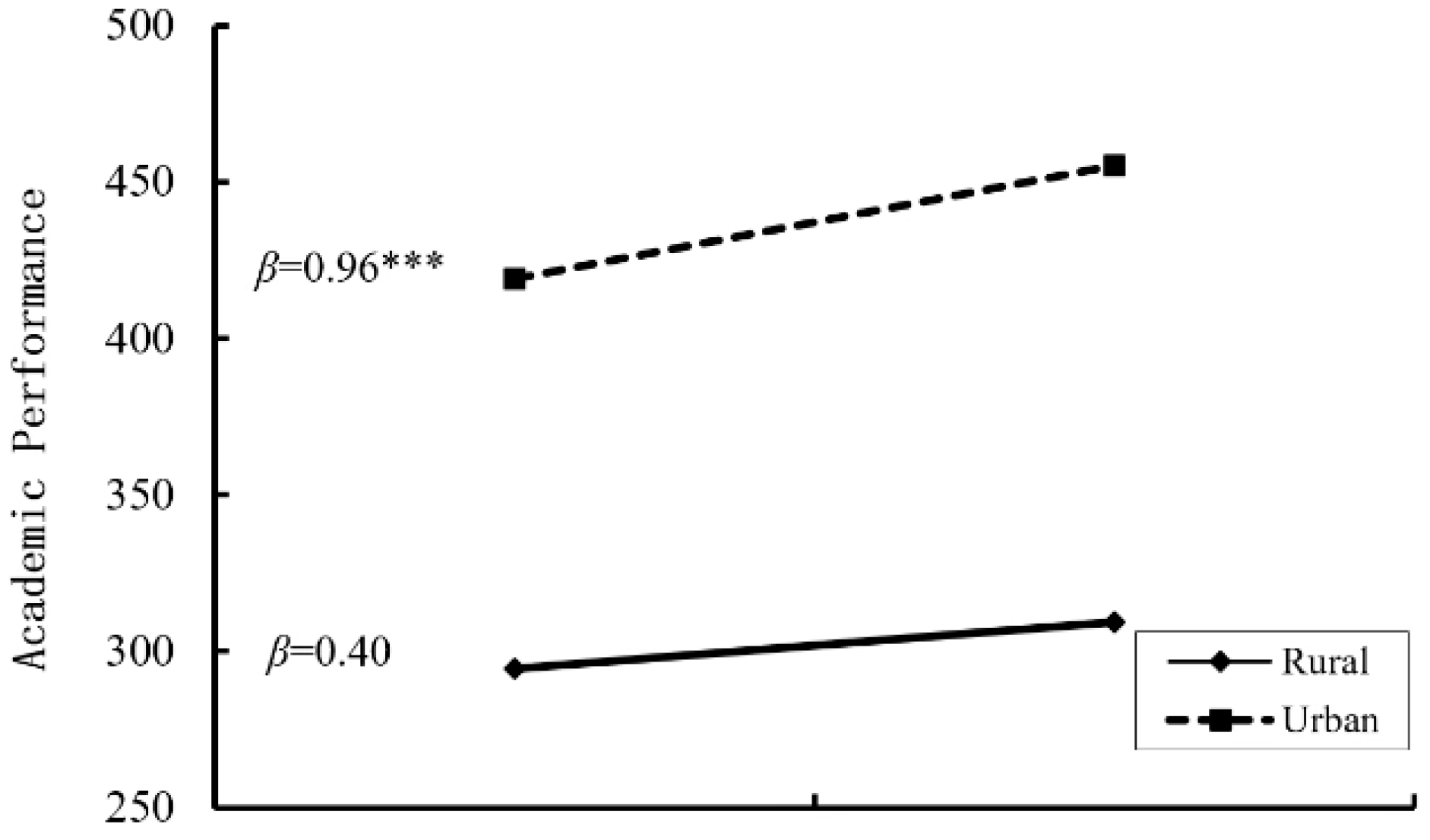
Model 3 indicated that digital inclusion significantly predicted family social capital (β = 7.64, p = 0.01), whereas rural–urban status had no significant effect (β = −1.74, p = 0.75); their interaction was not significant (β = 2.96, p = 0.06). In Model 4, family social capital did not directly predict academic achievement (β = −0.17, p = 0.68), but its interaction with rural–urban status was significant (β = 0.57, p = 0.01), suggesting a moderating role of rural–urban status. Simple slope analyses (see Figure 2) indicated that the effect was nonsignificant among rural students (β = 0.40, p = 0.057) but significant among urban students (β = 0.96, p < 0.001). The moderated mediation index was significant (8.86, 95% CI [3.63, 13.92]). Subgroup analyses further showed a nonsignificant indirect effect for rural students (effect = 4.20, 95% CI [−0.57, 9.26]) but a significant effect for urban students (effect = 13.06, 95% CI [11.84, 14.36]), suggesting that the mediating role of family social capital is stronger among urban students.
Figure 2.
Moderating effect of urban–rural status on the relationship between family social capital and academic performance. Note. *** p < 0.001.
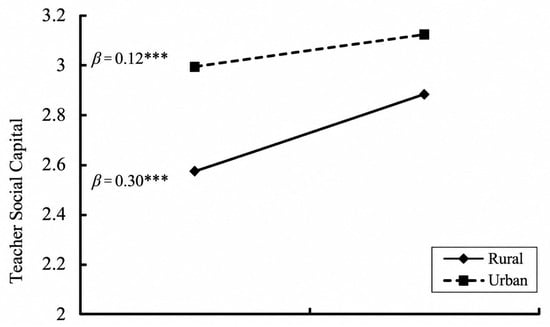
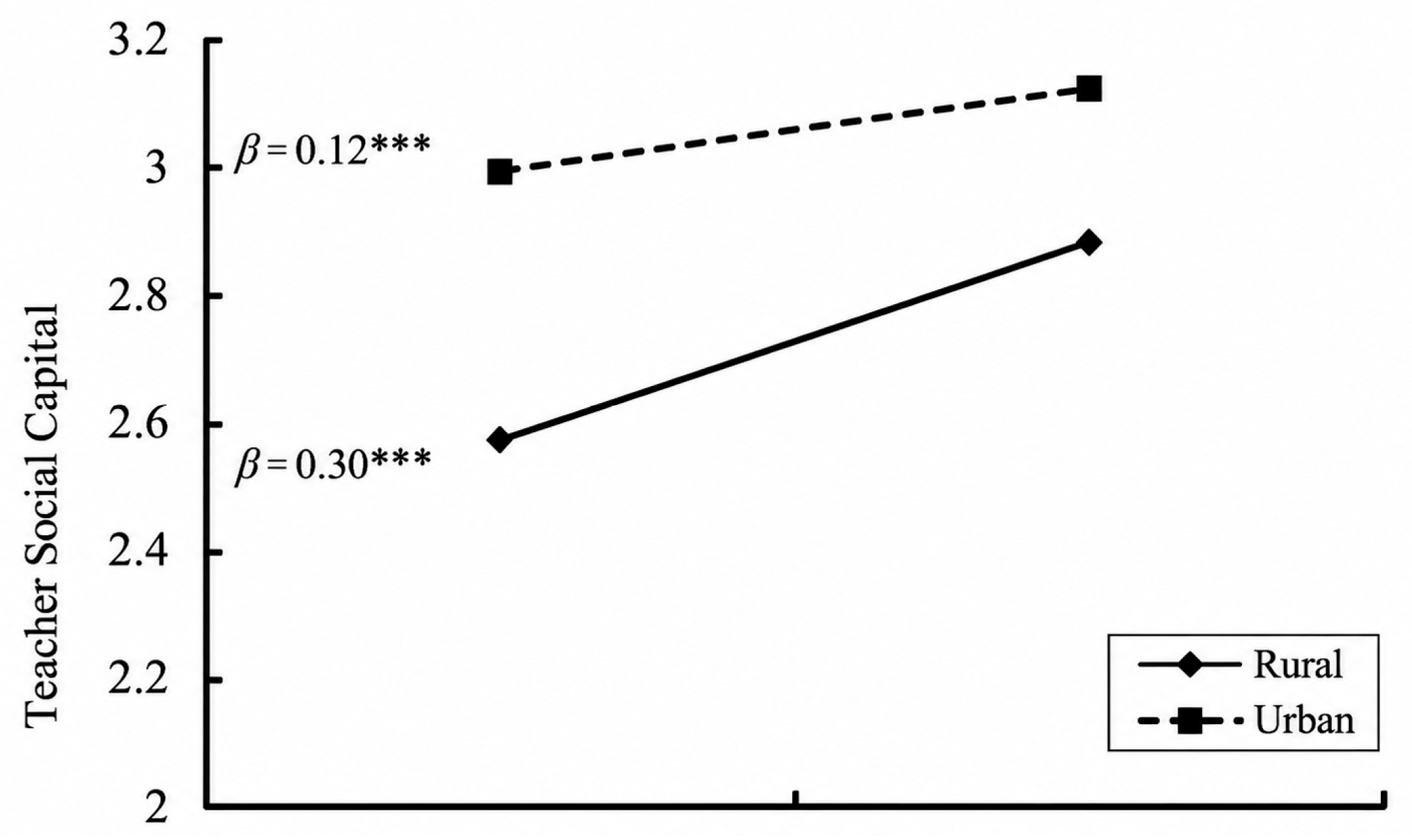
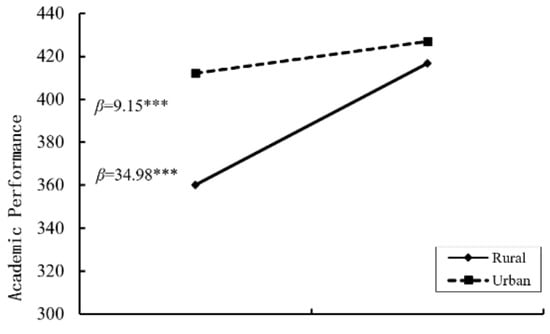
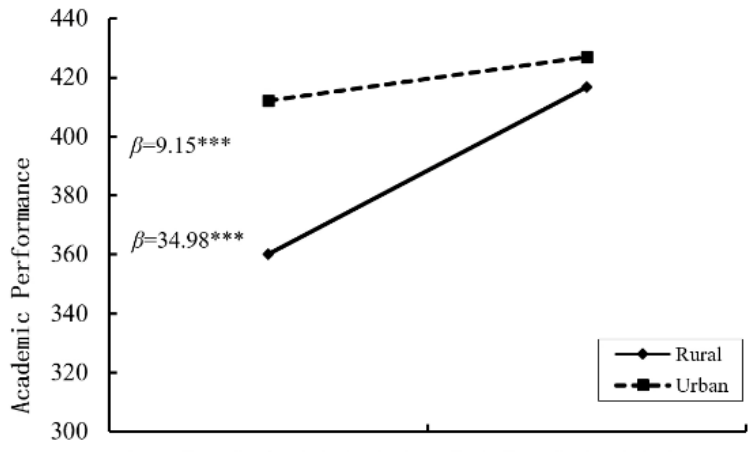
Model 5 showed that digital inclusion (β = 0.48, p = 0.001) and urban–rural status (β = 0.95, p < 0.001) positively predicted teacher capital, with a significant negative interaction (β = −0.18, p = 0.02), indicating moderation. Model 6 revealed that teacher capital significantly predicted academic achievement (β = 60.80, p < 0.001), and its interaction with urban–rural status was negative and significant (β = −25.83, p < 0.001), supporting the moderated mediation effect. Simple slope analyses (see Figure 3) showed stronger effects of digital inclusion on teacher capital among rural students (β = 0.30, p < 0.001) than urban students (β = 0.12, p < 0.001). Likewise, teacher capital had a stronger effect on academic achievement among rural students (β = 34.98, p < 0.001) than among urban students (β = 9.15, p < 0.001); see Figure 4 for the simple slope plot. The moderated mediation index was significant (effect = −9.33, 95% CI [−15.47, −3.56]). Subgroup analyses confirmed significant indirect effects for both rural (effect = 10.46, 95% CI [4.71, 16.59]) and urban students (effect = 1.13, 95% CI [0.79, 1.52]), indicating a stronger mediating role of teacher capital among rural students.
Figure 3.
Moderating effect of urban–rural status on the relationship between digital inclusion and teacher social capital. Note. *** p < 0.001.
Figure 4.
Moderating effect of urban–rural status on the relationship between teacher social capital and academic achievement. Note. *** p < 0.001.
5. Discussion
5.1. Intersectional Inequalities in Digital Inclusion
The findings indicate that boys and girls from highly educated families who attend urban schools exhibit substantial advantages across all dimensions of digital inclusion, including digital access, digital use, and digital outcomes. In contrast, girls from low-educated families attending rural schools experience the most severe forms of digital inclusion across all dimensions, providing support for Hypothesis H1. These findings are consistent with previous research. For example, Fu et al. (2024) demonstrated that urban children in China are better positioned to utilize advanced learning technologies and access diverse educational resources, an advantage that is partly attributable to their more favorable family economic conditions and higher levels of parental education. By comparison, rural children from socioeconomically disadvantaged backgrounds often encounter multiple constraints, including insufficient digital guidance and parental supervision, as well as limited support from schools and communities. Similarly, Sun et al. (2024) found that urban students in China outperform their rural counterparts in terms of access to and use of digital media, as well as their abilities to understand and evaluate digital information. Moreover, parental educational attainment and parental mediation of digital media were found to exert significant positive effects on students’ digital media literacy.
Importantly, this study further reveals that family educational background and the location of school are more important than gender in determining the level of digital inclusion, and that gender may amplify the disadvantages in digital usage and outcomes among children growing up in resource-constrained families and rural environments. Consistent with intersectionality theory, the intersection of multiple dimensions of social disadvantage can accumulate structural constraints and further intensify inequalities (Crenshaw, 1991; Bowleg, 2008; Lett et al., 2022). This finding also aligns with previous research on the digital gender divide. For instance, VS (2025) highlighted the mechanisms underlying digital gender inequality, demonstrating that in developing countries, cultural factors and gender norms interact to constrain girls’ access to digital resources and opportunities, thereby reinforcing their disadvantaged digital positions. Taken together, these findings suggest that efforts to reduce digital inclusion inequality should extend beyond simply narrowing the urban–rural digital divide. Instead, they should incorporate targeted redistribution of digital resources toward children from educationally disadvantaged families. Furthermore, policy interventions should prioritize groups situated at the intersection of multiple disadvantages, such as rural children from low-education families, and develop tailored support strategies that address their specific needs. Such differentiated approaches are essential for promoting equitable access to digital opportunities and mitigating persistent structural inequalities in the digital era.
5.2. Mediating Role of Social Capital
Mediation analysis indicated that family, peer, and teacher social capital significantly mediated the relationship between digital inclusion and academic achievement, supporting Hypothesis 2. Social class structures families’ access to digital resources and cultural capital, thereby constraining parental support and exacerbating educational inequality (Mzidabi et al., 2024). This finding underscores the central role of the family in students’ learning support systems and aligns with extensive evidence showing that parental expectations, involvement, and resource provision are critical for academic development (Tan & Fang, 2023; Chi & Qian, 2016; Prêteur et al., 1998). Under conditions of digital inclusion inequality, students may depend more heavily on stable home learning environments, positive parental attitudes, and effective supervision to sustain academic motivation and study routines.
Teacher social capital significantly mediated the effect of digital inclusion on academic achievement, with prior research indicating that teachers with strong digital competencies exert a substantially greater positive influence on students’ learning outcomes than those lacking such skills (Chaparro, 2024; Jeong et al., 2024). When equipped with adequate digital resources, teachers can enhance achievement through instructional guidance, timely feedback, and emotional support (Hu & Yu, 2023). However, digital inclusion inequality intensifies disparities in teachers’ digital literacy, limiting their capacity to provide effective support (Hong et al., 2024). This result further highlights the indispensable role of teachers in students’ academic development. However, although the mediation model showed significant indirect effects, the relatively low explained variance indicates that teacher social capital accounts for only a limited proportion of the variation in academic achievement. Therefore, the present findings should be interpreted cautiously. Future research should further investigate teacher-related mechanisms by incorporating more comprehensive indicators of teacher social capital, such as teachers’ digital competence, digital pedagogical practices, and capacity to provide academic and emotional support in digital learning environments.
Notably, peer social capital negatively mediated the relationship between digital inclusion and academic achievement: greater digital inclusion was associated with higher peer social capital, which was subsequently linked to lower academic achievement. This finding differs from previous research. For instance, X. Feng et al. (2025), focusing on Chinese adolescents, found that longer screen exposure negatively affected academic performance by undermining adolescents’ peer relationships. Meanwhile, a substantial body of research has demonstrated that positive peer relationships generally facilitate adolescents’ academic development (Shao et al., 2024; Berthelon et al., 2019; Yang & Wang, 2023). This discrepancy may stem from differences in the functions and contexts of peer relationships. While positive peer resources (e.g., cooperation, responsibility, and belonging) can enhance academic outcomes (Palardy, 2019; Berthelon et al., 2019), deviant peer behaviors may undermine academic performance (Jiang, 2023). In the present study, peer social capital primarily captured interaction frequency and relational ties, without distinguishing relationship quality or functions. Strong peer connections may not necessarily provide academically supportive resources and may sometimes involve non-academic interactions or peer norms that divert attention from learning (Goulas et al., 2024). Furthermore, the relatively low explained variance suggests that peer social capital represents only a limited pathway underlying the association between digital inclusion and academic achievement. Therefore, this finding should be interpreted cautiously, as the peer social capital measure used in the present study may not fully capture the complexity of peer-related mechanisms in digital learning contexts. Future research should further differentiate between positive peer support, academically oriented peer relationships, and negative peer influences to provide a more nuanced understanding of the mechanisms through which peer social capital shapes the association between digital inclusion inequality and academic achievement.
5.3. Moderating Role of Urban–Rural Status
The results showed that urban–rural status significantly moderated the effects of family social capital on academic achievement, digital inclusion on teacher social capital, and teacher social capital on academic achievement. However, urban–rural status did not significantly moderate the indirect effect of digital exclusion on academic achievement via peer social capital. Thus, Hypothesis 3 was partially supported. This pattern reflects structural differences in the functioning of social capital across regional contexts. In urban settings, higher levels of digitalization have rendered access to digital resources a core component of household educational investment (Addi-Raccah, 2024). Moreover, urban families typically hold higher educational expectations and possess greater cultural capital, enabling them to more effectively translate family resources into academic achievement (Pan, 2022). By contrast, in resource-constrained rural contexts, the compensatory role of teacher-based social capital becomes particularly salient (W. Li, 2023). The absence of significant moderation effects along peer pathways may indicate that peer influence is shaped more strongly by school-level microcultures than by broader regional structures.
Overall, this study elucidates key mechanisms through which digital inclusion affects academic achievement via multiple forms of social capital, with these processes contingent on urban–rural context. Several practical implications follow. First, efforts should be made to promote the equitable distribution of digital educational resources, with particular emphasis on improving rural digital infrastructure and enhancing teachers’ digital competencies to ensure that high-quality resources reach disadvantaged areas. Second, family education support systems should be strengthened by providing accessible digital training and tools for families with limited digital literacy, thereby enhancing their capacity to support children’s learning. Third, schools should improve digital learning environments by deepening the integration of technology, curriculum, and instruction, fostering supportive ecosystems that amplify the educational function of teacher social capital. Taken together, these strategies highlight the importance of establishing a multi-stakeholder digital education support system to mitigate the adverse consequences of digital inclusion inequality and advance educational equity.
6. Limitations and Future Research Direction
Despite its contributions, this study has several limitations. First, because the sample was drawn from four relatively economically developed regions in China, caution should be exercised when generalizing the findings to less developed areas, where digital resources, social support systems, and educational opportunities may differ substantially. Future research should extend investigations to a broader range of regions, particularly rural and economically disadvantaged areas, to examine whether the identified patterns remain consistent across diverse sociocultural contexts. Second, the cross-sectional design limits causal inference. Future studies should employ longitudinal or experimental designs to further examine the causal relationships among digital inclusion, social capital, and academic achievement. Third, defining urban–rural status solely by school location may not fully reflect students’ individual residential circumstances. Therefore, the urban–rural classification used in this study should be interpreted as a school/community-level contextual indicator rather than a direct measure of students’ residential location. Future research should incorporate individual-level information on students’ residential locations, where available, to more accurately capture urban–rural differences in students’ living environments and to examine how residential and school/community contexts may jointly shape their experiences and outcomes. Moreover, although parental occupational status has been widely used as an indicator of the structural dimension of family social capital (Guan et al., 2025; Wu et al., 2022), it may not fully capture the relational dimensions of family capital, such as parent–child communication, emotional support, and family cohesion. Future research should incorporate both resource-based and relational dimensions of family capital to provide a more comprehensive understanding of the mechanisms through which family resources are associated with digital inclusion and academic achievement. Fourth, although the mediation analysis identified the significant mediating roles of family, peer, and teacher social capital, the relatively small R2 values for peer and teacher social capital suggest that their explanatory power was limited. Therefore, the findings regarding the mediating roles of peer and teacher social capital should be interpreted with caution. Future research could adopt a multidimensional perspective and incorporate more comprehensive indicators (e.g., the quality of peer interactions, teacher support, and relationship characteristics) to better capture the complexity of social capital and further clarify its role in the association between digital inclusion inequality and academic achievement. Moreover, although the Cronbach’s α coefficient of the digital inclusion measure reached an acceptable level, its relatively low value warrants caution when interpreting the findings. Future studies could further refine the measurement of digital inclusion by incorporating more comprehensive dimensions, such as digital access, digital skills, quality of digital use, and digital participation, to enhance measurement reliability and validity. Finally, future studies should investigate the interactive effects of digital access, digital use, and digital outcomes, as well as consider the long-term developmental consequences of digital inclusion inequality on academic trajectories and social-emotional outcomes, to provide a more comprehensive understanding of how digital exclusion shapes educational equity.
Author Contributions
Conceptualization, S.J. and H.Z.; methodology, Y.L. (Yan Luo); software, S.Z. and Y.L. (Yingying Lyu); writing—original draft preparation, S.J., H.Z., Y.L. (Yan Luo), S.Z. and Y.L. (Yingying Lyu); writing—review and editing, H.Z., Y.L. (Yan Luo) and S.Z.; visualization, W.H.; supervision, W.H.; project administration, S.J., H.Z. and W.H.; funding acquisition, S.J. All authors have read and agreed to the published version of the manuscript.
Funding
This study was funded by the MOE (Ministry of Education in China) Project of Humanities and Social Sciences (Grant No. 22YJC880024).
Institutional Review Board Statement
Ethical review and approval were waived for this study since this study is a secondary analysis of publicly available, fully anonymized data from the Programme for International Student Assessment (PISA) 2018, conducted by the Organization for Economic Co-operation and Development (OECD). The dataset contains no information that could be used to identify individual students or schools. No additional ethical approval or informed consent was required for the present study.
Informed Consent Statement
Additional informed consent was not required for this secondary analysis.
Data Availability Statement
This study used publicly available secondary data from the Programme for International Student Assessment (PISA) 2018, conducted by the Organisation for Economic Co-operation and Development (OECD). The data can be accessed through the OECD website at: https://www.oecd.org/en/data/insights/data-explainers/2024/09/api.html (accessed on 24 May 2026).
Acknowledgments
The data used in this study were collected as part of the PISA and were supported by funding from OECD. The content of this article is solely the responsibility of the authors and does not necessarily reflect the views of PISA.
Conflicts of Interest
The authors declare no conflicts of interest.
References
- Abdykerimova, E., Turkmenbayev, A., Sagindykova, E., Nigmetova, G., & Mukhtarkyzy, K. (2025). Systematic review of digital tools’ impact on primary and secondary education outcomes. International Journal of Engineering Pedagogy, 15(3), 92–114. [Google Scholar] [CrossRef] [Scilit]
- Addi-Raccah, A. (2024). The role of digital capital in parental engagement. Education and Information Technologies, 29(13), 16901–16928. [Google Scholar] [CrossRef] [Scilit]
- Anh, P. H., Khoi, P. M., & Trung, T. D. M. (2025). Communication in the digital age: Social media’s influence on academic performance among South East-Asia students. Review of Communication Research, 13, 112–126. [Google Scholar] [CrossRef] [Scilit]
- Ben Youssef, A., Dahmani, M., & Ragni, L. (2022). ICT use, digital skills and students’ academic performance: Exploring the digital divide. Information, 13(3), 129. [Google Scholar] [CrossRef] [Scilit]
- Berthelon, M., Bettinger, E., Kruger, D. I., & Montecinos-Pearce, A. (2019). The structure of peers: The impact of peer networks on academic achievement. Research in Higher Education, 60(7), 931–959. [Google Scholar] [CrossRef] [Scilit]
- Bourdieu, P. (1986). The forms of capital. In J. G. Richardson (Ed.), Handbook of theory and research for the sociology of education (pp. 241–258). Greenwood Press. [Google Scholar]
- Bowleg, L. (2008). When Black+ lesbian+ woman≠ Black lesbian woman: The methodological challenges of qualitative and quantitative intersectionality research. Sex Roles, 59(5), 312–325. [Google Scholar] [CrossRef] [Scilit]
- Burns, T., & Gottschalk, F. (2019). Educating 21st century children: Emotional well-being in the digital age. Educational research and innovation. OECD Publishing. [Google Scholar]
- Camerini, A.-L., Schulz, P. J., & Jeannet, A.-M. (2018). The social inequalities of Internet access, its use, and the impact on children’s academic performance: Evidence from a longitudinal study in Switzerland. New Media & Society, 20(7), 2489–2508. [Google Scholar] [CrossRef] [Scilit]
- Chaparro, D. Y. G. (2024). Digital competencies of teachers and academic performance in regular elementary education: A systematic review. Espacios En Blanco-Serie Indagaciones, 34(2), 99–111. [Google Scholar] [CrossRef] [Scilit]
- Chen, H., & Tai, Z. (2023). Tethered disparities: Adolescent smartphone use in rural and urban China. Media and Communication, 11(4), 239–251. [Google Scholar] [CrossRef] [Scilit]
- Chi, W., & Qian, X. (2016). Human capital investment in children: An empirical study of household child education expenditure in China, 2007 and 2011. China Economic Review, 37, 52–65. [Google Scholar] [CrossRef] [Scilit]
- Coleman, J. S. (1988). Social capital in the creation of human capital. The American Journal of Sociology, 94, S95–S120. [Google Scholar] [CrossRef] [Scilit] [PubMed]
- Crenshaw, K. (1991). Mapping the margins: Intersectionality, identity politics, and violence against women of color. Stanford Law Review, 43(6), 1241–1299. [Google Scholar] [CrossRef] [Scilit]
- Cueto, S., Guerrero, G., León, J., De Silva, M., Huttly, S., Penny, M. E., Lanata, C. F., & Villar, E. (2005). Social capital and education outcomes in urban and rural Peru (Working paper No. 28). Save the Children UK. [Google Scholar]
- Dewi, R. P. (2026). Digital Inclusion in Education: The Relationship between Internet Access, Digital Literacy, and Academic Performance at the Global Level. Journal of Digital Psychology Review, 1(1), 20–28. [Google Scholar]
- Dufur, M. J., Parcel, T. L., & McKune, B. A. (2013). Does capital at home matter more than capital at school? the case of adolescent alcohol and marijuana use. Journal of Drug Issues, 43(1), 85–102. [Google Scholar] [CrossRef] [Scilit]
- Eynon, R., & Geniets, A. (2016). The digital skills paradox: How do digitally excluded youth develop skills to use the internet? Learning, Media and Technology, 41(3), 463–479. [Google Scholar] [CrossRef] [Scilit]
- Feng, S., & Tan, C. Y. (2024). Toward conceptual clarity for digital cultural and social capital in student learning: Insights from a systematic literature review. Humanities and Social Sciences Communications, 11(1), 68. [Google Scholar] [CrossRef] [Scilit]
- Feng, X., Ren, S., & Shi, P. (2025). The relationship and mechanism of screen time and academic performance among adolescents: An empirical study based on CEPS. Frontiers in Public Health, 13, 1533327. [Google Scholar] [CrossRef] [Scilit] [PubMed]
- Friemel, T. N. (2016). The digital divide has grown old: Determinants of a digital divide among seniors. New Media & Society, 18(2), 313–331. [Google Scholar] [CrossRef] [Scilit]
- Fu, L., Zeng, Y., & Kang, X. (2024). Bridging the urban–rural gap: A qualitative examination of perceived access, barriers, risks and opportunities of children’s digital learning during the COVID-19 pandemic. Child & Family Social Work, 29(1), 1–11. [Google Scholar] [CrossRef] [Scilit]
- Gnambs, T., & Hawrot, A. (2025). The development of social, gender, and migration-related disparities in digital competencies during adolescence. Computers in Human Behavior, 173, 108800. [Google Scholar] [CrossRef] [Scilit]
- Goolsbee, A., & Guryan, J. (2006). The impact of internet subsidies in public schools. The Review of Economics and Statistics, 88(2), 336–347. [Google Scholar] [CrossRef] [Scilit]
- Goulas, S., Griselda, S., Megalokonomou, R., & Zenou, Y. (2024). Disruptive peers and academic performance: Short-and long-term outcomes. IZA Institute of Labor Economics. [Google Scholar]
- Guan, D., Zhang, S., Sun, J., & He, E. (2025). How to breakthrough disparities in scientific literacy of different family background: The mediating role of self-directed learning efficacy and the moderating role of family support. Acta Psychologica, 261, 105817. [Google Scholar] [CrossRef] [Scilit] [PubMed]
- Hannan, B., & Eynon, R. (2025). Widening the digital divide: The mediating role of intelligent tutoring systems in the relationship between rurality, socioeducational advantage, and mathematics learning outcomes. Computers & Education, 233, 105312. [Google Scholar] [CrossRef] [Scilit]
- Hong, J., Liu, W., & Zhang, Q. (2024). Closing the digital divide: The impact of teachers’ ICT use on student achievement in China. Journal of Comparative Economics, 52(3), 697–713. [Google Scholar] [CrossRef] [Scilit]
- Hu, J., & Yu, H. (2023). Impact of extracurricular synchronous and asynchronous computer-mediated communication between students and teachers on digital reading performance: Evidence from 53 countries/regions. Education and Information Technologies, 28(2), 1559–1586. [Google Scholar] [CrossRef] [Scilit] [PubMed]
- Hurwitz, L. B., & Schmitt, K. L. (2020). Can children benefit from early internet exposure? Short-and long-term links between internet use, digital skill, and academic performance. Computers & Education, 146, 103750. [Google Scholar] [CrossRef] [Scilit]
- Jackson, L. A., Zhao, Y., Kolenic, A., III, Fitzgerald, H. E., Harold, R., & Von Eye, A. (2008). Race, gender, and information technology use: The new digital divde. CyberPsychology & Behavior, 11(4), 437–442. [Google Scholar] [CrossRef] [Scilit] [PubMed]
- Jeong, D. W., Moon, H., Jeong, S. M., & Moon, C. J. (2024). Digital capital accumulation in schools, teachers, and students and academic achievement: Cross-country evidence from the PISA 2018. International Journal of Educational Development, 107, 103024. [Google Scholar] [CrossRef] [Scilit]
- Jiang, J. (2023). Learning from bad peers? Influences of peer deviant behaviour on adolescent academic performance. International Journal of Adolescence and Youth, 28(1), 2246539. [Google Scholar] [CrossRef] [Scilit]
- Kates, A. W., Wu, H., & Coryn, C. L. S. (2018). The effects of mobile phone use on academic performance: A meta-analysis. Computers & Education, 127, 107–112. [Google Scholar] [CrossRef] [Scilit]
- Kong, Q., & Yang, L. (2026). Digital divide in rural education in Chinese schools: Exploring issues and opportunities. European Journal of Education, 61(1), e70436. [Google Scholar] [CrossRef] [Scilit]
- Lai, C.-H., & Gwung, H.-L. (2013). The effect of gender and Internet usage on physical and cyber interpersonal relationships. Computers & Education, 69, 303–309. [Google Scholar] [CrossRef] [Scilit]
- Lett, E., Asabor, E., Beltr’an, S., Cannon, A. M., & Arah, O. A. (2022). Conceptualizing, contextualizing, and operationalizing race in quantitative health sciences research. Annals of Family Medicine, 20(2), 157–163. [Google Scholar] [CrossRef] [Scilit] [PubMed]
- Li, L., Wang, Q., Shi, J., & Huang, C. (2024). Reproduction of digital inequalities: The impact of family cultural capital and digital habits on digital skills of middle school students in western rural areas. Modern Distance Education Research, 36(6), 69–80. [Google Scholar]
- Li, W. (2023). Opportunities, challenges, and responses to ensuring rural students’ right to educational equity in the digital era. Nanjing Journal of Social Sciences, (9), 151–162. [Google Scholar] [CrossRef]
- Li, Y., & Ranieri, M. (2013). Educational and social correlates of the digital divide for rural and urban children: A study on primary school students in a provincial city of China. Computers & Education, 60(1), 197–209. [Google Scholar] [CrossRef] [Scilit]
- Liu, J. (2020). Educational Equity under the digital divide: Analysis of four provinces in China based on PISA2018. Journal of National Academy of Education Administration, (9), 35–43. Available online: https://www.naea.edu.cn/library/fileDir/resource/cms/article/82787/95680/2020122509424336144.pdf (accessed on 24 May 2026).
- Mieziene, B., Emeljanovas, A., Jusiene, R., Breidokiene, R., Girdzijauskiene, S., Sabaliauskas, S., Buzaityte-Kasalyniene, J., Budiene, V., Eiliakaite, I., Speicyte-Ruschhoff, E., Babkovskiene, E., Zvirdauskas, D., & Kawachi, I. (2022). Direct and indirect effects of social support and school social capital on the academic success of 11–19-year-old students using distance learning. Sustainability, 14(4), 2131. [Google Scholar] [CrossRef] [Scilit]
- Mzidabi, J., Goudeau, S., Delès, R., Claes, N., Easterbrook, M. J., Alexopoulos, T., & Rouet, J.-F. (2024). Unequal homework: The hidden forces of social class contexts and parental self-efficacy in shaping educational outcomes. Journal of Social Issues, 80(4), 1315–1344. [Google Scholar] [CrossRef] [Scilit]
- National Digital Inclusion Alliance. (2022). Definitions. Available online: https://www.digitalinclusion.org/definitions/ (accessed on 5 January 2022).
- Nordrum, E., & Gracia, P. (2024). Impacts of broadband internet on adolescents’ academic outcomes: Heterogeneous effects among lower secondary school students in Norway. Information, Communication & Society, 27(16), 2776–2800. [Google Scholar] [CrossRef] [Scilit]
- Olson, K., Phillips, A., Smyth, J. D., & Stenger, R. (2025). The urban–rural digital divide in internet access and online activities during the COVID-19 pandemic. Rural Sociology, 90(3), e70012. [Google Scholar] [CrossRef] [Scilit]
- Organisation for Economic Co-operation and Development (OECD). (2019). PISA 2018 database. Available online: https://www.oecd.org/en/data/datasets/pisa-2018-database.html (accessed on 24 May 2026).
- Pagani, L., Argentin, G., Gui, M., & Stanca, L. (2016). The impact of digital skills on educational outcomes: Evidence from performance tests. Educational Studies, 42(2), 137–162. [Google Scholar] [CrossRef] [Scilit]
- Palardy, G. J. (2019). School peer non-academic skills and academic performance in high school. Frontiers in Education, 4, 57. [Google Scholar] [CrossRef] [Scilit]
- Pan, S. (2022). Why does online reproduction persist? A study on the impact of digital habitus and online tutoring on the academic achievement of urban and rural students. Journal of Education Research, 18(4), 139–155. [Google Scholar] [CrossRef]
- Parcel, T. L., Dufur, M. J., & Cornell Zito, R. (2010). Capital at home and at school: A review and synthesis. Journal of Marriage and Family, 72(4), 828–846. [Google Scholar] [CrossRef] [Scilit]
- Pénard, T., & Poussing, N. (2009). Internet use and social capital: The strength of virtual ties. Journal of Economic Issues, 44, 569–595. [Google Scholar] [CrossRef] [Scilit]
- Prêteur, Y., Lescarret, O., & de Léonardis, M. (1998). Family education, child-parent interactions and child development. European Journal of Psychology of Education, 13(4), 461–474. [Google Scholar] [CrossRef] [Scilit]
- Robinson, L., Wiborg, Ø., & Schulz, J. (2018). Interlocking inequalities: Digital stratification meets academic stratification. American Behavioral Scientist, 62(9), 1251–1272. [Google Scholar] [CrossRef] [Scilit]
- Room, G. (1995). Beyond the threshold: The measurement and analysis of social exclusion. Policy Press. [Google Scholar]
- Ryabov, I. (2009). The role of peer social capital in educational assimilation of immigrant youths. Sociological Inquiry, 79(4), 453–480. [Google Scholar] [CrossRef] [Scilit]
- Sen, A. (2000). Social exclusion: Concept, application, and scrutiny. Office of Environment and Social Development, Asian Development Bank. [Google Scholar]
- Shao, Y., Kang, S., Lu, Q., Zhang, C., & Li, R. (2024). How peer relationships affect academic achievement among junior high school students: The chain mediating roles of learning motivation and learning engagement. BMC Psychology, 12(1), 278. [Google Scholar] [CrossRef] [Scilit] [PubMed]
- Sun, J., Yang, Z., Chen, S., & Deng, R. (2024). Exploring the disparity in digital media literacy between urban and rural primary school students: Insights from an empirical study in China. Frontiers of Digital Education, 1(2), 178–197. [Google Scholar] [CrossRef] [Scilit]
- Tan, G. L. C., & Fang, Z. (2023). Family social and cultural capital: An analysis of effects on adolescents’ educational outcomes in China. The Journal of Chinese Sociology, 10(1), 21. [Google Scholar] [CrossRef] [Scilit]
- Timotheou, S., Miliou, O., Dimitriadis, Y., Villagrá Sobrino, S., Giannoutsou, N., Cachia, R., Martínez Monés, A., & Ioannou, A. (2023). Impacts of digital technologies on education and factors influencing schools’ digital capacity and transformation: A literature review. Education and Information Technologies, 28(6), 6695–6726. [Google Scholar] [CrossRef] [Scilit] [PubMed]
- Ueno, A., Dennis, C., & Dafoulas, G. A. (2023). Digital exclusion and relative digital deprivation: Exploring factors and moderators of internet non-use in the UK. Technological Forecasting and Social Change, 197, 122935. [Google Scholar] [CrossRef] [Scilit]
- Van Deursen, A. J. A. M., Helsper, E., Eynon, R., & van Dijk, J. A. G. M. (2016, June 9). Compound and sequential digital exclusion: Internet skills, uses, and outcomes [Conference paper]. 66th Annual Conference of the International Communication Association, Fukuoka, Japan. Available online: https://research.utwente.nl/en/publications/compound-and-sequential-digital-exclusion-internet-skills-uses-an/ (accessed on 24 May 2026).
- Van Deursen, A. J. A. M., & Van Dijk, J. A. (2015). Toward a multifaceted model of internet access for understanding digital divides: An empirical investigation. The Information Society, 31(5), 379–391. [Google Scholar] [CrossRef] [Scilit]
- Vermeire, L., & Van den Broeck, W. (2024). Digital futures: A signal-based approach to inclusive digital youth work for socially vulnerable youth. Media and Communication, 12, 8160. [Google Scholar] [CrossRef] [Scilit]
- VS, K. K. (2025, January). Digital gender divide among teenagers: Analysing disparities in access to technology and internet connectivity. In 2025 gender and technology conference (GTC) (pp. 1–7). IEEE. [Google Scholar]
- Wang, W., Jiang, X., & Zhang, C. (2022). The gender equality paradox: Global digital gender divide and its cultural explanations: A cross-country (region) analysis based on PISA2018. Studies in Foreign Education, 49(04), 19–35. [Google Scholar]
- Warren, M. (2007). The digital vicious cycle: Links between social disadvantage and digital exclusion in rural areas. Telecommunications Policy, 31(6), 374–388. [Google Scholar] [CrossRef] [Scilit]
- Wilson-Menzfeld, G., Erfani, G., Young-Murphy, L., Charlton, W., De Luca, H., Brittain, K., & Steven, A. (2025). Identifying and understanding digital exclusion: A mixed-methods study. Behaviour & Information Technology, 44(8), 1649–1666. [Google Scholar] [CrossRef] [Scilit]
- Wu, X., Liu, Z., & Lin, Y. (2022). Study on the influence of family capital on Chinese adolescents’ subjective well-being. Frontiers in Psychology, 13, 989229. [Google Scholar] [CrossRef] [Scilit] [PubMed]
- Yang, Y., & Wang, S. (2023). The relationship between exam anxiety, academic performance and peer support among 9th grade students in Shenzhen, China. Curriculum & Innovation, 1(1), 5–11. [Google Scholar] [CrossRef] [Scilit]
- Zhang, J., & Huang, S. (2018). An empirical study on internet use preference of urban and rural students from the perspective of educational equity. China Educational Technology, 382(11), 18–23+132. [Google Scholar]
- Zhao, L., Cao, C., Li, Y., & Li, Y. (2022). Determinants of the digital outcome divide in E-learning between rural and urban students: Empirical evidence from the COVID-19 pandemic based on capital theory. Computers in Human Behavior, 130, 107177. [Google Scholar] [CrossRef] [Scilit] [PubMed]
- Zhao, Y., Wang, Z., & Ren, Z. (2023). Research on the influence of family capital on academic achievement of first-generation college students in China. Frontiers in Psychology, 14, 1174345. [Google Scholar] [CrossRef] [Scilit] [PubMed]
- Zheng, Y., & Walsham, G. (2021). Inequality of what? An intersectional approach to digital inequality under Covid-19. Information and Organization, 31(1), 100341. [Google Scholar] [CrossRef] [Scilit]
- Zilka, G. C. (2019). The digital divide: Implications for the eSafety of children and adolescents. International Journal of Technology Enhanced Learning, 11(1), 20. [Google Scholar] [CrossRef] [Scilit]

Disclaimer/Publisher’s Note: The statements, opinions and data contained in all publications are solely those of the individual author(s) and contributor(s) and not of MDPI and/or the editor(s). MDPI and/or the editor(s) disclaim responsibility for any injury to people or property resulting from any ideas, methods, instructions or products referred to in the content. |
© 2026 by the authors. Licensee MDPI, Basel, Switzerland. This article is an open access article distributed under the terms and conditions of the Creative Commons Attribution (CC BY) license.