


Abstract
Employee psychological health has become an urgent concern for organizations, yet less is known about how employees can proactively protect their own psychological health through day-to-day work redesign. Drawing on Self-Determination Theory (SDT), this study examines whether three forms of job crafting (i.e., relational, task, and cognitive crafting) negatively associate with psychological distress through need-related mechanisms (i.e., belongingness, job autonomy, and self-efficacy). Using three-wave survey data from 883 employees in Mainland China, we find that relational crafting negatively associates with psychological distress through belongingness, task crafting through job autonomy, and cognitive crafting through self-efficacy. These findings clarify how proactive work redesign may help protect psychological health. This study contributes to revealing pathways linking job crafting to psychological distress. The practical implications for job crafting and employee well-being are also discussed.
1. Introduction
Employee psychological health has become a central concern for organizational scholars and practitioners in an era marked by rapid technological change, job insecurity, and work intensification (Backhaus et al., 2024). Psychological distress, reflected in symptoms such as anxiety, depression, emotional exhaustion, and other negative affective states (Wu et al., 2012), can undermine employee well-being, impair cognitive functioning, reduce job performance, and create substantial organizational costs through absenteeism, turnover, and healthcare expenditures (Brady et al., 2025; Hardy et al., 2003). Identifying workplace factors that can reduce psychological distress is therefore important both for employee welfare and for organizational effectiveness.
Prior research has identified several protective factors for employee psychological health, including supportive leadership, and positive workplace relationships (Brady et al., 2025; Van den Broeck et al., 2016). These studies have generated valuable insights, but they have tended to emphasize top-down organizational initiatives or relatively stable job characteristics. Such an emphasis leaves an important bottom-up question underdeveloped: how can employees themselves proactively shape their work in ways that reduce psychological distress?
Job crafting offers a useful entry point for addressing this question. Job crafting refers to employees’ self-initiated changes to the task, relational, or cognitive boundaries of their work (Wrzesniewski & Dutton, 2001). Research has shown that job crafting is associated with higher intrinsic motivation, work engagement, job satisfaction, person–job fit, and productivity (Dubbelt et al., 2019; Tims et al., 2013, 2022; Zhang & Parker, 2019). These findings suggest that job crafting can be beneficial, yet they do not fully explain how job crafting may help employees alleviate psychological distress.
This limitation is important because job crafting is not a unitary behavior (Wrzesniewski & Dutton, 2001). Relational crafting reshapes interpersonal connections at work, task crafting changes the content or methods of work tasks, and cognitive crafting reframes the meaning and purpose of work. Treating these forms as a broad aggregate may obscure the specific psychological processes through which job crafting protects employee health (Backhaus et al., 2024; Park et al., 2018). A more fine-grained account is therefore needed to explain which form of job crafting activates which pathway, and why each pathway matters for distress reduction (Wu et al., 2012).
Self-Determination Theory (SDT; Deci & Ryan, 2012; Ryan & Deci, 2000) provides a parsimonious framework for developing such an account. SDT proposes that autonomy, competence, and relatedness are basic psychological needs that support psychological growth and well-being (Deci et al., 2017). When these needs are satisfied, employees are more likely to experience vitality and psychological health; when they are frustrated, employees become more vulnerable to ill-being, burnout, and psychological distress (Van den Broeck et al., 2016). Because job crafting is proactive and self-directed, it should help employees create work conditions that satisfy these needs via crafting need-related psychological resources.
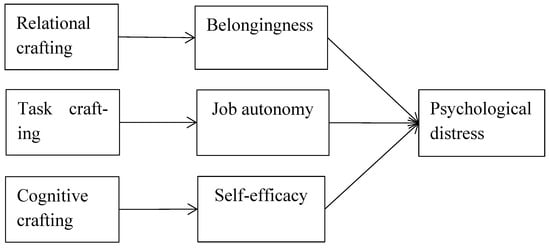
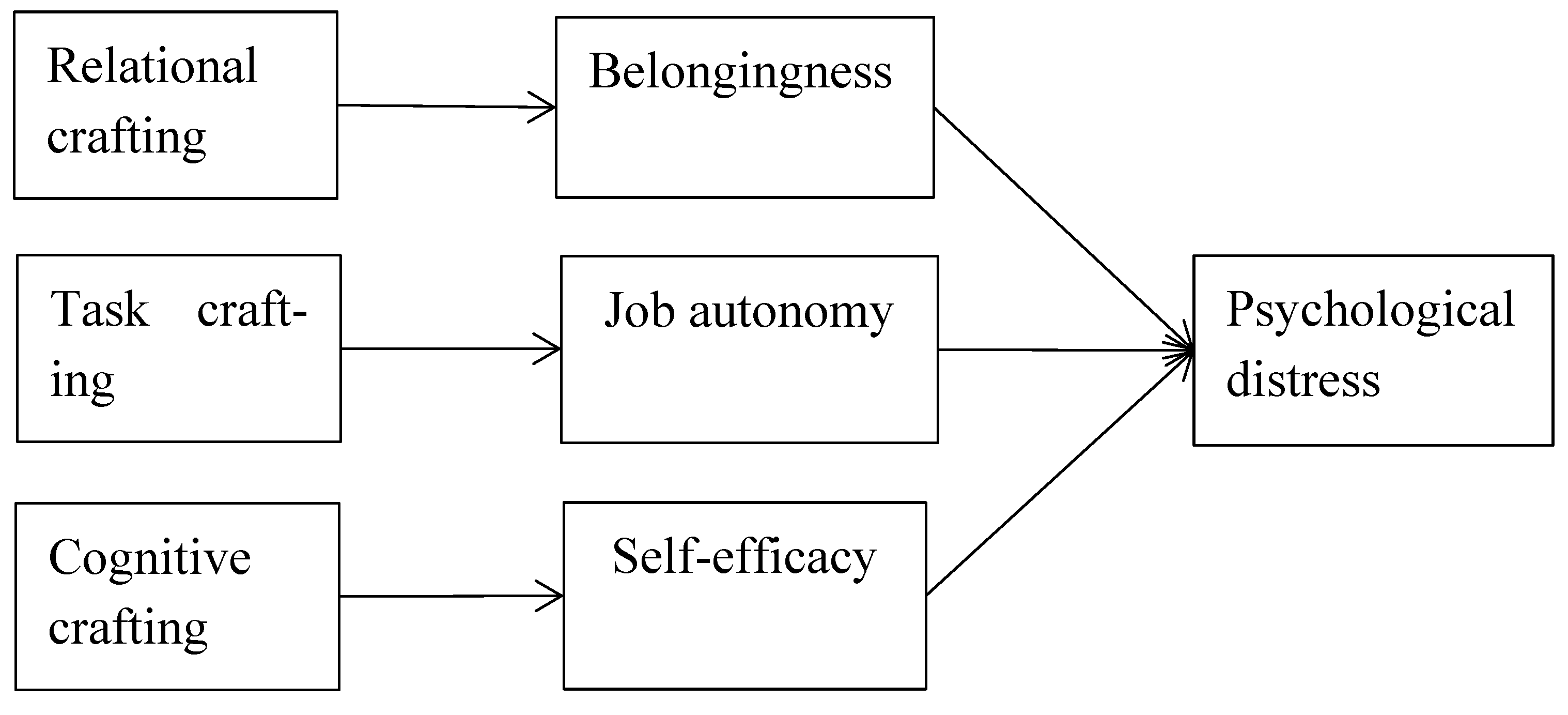
Building on this logic, we propose that different forms of job crafting may reduce psychological distress through different pathways (Wrzesniewski & Dutton, 2001). Relational crafting should foster belongingness (Den Hartog et al., 2007) by strengthening employees’ sense of connection and inclusion at work. Task crafting should foster job autonomy (Liu et al., 2007) by increasing employees’ perceived discretion and ownership over how work is done. Cognitive crafting should foster self-efficacy (Spreitzer, 1995) by helping employees interpret their work as meaningful and manageable.
The present study therefore develops and tests a mediation model in which relational crafting, task crafting, and cognitive crafting reduce psychological distress through belongingness, job autonomy, and self-efficacy, respectively (see Figure 1). This study makes three contributions. First, it extends job crafting research by positioning job crafting as a proactive pathway to employee psychological health, not only as a predictor of motivation or performance. Second, it clarifies differentiated mechanisms linking specific crafting forms to psychological distress. Third, it extends SDT in organizational behavior by showing how employees can craft need-related psychological resources through their own work redesign behaviors.
Figure 1.
Conceptual model.
2. Theoretical Background and Hypotheses Development
2.1. Self-Determination Theory
Self-Determination Theory (SDT; Ryan & Deci, 2000; Deci & Ryan, 2012) is a macro-theory of human motivation and well-being that explains why certain social contexts and behaviors foster psychological health. The theory posits three innate and universal basic psychological needs: autonomy, competence, and relatedness. Autonomy refers to the experience of volition and self-endorsement in one’s actions (Deci & Ryan, 2013). Competence refers to the experience of effectiveness and capability in dealing with challenges (Deci & Ryan, 2012). Relatedness refers to feeling connected to others and cared for within one’s social environment (Deci & Ryan, 2012).
According to SDT, satisfaction of these three needs provides the motivational basis for vitality, self-regulation, and psychological well-being (Ryan & Deci, 2000). Conversely, need frustration creates psychological strain and makes individuals more vulnerable to distress, burnout, depression, and diminished life satisfaction (Deci et al., 2017; Van den Broeck et al., 2016). Thus, SDT is especially useful for explaining why work experiences that satisfy autonomy, competence, and relatedness can protect employee psychological health.
Within the organizational context, SDT has been widely used to explain employee motivation and well-being. Workplace need satisfaction is positively associated with engagement, commitment, and performance and negatively associated with burnout, turnover intentions, and psychological distress (Van den Broeck et al., 2016). Importantly, SDT also recognizes employee agency: individuals are not merely passive recipients of work conditions but can take action to shape environments that better support their psychological needs (Deci et al., 2017).
2.2. Job Crafting and Psychological Distress from a Self-Determination Theory Perspective
Job crafting, as originally conceptualized by Wrzesniewski and Dutton (2001), refers to the physical and cognitive changes that employees make in the task or relational boundaries of their work. This conceptualization identifies three distinct but interrelated forms of crafting (Zhang & Parker, 2019). Task crafting involves altering the type, number, scope, or nature of work tasks—for instance, taking on additional responsibilities that match one’s strengths, reducing tasks that are draining, or introducing new and more efficient work methods (Rofcanin et al., 2019). Relational crafting involves changing the quality or quantity of interpersonal interactions at work—such as building deeper relationships with colleagues, seeking mentoring from supervisors, or minimizing contact with individuals who create stress (Geldenhuys et al., 2021). Cognitive crafting involves reframing how one perceives the meaning and purpose of one’s work—for example, viewing a job not merely as a set of discrete tasks but as a meaningful contribution to a larger mission (Wrzesniewski & Dutton, 2001; Zhang & Parker, 2019).
A key feature of job crafting that distinguishes it from traditional job design is its proactive, self-initiated nature (Tims et al., 2022). Whereas job design typically reflects top-down decisions made by managers about how work should be structured, job crafting represents a bottom-up process in which employees take the initiative to modify their work in personally meaningful ways (Tims et al., 2013). This distinction is critical because it positions employees as active agents in their own work experience, capable of shaping their jobs to better fit their needs, motives, and passions. Moreover, job crafting is not necessarily a one-time event but an ongoing, dynamic process that unfolds as employees continuously adapt their work to changing circumstances and evolving personal goals (Wrzesniewski & Dutton, 2001).
Relational crafting operates in the interpersonal domain and should therefore craft relatedness-related resources of belongingness. Task crafting operates on the structural and behavioral features of work and should therefore craft autonomy-related resources of job autonomy. Cognitive crafting operates on meaning-making and self-appraisal and should therefore craft competence-related resources of self-efficacy. This mapping allows us to move beyond the general claim that job crafting is beneficial and specify how different crafting behaviors reduce psychological distress.
Relational crafting refers to employees’ active, self-initiated modification of the nature, frequency, or quality of their interpersonal interactions in the workplace (Rofcanin et al., 2019; Wrzesniewski & Dutton, 2001). This form of crafting encompasses a broad range of behaviors through which employees proactively shape their social environment at work. For instance, employees may seek to build deeper, more trusting relationships with colleagues by engaging in informal conversations, offering emotional support, or participating in team-building activities. They may actively cultivate mentoring relationships with supervisors or senior colleagues to gain guidance and social resources. They may also seek out interactions with individuals who inspire, energize, or share similar values, while cognitively or behaviorally distancing themselves from those who are draining or conflictual (Tims et al., 2022).
At its core, relational crafting crafts a fundamental human need-related resources identified by SDT: the need for relatedness-related resources (Deci & Ryan, 2012). Relatedness refers to the innate desire to feel connected to others, to belong to social groups, and to experience mutual respect and care in one’s interpersonal relationships. When employees engage in relational crafting, they are essentially taking proactive steps to create and maintain high-quality social connections that boost resources of belongingness in satisfying this basic need. Through behaviors such as initiating collaborative projects, expressing appreciation, seeking feedback, and resolving interpersonal conflicts constructively, employees cultivate a sense of belongingness—a subjective feeling of being accepted, valued, and integrated within one’s workgroup (Den Hartog et al., 2007).
The link between belongingness and psychological health is well-established (Deci et al., 2017). When employees feel that they belong and are socially integrated, they have access to emotional support, instrumental assistance, and a shared sense of identity that collectively attenuate the impact of workplace stressors (Hardy et al., 2003). Socially connected employees are better able to cope with job demands, recover from setbacks, and maintain positive affect in the face of challenges (Van den Broeck et al., 2016). Empirical evidence provides converging support for this proposed pathway. Research has demonstrated that relational crafting is associated with higher-quality workplace relationships and increased perceptions of social support (Rofcanin et al., 2019). Similarly, studies have shown that employees who actively build positive connections at work report lower levels of emotional exhaustion and psychological strain (Tims et al., 2013). Furthermore, belongingness has been identified as a critical mediator linking social aspects of work to employee health outcomes (Den Hartog et al., 2007). These empirical findings align with the SDT proposition that relatedness need satisfaction serves as a protective mechanism against distress. Integrating these theoretical and empirical insights, we propose our first hypothesis:
H1.
Belongingness mediates the negative relationship between relational crafting and psychological distress.
Task crafting refers to employees’ proactive efforts to alter the design, content, scope, or methods of their work tasks (Weseler & Niessen, 2016; Wrzesniewski & Dutton, 2001). Unlike passive acceptance of assigned duties, task crafting reflects an active orientation toward reshaping one’s work to better align with personal skills, interests, and goals. Employees may engage in task crafting by seeking out new and challenging assignments that stretch their capabilities, adopting innovative or more efficient work procedures, reducing or delegating tasks that are tedious or misaligned with their strengths, and investing additional time and effort in the aspects of their work they find most meaningful (Tims et al., 2013).
The primary psychological function of task crafting, from an SDT perspective, is to craft autonomy-related resources (Deci & Ryan, 2013). Autonomy concerns the experience of volition—the sense that one’s actions are self-determined and reflect personal choice rather than external coercion or pressure. When employees engage in task crafting, they exercise agency over what they do, how they do it, and when they do it. This self-directed modification of work tasks transforms employees from passive executors of prescribed duties into active designers of their own work experience, enhancing employee job autonomy. By selecting tasks that match their interests, adopting methods that suit their working style, and adjusting the balance of activities to reflect personal priorities, employees enhance their sense of ownership and control over their work.
When employees experience autonomy at work, they are more intrinsically motivated, more deeply engaged in their tasks, and less susceptible to the draining effects of external pressures and demands (Deci et al., 2017). Job autonomy enables employees to regulate their behavior through internal, self-endorsed values rather than through external contingencies, which reduces the psychological tension and emotional strain that arise when individuals feel controlled or constrained (Deci & Ryan, 2012). Empirical research has consistently demonstrated that workplace autonomy is negatively associated with burnout, anxiety, and depressive symptoms, and positively associated with vitality, job satisfaction, and psychological well-being (Van den Broeck et al., 2016). Building on this theoretical reasoning and empirical evidence, we propose that:
H2.
Job autonomy mediates the negative relationship between task crafting and psychological distress.
Cognitive crafting involves employees’ active reframing of how they perceive, interpret, and make meaning of their work (Geldenhuys et al., 2021; Wrzesniewski & Dutton, 2001). Whereas task and relational crafting involve changes to the observable features of work—what one does and with whom one interacts—cognitive crafting operates at the level of mental representation and subjective interpretation. Employees who engage in cognitive crafting may, for example, broaden their perspective to appreciate how their individual tasks contribute to the organization’s broader mission, reinterpret routine duties as opportunities for skill development, or reframe challenging situations as meaningful tests of their capabilities rather than as threatening burdens (Slemp & Vella-Brodrick, 2013). Through such cognitive reframing, employees construct a more purposeful, coherent, and empowering narrative about their work and their role within the organization, namely higher self-efficacy.
By reframing work challenges as opportunities for growth, recognizing the value and impact of one’s contributions, and constructing a positive professional identity, employees strengthen their self-efficacy beliefs—the conviction that they can successfully execute the behaviors necessary to achieve desired outcomes (Bandura, 1997; Carter et al., 2018). Self-efficacy, in turn, is a powerful protective factor against psychological distress. Individuals with high self-efficacy approach difficulties with confidence and persistence, viewing obstacles as surmountable rather than overwhelming. They employ more effective coping strategies, set higher goals, and recover more quickly from setbacks (Bandura, 1997). In the workplace, employees with strong self-efficacy beliefs experience less anxiety and emotional exhaustion because they trust in their ability to manage job demands and navigate challenging situations. Conversely, low self-efficacy is associated with heightened perceptions of threat, rumination, and a sense of helplessness—all of which contribute to psychological distress (Carter et al., 2018). Accordingly, we propose that self-efficacy mediates the negative relationship between cognitive crafting and psychological distress:
H3.
Self-efficacy mediates the negative relationship between cognitive crafting and psychological distress.
3. Methods
3.1. Participants and Procedure
The participants are recruited through the authors’ alumni social network in Mainland China, snowballing invitations to participants. The participants volunteered to participate in the study with no monetary incentive. We collected multi-wave employee-reported data from companies located in Mainland China.
Notably, to reduce the concern of common method bias (Podsakoff et al., 2003), we employed a multi-wave design. The time interval between these rounds of data collection was four weeks. At Time 1, employees provided demographic information and evaluated their job crafting (i.e., relational, task, and cognitive crafting). At Time 2, employees completed measures of belongingness, job autonomy, and self-efficacy. Finally, at Time 3, employees reported their psychological distress. In order to match data in three waves, the participants were asked to create an identification code (i.e., the last 4 digits of their phone number) and report the code at each time point.
We delivered 1000 questionnaires in total. Finally, we obtained a sample of 883 data points (88.30% valid rate). Among the 883 employees, 38.28% (338) were male, and 28.99% (256) had a master’s degree or above. Their average age was 27.71 years (SD = 3.64).
3.2. Measures
All the responses were rated on a five-point Likert scale, ranging from 1 (not at all) to 5 (completely). We followed Brislin’s (1980) translation-back-translation procedure to translate English scales into Chinese versions.
Job crafting. We measured job crafting with fifteen items from Slemp and Vella-Brodrick (2013). Sample items include “Make an effort to get to know people well at work” (relational crafting, Cronbach’s α = 0.83), “Introduce new approaches to improve your work” (task crafting, Cronbach’s α = 0.85), and “Think about how your job gives your life purpose” (cognitive crafting, Cronbach’s α = 0.92).
Belongingness. We measured belongingness with three items from Den Hartog et al. (2007). Sample item includes “When at work, I really feel like I belong” (Cronbach’s α = 0.91).
Job autonomy. We measured job autonomy with three items from Liu et al. (2007). Sample item includes “I decide on my own how to go about doing the work” (Cronbach’s α = 0.86).
Self-efficacy. We measured self-efficacy with three items from Spreitzer (1995). Sample item includes “I am confident about my ability to do my job” (Cronbach’s α = 0.89).
Psychological distress. We measured psychological distress with four items from Park et al. (2018). Sample item includes “How frequently you have been feeling restless in the past month” (Cronbach’s α = 0.94).
4. Results
The analyses proceeded in two stages. Preliminary analyses examined the descriptive statistics, internal consistency, measurement structure, and bivariate associations among the study variables. The hypothesized indirect associations were then evaluated using three separate mediation models with bootstrap confidence intervals.
4.1. Preliminary Analysis
Prior to hypothesis testing, we conducted preliminary analyses to examine the measurement properties of the study variables and their bivariate relationships. First, confirmatory factor analysis (CFA) was performed using Mplus 7.4 to assess the measurement model. The hypothesized seven-factor model demonstrated acceptable overall fit to the data (χ2(329) = 1774.26, χ2/df = 5.39, CFI = 0.93, TLI = 0.92, SRMR = 0.05, RMSEA = 0.07), providing initial support for the proposed measurement structure. As presented in Table 1, the standardized factor loadings ranged from 0.60 to 0.94. The reported composite reliability (CR) values ranged from 0.88 to 0.96, while the average variance extracted (AVE) values ranged from 0.60 to 0.85. These results provided preliminary evidence of satisfactory internal consistency and convergent validity of the study measures.
Table 1.
Factor loading, composite reliability, average variance extracted (N = 883).
Table 2 presents the means, standard deviations, correlations, and internal consistency coefficients of the study variables. The Cronbach’s alpha coefficients ranged from 0.83 to 0.94, indicating satisfactory internal consistency. The correlation analysis revealed that relational crafting was positively associated with belongingness (r = 0.62, p < 0.01), task crafting was positively associated with job autonomy (r = 0.55, p < 0.01), and cognitive crafting was positively associated with self-efficacy (r = 0.62, p < 0.01). Furthermore, belongingness (r = −0.39, p < 0.01), job autonomy (r = −0.35, p < 0.01), and self-efficacy (r = −0.33, p < 0.01) were all negatively associated with psychological distress. In addition, relational crafting (r = −0.23, p < 0.01), task crafting (r = −0.21, p < 0.01), and cognitive crafting (r = −0.24, p < 0.01) were negatively correlated with psychological distress. Collectively, these correlations were consistent with the expected directions of the hypothesized relationships and provided preliminary support for further examination of the proposed indirect pathways.
Table 2.
Means, SD, correlations among variables (N = 883).
4.2. Hypotheses Testing
To examine the hypothesized mediating mechanisms linking different dimensions of job crafting to psychological distress, we conducted mediation analyses using the PROCESS macro for SPSS 27 (Model 4; Hayes, 2018). Following the bootstrapping approach, 5000 bootstrap resamples were employed to estimate 95% confidence intervals (CIs) for the indirect effects. Three separate mediation models were estimated, each focusing on a theoretically specified pathway. Specifically, relational crafting was examined in relation to psychological distress through belongingness, task crafting through job autonomy, and cognitive crafting through self-efficacy. The three crafting dimensions and their corresponding mediators were not included simultaneously in a single model.
The mediation analyses revealed statistically significant indirect associations across all three hypothesized pathways. First, relational crafting was negatively associated with psychological distress through belongingness (indirect effect = −0.31, SE = 0.03, 95% CI [−0.38, −0.24]). Because the confidence interval did not include zero, the indirect association was statistically significant, supporting H1. Second, job autonomy significantly mediated the negative association between task crafting and psychological distress (indirect effect = −0.26, SE = 0.03, 95% CI [−0.33, −0.20]), providing support for H2. Third, cognitive crafting was negatively associated with psychological distress through self-efficacy (indirect effect = −0.22, SE = 0.04, 95% CI [−0.29, −0.15]). The corresponding confidence interval also excluded zero, supporting H3.
Taken together, the results supported all three hypothesized indirect pathways, suggesting that distinct dimensions of job crafting were associated with lower psychological distress through their theoretically corresponding psychological resources. Specifically, relational crafting was indirectly associated with psychological distress through belongingness, task crafting through job autonomy, and cognitive crafting through self-efficacy. Nevertheless, because the mediation models were estimated separately, these findings do not establish whether the pathways remain significant after accounting for the shared variance among the crafting dimensions and mediators. Accordingly, the results should be interpreted as evidence consistent with the proposed indirect associations rather than as demonstrating independent or exclusive mediation mechanisms.
5. Discussion
Drawing on Self-Determination Theory (SDT), this study examined how three forms of job crafting were associated with employee psychological distress. Using three-wave survey data, we found evidence consistent with the proposed indirect associations: relational crafting through belongingness, task crafting through job autonomy, and cognitive crafting through self-efficacy. These findings suggest that the psychological implications of job crafting can be understood by considering how different crafting activities relate to employees’ social connections, discretion over work, and confidence in their capabilities. This study has several theoretical and practical implications.
5.1. Theoretical Implications
This study makes three theoretical contributions. First, it complements research on the motivational, attitudinal, and performance consequences of job crafting (Tims et al., 2022) by examining psychological distress. This focus helps clarify how employee-initiated work redesign relates to adverse psychological experiences, alongside its associations with positive work outcomes. The findings thus contribute to understanding job crafting as a behavior with implications for both work functioning and psychological health.
Second, the study offers a more specific explanation of these associations by linking the content of different crafting activities to theoretically corresponding pathways. Relational crafting concerns workplace connections and was associated with distress through belongingness. Task crafting concerns the organization and execution of work and was associated with distress through job autonomy. Cognitive crafting concerns employees’ interpretation of their work and was associated with distress through self-efficacy.
Third, the study contributes to the application of SDT in organizational research by examining employee agency in shaping need-relevant work experiences. It suggests that pathways associated with relatedness, autonomy, and competence may be linked to employees’ own crafting activities, complementing explanations centered on supportive work environments. However, belongingness, job autonomy, and self-efficacy are related to these needs without being equivalent to direct measures of need satisfaction.
5.2. Practical Implications
The findings suggest several ways organizations might facilitate constructive job crafting (Tims et al., 2022). Organizations may provide training for employees to proactively craft their jobs.
For relational crafting, managers may create opportunities for employees to develop supportive workplace connections. Potential practices include voluntary mentoring arrangements, peer exchanges, and opportunities to seek advice from colleagues with relevant experience. These activities could be incorporated into existing meetings or routines to make participation accessible. The association involving belongingness suggests that attention should focus on whether employees experience acceptance and inclusion within these interactions. Managers could therefore invite employees to identify the relationships they would like to develop and the forms of interaction they find helpful, allowing for differences in individual preferences.
For task crafting, organizations could clarify the areas in which employees have discretion to adjust their work. Employees and supervisors might jointly discuss opportunities to modify work methods, sequence activities, or revise task priorities while maintaining coordination with colleagues. For example, an employee could propose a different sequence for completing recurring tasks and agree with the supervisor on how the adjustment will be reviewed. Providing clear decision boundaries and access to necessary resources would make these opportunities more concrete. The observed association involving job autonomy points to the practical relevance of discretion that employees can actually exercise in their daily work.
For cognitive crafting, managers could encourage employees to reflect on how they understand their roles and contributions. Such discussions might connect routine activities with the people who benefit from them and help employees recognize how their existing skills contribute to valued outcomes. To connect these reflections with self-efficacy, supervisors could also invite employees to consider previous accomplishments, progress in handling difficult assignments, and specific examples of effective work. Concrete feedback could help employees ground their confidence in their own experiences. These practices offer potential ways to connect the interpretation of work with confidence in one’s capabilities.
Organizational support is also relevant to how crafting opportunities are introduced. Consistent with SDT’s emphasis on supportive work environments, employees could be given meaningful input into the changes they pursue (Deci et al., 2017). Crafting activities should be feasible within employees’ working time and supported by appropriate resources. Supervisors could discuss possible effects on colleagues and help coordinate adjustments where tasks are interdependent. These efforts should accompany attention to excessive workloads, inadequate resources, and other stressful working conditions, ensuring that support for employee initiative forms part of a broader organizational commitment to psychological health.
5.3. Limitations and Future Directions
Several limitations should guide the interpretation of these findings. First, temporal separation of the measures does not establish causality or eliminate common method bias. Without baseline measures of the mediators and psychological distress, reverse relationships and alternative explanations remain possible. In addition, the observed indirect relationships provide support for the proposed theoretical pathways but do not conclusively establish the independence or exclusivity of the respective psychological mechanisms, which could be further explored in future studies. Experimental studies and longitudinal designs with repeated measurements could better examine these processes (Dubbelt et al., 2019). Moreover, with self-reported data some common method bias may remain.
Second, all focal variables were self-reported. Future research could complement employees’ reports with peer or supervisor assessments of crafting behaviors and additional health indicators. Third, the separate mediation analyses do not establish the independent explanatory roles of the proposed pathways. Integrated models that include all crafting dimensions and mediators would help assess their overlapping and unique contributions.
Fourth, future studies should directly measure basic psychological need satisfaction to distinguish it from the need-related pathways examined here. Fifth, the Mainland China sample limits generalizability, warranting replication across cultural and occupational contexts. In addition, using an alumni network and snowball sampling may create sampling bias because participants may come from similar social or professional backgrounds. Finally, research could examine boundary conditions such as leadership, organizational climate, and proactive personality (Tims et al., 2022), while complementary perspectives such as Conservation of Resources theory could clarify how these resources develop over time (Halbesleben et al., 2014).
6. Conclusions
This study demonstrates that job crafting can serve as a proactive strategy for promoting employee psychological health. Grounded in Self-Determination Theory, the findings show that relational, task, and cognitive crafting are associated with lower psychological distress through belongingness, job autonomy, and self-efficacy, respectively. By specifying these distinct pathways, this research offers a more nuanced understanding of how employees can actively reshape work to protect their psychological well-being.
Funding
This research received no funding.
Institutional Review Board Statement
The study was conducted in accordance with the Declaration of Helsinki, and approved by the Research Ethics Committee of Nanjing Forestry University (approval code No. 20250915, date of approval 15 September 2025).
Informed Consent Statement
Informed consent was obtained from all individual participants included in the study.
Data Availability Statement
Due to confidential restrictions, data is not publicly available. Data is available upon request from correspondence author.
Conflicts of Interest
The authors have no conflict of interest to disclose.
References
- Backhaus, I., Lohmann-Haislah, A., Burr, H., Nielsen, K., di Tecco, C., & Dragano, N. (2024). Organizational change: Challenges for workplace psychosocial risks and employee mental health. BMC Public Health, 24(1), 2477. [Google Scholar] [CrossRef] [Scilit] [PubMed]
- Bandura, A. (1997). Self-efficacy: The exercise of control. W. H. Freeman. [Google Scholar]
- Brady, J. M., Hammer, L. B., & Westman, M. (2025). Supervisor resilience promotes employee well-being: The role of resource crossover. Journal of Vocational Behavior, 156, 104076. [Google Scholar] [CrossRef] [Scilit]
- Brislin, R. W. (1980). Translation and content analysis of oral and written materials. In H. C. Triandis, & J. W. Berry (Eds.), Handbook of cross-cultural psychology. Allyn and Bacon. [Google Scholar]
- Carter, W. R., Nesbit, P. L., Badham, R. J., Parker, S. K., & Sung, L. K. (2018). The effects of employee engagement and self-efficacy on job performance: A longitudinal field study. The International Journal of Human Resource Management, 29(17), 2483–2502. [Google Scholar] [CrossRef] [Scilit]
- Deci, E. L., Olafsen, A. H., & Ryan, R. M. (2017). Self-determination theory in work organizations: The state of a science. Annual Review of Organizational Psychology and Organizational Behavior, 4, 19–43. [Google Scholar] [CrossRef] [Scilit]
- Deci, E. L., & Ryan, R. M. (2012). Self-determination theory. In P. A. M. Van Lange, A. W. Kruglanski, & E. T. Higgins (Eds.), Handbook of theories of social psychology (Vol. 1, pp. 416–436). Sage. [Google Scholar]
- Deci, E. L., & Ryan, R. M. (2013). The importance of autonomy for development and well-being. In B. Soenens, M. Vansteenkiste, & S. Van Petegem (Eds.), Self-regulation and autonomy: Social and developmental dimensions of human conduct (pp. 19–46). Cambridge University Press. [Google Scholar]
- Den Hartog, D. N., De Hoogh, A. H., & Keegan, A. E. (2007). The interactive effects of belongingness and charisma on helping and compliance. Journal of Applied Psychology, 92(4), 1131–1139. [Google Scholar] [CrossRef] [Scilit] [PubMed]
- Dubbelt, L., Demerouti, E., & Rispens, S. (2019). The value of job crafting for work engagement, task performance, and career satisfaction: Longitudinal and quasi-experimental evidence. European Journal of Work and Organizational Psychology, 28(3), 300–314. [Google Scholar] [CrossRef] [Scilit]
- Geldenhuys, M., Bakker, A. B., & Demerouti, E. (2021). How task, relational and cognitive crafting relate to job performance: A weekly diary study on the role of meaningfulness. European Journal of Work and Organizational Psychology, 30(1), 83–94. [Google Scholar] [CrossRef] [Scilit]
- Halbesleben, J. R. B., Neveu, J. P., Paustian-Underdahl, S. C., & Westman, M. (2014). Getting to the “COR”: Understanding the role of resources in conservation of resources theory. Journal of Management, 40(5), 1334–1364. [Google Scholar] [CrossRef] [Scilit]
- Hardy, G. E., Woods, D., & Wall, T. D. (2003). The impact of psychological distress on absence from work. Journal of Applied Psychology, 88(2), 306–314. [Google Scholar] [CrossRef] [Scilit] [PubMed]
- Hayes, A. F. (2018). Introduction to mediation, moderation, and conditional process analysis: A regression-based approach (2nd ed.). Guilford Press. [Google Scholar]
- Liu, C., Spector, P. E., & Shi, L. (2007). Cross-national job stress: A quantitative and qualitative study. Journal of Organizational Behavior, 28(2), 209–239. [Google Scholar] [CrossRef] [Scilit]
- Park, J. H., Carter, M. Z., & DeFrank, R. S. (2018). Abusive supervision, psychological distress, and silence: The effects of gender dissimilarity between supervisors and subordinates. Journal of Business Ethics, 153(3), 775–792. [Google Scholar] [CrossRef] [Scilit]
- Podsakoff, P. M., MacKenzie, S. B., Lee, J. Y., & Podsakoff, N. P. (2003). Common method biases in behavioral research: A critical review of the literature and recommended remedies. Journal of Applied Psychology, 88(5), 879–903. [Google Scholar] [CrossRef] [Scilit] [PubMed]
- Rofcanin, Y., Bakker, A. B., Berber, A., Gölgeci, I., & Las Heras, M. (2019). Relational job crafting: Exploring the role of employee motives with a weekly diary study. Human Relations, 72(4), 859–886. [Google Scholar] [CrossRef] [Scilit]
- Ryan, R. M., & Deci, E. L. (2000). Self-determination theory and the facilitation of intrinsic motivation, social development, and well-being. American Psychologist, 55(1), 68–78. [Google Scholar] [CrossRef] [PubMed]
- Slemp, G. R., & Vella-Brodrick, D. A. (2013). The job crafting questionnaire: A new scale to measure the extent to which employees engage in job crafting. International Journal of Wellbeing, 3(2), 126–146. [Google Scholar]
- Spreitzer, G. M. (1995). Psychological empowerment in the workplace: Dimensions, measurement, and validation. Academy of Management Journal, 38(5), 1442–1465. [Google Scholar] [CrossRef] [Scilit]
- Tims, M., Bakker, A. B., & Derks, D. (2013). The impact of job crafting on job demands, job resources, and well-being. Journal of Occupational Health Psychology, 18(2), 230–240. [Google Scholar] [CrossRef] [Scilit] [PubMed]
- Tims, M., Twemlow, M., & Fong, C. Y. M. (2022). A state-of-the-art overview of job-crafting research: Current trends and future research directions. Career Development International, 27(1), 54–78. [Google Scholar] [CrossRef] [Scilit]
- Van den Broeck, A., Ferris, D. L., Chang, C. H., & Rosen, C. C. (2016). A review of self-determination theory’s basic psychological needs at work. Journal of Management, 42(5), 1195–1229. [Google Scholar] [CrossRef] [Scilit]
- Weseler, D., & Niessen, C. (2016). How job crafting relates to task performance. Journal of Managerial Psychology, 31(3), 672–685. [Google Scholar] [CrossRef] [Scilit]
- Wrzesniewski, A., & Dutton, J. E. (2001). Crafting a job: Revisioning employees as active crafters of their work. Academy of Management Review, 26(2), 179–201. [Google Scholar] [CrossRef] [Scilit]
- Wu, L. Z., Yim, F. H. K., Kwan, H. K., & Zhang, X. (2012). Coping with workplace ostracism: The roles of ingratiation and political skill in employee psychological distress. Journal of Management Studies, 49(1), 178–199. [Google Scholar] [CrossRef] [Scilit]
- Zhang, F., & Parker, S. K. (2019). Reorienting job crafting research: A hierarchical structure of job crafting concepts and integrative review. Journal of Organizational Behavior, 40(2), 126–146. [Google Scholar] [CrossRef] [Scilit]

Disclaimer/Publisher’s Note: The statements, opinions and data contained in all publications are solely those of the individual author(s) and contributor(s) and not of MDPI and/or the editor(s). MDPI and/or the editor(s) disclaim responsibility for any injury to people or property resulting from any ideas, methods, instructions or products referred to in the content. |
© 2026 by the author. Licensee MDPI, Basel, Switzerland. This article is an open access article distributed under the terms and conditions of the Creative Commons Attribution (CC BY) license.