


Abstract
Residential early parenting services in Australia provide psychoeducational programs for unsettled infant behaviour, which is reported by up to 35% of parents in their child’s first year and can negatively affect parenting self-efficacy. This study aimed to evaluate changes in infant behaviour and parenting self-efficacy following a five-night residential early parenting program and to identify demographic, social, and psychological predictors of parenting self-efficacy. An observational pre-post study using routinely collected medical record data from parents and infants aged up to 24 months was analysed. Parenting self-efficacy was assessed pre-admission and post-discharge using seven items from the Karitane Parenting Confidence Scale. Infant sleeping and cry/fuss behaviour was measured at pre-admission, pre-discharge, and at the 6-week follow-up using study-specific questions. N = 1243 completed the program and provided pre-admission and pre-discharge data. N = 540 provided follow-up data. Overall, improvements were observed following participation. Infant sleeping and cry/fuss behaviour improved pre-discharge and remained largely stable at follow-up. Parenting self-efficacy increased from pre-admission to follow-up. An older maternal age, infants aged ≤ 4 months, and the reporting of more borderline personality disorder symptoms were associated with lower improvements in parenting self-efficacy. Residential early parenting programs improve infant behaviour and parental self-efficacy, though targeted follow-up services are indicated to sustain outcomes for vulnerable subgroups.
1. Introduction
Dysregulated behaviour in infants is commonly described as behaviour occurring mostly in the first 12 months of life but may continue into toddlerhood and include behaviours such as frequent waking at night, being difficult to soothe and settle and persistent fussing or crying (Reuter et al., 2020). Problematic crying and fussing behaviours in infants were first defined by Wessel et al. (1954) as “an infant that is otherwise healthy and well fed but has episodes of crying/fussing for more than 3 h a day, on at least 3 days in any one week,” (Wessel et al., 1954, p. 425). Between 25 and 35% of parents report dysregulated behaviours in the first 12 months of their baby’s life (Reuter et al., 2020).
Dysregulated infant behaviour can be distressing and difficult to live with for parents. It can have negative consequences on parents’ physical and mental health, including maternal depression and anxiety (Fisher et al., 2024; Tran et al., 2025), fatigue (Tran et al., 2025), and paternal depression, frustration, and fatigue (Ellett et al., 2009). Poor parental health has been linked to diminished responsive care-giving behaviour, and this may adversely affect parent–child interactions and child development (F. Cook et al., 2019). Furthermore, F. Cook et al. (2019) study investigated regulatory behaviour in infants aged between 8 to 12 months and the association of future child mental health. The authors observed that early infant dysregulation might be associated with subsequent behavioural difficulties in childhood.
Wolke et al. (2023) made similar observations. Their prospective longitudinal study conducted with two cohorts in Germany and Finland investigated regulatory problems in young children and their association with behavioural problems in adulthood. Regulatory problems were assessed when the children were 5, 20, and 56 months of age. The authors reported that infants with persistent regulatory problems are more likely to report more internalising and total behavioural problems, compared to children who never had regulatory problems. In addition, they are more likely to receive an Attention Deficit Hyperactivity Disorder (ADHD) diagnosis. These findings indicate a possible association between early, persistent regulatory problems and behavioural outcomes later in life. Therefore, the authors recommended that screening for early regulatory problems could help to identify children who may be at risk for later behavioural problems.
Parenting confidence refers to a parent’s feeling of being a competent parent. While parenting self-efficacy is described as a parent’s judgement of their ability to perform a task-specific parenting role successfully. The specific task and ability of a parent to respond effectively to a crying and fussing infant has been linked to parenting self-efficacy (Kohlhoff & Barnett, 2013). It is based on Bandura’s theory of self-efficacy (Bandura, 1977), which proposes that individuals develop self-efficacy by interpreting information from four key sources, including the performance outcome, vicarious experience, verbal persuasion, and physiological feedback. Bandura (1977) describes a performance outcome as the experience of successfully completing a task. Individuals completing a task successfully are encouraged by their success and are more likely to perform well again at the same or a similar task. Vicarious experience, the second source, refers to the insights gained by observing others completing a task, which leads individuals to gauge and judge their own abilities. Self-efficacy is influenced by the feedback related to the individual’s ability to perform a given task, which Bandura (1977) refers to as verbal persuasion. The fourth source is the physiological feedback, which proposes that emotional and physiological well-being influences the capacity to build self-efficacy. Bandura (1977) concludes that it is not the intensity of emotional or physical reactions that are important, but rather how these reactions are perceived and interpreted. Hence, social support, positive reinforcement, and effective settling strategies can enhance parenting self-efficacy, while receiving criticism and unsolicited advice from family and friends and caring for an infant who is difficult to settle may lead to lowered parenting self-efficacy (Gelkopf & Jabotaro, 2013).
Dysregulated infant behaviour is a common reason for which parents of young infants seek help from healthcare providers (G. Cook et al., 2022). Parents also seek information and advice about infant sleep behaviour and settling strategies from other parents’ experiences, self-help books, DVDs, Apps, and websites (Augustin et al., 2024; G. Cook et al., 2022; Leichman et al., 2020). However, the quality and consistency of the information provided is difficult to assess, and only a small proportion of these sources are evidence-based (Augustin et al., 2024; Leichman et al., 2020). As a result, parents may be encouraged to implement strategies that are ineffective or even counterproductive, potentially prolonging the very behaviours for which help is sought and contributing to additional parental stress (G. Cook et al., 2022).
Early parenting services were established more than 100 years ago as a result of high infant morbidity and mortality rates. The service was to educate mothers about infant care, including feeding and monitoring infant growth and development. With improvements in infant and child health outcomes, these services have shifted their focus to providing support, education, and interventions for parents and caregivers experiencing challenges with their infants and young children (Hevey, 2020). Early parenting services offer a suite of programs, such as individual short (usually one hour) consultations provided in clinical or community settings, including maternal and child health services and home visiting programs, day programs, and 4–5-night residential programs. These programs provide assessments of parenting skills and education related to child development, behaviour, and care. In addition, the day program provides practical support and demonstrates settling strategies. The residential early parenting program provides more intensive support for parents and caregivers. Families usually stay in a dedicated facility for 4 to 5 nights where they receive personalised guidance and support. In Australia, most early parenting services are currently funded by state governments, but in the early 1990s, such services have been established in the private sector. Access to private early parenting centres is limited to people who have private health insurance or are able to self-fund the program’s costs.
A recent systematic review and meta-analysis (Stanzel et al., 2025) evaluated the available evidence about behavioural interventions to respond to and treat parent-reported unsettled sleeping and persistent crying/fuss behaviour in infants up to 12 months of age and determine the treatment effect on infant and maternal outcomes. A total of 22 papers reporting on 20 studies involving 14 pre- and post-intervention studies, two RCTs, and four quasi-experimental studies were included in the review, with a total of 1520 participants. The authors found that there are several diverse programs to address unsettled infant behaviours. These programs provide education about infant development and growth and demonstrate practical soothing and settling methods. The program delivery, setting, and length vary considerably from 45–60 min, individual face-to-face consultations and day programs in clinical and community settings to longer 4–5-night admissions to residential programs provided in early parenting centres. The authors concluded that using multiple intervention components made it difficult to identify which component was most likely to have the greatest effect on the reported outcomes but found that, on the whole, the 4–5-night admission to residential programs revealed more consistent and greater improvements than short consultations and day programs.
Although, the residential programs included in the systematic review showed that behavioural interventions to manage unsettled infant behaviour have positive effects on the reduction of night waking and the crying time (Don et al., 2002; Leeson et al., 1994; Middlemiss et al., 2017) and improvements in postnatal depressive symptoms (Fisher et al., 2004; Rowe & Fisher, 2010). These studies had small samples (the largest sample size was 109), and recruitment fractions ranged from 28% to 81% of eligible participants (Fisher et al., 2004; Rowe & Fisher, 2010). Further, the health and social circumstances of women who did not report improvements were not well characterised. A larger, comprehensive study is therefore needed to validate these intervention outcomes and identify populations requiring additional support.
The aims of this research were to (1) establish the changes in infant sleeping, crying and fuss behaviour, and level of parenting self-efficacy of parent–infant dyads after completing a five-night residential psychoeducation program and (2) to determine the psychological, social, and demographic characteristics associated with changes in parenting self-efficacy from pre-admission to 6 weeks post-discharge.
2. Materials and Methods
2.1. Study Design
This observational pre–post study analysed data contributed routinely by parents admitted with their unsettled infant to the residential early parenting psychoeducational program at Masada Private Hospital Early Parenting Centre (MPHEPC) in Melbourne, Australia.
2.2. Study Setting
The MPHEPC offers a five-night structured residential psychoeducation program. It is one of the largest early parenting services provided by privately funded health care services in Australia and has the capacity to admit over 1000 parent–infant dyads annually.
Parents of children aged 3 to 24 months who are experiencing problems with dysregulated sleeping/settling/feeding behaviours or their own clinically significant fatigue, which is often accompanied by anxiety and depressive symptoms, can be referred by a medical practitioner for admission to the program. The program provides education to each parent about age-appropriate infant care and offers opportunities to have supported practice in implementing new care-giving skills and routines. Individual strategies to assist parents to reduce unsustainable sleep associations, learn sustainable settling techniques, and establish a ‘feed, play, sleep’ routine of care (Middlemiss et al., 2017; Rowe & Fisher, 2010) are demonstrated.
Regular psychoeducational group sessions are held in which parents are expected to participate. These focus on infant development, daily routines of care, sleep, and settling, and age-appropriate feeding, playing, and sleeping. There are also small group discussions about common adjustment challenges and opportunities to reflect, share experiences, and problem solve. On the final day of admission, a pre-discharge group offers advice on how to maintain and implement the newly learned skills in the home environment and how to manage relapses in behaviour.
| Masada Residential Early Parenting Program The program admits up to five mothers with children aged 3 to 24 months per day for a five-night stay. Each mother is accommodated in a one-room suite with a bathroom. A separate bedroom for the child is located adjacent to the parent’s room. Shared kitchen and dining rooms and living and play spaces allow for opportunities for social interaction among parents and children. Partners are invited to attend either for the entire or part of the admission. This is to support the ‘parenting team’ to be consistent in their infant care approaches. The program is staffed by a multidisciplinary team of midwives, maternal and child health nurses, early childhood professionals, and psychologists. Mothers are admitted under the care of one of the program’s general practitioners. On admission, individualised care plans are developed and agreed on after a thorough and comprehensive admission assessment. The program provides education and support and demonstrates settling strategies. Group psychoeducation provides and promotes an understanding of child development, including the need for sleep and sleep cycles, sleep associations, understanding the baby’s crying, settling information and techniques, and the introduction for a feed–play–sleep routine (Middlemiss et al., 2017; Rowe & Fisher, 2010). In addition, adjustments to parenthood are explored and discussed. In addition, the program helps mothers to rest and build on and consolidate existing parenting strengths, assists with infant care-giving skills, and fosters parenting self-efficacy and confidence. The program consists of four phases: exploration, confidence building, skills consolidation, and preparing to go home. Mothers learn about their child’s signs of tiredness. The baby is settled into their bed before becoming overtired. They are placed on their back when first put to bed. Then, a word or short phrase like ‘time to sleep now’ is used to indicate to the child that it is time for a sleep. If the child is quiet, the parent leaves the room and allows the child to go to sleep. If the child starts to cry or grizzle when put to bed, the parents can use settling strategies such as rhythmically patting the child’s back and making calming shushing sounds. To pat the child’s back the child is repositioned onto their side facing away from the parent. Once the child is quiet, it is repositioned on their back and the parent leaves the room. If the child starts crying again, the parent waits a few moments to see whether the child self-settles and stops crying without any intervention. If the child does not stop crying, then the settling procedure is repeated. Parents are encouraged to establish a pattern of ‘feed–play–sleep’ to suit their child’s age and stage of development. Children up to 18 months are settled for sleep twice per day to sleep, with each sleep lasting for approximately 120 min. A staff ratio of five mothers to one program staff member allows for individually supported work, which is to build and strengthen parenting confidence by observing and providing feedback, and encouragement to assist with skills development. An education group is provided on the final day of the residential stay to prepare for discharge and how implemented changes and newly acquired skills can be maintained at home. |
2.3. Procedure and Data Source
Routinely collected medical record data of all parents with children aged 3 to 24 months who were admitted to the five-night residential program from May 2021 to September 2022 were included. Twenty parent/infant dyads were discharged early without completing the program because of respiratory or gastrointestinal infections experienced by the parent or the baby, and their data were not included.
Child behaviours and maternal mental health were assessed at pre-admission (two to three weeks before admission into the program), pre-discharge (day 5 of the program), and follow-up (6-weeks post-discharge). Maternal fatigue symptoms, parenting self-efficacy, and partner support were collected at pre-admission and at the six-week follow-up. Demographic characteristics, family support, obstetric and reproductive history, borderline personality disorder symptoms, major life events in the last 12 months, chronic health conditions, and health risk behaviour were assessed at pre-admission.
Data-collection forms were in self-completed digital format using VTOC™. Parents completed the forms in the platform using smartphones, tablets, and computers. Infant night waking, crying, and sleeping behaviours were collected at pre-admission and at the 6-week follow-up in self-completed digital format using VTOC™. Pre-discharge data on infant waking, crying, and sleeping behaviour was obtained from the 24 h infant activity record completed by healthcare staff during the residential program, covering the 24 h before discharge. See Table 1 for details about routinely collected data.
Table 1.
Data collected for quality assurance and continuous service improvement purposes.
2.4. Data Management and Analysis
The program’s effects on three infant crying and sleeping behaviour outcomes were examined descriptively. Each outcome comprised three categories. At pre-admission, pre-discharge, and follow-up, the proportion of infants in each category and its 95% confidence interval (CI) were estimated. Patterns of change across time points were assessed by comparing the estimated proportions and the extent of overlap between their 95% CIs. This CI-overlap approach was used as a descriptive comparison only; no formal repeated-measures hypothesis test or longitudinal regression model was fitted, and the comparisons did not account for the within-infant correlation across time points. Accordingly, these findings were interpreted as descriptive evidence of change rather than formal statistical tests of change over time.
The effect of the program on parenting confidence was assessed using the within-participant change in the seven-item Karitane Parenting Confidence Scale score from pre-admission to follow-up. For paired data, Cohen’s d was calculated as the mean within-participant change divided by the standard deviation of the change scores. Positive values indicate an increase in parenting confidence. Cohen’s d values of 0.2, 0.5, and 0.8 were interpreted as small, medium, and large effect sizes, respectively (Cohen, 1992).
Multiple linear regression models were used to examine whether the change in parenting confidence from pre-admission to follow-up varied according to individual and psychosocial characteristics measured at pre-admission. Baseline parenting confidence was included as a predictor to examine how the magnitude of change varied across the range of baseline confidence values, rather than to estimate an unadjusted mean change alone. Only participants with observed follow-up outcome data were included in the outcome analyses. Responders and non-responders were compared based on available baseline characteristics.
Missing outcome values at any time point were not imputed. Missing predictor values were imputed using multiple imputation by chained equations (MICE) under a missing-at-random assumption. The imputation model included all baseline demographic characteristics and baseline outcome values. Ten imputed datasets were generated because less than 10% of values were missing for the variables requiring imputation. Convergence was assessed using trace plots, and the distributions of observed and imputed values were compared to evaluate the plausibility of the imputed data. Estimates from the ten datasets were combined using Rubin’s rules. Analyses were conducted using Stata version 16.1.
Approval to conduct the project was provided by the Monash University Human Research Ethics Committee, Melbourne Australia (Certificate Number 2020-25903-51810).
3. Results
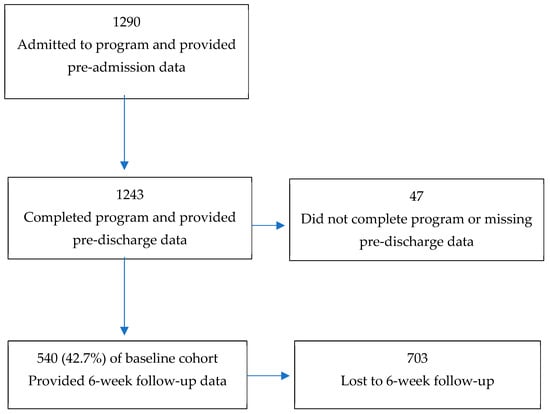
During the audit interval from May 2021 to September 2022, there were 1290 mother–infant pairs admitted to the program who provided data at pre-admission. Of those, 1243 completed the program and provided pre-discharge data and 540 pairs (42.78%) provided data at the 6-week follow-up (Figure 1) and were included in the analyses of this study (Table 2). The outcome baseline values and major socio-demographic characteristics were not significantly different between the group included in this study and the group who did not provide follow-up data (Supplement Table S1).
Figure 1.
Flow diagram of progression from admission to discharge and follow-up.
Table 2.
Demographic and psycho-social characteristics of 540 women included in the analyses.
Infant night waking, crying, and sleeping behaviours were significantly improved from pre-admission to pre-discharge and remained relatively stable until 6 weeks post-discharge (Table 3). At pre-admission, 63.5% of infants woke up more than three times per night. After the intervention at the 6-week follow-up, a statistically significant reduction was observed, with only 4.6% of infants demonstrating this frequency of night waking. Infants crying for under 10 min increased from 42.4% at pre-admission to 75.6% at follow-up, while crying longer than 20 min decreased from 22.4% at pre-admission to 5.9% at follow-up. Sleep time during the day of more than 4 h more than doubled, increasing from 22.8% at pre-admission to 54.6% at follow-up.
Table 3.
Infant night waking, crying, and sleeping behaviours (N = 540).
Parenting self-efficacy increased significantly from pre-admission to the 6-week follow-up at a medium effect size (Table 4). Mean scores on the Parenting Confidence Scale increased from 17.6 (95% CI: 17.3, 17.8) at pre-admission to 19.9 (95% CI: 19.8, 20.1) at follow-up, representing a mean change of 2.4 points (95% CI: 2.2, 2.6). This improvement represents a moderate effect size (Cohen’s d = 0.52, 95% CI: 0.47, 0.57).
Table 4.
Parenting self-efficacy (N = 540).
The increase in the parenting self-efficacy score between pre-admission and at the 6-week follow-up was associated with several maternal and infant characteristics (Table 4).
Women who were older and had more borderline personality disorder symptoms reported a lower increase in the parenting self-efficacy score. Parents with infants aged ≤ 4 months at pre-admission also reported a statistically lower increase in the parenting self-efficacy score at the 6-week follow-up (Table 5).
Table 5.
Model predicting the changes in the Parenting Confidence Scale score from pre-admission to 6-week follow-up.
Parents with a higher parenting self-efficacy score at pre-admission reported a lower increase in parenting self-efficacy at the 6-week follow-up. And parents living in the most advantaged areas and having two children or more reported significant improvements in parenting self-efficacy from pre-admission to the 6-week follow-up (Table 5).
4. Discussion
This is the largest cohort study to date of changes in unsettled infant and toddler behaviours and parenting self-efficacy after completing a residential early parenting program. We found that, following the five-night intervention, children exhibited a significantly reduced overnight waking frequency, longer daytime sleeps, and a lower duration of fussing and crying. Parenting self-efficacy improved at a medium effect size, but there were insufficient improvements among older women, women with infants 4 months and younger, and women reporting more symptoms of borderline personality disorder.
Although residential early parenting programs have been offered in Australia for many years, only a small number of studies (Don et al., 2002; Leeson et al., 1994; Middlemiss et al., 2017; Rowe & Fisher, 2010) have investigated the impact of residential early parenting programs on infant sleeping and cry/fuss behaviours. Our study of routinely collected data of 1243 parent/infant dyads at pre-admission and of 540 parent/infant dyads at a 6-week follow-up supports the findings of these previous smaller cohort studies on the positive association of residential early parenting programs on unsettled infant sleeping and cry/fuss behaviour.
Although studies have examined the effects on parental responsiveness and infant sleeping and cry/fuss behaviour following parenting intervention programs, there is limited data about the effects on parenting self-efficacy (Kohlhoff & Barnett, 2013; Mihelic et al., 2017). Although we found an improvement in parenting self-efficacy scores from pre-admission to the 6-week follow-up, the association between baseline parenting self-efficacy and subsequent changes should be interpreted cautiously. As change scores are mathematically related to baseline values, the association with baseline confidence may partly reflect regression to the mean, as participants with more extreme baseline scores may naturally demonstrate values closer to the average at follow-up. Furthermore, a ceiling effect may explain the smaller improvements observed among parents with higher baseline confidence. The coefficient for baseline confidence was therefore interpreted carefully.
We found that women with previous parenting experience, living in the most socio-economic advantaged area and with fewer co-incidental worries seemed to have benefitted from the program more than those without parenting experience and living in the lower socio-economic areas. These findings are consistent with Teti and Gelfand (1991) (Teti & Gelfand, 1991) who investigated mothers’ self-efficacy beliefs and their parenting behaviour and concluded that parenting self-efficacy improved over time and was associated with previous parenting experiences.
Although the early parenting program is generally associated with an improvement in infant sleeping and cry/fuss behaviour and parenting self-efficacy, for some parents, this program is insufficient to meet their needs. Having an infant that is ≤4 months or being of older maternal age was associated with lower scores of improvements in parenting self-efficacy.
However, we observed that the most significant factor associated with less improvement in parenting self-efficacy was for women who reported more symptoms associated with borderline personality characteristics. We acknowledge that this descriptor is a subject of ongoing conceptual discussion with some advocates preferring the term complicated trauma disorder or complex post-traumatic stress disorder (Leichsenring et al., 2011). Behaviours and traits associated with borderline personality characteristics include a pervasive pattern of emotional instability, difficulty regulating emotions, unstable interpersonal relationships, and impulsive behaviours (Leichsenring et al., 2011). Assessing symptoms associated with borderline personality characteristics provides additional information for nursing staff to personalise care. An essential component for the program relies on mothers trusting the nursing staff and following their guidance, including settling techniques that may feel counterintuitive to what the mother may feel comfortable doing. Healthcare staff care for groups of five mother/infant dyads, and perhaps, mothers with more borderline personality symptoms may be particularly vulnerable to perceiving that other dyads receive more attention or support than themselves. We hypothesise that establishing a trusting therapeutic relationship within a short 5-day admission period presents distinct challenges when working with mothers who may be naturally more cautious, wary, or distrustful, which might explain our observations that women with more borderline personality symptoms have lower scores of improvements in parenting self-efficacy.
Strengths and Limitations
The study strengths are that we were able to access routinely collected clinical data, including that from standardised instruments, about all women and their children admitted to a residential early parenting program. We were able to account for all participants, even those who were discharged early. We could identify distinctions between women who submitted follow-up data and those who did not, and our sensitivity analyses revealed comparable pre-admission to pre-discharge treatment effects between these groups.
Nevertheless, we acknowledge the following limitations. Because we used routinely collected medical record data, our analysis was constrained to the measures systematically recorded by the participating service. This early parenting service utilises the EPDS and seven items from the Karitane Parenting Confidence Scale routinely as part of its standard clinical assessments, which dictated its use in our study. We therefore were limited in our choice of measurement tools, including using the DASS for maternal mental health, the validated 15-item Karitane Parenting Confidence Scale, and a validated infant temperament scale. In the pre- and post-intervention design, there is no control group. Therefore, the improvement in infant sleep behaviour and parenting self-efficacy may have occurred spontaneously. Nevertheless, the improvement in infant behaviour observed over the 5-day admission is notable and suggests a positive association between infant behaviour and completing the residential early parenting program. Additionally, evaluating immediate program effects required an objective discharge assessment. This was achieved by healthcare staff completing a real-time, 24 h activity record within the controlled residential setting. Nevertheless, a controlled trial is required to confirm this relationship.
The six-week follow-up evaluated whether initial improvements were sustained over time upon returning home using the seven-day parental retrospective recall at both pre-admission and six weeks post-discharge. This captured broader, naturalistic behavioural patterns in the home setting but is more likely to result in recall bias. Because only 540 participants (approximately 43% of those with pre-discharge data) contributed follow-up data, residual attrition bias cannot be excluded. We acknowledge that the differences in the measurement procedure and time points may have introduced bias.
Further, the program is offered by a private sector healthcare provider, and women were disproportionately from socio-economically advantaged areas. A low socio-economic position is associated with a greater likelihood of coincidental uncertainties, and therefore, the findings of this study may not be generalised and applied to a public-sector parenting service.
5. Conclusions
This observational pre- and post-study observed that the Masada Private Hospital Early Parenting Program is associated with an improvement in unsettled infant behaviour and parenting self-efficacy in parents, but there are some indicators where this program might not be enough to lead to significant or sustained improvements for all.
Although all children had significant improvements in overnight waking, fussing and crying, and day sleep times from pre-admission to pre-discharge, there was slight worsening after the 6-week post-discharge follow-up. This may be because parents may revert to caregiving practices that were used before attending the program. A pre-discharge group held on day 5 of the program provides strategies for how to consolidate and maintain the routines learned in the program. Future research is recommended to evaluate the efficacy of post-discharge support mechanisms, such as structured follow-up groups, in helping families address immediate transition challenges and sustain learned routines during the initial weeks at home.
This research was conducted in a privately funded residential early parenting centre. Although, there is some evidence of the mental health and social circumstances of women admitted to a publicly funded, residential early parenting program with problematic unsettled infant behaviour, maternal and infant characteristics are not well described (Rowe & Fisher, 2010). Hence, to ascertain whether this program would report comparable parental and infant outcomes, future research needs to be conducted in publicly funded early parenting centres, include maternal and infant characteristics in their data, and recruit parents from diverse socio-economic backgrounds.
In addition to residential early parenting programs, Child and Family services offer day stay programs to provide support to parents and caregivers to respond to unsettled sleeping and cry/fuss behaviour. It would be useful to understand whether a shorter and less intense program could achieve the same effect and determine the characteristics of parents and infants for whom this shorter program is not enough.
Supplementary Materials
The following supporting information can be downloaded at: https://www.mdpi.com/article/10.3390/bs16112091/s1, Table S1: Characteristics of the group lost to follow-up and group for whom complete data were available, Table S2: Distributions of MacLean Screening Instrument for Borderline Personality Disorder (MSI-BPD) items.
Author Contributions
Conceptualisation, T.T. and J.F.; Methodology, T.T. and J.F.; Formal analysis, K.A.S., H.N., T.T., and J.F.; Investigation, K.A.S.; Data curation, K.A.S., H.N., P.T., D.F., and S.P.; Writing—original draft, K.A.S.; Writing—review and editing, K.A.S., H.N., T.T., P.T., D.F., S.P., and J.F.; Supervision, K.A.S. and J.F.; Project administration, K.A.S., H.N., P.T., and D.F.; Funding acquisition, J.F. All authors have read and agreed to the published version of the manuscript.
Funding
This research was funded by Ramsay Hospital Research Foundation grant number RHRF 2019/PRE/0003. JF is supported by a Finkel Professorial Fellowship, which is funded by the Finkel Family Foundation.
Institutional Review Board Statement
The study was conducted in accordance with the Declaration of Helsinki and approved by the Monash University Human Research Ethics Committee, Melbourne Australia (protocol code 2020-25903-51810 and date of approval: 14 December 2020).
Informed Consent Statement
Informed consent was obtained from all subjects involved in the study. Every patient admitted to this unit needs to complete a Medical Registration form. At the end of this form, each patient gives consent to have their information collected, used, and disclosed.
Data Availability Statement
The data presented in this study are available on request from the corresponding author.
Conflicts of Interest
The authors declare no conflicts of interest.
References
- Augustin, M., Wenzel, A. S., Licata-Dandel, M., Breeman, L. D., Bilgin, A., Wolke, D., Ziegler, M., Mall, V., & Friedmann, A. (2024). App-based intervention for parents of children with crying, sleeping, and feeding problems: Usability, usefulness and implications for improvement. Internet Interventions, 35, 100700. [Google Scholar] [CrossRef] [Scilit]
- Australian Bureau of Statistics. (2019). Australian demographic statistics. Australian Bureau of Statistics. Available online: https://www.abs.gov.au/AUSSTATS/abs@.nsf/DetailsPage/3101.0Sep%202019?OpenDocument (accessed on 10 February 2024).
- Bandura, A. (1977). Self-efficacy: Toward a unifying theory of behavioral change. Psychological Review, 84(2), 191–215. [Google Scholar] [CrossRef] [Scilit]
- Cohen, J. (1992). Quantitative methods in psychology: A power primer. Psychological Bulletin, 112(1), 155–159. [Google Scholar]
- Cook, F., Giallo, R., Hiscock, H., Mensah, F., Sanchez, K., & Reilly, S. (2019). Infant regulation and child mental health concerns: A longitudinal study. Pediatrics, 143(3), e20180977. [Google Scholar] [CrossRef] [Scilit]
- Cook, G., Appleton, J. V., & Wiggs, L. (2022). UK parents’ help-seeking for child sleep: A qualitative investigation into parental preferences and reservations about resources. Health & Social Care in the Community, 30(6), e5378–e5390. [Google Scholar] [CrossRef] [Scilit]
- Črnčec, R., Barnett, B., & Matthey, S. (2008). Karitane parenting confidence scale: Manual. Sydney South West Area Health Service. [Google Scholar]
- Don, N., McMahon, C., & Rossiter, C. (2002). Effectiveness of an individualized multidisciplinary programme for managing unsettled infants. Journal of Paediatrics and Child Health, 38(6), 563–567. [Google Scholar] [CrossRef] [Scilit]
- Ellett, M. L., Appleton, M. M., & Sloan, R. S. (2009). Out of the abyss of colic: A view through the fathers’ eyes. MCN: American Journal of Maternal Child Nursing, 34(3), 164–171. [Google Scholar] [CrossRef] [Scilit]
- Fisher, J., Feekery, C., & Rowe, H. (2004). Treatment of maternal mood disorder and infant behaviour disturbance in an Australian private mothercraft unit: A follow-up study. Archives of Women’s Mental Health, 7(1), 89–93. [Google Scholar] [CrossRef] [Scilit]
- Fisher, J., Stanzel, K., Nguyen, H., Thean, P., French, D., Popplestone, S., & Tran, T. (2024). Impact of a private sector residential early parenting program on clinically significant postnatal depressive symptoms experienced by women: Audit of routinely collected data. Acta Psychiatrica Scandinavica, 150, 458–473. [Google Scholar] [CrossRef] [Scilit]
- Gelkopf, M., & Jabotaro, S. E. (2013). Parenting style, competence, social network and attachment in mothers with mental illness. Child & Family Social Work, 18(4), 496. [Google Scholar] [CrossRef] [Scilit]
- Hevey, J. (2020). 1920–2020 A colourful tribute to tweddle child and family health service. Available online: https://www.tweddlecentenary.org.au/wp-content/uploads/2021/05/Tweddle-Historical-Tribute-Colour-Book-1920-_-2020-Jim-Hevey-compressed.pdf (accessed on 12 January 2024).
- Kohlhoff, J., & Barnett, B. (2013). Parenting self-efficacy: Links with maternal depression, infant behaviour and adult attachment. Early Human Development, 89(4), 249–256. [Google Scholar] [CrossRef] [Scilit]
- Leeson, R., Barbour, J., Romaniuk, D., & Warr, R. (1994). Management of infant sleep problems in a residential unit. Child: Care, Health and Development, 20, 89–100. [Google Scholar] [CrossRef] [Scilit]
- Leichman, E. S., Gould, R. A., Williamson, A. A., Walters, R. M., & Mindell, J. A. (2020). Effectiveness of an mHealth intervention for infant sleep disturbances. Behavior Therapy, 51(4), 548–558. [Google Scholar] [CrossRef] [Scilit]
- Leichsenring, F., Leibing, E., Kruse, J., New, A. S., & Leweke, F. (2011). Borderline personality disorder. Lancet, 377(9759), 74–84. [Google Scholar] [CrossRef] [Scilit]
- Middlemiss, W., Stevens, H., Ridgway, L., McDonald, S., & Koussa, M. (2017). Response-based sleep intervention: Helping infants sleep without making them cry [Research support, non-U.S. Gov’t]. Early Human Development, 108, 49–57. [Google Scholar]
- Mihelic, M., Morawska, A., & Filus, A. (2017). Effects of early parenting interventions on parents and infants: A meta-analytic review. Journal of Child and Family Studies, 26(6), 1507–1526. [Google Scholar] [CrossRef] [Scilit]
- Reuter, A., Silfverdal, S. A., Lindblom, K., & Hjern, A. (2020). A systematic review of prevention and treatment of infant behavioural sleep problems. Acta Paediatrica, 109(9), 1717–1732. [Google Scholar] [CrossRef] [Scilit]
- Rowe, H. J., & Fisher, J. R. (2010). The contribution of Australian residential early parenting centres to comprehensive mental health care for mothers of infants: Evidence from a prospective study. International Journal of Mental Health Systems, 4, 6. [Google Scholar] [CrossRef] [Scilit]
- Stanzel, K., Honda, T., Tran, T., & Fisher, J. (2025). Behavioural interventions for problematic infant sleeping and cry/fuss behaviour: A systematic review and meta-analyses. Infant and Child Development, 34(1), e2554. [Google Scholar] [CrossRef] [Scilit]
- Teti, D. M., & Gelfand, D. M. (1991). Behavioral competence among mothers of infants in the first year: The mediational role of maternal self-efficacy. Child Development, 62(5), 918–929. [Google Scholar] [CrossRef] [Scilit]
- Tran, T., Stanzel, K., Nguyen, H., Thean, P., French, D., Popplestone, S., & Fisher, J. (2025). Effects of a residential psychoeducational parenting program on maternal anxiety and fatigue symptoms. Journal of Reproductive and Infant Psychology, 43(4), 1050–1066. [Google Scholar] [CrossRef] [Scilit]
- Wessel, M. A., Cobb, J. C., Jackson, E. B., Harris, G. S., Jr., & Detwiler, A. C. (1954). Paroxysmal fussing in infancy, sometimes called colic. Pediatrics, 14(5), 421–435. Available online: https://www.ncbi.nlm.nih.gov/pubmed/13214956 (accessed on 10 January 2024). [CrossRef] [Scilit]
- Wolke, D., Baumann, N., Jaekel, J., Pyhala, R., Heinonen, K., Raikkonen, K., Sorg, C., & Bilgin, A. (2023). The association of early regulatory problems with behavioral problems and cognitive functioning in adulthood: Two cohorts in two countries. Journal of Child Psychology and Psychiatry and Allied Disciplines, 64(6), 876–885. [Google Scholar] [CrossRef] [Scilit]
- Wynter, K., Tran, T. D., Rowe, H., & Fisher, J. (2017). Development and properties of a brief scale to assess intimate partner relationship in the postnatal period. Journal of Affective Disorders, 215, 56–61. [Google Scholar] [CrossRef] [Scilit]
- Zanarini, M. C., Vujanovic, A. A., Parachini, E. A., Boulanger, J. L., Frankenburg, F. R., & Hennen, J. (2003). A screening measure for BPD: The McLean screening instrument for borderline personality disorder (MSI-BPD). Journal of Personality Disorders, 17(6), 568–573. [Google Scholar] [CrossRef] [Scilit]

Disclaimer/Publisher’s Note: The statements, opinions and data contained in all publications are solely those of the individual author(s) and contributor(s) and not of MDPI and/or the editor(s). MDPI and/or the editor(s) disclaim responsibility for any injury to people or property resulting from any ideas, methods, instructions or products referred to in the content. |
© 2026 by the authors. Licensee MDPI, Basel, Switzerland. This article is an open access article distributed under the terms and conditions of the Creative Commons Attribution (CC BY) license.