


Abstract
Generative artificial intelligence (GAI) is increasingly embedded in higher education, yet how AI literacy relates to AI-assisted innovative behavior in learning (IBL) remains unclear. This cross-sectional study examined whether cognitive and affective trust in AI, together with creative self-efficacy (CSE), sequentially linked AI literacy to IBL. A sample of 1173 Chinese college students completed an online survey; gender, age, and AI use frequency were controlled. AI literacy was associated with IBL in total (β = 0.211, 95% CI [0.155, 0.267]), but the direct association was no longer significant once the mediators were included (β = 0.057, p = 0.056); the total indirect effect accounted for 73.2% of the total association. When both trust dimensions were modeled simultaneously, all seven specific indirect pathways were significant. The pathway through cognitive trust (0.093) exceeded that through affective trust (0.057; Δ = 0.036). Re-estimation under a symmetric covariate specification confirmed a modest antecedent asymmetry (Δ = 0.086), whereas the two trust dimensions did not differ reliably downstream. Cognitive trust thus appears to be the more readily mobilized gateway to IBL, whereas affective trust may require relationally supportive design. Single-wave self-reports preclude causal inference.
1. Introduction
Generative artificial intelligence (GAI) tools have rapidly penetrated higher education classrooms, making AI-assisted learning commonplace for university students (Sun & Zhou, 2024; Tlili et al., 2025). Educational researchers have long established innovative learning behavior as critical for fostering students’ problem-solving, critical thinking, and academic achievements (Alt et al., 2023; Mubarak & Selimin, 2023). Such behaviors describe an exploratory learning process where students frame problems, synthesize knowledge, and generate novel solutions (Watts & Blessinger, 2017). Against this backdrop, college students’ AI-assisted innovative behavior in learning (IBL) has emerged as an essential contemporary research topic.
AI literacy refers to a multidimensional capacity to understand, apply, and critically evaluate AI technologies, forming the foundational capability for students to deploy AI within academic tasks (Alkhatib et al., 2026; Lee & Park, 2024). In the present study, AI literacy is operationalized as students’ self-reported competencies in this domain rather than as demonstrated cognitive ability or a general form of intelligence; it nonetheless draws on cognitive adaptation, evaluative judgment, and complex reasoning within technology-mediated environments (Long & Magerko, 2020). Following Corazza and Lubart (2021), such competencies can be viewed as a cognitive reservoir supplying the knowledge and structured mental representations required to translate creative potential into observable innovative action. Nevertheless, the association between AI literacy and students’ AI-assisted IBL, together with the underlying psychological mechanisms linking these constructs, remains insufficiently characterized.
Creative self-efficacy (CSE), defined as an individual’s beliefs in their capacity to produce creative outcomes (Tierney & Farmer, 2002), serves as one key psychological mediator. Higher AI literacy is associated with greater functional confidence, which in turn is associated with CSE during co-creation with intelligent systems (Peng et al., 2026). In turn, students with strong CSE report greater motivation to generate creative ideas, solve problems, and engage in innovative learning behaviors (Bandura, 1997; Tierney & Farmer, 2011). In AI-supported learning contexts, Ji et al. (2025) have already shown that AI literacy is positively associated with creative self-efficacy and, through it, with AI-assisted innovation. What remains less clear is whether this pathway is accompanied by additional, distinguishable mechanisms. The present study therefore tests a broader model that incorporates them.
More critically, effective AI integration into learning hinges on student trust in AI: a psychological state reflecting confidence in AI’s reliable, predictive functional performance (Glikson & Woolley, 2020; Obadă et al., 2025). Scholars separate trust in AI into two distinct dimensions: cognitive trust and affective trust (Glikson & Woolley, 2020; Shang et al., 2024). Prior work reports positive associations between AI literacy and AI trust (Archan & Krsmanović, 2026; Z. Wang et al., 2026). Greater AI literacy is associated with clearer insight into AI capabilities and limitations, which may in turn support better-calibrated trust. Trust in AI is also a prerequisite for acceptance of AI technologies (Glikson & Woolley, 2020). From this framework, trust in AI may be associated with higher CSE, insofar as students who trust AI are more likely to anticipate augmented creative performance with AI support, a link consistent with social cognitive theory (Bandura, 2001). What remains unexamined is whether AI literacy relates differentially to cognitive versus affective AI trust, and whether these two trust dimensions, alongside CSE, sequentially account for university students’ AI-assisted IBL. Disentangling these parallel sequential mechanisms is vital to design instructional strategies that nurture student innovation while mitigating technological over-reliance or resistance to AI.
To address these gaps, this study investigates how AI literacy relates to AI-assisted IBL through the sequential interplay of dual trust dimensions and CSE. Using survey data from college students with hands-on GAI learning experience, we test an integrated model connecting AI literacy, AI trust, CSE, and AI-assisted IBL. This study addresses three core research questions:
RQ1: To what extent is AI literacy associated with college students’ AI-assisted innovative behavior in learning?
RQ2: To what extent do trust in AI (cognitive and affective trust in AI) and creative self-efficacy act as sequential mediators in accounting for the relationship between AI literacy and AI-assisted innovative behavior in learning?
RQ3: Do these mediating pathways differ significantly between the cognitive mechanism (cognitive trust in AI) and the affective mechanism (affective trust in AI)?
2. Literature Review
2.1. AI Literacy and AI-Assisted Innovative Behavior in Learning
Innovative behavior is conceptualized as a complex, multistage process wherein an individual recognizes problems, generates novel and useful ideas or solutions, seeks sponsorship to build coalitions of support, and ultimately produces concrete prototypes or actionable models for implementation (Scott & Bruce, 1994). Extending this foundational perspective into AI-driven environments, innovative behavior in the age of AI further reflects an individual’s capacity to strategically leverage AI capabilities to augment creative thinking, streamline problem-solving processes, and execute novel solutions within professional and academic domains (Chen & Kahl, 2026; Thurlings et al., 2015). In the present study, AI-assisted IBL is defined as students’ active engagement in generating, advocating, and applying novel ideas or methods to resolve academic challenges within AI-enhanced environments. Achieving such innovative behavior inherently requires a deep understanding and proficient mastery of AI technologies—a foundational capability widely recognized as AI literacy.
AI literacy refers to the ability to understand, interact with, and critically evaluate AI systems and their outputs (B. Wang et al., 2023). Existing frameworks identify three core components: a basic understanding of AI technological principles, awareness of AI’s societal impacts, and a grasp of AI ethics (Lintner, 2024); extended frameworks further encompass advanced competencies, such as AI generation and higher-order critical evaluation (Chiu, 2025; Lee & Park, 2024). From a construct perspective, these multi-dimensional competencies largely shape whether students can efficiently leverage AI tools for academic learning, including engaging in highly creative learning practices.
Although empirical research directly linking AI literacy to IBL remains modest, the available evidence is consistent with a positive association. Chun et al. (2025) reported that AI literacy is positively associated with college students’ creativity, which in turn is associated with higher self-efficacy and learning achievements. Zhou and Peng (2025) similarly found that AI-supported teaching was associated with students’ creativity through learning engagement, and that this association was stronger among students with higher AI literacy. Examining a different pathway, Ji et al. (2025) found that AI literacy was not directly related to innovative behavior but was associated with creative self-efficacy and self-regulated learning, which in turn foster AI-assisted innovation. Together, these complementary lines of evidence suggest that AI literacy is consistently linked to students’ IBL, largely through psychological mechanisms rather than solely through a direct technology–behavior link.
Furthermore, unlike conventional technology literacy, which often centers on operational software proficiency or programming skills, AI literacy for large language model (LLM)-based generative AI encompasses conversational, human-like interactions. Rather than reflecting mere technical familiarity, AI literacy entails higher-order reflective judgment and critical thinking that enable learners to interpret, contextualize, and meaningfully apply AI-generated outputs (Allen & Kendeou, 2024; Ng et al., 2024). Specifically, greater AI literacy can enable students to recognize when AI outputs warrant skepticism and verification. Research on critical thinking in AI use also shows that stronger critical-thinking dispositions are associated with more accurate veracity judgments and more frequent verification of AI-generated content (Lau et al., 2026). Recent commentary in higher education similarly argues that critical evaluation, rather than deference, is the core competence for responsible use of generative AI (Larson et al., 2024). Indeed, uncritical dependence on generative AI has been linked to metacognitive disengagement and reduced self-regulated processing (Fan et al., 2025), and heavier reliance on AI has been associated with weaker critical thinking through automation bias and cognitive offloading (Gerlich, 2025; Yurt & Kuşci, 2026). Scholars increasingly acknowledge critical thinking as an integral facet of AI literacy, distinguishing informed, reflective AI engagement from passive acceptance (Lee & Park, 2024; Long & Magerko, 2020). Crucially, such critical-thinking capacities are closely intertwined with individual creativity, as rigorous idea evaluation and cognitive flexibility constitute the foundation of creative problem-solving and innovative behaviors (Wechsler et al., 2018). Accordingly, we propose the following hypothesis:
Hypothesis 1 (H1).
AI literacy is positively related to innovative behavior in AI-assisted learning.
2.2. The Sequential Mediating Roles of Trust in AI and Creative Self-Efficacy
The association between AI literacy and IBL is expected to be accounted for by intertwined cognitive and affective psychological mechanisms. Grounded in Social Cognitive Theory (Bandura, 2001), we posit that self-reported AI competencies are linked to adaptive behavioral outcomes largely through self-referent psychological processes rather than directly. Within human–AI collaborative learning contexts, we hypothesize that trust in AI and creative self-efficacy (CSE) act as sequential, nested mediators of this association.
2.2.1. The Mediating Role of Trust in AI
Trust in AI is defined as a psychological state characterized by positive expectations regarding an intelligent system’s reliability, competence, and alignment with personal goals (Glikson & Woolley, 2020; Obadă et al., 2025). Higher AI literacy is associated with stronger trust in AI (Archan & Krsmanović, 2026; Z. Wang et al., 2026). Trust in AI is central to GAI engagement, acting as a primary bridge between technical understanding and epistemic beliefs about the veracity of algorithmic output (Agergaard et al., 2026). As core components of AI literacy, conceptual mastery and critical evaluation skills are associated with learners’ ability to interpret complex AI algorithms and form rational trust in AI tools (Agergaard et al., 2026; Shang et al., 2024). Low AI literacy is often accompanied by either technology anxiety or uncritical overreliance; by contrast, greater AI literacy is associated with students’ capacity to critically assess AI-generated content, avoiding blind acceptance while sustaining constructive reliance on AI systems (Pitts et al., 2026). Importantly, AI literacy supports both calibrated trust and active verification. As Lau et al. (2026) demonstrated, stronger critical thinking promotes accurate veracity judgments and frequent output verification. Because trust reflects a general expectancy while verification involves behavioral checks, higher trust alone does not guarantee informed reliance; rather, appropriate AI use hinges on students’ capacity to discern when reliance is warranted (F. Wang et al., 2025). Longitudinal evidence further demonstrates that AI literacy temporally predicts systematic trust indirectly by fostering positive technological attitudes (Goyanes et al., 2026). Moreover, trust in AI supplies the psychological safety and confidence necessary for learners to pursue innovative action: individuals who trust intelligent tools are more willing to test novel ideas, explore alternative solutions, and take creative risks in technology-supported environments (Kong et al., 2023). Drawing on this theoretical and empirical foundation, we propose the following hypothesis:
Hypothesis 2 (H2).
Trust in AI mediates the relationship between AI literacy and innovative behavior in AI-assisted learning.
Crucially, trust in AI comprises two distinct yet complementary dimensions: cognitive trust and affective trust (Shang et al., 2024). Cognitive trust derives from logical assessments of the system’s functional reliability, accuracy, and competence. In academic settings, it lowers cognitive friction and permits reliance on AI recommendations for complex problem-solving (Omrani et al., 2022). Conversely, affective trust reflects an emotional bond and perceived psychological safety during human–AI interaction, encouraging students to embrace AI as an approachable partner and fostering emotional resilience when experimenting with uncertain, technology-driven learning. Grounded in McAllister’s (1995) dual-process model of trust, where cognition-based trust in a partner’s competence provides the foundation for affect-based trust to develop, cognitive trust is expected to precede and facilitate affective trust in AI (Shang et al., 2024). Thus, we propose the following hypotheses:
Hypothesis 2a (H2a).
Cognitive trust in AI mediates the relationship between AI literacy and innovative behavior in AI-assisted learning.
Hypothesis 2b (H2b).
Affective trust in AI mediates the relationship between AI literacy and innovative behavior in AI-assisted learning.
Hypothesis 2c (H2c).
AI literacy is indirectly associated with innovative behavior in AI-assisted learning through cognitive trust in AI and, in turn, affective trust in AI.
2.2.2. The Mediating Role of Creative Self-Efficacy
While trust in AI enables active human–AI interaction, converting AI-generated insights into novel learning outcomes requires domain-specific belief in one’s creative capacity. Creative self-efficacy (CSE) describes an individual’s confidence in their ability to produce creative, novel, useful outputs within a given domain (Tierney & Farmer, 2002). Within social cognitive frameworks, CSE governs motivational persistence, risk-taking, and exploratory problem-solving under challenging conditions (Jaussi & Randel, 2014). Educational research further confirms that creative learning builds upon this integrated set of motivational and cognitive foundations (Jeffrey & Craft, 2006).
CSE is malleable and can be strengthened through mastery experiences and supportive technological affordances (Mathisen & Bronnick, 2009). AI literacy is associated with stronger creative self-beliefs: AI-literate students perceive themselves as capable of deploying intelligent tools to pursue divergent learning goals (Chun et al., 2025; Ji et al., 2025). This elevated creative confidence, in turn, is associated with the internal psychological momentum needed to sustain risky, innovative learning behavior over time (Newman et al., 2018; Yin et al., 2024). Therefore, we propose:
Hypothesis 3 (H3).
Creative self-efficacy mediates the relationship between AI literacy and IBL.
2.2.3. The Sequential Chain of Trust in AI and Creative Self-Efficacy
Trust in AI and CSE are modeled here not as parallel pathways but as an integrated sequential psychological chain, with trust positioned as the distal (environmental) factor and CSE as the proximal (personal) one. This sequence aligns with Social Cognitive Theory, which posits that environmental affordances influence behavioral engagement primarily via personal self-referent beliefs (Bandura, 2001). Human–computer interaction research similarly indicates that users’ cognitive and affective trust in a technological partner functions as a critical environmental affordance shaping internal self-beliefs (Hoff & Bashir, 2015). When students develop secure trust in an AI agent—relying on its cognitive competence and receiving affective support—the AI is more likely to be experienced as an empowering co-creator than as a threat. We acknowledge that alternative orderings are plausible: creative self-efficacy could itself foster trust, and the two constructs may be reciprocally related. Distinguishing these possibilities requires longitudinal or experimental designs; the present cross-sectional model therefore tests the hypothesized ordering rather than a causal sequence.
This secure human–AI interaction is associated with richer mastery experiences and greater confidence in one’s capacity to generate and implement creative ideas with AI tools (Khoso et al., 2026; McGuire et al., 2024). In the hypothesized sequence, AI literacy is linked to rational cognitive and affective trust in AI (Agergaard et al., 2026; Shang et al., 2024). This technological trust, as an empowering environmental resource, is in turn associated with the student’s CSE. Elevated CSE finally represents the motivational efficacy through which cognitive and technological affordances are linked to observable IBL. Based on this sequential integration, we propose the following hypotheses:
Hypothesis 4 (H4).
AI literacy is indirectly associated with innovative behavior in AI-assisted learning through the sequential mediation of trust in AI and creative self-efficacy.
Hypothesis 4a (H4a).
AI literacy is indirectly associated with IBL through the sequential mediation of cognitive trust in AI and creative self-efficacy.
Hypothesis 4b (H4b).
AI literacy is indirectly associated with IBL through the sequential mediation of affective trust in AI and creative self-efficacy.
Hypothesis 4c (H4c).
AI literacy is indirectly associated with IBL through cognitive trust in AI, affective trust in AI, and creative self-efficacy in sequence.
2.3. The Present Study
This study investigates the psychological mechanisms linking AI literacy to college students’ IBL. Our measure of AI literacy captures students’ self-reported competencies rather than general intelligence or demonstrated cognitive ability. Grounded in Social Cognitive Theory (Bandura, 2001) and human–computer interaction paradigms (Hoff & Bashir, 2015), we investigate how such domain-specific competence beliefs are associated with creative learning behaviors via self-referent and relational processes. Specifically, we test an integrated framework addressing three research questions:
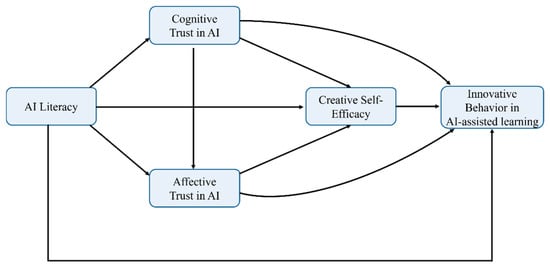
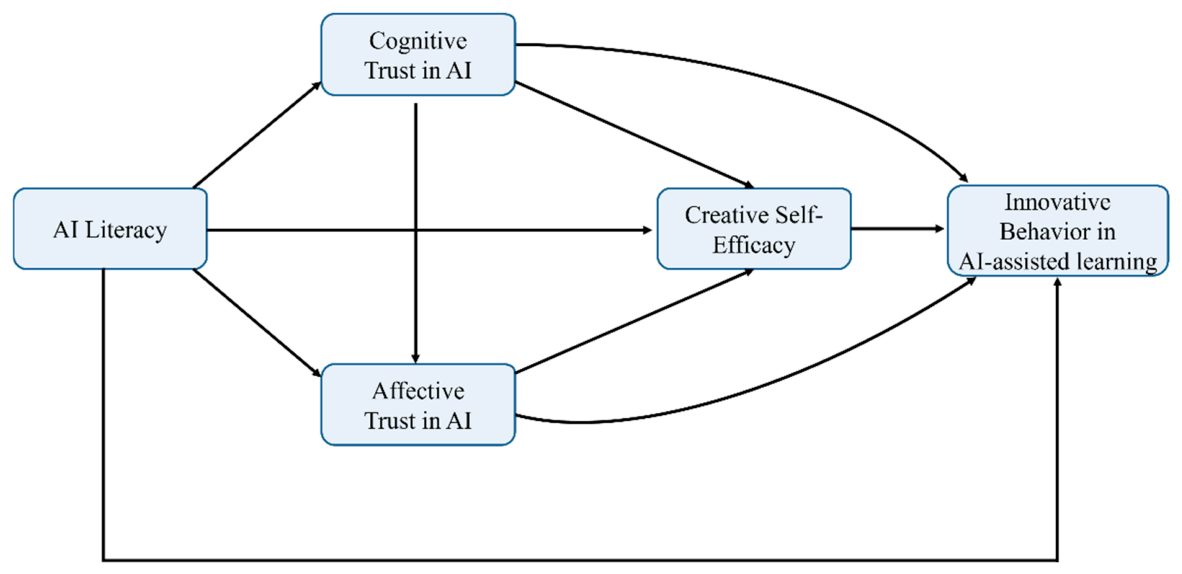
First, to what extent is AI literacy directly associated with IBL (RQ1)? Second, how do the two trust dimensions—cognitive and affective trust in AI—and CSE operate as sequential mediators of the AI literacy–IBL association (RQ2)? Third, do the mediating pathways through cognitive trust and affective trust differ significantly in magnitude (RQ3)? The resulting model (Figure 1) positions AI literacy as the distal antecedent, cognitive and affective trust in AI as intermediate relational antecedents of CSE (with cognitive trust preceding affective trust), and CSE as the motivational conduit to IBL. Tested in a sample of 1173 Chinese university students, the model is intended to clarify the cognitive and affective channels through which AI literacy relates to creative learning behavior, with implications for AI-era higher education.
Figure 1.
Theoretical model.
3. Materials and Methods
3.1. Participants and Procedure
Participants were undergraduate students primarily drawn from five collaborating universities in China, which were randomly selected from the pool of higher-education institutions accessible to the research team. Data collection used two non-clustered channels: digital invitations shared across campus student networks (WeChat and QQ) and distribution during a large-enrolment general course (College Students’ Mental Health) via two online platforms, www.credamo.com (accessed on 15 March 2026) and www.wjx.cn (accessed on 15 March 2026). Because the course enrolled students across varied majors and peer sharing naturally broadened participation, the sample spanned diverse disciplines and major geographical regions in China (Central, South, North, Southwest, and Northwest). To safeguard participant anonymity, institutional and class identifiers were not tracked; accordingly, hierarchical dependence was not modeled. Detailed demographics are summarized in Table S1 (Supplementary Materials). Under standardized instructions, participants voluntarily completed an online questionnaire in March 2026; survey completion required approximately 10 min. All subjects gave their informed consent for inclusion before they participated in the study. The study was conducted in accordance with the Declaration of Helsinki, and the protocol was approved by the Ethics Committee of Central China Normal University (No. CCNU–IRB–202603043A; Date of Approval: 16 March 2026). The initial sample included 1230 students. Fifty-seven responses were disregarded due to failed attention checks, yielding a final valid sample of 1173 students (39.5% males) with an average age of 20.75 years (SD = 1.966, range = 18–24 years). Most participants actively used generative AI for learning: 88.0% reported weekly use and 66.0% reported using such tools at least three or more times per week.
A sensitivity power analysis (Faul et al., 2007; Lakens, 2022) quantified the minimum detectable effect size for this sample. For N = 1173, two-tailed α of 0.05, and seven predictors, representing the maximum number entered into any single regression equation in the hypothesized model, the study had 80% power to detect an effect as small as f2 = 0.012 (ΔR2 = 0.012). This threshold lies below Cohen’s (2013) benchmark for a small effect (f2 = 0.02), and the achieved power was 0.96 for a small effect and effectively 1.00 for a medium effect (f2 = 0.15). The obtained sample was therefore smaller than those typically considered of theoretical interest. The research protocol was approved by the Institutional Review Board (IRB) of the corresponding author’s academic institution, and informed consent was obtained from all participants prior to data collection.
3.2. Measures
All instruments were originally developed in English and adapted into Chinese via a standardized translation and back-translation procedure supervised by bilingual experts. Scale items were framed around generative AI in learning, prompting participants to reflect on the specific tools they routinely deployed (e.g., DeepSeek and Doubao). The factorial structure of all adapted scales was substantiated through confirmatory factor analysis (CFA), demonstrating sound construct validity and reliability (see Section 4.1).
3.2.1. AI Literacy
AI literacy was assessed using the ChatGPT Literacy Scale developed by Lee and Park (2024). The original scale consists of 25 items. In the present study, the wording was adapted to fit AI-assisted learning contexts across four distinct dimensions: technical proficiency, critical evaluation, communication proficiency, and ethical competence, yielding a 21-item instrument. The four items forming the original creative-application dimension were deliberately excluded because their content (e.g., using ChatGPT to generate novel ideas and solutions) conceptually overlaps with innovative behavior and creative self-efficacy. All items were rated on a 5-point Likert scale, ranging from 1 (strongly disagree) to 5 (strongly agree), with higher scores reflecting greater AI literacy. In the current study, the 21-item scale demonstrated excellent internal consistency, yielding an overall Cronbach’s α of 0.948. The Cronbach’s α coefficients for the four dimensions were as follows: technical proficiency (α = 0.905), critical evaluation (α = 0.917), communication proficiency (α = 0.854), and ethical competence (α = 0.869).
3.2.2. AI-Assisted Innovative Behavior in Learning
Students’ innovative behavior in the learning context was evaluated using an adapted version of the Individual Innovative Behavior Scale developed by Scott and Bruce (1994). While the original 6-item, unidimensional scale was designed for supervisor ratings in the workplace, it was adapted in this study into a student self-report measure focused on AI-assisted learning. For instance, a sample item reads: “When using AI for learning, I typically take the initiative to explore new processes, technologies, and methods.” Participants responded to all items on a 5-point Likert scale ranging from 1 (never) to 5 (always), with higher aggregate scores indicating a greater frequency of innovative behavior in learning. In the present study, the adapted scale demonstrated good internal consistency, yielding a Cronbach’s α coefficient of 0.909.
3.2.3. Creative Self-Efficacy
Creative self-efficacy (CSE) was measured using the 3-item Creative Self-Efficacy Scale developed by Tierney and Farmer (2002). Originally designed to capture individuals’ beliefs in their ability to produce creative outcomes within their work roles, the items were contextualized in this study to fit the artificial intelligence-assisted learning environment for college students (e.g., “I have confidence in my ability to solve learning problems creatively using AI”). Unlike the original 7-point response format, participants in the current study rated the items on a 5-point Likert scale, ranging from 1 (strongly disagree) to 5 (strongly agree). Higher aggregate scores reflect a stronger belief in one’s creative capabilities during learning with AI. In the present study, the scale demonstrated good internal consistency, with a Cronbach’s α coefficient of 0.798.
3.2.4. Trust in AI
Trust in AI was assessed using the 27-item Semantic Differential Scale for AI Trust developed by Shang et al. (2024). This scale is a bi-dimensional instrument specifically validated to distinguish between the two core pathways of human–AI trust: cognitive trust (18 items), which captures users’ intellectual evaluations of the AI’s reliability, competence, understandability, and integrity; and affective trust (9 items), which reflects emotional responses to the AI’s benevolence and amiability. Rather than using traditional Likert statements, all items are structured as bipolar adjective pairs to minimize acquiescence bias. While the original response format ranges from −2 (fully leaning toward the negative term) to +2 (fully leaning toward the positive term), the scores in the current study were linearly transformed and recoded onto a 1-to-5 scale to ensure structural alignment and scaling consistency with the other continuous instruments. In the present study, the scale demonstrated excellent internal consistency, yielding an overall Cronbach’s α coefficient of 0.958. The Cronbach’s α coefficients for the two subscales were 0.969 for cognitive trust and 0.918 for affective trust, indicating high reliability in the current sample.
The full item wording is provided in Table S7.
3.3. Statistical Analysis
Data preparation and statistical analyses were performed using IBM SPSS Statistics (Version 27.0). Given that the online survey mandated responses for all items, the final dataset contained no missing values. Preliminary analyses indicated that the distributions of all primary variables conformed to the assumptions of univariate normality (see Table S2). Confirmatory factor analyses (CFAs) were conducted to evaluate the measurement model, and convergent and discriminant validity were assessed through the average variance extracted (AVE), composite reliability (CR) and McDonald’s ω, and the heterotrait–monotrait ratio of correlations (HTMT). To test the hypothesized sequential mediation model, we utilized the SPSS PROCESS Macro (Model 6; Hayes, 2022) with 5000 bootstrap resamples to generate 95% percentile bootstrap confidence intervals (CIs) for the indirect effects. As a robustness check, the hypothesized model was re-estimated as a latent-variable structural equation model in which all constructs were modeled as latent factors (χ2(1690) = 1730.32, χ2/df = 1.02, CFI = 0.999, TLI = 0.999, RMSEA = 0.005, SRMR = 0.020). The direction, relative magnitude, and significance of all paths were consistent with the observed-variable estimates reported by PROCESS (see Table S3). In addition, a single nested model was estimated in which cognitive and affective trust in AI were entered simultaneously, so that the two mediating pathways could be formally contrasted. Participants’ gender, age, and frequency of generative AI use were included as covariates in all mediation pathways to control for potential confounding effects, and all continuous variables were standardized prior to the mediation analyses.
4. Results
4.1. Preliminary Analyses
To assess potential common method variance (CMV) resulting from the self-reported and online nature of the data collection, Harman’s single-factor test was performed following the recommendations of Podsakoff et al. (2003). All continuous items measuring AI literacy, trust in AI, creative self-efficacy, and innovative behavior in learning were entered into an unrotated exploratory factor analysis (EFA). The analysis extracted 11 distinct factors with eigenvalues greater than 1. Notably, the first principal factor accounted for 31.59% of the total variance, which is below the critical threshold of 40%. To further examine common method variance, a confirmatory factor analysis (CFA) with an unmeasured latent method factor (ULMC; Podsakoff et al., 2003) was specified by adding a method factor on which all 57 items loaded freely, constrained to be orthogonal to the eight substantive factors. The model converged and fitted the data well, χ2(1454) = 1454.59, χ2/df = 1.000, CFI = 1.000, TLI = 1.000, RMSEA = 0.001, SRMR = 0.017. Relative to the baseline eight-factor model, adding the method factor improved the fit only marginally, Δχ2(57) = 101.34, p < 0.001, ΔCFI = 0.001, ΔRMSEA = 0.004, ΔSRMR = 0.002, all well below the conventional cutoffs (ΔCFI < 0.01, ΔRMSEA < 0.015, ΔSRMR < 0.01; Cheung & Rensvold, 2002). The method factor accounted for an average of 8.8% of the item variance (mean standardized loading = 0.27), and its loadings were markedly uneven across constructs (|λ| = 0.11 for innovative behavior vs. 0.46 for critical evaluation). Because a genuine common method effect would be expected to operate uniformly across items sharing the same response format, timing, and data source, this pattern is more consistent with the method factor absorbing construct-specific item homogeneity than with substantive common method bias. Together with Harman’s single-factor test, these results indicate that common method bias is unlikely to have distorted the reported relationships.
Prior to hypothesis testing, the measurement model was evaluated through confirmatory factor analyses (CFAs) in which AI literacy was specified as four first-order dimensions alongside cognitive trust in AI, affective trust in AI, creative self-efficacy, and innovative behavior in learning. This eight-factor model fitted the data well, χ2(1511) = 1555.93, χ2/df = 1.030, CFI = 0.999, TLI = 0.999, RMSEA = 0.005, SRMR = 0.019, and was clearly superior to both a single-factor model and a five-factor model treating AI literacy as a single factor (see Table S4). As shown in Table S5, all standardized loadings were substantial (λ = 0.68–0.87, all p < 0.001), and every construct achieved satisfactory average variance extracted (AVE > 0.50) as well as acceptable composite reliability and McDonald’s omega values (CR and ω > 0.79) (Hair et al., 2019). Discriminant validity was supported by heterotrait–monotrait ratios below the conservative threshold of 0.85 (maximum = 0.45; Henseler et al., 2015; see Table S6).
Bivariate associations between variables are reported in Table 1. The correlational relationships among variables support further analyses.
Table 1.
Descriptive statistics and correlations for key variables.
4.2. Testing for Sequential Mediation Effects
All continuous research variables were standardized before being entered into the models. With gender, age, and frequency of generative AI use controlled as covariates, a sequential mediation analysis was performed using the SPSS PROCESS Macro (Model 6; Hayes, 2022) with 5000 percentile bootstrap resamples to test the direct and indirect relationships among the variables.
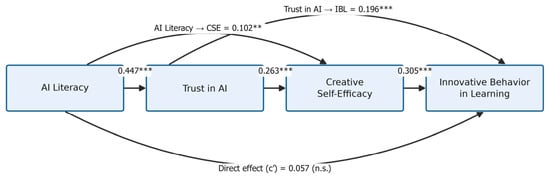
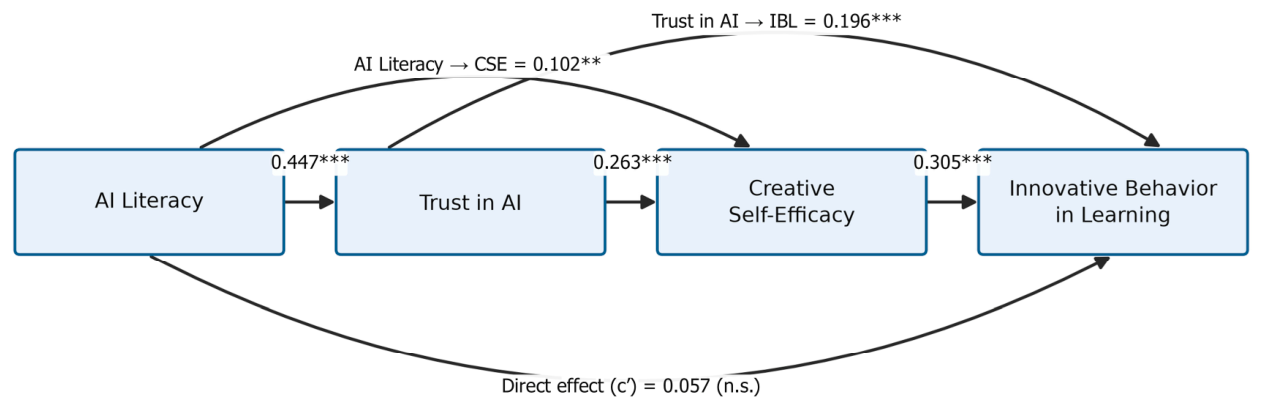
As detailed in Table 2, AI literacy was positively and significantly associated with innovative behavior in learning (β = 0.211, t = 7.383, p < 0.001, 95% CI = [0.155, 0.267]) in the initial total effect model, consistent with H 1. Crucially, after accounting for the dual mediators, the residual direct effect of AI literacy on innovative behavior in learning was attenuated to non-significance (β = 0.057, t = 1.912, p = 0.056, 95% CI = [−0.001, 0.115]), and the indirect effects accounted for the majority of the total effect. Figure 2 presents the standardized path coefficients.
Table 2.
The relationship between AI literacy and innovative behavior in learning: a sequential mediation model.
Figure 2.
The sequential mediation effect of Trust in AI and Creative Self-Efficacy. Note. Standardized regression coefficients are reported; n. s. = non-significant, ** p < 0.01, *** p < 0.001.
As shown in Table 3, the total indirect effect of AI literacy on innovative behavior in learning was 0.154 (Boot SE = 0.017, 95% CI = [0.120, 0.188]), accounting for 73.18% of the total effect. The total indirect effect comprised three statistically significant pathways (all 95% CIs excluded zero). Specifically, Indirect Effect 1 (the single mediating path via trust in AI) yielded an effect size of 0.087 (Boot SE = 0.015, 95% CI = [0.058, 0.117]), contributing 41.40% to the relative mediation effect, whereas Indirect Effect 2 (the single mediating path via creative self-efficacy) yielded an effect size of 0.031 (Boot SE = 0.010, 95% CI = [0.011, 0.051]), contributing 14.78%. Crucially, Indirect Effect 3 was significant, consistent with the sequential mediation pathway (AI Literacy → Trust in AI → Creative Self-Efficacy → Innovative Behavior in Learning), with an effect size of 0.036 (Boot SE = 0.006, 95% CI = [0.025, 0.048]), explaining 16.99% of the relative mediation effect, consistent with H2, H3, and H4.
Table 3.
Creative self-efficacy and trust in AI in the mediation effect analysis.
The technological-trust pathway (the mediating path via trust in AI) was significantly stronger than both the cognitive-motivational pathway (the mediating path via creative self-efficacy; Contrast 1 = 0.056, 95% CI = [0.018, 0.093]) and the sequential chain pathway (Contrast 2 = 0.051, 95% CI = [0.020, 0.083]). By contrast, the cognitive-motivational pathway and the sequential chain pathway did not differ significantly from each other (Contrast 3 = −0.005, 95% CI = [−0.030, 0.019]). Trust in AI thus showed the largest indirect effect on innovative behavior in learning.
4.3. Dimension-Specific Mechanisms of Trust in AI
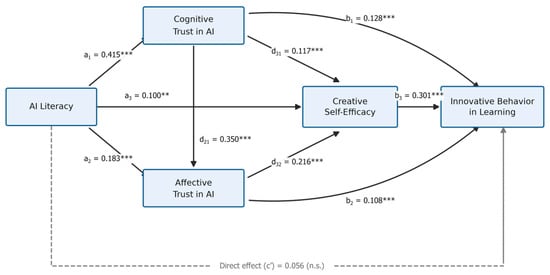
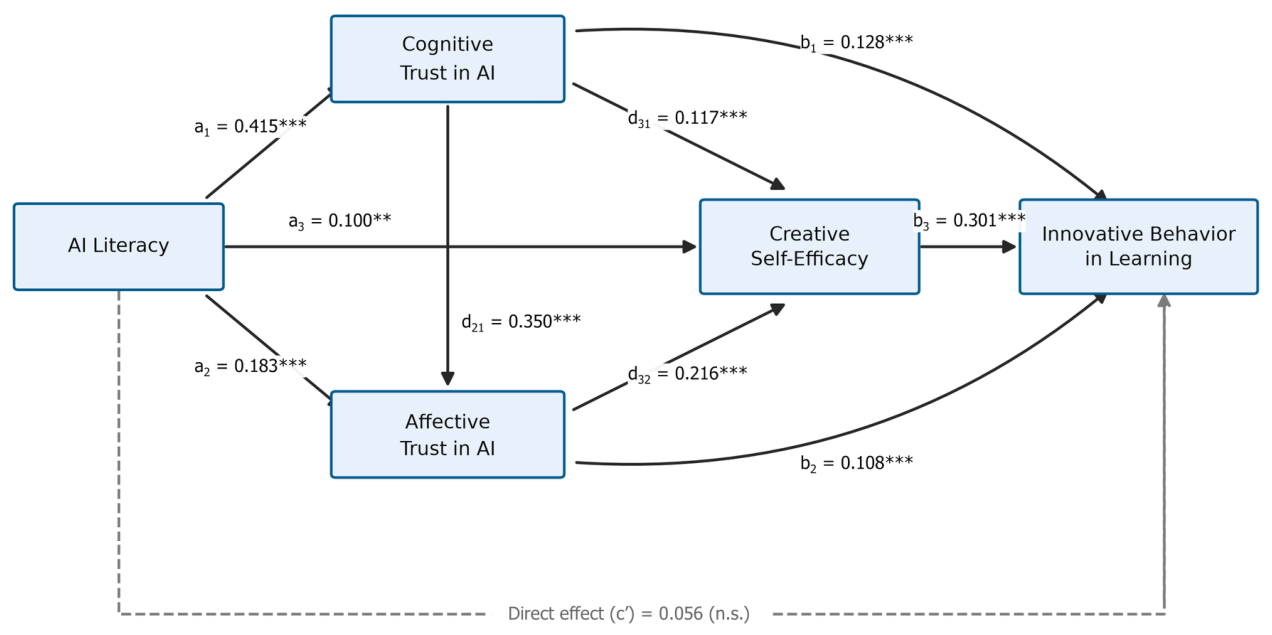
To gain a more detailed understanding of the dynamic interplay between human–AI collaboration and psychological factors, the bi-dimensional construct of trust in AI was decomposed into its cognitive and affective dimensions, and the two dimensions were entered simultaneously into a single nested sequential mediation model, so that their relative contributions could be directly contrasted rather than inferred from separately estimated models. Figure 3 illustrates the standardized path coefficients, while Table 4 provides the detailed regression outcomes.
Figure 3.
Simultaneous sequential mediation pathways through cognitive and affective trust in AI. Note. Standardized regression coefficients are reported; n.s. = non-significant, ** p < 0.01, *** p < 0.001.
Table 4.
Specific indirect effects of the simultaneous dual-trust sequential mediation model.
The regression results revealed that AI literacy was positively associated with students’ cognitive trust in AI (β = 0.415, t = 15.587, p < 0.001, 95% CI = [0.362, 0.467]) and with their affective trust in AI (β = 0.183, t = 6.402, p < 0.001, 95% CI = [0.127, 0.239]). Cognitive trust in AI, in turn, was significantly associated with affective trust in AI (β = 0.350, t = 12.214, p < 0.001, 95% CI = [0.294, 0.406]). When creative self-efficacy was regressed on the two trust dimensions simultaneously, both cognitive trust in AI (β = 0.117, t = 3.647, p < 0.001, 95% CI = [0.054, 0.180]) and affective trust in AI (β = 0.216, t = 6.987, p < 0.001, 95% CI = [0.156, 0.277]) retained significant positive effects, as did AI literacy itself (β = 0.100, t = 3.253, p = 0.001, 95% CI = [0.040, 0.161]).
In the final block estimating students’ innovative behavior in AI-assisted learning, cognitive trust in AI (β = 0.128, t = 4.130, p < 0.001, 95% CI = [0.067, 0.189]), affective trust in AI (β = 0.108, t = 3.567, p < 0.001, 95% CI = [0.049, 0.167]), and creative self-efficacy (β = 0.301, t = 10.740, p < 0.001, 95% CI = [0.246, 0.356]) were all significantly associated with innovative behavior in AI-assisted learning. Once both trust dimensions and creative self-efficacy were included, the residual direct effect of AI literacy on innovative behavior in AI-assisted learning was no longer significant (β = 0.056, t = 1.906, p = 0.057, 95% CI = [−0.002, 0.114]).
As shown in Table 4, the total indirect effect of AI literacy on innovative behavior in AI-assisted learning was 0.155 (Boot SE = 0.017, 95% CI = [0.122, 0.190]), capturing 73.26% of the total effect, and all seven specific indirect pathways were statistically significant. The strongest was the path through cognitive trust in AI alone (AI Literacy → Cognitive Trust → Innovative Behavior in Learning; effect = 0.053, 95% CI = [0.027, 0.080]), followed by the literacy-to-self-efficacy path (AI Literacy → Creative Self-Efficacy → Innovative Behavior in Learning; effect = 0.030, 95% CI = [0.011, 0.050]) and the path through affective trust in AI alone (effect = 0.020, 95% CI = [0.008, 0.033]), consistent with H2a, H2b, H3; the four serial pathways involving both trust dimensions and creative self-efficacy ranged from 0.009 to 0.016 (all 95% CIs excluded zero), consistent with H2c, H4a, H4b, H4c. Aggregating across pathways, the indirect effect routed through cognitive trust in AI (0.093, 95% CI = [0.066, 0.122]) was significantly larger than the indirect effect routed through affective trust in AI (0.057, 95% CI = [0.036, 0.080]) (via Cog − via Aff = 0.036, 95% CI = [0.001, 0.071]). Notably, the total indirect effect for each trust dimension covers both its exclusive pathway and the shared sequential pathway. Their contrast thus captures the overall association routed through each dimension rather than its isolated impact. In the unified model, this asymmetry was located mainly at the antecedent stage. AI literacy showed a larger coefficient for cognitive trust in AI than for affective trust in AI (Δ = 0.231, 95% CI = [0.154, 0.304]). This comparison is not strictly like-for-like, however, because the two antecedent coefficients derive from different adjustment sets: the literacy→affective coefficient also controlled for cognitive trust, whereas the literacy→cognitive coefficient did not control for affective trust. To provide a like-for-like contrast, we re-estimated both antecedent paths with an identical covariate set—each trust dimension regressed on AI literacy and the same covariates, without cross-adjustment. Under this symmetric specification, AI literacy was associated with cognitive trust (β = 0.415, 95% CI = [0.362, 0.467]) and with affective trust (β = 0.328, 95% CI = [0.274, 0.382]); the contrast remained positive and significant but was roughly one-third as large as the original estimate (Δ = 0.086, 95% CI = [0.025, 0.148]; bootstrap 95% CI = [0.027, 0.147]; see Table S8 and Figure S1).
By contrast, the two trust dimensions did not differ significantly in the strength with which they transmitted the effect onward, either to creative self-efficacy (0.117 vs. 0.216; Δ = −0.100, 95% CI = [−0.204, 0.006]) or to innovative behavior in learning (0.128 vs. 0.108; Δ = 0.019, 95% CI = [−0.078, 0.117]).
5. Discussion
This study investigated how AI literacy relates to college students’ AI-assisted innovative behavior in learning (IBL) through the sequential mediation of trust in AI and creative self-efficacy (CSE). Utilizing a quantitative methodology with a valid sample of 1173 college students, three findings stand out. First, the direct association between AI literacy and IBL was no longer significant once the mediators were entered; the total indirect effect through trust in AI, CSE, and their sequential chain accounted for 73.18% of the total association. Second, when cognitive and affective trust were modeled simultaneously, both transmitted the AI literacy effect to IBL. Third, the two trust dimensions displayed modest asymmetry at the antecedent stage: although AI literacy was associated more strongly with cognitive than affective trust in both the sequential model (Δ = 0.231) and under symmetric covariate adjustment without cross-adjustment (Δ = 0.086), the two dimensions showed comparable downstream associations with creative self-efficacy and innovative behavior. Because the study is cross-sectional, all paths should be read as cross-sectional associations rather than as evidence of causal or developmental processes; the sequential ordering reflects the hypothesized model, not observed temporal precedence.
5.1. The Association Between AI Literacy and Innovative Behavior in AI-Assisted Learning
As expected, AI literacy was positively associated with IBL, supporting H1 and addressing RQ1. H1 concerns this total association; the residual direct effect became non-significant once the mediators were included (β = 0.057, p = 0.056), leaving the indirect paths to account for 73.2% of the total association (β = 0.211). The total association is theoretically consistent with an affordance-actualization account: AI technologies offer rich creative-learning opportunities, but these opportunities translate into behavior only when users possess the literacy to perceive, evaluate, and act on them (Allen & Kendeou, 2024). Unlike traditional software literacy, which reduces to operational familiarity, AI literacy entails conversational prompting, reflective judgment, and critical evaluation (Casal-Otero et al., 2023; Ng et al., 2024). Students higher in AI literacy are better able to treat AI agents as interactive cognitive partners rather than passive answer generators—cross-verifying outputs, refining ideas, and executing novel academic solutions (Ma et al., 2026; B. Wang et al., 2023; Zi et al., 2026). This aligns with accounts framing advanced AI competencies as the cognitive architecture underlying innovative problem-solving in digital learning environments (Alkhatib et al., 2026).
That the direct effect dropped to nonsignificance—accounting for roughly one-quarter of the total association—indicates that technical understanding is linked to IBL predominantly through the psychological routes modeled here (trust in AI and CSE) rather than as an autonomous behavior driver. Other mechanisms beyond those tested may also operate; future research could examine AI-use intensity, prompting skills, and psychological need satisfaction (Ji et al., 2025).
5.2. The Mediating Roles of Trust in AI and Creative Self-Efficacy
Trust in AI and CSE each served as a significant independent mediator of the AI literacy–IBL association, addressing RQ2. The trust path aligns with technology acceptance accounts: technical understanding demystifies algorithmic opacity and fosters constructive reliance on AI recommendations (Glikson & Woolley, 2020; Obadă et al., 2025; Z. Wang et al., 2026). The CSE path aligns with Social Cognitive Theory: self-reported AI competencies appear to be linked to risk-bearing innovation largely through internal creative self-beliefs (Bandura, 2001; Newman et al., 2018; Tierney & Farmer, 2002); Students higher in AI literacy report feeling competent commanding intelligent systems, which is associated with greater confidence in their own creative capacity and with more proactive learning (Chun et al., 2025; Ji et al., 2025; Peng et al., 2026).
Two features of these independent pathways merit comment. First, they were not equivalent in magnitude: the indirect effect through trust in AI (0.087) significantly exceeded that through CSE (0.031), suggesting that “believing in the tool” is a more efficient conduit than “believing in oneself” for the AI literacy–IBL link. Second, when both mediators were entered simultaneously, CSE was more strongly associated with IBL (β = 0.31) than trust in AI (β = 0.20). This gradient is consistent with Social Cognitive Theory: trust in AI is a more distal environmental condition that is linked to behavior largely through self-efficacy (Bandura, 2001).
The sequential chain—AI literacy → trust in AI → IBL—maps onto Bandura’s (1986, 2001) reciprocal-determinism framework: AI literacy and trust form the environment layer (technology affordance), CSE forms the personal-factor layer, and IBL forms the behavioral layer. IN human–computer interaction terms, trust is an environmental affordance associated with self-perceptions (Hoff & Bashir, 2015); when students develop a secure relationship with an AI agent, the tool is more likely to be experienced as an empowering co-creator rather than as an intimidating black box, a stance associated with richer mastery experiences and greater confidence to generate and execute creative ideas (McGuire et al., 2024).
The sequential indirect effect (0.036; 16.99% of the total) was statistically robust but materially smaller than the direct trust path (41.40%). Its significance lies in establishing that technological trust can be converted into creative self-belief, and that this conversion holds when both trust dimensions are simultaneously modeled. The chain is therefore a theoretically meaningful but secondary pathway, not the dominant mechanism.
5.3. The Asymmetry Between Cognitive and Affective Trust in AI
When cognitive and affective trust entered a single nested model (RQ3), both operated as complementary rather than mutually exclusive alternatives. The aggregate indirect path through cognitive trust was significantly larger than through affective trust, even though both were statistically significant. Two qualifications are important. First, each aggregate indirect effect combines exclusive paths through a single dimension and shared paths traversing both; their contrast thus reflects the total association routed through each dimension rather than its isolated contribution. Second, while initial estimates suggested a notable antecedent asymmetry favoring cognitive trust, the two coefficients derived from different adjustment sets (Section 4.3) differed. When re-estimated with an identical covariate set, this antecedent difference remained statistically significant but was considerably smaller (Δ = 0.086, 95% CI = [0.025, 0.148]). The pattern nevertheless reflects how each trust dimension is formed. Cognitive trust is an intellectual appraisal of an AI’s competence, functional reliability, and accuracy (Shang et al., 2024), closely tied to the knowledge and evaluative skills that constitute AI literacy—making it a relatively accessible gateway through which literacy enters the trust system. Affective trust, by contrast, tends to require repeated interaction over time and is not a direct output of declarative knowledge.
Downstream, both trust dimensions were significantly and positively associated with CSE. Although affective trust showed a numerically larger point estimate (0.216) than cognitive trust (0.117), their contrast was statistically nonsignificant (Δ = −0.100, 95% CI = [−0.204, 0.006]), indicating that the two dimensions should not be treated as differing reliably in their downstream associations. Rather than implying an asymmetry, these findings suggest that cognitive and affective trust offer complementary psychological affordances under Social Cognitive Theory (Bandura, 1997). Cognitive trust confirms algorithmic reliability and competence, providing the functional prerequisite for constructive mastery experiences. Concurrently, affective trust cultivates psychological safety and emotional reassurance (Edmondson, 1999), mitigating the apprehension and risk aversion common in creative problem-solving (Amabile & Pillemer, 2012; Fredrickson, 2001). The two dimensions jointly scaffold students’ creative self-beliefs, demonstrating that effective AI-assisted innovation relies on both functional credibility and socio-emotional security.
5.4. Contributions and Limitations
Overall, this study contributes to the literature in three respects. First, it advances understanding of how domain-specific technological competencies relate to IBL in the generative AI era. Rather than treating AI literacy as general intelligence or objective ability, we operationalize it as self-reported competencies within Social Cognitive Theory (Bandura, 2001). Integrating this perspective with the dual-trust framework (McAllister, 1995; Shang et al., 2024), our model describes an integrated psychological sequence wherein technological affordances are translated into observable IBL primarily through self-referent creative self-efficacy (CSE). Second, by incorporating cognitive and affective trust into a single sequential model, our findings demonstrate that both conduits are effective yet functionally distinct. While the two trust dimensions show comparable downstream associations with CSE, AI literacy is more readily aligned with cognitive trust at the antecedent stage. Crucially, even after re-estimating both paths under an identical covariate set, this antecedent difference remained statistically robust (Δ = 0.086 vs. Δ = 0.231 in the sequential model). These consistent findings reveal that cognitive trust serves as the more readily mobilized gateway linking AI literacy to innovative learning, whereas cultivating affective trust likely requires deliberate, relationally supportive instructional environments rather than informational competence alone (Allen & Kendeou, 2024; Chiu, 2025). Third, the study extends self-efficacy theory to human–AI collaborative contexts, revealing that creative confidence is associated not only with functional competence appraisals but also with socio-emotional and psychologically safe interactions with artificial agents (Reeves & Nass, 1996; Short et al., 1976).
Several limitations qualify these contributions. First, the cross-sectional design precludes definitive causal conclusions about the sequential pathways; reverse and reciprocal paths are equally plausible (for example, successful creative use of AI could itself strengthen perceived literacy, trust, and confidence), and cross-sectional mediation estimates cannot resolve this directionality (Fiedler et al., 2011). Longitudinal designs (two-wave panels, experience sampling) or experiments that manipulate AI responsiveness while holding information quality constant are needed to track changes in trust and CSE and to establish the causal force of affective trust (Cheng & Huang, 2026).
Second, all measures were self-reported. Although Harman’s single-factor test and a confirmatory unmeasured-latent-method-factor analysis indicated that common method bias was not substantial, neither procedure can definitively rule it out; a marker-variable approach (Lindell & Whitney, 2001) and objective metrics such as system interaction logs or expert evaluations of creative products should complement self-reports in future work. This applies with particular force to AI literacy, because self-assessed competence diverges systematically from demonstrated performance (Dunning et al., 2004; Kruger & Dunning, 1999); performance-based AI-literacy tasks would therefore provide a stronger test of the mechanisms proposed here.
Third, trust in AI is dynamic—which is formed, calibrated, and occasionally breaks down over time (Hoff & Bashir, 2015)—and a single measurement cannot capture these trajectories. The 3-item CSE scale also offered limited bandwidth, and the IBL scale was adapted from a workplace instrument (Scott & Bruce, 1994); both require further validation in AI-assisted learning contexts.
Fourth, four creative self-appraisal items were deliberately excluded from the AI literacy scale to avoid criterion contamination (Section 3.2.1), which may have narrowed the construct’s bandwidth. The model also did not test boundary conditions; individual differences such as AI anxiety, need for cognition (Pitts et al., 2026), and field of study may moderate the conversion of affective trust into CSE and creative enactment.
Finally, the sampling strategy limits generalizability. Participants were predominantly drawn from five universities via online courses and student networks; peer sharing subsequently broadened the sample across diverse regions in China (Central, South, North, Southwest, and Northwest). However, because institutional identifiers were not tracked, we could not model hierarchical dependence across universities or classes. Furthermore, the non-probabilistic, voluntary sampling approach introduces potential self-selection bias, precluding broad generalizations to the entire undergraduate population. Future research should implement clustered multilevel sampling and cross-cultural comparisons to substantiate the generalizability of our findings.
6. Conclusions
AI literacy was positively associated with students’ AI-assisted innovative behavior in learning, but this association operated largely indirectly through trust in AI and creative self-efficacy (CSE) as sequential mediators. When cognitive and affective trust were entered simultaneously, both made significant, non-redundant contributions to the indirect pathway. The asymmetry between them was most evident at the antecedent stage, where AI literacy showed a larger coefficient for cognitive than for affective trust (a difference that remained significant, though considerably smaller, when both paths were re-estimated with an identical covariate set); downstream, the two dimensions did not significantly differ in their association with CSE or with IBL. These findings suggest that the indirect linkage between AI literacy and creative learning behavior involves both functional appraisals of AI competence and the socio-emotional quality of the human–AI relationship. Educational efforts should therefore attend not only to building students’ understanding of AI but also to cultivating affectively supportive, psychologically safe interactions that support CSE.
Supplementary Materials
The following supporting information can be downloaded at: https://www.mdpi.com/article/10.3390/bs16112083/s1, Figure S1: Antecedent trust paths in the sequential mediation model under the serial specification (as originally reported) and under a symmetric specification with an identical covariate set; Table S1. Demographic characteristics of participants; Table S2. Descriptive statistics and univariate normality of the study variables; Table S3. Comparison of standardized path coefficients between the observed-variable and latent-variable models; Table S4. Comparison of alternative measurement models; Table S5. Measurement model assessment; Table S6. Heterotrait–Monotrait (HTMT) ratio; Table S7. Instruments for AI Literacy, Trust in AI, Creative self-efficacy, and AI-assisted Innovative Behavior in learning. Table S8. AI literacy → trust paths under the serial specification (as originally reported) and under a symmetric specification with an identical covariate set.
Author Contributions
Conceptualization, W.Q., Z.W. and C.G.; methodology, W.Q., H.G., L.Z. and B.Y.H.; software, W.Q., Z.W. and M.C.; validation, W.Q., H.G., L.Z. and M.P.; formal analysis, W.Q., H.G., L.Z., J.F., M.C. and M.P.; investigation, W.Q., H.G., L.Z., J.F. and B.Y.H.; resources, H.G., L.Z., B.Y.H. and C.G.; data curation, M.C., H.G., J.F., Z.W. and M.P.; writing—original draft preparation, W.Q., H.G., L.Z., J.F. and M.P.; writing—review and editing, W.Q., H.G., L.Z., B.Y.H., M.C., Z.W. and C.G.; visualization, J.F. and Z.W.; supervision, W.Q., B.Y.H., Z.W. and C.G.; project administration, Z.W. and C.G.; funding acquisition, C.G. All authors have read and agreed to the published version of the manuscript.
Funding
This study was funded by the Key Project of Hubei Higher Education Association on “Research on Empowering Creativity with Artificial Intelligence” (2025XAZ019) and the General Seed Cultivation Project of Central China Normal University on “Mechanism and Application of GenAI Assisted Creativity Enhancement Based on Metacognition” (CCNU25ZZ156).
Institutional Review Board Statement
The study was conducted in accordance with the Declaration of Helsinki and approved by the Ethics Committee of the Central China Normal University (No. CCNU–IRB–202603043A; approved on 16 March 2026).
Informed Consent Statement
Informed consent was obtained from all subjects involved in the study.
Data Availability Statement
The original contributions presented in this study are included in the article and Supplementary Materials. Further inquiries can be directed to the corresponding authors.
Acknowledgments
The authors would like to express their sincere gratitude to all the students who participated in this study.
Conflicts of Interest
Chuanhua Gu is a Guest Editor for the Special Issue “Psychological Processes of Creativity and Online Behavior in the Internet Era” of Behavioral Sciences and was not involved in the editorial review or the decision to publish this article. The other authors declare no conflicts of interest.
References
- Agergaard, T. E., Nielsen, K. H., Labouriau, R., & Fage-Butler, A. (2026). Exploring trust and literacy in engagement with generative AI and science information behavior. Media and Communication, 14, 11357. [Google Scholar] [CrossRef] [Scilit]
- Alkhatib, O. J., Rahman, F., Hussain, A. K., Siddique, M. E., & Farooq, H. O. (2026). Impact of generative artificial intelligence on student learning outcomes: The mediating role of student engagement and AI literacy in higher education. The Critical Review of Social Sciences Studies, 4(1), 6400–6424. [Google Scholar] [CrossRef] [Scilit]
- Allen, L. K., & Kendeou, P. (2024). ED-AI Lit: An interdisciplinary framework for AI literacy in education. Policy Insights from the Behavioral and Brain Sciences, 11(1), 3–10. [Google Scholar] [CrossRef] [Scilit]
- Alt, D., Kapshuk, Y., & Dekel, H. (2023). Promoting perceived creativity and innovative behavior: Benefits of future problem–solving programs for higher education students. Thinking Skills and Creativity, 47, 101201. [Google Scholar] [CrossRef] [Scilit]
- Amabile, T. M., & Pillemer, J. (2012). Perspectives on the social psychology of creativity. The Journal of Creative Behavior, 46(1), 3–15. [Google Scholar] [CrossRef] [Scilit]
- Archan, D., & Krsmanović, I. (2026). AI literacy and trust in AI among higher education lecturers. In T. Schlippe, E. C. K. Cheng, & T. Wang (Eds.), Artificial intelligence in education technologies: New development and innovative practices (AIET 2025). (Lecture Notes on Data Engineering and Communications Technologies, Vol. 279, pp. 450–462). Springer. [Google Scholar] [CrossRef] [Scilit]
- Bandura, A. (1986). Social foundations of thought and action: A social cognitive theory. Prentice-Hall. [Google Scholar]
- Bandura, A. (1997). Self-efficacy: The exercise of control. W. H. Freeman. [Google Scholar]
- Bandura, A. (2001). Social cognitive theory: An agentic perspective. Annual Review of Psychology, 52(1), 1–26. [Google Scholar] [CrossRef] [Scilit] [PubMed]
- Casal-Otero, L., Catala, A., Fernández-Morante, C., Taboada, M., Cebreiro, B., & Barro, S. (2023). AI literacy in K-12: A systematic literature review. International Journal of STEM Education, 10(1), 29. [Google Scholar] [CrossRef] [Scilit]
- Chen, K., & Kahl, C. (2026). Reduced workload or diminished capabilities? The double-edged sword effect of artificial intelligence on knowledge workers’ innovative behaviours. European Journal of Innovation Management, 29(4), 1267–1291. [Google Scholar] [CrossRef] [Scilit]
- Cheng, Y., & Huang, X. (2026). Beyond cognitive support: Social interaction and affective experience in AI–assisted creative thinking among university students. Journal of Intelligence, 14(7), 151. [Google Scholar] [CrossRef] [Scilit] [PubMed]
- Cheung, G. W., & Rensvold, R. B. (2002). Evaluating goodness-of-fit indexes for testing measurement invariance. Structural Equation Modeling, 9(2), 233–255. [Google Scholar] [CrossRef] [Scilit] [PubMed]
- Chiu, T. K. (2025). AI literacy and competency: Definitions, frameworks, development and future research directions. Interactive Learning Environments, 33(5), 3225–3229. [Google Scholar] [CrossRef] [Scilit]
- Chun, Z., Ning, Y., Chen, J., & Wijaya, T. T. (2025). Exploring the interplay among artificial intelligence literacy, creativity, self-efficacy, and academic achievement in college students: Findings from PLS-SEM and FsQCA. Education and Information Technologies, 30(15), 21283–21316. [Google Scholar] [CrossRef] [Scilit]
- Cohen, J. (2013). Statistical power analysis for the behavioral sciences. Routledge. [Google Scholar] [CrossRef] [Scilit]
- Corazza, G. E., & Lubart, T. (2021). Intelligence and creativity: Mapping constructs on the space-time continuum. Journal of Intelligence, 9(1), 1. [Google Scholar] [CrossRef] [Scilit] [PubMed]
- Dunning, D., Heath, C., & Suls, J. M. (2004). Flawed self-assessment: Implications for health, education, and the workplace. Psychological Science in the Public Interest, 5(3), 69–106. [Google Scholar] [CrossRef] [Scilit] [PubMed]
- Edmondson, A. (1999). Psychological safety and learning behavior in work teams. Administrative Science Quarterly, 44(2), 350–383. [Google Scholar] [CrossRef] [Scilit]
- Fan, Y., Tang, L., Le, H., Shen, K., Tan, S., Zhao, Y., Shen, Y., Li, X., & Gašević, D. (2025). Beware of metacognitive laziness: Effects of generative artificial intelligence on learning motivation, processes, and performance. British Journal of Educational Technology, 56(2), 489–530. [Google Scholar] [CrossRef] [Scilit]
- Faul, F., Erdfelder, E., Lang, A. G., & Buchner, A. (2007). G*Power 3: A flexible statistical power analysis program for the social, behavioral, and biomedical sciences. Behavior Research Methods, 39(2), 175–191. [Google Scholar] [CrossRef] [Scilit] [PubMed]
- Fiedler, K., Schott, M., & Meiser, T. (2011). What mediation analysis can (not) do. Journal of Experimental Social Psychology, 47(6), 1231–1236. [Google Scholar] [CrossRef] [Scilit]
- Fredrickson, B. L. (2001). The role of positive emotions in positive psychology: The broaden-and-build theory of positive emotions. American Psychologist, 56(3), 218–226. [Google Scholar] [CrossRef] [PubMed]
- Gerlich, M. (2025). AI tools in society: Impacts on cognitive offloading and the future of critical thinking. Societies, 15(1), 6, (Correction in 2025, Societies, 15(9), 252).. [Google Scholar] [CrossRef] [Scilit]
- Glikson, E., & Woolley, A. W. (2020). Human trust in artificial intelligence: Review of empirical research. Academy of Management Annals, 14(2), 627–660. [Google Scholar] [CrossRef] [Scilit]
- Goyanes, M., Utz, S., & de Zúñiga, H. G. (2026). Trust in AI news, AI literacy, and the mediating role of artificial intelligence attitudes: A longitudinal study across diverse societies. Computers in Human Behavior: Artificial Humans, 7, 100279. [Google Scholar] [CrossRef] [Scilit]
- Hair, J. F., Black, W. C., Babin, B. J., & Anderson, R. E. (2019). Multivariate data analysis (8th ed.). Cengage. [Google Scholar]
- Hayes, A. F. (2022). Introduction to mediation, moderation, and conditional process analysis: A regression–based approach (3rd ed.). Guilford Press. [Google Scholar]
- Henseler, J., Ringle, C. M., & Sarstedt, M. (2015). A new criterion for assessing discriminant validity in variance–based structural equation modeling. Journal of the Academy of Marketing Science, 43(1), 115–135. [Google Scholar] [CrossRef] [Scilit]
- Hoff, K. A., & Bashir, M. (2015). Trust in automation: Integrating empirical evidence on factors that influence trust. Human Factors, 57(3), 407–434. [Google Scholar] [CrossRef] [Scilit] [PubMed]
- Jaussi, K. S., & Randel, A. E. (2014). Where to look? Creative self-efficacy, knowledge retrieval, and incremental and radical creativity. Creativity Research Journal, 26(4), 400–410. [Google Scholar] [CrossRef] [Scilit]
- Jeffrey, B., & Craft, A. (2006). Creative learning and possibility thinking. In A. Craft, B. Jeffrey, & M. Leibling (Eds.), Creative learning practices: European experiences (pp. 73–91). Tufnell Press. [Google Scholar]
- Ji, Y., Zhong, M., Lyu, S., Li, T., Niu, S., & Zhan, Z. (2025). How does AI literacy affect individual innovative behavior: The mediating role of psychological need satisfaction, creative self-efficacy, and self–regulated learning. Education and Information Technologies, 30(11), 16133–16162. [Google Scholar] [CrossRef] [Scilit]
- Khoso, A. K., Wang, H., & Darazi, M. A. (2026). Trust and attitude towards AI as pathways to creativity: A TAM model study of EFL students’ digital literacy and AI acceptance. Humanities and Social Sciences Communications, 13(1), 69. [Google Scholar] [CrossRef] [Scilit]
- Kong, H., Yin, Z., Chon, K., Yuan, Y., & Yu, J. (2023). How does artificial intelligence (AI) enhance hospitality employee innovation? The roles of exploration, AI trust, and proactive personality. Journal of Hospitality Marketing & Management, 33(3), 261–287. [Google Scholar] [CrossRef] [Scilit]
- Kruger, J., & Dunning, D. (1999). Unskilled and unaware of it: How difficulties in recognizing one’s own incompetence lead to inflated self-assessments. Journal of Personality and Social Psychology, 77(6), 1121–1134. [Google Scholar] [CrossRef] [PubMed]
- Lakens, D. (2022). Sample size justification. Collabra: Psychology, 8(1), 33267. [Google Scholar] [CrossRef] [Scilit]
- Larson, B. Z., Möser, C., Caza, A., Muehlfeld, K. S., & Colombo, L. A. (2024). Critical thinking in the age of generative AI. Academy of Management Learning & Education, 23(3), 373–378. [Google Scholar] [CrossRef] [Scilit]
- Lau, G. R., Low, W. Y., Tay, L., Guevarra, Y. A., Gašević, D., & Hartanto, A. (2026). Understanding critical thinking in generative artificial intelligence use: Development, validation, and correlates of the critical thinking in AI use scale. Computers in Human Behavior Reports, 22, 101103. [Google Scholar] [CrossRef] [Scilit]
- Lee, S., & Park, G. (2024). Development and validation of ChatGPT literacy scale. Current Psychology, 43(21), 18992–19004. [Google Scholar] [CrossRef] [Scilit]
- Lindell, M. K., & Whitney, D. J. (2001). Accounting for common method variance in cross-sectional research designs. Journal of Applied Psychology, 86(1), 114–121. [Google Scholar] [CrossRef] [Scilit] [PubMed]
- Lintner, T. (2024). A systematic review of AI literacy scales. npj Science of Learning, 9(1), 50. [Google Scholar] [CrossRef] [Scilit] [PubMed]
- Long, D., & Magerko, B. (2020). What is AI literacy? Competencies and design considerations. In Proceedings of the 2020 CHI conference on human factors in computing systems (pp. 1–16). Association for Computing Machinery. [Google Scholar] [CrossRef] [Scilit]
- Ma, L., Liu, T., Zhao, C., & Niu, T. (2026). How does artificial intelligence literacy affect university students’ innovative behavior? A serial mediation analysis based on latent profiles. Frontiers in Psychology, 17, 1844997. [Google Scholar] [CrossRef] [Scilit] [PubMed]
- Mathisen, G. E., & Bronnick, K. S. (2009). Creative self-efficacy: An intervention study. International Journal of Educational Research, 48(1), 21–29. [Google Scholar] [CrossRef] [Scilit]
- McAllister, D. J. (1995). Affect- and cognition-based trust as foundations for interpersonal cooperation in organizations. Academy of Management Journal, 38(1), 24–59. [Google Scholar] [CrossRef] [Scilit]
- McGuire, J., De Cremer, D., & Van de Cruys, T. (2024). Establishing the importance of co–creation and self-efficacy in creative collaboration with artificial intelligence. Scientific Reports, 14(1), 18525. [Google Scholar] [CrossRef] [Scilit] [PubMed]
- Mubarak, Z. K., & Selimin, M. A. (2023). Significance of innovative learning skills in the era of Education 4.0. International Journal of Sustainable Construction Engineering and Technology, 14(3), 339–352. [Google Scholar] [CrossRef] [Scilit]
- Newman, A., Herman, H., Schwarz, G., & Nielsen, I. (2018). The effects of employees’ creative self-efficacy on innovative behavior: The role of entrepreneurial leadership. Journal of Business Research, 89, 1–9. [Google Scholar] [CrossRef] [Scilit]
- Ng, D. T. K., Su, J., Leung, J. K. L., & Chu, S. K. W. (2024). Artificial intelligence (AI) literacy education in secondary schools: A review. Interactive Learning Environments, 32(10), 6204–6224. [Google Scholar] [CrossRef] [Scilit]
- Obadă, D. R., Dabija, D. C., & Pop, R. A. (2025). From understanding to influence: The interplay of AI literacy, self-efficacy, and trust in predicting communication students’ AI adoption and word-of-mouth. Frontiers in Communication, 10, 1722464. [Google Scholar] [CrossRef] [Scilit]
- Omrani, N., Rivieccio, G., Fiore, U., Schiavone, F., & Agreda, S. G. (2022). To trust or not to trust? An assessment of trust in AI-based systems: Concerns, ethics and contexts. Technological Forecasting and Social Change, 181, 121763. [Google Scholar] [CrossRef] [Scilit]
- Peng, C., Zhang, Z., Zhang, Z., Zhang, J., Zhang, Z., Liu, Y., Jia, R., & Xu, X. (2026). AI literacy and creative self–beliefs among Chinese college students: Examining the underlying mechanisms and boundary conditions. Frontiers in Psychology, 17, 1719970. [Google Scholar] [CrossRef] [Scilit] [PubMed]
- Pitts, G., Rani, N., & Mildort, W. (2026). Trust and reliance on AI in education: AI literacy and need for cognition as moderators. arXiv, arXiv:2604.01114. [Google Scholar]
- Podsakoff, P. M., MacKenzie, S. B., Lee, J.-Y., & Podsakoff, N. P. (2003). Common method biases in behavioral research: A critical review of the literature and recommended remedies. Journal of Applied Psychology, 88(5), 879–903. [Google Scholar] [CrossRef] [Scilit] [PubMed]
- Reeves, B., & Nass, C. (1996). The media equation: How people treat computers, television, and new media like real people and places. Cambridge University Press. [Google Scholar]
- Scott, S. G., & Bruce, R. A. (1994). Determinants of innovative behavior: A path model of individual innovation in the workplace. Academy of Management Journal, 37(3), 580–607. [Google Scholar] [CrossRef] [Scilit]
- Shang, R., Hsieh, G., & Shah, C. (2024). Trusting your AI agent emotionally and cognitively: Development and validation of a semantic differential scale for AI trust. In Proceedings of the AAAI/ACM conference on AI, ethics, and society (Vol. 7, No. 1, pp. 1343–1356). AAAI Press. [Google Scholar] [CrossRef] [Scilit]
- Short, J., Williams, E., & Christie, B. (1976). The social psychology of telecommunications. John Wiley & Sons. [Google Scholar]
- Sun, L., & Zhou, L. (2024). Does generative artificial intelligence improve the academic achievement of college students? A meta-analysis. Journal of Educational Computing Research, 62(7), 1676–1713. [Google Scholar] [CrossRef] [Scilit]
- Thurlings, M., Evers, A. T., & Vermeulen, M. (2015). Toward a model of explaining teachers’ innovative behavior: A literature review. Review of Educational Research, 85(3), 430–471. [Google Scholar] [CrossRef] [Scilit]
- Tierney, P., & Farmer, S. M. (2002). Creative self-efficacy: Its potential antecedents and relationship to creative performance. Academy of Management Journal, 45(6), 1137–1148. [Google Scholar] [CrossRef] [Scilit]
- Tierney, P., & Farmer, S. M. (2011). Creative self-efficacy development and creative performance over time. Journal of Applied Psychology, 96(2), 277–293. [Google Scholar] [CrossRef] [Scilit] [PubMed]
- Tlili, A., Saqer, K., Salha, S., & Huang, R. (2025). Investigating the effect of artificial intelligence in education (AIEd) on learning achievement: A meta-analysis and research synthesis. Information Development, 41(3), 825–842. [Google Scholar] [CrossRef] [Scilit]
- Wang, B., Rau, P. L. P., & Yuan, T. (2023). Measuring user competence in using artificial intelligence: Validity and reliability of artificial intelligence literacy scale. Behaviour & Information Technology, 42(9), 1324–1337. [Google Scholar] [CrossRef] [Scilit]
- Wang, F., Li, N., Cheung, A. C. K., & Wong, G. K. W. (2025). In GenAI we trust: An investigation of university students’ reliance on and resistance to generative AI in language learning. International Journal of Educational Technology in Higher Education, 22(1), 59. [Google Scholar] [CrossRef] [Scilit]
- Wang, Z., Wang, K., Park, S., Li, Y., & Chen, X. (2026). How does AI literacy influence users’ perceived trust? A chain mediation model from triangular theory of love. Current Psychology, 45(1), 506–518. [Google Scholar] [CrossRef] [Scilit]
- Watts, L. S., & Blessinger, P. (Eds.). (2017). Creative learning in higher education: International perspectives and approaches. Routledge. [Google Scholar] [CrossRef] [Scilit]
- Wechsler, S. M., Saiz, C., Rivas, S. F., Vendramini, C. M. M., Almeida, L. S., Mundim, M. C., & Franco, A. (2018). Creative and critical thinking: Independent or overlapping components? Thinking Skills and Creativity, 30, 66–77. [Google Scholar] [CrossRef] [Scilit]
- Yin, M., Jiang, S., & Niu, X. (2024). Can AI really help? The double-edged sword effect of AI assistant on employees’ innovation behavior. Computers in Human Behavior, 150, 107987. [Google Scholar] [CrossRef] [Scilit]
- Yurt, E., & Kuşci, İ. (2026). The association between AI usage and critical thinking in AI contexts: Examining the mediating roles of automation bias and cognitive offloading. Journal of Computing in Higher Education. Advanced online publication. [Google Scholar] [CrossRef] [Scilit]
- Zhou, M., & Peng, S. (2025). The usage of AI in teaching and students’ creativity: The mediating role of learning engagement and the moderating role of AI literacy. Behavioral Sciences, 15(5), 587. [Google Scholar] [CrossRef] [Scilit] [PubMed]
- Zi, Y., Liang, S., Zhang, M., Liu, X., & Liu, B. (2026). AI literacy and innovative behaviour among Chinese university students in the context of sustainable development in higher education: A moderated serial mediation model. Sustainability, 18(13), 6701. [Google Scholar] [CrossRef] [Scilit]

Disclaimer/Publisher’s Note: The statements, opinions and data contained in all publications are solely those of the individual author(s) and contributor(s) and not of MDPI and/or the editor(s). MDPI and/or the editor(s) disclaim responsibility for any injury to people or property resulting from any ideas, methods, instructions or products referred to in the content. |
© 2026 by the authors. Licensee MDPI, Basel, Switzerland. This article is an open access article distributed under the terms and conditions of the Creative Commons Attribution (CC BY) license.