


Abstract
Strategic adaptation in highly dynamic environments is a central focus of entrepreneurship research. However, existing studies lack a rigorous analysis of the mechanisms linking relational governance to opportunity pivoting (OP). Consequently, the effectiveness of OP remains inconclusive. Based on dynamic capabilities theory, this study uses two-wave survey data from 471 new ventures to examine the associations among entrepreneurial team relational governance (ETRG), opportunity pivoting, new venture performance, and AI-environmental dynamism (AIED), focusing on the indirect (mediating) association of OP between ETRG and new venture performance and the moderating association of AIED. The results show that ETRG is positively associated with OP, that OP is positively associated with new venture performance (a significant indirect association). In addition, AIED positively moderates the relationship between ETRG and OP. The theoretical contributions of this study are threefold. First, it highlights the role of relational governance in relating to entrepreneurial team opportunity pivoting. Second, it clarifies the indirect pathway—relational governance → opportunity pivoting → new venture performance—as an associational mechanism. Third, it identifies the boundary conditions for effective governance in the AI era, providing practical implications for optimizing governance mechanisms to navigate technological turbulence.
1. Introduction
New ventures face severe challenges in survival and growth. While entrepreneurial activity involves exploring and exploiting opportunities despite resource scarcity and information asymmetry (Shane & Venkataraman, 2000), establishing an enterprise does not mark the end of opportunity development. Persistent uncertainty requires new ventures to continuously refine, adjust, or fundamentally transform their initial opportunities as environments change (Townsend et al., 2018; Wood & McKinley, 2020; Kirtley & O’Mahony, 2023). Known as opportunity pivoting (OP), this process represents a key strategic action for new ventures to survive and grow amid high uncertainty (Kirtley & O’Mahony, 2023; Fu et al., 2023). However, OP implementation is not straightforward. The liability of newness restricts access to the resources and capital needed for continuous trial and error (Freeman et al., 1983). Moreover, teams pursuing initial goals often develop organizational inertia, which hinders prompt changes when an opportunity proves flawed or difficult to scale (West, 2007). Therefore, identifying the factors that enable entrepreneurial teams to divest and make effective pivoting decisions becomes a critical issue.
Existing research suggests that interpersonal relationships and governance patterns among team members substantially influence team decision-making (Sleesman et al., 2018; Moon et al., 2003). The effectiveness of team decision-making depends on the ability to process uncertain information. Internal interaction patterns, including information sharing, conflict resolution, and consensus building, directly determine the quality of this processing (Y. Zhao et al., 2025). Among the various factors shaping team interaction patterns, relational governance, an informal institutional arrangement, coordinates member interactions through trust, reciprocity, and shared norms (Poppo & Zenger, 2002). It serves as a core mechanism influencing internal information flow, cognitive integration, and decision-making efficiency (Zahra et al., 2006). Existing studies have primarily focused on the positive role of relational governance in inter-organizational opportunity development (Y. Zhao et al., 2025), business model design adaptation (Brenk et al., 2025), and opportunity reconfiguration (Kerr & Coviello, 2020). Several studies have also examined the role of internal relational governance in entrepreneurial processes. Zahra et al. (2006) found that trust exerts a dual effect on opportunity evaluation. DesJardine et al. (2024) argue that internal relational collaboration may hinder opportunity identification. Similarly, Khayati et al. (2025) showed that relational interactions between CEOs and CFOs in mature firms can impede strategic adjustment. Nonetheless, two key issues remain.
First, while existing studies link internal relational governance to opportunity change (Zahra et al., 2006; DesJardine et al., 2024; Khayati et al., 2025), they focus mainly on intrapreneurship in mature firms, corporate governance in listed companies, or top-management team behavior. For entrepreneurial teams, a distinct organizational form characterized by closer ties, flat power structures, and high uncertainty (Klotz et al., 2014), the influence of relational governance on opportunity change has yet to be systematically analyzed or empirically tested. Therefore, this study first asks how relational governance in the entrepreneurial team context influences opportunity pivoting. Second, the effectiveness of OP within the entrepreneurial team context in driving new venture performance (NVP) remains unexplored. Existing studies suggest that OP enhances firm performance by improving team adaptability (Burnell et al., 2023; Motley et al., 2025).
Conversely, it may weaken team strategic cognition, trigger cognitive dissonance, and increase coordination costs (Sohn, 2023), thus undermining entrepreneurial performance. These divergent findings indicate that the effectiveness of OP remains insufficiently explored. Notably, recent research has begun to examine the link between relational governance and opportunity change, including its mediating mechanisms (Zahra et al., 2006; DesJardine et al., 2024; Khayati et al., 2025). However, most studies view OP as a passive adaptation within a “negative feedback–strategic response” framework. Moreover, systematic and integrated research on two critical links is lacking: how relational governance influences OP and how OP affects performance. Specifically, the mechanisms through which governance influences pivoting via specific team cognitive and behavioral processes remain a “black box.” Furthermore, it is unclear how OP translates into performance outcomes or how these processes vary under external environmental conditions, particularly the disruptions induced by artificial intelligence (AI) technologies.
Dynamic capabilities theory provides a powerful integrative lens to elucidate these black boxes. The theory emphasizes that firms adapt to change by sensing, seizing, and reconfiguring resources in uncertain environments (Teece et al., 1997). OP represents a strategic manifestation of dynamic capabilities at the entrepreneurial team level. Building on this perspective, the current study focuses on the decision-making process of OP in entrepreneurial teams, examining how relational governance drives new venture performance by influencing opportunity pivoting. Furthermore, this research explores how environmental dynamism, particularly the disruptions driven by AI, defines the boundary of this mechanism. For new ventures, environmental dynamism constitutes a critical contextual pressure on OP decisions and largely influences the efficacy of relational governance as an informal institutional arrangement (Poppo & Zenger, 2002; Zhang & Zhu, 2021). Consequently, the present study incorporates AI-environmental dynamism (AIED) as a key contextual variable to reveal its moderating role in the relationship between relational governance and opportunity pivoting.
In summary, this study constructs and tests a moderated mediation model to reveal the mechanism through which relational governance influences new venture performance via OP in entrepreneurial team contexts. It further examines the boundary role of AIED in influencing these relationships. This study contributes to the literature in three primary ways. First, it focuses on the role of relational governance in driving OP, elucidating its strategic function within entrepreneurial teams. While prior studies have examined the impact of internal relational governance on opportunity change, they largely focus on intrapreneurship in mature firms, corporate governance in listed companies, and top-management team behavior. Even studies that examine relational governance in entrepreneurial team contexts have prioritized outcomes such as relational capital formation or organizational resilience (Blatt, 2009; Mai et al., 2022), rather than directly examining OP as a strategic decision. This study directly addresses the first key question by examining the impact of relational governance on OP within entrepreneurial teams. Second, this study systematically examines the “relational governance → opportunity pivoting → new venture performance” pathway. By introducing AIED as a key contingency, it reveals the boundary conditions of this process and reconciles inconsistent findings regarding the effectiveness of OP in extant research. Existing studies largely frame OP as a passive adaptation mechanism within a “negative feedback–strategic response” paradigm, while still lack an integrative examination of the governance–pivoting–performance pathway. This study examines the indirect association along this pathway. The findings reveal that the effectiveness of OP depends not on the pivoting behavior itself but on its antecedent, whether relational governance empowers the dynamic capabilities necessary for high-quality pivoting decisions. Furthermore, this study incorporates dynamism induced by the AI-driven environmental dynamism as a salient contextual variable and empirically examines its moderating effect on the relationship between relational governance and opportunity pivoting. Findings indicate that AIED amplifies the effect of relational governance on opportunity pivoting. Specifically, the empowering effect of governance is most pronounced under high AIED yet weakens in stable environments. This evidence validates the core premise of dynamic capabilities theory and provides a contingency-based explanation for inconsistent performance outcomes, thereby clarifying the boundary conditions of entrepreneurial team governance.
2. Theory and Hypotheses
2.1. Dynamic Capabilities Theory
Dynamic capabilities theory explains how firms sustain competitive advantage in rapidly changing environments. Extending the resource-based view, Teece et al. (1997) defined dynamic capabilities as “the firm’s ability to integrate, build, and reconfigure internal and external resources and competencies to adapt to rapidly changing environments”. Unlike static ordinary capabilities, dynamic capabilities function as higher-order capabilities that do not directly generate outputs. Instead, they reconfigure the routines and resources of the firm—creating, extending, and renewing substantive capabilities to drive continuous adaptation and innovation (Teece, 2007; Zahra et al., 2006). Since its inception, dynamic capabilities theory has undergone continuous refinement and extension of its micro-foundations. Subsequent research generally regards these capabilities as a multidimensional, process-oriented construct. Teece (2007) further delineates its core activities into three key processes: sensing, seizing, and reconfiguring (or transforming). Specifically, sensing enables firms to scan and interpret the environment to identify market opportunities; seizing involves mobilizing resources through investment, alliances, or new product development to capture identified opportunities; and reconfiguring emphasizes restructuring assets and adjusting organizational structures and culture to achieve innovation and transformation and maintain strategic alignment (Teece, 2007, 2018).
Dynamic capabilities theory explains how firms achieve long-term survival and growth in turbulent environments through proactive strategic actions. First, new ventures must navigate liabilities of newness and resource constraints (Fisher et al., 2016). Their survival and growth largely depend on the ability to rapidly identify opportunities, flexibly allocate limited resources, and implement strategic adjustments under high uncertainty. Dynamic capabilities theory offers a systematic perspective for analyzing how new ventures overcome such uncertainty. Specifically, opportunity pivoting, a key strategic reconfiguration behavior, involves the directional adjustment of a venture’s core products, markets, or business models in response to market feedback or environmental changes. This behavior represents a concentrated manifestation of dynamic capabilities (Kirtley & O’Mahony, 2023; Berends et al., 2021). Moreover, existing research identifies the entrepreneurial team as a micro-foundation for these capabilities (Zahra et al., 2006), for example, the human capital, social capital, and management expertise of entrepreneurial team members (Razmdoost et al., 2020; Helfat & Martin, 2015). These micro-level factors directly affect the perception of market signals, acquisition of key resources, and effectiveness of strategic restructuring of new ventures (Helfat & Martin, 2015; Helfat & Peteraf, 2015). Applying a dynamic capabilities lens thus reveals the mechanisms by which entrepreneurial teams drive pivoting to enhance performance in the turbulent data-driven AI era.
2.2. Entrepreneurial Team Relational Governance and Pivoting
Entrepreneurial team relational governance (ETRG) refers to an informal institutional arrangement rooted in social norms and shared values. It aims to shape positive interaction norms through interpersonal trust, shared vision, communication and cooperation, and team identification to motivate human capital and reduce collaboration costs (Mai et al., 2022). In highly dynamic entrepreneurial environments, ambiguity and rapid change define opportunity identification and development (Grossman & Hart, 1986). These conditions demand flexibility, adaptability, and the social integration inherent in relational governance become particularly important. Relational governance can compensate for limited formal contractual arrangements, providing the socio-psychological support and processes entrepreneurial teams need to pivot (Kirtley & O’Mahony, 2023).
Guided by the three-stage framework proposed by Teece (2007), the current study examines how relational governance empowers dynamic capabilities to drive opportunity pivoting. First, during sensing, dynamic capabilities require firms to continuously scan the environment, interpret signals, and identify new opportunities or deficiencies in existing models. Within ETRG, shared vision aligns the team members’ mental models with strategic objectives and market evolution (Evans, 2021). This alignment directs the team’s attention toward external signals consistent with the shared vision, reduces cognitive bias, and enables earlier and more accurate identification of triggers for strategic pivoting (Ensley & Pearce, 2001). Meanwhile, open communication and cooperation promote the free flow of tacit knowledge regarding customer feedback, technological trends, and competitive dynamics. This knowledge substantially enriches environmental scanning and deepens collective processing, improving the collective efficacy in identifying opportunities and assessing threats (Rampersad et al., 2010).
Second, during the seizing stage, dynamic capabilities prompt firms to evaluate opportunities, commit to strategic choices, and allocate resources. Interpersonal trust plays a central role in the governance of entrepreneurial team relationships at this stage. The seizing stage, characterized by high ambiguity and uncertainty, requires interpersonal trust to facilitate strategic commitment. High levels of trust reduce defensiveness and opportunism during high-risk pivots. Instead of engaging in political bargaining, teams with high trust can candidly weigh the feasibility of pivoting (Schoorman et al., 2007). In addition, trust facilitates informal commitments among entrepreneurial team members during periods of high uncertainty (Rampersad et al., 2010), that is, when formal contracts cannot fully cover the changes in responsibilities, rights, and benefits during the early stages of a pivot, trust ensures that team members are still willing to invest effort and dedicated resources in pivoting amid uncertainty (Blatt, 2009; S. J. Carson et al., 2006).
Finally, during reconfiguring, dynamic capabilities are reflected in the substantial reorganization of resources, processes, and even organizational identity to implement new strategies. Strong team identification encourages members to prioritize team success over short-term individual interests (Blatt, 2009). This unity encourages members to embrace role adjustments, skill redevelopment, and even changes in equity structure that may arise from pivoting, reducing resistance to the pivot. Shared vision provides the framework for pivoting, helping team members understand the necessity and value of a new direction. It integrates seemingly fragmented adjustment actions into a coherent strategic narrative (Evans, 2021), ensuring a coordinated reconfiguration. As a deep form of strategic reconfiguration, OP heavily relies on team adaptability, collaboration, and commitment to change. Relational governance effectively supports strategic renewal and resource reorganization by integrating human capital and fostering team flexibility (Gedajlovic et al., 2012).
In summary, ETRG enhances the effectiveness of new ventures across the three stages of dynamic capabilities (sensing, seizing, reconfiguring), providing precise trigger identification, firm strategic commitment, and efficient organizational execution for opportunity pivoting. Therefore, this study proposes the following:
H1.
Entrepreneurial team relational governance exerts a significant positive effect on opportunity pivoting.
2.3. The Mediating Effect of Opportunity Pivoting
As a strategic adjustment mechanism for navigating environmental uncertainty, OP significantly improves firm performance (Kirtley & O’Mahony, 2023; Fu et al., 2023; Pillai et al., 2020). Within the framework of dynamic capabilities, OP reconfigures the firm by transforming perceived opportunities or threats into substantive adjustments in business models, technological trajectories, or market positioning. Successful pivoting demonstrates that a venture has mobilized its dynamic capabilities, transforming adaptive potential into actual market fit and optimized resource allocation. Consequently, the firm enhances financial and growth performance (Zahra et al., 2006). Although OP can disrupt team strategic cognition, induce cognitive dissonance, and lead to resource dispersion and strategic focus ambiguity (Sohn, 2023), dynamic capabilities theory frames OP as a core mechanism for adaptation and resource reconfiguration. For ventures where resource constraints and environmental uncertainty are intertwined, the risk of rigid adherence to a failing strategy often outweighs the short-term coordination costs of pivoting (Kirtley & O’Mahony, 2023). By achieving better product-market fit and stimulating intra-organizational learning and innovation, OP enables firms to break free from path dependence on initial opportunities and reallocate limited resources toward more promising directions (Camuffo et al., 2020). Existing empirical studies provide extensive support for this positive relationship. For instance, a longitudinal study of startups by Kirtley and O’Mahony (2023) found that firms that pivot significantly outperform those that adhere to their original paths in subsequent growth indicators. Similarly, Fu et al. (2023) demonstrate that in digital entrepreneurship contexts, OP can effectively enhance a firm’s market adaptability and financial performance. Thus, this study proposes H2:
H2.
Opportunity pivoting has a significant positive effect on new venture performance.
Encompassing four dimensions: trust, shared vision, communication, and team identification (Zhu et al., 2020). ETRG essentially constructs a high-quality team interaction climate and forms team-level social capital (Nahapiet & Ghoshal, 1998). This relational governance mechanism coordinates team interactions through trust and shared norms, supporting team strategic decisions. However, it does not produce performance directly; it creates value only by activating concrete strategic actions. Dynamic capabilities theory suggests that ETRG shapes and empowers the dynamic capabilities of a venture at the micro-organizational level, driving value-creating strategic actions (Adler & Kwon, 2002) and ultimately driving entrepreneurial performance. Relational governance reduces internal transaction costs, facilitates knowledge sharing, and enhances commitment and cohesion, providing the foundation for complex strategic adjustments (Mai et al., 2022; De Clercq et al., 2010). OP is precisely such a key strategic action. Furthermore, high-quality relational governance can reduce cognitive conflict and coordination costs during OP, improving the quality of decisions and enhancing execution efficiency. Building on the link between pivoting and performance (H2), this study posits that OP mediates the link between ETRG and new venture performance. Thus, this study proposes H3:
H3.
Opportunity pivoting mediates the relationship between entrepreneurial team relational governance and new venture performance.
2.4. The Moderating Effect of AI-Environmental Dynamism
Compared with general environmental dynamism, AIED emphasizes that turbulence is specifically driven by the rapid evolution, convergence, and diffusion of AI-enabled digital technologies, which continuously disrupt traditional industry logics, reshape competitive landscapes, and generate entirely new market demands. AIED refers to the frequency, magnitude, and unpredictability of changes in technology, market, and competition that firms face in the context of AI development (Dess & Beard, 1984; Chaudhuri et al., 2022). As a result, new ventures are confronted with unprecedented levels of external uncertainty (Townsend et al., 2025). At the same time, firms’ own production and service delivery models are also undergoing significant transformations under the influence of AI development, and investments in R&D and innovation capabilities are playing an increasingly important role in competition (Azadegan et al., 2013; Ahmed et al., 2022). In this sense, AI-driven turbulent environment continuously disrupts the internal and external conditions upon which new ventures rely for development, while simultaneously generating new entrepreneurial opportunities (Shane & Venkataraman, 2000), thus providing great potential for OP. Accordingly, AIED can be understood as an AI-specific manifestation of environmental dynamism rather than a completely separate environmental category.
This study argues that AIED serves as a key contextual condition that influences the strength of the relationship between ETRG and opportunity pivoting. Since its inception, dynamic capabilities theory has centered on explaining how firms build and sustain competitive advantage in rapidly changing and turbulent environments (Teece et al., 1997). The theory emphasizes that the value of dynamic capabilities is not invariant; rather, their effectiveness is highly contingent upon the level of environmental dynamism (Eisenhardt & Martin, 2000). Specifically, under high AIED, the positive effect of ETRG on OP is expected to be significantly strengthened. In highly turbulent, AI-driven environments, technologies evolve rapidly, opportunity windows are fleeting, and the risk of failure from adhering to the initial strategy increases sharply. In addition, AIED does not uniformly promote opportunity pivoting. Although AIED creates pressure for adaptive responses, translating such pressure into effective action may depend on teams’ ability to interpret environmental signals and coordinate their responses (Fu et al., 2025; Shahid et al., 2026). When ETRG is weak, high AIED may increase ambiguity and decision complexity, so that the pressure it creates is unlikely to be translated into opportunity pivoting. By contrast, strong ETRG facilitates shared interpretation and coordinated decision-making, enabling teams to translate AIED into opportunity-pivoting actions.
Environmental changes impose higher demands on new ventures’ sensing-seizing-reconfiguring capabilities, making flexible pivoting and rapid experimentation essential for survival and growth (Eisenhardt & Martin, 2000; Gans et al., 2019). In such contexts, the high-quality social capital and interaction norms fostered by ETRG become pivotal in empowering the micro-processes of dynamic capabilities. They allow teams to transform environmental pressures into effective collective action, enhance dynamic capabilities, and facilitate agile adaptive actions such as opportunity pivoting. When the environment is relatively stable, new ventures may rely on routines, existing knowledge, or simple coordination mechanisms to address challenges. However, under high AIED characterized by information overload, if high-quality relational governance is lacking, the team is prone to internal conflicts or opportunistic behavior (J. B. Carson et al., 2007), making it difficult to effectively leverage dynamic capabilities (Razmdoost et al., 2020), thereby missing the window for pivoting or making low-quality pivoting decisions. In sum, this study proposes:
H4.
AI-environmental dynamism (AIED) positively moderates the relationship between ETRG and opportunity pivoting. That is, the positive effect of ETRG on OP is stronger when AIED is higher.
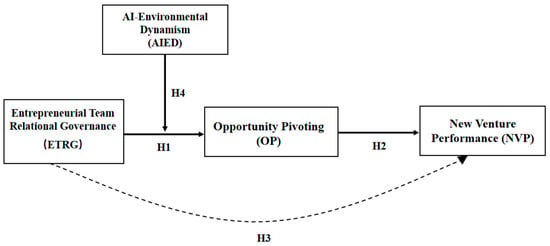
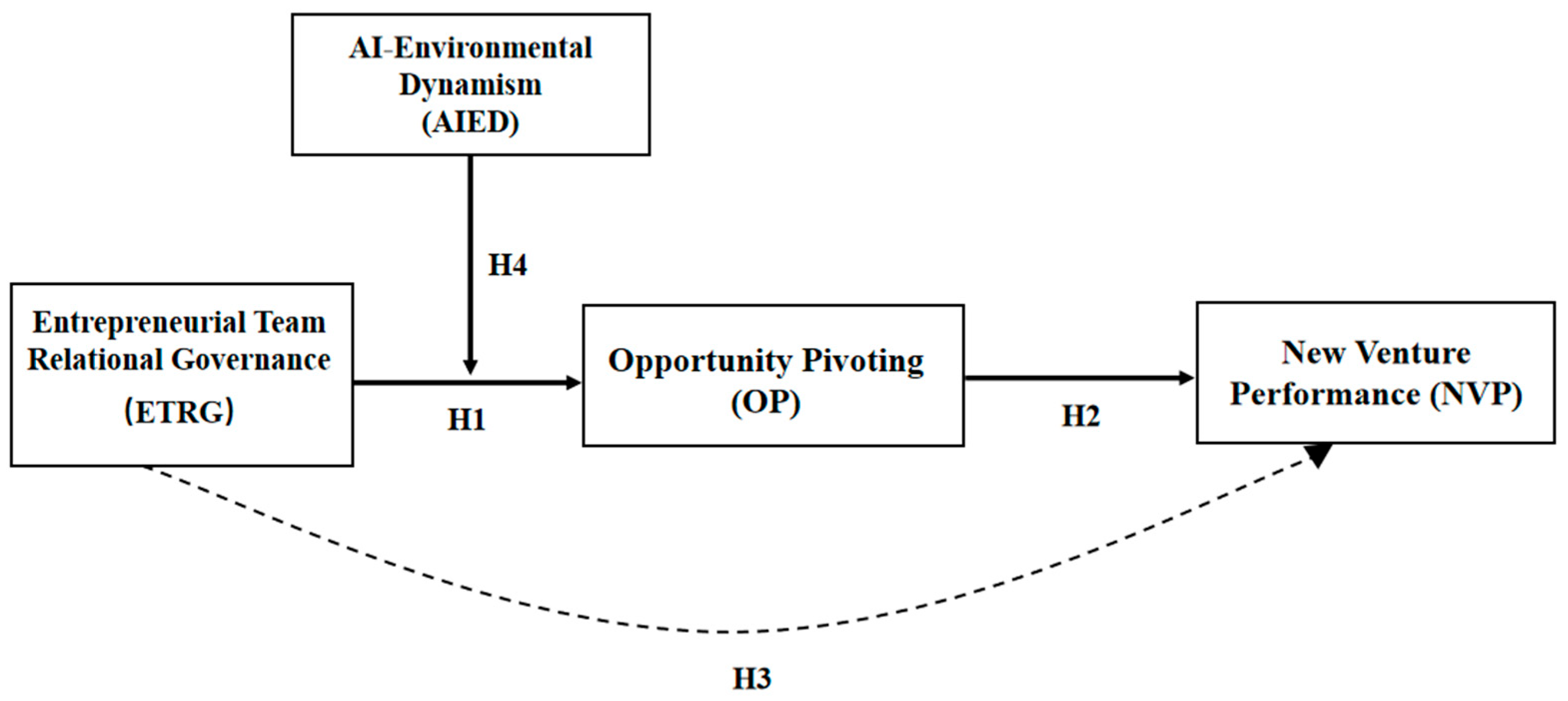
The theoretical model is demonstrated in Figure 1.
Figure 1.
Theoretical model.
3. Methods
3.1. Sample and Data Collection
This study examines the impact of ETRG on NVP, with startups serving as the focal research subjects. To maintain data validity and mitigate common method bias, a two-wave survey was administered to qualified new ventures between September 2024 and February 2025. The first wave (September to November 2024) measured ETRG, AI-environment dynamism, and control variables. The second wave (December to February 2025) focused on opportunity pivoting and new venture performance data collecting. Consistent with widely accepted academic criteria (Li & Atuahene-Gima, 2001), “new ventures” were defined as firms established within the past eight years.
This study gathered data in various areas in China, and a total of 750 questionnaires were distributed; 471 valid responses were retained. Specifically, in the first wave, 750 questionnaires were issued and 640 were returned (about 85.3% of those distributed). After removing firms established for more than eight years, those reporting fewer than two team members, and those with incomplete first-wave answers, 580 responses advanced to the second wave. In the second wave, questionnaires were re-issued to these 580 respondents and linked to their first-wave records by a unique respondent identifier; 530 were returned and successfully matched. A final screening removed submissions that were incomplete at the second wave, internally inconsistent, or otherwise non-compliant, leaving 471 complete cases, a 62.8% valid response rate (471 of 750 distributed). All hypotheses were tested on the 471 respondents who provided usable data at both waves; no imputation or partial-case estimation was applied, so the analysis is a complete-case analysis.
To ensure the validity and generalizability of the sample, we collected data from multiple regions across China, including the Pearl River Delta, the Yangtze River Delta, the Beijing–Tianjin–Hebei region, and Central China. Data collection was facilitated through cooperative relationships with local governments, entrepreneurship service agencies, startup accelerators, and entrepreneurship training institutions. These institutions identified eligible new ventures from their registered or served enterprise pools—namely, firms established within the past eight years—and the questionnaires were then distributed to the founders or core team members of these firms through the same institutional channels. Respondents participated voluntarily and received no monetary compensation or material incentives for their participation. The respondents were not personally known to the researchers; all contact was mediated through the cooperating institutions. Key sample characteristics include: A relatively balanced gender distribution (slight female predominance), with 85.99% of respondents aged 21–40. Over 81.53% held bachelor’s degrees or higher. The sample consists of 59.2% entrepreneurs with prior experience and 40.8% without. Most ventures reported total assets below RMB 10 million and were predominantly in the “Startup Phase” and “Survive Phase” stages and operated in highly or intensely competitive industries (82.2%). These characteristics align with typical new venture profiles. The industries of new ventures are classified according to the Industrial Classification for National Economic Activities (Standards Press of China, 2017, GB/T 4754—2017; 20 sections, A–T) (as shown in Table 1).
Table 1.
Sample composition.
3.2. Measures
All measurement scales were adapted from previous literature. To ensure the accuracy and validity of the scales, we consulted with academic advisors and entrepreneurship scholars to optimize the translation and linguistic refinement of scale items. Finally, we established the final questionnaire by modifying some items and conducting a final pretest. All items were measured on 5-point Likert scales (1 = strongly disagree, 5 = strongly agree).
3.2.1. Entrepreneurial Team Relational Governance
We measured ETRG using a 24-item scale based on the four-dimensional construct developed by Zhu et al. (2020) and Mai et al. (2022). This scale assesses shared vision, communication and cooperation, trust, and team identification. The shared vision dimension is based on Mustakallio et al. (2002) and adapts the family context to a team entrepreneurship context. A sample item for shared vision is “Team members share the same vision about our firm.” We adapted the communication and cooperation dimension from Lester et al. (2002), using items, such as “Members of my team are very willing to share information with other team members about our work.” The trust dimension was derived from S. J. Carson et al. (2006), a sample item is “We held mutual expectations about our team members’ responsibilities that went beyond what was specified in our formal agreements.” We adapted the team identification dimension from Shamir et al. (2000), a sample item is “I identify strongly with the team members in my company.” During the survey, participants evaluated the overall state of their team relationship governance. A five-point Likert scale (1 = strongly disagree, 5 = strongly agree) was employed. The Cronbach’s alpha for the scale was 0.887. Although ETRG is conceptually a four-dimensional construct, we follow prior entrepreneurial-team governance research (Zhu et al., 2020; Mai et al., 2022) and aggregate the four dimensions into a single relational-governance score for the hypothesis tests; the four-dimensional structure is described in Section 3.2.1, with each dimension measured by its own items.
3.2.2. New Venture Performance
We measured new venture performance, using items adapted from Zahra et al. (2002). A sample item is “How satisfied are you with the company’s achievement of the market share growth rate?”. These items were measured on a 5-point Likert scale (from “dissatisfied” to “very satisfied”). The Cronbach’s alpha for this scale was 0.811.
3.2.3. Opportunity Pivoting
We measured OP using a 5-item scale adapted from Fu et al. (2023). A sample item is “We are dedicated to exploring new opportunities distinct from our original ones.” The scale ranged from 1 = strongly disagree to 5 = strongly agree, where higher scores indicate greater OP activity. The Cronbach’s alpha for this scale was 0.852.
3.2.4. AI-Environmental Dynamism
We measured AIED using a 5-item scale adapted from Azadegan et al. (2013) and Ahmed et al. (2022) who conceptualize environmental dynamism in terms of the frequency, magnitude, and unpredictability of environmental changes. We contextualized the items to reference AI-driven turbulence specifically, rather than general environmental change, so that AIED captures dynamism attributable to the AI context rather than environmental dynamism in general. A sample item is “Under the development of AI, frequent and major changes in the number of competitors.” The Cronbach’s alpha for the scale was 0.770.
3.2.5. Control Variables
We controlled for variables at the individual and firm levels to account for alternative explanations. Individual-level controls included gender, age, educational background, and entrepreneurial experience. These individual characteristics have been shown to shape entrepreneurs’ cognition and decision-making in prior work on entrepreneurial passion and pivoting (Cardon et al., 2013; Jiao et al., 2026; Fu et al., 2023). Firm-level controls included firm age (Year), the industrial sector, stage, total assets and industrial competition. Firm age (Year) denotes the number of years since a venture’s founding and is conceptually distinct from venture stage, which reflects a venture’s developmental phase rather than its chronological age. Industrial sector was coded using the section-level classification of the GB/T 4754—2017 standard, which distinguishes 20 sections (A–T); 19 of these are represented in our sample, as no sampled venture belonged to the remaining section, T (international organizations). We controlled for industry because sector-specific conditions influence new venture opportunities and pivot decisions; prior pivot studies have controlled for industry classifications (Jiao et al., 2026; Fu et al., 2023). We also controlled for venture stage, total assets, and industrial competition—stage affects resource availability and pivoting, total assets represent firm size and resources, and competitive intensity pressures ventures to pivot (Cardon et al., 2013; Kirtley & O’Mahony, 2023; Jiao et al., 2026; Fu et al., 2023).
3.3. Statistical Power
A priori power analysis. Because the empirical model contains up to twelve predictors, we assessed its statistical power prior to hypothesis testing using G*Power 3.1 (Faul et al., 2009), specifying an F test for the increase in R2 in a fixed-model linear multiple regression. The most demanding specification includes the two main effects, the interaction term, and nine control variables. Assuming α = 0.05 (two-tailed) and a conventional power level of 0.80, detecting a small effect (f2 = 0.02) requires a minimum sample of 395 observations. Our sample of 471 therefore exceeds this threshold and yields adequate power (power = 0.87) to detect effects at or above the small-effect benchmark for all four hypothesized relationships.
4. Results
4.1. Descriptive Statistics
Table 2 presents the means, standard deviations, and correlations of the measured variables. As shown, ETRG is significantly and positively related to OP (r = 0.376, p < 0.001) and AIED (r = 0.383, p < 0.001). OP is also positively related to NVP (r = 0.330, p < 0.001), providing initial evidence for the hypothesized relationships.
Table 2.
Means, standard deviations, and correlations.
4.2. Regression Analysis
Before the regression analysis, we conducted a confirmatory factor analysis (CFA) to assess the reliability and validity of the constructs (Fang et al., 2014; Guo et al., 2019) and to estimate measurement model. We specified a confirmatory factor structure in which 39 items were assigned to four factors: ETRG (24 items); OP (5 items); NVP (5 items); AIED (5 items). The CFA model demonstrated an acceptable fit to the data (χ2/df = 1.867 < 3, CFI = 0.962 > 0.9, TLI = 0.956 > 0.9, RMSEA = 0.043 < 0.08, SRMR = 0.038 < 0.08). These fit indices derive from this full 39-item, four-factor specification, in which ETRG is represented by its 24 items and OP, NVP, and AIED by 5 items each. The composite reliability (CR) and average variance extracted (AVE) reported in Table 3, by contrast, are computed per construct: OP, NVP, and AIED at the item level, and ETRG—a four-dimensional construct measured with 24 heterogeneous items—at the parcel level using its four-dimension parcels (shared vision, communication and cooperation, trust, team identification). This two-specification distinction is set out in the Table 3 footnote.
Table 3.
Reliability and convergent validity.
Furthermore, Cronbach’s α ranged from 0.770 to 0.887 and composite reliability (CR) from 0.770 to 0.854, both above the 0.70 benchmark (Guo et al., 2019; Zhang & Zhu, 2021), and all standardized factor loadings were significant at p < 0.001. AVE ranged from 0.402 to 0.577 (Table 3). Because all constructs were measured with five-point Likert items, we also computed AVE on the basis of polychoric correlations, which correct the attenuation inherent in Pearson-based estimates; AVE then ranged from 0.445 to 0.577. The AVE of AIED (0.402; 0.445 with polychoric correlations) and NVP (0.467) falls below the conventional 0.50 criterion. Following Fornell and Larcker (1981) and Malhotra and Dash (2011), convergent validity may still be treated as adequate when CR exceeds 0.60 even though AVE is marginally lower, because AVE drops below 0.50 whenever the mean standardized loading falls below roughly 0.71, irrespective of how internally consistent the construct is. Every CR in our data exceeds 0.77 and every loading is significant; these estimates provide supporting evidence for convergent validity. Nevertheless, the below-threshold AVE values for AIED (0.402/0.445) and NVP (0.467) constitute mixed evidence, and we therefore do not conclude without qualification that convergent validity is supported; instead, we regard it as partially supported and acknowledge the AVE shortfall as a limitation of the measurement model. Following Henseler et al. (2015), we assessed discriminant validity with the heterotrait–monotrait ratio of correlations (HTMT), computed from indicator-level correlations and tested with percentile bootstrap confidence intervals based on 5000 resamples (Table 4). All HTMT values fall below the conservative 0.85 threshold, and the upper bound of every 95% confidence interval lies below 1.00, indicating that the constructs are empirically distinct. HTMT between ETRG and OP is 0.426 (95% CI [0.331, 0.529]), well below the threshold, so the substantial ETRG → OP path reflects a predictive relationship rather than construct redundancy.
Table 4.
HTMT results.
Because all constructs were measured with self-reports, we assessed common method bias with three diagnostics. First, the full collinearity variance inflation factor of Kock (2015), computed from the latent correlations of the measurement model, reached 2.016 at most, comfortably below the conservative threshold of 3.3. Second, we estimated an unmeasured latent method construct that loaded on every indicator with equal loadings and was uncorrelated with the substantive factors; it improved the fit only marginally, Δχ2 (1) = 3.40, p = 0.065, ΔCFI = +0.0007, and explained only 7.7% of the variance of the average indicator, with all substantive loadings remaining significant. Third, Harman’s single-factor test, implemented as a one-factor confirmatory factor analysis, fitted badly (χ2/df = 4.05, CFI = 0.592). Together with the two-wave design, these results indicate that common method bias is unlikely to account for the observed relationships.
We applied hierarchical multiple regression to test the moderated mediation effect (Aiken & West, 1991), the results are shown in Table 5. Hypothesis 1 predicted that ETRG is positively related to OP. As shown in Model 4, ETRG was significantly associated with OP (b = 0.796, p < 0.001); thus, H1 was supported. Hypothesis 2 predicted that OP is positively related to NVP. In Model 3 (Table 5), after controlling for ETRG and other variables, we found that OP exerted a significant positive effect on NVP (b = 0.169, p < 0.001), H2 is thus supported. Hypothesis 3 predicted that OP mediates the relationship between ETRG and NVP. Model 2 (Table 5) shows that ETRG is positively related to NVP (b = 0.537, p < 0.001). When we added OP in Model 3, the effect of ETRG on NVP decreased but remained significant (b = 0.402, p < 0.001); meanwhile, OP was significant (b = 0.169, p < 0.001). These results suggest partial mediation. To further test the significance of the indirect effect, we conducted a Bootstrap mediation effect analysis. As shown in Table 6, the indirect effect of OP was 0.135, with a 95% bias-corrected bootstrap confidence interval of [0.0730, 0.2089], excluding 0. This indicates that the indirect effect is statistically significant. Because both the direct effect of ETRG on NVP (b = 0.402, p < 0.001) and the indirect effect (0.135, 95% CI [0.0730, 0.2089]) are positive and significant, and they operate in the same direction, the pattern reflects complementary mediation according to the typology of X. Zhao et al. (2010). The proportion of the total effect of ETRG on NVP that was mediated by OP was approximately 25.1% (0.1348/0.5369 = 0.251). Therefore, H3 was supported. The presence of a significant direct effect alongside a significant indirect effect suggests that opportunity Pivoting is an important mediating mechanism, but it is not the only pathway through which ETRG affects new venture performance. Future research could examine these alternative pathways to provide a more complete understanding of how relational governance influences firm outcomes. This exclusion demonstrates that the mediation effect is significant, and H3 is verified.
Table 5.
Regression results.
Table 6.
Bootstrap mediation results.
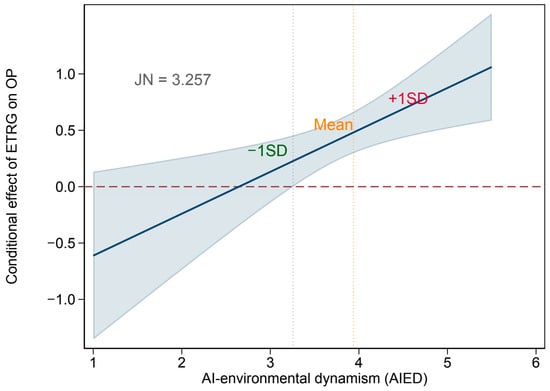
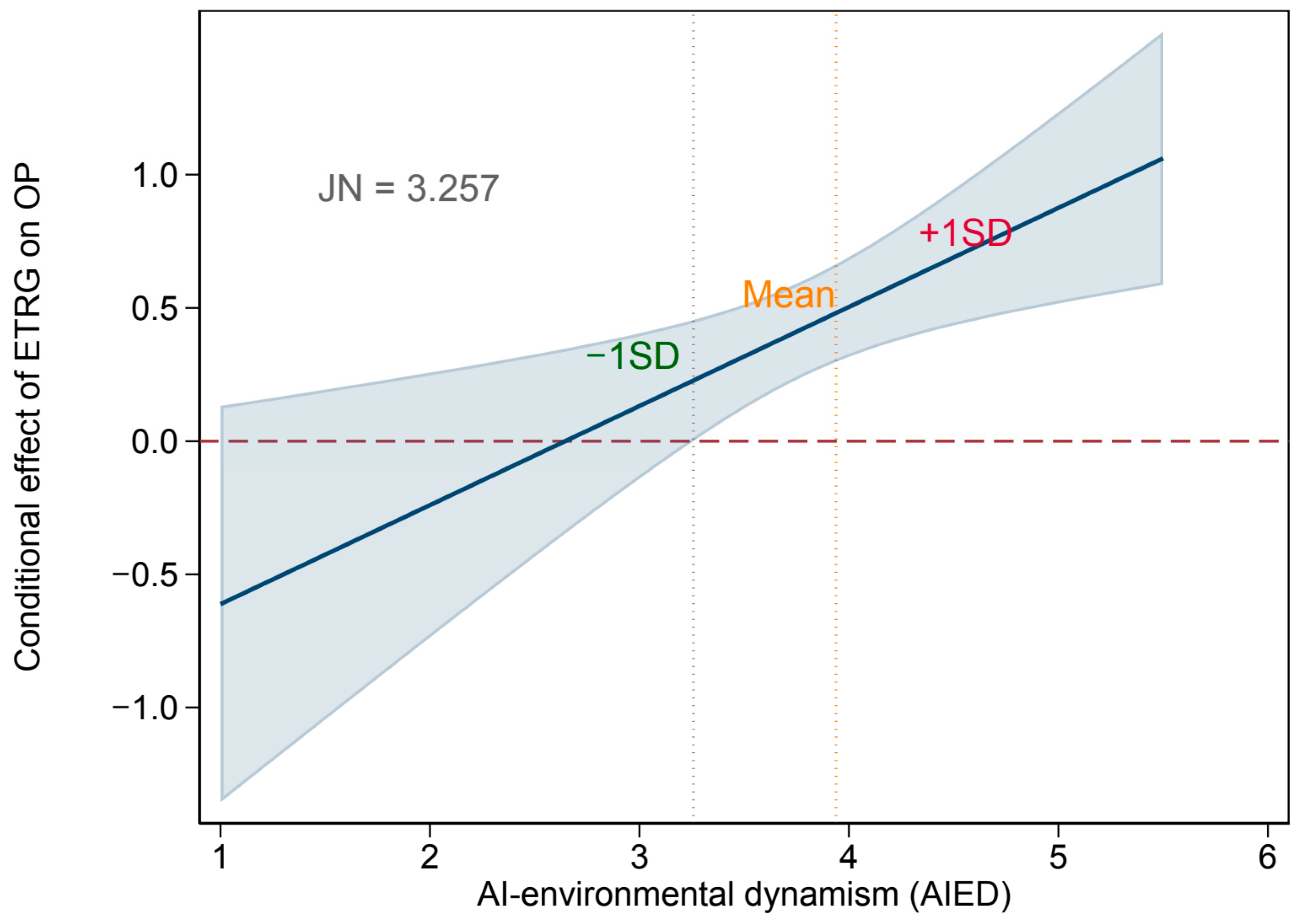
For the moderating effects of AIED, we added an interaction term (ETRG) to the model. Model 5 demonstrated that this interaction positively affected OP (b = 0.372, p < 0.01), indicating that AIED positively moderates the effect of ETRG on OP; thus, H4 was supported. We further examined this moderation in Figure 2, which plots the conditional effect of ETRG on OP across the observed range of AIED with its 95% confidence band; the vertical reference line marks the Johnson–Neyman boundary. The Johnson–Neyman analysis locates that boundary at AIED = 3.257: the conditional effect of ETRG on OP is positive and significant above this value, 86.2% of the sample, 406 of 471 ventures and not distinguishable from zero below it. The second boundary lies at AIED = −0.108, outside the observed range of 1.40 to 5.00, so no region of significant negative effect exists within the data. Simple slopes at one standard deviation below the AIED mean (3.32), at the mean (3.94) and one standard deviation above it (4.56) are 0.251 (p = 0.024), 0.481 (p < 0.001) and 0.711 (p < 0.001), increasing monotonically with AIED, consistent with H4. Note also that Model 5 is estimated on the uncentred variables, so the coefficient on AIED (−0.981) is its effect at ETRG = 0, a point outside the observed range of 1.96 to 5.00, and should not be read as a main effect: within the data the conditional effect of AIED on OP is positive and significant wherever it is significant, and otherwise not distinguishable from zero. ETRG and AIED were entered in their original (uncentered) metrics in all reported models; mean-centering is a linear reparameterization that leaves the interaction coefficient unchanged (b = 0.372 in both centered and uncentered specifications; standardized β = 0.107), so the reported unstandardized coefficient is directly comparable to the centered alternative and no centering-related respecification is required.
Figure 2.
Johnson–Neyman analysis of the conditional effect of ETRG on OP across the observed range of AIED. The solid line depicts the estimated conditional effect of ETRG on OP at each level of AIED, and the shaded area denotes the corresponding 95% confidence band. The horizontal dashed line marks the zero-reference line. The gray dotted vertical line marks the Johnson–Neyman point of significance (AIED = 3.257), above which the conditional effect is statistically significant at the 0.05 level; the orange dotted vertical line marks the sample mean of AIED. The green, orange, and dark red annotations indicate the conditional effects at one SD below the mean, at the mean, and at one SD above the mean of AIED, respectively.
In the primary models, industry was entered as 18 section dummy variables based on the section-level classification of GB/T 4754—2017 (20 sections, A–T; 19 represented in our sample), with Section 1 as the reference category. The joint test of the 18 section dummies was non-significant in the OP equation (F (18, 441) = 1.28, p = 0.20) yet significant in the NVP equation (F (18, 441) = 1.98, p = 0.01); no individual section dummy reached significance, indicating that industry is a relevant covariate whose effect is diffuse across sections rather than driven by any single industry. All substantive conclusions were unchanged—under dummy coding, the ETRG → OP effect (H1) was b = 0.796 (p < 0.001), the OP → NVP effect (H2) was b = 0.169 (p < 0.001), the ETRG × AIED interaction (H4) was b = 0.372 (p < 0.01), and the indirect effect (H3) was 0.1348. As a robustness check, we re-estimated all models with industry entered as a single continuous index based on the same classification; all substantive conclusions were unchanged. The full set of dummy coefficients is reported in Appendix B.
As shown in Table 7, the effect of AIED was significant in the moderated mediation relationship (index of moderated mediation = 0.0630, 95% BCCI [0.0203, 0.1275], excluding zero). Specifically, we tested the indirect relationship of ETRG with NVP via OP at low, mean, and high levels of AIED. As predicted, the positive indirect effect was strongest when AIED was high (b = 0.1204, 95% BCCI [0.0646, 0.2003], excluding zero); at the mean of AIED it remained positive and significant (b = 0.0815, 95% BCCI [0.0430, 0.1394]); at low AIED it was smaller but still significant under the bias-corrected CI (b = 0.0425, 95% BCCI [0.0034, 0.1012]).
Table 7.
Moderated mediation analysis.
Residual diagnostics (Shapiro–Wilk, Breusch–Pagan, White) and the corresponding normal Q–Q and residual-versus-fitted plots are reported in Supplementary Figure S1.
5. Discussion and Conclusions
5.1. Theoretical Implications
First, by integrating dynamic capabilities theory with relational governance research, this study shifts entrepreneurial team governance from static social capital to micro-foundations of dynamic capabilities. This transition extends the theoretical boundaries of relational governance research. Although prior studies have examined the effect of internal relational governance on opportunity change (Zahra et al., 2006; DesJardine et al., 2024; Khayati et al., 2025), they have primarily focused on intrapreneurship in mature firms, corporate governance in listed companies, and top-management team behavior. While some studies explore relational governance within entrepreneurial team contexts, the focus has largely been on outcomes such as relational capital formation or organizational resilience (Mai et al., 2022; Blatt, 2009). The current study expands the research context of relational governance from top-management teams to entrepreneurial ones, shifting the focus from static issues of personnel structure and capability endowment to a dynamic capability governance mechanism, thereby framing governance as a micro-foundation that empowers entrepreneurial teams’ dynamic capabilities. It provides a new lens for understanding how entrepreneurial teams achieve strategic adaptation under uncertainty.
Second, this study examines the indirect association along the “relational governance → opportunity pivoting → new venture performance.” By introducing AIED as a key contingency factor, it reveals the boundary conditions of this process and reconciles conflicting findings regarding its effectiveness. Previous studies have mainly examined OP within a “negative feedback–strategic response” framework, emphasizing its role as a passive adaptation mechanism. These studies lack a systematic integration of how relational governance influences pivoting and how pivoting subsequently affects performance (Zahra et al., 2006; DesJardine et al., 2024; Khayati et al., 2025). This study finds that relational governance significantly facilitates opportunity pivoting, which in turn enhances new venture performance. Drawing on the dynamic capabilities perspective, this finding may be theoretically interpreted as suggesting that relational governance operates by strengthening the team’s capabilities through the stages of sensing (identifying the need for pivoting), seizing (forming pivoting commitment), and reconfiguring (executing pivoting actions). It should be noted, however, that sensing, seizing, and reconfiguring are invoked solely as a theoretical interpretive framework and were not measured as separate constructs in this study. This integrative framework provides a process-based explanation for inconsistent performance outcomes. The success of a pivot depends not on the pivoting behavior itself but on its antecedent—whether relational governance can empower dynamic capabilities to generate high-quality pivoting decisions. Furthermore, this study incorporates AIED as a salient contextual variable and empirically examines its moderating effect on the relationship between relational governance and opportunity pivoting. The findings indicate that high AIED significantly strengthens the positive effect of relational governance on OP. Conversely, below AIED = 3.257 the conditional effect of relational governance on OP is not statistically distinguishable from zero, indicating the effect is not precisely estimated in that region; it does not establish that the ETRG → OP mechanism is absent. More importantly, AIED functions as a contingent environmental condition rather than a uniformly beneficial antecedent: within the observed range, its own conditional effect on OP is significant only above ETRG ≈ 3.33 and is not distinguishable from zero below that point. Thus, the data do not establish that turbulence alone generates opportunity pivoting where relational governance is weak, nor that turbulence suppresses pivoting in that region. Opportunity pivoting is instead observed where relational governance is present to translate environmental dynamism into sensing, seizing, and reconfiguring. These findings not only respond to the core premise of dynamic capabilities theory that environmental dynamism is a prerequisite for realizing capability value, but they also reveal the boundary conditions for team governance in the era of technological turbulence, providing empirical evidence for its contingency mechanisms.
5.2. Practical Implications
First, entrepreneurial teams should recognize the empowering role of relational governance in OP and shift from “maintaining emotions” to “supporting high-quality strategic transformation.” The findings indicate that the value of relational governance lies not merely in maintaining team harmony but in providing a safe and efficient platform for members to challenge assumptions and pivot in response to market feedback and technological disruption, rather than passively adhering to initial strategies under emotional pressure. In the context of rapid AI-driven technological change, entrepreneurial teams should leverage trust and open communication to integrate feedback from customers, platforms, and algorithms. This approach enables swift OP in product direction, business models, and target customer segments.
Second, managers and investors should reassess team governance through the lens of AIED. New venture managers should strengthen the dynamic capabilities embedded in relational governance, enhancing the ability to sense environmental changes and reconfigure resources. During due diligence, venture capitalists should look beyond founders’ backgrounds and equity structures. They must examine whether a team can translate strong relational bonds into rapid adjustment to opportunity paths, rather than focusing solely on short-term performance or execution capability. Specifically, investors could incorporate scenario-based simulations to observe how teams make pivoting decisions under time pressure and information ambiguity.
5.3. Limitations and Future Directions
First, this study faces limitations in data sources, generalizability, and causal inference. Although it adopts a two-wave data collection design, the relatively short 1–3-month interval limits causal inference and represents a temporal boundary condition that may inflate correlations and fail to capture longer-term dynamics. Moreover, relying on a single respondent per venture may introduce respondent bias and common method bias and inadequately capture team-level phenomena. Notably, prior entrepreneurial team research has relied on a single core team member to represent the team when assessing team-level constructs in new ventures, an approach consistent with the small size of these firms. Even so, a single respondent cannot fully capture the shared nature of ETRG or the degree of within-team agreement. In addition, recruitment through institutional channels may overrepresent ventures connected to formal support organizations, which may differ from non-institutionally networked ventures in their access to information, resources, and external support. The exclusively Chinese sample also limits cross-cultural generalizability, as the role of relational governance may vary across cultural and institutional contexts. Future research should employ multi-informant, multi-wave longitudinal designs with longer intervals and assess within-team agreement before aggregating responses, thereby better capturing team-level perceptions, temporal patterns, and lagged effects. Future studies should also diversify recruitment channels and conduct cross-national comparative research to test the generalizability of the proposed relationships.
Second, this study focuses on the team level rather than individual traits. For example, the sample skews toward relatively young (85.99% aged 21–40) and highly educated respondents (81.53% with at least a bachelor’s degree), thereby limiting the generalizability of the results to older entrepreneurs or less formally educated teams. Consequently, it does not fully examine the interaction between individual entrepreneurial characteristics (such as age, educational background, cognitive style, and risk preference) and relational governance. Future research should extend the current framework by incorporating variables such as individual entrepreneurial traits and top-management team heterogeneity. Researchers could explore whether entrepreneurs with different traits tend to develop distinct relational governance patterns and how these traits interact with relational governance to influence OP.
Third, our sample, which spans 19 of the 20 sections of the GB/T 4754—2017 classification (only section T, international organizations, is unrepresented), enhances external validity but also introduces industry-specific heterogeneity that may not be fully captured by 18 industry dummy variables (reference = Section 1). Thus, our findings should be interpreted as average effects across industries. Future research could examine whether these relationships vary with industry-level AI penetration and technological turbulence.
Fourth, we did not collect a scale of general (non-AI) environmental dynamism, so we could not directly compare AIED against a general dynamism construct within the same model. Future research should include both a general and an AI-specific dynamism scale to examine their relative contributions and avoid conflating the two.
Fifth, although the Johnson–Neyman analysis identified a boundary at AIED = 3.257, this boundary should be read as a descriptive precision indicator rather than as evidence of a distinct subgroup or a qualitative break in the relationship. A non-significant conditional effect below the boundary indicates that the ETRG → OP effect is not precisely estimated in that region; it does not establish that the mechanism is absent. In an exploratory post-hoc comparison, the 65 ventures below the boundary did not differ systematically from the remainder on any measured covariate; the one exception was industry-related variables, where the two groups differed significantly at the 0.05 level (χ2 = 29.39, df = 18, p = 0.044). Although this pattern is descriptive and suggestive, it does not establish that the ETRG→OP mechanism is absent in that region, nor that reduced statistical power is the primary explanation for the attenuated effect at low AIED. A formal three-way interaction (e.g., with industry or venture stage) was not pursued because the present sample (N = 471) lacks power for such a test. Future research should examine additional boundary conditions, for example, three-way interactions involving industry or venture stage, using larger samples that are better powered to detect subgroup effects.
Additionally, regarding the statistical inference strategy, we acknowledge that α = 0.05 was applied per test without formal family-wise error rate correction. This decision reflects that all four hypotheses were theory-driven and pre-specified, are not independent (H1, H2, and H3 form a single associational mediational pathway, with H4 moderating H1), and that the conclusions are insensitive to correction; even the least significant hypothesis (H4, p = 0.005) falls below the strictest Bonferroni threshold (α = 0.0125). Future research is encouraged to replicate these findings on independent samples.
Supplementary Materials
The following supporting information can be downloaded at https://www.mdpi.com/article/10.3390/bs16112054/s1: Figure S1: Residual diagnostics for the regression models in Table 5 (N = 471).
Author Contributions
Conceptualization, F.S., S.H. and R.Z.; Methodology, F.S., S.H. and H.P.; Formal analysis, S.H.; Investigation, F.S. and H.P.; Resources, R.Z.; Data curation, F.S. and S.H.; Writing—original draft, F.S., S.H. and H.P.; Writing—review and editing, F.S., S.H. and R.Z.; Supervision, R.Z.; Project administration, R.Z.; Funding acquisition, F.S. All authors have read and agreed to the published version of the manuscript.
Funding
This study was supported by the 2024 Youth Innovation Talent Projects of Regular Universities in Guangdong Province (Guangdong Provincial Department of Education): “Entrepreneurial Team Relational Governance and New Venture Performance: A Moderated Mediation Model of Entrepreneurial Pivoting” (Project Number: 2024WQNCX064, Fangfang Shi).
Institutional Review Board Statement
The study was conducted in accordance with the Declaration of Helsinki. Since this study only involves questionnaire surveys and does not cause any harm to the human body or involve sensitive personal information, ethical review and approval were waived for this study according to Article 32 of the Ethical review methods involving human life science and medical research.
Informed Consent Statement
Informed consent was obtained from all subjects involved in the study.
Data Availability Statement
The data presented in this study are available on request from the corresponding author.
Conflicts of Interest
The authors declare no conflicts of interest.
Abbreviations
The following abbreviations are used in this manuscript:
| ETRG | Entrepreneurial Team Relational Governance |
| OP | Opportunity Pivoting |
| AIED | AI-Environmental Dynamism |
| NVP | New Venture Performance |
Appendix A
Table A1.
Measurement scales.
Appendix B. Robustness Checks
Appendix B.1. Industry Coding (Dummy Primary; Continuous-Index Robustness)
In the main manuscript, industry is controlled using 18 section dummy variables (reference = Section 1, the GB/T 4754—2017 classification; 19 sections represented in the sample) in the regression models (Table 5, Table 6 and Table 7). In the descriptive statistics (Table 2), the industry variable is omitted from the correlation matrix for the same reason and is noted accordingly. Table A2a reports these 18 dummy coefficients from the primary Model 5. As a robustness check, Table A2b re-estimates the principal hypotheses with industry entered as a single continuous index (section code 1–19, treated as linear). Every substantive conclusion is unchanged (e.g., H4 interaction b = 0.365, p < 0.01, versus b = 0.372 under dummies; H1: 0.791 vs. 0.796; H2: 0.172 vs. 0.169; H3 total: 0.472 vs. 0.537; indirect: 0.1361 [0.0677, 0.2045] vs. 0.1348 [0.0730, 0.2089]). The joint test of the 18 section dummies was non-significant in the OP equation under conventional OLS standard errors (F (18, 441) = 1.28, p = 0.20) yet significant in the NVP equation (F (18, 441) = 1.98, p = 0.01).
Table A2.
(a) Industry dummy coefficients from the primary Model 5 (N = 471; reference = Section 1). (b) Principal hypothesis estimates: 18-section dummy (primary) versus continuous-index (robustness).
Appendix B.2. Firm-Age Specification (Robustness Check)
As a further robustness check on the firm-age specification, we re-estimated Model 5 replacing the linear firm-age control (years since founding; M = 3.03, SD = 2.25) with (i) a quadratic term and (ii) a categorical specification (0–2, 3–5, 6–8 years; 0–2 as reference). In every specification the ETRG x AIED interaction remains significant (b approx. 0.37, p < 0.01) and firm age is non-significant, indicating the results are not driven by the functional form of firm age. We therefore retain the linear control in the main models.
Table A3.
Firm-age specification robustness check.
References
- Adler, P., & Kwon, S. W. (2002). Social capital: Prospects for a new concept. Academy of Management Review, 27, 17–40. [Google Scholar] [CrossRef] [Scilit]
- Ahmed, A., Bhatti, S. H., Gölgeci, I., & Arslan, A. (2022). Digital platform capability and organizational agility of emerging market manufacturing SMEs: The mediating role of intellectual capital and the moderating role of environmental dynamism. Technological Forecasting Social Change, 177, 121513. [Google Scholar] [CrossRef] [Scilit]
- Aiken, L. S., & West, S. G. (1991). Multiple regression: Testing and interpreting interactions. Saga. [Google Scholar] [CrossRef] [Scilit]
- Azadegan, A., Patel, P. C., Zangoueinezhad, A., & Linderman, K. (2013). The effect of environmental complexity and environmental dynamism on lean practices. Journal of Operations Management, 31, 193–212. [Google Scholar] [CrossRef] [Scilit]
- Berends, H., Van Burg, E., & Garud, R. (2021). Pivoting or persevering with venture ideas: Recalibrating temporal commitments. Journal of Business Venturing, 36, 106126. [Google Scholar] [CrossRef] [Scilit]
- Blatt, R. (2009). Tough love: How communal schemas and contracting practices build relational capital in entrepreneurial teams. Academy of Management Review, 34, 533–551. [Google Scholar] [CrossRef] [Scilit]
- Brenk, S., Burmeister, C., Diener, K., & Luettgens, D. (2025). Boon or bane of open value creation: The impact of business model design and relational trust on competitive advantage. Long Range Planning, 58, 102507. [Google Scholar] [CrossRef] [Scilit]
- Burnell, D., Stevenson, R., & Fisher, G. (2023). Early-stage business model experimentation and pivoting. Journal of Business Venturing, 38, 106314. [Google Scholar] [CrossRef] [Scilit]
- Camuffo, A., Cordova, A., Gambardella, A., & Spina, C. (2020). A scientific approach to entrepreneurial decision making: Evidence from a randomized control trial. Management Science, 66, 564–586. [Google Scholar] [CrossRef] [Scilit]
- Cardon, M. S., Gregoire, D. A., Stevens, C. E., & Patel, P. C. (2013). Measuring entrepreneurial passion: Conceptual foundations and scale validation. Journal of Business Venturing, 28(3), 373–396. [Google Scholar] [CrossRef] [Scilit]
- Carson, J. B., Tesluk, P. E., & Marrone, J. A. (2007). Shared leadership in teams: An investigation of antecedent conditions and performance. The Academy of Management Journal, 50, 1217–1234. [Google Scholar] [CrossRef] [Scilit]
- Carson, S. J., Madhok, A., & Wu, T. (2006). Uncertainty, opportunism, and governance: The effects of volatility and ambiguity on formal and relational contracting. Academy of Management Journal, 49, 1058–1077. [Google Scholar] [CrossRef] [Scilit]
- Chaudhuri, R., Chatterjee, S., Vrontis, D., & Chaudhuri, S. (2022). Innovation in SMEs, AI dynamism, and sustainability: The current situation and way forward. Sustainability, 14, 12760. [Google Scholar] [CrossRef] [Scilit]
- De Clercq, D., Dimov, D., & Thongpapanl, N. T. (2010). The moderating impact of internal social exchange processes on the entrepreneurial orientation–performance relationship. Journal of Business Venturing, 25, 87–103. [Google Scholar] [CrossRef] [Scilit]
- DesJardine, M. R., Shi, W., & Marti, E. (2024). The corporate opportunity structure for shareholder activism: How activist hedge funds exploit board demographic diversity. Organization Science, 35, 644–666. [Google Scholar] [CrossRef] [Scilit]
- Dess, G. G., & Beard, D. W. (1984). Dimensions of organizational task environments. Administrative Science Quarterly, 29, 52–73. [Google Scholar] [CrossRef] [Scilit]
- Eisenhardt, K. M., & Martin, J. A. (2000). Dynamic capabilities: What are they? Strategic Management Journal, 21, 1105–1121. [Google Scholar] [CrossRef] [Scilit]
- Ensley, M. D., & Pearce, C. L. (2001). Shared cognition in top management teams: Implications for new venture performance. Journal of Organizational Behavior: The International Journal of Industrial, Occupational Organizational Psychology, 22, 145–160. [Google Scholar] [CrossRef] [Scilit]
- Evans, M. (2021). Conversations across the table: Shared cognition in top management teams. Team Performance Management: An International Journal, 27, 406–424. [Google Scholar] [CrossRef] [Scilit]
- Fang, Y., Qureshi, I., Sun, H., McCole, P., Ramsey, E., & Lim, K. H. (2014). Trust, satisfaction, and online repurchase intention. MIS Quarterly, 38, 407–428. [Google Scholar] [CrossRef] [Scilit]
- Faul, F., Erdfelder, E., Buchner, A., & Lang, A.-G. (2009). Statistical power analyses using G*power 3.1: Tests for correlation and regression analyses. Behavior Research Methods, 41(4), 1149–1160. [Google Scholar] [CrossRef] [Scilit] [PubMed]
- Fisher, G., Kotha, S., & Lahiri, A. (2016). Changing with the times: An integrated view of identity, legitimacy, and new venture life cycles. Academy of Management Review, 41, 383–409. [Google Scholar] [CrossRef] [Scilit]
- Fornell, C., & Larcker, D. F. (1981). Evaluating structural equation models with unobservable variables and measurement error. Journal of Marketing Research, 18, 39–50. [Google Scholar] [CrossRef] [Scilit]
- Freeman, J., Carroll, G. R., & Hannan, M. T. (1983). The liability of newness: Age dependence in organizational death rates. American Sociological Review, 48, 692–710. [Google Scholar] [CrossRef] [Scilit]
- Fu, J., Jiao, Y., Zhu, R., Yan, Y., & Liu, Q. (2025). Digital orientation and pivoting in new ventures: The role of dynamic capabilities. Journal of Strategy and Management, 18(3), 539–566. [Google Scholar] [CrossRef] [Scilit]
- Fu, J., Zhu, R., Liu, Q., Jiao, Y., & Li, X. (2023). The dark side effect of entrepreneurial resilience diversity on pivoting: The role of team reflexivity. Behavioral Sciences, 13, 899. [Google Scholar] [CrossRef] [Scilit] [PubMed]
- Gans, J. S., Stern, S., & Wu, J. (2019). Foundations of entrepreneurial strategy. Strategic Management Journal, 40, 736–756. [Google Scholar] [CrossRef] [Scilit]
- Gedajlovic, E., Cao, Q., & Zhang, H. (2012). Corporate shareholdings and organizational ambidexterity in high-tech SMEs: Evidence from a transitional economy. Journal of Business Venturing, 27, 652–665. [Google Scholar] [CrossRef] [Scilit]
- Grossman, S. J., & Hart, O. D. (1986). The costs and benefits of ownership: A theory of vertical and lateral integration. Journal of Political Economy, 94, 691–719. [Google Scholar] [CrossRef] [Scilit] [PubMed]
- Guo, F., Restubog, S. L. D., Cui, L., Zou, B., & Choi, Y. (2019). What determines the entrepreneurial success of academics? Navigating multiple social identities in the hybrid career of academic entrepreneurs. Journal of Vocational Behavior, 112, 241–254. [Google Scholar] [CrossRef] [Scilit]
- Helfat, C. E., & Martin, J. A. (2015). Dynamic managerial capabilities: Review and assessment of managerial impact on strategic change. Journal of Management, 41, 1281–1312. [Google Scholar] [CrossRef] [Scilit]
- Helfat, C. E., & Peteraf, M. A. (2015). Managerial cognitive capabilities and the microfoundations of dynamic capabilities. Strategic Management Journal, 36, 831–850. [Google Scholar] [CrossRef] [Scilit]
- Henseler, J., Ringle, C. M., & Sarstedt, M. (2015). A new criterion for assessing discriminant validity in variance-based structural equation modeling. Journal of the Academy of Marketing Science, 43(1), 115–135. [Google Scholar] [CrossRef] [Scilit]
- Jiao, Y., Zhu, R., Wang, Y., & Li, X. (2026). The double-edged effect of resourcefulness on entrepreneurial decision-making. Management Decision, 64(3), 1032–1062. [Google Scholar] [CrossRef] [Scilit]
- Kerr, J., & Coviello, N. (2020). Weaving network theory into effectuation: A multi-level reconceptualization of effectual dynamics. Journal of Business Venturing, 35, 105937. [Google Scholar] [CrossRef] [Scilit]
- Khayati, A., Tompkins, J., Bray, D., & Clampit, J. (2025). CEO and CFO stock options and trading activity around bank loans. Corporate Governance: An International Review, 33, 178–201. [Google Scholar] [CrossRef] [Scilit]
- Kirtley, J., & O’Mahony, S. (2023). What is a pivot? Explaining when and how entrepreneurial firms decide to make strategic change and pivot. Strategic Management Journal, 44, 197–230. [Google Scholar] [CrossRef] [Scilit]
- Klotz, A. C., Hmieleski, K. M., Bradley, B. H., & Busenitz, L. W. (2014). New venture teams: A review of the literature and roadmap for future research. Journal of Management, 40, 226–255. [Google Scholar] [CrossRef] [Scilit]
- Kock, N. (2015). Common method bias in PLS-SEM: A full collinearity assessment approach. International Journal of e-Collaboration, 11(4), 1–10. [Google Scholar] [CrossRef] [Scilit]
- Lester, S. W., Meglino, B. M., & Korsgaard, M. A. (2002). The antecedents and consequences of group potency: A longitudinal investigation of newly formed work groups. Academy of Management Journal, 45, 352–368. [Google Scholar] [CrossRef] [Scilit] [PubMed]
- Li, H., & Atuahene-Gima, K. (2001). Product innovation strategy and the performance of new technology ventures in China. Academy of Management Journal, 44, 1123–1134. [Google Scholar] [CrossRef] [Scilit]
- Mai, Y., Wu, Y. J., & Wang, Y.-M. (2022). How does entrepreneurial team relational governance promote social start-ups’ organizational resilience? International Journal of Environmental Research Public Health, 19, 6677. [Google Scholar] [CrossRef] [Scilit] [PubMed]
- Malhotra, N. K., & Dash, S. (2011). Marketing research: An applied orientation (6th ed.). Pearson. [Google Scholar]
- Moon, H., Conlon, D. E., Humphrey, S. E., Quigley, N., Devers, C. E., & Nowakowski, J. M. (2003). Group decision process and incrementalism in organizational decision making. Organizational Behavior Human Decision Processes, 92, 67–79. [Google Scholar] [CrossRef] [Scilit]
- Motley, D. C., Leatherbee, M., & Katila, R. (2025). From critique to catalyst: How academic entrepreneurs transform negative feedback into pivots and performance. Strategic Entrepreneurship Journal, 20, 491–515. [Google Scholar] [CrossRef] [Scilit]
- Mustakallio, M., Autio, E., & Zahra, S. A. (2002). Relational and contractual governance in family firms: Effects on strategic decision making. Family Business Review, 15, 205–222. [Google Scholar] [CrossRef] [Scilit]
- Nahapiet, J., & Ghoshal, S. (1998). Social capital, intellectual capital, and the organizational advantage. Academy of Management Review, 23, 242–266. [Google Scholar] [CrossRef] [Scilit] [PubMed]
- Pillai, S. D., Goldfarb, B., & Kirsch, D. A. (2020). The origins of firm strategy: Learning by economic experimentation and strategic pivots in the early automobile industry. Strategic Management Journal, 41, 369–399. [Google Scholar] [CrossRef] [Scilit]
- Poppo, L., & Zenger, T. (2002). Do formal contracts and relational governance function as substitutes or complements? Strategic Management Journal, 23, 707–725. [Google Scholar] [CrossRef] [Scilit]
- Rampersad, G., Quester, P., & Troshani, I. (2010). Examining network factors: Commitment, trust, coordination and harmony. Journal of Business Industrial Marketing, 25, 487–500. [Google Scholar] [CrossRef] [Scilit]
- Razmdoost, K., Alinaghian, L., & Linder, C. (2020). New venture formation: A capability configurational approach. Journal of Business Research, 113, 290–302. [Google Scholar] [CrossRef] [Scilit]
- Schoorman, F. D., Mayer, R. C., & Davis, J. H. (2007). An integrative model of organizational trust: Past, present, and future. Academy of Management Review, 32, 344–354. [Google Scholar] [CrossRef] [Scilit]
- Shahid, M. K., Mahmood, K., Altayyar, R. S., & Abdullah, H. (2026). Role of AI capabilities in sustainable firm performance: Mediating role of innovative work behavior and the moderating effect of environmental dynamism. International Journal of Productivity and Performance Management, 75(2), 651–671. [Google Scholar] [CrossRef] [Scilit]
- Shamir, B., Zakay, E., Brainin, E., & Popper, M. (2000). Leadership and social identification in military units: Direct and indirect relationships. Journal of Applied Social Psychology, 30, 612–640. [Google Scholar] [CrossRef] [Scilit]
- Shane, S., & Venkataraman, S. (2000). The promise of entrepreneurship as a field of research. Academy of Management Review, 25, 217–226. [Google Scholar] [CrossRef] [Scilit]
- Sleesman, D. J., Lennard, A. C., McNamara, G., & Conlon, D. E. (2018). Putting escalation of commitment in context: A multilevel review and analysis. Academy of Management Annals, 12, 178–207. [Google Scholar] [CrossRef] [Scilit]
- Sohn, W. (2023). Are we all on the same page? How pivoting disrupts team strategic cognition [Doctoral dissertation, The University of Texas at Austin]. [Google Scholar]
- Standards Press of China. (2017). Industrial classification for national economic activities (GB/T 4754—2017). Standards Press of China.
- Teece, D. J. (2007). Explicating dynamic capabilities: The nature and microfoundations of (sustainable) enterprise performance. Strategic Management Journal, 28, 1319–1350. [Google Scholar] [CrossRef] [Scilit]
- Teece, D. J. (2018). Business models and dynamic capabilities. Long Range Planning, 51, 40–49. [Google Scholar] [CrossRef] [Scilit]
- Teece, D. J., Pisano, G., & Shuen, A. (1997). Dynamic capabilities and strategic management. Strategic Management Journal, 18, 509–533. [Google Scholar] [CrossRef] [Scilit]
- Townsend, D. M., Hunt, R. A., McMullen, J. S., & Sarasvathy, S. D. (2018). Uncertainty, knowledge problems, and entrepreneurial action. Academy of Management Annals, 12, 659–687. [Google Scholar] [CrossRef] [Scilit]
- Townsend, D. M., Hunt, R. A., Rady, J., Manocha, P., & Jin, J. H. (2025). Are the futures computable? Knightian uncertainty and artificial intelligence. Academy of Management Review, 50, 415–440. [Google Scholar] [CrossRef] [Scilit]
- Voorhees, C. M., Brady, M. K., Calantone, R., & Ramirez, E. (2016). Discriminant validity testing in marketing: An analysis, causes for concern, and proposed remedies. Journal of the Academy of Marketing Science, 44(1), 119–134. [Google Scholar] [CrossRef] [Scilit]
- West, P. G. (2007). Collective cognition: When entrepreneurial teams, not individuals, make decisions. Entrepreneurship Theory and Practice, 31(1), 77–102. [Google Scholar] [CrossRef] [Scilit]
- Wood, M. S., & McKinley, W. (2020). The entrepreneurial opportunity construct: Dislodge or leverage? Academy of Management Perspectives, 34, 352–365. [Google Scholar] [CrossRef] [Scilit]
- Zahra, S. A., Neubaum, D. O., & El-Hagrassey, G. M. (2002). Competitive analysis and new venture performance: Understanding the impact of strategic uncertainty and venture origin. Entrepreneurship Theory and Practice, 27(1), 1–28. [Google Scholar] [CrossRef] [Scilit]
- Zahra, S. A., Sapienza, H. J., & Davidsson, P. (2006). Entrepreneurship and dynamic capabilities: A review, model and research agenda. Journal of Management Studies, 43, 917–955. [Google Scholar] [CrossRef] [Scilit]
- Zhang, F., & Zhu, L. (2021). Social media strategic capability, organizational unlearning, and disruptive innovation of SMEs: The moderating roles of TMT heterogeneity and environmental dynamism. Journal of Business Research, 133, 183–193. [Google Scholar] [CrossRef] [Scilit]
- Zhao, X., Lynch, J. G., Jr., & Chen, Q. (2010). Reconsidering Baron and Kenny: Myths and truths about mediation analysis. Journal of Consumer Research, 37(2), 197–206. [Google Scholar] [CrossRef] [Scilit]
- Zhao, Y., Liu, Y., Feng, T., Wang, J., Zhang, Z., & Bai, J. (2025). External boundary permeability and inclusive innovation: The moderating role of dual governance. Technology Analysis Strategic Management, 37, 1694–1708. [Google Scholar] [CrossRef] [Scilit]
- Zhu, R., Zhou, Q., & Zhang, S. (2020). Inverted u-shape between entrepreneurial team relational governance and the new venture performance and the moderating role of hostile environment. Nankai Business Review, 23, 202–212. [Google Scholar]

Disclaimer/Publisher’s Note: The statements, opinions and data contained in all publications are solely those of the individual author(s) and contributor(s) and not of MDPI and/or the editor(s). MDPI and/or the editor(s) disclaim responsibility for any injury to people or property resulting from any ideas, methods, instructions or products referred to in the content. |
© 2026 by the authors. Licensee MDPI, Basel, Switzerland. This article is an open access article distributed under the terms and conditions of the Creative Commons Attribution (CC BY) license.