


Abstract
As a core competency of the 21st century, creativity is of great significance to students’ academic success and lifelong development. However, there remains a lack of systematic exploration regarding the underlying psychological mechanisms through which a growth mindset influences student creativity. Based on Amabile’s theory of the components of creativity, this study constructs a chained mediation model to examine the mediating roles of achievement motivation and resilience in the relationship between a growth mindset and student creativity. Using data from Suzhou, China, in the Social and Emotional Skills Survey (SSES) conducted by the Organisation for Economic Co-operation and Development (OECD), this study employed structural equation modeling to test the mediating effects. The results indicate that (1) a growth mindset is significantly positively correlated with student creativity; (2) achievement motivation mediates the relationship between a growth mindset and creativity; (3) resilience mediates the relationship between a growth mindset and creativity; and (4) Achievement motivation and resilience exert a chained mediating effect between growth mindset and creativity. This study reveals the multiple psychological pathways through which a growth mindset influences student creativity, providing theoretical grounds and empirical support for enhancing student creativity in educational practice by fostering a growth mindset, stimulating achievement motivation, and strengthening resilience.
1. Introduction
Creativity is widely recognized as an individual’s ability to generate ideas or solutions that are both novel and valuable within a given context (Runco & Jaeger, 2012). Recent theoretical advances have moved beyond this standard definition to emphasize the dynamic and process-oriented nature of creativity (Liu et al., 2024). Walia (2019) proposed a dynamic definition that underscores the iterative process of generating original and useful ideas, while Green et al. (2024) offered a process definition that focuses on the cognitive and affective mechanisms involved in creative thought. These perspectives highlight that creativity is not a fixed trait but a multifaceted competence shaped by cognitive, motivational, and socio-emotional factors (Amabile et al., 1996). In educational contexts, students’ creativity plays a foundational role in fostering problem-solving skills, innovative thinking, and adaptability and is crucial for academic success and lifelong learning (Ghanamah, 2024; Tang et al., 2022). Beyond traditional academic domains, creativity also underpins advanced cognitive operations such as probabilistic reasoning, where divergent thinking facilitates the generation of multiple possible outcomes (Giancola et al., 2022). As the global economy increasingly emphasizes knowledge-based industries, fostering students’ creative potential has become a central issue in educational research and practice (Bloom & Dole, 2018).
However, despite the recognized importance of creativity, there remains a lack of systematic exploration regarding the underlying psychological mechanisms through which key internal beliefs, particularly a growth mindset, influence student creativity. A growth mindset is the belief that intelligence and abilities are malleable and can be continuously developed through effort, learning, and persistence, rather than being fixed traits (Dweck, 2006, 2017). Students with a growth mindset tend to view challenges as opportunities for growth, demonstrate greater persistence and resilience in the face of difficulties, and actively explore novel solutions (Burnette et al., 2013; Yeager & Dweck, 2012). Although the positive association between a growth mindset and student creativity has been preliminarily confirmed (Han & Stieha, 2020; Rahimi et al., 2024), the underlying psychological mechanisms remain largely unexplored, particularly the roles that key mediators play in this association.
To address this gap, the present study draws on Amabile’s (1983) and Amabile et al.’s (1996) componential theory of creativity as its core theoretical framework. This theory posits that creative performance arises from the dynamic interaction of three core components: domain-relevant skills, creativity-relevant processes, and intrinsic task motivation. We propose that a growth mindset, as a core belief in ability malleability, serves as a distal belief resource that may be linked with two of these components: first, it stimulates intrinsic task motivation in the form of achievement motivation—the drive to pursue excellence and master challenging tasks (Wigfield et al., 2021); achievement motivation may also be associated with a key creativity-relevant process, namely resilience, the capacity to adapt and persevere in the face of setbacks (Masten, 2014). Creativity-relevant processes, as defined by Amabile, encompass cognitive styles and personality traits conducive to generating novel ideas, such as persistence, cognitive flexibility, and tolerance for ambiguity. Resilience, characterized by adaptive coping and sustained effort in adversity, directly embodies these process-oriented attributes, serving as a crucial mechanism that sustains creative exploration amid the inherent challenges and failures of creative work. This linked pathway suggests that achievement motivation and resilience may function as chained mediators in the relationship between a growth mindset and creativity.
Based on this theoretical rationale, by using a large-scale, representative sample of Chinese students from the OECD’s Social and Emotional Skills Survey (SSES), this study aims to reveal the multiple psychological pathways through which a growth mindset influences student creativity. We propose a chain mediation model and test the following hypotheses: (1) a growth mindset is significantly positively correlated with student creativity; (2) achievement motivation mediates the relationship between a growth mindset and creativity; (3) resilience mediates the relationship between a growth mindset and creativity; and (4) achievement motivation and resilience exert a chained mediating effect between growth mindset and creativity. Despite the growing body of literature, this study makes several distinctive contributions. First, while prior research has predominantly examined isolated mediating mechanisms, such as the independent roles of motivation or resilience, this study proposes and tests a linked, chained pathway. Second, this refined understanding provides precise, actionable insights for educational practice. Without such a chained framework, interventions might target these factors in isolation, risking either short-lived motivation that fades when setbacks occur or resilience training that lacks the initial motivational drive to engage with creative challenges. The chained model suggests that interventions may need to coordinate motivational and resilience-related components—coupling motivational activation with resilience cultivation—to effectively transform a belief in ability malleability into sustained creative performance. Third, by empirically validating this chained pathway using a large-scale, representative sample of Chinese students from the OECD SSES dataset, this study enhances the cross-cultural robustness of componential creativity theory. It demonstrates that the interplay of cognitive belief, intrinsic motivation, and psychological resources is a particularly salient mechanism in the high-effort, high-pressure East Asian educational context, thereby extending the theory’s generalizability.
2. Literature Review and Theoretical Framework
2.1. Theoretical Framework: Amabile’s Componential Theory of Creativity
This study adopts Amabile’s (1983) and Amabile et al.’s (1996) Componential Theory of Creativity as its core theoretical framework. This theory posits that creativity is not the product of a single ability, but rather the result of the interaction among three core components: domain-relevant skills, creativity-relevant processes, and intrinsic task motivation. Domain-relevant skills include an individual’s knowledge, technical abilities, and aptitudes within a specific field (Hennessey & Amabile, 2010); creativity-relevant processes encompass cognitive styles, work styles, and personality traits conducive to generating novel ideas (such as persistence and cognitive flexibility); and intrinsic task motivation refers to the internal drive that leads an individual to engage in a task based on interest, enjoyment, or a sense of challenge, rather than being driven by external rewards or pressure (Amabile et al., 1996).
Amabile’s theory particularly emphasizes the critical role of social environmental factors in shaping motivation and creativity-related processes. A supportive environment can stimulate an individual’s intrinsic motivation, encourage risk-taking and exploratory behavior, and thereby promote creativity (Hennessey & Amabile, 2010). This theory has been widely applied in the fields of educational and developmental psychology, providing a robust analytical framework for understanding how individual and environmental factors synergistically promote creativity in children and adolescents (Hennessey, 2017).
Based on the components of creativity theory, this study conceptualizes a growth mindset as a crucial internal belief resource that promotes creativity by influencing an individual’s motivational orientation (achievement motivation) and creativity-related processes (resilience). Specifically, as a core belief in the malleability of abilities, a growth mindset can stimulate individuals’ interest in and engagement with challenging tasks, thereby enhancing the internal drive to pursue success (i.e., achievement motivation), a key manifestation of intrinsic task motivation. At the same time, a growth mindset fosters positive attributions and adaptive coping strategies when individuals face setbacks, thereby enhancing psychological resilience—a trait characteristic of creativity-related processes—and enabling them to maintain sustained effort and emotional stability during creative exploration. Resilience aligns with Amabile’s conceptualization of creativity-relevant processes, which include cognitive styles and personality characteristics like persistence, self-discipline, and a tolerance for ambiguity. These are the very attributes resilience provides, enabling an individual to navigate the setbacks, high uncertainty, and iterative failures inherent in creative endeavors. It functions as the psychological engine that maintains the cognitive and affective effort required for creativity. Therefore, achievement motivation and resilience constitute the key psychological pathways linking a growth mindset to creativity; the linked mediating mechanism between the two provides a more comprehensive explanation of the pathway from belief to creative performance.
2.2. The Relationship Between Growth Mindset and Student Creativity
A growth mindset refers to an individual’s core belief in the malleability of intelligence and ability—specifically, the belief that one’s capabilities can be developed and enhanced through effort, strategy, and guidance (Dweck, 2006). Unlike individuals with a fixed mindset, those with a growth mindset view challenges as opportunities for learning and growth, regard effort as a pathway to mastery, and exhibit more adaptive response patterns when faced with failure (Dweck & Yeager, 2019).
The positive association between a growth mindset and student creativity has been supported by both theoretical and empirical research. From a theoretical perspective, a growth mindset encourages individuals to view challenges as opportunities for growth rather than threats to their self-worth (Dweck & Yeager, 2019). Students with a growth mindset are more likely to persevere in the face of difficulty, actively explore novel ideas, and take intellectual risks—behaviors that are precisely the core elements of creative thinking (Li & Li, 2025). Empirical research further indicates that a growth mindset enhances creative problem-solving by fostering openness to experience and greater tolerance for ambiguity (Rahimi et al., 2024). For example, H. Zhao et al. (2021) found that a growth mindset indirectly enhances team creativity through team achievement goal orientation (H. Zhao et al., 2021). Krskova and Breyer (2023) noted that a growth mindset helps students perform better in environments requiring creativity and innovation. Based on this, this study proposes the following hypothesis:
H1.
Growth mindset is significantly positively correlated with student creativity.
2.3. The Mediating Role of Achievement Motivation
Achievement motivation is an intrinsic drive for success that reflects an individual’s desire to engage in meaningful and challenging tasks, pursue excellence, and outperform others (Wigfield et al., 2021). According to Atkinson’s (1957) theory of achievement motivation, individual behavior is driven by two motivational tendencies: the hope for success and the fear of failure. Those driven by the hope for success tend to choose challenging tasks and persist in their efforts, while those driven by the fear of failure tend to avoid situations that might expose their shortcomings.
There is a close theoretical and empirical link between growth mindset and achievement motivation. The model of intellectual achievement motivation proposed by Dweck (2006) indicates that individuals with different mindsets set different types of achievement goals: those with a growth mindset tend to set mastery goals, focusing on the development and enhancement of abilities; whereas those with a fixed mindset tend to set performance goals, focusing on the demonstration of abilities and others’ evaluations. These differing goal orientations further drive variations in motivation levels. Empirical research indicates that a growth mindset significantly and positively predicts an individual’s achievement motivation (W. Zhao et al., 2024). Students with a growth mindset believe that effort leads to improved ability; consequently, they are more willing to invest time and energy in pursuing excellence and demonstrate a stronger desire for success (W. Zhao et al., 2024).
Numerous studies have supported the positive relationship between achievement motivation and creativity. Individuals with high achievement motivation have a stronger desire for success, are more willing to take on challenging tasks, and demonstrate greater initiative when facing difficulties; these traits align closely with the risk-taking and exploratory behaviors required for creativity (Schoen, 2015; Wigfield & Eccles, 2000). According to Amabile et al.’s (1996) theory of the components of creativity, intrinsic motivation is the core driving force of creativity. As a key manifestation of intrinsic motivation, achievement motivation can inspire individuals to engage in creative activities driven by interest and a sense of challenge, thereby promoting divergent thinking and generating novel solutions. Empirical research provides direct evidence for this. For example, studies have found that achievement motivation significantly predicts research creativity among doctoral students (Liu et al., 2023). Among college students, He and Wang (2025) noted that achievement motivation is a key form of intrinsic motivation that influences creativity. Based on the above theoretical and empirical evidence, this study proposes the following hypothesis:
H2.
Achievement motivation mediates the relationship between a growth mindset and creativity.
2.4. The Mediating Role of Resilience
Resilience is defined as an individual’s ability to effectively cope with and adapt to adversity, trauma, threats, or major stressors (Masten, 2014). It is not a fixed trait but rather a process that reflects the dynamic interaction among personal characteristics, coping strategies, and external support networks. In educational contexts, resilience enables students to withstand academic pressure, cope with failure and challenges, and maintain engagement in learning and positive emotions (Connor & Davidson, 2003).
A growth mindset is a crucial psychological resource for fostering resilience. According to the theoretical model proposed by Burnette et al. (2013), a growth mindset enhances resilience by influencing an individual’s goal-setting, beliefs about effort, and attribution styles, thereby improving their adaptive coping abilities in the face of challenges. Students with a growth mindset view academic difficulties as opportunities to improve their abilities rather than as threats to their self-worth; this positive cognitive framework helps them maintain motivation and hope in the face of setbacks (Yeager & Dweck, 2012). Empirical research provides abundant evidence for this relationship. Zeng et al. (2016) found that a growth mindset influences school engagement and mental health among Chinese primary and secondary students through the mediating effect of resilience. W. Zhao et al. (2024) confirmed that a growth mindset indirectly enhances adolescents’ subjective well-being through resilience.
Resilience plays an indispensable role in the development of student creativity and can be clearly situated within Amabile’s (1983) and Amabile et al.’s (1996) componential framework as a key creativity-relevant process. Amabile posits that creativity-relevant processes include a cognitive style and personality disposition marked by persistence in the face of obstacles, the ability to delay gratification, and a high tolerance for ambiguity. Resilience, by definition, encompasses these exact characteristics; it is the dynamic capacity to positively adapt and persevere in the face of adversity. The creative process is inherently fraught with uncertainty and repeated failures, requiring individuals to recover from setbacks, maintain positive emotions, and sustain engagement (Yao et al., 2023). As a psychological resource, resilience enables individuals to reframe failure as a learning experience, maintain creative momentum in the face of difficulties, and continue exploring novel solutions (Forgeard, 2025). Empirical research indicates a robust positive association between resilience and creativity. Tong et al. (2022) found that resilience fully mediated the relationship between emotional intelligence and creative achievement, with highly resilient individuals being more likely to overcome challenges and continuously refine their ideas. Based on this, the present study proposes the following hypothesis:
H3.
Resilience mediates the relationship between a growth mindset and creativity.
2.5. Chain Mediation of Achievement Motivation and Resilience
Achievement motivation and resilience do not operate in isolation; there is a close intrinsic connection between the two. Both theoretical and empirical research indicate that achievement motivation is a significant predictor of resilience. The strong drive for excellence and desire for success among individuals with high achievement motivation prompt them to persist in their efforts when facing difficulties and setbacks. Through this process, they continuously hone their ability to cope with adversity, thereby cultivating greater psychological resilience (Resnick, 2018). McClelland’s (1961) theory of achievement motivation posits that achievement-oriented individuals demonstrate sustained effort and perseverance in pursuing their goals, qualities that overlap significantly with resilience. Riaz et al. (2024) found a significant moderate positive correlation between students’ achievement motivation and academic resilience. Based on the above analysis, this study proposes the following hypothesis:
H4.
Achievement motivation and resilience mediate the relationship between growth mindset and creativity in a chained manner.
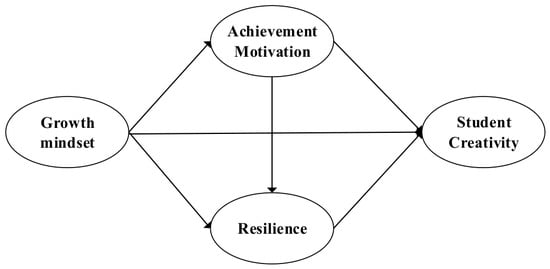
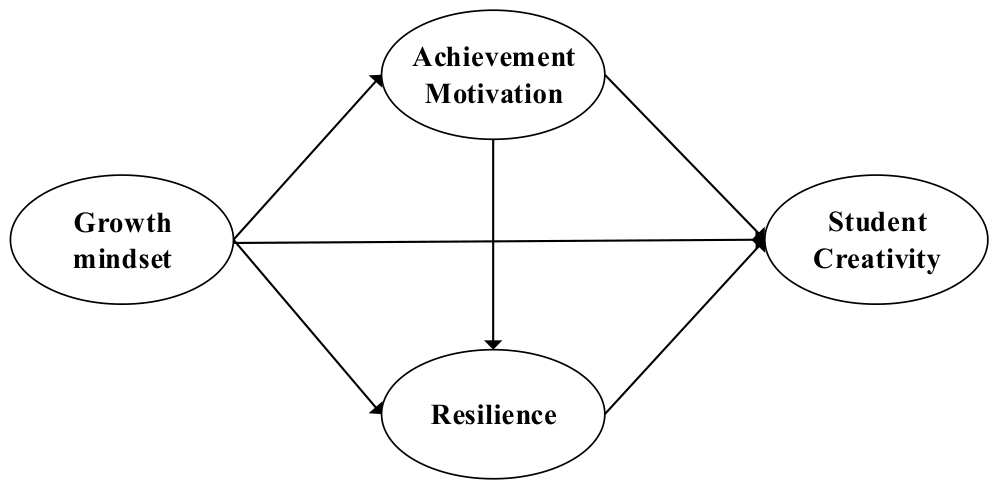
Based on the theoretical analysis and research hypotheses outlined above, this study constructed a chain mediation model as shown in Figure 1. The model features a growth mindset as the independent variable, student creativity as the dependent variable, and achievement motivation and resilience as mediating variables.
Figure 1.
Conceptual Framework.
3. Methods
3.1. Sample and Procedures
The data for this study were drawn from the Survey on Social and Emotional Skills (SSES) conducted by the Organisation for Economic Co-operation and Development (OECD). The SSES is a large-scale international assessment designed to measure the conditions and practices that influence the development of students’ social and emotional skills, targeting 10- and 15-year-old students (OECD, 2021). These two age groups were selected because they represent key developmental stages of childhood and adolescence, respectively: 10-year-old students are typically in the final years of primary education, while 15-year-old students are in secondary education and face more complex academic and social demands (OECD, 2021). Studying these two age groups helps examine the characteristics of social-emotional development during two critical educational transitions. The SSES combines self-report questionnaires with performance-based measures to comprehensively capture the full spectrum of growth mindset, achievement motivation, resilience, and creativity. The questionnaire content has been validated through extensive pilot testing and psychometric analysis to ensure its suitability for the target age groups (OECD, 2021). Data collection strictly adheres to ethical guidelines. Both students and their parents or guardians have signed informed consent forms. The assessment is administered uniformly by trained survey administrators in school settings to ensure consistency in data collection procedures and minimal disruption to students’ daily activities. The SSES database has undergone ethical review and is publicly available; researchers have no access to any information that could identify individual participants.
This study utilized the SSES China Suzhou sample data. Data collection employed a stratified two-stage cluster sampling method to ensure representativeness of the sample. In the first stage, schools were randomly selected from six districts and four county-level cities in Suzhou; in the second stage, students were randomly selected from each sampled school. The study sample comprised 7074 students, including 3338 females (47.19%) and 3724 males (52.64%), with an additional 12 students (0.17%) who did not report their gender. Among the sample, 3516 students (49.70%) were 10 years old, and 3558 students (50.30%) were 15 years old. All participants completed a comprehensive assessment covering social and emotional skills and related background variables. All variables in this study were drawn from the SSES database. The OECD conducted a series of psychometric analyses using item response theory and confirmatory factor analysis, demonstrating that the scales exhibit high reliability and construct validity across age groups and cities (OECD, 2021).
3.2. Instruments
3.2.1. Growth Mindset
Growth mindset was measured using three items designed to assess students’ beliefs regarding the malleability of their intellectual, social, and emotional abilities (OECD, 2021). Sample items included: “There are many aspects of your intellectual ability that you cannot change” (reversely scored). Students self-reported their responses on a five-point Likert scale ranging from 1 (“Strongly Disagree”) to 5 (“Strongly Agree”). Higher scores indicate a stronger growth mindset, reflecting the extent to which an individual believes that abilities can be developed through effort and learning. A confirmatory factor analysis (CFA) was conducted on the growth mindset scale. Since the scale contains only three items, the CFA model is just-identified (saturated), with zero degrees of freedom; therefore, model fit indices (such as RMSEA and CFI) do not provide meaningful information. Standardized factor loadings ranged from 0.582 to 0.909, indicating that the items loaded strongly and consistently on the construct. The scale’s Cronbach’s alpha coefficient was 0.805, indicating good internal consistency.
3.2.2. Achievement Motivation
Achievement motivation was measured using the Achievement Motivation Scale from the SSES (OECD, 2021). This scale consists of five items that assess students’ tendency to strive for excellence and to set high goals. Sample items include: “I set high standards for myself” and “I try to do my best on tasks. “Students self-reported their responses on a five-point Likert scale ranging from 1 (“Strongly Disagree”) to 5 (“Strongly Agree”). Results from confirmatory factor analysis indicated a good model fit: χ2/df = 8.462, CFI = 0.996, TLI = 0.992, RMSEA = 0.032, SRMR = 0.010. Standardized factor loadings ranged from 0.444 to 0.762, indicating good convergent validity for the scale. Cronbach’s α was 0.770, indicating good internal consistency.
3.2.3. Resilience
Resilience was measured using six items that assess students’ self-reported ability to recover from adversity (OECD, 2021). Sample items include: “I am relaxed and able to cope well with stress.” Students self-report on a five-point Likert scale ranging from 1 (“Strongly Disagree”) to 5 (“Strongly Agree”). The results of confirmatory factor analysis indicate a good model fit: χ2/df = 9.503, CFI = 0.997, TLI = 0.991, RMSEA = 0.035, SRMR = 0.010. Standardized factor loadings ranged from 0.483 to 0.774, indicating that the scale possesses acceptable convergent validity. Cronbach’s α was 0.835, indicating good internal consistency.
3.2.4. Student Creativity
Student creativity was assessed using the Student Self-Reported Creativity Assessment (OECD, 2021). The assessment employed six items designed to measure creative abilities and dispositions. An example item is: “I can find new ways of doing things.” Responses were rated on a five-point Likert scale ranging from 1 (“Strongly Disagree”) to 5 (“Strongly Agree”). The results of confirmatory factor analysis indicate a good model fit: χ2/df = 37.785, CFI = 0.970, TLI = 0.951, RMSEA = 0.072, SRMR = 0.026. Standardized factor loadings ranged from 0.539 to 0.775, and Cronbach’s α was 0.795.
3.3. Data Analysis
Data analysis followed these steps: First, Harman’s single-factor test was conducted using Stata 17.0 to assess the severity of common method bias. Second, the means, standard deviations, and Pearson correlation coefficients of each variable were calculated to preliminarily examine the relationships among variables. Prior to the main analyses, we verified that all scales demonstrated acceptable reliability and construct validity through separate CFAs (see Section 3.2). In the structural equation model, each latent construct was indicated by its respective observed items. The model simultaneously estimated measurement and structural parameters, with paths specified according to the hypothesized chain mediation. Third, structural equation modeling was performed using Mplus 8.3. Model fit was assessed using multiple indices: the comparative fit index (CFI), Tucker–Lewis index (TLI), root mean square error of approximation (RMSEA), and standardized root mean square residual (SRMR), with values of CFI/TLI ≥ 0.90, RMSEA ≤ 0.08, and SRMR ≤ 0.08 considered indicative of acceptable fit. Because the chi-square statistic is highly sensitive to large sample sizes, it is reported but was not used as the sole determinant of model fit. The mediating effects were tested using the Bootstrap method (with 5000 repetitions) and bias-corrected 95% confidence intervals were computed for the total, direct, and all specific indirect effects. If the 95% confidence interval does not include 0, the mediating effect is considered significant. To address the clustering characteristics of the data (i.e., students forming clusters within schools) and issues of multivariate non-normality, the study specified TYPE=COMPLEX in the model and employed the Maximum Likelihood Robust (MLR) estimation method. In addition, final student weights (WT2019) were incorporated to adjust the sample to make it more representative.
4. Results
4.1. Test for Common Method Bias
Since all data in this study were collected via self-reported questionnaires, common method bias may be present. To minimize this bias as much as possible, several procedural preventive strategies were incorporated into the questionnaire design and administration process, such as ensuring respondent anonymity and using varied item wording. The Harman single-factor test was used for evaluation. An unrotated exploratory factor analysis was conducted on all items. The results showed that four factors had eigenvalues greater than 1. The first factor explained 32.07% of the variance, which is below the 40% critical threshold (Podsakoff et al., 2003), indicating that common method bias does not constitute a serious issue in this study.
4.2. Descriptive Statistics and Correlation Analysis
Table 1 presents the means, standard deviations, and correlation coefficients for each variable. The results of the correlation analysis indicate significant correlations among all variables. Specifically, a growth mindset was significantly and positively correlated with achievement motivation (r = 0.219, p < 0.001), psychological resilience (r = 0.265, p < 0.001), and student creativity (r = 0.259, p < 0.001). Achievement motivation was significantly and positively correlated with psychological resilience (r = 0.467, p < 0.001) and strongly and positively correlated with student creativity (r = 0.640, p < 0.001). Psychological resilience was also significantly and positively correlated with student creativity (r = 0.466, p < 0.001). Overall, a positive relationship exists among growth mindset, achievement motivation, resilience, and student creativity. Among these, the correlation between achievement motivation and creativity was the strongest, and the relationship between psychological resilience and achievement motivation was also relatively close. These correlations provide preliminary support for subsequent tests of mediation effects.
Table 1.
Descriptive statistics and correlation analysis.
4.3. Hypothesis Testing
Based on the research hypotheses, this study constructed a structural equation model in which growth mindset was the independent variable, student creativity the dependent variable, and achievement motivation and resilience the mediating variables. The model fit indices were as follows: χ2/df = 15.862, CFI = 0.931, TLI = 0.920, RMSEA = 0.046, SRMR = 0.056. Although the chi-square value was significant and the χ2/df ratio appeared inflated due to the large sample size (N = 7074), the other fit indices met the recommended criteria (CFI, TLI > 0.90; RMSEA, SRMR < 0.08), indicating that the model provided an acceptable representation of the data and was appropriate for testing the hypothesized pathways.
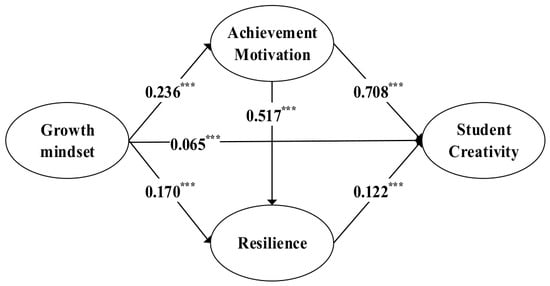
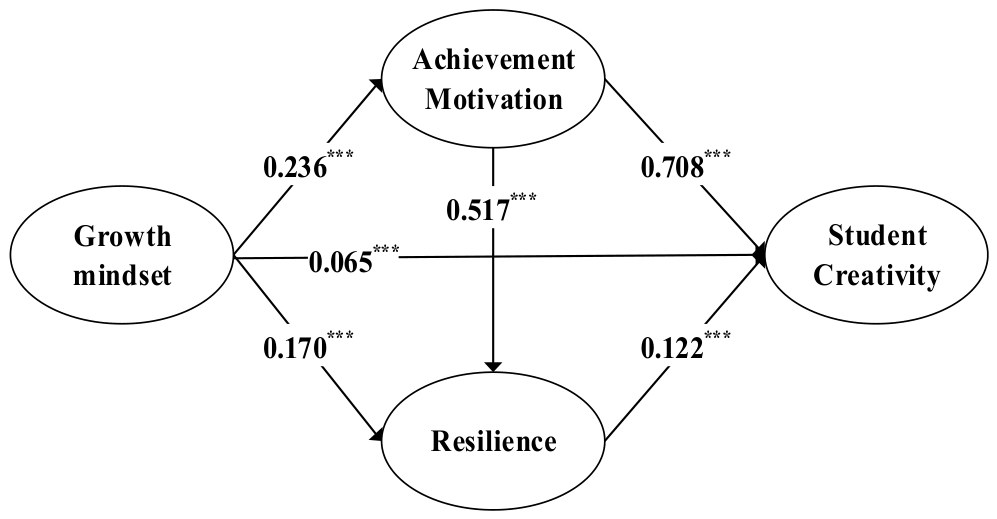
Figure 2 displays the standardized path coefficients of the structural equation model. The results show that a growth mindset is significantly and positively correlated with student creativity (β = 0.065, p < 0.001) and has a significant positive predictive effect on both achievement motivation (β = 0.236, p < 0.001) and resilience (β = 0.170, p < 0.001). Achievement motivation had a significant positive effect on resilience (β = 0.517, p < 0.001) and a significant positive predictive effect on student creativity (β = 0.708, p < 0.001). Resilience also showed a significant positive correlation with student creativity (β = 0.122, p < 0.001). All of the above path coefficients were statistically significant, indicating that a growth mindset not only directly promotes creativity but also exerts an indirect effect through the separate and chained mediations of achievement motivation and resilience. Research Hypothesis 1 is supported.
Figure 2.
Path diagram of the structural equation model (standardized coefficients). *** p < 0.001.
According to the bias-corrected percentile Bootstrap test results presented in Table 2, the total effect of growth mindset on student creativity was 0.268 (95% CI [0.234, 0.301]), the direct effect was 0.065 (95% CI [0.038, 0.093]), and the total indirect effect was 0.203 (95% CI [0.175, 0.229]). Indirect effects accounted for 75.75% of the total effect. The confidence intervals for the total, direct, and total indirect effects all excluded zero, confirming that achievement motivation and resilience play a significant partial mediating role and that the mediated pathways are predominant.
Table 2.
Test of mediating effect.
Further decomposition of the specific indirect effects directly addressed the main aim of the study by testing the hypothesized chain mediation. The indirect effect of the path “growth mindset → achievement motivation → student creativity” was 0.167 (95% CI [0.140, 0.193]), demonstrating an independent mediating role for achievement motivation. The indirect effect of the path “growth mindset → resilience → student creativity” was 0.021 (95% CI [0.013, 0.028]), supporting resilience as another significant mediator. Crucially, the chain mediation path “growth mindset → achievement motivation → resilience → student creativity” yielded a significant indirect effect of 0.015 (95% CI [0.010, 0.019]), with the confidence interval excluding zero. This indicates that a growth mindset may be associated with resilience alongside achievement motivation, and these linked factors may be associated with students’ creativity. All specific indirect effects were significant, validating the multiple mediating mechanisms, particularly the chain-mediated pathway that is central to this study’s theoretical framework.
5. Discussion
Based on Amabile’s componential theory of creativity, the main aim of this study was to elucidate the psychological mechanisms linking growth mindset to student creativity, with a specific focus on the chain mediation of achievement motivation and resilience. Using a large-scale sample of Chinese students, we tested a linked model in which a growth mindset is associated with creativity through achievement motivation and resilience. The results provide clear support for this chained pathway while also confirming the independent mediating roles of the two variables, thereby offering a refined process-oriented account of how the belief in ability malleability is transformed into creative performance.
Growth mindset was positively associated with creativity (Rahimi et al., 2024). This direct link reaffirms that viewing intelligence as improvable fosters the exploratory, risk-tolerant behaviors that are fundamental to creative thought. Notably, the decomposition of total effects showed that the majority of the growth-mindset effect on creativity was transmitted indirectly, underscoring the necessity of examining the mediating mechanisms hypothesized in this study.
Achievement motivation served as the strongest single mediator. Students with a growth mindset tend to adopt mastery goals (Dweck, 2006), which stimulate an intrinsic desire for excellence. This heightened achievement motivation—a central manifestation of intrinsic task motivation in Amabile et al.’s (1996) framework—propels deeper engagement with challenging tasks and greater willingness to generate novel solutions (He & Wang, 2025; Schoen, 2015). Achievement motivation thus functions as the primary energizing force that initiates and directs creative effort.
Resilience independently mediated the growth mindset–creativity link, supporting H3. A growth mindset fosters adaptive causal attributions and coping strategies (Burnette et al., 2023; Yeager & Dweck, 2020), helping students view setbacks as surmountable. This resilient orientation sustains creative engagement when individuals encounter the uncertainty and iterative failure inherent in creative work (Tong et al., 2022; Yao et al., 2023). Resilience therefore acts as a sustaining mechanism that protects creative effort once it has been mobilized.
Most critically, the chained mediation model involving achievement motivation and resilience was significant, directly addressing the study’s central objective. Growth mindset was associated with higher achievement motivation, and both motivation and resilience were also related to greater creativity. This finding reveals that these psychological resources are interwoven in a way that extends beyond their independent effects: in Amabile et al.’s (1996) framework, intrinsic task motivation and creativity-relevant processes are not merely parallel but relate to each other in a meaningful configuration. Achievement motivation and resilience are not simply co-existing; striving for achievement involves engagement with demanding tasks, which is precisely where resilience is observed. Strong motivation is accompanied by greater resilience, and both are linked to sustained creative engagement.
Previous studies have separately examined growth mindset in relation to motivation or resilience, but the present findings reveal their interconnected roles: motivation is associated not only with a growth mindset but also with resilience in the creative process. This perspective clarifies why a growth mindset alone may be insufficient—its link to creativity involves motivation and the capacity to withstand creative adversity. Motivation without resilience tends to wane when obstacles arise, while resilience-building without motivational engagement lacks the challenging experiences needed for growth, underscoring the need to consider both.
In summary, by clarifying the chain-mediated mechanism, this discussion responds directly to the main aim of the study. The findings demonstrate that a growth mindset influences student creativity through a linked pathway in which achievement motivation and resilience operate as linked mediators, highlighting the importance of coupling motivational enhancement with resilience cultivation in educational practice.
6. Theory and Practical Implementation
From a theoretical standpoint, this study advances the understanding of creativity development by demonstrating that a growth mindset functions as a distal belief resource that may be associated with intrinsic task motivation and creativity-relevant processes, thereby extending Amabile’s componential theory of creativity. The identified chain mediation pathway—in which achievement motivation acts as an energizing force that propels students into challenging creative endeavors, and resilience serves as a sustaining force that maintains creative engagement in the face of setbacks—provides a refined, process-oriented account of how the belief in ability malleability is transformed into creative performance. Furthermore, the robust support for this model within a large-scale sample of Chinese students from the OECD SSES Suzhou dataset strengthens its cross-cultural validity and demonstrates that the growth-mindset–creativity link, along with its motivational and resilience mechanisms, is particularly meaningful in East Asian educational contexts that emphasize effort and self-improvement. The study also contributes to the integration of motivation and resilience studies by revealing that the intrinsic drive for excellence may not only be associated with creative pursuit but also with the psychological capacity to cope with adversity.
On the practical side, these findings inform educational practices aimed at fostering student creativity. One strategy is to systematically cultivate a growth mindset by training teachers to provide feedback that emphasizes effort and to frame errors as learning opportunities; another is to stimulate achievement motivation through optimally challenging tasks, mastery goal structures, and instruction that supports autonomy, encouraging self-improvement rather than peer comparison; and a further strategy is to build resilience by explicitly teaching adaptive coping strategies, emotion regulation, and constructive failure attribution within supportive teacher and peer networks. Importantly, because the findings reveal that achievement motivation and resilience may function as linked rather than merely parallel mediators, educational interventions should couple these two components systematically. For instance, alongside activating students’ pursuit of excellence through challenging goal setting, educators can also embed structured resilience-building exercises within creative tasks, such as guiding reflection on coping strategies, reframing failure as information, and developing action plans for continued effort, so that motivation and resilience-building can be addressed in an integrated way, with resilience-related activities potentially helping sustain initial motivation when difficulties arise. This integrated strategy is consistent with the linked mediation pathway identified in the model and connects motivation enhancement and resilience cultivation, offering an intervention approach grounded in the present findings. A holistic, project-based learning experience, such as a sustainable design challenge that primes a malleable view of creativity, sets challenging yet attainable goals, incorporates structured reflection following setbacks, and integrates goal-setting and coping-related activities, can potentially engage multiple elements of the pathway.
7. Limitations and Future Directions
Despite the contributions of this study, several limitations must be acknowledged, each pointing to clearly defined directions for future research. First, the cross-sectional design precludes causal inferences regarding the pathways from a growth mindset to creativity. Although the chained mediation model is theoretically grounded, the temporal ordering of the variables cannot be established with concurrent data, and the estimated indirect effects may reflect correlational rather than causal dynamics. To address this limitation, future research should adopt longitudinal designs with at least three waves of data collection to test the mediating mechanisms through cross-lagged panel models, and implement randomized experimental or quasi-experimental interventions that directly cultivate a growth mindset to examine its causal effects on achievement motivation, resilience, and creativity. Second, the sample was drawn exclusively from Suzhou, a relatively developed city in Eastern China. The educational resources, cultural emphasis on effort, and social environment in this region may differ substantially from those in less developed rural areas or other cultural contexts, limiting the generalizability of the findings. Future studies should replicate the proposed model using nationally representative Chinese samples and in cross-cultural settings to assess its universality and to identify cultural or socioeconomic moderators of the mediated pathways. Third, all constructs were measured through self-reported questionnaires, which are susceptible to common method variance and social desirability bias, potentially inflating the observed relationships. Future research should adopt a multi-method and multi-informant strategy, incorporating teacher ratings, parent reports, peer nominations, and performance-based assessments of creativity (e.g., divergent thinking tasks, creative problem-solving tests) to triangulate the findings and enhance validity. Fourth, the current model examined only achievement motivation and resilience as mediators. However, a growth mindset may influence creativity through additional psychological mechanisms, including creative self-efficacy, cognitive flexibility, openness to experience, and tolerance of ambiguity. Future research should integrate these variables to construct a more comprehensive multiple-mediation model, and explore potential moderators such as school climate and teacher autonomy support that may condition the indirect effects. This would yield a more complete understanding of both the mechanisms and the boundary conditions underlying the growth mindset–creativity relationship.
8. Conclusions
Based on Amabile’s componential theory of creativity, this study constructed and empirically tested a chain mediation model using representative data from Chinese students, revealing the psychological mechanisms through which a growth mindset was associated with creativity. The core conclusion is that a growth mindset enhances student creativity not only directly but more importantly, through a linked pathway of “motivational activation—resilience cultivation.” Specifically, achievement motivation and resilience function as both independent and chained mediators, forming a linked process in which a growth mindset is associated with achievement motivation and resilience, which are in turn associated with creative performance. Among these, the “growth mindset → achievement motivation → creativity” pathway constitutes the primary mediating mechanism. By elucidating this multi-pathway process, this study provides a more comprehensive theoretical framework for understanding the cognitive-motivational roots of creativity and offers clear, evidence-based guidance for educational practice—namely, that fostering a growth mindset, stimulating achievement motivation, and cultivating resilience are interrelated strategies that may jointly support student creativity.
Author Contributions
Y.H. was responsible for defining the research framework, research methods, software, validation, and Writing—review and editing. Z.Z. (Ziying Zhang) and Y.B. contributed to Conceptualization (defining the research framework and objectives), Data curation, Visualization, and wrote the original draft. Z.Z. (Zhengzhou Zhu), as the corresponding author, managed Resources, Project administration and Supervision, provided Methodology guidance. All authors have read and agreed to the published version of the manuscript.
Funding
This research received no external funding.
Institutional Review Board Statement
According to institutional and national guidelines, ethical review was waived for this study as it exclusively relies on publicly available data from the OECD SSES 2019 database and does not involve any interactions with human subjects or private information. The use of these public data fully complies with all applicable ethical standards and guidelines.
Informed Consent Statement
Not applicable.
Data Availability Statement
The data that support the findings of this study are openly available in the OECD SSES 2019 (Survey on Social and Emotional Skills) database at the OECD SSES portal: https://www.oecd.org/education/ceri/social-emotional-skills-study/ (accessed on 20 April 2026).
Acknowledgments
We thank the Organization for Economic Co-operation and Development (OECD) for granting access to the Study on Social and Emotional Skills database. Its comprehensive data enabled empirical analysis of a representative sample of 10- and 15-year-old students from Suzhou, China. The institutional support provided by the School of Education at Hubei University and the School of Education at Central China Normal University has been indispensable. We are grateful to both institutions for the academic resources, collaborative frameworks, and intellectual support they have provided, particularly for their contributions to theoretical development and methodological refinement.
Conflicts of Interest
The authors declare no conflict of interest.
References
- Amabile, T. M. (1983). The social psychology of creativity: A componential conceptualization. Journal of Personality and Social Psychology, 45(2), 357. [Google Scholar] [CrossRef] [Scilit]
- Amabile, T. M., Conti, R., Coon, H., Lazenby, J., & Herron, M. (1996). Assessing the work environment for creativity. Academy of Management Journal, 39(5), 1154–1184. [Google Scholar] [CrossRef] [Scilit]
- Atkinson, J. W. (1957). Motivational determinants of risk-taking behavior. Psychological Review, 64(6), 359. [Google Scholar] [CrossRef] [Scilit]
- Bloom, L. A., & Dole, S. (2018). Creativity in education: A global concern. Global Education Review, 5(1), 1–4. [Google Scholar]
- Burnette, J. L., Knouse, L. E., Billingsley, J., Earl, S., Pollack, J. M., & Hoyt, C. L. (2023). A systematic review of growth mindset intervention implementation strategies. Social and Personality Psychology Compass, 17(2), e12723. [Google Scholar] [CrossRef] [Scilit]
- Burnette, J. L., O’Boyle, E. H., VanEpps, E. M., Pollack, J. M., & Finkel, E. J. (2013). Mindsets matter: A meta-analytic review of implicit theories and self-regulation. Psychological Bulletin, 139, 655–701. [Google Scholar] [CrossRef] [Scilit]
- Connor, K. M., & Davidson, J. R. (2003). Development of a new resilience scale: The Connor–Davidson Resilience Scale (CD-RISC). Depression and Anxiety, 18(2), 76–82. [Google Scholar] [CrossRef] [Scilit]
- Dweck, C. S. (2006). Mindset: The new psychology of success. Ballantine Books. [Google Scholar]
- Dweck, C. S. (2017). The journey to children’s mindsets—And beyond. Child Development Perspectives, 11(2), 139–144. [Google Scholar] [CrossRef] [Scilit]
- Dweck, C. S., & Yeager, D. S. (2019). Mindsets: A view from two eras. Perspectives on Psychological Science, 14(3), 481–496. [Google Scholar] [CrossRef] [Scilit]
- Forgeard, M. (2025). Creativity and resilience: Creativity from, or through, adversity? Creativity Research Journal, 37(2), 222–229. [Google Scholar] [CrossRef] [Scilit]
- Ghanamah, R. (2024). Creativity and motor skill learning among kindergarten children: Investigating predictive correlations and performance differences. Thinking Skills and Creativity, 54, 101684. [Google Scholar] [CrossRef] [Scilit]
- Giancola, M., Palmiero, M., Bocchi, A., Piccardi, L., Nori, R., & D’Amico, S. (2022). Divergent thinking in Italian elementary school children: The key role of probabilistic reasoning style. Cognitive Processing, 23(4), 637–645. [Google Scholar] [CrossRef] [Scilit]
- Green, A. E., Beaty, R. E., Kenett, Y. N., & Kaufman, J. C. (2024). The process definition of creativity. Creativity Research Journal, 36(3), 544–572. [Google Scholar] [CrossRef] [Scilit]
- Han, S. J., & Stieha, V. (2020). Growth mindset for human resource development: A scoping review of the literature with recommended interventions. Human Resource Development Review, 19(3), 309–331. [Google Scholar] [CrossRef] [Scilit]
- He, X., & Wang, Y. (2025). The impact of achievement motivation on creativity tendencies among college students: A moderated mediation model. Frontiers in Psychology, 16, 1720648. [Google Scholar] [CrossRef] [Scilit]
- Hennessey, B. A. (2017). Taking a systems view of creativity: On the right path toward understanding. The Journal of Creative Behavior, 51(4), 341–344. [Google Scholar] [CrossRef] [Scilit]
- Hennessey, B. A., & Amabile, T. M. (2010). Creativity. Annual Review of Psychology, 61, 569–598. [Google Scholar]
- Krskova, H., & Breyer, Y. A. (2023). The influence of growth mindset, discipline, flow, and creativity on innovation: Introducing the MDFC model of innovation. Heliyon, 9(3), e13884. [Google Scholar] [CrossRef] [Scilit]
- Li, Z., & Li, Q. (2025). The effects of school climate on students’ creativity: The mediating role of growth mindset and self-efficacy. Thinking Skills and Creativity, 57, 101851. [Google Scholar] [CrossRef] [Scilit]
- Liu, C., Li, G., Gong, S., Tu, S., Shi, Z., & Guan, J. (2024). Exploration of impact of incubation on creativity: A meta-analysis. Psychology of Aesthetics, Creativity, and the Art. Advance online publication. [Google Scholar] [CrossRef] [Scilit]
- Liu, C., Wu, M., & Gao, X. (2023). The influence of challenge-related research stressors on research creativity among Chinese doctoral students: A mediated moderation model. Frontiers in Psychology, 14, 1290342. [Google Scholar] [CrossRef] [Scilit]
- Masten, A. S. (2014). Global perspectives on resilience in children and youth. Child Development, 85(1), 6–20. [Google Scholar] [CrossRef] [Scilit]
- McClelland, D. C. (1961). Achieving society (Vol. 92051). Simon and Schuster. [Google Scholar]
- OECD. (2021). OECD Survey on social and emotional skills technical report. OECD. Available online: https://www.oecd.org/content/dam/oecd/en/about/programmes/edu/survey-on-social-and-emotional-skills/Technical%20Report%20SSES.pdf (accessed on 21 January 2025).
- Podsakoff, P. M., MacKenzie, S. B., Lee, J. Y., & Podsakoff, N. P. (2003). Common method biases in behavioral research: A critical review of the literature and recommended remedies. Journal of Applied Psychology, 88(5), 879. [Google Scholar] [CrossRef] [Scilit]
- Rahimi, H., Hejazi, S. Y., Lou, N. M., & Heidarzadeh, M. (2024). Are teachers with better quality of work life more innovative? The mediating roles of psychological empowerment and teaching mindsets. Acta Psychologica, 247, 104315. [Google Scholar] [CrossRef] [Scilit]
- Resnick, B. (2018). The relationship between resilience and motivation. In Resilience in aging: Concepts, research, and outcome (pp. 221–244). Springer. [Google Scholar]
- Riaz, T., Ali, A., Khan, A., & Ullah, R. (2024). The association of achievement motivation and students’ academic resilience. Journal of Asian Development Studies, 13(3), 1213–1221. [Google Scholar] [CrossRef] [Scilit]
- Runco, M. A., & Jaeger, G. J. (2012). The standard definition of creativity. Creativity Research Journal, 24(1), 92–96. [Google Scholar] [CrossRef] [Scilit]
- Schoen, J. L. (2015). Effects of implicit achievement motivation, expected evaluations, and domain knowledge on creative performance. Journal of Organizational Behavior, 36(3), 319–338. [Google Scholar] [CrossRef] [Scilit]
- Tang, C., Mao, S., Naumann, S. E., & Xing, Z. (2022). Improving student creativity through digital technology products: A literature review. Thinking Skills and Creativity, 44, 101032. [Google Scholar] [CrossRef] [Scilit]
- Tong, D., Kang, H., Li, M., Yang, J., Lu, P., & Xie, X. (2022). The impact of emotional intelligence on domain-specific creativity: The mediating role of resilience and the moderating effects of gratitude. Journal of Intelligence, 10(4), 115. [Google Scholar] [CrossRef] [Scilit]
- Walia, C. (2019). A dynamic definition of creativity. Creativity Research Journal, 31(3), 237–247. [Google Scholar] [CrossRef] [Scilit]
- Wigfield, A., & Eccles, J. S. (2000). Expectancy–value theory of achievement motivation. Contemporary Educational Psychology, 25(1), 68–81. [Google Scholar] [CrossRef] [Scilit]
- Wigfield, A., Muenks, K., & Eccles, J. S. (2021). Achievement motivation: What we know and where we are going. Annual Review of Developmental Psychology, 3, 87–111. [Google Scholar] [CrossRef] [Scilit]
- Yao, H., Chen, S., & Liu, A. (2023). Exploring the relationship between academic challenge stress and self-rated creativity of graduate students: Mediating effects and heterogeneity analysis of academic self-efficacy and resilience. Journal of Intelligence, 11(9), 176. [Google Scholar] [CrossRef] [Scilit]
- Yeager, D. S., & Dweck, C. S. (2012). Mindsets that promote resilience: When students believe that personal characteristics can be developed. Educational Psychologist, 47(4), 302–314. [Google Scholar] [CrossRef] [Scilit]
- Yeager, D. S., & Dweck, C. S. (2020). What can be learned from growth mindset controversies? American Psychologist, 75(9), 1269. [Google Scholar] [CrossRef] [Scilit]
- Zeng, G., Hou, H., & Peng, K. (2016). The effect of growth mindset on school engagement and psychological well-being among Chinese primary and middle school students: The mediating role of resilience. Frontiers in Psychology, 7, 217988. [Google Scholar] [CrossRef] [Scilit]
- Zhao, H., Zhang, J., Heng, S., & Qi, C. (2021). Team growth mindset and team scientific creativity of college students: The role of team achievement goal orientation and leader behavioral feedback. Thinking Skills and Creativity, 42, 100957. [Google Scholar] [CrossRef] [Scilit]
- Zhao, W., Shi, X., Jin, M., Li, Y., Liang, C., Ji, Y., Cao, J., Oubibi, M., Li, X., & Tian, Y. (2024). The impact of a growth mindset on high school students’ learning-related subjective well-being: The serial mediating role of achievement motivation and grit. Frontiers in Psychology, 15, 1399343. [Google Scholar] [CrossRef] [Scilit]

Disclaimer/Publisher’s Note: The statements, opinions and data contained in all publications are solely those of the individual author(s) and contributor(s) and not of MDPI and/or the editor(s). MDPI and/or the editor(s) disclaim responsibility for any injury to people or property resulting from any ideas, methods, instructions or products referred to in the content. |
© 2026 by the authors. Licensee MDPI, Basel, Switzerland. This article is an open access article distributed under the terms and conditions of the Creative Commons Attribution (CC BY) license.