


Abstract
The intrauterine period is a time of high sensitivity in the development of the embryo and the fetus. Therefore, low levels of maternal stress are closely associated with healthy brain development in the neonatal and early childhood periods. There is increasing evidence linking natural disasters as prenatal maternal stress (PNMS) to neurodevelopmental disorders (including subclinical manifestations). Natural disasters involve many factors in addition to the trauma they cause, including loss and the physical and psychosocial difficulties that result from that trauma. This review article aims to bring together research findings on the neurodevelopmental effects of natural disasters on children as PNMS. It also looks at how factors such as gestational age and gender contribute to these effects. We conducted a systematic review on PubMed, Web of Science, and Scopus, with 30 studies meting the inclusion criteria. This systematic review was conducted in accordance with the PRISMA guidelines. A total of 1,327,886 mother–child dyads participated in the included studies. The results of the studies indicate that natural disasters have a negative impact on children’s outcomes in terms of cognitive development, language development, autism/autism-like features, motor skills, performance in mathematics, mental development, sleep, attention, behavioral and emotional problems, and various psychiatric comorbidities.
1. Introduction
Worldwide, more than 400 natural disasters occur every year. A natural disaster is defined as a natural hazard event causing an economic loss of at least 50 million U.S. dollars or 2000 homes damaged and include floods, earthquakes, fires, or hurricanes [1,2]. Natural disasters can be considered nature experiments since a significant number of people are exposed to the same event, occurs in a specific period of time, and has a high stress load. This approach is analogous to a controlled scientific experiment design, as the level of exposure to the stressful situation is largely independent of factors such as socioeconomic status, personality, and genotype, which can be confounded with other types of stressful life events [3]. However, children and families from disadvantaged groups may be more vulnerable to disasters due to their social position [4]. For example, low-income communities, people with disabilities, ethnic and racial minorities, and families living in poorly constructed houses or with limited access to food supplies are more likely to be affected by an earthquake than families with more resources.
During a natural disaster, certain intrauterine negative consequence may arise (low birth weight, still birth) [5]. The intrauterine period is a time of high sensitivity in the development of the embryo and fetus, and highly stressful situations such as natural disasters can have detrimental consequences on offspring [6,7]. Pregnant women and neonates are considered a vulnerable population to natural disasters [8,9,10]. In addition, natural disasters can result in the premature rupture of membranes, preterm labor, low birth weight, and infectious diseases [11,12,13]. Additionally, the challenges of women’s working lives may make them more vulnerable to disaster-related economic impacts, resulting in reduced access to health resources [8]. Furthermore, pregnant women exposed to natural disasters are vulnerable to a higher prevalence of mental health problems (anxiety, depression) [14]. Perceived stresses such as pregnant women’s worries about their babies and their own health, changes in physical activity due to pregnancy, and postpartum parenting concerns are significantly associated with both depression and post-traumatic stress disorder [15]. Therefore, pregnant women are more likely to experience both physical and mental health issues during and after a natural disaster compared to the general population [13].
Prenatal maternal stress (PNMS) is defined as a pregnant mother’s experience of distress due to various environmental exposures and their associated affective response to those stressors [16]. Maternal psychopathology and stress during pregnancy are among the most common intrauterine exposures that negatively affect the health of the fetus in the prenatal period [17,18]. This has been associated with preterm birth and low birth weight [19]. In the long term, it has been associated with behavioral, emotional, cognitive, and motor problems in childhood [20,21] and psychiatric disorders among adolescents [22,23]. High levels of maternal stress are closely associated with brain development delays in neonates and toddlers [7,24].
Natural disasters, in addition to the trauma they create, also include many factors, including losses and physical and psychosocial difficulties that develop due to this trauma. According to our research, there are only a few studies examining various problems in the children of women exposed to natural disasters during pregnancy. Along with this limited number of studies, the number of reviews on this subject is also quite limited. The reviews we examined have some limitations; in one review, only the mental problems of pregnant women exposed to an earthquake were mentioned, and the effects on children were not evaluated [25]. In a review, only the effects of flood natural disasters were examined [26], and in a meta-analytical review examining the comprehensive effects of natural disasters on children as PNMS, only ice storm, flood, and cyclone effects were studied as meta-regression [27]. In an additional review conducted in 2020, Blanc et al. examined only studies on the 2010 Haiti Earthquake [28]. In the few reviews conducted so far, mostly one type of natural disaster has been evaluated. In light of all these data, we planned to conduct a study that covers all types of natural disasters and their neurodevelopmental effects in offspring. In addition, we aimed to evaluate the effect of gestational age and sex, which have not been evaluated sufficiently before.
For this reason, the aim of this study was to investigate the neurodevelopmental effects in children exposed to natural disasters during the intrauterine period. Furthermore, the effect of gestational age and sex of the child on these neurodevelopmental changes was also assessed. The aim of this review was to systematically summarize the research findings and to facilitate collaboration between related disciplines.
2. Materials and Methods
This review was conducted in accordance with the PRISMA 2020 guidelines [29]. This review was registered in Open Science Framework with registration Doi: https://doi.org/10.17605/OSF.IO/5CQX6 (accessed on 10 September 2024). PRISMA 2020 expanded checklist can be found in Supplementary Materials. The inclusion and exclusion criteria can be reviewed in Table 1.
Table 1.
Inclusion and exclusion criteria.
2.1. Literature Search and Selection Studies
Searches were conducted between May and September 2024 on PubMed, Web of Science, and Scopus databases by 2 independent searchers (S.Y. and G.Ü.-B.). The search strategy included keywords related to natural disasters, prenatal maternal stress, and child neurodevelopment. The search terms used on the databases were as follows: (“natural disasters” OR “disasters” OR “earthquake” OR “flood” OR “tornado” OR “hurricane” OR “storm” AND “prenatal maternal stress” OR “antenatal stress” OR “maternal stress” OR “pregnancy” OR “prenatal exposure delayed effects” AND “neurodevelopment disorders” OR “language development” OR “motor development “OR “cognitive development” OR “adhd” OR “autism spectrum disorder” AND “children” OR “offspring” OR “adolescents”). A total amount of 1971 records were identified. After full-text review, 30 articles met the inclusion criteria.
2.2. Data Collection and Analyses
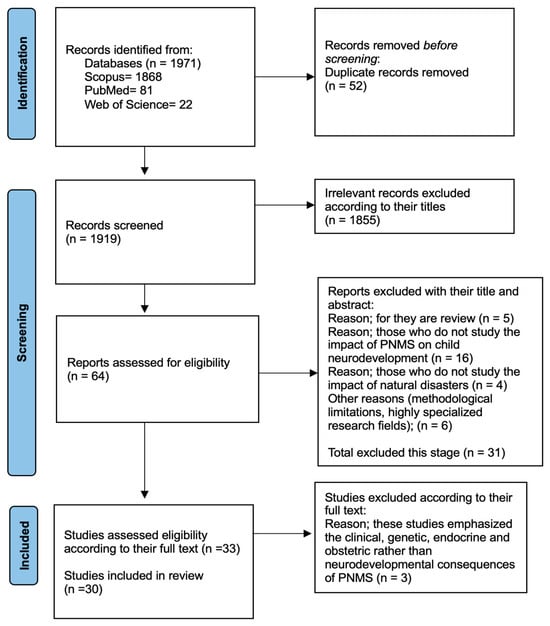
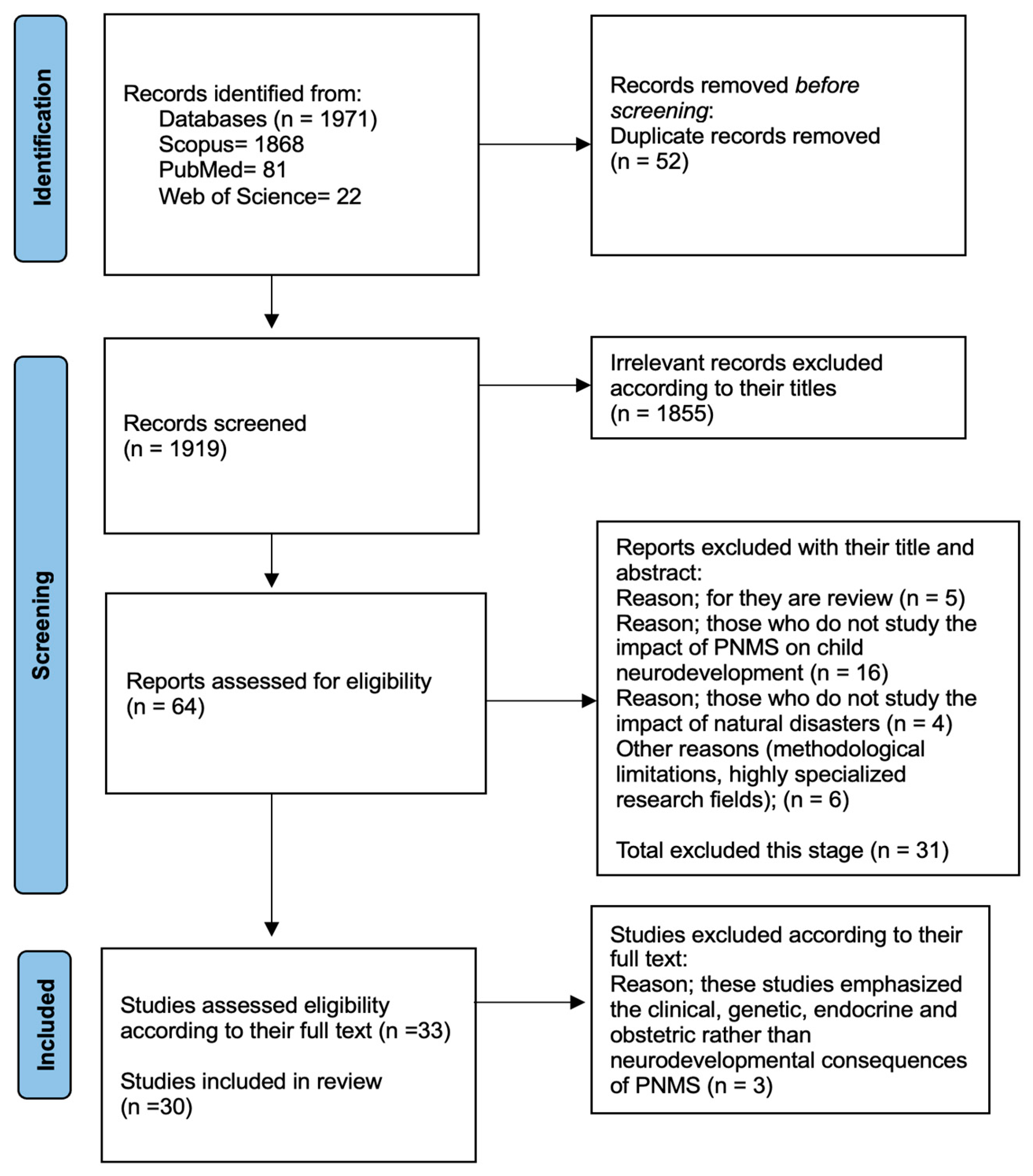
Eligible studies were selected through a multistep approach (elimination of duplicates, title reading, abstract, and full-text assessment). Two researchers (G.Ü.-B. and S.Y.) collaboratively screened the titles and abstracts, followed by a thorough evaluation of the full texts based on the inclusion criteria outlined above. Any disagreement between the reviewers was solved by means of a consensus session with a third reviewer (F.K.). The entire process was supervised by R.A.C.-G. In the case of ambiguity in reporting or lack of data, primary authors were contacted for clarification. Sixty-four were potentially eligible for inclusion based on the title and abstract. After full-text review, thirty articles met the inclusion criteria. The PRISMA 2020 [29] flow diagram summarizes the study selection process (Figure 1).
Figure 1.
PRISMA 2020 [29] flow diagram.
2.3. Data Extraction and Management
The data were extracted by two researchers (G.Ü.-B. and S.Y.). During the assessment process, both authors reviewed all studies together, agreed upon the assessment criteria, and considered the following information for each article: (1) first author and year of publication; (2) natural disaster and the country where the disaster occurred; (3) study design; (4) the assessment tool used in every study; (5) number of participants; (6) the average age of infants population; (7) the gestational age of pregnant women; (8) main results obtained; and (9) the most important findings of each study.
2.4. Quality Assessment Tools
The quality of each cohort and cross-sectional study was assessed using the Newcastle–Ottawa Quality Assessment Scale (NOQAS) [30]. The quality of each natural experiment and quasi-experimental study was assessed using the TREND Statement Checklist [31].
3. Results
3.1. Study Characteristics
A total of 30 articles written in English were included in this review (Table 2). The countries where natural disasters occurred were Australia (n = 11), Canada (n = 5), China (n = 3), Chile (n = 3), India (n = 2), and the USA (n = 6). The type of natural disasters included earthquakes (n = 4), floods (n = 13), hurricanes (n = 4), ice storms (n = 5), sand storms (n = 1), cyclones (n = 2), and others (a combination of hurricanes, tornadoes, floods, storms) (n = 1). Twenty-one studies were cohort studies, and there was one cross-sectional study, five natural experiment studies, and three quasi-experimental studies. A total of 1,327,886 mother–child dyads participated in the included studies.
3.2. Maternal Stress and Socio-Emotional Development in Offspring
Eleven of the reviewed studies [32,33,34,35,36,37,38,39,40,41,42] indicate that maternal stress due to exposure to natural disasters during pregnancy negatively affects the emotional development of children. The scales used among the studies were the CBCL (Child Behavior Checklist), QFOSS (Queensland Flood Objective Stress Scale), PDI (Peritraumatic Distress Inventory), PDEQ (Peritraumatic Dissociative Experiences Questionnaire), IES-R (Impact of Event Scale—Revised), DASS-21 (Depression Anxiety Stress Scales-21), BDI (Beck Depression Inventory), TADI (Teacher’s ADHD Rating Scale), LES (Life Events Scale), STAI (State-Trait Anxiety Inventory), BITSEA (Brief Infant–Toddler Social and Emotional Assessment), SPAS (Spence Preschool Anxiety Scale), IBQ-R (Infant Behavior Questionnaire—Revised), PAPA (Preschool Age Psychiatric Assessment), and ECBQ (Early Childhood Behavior Questionnaire).
It was observed that the major objective difficulties experienced by pregnant women exposed to the Queensland floods as a natural disaster during pregnancy were associated with higher anxiety symptoms in their 4- and 6-year-old children, and that negative reactivity and timid temperament traits in the toddler age group mediated the relationship between these anxiety symptoms [33,34,35,36]. It has even been shown that these anxiety symptoms at 2.5 years of age predict sleep problems (sleep duration, awakenings) at 4 years of age [40]. Children exposed in utero to the Chilean earthquake had more negative socio-emotional outcomes in early childhood [32], with scores on behavioral problems such as emotional reactivity, anxious/depressed mood, sleep and attention problems, and aggression being significantly higher in these children than in children not exposed to the earthquake [37].
Laplante et al. concluded that toddlers of pregnant women exposed to the Quebec ice storm engaged in less functional play and more stereotypical play [42]. In studies related to Hurricane Sandy, prenatal maternal depression has been shown to affect infant temperament, including poorer emotion regulation and increased negative affect, distress, and sadness in infants [38,41]. A significant increase in the risk of various psychiatric disorders, including anxiety disorders, depressive disorders, and attention deficit disorder/disruptive behavior disorder, has been observed in preschool children exposed to the same natural disaster in the womb [39].
3.3. Exposure to Natural Disasters and Infants/Toddlers/Children’s Neurodevelopment
In most of the studies [32,43,44,45,46,47,48,49,50,51,52,53,54,55,56,57,58,59,60,61], neurodevelopmental effects in children of pregnant women exposed to natural disasters as prenatal maternal stress have been examined. Therefore, more data were obtained on this subject. The MCDI-III (MacArthur–Bates Communicative Development Inventories-III), TADI (Teacher’s ADHD Rating Scale), CBCL (Child Behavior Checklist), DST (Developmental Screening Test), BOTMP (Bruininks–Oseretsky Test of Motor Proficiency), VMI (Visual–Motor Integration), BOT-2 (Bruininks–Oseretsky Test of Motor Proficiency, Second Edition), Gesell DI (Gesell Developmental Inventory), WISC-CR (Wechsler Intelligence Scale for Children—Chinese Revised), Conner’s TRS-R (Conners’ Teacher Rating Scale—Revised), ASQ (Ages and Stages Questionnaire), Bayley Scales of Infant Development-MDI (Mental Development Index), MCDI (MacArthur–Bates Communicative Development Inventories), WPPSI-R (Wechsler Preschool and Primary Scale of Intelligence—Revised), PPVT-R (Peabody Picture Vocabulary Test—Revised), BITSEA (Brief Infant–Toddler Social and Emotional Assessment), and PAPA (Preschool Age Psychiatric Assessment) scales were used to evaluate neurodevelopmental effects.
Twenty studies have shown that in utero exposure to natural disasters negatively affects children’s neurodevelopment [32,43,44,45,46,47,48,49,50,51,52,53,54,55,56,57,58,59,60,61]. These neurodevelopmental effects in studies include cognitive development, language development, reading and pre-reading skills, fine and gross motor skills, mathematical skills, attention deficit hyperactivity disorder symptoms, and autism spectrum disorder symptoms.
In the Developmental Screening Test (DST) conducted on children aged 0–3 years of 89 mothers exposed to the Wenchuan earthquake during pregnancy, higher maternal PTSD (post-traumatic stress disorder) scores were significantly associated with lower child Developmental Quotient (DQ) and Mental Index (MI) scores (p < 0.01) [45]. The pre-reading skills of kindergarten-aged children of pregnant women exposed to the Chilean earthquake were found to be lower than those of the nonexposed group (p < 0.001) [44]. The neurodevelopmental effects of natural disasters are not limited to the preschool age group. A study of third grade standardized math and reading test scores of 187,000 children aged 8–10 who were exposed in utero to 15 different natural disasters in the US between 1988 and 2000, and 693,967 children who were not exposed in utero, showed that the exposed group had lower math (p < 0.01) and reading (p < 0.05) scores [47]. Other studies have shown that cognitive effects are significant [32,43,49,51,53,54,55,57].
A study examining the motor development of children of pregnant women exposed to the 2011 Queensland floods found that high prenatal maternal stress was positively associated with motor development in 2-month-old children but negatively associated with motor development in 6- and 16-month-old children, particularly when exposure occurred late in pregnancy [59]. A study of the same natural disaster concluded that high levels of maternal PTSD symptoms were associated with poorer fine motor skills in children (p < 0.05) [58]. Gomula et al. showed that prenatal exposure to the 2009 Cyclone Aila disaster was associated with poorer performance on motor skills tests (p < 0.05) [48] in a study conducted with prenatal (n = 290), postnatal (n = 169), and nonexposed (n = 260) groups.
Studies have also mentioned the negative impact of natural disaster exposure on language development [43,53,54,56]. Weaker language skills were observed in children exposed to high levels of PNMS compared to those exposed to moderate or low levels of PNMS caused by natural disaster exposure [54]. Li et al. reported that every 10 days of prenatal exposure to PNMS caused a 0.20 SD decrease in vocabulary test scores, leading to delays in sentence construction and speech [56].
In addition, there are studies showing that children exposed to natural disasters as PNMS have higher scores on autism spectrum disorder screening tests [61] and even an increased prevalence of ASD [52] and higher symptoms of attention deficit hyperactivity disorder [50].
3.4. Exposure of Pregnant Women to Natural Disasters: Implications of Trimester of Pregnancy and Children’s Gender
In these studies [34,42,44,48,49,51,52,53,55,56,58,59,61], researchers not only examined the neurodevelopmental effects of exposure to natural disasters in children but also whether the period of pregnancy during which exposure to natural disasters occurs is effective or not. Most of the studies reviewed found that exposure to natural disasters in the first trimester resulted in worse neurodevelopmental effects (poorer reading skills, cognitive development, intellectual abilities, language abilities, functional play, motor development, presence of symptoms of autism spectrum disorder) in children [42,44,49,51,53,55,58,61]. While some studies suggest that exposure in late pregnancy leads to worse outcomes [52,56,59], two studies found no significant association between gestational age of exposure and neurodevelopmental effects (motor function, anxiety symptoms) in children (p < 0.01) [34,48].
In three studies investigating the impact of gender, while significant results were obtained in terms of hyperactivity, behavioral problems, and poorer fine motor skills in boys [33,39,60], it was mentioned that problems with reading and language skills were more common in girls [44,55].
Table 2.
Characteristics of included studies.
4. Discussion
The aim of this study was to investigate the neurodevelopmental effects in children exposed to natural disasters during the intrauterine period. In addition, the effects of gestational age and sex of the child on these neurodevelopmental changes were assessed.
As a result, the present systematic review of the literature reveals that children of pregnant women exposed to natural disasters are affected in a multitude of ways. Based on the findings of the studies, it can be concluded that natural disasters have a negative impact on cognitive development, language development, autism/autism-like characteristics, motor skills, performance in mathematics, mental development, sleep problems, attention problems, behavioral and emotional problems, and various psychiatric comorbidities in children. Although the number of studies on the effect of time of exposure is limited and the results are inconsistent, these inconsistencies can be attributed to methodological factors such as the lack of studies on PNMS related to natural disasters and the type of stress exposure. However, it can be concluded that exposure to natural disasters in the first trimester brings a higher risk according to the studies examined. Despite mounting evidence linking PNMS with neurodevelopmental disorders (including subclinical presentations), several limitations remain. These include the retrospective design of many studies and the fact that the clinical evaluation of children was performed many years after the natural disaster. This has negative implications for early intervention.
Among the reviewed studies, the impact of floods has been analyzed the most. In 2023, floods were the most frequent natural disaster in the world, followed by storms [62]. Floods are particularly common in Asia, Africa, and some European countries, affecting millions of people annually. The frequency and severity of flood events are increasing due to climate change [63].
In respect to the instruments used to assess children’s neurodevelopment, different scales were used in the reviewed studies. Researchers often used the CBCL 1.5-5 version to assess the social and emotional effects of natural disasters on children, and seven studies used this scale [32,34,35,36,37,40,51]. The CBCL 1.5-5 is a screening tool used for the assessment of multiple behavioral and emotional difficulties in children aged 1.5 to 5 years. This version includes seven subscales: emotionally reactive (9 items), anxious/depressed (8 items), somatic complaints (11 items), withdrawn (8 items), sleep problems (7 items), attention problems (5 items), and aggression (19 items). Items are scored on a three-point Likert scale ranging from 0 (not true) to 2 (very or often true), with higher scores indicating more problematic behaviors. The Bayley Scales of Infant and Toddler Development—third edition (BSID-III), another scale that assesses cognitive, social, and emotional abilities and is often used in studies, was used in six studies [42,43,53,55,57,58]. The Bayley is a standardized assessment of developmental functioning and is widely used in studies of child development. The BSID-III has high internal consistency and has been extensively validated with mean reliability coefficients of 0.91 for the Cognitive Scale, 0.86 for the Fine Motor Scale, and 0.91 for the Gross Motor Scale [64]. The Bayley Scales are useful scales that have been used for several decades to detect early developmental delays in clinical practice and research [65]. Moss et al. [57] assessed the cognitive and motor outcomes of flood exposure during pregnancy using the BSID-III scale, while Morales et al. [37] assessed the outcomes of emotional reactivity, anxious/depressed, sleep problems, attention problems, and aggression in children of mothers exposed to earthquakes during pregnancy using the CBCL 1.5-5 scale. The BSID-III and CBCL 1.5-5 are complementary tools used for different purposes. While the Bayley-III assesses children’s general development, the CBCL is more of a tool for understanding children’s emotional and behavioral functioning. The two scales can be used together, particularly in cases where developmental delays and mental health problems need to be addressed together.
Pregnancy is an important period when environmental exposures, such as maternal psychological stress, have lifelong consequences for the developing infant, a concept termed ‘fetal programming’ [66]. The effects of maternal psychosocial stress on fetal development and later life health and disease are not the result of a single pathway but are mediated by multiple stress transmission mechanisms (maternal cortisol, catecholamines, cytokines, reactive oxygen radicals, serotonin/tryptophan, microbiota) acting together in a synergistic manner [66]. Cortisol is a glucocorticoid hormone released by stimulation of the hypothalamic–pituitary–adrenal (HPA) axis in response to stressors [67]. The role of cortisol as a mediator of prenatal stress has been extensively investigated in recent years and has previously been reviewed in detail [68,69,70,71]. In response to acute or chronic psychological stress, the maternal HPAA is activated by higher brain structures and, as a result, the adrenal cortex synthesizes and releases cortisol into the maternal circulation [72]. After release into the maternal circulation, the highly lipophilic cortisol crosses the placental barrier and reaches the fetus. However, the placental enzyme 11beta-hydroxysteroid dehydrogenase type 2 (11β-HSD-2) inactivates approximately 80–90% of maternal cortisol. In addition, fetal HPAA does not produce cortisol until late in pregnancy, suggesting that the fetus is completely dependent on maternal cortisol for most of pregnancy. The intrauterine determination of fetal HPAA activity later in life is thought to be one of the key mechanisms of ‘fetal programming’ [66]. This mechanism may explain the neurodevelopmental effects of prenatal exposure to natural disasters through acute maternal stress.
The placental enzyme 11beta-hydroxysteroid dehydrogenase type 2 (11β-HSD-2) inactivates about 80–90% of maternal cortisol. As a result, fetal plasma concentrations are 5–10 times lower than maternal levels under physiological conditions [73]. This mechanism is thought to protect the fetus from excessive maternal cortisol concentrations under physiological conditions. Prenatal stress itself, or maternal anxiety as a marker of prenatal stress, has been shown to reduce 11β-HSD-2 expression and activity in humans and animal models [73,74,75,76]. This may explain why exposure to natural disasters in the first trimester leads to worse neurodevelopmental outcomes in children in most of the studies analyzed. On the other hand, human placental 11β-HSD-2 activity decreases near delivery in uncomplicated pregnancies [77], resulting in greater maternal cortisol transmission to the fetus in late pregnancy. This may be the mechanism underlying the greater neurodevelopmental effects of late-gestational exposure to natural disasters in children in some of the studies reviewed. Information on the relationship between exposure to natural disasters and gestational age is still limited, and more studies are needed.
A review published in 2022 [67] examined the relationship between stress in pregnant women and fetal sex and found that female fetuses had a less accelerated fetal heart rate [78] and lower placental 11b-hydroxysteroid dehydrogenase type 2 function [79] compared to male fetuses. Less 11b-hydroxysteroid dehydrogenase type 2 means that the fetus is exposed to more maternal cortisol. Higher levels of cortisol in the female fetus may be a factor associated with more reading and language problems in girls in the studies we reviewed. Most of the studies in this review did not include a gender perspective on the effects of prenatal stress. There is evidence that maternal stress affects male and female newborns differently [80]. Future studies addressing natural disasters as a factor in PNMS should consider fetal sex and analyze how prenatal stress affects infant outcomes from a gender perspective.
4.1. Limitations
The small number of databases consulted and the lack of a meta-analytic perspective are the main limitations of this study. Databases such as PsycINFO, LILACS, Latindex, and DergiPark could have been included for further review, allowing for a more comprehensive understanding of studies from diverse regions and enhancing the likelihood of identifying relevant research across various cultural and regional contexts. Secondly, the generalizability of the results is difficult due to the heterogeneity in the methodology (differences in sample size, scales used, statistical methods used, etc.) of the studies reviewed.
4.2. Strengths
The main strength is that we carried out a scoping review in accordance with the PRISMA extension for scoping reviews guidelines. Our research was a comprehensive study covering all types of natural disasters and analyzing all neurodevelopmental effects in children. In addition, the quality of the analyzed studies was mostly high, which is an important indicator of the reliability of the results of these studies.
4.3. Clinical and Research Implications for Future Research
Is exposure to a natural disaster alone a predictor of adverse mental health? Furthermore, to what extent do the death of relatives and various unfavorable conditions experienced after the disaster increase this risk? With regard to the earthquake natural disaster, it is unclear whether the duration of stay in the region after the disaster poses an additional teratogenic risk in terms of exposure to chemicals. In particular, the relationship between the mental health outcomes of early children exposed to these events in the intrauterine period remains unclear. Follow-up studies established for early childhood allow for the effects of objective and subjective components of maternal exposure to be assessed and separated.
A new study has been initiated to address these questions and minimize the limitations of previous research. This study is currently in the design phase and is planned to be conducted in the future. The aim is to increase knowledge on this subject and contribute to the literature by using a prospective research design to determine the extent to which postnatal maternal stress caused by a major natural disaster predicts autism spectrum disorder (ASD) symptoms in early childhood. In addition, the effects of child gender and timing of exposure, as well as the effects of other maternal and child factors on PNMS and autism-like features, including social, emotional, and cognitive features, will be evaluated.
Supplementary Materials
The following supporting information can be downloaded at: https://www.mdpi.com/article/10.3390/bs14111054/s1.
Author Contributions
Conceptualization, G.Ü.-B., S.Y., F.K. and R.A.C.-G.; methodology, G.Ü.-B., S.Y., F.K. and R.A.C.-G.; validation, G.Ü.-B., S.Y. and R.A.C.-G.; investigation, G.Ü.-B., S.Y., F.K. and R.A.C.-G.; data curation, G.Ü.-B. and S.Y.; writing—original draft preparation, S.Y.; writing—review and editing, G.Ü.-B., R.A.C.-G. and F.K.; visualization, S.Y. and R.A.C.-G.; supervision, G.Ü.-B., R.A.C.-G. and F.K.; project administration, G.Ü.-B., S.Y., F.K. and R.A.C.-G. All authors have read and agreed to the published version of the manuscript.
Funding
This research received no funding.
Institutional Review Board Statement
Not applicable.
Informed Consent Statement
Not applicable.
Data Availability Statement
The original contributions presented in this study are included in the article. Further inquiries can be directed to the corresponding author.
Conflicts of Interest
The authors declare no conflicts of interest.
References
- Salas, E.B. Global Number of Natural Disasters Events 2000–2023. Statista. Available online: https://www.statista.com/statistics/510959/number-of-natural-disasters-events-globally/ (accessed on 20 August 2024).
- Walika, M.; Moitinho De Almeida, M.; Castro Delgado, R.; Arcos González, P. Outbreaks Following Natural Disasters: A Review of the Literature. Disaster Med. Public Health Prep. 2023, 17, 2. [Google Scholar] [CrossRef] [Scilit] [PubMed]
- Gomez, C.J.; Yoshikawa, H. Earthquake effects: Estimating the relationship between exposure to the 2010 Chilean earthquake and preschool children’s early cognitive and executive function skills. Early Child. Res. Q. 2017, 38, 127–136. [Google Scholar] [CrossRef] [Scilit]
- Peek, L.; Stough, L.M. Children with disabilities in the context of disaster: A social vulnerability perspective. Child Dev. 2010, 81, 1260–1270. [Google Scholar] [CrossRef] [Scilit] [PubMed]
- de Oliveira, V.H.; Lee, I.; Quintana-Domeque, C. Natural disasters and early human development: Hurricane Catarina and infant health in Brazil. J. Hum. Resour. 2023, 58, 819–851. [Google Scholar] [CrossRef] [Scilit]
- Matthews, S.G. Antenatal glucocorticoids and programming of the developing CNS. Pediatr. Res. 2000, 47, 291–300. [Google Scholar] [CrossRef] [Scilit] [PubMed]
- Mulder, E.J.; Robles de Medina, P.G.; Huizink, A.C.; Van den Bergh, B.R.; Buitelaar, J.K.; Visser, G.H. Prenatal maternal stress: Effects on pregnancy and the (unborn) child. Early Hum. Dev. 2002, 70, 3–14. [Google Scholar] [CrossRef] [Scilit] [PubMed]
- Al Gasseer, N.; Dresden, E.; Keeney, G.B.; Warren, N. Status of women and infants in complex humanitarian emergencies. J. Midwifery Womens Health 2004, 49 (Suppl. S1), 7–13. [Google Scholar] [CrossRef] [PubMed]
- Dong, X.; Qu, Z.; Liu, F.; Jiang, X.; Wang, Y.; Chui, C.H.; Wang, X.; Tian, D.; Zhang, X. Depression and its risk factors among pregnant women in 2008 Sichuan earthquake area and non-earthquake struck area in China. J. Affect. Disord. 2013, 151, 566–572. [Google Scholar] [CrossRef] [Scilit] [PubMed]
- Harville, E.W.; Do, M. Reproductive and Birth Outcomes in Haiti Before and After the 2010 Earthquake. Disaster Med. Public Health Prep. 2016, 10, 59–66. [Google Scholar] [CrossRef] [Scilit]
- Antipova, A.; Curtis, A. The post-disaster negative health legacy: Pregnancy outcomes in Louisiana after Hurricane Andrew. Disasters 2015, 39, 665–686. [Google Scholar] [CrossRef] [Scilit] [PubMed]
- Sekizuka, N.; Sakai, A.; Aoyama, K.; Kohama, T.; Nakahama, Y.; Fujita, S.; Hibino, Y.; Hitomi, Y.; Kambayashi, Y.; Nakamura, H. Association between the incidence of premature rupture of membranes in pregnant women and seismic intensity of the Noto Peninsula earthquake. Environ. Health Prev. Med. 2010, 15, 292–298. [Google Scholar] [CrossRef] [Scilit] [PubMed]
- Sato, M.; Nakamura, Y.; Atogami, F.; Horiguchi, R.; Tamaki, R.; Yoshizawa, T.; Oshitani, H. Immediate Needs and Concerns among Pregnant Women During and after Typhoon Haiyan (Yolanda). PLoS Curr. 2016, 8. [Google Scholar] [CrossRef] [Scilit] [PubMed]
- Oni, O.; Harville, E.; Xiong, X.; Buekens, P. Relationships among stress coping styles and pregnancy complications among women exposed to hurricane katrina. J. Obstet. Gynecol. Neonatal Nurs. 2015, 44, 256–267. [Google Scholar] [CrossRef] [Scilit] [PubMed]
- Qu, Z.; Tian, D.; Zhang, Q.; Wang, X.; He, H.; Zhang, X.; Huang, L.; Xu, F. The impact of the catastrophic earthquake in China’s Sichuan province on the mental health of pregnant women. J. Affect. Disord. 2012, 136, 117–123. [Google Scholar] [CrossRef] [Scilit] [PubMed]
- Sosnowski, D.W.; Booth, C.; York, T.P.; Amstadter, A.B.; Kliewer, W. Maternal prenatal stress and infant DNA methylation: A systematic review. Dev. Psychol. 2017, 60, 127–139. [Google Scholar] [CrossRef] [Scilit]
- Ding, X.X.; Wu, Y.L.; Xu, S.J.; Zhu, R.P.; Jia, X.M.; Zhang, S.F.; Huang, K.; Zhu, P.; Hao, J.H.; Tao, F.B. Maternal anxiety during pregnancy and adverse birth outcomes: A systematic review and meta-analysis of prospective cohort studies. J. Affect. Disord. 2014, 159, 103–110. [Google Scholar] [CrossRef] [Scilit] [PubMed]
- Woody, C.A.; Ferrari, A.J.; Siskind, D.J.; Whiteford, H.A.; Harris, M.G. A systematic review and meta-regression of the prevalence and incidence of perinatal depression. J. Affect. Disord. 2017, 219, 86–92. [Google Scholar] [CrossRef] [Scilit]
- Grote, N.K.; Bridge, J.A.; Gavin, A.R.; Melville, J.L.; Iyengar, S.; Katon, W.J. A meta-analysis of depression during pregnancy and the risk of preterm birth, low birth weight, and intrauterine growth restriction. Arch. Gen. Psychiatry 2010, 67, 1012–1024. [Google Scholar] [CrossRef] [Scilit]
- Field, T. Prenatal depression effects on early development: A review. Infant Behav. Dev. 2011, 34, 1–14. [Google Scholar] [CrossRef] [Scilit]
- Goodman, S.H.; Rouse, M.H.; Connell, A.M.; Broth, M.R.; Hall, C.M.; Heyward, D. Maternal depression and child psychopathology: A meta-analytic review. Clin. Child Fam. Psychol. Rev. 2011, 14, 1–27. [Google Scholar] [CrossRef] [Scilit] [PubMed]
- Pearson, R.M.; Evans, J.; Kounali, D.; Lewis, G.; Heron, J.; Ramchandani, P.G.; O’Connor, T.G.; Stein, A. Maternal depression during pregnancy and the postnatal period: Risks and possible mechanisms for offspring depression at age 18 years. JAMA Psychiatry 2013, 70, 1312–1319. [Google Scholar] [CrossRef] [Scilit] [PubMed]
- Van den Bergh, B.R.; Van Calster, B.; Smits, T.; Van Huffel, S.; Lagae, L. Antenatal maternal anxiety is related to HPA-axis dysregulation and self-reported depressive symptoms in adolescence: A prospective study on the fetal origins of depressed mood. Neuropsychopharmacology 2008, 33, 536–545. [Google Scholar] [CrossRef] [Scilit] [PubMed]
- Caparros-Gonzalez, R.A.; Romero-Gonzalez, B.; Gonzalez-Perez, R.; Lucena-Prieto, L.; Perez-Garcia, M.; Cruz-Quintana, F.; Peralta-Ramirez, M.I. Maternal and Neonatal Hair Cortisol Levels Are Associated with Infant Neurodevelopment at Six Months of Age. J. Clin. Med. 2019, 8, 2015. [Google Scholar] [CrossRef] [Scilit] [PubMed]
- Khatri, G.K.; Tran, T.D.; Fisher, J. Prevalence and determinants of symptoms of antenatal common mental disorders among women who had recently experienced an earthquake: A systematic review. BMC Psychiatry 2019, 19, 47. [Google Scholar] [CrossRef] [Scilit] [PubMed]
- Mallett, L.H.; Etzel, R.A. Flooding: What is the impact on pregnancy and child health? Disasters 2018, 42, 432–458. [Google Scholar] [CrossRef] [Scilit] [PubMed]
- Lafortune, S.; Laplante, D.P.; Elgbeili, G.; Li, X.; Lebel, S.; Dagenais, C.; King, S. Effect of Natural Disaster-Related Prenatal Maternal Stress on Child Development and Health: A Meta-Analytic Review. Int. J. Environ. Res. Public Health 2021, 18, 8332. [Google Scholar] [CrossRef] [Scilit] [PubMed]
- Blanc, J.; Eugene, D.; Louis, E.F.; Cadichon, J.M.; Joseph, J.; Pierre, A.; Laine, R.; Alexandre, M.; Huang, K.Y. Mental Health Among Children Older than 10 Years Exposed to the Haiti 2010 Earthquake: A Critical Review. Curr. Psychiatry Rep. 2020, 22, 57. [Google Scholar] [CrossRef] [Scilit] [PubMed]
- Page, M.J.; McKenzie, J.E.; Bossuyt, P.M.; Boutron, I.; Hoffmann, T.C.; Mulrow, C.D.; Shamseer, L.; Tetzlaff, J.M.; Akl, E.A.; Brennan, S.E.; et al. The PRISMA 2020 statement: An updated guideline for reporting systematic reviews. BMJ 2021, 372, n71. [Google Scholar] [CrossRef] [Scilit] [PubMed]
- Munn, Z.; Peters, M.D.J.; Stern, C.; Tufanaru, C.; McArthur, A.; Aromataris, E. Systematic review or scoping review? Guidance for authors when choosing between a systematic or scoping review approach. BMC Med. Res. Methodol. 2018, 18, 143. [Google Scholar] [CrossRef]
- Des Jarlais, D.C.; Lyles, C.; Crepaz, N. Improving the reporting quality of nonrandomized evaluations of behavioral and public health interventions: The TREND statement. Am. J. Public Health 2004, 94, 361–366. [Google Scholar] [CrossRef] [Scilit] [PubMed]
- Berthelon, M.; Kruger, D.; Sanchez, R. Maternal stress during pregnancy and early childhood development. Econ. Hum. Biol. 2021, 43, 101047. [Google Scholar] [CrossRef] [Scilit] [PubMed]
- Lequertier, B.; Simcock, G.; Cobham, V.E.; Kildea, S.; King, S. Infant Behavior and Competence Following Prenatal Exposure to a Natural Disaster: The QF2011 Queensland Flood Study. Infancy 2019, 24, 411–432. [Google Scholar] [CrossRef] [Scilit] [PubMed]
- McLean, M.A.; Cobham, V.E.; Simcock, G.; Elgbeili, G.; Kildea, S.; King, S. The role of prenatal maternal stress in the development of childhood anxiety symptomatology: The QF2011 Queensland Flood Study. Dev. Psychopathol. 2018, 30, 995–1007. [Google Scholar] [CrossRef] [Scilit] [PubMed]
- McLean, M.A.; Cobham, V.E.; Simcock, G.; Kildea, S.; King, S. Toddler temperament mediates the effect of prenatal maternal stress on childhood anxiety symptomatology: The QF2011 queensland flood study. Int. J. Environ. Res. Public Health 2019, 16, 1998. [Google Scholar] [CrossRef] [Scilit]
- McLean, M.A.; Cobham, V.E.; Simcock, G.; Lequertier, B.; Kildea, S.; King, S. Childhood Anxiety: Prenatal Maternal Stress and Parenting in the QF2011 Cohort. Child Psychiatry Hum. Dev. 2021, 52, 389–398. [Google Scholar] [CrossRef] [Scilit]
- Morales, M.F.; Girard, L.C.; Sawrikar, V.; MacBeth, A. An examination of behavioural and emotional problems in children exposed prenatally to the 27F Chilean earthquake: Findings from the ELPI cohort. Soc. Psychiatry Psychiatr. Epidemiol. 2023, 58, 1065–1073. [Google Scholar] [CrossRef] [Scilit] [PubMed]
- Nomura, Y.; Davey, K.; Pehme, P.M.; Finik, J.; Glover, V.; Zhang, W.; Huang, Y.; Buthmann, J.; Dana, K.; Yoshida, S.; et al. Influence of in utero exposure to maternal depression and natural disaster-related stress on infant temperament at 6 months: The children of Superstorm Sandy. Infant Ment. Health J. 2019, 40, 204–216. [Google Scholar] [CrossRef] [Scilit]
- Nomura, Y.; Newcorn, J.H.; Ginalis, C.; Heitz, C.; Zaki, J.; Khan, F.; Nasrin, M.; Sie, K.; DeIngeniis, D.; Hurd, Y.L. Prenatal exposure to a natural disaster and early development of psychiatric disorders during the preschool years: Stress in pregnancy study. J. Child Psychol. Psychiatry Allied Discip. 2023, 64, 1080–1091. [Google Scholar] [CrossRef] [Scilit] [PubMed]
- Simcock, G.; Cobham, V.E.; Laplante, D.P.; Elgbeili, G.; Gruber, R.; Kildea, S.; King, S. A cross-lagged panel analysis of children’s sleep, attention, and mood in a prenatally stressed cohort: The QF2011 Queensland flood study. J. Affect. Disord. 2019, 255, 96–104. [Google Scholar] [CrossRef] [Scilit] [PubMed]
- Zhang, W.; Rajendran, K.; Ham, J.; Finik, J.; Buthmann, J.; Davey, K.; Pehme, P.M.; Dana, K.; Pritchett, A.; Laws, H.; et al. Prenatal exposure to disaster-related traumatic stress and developmental trajectories of temperament in early childhood: Superstorm Sandy pregnancy study. J. Affect. Disord. 2018, 234, 335–345. [Google Scholar] [CrossRef] [Scilit] [PubMed]
- Laplante, D.P.; Zelazo, P.R.; Brunet, A.; King, S. Functional play at 2 years of age: Effects of prenatal maternal stress. Infancy 2007, 12, 69–93. [Google Scholar] [CrossRef] [Scilit] [PubMed]
- Austin, M.P.; Christl, B.; McMahon, C.; Kildea, S.; Reilly, N.; Yin, C.; Simcock, G.; Elgbeili, G.; Laplante, D.P.; King, S. Moderating effects of maternal emotional availability on language and cognitive development in toddlers of mothers exposed to a natural disaster in pregnancy: The QF2011 Queensland Flood Study. Infant Behav. Dev. 2017, 49, 296–309. [Google Scholar] [CrossRef] [Scilit]
- Bátiz, L.F.; Palmeiro-Silva, Y.K.; Rice, G.E.; Monteiro, L.J.; Galaburda, A.M.; Romero, R.; Choolani, M.A.; Wyneken, U.; Orellana, P.; Illanes, S.E. Maternal exposure to a high-magnitude earthquake during pregnancy influences pre-reading skills in early childhood. Sci. Rep. 2021, 11, 9244. [Google Scholar] [CrossRef] [Scilit] [PubMed]
- Cai, D.; Zhu, Z.; Sun, H.; Qi, Y.; Xing, L.; Zhao, X.; Wan, Q.; Su, Q.; Li, H. Maternal PTSD following Exposure to the Wenchuan earthquake is associated with impaired mental development of children. PLoS ONE 2017, 12, e0168747. [Google Scholar] [CrossRef] [Scilit] [PubMed]
- Cao, X.; Laplante, D.P.; Brunet, A.; Ciampi, A.; King, S. Prenatal maternal stress affects motor function in 51/2-year-old children: Project Ice Storm. Dev. Psychobiol. 2014, 56, 117–125. [Google Scholar] [CrossRef] [Scilit] [PubMed]
- Fuller, S.C. The Effect of Prenatal Natural Disaster Exposure on School Outcomes. Demography 2014, 51, 1501–1525. [Google Scholar] [CrossRef] [Scilit] [PubMed]
- Gomula, A.; Nowak-Szczepanska, N.; Chakraborty, R.; Malina, R.M.; Ignasiak, Z.; Koziel, S. Fine and gross motor skills in 7–10 years old Indian children exposed to a natural disaster during early development. Dev. Psychobiol. 2023, 65, e22401. [Google Scholar] [CrossRef] [Scilit] [PubMed]
- Guo, C.; Chen, G.; He, P.; Zhang, L.; Zheng, X. Risk of cognitive impairment in children after maternal exposure to the 1998 Yangtze River flood during pregnancy: Analysis of data from China’s second National Sample Survey on Disability. Lancet Planet. Health 2020, 4, e522–e529. [Google Scholar] [CrossRef] [Scilit]
- Hanć, T.; Gomula, A.; Nowak-Szczepanska, N.; Chakraborty, R.; Kozieł, S. Prenatal and early postnatal exposure to a natural disaster and Attention-Deficit/Hyperactivity Disorder symptoms in Indian children. Sci. Rep. 2022, 12, 16235. [Google Scholar] [CrossRef] [Scilit] [PubMed]
- King, S.; Kildea, S.; Austin, M.P.; Brunet, A.; Cobham, V.E.; Dawson, P.A.; Harris, M.; Hurrion, E.M.; Laplante, D.P.; McDermott, B.M.; et al. QF2011: A protocol to study the effects of the Queensland flood on pregnant women, their pregnancies, and their children’s early development. BMC Pregnancy Childbirth 2015, 15, 109. [Google Scholar] [CrossRef] [Scilit]
- Kinney, D.K.; Miller, A.M.; Crowley, D.J.; Huang, E.; Gerber, E. Autism prevalence following prenatal exposure to hurricanes and tropical storms in Louisiana. J. Autism Dev. Disord. 2008, 38, 481–488. [Google Scholar] [CrossRef] [Scilit] [PubMed]
- Laplante, D.P.; Barr, R.G.; Brunet, A.; du Fort, G.G.; Meaney, M.L.; Saucier, J.F.; Zelazo, P.R.; King, S. Stress during pregnancy affects general intellectual and language functioning in human toddlers. Pediatr. Res. 2004, 56, 400–410. [Google Scholar] [CrossRef] [Scilit]
- Laplante, D.P.; Brunet, A.; Schmitz, N.; Ciampi, A.; King, S. Project ice storm: Prenatal maternal stress affects cognitive and linguistic functioning in 51/2-year-old children. J. Am. Acad. Child Adolesc. Psychiatry 2008, 47, 1063–1072. [Google Scholar] [CrossRef] [Scilit] [PubMed]
- Laplante, D.P.; Hart, K.J.; O’Hara, M.W.; Brunet, A.; King, S. Prenatal maternal stress is associated with toddler cognitive functioning: The Iowa Flood Study. Early Hum. Dev. 2018, 116, 84–92. [Google Scholar] [CrossRef] [Scilit]
- Li, Z.; Chen, L.; Li, M.; Cohen, J. Prenatal exposure to sand and dust storms and children’s cognitive function in China: A quasi-experimental study. Lancet Planet. Health 2018, 2, e214–e222. [Google Scholar] [CrossRef] [Scilit] [PubMed]
- Moss, K.M.; Simcock, G.; Cobham, V.; Kildea, S.; Elgbeili, G.; Laplante, D.P.; King, S. A potential psychological mechanism linking disaster-related prenatal maternal stress with child cognitive and motor development at 16 months: The QF2011 Queensland flood study. Dev. Psychol. 2017, 53, 629–641. [Google Scholar] [CrossRef] [Scilit] [PubMed]
- Moss, K.M.; Simcock, G.; Cobham, V.E.; Kildea, S.; Laplante, D.P.; King, S. Continuous, emerging, and dissipating associations between prenatal maternal stress and child cognitive and motor development: The QF2011 Queensland Flood Study. Early Hum. Dev. 2018, 119, 29–37. [Google Scholar] [CrossRef] [Scilit] [PubMed]
- Simcock, G.; Kildea, S.; Elgbeili, G.; Laplante, D.P.; Stapleton, H.; Cobham, V.; King, S. Age-related changes in the effects of stress in pregnancy on infant motor development by maternal report: The Queensland Flood Study. Dev. Psychobiol. 2016, 58, 640–659. [Google Scholar] [CrossRef] [Scilit]
- Simcock, G.; Laplante, D.P.; Elgbeili, G.; Kildea, S.; King, S. A trajectory analysis of childhood motor development following stress in pregnancy: The QF2011 flood study. Dev. Psychobiol. 2018, 60, 836–848. [Google Scholar] [CrossRef] [Scilit] [PubMed]
- Walder, D.J.; Laplante, D.P.; Sousa-Pires, A.; Veru, F.; Brunet, A.; King, S. Prenatal maternal stress predicts autism traits in 61/2-year-old children: Project Ice Storm. Psychiatry Res. 2014, 219, 353–360. [Google Scholar] [CrossRef] [Scilit]
- Dyvik, E.H. Number of Natural Disasters Worldwide 2023. Available online: https://www.statista.com/statistics/269653/natural-disasters-on-the-continents-by-nature-of-the-disaster/ (accessed on 12 October 2024).
- United Nations Office for Disaster Risk Reduction (UNDRR). Global Assessment Report on Disaster Risk Reduction 2022. Available online: https://www.undrr.org/gar/gar2022-our-world-risk-gar#container-downloads (accessed on 12 October 2024).
- Bayley, N. Bayley Scales of Infant and Toddler Development—Technical Manual, 3rd ed.; Psychological Corporation: San Antonio, TX, USA, 2006. [Google Scholar]
- Anderson, P.J.; Burnett, A. Assessing developmental delay in early childhood—Concerns with the Bayley-III scales. Clin. Neuropsychol. 2017, 31, 371–381. [Google Scholar] [CrossRef] [Scilit] [PubMed]
- Rakers, F.; Rupprecht, S.; Dreiling, M.; Bergmeier, C.; Witte, O.W.; Schwab, M. Transfer of maternal psychosocial stress to the fetus. Neurosci. Biobehav. Rev. 2017, 117, 185–197. [Google Scholar] [CrossRef] [Scilit] [PubMed]
- Caparros-Gonzalez, R.A.; Lynn, F.; Alderdice, F.; Peralta-Ramirez, M.I. Cortisol levels versus self-report stress measures during pregnancy as predictors of adverse infant outcomes: A systematic review. Stress 2022, 25, 189–212. [Google Scholar] [CrossRef] [Scilit] [PubMed]
- Cottrell, E.C.; Seckl, J.R. Prenatal stress, glucocorticoids and the programming of adult disease. Front. Behav. Neurosci. 2009, 3, 19. [Google Scholar] [CrossRef] [Scilit] [PubMed]
- Glover, V.; O’Connor, T.G.; O’Donnell, K. Prenatal stress and then programming of the HPA axis. Neurosci. Biobehav. Rev. 2010, 35, 17–22. [Google Scholar] [CrossRef] [Scilit] [PubMed]
- Harris, A.; Seckl, J. Glucocorticoids, prenatal stress and the programming of disease. Horm. Behav. 2011, 59, 279–289. [Google Scholar] [CrossRef] [Scilit] [PubMed]
- Moisiadis, V.G.; Matthews, S.G. Glucocorticoids and fetal programming part 1: Outcomes. Nat. Rev. Endocrinol. 2014, 10, 391–402. [Google Scholar] [CrossRef] [Scilit] [PubMed]
- Ulrich-Lai, Y.M.; Herman, J.P. Neural regulation of endocrine and autonomic stress responses. Nat. Rev. Neurosci. 2009, 10, 397–409. [Google Scholar] [CrossRef] [Scilit] [PubMed]
- Chapman, K.; Holmes, M.; Seckl, J. 11beta-hydroxysteroid dehydrogenases: Intracellular gate-keepers of tissue glucocorticoid action. Physiol. Rev. 2013, 93, 1139–1206. [Google Scholar] [CrossRef] [Scilit]
- Jensen Pena, C.; Monk, C.; Champagne, F.A. Epigenetic effects of prenatal stress on 11beta-hydroxysteroid dehydrogenase-2 in the placenta and fetal brain. PLoS ONE 2012, 7, e39791. [Google Scholar] [CrossRef] [Scilit]
- Monk, C.; Feng, T.; Lee, S.; Krupska, I.; Champagne, F.A.; Tycko, B. Distress during pregnancy: Epigenetic regulation of placenta glucocorticoid-related genes and fetal neurobehavior. Am. J. Psychiatry 2016, 173, 705–713. [Google Scholar] [CrossRef] [Scilit] [PubMed]
- O’Donnell, K.J.; Jensen, A.B.; Freeman, L.; Khalife, N.; O’Connor, T.G.; Glover, V. Maternal prenatal anxiety and downregulation of placental 11β-HSD2. Psychoneuroendocrinology 2012, 37, 818–826. [Google Scholar] [CrossRef] [Scilit] [PubMed]
- Murphy, V.E.; Clifton, V.L. Alterations in human placental 11beta-hydroxysteroid dehydrogenase type 1 and 2 with gestational age and labour. Placenta 2003, 24, 739–744. [Google Scholar] [CrossRef] [Scilit] [PubMed]
- Doyle, C.; Werner, E.; Feng, T.; Lee, S.; Altemus, M.; Isler, J.R.; Monk, C. Pregnancy distress gets under fetal skin: Maternal ambulatory assessment & sex differences in prenatal development. Dev. Psychobiol. 2015, 57, 607–625. [Google Scholar] [CrossRef] [Scilit] [PubMed]
- Jahnke, J.R.; Teran, E.; Murgueitio, F.; Cabrera, H.; Thompson, A.L. Maternal stress, placental 11b-hydroxysteroid dehydrogenase type 2, and infant HPA axis development in humans: Psychosocial and physiological pathways. Placenta 2021, 104, 179–187. [Google Scholar] [CrossRef] [Scilit] [PubMed]
- Kortesluoma, S.; Korhonen, L.; Pelto, J.; Hyttinen, S.; Laine, O.; Karlsson, L.; Karlsson, H. Sex differences in the associations between maternal prenatal distress and infant cortisol reactivity and recovery. Psychoneuroendocrinology 2021, 124, 105064. [Google Scholar] [CrossRef] [Scilit]

Disclaimer/Publisher’s Note: The statements, opinions and data contained in all publications are solely those of the individual author(s) and contributor(s) and not of MDPI and/or the editor(s). MDPI and/or the editor(s) disclaim responsibility for any injury to people or property resulting from any ideas, methods, instructions or products referred to in the content. |
© 2024 by the authors. Licensee MDPI, Basel, Switzerland. This article is an open access article distributed under the terms and conditions of the Creative Commons Attribution (CC BY) license (https://creativecommons.org/licenses/by/4.0/).