


Abstract
Cenozoic felsic magmatism along the northern Tibetan Plateau records the evolution of thickened continental crust, yet Miocene intrusions in the East Kunlun Orogen remain poorly constrained. Here we integrate field and petrographic observations with zircon U-Pb geochronology, zircon Lu-Hf isotopes, and whole-rock geochemistry for the Ganquanhe biotite monzogranite porphyry. Sample TW6 contains two zircon 206Pb/238U age populations at 14.8 ± 0.2 Ma and 17.5 ± 0.2 Ma, whereas the coherent TW7 population yields the preferred crystallization age of 17.6 ± 0.2 Ma; these uncertainties include a conservative 1% external reproducibility term. The overlapping εHf(t) ranges of the two TW6 age groups support a common magma source and indicate that the younger dates most likely record Pb loss rather than a separate magmatic event. The high-K calc-alkaline, metaluminous to weakly peraluminous rocks have low Y and Yb, high Sr/Y and (La/Yb)N, fractionated rare earth element (REE) patterns, and weak Eu anomalies. Low MgO, Cr, and Ni contents, negative zircon εHf(t) values, and Mesoproterozoic TDM2 ages indicate derivation mainly from ancient, garnet ± amphibole-bearing lower crust. Whole-rock zircon saturation temperatures of 760–782 °C and Sr/Y- and (La/Yb)N-based crustal-thickness estimates of approximately 72–77 km indicate melting within a warm, strongly thickened crust. Major-element source discrimination further favors an amphibolitic lower-crustal source with possible subordinate graywacke–orthogneiss components. The intrusion therefore records Early Miocene lower-crustal melting within a collisional to post-collisional setting along the northern Tibetan Plateau.
1. Introduction
Cenozoic magmatism across the Tibetan Plateau records thermal and compositional responses of the continental crust to India–Asia convergence, crustal thickening, plateau uplift, and intracontinental deformation [1,2,3,4,5,6,7,8,9,10,11]. In central and northern Tibet, high-Sr/Y felsic rocks, leucogranites, and rhyolites document repeated melting of thickened continental crust from the Eocene to the Quaternary [2,3,12,13,14,15,16,17,18,19]. These rocks are important for evaluating how deep-crustal melting accompanied the outward growth and deformation of the northern Tibetan Plateau [2,3,4,5,6].
The origin of Cenozoic high-Sr/Y felsic magmatism in northern Tibet remains debated. Proposed sources include subducted continental crust, thickened lower crust, and reworked mid-to-lower crust during post-collisional deformation [12,13,14,15,16,17,20,21]. Miocene to Quaternary leucogranites and rhyolites record prolonged crustal melting, locally linked to strike-slip extension and thermally weakened crust [2,3,14,16,17,22,23,24,25,26,27,28,29]. Distinguishing these models requires constraints on source depth, thermal trigger, and the timing of melting relative to plateau deformation.
The East Kunlun Orogen, at the northern Tibetan Plateau margin, was strongly reactivated during the Cenozoic India–Asia collision [4,5,6,30,31,32,33,34,35,36,37]. Late Oligocene–Early Miocene thrusting, shortening, and uplift along southern Qaidam preceded stronger strike-slip and extensional deformation [5,16,22,23,30,31,32,33,34,35,36,37]. However, the age, source, and tectonic significance of Miocene felsic intrusions in the Ganquanhe area remain poorly constrained. This gap limits comparison with the better-documented Cenozoic magmatic belts of Hoh Xil, Qiangtang, and the southern Kunlun Range.
This study investigates the Ganquanhe biotite monzogranite porphyry using field observations, petrography, zircon U-Pb geochronology, whole-rock geochemistry, and in situ zircon Lu-Hf isotopes. We determine its crystallization age, evaluate its adakitic affinity and petrogenesis, constrain the magma source, and assess its Miocene tectonic setting. The results clarify links among collision-related crustal thickening, lower-crustal melting, and later post-collisional deformation along the northern Tibetan Plateau. Because a felsic pluton does not directly test mantle–lithosphere reorganization, our interpretation is restricted to crustal thickening, melting, and post-collisional deformation.
2. Geological Setting
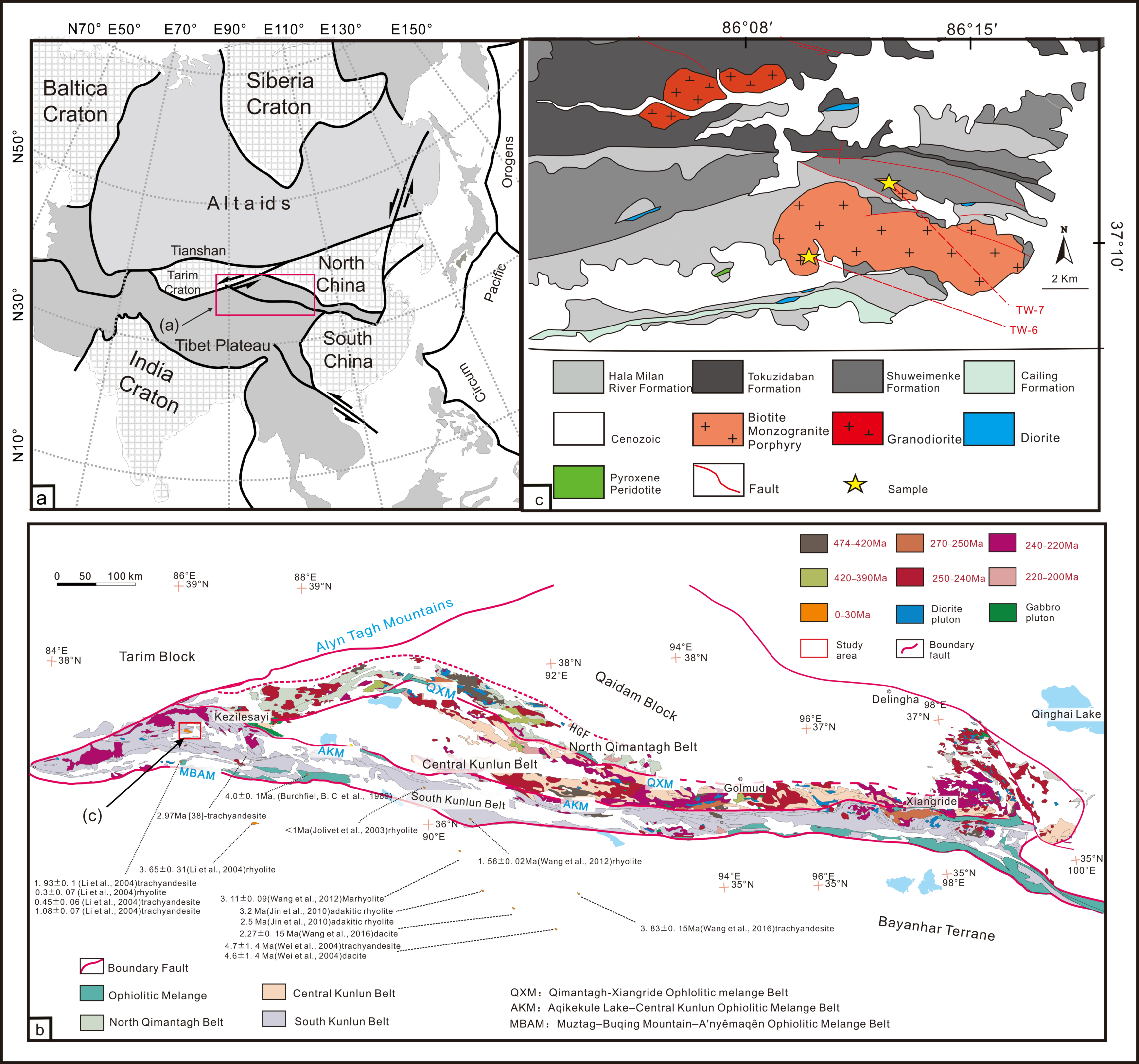
The Tibetan Plateau occupies the India–Asia collision zone and is bordered by the India, Tarim, North China, and South China cratonic blocks [1] (Figure 1a).
Figure 1.
(a) Simplified tectonic map showing the Tibetan Plateau and surrounding cratons (modified after [38]). The location of (b) is indicated. (b) Schematic map showing the distribution of plutonic and ophiolitic rocks in the East Kunlun Orogenic Belt (modified after [30]). The position of (c) is marked. (c) Geological map of the Ganquanhe area showing sedimentary formations, intrusive rocks, faults, and sample locations. Age and lithology annotations in panel (b) are compiled from [2,3,16,39,40,41,42,43].
The East Kunlun Orogen separates the Qaidam Block from the Bayan Har–Songpan–Ganzi terrane along the northern plateau margin [30] (Figure 1b). From north to south, it comprises the North Qimantagh, Central Kunlun, and South Kunlun belts. These belts are separated by the Qimantagh–Xiangride, Aqikekule Lake–Central Kunlun, and Muztag–Buqing Mountain–Anemaqen ophiolitic mélange zones. Its Paleozoic–Early Mesozoic architecture records Proto-Tethyan and Paleo-Tethyan evolution, whereas Cenozoic collision strongly reactivated the inherited structures [1,30]. Late Oligocene–Early Miocene contraction involved thrusting, crustal shortening, and lower-crustal underthrusting or injection along southern Qaidam and the adjacent East Kunlun region [31,32,33,35,36,37,44,45].
Miocene tectonic reorganization accelerated strike-slip deformation along the Kunlun fault and enhanced deformation at the northern plateau margin [30,33,35,36,37]. Shortening, strike-slip motion, and uplift overprinted the older orogenic framework and established the modern Qaidam–East Kunlun basin–mountain system [27,32,33,34,35,36,37,44,45].
The Ganquanhe pluton crops out along the southern East Kunlun margin, adjacent to the Shuweimenke Formation and younger Cenozoic cover (Figure 1c). The local east–west-trending stratigraphic and intrusive framework includes the Hala Milan River, Tokuzidaban, Shuweimenke, and Cailing (Caishiling) units, granitoid bodies, and minor mafic–ultramafic rocks. Faults truncate or offset sedimentary, volcanic, and intrusive contacts, recording later structural reworking of the map-scale relationships.
The Upper Carboniferous Hala Milan River Group (C2H) is a marine carbonate–siliciclastic succession composed mainly of calcareous mudstone, micritic limestone, calcareous siltstone, sandstone, and local tuffaceous to mafic volcanic rocks; brachiopod-bearing beds occur locally. The Lower Carboniferous Tokuzidaban Group (C1Tk) comprises three members: a lower feldspathic siltstone–sandstone–slate–calcareous unit; a middle sandstone–quartz sandstone–siltstone–slate unit with subordinate andesitic to rhyolitic volcanic rocks; and an upper sandstone–quartz sandstone–calcareous sandstone–siltstone–slate unit with local limestone. The Early–Middle Permian Shuweimenke Formation is dominated by intermediate-felsic volcanic rocks accompanied by conglomerate and other clastic rocks. The Middle Jurassic Cailing (Caishiling) Formation is a continental conglomerate–sandstone–siltstone–mudstone succession. These age and lithologic relationships show that the Ganquanhe intrusion was emplaced into a differentiated Carboniferous–Permian sedimentary–volcanic sequence that was later partly covered by Jurassic and Cenozoic strata.
3. Materials and Methods
Fresh biotite monzogranite porphyry samples were collected from the Ganquanhe area on the southern margin of the East Kunlun Orogen. The sampling sites are shown in Figure 1c. Representative samples TW6 and TW7 were selected for petrographic observation and zircon U-Pb dating. Following U-Pb screening, TW7 was used as the principal crystallization-age constraint because its 60 analyses define a coherent population. TW6 was selected for in situ zircon Lu-Hf analysis because its 20 dated spots span both the older magmatic and younger disturbed U-Pb populations; comparison of their Hf-isotope signatures provides a direct test of whether the younger dates represent a distinct magma source or post-crystallization Pb loss. Six fresh whole-rock samples from the TW6 and TW7 outcrops were selected for major- and trace-element analyses. Weathered surfaces were removed before preparation, and fresh interiors were used for geochemical and isotopic analyses.
Fresh rock was crushed before zircon concentration by heavy-liquid and magnetic techniques. Zircon grains were then selected individually under a binocular microscope, embedded in epoxy, and ground to expose their interiors. Cathodoluminescence (CL) imaging preceded isotopic measurement and guided the placement of analytical spots.
At the Testing Center of Shandong Bureau, China Metallurgical Geology Bureau, zircon U-Pb isotopes were measured with a Thermo Scientific iCAP Q ICP-MS (Thermo Fisher Scientific, Bremen, Germany) coupled to a GeoLas laser-ablation system equipped with a COMPexPro ArF excimer laser (Coherent, Göttingen, Germany). Ablation conditions were a 32 μm beam diameter, an 8 Hz repetition rate, and a fluence of ca. 8 J/cm2. Element concentrations were calibrated against NIST SRM 610 glass (National Institute of Standards and Technology, Gaithersburg, MD, USA), and zircon 91500 served as the U-Pb ratio standard [46]. ICPMSDataCal (State Key Laboratory of Geological Processes and Mineral Resources, China University of Geosciences, Wuhan, China) [47] was used for signal reduction, whereas Isoplot (Berkeley Geochronology Center, Berkeley, CA, USA) and IsoplotR (University College London, London, UK; open-source R package) [48,49] were used for concordia and weighted-mean calculations. Repeated analyses of zircon standard 91500 yielded results consistent with recommended values within analytical uncertainty. Individual analytical uncertainties are reported at the 1σ level unless otherwise stated. The weighted-mean uncertainties obtained from the spot data describe internal analytical precision only. To avoid overstating the geological age precision, a conservative 1% external reproducibility term was combined in quadrature with each internal weighted-mean uncertainty, σtotal = [σint2 + (0.01t)2]1/2, to encompass systematic effects not reduced by averaging, including reference-material calibration, common-Pb correction, and session-scale instrumental drift. Internal and total uncertainties are distinguished throughout the text.
In situ zircon Lu-Hf isotopic analyses were performed at the Testing Center of Shandong Bureau, China Metallurgical Geology Bureau, on or near the same zircon domains used for U-Pb dating. The analyses were carried out by LA-MC-ICP-MS using a Neptune Plus MC-ICP-MS (Thermo Fisher Scientific, Bremen, Germany) coupled with a GeoLas Pro 193 nm laser-ablation system (Coherent, Göttingen, Germany). Laser ablation was conducted using a spot size of 44 μm, a repetition rate of 8 Hz, and an energy density of ca. 10 J/cm2. Zircon standards 91500 and GJ-1 [50] were used to monitor analytical quality, and repeated analyses of these standards yielded results consistent with recommended values within analytical uncertainty. The decay constant of 176Lu was taken as 1.867 × 10⁻¹¹ yr−1 [51]. The present-day chondritic values of 176Hf/177Hf = 0.282772 and 176Lu/177Hf = 0.0332 were used for calculating εHf(t). Depleted mantle model ages were calculated using present-day values of 176Hf/177Hf = 0.28325 and 176Lu/177Hf = 0.0384. Two-stage model ages used an average continental crustal 176Lu/177Hf ratio of 0.015, following [52,53]. The calculated εHf(t) values and Hf model ages were based on the corresponding zircon U–Pb ages obtained in this study.
Major and trace elements were measured at the Experimental Testing Center of Xi’an Institute of Geology and Mineral Resources. After altered surfaces had been discarded, fresh interior chips were cleaned, crushed, and milled in agate to less than 200 mesh. Major oxides were determined with a 4.0 kW Axios X-ray fluorescence spectrometer (PANalytical, Almelo, The Netherlands), whereas trace and rare earth elements were measured using an Agilent 7700x ICP-MS (Agilent Technologies, Santa Clara, CA, USA). Sample preparation and measurement followed GB/T 14506.28-2010 [54] and DZ/T 0223-2001 [55]. Major oxides are reported in wt.% and trace elements in ppm; analytical uncertainties are generally below 2% and 5%, respectively. Chondrite-normalized REE ratios and Eu anomalies use the normalization values in [56].
Whole-rock zircon saturation temperatures (TZr) were calculated from Zr concentrations and major-element compositions using the calibration in [57], TZr(K) = 12,900/[2.95 + 0.85M + ln(496,000/Zr)], where M = (Na + K + 2Ca)/(Al × Si) is calculated from normalized cation fractions and Zr is in ppm. Because zircon occurs in both samples, these values are treated as saturation/crystallization-temperature constraints rather than liquidus temperatures [58,59]. Paleo-crustal thickness (DM, km) was estimated from the median whole-rock Sr/Y and chondrite-normalized (La/Yb)N ratios using the continental-collision calibrations in [60]: DM = 0.67(Sr/Y) + 28.21 and DM = 27.78 ln[0.34(La/Yb)N]. These regressions have a typical propagated uncertainty of approximately ±9 km and require particular caution for high-ratio results exceeding about 70 km [60]. Recent recalibrations and multivariate approaches show that these ratios also respond to composition and petrogenetic process; accordingly, the paired estimates are used only as first-order indicators [61,62,63].
4. Sample Description and Petrography
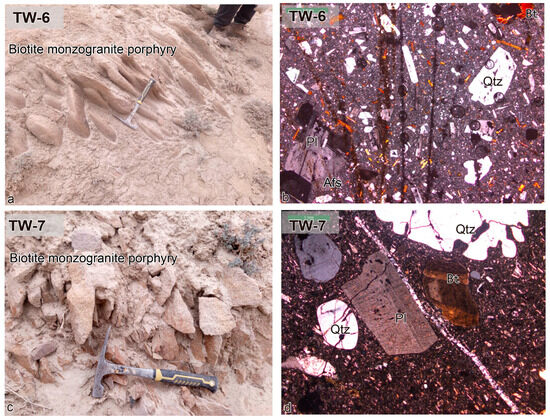
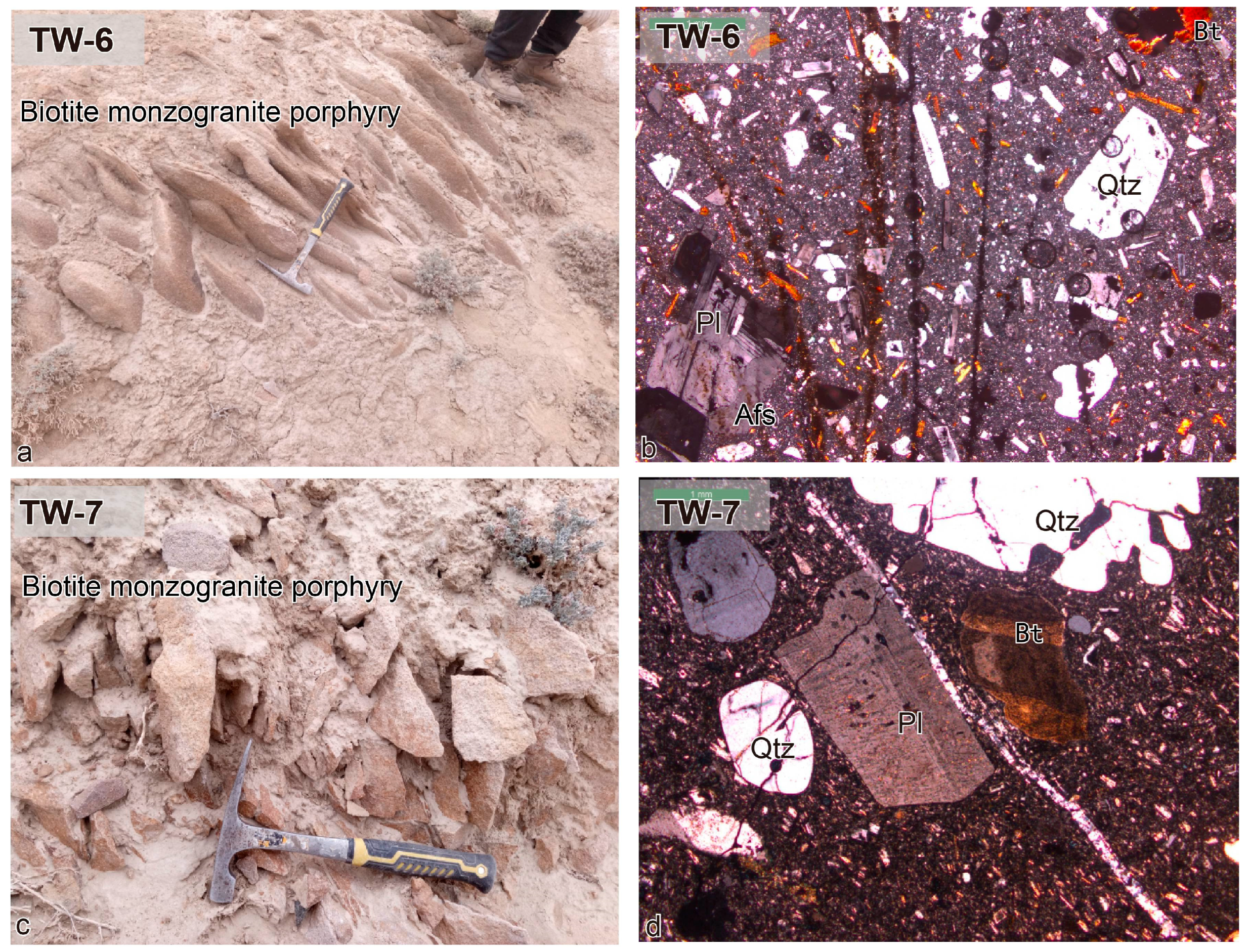
The intrusion is red to pale pink, massive, and porphyritic, with quartz and feldspar phenocrysts set in a fine-grained felsic groundmass (Figure 2a,c). Fresh surfaces are compact, whereas weathered surfaces are paler and locally friable. Samples TW6 and TW7 were collected from the least weathered exposures.
Figure 2.
Field photographs and photomicrographs of the Ganquanhe biotite monzogranite porphyry. (a,c) Field occurrences of samples TW6 and TW7. (b,d) Photomicrographs showing quartz (Qtz), plagioclase (Pl), alkali feldspar (Afs), biotite (Bt), and a fine-grained quartz–plagioclase–alkali feldspar groundmass. Plagioclase is recognized by polysynthetic twinning and sericitization; alkali feldspar is untwinned to weakly perthitic; quartz commonly shows embayed or resorbed margins.
TW6 contains quartz, plagioclase, alkali feldspar, biotite, opaque minerals, and a microcrystalline felsic groundmass (Figure 2b). Feldspar and quartz phenocrysts account for approximately 25–30 and 10–15 vol.%, respectively; biotite is sparse (<5 vol.%), and opaque minerals are accessory. The groundmass constitutes approximately 55–60 vol.% and consists chiefly of fine-grained quartz, plagioclase, and alkali feldspar. Plagioclase is identified by polysynthetic twinning and local sericitization, whereas alkali feldspar is untwinned or weakly perthitic. Quartz is anhedral to subhedral and commonly has embayed or resorbed margins. Biotite occurs as brown, pleochroic flakes and is locally chloritized. The quartz–plagioclase–alkali feldspar assemblage with minor biotite supports the name biotite monzogranite porphyry.
TW7 has the same essential assemblage and is likewise classified as biotite monzogranite porphyry (Figure 2d). Phenocrysts constitute approximately 35–45 vol.% and the quartz–plagioclase–alkali feldspar groundmass approximately 55–65 vol.%; biotite is minor (<5 vol.%) and locally chloritized. Plagioclase commonly shows polysynthetic twinning and sericitization, alkali feldspar is untwinned to weakly perthitic, and quartz has widespread embayment or resorption textures. One conspicuously sericitized feldspar grain shows clear polysynthetic twinning and is therefore assigned to plagioclase rather than alkali feldspar.
5. Results
5.1. Zircon U-Pb Ages
Table S1 compiles all zircon U-Pb analyses obtained from samples TW6 and TW7.
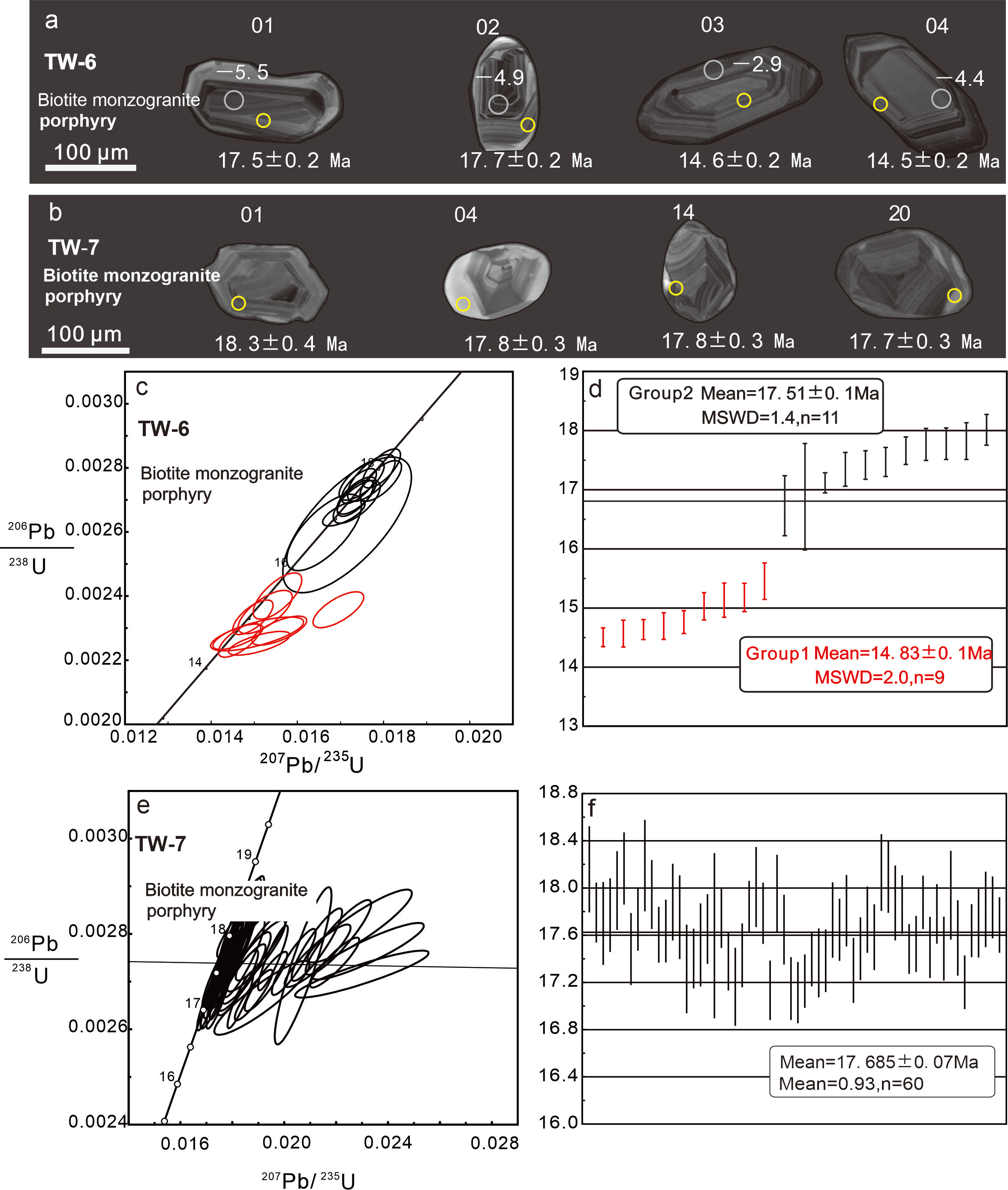
Figure 3a,b documents the CL textures of the analyzed zircon grains. Most grains are transparent, euhedral to subhedral prisms. Their oscillatory zoning and Th/U ratios of 0.11–4.58 are consistent with a magmatic origin.
Twenty analyses from TW6 define two distinct 206Pb/238U age populations (Figure 3c,d). Nine younger analyses yield an internal weighted mean of 14.83 ± 0.10 Ma (MSWD = 2.0), whereas eleven older analyses yield 17.51 ± 0.10 Ma (MSWD = 1.4). After inclusion of the conservative external term, these ages are reported as 14.8 ± 0.2 and 17.5 ± 0.2 Ma, respectively. The older population overlaps the coherent TW7 age and approximates crystallization, whereas the younger population most likely records post-crystallization Pb loss or isotopic disturbance.
Sixty analyses from TW7 define a coherent 206Pb/238U age population of 17.1–18.3 Ma and yield an internal weighted mean age of 17.63 ± 0.04 Ma (MSWD = 1.0; Figure 3e,f). Incorporating the conservative 1% external reproducibility term gives 17.6 ± 0.2 Ma, which is taken as the preferred crystallization age of the Ganquanhe intrusion.
Figure 3.
Zircon textures and U-Pb geochronology of the Ganquanhe biotite monzogranite porphyry. (a,b) Representative cathodoluminescence images of TW6 and TW7 zircons; yellow circles mark U-Pb analytical spots, gray circles mark Lu-Hf analytical spots, and adjacent values are εHf(t). (c,d) TW6 concordia and weighted-mean age plots, showing internal weighted means of 14.83 ± 0.10 Ma (MSWD = 2.0, n = 9) and 17.51 ± 0.10 Ma (MSWD = 1.4, n = 11). (e,f) TW7 concordia and weighted-mean age plots, yielding an internal weighted mean of 17.63 ± 0.04 Ma (MSWD = 1.0, n = 60). Error ellipses and internal weighted-mean uncertainties are shown at 1σ; the corresponding interpreted ages including the conservative 1% external term are 14.8 ± 0.2, 17.5 ± 0.2, and 17.6 ± 0.2 Ma, respectively.
5.2. Whole-Rock Geochemistry
Table S2 reports the major- and trace-element concentrations of the six whole-rock samples.
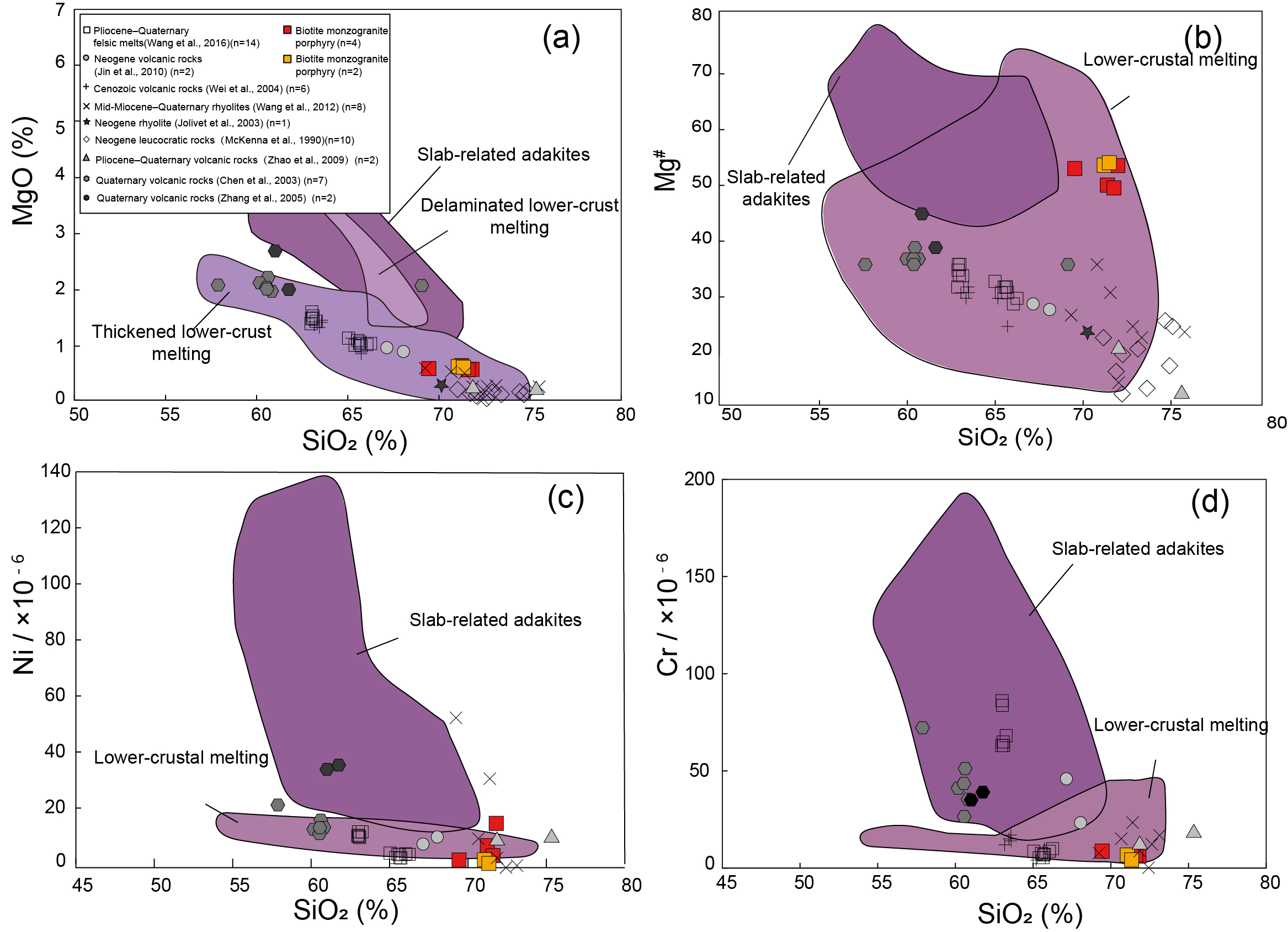
Major-element diagrams place the samples in the granite and high-K calc-alkaline fields (Figure 4a,b). They are metaluminous to weakly peraluminous in the A/NK-A/CNK diagram (Figure 4c). SiO2 ranges from 69.44 to 71.81 wt.%, and Al2O3 ranges from 14.44 to 15.07 wt.%. MgO, TFe2O3, TiO2, and P2O5 contents are low, at 0.54–0.62, 1.16–1.49, 0.25–0.27, and approximately 0.07 wt.%, respectively. Mg# values range from 49 to 53.
Figure 4.
Major-element classification diagrams for the Ganquanhe biotite monzogranite porphyry. (a) Total alkali–silica diagram, modified after [64]; (b) K2O versus SiO2 diagram, modified after [65]; (c) A/NK versus A/CNK diagram, modified after [66]. Comparative datasets comprise Pliocene–Quaternary felsic crustal melts [2], mid-Miocene–Quaternary peraluminous rhyolites [3], Neogene volcanic and leucocratic rocks [16,17,39,40,67], and Quaternary volcanic rocks [41,68].
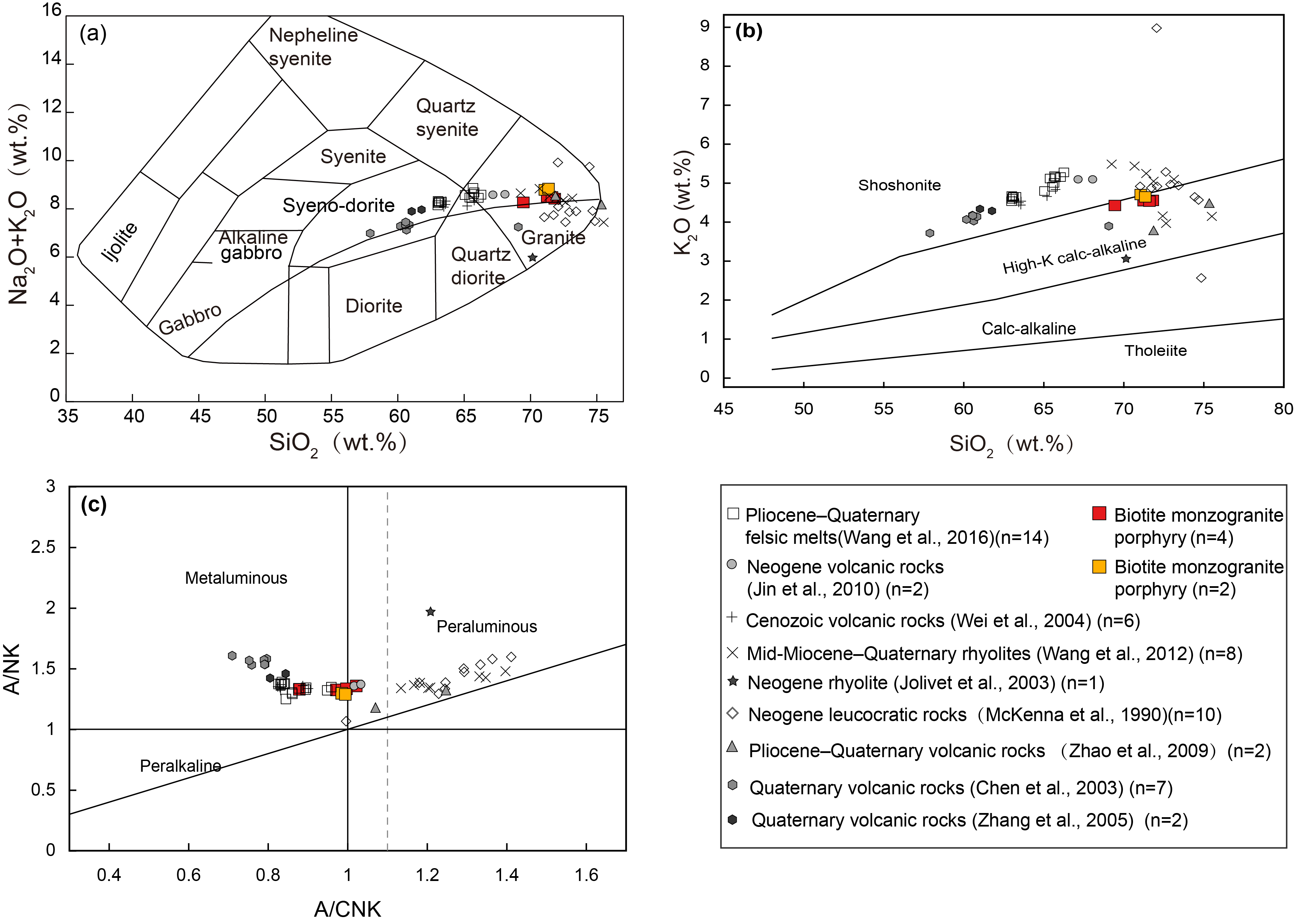
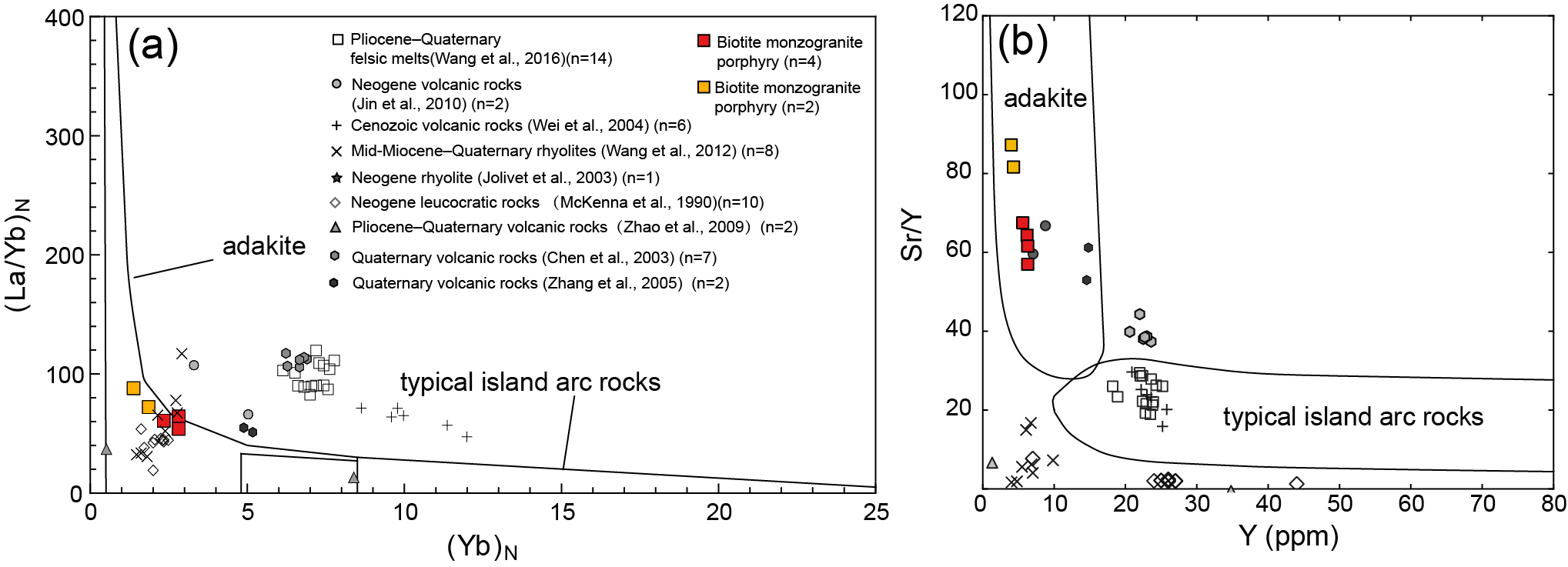
The samples contain 8.11–8.70 wt.% total alkalis (K2O + Na2O), with K2O/Na2O ratios of 1.14–1.22. These compositions define high-SiO2, alkali-rich felsic intrusive rocks (Figure 4a,b). Sr (349–399 ppm) and Ba (751–855 ppm) are relatively high. Y (4.0–6.3 ppm) and Yb (0.3–0.6 ppm) are low, whereas Sr/Y ratios are high (57–87).
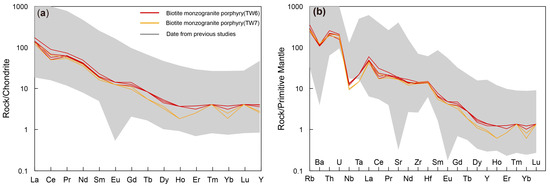
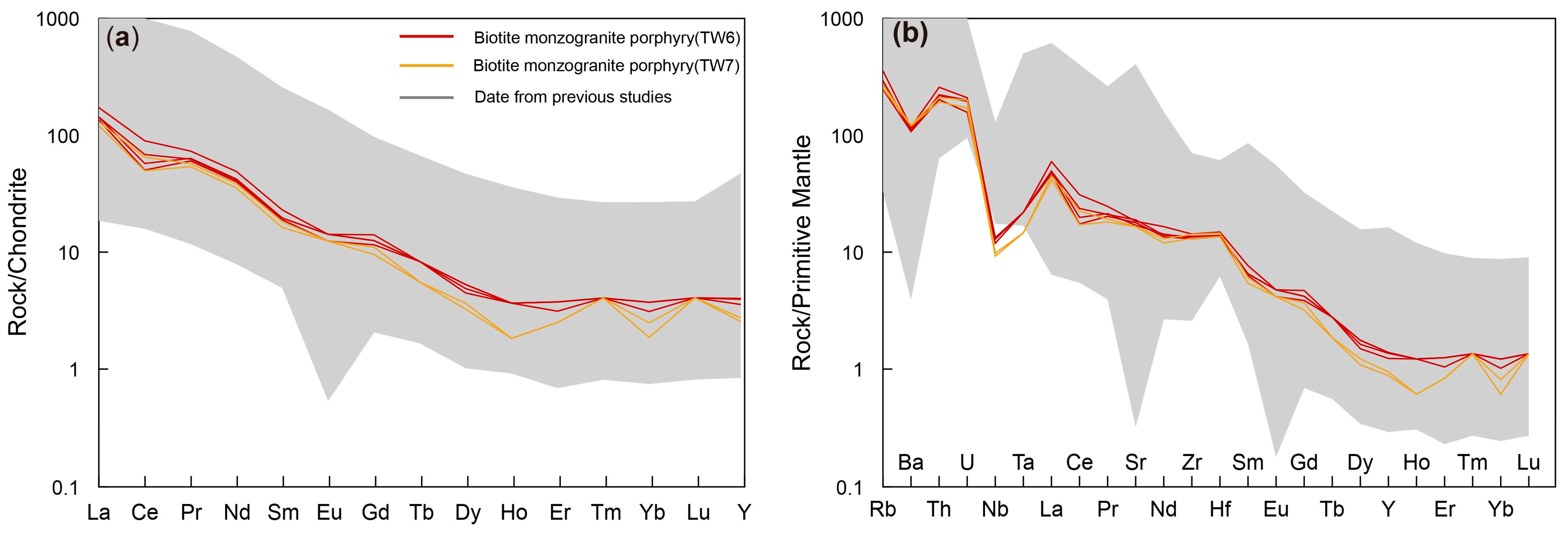
The chondrite-normalized rare earth element patterns and primitive-mantle-normalized trace-element spidergrams are shown in Figure 5. The samples display strongly fractionated REE patterns, with (La/Yb)N values of 39.9–67.6 and (La/Sm)N values of 7.4–7.8 (Figure 5a). They show weak Eu anomalies, with δEu values of 0.79–1.00. The primitive-mantle-normalized spidergrams show enrichment in large-ion lithophile elements and depletion in Nb and Ta (Figure 5b).
Figure 5.
(a) Chondrite-normalized rare earth element patterns and (b) primitive-mantle-normalized trace-element patterns for the Ganquanhe biotite monzogranite porphyry. Normalization values are from [56]; comparative datasets and their age-lithology groupings are described in the Figure 4 caption.
5.3. Zircon Saturation Temperature and Crustal-Thickness Estimates
Calculated M values range from 1.45 to 1.71, and the six samples yield TZr values of 760–782 °C (mean = 772 °C; Table S4). The median Sr/Y and (La/Yb)N ratios are 66.0 and 46.85, respectively. Applying the two collision-belt calibrations gives paleo-crustal-thickness estimates of 72.4 km from Sr/Y and 76.9 km from (La/Yb)N. The two estimates agree within the model uncertainty of approximately ±9 km; therefore, they are interpreted collectively as evidence for a strongly thickened crust rather than as precise Moho depths.
5.4. Zircon Lu-Hf Isotopes
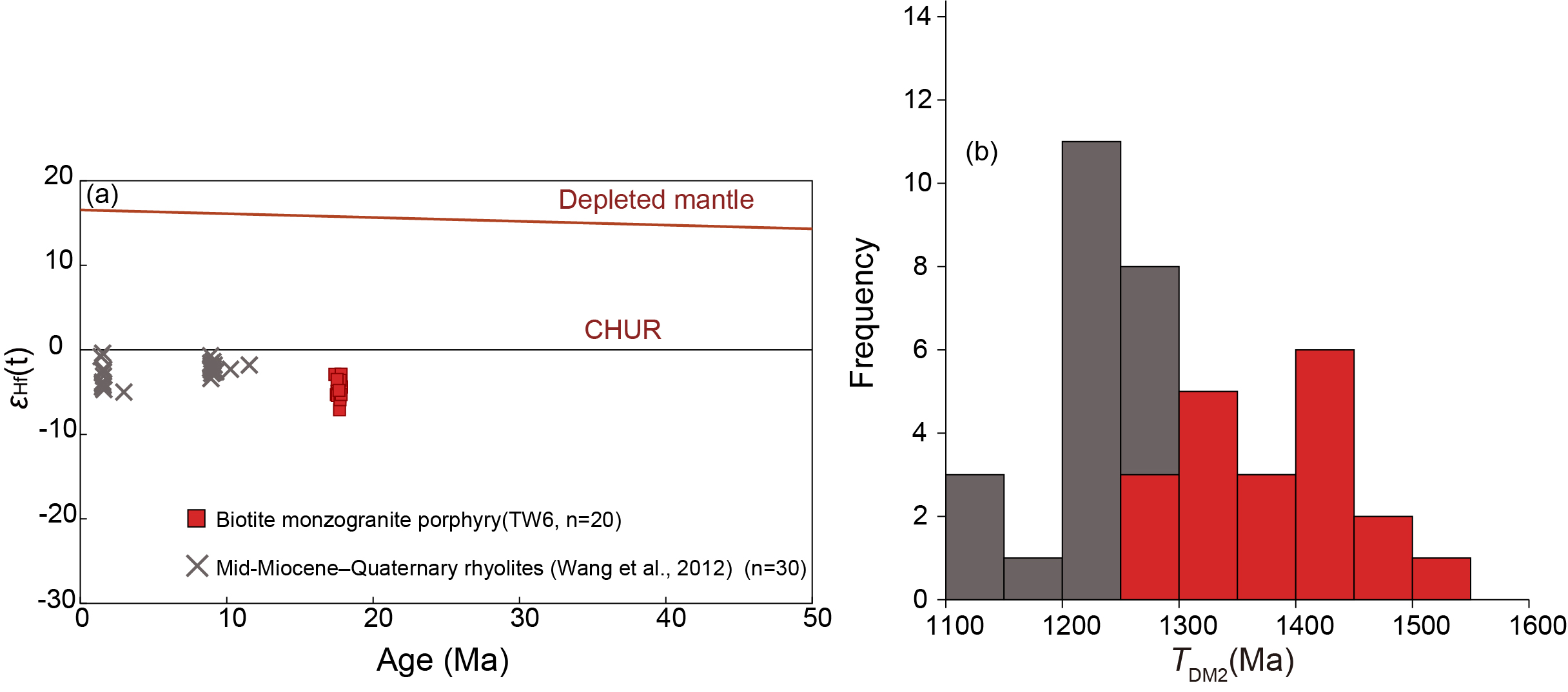
In situ zircon Lu-Hf isotopic compositions for sample TW6 are provided in Table S3. TW6 was chosen because all 20 U-Pb-dated spots, including both age populations, could be compared isotopically; the purpose of the Hf analyses is source characterization rather than age determination. The εHf(t) values were calculated using 14.83 Ma for the younger group and 17.51 Ma for the older group.
The analyzed zircons have 176Yb/177Hf ratios of 0.005367–0.019521, 176Lu/177Hf ratios of 0.000207–0.000899, and 176Hf/177Hf ratios of 0.282563–0.282681.
The younger TW6 group has εHf(t) values of −7.1 to −2.9 (mean = −4.2, n = 9) and TDM2 ages of 1278–1542 Ma (mean = 1359 Ma), whereas the older group has εHf(t) values of −5.9 to −2.9 (mean = −4.7, n = 11) and TDM2 ages of 1280–1470 Ma (mean = 1397 Ma). The substantial overlap between the two groups is consistent with a common crustal magma source and supports interpreting the younger U-Pb dates as Pb loss or isotopic disturbance rather than a separate magmatic episode. The isotopic results are summarized in Figure 6.
No Lu-Hf analyses are available for TW7. Consequently, the Hf data are used only to constrain the source characteristics represented by TW6 and to compare its two age populations; they are not used to establish the crystallization age or to claim sample-to-sample Hf-isotope homogeneity. TW7 provides the independent and more coherent U-Pb crystallization-age constraint.
Figure 6.
Zircon Hf isotopic characteristics of the Ganquanhe biotite monzogranite porphyry. (a) Zircon εHf(t) values plotted against the corresponding TW6 group ages, with chondritic uniform reservoir (CHUR) and depleted-mantle evolution lines. (b) Frequency distribution of two-stage Hf model ages (TDM2). Red squares in (a) and red bars in (b) represent TW6 zircons; gray crosses in (a) and gray bars in (b) represent the comparative dataset. Comparative zircon Hf-isotope data for the mid-Miocene–Quaternary peraluminous rhyolites are from [3].
6. Discussion
6.1. Adakitic Affinity
Adakitic affinity is used here as a descriptive geochemical association, not as a genetic designation. High Sr/Y and La/Yb, low Y and Yb, heavy rare earth element (HREE) depletion, and weak Eu anomalies can arise through several petrogenetic pathways [69,70,71,72,73,74,75,76,77,78,79,80,81,82].
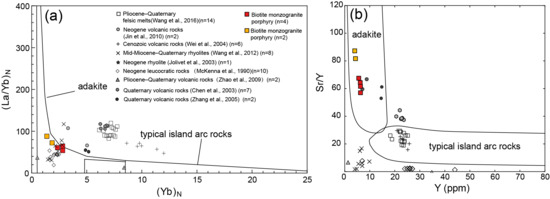
The Ganquanhe samples plot within or adjacent to the adakitic fields (Figure 7). Although Sr contents do not uniformly exceed the conventional 400 ppm threshold, the combined Sr/Y, Y and Yb, REE, and Eu-anomaly systematics support classification as a high-Sr/Y felsic intrusion with adakitic affinity.
Figure 7.
Adakitic discrimination diagrams for the Ganquanhe biotite monzogranite porphyry: (a) (La/Yb)N versus (Yb)N and (b) Sr/Y versus Y, modified after [83]. Comparative datasets and their age-lithology groupings are described in the Figure 4 caption.
6.2. Petrogenesis
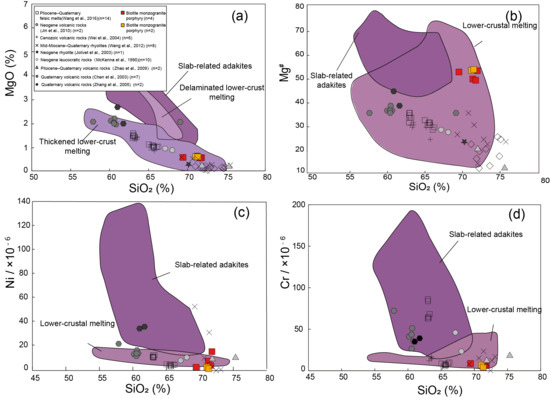
High-Sr/Y felsic magmas can originate through slab melting, remelting of delaminated or thickened lower crust, magma mixing, or high-pressure differentiation [15,69,70,71,72,73,74,75,76,77,78,79,80,81,82]. The low MgO, Ni, and Cr contents and felsic mineralogy of the Ganquanhe samples provide little evidence for substantial mantle input. Their positions in Figure 8 favor lower-crustal melting over slab-related fields, although Mg# values of 48.6–53.1 permit limited interaction with mafic magma or mantle-derived material.
Figure 8.
Petrogenetic discrimination diagrams for the Ganquanhe biotite monzogranite porphyry: (a) SiO2 versus MgO, modified after [84]; (b) SiO2 versus Mg#, modified after [85]; (c) SiO2 versus Ni and (d) SiO2 versus Cr, modified after [86]. Comparative datasets are described in the Figure 4 caption.
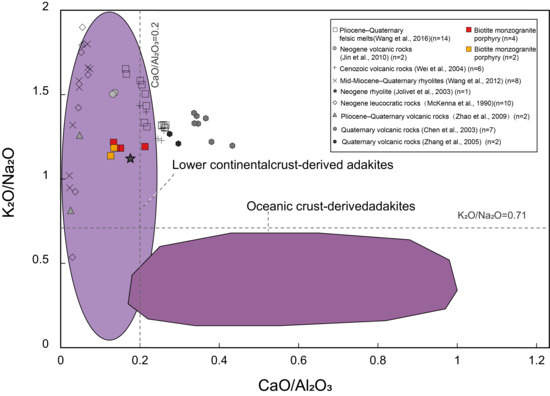
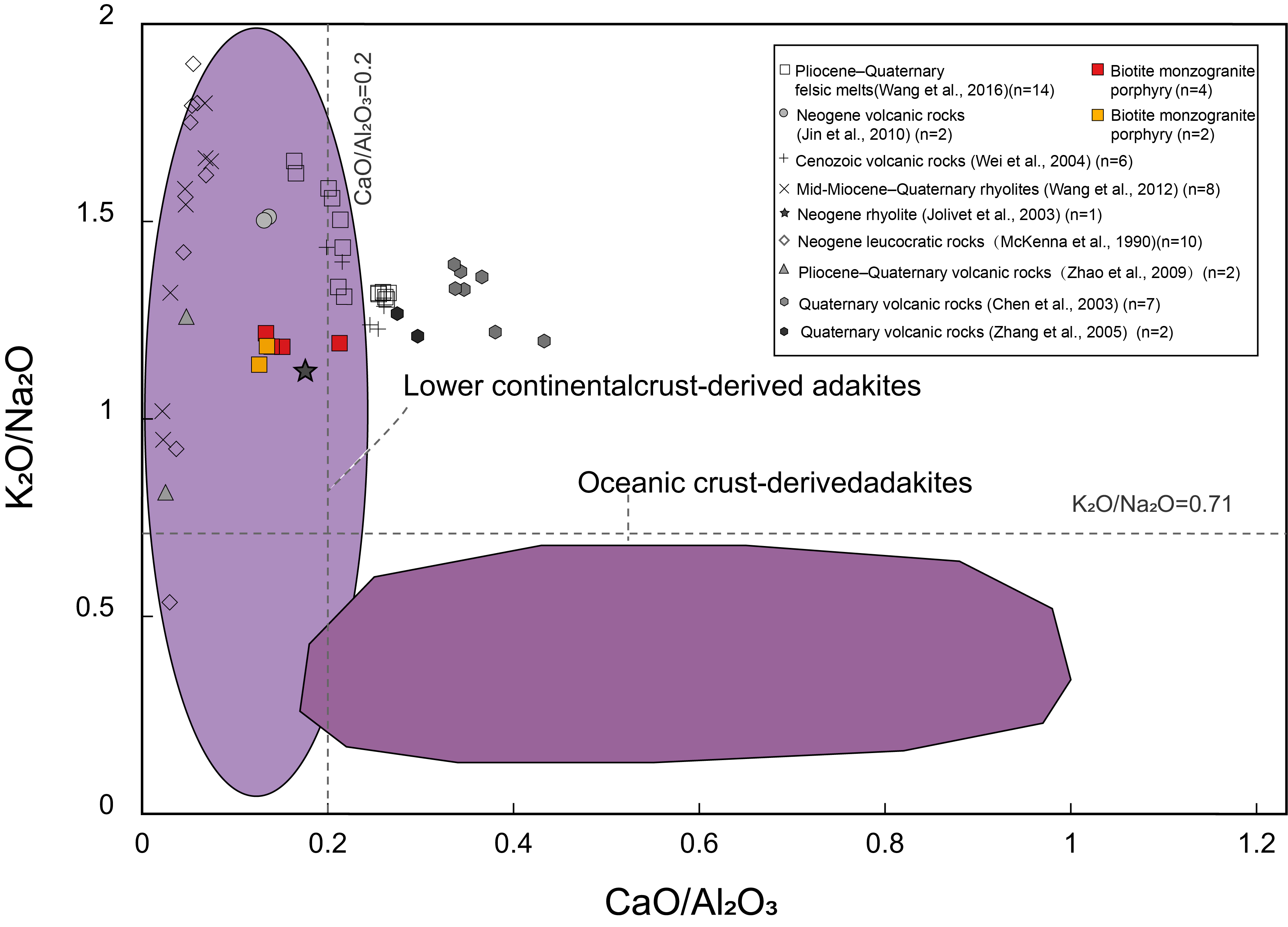
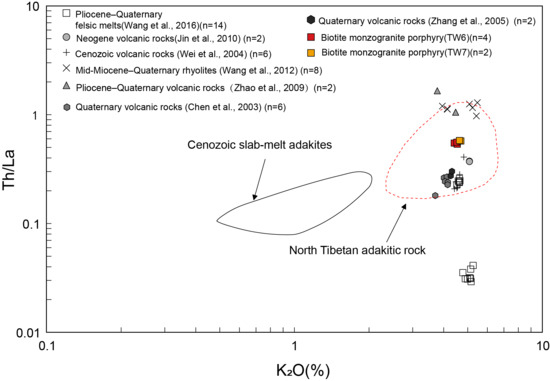
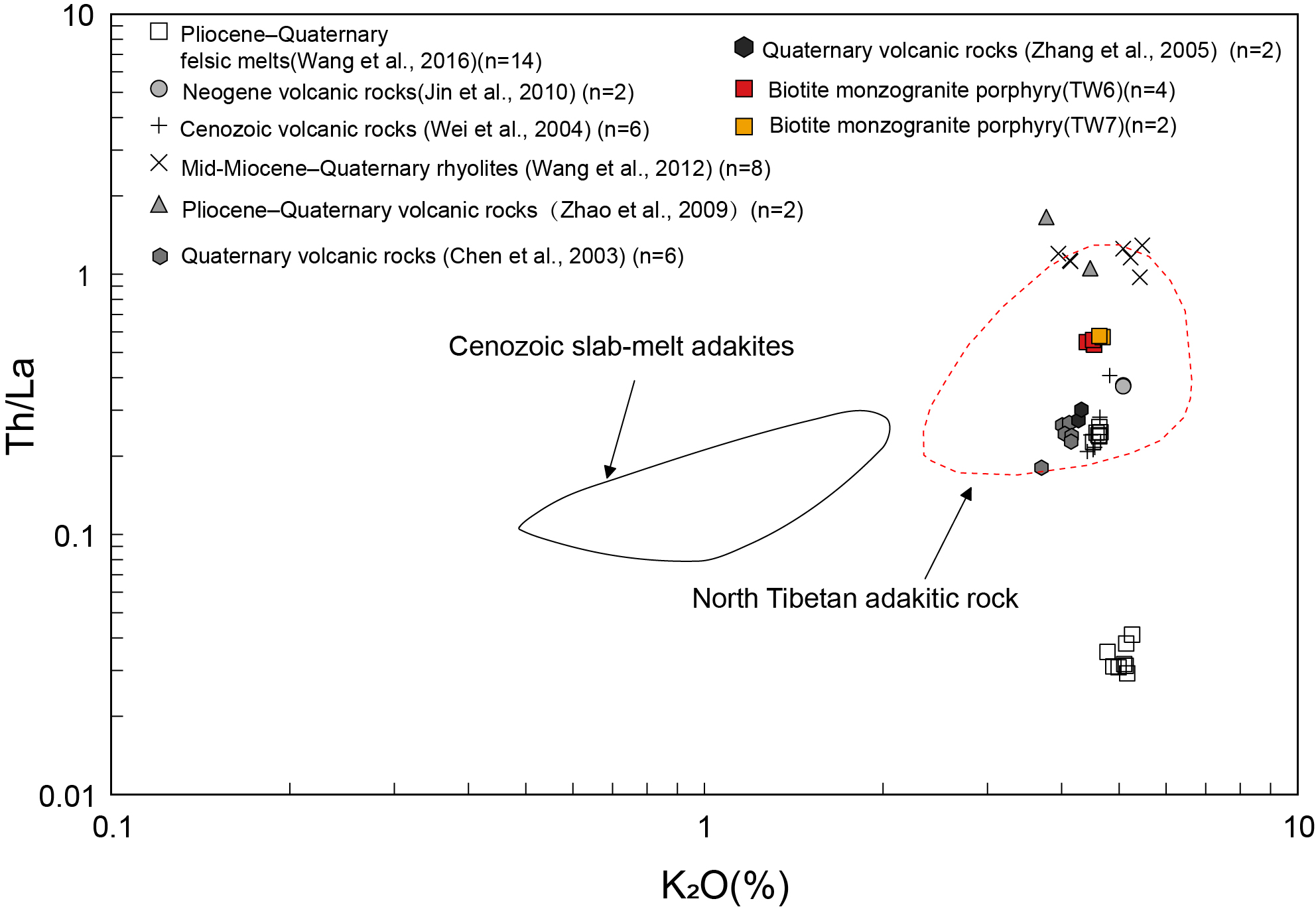
Compositional ratios further oppose direct melting of young oceanic crust. High K2O/Na2O (1.14–1.22) and Th/La (0.535–0.579) overlap northern Tibetan adakitic rocks (Figure 9 and Figure 10). Low CaO/Al2O3 (0.126–0.213) further distinguishes the samples from typical Cenozoic slab melts. The intracontinental Miocene setting independently supports a continental lower-crustal source [15,70,71,76,77].
Figure 9.
K2O/Na2O versus CaO/Al2O3 discrimination diagram for the Ganquanhe biotite monzogranite porphyry, showing lower-continental-crust-derived and oceanic-crust-derived adakite fields; modified after [84]. Comparative datasets are described in the Figure 4 caption.
Figure 10.
Th/La versus K2O diagram for the Ganquanhe biotite monzogranite porphyry, showing Cenozoic slab-melt adakites and northern Tibetan adakitic rocks; modified after [83]. Comparative datasets are described in the Figure 4 caption.
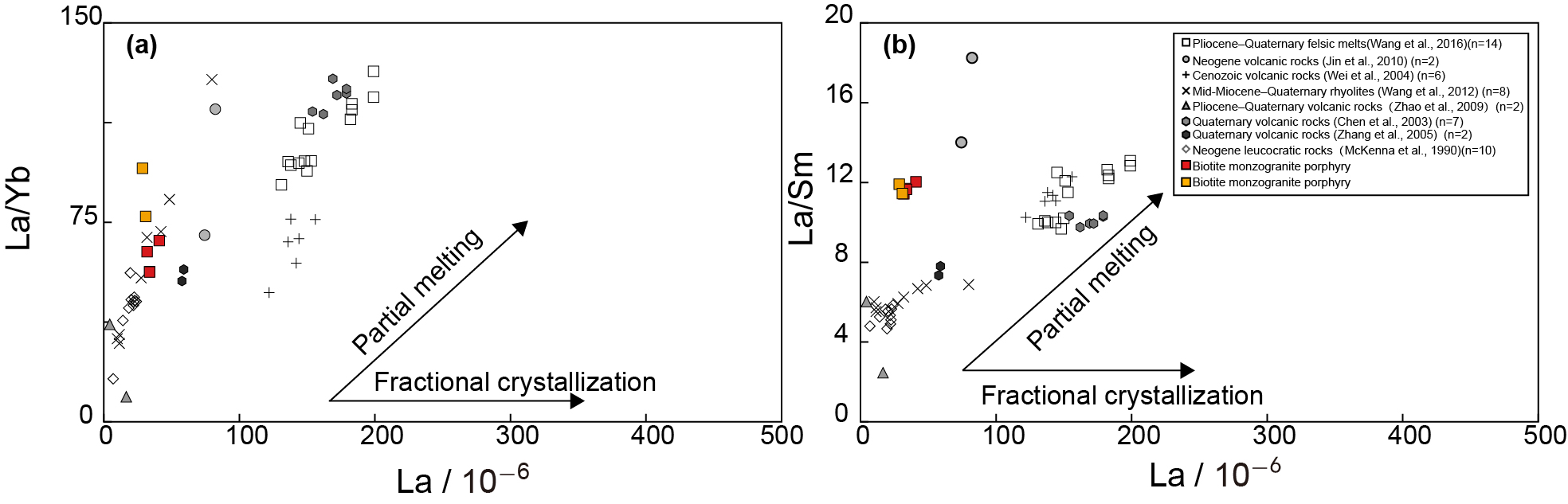
Low Fe, Ti, and Mg contents alone do not demonstrate that the magma was strongly evolved. The relatively high Mg# values, together with weak negative Eu, Sr, P, and Ti anomalies, argue against extensive fractionation of feldspar, apatite, or Fe-Ti oxides. Limited shallow differentiation may have occurred, but it cannot account for the primary high-Sr/Y and strongly fractionated REE signatures, which are better explained by source-region mineral residues. The partial-melting and fractional-crystallization relationships are shown in Figure 11.
Figure 11.
(a) La versus La/Yb and (b) La versus La/Sm diagrams for the Ganquanhe biotite monzogranite porphyry, showing partial-melting and fractional-crystallization trends; modified after [87]. Comparative datasets are described in the Figure 4 caption.
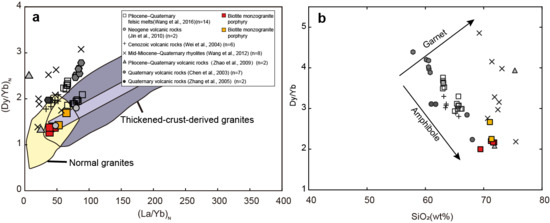
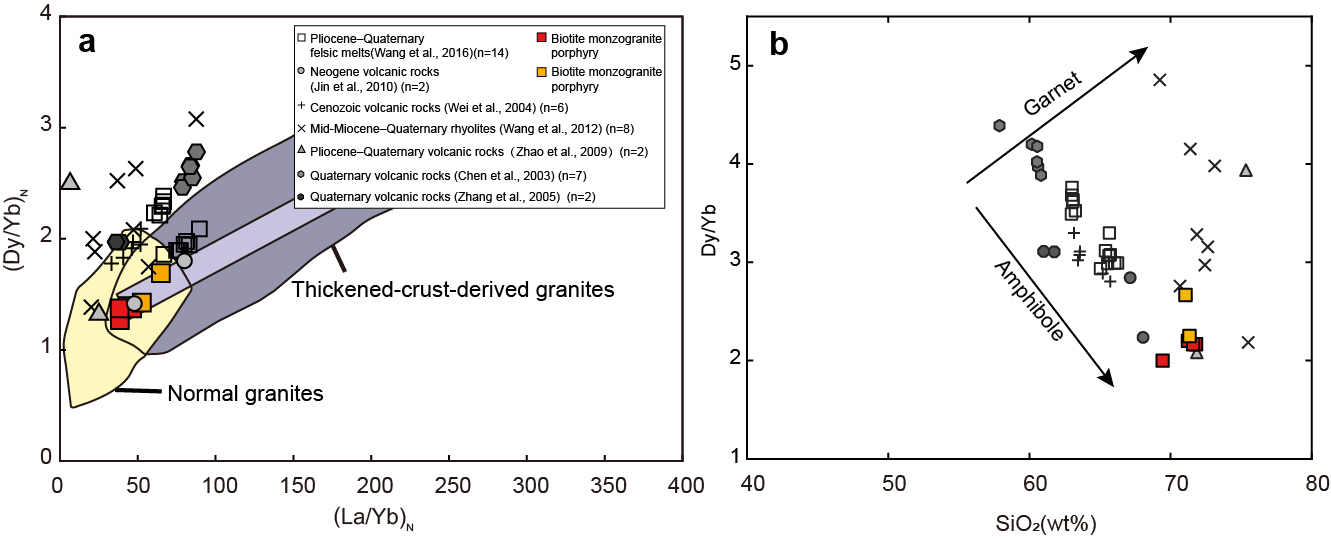
The elevated (Dy/Yb)N ratios (1.27–1.69), HREE depletion, and weak Eu anomalies indicate melting in the presence of residual garnet ± amphibole but little residual plagioclase [63,70,76,77,78,79,80]. In the Dy/Yb versus SiO2 plot, the six samples retain high Dy/Yb over a narrow silica range and do not define a systematic differentiation trend (Figure 12b). This pattern is consistent with source-controlled HREE fractionation, although the small sample size precludes a strong trend-based inference. Negative zircon εHf(t) values and Mesoproterozoic TDM2 ages further identify an ancient continental source rather than newly accreted juvenile crust. The overlapping εHf(t) and TDM2 distributions of the younger and older TW6 zircon groups further argue against two isotopically distinct magma sources, although the absence of TW7 Hf data limits assessment of between-sample isotopic variability.
Figure 12.
Residual-mineral constraints for the Ganquanhe biotite monzogranite porphyry. (a) (La/Yb)N versus (Dy/Yb)N diagram showing normal-granite and thickened-crust-derived granite fields, modified after [88]; comparative datasets are described in the Figure 4 caption. (b) Dy/Yb versus SiO2 for the six Ganquanhe samples. Red squares, TW6 (n = 4); orange squares, TW7 (n = 2). The narrow SiO2 range and small sample size are noted; no regression is fitted.
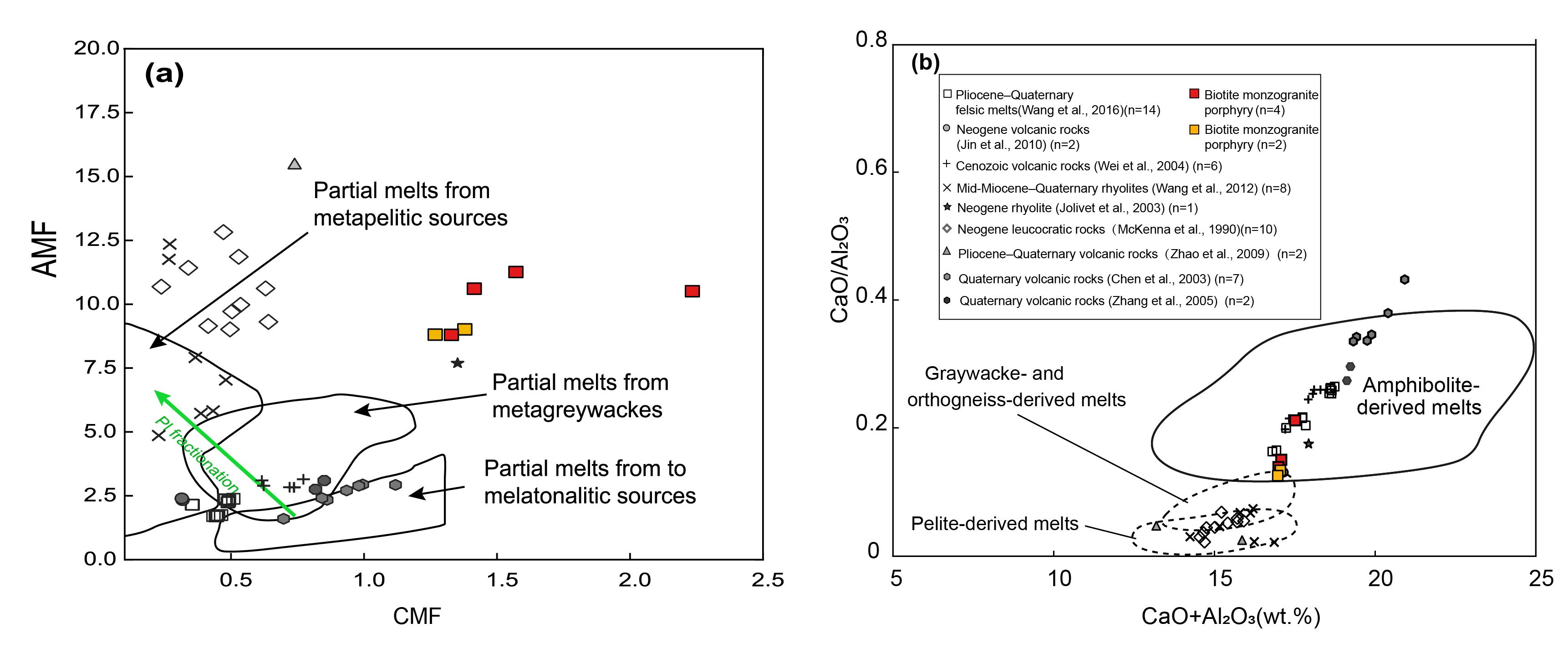
The Harker diagrams show weak or inconsistent major-element trends, supporting limited rather than extensive fractional crystallization (Figure 13). The major-element source-discrimination diagrams provide a more specific source constraint (Figure 14). The samples lie closest to amphibolite-derived melts and partly overlap the graywacke–orthogneiss domain, whereas a dominantly pelitic source is not supported. Combined with the low MgO, Ni, and Cr contents, negative zircon εHf(t), and garnet ± amphibole residue signature, the preferred source is therefore ancient amphibolitic (mafic) lower crust containing subordinate felsic crustal components. The displacement of some samples from experimental melt fields may reflect source heterogeneity and limited magmatic differentiation, so a minor graywacke or orthogneiss contribution cannot be excluded.
Figure 13.
Harker diagrams for the Ganquanhe biotite monzogranite porphyry: (a) Al2O3, (b) Na2O, (c) TiO2, (d) K2O, (e) MgO, (f) Eu/Eu*, (g) CaO, and (h) P2O5 versus SiO2; (i) legend. The weak or inconsistent trends and limited Eu, P, and Ti depletions argue against extensive feldspar, apatite, or Fe-Ti oxide fractionation. Comparative datasets are described in the Figure 4 caption.
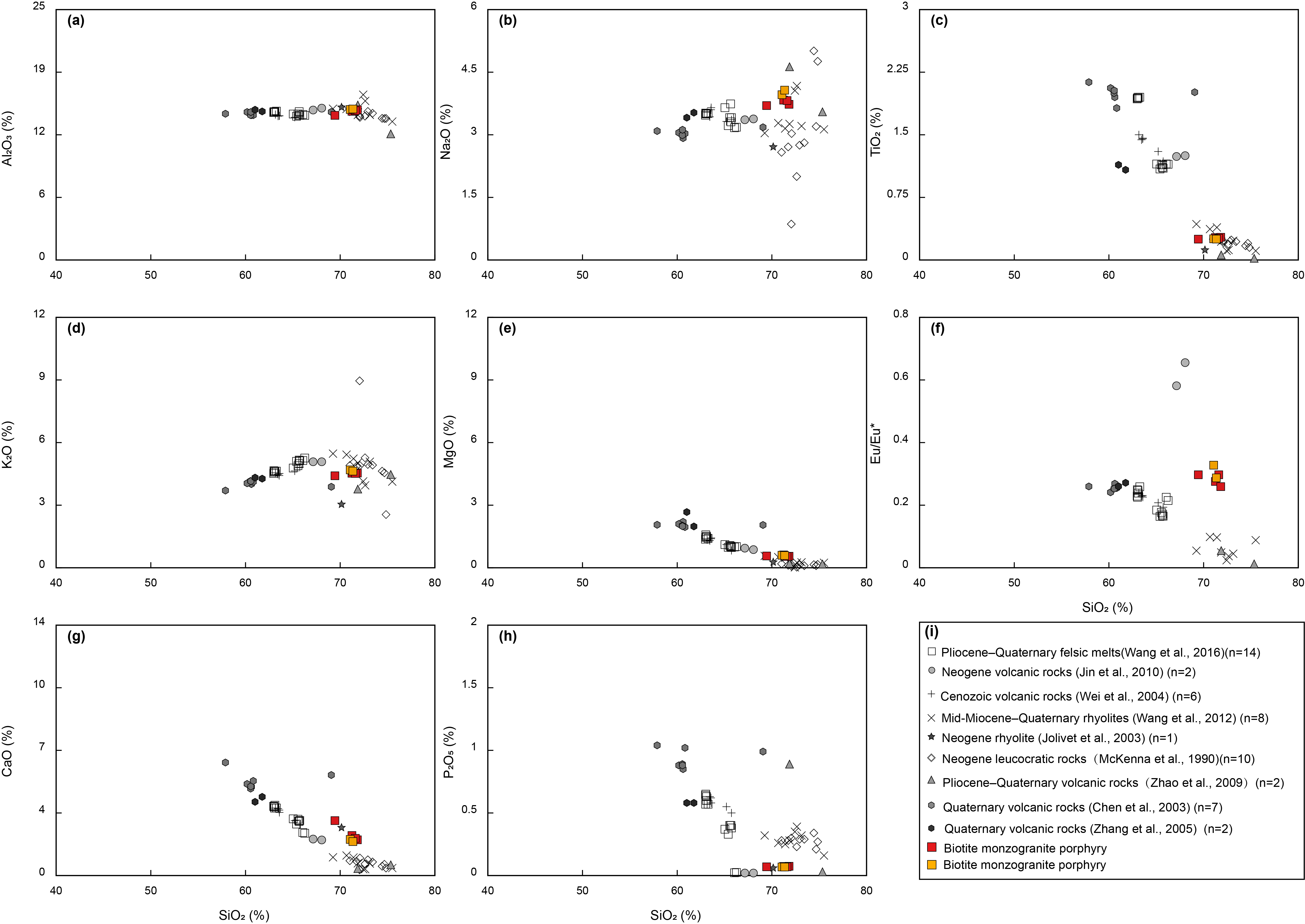
Figure 14.
Major-element source-discrimination diagrams for the Ganquanhe biotite monzogranite porphyry. (a) Molar Al2O3/(MgO + FeOᵀ) (AMF) versus molar CaO/(MgO + FeOᵀ) (CMF), modified after [89]. (b) CaO/Al2O3 versus CaO + Al2O3, showing experimental melt fields for amphibolite, graywacke–orthogneiss, and pelite sources; modified after [90]. Comparative datasets and their age-lithology groupings are described in the Figure 4 caption.
6.3. Tectonic Implications for Miocene Magmatism in the East Kunlun Orogen
The 17.6 ± 0.2 Ma crystallization age, including the conservative external uncertainty term, dates magma emplacement rather than the onset of crustal thickening. Regional evidence shows that southern Qaidam and East Kunlun had already undergone substantial shortening, thrusting, and lower-crustal underthrusting by the Early Miocene [5,6,30,31,32,33,34,35,36,37,44,45,91,92]. The intrusion therefore records melting of a preconditioned thickened crustal source rather than a sharp regional tectonic transition at ca. 17.6 Ma.
The comparative dataset is not uniformly coeval with Ganquanhe. Only the mid-Miocene subset overlaps its emplacement age; the remaining samples include broader Neogene and Pliocene–Quaternary felsic volcanic, rhyolitic, and leucocratic intrusive assemblages [2,3,16,17,39,40,41,67,68]. Their compositional divergence from Ganquanhe therefore reflects both different source–process combinations and a time-transgressive regional magmatic record. Ganquanhe specifically extends the evidence for crust-derived Early Miocene magmatism to the southern East Kunlun margin.
The TZr range of 760–782 °C indicates a moderately hot felsic magma and lies within the 700–844 °C range reported for crust-derived felsic lavas of the Songpan–Ganzi–Central Kunlun region [2]. More importantly, the ca. 17.6 Ma Ganquanhe intrusion is coeval with 18–15 Ma Hoh Xil K-rich adakitic magmatism attributed to melting of amphibole-bearing lower crust at depths of at least 55 km [12]. The Ganquanhe proxy estimates of 72–77 km also overlap, within model uncertainty, the independently constrained 66–69 km crustal thickness of southern Tibet during the Middle Miocene [60]. These comparisons support a regionally thick and thermally capable crust during Early–Middle Miocene magmatism, but they do not establish when thickening began or uniquely identify the heat source.
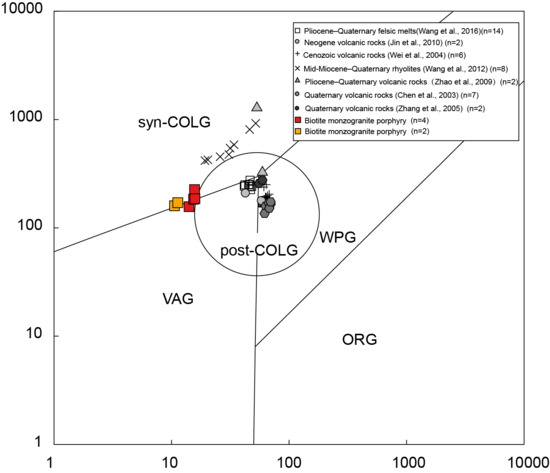
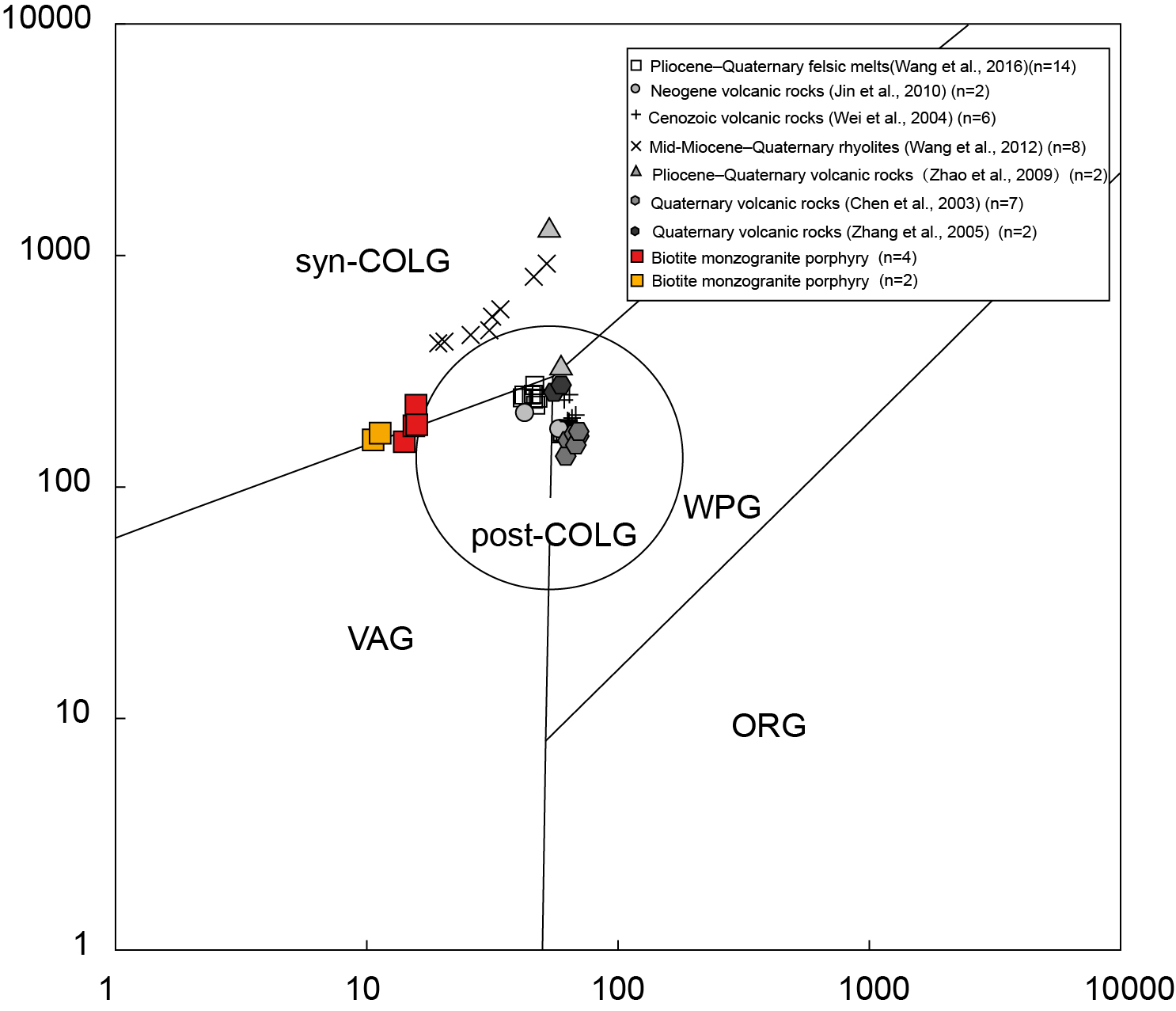
Trace-element discrimination places the samples near syn-collisional and post-collisional granite fields (Figure 15). Such diagrams are non-unique because inherited and fractionated magmas may preserve arc-like signatures after collision [93]. Nevertheless, the regional absence of a coeval oceanic arc and the crustal geochemical and isotopic characteristics support an intracontinental collisional to post-collisional setting.
Figure 15.
Rb versus Y + Nb tectonic discrimination diagram for the Ganquanhe biotite monzogranite porphyry, modified after [93]. VAG, volcanic-arc granites; syn-COLG, syn-collisional granites; post-COLG, post-collisional granites; WPG, within-plate granites; ORG, ocean-ridge granites. Red and orange squares represent TW6 and TW7, respectively; the other symbols denote the published comparative datasets identified in the legend. Comparative datasets are described in the Figure 4 caption.
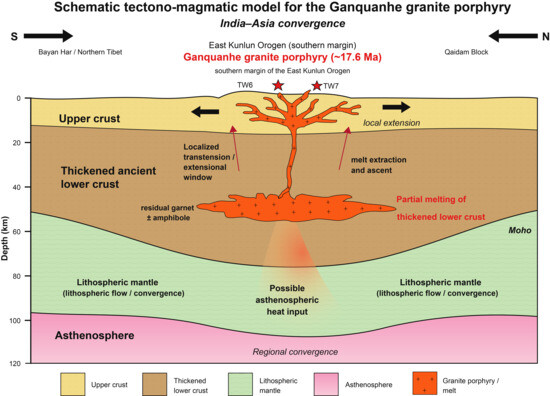
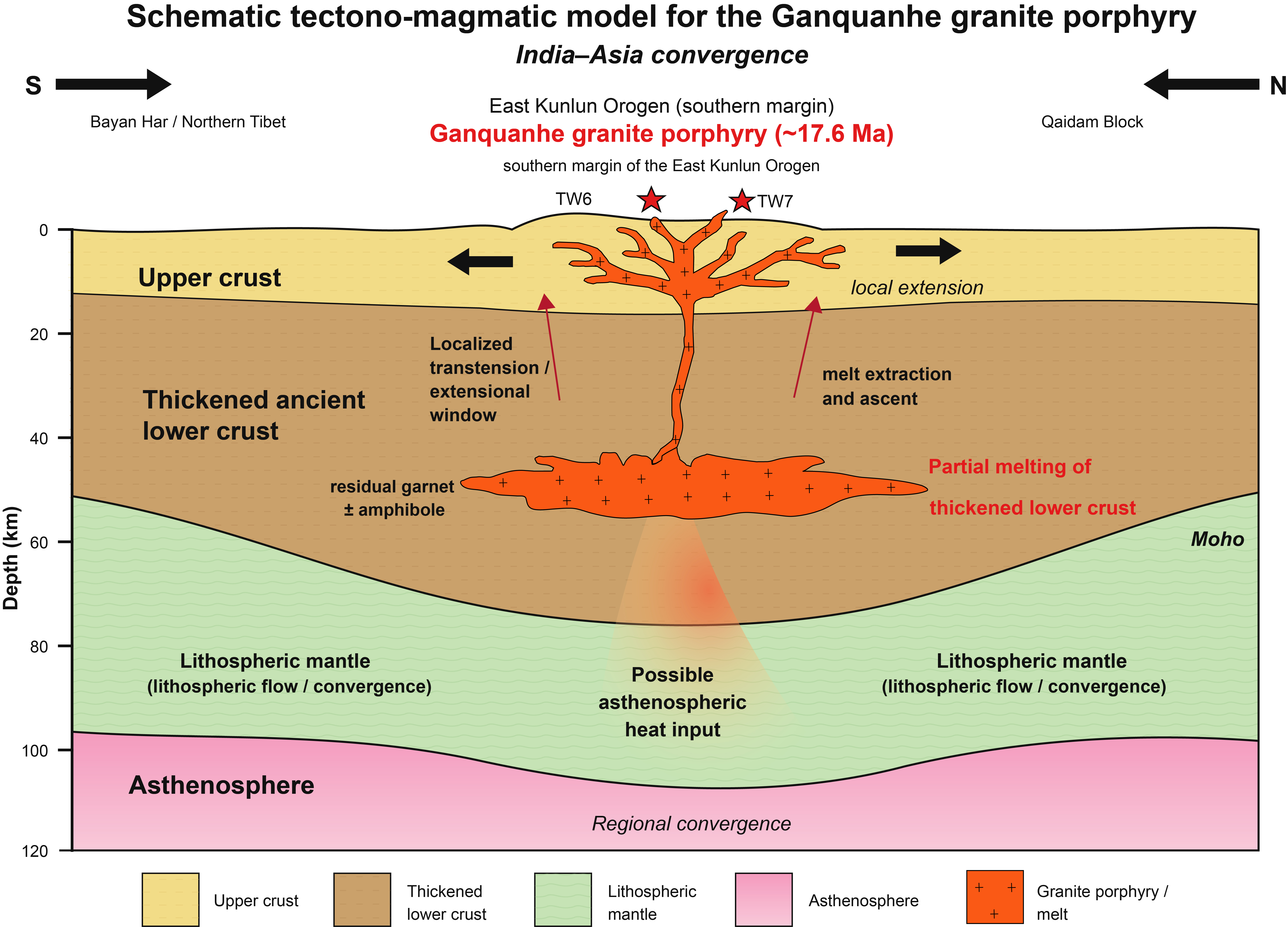
Regional geophysical studies identify partially molten mid-to-lower-crustal domains beneath northern Tibet and possible melt migration beyond the Kunlun fault [2,3,24,25,26,27,28,29,37,92]. Neogene fault reactivation may therefore have aided melt extraction and ascent [16,22,23,27,30,33,34,35,36,37]. In the preferred model, ancient amphibolitic lower crust containing residual garnet ± amphibole thickened during collision and partially melted at ca. 17.6 Ma (Figure 16). The melt rose along deep structures and crystallized as the Ganquanhe pluton, although the immediate thermal trigger remains unresolved.
Figure 16.
Tectono-magmatic model for the Early Miocene Ganquanhe biotite monzogranite porphyry. Cenozoic convergence thickened ancient amphibolitic lower crust beneath the southern East Kunlun margin. At ca. 17.6 Ma, localized transtension and possible heat input promoted partial melting in the presence of residual garnet ± amphibole. The melt ascended along structural weaknesses and formed the Ganquanhe pluton; the immediate heat-transfer mechanism remains uncertain. Inward-pointing black arrows indicate regional India–Asia convergence, and outward-pointing black arrows indicate local extension. Red arrows denote localized transtension and melt extraction and ascent, as labeled.
Whole-rock Sr–Nd–Pb isotopes, mineral chemistry, thermobarometry, and phase-equilibrium modeling are needed to constrain the source lithology, pressure–temperature conditions, and heat-transfer mechanism.
7. Conclusions
- (1)
- TW6 contains two zircon age groups with internal weighted means of 14.83 ± 0.10 and 17.51 ± 0.10 Ma; after inclusion of a conservative 1% external reproducibility term, the corresponding ages are 14.8 ± 0.2 and 17.5 ± 0.2 Ma. The older group overlaps the coherent TW7 crystallization age of 17.6 ± 0.2 Ma. The Ganquanhe intrusion is therefore Early Miocene and is accurately classified as biotite monzogranite porphyry.
- (2)
- Integrated Sr/Y, Y and Yb, REE, and Eu-anomaly systematics establish a high-Sr/Y felsic composition with adakitic affinity. Relatively high Mg#, weak negative Eu, Sr, P, and Ti anomalies, and Harker relationships indicate limited rather than extensive fractional crystallization; the fractionated REE pattern mainly records residual garnet ± amphibole in the source.
- (3)
- Whole-rock zircon saturation temperatures of 760–782 °C and Sr/Y- and (La/Yb)N-based paleo-crustal-thickness estimates of approximately 72–77 km indicate Early Miocene melting within a warm, strongly thickened crust. Major-element source discrimination, whole-rock geochemistry, and negative zircon εHf(t) values favor partial melting of ancient amphibolitic lower crust with possible subordinate graywacke–orthogneiss components in a collisional to post-collisional intracontinental setting; the immediate thermal trigger remains uncertain.
Supplementary Materials
The following supporting information can be downloaded at: https://www.mdpi.com/article/10.3390/geosciences16090383/s1 ; Table S1: LA-ICP-MS zircon U-Pb dating results for the Ganquanhe biotite monzogranite porphyry (samples TW6 and TW7); Table S2: whole-rock major- and trace-element compositions of the Ganquanhe biotite monzogranite porphyry; Table S3: LA-MC-ICP-MS zircon Lu-Hf isotope data for the Ganquanhe biotite monzogranite porphyry (sample TW6); Table S4: whole-rock zircon saturation temperatures and trace-element ratios used for paleo-crustal-thickness estimation.
Author Contributions
Conceptualization, T.B. and J.Z.; methodology, T.B.; software, T.B.; validation, J.Z., M.S., Y.Z., Y.S., S.Y. and X.L.; formal analysis, T.B.; investigation, T.B., Y.Z., Y.S., S.Y. and X.L.; resources, J.Z. and M.S.; data curation, T.B.; writing—original draft preparation, T.B. and M.S.; writing—review and editing, J.Z. and M.S.; visualization, T.B.; supervision, J.Z. and M.S.; project administration, M.S.; funding acquisition, J.Z. and M.S. All authors have read and agreed to the published version of the manuscript.
Funding
This research was funded by the China Geological Survey through the 1:50,000 Regional Geological Survey of three map sheets including J45E018007 in the Qukuklek area, Qiemo County, Xinjiang (Grant No. DD20250103003).
Institutional Review Board Statement
Not applicable.
Informed Consent Statement
Not applicable.
Data Availability Statement
The original contributions presented in this study are included in the article and Supplementary Materials (Tables S1–S4). Further inquiries can be directed to the corresponding authors.
Acknowledgments
Not applicable.
Conflicts of Interest
The authors declare no conflicts of interest. The funders had no role in the design of the study; in the collection, analyses, or interpretation of data; in the writing of the manuscript; or in the decision to publish the results.
References
- Yin, A.; Harrison, T.M. Geologic evolution of the Himalayan-Tibetan orogen. Annu. Rev. Earth Planet. Sci. 2000, 28, 211–280. [Google Scholar] [CrossRef] [Scilit]
- Wang, Q.; Hawkesworth, C.J.; Wyman, D.; Chung, S.-L.; Wu, F.-Y.; Li, X.-H.; Li, Z.-X.; Gou, G.-N.; Zhang, X.-Z.; Tang, G.-J.; et al. Pliocene-Quaternary crustal melting in central and northern Tibet and insights into crustal flow. Nat. Commun. 2016, 7, 11888. [Google Scholar] [CrossRef] [Scilit] [PubMed]
- Wang, Q.; Chung, S.-L.; Li, X.-H.; Wyman, D.; Li, Z.-X.; Sun, W.-D.; Qiu, H.-N.; Liu, Y.-S.; Zhu, Y.-T. Crustal melting and flow beneath northern Tibet: Evidence from Mid-Miocene to Quaternary strongly peraluminous rhyolites in the Southern Kunlun Range. J. Petrol. 2012, 53, 2523–2566. [Google Scholar] [CrossRef] [Scilit]
- Chung, S.-L.; Chu, M.-F.; Zhang, Y.; Xie, Y.; Lo, C.-H.; Lee, T.-Y.; Lan, C.-Y.; Li, X.; Zhang, Q.; Wang, Y. Tibetan tectonic evolution inferred from spatial and temporal variations in post-collisional magmatism. Earth-Sci. Rev. 2005, 68, 173–196. [Google Scholar] [CrossRef] [Scilit]
- Tapponnier, P.; Xu, Z.; Roger, F.; Meyer, B.; Arnaud, N.; Wittlinger, G.; Yang, J. Oblique stepwise rise and growth of the Tibet Plateau. Science 2001, 294, 1671–1677. [Google Scholar] [CrossRef] [Scilit] [PubMed]
- Royden, L.H.; Burchfiel, B.C.; van der Hilst, R.D. The geological evolution of the Tibetan Plateau. Science 2008, 321, 1054–1058. [Google Scholar] [CrossRef] [Scilit] [PubMed]
- Molnar, P.; England, P.; Martinod, J. Mantle dynamics, uplift of the Tibetan Plateau, and the Indian monsoon. Rev. Geophys. 1993, 31, 357–396. [Google Scholar] [CrossRef] [Scilit]
- Nelson, K.D.; Zhao, W.; Brown, L.D.; Kuo, J.; Che, J.; Liu, X.; Klemperer, S.L.; Makovsky, Y.; Meissner, R.; Mechie, J.; et al. Partially molten middle crust beneath southern Tibet: Synthesis of project INDEPTH results. Science 1996, 274, 1684–1688. [Google Scholar] [CrossRef] [Scilit] [PubMed]
- Royden, L.H.; Burchfiel, B.C.; King, R.W.; Wang, E.; Chen, Z.; Shen, F.; Liu, Y. Surface deformation and lower crustal flow in eastern Tibet. Science 1997, 276, 788–790. [Google Scholar] [CrossRef] [Scilit] [PubMed]
- Clark, M.K.; Royden, L.H. Topographic ooze: Building the eastern margin of Tibet by lower crustal flow. Geology 2000, 28, 703–706. [Google Scholar] [CrossRef] [Scilit]
- Beaumont, C.; Jamieson, R.A.; Nguyen, M.H.; Lee, B. Himalayan tectonics explained by extrusion of a low-viscosity crustal channel coupled to focused surface denudation. Nature 2001, 414, 738–742. [Google Scholar] [CrossRef] [Scilit] [PubMed]
- Wang, Q.; McDermott, F.; Xu, J.-F.; Bellon, H.; Zhu, Y.-T. Cenozoic K-rich adakitic volcanic rocks in the Hohxil area, northern Tibet: Lower-crustal melting in an intracontinental setting. Geology 2005, 33, 465–468. [Google Scholar] [CrossRef] [Scilit]
- Wang, Q.; Wyman, D.A.; Xu, J.-F.; Dong, Y.-H.; Vasconcelos, P.M.; Pearson, N.; Wan, Y.-S.; Dong, H.; Li, C.-F.; Yu, Y.-S.; et al. Eocene melting of subducting continental crust and early uplifting of central Tibet: Evidence from central-western Qiangtang high-K calc-alkaline andesites, dacites and rhyolites. Earth Planet. Sci. Lett. 2008, 272, 158–171. [Google Scholar] [CrossRef] [Scilit]
- Zhang, L.-Y.; Ding, L.; Yang, D.; Xu, Q.; Cai, F.-L.; Liu, D.-L. Origin of middle Miocene leucogranites and rhyolites on the Tibetan Plateau: Constraints on the timing of crustal thickening and uplift of its northern boundary. Chin. Sci. Bull. 2012, 57, 511–524. [Google Scholar] [CrossRef] [Scilit]
- Chung, S.-L.; Liu, D.; Ji, J.; Chu, M.-F.; Lee, H.-Y.; Wen, D.-J.; Lo, C.-H.; Lee, T.-Y.; Qian, Q.; Zhang, Q. Adakites from continental collision zones: Melting of thickened lower crust beneath southern Tibet. Geology 2003, 31, 1021–1024. [Google Scholar] [CrossRef] [Scilit]
- Jolivet, M.; Brunel, M.; Seward, D.; Xu, Z.; Yang, J.; Malavieille, J.; Roger, F.; Leyreloup, A.; Arnaud, N.; Wu, C. Neogene extension and volcanism in the Kunlun Fault Zone, northern Tibet: New constraints on the age of the Kunlun Fault. Tectonics 2003, 22, 1052. [Google Scholar] [CrossRef] [Scilit]
- McKenna, L.W.; Walker, J.D. Geochemistry of crustally derived leucocratic igneous rocks from the Ulugh Muztagh area, northern Tibet and their implications for the formation of the Tibetan Plateau. J. Geophys. Res. Solid Earth 1990, 95, 21483–21502. [Google Scholar] [CrossRef] [Scilit]
- Guo, Z.; Wilson, M.; Liu, J.; Mao, Q. Post-collisional, Potassic and Ultrapotassic Magmatism of the Northern Tibetan Plateau: Constraints on Characteristics of the Mantle Source, Geodynamic Setting and Uplift Mechanisms. J. Petrol. 2006, 47, 1177–1220. [Google Scholar] [CrossRef] [Scilit]
- Turner, S.; Hawkesworth, C.; Liu, J.; Rogers, N.; Kelley, S.; van Calsteren, P. Timing of Tibetan uplift constrained by analysis of volcanic rocks. Nature 1993, 364, 50–54. [Google Scholar] [CrossRef] [Scilit]
- Rosenberg, C.L.; Handy, M.R. Experimental deformation of partially melted granite revisited: Implications for the continental crust. J. Metamorph. Geol. 2005, 23, 19–28. [Google Scholar] [CrossRef] [Scilit]
- Sawyer, E.W. Formation and evolution of granite magmas during crustal reworking: The significance of diatexites. J. Petrol. 1998, 39, 1147–1167. [Google Scholar] [CrossRef] [Scilit]
- Blisniuk, P.M.; Hacker, B.R.; Glodny, J.; Ratschbacher, L.; Bi, S.; Wu, Z.; McWilliams, M.O.; Calvert, A. Normal faulting in central Tibet since at least 13.5 Myr ago. Nature 2001, 412, 628–632. [Google Scholar] [CrossRef] [Scilit] [PubMed]
- Coleman, M.; Hodges, K. Evidence for Tibetan Plateau uplift before 14 Myr ago from a new minimum age for east-west extension. Nature 1995, 374, 49–52. [Google Scholar] [CrossRef] [Scilit]
- Shapiro, N.M.; Ritzwoller, M.H.; Molnar, P.; Levin, V. Thinning and flow of Tibetan crust constrained by seismic anisotropy. Science 2004, 305, 233–236. [Google Scholar] [CrossRef] [Scilit] [PubMed]
- Wei, W.; Unsworth, M.; Jones, A.; Booker, J.; Tan, H.; Nelson, D.; Chen, L.; Li, S.; Solon, K.; Bedrosian, P.; et al. Detection of widespread fluids in the Tibetan crust by magnetotelluric studies. Science 2001, 292, 716–719. [Google Scholar] [CrossRef] [Scilit] [PubMed]
- Unsworth, M.J.; Jones, A.G.; Wei, W.; Marquis, G.; Gokarn, S.G.; Spratt, J.E. Crustal rheology of the Himalaya and southern Tibet inferred from magnetotelluric data. Nature 2005, 438, 78–81. [Google Scholar] [CrossRef] [Scilit] [PubMed]
- Le Pape, F.; Jones, A.G.; Vozar, J.; Wenbo, W. Penetration of crustal melt beyond the Kunlun Fault into northern Tibet. Nat. Geosci. 2012, 5, 330–335. [Google Scholar] [CrossRef] [Scilit]
- Yang, Y.; Ritzwoller, M.H.; Zheng, Y.; Shen, W.; Levshin, A.L.; Xie, Z. A synoptic view of the distribution and connectivity of the mid-crustal low velocity zone beneath Tibet. J. Geophys. Res. 2012, 117, B04303. [Google Scholar] [CrossRef] [Scilit]
- Hacker, B.R.; Ritzwoller, M.H.; Xie, J. Central Tibet has a partially melted, mica-bearing crust. Tectonics 2014, 33, 1408–1424. [Google Scholar] [CrossRef] [Scilit]
- Wu, C.; Zuza, A.V.; Chen, X.H.; Ding, L.; Levy, D.A.; Liu, C.; Liu, W.; Jiang, T.; Stockli, D.F. Tectonics of the Eastern Kunlun Range: Cenozoic reactivation of a Paleozoic-Early Mesozoic orogen. Tectonics 2019, 38, 1609–1650. [Google Scholar] [CrossRef] [Scilit]
- Yin, A.; Dang, Y.Q.; Zhang, M.; McRivette, M.W.; Burgess, W.P.; Chen, X.H. Cenozoic tectonic evolution of Qaidam Basin and its surrounding regions (Part 2): Wedge tectonics in southern Qaidam basin and the Eastern Kunlun Range. Geol. Soc. Am. Spec. Pap. 2007, 433, 369–390. [Google Scholar] [CrossRef] [Scilit]
- Yin, A.; Dang, Y.Q.; Zhang, M.; Chen, X.H.; McRivette, M.W. Cenozoic tectonic evolution of the Qaidam Basin and its surrounding regions (Part 3): Structural geology, sedimentation, and regional tectonic reconstruction. Geol. Soc. Am. Bull. 2008, 120, 847–876. [Google Scholar] [CrossRef] [Scilit]
- Mao, L.G.; Xiao, A.C.; Wu, L.; Li, B.L.; Wang, L.Q.; Lou, Q.Q.; Dong, Y.P.; Qin, S.H. Cenozoic tectonic and sedimentary evolution of southern Qaidam Basin, NE Tibetan Plateau and its implication for the rejuvenation of Eastern Kunlun Mountains. Sci. China Earth Sci. 2014, 57, 2726–2739. [Google Scholar] [CrossRef] [Scilit]
- Wu, Z.H.; Ye, P.S.; Barosh, P.J.; Hu, D.G.; Zhao, X.X.; Ye, P.S. The late Oligocene-early Miocene South Kunlun thrust system, northern Tibetan Plateau. Geol. Bull. China 2009, 28, 991–1000, (In Chinese with English Abstract). [Google Scholar]
- Staisch, L.M.; Niemi, N.A.; Clark, M.K.; Chang, H. The Cenozoic evolution of crustal shortening and left-lateral shear in the central East Kunlun Shan: Implications for the uplift history of the Tibetan Plateau. Tectonics 2020, 39, e2020TC006065. [Google Scholar] [CrossRef] [Scilit]
- Wu, C.; Li, J.; Ding, L. Low-temperature thermochronology constraints on the evolution of the Eastern Kunlun Range, northern Tibetan Plateau. Geosphere 2021, 17, 1193–1213. [Google Scholar] [CrossRef] [Scilit]
- Li, C.; Zheng, D.; Yu, J.; Wang, Y.; Pang, J.; Wang, Y.; Ma, Y.; Hao, Y.; Xu, Y.-G. Late Oligocene orogen-scale tilting in northern Tibet: A response to northward injection of the Tibetan lower crust? Geophys. Res. Lett. 2023, 50, e2022GL102700. [Google Scholar] [CrossRef] [Scilit]
- Şengör, A.M.C.; Natal’in, B.A.; Sunal, G.; Van der Voo, R. The tectonics of the Altaids: Crustal growth during the construction of the continental lithosphere of Central Asia between ~750 and ~130 Ma ago. Annu. Rev. Earth Planet. Sci. 2018, 46, 439–494. [Google Scholar] [CrossRef] [Scilit]
- Jin, C.-H.; Zhu, T.-X.; Zhou, B.-G.; Yu, Y.-S. Geochemical features of Neogene volcanic rocks in the Shawotan-Hongyuquan area of northern Qiangtang in Tibet and their tectonic implications. Geol. Explor. 2010, 46, 1061–1070, (In Chinese with English Abstract). [Google Scholar]
- Wei, J.-Q.; Wang, J.-X.; Niu, Z.-J. A study of Cenozoic volcanic rocks in the Chibuzhang Lake area, Qiangtang. Sediment. Geol. Tethyan Geol. 2004, 24, 16–21, (In Chinese with English Abstract). [Google Scholar]
- Zhang, X.-X.; Chen, B.-H. Geology-geochemistry and genesis of Quaternary volcanic rocks in the Feiyunshan area, West Kunlun. J. East China Inst. Technol. 2005, 28, 216–222, (In Chinese with English Abstract). [Google Scholar]
- Burchfiel, B.C.; Molnar, P.; Zhao, Z.; Liang, K.; Wang, S.; Huang, M.; Sutter, J. Geology of the Ulugh Muztagh area, northern Tibet. Earth Planet. Sci. Lett. 1989, 94, 57–70. [Google Scholar] [CrossRef] [Scilit]
- Li, J.D.; Bai, D.Y.; Wang, X.H. Ages of volcanic rocks and planation surface in the Canmei Mountain area, northern Tibet. Geol. Bull. China 2004, 23, 670–675, (In Chinese with English Abstract). [Google Scholar]
- Karplus, M.S.; Zhao, W.; Klemperer, S.L.; Wu, Z.; Mechie, J.; Shi, D.; Brown, L.D.; Chen, C. Injection of Tibetan crust beneath the south Qaidam Basin: Evidence from INDEPTH IV wide-angle seismic data. J. Geophys. Res. 2011, 116, B07301. [Google Scholar] [CrossRef] [Scilit]
- Jiang, X.D.; Li, Z.X. Seismic reflection data support episodic and simultaneous growth of the Tibetan Plateau since 25 Myr. Nat. Commun. 2014, 5, 5453. [Google Scholar] [CrossRef] [Scilit] [PubMed]
- Wiedenbeck, M.; Allé, P.; Corfu, F.; Griffin, W.L.; Meier, M.; Oberli, F.; von Quadt, A.; Roddick, J.C.; Spiegel, W. Three natural zircon standards for U–Th–Pb, Lu–Hf, trace element and REE analyses. Geostand. Newsl. 1995, 19, 1–23. [Google Scholar] [CrossRef] [Scilit]
- Liu, Y.S.; Hu, Z.C.; Zong, K.Q.; Gao, C.G.; Gao, S.; Xu, J.; Chen, H.H. Reappraisement and refinement of zircon U-Pb isotope and trace element analyses by LA-ICP-MS. Chin. Sci. Bull. 2010, 55, 1535–1546. [Google Scholar] [CrossRef] [Scilit]
- Ludwig, K.R. Isoplot/Ex Version 3.00: A Geochronological Toolkit for Microsoft Excel; Berkeley Geochronology Center: Berkeley, CA, USA, 2003; pp. 1–70, Special Publication No. 4. [Google Scholar]
- Vermeesch, P. IsoplotR: A free and open toolbox for geochronology. Geosci. Front. 2018, 9, 1479–1493. [Google Scholar] [CrossRef] [Scilit]
- Jackson, S.E.; Pearson, N.J.; Griffin, W.L.; Belousova, E.A. The application of laser ablation-inductively coupled plasma-mass spectrometry to in situ U–Pb zircon geochronology. Chem. Geol. 2004, 211, 47–69. [Google Scholar] [CrossRef] [Scilit]
- Scherer, E.; Munker, C.; Mezger, K. Calibration of the lutetium-hafnium clock. Science 2001, 293, 683–687. [Google Scholar] [CrossRef] [Scilit] [PubMed]
- Griffin, W.L.; Pearson, N.J.; Belousova, E.; Jackson, S.E.; van Achterbergh, E.; O’Reilly, S.Y.; Shee, S.R. The Hf isotope composition of cratonic mantle: LAM-MC-ICPMS analysis of zircon megacrysts in kimberlites. Geochim. Cosmochim. Acta 2000, 64, 133–147. [Google Scholar] [CrossRef] [Scilit]
- Griffin, W.L.; Wang, X.; Jackson, S.E.; Pearson, N.J.; O’Reilly, S.Y.; Xu, X.S.; Zhou, X.M. Zircon chemistry and magma mixing, SE China: In-situ analysis of Hf isotopes, Tonglu and Pingtan igneous complexes. Lithos 2002, 61, 237–269. [Google Scholar] [CrossRef] [Scilit]
- GB/T 14506.28-2010; Methods for Chemical Analysis of Silicate Rocks—Part 28: Determination of 16 Major and Minor Elements Content. Standards Press of China: Beijing, China, 2010. (In Chinese)
- DZ/T 0223-2001; General Rules for Inductively Coupled Plasma Mass Spectrometry. China Land Press, Ministry of Land and Resources: Beijing, China, 2001. (In Chinese)
- Sun, S.S.; McDonough, W.F. Chemical and isotopic systematics of oceanic basalts: Implications for mantle composition and processes. In Magmatism in the Ocean Basins; Saunders, A.D., Norry, M.J., Eds.; Geological Society: London, UK, 1989; pp. 313–345, Special Publication No. 42. [Google Scholar] [CrossRef] [Scilit]
- Watson, E.B.; Harrison, T.M. Zircon saturation revisited: Temperature and composition effects in a variety of crustal magma types. Earth Planet. Sci. Lett. 1983, 64, 295–304. [Google Scholar] [CrossRef] [Scilit]
- Miller, C.F.; McDowell, S.M.; Mapes, R.W. Hot and cold granites? Implications of zircon saturation temperatures and preservation of inheritance. Geology 2003, 31, 529–532. [Google Scholar] [CrossRef] [Scilit]
- Crisp, L.J.; Berry, A.J. A new model for zircon saturation in silicate melts. Contrib. Mineral. Petrol. 2022, 177, 71. [Google Scholar] [CrossRef] [Scilit]
- Hu, F.; Ducea, M.N.; Liu, S.; Chapman, J.B. Quantifying crustal thickness in continental collisional belts: Global perspective and a geologic application. Sci. Rep. 2017, 7, 7058. [Google Scholar] [CrossRef] [Scilit] [PubMed]
- Sundell, K.E.; Laskowski, A.K.; Kapp, P.; Ducea, M.N.; Chapman, J.B. Jurassic to Neogene quantitative crustal thickness estimates in southern Tibet. GSA Today 2021, 31, 4–10. [Google Scholar] [CrossRef] [Scilit]
- Guo, P.; Yang, T. Quantifying continental crust thickness using the machine learning method. J. Geophys. Res. Solid Earth 2023, 128, e2022JB025970. [Google Scholar] [CrossRef] [Scilit]
- Roberts, N.M.W.; Hernández-Montenegro, J.D.; Palin, R.M. Garnet stability during crustal melting: Implications for chemical mohometry and secular change in arc magmatism and continent formation. Chem. Geol. 2024, 659, 122142. [Google Scholar] [CrossRef] [Scilit]
- Middlemost, E.A.K. Naming materials in the magma/igneous rock system. Earth-Sci. Rev. 1994, 37, 215–224. [Google Scholar] [CrossRef] [Scilit]
- Peccerillo, A.; Taylor, S.R. Geochemistry of Eocene calc-alkaline volcanic rocks from the Kastamonu area, northern Turkey. Contrib. Mineral. Petrol. 1976, 58, 63–81. [Google Scholar] [CrossRef] [Scilit]
- Maniar, P.D.; Piccoli, P.M. Tectonic discrimination of granitoids. Geol. Soc. Am. Bull. 1989, 101, 635–643. [Google Scholar] [CrossRef]
- Zhao, Z.-M.; Ji, W.-H.; Li, R.-S.; Ma, H.-D.; Yang, Z.-J.; Wang, B.-Z.; Zhu, Y.-T.; Wang, G.-C.; Bai, D.-Y.; Zhang, Z.-F.; et al. Geochemical characteristics and petrogenesis of volcanic rocks since the Neogene in the Bayankala and East Kunlun region, northern Tibetan Plateau. Geochimica 2009, 38, 205–230, (In Chinese with English Abstract). [Google Scholar]
- Chen, B.-H.; Liu, Y.-R.; Xiao, D.-G.; Peng, X.-J. Characteristics and tectonic environments of Quaternary volcanic rocks in Jindingshan, North Tibet Plateau. Acta Petrol. Mineral. 2003, 22, 125–130, (In Chinese with English Abstract). [Google Scholar]
- Defant, M.J.; Drummond, M.S. Derivation of some modern arc magmas by melting of young subducted lithosphere. Nature 1990, 347, 662–665. [Google Scholar] [CrossRef] [Scilit]
- Moyen, J.-F. High Sr/Y and La/Yb ratios: The meaning of the adakitic signature. Lithos 2009, 112, 556–574. [Google Scholar] [CrossRef] [Scilit]
- Castillo, P.R. Adakite petrogenesis. Lithos 2012, 134–135, 304–316. [Google Scholar] [CrossRef] [Scilit]
- Martin, H.; Smithies, R.H.; Rapp, R.; Moyen, J.F.; Champion, D.C. An overview of adakite, tonalite-trondhjemite-granodiorite (TTG), and sanukitoid: Relationships and some implications for crustal evolution. Lithos 2005, 79, 1–24. [Google Scholar] [CrossRef] [Scilit]
- Kay, R.W.; Kay, S.M. Delamination and delamination magmatism. Tectonophysics 1993, 219, 177–189. [Google Scholar] [CrossRef] [Scilit]
- Macpherson, C.G.; Dreher, S.T.; Thirlwall, M.F. Adakites without slab melting: High pressure differentiation of island arc magma, Mindanao, the Philippines. Earth Planet. Sci. Lett. 2006, 243, 581–593. [Google Scholar] [CrossRef] [Scilit]
- Xiao, L.; Clemens, J.D. Origin of potassic (C-type) adakite magmas: Experimental and field constraints. Lithos 2007, 95, 399–414. [Google Scholar] [CrossRef] [Scilit]
- Rapp, R.P.; Watson, E.B. Dehydration melting of metabasalt at 8-32 kbar: Implications for continental growth and crust-mantle recycling. J. Petrol. 1995, 36, 891–931. [Google Scholar] [CrossRef] [Scilit]
- Qian, Q.; Hermann, J. Partial melting of lower crust at 10-15 kbar: Constraints on adakite and TTG formation. Contrib. Mineral. Petrol. 2013, 165, 1195–1224. [Google Scholar] [CrossRef] [Scilit]
- Beard, J.S.; Lofgren, G.E. Dehydration melting and water-saturated melting of basaltic and andesitic greenstones and amphibolites at 1, 3, and 6.9 kbar. J. Petrol. 1991, 32, 365–401. [Google Scholar] [CrossRef] [Scilit]
- Rapp, R.P.; Shimizu, N.; Norman, M.D. Growth of early continental crust by partial melting of eclogite. Nature 2003, 425, 605–609. [Google Scholar] [CrossRef] [Scilit] [PubMed]
- Xiong, X.L.; Adam, J.; Green, T.H. Rutile stability and rutile/melt HFSE partitioning during partial melting of hydrous basalt: Implications for TTG genesis. Chem. Geol. 2005, 218, 339–359. [Google Scholar] [CrossRef] [Scilit]
- Gan, J.; Xiong, F.; Xiao, Q.; Wang, W.; Yan, D. Petrogenesis and geodynamic implications of Late Triassic Mogetong adakitic pluton in East Kunlun Orogen, northern Tibet: Constraints from zircon U-Pb-Hf isotopes and whole-rock geochemistry. Front. Earth Sci. 2022, 10, 845763. [Google Scholar] [CrossRef] [Scilit]
- Moyen, J.-F.; Janoušek, V.; Laurent, O.; Bachmann, O.; Jacob, J.-B.; Farina, F.; Fiannacca, P.; Villaros, A. Crustal melting vs. fractionation of basaltic magmas: Part 1, granites and paradigms. Lithos 2021, 402–403, 106291. [Google Scholar] [CrossRef] [Scilit]
- Kay, R.W.; Kay, S.M. Andean adakites: Three ways to make them. Acta Petrol. Sin. 2002, 18, 303–311. [Google Scholar]
- Wang, Q.; Xu, J.F.; Jian, P.; Bao, Z.W.; Zhao, Z.H.; Li, C.F.; Xiong, X.L.; Ma, J.L. Petrogenesis of adakitic porphyries in an extensional tectonic setting, Dexing, South China: Implications for the genesis of porphyry copper mineralization. J. Petrol. 2006, 47, 119–144. [Google Scholar] [CrossRef] [Scilit]
- Guan, Q.; Zhu, D.C.; Zhao, Z.D.; Dong, G.C.; Zhang, L.-L.; Li, X.-W.; Liu, M.; Mo, X.X.; Liu, Y.S.; Yuan, H.L. Crustal thickening prior to 38 Ma in southern Tibet: Evidence from lower crust-derived adakitic magmatism in the Gangdese Batholith. Gondwana Res. 2012, 21, 88–99. [Google Scholar] [CrossRef] [Scilit]
- Fan, Y.; Zhang, J.; Lin, C.; Wang, H.; Gu, D.; Wang, X.; Zhang, B. Origin of the Miocene adakitic rocks and implication for tectonic transition in the Himalayan Orogen: Constraints from Kuday granitoid porphyry in southern Tibet. Lithosphere 2022, 2022, 8061474. [Google Scholar] [CrossRef] [Scilit]
- Dong, R.; Wang, H.; Yan, Q.H. Petrogenesis and geodynamic setting of Akesayi Cenozoic monzogranite in West Kunlun: Constraints from geochronology, geochemistry and Sr-Nd-Pb-Hf isotopes. Geotecton. Metallog. 2021, 45, 370–388, (In Chinese with English Abstract). [Google Scholar]
- He, Y.; Li, S.; Hoefs, J.; Huang, F.; Liu, S.-A.; Hou, Z. Post-collisional granitoids from the Dabie orogen: New evidence for partial melting of a thickened continental crust. Geochim. Cosmochim. Acta 2011, 75, 3815–3838. [Google Scholar] [CrossRef] [Scilit]
- Altherr, R.; Holl, A.; Hegner, E.; Langer, C.; Kreuzer, H. High-potassium, calc-alkaline I-type plutonism in the European Variscides: Northern Vosges (France) and northern Schwarzwald (Germany). Lithos 2000, 50, 51–73. [Google Scholar] [CrossRef] [Scilit]
- Patiño Douce, A.E. What do experiments tell us about the relative contributions of crust and mantle to the origin of granitic magmas? Geol. Soc. Lond. Spec. Publ. 1999, 168, 55–75. [Google Scholar] [CrossRef] [Scilit]
- Nabelek, J.; Hetenyi, G.; Vergne, J.; Sapkota, S.; Kafle, B.; Jiang, M.; Su, H.; Chen, J.; Huang, B.S.; Hi-CLIMB Team. Underplating in the Himalaya-Tibet collision zone revealed by the Hi-CLIMB experiment. Science 2009, 325, 1371–1374. [Google Scholar] [CrossRef] [Scilit] [PubMed]
- Bai, D.; Unsworth, M.J.; Meju, M.A.; Ma, X.; Teng, J.; Kong, X.; Sun, Y.; Sun, J.; Wang, L.; Jiang, C.; et al. Crustal deformation of the eastern Tibetan Plateau revealed by magnetotelluric imaging. Nat. Geosci. 2010, 3, 358–362. [Google Scholar] [CrossRef] [Scilit]
- Pearce, J.A.; Harris, N.B.W.; Tindle, A.G. Trace element discrimination diagrams for the tectonic interpretation of granitic rocks. J. Petrol. 1984, 25, 956–983. [Google Scholar] [CrossRef] [Scilit]
Disclaimer/Publisher’s Note: The statements, opinions and data contained in all publications are solely those of the individual author(s) and contributor(s) and not of MDPI and/or the editor(s). MDPI and/or the editor(s) disclaim responsibility for any injury to people or property resulting from any ideas, methods, instructions or products referred to in the content. |
© 2026 by the authors. Licensee MDPI, Basel, Switzerland. This article is an open access article distributed under the terms and conditions of the Creative Commons Attribution (CC BY) license.