


Simple Summary
The casein alpha s1 (CSN1S1) gene is a critical milk protein locus in goats, characterized by extensive genetic polymorphism. The CSN1S101 allele is a key ‘null’ variant. However, its distribution across diverse breeds and large populations remains unclear. Furthermore, its associations with economic traits have not been fully elucidated. In this study, a cost-effective genotyping approach was employed to screen 2319 goats from 11 Chinese breeds for the CSN1S101 allele. Our results show that the “1” allele predominates across all populations, whereas the “0” allele occurs at a low frequency, indicating limited genetic diversity at this locus. Association analysis revealed that CSN1S101 genotypes are significantly correlated with body length, third-parity litter size, and average litter size, specifically in Laoshan dairy goats. This study provides important evidence for the association of CSN1S101 genetic variation within goat populations.
Abstract
The casein alpha s1 (CSN1S1) gene plays an important role in milk protein synthesis and has been associated with milk quality and calcium-related physiological processes in mammals. To date, 19 CSN1S1 variants have been reported. Among them, the CSN1S101 allele has been described as a key “null” variant that may influence goat milk production traits through its effect on CSN1S1 gene expression. However, the association between this allele and economically important traits in goats remains poorly understood. Therefore, the present study aimed to investigate the CSN1S101 allele in goats using economical and rapid approaches, including mathematical expectation (ME) analysis and allele-specific PCR (AS-PCR), and to evaluate its association with economic traits in Chinese goat breeds. A total of 2319 goats from 11 breeds were analyzed. Compared with the “0” allele, the “1” allele showed a higher frequency across all populations and exhibited low genetic diversity. Significant associations were detected between CSN1S101 genotypes and body length, third parity, and average kidding number in Laoshan dairy goats (p < 0.05). In addition, the low-frequency distribution of the CSN1S1 “0” allele was further confirmed. Overall, this study provides population-based association evidence supporting the consideration of CSN1S101 genetic variation in goat breeding programs.
1. Introduction
Casein is a unique phosphoprotein in milk that contains high levels of calcium and phosphorus. In goats (Capra hircus), caseins consist of four polypeptide chains: αs1, αs2, β, and k caseins [1]. The CSN genes encoding casein are linked as CSN1S1-CSN1S2-CSN2-CSN3, and the gene cluster spans about a 250 kb region on goat chromosome 6 [2,3]. Polymorphisms in these four genes are associated with milk yield and quality traits (fat, protein, and total solids), regulation of milk enzyme activity and edible suitability, body measurement traits, and reproductive traits [4,5,6].
As we know, the αs1 -casein (CSN1S1) is one of four caseins synthesized by the lactating mammary gland. The goat CSN1S1 gene is generally polymorphic; at least 19 CSN1S1 protein variants have been identified in goats and used for breed characterization, biodiversity, and phylogenetic research. Detailed information on the identified alleles is summarized in Table 1. Most of the mutations contributing to CSN1S1 allele differentiation have been characterized. The B1 allele is considered the ancestral form and has given rise to two major lineages: type A (A, A2, A3, 01, 02, I, G, and H) and type B (B2, B3, B4, C, E, F, and L) [7]. Previous studies have suggested that interallelic recombination events between type-A and type-B alleles may have contributed to the formation of the CSN1S1 N and M alleles [8]. Certain alleles, such as the F allele, are distinguished by specific intronic insertions or deletions [9,10]. Molecular approaches including PCR-SSCP have been widely used to identify alleles such as N and F, and previous studies reported associations with milk yield and composition in Chinese dairy goats [11]. The 02 allele has been described as a null allele containing a large insertion that has not yet been fully characterized. In addition, alleles 01 and 02 are called ‘null’ alleles and cause the deficiency of αs1-casein [12]. An 11 bp indel of this gene was associated with litter size and body measurement traits in goats, suggesting a potential link between CSN1S1 polymorphisms and multiple traits [6,13]. However, the association between different CSN1S1 alleles and body measurements and reproductive traits of goats has not been reported. The low-frequency CSN1S101 allele of the goat CSN1S1 gene was mentioned in previous studies, and the mutational origin of this allele is the large deletion of a DNA segment of approximately 8.5 kb, starting from the 181st nucleotide of intron 12 [14]. Although the CSN1S101 allele is considered a null allele and has multiple functions such as goat milk allergenicity [15]. Milk obtained from goats carrying the “null” allele may be more suitable for specific nutritional or dietary purposes, specific transformation technology processes, or for “humanized” milk production [16]. Given the diversity of CSN1S1 gene functions, its influence on growth and reproductive traits requires further exploration. Previous studies have shown that the polymorphism of the CSN1S101 allele in goat breeds [17]. Thus, we detected this rare mutation in 11 goat breeds by combining the allele-specific polymerase chain reaction method (AS-PCR) and the mathematical expectation (ME) method [18] and explored the relationship between mutation and its association with growth and reproductive traits.
Table 1.
Details on the goat CSN1S1 alleles.
In this study, we described an economical and rapid method for analyzing the goat CSN1S101 allele and found a significant association between different genotypes of the CSN1S101 allele and goat growth and reproductive traits. Therefore, this study provides population-based association evidence that may inform future investigations into the role of CSN1S101 genetic variation in goat breeding programs.
2. Materials and Methods
2.1. Samples and Data Collection
In this study, 2319 goats representing 11 breeds were used. Samples of Shaanbei white cashmere goats (SBWC) were collected from Yulin, Shaanxi Province. Guizhou Heima goat (GZHM) and Nubia goat (NG) samples were collected from Guizhou province. Guanzhong (GZ) and Xinong Saanen (SA) dairy goats were collected from Qianyang County in Shaanxi Province. Inner Mongolia white cashmere goats (IMWC) were collected from Ordos City in the Inner Mongolia Autonomous Region. Goats of the same breed were raised and managed under identical conditions, and individuals included in this study were randomly selected. Body measurement traits were recorded following the protocol described by Zhang et al. [24]. Sample collection and storage procedures were performed according to the previously reported method [6].
2.2. DNA Isolation and Primer Design
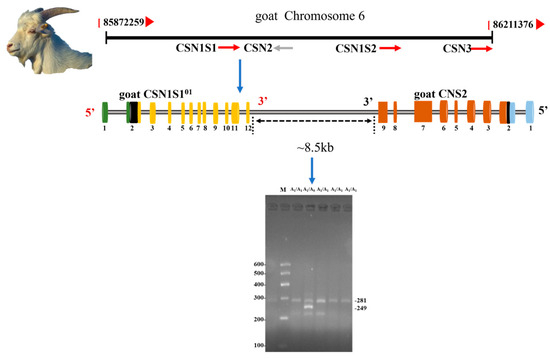
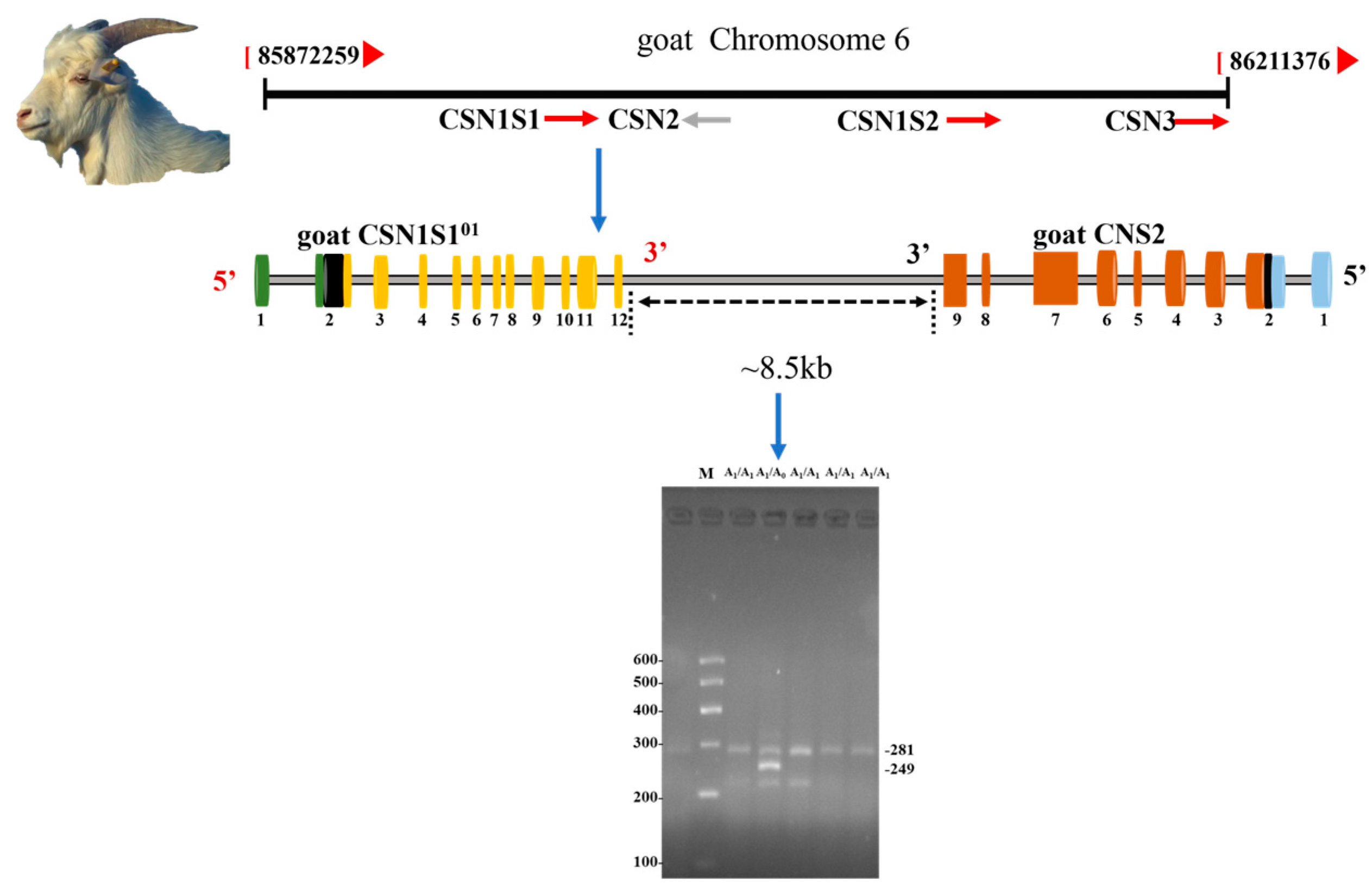
Genomic DNA was extracted from the collected ear tissue samples using the high-salt extraction method [25]. A Nanodrop 2000 spectrometer (Thermo Fisher Scientific, Waltham, MA, USA) was used to determine the DNA purity and quality. Subsequently double-distilled water was added to dilute the extracted DNA to 20 ng/μL and stored at −20 °C. A set of allele-specific primers was designed based on previously published methods to amplify a region spanning part of exon 12 and the adjacent intron 12 of the goat CSN1S1 gene, which contains the deletion characteristic of the CSN1S101 null allele [17]. The primers used were: goat-CSN1S1-AS-a (5′-CCCCAGCTGGTAATGTTTTA-3′), goat-CSN1S1-AS-b (5′-GGTCCATCAATTCCCTGTGT-3′), and goat-CSN1S1-AS-c (5′-TGTATGGATCCCTGATTCCTTC-3′). The amplified fragment is approximately 249 bp for the CSN1S101 allele and 281 bp for the reference allele, allowing clear discrimination of homozygous, heterozygous, and reference genotypes. Primer positions relative to the gene structure are illustrated in a schematic diagram. The PCR was performed in a 20 μL reaction mixture containing 2 μL of DNA solution (20 ng) goat genomic DNA (constructed from four different individuals), 10 μL of 2× Eco Taq PCR Super mix (Vazyme Biotech Co., Ltd., Nanjing, China; Cat# No. P222-01), 0.6 μL of forward primer, 0.4 μL of reverse primer, and 6.6 μL of double distilled. The protocols for the PCR reaction mixture and amplification conditions used in the present study were based on Yang et al. [26]. A 3.5% agarose gel was used for electrophoresis of the PCR products to identify the indel locus [27].
2.3. Statistical Analysis
Previously reported methods were used to examine the Hardy–Weinberg equilibrium (HWE) and population-genetic parameters, such as homozygosity (Ho), effective allele numbers (Ne), and polymorphism information content (PIC) [28]. The association between the goat CSN1S101 allele and economic traits was analyzed using t-test on SPSS software (version 24.0). A linear model of the relationship between goat genotypes and each growth trait was constructed using Hui’s method [29].
3. Results
3.1. Identification of Indel Variations and Genotyping
The AS-PCR amplification results showed that there were two genotypes in the goat population: the A1A1 genotype showed one band (281 bp), and the A1A0 genotypes showed two bands (281 and 249 bp) (Figure 1). However, only the A1A1 genotype was detected in IMWC, GB, BJ, MT, GW, SBWC, and NG goats (Table 2).
Figure 1.
Electrophoresis of AS-PCR products of goat CSN1S1 gene. Note: Red arrows indicate the transcription orientation of genes, colored boxes represent exonic regions, the blue arrow denotes the deletion locus analyzed in this study, and the dashed line indicates the genomic distance between CSN1S1 and CSN2 (~8.5 kb).
Table 2.
The population genetic metrics of the CSN1S1 locus for different populations.
3.2. Genetic Parameter Analysis
The frequency of the A1 allele ranged between 0.946 and 1.000, and this locus was in Hardy–Weinberg equilibrium in all populations (p > 0.05). The genotypic distribution among the 11 goat breeds was determined by calculating the genetic parameters associated with the CSN1S101 allele, such as genotype and allele frequencies (Table 2). Compared with the “0” allele, the “1” allele had a higher frequency in the 11 goat breeds. Based on the PIC values, this allele showed low genetic diversity in all breeds.
3.3. Association Analysis of Genotypes and Body Measurement Traits
The association between the CSN1S101 allele and economic traits in Laoshan dairy goats is shown in Table 3 and Table 4. The CSN1S101 allele was highly associated with third parity and average kidding number (p < 0.05, Table 3). A doe with A1A0 genotype produces approximately 0.6 more kids per parity (2.25 vs. 1.61) represent a major economic benefit through more replacement stock. Similarly, the CSN1S101 allele was also associated with body length (p < 0.05, Table 4). For all other traits (weight, height, chest, cannon), the A1A0 genotype had numerically higher averages than A1A1 but statistically non-significant.
Table 3.
Association between different genotypes of the CSN1S1 gene with litter size (means ± SE) in Laoshan dairy goats.
Table 4.
Association between different genotypes of CSN1S1 gene and goat economic traits (Mean ± SE) in Laoshan dairy goat.
4. Discussion
In this study, the CSN1S101 polymorphism was systematically characterized across multiple goat populations using AS-PCR and ME methods. Only two genotypes (A1A1 and A1A0) were detected, and the A0 allele was observed at a very low frequency and only in a limited number of breeds. This distribution pattern indicates that CSN1S101 is a low-polymorphism locus in goats, which is consistent with previous reports describing the rarity of the A0 allele in different geographic and production populations [13,17,30,31].
The investigation of genetic variation in the CSN1S1 gene and its association with production traits is of considerable interest. Previous studies have demonstrated that polymorphisms in CSN1S1 are associated with variation in milk casein content as well as milk structure and nutritional properties. To date, ruminants—including cattle, sheep, and goats—remain the primary source of milk for human consumption worldwide, and most studies on CSN1S1 have therefore focused on these species. In cattle, ten CSN1S1 protein variants (A, B, C, D, E, F, G, H, I, and J) have been reported, and several alleles have been associated with differences in milk composition traits, such as milk fat percentage and CSN1S1 content [32,33]. In sheep, seven CSN1S1 phenotypes (A, B, C, D, E, F, and X) have been identified [34]. Beyond milk composition, CSN1S1 polymorphisms have also been examined in association studies involving other economically relevant traits in livestock. For instance, CSN1S1 polymorphisms have been associated with lower yearling weights in cattle [35]. In goats, CSN1S1 polymorphisms have also been linked to reproductive and growth traits [14,24]. However, the biological basis of these associations remains unclear. Overall, existing evidence indicates that genetic variation at the CSN1S1 locus is primarily relevant to milk-related traits, while reported associations with non-milk traits should be considered descriptive and population-specific rather than indicative of direct functional effects.
In the present study, we focused specifically on the CSN1S101 allele across different goat populations. Methods including ME and AS-PCR were established for reliable identification of the 01 allele, and the reported mutation frequency of this allele in other goat populations is summarized in Table 5. Notably, while the frequency of the CSN1S101 allele varies across breeds, it reaches an exceptionally high level (approximately 70–73%) in Norwegian Dairy goats, significantly impacting milk composition and technological properties [36,37]. Genetic parameter analysis revealed that the CSN1S1 locus adheres to the Hardy–Weinberg equilibrium (HWE) across all studied populations, with PIC values indicating a low genetic diversity. These results suggest a relatively stable allelic distribution and imply that strong directional selection is unlikely to be acting on this locus. However, the limited polymorphism observed necessitates caution when interpreting downstream association analyses, particularly concerning rare genotypes. Association analysis demonstrated that the CSN1S101 allele is significantly correlated with the third-parity litter size and body length in Laoshan dairy goats, whereas no significant associations were detected for other morphological traits. Notably, these associations were inconsistent across breeds and traits, highlighting a clear population- and trait-specific pattern. The absence of significant effects on most growth-related parameters suggests that CSN1S1 polymorphisms do not exert a broad influence on overall body conformation. Reproductive performance and body measurements are complex quantitative traits governed by polygenic inheritance and environmental-management interactions. The parity-specific associations observed here further reflect the complexity of reproductive traits, potentially influenced by sample structure, breeding history, or management practices. Consequently, the identified associations should be interpreted as localized statistical correlations rather than evidence of a universal or direct genetic effect.
Table 5.
The allele frequency of the CSN1S1 locus for the reported populations.
From a methodological perspective, this study establishes a practical framework for the detection and population-level screening of the CSN1S1 allele in goats. The integrated application of AS-PCR and ME methods ensures reliable genotype differentiation across diverse breeds, facilitating future investigations into CSN1S1 polymorphisms within various genetic backgrounds. However, several limitations must be acknowledged. First, the low frequency of the A0 allele constrained the statistical power of our association analyses, particularly in breeds where only the A1A1 genotype was present. Second, this study focused on a single locus without integrating functional or expression data. Finally, environmental and management factors, which can influence reproductive performance and growth traits [40], should be considered in future investigations as their potential effects were not explicitly modeled here. These constraints underscore the necessity for further validation in independent cohorts and integrated omics research to fully elucidate the biological significance of CSN1S1 variations.
In summary, this study systematically characterized the genetic variations in CSN1S1 across Chinese goat populations and elucidated population-specific associations with key growth and reproductive traits. While these findings are preliminary and descriptive in nature, they expand the current understanding of CSN1S1 polymorphisms and provide a valuable foundation for subsequent functional validation.
5. Conclusions
AS-PCR and mathematical expectation (ME) methods can be used to rapidly and efficiently detect goat CSN1S101 allelic mutations. The low-frequency characteristics of the CSN1S101 allele are universal in the goat breeds. The CSN1S101 allele shows population- and breed-specific associations with selected growth and reproductive traits in Laoshan dairy goats.
Author Contributions
Conceptualization, C.P. and X.L.; methodology, J.W. and Y.Y.; formal analysis, J.W. and Y.Y.; investigation, J.W., Y.G. and E.A.; data collection, J.W., Y.Y., Y.G. and X.L.; writing—original draft preparation, J.W. and Y.Y.; writing—review and editing, J.W., Y.Y., E.A. and X.L.; supervision, C.P.; project administration, C.P. and H.Z. All authors have read and agreed to the published version of the manuscript.
Funding
This work was supported by the National Key R&D Program of China (2022YFD1300200) and National Natural Science Foundation (No. 32272850); China Agriculture Research System of MOF and MARA (CARS-34), the National Innovation Project for Undergraduate of Northwest A&F University (No. XN2025004117), and the University Innovation Project for Undergraduate of Northwest A&F University (XN2025001068; XN2026004160).
Institutional Review Board Statement
All animal procedures were conducted in accordance with the national guidelines for the care and use of laboratory animals and were approved by the Institutional Animal Care and Use Committee of Northwest A&F University (IACUC-NWAFU).
Informed Consent Statement
Written informed consent was obtained from the owner of the animals involved in this study.
Data Availability Statement
All data analyzed during this study are available from the corresponding author upon reasonable request.
Acknowledgments
We are grateful for the support from the Shaanbei White Cashmere goat breeding farm, Yulin City, Shaanxi Province, China. We would also like to thank Lei Qu, Hailong Yan, and Jinwang Liu from Yulin University for their help in sample collection. Thanks to Chuchao Lei of the Academy of Animal Sciences for providing the goat samples; thanks to the Guizhou Institute of Animal Husbandry and Veterinary Medicine; thanks to the Fujian Academy of Agricultural Sciences for the samples; Ruoyu Liu of Guizhou University for the samples; and Lingjiang Min of Qingdao Agricultural University.
Conflicts of Interest
The authors declare no conflicts of interest.
Abbreviations
Sa: Saanen dairy goat; LS: Laoshan dairy goat; GZ: Guanzhong dairy goat; IMWC: Inner Mongolia white cashmere goat; GZBG: Guanzhong black goat; BJ: Banjiao goat; MT: matou goat; GW: Guizhou white goat; SBWC: Shaanbei White Cashmere Goat; GZHM: Guizhou Heima goat; AS-PCR: allele-specific polymerase chain reaction; ME: mathematical expectation.
References
- Albenzio, M.; Santillo, A.; d’Angelo, F.; Sevi, A. Focusing on casein gene cluster and protein profile in Garganica goat milk. J. Dairy Res. 2009, 76, 83–89. [Google Scholar] [CrossRef] [Scilit]
- Cosenza, G.; Pauciullo, A.; Gallo, D.; Berardino, D.D.; Ramunno, L. A Ssp I PCR-RFLP detecting a silent allele at the goat CSN2 locus. J. Dairy Res. 2005, 72, 456–459. [Google Scholar] [CrossRef] [Scilit]
- Martin, P.; Szymanowska, M.; Zwierzchowski, L.; Leroux, C. The impact of genetic polymorphisms on the protein composition of ruminant milks. Reprod. Nutr. Dev. 2002, 42, 433–459. [Google Scholar] [CrossRef] [Scilit]
- Cardona, S.J.C.; Cadavid, H.C.; Corrales, J.D.; Munilla, S.; Cantet, R.J.C.; Rogberg-Muñoz, A. Longitudinal data analysis of polymorphisms in the κ-casein and β-lactoglobulin genes shows differential effects along the trajectory of the lactation curve in tropical dairy goats. J. Dairy Sci. 2016, 99, 7299–7307. [Google Scholar] [CrossRef] [Scilit]
- Pizarro Inostroza, M.G.; Landi, V.; Navas González, F.J.; Jurado, J.M.L.; Martínez, M.d.A.M.; Álvarez, J.F.; Bermejo, J.V.D. Non-parametric association analysis of additive and dominance effects of casein complex SNPs on milk content and quality in Murciano-Granadina goats. J. Anim. Breed. Genet. 2020, 137, 407–422. [Google Scholar] [CrossRef] [Scilit]
- Wang, K.; Yan, H.; Xu, H.; Yang, Q.; Zhang, S.; Pan, C.; Chen, H.; Zhu, H.; Liu, J.; Qu, L.; et al. A novel indel within goat casein alpha S1 gene is significantly associated with litter size. Gene 2018, 671, 161–169. [Google Scholar] [CrossRef] [Scilit]
- Cosenza, G.; Pauciullo, A.; Gallo, D.; Colimoro, L.; D’aVino, A.; Mancusi, A.; Ramunno, L. Genotyping at the CSN1S1 locus by PCR-RFLP and AS-PCR in a Neapolitan goat population. Small Rumin. Res. 2008, 74, 84–90. [Google Scholar] [CrossRef] [Scilit]
- Ramunno, L.; Cosenza, G.; Rando, A.; Pauciullo, A.; Illario, R.; Gallo, D.; Di Berardino, D.; Masina, P. Comparative analysis of gene sequence of goat CSN1S1 F and N alleles and characterization of CSN1S1 transcript variants in mammary gland. Gene 2005, 345, 289–299. [Google Scholar] [CrossRef] [Scilit] [PubMed]
- Leroux, C.; Mazure, N.; Martin, P. Mutations away from splice site recognition sequences might cis-modulate alternative splicing of goat alpha s1-casein transcripts. Structural organization of the relevant gene. J. Biol. Chem. 1992, 267, 6147–6157. [Google Scholar] [CrossRef] [Scilit]
- Ramunno, L.; Cosenza, G.; Pappalardo, M.; Pastore, N.; Gallo, D.; Di Gregorio, P.; Masina, P. Identification of the goat CSN1S1 F allele by means of PCR-RFLP method. Anim. Genet. 2000, 31, 342. [Google Scholar] [CrossRef] [Scilit] [PubMed]
- Yue, X.P.; Zhang, X.M.; Wang, W.; Ma, R.N.; Deng, C.J.; Lan, X.Y.; Chen, H.; Li, F.; Xu, X.R.; Ma, Y.; et al. The CSN1S1 N and F alleles identified by PCR-SSCP and their associations with milk yield and composition in Chinese dairy goats. Mol. Biol. Rep. 2011, 38, 2821–2825. [Google Scholar] [CrossRef] [Scilit]
- Martin, P.; Ollivier-Bousquet, M.; Grosclaude, F. Genetic polymorphism of caseins: A tool to investigate casein micelle organization. Int. Dairy J. 1999, 9, 163–171. [Google Scholar] [CrossRef] [Scilit]
- Zhang, Y.; Wang, K.; Liu, J.; Zhu, H.; Qu, L.; Chen, H.; Lan, X.; Pan, C.; Song, X. An 11-bp Indel Polymorphism within the CSN1S1 Gene Is Associated with Milk Performance and Body Measurement Traits in Chinese Goats. Animals 2019, 9, 1114. [Google Scholar] [CrossRef] [Scilit]
- Cosenza, G.; Illario, R.; Rando, A.; Di Gregorio, P.; Masina, P.; Ramunno, L. Molecular characterization of the goat CSN1S101 allele. J. Dairy Res. 2003, 70, 237–240. [Google Scholar] [CrossRef] [Scilit] [PubMed]
- Ballabio, C.; Chessa, S.; Rignanese, D.; Gigliotti, C.; Pagnacco, G.; Terracciano, L.; Fiocchi, A.; Restani, P.; Caroli, A. Goat milk allergenicity as a function of αS1-casein genetic polymorphism. J. Dairy Sci. 2011, 94, 998–1004. [Google Scholar] [CrossRef] [Scilit] [PubMed]
- Ramunno, L.; Longobardi, E.; Pappalardo, M.; Rando, A.; Di Gregorio, P.; Cosenza, G.; Mariani, P.; Pastore, N.; Masina, P. An allele associated with a non-detectable amount of αs2 casein in goat milk. Anim. Genet. 2001, 32, 19–26. [Google Scholar] [CrossRef] [Scilit]
- Sztankóová, Z.; Kott, T.; Czerneková, V.; Dudková, G.; Mátlová, V.; Soldát, J. A new allele specific polymerase chain reaction method (AS-PCR) for detection of the goat CSN1S101 allele. Small Rumin. Res. 2006, 66, 282–285. [Google Scholar] [CrossRef] [Scilit]
- Li, J.; Zhu, X.; Ma, L.; Xu, H.; Cao, X.; Luo, R.; Chen, H.; Sun, X.; Cai, Y.; Lan, X. Detection of a new 20-bp insertion/deletion (indel) within sheep PRND gene using mathematical expectation (ME) method. Prion 2017, 11, 143–150. [Google Scholar] [CrossRef] [Scilit]
- Brignon, G.; Mahe, M.; Ribadeau-Dumas, B.; Mercier, J.; Grosclaude, F. Two of the three genetic variants of goat αs1-casein which are synthesized at a reduced level have an internal deletion possibly due to altered RNA splicing. Eur. J. Biochem. 1990, 193, 237–241. [Google Scholar] [CrossRef] [Scilit] [PubMed]
- Grosclaude, F.; Martin, P. Casein polymorphisms in the goat. In Proceedings of the IDF Seminar Milk Protein Polymorphism II; IDF: Palmerston North, New Zealand, 1997. [Google Scholar]
- Bevilacqua, C.; Ferranti, P.; Garro, G.; Veltri, C.; Lagonigro, R.; Leroux, C.; Pietrolà, E.; Addeo, F.; Pilla, F.; Chianese, L.; et al. Interallelic recombination is probably responsible for the occurrence of a new alpha(s1)-casein variant found in the goat species. Eur. J. Biochem. 2002, 269, 1293–1303. [Google Scholar] [CrossRef] [Scilit]
- Pérez, M.J.; Leroux, C.; Bonastre, A.S.; Martin, P. Occurrence of a LINE sequence in the 3′ UTR of the goat αs1-casein E-encoding allele associated with reduced protein synthesis level. Gene 1994, 147, 179–187. [Google Scholar] [CrossRef] [Scilit]
- Chianese, L.; Ferranti, P.; Garro, G.; Mauriello, R.; Addeo, F. Occurrence of three novel alpha s1-casein variants in goat milk. In Proceedings of the International Dairy Federation Seminar; IDF: Brussels, Belgium, 1997. [Google Scholar]
- Zhang, S.; Jiang, E.; Wang, K.; Zhang, Y.; Yan, H.; Qu, L.; Chen, H.; Lan, X.; Pan, C. Two Insertion/Deletion Variants within SPAG17 Gene Are Associated with Goat Body Measurement Traits. Animals 2019, 9, 379. [Google Scholar] [CrossRef] [Scilit]
- Aljanabi, S.M.; Martinez, I. Universal and rapid salt-extraction of high quality genomic DNA for PCR-based techniques. Nucleic Acids Res. 1997, 25, 4692–4693. [Google Scholar] [CrossRef] [Scilit]
- Yang, Q.; Yan, H.; Li, J.; Xu, H.; Wang, K.; Zhu, H.; Chen, H.; Qu, L.; Lan, X. A novel 14-bp duplicated deletion within goat GHR gene is significantly associated with growth traits and litter size. Anim. Genet. 2017, 48, 499–500. [Google Scholar] [CrossRef] [Scilit]
- Wang, X.; Yang, Q.; Wang, K.; Zhang, S.; Pan, C.; Chen, H.; Qu, L.; Yan, H.; Lan, X. A novel 12-bp indel polymorphism within the GDF9 gene is significantly associated with litter size and growth traits in goats. Anim. Genet. 2017, 48, 735–736. [Google Scholar] [CrossRef] [Scilit]
- Nei, M. Analysis of Gene Diversity in Subdivided Populations. Proc. Natl. Acad. Sci. USA 1973, 70, 3321–3323. [Google Scholar] [CrossRef] [Scilit]
- Hui, Y.; Zhang, Y.; Wang, K.; Pan, C.; Chen, H.; Qu, L.; Song, X.; Lan, X. Goat DNMT3B: An indel mutation detection, association analysis with litter size and mRNA expression in gonads. Theriogenology 2020, 147, 108–115. [Google Scholar] [CrossRef] [Scilit]
- Caroli, A.; Chiatti, F.; Chessa, S.; Rignanese, D.; Bolla, P.; Pagnacco, G. Focusing on the Goat Casein Complex. J. Dairy Sci. 2006, 89, 3178–3187. [Google Scholar] [CrossRef] [Scilit]
- Vacca, G.M.; Dettori, M.L.; Piras, G.; Manca, F.; Paschino, P.; Pazzola, M. Goat casein genotypes are associated with milk production traits in the Sarda breed. Anim. Genet. 2014, 45, 723–731. [Google Scholar] [CrossRef] [Scilit]
- Meier, S.; Korkuć, P.; Arends, D.; Brockmann, G.A. DNA Sequence Variants and Protein Haplotypes of Casein Genes in German Black Pied Cattle (DSN). Front. Genet. 2019, 10, 1129. [Google Scholar] [CrossRef] [Scilit]
- Prinzenberg, E.M.; Weimann, C.; Brandt, H.; Bennewitz, J.; Kalm, E.; Schwerin, M.; Erhardt, G. Polymorphism of the Bovine CSN1S1 Promoter: Linkage Mapping, Intragenic Haplotypes, and Effects on Milk Production Traits. J. Dairy Sci. 2003, 86, 2696–2705. [Google Scholar] [CrossRef] [Scilit] [PubMed]
- Giambra, I.J.; Erhardt, G. Molecular genetic characterization of ovine CSN1S2 variants C and D reveal further important variability within CSN1S2. Anim. Genet 2012, 43, 642–645. [Google Scholar] [CrossRef] [Scilit]
- White, S.N.; Casas, E.; Allan, M.F.; Keele, J.W.; Snelling, W.M.; Wheeler, T.L.; Shackelford, S.D.; Koohmaraie, M.; Smith, T.P.L. Evaluation in beef cattle of six deoxyribonucleic acid markers developed for dairy traits reveals an osteopontin polymorphism associated with postweaning growth. J. Anim. Sci. 2007, 85, 1–10. [Google Scholar] [CrossRef] [Scilit]
- Devold, T.G.; Nordbø, R.; Langsrud, T.; Vegarud, G.E.; Skeie, S. Extreme Frequencies of the αs1-Casein “Null” Variant in Milk from Norwegian Dairy Goats—Implications for Milk Composition, Micellar Size and Renneting Properties. Dairy Sci. Technol. 2011, 91, 39–51. [Google Scholar] [CrossRef] [Scilit]
- Dagnachew, B.S.; Meuwissen, T.H.E.; Ådnøy, T. Casein SNP in Norwegian Goats: Additive and Dominance Effects on Milk Composition and Quality. Genet. Sel. Evol. 2011, 43, 31. [Google Scholar] [CrossRef] [Scilit]
- Soares, M.A.M.; Rodrigues, M.T.; Mognol, G.P.; Ribeiro, L.F.C.; Silva, J.L.C.; Brancalhão, R.M.C. Polymorphism of alpha s1-casein gene in a dairy goat herd in the southeastern region of Brazil. Rev. Bras. Zootec. 2009, 38, 1026–1032. [Google Scholar] [CrossRef] [Scilit]
- Bozkaya, F.; Gürler, Ş.; Yertürk, M. Genetic variability of CSN1S1 gene in goat populations raised in southeastern region of Turkey. Kafkas Univ. Vet. Fak. Derg. 2013, 19, 147–152. [Google Scholar] [CrossRef] [Scilit]
- Amiridis, G.S.; Fthenakis, G.C. Reproductive health management of sheep and goats. Preface. Anim. Reprod. Sci. 2012, 130, 125. [Google Scholar] [CrossRef] [Scilit] [PubMed]

Disclaimer/Publisher’s Note: The statements, opinions and data contained in all publications are solely those of the individual author(s) and contributor(s) and not of MDPI and/or the editor(s). MDPI and/or the editor(s) disclaim responsibility for any injury to people or property resulting from any ideas, methods, instructions or products referred to in the content. |
© 2026 by the authors. Licensee MDPI, Basel, Switzerland. This article is an open access article distributed under the terms and conditions of the Creative Commons Attribution (CC BY) license.