


Simple Summary
Cooled stallion semen is frequently used for artificial insemination in horses, but sperm quality can be adversely affected by the presence of bacteria or urine in the sample. Preparing the semen using a microfluidic chamber might enable the sperm to be separated from the seminal plasma and contaminants. Three studies were performed as follows: (i) to determine whether penile washing and use of a microfluidic chamber enhanced sperm quality and affected bacterial counts; (ii) fresh urine was added to semen samples and the effect on sperm motility was assessed for several hours; (iii) semen samples contaminated with urine were processed by a microfluidic chamber before preparation using the microfluidic chamber. Microfluidic selection improved total and progressive motility and reduced bacterial load, although penile washing did not affect the outcome. Urine contamination adversely affected sperm motility. However, processing the semen using the microfluidic chamber reversed the adverse effects of urine contamination. These results indicate that processing stallion semen with the microfluidic chamber could have a beneficial effect on stallion sperm quality during cooled storage.
Abstract
Bacterial contamination and urospermia are common causes of reduced sperm longevity in cooled stallion semen doses. Microfluidic sperm selection might improve sperm quality by removing contaminants, seminal plasma, and low-quality sperm subpopulations. This study comprised three complementary experiments. Study 1 evaluated the effects of microfluidic selection on bacterial load and sperm motility in ejaculates collected with and without penile washing. Sixteen Straight Egyptian Arabian stallions were assigned to washed or unwashed groups. Semen was processed using a 3000 µL equine-specific microfluidic device and compared with untreated controls. Study 2 assessed the effect of urine contamination by adding fresh urine (9.1 to 33%) to diluted ejaculates from ten stallions, with motility measured at defined intervals up to 12 h. Study 3 tested whether microfluidic processing mitigates urine-induced damage when applied within 30 min after contamination, using 16 ejaculates submitted to three treatments: Control (diluted), Urine (33% urine), and Selected (33% urine + microfluidics). Microfluidic selection improved total and progressive motility and reduced bacterial load. Urine contamination caused rapid motility loss, particularly at 33%, while microfluidic selection restored motility to values comparable with uncontaminated controls for up to 6 h of storage. Microfluidic sperm selection effectively improves semen quality and extends sample longevity in samples compromised by bacterial contamination or urospermia.
1. Introduction
The use of cooled semen is a cornerstone of modern equine breeding, enabling genetic exchange and improved fertility management. However, maintaining sperm viability and functionality during storage is challenged by factors that compromise semen quality, such as bacterial contamination and inadvertent contact with urine during collection (urospermia).
The stallion genital tract is not sterile, harboring fungi (such as Aspergillus spp. and Penicillium spp.) and both saprophytic and potentially pathogenic bacteria [1,2,3]. The presence of microorganisms may represent a risk of endometritis and reduced fertility in susceptible mares, depending on which bacteria are present [1]. In addition, the presence of microorganisms in semen can impair semen quality, leading to suboptimal reproductive results [3].
Bacterial contamination of cooled semen doses is associated with reduced shelf life, sudden decline in motility, sperm agglutination, acrosomal damage, and, consequently, lower fertility, with occurrences of vaginal discharge and uterine fluid accumulation after insemination [4]. Standard broad-spectrum antibiotics commonly added to extender formulations may be ineffective against certain bacterial populations, especially when ejaculate contamination is high [4,5]. Increasing antibiotic concentrations in extenders without improving semen-handling practices is inadequate and may promote undesirable antimicrobial resistance [6].
Improvements in sanitary protocols, better semen-handling practices, and alternative methods to control bacterial load have therefore been promoted as first-line strategies for semen dose preparation. Washing the stallion penis with tap water alone before semen collection has been shown to reduce contamination, allowing better antibiotic control of bacterial growth and improved semen dose quality with longer storage [7]. The use of soap or detergents for penile cleansing is not recommended, as it may disrupt the normal microbial flora and predispose to opportunistic infections [8].
The addition of antibiotics to semen extenders as a safe strategy to preserve semen quality is not appropriate, as some bacteria, even at low loads, may be resistant to the antibiotic used or the concentration may be insufficient to control microbial proliferation [7,9]. A wide range of antibiotics is used in semen extenders [10], and some of them, such as gentamicin, have been shown to exert detrimental effects on semen quality [11,12]. The frequent non-therapeutic use of antibiotics, as occurs in semen dose prophylaxis, is discouraged due to the increasing bacterial resistance observed [12]. Alternatives, such as physical methods to remove bacteria, such as filtration and centrifugation, have been proposed [12,13]. Removal of the gel fraction of the ejaculate reduces bacterial load [14]. Both conventional and cushioned centrifugation remove seminal plasma and part of the contamination [15,16], thus contributing to longer sperm survival. Single Layer Centrifugation (SLC) has proven to be the most efficient method for semen purification, as it removes seminal plasma, damaged sperm cells, and bacteria [17]. By gently passing semen doses through a colloid during centrifugation, SLC eliminates a substantial proportion of microorganisms, representing an effective alternative to antibiotics [18]. However, access to a centrifuge is not always possible when processing stallion semen in the field.
Another potentially harmful component of the ejaculate is urine contamination (urospermia), which may often go unnoticed and negatively affect fertility [19]. In equine practice, the diagnosis of urospermia is often based on qualitative assessment, including visual inspection for a change in normal semen color to a yellowish appearance and the presence of a characteristic urine odor in the ejaculate [20]. Although additional diagnostic methods exist [19,21], such as measurements of urea nitrogen, creatinine, nitrite, uric acid, and pH, these are not commonly used in the daily semen collection routine. Ejaculates without obvious contamination but affected by subclinical disorders may be considered normal, leading to the production of suboptimal semen doses and resulting in reduced fertility [19].
The detrimental effects of urine in semen doses are closely related to the amount present in the ejaculate, primarily affecting sperm cells through changes in pH and osmolarity [22]. In human semen, sperm motility was shown to decrease markedly within 30 min after urine was added to the sample [23]. A similar sharp reduction in motility was observed in fresh [22] and cooled stallion semen doses [21] and in ejaculates subjected to freezing, resulting in lower post-thaw motility in contaminated samples, even after removal of the urine by cushioned centrifugation [24].
Microfluidic selection aims to select a highly motile sperm subpopulation [25,26]. The technique used consists of active sperm cell passage through a membrane towards a less sperm-concentrated environment, blocking access to immotile, slow and damaged sperm. Seminal plasma, previously added extender and other large immotile contaminants in the original sample are prevented from passing through the membrane into the selected sample [27,28].
Our hypothesis is that microfluidic technology can address the dual challenges of bacterial contamination and urospermia in stallion semen by physically selecting a subpopulation of motile and functional spermatozoa and spatially separating them from contaminants. Therefore, the present study comprised three coordinated experiments designed to (1) determine whether microfluidic selection reduces bacterial contamination and improves semen motility (Experiment 1); (2) quantify the detrimental effect of gradual urine contamination on the longevity of cooled semen (Experiment 2); and (3) evaluate whether microfluidic selection applied immediately after urine contamination can preserve sperm motility during storage (Experiment 3). This structured approach aims to provide experimental evidence supporting microfluidics as a novel tool to enhance the robustness and hygienic quality of cooled-stored stallion semen.
2. Materials and Methods
2.1. Animals
Sixteen healthy, mature Straight Egyptian Arabian stallions located at Al-Baydaa Stud (Giza, Egypt), familiar with artificial-vagina (AV) semen collection and with proven fertility, were used in Study 1 and Study 3. Ten stallions with historically good semen quality were used in Study 2 (MK Arabians, Ajman, United Arab Emirates). All animals were maintained under standard management and nutritional conditions, with ad libitum access to water and forage. Semen collections were performed during the breeding season using a Missouri-model artificial vagina equipped with a sterile in-line filter to remove gel fraction immediately after collection.
2.2. Microfluidic Device
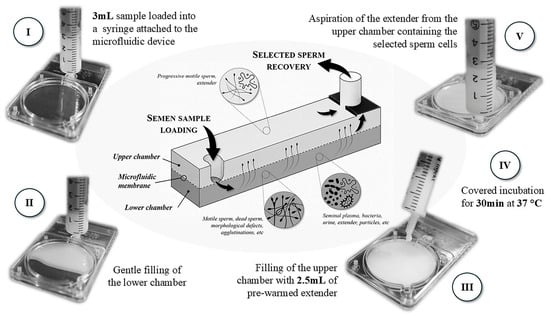
A new sterile, single-use microfluidic device was used for each sample trial in Experiments 1 and 3, following the treatments established according to the experimental design. The microfluidic device (VetMotl®, Germantown, MD, USA) consists of a sterile plastic cassette with two chambers separated by a microfluidic membrane with pores sized for equine sperm heads (VME 3000), two ports for syringe attachment (inlet/outlet), and a lower-chamber capacity of 3000 µL for the diluted sample to be purified (Figure 1). Through active movement, progressively motile sperm present in the original sample pass through the membrane toward the upper chamber, which is prefilled with 2.5 mL of extender according to each experimental protocol. Purification occurs through active sperm separation over 30 min, with the device placed on a heated plate at 37 °C and covered with a Petri dish to prevent evaporation and the consequent reduction in volume. After this incubation period, the extender from the upper chamber is aspirated, carrying the selected sperm with higher progressive motility, while most of the seminal plasma, sperm agglutinations, less motile sperm cells, and sample contaminants remain in the lower chamber.
Figure 1.
Illustration of VetMotl cassette loading and selected-sample aspiration, along with the location of the microfluidic membrane within the device, its different areas, mechanism of action, and the general differences between unselected and selected samples.
2.3. Computer-Assisted Sperm Kinematic Analysis
Sperm kinematic evaluations were performed using a portable CASA system (AndroScope®; Minitube Middle East, Dubai, United Arab Emirates). A pre-warmed counting chamber with four designated slots for homogenized samples was used for all sperm analyses. Each slot was loaded with 3 µL using a calibrated pipette and disposable tips to ensure the correct volume and prevent sperm drift within the chamber. Computerized sperm classification was performed by evaluating four fields, using 0.5-s videos recorded at a rate of 60 frames per second. The trajectory of each cell was classified, and different velocities were measured in micrometers per second. Their combination was expressed as a percentage according to the following criteria: immotile sperm (HAC < 0.05 and VSL < 5.0), local motility (STR < 0.75 and VAP < 120.0), circular motility (Radius > 10.0 and < 60.0, and Rotation > 0.7), and slow motility (VCL < 120.0), with the remaining cells classified as fast, progressively moving sperm.
The raw semen aliquots were diluted 1:10 (v/v) with extender to ensure that the sperm concentration was within the preferred range for accurate CASA measurements.
2.4. Colony Forming Units Counting
For bacteriology, aliquots of all samples were further diluted 1:200 in sterile water and inoculated onto blood agar plates to determine bacterial load in colony-forming units (CFU/mL) after 24 h of incubation at 37 °C. Colonies were counted visually by an experienced technician.
2.5. Urine Collection and Addition
Urine was collected aseptically via urinary catheterization from three healthy mares in anestrus, with no preovulatory follicles or corpora lutea and receiving no treatment. The urine was pooled and divided into sterile vials for use over the two experimental days. Before addition to the designated experimental group, the urine was warmed to 37 °C.
Urine contamination was standardized by volume by adding progressively increasing volumes of urine to fixed volumes of diluted semen and expressing the resulting urine proportions as percentages. Given the absence of an established protocol for experimental urine contamination and the considerable variation in contamination among ejaculates and stallions, the initial aim was to identify a realistic urine proportion suitable for the experiment and determine the exposure times associated with impaired semen quality. Temperature, sperm concentration, dilution, and processing times were selected to reflect routine semen laboratory practices.
2.6. Experiment 1
In Study 1, stallions were randomly assigned to two groups of eight animals each: the washed group (penis washed prior to collection) and the unwashed group (penis not washed). The washed group underwent a standard cleaning protocol, including manual extrusion of the penis, rinsing with warm sterile saline (37 °C), and gentle removal of smegma with sterile gauze. All handling involved sterile gloves and disposable materials to avoid cross-contamination. Each ejaculate was immediately assessed for volume, and a 1:10 dilution was performed for sperm concentration determination using a portable CASA system (AndroScope®, Minitube GmbH, Tiefenbach, Germany). Subsequent dilution in a milk-based extender (EquiPlus Powder®, Dar es Salaam, Tanzania, containing gentamicin) produced final semen doses of 50 × 106 total sperm/mL. Total motility (TM) and progressive motility (PM) were evaluated 30 min after dilution for control (untreated) samples. Aliquots were taken for bacteriology. For microfluidic treatment, 3 mL of each diluted ejaculate were loaded into the lower chamber of a 3000 µL equine-specific microfluidic device (VetMotl E3000®), while the upper chamber was filled with 2.5 mL of pre-warmed extender. Devices were maintained at 37 °C for 30 min, after which the upper chamber contents were collected, analyzed for motility, and inoculated for bacterial culture. Treated samples were stored at 5 °C for 24 h, and TM and PM were reassessed following a 10-min equilibration at 37 °C.
2.7. Experiment 2
A single ejaculate from each of ten stallions was diluted to 50 × 106 sperm/mL, and six 5 mL aliquots were prepared per ejaculate: one control and five experimental groups with increasing urine volumes corresponding to 9.1%, 16.7%, 23.2%, 28.6%, and 33% (v/v) contamination. Sperm motility was measured immediately after urine addition, and again after 30 min at room temperature, and after 1, 6 and 12 h at 5 °C.
2.8. Experiment 3
Study 3 evaluated whether microfluidic processing could mitigate the effects of urospermia. Sixteen ejaculates were divided into three treatment groups: Control (diluted ejaculate), Urine (diluted ejaculate plus 33% urine), and Selected (diluted ejaculate plus 33% urine submitted to microfluidic selection). Following 30 min at 37 °C, motility was assessed, and all samples were then stored at 5 °C, with motility measurements repeated at 6 and 12 h. Microfluidic processing followed the same procedure as described in Experiment 1.
2.9. Statistical Analysis
Statistical analyses were performed according to the experimental design of each study, with a significance level of 5% (p < 0.05). In Experiment 1, the effects of penile washing and microfluidic sperm selection were assessed using the nonparametric Kruskal–Wallis test. Total motility (TM) and progressive motility (PM) were also analyzed in a completely randomized split-split-plot design, with penile washing (washed or unwashed) as the main-plot factor, microfluidic treatment (with or without VetMotl) as the subplot factor, and evaluation time (0 and 24 h) as the sub-subplot factor. Mean comparisons were performed using the F-test. In Experiment 2, the effects of increasing urine concentrations (0, 9.1, 16.7, 23.2, 28.6, and 33%) on sperm motility at different evaluation times (0, 30 min, 1, 6, and 12 h) were descriptively evaluated, with results expressed as mean ± standard deviation. In Experiment 3, TM and PM were analyzed in a completely randomized split-plot design, considering treatment (Control, Urine, and VetMotl) as the main-plot factor and evaluation time (0, 30 min, 6 h, and 12 h) as the subplot factor. Mean comparisons were performed using Fisher’s least significant difference (LSD) test. Coefficients of variation (CV) were calculated for Experiments 1 and 3.
3. Results
The analysis of total motility (TM, presented in Table 1) demonstrated that microfluidic selection significantly improved sperm motility (p < 0.001). The overall TM was higher in combined processed samples compared to controls, both at 0 h (78.22 ± 8.63% vs. 69.02 ± 12.54%) and after 24 h of cooled storage (51.84 ± 17.05% vs. 39.95 ± 12.92%). This beneficial effect was consistent in ejaculates from both washed and dirty stallions. As expected, storage time significantly reduced TM in all groups (p < 0.001). No significant interaction was found between the processing method and the pre-collection hygiene protocol (p = 0.7092).
Table 1.
Effect of microfluidic selection (VetMotl) and chilled storage time (0 h vs. 24 h) on total motility in stallion spermatozoa, according to pre-collection hygiene protocol.
The results for progressive motility (PM, presented in Table 2) revealed a pronounced positive effect of microfluidic processing (p < 0.001). Immediately after processing, PM was substantially higher in combined-treated samples than in controls (68.61 ± 10.49% vs. 50.02 ± 11.29%), an advantage maintained at 24 h (42.92 ± 15.44% vs. 22.71 ± 10.95%). This pattern was confirmed in both hygiene groups. Cooled storage caused a significant decline in PM (p < 0.001), which was more severe in control samples. The pre-collection hygiene status did not have a significant effect on this parameter (p = 0.9866).
Table 2.
Effect of microfluidic selection (VetMotl) and chilled storage time (0 h vs. 24 h) on progressive motility in stallion spermatozoa, according to pre-collection hygiene protocol.
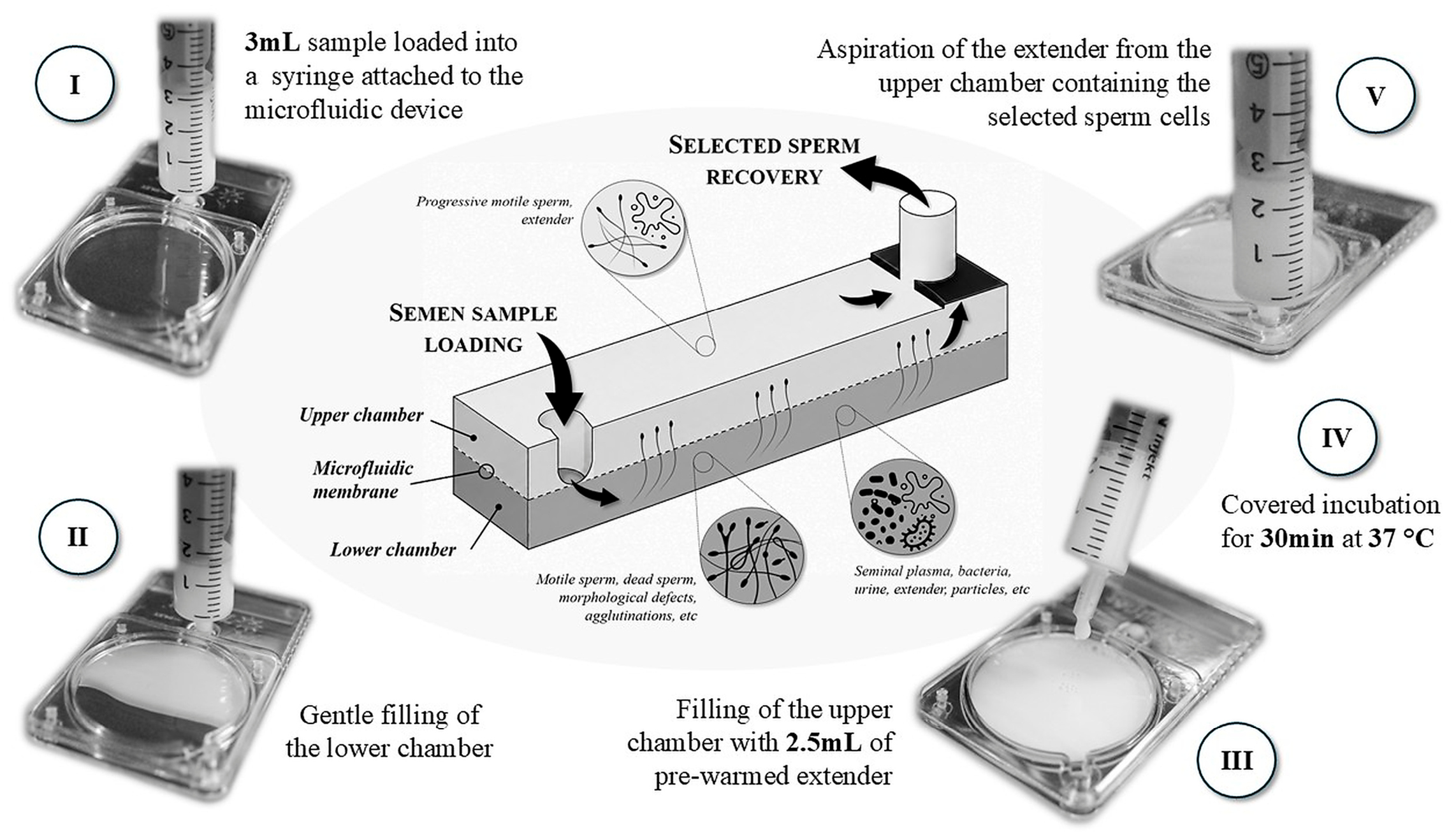
The quantitative analysis of bacterial load (presented in Figure 2) showed that microfluidic selection using the VetMotl device resulted in a significant reduction (p < 0.001) in colony-forming units (CFU). The overall microbial load in processed samples was approximately 72% lower than in unprocessed controls (1.5 ± 0.9 × 10³ CFU/mL vs. 5.4 ± 3.4 × 10³ CFU/mL). This effective reduction was consistently achieved for ejaculates from both hygienically prepared and unwashed stallions. The efficacy of the microfluidic treatment in reducing contamination was independent of the pre-collection protocol.
Figure 2.
Reduction in bacterial contamination by microfluidic selection (VetMotl®) in stallion semen. Microbial load (CFU/mL) is compared between unprocessed controls and processed samples, stratified by pre-collection hygiene protocol (washed vs. dirty). * indicates a significant difference (p < 0.001) between treatments within the same hygiene group. Data represent mean ± SD.
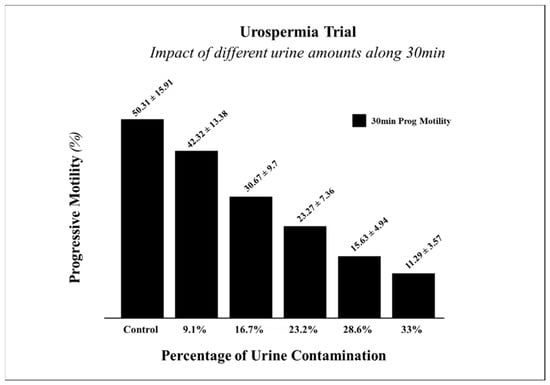
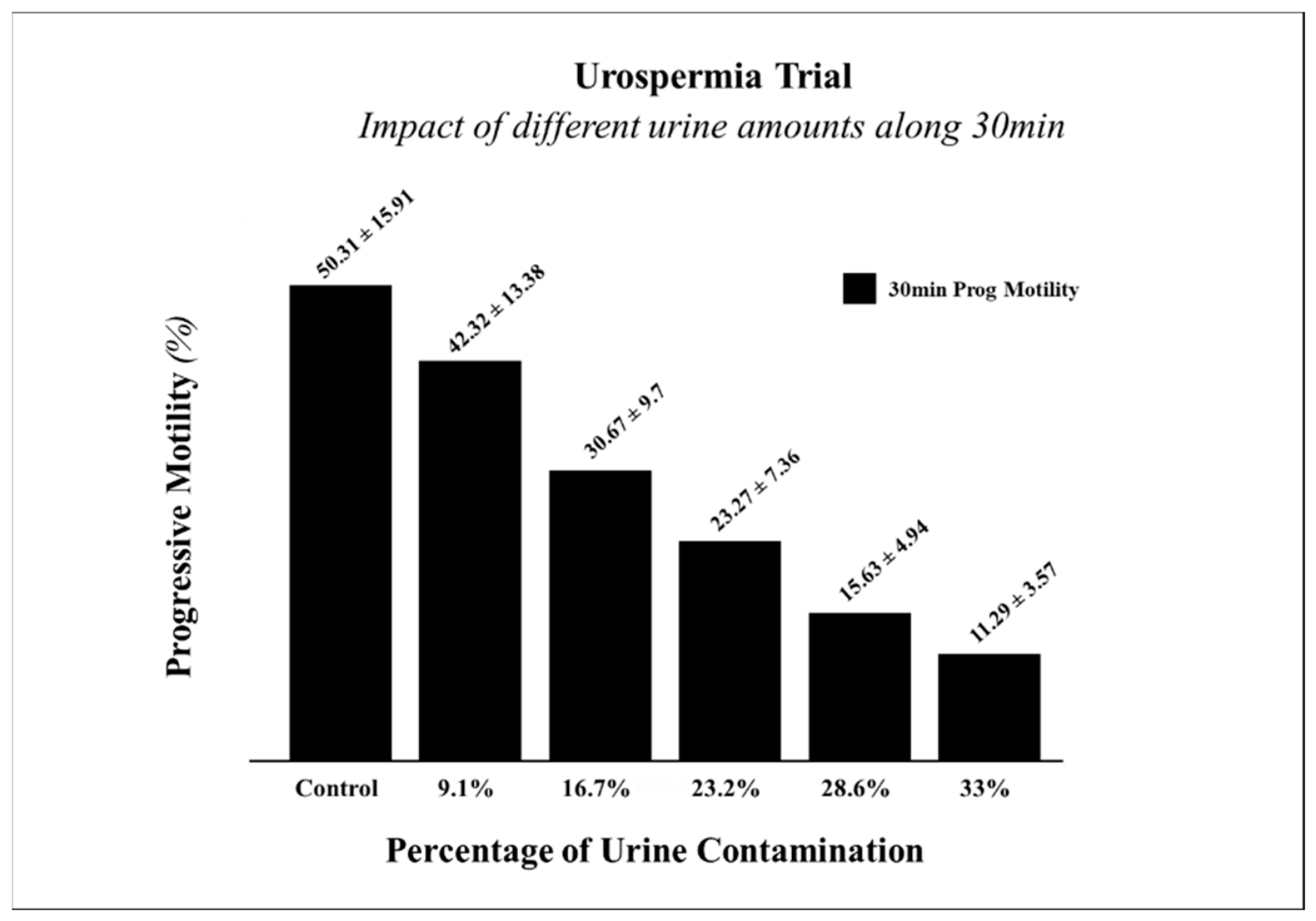
The results of Experiment 2, quantifying the impact of graded urine contamination, are summarized in Figure 3. Mean baseline raw semen parameters were: volume 31.07 ± 16.98 mL and concentration 234.3 ± 83.94 × 10⁶/mL. A clear, dose-dependent detrimental effect on sperm progressive motility (PM) was observed immediately following contamination. Compared to the uncontaminated control (50.31 ± 15.91% PM), the addition of 9.1% urine (G1) reduced PM to 42.32 ± 13.38%. This decline progressed sharply with increasing contamination: to 30.67 ± 9.70% at 16.7% urine (G2), 23.27 ± 7.36% at 23.2% (G3), 15.63 ± 4.94% at 28.6% (G4), and 11.29 ± 3.57% at 33% urine (G5). The longevity during cooled storage was also severely compromised in a concentration-dependent manner. While samples with lower contamination (G1) occasionally maintained motility for up to 6 h, those with high urine levels (G5) exhibited a near-complete loss of motility within 30 min. Critically, no urine-contaminated sample sustained viable motility beyond 12 h of storage. A notable clinical finding was that all contaminated ejaculates maintained a visual appearance similar to the control, underscoring the inability to detect urospermia by gross inspection alone.
Figure 3.
Dose-dependent effect of urine contamination on the immediate progressive motility and longevity of chilled stallion semen.
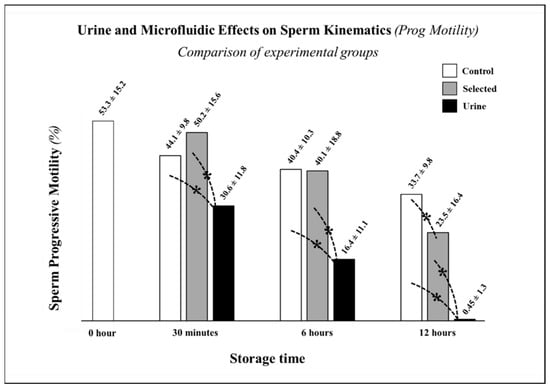
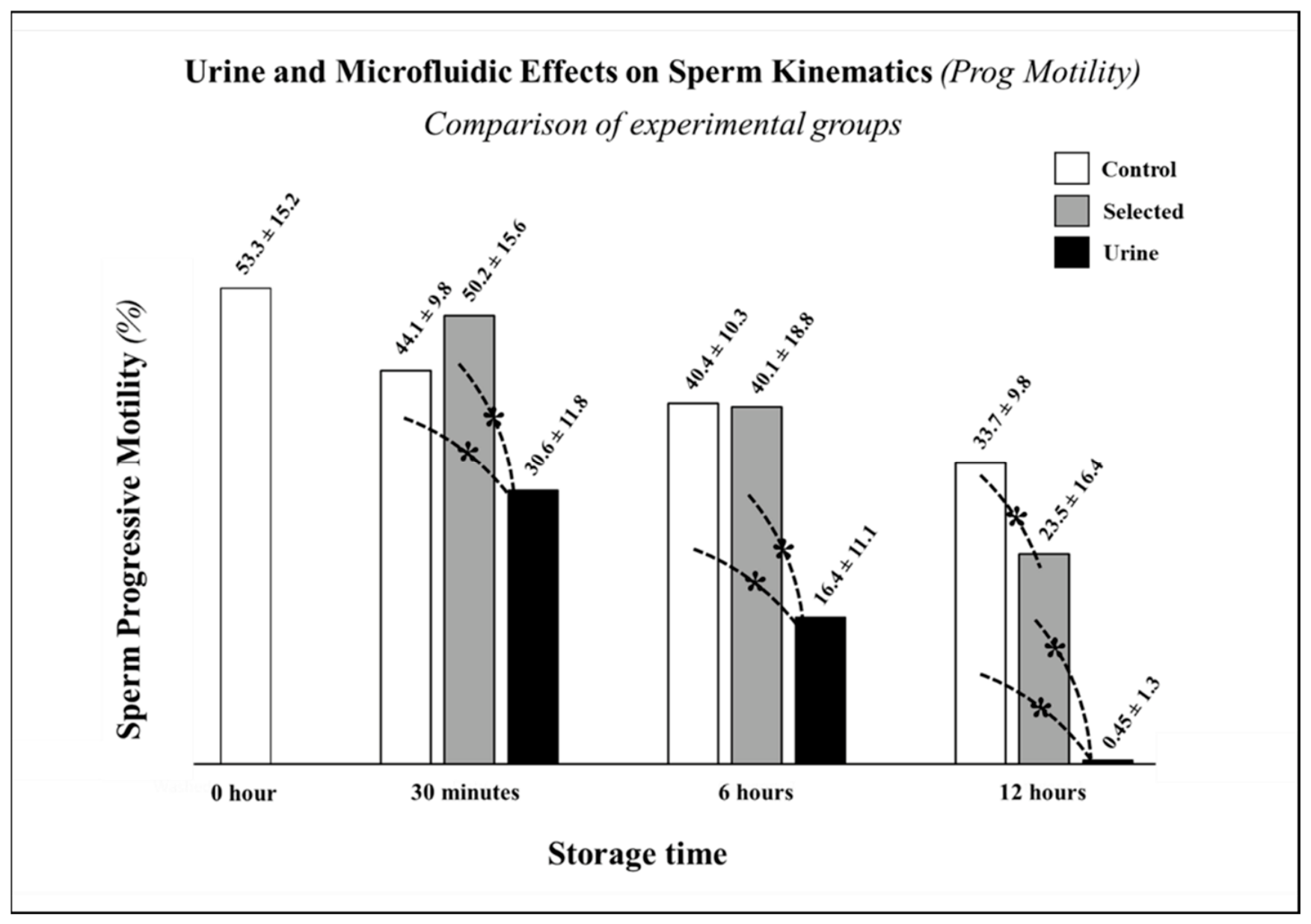
The results of Experiment 3 showed significant differences in sperm motility between treatment groups and over the storage time (p < 0.001), as detailed in Figure 4. After 30 min of incubation at 37 °C, the Urine-contaminated group showed a sharp decline in progressive motility (PM 30.64 ± 11.80%) compared to the Control (PM 44.12 ± 9.79%). In contrast, the microfluidic-selected group (PM 50.25 ± 15.56%) maintained motility at a level comparable to the Control. Following 6 h of cooled storage at 5 °C, the Urine group exhibited severely compromised quality (PM 16.43 ± 11.08%), while the Selected group (PM 40.04 ± 18.85%) maintained parameters that were statistically similar to the Control group (PM 40.39 ± 10.31%). At the 12-h time point, motility in the Urine group was negligible (PM 0.45 ± 1.26%). Although the Selected group (PM 23.49 ± 16.43%) showed a significant decline from earlier time points, its motility remained superior to the Urine group. This result demonstrates that microfluidic selection applied immediately after contamination can restore initial motility and preserve a functional sperm population during the first 6 h of cooled storage.
Figure 4.
Time-course evaluation of sperm progressive motility following high-level urospermia (33% v/v) and immediate intervention with microfluidic sperm selection. * indicates a significant difference (p < 0.001) between treatments within the same hygiene group. Data represent mean ± SD.
4. Discussion
The results of this study demonstrate that microfluidic sperm selection (VetMotl®) exerts a consistent beneficial effect on the sperm quality of cooled equine semen, mitigating the deleterious effects of both bacterial contamination and urospermia. The improvement observed in total motility (TM) and progressive motility (PM) in treated samples compared with controls corroborates recent studies [16]. In the latter, microfluidic devices were effective in enriching sperm subpopulations with high functional integrity and intact DNA. Although functionality and DNA integrity were not evaluated in the present study, motility was maintained after 24 h of cooling, suggesting that microfluidic selection confers greater resilience to the thermal and oxidative stress associated with hypothermic storage.
The significant reduction in bacterial load observed after microfluidic processing supports the effectiveness of this technique in promoting the physical segregation of spermatozoa from contaminating microorganisms. Thus, potential indirect deleterious effects mediated by bacterial endotoxins and oxidative stress are minimized, without exclusive reliance on antibiotic use. The presence of bacteria in stallion ejaculates is well documented in the literature and is commonly observed even immediately after semen collection, with a predominance of commensal microorganisms but also including opportunistic pathogens such as Pseudomonas aeruginosa, Klebsiella pneumoniae, and Streptococcus zooepidemicus, as well as classical pathogens such as Taylorella equigenitalis. These microorganisms may trigger inflammatory processes in the mare’s reproductive tract following artificial insemination, ultimately compromising fertility [1,2,14,29,30]. Additionally, even non-pathogenic bacteria may negatively affect semen quality during storage, regardless of their virulence, particularly under conditions that favor bacterial proliferation [10]. Although the inclusion of antibiotics in semen extenders is a routine practice for bacterial inhibition, their efficacy and safety are increasingly being questioned; certain compounds, such as gentamicin, may adversely affect sperm motility and functionality [13]. In this context, microfluidic processing emerges as a promising and biologically safe strategy, as it reduces bacterial load through a mechanical and selective mechanism, contributing to the preservation of sperm quality while aligning with current demands for more sustainable reproductive techniques with reduced dependence on antimicrobials.
The sperm recovery was outside the scope of the present trial, but recovery data using this device at input concentrations of 60–180 × 106 spermatozoa/mL (three concentration groups) was reported previously [26,31]. The expected recovery amount is approximately 18–20% of the total number of spermatozoa loaded. The recovered fraction (2.5 mL) in the previous study contained 40–100 × 106 spermatozoa in total, depending on the initial concentration group and showed improved semen quality after selection. The recovered fraction (2.5 mL) contained 40–100 × 106 total spermatozoa depending on the initial concentration and showed improved semen quality after selection. The number of spermatozoa should be sufficient for deep horn insemination as reported previously where a 47–53% pregnancy rate was achieved with a similar number of spermatozoa [32].
In Experiment 1, penile washing before semen collection did not influence sperm motility, in agreement with a comparison of different preparation methods, hygienic measures [33] and different semen handling practices [5], but in contrast to [4], where sperm motility was lower in samples where no penile washing occurred. The question of whether or not the penis should be washed prior to semen collection is often debated. Although penile washing was recommended by some authors, e.g., [30], routine washing of the penis with water was reported to result in replacement of the normal flora by potential pathogens [9,34]. Furthermore, there was a report of Pseudomonas spp. being transferred from the water supply to the penis during washing [34].
Regarding urinary contamination (Experiment 2), a dose-dependent deleterious effect of urine on sperm motility and longevity was observed, consistent with the well-documented sensitivity of equine spermatozoa to alterations in urinary osmolarity and pH [22]. The rapid deterioration of motility at increasing urine concentrations underscores the importance of early diagnosis, as visual inspection often fails to detect subclinical levels of urospermia.
In the present study, all contaminated ejaculates exhibited an appearance comparable to control samples, indicating that macroscopic evaluation alone is not sufficient to identify urospermia. This limitation may have clinical relevance, as undetected urospermia could contribute to reduced semen longevity during cooling and storage. Consistent with this observation, the application of microfluidic sperm processing in the current experiments resulted in improved semen quality and extended functional lifespan in compromised samples. Together, these findings suggest that microfluidic processing may represent a valuable clinical tool for improving quality of cooled semen, particularly in stallions exhibiting reduced semen viability during storage (“bad coolers”).
The detrimental effect of urine is influenced by its concentration, affecting sperm motility, quality and longevity in raw, cooled and frozen-thawed samples [35,36]. A simple semen dilution might enhance sample longevity depending on the level of contamination but is not the most effective method to ensure better quality. Simple centrifugation, cushioned centrifugation and silane-coated colloid centrifugation [25] represent more effective methods to remove the urine experimentally added to semen samples for cooling [35,36], or freezing [37].
In Experiment 3, the application of microfluidic processing immediately after the induction of urospermia partially attenuated sperm damage, preserving progressive motility at levels comparable to the control. The ability of this technique to recover a viable sperm population suggests that microfluidics may represent a superior alternative to conventional washing methods for the management of chemically contaminated ejaculates.
Due to the detrimental impact of urine contamination on semen quality, its presence in the ejaculate must be avoided, or urine already mixed with the sample must be removed or its effects mitigated. To prevent this negative effect, medications such as bunutrolol [38], furosemide, and noradrenaline hydrochloride have been used in stallions, but their effectiveness was inconsistent [38,39]. A definitive diagnosis of the cause of urospermia is often uncertain, even when neurological involvement is suspected, and management strategies are commonly adopted to obtain a urine-free ejaculate. Stallion exercise followed by immediate return to a stall with fresh straw to stimulate urination, thereby emptying the bladder prior to semen collection, is one of the strategies employed [39]. When a contaminated ejaculate is obtained, in-laboratory handling techniques have been tested to allow its use and processing for immediate insemination and freezing, aiming to achieve acceptable pregnancy rates.
5. Conclusions
The present study demonstrates that microfluidic sperm selection represents an effective and innovative strategy to mitigate two major challenges affecting cooled stallion semen: bacterial contamination and urospermia. The results from Experiment 1 show that microfluidic processing significantly reduces bacterial load while maintaining or improving sperm motility, supporting its capacity to physically segregate motile spermatozoa from microbial contaminants. This finding is particularly relevant in the current context of increasing concern over antimicrobial resistance and the potential adverse effects of antibiotics on sperm function.
Experiment 2 confirms that urospermia exerts a rapid, dose-dependent deleterious effect on sperm motility and longevity during cooled storage, even at subclinical levels that may not be detected by visual inspection. These data reinforce the importance of early diagnosis and immediate intervention to prevent irreversible losses in semen quality. Furthermore, Experiment 3 demonstrates that the application of microfluidic selection immediately after urine contamination can partially preserve sperm motility during storage, highlighting the potential of this technology as a corrective tool in cases of accidental urospermia.
Taken together, these findings provide experimental evidence that microfluidic sperm selection enhances the robustness and hygienic quality of cooled-stored stallion semen by selectively enriching functional sperm populations and reducing exposure to harmful contaminants. Microfluidics could be a promising adjunct or alternative to conventional semen processing methods, with the potential to improve reproductive efficiency, reduce economic losses, and contribute to more sustainable equine breeding practices, supporting its application as a practical strategy to enhance the quality of cooled semen in stallions, including those with reduced semen viability during storage (“bad coolers”). Future studies should focus on validating these results under field conditions and assessing the impact of microfluidic-selected semen on pregnancy rates and long-term reproductive outcomes in mares.
Author Contributions
Conceptualization, M.M.N.; methodology, M.M.N.; software, G.G.D.S.; validation.; formal analysis, G.G.D.S.; investigation, M.M.N., M.L.M. and O.A.I.; resources, M.M.N. and O.A.I.; data curation, M.M.N. and O.A.I.; writing—original draft preparation, M.M.N. and M.L.M.; writing—review and editing, J.M.M. and G.F.C.; visualization, M.M.N., J.M.M. and G.F.C.; supervision, G.F.C.; project administration, M.M.N. and G.F.C. All authors have read and agreed to the published version of the manuscript.
Funding
This research received no external funding.
Institutional Review Board Statement
Ethical review and approval were waived for this study since semen collection in stallions is a routine husbandry procedure that does not harm the animal.
Informed Consent Statement
Not applicable.
Data Availability Statement
The original contributions presented in this study are included in the article. Further inquiries can be directed to the corresponding authors.
Acknowledgments
To Al-baydaa Equine Hospital for providing the semen samples and facilities, VetMotl for providing the microfluidic devices, German Standard Group and MK Arabians for logistical support, and the PGBA of UFRPE for academic support.
Conflicts of Interest
The authors have read the journal’s policy and have the following competing interests: the co-authors (Nunes M.M. and Munhoz M.L.) are employees of German Standard Group and MK Arabians Stud Farm, respectively. Neither GSG nor the stud farm influenced the results or the writing, nor did they provide any funding. The other authors have no competing interests.
Abbreviations
The following abbreviations are used in this manuscript:
| Tot | Total motility |
| Prog | Progressive motility |
References
- Malmgren, L.; Olsson Engvall, E.; Engvall, A.; Albihn, A. Aerobic bacterial flora of semen and stallion reproductive tract and its relation to fertility under field conditions. Acta Vet. Scand. 1998, 39, 173–182. [Google Scholar] [CrossRef] [Scilit]
- Rota, A.; Calicchio, E.; Nardoni, S.; Fratini, F.; Ebani, V.V.; Sgorbini, M.; Panzani, D.; Camillo, F.; Mancianti, F. Presence and distribution of fungi and bacteria in the reproductive tract of healthy stallions. Theriogenology 2011, 76, 464–470. [Google Scholar] [CrossRef] [Scilit]
- Al-Kass, Z.; Eriksson, E.; Bagge, E.; Wallgren, M.; Morrell, J.M. Bacteria detected in the genital tract, semen or pre-ejaculatory fluid of Swedish stallions from 2007 to 2017. Acta Vet. Scand. 2019, 61, 25. [Google Scholar] [CrossRef] [Scilit]
- Althouse, G.C.; Kuster, C.E.; Clark, S.G.; Weisiger, R.M. Field investigations of bacterial contaminants and their effects on extended porcine semen. Theriogenology 2000, 53, 1167–1176. [Google Scholar] [CrossRef] [Scilit]
- Althouse, G.C.; Skaife, J.; Loomis, P. Prevalence and types of contaminant bacteria in extended, chilled equine semen. Anim. Reprod. Sci. 2010, 121, 224–225. [Google Scholar] [CrossRef] [Scilit]
- Morrell, J.M.; Cojkic, A.; Malaluang, P.; Ntallaris, T.; Lindahl, J.; Hansson, I. Antibiotics in semen extenders—A multiplicity of paradoxes. Reprod. Fertil. Dev. 2024, 36, RD23218. [Google Scholar] [CrossRef] [Scilit]
- Ramires Neto, C.; Silva, Y.F.R.; Resende, H.L.; Guasti, P.N.; Monteiro, G.A.; Papa, P.M.; Júnior, J.A.D.; Filho, J.N.P.P.; Alvarenga, M.A.; Papa, F.O. Control methods and evaluation of bacterial growth on fresh and cooled stallion semen. J. Equine Vet. Sci. 2015, 35, 277–282. [Google Scholar] [CrossRef] [Scilit]
- Bowen, J.M.; Tobin, N.; Simpson, R.B.; Ley, W.B.; Ansari, M.M. Effects of washing on the bacterial flora of the stallion’s penis. J. Reprod. Fertil. 1982, 32, 41–45. [Google Scholar]
- Pétry, S.; Sévin, C.; Barrier Battut, I. Bacterial development in semen stored at ambient temperature in INRA96®. J. Equine Vet. Sci. 2023, 125, 104610. [Google Scholar] [CrossRef] [Scilit]
- Varner, D.D.; Scanlan, C.M.; Thompson, J.A.; Brumbaugh, G.W.; Blanchard, T.L.; Carlton, C.M.; Johnson, L. Bacteriology of preserved stallion semen and antibiotics in semen extenders. Theriogenology 1998, 50, 559–573. [Google Scholar] [CrossRef] [Scilit]
- Aurich, C.; Spergser, J. Influence of bacteria and gentamicin on cooled-stored stallion spermatozoa. Theriogenology 2007, 67, 912–918. [Google Scholar] [CrossRef] [Scilit]
- Santos, C.S.; Silva, A.R. Current and alternative trends in antibacterial agents used in mammalian semen technology. Anim. Reprod. 2020, 17, e20190111. [Google Scholar] [CrossRef] [Scilit]
- Zabala, S.M.; Serres, C.; Montero, N.; Crespo, F.; Lorenzo, P.L.; Pérez-Aguilera, V.; Galán, C.; Domínguez-Gimbernat, M.; Oliet, A.; Moreno, S.; et al. Strategies to reduce the use of antibiotics in fresh and chilled equine semen. Animals 2024, 14, 179. [Google Scholar] [CrossRef] [Scilit]
- Samper, J.C.; Tibary, A. Disease transmission in horses. Theriogenology 2006, 66, 551–559. [Google Scholar] [CrossRef] [Scilit]
- Bliss, S.B.; Voge, J.L.; Hayden, S.S.; Teague, S.R.; Brinsko, S.P.; Love, C.C.; Blanchard, T.L.; Varner, D.D. The impact of cushioned centrifugation protocols on semen quality of stallions. Theriogenology 2012, 77, 1232–1239. [Google Scholar] [CrossRef] [Scilit]
- Paredes, B.J.; Hernández-Avilés, C.; Ramírez-Agámez, L.F.; Favetta, L.A.; Ribeiro, E.S.; Amorim, M.D.; Neal, M.S.; Love, C.C.; Chenier, T. Sperm processing methods effectively reduce the DNA fragmentation index in samples with high initial values. J. Equine Vet. Sci. 2023, 125, 104609. [Google Scholar] [CrossRef] [Scilit]
- Morrell, J.M.; Klein, C.; Lundeheim, N.; Erol, E.; Troedsson, M.H.T. Removal of bacteria from stallion semen by colloid centrifugation. Anim. Reprod. Sci. 2014, 145, 47–53. [Google Scholar] [CrossRef] [Scilit]
- Morrell, J.M.; Nunes, M.M. Practical guide to single layer centrifugation of stallion semen. Equine Vet. Educ. 2018, 30, 392398. [Google Scholar] [CrossRef] [Scilit]
- Boyle, M. The investigation of stallion fertility problems. Equine Vet. Educ. 1990, 2, 65–71. [Google Scholar] [CrossRef] [Scilit]
- Althouse, G.C.; Seager, S.W.; Varner, D.D.; Webb, G.W. Diagnostic aids for the detection of urine in the equine ejaculate. Theriogenology 1989, 31, 1141–1148. [Google Scholar] [CrossRef] [Scilit]
- Griggers, S.; Paccamonti, D.L.; Thompson, R.A.; Eilts, B.E. The effects of pH, osmolarity and urine contamination on equine spermatozoal motility. Theriogenology 2001, 56, 613–622. [Google Scholar] [CrossRef] [Scilit]
- Kim, S.C.; Kim, H.W. Effects of nitrogenous components of urine on sperm motility: An in vitro study. Int. J. Androl. 1998, 21, 29–33. [Google Scholar] [CrossRef] [Scilit]
- Lowe, J.N. Diagnosis and management of urospermia in a commercial Thoroughbred stallion. Equine Vet. Educ. 2001, 13, 47. [Google Scholar] [CrossRef] [Scilit]
- Ellerbrock, R.; Canisso, I.; Feijo, L.; Lima, F.; Shipley, C.; Kline, K. Diagnosis and effects of urine contamination in cooled-extended stallion semen. Theriogenology 2016, 85, 1219–1224. [Google Scholar] [CrossRef] [Scilit]
- Bhat, G.R.; Lone, F.A.; Dalal, J. Microfluidics-a novel technique for high-quality sperm selection for greater ART outcomes. FASEB Bioadv. 2024, 6, 406–423. [Google Scholar] [CrossRef] [Scilit]
- Nunes, M.M.; Munhoz, M.L.; Freitas, F.A.S.; Gallelli, M.F.; Carneiro, G.F.; Miragaya, M. Comparison of two sperm selection devices using variable sperm loads to enhance quality and sperm harvest from fresh-diluted stallion ejaculates. Anim. Reprod. Sci. 2025, 272, 107729. [Google Scholar] [CrossRef] [Scilit]
- Ietje, P.; Leendertse, A.C.; Asbury, K.J.; Boening, F.C.; von Saldern, V. Successful management of persistent urination during ejaculation in a Thoroughbred stallion. Equine Vet. Educ. 1990, 2, 62–64. [Google Scholar] [CrossRef] [Scilit]
- Jahangiri, A.R.; Ziarati, N.; Dadkhah, E.; Bucak, M.N.; Rahimizadeh, P.; Shahverdi, A.; Gilani, M.A.S.; Topraggaleh, T.R. Microfluidics: The future of sperm selection in assisted reproduction. Andrology 2024, 12, 1236–1252. [Google Scholar] [CrossRef] [Scilit]
- Parlevliet, J.M.; Bleumink-Pluyn, N.M.; Houwers, D.J.; Remmen, J.L.; Sluijter, F.J.; Colenbrander, B. Epidemiological aspects of Taylorella equigenitalis. Theriogenology 1997, 47, 1169–1177. [Google Scholar]
- Gibb, Z.; Clulow, J.R.; Aitken, R.J.; Swegen, A. First publication to describe a protocol for the liquid storage of stallion spermatozoa for 7 days. J. Equine Vet. Sci. 2018, 66, 37–40. [Google Scholar] [CrossRef] [Scilit]
- Munhoz, M.L.; Nunes, M.M.; Freitas, F.A.S.; Gallelli, M.F.; Carneiro, G.F.; Miragaya, M. Influence of VetMotl selection and choice of extender on stallion sperm quality stored at 5 °C for 24 hours. Anim. Reprod. Sci. 2025, 272, 107730. [Google Scholar] [CrossRef] [Scilit]
- Woods, J.; Rigby, S.; Brinsko, S.; Stephens, R.; Varner, D.; Blanchard, T. Effect of intrauterine treatment with prostaglandin E2 prior to insemination of mares in the uterine horn or body. Theriogenology 2000, 53, 1827–1836. [Google Scholar] [CrossRef] [Scilit]
- Lauciello, A.; Loncaric, I.; Bernardi, L.; Schreiner, B.; Spergser, J.; Aurich, C. Effect of washing stallion’s penis prior to semen collection on bacterial load of the distal genital tract and semen. J. Equine Vet. Sci. 2025, 145, 38. [Google Scholar] [CrossRef] [Scilit]
- Allen, J.L.; Begg, A.P.; Browning, G.F. Outbreak of equine endometritis caused by a genotypically identical strain of Pseudomonas aeruginosa. J. Vet. Diagn. Investig. 2011, 23, 1236–1239. [Google Scholar] [CrossRef] [Scilit]
- Ellerbrook, R.E.; Honorato, J.; Curcio, B.R.; Stewart, J.L.; Souza, J.A.T.; Love, C.C.; Lima, F.; Canisso, I. Effect of urine contamination on stallion semen freezing ability. Theriogenology 2018, 117, 1–6. [Google Scholar] [CrossRef] [Scilit]
- Podico, G.; Ellerbrock, R.E.; Curcio, B.R.; Cheong, S.H.; Lima, F.S.; Canisso, I.F. Single-layer colloid centrifugation as a method to process urine-contaminated stallion semen after freezing-thawing. J. Equine Vet. Sci. 2020, 87, 102910. [Google Scholar] [CrossRef] [Scilit]
- Voge, J.; Varner, D.D.; Blanchard, T.L.; Meschini, M.; Turner, C.; Teague, S.R.; Brinsko, S.P.; Love, C.C. The effects of urine concentration, and cushion centrifugation to remove urine, on the quality of cool-stored stallion sperm. Theriogenology 2016, 86, 1294–1298. [Google Scholar] [CrossRef] [Scilit]
- Pearson, M.M.; Hernández-Avilés, C.; Spacek, S.G.; Beckham, A.M.N.; Kelley, D.E.; Ramírez-Agámez, L.; LaCaze, K.A.; Varner, D.D.; Love, C.C. Comparison of two processing techniques on the sperm quality of semen contaminated with urine. Theriogenology 2024, 216, 137–145. [Google Scholar] [CrossRef] [Scilit]
- Mayhew, I.G. Neurological aspects of urospermia in the horse. Equine Vet. Educ. 1990, 2, 68–69. [Google Scholar] [CrossRef] [Scilit]

Disclaimer/Publisher’s Note: The statements, opinions and data contained in all publications are solely those of the individual author(s) and contributor(s) and not of MDPI and/or the editor(s). MDPI and/or the editor(s) disclaim responsibility for any injury to people or property resulting from any ideas, methods, instructions or products referred to in the content. |
© 2026 by the authors. Licensee MDPI, Basel, Switzerland. This article is an open access article distributed under the terms and conditions of the Creative Commons Attribution (CC BY) license.