


Simple Summary
Pig farming relies heavily on grain-based feeds such as corn and soybean meal, so developing sustainable alternative feed resources is important for the pig industry. Pennisetum giganteum grows quickly and contains valuable nutrients, but it is unclear how much of it can replace standard pig feed without harming growth or health. In this study, we fed thirty six-month-old Congjiang pigs either a normal diet or diets in which 10% or 20% of the dry feed was replaced with fresh Pennisetum giganteum for 90 days. No adverse effect on growth was observed. Both replacement levels lowered blood cholesterol. The 20% level also lowered blood sugar and a marker of protein breakdown, and reduced visible fat marbling in meat. The 10% level increased genes involved in fat turnover and improved the body’s natural defenses against harmful molecules. The 20% level reduced some fat-building genes and increased a gene involved in using fatty acids. These results suggest that Pennisetum giganteum can be a sustainable feed for local pigs. A 10% replacement may support antioxidant and metabolic health, while a 20% replacement may help lower blood sugar and cholesterol. This work provides a sustainable forage alternative to reduce grain dependency in local pig production.
Abstract
Developing unconventional feed resources is important for sustainable pig production. This study investigated the effects of partially replacing the basal diet with fresh Pennisetum giganteum at two inclusion levels on serum biochemistry, meat quality, lipid metabolism, and antioxidant capacity in finishing Congjiang pigs. Thirty 6-month-old Congjiang pigs (15 males and 15 females) of similar initial body weight were randomly assigned to three groups (n = 5 replicates per group; 2 pigs per replicate). The control group (CON) received the basal diet. The PG10 and PG20 groups received diets in which 10% and 20% of the basal diet dry matter was replaced with Pennisetum giganteum dry matter, respectively. Following a 7-day pre-feeding period, the feeding trial lasted 90 days. Blood samples were collected on day 90, and meat quality traits, lipid metabolism gene expression, and antioxidant indices in liver and longissimus dorsi muscle were determined after slaughter. Compared with CON, serum total cholesterol (TCHO) was significantly lower in PG10 and PG20 (p < 0.05). Serum glucose (GLU) and blood urea nitrogen (BUN), as well as marbling score, were significantly lower in PG20 relative to CON (p < 0.05). In the longissimus dorsi muscle, compared with CON, PG10 upregulated LPL and ACC mRNA expression, whereas PG20 downregulated FAS and ACC and upregulated FABP4 mRNA expression (p < 0.05). Compared with CON, PG10 increased the activities of SOD and HRSC, the GSH content and GSH/GSSG ratio in longissimus dorsi muscle, and elevated hepatic SOD activity and GSH content; meanwhile, PG10 upregulated the mRNA expression of hepatic SOD1, and muscular HO1 and GCLC; PG20 increased muscular SOD activity and GCLC expression and hepatic NRF2 expression. In conclusion, dietary Pennisetum giganteum induced differential metabolic responses depending on inclusion level: 10% inclusion improved lipid turnover and antioxidant status, whereas 20% inclusion reduced serum glucose and cholesterol concentrations and suppressed lipogenic gene expression. These findings support Pennisetum giganteum as a sustainable feed resource for indigenous pig production.
1. Introduction
Feed accounts for approximately 60–70% of total livestock production costs and is a major determinant of the sustainability of animal production systems [1]. Conventional corn–soybean meal-based diets remain the predominant feeding strategy for swine production worldwide [2,3]. However, rapid population growth, increasing competition between human food and animal feed, and climate-related challenges have intensified pressure on global grain supplies, resulting in rising feed costs and increasing concerns regarding feed security [4]. Consequently, the development and utilization of sustainable unconventional feed resources have become important strategies for reducing dependence on grain-based feeds and promoting the long-term development of animal husbandry.
Pennisetum giganteum is a perennial forage grass characterized by high biomass yield, strong environmental adaptability, and considerable nutritional value. Owing to its high concentrations of soluble carbohydrates and crude protein, as well as its tolerance to adverse environmental conditions, Pennisetum giganteum has attracted increasing attention as a promising unconventional feed resource [5]. Moreover, its ease of cultivation and high productivity make it particularly suitable for alleviating feed shortages and reducing feeding costs in livestock production systems [6].
Forages rich in dietary fiber can influence glucose homeostasis, lipid metabolism, and antioxidant capacity in pigs through modulation of nutrient utilization, gut microbial fermentation, and metabolic signaling pathways [7,8,9]. For example, dietary grass meal supplementation altered fatty acid composition and increased polyunsaturated fatty acid deposition in porcine muscle [10], while alfalfa supplementation improved growth performance, antioxidant status, and meat quality in finishing pigs [11]. Furthermore, dietary fiber has been reported to regulate interorgan nutrient partitioning and muscle–adipose energy metabolism, thereby influencing lipid deposition and metabolic homeostasis [12]. These findings indicate that forage inclusion may function not only as a nutritional strategy but also as a metabolic regulator. Nevertheless, the biological effects of forage supplementation often depend on inclusion level, and excessive fiber inclusion may alter nutrient digestibility, energy utilization, and lipid deposition patterns [9]. To date, little information is available regarding the optimal inclusion level of Pennisetum giganteum in finishing pig diets, and the mechanisms through which it regulates lipid metabolism and antioxidant function, particularly via antioxidant signaling pathways such as Keap1–Nrf2, remain largely unexplored.
The Congjiang pig is an indigenous Chinese breed renowned for its strong roughage tolerance, preference for fresh forage, and superior meat quality [13], making it an ideal model for evaluating the biological effects of forage-based feeding strategies. We hypothesized that dietary inclusion of Pennisetum giganteum would exert effects on metabolic regulation that depend on inclusion level, improving lipid metabolism and antioxidant status without compromising growth performance. Therefore, this study investigated the effects of replacing 10% or 20% of the basal diet with Pennisetum giganteum on growth performance, serum biochemical parameters, meat quality, lipid metabolism-related gene expression, and hepatic and muscular antioxidant capacity in finishing Congjiang pigs. Particular attention was given to identifying metabolic responses that differ by inclusion level and their underlying molecular mechanisms. The results provide new insights into the application of Pennisetum giganteum as a sustainable functional feed resource for indigenous pig production.
2. Materials and Methods
2.1. Ethics Approval
All experimental procedures were reviewed and approved by the Committee of Animal Experiments of Fujian Agriculture and Forestry University (Fuzhou, Fujian, China; approval ID PZCASFAFU22009).
2.2. Experimental Design, Animals, and Diets
Thirty 6-month-old Congjiang pigs (15 males and 15 females) of similar initial body weight were randomly assigned to 3 dietary treatments, with 5 replicates per treatment and 2 pigs per replicate. The experiment consisted of a 7-day pre-feeding adaptation period and a 90-day formal feeding trial. During the adaptation period, all pigs were gradually acclimated to the experimental diets and housing conditions. The health status of each pig (including mental state, appetite, and faecal consistency) was monitored twice daily, and no clinical abnormalities were observed throughout the trial. To align with practical on-farm feeding practices and facilitate the application of fresh forage in small-scale pig production, this study adopted a direct dry-matter replacement strategy: fresh Pennisetum giganteum was used to partially replace the basal diet without additional supplementation of protein, energy, or trace mineral premix. Pigs in the control group (CON) were fed a basal diet exclusively. Pigs in the PG10 and PG20 groups received diets in which 10% and 20% of the basal diet (dry matter) was replaced by Pennisetum giganteum (dry matter), respectively. The dry matter content of fresh Pennisetum giganteum (harvested at 1.8–2 m in height) was approximately 14.6%, and that of the basal diet was approximately 88% [14]. To achieve the designed dry matter substitution ratio, a fresh weight ratio of 6:1 (Pennisetum giganteum: basal diet) was applied, meaning 6 kg of fresh Pennisetum giganteum replaced 1 kg of the basal diet on an air-dry basis. Fresh Pennisetum giganteum was harvested on the same day of feeding, chopped into 2–3 cm segments using a grass shredder, and thoroughly mixed with the basal diet immediately before feeding. The basal diet was formulated to meet the nutrient requirements of finishing pigs (GB/T 39235-2020) [15] and was provided by Zhangzhou Nanjing Luming Ecological Farm. The ingredient composition and nutrient levels of the basal diet are shown in Table 1, and the measured nutrient composition of fresh Pennisetum giganteum is shown in Table 2. The calculated nutrient profiles of the PG10 and PG20 diets are provided in Supplementary Table S2. No extra nutrients were added to balance the experimental diets; thus, the three dietary treatments were not isonitrogenous or isocaloric.
Table 1.
Composition and nutrient levels of the basal diet (air-dried basis, %).
Table 2.
Nutrition levels of Pennisetum giganteum (%).
All pigs were housed in indoor pens with natural ventilation under local ambient temperature conditions. Due to the limited gastric capacity of Congjiang pigs and to ensure complete daily consumption of the forage-containing diets, all pigs were subjected to a restricted feeding regime. The CON group was offered the basal diet at 3.5% of body weight per day, divided into two equal meals at 09:00 and 15:00. The experimental groups were fed the corresponding mixed diets according to the same body weight-based allowance and substitution ratios. The daily feed allowance was readjusted every two weeks based on estimated body weight. The body weight was estimated by combining the results from our preliminary trial and the growth performance of Congjiang pigs. No residual feed was observed after each feeding, indicating complete feed consumption by pigs. All pigs had free access to drinking water and were vaccinated following the routine immunization procedure for finishing pigs.
2.3. Sample Collection
On day 90 of the feeding trial, one pig with body weight close to the pen-average weight was selected from each replicate pen for sampling and slaughter. Each pen contained one male and one female pig, and an equal sex ratio of slaughtered pigs was maintained across all dietary treatments. Selected pigs were weighed using an electronic livestock platform scale (maximum capacity: 1000 kg; graduation: 0.1 kg). Pigs were fasted for 12 h after the last feeding on day 90. At 08:00 on day 91, 5–10 mL of blood was collected from the anterior vena cava. The blood samples were allowed to stand at room temperature for 30 min, then centrifuged at 835× g for 15 min (Eppendorf AG, Hamburg, Germany). The supernatant serum was aspirated and stored at −20 °C for further analysis. After blood collection, the pigs were humanely slaughtered by electrical stunning followed by exsanguination. Liver tissue samples were collected into cryovials, snap-frozen in liquid nitrogen, and stored at −80 °C for antioxidant index determination. The left longissimus dorsi muscle was also collected: one portion was used for meat quality measurement, and the remaining portion was snap-frozen in liquid nitrogen and stored at −80 °C for subsequent antioxidant and gene expression analyses.
2.4. Serum Biochemistry Analysis
Serum concentrations of glucose (GLU), triglycerides (TGs), total cholesterol (TCHO), high-density lipoprotein cholesterol (HDL-C), low-density lipoprotein cholesterol (LDL-C), total protein (TP), and blood urea nitrogen (BUN) were measured using colorimetric assay kits (Hunan Yonghe-Sun Biotechnology Co., Ltd., Changsha, China; catalog numbers: GLU: YHS-1001; TG: YHS-1002; TCHO: YHS-1003; HDL-C: YHS-1004; LDL-C: YHS-1005; TP: YHS-1006; BUN: YHS-1007) on a fully automated biochemical analyzer (Mindray BS-420, Shenzhen, China). Each sample was measured in duplicate.
2.5. Meat Quality Determination
Marbling was scored by trained evaluators according to the published visual standards of the National Pork Producers Council [16]. A laboratory pH meter (pH Star, Matthaus, Germany) was used to record pH values at 45 min post-slaughter (pH45min) and 24 h post-slaughter (pH24h). The color values, including lightness (L*), redness (a*), and yellowness (b*), were measured using a colorimeter (Minolta CR-410; Konica Minolta Sensing, Inc., Tokyo, Japan). Drip loss was determined according to the standardized bag method described by Honikel [17]. Longissimus dorsi muscle samples stored at 4 °C (24 h and 48 h post-slaughter) were placed into vacuum bags and heated in a 75 °C constant-temperature water bath for 30 min. The core temperature was monitored with a thermocouple thermometer until it reached 70 °C. Subsequently, the cooked meat samples were trimmed along the direction of muscle fibers into cylindrical specimens with a diameter of 12.7 mm and a length of 20 mm. Shear force (expressed in Newtons, N) was determined using a texture analyzer (C-LM3B, Tenovo, Beijing, China) equipped with a 15-kg load cell at a crosshead speed of 200 mm/min. The intramuscular fat (IMF) content of the longissimus dorsi muscle samples was determined by Soxhlet extraction with diethyl ether [18] and expressed as a percentage of the fresh muscle weight.
2.6. Antioxidant Index Determination
Liver and longissimus dorsi muscle samples were homogenized in ice-cold normal saline and centrifuged to prepare 10% tissue homogenate supernatant. The activities of total superoxide dismutase (SOD), glutathione peroxidase (GSH-Px), catalase (CAT), and the contents of reduced glutathione (GSH), malondialdehyde (MDA), total antioxidant capacity (AOC), and hydroxyl radical scavenging capacity (HRSC) were determined using commercial colorimetric assay kits (Hunan Yonghe-Sun Biotechnology Co., Ltd., Changsha, China). All assays were performed on a full-wavelength microplate reader according to the manufacturer’s instructions.
2.7. RNA Extraction and Quantitative Real-Time PCR
As previously reported [19], total RNA was isolated from liver and muscle tissues using the SteadyPure RNA Extraction Kit (Hunan Aikerui Bioengineering Co., Ltd., Changsha, China). The quantity and quality of total RNA were assessed using a Nanodrop 2000 spectrophotometer (Thermo Fisher Scientific, Waltham, MA, USA). RNA integrity was verified by agarose gel electrophoresis. Then, cDNA was reverse-transcribed from 1 μg of total RNA using the Hifair® III 1st Strand cDNA Synthesis SuperMix for qPCR (Hunan Aikerui Bioengineering Co., Ltd., Changsha, China). Relative gene expression levels were determined by qRT-PCR on a real-time PCR system (Bio-Rad Laboratories Co., Ltd., Shanghai, China) using the PerfectStart® Green qPCR SuperMix kit (TransGen Biotech, Beijing, China). The qRT-PCR protocol was as follows: pre-denaturation at 95 °C for 5 min, followed by 40 cycles of denaturation at 95 °C for 10 s, annealing at 55–65 °C for 10 s, and extension at 72 °C for 10 s. Primers were designed and synthesized by Shanghai Sangon Biotech Co., Ltd. (Shanghai, China), and their sequences are presented in Supplementary Table S3. β-Actin was used as the internal reference gene, and gene expression levels were analysed using the 2−ΔΔCT method.
2.8. Statistical Analysis
Statistical analysis was performed using SPSS 26.0 (SPSS, Inc., Chicago, IL, USA). The pen (replicate) was used as the experimental unit. Normality of residuals and homogeneity of variances were verified by the Shapiro–Wilk test and Levene’s test, respectively, before ANOVA. Data were analyzed by one-way ANOVA [20] followed by Tukey’s multiple comparison test. Results are presented as mean ± standard deviation. Error bars in all figures represent SD. Differences were considered statistically significant at p < 0.05.
3. Results
3.1. Growth Performance
The effects of partially replacing the basal diet with Pennisetum giganteum on the growth performance of Congjiang pigs are presented in Supplementary Table S1 [21]. No significant differences in final body weight and average daily gain were observed among the three groups (p > 0.05).
3.2. Serum Biochemical Indexes
As shown in Table 3, compared with the CON group, serum TCHO levels in the Congjiang pigs from the PG10 and PG20 groups were significantly reduced (p < 0.05). Similarly, serum GLU and BUN levels in the Congjiang pigs from the PG20 group were significantly decreased (p < 0.05). However, no significant differences were observed in serum TG, HDL-C, LDL-C, or TP levels among the groups (p > 0.05).
Table 3.
Effects of Pennisetum giganteum on serum biochemical indexes of Congjiang pigs.
3.3. Meat Quality
As shown in Table 4, the marbling scores of meat samples in the PG20 group were significantly lower than those in the CON group (p < 0.05). There were no significant differences (p > 0.05) among groups in pH and meat color at 45 min and 24 h post-slaughter, shear force at 5 min post-slaughter, drip loss, and ether extract content in the longissimus dorsi muscle.
Table 4.
Effects of Pennisetum giganteum on the meat quality of longissimus dorsi muscle in Congjiang pigs.
3.4. Muscle Lipid Metabolism
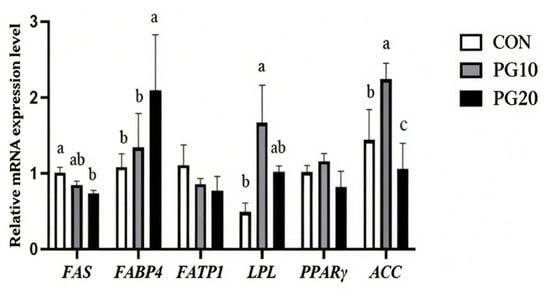
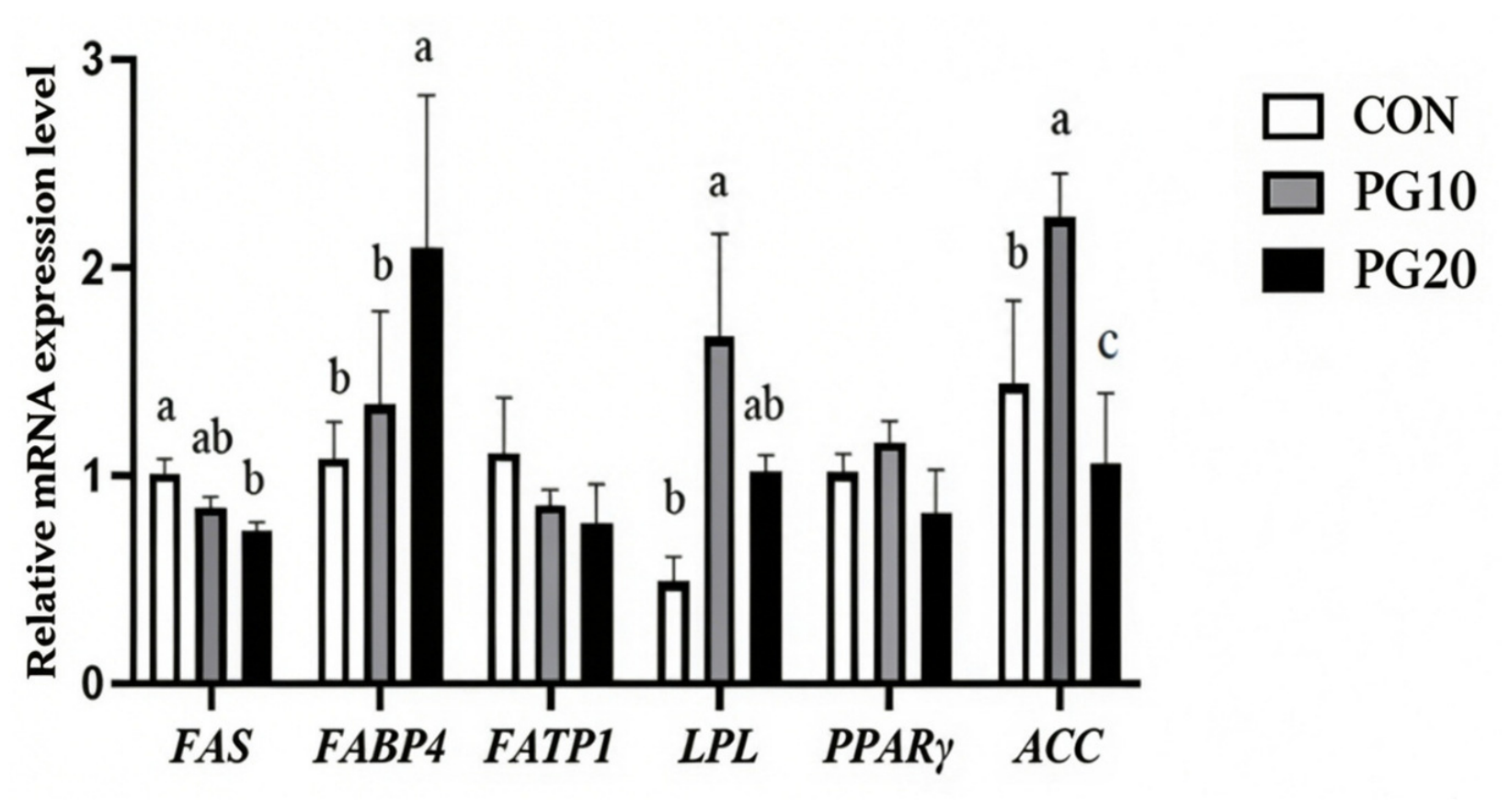
As shown in Figure 1, compared with the CON group, the expression levels of LPL and ACC genes in the longissimus dorsi muscle of PG10 were significantly increased (p < 0.05). Compared with the CON group, the gene expression levels of FAS and ACC in the PG20 group were significantly lower, while the FABP4 gene expression level was significantly increased (p < 0.05). There were no significant differences in the expression levels of FATP1 and PPAR-γ genes in the longissimus dorsi muscle among the groups (p > 0.05).
Figure 1.
Effect of partial replacement of basal diet with Pennisetum giganteum on muscle lipid metabolism of Congjiang pigs. CON, basal diet; PG10, 10% Pennisetum giganteum + 90% basal diet; PG20, 20% Pennisetum giganteum + 80% basal diet. Values are presented as mean ± SD. Labeled means without a common letter differ significantly (p < 0.05). Error bars represent standard deviation (SD).
3.5. Antioxidant Enzyme Activities of Liver and Muscle
As shown in Table 5, the SOD activity in the longissimus dorsi muscle of pigs in the PG10 and PG20 groups was significantly higher than that in the CON group (p < 0.05). Additionally, the SOD activity in the liver of pigs in the PG10 group was significantly higher than that in the CON group (p < 0.05). The PG10 group exhibited significantly higher GSH/GSSG ratios and hydroxyl radical scavenging capacity (HRSC) in the longissimus dorsi muscle of Congjiang pigs compared to the CON group (p < 0.05). Compared with the CON group, the GSH content in the longissimus dorsi muscle and liver of Congjiang pigs in the PG10 group was significantly increased (p < 0.05). There were no significant differences (p > 0.05) in the levels of AOC, GSH-Px, and CAT in the longissimus dorsi muscle and liver of Congjiang pigs, or in the level of MDA in the liver.
Table 5.
Effects of Pennisetum giganteum on antioxidant capacity of the longissimus dorsi muscle and the liver of Congjiang pigs.
3.6. Relative Expression of Antioxidant Enzyme Genes in Liver and Muscle
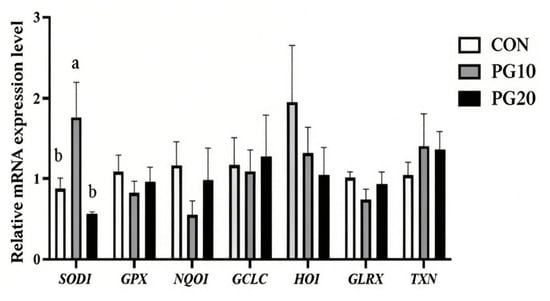
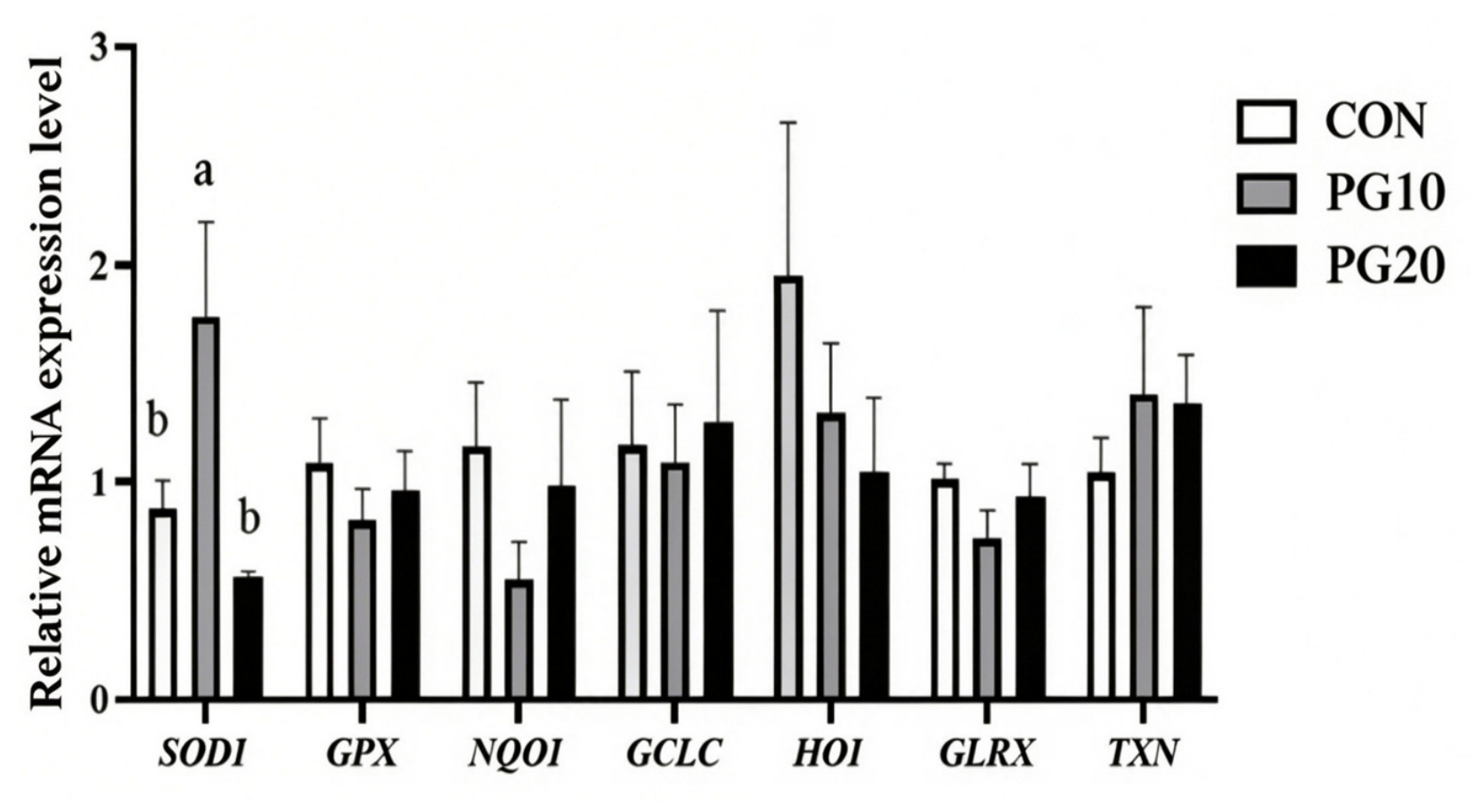
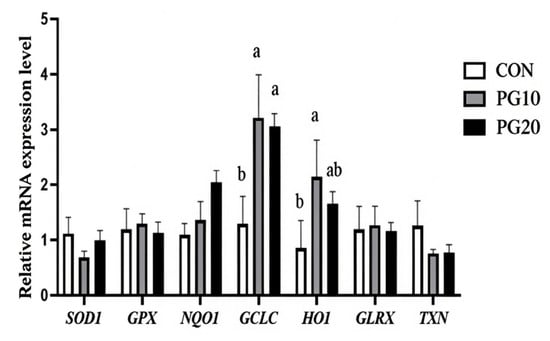
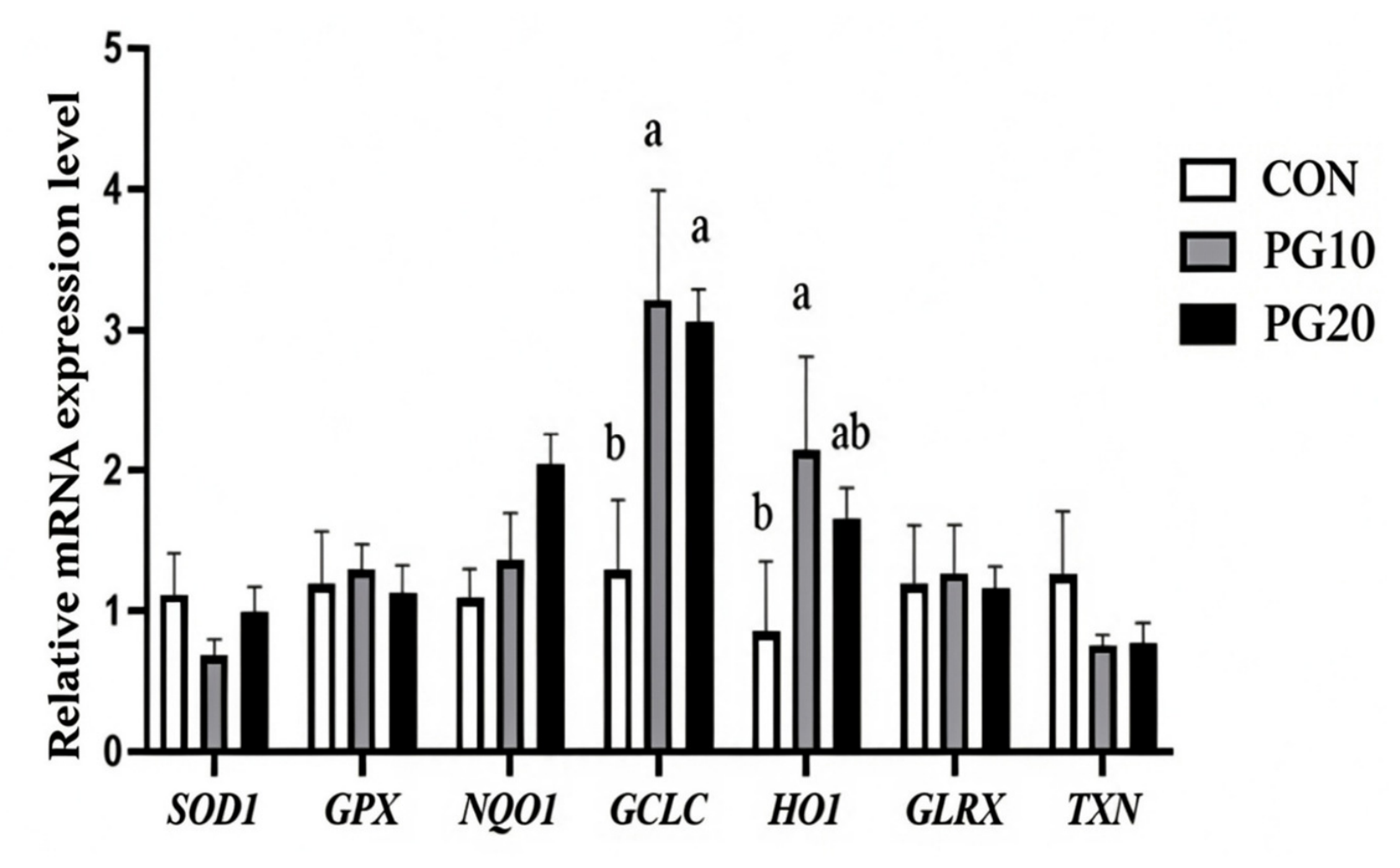
As shown in Figure 2 and Figure 3, compared with the CON group, the expression levels of the SOD1 gene in the liver and the HO1 gene in the longissimus dorsi muscle were significantly upregulated in the PG10 group (p < 0.05). Compared with the CON group, GCLC gene expression was significantly upregulated in the longissimus dorsi muscle of Congjiang pigs in both the PG10 and PG20 groups (p < 0.05). No significant changes were observed in the expression levels of other genes among the groups (p > 0.05).
Figure 2.
Effect of Pennisetum giganteum on the expression of the antioxidant gene in the liver of Congjiang pigs. CON, basal diet; PG10, 10% Pennisetum giganteum + 90% basal diet; PG20, 20% Pennisetum giganteum + 80% basal diet. Values are presented as mean ± SD. Labeled means without a common letter differ significantly (p < 0.05). Error bars represent standard deviation (SD).
Figure 3.
Effect of Pennisetum giganteum on the expression of the antioxidant gene in the muscle of Congjiang pigs. CON, basal diet; PG10, 10% Pennisetum giganteum + 90% basal diet; PG20, 20% Pennisetum giganteum + 80% basal diet. Values are presented as mean ± SD. Labeled means without a common letter differ significantly (p < 0.05). Error bars represent standard deviation (SD).
3.7. Relative Expression of Genes Related to the Keap1-Nrf2/ARE Antioxidant Signaling Pathway
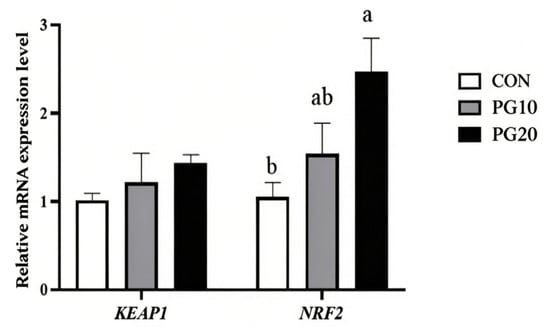
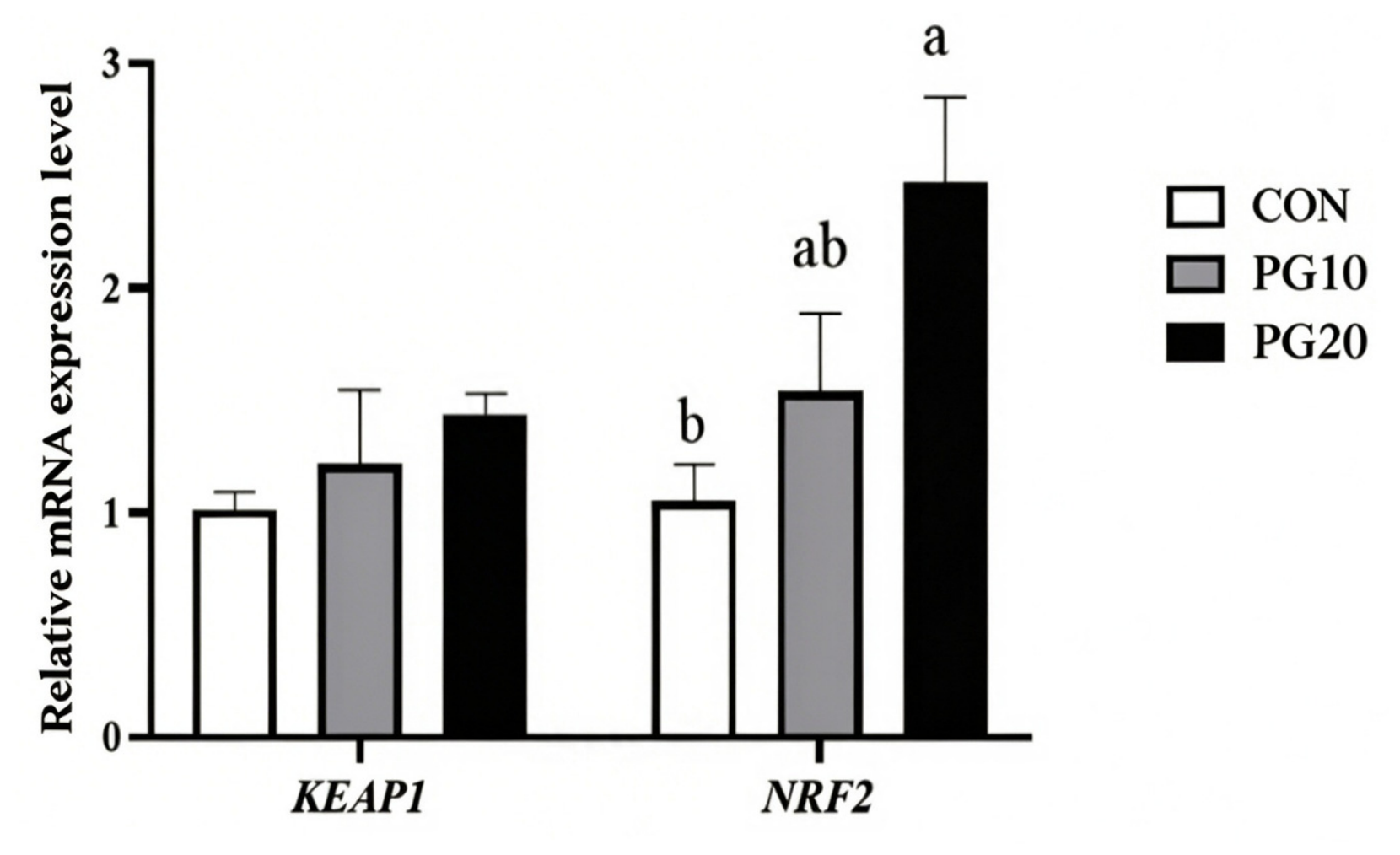
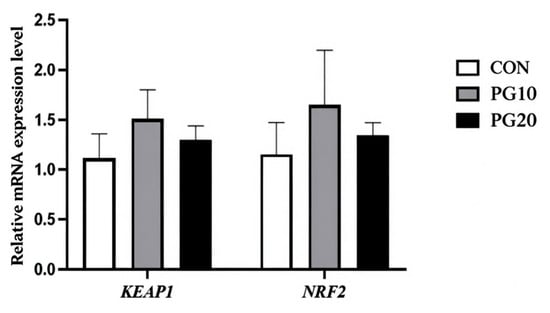
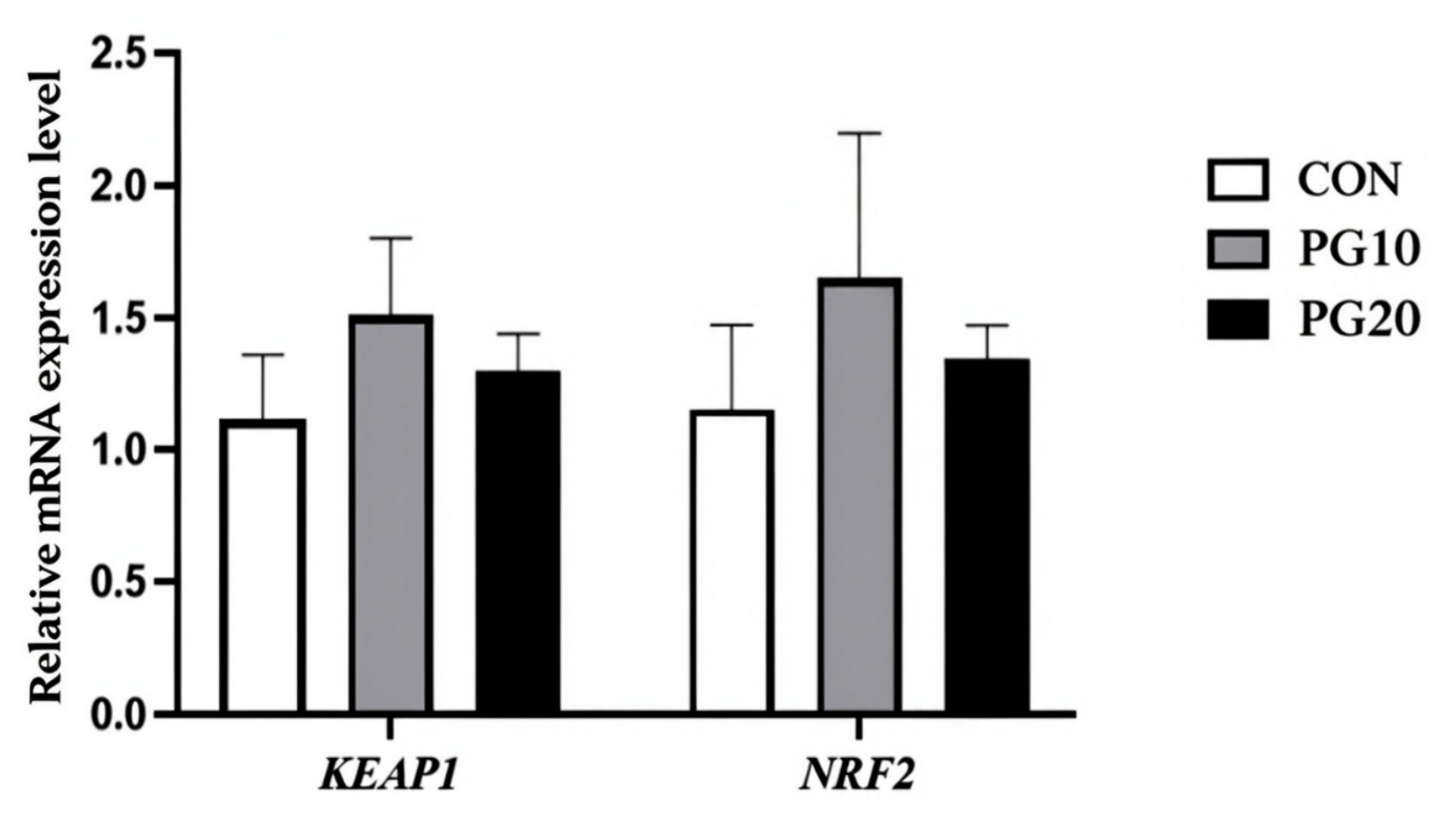
As shown in Figure 4, compared with the CON group, the expression level of the NRF2 gene in the liver of Congjiang pigs in the PG20 group was significantly increased (p < 0.05), while the expression level of the KEAP1 gene showed no significant difference among the groups (p > 0.05). As shown in Figure 5, there were no significant differences in the expression levels of the KEAP1 and NRF2 genes in the longissimus dorsi muscle among the three groups (p > 0.05).
Figure 4.
Effect of Pennisetum giganteum on KEAP1-NRF2 pathway-related gene expression in the liver of Congjiang pigs. CON, basal diet; PG10, 10% Pennisetum giganteum + 90% basal diet; PG20, 20% Pennisetum giganteum + 80% basal diet. Values are presented as mean ± SD. Labeled means without a common letter differ significantly (p < 0.05). Error bars represent standard deviation (SD).
Figure 5.
Effect of Pennisetum giganteum on KEAP1-NRF2 pathway-related gene expression in the muscle of Congjiang pigs. CON, basal diet; PG10, 10% Pennisetum giganteum + 90% basal diet; PG20, 20% Pennisetum giganteum + 80% basal diet. Values are presented as mean ± SD. Error bars represent standard deviation (SD).
4. Discussion
Growth performance is an important indicator for evaluating the feeding effect of unconventional feed resources. In this study, partial replacement of the basal diet with Pennisetum giganteum did not adversely affect growth performance, suggesting that 10% and 20% inclusion levels are safe for finishing Congjiang pigs.
Blood biochemical indices are important indicators reflecting metabolic changes and health status in livestock [22]. In the present study, partial replacement of the basal diet with Pennisetum giganteum improved several serum biochemical parameters, suggesting that this forage may function not only as a feed ingredient but also as a metabolic regulator. Variations in dietary crude fiber levels can alter the digestion, absorption, and metabolism of nutrients, which can be reflected by changes in blood biochemical parameters [9]. Studies have shown that high-fiber diets reduce serum glucose levels in Shenxian pigs [23]. In our study, substituting 20% of the basal diet with Pennisetum giganteum decreased serum glucose levels in Congjiang pigs, which is consistent with the findings of Pluschke et al. [24]. This suggests that excessive dietary fiber may hinder glucose utilization [25], whereas optimal fiber levels promote it [7]. Han et al. [26] demonstrated that supplementing a high-fat, high-cholesterol diet with cereal fibers (e.g., oat or wheat fiber) in mice significantly reduced TG, TCHO, and LDL-C levels. In the present study, replacing 10% and 20% of the basal diet with Pennisetum giganteum lowered serum TCHO levels, indicating that increased dietary fiber content promotes cholesterol metabolism. This effect may stem from the binding of lignin in Pennisetum giganteum to bile acids, which are then excreted in feces, thereby indirectly promoting the hepatic conversion of cholesterol to bile acids and reducing cholesterol accumulation. BUN levels are negatively correlated with nitrogen retention [27]. Researchers have found that elevated serum BUN levels are associated with enhanced protein catabolism, indicating reduced nitrogen retention or abnormal kidney function [28]. In this trial, replacing 20% of the basal diet with Pennisetum giganteum significantly decreased serum BUN levels in Congjiang pigs. This finding suggests that dietary fiber from Pennisetum giganteum may improve nitrogen utilization efficiency by modulating gut microbial fermentation and protein turnover. Considering the practice-oriented direct replacement design of this study, the slight reduction in dietary protein concentration may also contribute to this change. Further isonitrogenous trials with nitrogen balance measurements will help to fully clarify the regulatory effect of Pennisetum giganteum on nitrogen metabolism. Collectively, these findings suggest that Pennisetum giganteum contributes to improved metabolic homeostasis in finishing pigs.
Meat quality in pigs is influenced by various factors, including genetics, nutrition, environment, transportation, and slaughtering conditions [29]. Key indicators for evaluating meat quality include meat color, tenderness, drip loss, marbling, and pH value [30]. Under normal conditions, muscle pH at 45 min post-mortem ranges from 6 to 7 [31]. The results of this experiment indicate that replacing the basal diet with Pennisetum giganteum had no significant effect on the pH values, meat color, shear force, or drip loss of the longissimus dorsi muscle in Congjiang pigs. This demonstrates that substituting 10% and 20% of the basal diet with Pennisetum giganteum exerts no adverse effects on muscle color or tenderness. Déru et al. [32] found that feeding a high-fiber diet had no significant effect on pork color or pH. Although most meat quality traits were unaffected, changes in marbling score suggested that partial replacement of the basal diet with Pennisetum giganteum may influence lipid deposition patterns. A notable discrepancy emerged in our study: although the marbling score in the PG20 group was significantly lower than that in the CON group, the intramuscular fat (IMF) content measured by Soxhlet extraction showed no significant difference among groups. Marbling score is a visual assessment of the amount and distribution of visible fat flecks within the muscle, whereas Soxhlet extraction measures total lipid content, including both storage triglycerides and membrane phospholipids [33]. Previous studies have reported that dietary fiber can alter the size and distribution of adipocytes without necessarily changing total IMF content [12]. We hypothesize that the reduced marbling score in PG20 may result from a decrease in the size of intramuscular adipocytes or a more dispersed fat distribution, rather than a reduction in absolute lipid mass. This hypothesis will need to be further verified by histological examination of adipose tissue in subsequent studies. Supporting this hypothesis, Song et al. [34] observed that increasing dietary fiber from 5% to 8–11% reduced both IMF and marbling scores in Sujiang pigs, but their effect on IMF reached statistical significance only at the highest fiber level. The lack of a significant change in total IMF in our study could be due to the moderate fiber content (20% substitution) and the specific fiber composition of Pennisetum giganteum, which is rich in lignin and hemicellulose. These fiber components may influence adipose tissue distribution patterns rather than total lipid accumulation. These observations suggest that partial replacement of the basal diet with Pennisetum giganteum may alter adipose tissue distribution rather than total lipid accumulation, providing preliminary evidence for its regulatory effects on lipid deposition.
Serum levels of TGs, TCHO, HDL-C, and LDL-C are closely associated with lipid metabolism in animals [35]. The present results demonstrated a significant decrease in serum TCHO levels in the PG10 and PG20 groups, suggesting that dietary fiber content may enhance lipid metabolism and transport. ACC and FAS are key enzymes for lipid synthesis, whereas LPL is crucial for lipid catabolism [36]. A particularly noteworthy finding of this study was the contrasting regulation of lipid metabolism between the PG10 and PG20 groups, indicating that the metabolic response depends on inclusion level to dietary Pennisetum giganteum. This divergence warrants careful interpretation. Rather than simply stimulating or suppressing lipid metabolism, Pennisetum giganteum appears to induce distinct metabolic states at different inclusion levels. The upregulation of ACC and LPL in PG10 suggests that a moderate level of Pennisetum giganteum promotes lipid synthesis and turnover. ACC catalyzes the rate-limiting step of fatty acid synthesis, and its increased expression may be a compensatory response to enhanced fiber fermentation yielding short-chain fatty acids (SCFAs), particularly acetate and butyrate, which serve as substrates for lipogenesis [37]. SCFAs can activate the transcription factor SREBP1c, thereby upregulating ACC and FAS [38]. In contrast, the downregulation of ACC and FAS in PG20 indicates suppressed de novo fatty acid synthesis at higher fiber inclusion. This is consistent with a negative energy balance induced by excessive dietary fiber, which dilutes dietary energy density and activates AMP-activated protein kinase (AMPK) [8]. AMPK phosphorylates and inactivates ACC, and also suppresses SREBP1c transcriptional activity, leading to reduced expression of lipogenic genes [39]. Similar responses to dietary fiber depending on inclusion level have been reported in livestock, where moderate fiber inclusion promoted nutrient metabolism whereas excessive fiber reduced energy availability and altered lipid deposition patterns [8,12]. In growing pigs, a moderate increase in dietary fiber (around 10% substitution) may stimulate lipid turnover, whereas excessive fiber (20% substitution) shifts the metabolic state toward fatty acid oxidation to meet energy demands, as reflected by increased FABP4 expression, a transporter facilitating fatty acid uptake for β-oxidation [12]. Collectively, these findings suggest that dietary replacement with Pennisetum giganteum induced a metabolic reprogramming that differed by inclusion level, in which moderate replacement enhanced lipid turnover whereas higher replacement shifted metabolism toward reduced lipogenesis and increased fatty acid utilization.
In addition to lipid metabolism, partial replacement of the basal diet with Pennisetum giganteum exerted non-linear effects on antioxidant status depending on inclusion level. Reactive oxygen species (ROS) are byproducts of aerobic metabolism [40] and typically exist in a state of relative equilibrium in the body. However, continuous ROS accumulation disrupts this equilibrium [41], leading to lipid, protein, and DNA damage [42]. Consistent with our findings, Omoor et al. [43] reported that fermented Pennisetum giganteum increased serum antioxidant enzyme activities in broilers. In the present study, replacing 10% of the basal diet with Pennisetum giganteum significantly increased SOD and GSH levels in muscle and liver of Congjiang pigs and enhanced muscle HRSC. However, 20% substitution only increased muscle SOD activity, with no significant effects on other indexes, and liver MDA content showed an upward trend compared with PG10. Notably, the antioxidant response was substantially stronger in the PG10 group than in the PG20 group. This non-linear response across inclusion levels resembles a hormesis-like response, in which moderate stimulation elicits optimal adaptive antioxidant defenses. A similar biphasic pattern was reported by Azad et al. [44] for cassava residue, where the optimal antioxidant benefit occurred at 20% substitution, whereas lower (10%) or higher (30%) levels were less effective. The weaker antioxidant response at 20% in our study may be due to the higher lignin content in Pennisetum giganteum compared to cassava residue, which could reduce nutrient digestibility at high inclusion levels and impose mild oxidative stress [45]. Collectively, these results suggest that an appropriate level of crude fiber (10% substitution of Pennisetum giganteum) improves antioxidant status in pigs, but exceeding a threshold may compromise these benefits.
To further elucidate the molecular basis underlying the improved antioxidant status, we investigated the KEAP1-NRF2 signaling pathway. The KEAP1-NRF2 signaling pathway is a crucial intracellular mechanism for cellular defense against oxidative stress [46], modulating antioxidant factors to counteract free radical damage [47]. Unlike Fan et al. [48], who found that defatted rice bran downregulated NQO1 and HO1 in the colon, our study showed that 10% Pennisetum giganteum substitution significantly increased SOD and GSH activities in liver and muscle, enhanced muscle HRSC, and upregulated hepatic SOD1 and muscular HO1 and GCLC. In addition, 20% substitution increased hepatic NRF2 expression. These differences likely arise from the distinct fiber compositions: defatted rice bran is rich in β-glucan and polysaccharides that directly scavenge free radicals [49,50], whereas Pennisetum giganteum contains higher lignin and hemicellulose, which may exert antioxidant effects primarily through NRF2 pathway activation rather than direct radical scavenging. Indeed, we found no significant changes in TXN and GLRX (redox-related genes) expression among groups, but HRSC was specifically enhanced in PG10, suggesting that the observed antioxidant effect is mediated by enzymatic scavenging rather than redox conversion of free radicals. Future studies should investigate the specific phytochemicals in Pennisetum giganteum responsible for NRF2 activation. Taken together, these findings suggest that the Keap1-Nrf2 signaling pathway may be involved in the transcriptional regulation of antioxidant responses induced by dietary Pennisetum giganteum. In-depth investigations at the protein level, including detection of Nrf2 nuclear translocation, are warranted to confirm the functional activation of this pathway.
Taken together, the present findings demonstrate that Pennisetum giganteum acts as more than a simple forage substitute in finishing pig diets. Moderate replacement (10%) enhanced lipid turnover and antioxidant defense, whereas higher replacement (20%) promoted a metabolic shift toward reduced lipogenesis and increased fatty acid utilization. Furthermore, activation of the KEAP1-NRF2 pathway may contribute to the improved antioxidant status observed in pigs receiving Pennisetum giganteum. These results suggest that Pennisetum giganteum functions as a nutritional regulator capable of modulating metabolic and redox homeostasis depending on inclusion level.
Overall, this study systematically demonstrates the regulatory effects of fresh Pennisetum giganteum at two inclusion levels on serum biochemistry, meat quality, lipid metabolism and antioxidant function in Congjiang pigs, providing practical reference for the development of unconventional forage resources in indigenous pig production. Looking forward, further studies with larger sample sizes will help to more comprehensively verify the trends observed in the present work, especially for antioxidant indices and gene expression with high biological variability. In addition, quantitative analysis of anti-nutritional factors (such as tannins, oxalates and lignin) in Pennisetum giganteum will contribute to a deeper understanding of its regulatory mechanism on nutrient digestion and metabolic responses, and further support the efficient application of this forage in pig production. It should also be noted that the non-isonitrogenous and non-isocaloric design and proportional dilution of trace mineral-vitamin premix are important confounding factors, and selective feeding cannot be completely excluded even with visual confirmation of full feed consumption. Follow-up isocaloric and isonitrogenous trials are required to disentangle these confounding effects.
5. Conclusions
In conclusion, dietary inclusion of Pennisetum giganteum induced distinct metabolic responses depending on inclusion level in finishing Congjiang pigs. Moderate substitution (10%) enhanced lipid turnover and antioxidant defense, whereas higher substitution (20%) reduced serum glucose and cholesterol concentrations, suppressed lipogenic gene expression, and promoted a metabolic shift toward fatty acid utilization. Furthermore, the improved antioxidant status in PG10 may be associated with the KEAP1-NRF2 signaling pathway. These findings demonstrate that Pennisetum giganteum functions not only as a sustainable unconventional feed resource but also as a nutritional regulator capable of modulating lipid metabolism and redox homeostasis in indigenous pigs. This study provides new evidence supporting the application of forage-based feeding strategies for improving metabolic health while reducing dependence on conventional grain-based feeds.
Supplementary Materials
The following supporting information can be downloaded at https://www.mdpi.com/article/10.3390/ani16233765/s1. Table S1: Effects of Pennisetum giganteum on growth performance of Congjiang pigs; Table S2: Calculated nutrient composition of experimental diets and theoretical daily nutrient intake per 100 kg body weight; Table S3: Primer sequences and amplification conditions for genes related to lipid metabolism and antioxidant function.
Author Contributions
Methodology, Y.Y.; formal analysis, R.Y.; investigation, H.L. and Z.C.; resources, Z.C.; data curation, H.L.; writing—original draft preparation, Y.Y.; writing—review and editing, Y.G.; visualization, R.Y.; supervision, L.J. and Y.G.; project administration, L.J.; funding acquisition, L.J. All authors have read and agreed to the published version of the manuscript.
Funding
This study was supported by the National Key Research and Development Program of China (2023YFD1600500), Agricultural Guiding (Key) Project of Fujian Provincial Science and Technology Department (2023N0008), Science and Technology Development Projects Funded by Chinese Central and Local Governments (2022L3085), and Science and Technology Innovation Special Fund Project of Fujian Agriculture and Forestry University (KFB23099A).
Institutional Review Board Statement
The animal study protocol was approved by the Committee of Animal Experiments of Fujian Agriculture and Forestry University (Fuzhou, Fujian, China; approval ID PZCASFAFU22009; date of approval: 15 March 2022).
Informed Consent Statement
Not applicable.
Data Availability Statement
The data that support the findings of this study are available upon request from the corresponding author.
Acknowledgments
The authors appreciate all the help from our colleagues and collaborators.
Conflicts of Interest
The authors declare no conflicts of interest.
References
- Akintan, O.; Gebremedhin, K.G.; Uyeh, D.D. Animal Feed Formulation—Connecting Technologies to Build a Resilient and Sustainable System. Animals 2024, 14, 1497. [Google Scholar] [CrossRef] [Scilit] [PubMed]
- Liu, S.; He, Z.; Wen, X.; Zhan, X.; Hou, L.; Deng, D.; Gao, K.; Yang, X.; Cao, S.; Jiang, Z.; et al. Effects of Soybean Meal Substitution in Finishing Pig Diet on Carcass Traits, Meat Quality, and Muscle Antioxidant Capacity. Animals 2025, 15, 1611. [Google Scholar] [CrossRef] [Scilit] [PubMed]
- Lyte, K.E.; Kouakou, B.; Lee, J. PSX-31 Effects of substitution of corn and soybean meal with dried distiller’s grains and solubles (DDGS) in legume based diets on lamb feed intake, body weight gain and blood metabolites. J. Anim. Sci. 2019, 97, 455–456. [Google Scholar] [CrossRef] [Scilit]
- Sapkota, A.R. Water reuse, food production and public health: Adopting transdisciplinary, systems-based approaches to achieve water and food security in a changing climate. Environ. Res. 2019, 171, 576–580. [Google Scholar] [CrossRef] [Scilit] [PubMed]
- Xing, L.; Wang, M.; He, Q.; Zhang, H.; Liang, H.; Zhou, Q.; Liu, Y.; Liu, Z.; Wang, Y.; Du, C.; et al. Differential subgenome expression underlies biomass accumulation in allotetraploid Pennisetum giganteum. BMC Biol. 2023, 21, 1–24. [Google Scholar] [CrossRef] [Scilit] [PubMed]
- Lin, X.S.; Lin, Z.X.; Lin, D.M.; Lin, H.; Luo, H.L.; Hu, Y.P.; Lin, C.M.; Zhu, Z.Z. Effects of planting Pennisetum sp. (Giant juncao) on soil microbial functional diversity and fertility in the barren hillside. Acta Ecol. Sin. 2014, 34, 4304–4312. [Google Scholar] [CrossRef] [Scilit]
- Li, Y.; He, J.; Zhang, L.; Liu, H.; Cao, M.; Lin, Y.; Xu, S.; Che, L.; Fang, Z.; Feng, B.; et al. Improvement of insulin sensitivity by dietary fiber consumption during late pregnant sows is associated with gut microbiota regulation of tryptophan metabolism. Anim. Microbiome 2024, 6, 34. [Google Scholar] [CrossRef] [Scilit] [PubMed]
- Li, Y.; Xia, D.; Chen, J.; Zhang, X.; Wang, H.; Huang, L.; Shen, J.; Wang, S.; Feng, Y.; He, D.; et al. Dietary fibers with different viscosity regulate lipid metabolism via ampk pathway: Roles of gut microbiota and short-chain fatty acid. Poult. Sci. 2022, 101, 101742. [Google Scholar] [CrossRef] [Scilit] [PubMed]
- Liu, J.; Luo, Y.; Kong, X.; Yu, B.; Zheng, P.; Huang, Z.; Mao, X.; Yu, J.; Luo, J.; Yan, H.; et al. Effects of Dietary Fiber on Growth Performance, Nutrient Digestibility and Intestinal Health in Different Pig Breeds. Animals 2022, 12, 3298. [Google Scholar] [CrossRef] [Scilit] [PubMed]
- Raj, S.; Skiba, G.; Sobol, M.; Weremko, D. Body composition and fatty acid profile of musculus longissimus dorsi in growing pigs fed a diet supplemented with grass meal. J. Anim. Feed. Sci. 2015, 24, 315–322. [Google Scholar] [CrossRef] [Scilit]
- Ma, J.; Huangfu, W.; Yang, X.; Xu, J.; Zhang, Y.; Wang, Z.; Zhu, X.; Wang, C.; Shi, Y.; Cui, Y. “King of the forage”—Alfalfa supplementation improves growth, reproductive performance, health condition and meat quality of pigs. Front. Vet. Sci. 2022, 9, 1025942. [Google Scholar] [CrossRef] [Scilit] [PubMed]
- Ben Mohamed, A.; Remond, D.; Gual-Grau, A.; Bernalier-Donnadille, A.; Capel, F.; Michalski, M.C.; Laugerette, F.; Cohade, B.; Hafnaoui, N.; Bechet, D.; et al. A Mix of Dietary Fibres Changes Interorgan Nutrients Exchanges and Muscle-Adipose Energy Handling in Overfed Mini-Pigs. Nutrients 2021, 13, 4202. [Google Scholar] [CrossRef] [Scilit] [PubMed]
- Tan, L.; Chen, Z.; Teng, M.; Chen, B.; Xu, H. Genome-wide analysis of mRNAs, lncRNAs, and circRNAs during intramuscular adipogenesis in Chinese Guizhou Congjiang pigs. PLoS ONE 2022, 17, e0261293. [Google Scholar] [CrossRef] [Scilit] [PubMed]
- Hayat, K.; Zhou, Y.; Menhas, S.; Bundschuh, J.; Hayat, S.; Ullah, A.; Wang, J.; Chen, X.; Zhang, D.; Zhou, P. Pennisetum giganteum: An emerging salt accumulating/tolerant non-conventional crop for sustainable saline agriculture and simultaneous phytoremediation. Environ. Pollut. 2020, 265, 114876. [Google Scholar] [CrossRef] [Scilit] [PubMed]
- GB/T 39235-2020; Nutrient Requirements of Swine. Standardization Administration of China: Beijing, China, 2020.
- National Pork Producers Council. Pork Composition and Quality Assessment Procedures; National Pork Producers Council: Des Moines, IA, USA, 2000. [Google Scholar]
- Honikel, K.O. Reference methods for the assessment of physical characteristics of meat. Meat Sci. 1998, 49, 447–457. [Google Scholar] [CrossRef] [Scilit] [PubMed]
- Thiex, N.J.; Anderson, S.; Gildemeister, B. Crude fat, diethyl ether extraction, in feed, cereal grain, and forage (Randall/Soxtec/submersion method): Collaborative study. J. AOAC Int. 2003, 86, 888–898. [Google Scholar] [CrossRef] [Scilit]
- Lin, Z.; Yang, G.; Zhang, M.; Yang, R.; Wang, Y.; Guo, P.; Zhang, J.; Wang, C.; Liu, Q.; Gao, Y. Dietary Supplementation of Mixed Organic Acids Improves Growth Performance, Immunity, and Antioxidant Capacity and Maintains the Intestinal Barrier of Ira Rabbits. Animals 2023, 13, 3140. [Google Scholar] [CrossRef] [Scilit] [PubMed]
- Gu, X.M.; Ye, D.C.; Cheng, J.W.; Lin, Z.X.; Lv, H.X.; Cai, Z.X.; Yang, Y.; Wang, C.K.; Gao, Y.Y.; Jin, L. Astaxanthin enhances broiler health via integrated regulation of antioxidant capacity, immune function, and gut microbiota. Food Chem. 2025, 496, 146463. [Google Scholar] [CrossRef] [Scilit] [PubMed]
- Zhang, M.; Yang, R.; Huang, C.W.; Trush, M.A.; Misra, H.P.; Li, Y. Effects of Pennisetum giganteum on growth performance and intestinal health of finishing Congjiang fragrant pigs. Acta Prataculturae Sin. 2025, 34, 171–188. [Google Scholar] [CrossRef]
- Wang, Y.C.; Wang, Q.Y.; Dai, C.P.; Li, J.Z.; Huang, P.F.; Li, Y.L.; Ding, X.Q.; Huang, J.; Hussain, T.; Yang, H.S. Effects of dietary energy on growth performance, carcass characteristics, serum biochemical index, and meat quality of female Hu lambs. Anim. Nutr. 2020, 6, 499–506. [Google Scholar] [CrossRef] [Scilit] [PubMed]
- Serena, A.; Jorgensen, H.; Knudsen, K.E.B. Absorption of carbohydrate-derived nutrients in sows as influenced by types and contents of dietary fiber. J. Anim. Sci. 2009, 87, 136–147. [Google Scholar] [CrossRef] [Scilit] [PubMed]
- Pluschke, A.M.; Williams, B.A.; Zhang, D.; Anderson, S.T.; Roura, E.; Gidley, M.J. Male grower pigs fed cereal soluble dietary fibres display biphasic glucose response and delayed glycaemic response after an oral glucose tolerance test. PLoS ONE 2018, 13, e0193137. [Google Scholar] [CrossRef] [Scilit] [PubMed]
- Agyekum, A.K.; Kiarie, E.; Walsh, M.C.; Nyachoti, C.M. Postprandial portal glucose and lactate fluxes, insulin production, and portal vein-drained viscera oxygen consumption in growing pigs fed a high-fiber diet supplemented with a multi-enzyme cocktail. J. Anim. Sci. 2016, 94, 3760–3770. [Google Scholar] [CrossRef] [Scilit] [PubMed]
- Han, S.F.; Zhang, W.; Zhang, R.; Jiao, J.; Fu, C.L.; Tong, X.; Zhang, W.G.; Qin, L.Q. Cereal fiber improves blood cholesterol profiles and modulates intestinal cholesterol metabolism in C57BL/6 mice fed a high-fat, high-cholesterol diet. Food Nutr. Res. 2019, 63, 1591. [Google Scholar] [CrossRef] [Scilit] [PubMed]
- Berghaus, D.; Haese, E.; Weishaar, R.; Sarpong, N.; Kurz, A.; Seifert, J.; Camarinha-Silva, A.; Bennewitz, J.; Chillon, T.; Stefanski, V.; et al. Nitrogen and lysine utilization efficiencies, protein turnover, and blood urea concentrations in crossbred grower pigs at marginal dietary lysine concentration. J. Anim. Sci. 2023, 101, 1–10. [Google Scholar] [CrossRef] [Scilit] [PubMed]
- Wu, P.-H.; Kim, H.J.; Kim, T.E.; Han, M.; Yi, Y.; Jeong, J.C.; Chin, H.J.; Song, S.H.; Lee, J.; Lee, K.-B.; et al. Effects of blood urea nitrogen independent of the estimated glomerular filtration rate on the development of anemia in non-dialysis chronic kidney disease: The results of the KNOW-CKD study. PLoS ONE 2021, 16, e0257305. [Google Scholar] [CrossRef] [Scilit] [PubMed]
- Pandey, S.; Kim, S.; Kim, E.S.; Keum, G.B.; Doo, H.; Kwak, J.; Ryu, S.; Choi, Y.; Kang, J.; Kim, H.; et al. Exploring the multifaceted factors affecting pork meat quality. J. Anim. Sci. Technol. 2024, 66, 863–875. [Google Scholar] [CrossRef] [Scilit] [PubMed]
- Joo, S.T.; Kim, G.D.; Hwang, Y.H.; Ryu, Y.C. Control of fresh meat quality through manipulation of muscle fiber characteristics. Meat Sci. 2013, 95, 828–836. [Google Scholar] [CrossRef] [Scilit] [PubMed]
- Stephens, J.W.; Dikeman, M.E.; Unruh, J.A.; Haub, M.D.; Tokach, M.D.; Dritz, S.S. Effects of oral administration of sodium citrate or acetate to pigs on blood parameters, postmortem glycolysis, muscle pH decline, and quality attributes of pork. J. Anim. Sci. 2008, 86, 1669–1677. [Google Scholar] [CrossRef] [Scilit] [PubMed]
- Déru, V.; Bouquet, A.; Hassenfratz, C.; Blanchet, B.; Carillier-Jacquin, C.; Gilbert, H. Impact of a high-fibre diet on genetic parameters of production traits in growing pigs. Animal 2020, 14, 2236–2245. [Google Scholar] [CrossRef] [Scilit] [PubMed]
- Holman, B.W.B.; Bailes, K.L.; Meyer, R.G.; Hopkins, D.L. Effect of modified Soxhlet (Soxtec) and Folch extraction method selection on the total lipid determination of aged beef. J. Food Sci. Technol.-Mysore 2019, 56, 3957–3961. [Google Scholar] [CrossRef] [Scilit] [PubMed]
- Song, Y.X.; Xue, M.M.; Wang, F.; Tang, Q.G.; Luo, Y.B.; Zheng, M.L.; Wang, Y.B.; Xue, P.X.; Dong, N.Q.; Sun, R.P.; et al. Study on the Characteristics of Coarse Feeding Tolerance of Ding’an Pigs: Phenotypic and Candidate Genes Identification. Genes 2024, 15, 599. [Google Scholar] [CrossRef] [Scilit]
- Uddin, M.J.; Duy, D.N.; Cinar, M.U.; Tesfaye, D.; Tholen, E.; Juengst, H.; Looft, C.; Schellander, K. Detection of quantitative trait loci affecting serum cholesterol, LDL, HDL, and triglyceride in pigs. BMC Genet. 2011, 12, 62. [Google Scholar] [CrossRef] [Scilit] [PubMed]
- Saggerson, D. Malonyl-CoA, a key signaling molecule in mammalian cells. Annu. Rev. Nutr. 2008, 28, 253–272. [Google Scholar] [CrossRef] [Scilit] [PubMed]
- Ali, I.; Li, C.; Li, L.; Kuang, M.; Shafiq, M.; Wang, Y.; Yang, M.; Wang, G. Effect of acetate, β-hydroxybutyrate and their interaction on lipogenic gene expression, triglyceride contents and lipid droplet formation in dairy cow mammary epithelial cells. Vitr. Cell. Dev. Biol.-Anim. 2021, 57, 66–75. [Google Scholar] [CrossRef] [Scilit] [PubMed]
- Lin, M.; Jiang, M.; Yang, T.; Tan, D.; Hu, G.; Zhao, G.; Zhan, K. Acetate-Induced Milk Fat Synthesis Is Associated with Activation of the mTOR Signaling Pathway in Bovine Mammary Epithelial Cells. Animals 2022, 12, 2616. [Google Scholar] [CrossRef] [Scilit] [PubMed]
- Assifi, M.M.; Suchankova, G.; Constant, S.; Prentki, M.; Saha, A.K.; Ruderman, N.B. AMP-activated protein kinase and coordination of hepatic fatty acid metabolism of starved/carbohydrate-refed rats. Am. J. Physiol.-Endocrinol. Metab. 2005, 289, E794–E800. [Google Scholar] [CrossRef] [Scilit] [PubMed]
- Schieber, M.; Chandel, N.S. ROS Function in Redox Signaling and Oxidative Stress. Curr. Biol. 2014, 24, R453–R462. [Google Scholar] [CrossRef] [Scilit] [PubMed]
- Tudorachi, N.B.; Totu, E.E.; Fifere, A.; Ardeleanu, V.; Mocanu, V.; Mircea, C.; Isildak, I.; Smilkov, K.; Cărăuşu, E.M. The Implication of Reactive Oxygen Species and Antioxidants in Knee Osteoarthritis. Antioxidants 2021, 10, 985. [Google Scholar] [CrossRef] [Scilit] [PubMed]
- Yang, H.; Leng, J.; Liu, N.; Huang, L. Editorial: Free radicals and antioxidants in diseases associated with immune dysfunction, inflammatory process, and aberrant metabolism. Front. Endocrinol. 2024, 15, 1363854. [Google Scholar] [CrossRef] [Scilit] [PubMed]
- Omoor, I.N.A.; Yankey, R.; Shehata, A.I.; Fang, C.H.; Hui, L.; Lin, D.M.; Ling, J.; Dosoky, W.M.; Karanja, J.K.; Dawood, M.A.O.; et al. Dietary supplement of fermented grass forage regulates growth performance, antioxidant capacity, and immune response of broiler chickens. Poult. Sci. 2024, 103, 103323. [Google Scholar] [CrossRef] [Scilit] [PubMed]
- Azad, M.A.K.; Jiang, H.; Ni, H.; Liu, Y.; Huang, P.; Fang, J.; Kong, X. Diets Partially Replaced With Cassava Residue Modulate Antioxidant Capacity, Lipid Metabolism, and Gut Barrier Function of Huanjiang Mini-Pigs. Front. Vet. Sci. 2022, 9, 902328. [Google Scholar] [CrossRef] [Scilit] [PubMed]
- Leite, B.G.d.S.; Granghelli, C.A.; Roque, F.d.A.; Carvalho, R.S.B.; Lopes, M.H.S.; Pelissari, P.H.; Dias, M.T.; Araujo, C.S.d.S.; Araujo, L.F. Evaluation of dietary lignin on broiler performance, nutrient digestibility, cholesterol and triglycerides concentrations, gut morphometry, and lipid oxidation. Poult. Sci. 2024, 103, 103518. [Google Scholar] [CrossRef] [Scilit] [PubMed]
- Zhang, S.; Pan, P.; Xie, H.; Wei, C.; Wang, Q.; Yang, B.; Sun, Y.; Li, Y.; Luo, Y.; Song, Y.; et al. Resveratrol improves meat quality traits by activating the lncRNAs-KEAP1-NRF2 axis in pigs. Meat Sci. 2024, 209, 109411. [Google Scholar] [CrossRef] [Scilit] [PubMed]
- Galicia-Moreno, M.; Lucano-Landeros, S.; Monroy-Ramirez, H.C.; Silva-Gomez, J.; Gutierrez-Cuevas, J.; Santos, A.; Armendariz-Borunda, J. Roles of Nrf2 in Liver Diseases: Molecular, Pharmacological, and Epigenetic Aspects. Antioxidants 2020, 9, 980. [Google Scholar] [CrossRef] [Scilit] [PubMed]
- Fan, L.J.; Huang, R.H.; Wu, C.W.; Cao, Y.; Du, T.R.; Pu, G.; Wang, H.; Zhou, W.D.; Li, P.H.; Kim, S.W. Defatted Rice Bran Supplementation in Diets of Finishing Pigs: Effects on Physiological, Intestinal Barrier, and Oxidative Stress Parameters. Animals 2020, 10, 449. [Google Scholar] [CrossRef] [Scilit] [PubMed]
- Ryan, E.P. Bioactive food components and health properties of rice bran. J. Am. Vet. Med. Assoc. 2011, 238, 593–600. [Google Scholar] [CrossRef] [Scilit] [PubMed]
- Wang, J.; Hu, S.; Nie, S.; Yu, Q.; Xie, M. Reviews on Mechanisms of In Vitro Antioxidant Activity of Polysaccharides. Oxidative Med. Cell. Longev. 2016, 2016, 5692852. [Google Scholar] [CrossRef] [Scilit] [PubMed]

Disclaimer/Publisher’s Note: The statements, opinions and data contained in all publications are solely those of the individual author(s) and contributor(s) and not of MDPI and/or the editor(s). MDPI and/or the editor(s) disclaim responsibility for any injury to people or property resulting from any ideas, methods, instructions or products referred to in the content. |
© 2026 by the authors. Licensee MDPI, Basel, Switzerland. This article is an open access article distributed under the terms and conditions of the Creative Commons Attribution (CC BY) license.