


Simple Summary
The widespread use of antibiotics in animal reproduction to prevent bacterial contamination of semen contributes to the global problem of antimicrobial resistance, making natural alternatives increasingly necessary. This study tested whether plant-derived compounds such as berberine, naringin, and bergamot essential oil could serve as natural antimicrobial agents in the liquid storage of rabbit semen for breeding purposes. In a series of experiments, all tested compounds preserved sperm quality and controlled aerobic mesophilic bacterial growth over 24 h as effectively as standard antibiotics. Only berberine, however, sustained this antibacterial efficacy for up to 72 h at higher concentrations, whereas a lower concentration effectively controlled bacterial growth for up to 48 h—covering the standard commercial storage and transport window—without impairing sperm motility or viability. A preliminary field trial suggested that semen treated with a low concentration of berberine for 24 h achieved pregnancy rates comparable to those obtained with antibiotic-treated semen, alongside a potential increase in litter size. Overall, these findings identify berberine as a promising bioactive component for antibiotic-free rabbit semen extenders; future large-scale field trials and combinatorial formulation optimizations will be essential to validate its commercial application and help reduce routine antibiotic use in livestock breeding.
Abstract
The routine use of antibiotics in semen extenders is a recognized driver of antimicrobial resistance, creating a need for effective natural alternatives. This study evaluated naringin berberine and bergamot essential oil as alternatives to antibiotics for the liquid storage of rabbit artificial insemination (AI) doses. Methods: In Experiment 1, the three compounds (250 µg/mL) were added to a Tris-Citric-Glucose (TCG) extender and compared with an antibiotic-supplemented extender (100 IU/mL penicillin and 100 µg/mL streptomycin) and an antibiotic-free extender; sperm motility, viability, kinematics and total aerobic mesophilic bacterial counts were assessed during refrigeration at 16 ± 1 °C for 72 h. In Experiment 2, the dose-dependent effect of berberine (62.5, 125 and 250 µg/mL) was evaluated under the same conditions. In Experiment 3, a preclinical trial inseminated 50 does with doses stored for 24 h to record pregnancy rate and litter size. Data were analyzed combining frequentist and Bayesian statistical frameworks. Results: At 250 µg/mL, the three compounds maintained in vitro sperm quality comparable to the antibiotic extender and controlled aerobic mesophilic bacterial growth for 24 h; however, only berberine matched the antibiotic over 72 h. In the dose-dependent assay (experiment 2), berberine did not impair total motility or viability relative to the antibiotic extender, and the lowest concentration (62.5 μg/mL) controlled aerobic mesophilic bacterial growth comparably to the antibiotic for up to 48 h, whereas higher concentrations (125 and 250 μg/mL) lost efficacy earlier. In vivo (experiment 3), the lowest berberine concentration tested (62.5 µg/mL) achieved pregnancy rates comparable to those of the antibiotic-supplemented control and yielded a relevant increase in litter size, supporting its potential as an antibiotic-free alternative for rabbit semen extenders. Conclusions: In this preliminary study, berberine emerges as an effective and sperm-compatible phytotherapeutic candidate for rabbit semen preservation, matching conventional antibiotics in controlling aerobic mesophilic bacterial load within a One Health framework.
1. Introduction
Since its systematic adoption in commercial rabbit farming in the late 1980s, artificial insemination (AI) has become the cornerstone of modern reproductive management, enabling batch production systems that group farm tasks into fixed schedules [1]. Consequently, liquid preservation of rabbit semen constitutes a critical step for the industry, as fertility outcomes largely depend on the sperm quality maintained during the storage and transport of seminal doses. However, refrigerated storage at 15–17 °C reduces sperm biochemical functions, resulting in an estimated fertility loss of 10% to 35% per day, which justifies the search for strategies to prolong sperm viability without compromising dose quality [2]. In this context, the primary challenge lies in bacterial growth—largely driven by commensal microorganisms from the male genital tract—which compromises dose integrity during liquid storage; thus, antibiotics have traditionally been added to semen extenders [3]. Nevertheless, the systematic use of antimicrobials in livestock production accelerates antimicrobial resistance (AMR)—the ability of microorganisms to adapt and survive exposure to drugs designed to inhibit or kill them—which compromises treatment efficacy in both veterinary and human medicine and poses a growing threat to public health and the global economy [4,5]. Two trends make this concern especially acute. First, the antibiotic pipeline has stagnated: since the 1990s the number of approvals per decade has fallen and no structurally novel class has reached the clinic, leaving few options to replace those lost to resistance [6]. Second, the human toll continues to climb—AMR was associated with an estimated 4.71 million deaths in 2021, of which 1.14 million were directly attributable to resistant infections, and projections point to as many as ten million annual deaths by 2050 should current trends persist [7,8]. Crucially, resistant bacteria and resistance genes do not remain confined to one setting but move between people, animals and the environment [9]; this circulation is precisely why AMR is now framed within the One Health paradigm, and why reducing non-essential antibiotic use in animal production—including practices such as the routine supplementation of semen extenders—has become a tangible and achievable target [10].
Among the strategies proposed to replace antibiotics in semen extenders, temperature management, physical separation of sperm from bacteria, and extender supplementation with natural antimicrobial alternatives have been explored [11,12,13,14,15,16,17,18,19]. In the rabbit, however, the first two options translate poorly into routine practice. Cryopreservation, although capable of yielding acceptable fertility when cryoprotectants such as dimethyl sulfoxide and dextran are used [20], remains too expensive to be adopted on a day-to-day basis at farm level. Unlike other livestock species where colloid centrifugation or complete seminal plasma (SP) removal is routinely applied, rabbit spermatozoa present unique physiological sensitivities. Rabbit SP provides critical antioxidant buffering during in vitro preservation, protecting sperm membranes against massive lipid peroxidation [21,22,23]. Specifically, the eliminating or over-diluting rabbit SP (dilutions > 1:30) triggers massive lipid peroxidation of sperm membranes, leading to a complete loss of viability and motility within just 1–3 h [22]. Furthermore, the mechanical stress associated with centrifugation disrupts plasma and acrosomal membrane integrity [22,23]. Given that commercial rabbit AI relies on high-throughput dose production at centralized buck centers for dispatch within 24 h, maintaining moderate seminal plasma preservation is essential. Against this backdrop, incorporating antimicrobial molecules directly into the extender stands out as the most realistic route to replacing antibiotics in rabbit seminal doses [14,18]. Among the potential alternatives, essential oils (EOs) have attracted attention. These aromatic, volatile substances are products of plant secondary metabolism and are responsible for the characteristic fragrance of plants. EOs consist of a mixture of different terpenes, sesquiterpenes and aromatic compounds such as phenols and phenylpropanes [24]. Numerous EOs have proven antifungal, antiviral, and also antibacterial activities, as reported by Tariq and colleagues [25], whose exhaustive review outlines the mechanisms of action of the most famous compound among the most widely studied. The activity of EOs on spermatozoa has also been assessed in previous studies, which have already tested the potential use of some officinalis EOs as antimicrobial agents for liquid storage [26,27,28,29]. Against this backdrop, selecting a viable antibiotic replacement demands more than demonstrating antimicrobial activity in isolation. According to Schulze et al. [30], a candidate additive must simultaneously meet criteria spanning microbiological efficacy, sperm safety, fertility preservation, physicochemical stability, activity at typical storage temperatures, low resistance-selection potential, practical applicability, and cost-effectiveness. With this framework in mind, the present study assessed berberine, naringin, and bergamot essential oil as putative antimicrobial additives for rabbit semen extenders under liquid storage conditions. The study was structured in three sequential experiments: a comparative screening of the three compounds at 250 µg/mL (Experiment 1), a dose-dependent evaluation of berberine (Experiment 2), and a preclinical assessment of fertility and prolificacy (Experiment 3).
2. Materials and Methods
All chemical compounds were obtained from Merck (Madrid, Spain). The study was conducted in accordance with ethical requirements and approved by the Dirección General de Agricultura, Pesca y Ganadería of the Comunidad Valenciana (research code: 2025-VSC-PEA-0029). A total of 58 New Zealand White rabbits (8 males for semen collection and 50 multiparous females for the In Vivo trial) were used in this study. The sexually mature bucks used as semen donors were aged between 12 and 15 months at the start of the study and had proven fertility from previous commercial breeding cycles. Female rabbits used for the In Vivo fertility trial were multiparous does (having completed ≥2 successful lactations/parturitions) in active commercial production, aged between 10 and 14 months at the time of artificial insemination. All animals were housed at the Universitat Politècnica de València experimental farms in flat-deck indoor cages (75 cm × 50 cm × 30 cm), with ad libitum access to water and a commercial pelleted diet (Cunilactal, Nanta, Valencia, Spain). Controlled environmental conditions were maintained under a 16 h light: 8 h dark photoperiod and room temperatures ranging between 14 °C and 28 °C, reflecting the typical seasonal fluctuations of commercial rabbit production facilities in the Valencian region.
2.1. Experiment 1: In Vitro Evaluation of Naringin, Berberine, and Bergamot Essential Oil
All chemicals, media components, and reagents were obtained from Sigma-Aldrich (St. Louis, MO, USA) unless otherwise stated. To evaluate the effect of naringin, berberine, and bergamot EO on in vitro sperm quality and antimicrobial activity, five extenders were prepared in TCG medium (250 mM tris(hydroxymethyl)aminomethane, 83 mM citric acid, 50 mM glucose, pH 6.8–7.0): (i) naringin (250 µg/mL, N1376); (ii) berberine (250 µg/mL, B3412); (iii) bergamot EO (250 µg/mL, B4383); (iv) an antibiotic-supplemented extender (AB+, 100 IU/mL penicillin and 100 µg/mL streptomycin); and (v) an antibiotic-free extender (AB−). Stock solutions (31.25 μg/μL) of each compound were prepared in Cyrene (dihydrolevoglucosenone, Product No. 807796). Additionally, AB+ and AB− control groups supplemented with Cyrene were included. Intermediate extenders were obtained by spiking 100 μL of stock into 10 mL of antibiotic-free extender. Final extended semen doses were established using a standard dilution ratio of 1:4 (v/v, ejaculate to extender), yielding final active naringin, berberine, and bergamot EO concentrations of 250 μg/mL. Consequently, the final residual concentration of Cyrene in all working semen doses was 0.8% (v/v), strictly remaining below the 1.0% threshold.
Ejaculates were collected using an artificial vagina from eight sexually mature males maintained under a routine commercial collection schedule of two ejaculate collections per week. These males were not collected exclusively for this trial, ensuring that the samples reflected the physiological status of bucks under standard commercial management. Immediately after collection, individual ejaculates were subjected to strict macroscopic and microscopic quality screening prior to pooling. Subjective sperm motility was estimated by the same trained operator under a phase-contrast microscope at ×100 on a warmed stage (37 °C) and expressed as the percentage of progressively motile spermatozoa. For the assessment of acrosome integrity and sperm morphology, an aliquot of each ejaculate was fixed in 1% (v/v) glutaraldehyde and examined under phase-contrast microscopy at ×400; 100 spermatozoa per ejaculate were scored, classifying cells as acrosome-intact when a normal apical ridge was observed. Only ejaculates exhibiting a normal white appearance, >70% progressively motile spermatozoa, ≥85% intact acrosomes, and <15% abnormal forms were accepted; any ejaculate failing to meet these predefined thresholds was discarded. Selected ejaculates were pooled weekly over eight consecutive weeks to eliminate the individual male effect. This process yielded eight independent heterospermic pools (one per week), which served as biological replicates (N = 8). Each weekly pool was divided into the five experimental groups and stored at 16 ± 1 °C. In vitro evaluations were performed at 2, 24, 48 and 72 h. A total of 8 semen pools were used. For sperm motility analysis, 10 μL aliquots of each sample were loaded onto a Makler chamber pre-warmed to 37 °C and examined using a Computer-Assisted Sperm Analysis (CASA, ISAS Proiser, Valencia, Spain) coupled to a Nikon Eclipse E200 phase contrast microscope (Nikon Corporation, Tokyo, Japan) at 100× magnification, as previously described by Viudes-de-Castro et al. [31]. A minimum of five non-overlapping video fields were recorded per sample, with at least 400 spermatozoa analyzed in total. Sperm detection criteria were set with a minimum cell area of 20 μm2 and a maximum of 75 μm2, while progressive motility was defined by a straightness threshold of 50%. The parameters assessed included total motility (M, %), curvilinear velocity (VCL, µm/s), straight-line velocity (VSL, μm/s), average path velocity (VAP, µm/s), linearity (LIN, %), amplitude of lateral head displacement (ALH, µm), and beat-cross frequency (BCF, Hz). Sperm viability was evaluated by fluorescence microscopy (Zeiss Axioscope 5) (Carl Zeiss AG, Oberkochen, Germany) using Propidium Iodide (PI) and SYBR-14 (SYBR, LIVE/DEAD™ Sperm Viability Kit, L7011, ThermoFisher, Madrid, Spain). Sperm were incubated with the fluorochromes for 10 min at 37 °C in the dark. Sperm were classified into two populations: viable sperm (SYBR+, green) and non-viable sperm (PI+, red). For each sample and time point, a minimum of 200 spermatozoa per slide were randomly selected and evaluated across eight biological replicates (N = 8) per treatment group.
For microbiological analysis, samples were serially diluted (1:10 followed by 1:100) in buffered peptone water (BPW; Scharlau) (BPW; Scharlau, Scharlab S.L., Barcelona, Spain) and plated on non-selective Plate Count Agar (PCA, Sigma-Aldrich) for enumeration of total viable aerobic mesophilic bacteria. Plates were incubated at 37 ± 1 °C for 24 h and colony-forming units (CFU/mL) were counted. Total mesophilic bacteria in rabbit semen have been estimated to account for 14.0% to 25.5% of the seminal bacterial community depending on the genetic line, corresponding to genera such as Fusobacterium, Delftia, Parvimonas, Ochrobactrum, Actinobacillus, Herbaspirillum, Bacteroides, Pseudomonas, Flavobacterium, Simonsiella, Ruminococcus, as well as Allorhizobium-Rhizobium, Oscillibacter, Corynebacterium, Streptococcus, Sphingomonas, and Stenotrophomonas, among others [32]. For microbiological analysis, six of the eight independent heterospermic pools (N = 6) were evaluated.
2.2. Experiment 2: Dose-Dependent Evaluation of Berberine
Based on the results of Experiment 1, a second experiment evaluated berberine across a 2-fold serial dilution range (62.5, 125, and 250 µg/mL) derived from the initial effective screening dose (250 μg/mL). This concentration gradient was selected to identify the minimum effective dose capable of maintaining antimicrobial control without inducing sperm toxicity, and was tested against the same antibiotic-supplemented (AB+) and antibiotic-free (AB−) controls under identical environmental conditions (16 ± 1 °C; 2, 24, 48, and 72 h). Stock solutions (31.25 μg/μL) were prepared in Cyrene. Intermediate extenders were obtained by spiking 25, 50, or 100 μL of stock into 10 mL of antibiotic-free extender. Final extended semen doses were established using a standard dilution ratio of 1:4 (v/v, ejaculate to extender), yielding final active berberine concentrations of 62.5, 125, and 250 μg/mL, respectively. Consequently, the final residual concentration of Cyrene across all working semen doses ranged from 0.2% to 0.8% (v/v), strictly remaining below the 1.0%. Semen collection, dose preparation, sperm quality assessment, and microbiological analysis were performed according to the protocols established in Experiment 1. For dose-dependent evaluation of berberine analysis, four independent heterospermic pools (N = 4) were evaluated.
2.3. Experiment 3: Field Evaluation of Reproductive Performance
Fifty multiparous does (10 per group) were inseminated with doses prepared using the five experimental extenders (berberine at 62.5, 125, and 250 µg/mL, AB+ and AB−), adjusted to 30 × 106 sperm/mL and stored for 24 h at 16 ± 1 °C, following routine rabbit AI protocols. They presented a receptive vulva status (pink/turgid) on the day of insemination to ensure homogeneous reproductive readiness across groups. Estrus was synchronized via intramuscular injection of eCG (12.5 IU, SERIGAN; Vetia Animal Health, Madrid, Spain) 48 h prior to insemination, and ovulation was induced with 1 µg of buserelin acetate (Suprefact; Sanofi-Aventis, Barcelona, Spain) at the time of insemination. Pregnancy rate was determined by abdominal palpation on day 12, and prolificacy (total kits born) was evaluated at parturition.
2.4. Statistical Analysis
In vitro sperm quality parameters (motility, viability, and kinematics) were analyzed using a generalized linear model (GLM) in Python v3.11, with extender formulation and storage time (2, 24, 48, 72 h) as fixed effects and Tukey’s post hoc test (p < 0.05). Bacterial counts (log10 CFU/mL) and prolificacy were evaluated within a Bayesian framework using Normal models with Jeffreys priors, while pregnancy rate was modeled via a Beta-Binomial distribution [θ∼Beta(1,1)]. Marginal posterior distributions were obtained via Monte Carlo sampling (200,000 draws). Inferences relied on posterior mean differences, HPD95%, and the posterior probability P0 (with PEP = 1 − P0), considering contrasts relevant at P0 > 80%.
3. Results
3.1. Experiment 1: In Vitro Evaluation of Naringin, Berberine, and Bergamot Essential Oil
The mean initial values of the eight heterospermic pools used in this experiment met the quality standards for rabbit seminal doses (motility 78.1 ± 3.24%, and viability 77.8 ± 3.30% [33]). No significant differences were observed in the AB+ and AB− control groups supplemented with Cyrene (<1% v/v), confirming that the solvent had no confounding effect on in vitro sperm quality evaluation.
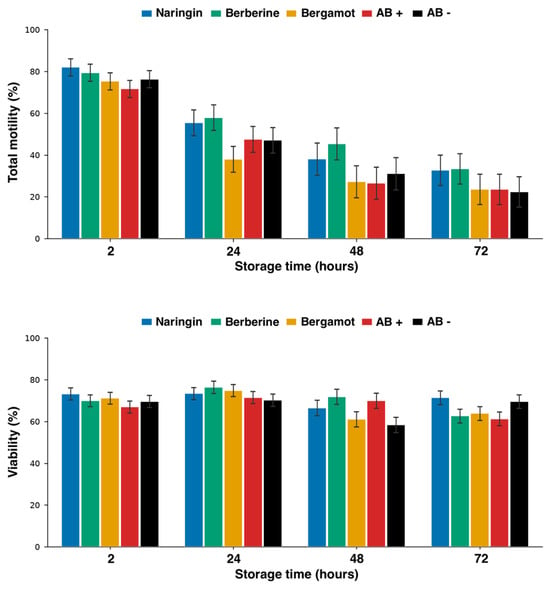
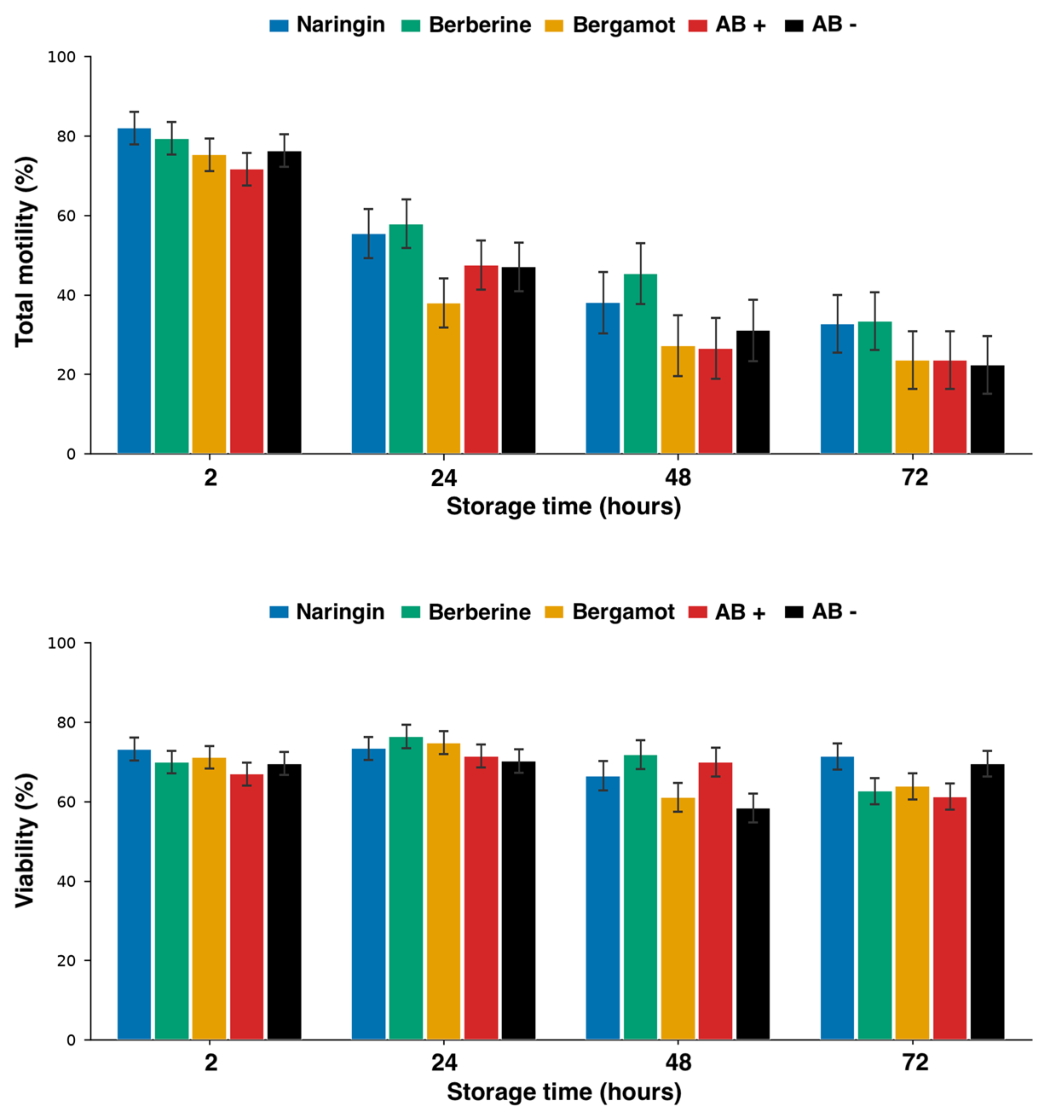
Regarding total motility (Figure 1, upper panel), no differences were observed between the plant-derived compounds and the antibiotic-supplemented or antibiotic-free extenders. As expected, motility declined progressively over storage, from a mean of 74.4% at 2 h to 44.37%, 33.60% and 27.47% at 24, 48 and 72 h, respectively. Sperm viability was likewise similar among groups at all time points (Figure 1, lower panel).
Figure 1.
Comparative effect of plant-derived compounds (250 μg/mL naringin, berberine, and bergamot essential oil) and controls with (AB+: 100 IU/mL penicillin and 100 μg/mL streptomycin) or without (AB−) antibiotics in a Tris-citric acid–glucose base extender (TCG; 250 mM tris(hydroxymethyl)aminomethane, 83 mM citric acid, 50 mM glucose, pH 6.8–7.0) on In vitro sperm quality in rabbit seminal AI doses stored at 16 ± 1 °C for 72 h. (Upper panel): Total motility (%). (Lower panel): Viability (%). Values are expressed as LSM ± SEM. No statistically significant differences were observed among treatments within any storage time point (p > 0.05). Eight independent biological replicates per treatment were performed.
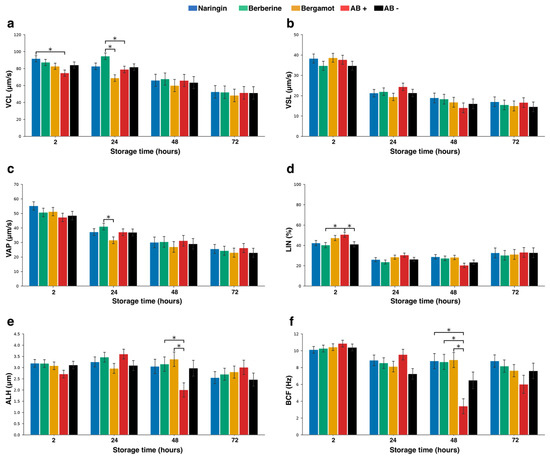
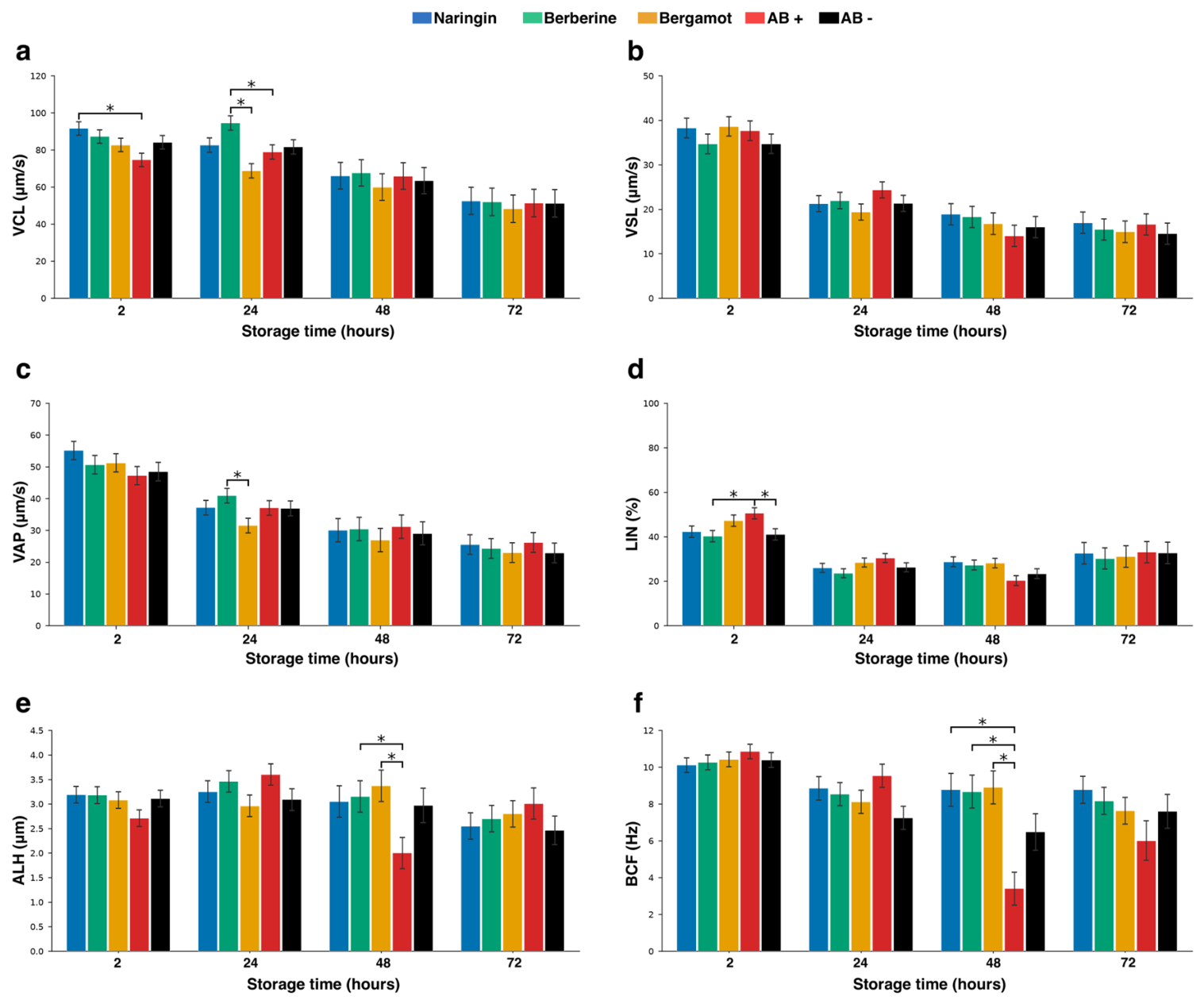
The kinematic parameters of rabbit spermatozoa evaluated over 72 h of refrigerated storage are shown in Figure 2. Regarding curvilinear velocity (VCL; Figure 2a), naringin exhibited higher initial values at 2 h compared to the antibiotic control (AB+) (p < 0.05). At 24 h, berberine preserved significantly higher VCL values than bergamot essential oil (p < 0.05), which showed the lowest velocity at this time point. No significant differences in VCL were detected among groups at 48 and 72 h. Straight-line velocity (VSL; Figure 2b) remained similar among treatments throughout storage, whereas average path velocity (VAP; Figure 2c) at 24 h was higher in the berberine group compared to bergamot (p < 0.05). Linearity (LIN; Figure 2d) was higher in the AB+ control at 2 h compared to berberine (p < 0.05), but remained similar among groups at subsequent time points. Interestingly, at 48 h, both amplitude of lateral head displacement (ALH; Figure 2e) and beat-cross frequency (BCF; Figure 2f) were significantly reduced in the AB+ control compared to the plant-derived compounds (p < 0.05), which successfully maintained higher values for both parameters. By 72 h, no significant differences were observed among groups for LIN, ALH, or BCF. Overall, despite these isolated statistical differences at specific time points, the observed variations remained within narrow ranges and were likely without functional or biological relevance to overall sperm fertilizing potential.
Figure 2.
Comparative effect of plant-derived compounds (250 μg/mL naringin, berberine, and bergamot essential oil) and controls with (AB+; 100 IU/mL penicillin and 100 μg/mL streptomycin) or without (AB−) antibiotics in a Tris-citric acid–glucose base extender (TCG; 250 mMtris(hydroxymethyl)aminomethane, 83 mM citric acid, 50 mM glucose, pH 6.8–7.0) on sperm kinetic and head-movement parameters in rabbit seminal AI doses stored at 16 ± 1 °C for 72 h. Parameters evaluated include: (a) curvilinear velocity (VCL, μm/s); (b) straight-line velocity (VSL, μm/s); (c) average path velocity (VAP, μm/s); (d) linearity (LIN, %); (e) amplitude of lateral head displacement (ALH, μm); and (f) beat-cross frequency (BCF, Hz). Values are expressed as LSM ± SEM. Horizontal brackets with asterisks (*) indicate statistically significant differences between specific treatment groups within a storage time point (p < 0.05). Time points or panels without brackets indicate no statistically significant differences among treatments (p > 0.05). Eight independent biological replicates per treatment were performed.
Bacterial counts across all extenders were equivalent at 2 h of refrigeration, with no relevant differences observed relative to AB+ (P0 < 0.65 for all comparisons; Table 1). Berberine was the only plant-derived compound that maintained bacterial counts statistically indistinguishable from AB+ throughout the entire 72 h storage period (P0 ≤ 0.64 at all timepoints). By contrast, the AB− showed a relevant increase in bacterial load relative to AB+ from 24 h onwards (P0 = 0.86; mean difference: −0.545 log10 CFU/mL), which persisted at 48 h (P0 = 0.97; −1.014 log10) and 72 h (P0 = 0.91; −1.056 log10). Naringin-supplemented doses showed a relevant accumulation of bacteria compared to AB+ at 48 h (P0 = 0.96; −0.937 log10) and 72 h (P0 = 0.89; −0.973 log10). Bergamot EO showed a borderline relevant difference at 48 h (P0 = 0.81; −0.450 log10) that became more evident at 72 h (P0 = 0.94; −1.095 log10). Overall, only berberine achieved an antimicrobial effect comparable to conventional antibiotics over the full refrigeration period.
Table 1.
Bayesian analysis of Total aerobic mesophilic bacterial counts (CFU/mL, Plate Count Agar) of rabbit seminal AI doses stored at 16 ± 1 °C for 72 h, comparing extenders supplemented with plant-derived compounds (250 μg/mL naringin, berberine, and bergamot essential oil) against control extenders with (AB+; 100 IU/mL penicillin and 100 μg/mL streptomycin) or without (AB−) antibiotics. The columns are the posterior mean of the differences between the two groups being comparison, the probability of the difference being larger (if the difference is positive) or smaller (if negative) than 0 (P0), the 95% highest posterior interval density (HPD95), and the cumulative posterior error probability (PEP). A comparison was considered relevant when P0 exceeded 0.80, indicating that at least 80% of the posterior distribution supported the observed direction of the effect.
3.2. Experiment 2: Dose-Dependent Evaluation of Berberine
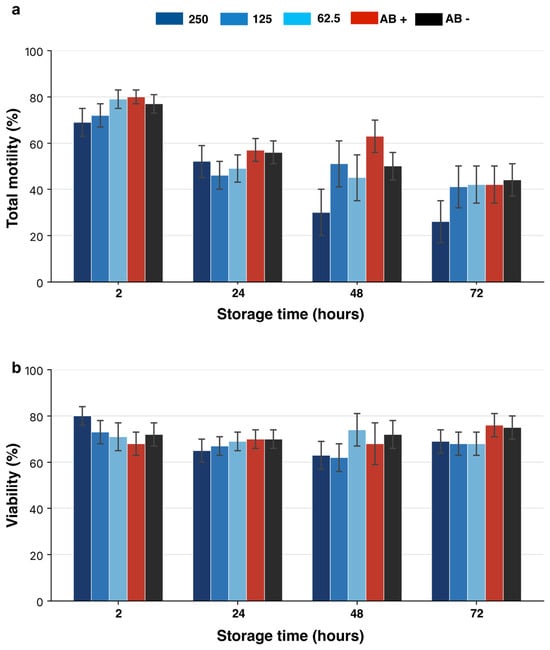
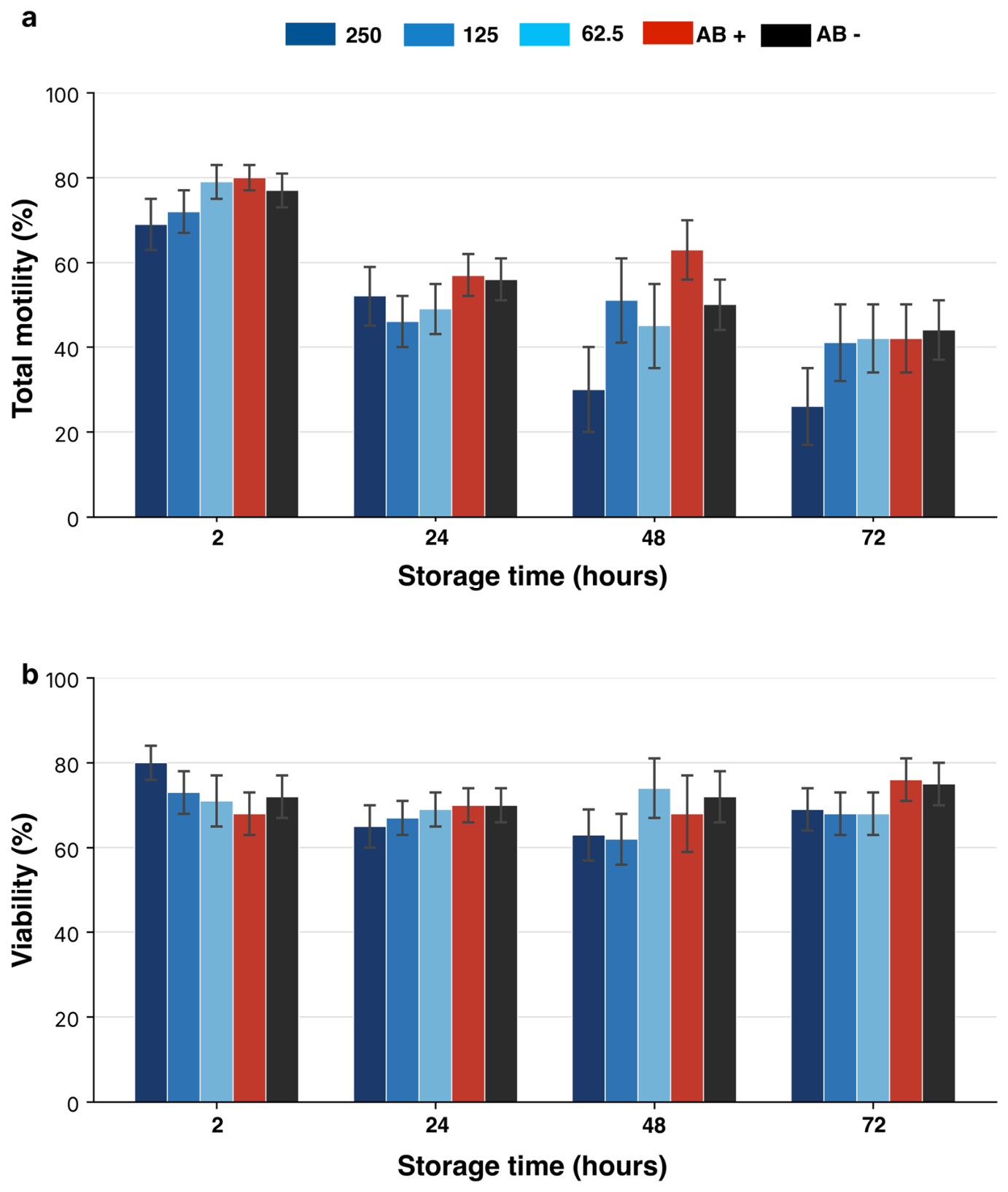
None of the berberine concentrations (62.5, 125 and 250 µg/mL) altered total motility (Figure 3a) or viability (Figure 3b).
Figure 3.
Dose-dependent effect of berberine (62.5, 125, and 250 μg/mL) and controls with (AB+; 100 IU/mL penicillin and 100 μg/mL streptomycin) or without (AB−) antibiotics in a Tris-citric acid–glucose base extender (TCG; 250 mMtris(hydroxymethyl)aminomethane, 83 mM citric acid, 50 mM glucose, pH 6.8–7.0) on in vitro sperm quality in rabbit seminal AI doses stored at 16 ± 1 °C for 72 h. (a) Total motility (%). (b) Viability (%). Values are expressed as LSM ± SEM. No statistically significant differences were observed among treatments within any storage time point (p > 0.05). Four independent biological replicates per treatment were performed.
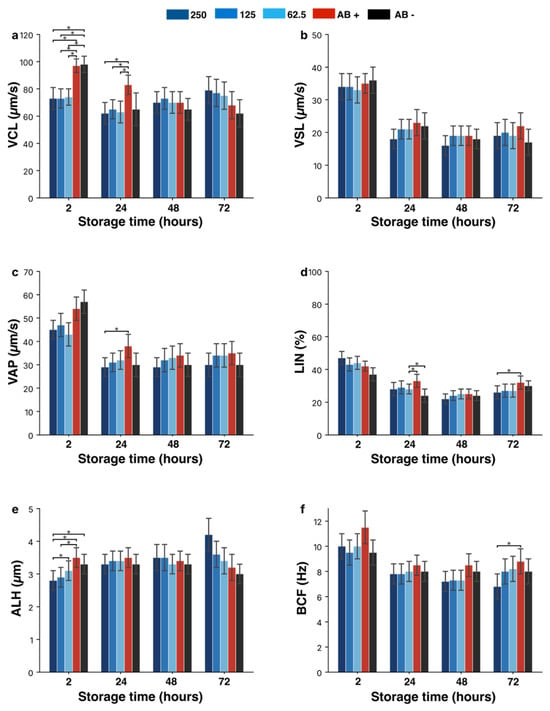
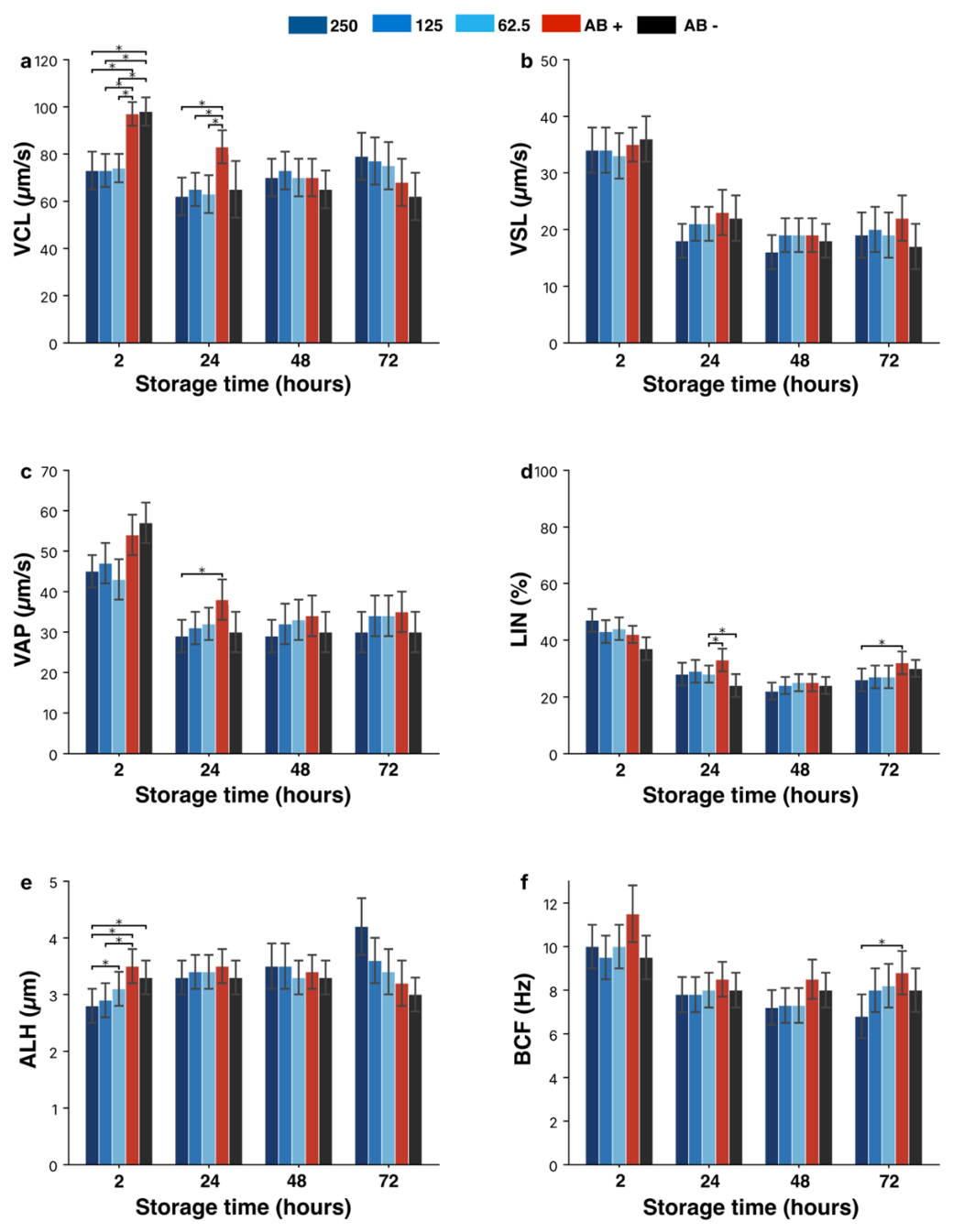
Sperm kinematic parameters during the dose-dependent evaluation of berberine are presented in Figure 4. Regarding curvilinear velocity (VCL; Figure 4a), both control groups (AB+ and AB−) displayed higher initial values at 2 h compared to all berberine concentrations (p < 0.05). At 24 h, the AB+ control maintained higher VCL than the 250 and 62.5 μg/mL berberine groups (p < 0.05), while no significant differences in VCL were detected between treatments at 48 and 72 h. Straight-line velocity (VSL; Figure 4b) remained similar across all groups throughout storage. For average path velocity (VAP; Figure 4c), higher values were observed at 24 h in the AB+ control compared to the 250 and 62.5 μg/mL berberine concentrations (p < 0.05). Linearity (LIN; Figure 4d) at 24 h was higher in the 62.5 μg/mL berberine group compared to the highest dose (250 μg/mL) and the AB− control (p < 0.05), whereas at 72 h, the AB+ control exhibited higher LIN than the 125 μg/mL berberine group (p < 0.05). Initial amplitude of lateral head displacement (ALH; Figure 4e) at 2 h was higher in the AB+ control relative to the 250 and 62.5 μg/mL berberine treatments (p < 0.05), with no significant differences observed at subsequent time points. Beat-cross frequency (BCF; Figure 4f) showed no treatment differences up to 48 h, though the AB+ control retained higher BCF than the 250 μg/mL berberine dose at 72 h (p < 0.05). Overall, although occasional statistical differences were noted at specific time points, sperm kinematics across all tested berberine concentrations remained within physiological ranges throughout the 72 h storage period.
Figure 4.
Dose-dependent effect of berberine (62.5, 125, and 250 μg/mL) and controls with (AB+; 100 IU/mL penicillin and 100 μg/mL streptomycin) or without (AB−) antibiotics in a Tris-citric acid–glucose base extender (TCG; 250 mMtris(hydroxymethyl)aminomethane, 83 mM citric acid, 50 mM glucose, pH 6.8–7.0) on sperm kinetic and head-movement parameters in rabbit seminal AI doses stored at 16 ± 1 °C for 72 h. Parameters evaluated include: (a) curvilinear velocity (VCL, μm/s); (b) straight-line velocity (VSL, μm/s); (c) average path velocity (VAP, μm/s); (d) linearity (LIN, %); (e) amplitude of lateral head displacement (ALH, μm); and (f) beat-cross frequency (BCF, Hz). Values are expressed as LSM ± SEM. Horizontal brackets with asterisks (*) indicate statistically significant differences between specific treatment groups within a storage time point (p < 0.05). Time points or panels without brackets indicate no statistically significant differences among treatments (p > 0.05). Four independent biological replicates per treatment were performed.
Regarding bacterial growth (Table 2), at 2 h of refrigeration, B62.5 and B125 were indistinguishable from AB+ (P0 = 0.60 and 0.77, respectively), whereas B250 already showed a relevant difference (P0 = 0.90; mean difference: −0.247 log10 CFU/mL), comparable in magnitude to AB− (P0 = 0.90; −0.250 log10). At 24 h, B62.5 remained equivalent to AB+ (P0 = 0.57), while B125 and B250 showed relevant bacterial accumulation relative to AB+ (P0 = 0.92, −0.332 log10; and P0 = 0.91, −0.318 log10, respectively), though both remained below the level observed for AB− (P0 = 0.98; −0.532 log10). By 48 h, B250 reached a bacterial load statistically equivalent to AB− (P0 = 1.00; −0.862 and −0.932 log10, respectively), with both HPD95% intervals entirely below zero, confirming the absence of antimicrobial control. B125 also showed a relevant difference from AB+ at this timepoint (P0 = 0.94; −0.412 log10), whereas B62.5 remained equivalent (P0 = 0.56). At 72 h, all three berberine doses showed relevant differences from AB+, including B62.5 (P0 = 0.92; −0.695 log10), B125 (P0 = 0.97; −0.934 log10), and B250 (P0 = 0.97; −0.968 log10). Taken together, these results reveal a paradoxical inverse dose–response pattern: the lowest berberine concentration (B62.5) maintained bacterial counts closest to AB+ for the longest period, while the highest concentration (B250) showed relevant bacterial accumulation from the earliest timepoint, converging with the antibiotic-free control by 48 h.
Table 2.
Bayesian analysis of total aerobic mesophilic bacterial counts (CFU/mL, plate count agar) in rabbit seminal AI doses stored at 16 ± 1 °C for 72 h, comparing extenders supplemented with berberine (62.5, 125, and 250 μg/mL) against control extenders with and without antibiotics. The columns are the posterior mean of the differences between the two groups of the comparison, the probability of the difference being larger (if the difference is positive) or smaller (if negative) than 0 (P0), the 95% highest posterior interval density (HPD95), and the cumulative posterior error probability (PEP). A comparison was considered relevant when P0 exceeded 0.80, indicating that at least 80% of the posterior distribution supported the observed direction of the effect.
3.3. Experiment 3: Field Evaluation of Reproductive Performance
Following the initial screening in Experiments 1 and 2, an in vivo field evaluation was performed comparing three berberine concentrations (62.5, 125, and 250 μg/mL) against control groups. In line with standard commercial rabbit AI practices, seminal doses were stored under refrigeration at 16 ± 1 °C for 24 h prior to insemination. The raw descriptive field reproductive performance parameters (pregnancy rate and total born per litter) across treatment groups are detailed in Table 3.
Table 3.
Descriptive field reproductive outcomes (pregnancy rate and prolificacy) across experimental extenders.
Applying a posterior probability threshold for relevant differences (P0 > 0.80, Table 4), the antibiotic-supplemented control (AB+) achieved higher pregnancy rates than the 125 μg/mL and 250 μg/mL berberine groups, as well as the antibiotic-free control (AB−). In contrast, the lowest berberine concentration (62.5 μg/mL) showed no difference in pregnancy rate compared to the AB+ extender, demonstrating comparable fertility. Regarding prolificacy, both 62.5 μg/mL and 125 μg/mL berberine groups showed a relevant increase in litter size relative to the AB+ control, producing 2.16 and 3.31 additional kits per litter, respectively. Neither the high berberine dose (250 μg/mL) nor the AB− control displayed relevant differences in prolificacy compared to the antibiotic-supplemented extender.
Table 4.
Bayesian analysis of pregnancy rate and prolificacy in rabbit seminal AI doses stored at 16 ± 1 °C for 24 h prior to insemination, comparing extenders supplemented with berberine (62.5, 125, and 250 μg/mL) against control extenders with and without antibiotics. The columns are the posterior mean of the differences between the two groups of the comparison, the probability of the difference being larger (if the difference is positive) or smaller (if negative) than 0 (P0), the 95% highest posterior interval density (HPD95), and the cumulative posterior error probability (PEP).
4. Discussion
The progressive rise in total aerobic mesophilic counts observed across all groups confirms that bacterial proliferation is an intrinsic feature of liquid-stored semen, driven by the nutrient-rich composition of the extender and the residual microbiota of the ejaculate [34]. The fact that all three plant-derived compounds suppressed bacterial proliferation to a level statistically comparable to the antibiotic extender and significantly lower than the antibiotic-free control during the first 24 h indicates that berberine, naringin and bergamot EO, at 250 µg/mL, possess genuine antimicrobial activity against the aerobic mesophilic population of rabbit semen, in agreement with the membrane-disrupting and biofilm-inhibiting properties previously reported for these molecules in pure-culture models. This short-term equivalence is the most relevant outcome from an applied standpoint, since rabbit artificial insemination is routinely performed with doses stored for no more than 24 h; within this commercially meaningful window, the three compounds behaved as effective antibiotic substitutes.
The concentration of 250 µg/mL was selected for the initial screening based on a review of the existing literature on antimicrobial activity of plant-derived compounds in biological matrices. Reported minimum inhibitory concentrations (MICs) for berberine against common bacterial contaminants of seminal origin typically range from 32 to 256 µg/mL depending on the strain and culture conditions [35,36,37,38], while effective concentrations for naringin and bergamot EO tend to be higher in complex matrices than in pure-culture models due to binding to extender components such as albumin and sugars [39,40]. A concentration of 250 µg/mL therefore represents a biologically meaningful dose at which genuine antimicrobial activity could be expected across all three compounds, while remaining below cytotoxic thresholds reported for mammalian cells in vitro. Previous evidence on berberine demonstrated that concentrations ranging from ~0.04–37 µg/mL effectively sustained total and progressive sperm motility [41,42], and the absence of detrimental effects observed in the present study at substantially higher concentrations (250 µg/mL) extends this compatibility evidence to a liquid storage context and to a broader concentration range than previously reported. Similarly, naringin at concentrations of ~14.5–290 µg/mL has been shown not only to preserve but to actively restore motility in oxidatively stressed spermatozoa in a dose-dependent manner [43], providing prior support for the sperm-safe profile observed here at 250 µg/mL. Collectively, these data reinforce the suitability of the selected concentration for evaluating all three compounds as sperm-compatible antimicrobial alternatives for controlling aerobic mesophilic population in semen extenders.
The divergence that emerged beyond 24 h at 16 ± 1 °C is, nonetheless, informative. Only berberine sustained an antimicrobial effect equivalent to the antibiotic through 72 h, whereas naringin and bergamot EO progressively lost their inhibitory capacity. Several non-mutually-exclusive factors may explain this contrast. Berberine is a highly stable isoquinoline alkaloid that resists hydrolytic cleavage and auto-oxidation in neutral aqueous buffers, maintaining >95% structural integrity over prolonged incubation periods [44]. Its pleiotropic mechanism of action—which combines membrane permeabilization with DNA intercalation and the inhibition of FtsZ-mediated cell division, efflux pumps, and biofilm formation—not only reduces the likelihood of bacterial resistance development [35], but also remains functionally concentration-stable throughout the entire storage window [45,46,47,48]. In contrast, the antimicrobial efficacy of bergamot EO relies on low-molecular-weight volatile monoterpenes (such as limonene, linalyl acetate, and linalool) characterized by high vapor pressure, poor aqueous solubility, and susceptibility to auto-oxidation into hydroperoxides during liquid incubation [39,49,50,51]. These processes drive progressive volatilization, phase separation, and chemical depletion, causing the active terpene fraction to drop below its minimum inhibitory threshold over time. Meanwhile, naringin—a glycosylated flavonoid with comparatively weaker direct bactericidal potency—is subject to rapid non-covalent binding kinetics with seminal plasma proteins and nutrient-rich extender components (such as albumins and caseins), as well as microbial metabolism [40,52,53,54]. This reversible protein–flavonoid complexation acts as a functional sink that sequesters the free active fraction, progressively eroding its bacteriostatic pressure as incubation proceeds. Consequently, while naringin and bergamot EO exert acute initial suppression following dilution with 0.8% Cyrene™, only berberine preserves sufficient bioavailable concentration to contain the exponential bacterial proliferation characteristic of the late storage phase. Taken together, these preliminary findings position berberine as the most promising candidate among the three compounds for further evaluation in the liquid preservation of rabbit semen, being the only tested compound able to match conventional antibiotics in controlling aerobic mesophilic bacteria throughout the entire 72 h storage period. Importantly, the practical implication is not that naringin and bergamot EO are ineffective, but that their usefulness is confined to the early storage window that coincides with routine insemination practice. This time-dependent behavior underscores the need to define the antimicrobial requirement of a semen extender in relation to its real-world storage interval rather than to a fixed end-point, and provides the rationale for the subsequent dose-dependent characterization of berberine.
Among the criteria defined by Schulze et al. [30], sperm safety and absence of effects on fertility are arguably the most critical, as any compound that impairs semen quality or reproductive performance would be unsuitable regardless of its antimicrobial activity. In this regard, the three plant-based substances at 250 µg/mL did not compromise sperm quality throughout the 72 h storage period. Total motility and viability were preserved at levels equivalent to both the antibiotic-supplemented and antibiotic-free controls at all time points. Although isolated statistically significant differences in kinematic parameters were detected—notably in VCL, VAP, ALH and BCF at specific time points—these were inconsistent across groups and storage intervals, remained within physiologically normal ranges, and are unlikely to translate into meaningful differences in fertilising capacity. The sperm-compatibility profile of all three compounds can therefore be considered equivalent to that of the antibiotic extender under the conditions evaluated. Beyond direct sperm compatibility, the antioxidant properties of these compounds may provide additional protection during liquid storage [51]. Oxidative stress, driven by the accumulation of reactive oxygen species (ROS), is a recognised cause of lipid peroxidation, motility loss and DNA fragmentation in refrigerated spermatozoa [2]. In this regard, both naringin and berberine exhibit well-documented free-radical scavenging activity [43], while the phenolic and terpenic constituents of bergamot EO similarly confer antioxidant capacity [23]. Consistent with this, studies evaluating EOs in liquid-stored semen have reported preservation of sperm membrane integrity at non-spermicidal concentrations [26,27,28,29], a pattern compatible with the absence of quality impairment observed in the present study. Whether the antioxidant activity of these compounds actively contributes to sperm protection during the 72 h storage period remains to be confirmed through direct measurement of oxidative stress markers.
Given that berberine was the only compound to sustain antimicrobial activity equivalent to conventional antibiotics throughout the 72 h storage period, while simultaneously preserving sperm quality and demonstrating a well-characterised pleiotropic mechanism of action, subsequent experiments focused exclusively on this alkaloid. In addition, berberine has more recently attracted attention in the field of sperm biology, where oxidative stress is one of the main factors limiting the success of liquid semen storage for artificial insemination [42,55,56]. To move towards a field-applicable formulation, a dose–response approach was adopted to evaluate whether lower berberine concentrations could control bacterial proliferation without compromising sperm function or reproductive performance—a prerequisite for practical implementation in commercial rabbit artificial insemination.
The dose-dependent evaluation of berberine confirmed and extended the findings of Experiment 1. Sperm quality—both total motility and viability—remained unaffected across all tested concentrations throughout the 72 h storage period, and the sporadic kinematic differences observed were again transient, inconsistent across time points, and confined to the physiological range, reinforcing the conclusion that berberine is sperm-compatible up to 250 µg/mL in this system [41,42]. From a microbiological standpoint, experiment 2 revealed an inverse dose–response pattern rather than a uniform plateau across concentrations. Specifically, the lowest concentration (62.5 μg/mL) suppressed aerobic mesophilic bacterial growth to levels comparable to the antibiotic control for up to 48 h, whereas higher concentrations (125 and 250 μg/mL) showed earlier bacterial accumulation, with all groups converging above the antibiotic threshold by 72 h. This behavior indicates that 62.5 μg/mL is sufficient to cover both the commercial 24 h insemination window and extended 48 h storage. The apparent divergence in the antimicrobial duration of the 250 μg/mL berberine dose between experiment 1 and experiment 2 can be attributed to two complementary factors. First, because both experiments were conducted using independent weekly heterospermic pools, natural week-to-week fluctuations in the initial bacterial load and taxonomic composition of the native seminal microbiota—which comprises diverse Gram-positive and Gram-negative genera with varying intrinsic susceptibilities [32]—can shift the kinetic threshold of bacterial suppression. Second, at higher concentrations (250 μg/mL) in complex electrolyte- and protein-rich extenders, amphiphilic cationic alkaloids like berberine are prone to molecular self-aggregation [35,36] and non-specific binding to seminal plasma components [57], which can paradoxically reduce the free bioavailable fraction compared to lower, fully monomeric concentrations (62.5 μg/mL). Notably, despite this inter-experimental variation at prolonged storage times, 62.5 μg/mL berberine consistently matched the antibiotic in controlling aerobic mesophilic bacteria throughout the first 48 h—fully covering the standard 24 h commercial insemination window. This effective concentration aligns with the lower end of MIC ranges reported for berberine against seminal bacterial contaminants [35,36]. From an applied standpoint, achieving equivalent short- and medium-term bacterial control at the lowest tested concentration adheres to the precautionary principle of minimizing additive load [30], thereby lowering formulation costs and reducing the risk of unintended biological effects. Collectively, these findings justified advancing 62.5 µg/mL alongside the two higher concentrations into the subsequent in vivo reproductive trial.
The field evaluation confirmed that berberine at 62.5 µg/mL is a functionally viable substitute for conventional antibiotics in rabbit semen extenders, specifically regarding the control of aerobic mesophilic bacteria. This concentration achieved pregnancy rates equivalent to the antibiotic control while yielding a relevant increase in litter size. The higher berberine concentrations (125 and 250 µg/mL) did not replicate this fertility profile, suggesting a non-linear dose–fertility relationship that warrants careful interpretation. The reproductive parameters recorded across all groups are consistent with those reported under standard commercial artificial insemination conditions in rabbits [19,58,59], confirming that the experimental model reflected a realistic productive scenario.
The superior reproductive performance observed at 62.5 µg/mL—evidenced by pregnancy rates equivalent to the antibiotic control alongside an increased litter size—highlights a classical hormetic, biphasic dose–response typical of berberine [60,61]. At this optimal threshold, berberine effectively suppresses aerobic mesophilic bacterial proliferation while exerting direct cytoprotective and antioxidant effects that preserve sperm plasma membrane integrity and mitochondrial function [56,62]. Because sublethal oxidative damage to sperm chromatin compromises post-fertilization embryonic development without necessarily preventing initial conception [63], this antioxidant protection likely enhanced early embryonic survival, translating into larger litter sizes. Conversely, the decline in fertility at 250 µg/mL reflects a narrow therapeutic window in which supra-optimal alkaloid concentrations induce sublethal sperm bioenergetic stress. Owing to its cationic lipophilic nature, berberine preferentially accumulates within the mitochondrial matrix and inhibits respiratory chain Complex I in a dose-dependent manner, leading to membrane potential dissipation, ATP depletion, and impaired sperm vitality at high concentrations [62,64,65]. Consequently, although higher doses maximize acute bacteriostasis in vitro, 62.5 µg/mL represents the physiological optimum that balances microbial control with fertilizing competence in vivo. Beyond direct sperm chromatin protection, the reduction in aerobic mesophilic bacterial load achieved by berberine at 62.5 (and partial suppression relative to AB− at 125 µg/mL) may also create a less hostile uterine environment post-insemination, lowering bacterially derived inflammatory mediators that could otherwise impair early embryo survival [2]. These hypotheses remain speculative and would require dedicated experimental validation, but they position berberine not merely as an antibiotic substitute but as a potentially beneficial additive in its own right.
Several limitations of the present study should be acknowledged to contextualize our findings and guide future research. First, microbiological evaluations were restricted to AMB. While AMB serves as the established gold-standard indicator of overall seminal hygiene, this approach relies on culture-dependent methods that capture only the culturable fraction of the ejaculatory microbiota, potentially underestimating fastidious or strictly anaerobic taxa; future studies incorporating culture-independent approaches, such as 16S rRNA gene sequencing, would provide a more comprehensive metagenomic profile. Second, the subsequent dose–response characterization and in vivo trials focused exclusively on berberine based on its superior 72 h antimicrobial stability, leaving the potential optimization of naringin and bergamot essential oil—or their combination in synergistic phytogenic cocktails—unexplored. Third, female reproductive performance was evaluated during a single artificial insemination cycle in a relatively small cohort of does (n = 10 per treatment group). Although this sample size provided sufficient power within a robust Bayesian inferential framework and no adverse clinical signs, systemic toxicity, or maternal health impairment were observed, evaluating multi-cycle fertility across consecutive inseminations in larger commercial herds will be essential to confirm long-term reproductive safety. Altogether, these results establish berberine at 62.5 µg/mL as a promising, eco-friendly additive for semen extenders, aligning commercial rabbit farming with global efforts to reduce veterinary antibiotic reliance without compromising reproductive yield.
5. Conclusions
In this preliminary study, supplementation with 250 µg/mL of berberine, naringin, or bergamot EO controlled aerobic mesophilic bacterial proliferation in liquid-stored rabbit semen doses with an efficacy comparable to conventional antibiotics over the first 24 h, thereby covering the standard commercial insemination window. None of the compounds compromised sperm motility, viability or kinematics at this concentration, confirming their sperm-safe profile under the conditions evaluated. Among them, berberine was the only substance to sustain antibacterial efficacy throughout the full 72 h storage period in the initial screening, whereas the subsequent dose-dependent assessment revealed an inverse dose–response pattern in which 62.5 µg/mL maintained bacterial control up to 48 h, while increasing the concentration to 125 and 250 µg/mL reduced antimicrobial efficacy. Field evaluation confirmed that 62.5 µg/mL berberine preserved pregnancy rates equivalent to the antibiotic-supplemented extender while producing a relevant increase in litter size, positioning this alkaloid as a promising antibiotic substitute for rabbit artificial insemination. Further studies should investigate the mechanisms underlying the prolificacy improvement observed with berberine, evaluate its efficacy against a broader range of seminal bacterial species, and explore combinations of plant-derived compounds to achieve sustained antimicrobial protection across extended storage periods.
Author Contributions
Conceptualisation, F.M.-J., J.S.V. and M.P.V.-d.-C.; methodology and data curation, F.M.-J., A.D.-G., T.S.-D. and L.L.-R.; writing—original draft preparation, F.M.-J.; writing—review and editing, L.L.-R., M.P.V.-d.-C., J.S.V. and F.M.-J.; funding acquisition, F.M.-J., J.S.V. and M.P.V.-d.-C.; supervision, F.M.-J. All authors have read and agreed to the published version of the manuscript.
Funding
This research was funded through grant PID2021-127867OB-100 by MCIN/AEI/10.13039/501100011033 and by ERDF, “A way of making Europe”.
Institutional Review Board Statement
The study was conducted in accordance with ethical requirements and approved by the Dirección General de Agricultura, Pesca y Ganadería of the Comunidad Valenciana (research code: 2025-VSC-PEA-0029; approval date: 10 March 2025).
Informed Consent Statement
Not applicable.
Data Availability Statement
The data presented in this study are available upon request from the corresponding author.
Conflicts of Interest
The authors declare no conflicts of interest.
Abbreviations
The following abbreviations are used in this manuscript:
| AB+ | Antibiotic-supplemented extender |
| AB− | Antibiotic-free extender |
| AI | Artificial insemination |
| ALH | Amplitude of lateral head displacement |
| CASA | Computer-assisted sperm analysis |
| CFU/mL | Colony-forming units per millilitre |
| eCG | Equine chorionic gonadotropin |
| EO | Essential oil |
| GLM | Generalized linear model |
| HPD95% | Highest posterior density interval (95%) |
| LIN | Linearity |
| LSM | Least-squares means |
| Me2SO | Dimethyl sulfoxide |
| PCA | Plate count agar |
| PEP | Cumulative posterior error probability |
| PI | Propidium iodide |
| P0 | Posterior probability |
| SEM | Standard error of the mean |
| TCG | Tris-citric acid–glucose extender |
| VAP | Average path velocity |
| VCL | Curvilinear velocity |
| VSL | Straight-line velocity |
References
- Quintela, L.A.; Becerra, J.J.; Peña, A.I.; Yáñez, U.; Villamayor, P.R.; Sánchez-Quinteiro, P.; Martínez, P.; Herradón, P.G. Three decades of progress in artificial insemination in rabbit farming: A review. World Rabbit Sci. 2023, 31, 93–107. [Google Scholar] [CrossRef] [Scilit]
- Campos, A.; Soria-Meneses, P.J.; Arenas-Moreira, M.; Alonso-Moreno, C.; Rodríguez-Robledo, V.; Soler, A.J.; Garde, J.J.; Fernández-Santos, M.R. Minimizing sperm oxidative stress using nanotechnology for breeding programs in rams. J. Anim. Sci. Biotechnol. 2023, 14, 106. [Google Scholar] [CrossRef] [Scilit] [PubMed]
- Jäkel, H.; Scheinpflug, K.; Mühldorfer, K.; Gianluppi, R.; Lucca, M.S.; Mellagi, A.P.G.; Bortolozzo, F.P.; Waberski, D. In vitro performance and in vivo fertility of antibiotic-free preserved boar semen stored at 5 °C. J. Anim. Sci. Biotechnol. 2021, 12, 9. [Google Scholar] [CrossRef] [Scilit] [PubMed]
- Waberski, D.; Luther, A.M.; Grünther, B.; Jäkel, H.; Henning, H.; Vogel, C.; Peralta, W.; Weitze, K.F. Sperm function in vitro and fertility after antibiotic-free, hypothermic storage of liquid preserved boar semen. Sci. Rep. 2019, 9, 14748. [Google Scholar] [CrossRef] [Scilit] [PubMed]
- Caneschi, A.; Bardhi, A.; Barbarossa, A.; Zaghini, A. The use of antibiotics and antimicrobial resistance in veterinary medicine, a complex phenomenon: A narrative review. Antibiotics 2023, 12, 487. [Google Scholar] [CrossRef] [Scilit] [PubMed]
- Renwick, M.; Mossialos, E. What are the economic barriers of antibiotic R&D and how can we overcome them? Expert Opin. Drug Discov. 2018, 13, 889–892. [Google Scholar] [CrossRef] [Scilit] [PubMed]
- Naghavi, M.; Vollset, S.E.; Ikuta, K.S.; Swetschinski, L.R.; Gray, A.; Wool, E.E.; Aguilar, G.R.; Mestrovic, T.; Smith, G.; Han, C.; et al. Global burden of bacterial antimicrobial resistance 1990–2021: A systematic analysis with forecasts to 2050. Lancet 2024, 404, 1199–1226. [Google Scholar] [CrossRef] [Scilit] [PubMed]
- Murray, C.J.; Ikuta, K.S.; Sharara, F.; Swetschinski, L.; Aguilar, G.R.; Gray, A.; Han, C.; Bisignano, C.; Rao, P.; Wool, E.; et al. Global burden of bacterial antimicrobial resistance in 2019: A systematic analysis. Lancet 2022, 399, 629–655. [Google Scholar] [CrossRef] [Scilit] [PubMed]
- Ahmed, M.M.; Kayode, H.H.; Okesanya, O.J.; Ukoaka, B.M.; Eshun, G.; Mourid, M.R.; Adigun, O.A.; Ogaya, J.B.; Mohamed, Z.O.; Lucero-Prisno, D.E., III. CRISPR-Cas systems in the fight against resistance: Current status, potentials, and future directions. Infect. Drug Resist. 2024, 17, 5229–5245. [Google Scholar] [CrossRef] [Scilit] [PubMed]
- Abdallah, E.M. The silent threat of antibiotic pollution in global ecosystems: A bioethical crisis demanding urgent multisectoral action. Ethics Med. Public Health 2025, 33, 101156. [Google Scholar] [CrossRef] [Scilit]
- Morrell, J.M.; Cojkic, A.; Malaluang, P.; Ntallaris, T.; Lindahl, J.; Hansson, I. Antibiotics in semen extenders—A multiplicity of paradoxes. Reprod. Fertil. Dev. 2024, 36, RD23218. [Google Scholar] [CrossRef] [Scilit] [PubMed]
- Morrell, J.M.; Malaluang, P.; Cojkic, A.; Hansson, I. Alternatives to antibiotics in semen extenders used in artificial insemination. In The Global Antimicrobial Resistance Epidemic—Innovative Approaches and Cutting-Edge Solutions; Tellez-Isaias, G., Ed.; IntechOpen: London, UK, 2022; pp. 1–17. [Google Scholar] [CrossRef] [Scilit]
- Morrell, J.M.; Ntallaris, T.; Hansson, I.; Cojkic, A. The seminal microbiome/microbiota and implications for antibiotics in semen extenders. Anim. Reprod. Sci. 2026, 294, 108347. [Google Scholar] [CrossRef] [Scilit] [PubMed]
- Ros-Santaella, J.L.; Nový, P.; Scaringi, M.; Pintus, E. Antimicrobial peptides and proteins as alternative antibiotics for porcine semen preservation. BMC Vet. Res. 2024, 20, 257. [Google Scholar] [CrossRef] [Scilit] [PubMed]
- Malaluang, P.; Wagner, L.H.; Cojkic, A.; Spergser, J.; Aurich, C.; Morrell, J.M. Reduced bacterial load in stallion semen by modified single-layer centrifugation or sperm washing. Theriogenology 2024, 216, 111–117. [Google Scholar] [CrossRef] [Scilit] [PubMed]
- Lacalle, E.; Martínez-Martínez, S.; Fernández-Alegre, E.; Soriano-Úbeda, C.; Morrell, J.M.; Martínez-Pastor, F. Low-density colloid centrifugation removes bacteria from boar semen doses after spiking with selected species. Res. Vet. Sci. 2023, 158, 215–225. [Google Scholar] [CrossRef] [Scilit] [PubMed]
- Lacalle, E.; Fernández-Alegre, E.; Soriano-Úbeda, C.; Martínez-Martínez, S.; Domínguez, J.C.; González-Montaña, J.R.; Morrell, J.M.; Martínez-Pastor, F. Single-layer centrifugation (SLC) for bacterial removal with Porcicoll positively modifies chromatin structure in boar spermatozoa. Theriogenology 2023, 201, 95–105. [Google Scholar] [CrossRef] [Scilit] [PubMed]
- Sharaf, A.E.; El-Harairy, M.A.; Khalifa, E.I.; Abdelnour, S.A.; Khalil, W.A. The shift toward antibiotic-free semen extenders: Innovative uses of natural substances in ruminant sperm cryopreservation. Reprod. Domest. Anim. 2026, 61, e70202. [Google Scholar] [CrossRef] [Scilit]
- Marco-Jiménez, F.; Ferriz-Nuñez, C.; Viudes-de-Castro, M.P.; Vicente, J.S.; Lorenzo-Rebenaque, L. Chitosan-based semen extenders: An approach to antibiotic-free artificial insemination in rabbit. Antibiotics 2025, 14, 55. [Google Scholar] [CrossRef] [Scilit] [PubMed]
- Viudes-de-Castro, M.P.; Talaván, A.G.; Vicente, J.S. Evaluation of dextran for rabbit sperm cryopreservation: Effect on frozen-thawed rabbit sperm quality variables and reproductive performance. Anim. Reprod. Sci. 2021, 226, 106714. [Google Scholar] [CrossRef] [Scilit] [PubMed]
- Castellini, C.; Mourvaki, E.; Cardinali, R.; Collodel, G.; Lasagna, E.; Del Vecchio, M.T.; Dal Bosco, A. Secretion patterns and effect of prostate-derived granules on the sperm acrosome reaction of rabbit buck. Theriogenology 2012, 78, 715–723. [Google Scholar] [CrossRef] [Scilit] [PubMed]
- Castellini, C.; Lattaioli, P.; Moroni, M.; Minelli, A. Effect of seminal plasma on the characteristics and fertility of rabbit spermatozoa. Anim. Reprod. Sci. 2000, 63, 275–282. [Google Scholar] [CrossRef] [Scilit] [PubMed]
- Domingo, P.; Olaciregui, M.; González, N.; De Blas, I.; Gil, L. Centrifugation of rabbit semen: Effect on sperm quality and fertility during cooled storage. Reprod. Domest. Anim. 2018, 53, 953–960. [Google Scholar] [CrossRef] [Scilit] [PubMed]
- Hoffmann, K.H. Essential oils. Z. Naturforsch. C 2020, 75, 177. [Google Scholar] [CrossRef] [Scilit] [PubMed]
- Tariq, S.; Wani, S.; Rasool, W.; Shafi, K.; Bhat, M.A.; Prabhakar, A.; Shalla, A.H.; Rather, M.A. A comprehensive review of the antibacterial, antifungal and antiviral potential of essential oils and their chemical constituents against drug-resistant microbial pathogens. Microb. Pathog. 2019, 134, 103580. [Google Scholar] [CrossRef] [Scilit] [PubMed]
- Elmi, A.; Ventrella, D.; Barone, F.; Zannoni, A.; Bertocchi, M.; Bacci, M.L. In vitro effects of tea tree oil (Melaleuca alternifolia essential oil) and its principal component terpinen-4-ol on swine spermatozoa. Molecules 2019, 24, 1071. [Google Scholar] [CrossRef] [Scilit] [PubMed]
- Elmi, A.; Ventrella, D.; Barone, F.; Zannoni, A.; Bertocchi, M.; Bacci, M.L. Antimicrobial capabilities of non-spermicidal concentrations of tea tree (Melaleuca alternifolia) and rosemary (Rosmarinus officinalis) essential oils on the liquid phase of refrigerated swine seminal doses. Res. Vet. Sci. 2019, 127, 76–81. [Google Scholar] [CrossRef] [Scilit] [PubMed]
- Elmi, A.; Ventrella, D.; Barone, F.; Zannoni, A.; Bertocchi, M.; Bacci, M.L. Thymbra capitata L. Cav. and Rosmarinus officinalis L. essential oils: In vitro effects and toxicity on swine spermatozoa. Molecules 2017, 22, 2162. [Google Scholar] [CrossRef] [Scilit] [PubMed]
- Troisio, I.; Bertocchi, M.; Ventrella, D.; Elmi, A.; Barone, F.; Bacci, M.L. Short- and long-term effects of essential oils on swine spermatozoa during liquid phase refrigeration. Sci. Rep. 2024, 14, 285. [Google Scholar] [CrossRef] [Scilit] [PubMed]
- Schulze, M.; Dathe, M.; Waberski, D.; Müller, K. Liquid storage of boar semen: Current and future perspectives on the use of cationic antimicrobial peptides to replace antibiotics in semen extenders. Theriogenology 2016, 85, 39–46. [Google Scholar] [CrossRef] [Scilit] [PubMed]
- Viudes-de-Castro, M.P.; Mocé, E.; Lavara, R.; Marco-Jiménez, F.; Vicente, J.S. Aminopeptidase activity in seminal plasma and effect of dilution rate on rabbit reproductive performance after insemination with an extender supplemented with buserelin acetate. Theriogenology 2014, 81, 1223–1228. [Google Scholar] [CrossRef] [Scilit] [PubMed]
- Marco-Jiménez, F.; Borrás, S.; Garcia-Dominguez, X.; D’Auria, G.; Vicente, J.S.; Marin, C. Roles of host genetics and sperm microbiota in reproductive success in healthy rabbit. Theriogenology 2020, 158, 416–423. [Google Scholar] [CrossRef] [Scilit] [PubMed]
- Lavara, R.; Mocé, E.; Lavara, F.; Viudes de Castro, M.P.; Vicente, J.S. Do parameters of seminal quality correlate with the results of on-farm inseminations in rabbits? Theriogenology 2005, 64, 1130–1141. [Google Scholar] [CrossRef] [Scilit] [PubMed]
- Luther, A.; Beckermann, C.; Nguyen, T.Q.; Verspohl, J.; Waberski, D. Growth dynamic and threshold values for spermicidal effects of multidrug-resistant bacteria in extended boar semen. Microorganisms 2023, 11, 788. [Google Scholar] [CrossRef] [Scilit] [PubMed]
- Duda-Madej, A.; Viscardi, S.; Bazan, H.; Sobieraj, J. Exploring the role of berberine as a molecular disruptor in antimicrobial strategies. Pharmaceuticals 2025, 18, 947. [Google Scholar] [CrossRef] [Scilit] [PubMed]
- Yang, X.; Wang, Y.; Li, L.; Tang, D.; Zhong, Y.; Li, M.; Jiang, J.; Bi, D. Berberine and its nanoformulations and extracts: Potential strategies and future perspectives against multi-drug resistant bacterial infections. Front. Microbiol. 2025, 16, 1643409. [Google Scholar] [CrossRef] [Scilit] [PubMed]
- Jadhav, S.; Jadhav, V.; Angadi, K. Berberine: Best alternative medicine insight abating global challenges for treatment of MRSA infections. Infect. Drug Resist. 2022, 15, 2573–2574. [Google Scholar] [CrossRef] [Scilit] [PubMed]
- Zhang, M.; Liu, J.; Yu, C.; Tang, S.; Jiang, G.; Zhang, J.; Zhang, H.; Xu, J.; Xu, W. Berberine regulation of cellular oxidative stress, apoptosis and autophagy by modulation of m6A mRNA methylation through targeting the Camk1db/ERK pathway in zebrafish-hepatocytes. Antioxidants 2022, 11, 2370. [Google Scholar] [CrossRef] [Scilit] [PubMed]
- Kokina, M.; Salević-Jelić, A.; Kalušević, A.; Lević, S.; Pantić, M.; Pljevljakušić, D.; Šavikin, K.; Shamtsyan, M.; Nikšić, M.; Nedović, V. Characterization, antioxidant and antibacterial activity of essential oils and their encapsulation into biodegradable material followed by freeze drying. Food Technol. Biotechnol. 2019, 57, 282–289. [Google Scholar] [CrossRef] [Scilit] [PubMed]
- Roy, A.S.; Tripathy, D.R.; Chatterjee, A.; Dasgupta, S. A spectroscopic study of the interaction of the antioxidant naringin with bovine serum albumin. J. Biophys. Chem. 2010, 1, 141–152. [Google Scholar] [CrossRef]
- Zhang, X.; Lu, X.; Li, J.; Xia, Q.; Gao, J.; Wu, B. Mito-Tempo alleviates cryodamage by regulating intracellular oxidative metabolism in spermatozoa from asthenozoospermic patients. Cryobiology 2019, 91, 18–22. [Google Scholar] [CrossRef] [Scilit] [PubMed]
- Kuželová, L.; Svoradová, A.; Baláži, A.; Vašíček, J.; Langraf, V.; Kolesárová, A.; Sláma, P.; Chrenek, P. Enhancing of rabbit sperm cryopreservation with antioxidants Mito-Tempo and Berberine. Antioxidants 2024, 13, 1360. [Google Scholar] [CrossRef] [Scilit] [PubMed]
- Jamalan, M.; Ghaffari, M.A.; Hoseinzadeh, P.; Hashemitabar, M.; Zeinali, M. Human sperm quality and metal toxicants: Protective effects of some flavonoids on male reproductive function. Int. J. Fertil. Steril. 2016, 10, 215–223. [Google Scholar] [CrossRef] [Scilit] [PubMed]
- Battu, S.K.; Repka, M.A.; Maddineni, S.; Chittiboyina, A.G.; Avery, M.A.; Majumdar, S. Physicochemical characterization of berberine chloride: A perspective in the development of a solution dosage form for oral delivery. AAPS PharmSciTech 2010, 11, 1466–1475. [Google Scholar] [CrossRef] [Scilit] [PubMed]
- Zhou, H.; Wang, W.; Cai, L.; Yang, T. Potentiation and mechanism of berberine as an antibiotic adjuvant against multidrug-resistant bacteria. Infect. Drug Resist. 2023, 16, 7313–7326. [Google Scholar] [CrossRef] [Scilit] [PubMed]
- Yi, L.; Cao, M.; Chen, X.; Bai, Y.; Wang, W.; Wei, X.; Shi, Y.; Zhang, Y.; Ma, T.; Zhu, Z.; et al. In vitro antimicrobial synergistic activity and the mechanism of the combination of naringenin and amikacin against antibiotic-resistant Escherichia coli. Microorganisms 2024, 12, 1871. [Google Scholar] [CrossRef] [Scilit] [PubMed]
- Stermitz, F.R.; Lorenz, P.; Tawara, J.N.; Zenewicz, L.A.; Lewis, K. Synergy in a medicinal plant:antimicrobial action of berberine potentiated by 5′-methoxyhydnocarpin, a multidrug pump inhibitor. Proc. Natl. Acad. Sci. USA 2000, 97, 1433–1437. [Google Scholar] [CrossRef] [Scilit] [PubMed]
- Wu, S.; Yang, K.; Hong, Y.; Gong, Y.; Ni, J.; Yang, N.; Ding, W. A new perspective on the antimicrobial mechanism of berberine hydrochloride against Staphylococcus aureus revealed by untargeted metabolomic studies. Front. Microbiol. 2022, 13, 917414. [Google Scholar] [CrossRef] [Scilit] [PubMed]
- Turek, C.; Stintzing, F.C. Stability of essential oils: A review. Compr. Rev. Food Sci. Food Saf. 2013, 12, 40–53. [Google Scholar] [CrossRef] [Scilit]
- González-Mas, M.C.; Rambla, J.L.; López-Gresa, M.P.; Blázquez, M.A.; Granell, A. Volatile Compounds in Citrus Essential Oils: A Comprehensive Review. Front. Plant Sci. 2019, 10, 12. [Google Scholar] [CrossRef] [Scilit] [PubMed]
- Dhifi, W.; Bellili, S.; Jazi, S.; Bahloul, N.; Mnif, W. Essential Oils’ Chemical Characterization and Investigation of Some Biological Activities: A Critical Review. Medicines 2016, 3, 25. [Google Scholar] [CrossRef] [Scilit] [PubMed]
- Fuhr, U.; Kummert, A.L. The fate of naringin in humans: A key to grapefruit juice-drug interactions? Clin. Pharmacol. Ther. 1995, 58, 365–373. [Google Scholar] [CrossRef] [Scilit] [PubMed]
- Liu, M. Comparative protein binding of naringin and its aglycone naringenin in rat, dog and human plasma. Afr. J. Pharm. Pharmacol. 2012, 6, 894–900. [Google Scholar] [CrossRef] [Scilit]
- Liu, S.; Guo, C.; Guo, Y.; Yu, H.; Greenaway, F.; Sun, M.Z. Comparative binding affinities of flavonoid phytochemicals with bovine serum albumin. Iran. J. Pharm. Res. 2014, 13, 1019–1028. [Google Scholar] [PubMed]
- Tvrdá, E.; Benko, F.; Slanina, T.; du Plessis, S.S. The role of selected natural biomolecules in sperm production and functionality. Molecules 2021, 26, 5196. [Google Scholar] [CrossRef] [Scilit] [PubMed]
- Chen, L.; Wang, T.; Liu, J. Effect of berberine on human sperm parameters in vitro. Transl. Androl. Urol. 2016, 5, AB229. [Google Scholar] [CrossRef] [Scilit]
- Hu, Y.J.; Liu, Y.; Xiao-He, X. Investigation of the Interaction between Berberine and Human Serum Albumin. Biomacromolecules 2009, 10, 517–521. [Google Scholar] [CrossRef] [Scilit] [PubMed]
- Castillo, J.J.; Vicente, J.S.; Marco-Jiménez, F.; Viudes-de-Castro, M.P. Intravaginal GnRH analogues in rabbits: Fertirelin as the most effective option for ovulation induction. Theriogenology 2026, 263, 117990. [Google Scholar] [CrossRef] [Scilit] [PubMed]
- Castillo, J.J.; Vicente, J.S.; Marco-Jiménez, F.; Aguilar, E.; Viudes-de-Castro, M.P. Reducing hormonal inputs in rabbit reproduction: Physical ovulation induction with a 3D-printed cannula. Animals 2025, 15, 2544. [Google Scholar] [CrossRef] [Scilit] [PubMed]
- Calabrese, E.J.; Kozumbo, W.J. Berberine induces pleiotropic beneficial effects via hormesis. Pharmacol. Res. 2026, 233, 109638. [Google Scholar] [CrossRef] [Scilit] [PubMed]
- Bao, J.; Huang, B.; Zou, L.; Chen, S.; Zhang, C.; Zhang, Y.; Chen, M.; Wan, J.B.; Su, H.; Wang, Y.; et al. Hormetic Effect of Berberine Attenuates the Anticancer Activity of Chemotherapeutic Agents. PLoS ONE 2015, 10, e0139298. [Google Scholar] [CrossRef] [Scilit] [PubMed]
- Tvrdá, E.; Greifová, H.; Ivanič, P.; Lukáč, N. In vitro effects of berberine on the vitality and oxidative profile of bovine spermatozoa. Int. J. Anim. Vet. Sci. 2019, 13, 244–249. [Google Scholar] [CrossRef]
- Kumaresan, A.; Das Gupta, M.; Datta, T.K.; Morrell, J.M. Sperm DNA Integrity and Male Fertility in Farm Animals: A Review. Front. Vet. Sci. 2020, 7, 321. [Google Scholar] [CrossRef] [Scilit] [PubMed]
- Kysenius, K.; Brunello, C.A.; Huttunen, H.J. Mitochondria and NMDA receptor-dependent toxicity of berberine sensitizes neurons to glutamate and rotenone injury. PLoS ONE 2014, 9, e107129. [Google Scholar] [CrossRef] [Scilit] [PubMed] [PubMed Central]
- Fang, X.; Wu, H.; Wei, J.; Miao, R.; Zhang, Y.; Tian, J. Research progress on the pharmacological effects of berberine targeting mitochondria. Front. Endocrinol. 2022, 13, 982145. [Google Scholar] [CrossRef] [Scilit] [PubMed]

Disclaimer/Publisher’s Note: The statements, opinions and data contained in all publications are solely those of the individual author(s) and contributor(s) and not of MDPI and/or the editor(s). MDPI and/or the editor(s) disclaim responsibility for any injury to people or property resulting from any ideas, methods, instructions or products referred to in the content. |
© 2026 by the authors. Licensee MDPI, Basel, Switzerland. This article is an open access article distributed under the terms and conditions of the Creative Commons Attribution (CC BY) license.