Article

Spatial and Temporal Trends in the Invasion Dynamics of the Ring-Necked Parakeet (Psittacula krameri) in the Urban Complex of Thessaloniki, Greece


by
Charalambos T. Thoma
*,
Konstantina N. Makridou
and
Dimitrios E. Bakaloudis
Laboratory of Wildlife and Freshwater Fisheries, School of Forestry and Natural Environment, Aristotle University of Thessaloniki, P.O. Box 241, 541 24 Thessaloniki, Greece
*
Author to whom correspondence should be addressed.
Animals 2026, 16(2), 224; https://doi.org/10.3390/ani16020224
Submission received: 9 December 2025 / Revised: 4 January 2026 / Accepted: 8 January 2026 / Published: 12 January 2026

Simple Summary

The ring-necked parakeet is a charismatic parrot that has become one of the most successful invasive bird species in Europe. Originally from Africa and Asia, its presence in Greece counts more than four decades. However, until now, no one has studied how its population is changing or what makes it thrive in Greek cities. In this study, we recorded the presence and abundance of parakeets across the urban complex of Thessaloniki to understand where they live, how many there are, and how their presence and numbers are changing. We found that their presence is mostly associated with dense urban areas and green spaces. In addition, their population showed strong short-term growth, increasing by an estimated 64% from 2024 to 2025. Our results suggest that Thessaloniki supports a large and expanding parakeet population. Keeping track of their numbers in the future is important, since their spread could affect native wildlife.

Abstract

Invasive alien species pose a major threat to global biodiversity, especially within Europe. Understanding their spatial and temporal dynamics is essential for effective management planning and implementation. The ring-necked parakeet (Psittacula krameri, hereafter RNP) has been established in Greece for over four decades, yet its invasion dynamics remain unstudied despite pilling evidence of ecological impacts. During 2024 and 2025, we conducted repeated transect surveys across 99 1 km2 grid squares within the urban complex of Thessaloniki to assess environmental factors influencing occupancy and abundance, and to estimate RNP population trends. Dynamic occupancy and N-mixture models revealed that both the presence and abundance of RNP were positively associated with the proportion of dense urban fabric and urban green areas. The proportion of occupied sites increased by more than 10% between survey years (2024–2025), while the estimated population growth rate for this interval was 1.64, signaling a substantial short-term increase. Our findings provide the first detailed evidence of an established and growing RNP population within the urban complex of Thessaloniki, Greece. Continued monitoring and research on ecological impacts are essential, while any management actions should be developed with public engagement to ensure social acceptance and long-term effectiveness.

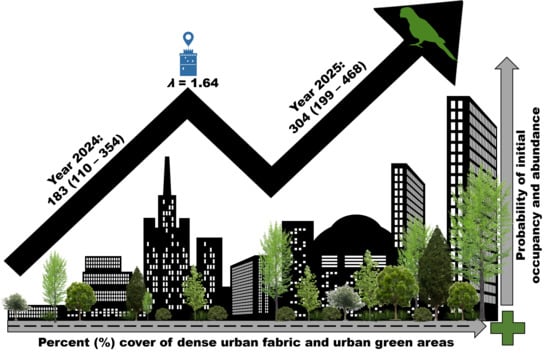
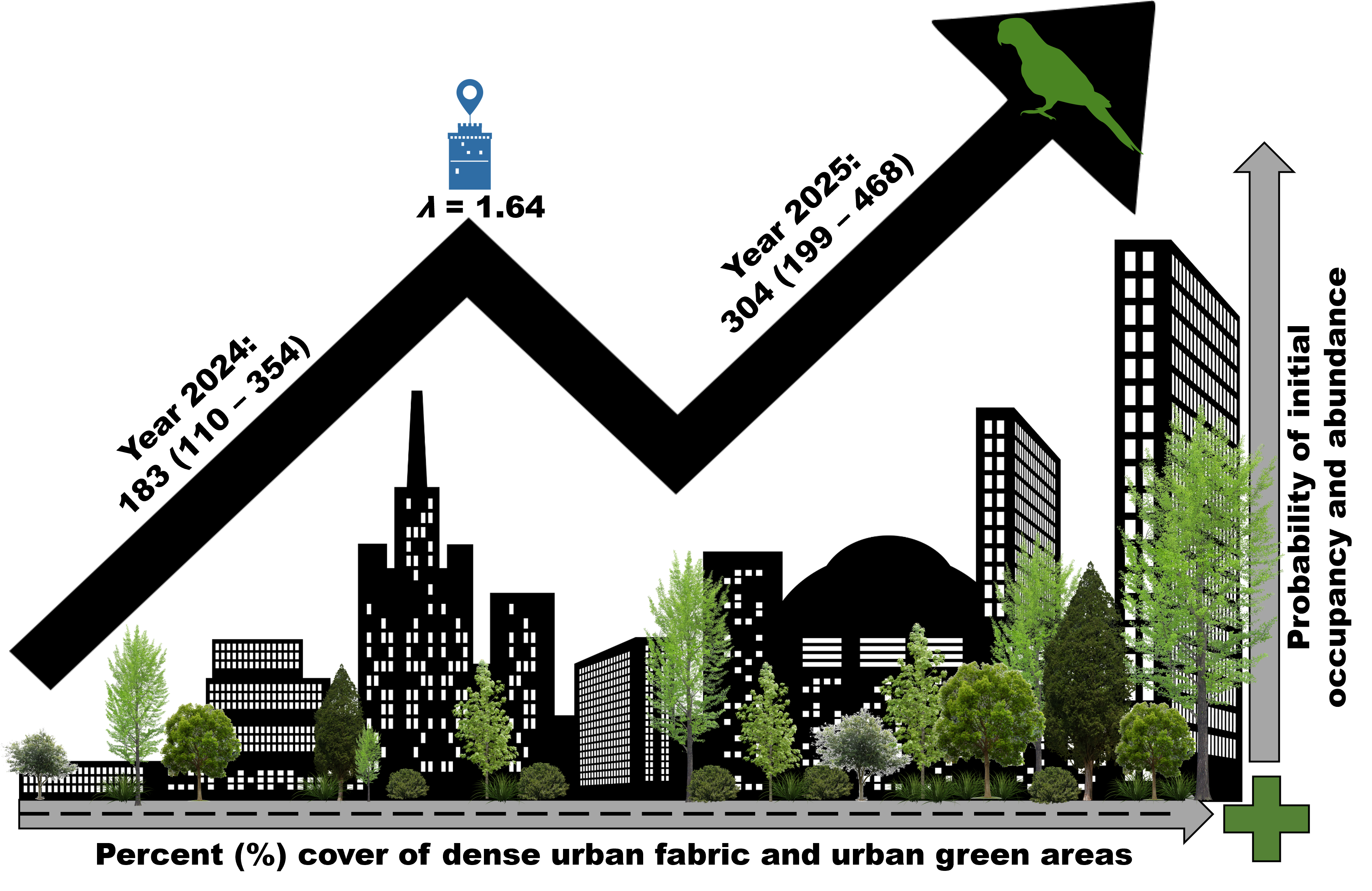
Graphical Abstract

1. Introduction

Human activities during the last two centuries have led to a significant increase in the intentional or unintentional translocation of species beyond their native ranges [1,2,3]. While many introduced species fail to persist, some establish viable populations, whilst an even smaller portion is able to spread and cause diverse negative impacts [4]. Such species are labeled invasive [4] and are considered as one of the leading causes of biodiversity loss worldwide [5,6]. In Europe, the rate of invasion by non-native species is expected to rise in the near future [5]. Therefore, systematic monitoring of established non-native populations [7], along with an understanding of the mechanisms driving invasion dynamics in space and time [8] are essential for safeguarding biodiversity and reducing the impacts of native taxa [9].
Birds are among the most frequently introduced animal groups [2], with at least 971 species recorded outside their native ranges [2] and approximately 420 now supporting self-sustaining populations [2]. Among bird species, parrots and parakeets illustrate a high invasion and establishment success [9,10], mainly due to their popularity in the pet trade [11] and their phenotypic plasticity [12]. As a consequence, more than 16% of the world’s 352 parrot species have established breeding populations in non-native environments [11]. Similarly, in Europe 53 non-native parrot species have been recorded, of which 12 have established viable populations [13].
Originally distributed across Africa and Asia [14], the ring-necked parakeet (Psittacula krameri, hereafter RNP) is now one of the most successful and widespread introduced parrot species in Europe and the Mediterranean basin [7]. By 2015, its European population numbered at least 85120 individuals [7], while the species has been recorded in 92 countries beyond its native range [15]. Within Europe, the species occurs predominantly in major urban centers, where it shows a strong preference for densely inhabited areas and urban green spaces [10,16,17,18,19].
Listed as one of the 100 most harmful alien species in Europe [20], the RNP affects native ecosystems and human activities throughout its European invaded range [21]. The species is primarily recognized as a nesting competitor of native fauna [22,23,24,25,26]. Other impacts on native species include foraging interference [27], as well as mobbing [28] and fatal attacks [22,29,30]. Additional negative impacts reported in the literature include agricultural damages [31], acoustic disturbance [32], and possible disease transmission [31]. Despite rising evidence on the negative impacts related to the RNP, their magnitude; especially on native fauna, remains controversial [33,34]. Moreover, efforts to control the species are seldomly initiated due to a general lack of fundamental information [18], as well as due to the general positive public perception of this charismatic species [35].
In Greece, published information regarding the species is very limited. According to Pârâu et al. [7], Greece is home to 1000 individuals (800–1200), most of them found in the city of Athens. Other, more recent media sources report a population of 2000–3000 individuals, however no details regarding these estimates are provided. It is believed that the species was initially introduced in the 1980s through the pet trade and became established by 1990, following an accidental release. Despite its presence for over 40 years, the species’ ecology and invasion dynamics have never been studied before.
Given the species’ exponential increase in population numbers and rapid expansion potential [7], as well as the rising evidence of negative impacts on native fauna [31], managers; primarily the Ministry of Environment and Energy in Greece, together with regional authorities, Forestry Services, and protected-area management units, are often called upon to take effective measures aimed at reducing invasive species’ population numbers or controlling their spread [36]. Monitoring and comprehending the spatial and temporal trends of invasive species is key to understanding and managing biological invasions successfully [37,38,39].
In this context, our study offers the first detailed analysis of the spatial and temporal trends of RNP expansion in Greece, focusing on the urban complex of Thessaloniki. Based on previous studies regarding the species, we hypothesized that (i) RNP occupancy and abundance would be positively associated with urbanization intensity and greater availability of nesting and foraging sites, and (ii) the population would show an increasing trend between survey years, reflecting the species’ ongoing spread and expansion. Our study could provide insights into the mechanisms that facilitate RNP establishment and persistence in Mediterranean urban environments and could serve as a baseline for long-term monitoring of the species’ spread and population size, and for assessing the outcomes of management and control measures.

2. Materials and Methods

2.1. Study Area

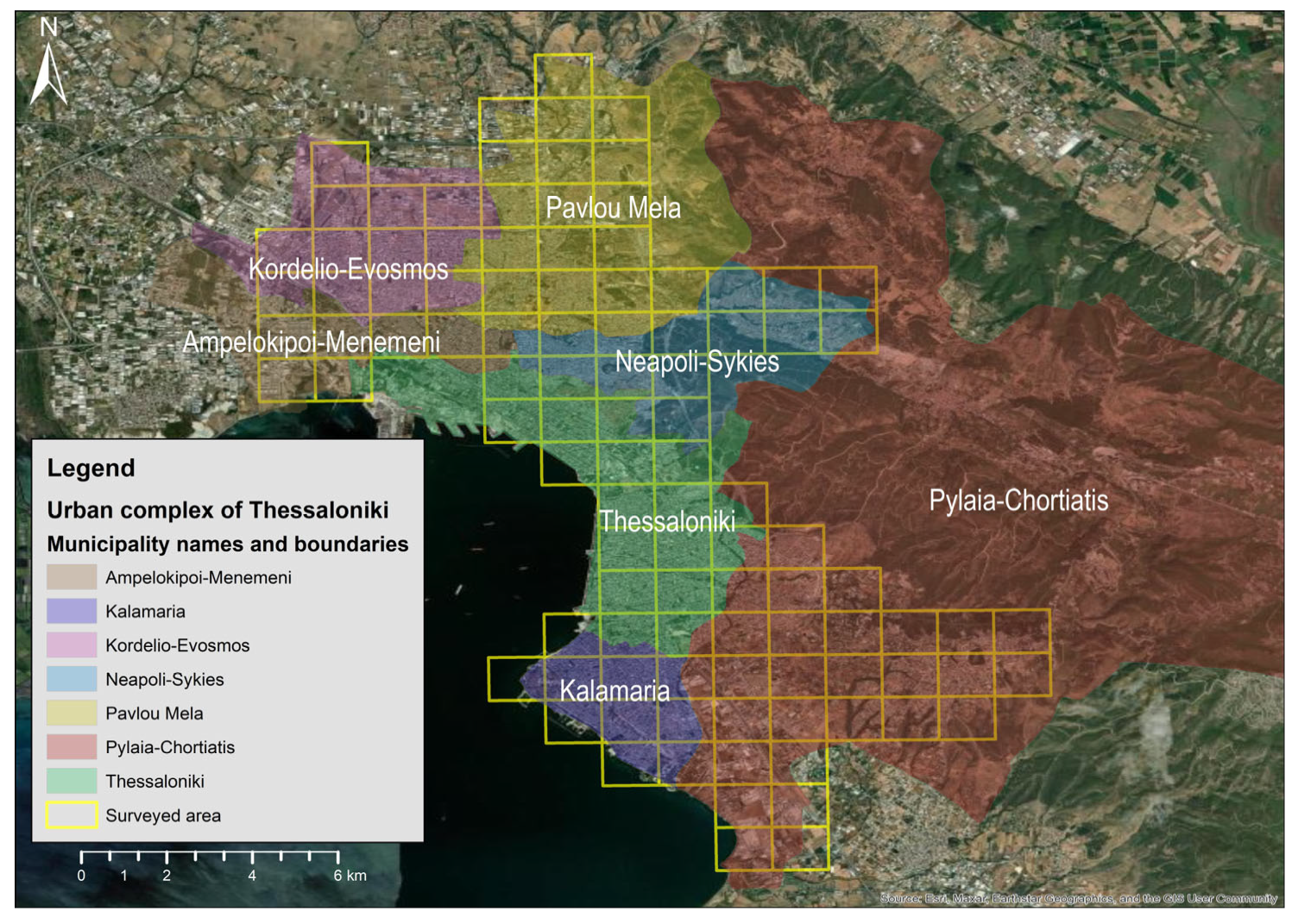
Thessaloniki is located in northern Greece, within the region of Central Macedonia, and is the country’s second-largest urban center after Athens. The city forms part of the Metropolitan Unit of Thessaloniki (MUTH), an administrative subdivision of the region that includes 13 municipalities [40]. The main urban complex consists of seven contiguous municipalities; Thessaloniki, Ampelokipoi-Menemeni, Kalamaria, Kordelio-Evosmos, Neapoli-Sykies, Pavlos Melas and Pylaia-Chortiatis, which together make up the city’s continuous built-up area (Figure 1). Geographically, the city is bordered to the north by the Seich Sou peri-urban forest, to the south by Thermaikos gulf, to the west by the industrial zone of Sindos and the port area, and to the east by suburban municipalities and open landscapes extending toward Thermi and the Halkidiki peninsula. The urban complex of Thessaloniki concentrates most of the population of the wider metropolitan area. The MUTH has a total population of about one million inhabitants [41] and covers approximately 1285 km2, serving as the main economic and cultural center of northern Greece. The city experiences a temperate Mediterranean climate, characterized by hot, dry summers and mild, wet winters, although notable seasonal variations may occur [42]. The broader area is characterized by high floristic [43] and faunal diversity [44,45].

2.2. RNP Surveys

Data describing the presence and abundance of RNP were obtained from field surveys conducted during what is believed to be the species’ breeding period. The study area was divided into 1 km2 grid squares [46], from which 103 were selected for potential surveying (Figure 1). The survey was designed to cover all of the municipalities that form the urban complex of Thessaloniki. Grids were selected based on accessibility and potential suitable habitat for RNP; however, four of the selected grid squares were ultimately not surveyed due to access restrictions or safety concerns.
Within each grid square, we carried out line transect surveys [47,48]. Transects mainly followed residential roads, pedestrian tracks or dirt roads and had a mean length of 1184 m (range: 492–2075 m). Each transect was walked at a slow pace by a single observer and all RNP seen or heard along each transect were recorded. RNP auditory cues primarily guided visual searches. When visual confirmation was not possible, vocalizations originating from a single point source were attributed to one individual. Individuals flying over the area during surveys were excluded.
Surveys were conducted during two consecutive primary sampling periods, corresponding to May 2024 and May 2025. Within each primary period, each transect was surveyed twice, resulting in two repeat surveys per site per year. Repeated surveys were carried out within the same month to satisfy the assumption of population closure within primary periods. Surveys were scheduled in two daily time windows (06:30–09:30 and 17:00–19:30) and each transect was surveyed once in each time window per year, ensuring temporal variation in detectability was accounted for [46]. Surveys were carried out during days with good weather conditions (no rain, low wind).
This level of within-season replication represents a deliberate trade-off between temporal and spatial sampling effort. Given the conspicuous and vocal behavior of RNP in urban environments and the moderate to high detection probability observed in our study, two-repeat surveys per site are considered sufficient and can provide reliable estimates [49,50], while allowing broader spatial coverage [51].

2.3. Environmental Variables

To better understand the associations between landscape features and RNP occupancy and abundance, we derived a set of variables describing land cover characteristics, anthropogenic influence and topography (Table S1). Candidate variables were selected based on previously documented effects of these factors on invasive parakeet distribution and abundance [10,19,52,53]. All variables were cropped to match the extent of the survey area and were resampled to a 1 km resolution using ArcGIS 10.2. Prior to any analyses, we assessed the linear correlation among all candidate variables and discarded those with a correlation coefficient greater than 0.6 [54].From an initial set of 14 candidate variables [55,56,57,58,59,60], six were retained for the final analyses and are described in Table 1.

2.4. Data Analysis

2.4.1. Dynamic Occupancy Model

RNP detection and non-detection data were analyzed using multi-season dynamic occupancy models [61], wherein initial occupancy (ψ1; i.e., the probability that a site was occupied during the first year of surveys), colonization (γ; i.e., the probability that an unoccupied site becomes occupied between survey years), extinction (ε; i.e., the probability that an occupied site becomes unoccupied between survey years), and detectability (p; i.e., the probability of detecting the species during a survey, conditional to its presence) are jointly estimated to describe state transitions across the surveyed area. Time of survey, date and year, as well as line transect length (Table 1), were considered as potential covariates affecting detectability. All environmental variables (Table 1) were used to model the probability of initial occupancy (ψ1), as well as colonization probability (γ). Finally, because no instances of local extinction were detected during the second survey year (i.e., all sites occupied in 2024 remained occupied in 2025), extinction probability (ε) was held constant throughout the modeling process. This constraint reflects the observed biological pattern during the study period and ensures model estimability. All variables were z-standardized prior to model fitting, so that their relative effect could be compared in model outputs. Model development followed a sequential approach [8], beginning with the estimation of p, while keeping all other parameters constant (Table S2). We then used the top ranked p model to develop a set of models examining ψ1, while keeping γ and ε constant (Table S3). Sequentially, we used the top ranked ψ1 model from the previous step to create a list of models examining γ, while keeping ε constant (Table S4). The top ranked model from this step was selected as the final model on which the interpretation of our results was based. Model fit of the final model was tested using a parametric bootstrap goodness-of-fit test based on Pearson’s χ2, where p > 0.05 indicates adequate model fit [62,63]. Dynamic occupancy was investigated via the colext function of the unmarked package [63] in R [64].

2.4.2. Dynamic N-Mixture Model

RNP population changes between 2024 and 2025 were estimated using the models of Dail and Madsen [65]; also known as dynamic N-mixture models, which generalize the [66] N-mixture model by relaxing the population closure assumption. In each dynamic N-mixture model, four distinct parameters are estimated describing population and observation processes: initial abundance (λ1), recruitment (γ) and apparent survival (ω), and detection probability (p). Count data were analyzed using the unmarked package [63] in R [64], and models were fitted with the pcountOpen function. For all models, we set the K-value to 50, which was more than double the highest site count (n = 21 individuals) and trials showed it was sufficient not to influence parameter estimates. Model fitting followed a two-stage approach. In the first stage, we built a set of candidate models to estimate p, using the same variables that could potentially affect detectability as in our dynamic occupancy models (Table 1) and explored three alternative statistical distributions; Poisson (P), Negative Binomial (NB), and Zero-Inflated Poisson (ZIP). The top ranked p model (Table S5) then served as the basis for the subsequent models for λ1, in which the environmental variables (Table 1) were used as potential covariates affecting abundance. The top ranked model (Table S6) from this step was selected as the final model on which the interpretation of our results was based. In all models, recruitment rate (γ) and apparent survival (ω) were kept constant and model dynamics were set to “trends”. Model fit of the final model was tested using a parametric bootstrap goodness-of-fit test based on Pearson’s χ2, where p > 0.05 indicates adequate model fit [62,63].
For both the dynamic occupancy and the dynamic N-mixture models, parameter estimates with 95% confidence intervals not spanning zero were interpreted as highly informative, those with 85% confidence intervals not spanning zero were interpreted as moderately informative, and those with 85% confidence intervals spanning zero were considered uninformative [67].

3. Results

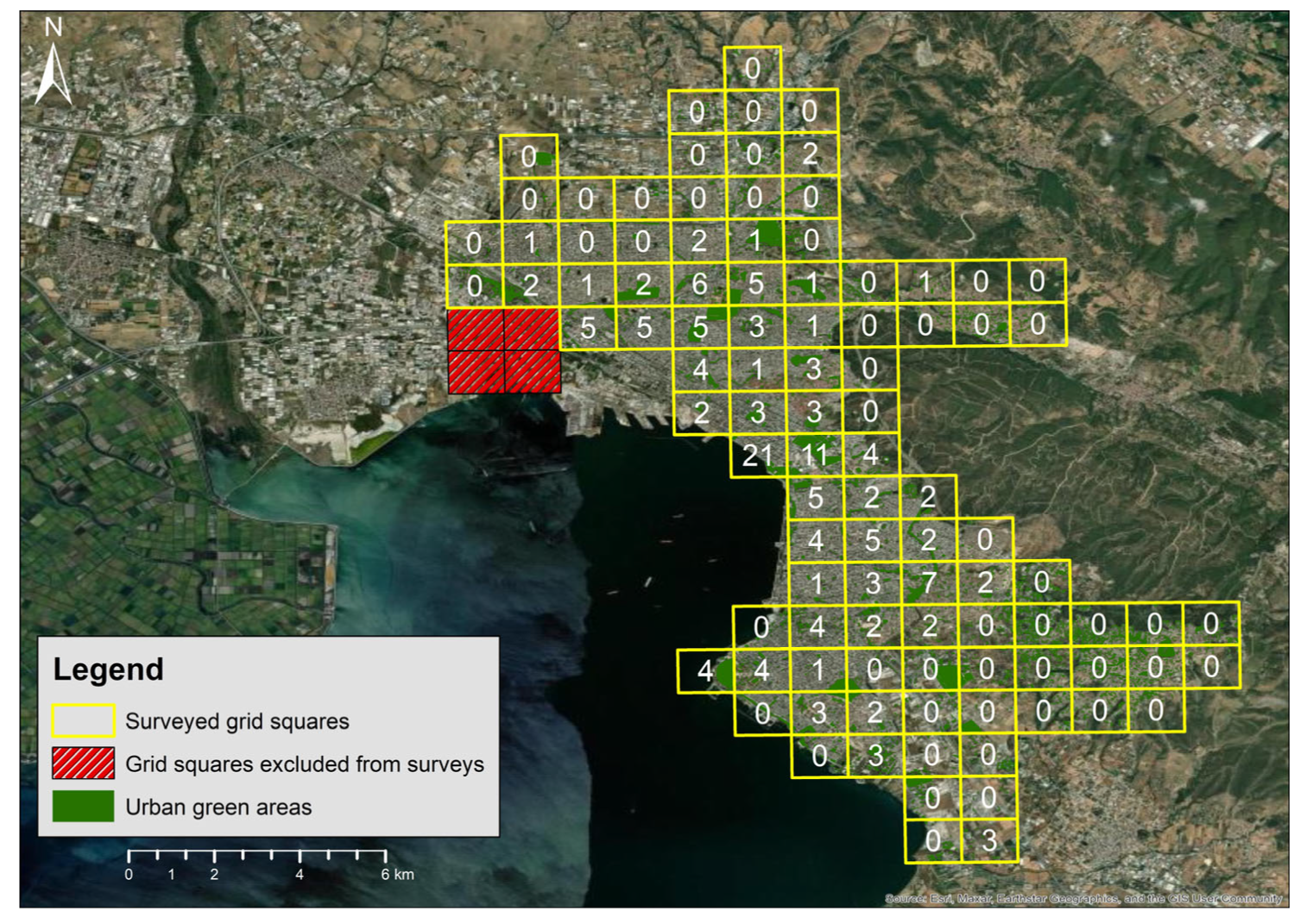
Of the 99 grid squares that were surveyed during both breeding periods, RNPs were detected at least once in 45 of them (Figure 2). Naïve occupancy (i.e., without accounting for imperfect detection) illustrated a 11.2% increase between survey years, from 34.3% in 2024 to 45.5% in 2025. At sites where the species was detected at least once, the mean observed detection frequency across surveys was 0.72 (range: 0.25–1). Similarly, observed abundance of RNP varied among sites and survey years. Across all surveyed grid squares, the maximum number of individuals recorded at a single site (i.e., based on the higher count from the two surveys conducted within each year) increased from 97 individuals in 2024 to 156 individuals in 2025 (Figure 2). A small number of sites, located within the city center, supported particularly large aggregations. At sites were RNP were detected at least once, the mean naïve abundance per site increased from 2.85 individuals (range: 1–15) in 2024 to 3.46 individuals (range: 1–21) in 2025.
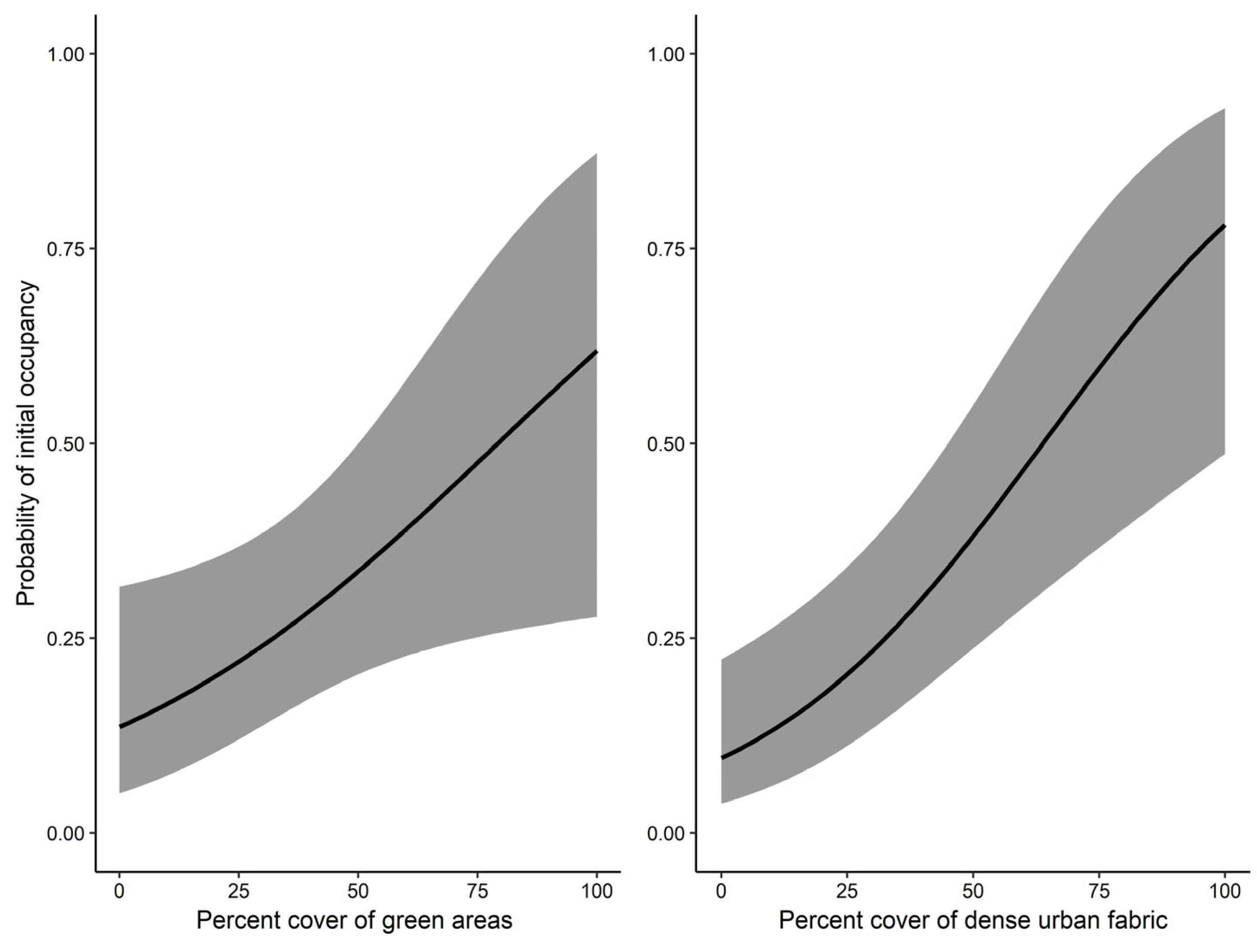
Our top dynamic occupancy model (Table 2) showed that detection probability (p) was not influenced by any of the observation-level covariates. The null detection model provided the best fit, illustrating a detection probability of 78.7% ( β ^ = 1.31, S.E. = 0.217). The estimated probability of initial occupancy (ψ) across the study area was 25.5% ( β ^ = −1.07, S.E. = 0.338). Initial occupancy was positively associated with the percentage cover of green areas (PC_Green: β ^ = 0.778, S.E. = 0.366) and dense urban fabric (PC_Urban: β ^ = 1.17, S.E. = 0.322) (Figure 3). Both these variables were highly informative, as their 95% confidence intervals did not span zero. Conversely, elevation (DEM) illustrated a negative association ( β ^ = −1.024, S.E. = 0.473), however this variable was uninformative. The probability of a grid square being colonized by the species increased with increasing cover of dense urban fabric (PC_Urban: β ^ = 4.63, S.E. = 3.04). This variable was moderately informative, as its 85% confidence intervals did not overlap zero. Over the same study period, the estimated probability of colonization (γ) was 8.63% ( β ^ = −2.36, S.E. = 1.14), while extinction probability (ε) was effectively zero ( β ^ = −10.5, S.E. = 33.6). Colonization probability tended to decrease with increasing distance from arable land (Dis_Arable: β ^ = −2.24, S.E. = 1.84), although this effect was uninformative. The final dynamic occupancy model from which the results were drawn had adequate model fit according to Pearson’s χ2 (p = 0.72).
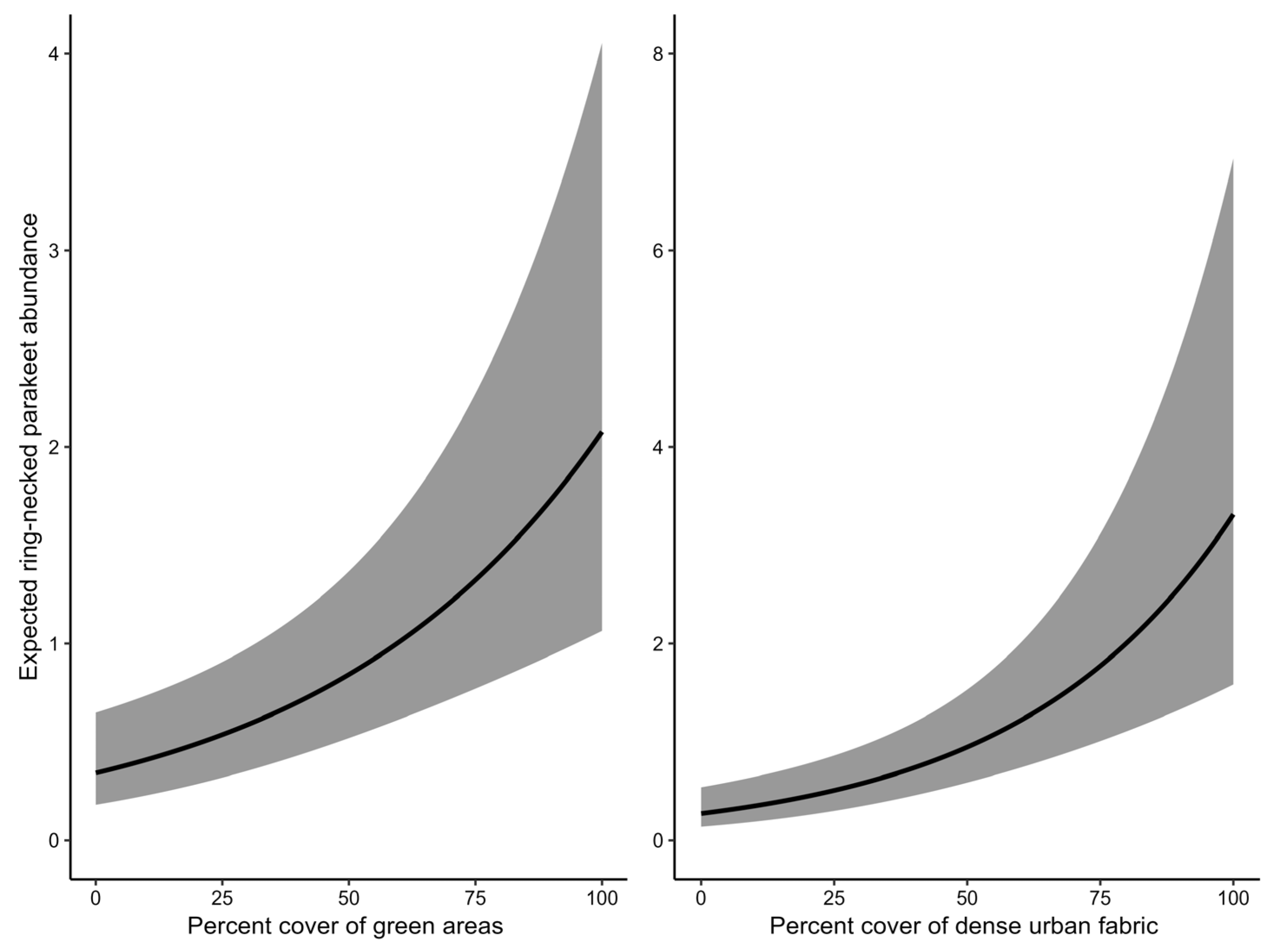
For the best supporting dynamic N-mixture model (Table 3), the negative binomial distribution provided a better fit. Detection probability (p) was not influenced by any of the observation-level covariates, with the null detection model providing the best fit. Detectability was estimated at 43.8% ( β ^ = −0.254, S.E. = 0.213). The model estimated a mean initial abundance (λ1) of 0.62 individuals per grid square in the first survey year ( β ^ = −0.472, S.E. = 0.255), representing baseline abundance at average covariate values. Initial RNP abundance (λ1) was positively influenced by the percentage cover of green areas (PC_Green: β ^ = 0.602, S.E. = 0.150) and dense urban fabric (PC_Urban: β ^ = 0.835, S.E. = 0.179) (Figure 4), but showed a negative association with elevation (DEM: β ^ = −1.270, S.E. = 0.303). The 95% confidence intervals for the first two variables did not span zero, indicating high certainty regarding their effect on initial abundance. Predicted RNP abundance during the first breeding period was 183 (range: 110–356) individuals, and increased to 304 (range: 199–468) individuals during the second year of surveys. The estimated growth rate (λ) between survey years was 1.64 (1.37–1.97), reflecting a strong population increase of 64% from 2024 to 2025. The best supporting dynamic N-mixture model from which the results were drawn, illustrated adequate model fit according to Pearson’s χ2 (p = 0.174).

4. Discussion

Our study provides clear evidence that the urban complex of Thessaloniki supports a thriving and expanding population of RNP. The key findings of widespread occupancy and strong positive growth rate during our study period, highlight the remarkable ability of this non-native species to flourish in urban-dominated environments. We found a consistent and positive association between RNP populations and two key urban land cover types; dense urban fabric and urban green areas. This pattern was consistent across both the dynamic occupancy and N-mixture best supporting models, indicating that these landscape features not only increase the likelihood of the species being present in an area, but also support higher local abundances.
Urban areas have become the primary habitat for RNPs, as well as other non-native parakeet species, especially throughout Europe [7,9,10,17]. Large urban areas are generally warmer than surrounding rural areas [68], due to the heat-island phenomenon [69]. Although the RNP is an adaptable species capable of tolerating a range of environmental conditions [70], low temperatures can limit its ability to establish viable populations [19]. In fact, extreme cold weather has been documented to have caused local population declines or extinctions [71,72]. Moreover, urban settings generally provide plentiful feeding opportunities year-round, supported by the wide variety of both native and ornament vegetation found in urban green areas, streets and private gardens [73,74,75,76]. In Greece, RNPs have been observed feeding on a variety of plant species, including native trees such as Cupressus sempervirens and Olea europaea, as well as introduced species like Melia azedavach and Phoenix canaviensis [77]. This dietary breadth reflects the species’ opportunistic and adaptable feeding strategy which allows it to exploit a variety of food sources, including those that may be toxic to other animals [77].
Besides providing food resources, urban green areas may also contribute to the availability of nesting and roosting sites across the urban landscape [19,78]. Mature trees, commonly retained for their visual or cultural value [78], are particularly valuable to RNPs, as these provide abundant cavities for nesting and sheltered spots for roosting [18,19,26,79]. However, when natural tree cavities are limited, RNPs may exploit alternative nesting sites such as cavities in old buildings [16], or in some cases they may even excavate their own nesting cavities [25,80], highlighting once again their behavioral plasticity.
While nest site availability may act as a limiting factor [81], several studies have found an exponential increase in RNP numbers across its invaded range. For example, a study in Italy found a 70.5% annual increase in ring-necked population numbers [33]. Similarly, a mean annual increase of ~62% and ~63% were found in Spain and Turkey, respectively [17,82]. In the UK, RNP population numbers have increased by 2406% since 1995 [83], whereas in the Netherlands there was an 1582% increase in breeding pairs since 1998 [84]. Similar patterns have also been reported for France, Belgium and Germany [7]. In Greece, the total number of RNPs remains somewhat unknown. Pârâu et al. [7] report a lower estimate of 1000 individuals, while several media sources report an estimate of 2000 to 3000 individuals. Our study provides the first ever estimate for both the spread and abundance of the species within Greece. Our two-year data indicate a substantial population increase, similar in magnitude to growth rates observed during establishment phases in other regions. This recurring pattern may be attributed to the species’ high reproductive success [85].
Our results indicate a substantial RNP population within the study area, although the actual number of individuals is likely higher. It is likely that additional colonies exist outside our surveyed area. In fact, several individuals were observed up to ~10 km beyond the survey boundaries (near the thermal springs of Lagkadas, personal observation), indicating that the species may be more abundant and widespread than our data suggest. Furthermore, the relatively low detection probability (~40%) estimated by the N-mixture model may also imply that not all individuals were detected during counts. While the species is highly vocal [32], and its presence can be easily detected, the species’ predominantly green plumage likely provides effective camouflage in tree canopies, making individual birds difficult to distinguish. In fact, this could perhaps explain the high detection probability (~80%) in our dynamic occupancy model, in relation to the N-mixture model. Hence, conducting roost counts, particularly in winter when deciduous trees have reduced foliage, may improve detectability and produce more accurate abundance estimates, given that all major roost sites are previously identified.
Nevertheless, monitoring the spatial and temporal trends of invasive species constitutes a fundamental tool, based on which long term management initiatives can be developed [36,46]. However, implementing management actions for RNP may be particularly challenging due to two key factors: its high reproductive capacity [85], and public opposition [86,87]. In our study, population numbers increased exponentially, while naïve occupancy increased by more than 10% in between surveys, highlighting the species’ rapid expansion potential. Such population dynamics, along with the species’ high reproductive potential and behavioral flexibility, can hinder large-scale or long-term management efforts, as populations may quickly recover following control interventions. Conversely, control or eradication has been proven successful in some cases. For instance, Anderson et al. [88] successfully reduced the numbers of established RNPs on the island of Kaua’I and concluded that managers should consider long-term, alternative management options. Similarly, eradication has been successful only for small or developing insular populations [36,89]. In all cases, RNP culling was performed by either shooting or a combination of trapping and shooting. However, in densely populated urban areas such as Thessaloniki, these methods may be unsuitable mainly due to the potential public safety risks associated with shooting, and strong public opposition to such practices.
Public perception plays a crucial role in the management of invasive species [32,34,86,87]. The RNP is often viewed positively by the public due to its charismatic appearance [90], which can hinder the implementation of any control measures, unless accompanied by well-designed awareness and outreach campaigns [91]. As such, any future interventions should be planned in conjunction with transparent communication and consultation with the public, in an effort to minimize opposition [35,92]. Understanding the social drivers, values and perceptions underlying these disputes is essential for improving management acceptance and long-term effectiveness [34,86,87].
Although there is currently no mandatory requirement to control RNP populations in Europe [11], their strong population increase observed during the study and high modeled growth potential may pose risks to native species mainly through competition for resources [18,22,23,24,25,27,93]. To anticipate and mitigate these risks, regular monitoring of population status is essential [7], alongside targeted research on ecological impacts, and should be extended to suburban and rural areas beyond the urban core. Integrating these efforts with proactive management strategies and public engagement is crucial in ensuring informed, effective, and socially acceptable conservation decisions.

5. Conclusions

Our study demonstrates that RNPs occupancy and abundance are positively associated with dense urban areas combined with green spaces. This pattern is also reflected in both its widespread distribution and the substantial population growth we documented within the urban complex of Thessaloniki between 2024 and 2025. Our findings indicate a strong potential for continued expansion across the urban landscape. Hence, regular monitoring of population trends and distribution is essential for identifying emerging impacts on native species and for supporting timely management decisions. Any future control measures should be developed in close collaboration with the public to ensure social acceptance and long-term effectiveness.

Supplementary Materials

The following supporting information can be downloaded at https://www.mdpi.com/article/10.3390/ani16020224/s1: Table S1: Description of all environmental variables that were initially considered in modeling the dynamic occupancy and abundance of ring-necked parakeet (Psittacula krameri) within the urban complex of Thessaloniki, Greece; Table S2: Model results for probability of detection (p) from multi-season occupancy models of ring-necked parakeet in the urban complex of Thessaloniki, Greece, 2024–2025. Initial occupancy (ψ), colonization (γ), and extinction (ε) were held constant in all models. The models are ranked based on the lowest Akaike’s Information Criterion (AIC) where deltaAIC = AICi—minimum AIC, nPars = number of parameters, and AICwt = AIC weight. Only models with deltaAIC < 2 are shown; Table S3: Model results for probability of initial occupancy (ψ) from multi-season occupancy models of ring-necked parakeet in the urban complex of Thessaloniki, Greece, 2024–2025. The models included the top detection model (null), represented as p (top). Colonization (γ), and extinction (ε) were held constant in all models. The models are ranked based on the lowest Akaike’s Information Criterion (AIC) where deltaAIC = AICi—minimum AIC, nPars = number of parameters, and AICwt = AIC weight. Only models with deltaAIC < 2 are shown; Table S4: Model results for probability of colonization (γ) from multi-season occupancy models of ring-necked parakeet in the urban complex of Thessaloniki, Greece, 2024–2025. The models included the top detection model (null), represented as p (top) and the top initial occupancy model (DEM+PC_Green+PC_Urban), represented as ψ (top). Extinction (ε) was held constant in all models. The models are ranked based on the lowest Akaike’s Information Criterion (AIC) where deltaAIC = AICi—minimum AIC, nPars = number of parameters, and AICwt = AIC weight. Only models with deltaAIC < 2 are shown; Table S5: Model results for probability of detection (p) from dynamic N-mixture models of ring-necked parakeet in the urban complex of Thessaloniki, Greece, 2024–2025. Initial abundance (λ1), recruitment (γ), and apparent survival (ω) were held constant in all models. The models are ranked based on the lowest Akaike’s Information Criterion (AIC) where deltaAIC = AICi—minimum AIC, nPars = number of parameters, and AICwt = AIC weight. Only models with deltaAIC < 2 are shown; Table S6: Model results for probability of initial abundance (λ1) from dynamic N-mixture models of ring-necked parakeet in the urban complex of Thessaloniki, Greece, 2024–2025. The models included the top detection model (null), represented as p (top) Recruitment (γ), and apparent survival (ω) were held constant in all models. The models are ranked based on the lowest Akaike’s Information Criterion (AIC) where deltaAIC = AICi—minimum AIC, nPars = number of parameters, and AICwt = AIC weight. Only models with deltaAIC < 2 are shown.

Author Contributions

Conceptualization, C.T.T.; methodology, C.T.T. and K.N.M.; field work, C.T.T. and K.N.M.; formal analysis, C.T.T. and K.N.M.; data curation, C.T.T. and K.N.M.; writing—original draft preparation, C.T.T. and K.N.M.; writing—review and editing, C.T.T., K.N.M. and D.E.B.; visualization, C.T.T.; supervision, D.E.B. All authors have read and agreed to the published version of the manuscript.

Funding

This research received no external funding.

Institutional Review Board Statement

Not applicable due to the observational and indirect sampling method.

Informed Consent Statement

Not applicable.

Data Availability Statement

Data are available from the corresponding author upon reasonable request.

Conflicts of Interest

The authors declare no conflicts of interest.

Abbreviations

The following abbreviations are used in this manuscript:
RNPRing-necked parakeet
MUTHMetropolitan Unit of Thessaloniki

References

  1. Keller, R.P.; Geist, J.; Jeschke, J.M.; Kühn, I. Invasive Species in Europe: Ecology, Status, and Policy. Environ. Sci. Eur. 2011, 23, 23. [Google Scholar] [CrossRef]
  2. Blackburn, T.M.; Dyer, E.; Su, S.; Cassey, P. Long after the Event, or Four Things We (Should) Know about Bird Invasions. J. Ornithol. 2015, 156, 15–25. [Google Scholar] [CrossRef]
  3. Hulme, P.E.; Pyšek, P.; Nentwig, W.; Vilà, M. Will Threat of Biological Invasions Unite the European Union? Science (1979) 2009, 324, 40–41. [Google Scholar] [CrossRef] [PubMed]
  4. Kolar, C.S.; Lodge, D.M. Progress in Invasion Biology: Predicting Invaders. Trends Ecol. Evol. 2001, 16, 199–204. [Google Scholar] [CrossRef] [PubMed]
  5. Sala, O.E.; Stuart Chapin, F.; Armesto, J.J.; Berlow, E.; Bloomfield, J.; Dirzo, R.; Huber-Sanwald, E.; Huenneke, L.F.; Jackson, R.B.; Kinzig, A. Global Biodiversity Scenarios for the Year 2100. Science (1979) 2000, 287, 1770–1774. [Google Scholar] [CrossRef] [PubMed]
  6. Vitousek, P.M.; D’antonio, C.M.; Loope, L.L.; Rejmanek, M.; Westbrooks, R. Introduced Species: A Significant Component of Human-Caused Global Change. N. Z. J. Ecol. 1997, 21, 1–16. [Google Scholar]
  7. Pârâu, L.G.; Strubbe, D.; Mori, E. Rose-Ringed Parakeet (Psittacula krameri) Populations and Numbers in Europe: A Complete Overview. Open Ornithol. J. 2016, 9, 1–13. [Google Scholar] [CrossRef]
  8. Bakaloudis, D.E.; Thoma, C.T.; Makridou, K.N.; Kotsonas, E.G. Occupancy Dynamics of Free Ranging American Mink (Neogale vison) in Greece. Sci. Rep. 2024, 14, 9973. [Google Scholar] [CrossRef]
  9. Mori, E.; Di Febbraro, M.; Foresta, M.; Melis, P.; Romanazzi, E.; Notari, A.; Boggiano, F. Assessment of the Current Distribution of Free-Living Parrots and Parakeets (Aves: Psittaciformes) in Italy: A Synthesis of Published Data and New Records. Ital. J. Zool. 2013, 80, 158–167. [Google Scholar] [CrossRef]
  10. Strubbe, D.; Matthysen, E. Predicting the Potential Distribution of Invasive Ring-Necked Parakeets (Psittacula krameri) in Northern Belgium Using an Ecological Niche Modelling Approach. Biol. Invasions 2009, 11, 497–513. [Google Scholar] [CrossRef]
  11. Menchetti, M.; Mori, E. Worldwide Impact of Alien Parrots (Aves Psittaciformes) on Native Biodiversity and Environment: A Review. Ethol. Ecol. Evol. 2014, 26, 172–194. [Google Scholar] [CrossRef]
  12. Le Gros, A.; Samadi, S.; Zuccon, D.; Cornette, R.; Braun, M.P.; Senar, J.C.; Clergeau, P. Rapid Morphological Changes, Admixture and Invasive Success in Populations of Ring-Necked Parakeets (Psittacula krameri) Established in Europe. Biol. Invasions 2016, 18, 1581–1598. [Google Scholar] [CrossRef]
  13. Katsanevakis, S.; Bogucarskis, K.; Gatto, F.; Vandekerkhove, J.; Deriu, I.; Cardoso, A.C. Building the European Alien Species Information Network (EASIN): A Novel Approach for the Exploration of Distributed Alien Species Data. BioInvasions Rec. 2012, 1, 235–245. [Google Scholar] [CrossRef]
  14. Forshaw, J.M. Parrots of the World; Princeton University Press: Princeton, NJ, USA, 2010; ISBN 1400836204. [Google Scholar]
  15. Strubbe, D.; CABI International. Psittacula krameri (Rose-Ringed Parakeet); CABI Compendium: Wallingford, UK, 2022. [Google Scholar]
  16. Grandi, G.; Menchetti, M.; Mori, E. Vertical Segregation by Breeding Ring-Necked Parakeets (Psittacula krameri) in Northern Italy. Urban. Ecosyst. 2018, 21, 1011–1017. [Google Scholar] [CrossRef]
  17. Hernández-Brito, D.; Carrete, M.; Tella, J.L. Annual Censuses and Citizen Science Data Show Rapid Population Increases and Range Expansion of Invasive Rose-Ringed and Monk Parakeets in Seville, Spain. Animals 2022, 12, 677. [Google Scholar] [CrossRef]
  18. Strubbe, D.; Matthysen, E. Invasive Ring-necked Parakeets (Psittacula krameri) in Belgium: Habitat Selection and Impact on Native Birds. Ecography 2007, 30, 578–588. [Google Scholar] [CrossRef]
  19. Strubbe, D.; Matthysen, E. Establishment Success of Invasive Ring-necked and Monk Parakeets in Europe. J. Biogeogr. 2009, 36, 2264–2278. [Google Scholar] [CrossRef]
  20. Species, D.A.I. Handbook of Alien Species in Europe; Springer Science & Business Media: Heidelberg, Germany, 2008; Volume 3, ISBN 1402082800. [Google Scholar]
  21. White, R.L.; Strubbe, D.; Dallimer, M.; Davies, Z.G.; Davis, A.J.S.; Edelaar, P.; Groombridge, J.; Jackson, H.A.; Menchetti, M.; Mori, E. Assessing the Ecological and Societal Impacts of Alien Parrots in Europe Using a Transparent and Inclusive Evidence-Mapping Scheme. NeoBiota 2019, 48, 45–69. [Google Scholar] [CrossRef]
  22. Hernández-Brito, D.; Carrete, M.; Ibáñez, C.; Juste, J.; Tella, J.L. Nest-Site Competition and Killing by Invasive Parakeets Cause the Decline of a Threatened Bat Population. R. Soc. Open Sci. 2018, 5, 172477. [Google Scholar] [CrossRef]
  23. Mori, E.; Ancillotto, L.; Menchetti, M.; Strubbe, D. ‘The Early Bird Catches the Nest’: Possible Competition Between Scops Owls and Ring-necked Parakeets. Anim. Conserv. 2017, 20, 463–470. [Google Scholar] [CrossRef]
  24. Strubbe, D.; Matthysen, E. Experimental Evidence for Nest-Site Competition Between Invasive Ring-Necked Parakeets (Psittacula krameri) and Native Nuthatches (Sitta europaea). Biol. Conserv. 2009, 142, 1588–1594. [Google Scholar] [CrossRef]
  25. Yosef, R.; Zduniak, P.; Żmihorski, M. Invasive Ring-Necked Parakeet Negatively Affects Indigenous Eurasian Hoopoe. Ann. Zool. Fenn. 2016, 53, 281–287. [Google Scholar] [CrossRef]
  26. Czajka, C.; Braun, M.P.; Wink, M. Resource Use by Non-Native Ring-Necked Parakeets (Psittacula krameri) and Native Starlings (Sturnus vulgaris) in Central Europe. Open Ornithol. J. 2011, 4, 17–22. [Google Scholar] [CrossRef]
  27. Le Louarn, M.; Couillens, B.; Deschamps-Cottin, M.; Clergeau, P. Interference Competition between an Invasive Parakeet and Native Bird Species at Feeding Sites. J. Ethol. 2016, 34, 291–298. [Google Scholar] [CrossRef] [PubMed]
  28. Battisti, C.; Fraticelli, F. When ‘Bullies’ Come out of Cities: Mobbing among Introduced Rose-Ringed Parakeets (Psittacula krameri) and Native Species of Conservation Concern in Extra-Urban Habitats with Suggestions for a Framework of PSIR Indicators. Biodiversity 2023, 24, 96–101. [Google Scholar] [CrossRef]
  29. Hernández-Brito, D.; Luna, A.; Carrete, M.; Tella, J.L. Alien Rose-Ringed Parakeets (Psittacula krameri) Attack Black Rats (Rattus rattus) Sometimes Resulting in Death. Hystrix Ital. J. Mammal. 2014, 25, 121–123. [Google Scholar]
  30. Covas, L.; Senar, J.C.; Roqué, L.; Quesada, J. Records of Fatal Attacks by Rose-Ringed Parakeets (Psittacula krameri) on Native Avifauna. Rev. Catalana D’ornitologia 2017, 33, 45–49. [Google Scholar]
  31. Menchetti, M.; Mori, E.; Angelici, F.M. Effects of the Recent World Invasion by Ring-Necked Parakeets (Psittacula krameri). In Problematic Wildlife: A Cross-Disciplinary Approach; Springer: Berlin/Heidelberg, Germany, 2015; pp. 253–266. [Google Scholar]
  32. Mori, E.; Onorati, G.; Giuntini, S. Loud Callings Limit Human Tolerance towards Invasive Parakeets in Urban Areas. Urban. Ecosyst. 2020, 23, 755–760. [Google Scholar] [CrossRef]
  33. Fraticelli, F. The Rose-Ringed Parakeet (Psittacula krameri) in a Urban Park: Demographic Trend, Interspecific Relationships and Feeding Preferences (Rome, Central Italy). Avocetta 2014, 38, 23–28. [Google Scholar]
  34. Pirzio-Biroli, A.; Crowley, S.L.; Siriwardena, G.; Plummer, K.; Schroeder, J.; White, R. Not in the Countryside Please! Investigating UK Residents’ Perceptions of an Introduced Species, the Ring-Necked Parakeet (Psittacula krameri). NeoBiota 2024, 93, 1–24. [Google Scholar] [CrossRef]
  35. Fischer, A.; Young, J.C. Understanding Mental Constructs of Biodiversity: Implications for Biodiversity Management and Conservation. Biol. Conserv. 2007, 136, 271–282. [Google Scholar] [CrossRef]
  36. Saavedra, S.; Medina, F.M. Control of Invasive Ring-Necked Parakeet (Psittacula krameri) in an Island Biosphere Reserve (La Palma, Canary Islands): Combining Methods and Social Engagement. Biol. Invasions 2020, 22, 3653–3667. [Google Scholar] [CrossRef]
  37. Hauser, C.E.; Pople, A.R.; Possingham, H.P. Should Managed Populations Be Monitored Every Year? Ecol. Appl. 2006, 16, 807–819. [Google Scholar] [CrossRef] [PubMed]
  38. Reaser, J.K.; Burgiel, S.W.; Kirkey, J.; Brantley, K.A.; Veatch, S.D.; Burgos-Rodríguez, J. The Early Detection of and Rapid Response (EDRR) to Invasive Species: A Conceptual Framework and Federal Capacities Assessment. Biol. Invasions 2020, 22, 1–19. [Google Scholar] [CrossRef]
  39. Simberloff, D.; Martin, J.-L.; Genovesi, P.; Maris, V.; Wardle, D.A.; Aronson, J.; Courchamp, F.; Galil, B.; García-Berthou, E.; Pascal, M. Impacts of Biological Invasions: What’s What and the Way Forward. Trends Ecol. Evol. 2013, 28, 58–66. [Google Scholar] [CrossRef]
  40. Chatzitheodoridis, F.; Melfou, K.; Kontogeorgos, A.; Kalogiannidis, S. Exploring Key Aspects of an Integrated Sustainable Urban Development Strategy in Greece: The Case of Thessaloniki City. Smart Cities 2022, 6, 19–39. [Google Scholar] [CrossRef]
  41. Hellenic Statistical Authority. Population-Housing Census; Hellenic Statistical Authority: Piraeus, Greece, 2011. [Google Scholar]
  42. Tsoka, S.; Tsikaloudaki, K.; Theodosiou, T. Urban Space’s Morphology and Microclimatic Analysis: A Study for a Typical Urban District in the Mediterranean City of Thessaloniki, Greece. Energy Build. 2017, 156, 96–108. [Google Scholar] [CrossRef]
  43. Petaloudi, L.M.; Ganatsas, P.; Tsakaldimi, M. Exploring Biodiversity and Disturbances in the of Peri-Urban Forests of Thessaloniki, Greece. Sustainability 2022, 14, 8497. [Google Scholar] [CrossRef]
  44. Koukouvinou, M. Response of avian communities to wildfire in conifer forest. Diploma Thesis, School of Forestry and Natural Environment, Aristotle University of Thessaloniki, Thessaloniki, Greece, 2023; 77p. [Google Scholar]
  45. Strachinis, I. The Herpetofauna of the Peri-Urban Forest Seich Sou (Kedrinos Lofos), Thessaloniki, Greece. Ecol. Balk. 2023, 15, 1–7. [Google Scholar]
  46. Geary, M.; Brailsford, C.J.; Hough, L.I.; Baker, F.; Guerrero, S.; Leon, Y.M.; Collar, N.J.; Marsden, S.J. Street-Level Green Spaces Support a Key Urban Population of the Threatened Hispaniolan Parakeet (Psittacara chloropterus). Urban. Ecosyst. 2021, 24, 1371–1378. [Google Scholar] [CrossRef]
  47. Legault, A.; Theuerkauf, J.; Baby, E.; Moutin, L.; Rouys, S.; Saoumoé, M.; Verfaille, L.; Barré, N.; Chartendrault, V.; Gula, R. Standardising Distance Sampling Surveys of Parrots in New Caledonia. J. Ornithol. 2013, 154, 19–33. [Google Scholar] [CrossRef]
  48. Buckland, S.T.; Marsden, S.J.; Green, R.E. Estimating Bird Abundance: Making Methods Work. Bird. Conserv. Int. 2008, 18, S91–S108. [Google Scholar] [CrossRef]
  49. Field, S.A.; Tyre, A.J.; Possingham, H.P. Optimizing Allocation of Monitoring Effort Under Economic and Observational Constraints. J. Wildl. Manag. 2005, 69, 473–482. [Google Scholar] [CrossRef]
  50. MacKenzie, D.I.; Nichols, J.D.; Lachman, G.B.; Droege, S.; Andrew Royle, J.; Langtimm, C.A. Estimating Site Occupancy Rates When Detection Probabilities Are Less than One. Ecology 2002, 83, 2248–2255. [Google Scholar] [CrossRef]
  51. Tyre, A.J.; Tenhumberg, B.; Field, S.A.; Niejalke, D.; Parris, K.; Possingham, H.P. Improving Precision and Reducing Bias in Biological Surveys: Estimating False-Negative Error Rates. Ecol. Appl. 2003, 13, 1790–1801. [Google Scholar] [CrossRef]
  52. Cardador, L.; Tella, J.L.; Louvrier, J.; Anadón, J.D.; Abellán, P.; Carrete, M. Climate Matching and Anthropogenic Factors Contribute to the Colonization and Extinction of Local Populations during Avian Invasions. Divers. Distrib. 2022, 28, 1908–1921. [Google Scholar] [CrossRef]
  53. Nardotto, A. How Far Will They Go? Considerations on the Potential Expansion of the Ring-Necked Parakeet (Psittacula krameri) and Monk Parakeet (Myiopsitta monachus) in Veneto Region (Italy) with MaxEnt Distribution Models. J. Biol. Res.-Boll. Soc. Ital. Biol. Sper. 2022, 95, 1–17. [Google Scholar] [CrossRef]
  54. Dormann, C.F.; Elith, J.; Bacher, S.; Buchmann, C.; Carl, G.; Carré, G.; Marquéz, J.R.G.; Gruber, B.; Lafourcade, B.; Leitão, P.J. Collinearity: A Review of Methods to Deal with It and a Simulation Study Evaluating Their Performance. Ecography 2013, 36, 27–46. [Google Scholar] [CrossRef]
  55. European Environmental Agency. Urban Atlas Land Cover/Land Use 2018 (Vector), Europe, 6-Yearly, Jul. 2021; European Environmental Agency: Copenhagen, Denmark, 2020. [Google Scholar]
  56. European Environmental Agency. Urban Atlas Street Tree Layer 2012 (Vector), Europe, 6-Yearly, May 2016; European Environmental Agency: Copenhagen, Denmark, 2023. [Google Scholar]
  57. Sanderson, E.W.; Jaiteh, M.; Levy, M.A.; Redford, K.H.; Wannebo, A.V.; Woolmer, G. The Human Footprint and the Last of the Wild: The Human Footprint Is a Global Map of Human Influence on the Land Surface, Which Suggests That Human Beings Are Stewards of Nature, Whether We like It or Not. Bioscience 2002, 52, 891–904. [Google Scholar] [CrossRef]
  58. European Environmental Agency. European Digital Elevation Model (Raster 25 m), Apr. 2016; European Environmental Agency: Copenhagen, Denmark, 2016. [Google Scholar]
  59. European Environmental Agency Impervious Built-Up 2021 (Raster 10 m), Europe, 3-Yearly, Jun. 2025; European Environmental Agency: Copenhagen, Denmark, 2025.
  60. Geofabrik GmbH. Geofabrik. 2020. Available online: https://www.geofabrik.de/en/index.html (accessed on 20 April 2024).
  61. MacKenzie, D.I.; Nichols, J.D.; Hines, J.E.; Knutson, M.G.; Franklin, A.B. Estimating Site Occupancy, Colonization, and Local Extinction When a Species Is Detected Imperfectly. Ecology 2003, 84, 2200–2207. [Google Scholar] [CrossRef]
  62. Kéry, M.; Chandler, R. Dynamic Occupancy Models in Unmarked. 2016. Available online: https://cran.r-project.org/web/packages/unmarked/vignettes/colext.html (accessed on 20 April 2024).
  63. Fiske, I.; Chandler, R. Unmarked: An R Package for Fitting Hierarchical Models of Wildlife Occurrence and Abundance. J. Stat. Softw. 2011, 43, 1–23. [Google Scholar] [CrossRef]
  64. R Core Team. R: A Language and Environment for Statistical Computing; R Core Team: Vienna, Austria, 2013. [Google Scholar]
  65. Dail, D.; Madsen, L. Models for Estimating Abundance from Repeated Counts of an Open Metapopulation. Biometrics 2011, 67, 577–587. [Google Scholar] [CrossRef] [PubMed]
  66. Royle, J.A. N-Mixture Models for Estimating Population Size from Spatially Replicated Counts. Biometrics 2004, 60, 108–115. [Google Scholar] [CrossRef] [PubMed]
  67. Arnold, T.W. Uninformative Parameters and Model Selection Using Akaike’s Information Criterion. J. Wildl. Manag. 2010, 74, 1175–1178. [Google Scholar]
  68. Haggard, W.H. Urban Weather. Int. J. Environ. Stud. 1990, 36, 73–82. [Google Scholar] [CrossRef]
  69. Arnfield, A.J. Two Decades of Urban Climate Research: A Review of Turbulence, Exchanges of Energy and Water, and the Urban Heat Island. Int. J. Climatol. 2003, 23, 1–26. [Google Scholar] [CrossRef]
  70. Bonier, F.; Martin, P.R.; Wingfield, J.C. Urban Birds Have Broader Environmental Tolerance. Biol. Lett. 2007, 3, 670–673. [Google Scholar] [CrossRef]
  71. Vergeer, J.-W.; van Zuylen, G. Broedvogels van Zeeland; Uitgeverij KNNV: Zeist, The Netherlands, 1994; ISBN 9050110673. [Google Scholar]
  72. Schürmann, A. Deutschland—Deine Papageien. Kosmos 1981, 8, 42–49. [Google Scholar]
  73. Wood, E.M.; Esaian, S. The Importance of Street Trees to Urban Avifauna. Ecol. Appl. 2020, 30, e02149. [Google Scholar] [CrossRef]
  74. Luna, Á.; Pomeda-Gutiérrez, F.; Galán Díaz, J. Feeding Ecology of the Common Wood Pigeon (Columba palumbus) in a Major European City. R. Soc. Open Sci. 2024, 11, 1231721. [Google Scholar] [CrossRef]
  75. Chace, J.F.; Walsh, J.J. Urban Effects on Native Avifauna: A Review. Landsc. Urban. Plan. 2006, 74, 46–69. [Google Scholar] [CrossRef]
  76. Francini, A.; Romano, D.; Toscano, S.; Ferrante, A. The Contribution of Ornamental Plants to Urban Ecosystem Services. Earth 2022, 3, 1258–1274. [Google Scholar] [CrossRef]
  77. Christodoulopoulos, M.A.B.; Cotou, E.; Politakis, N.; Tsekouras, N.; Paraskeuas, V.V.; Kotzamanis, Y.; Christodoulopoulos, G.; Pappas, A.C. Urban Foraging and Plant Toxicological Risks for Rose-Ringed Parakeets (Psittacula krameri) in Athens. Diversity 2025, 17, 801. [Google Scholar] [CrossRef]
  78. Xie, L.; Huang, X.; Xia, T.; Wu, L.; Chen, S.-C. Large Old Trees Sustain Avian Communities and Critical Plant-Bird Interactions in Highly Urbanised Environments. Biol. Conserv. 2026, 313, 111582. [Google Scholar] [CrossRef]
  79. Rakha, B.A.; Zafar, N.; Ansari, M.S.; Khan, M.; Akhter, A.; Kanwal, Q.; Khan, M.Z.; Chaudhary, M. Nesting Characteristics and Breeding Success of Rose-Ringed Parakeet (Psittacula krameri) in Urban and Natural Areas. Ornithol. Sci. 2021, 20, 141–148. [Google Scholar] [CrossRef]
  80. Hernández-Brito, D.; Tella, J.L.; Blanco, G.; Carrete, M. Nesting Innovations Allow Population Growth in an Invasive Population of Rose-Ringed Parakeets. Curr. Zool. 2022, 68, 617–626. [Google Scholar] [CrossRef] [PubMed]
  81. Cornelius, C.; Cockle, K.; Politi, N.; Berkunsky, I.; Sandoval, L.; Ojeda, V.; Rivera, L.; Hunter, M., Jr.; Martin, K. Cavity-Nesting Birds in Neotropical Forests: Cavities as a Potentially Limiting Resource. Ornitol. Neotrop. 2008, 19, 253–268. [Google Scholar]
  82. Erciyas-Yavuz, K.; Arslan, D.; Bal, M.; Şahin, D.; Çiçek, K. Rose-Ringed Parakeets (Psittacula krameri, Scopoli, 1769) in Turkey: Is the Threat Rising in the Future? J. Ornithol. 2025, 166, 893–903. [Google Scholar] [CrossRef]
  83. Heywood, J.J.N.; Massimino, D.; Balmer, D.E.; Kelly, L.; Marion, S.; Noble, D.G.; Pearce-Higgins, J.W.; White, D.M.; Woodcock, P.; Wotton, S.; et al. The Breeding Bird Survey 2024; BTO ResearchReport 765; British Trust for Ornithology: Thetford, UK, 2025. [Google Scholar]
  84. van Kleunen, A.; Kampichler, C.; Sierdsema, H. De Verspreiding van Halsbandpar Iet en Andere in Het Wild Voor Omende Papegaaiachtigen (Psittaciformes) in Nederland; Sovon: Nijmegen, The Netherlands, 2014. [Google Scholar]
  85. Butler, C.J.; Cresswell, W.; Gosler, A.; Perrins, C. The Breeding Biology of Rose-Ringed Parakeets (Psittacula krameri) in England during a Period of Rapid Population Expansion. Bird. Study 2013, 60, 527–532. [Google Scholar] [CrossRef]
  86. Rotherham, I.D.; Watchman, M.J. Attitudes to Exotic Parakeets: A Comparative Case Study and Citizen Science Review. Diversity 2025, 17, 423. [Google Scholar] [CrossRef]
  87. Ribeiro, J.; Carneiro, I.; Nuno, A.; Porto, M.; Edelaar, P.; Luna, Á.; Reino, L. Investigating People’s Perceptions of Alien Parakeets in Urban Environments. Eur. J. Wildl. Res. 2021, 67, 45. [Google Scholar] [CrossRef]
  88. Anderson, C.J.; Brennan, L.A.; Bukoski, W.P.; Hess, S.C.; Hilton, C.D.; Shiels, A.B.; Siers, S.R.; Kluever, B.M.; Klug, P.E. Evaluation of Roost Culling as a Management Strategy for Reducing Invasive Rose-Ringed Parakeet (Psittacula krameri) Populations. Biol. Invasions 2023, 25, 1403–1419. [Google Scholar] [CrossRef]
  89. Bunbury, N.; Haverson, P.; Page, N.; Agricole, J.; Angell, G.; Banville, P.; Constance, A.; Friedlander, J.; Leite, L.; Mahoune, T. Five Eradications, Three Species, Three Islands: Overview, Insights and Recommendations from Invasive Bird Eradications in the Seychelles. In Proceedings of the Island Invasives 2017 Conference, Dundee, Scotland, 10–14 July 2017; IUCN, International Union for Conservation of Nature: Gland, Switzerland, 2019; pp. 282–288. [Google Scholar]
  90. Luna, Á.; Edelaar, P.; Shwartz, A. Assessment of Social Perception of an Invasive Parakeet Using a Novel Visual Survey Method. NeoBiota 2019, 46, 71–89. [Google Scholar] [CrossRef]
  91. Sharp, R.L.; Larson, L.R.; Green, G.T. Factors Influencing Public Preferences for Invasive Alien Species Management. Biol. Conserv. 2011, 144, 2097–2104. [Google Scholar] [CrossRef]
  92. Perrings, C.; Williamson, M.; Barbier, E.B.; Delfino, D.; Dalmazzone, S.; Shogren, J.; Simmons, P.; Watkinson, A. Biological Invasion Risks and the Public Good: An Economic Perspective. Conserv. Ecol. 2002, 6, 1. [Google Scholar] [CrossRef]
  93. Newson, S.E.; Johnston, A.; Parrott, D.; Leech, D.I. Evaluating the Population-level Impact of an Invasive Species, Ring-necked Parakeet (Psittacula krameri), on Native Avifauna. Ibis 2011, 153, 509–516. [Google Scholar] [CrossRef]
Figure 1. Depiction of the seven municipalities forming the urban complex of Thessaloniki, Greece. Yellow grid squares (n = 103) represent the selected sites for potential surveying of the ring-necked parakeet occupancy and abundance.
Animals 16 00224 g001
Figure 2. Maximum number of ring-necked parakeets recorded across four visits in each grid square surveyed in May 2024 and May 2025. Red squares depict un-surveyed grids, whereas urban green areas are shown in green.
Animals 16 00224 g002
Figure 3. Predicted relationships between percentage cover of green areas and dense urban fabric and the probability of initial occupancy by ring-necked parakeet in the urban complex of Thessaloniki, Greece. Shaded areas represent 95% confidence intervals of the estimations.
Animals 16 00224 g003
Figure 4. Predicted relationships between percentage cover of green areas and dense urban fabric and the probability of initial abundance of the ring-necked parakeet in the urban complex of Thessaloniki, Greece. Shaded areas represent 95% confidence intervals of the estimations.
Animals 16 00224 g004
Table 1. List of environmental and observation level (detection probability) variables used to model ring-necked parakeet dynamic occupancy and abundance.
Parameter: Initial Occupancy (ψ1), Colonization (γ), Initial Abundance (λ1)
AcronymDescriptionUnitsSource
PC_UrbanPercentage cover of dense urban fabric (estimated from Urban Atlas Land Cover class 11,100: Continuous urban fabric (S.L.: >80%))%[55]
PC_ForestPercentage cover of forests (estimated from Urban Atlas Land Cover class 31,000: Forests)%[55]
PC_GreenPercentage cover of urban green areas (estimated from Urban Atlas Land Cover classes 14,100: Green urban areas, 12,100: Military and public units (only abandoned military units and university campus were included) merged with Urban Atlas Street Tree Layer%[55,56]
Dis_ArableDistance (measured from the center of each grid square) to the nearest arable landm[55]
GHII *Global Human Influence Index-[57]
DEMElevationm[58]
Parameter: Detection probability (p)
AcronymDescriptionUnitsSource
masTime of survey expressed as minutes after sunriseInteger-
JdayDate of survey expressed as Julian dateInteger-
YearYear of surveyInteger-
LTLine transect lengthm-
* GHII is a global index that measures cumulative human pressure based on population density, land use, infrastructure, and accessibility.
Table 2. Results of the final dynamic occupancy model for the ring-necked parakeet in the urban complex of Thessaloniki, Greece.
Probability ofVariable Parameter   Estimates   ( β ^ ) SE
Initial occupancy (logit-scale)(Intercept)−1.070.338
DEM−1.020.473
PC_Green *0.780.366
PC_Urban *1.170.322
Colonization (logit-scale)(Intercept)−2.361.14
Dis_Arable−2.241.84
PC_Urban **4.633.04
Extinction (logit-scale)(Intercept)−10.533.6
Detection (logit-scale)(Intercept)1.310.217
* Indicates variables with 95% confidence intervals not spanning zero. ** Indicates variables with 85% confidence intervals not spanning zero.
Table 3. Results of the final dynamic N-mixture model for the ring-necked parakeet in the urban complex of Thessaloniki, Greece.
ParameterVariable Parameter   Estimates   ( β ^ ) SE
Initial abundance (log-scale)(Intercept)−0.4720.255
DEM−1.2700.303
PC_Green *0.6020.150
PC_Urban *0.8350.179
Growth rate (log-scale)(Intercept)0.4980.092
Detection (logit-scale)(Intercept)−0.2540.213
Dispersion (log-scale)(Intercept)0.2270.33
* Indicates variables with 95% confidence intervals not spanning zero.
Disclaimer/Publisher’s Note: The statements, opinions and data contained in all publications are solely those of the individual author(s) and contributor(s) and not of MDPI and/or the editor(s). MDPI and/or the editor(s) disclaim responsibility for any injury to people or property resulting from any ideas, methods, instructions or products referred to in the content.