


Simple Summary
The present study addressed the challenge of enhancing poultry gut health, a key factor in digestion, nutrient utilization, and overall growth. Researchers evaluated Biostrong™ Dual (Cargill Inc., Cedar Rapids, IA, USA), a feed supplement composed of yeast fermentation products (postbiotics) and essential oil compounds (phytogenics), to determine its impact on broiler chicken performance. Across three large trials, birds receiving Biostrong™ Dual demonstrated faster growth, improved feed-to-body weight conversion, more consistent feed intake, and slightly higher breast meat yield compared to those on a standard diet. In one experiment, the supplement also reduced footpad lesions. Overall, the findings show that combining postbiotics and phytogenics can improve production efficiency, offering farmers a practical tool to achieve stronger performance results under varying conditions.
Abstract
Recent innovations in poultry feed technology have emphasized the role of postbiotics and phytogenics as promising strategies to strengthen gut health and improve overall performance in broilers. Within this context, the current study evaluated the effectiveness of Biostrong™ Dual (Cargill Inc., Cedar Rapids, IA, USA), a novel product that integrates Saccharomyces cerevisiae fermentation-derived postbiotic products (SCFPs) with a proprietary blend of essential oil compounds (EOCs). The objective was to determine whether this dual formulation could consistently enhance growth, feed efficiency, and carcass quality across multiple production phases. To test this, three independent trials were conducted using commercial broiler strains. Birds were allocated to either a control group (CON) receiving a basal diet or a treatment group (DUAL) receiving the same diet supplemented with 0.4 kg/MT of Biostrong™ Dual. Each trial employed a randomized block design with 24 replicates per treatment and 16–25 birds per replicate. Results consistently demonstrated that DUAL improved (p < 0.05) body weight and the cumulative feed conversion ratio (cFCR) at 42 days. Pooled analysis revealed body weight gains of 5.5%, a cFCR improvement of 5 points, increased feed intake, and a 0.86% rise in breast meat yield. Additionally, one trial showed reduced footpad lesion scores. Collectively, these findings highlight Biostrong™ Dual as a valuable nutritional intervention to optimize productivity and carcass quality in poultry production and further research is needed to understand the mode of action of the product.
1. Introduction
The global population is projected to reach 8.8 billion by 2034 [1]. This growth intensifies the need for sustainable food systems to ensure food security. Rising affluence and urbanization are shifting diets toward protein-rich foods [1], creating pressure on animal agriculture to meet demand responsibly. Poultry, due to affordability, efficiency, and a lower environmental footprint, has become central to global protein supply [2]. Meeting future demand requires balancing environmental care, economic viability, and social responsibility [3]. Key strategies include improving efficiency, reducing environmental impact, ensuring welfare, and adopting innovation [4]. Gut health plays a vital role in these strategies, supporting digestion, nutrient absorption, and overall system function [5].
Nutritional interventions are widely used to improve gut health. Options include prebiotics, probiotics, postbiotics, phytogenics, and organic acids. Yet, results often vary across farms, raising concerns about consistency [6]. Deeper study of feed ingredient mechanisms shows that single technologies may not maximize benefits [6,7]. Combining approaches may provide more reliable outcomes.
Postbiotics and essential oil compounds are two feed ingredients with potential synergy. Postbiotics are increasingly applied in humans and animals, offering anti-inflammatory, antibacterial, immunomodulatory, antioxidant, and other health benefits [8,9]. They are defined as a “preparation of inanimate microorganisms and/or their components that confer a health benefit on the host” [10]. Postbiotic products contain proteins, peptides, oligosaccharides, vitamins, minerals, enzymes, and other bioactive compounds that support host health [11]. Unlike prebiotics and probiotics, postbiotics remain stable during feed processing and storage, ensuring bioavailability and consistent effects [12].
Among postbiotics, Saccharomyces cerevisiae fermentation-derived products (SCFPs) are widely studied and used [11]. SCFPs benefit poultry by enhancing stress response [13,14,15], modulating immunity [16,17,18,19,20], and shaping the gut microbiome [21,22,23,24,25,26,27,28,29]. Essential oils, meanwhile, support enzymatic activity, provide antioxidant effects, and help control harmful gut bacteria [30,31,32,33]. A preliminary study showed that combining SCFPs with essential oil compounds (Biostrong™ Dual, Cargill Inc., Cedar Rapids, IA, USA) improved growth, metabolites, and antioxidant profiles in broiler chicks [34].
The objective of this study is to evaluate the consistency of Biostrong™ Dual across different conditions and phases of broiler production. We hypothesize that combining SCFPs with essential oils will deliver superior and consistent health benefits under different conditions compared to individual use.
2. Materials and Methods
Three independent experiments were conducted comparing broiler birds fed with a basal diet (CON) and the treatment group (DUAL), which was fed with on-top inclusion of Biostrong™ Dual (Cargill Inc., Cedar Rapids, IA, USA) feed ingredient with the basal diet. Previously, the dose response of the combination product was evaluated using 0.2, 0.4, and 0.8 kg/MT of inclusion in finished feed [34]. Results from the study showed that 0.4 kg/MT was the lowest dose providing maximum benefit, supporting enhanced growth performance along with improved metabolites and antioxidant profiles in broiler chicks [34]. In the present study, the experiments were conducted using the same dose (0.4 kg/MT of Biostrong™ Dual) in different research settings to evaluate the consistency of benefits of the product under various challenging conditions.
2.1. Experimental Design, Bird Housing, and Treatments
2.1.1. Experiment 1 and 2
Experiments 1 and 2 were conducted at Texas A&M University with similar experimental designs. All procedures were carried out in accordance with the guidelines established by the Texas A&M Institutional Animal Care and Use Committee (IACUC 2019-0056) and the birds were managed according to the guidelines described in the Guide for the Care and Use of Agricultural Animals in Research and Teaching. In Experiment 1, 960-day-old Cobb 500 male broiler chicks were sourced from a commercial hatchery and randomly assigned to two treatment groups (CON and DUAL). Each treatment consisted of 24 replicate pens, with 20 birds per pen, arranged in a randomized complete block design. In Experiment 2, 1200-day-old Ross 708 male broiler chicks were obtained and similarly allocated to CON and DUAL treatments, with 24 replicate pens per treatment and 25 birds per pen. The overall study design remained consistent across both experiments. All birds received a commercial coccidiosis vaccine on the day of placement. The birds were fed with the same basal diet, except the SCFP and EOC combination feed ingredient was added on top for the DUAL treatment group, which was corn-soybean-based and met or exceeded NRC 1994 recommendations [35] in three phases: starter (0–14 d), grower (14–28 d), and finisher (28 to 42 d). All birds had ad libitum access to feed and water throughout the period of study and were grown on re-used litter to mimic commercial management stress conditions. Birds were housed in floor pens measuring 0.91 × 1.83 m with 0.9 ft2/bird floor space. The temperature of the house was set to 95 °F (35 °C) for 7 days, then 88 °F (31 °C) for 8 days after the arrival of chicks to the facility. In week 2, the house temperature was maintained at 85 °F (29 °C). Beginning at week 2, the house temperature was reduced by 5 degrees each week until ambient temperature was reached. The house received 24 h of light for the first 3 days and then 20 h of light and 4 h of darkness until study completion on day 42. The birds in each pen were weighed on days 0, 14, 28, 35, and 42. Feed was weighed before its addition to the feeder in each pen and remaining feed was weighed on feed transition days so that total feed intake could be calculated. Body weight, cumulative feed conversion ratio (cFCR), and cumulative feed intake (cFI) were determined at 0, 14, 28, 35, and 42 d. Feed conversion ratio was calculated by dividing the total feed intake per pen by the total body weight gain per pen, corrected for mortality. At the end of each experiment (42 d), following 8 h of feed withdrawal, 5 birds per pen were processed and deboned to determine carcass and breast yields.
2.1.2. Experiment 3
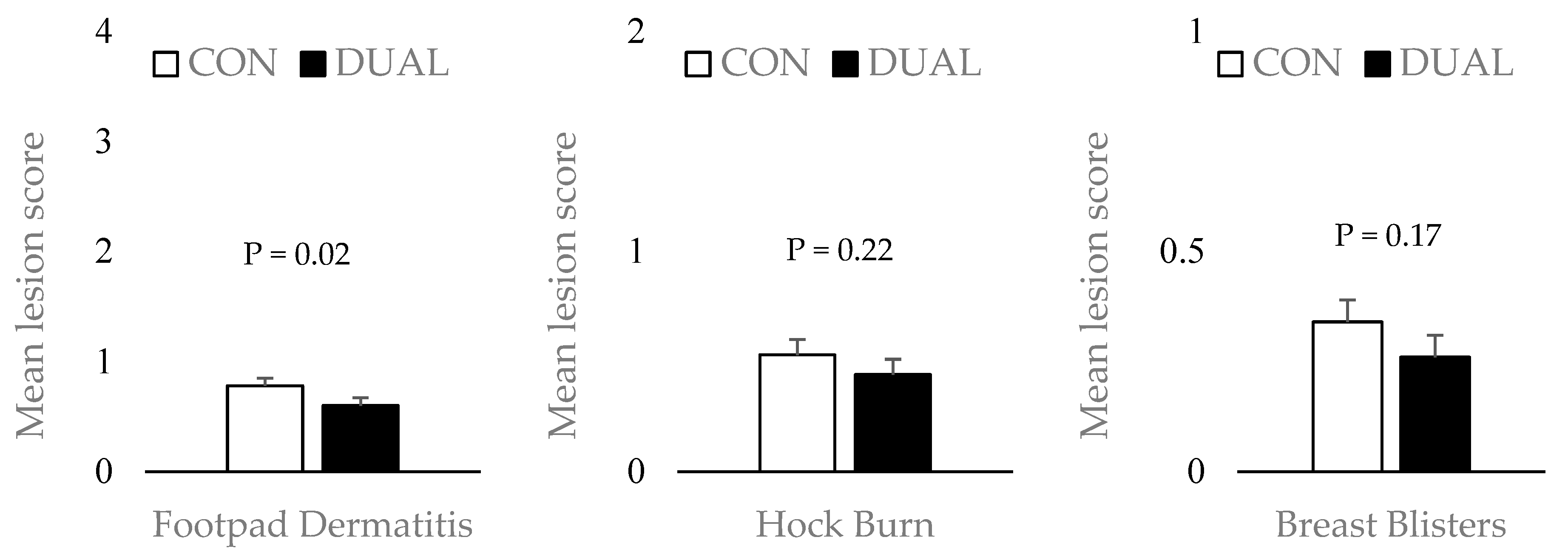
Experiment 3 was approved by the Animal Ethic Committee of the Bangkok Animal Research Center (BARC) under protocol number AB21496A and was conducted following the guidelines for using animals for scientific purpose of the National Research Council of Thailand. Seven hundred and sixty-eight newly hatched Ross 308 male chicks were allocated to 2 treatments (CON and DUAL) with 24 replications per treatment, using 16 birds/pen in a randomized complete block design. A practical corn-soybean diet was formulated with three phases—starter (0–14 d), grower (14–35 d), and finisher (35 to 42 d). The diet was compliant with the nutrient requirements of the commercial strain recommendation (coccidiostat included in the diet formulation) and was used as the basal diet in all treatment groups, while the SCFP and EOC combination feed ingredient was added on top of the basal diet for the DUAL treatment group. The experiment was conducted in a closed house with a tunnel ventilation and evaporative cooling system and with solid-concrete-floor pens using rice hull as bedding material. Each pen measured 1.0 m × 1.5 m and was equipped with a tubular feeder and 3 nipple water drinkers. Feed and water were provided for ad libitum consumption. Birds were maintained under lighting and management programs according to commercial broiler breeder recommendations. All birds were vaccinated for Newcastle and Infectious Bronchitis diseases at 7 days and Gumboro disease at 14 days of age. At 37 days of age, feed and water were withdrawn from all pens for 12 h from 03.00 am until 3.00 p.m. and heat stress was induced from 9.00 a.m. to 3.00 p.m. by reducing pen space. Total pen feed consumption and body weight were measured weekly at 7, 14, 28, 35, and 42 days of age to determine body weight, cFCR, and cFI. Dead and culled birds were monitored and recorded daily. At the end of the trial (42 days of age), five birds from each pen with body weight close to the pen mean were slaughtered for breast yield measurement as well as carcass quality assessments such as footpad dermatitis, hock burn, and breast blister scored by trained panelist. Footpad dermatitis was measured by scores ranging from 0 to 4 (0 = smooth, no lesion; 1 = very small and superficial lesion, slight discoloration over a small surface; 2 = superficial lesion and discoloration of the footpad; 3 = moderate lesion, ulcers, and blood crust; 4 = severe lesions, ulcers, blood crust, hematomas, and deep wound). The scores of hock burn ranged from 0 to 2 (0 = Slight discoloration and/or small defects, but the absence of any lesion; 1 = very small and superficial lesion and slight discoloration over a small surface; 2 = superficial lesion and discoloration of the hock burn). The breast blister scores ranged from 0 to 1 (0 = absence and 1 = presence of breast blister).
2.1.3. Statistical Analysis
For individual experiments, pens were used as experimental units and the data were analyzed using statistical software (SAS v9.4, Cary, NC, USA). Performance data from individual trials were analyzed using PROC MIXED with fixed effects of treatments and blocks as random effects. Livability and carcass quality data were analyzed using PROC GLIMMIX with the fixed effect of treatment and random effect of blocks. Averages across the data from the three experiments were analyzed using a PROC MIXED model with block nested in the study as a random effect and significant difference determined at p < 0.05. For livability and carcass quality data, PROC GLIMMIX was used with the fixed effect of treatment and block nested in the study as a random effect. The data are presented as least square means and standard error of the means (SEM) with significant statistical differences at p < 0.05.
3. Results and Discussion
3.1. Growth Performance
In Experiment 1, DUAL improved (p < 0.05) body weight, cFCR, and cFI, except at day 14 (Table 1). In Experiment 2, body weight gains appeared from day 28, with cFCR improvement (p < 0.05) at day 42. Early cFI was higher, but no difference (p > 0.05) was observed at market age. In Experiment 3, body weight gains were evident from day 14, and cFCR differences became significant (p < 0.05) from day 35. DUAL-fed birds also showed higher cFI, with a significant increase at day 42 (Table 1). Pooled analysis confirmed that DUAL improved (p < 0.05) body weight and cFCR at 14, 28, 35, and 42 days (Table 2). At market age, DUAL-fed birds had 5.5% higher body weight and a 5-point cFCR improvement compared to controls. cFI was also higher (p < 0.05) at 28, 35, and 42 days. The consistent improvements in body weight and feed efficiency highlight the efficacy of DUAL. The magnitude of differences, particularly the 5.5% increase in body weight and 5-point cFCR improvement at market age, demonstrates a clear advantage over controls. These findings align with earlier reports on SCFP improving broiler performance [18,19,20,36,37,38,39], turkeys [40,41], and layers/breeders [38,42,43]. They also support previous evidence that SCFP and EOC together enhance body weight and cFCR at 35 d [34]. No differences (p > 0.05) in livability were observed in individual trials (Exp 1—CON 96.76%, DUAL 95.80%; Exp 2—CON 92.51%, DUAL 91.70%; Exp 3—CON 96.23%, DUAL 96.74%) or in pooled analysis (CON 94.92%; DUAL 94.33%). The lack of differences in livability suggests that performance gains were not offset by health risks. Variations among experiments may reflect differing challenge conditions (such as re-used litter, heat stress, diets, etc.), yet the overall pattern shows robustness of DUAL under commercially relevant settings.
Table 1.
Broiler performance from three independent experiments *.
Table 2.
Pooled analysis of body weight, cumulative feed conversion ratio (cFCR), and cumulative feed intake (cFI) across three different experiments at different time points.
3.2. Mechanistic Insights on Gut Health and Performance Benefits
The complementary actions of SCFP and EOC likely underpin the observed performance improvements. SCFP supports distal gut microbiota, promoting Lactobacillus [24,44,45,46]. EOC acts in the upper gut [47], enhancing enzyme activity [30,32] and suppressing pathogens such as E. coli and Salmonella [31,33]. Their complementary distribution suggests synergy consistent with reports of SCFP reducing avian pathogenic E. coli lesion scores and pathogen loads [48] in broilers and improving turkey performance [41]. Preliminary DUAL studies also showed increased SCFA-producing bacteria at 21 d [49], which are linked to gut maturity and feed efficiency [50,51]. Collectively, these mechanisms suggest that DUAL accelerates microbiome development, optimizes gut health as well as nutrient utilization, and enhances growth performance.
3.3. Breast Meat Yield and Carcass Quality Improvements
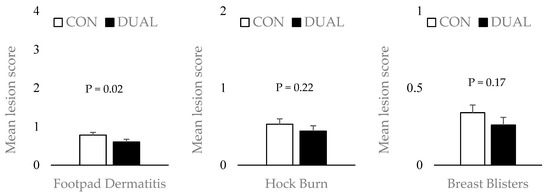
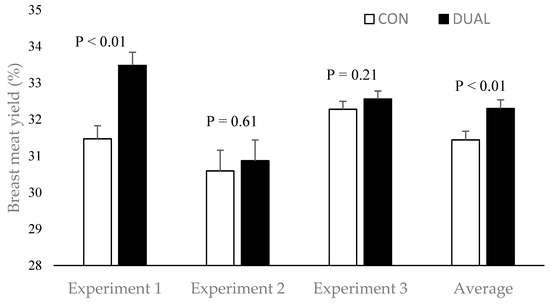
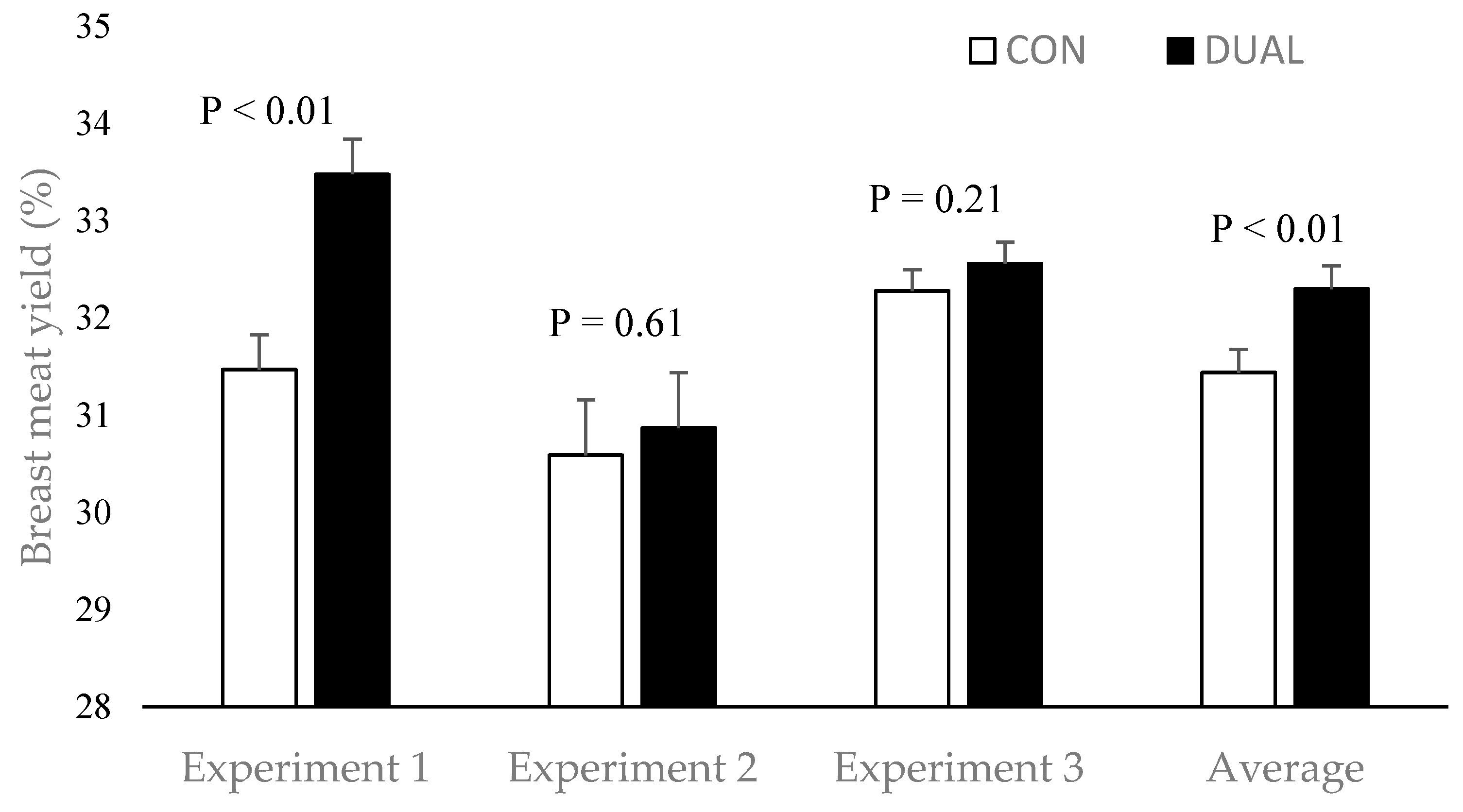
In Experiment 3, DUAL-fed birds had lower (p < 0.05) footpad lesion scores and numerically better hock burn and breast blister scores (Figure 1). Combined processing data across all three experiments showed no difference (p > 0.05) in overall carcass yield between treatments (CON: 77.13% vs. DUAL: 76.80%). However, pooled breast meat yield was higher (0.86%, p < 0.05) in DUAL-fed birds (Figure 2). Carcass quality improvements, particularly reduced footpad lesions, may be linked to better gut health, lower excreta moisture. SCFP enhances gut integrity [19,37,52], while EOC supports nutrient absorption [30,32]. Together, they may reduce litter moisture, lowering skin lesion incidence. The increase in breast meat yield, though modest, suggests improved nutrient absorption and partitioning toward muscle deposition, possibly mediated by microbiome modulation. The exact mechanism of action of the combination in enhancing breast meat yield needs to be further investigated.
Figure 1.
Carcass quality scores (footpad dermatitis, hock burn, and breast blisters) evaluated from Experiment 3 (n = 120 birds/treatment).
Figure 2.
Breast meat yield from individual studies and pooled analysis across three different experiments (n = 120 birds/treatment/experiment).
4. Conclusions
DUAL, a combination of SCFP and EOC, improved broiler performance across all trials. Birds fed DUAL showed higher body weight, better feed efficiency, and greater feed intake. Breast meat yield was increased, supporting growth and production. In Experiment 3, DUAL reduced footpad lesions, indicating carcass quality and welfare benefits. These effects are hypothesized to be related to faster gut microbiome maturation and improved nutrient use. Overall, DUAL is a promising nutritional strategy to enhance broiler health, productivity, and a potential reduction in footpad dermatitis. Further research is needed to clarify its mode of action.
Author Contributions
Conceptualization, V.A.K. and Y.F.; methodology, G.S.A., V.A.K., and Y.F.; software, V.A.K.; validation, V.A.K., G.S.A., Y.F., and M.D.; formal analysis, V.A.K.; investigation, G.S.A. and V.A.K.; resources, M.D.; data curation, G.S.A. and V.A.K.; writing—original draft preparation, V.A.K.; writing—review and editing, Y.F., G.S.A., and M.D.; visualization, V.A.K.; supervision, M.D.; project administration, G.S.A. and Y.F.; funding acquisition, Y.F. and M.D. All authors have read and agreed to the published version of the manuscript.
Funding
This research was funded by Cargill, Inc.
Institutional Review Board Statement
The experiments were conducted with the guidelines established by the Texas A&M Institutional Animal Care and Use Committee (IACUC 2019-0056, approved on 6 March 2019) and the birds were managed according to the guidelines described in the Guide for the Care and Use of Agricultural Animals in Research and Teaching. Experiment 3 was approved by the Animal Ethic Committee of the Bangkok Animal Research Center (BARC) under protocol number AB21496A and was conducted following the guidelines for using animals for scientific purpose of the National Research Council of Thailand.
Informed Consent Statement
Not applicable.
Data Availability Statement
Data will be made available from the corresponding author upon reasonable request.
Acknowledgments
We extend our heartfelt gratitude to the Bangkok Animal Research Center (BARC) for their invaluable support in facilitating one of the experiments central to this study. The breadth of this work was significant, and we deeply appreciate the dedication and expertise of all staff members and co-authors whose contributions enriched the research. In preparing this manuscript, the authors utilized Microsoft Copilot (2025) to refine the language. All outputs were carefully reviewed and edited, and the authors assume full responsibility for the final content of this publication.
Conflicts of Interest
Vivek A. Kuttappan, Yann Fournis, and Marc Decoux are employees of Cargill, Inc. Also, Cargill, Inc. provided the Biostrong™ Dual used in this study, which has a proprietary composition. The funder was not involved in the study design, collection, analysis, interpretation of data, the writing of this article or the decision to submit it for publication.
References
- OECD; FAO. OECD-FAO Agricultural Outlook 2025–2034; OECD Publishing: Paris, France; FAO: Rome, Italy, 2025. [Google Scholar] [CrossRef] [Scilit]
- Kleyn, F.J.; Ciacciariello, M. Future demands of the poultry industry: Will we meet our commitments sustainably in developed and developing economies? Worlds Poult. Sci. J. 2021, 77, 267–278. [Google Scholar] [CrossRef] [Scilit]
- FAO. Sustainable Food Systems: Concept and Framework; Food and Agriculture Organization of the United Nations: Rome, Italy, 2018. [Google Scholar]
- Bist, R.B.; Bist, K.; Poudel, S.; Subedi, D.; Yang, X.; Paneru, B.; Mani, S.; Wang, D.; Chai, L. Sustainable poultry farming practices: A critical review of current strategies and future prospects. Poult. Sci. 2024, 104, 104295. [Google Scholar] [CrossRef] [Scilit]
- Ahlawat, S.; Asha, K.; Sharma, K. Gut–organ axis: A microbial outreach and networking. Lett. Appl. Microbiol. 2021, 72, 636–668. [Google Scholar] [CrossRef] [Scilit]
- Gadde, U.; Kim, W.H.; Oh, S.T.; Lillehoj, H.S. Alternatives to antibiotics for maximizing growth performance and feed efficiency in poultry: A review. Anim. Health Res. Rev. 2017, 18, 26–45. [Google Scholar] [CrossRef] [Scilit]
- Perera, W.N.U.; Ravindran, V. Role of feed additives in poultry nutrition: Historical, current and future perspectives. Anim. Feed Sci. Technol. 2025, 326, 116371. [Google Scholar] [CrossRef] [Scilit]
- Bourebaba, Y.; Marycz, K.; Mularczyk, M.; Bourebaba, L. Postbiotics as potential new therapeutic agents for metabolic disorders management. Biomed. Pharmacother. 2022, 153, 113138. [Google Scholar] [CrossRef] [Scilit] [PubMed]
- Hijová, E. Postbiotics as metabolites and their biotherapeutic potential. Int. J. Mol. Sci. 2024, 25, 5441. [Google Scholar] [CrossRef] [Scilit] [PubMed]
- Swanson, K.S.; Gibson, G.R.; Hutkins, R.; Reimer, R.A.; Reid, G.; Verbeke, K. The international scientific association for probiotics and prebiotics (ISAPP) consensus statement on the definition and scope of synbiotics. Nat. Rev. Gastroenterol. Hepatol. 2020, 17, 687–701. [Google Scholar] [CrossRef] [Scilit]
- Perricone, V.; Sandrini, S.; Irshad, N.; Savoini, G.; Comi, M.; Agazzi, A. Yeast-derived products: The role of hydrolyzed yeast and yeast culture in poultry nutrition—A review. Animals 2022, 12, 1426. [Google Scholar] [CrossRef] [Scilit]
- Zhong, Y.; Wang, S.; Di, H.; Deng, Z.; Liu, J.; Wang, H. Gut health benefit and application of postbiotics in animal production. J. Anim. Sci. Biotechnol. 2022, 13, 38. [Google Scholar] [CrossRef] [Scilit]
- Nelson, J.R.; McIntyre, D.R.; Pavlidis, H.O.; Archer, G.S. Reducing stress susceptibility of broiler chickens by supplementing a yeast fermentation product in the feed or drinking water. Animals 2018, 8, 173. [Google Scholar] [CrossRef] [Scilit] [PubMed]
- Nelson, J.R.; Sobotik, E.B.; Athrey, G.; Archer, G.S. Effects of supplementing yeast fermentate in the feed or drinking water on stress susceptibility, plasma chemistry, cytokine levels, antioxidant status, and stress- and immune-related gene expression of broiler chickens. Poult. Sci. 2020, 99, 3312–3318. [Google Scholar] [CrossRef] [Scilit] [PubMed]
- Heinsohn, Z.; Brown, A.; Sobotik, E.; House, G.; Stiewert, A.; Chaney, W.E.; Kuttappan, V.A.; Archer, G.S. Evaluating the effects of feeding a concentrated Saccharomyces cerevisiae fermentation product on the performance and stress susceptibility of broiler chickens. Poult. Sci. 2024, 103, 57–65. [Google Scholar] [CrossRef] [Scilit]
- Park, J.W. Effects of Yeast Product on Modulating the Adaptive Immune Function in Broilers. Master’s Thesis, Texas A&M University, College Station, TX, USA, 2014. [Google Scholar]
- Chou, W.K.; Park, J.; Carey, J.B.; McIntyre, D.R.; Berghman, L.R. Immunomodulatory effects of Saccharomyces cerevisiae fermentation product supplementation on immune gene expression and lymphocyte distribution in immune organs in broilers. Front. Vet. Sci. 2017, 4, 37. [Google Scholar] [CrossRef] [Scilit]
- El-Husseiny, O.M.; Abdallah, A.G.; Abdel-Latif, K.O. The influence of biological feed additives on broiler performance. Int. J. Poult. Sci. 2008, 7, 862–871. [Google Scholar] [CrossRef] [Scilit]
- Gao, J.; Zhang, H.J.; Yu, S.H.; Wu, S.G.; Yoon, I.; Quigley, J.; Gao, Y.P.; Qi, G.H. Effects of yeast culture in broiler diets on performance and immunomodulatory functions. Poult. Sci. 2008, 87, 1377–1384. [Google Scholar] [CrossRef] [Scilit]
- Fathi, M.M.; Al-Mansour, S.; Al-Homidan, A.; Al-Khalaf, A.; Al-Damegh, M. Effect of yeast culture supplementation on carcass yield and humoral immune response of broiler chicks. Vet. World 2012, 11, 651–657. [Google Scholar] [CrossRef] [Scilit]
- Park, S.H.; Roto, S.; Pavlidis, H.; McIntyre, D.; Striplin, K.; Brammer, L.; Ricke, S.C. Effects of feeding original XPC to broilers with a live coccidiosis vaccine under industrial conditions: Part 2. Cecal microbiota analysis. Poult. Sci. 2017, 96, 2400–2411. [Google Scholar] [CrossRef] [Scilit] [PubMed]
- Rubinelli, P.; Roto, S.; Kim, S.A.; Park, S.H.; Pavlidis, H.; McIntyre, D.; Ricke, S.C. Reduction of Salmonella Typhimurium by fermentation metabolites of Diamond V Original XPC in an in vitro anaerobic mixed chicken cecal culture. Front. Vet. Sci. 2016, 3, 83. [Google Scholar] [CrossRef] [Scilit]
- Price, P.T.; Byrd, J.A.; Alvarado, C.Z.; Pavlidis, H.O.; McIntyre, D.R.; Archer, G.S. Utilizing original XPC in feed to reduce stress susceptibility of broilers. Poult. Sci. 2018, 97, 855–859. [Google Scholar] [CrossRef] [Scilit]
- Feye, K.M.; Dittoe, D.K.; Rubinelli, P.M.; Olson, E.G.; Ricke, S.C. Yeast fermentate-mediated reduction of Salmonella Reading and Typhimurium in an in vitro turkey cecal culture model. Front. Microbiol. 2021, 12, 645301. [Google Scholar] [CrossRef] [Scilit]
- Gingerich, E.; Frana, T.; Logue, C.M.; Smith, D.P.; Pavlidis, H.O.; Chaney, W.E. Effect of feeding a postbiotic derived from Saccharomyces cerevisiae fermentation as a preharvest food safety hurdle for reducing Salmonella Enteritidis in the ceca of layer pullets. J. Food Prot. 2021, 84, 275–280. [Google Scholar] [CrossRef] [Scilit]
- Chaney, W.E.; Naqvi, S.A.; Gutierrez, M.; Gernat, A.; Johnson, T.J.; Petry, D. Dietary inclusion of a Saccharomyces cerevisiae-derived postbiotic is associated with lower Salmonella enterica burden in broiler chickens on a commercial farm in Honduras. Microorganisms 2022, 10, 544. [Google Scholar] [CrossRef] [Scilit]
- Kalani, M.; Rahimi, S.; Zahraei Salehi, T.; Hajiaghaee, R.; Behnamifar, A. Comparison of the effects of probiotic and prebiotic as antibiotic alternatives on Salmonella colonization, performance, and egg quality in laying hens challenged with Salmonella enterica serotype Enteritidis. Iran. J. Vet. Res. 2022, 23, 154–162. [Google Scholar]
- Alves, V.V.; Arantes, L.C.R.V.; de Barros Moreira Filho, A.L. Effect of diets containing commercial bioactive compounds on Salmonella Heidelberg infection in broiler chicks. Braz. J. Microbiol. 2023, 54, 571–577. [Google Scholar] [CrossRef] [Scilit] [PubMed]
- Chaney, W.E.; McBride, H.; Girgis, G. Effect of a Saccharomyces cerevisiae postbiotic feed additive on Salmonella Enteritidis colonization of cecal and ovarian tissues in directly challenged and horizontally exposed layer pullets. Animals 2023, 13, 1186. [Google Scholar] [CrossRef] [Scilit] [PubMed]
- Brenes, A.; Roura, E. Essential oils in poultry nutrition: Main effects and modes of action. Anim. Feed Sci. Technol. 2010, 158, 1–14. [Google Scholar] [CrossRef] [Scilit]
- Mahfuz, S.; Shang, Q.; Piao, X. Phenolic compounds as natural feed additives in poultry and swine diets: A review. J. Anim. Sci. Biotechnol. 2021, 12, 48. [Google Scholar] [CrossRef] [Scilit]
- Abd El-Hack, M.E.; El-Saadony, M.T.; Saad, A.M.; Salem, H.M.; Ashry, N.M.; Abo Ghanima, M.M.; Shukry, M.; Swelum, A.A.; Taha, A.E.; El-Tahan, A.M.; et al. Essential oils and their nanoemulsions as green alternatives to antibiotics in poultry nutrition: A comprehensive review. Poult. Sci. 2022, 101, 101584. [Google Scholar] [CrossRef] [Scilit]
- Gholami-Ahangaran, M.; Ahmadi-Dastgerdi, A.; Azizi, S.; Basiratpour, A.; Zokaei, M.; Derakhshan, M. Thymol and carvacrol supplementation in poultry health and performance. Vet. Med. Sci. 2022, 8, 267–288. [Google Scholar] [CrossRef] [Scilit]
- Alyousef, Y.; Shawky, M.; Rayan, G.; Darrag, H.; Najib, H.; Mohammed, A. Effects of different doses of Dia-VTM MBPRO on growth performance, serum metabolites and antioxidant profiles of broiler chickens. Indian J. Anim. Res. 2025, 59, 130–136. [Google Scholar] [CrossRef] [Scilit]
- National Research Council (NRC). Nutrient Requirements of Poultry; National Academies Press: Washington, DC, USA, 1994. [Google Scholar]
- Gao, J.; Zhang, H.J.; Wu, S.G.; Yu, S.H.; Yoon, I.; Moore, D.; Gao, Y.P.; Yan, H.J.; Qi, G.H. Effect of Saccharomyces cerevisiae fermentation product on immune functions of broilers challenged with Eimeria tenella. Poult. Sci. 2009, 88, 2141–2151. [Google Scholar] [CrossRef] [Scilit] [PubMed]
- Akhavan-Salamat, H.; Ghasemi, H.A.; Khaltabadi-Farahani, A.H.; Kazemi-Bonchenari, M. The effects of Saccharomyces cerevisiae on performance and nutrient digestibility in broilers fed with diet containing different levels of phosphorus. Afr. J. Biotechnol. 2011, 10, 7526–7533. [Google Scholar]
- Kidd, M.T.; Araujo, L.; Araujo, C.; McDaniel, C.D.; McIntyre, D. A study assessing hen and progeny performance through dam diet fortification with a Saccharomyces cerevisiae fermentation product. J. Appl. Poult. Res. 2013, 22, 872–877. [Google Scholar] [CrossRef] [Scilit]
- Roto, S.M.; Park, S.H.; Lee, S.I.; Kaldhone, P.; Pavlidis, H.O.; Frankenbach, S.B. Effects of feeding Original XPC to broilers with a live coccidiosis vaccine under industry conditions: Part 1. Growth performance and Salmonella inhibition. Poult. Sci. 2017, 96, 1831–1837. [Google Scholar] [CrossRef] [Scilit] [PubMed]
- Firman, J.D.; Broomhead, J.; McIntyre, D. Effects of dietary inclusion of a Saccharomyces cerevisiae fermentation product on performance and gut characteristics of male turkeys to market weight. Int. J. Poult. Sci. 2013, 12, 3. [Google Scholar] [CrossRef] [Scilit]
- Chaney, E.; Miller, E.A.; Firman, J.; Binnebose, A.; Kuttappan, V.A.; Johnson, T.J. Effects of a postbiotic, with and without a saponin-based product, on turkey performance. Poult. Sci. 2023, 102, 102607. [Google Scholar] [CrossRef] [Scilit]
- Yalcin, S.; Ozsoy, B.; Erol, H.; Yalcin, S. Yeast culture supplementation to laying hen diets containing soybean meal or sunflower seed meal and its effect on performance, egg quality traits, and blood chemistry. J. Appl. Poult. Res. 2008, 17, 229–236. [Google Scholar] [CrossRef] [Scilit]
- Suarez Martinez, J.C.; Blount, R.L.; Park, J.; McIntyre, D.R.; Pavlidis, H.O.; Carey, J.B. Effects of feeding Original XPC to laying hens on egg production, component yield and composition. J. Appl. Poult. Res. 2018, 27, 603–608. [Google Scholar] [CrossRef] [Scilit]
- Zhao, W.; Zhen, Y.G.; Zhang, X.F.; Li, L.J.; Chen, X.; Wang, T.; Lee, H.G. Effects of yeast culture on broiler growth performance, nutrient digestibility and caecal microbiota. S. Afr. J. Anim. Sci. 2019, 49, 99–108. [Google Scholar]
- Feye, K.M.; Rubinelli, P.M.; Chaney, W.E.; Pavlidis, H.O.; Kogut, M.H.; Ricke, S.C. The preliminary development of an in vitro poultry cecal culture model to evaluate the effects of Original XPC for the reduction of Campylobacter jejuni and its potential effects on the microbiota. Front. Microbiol. 2020, 10, 645301. [Google Scholar] [CrossRef] [Scilit] [PubMed]
- Gong, H.; Liang, F.; Cai, C.; Ding, X.; Bai, S.; Zhang, K.; Zeng, Q.; Liu, Y.; Xuan, Y.; Xu, S.; et al. Dietary Saccharomyces cerevisiae fermentation product improved egg quality by modulating intestinal health, ovarian function, and cecal microbiota in post-peak laying hens. Poult. Sci. 2025, 104, 104979. [Google Scholar] [CrossRef] [Scilit] [PubMed]
- Michiels, J.; Missotten, J.; Dierick, N.; Fremaut, D.; Maene, P.; De Smet, S. In vitro degradation and in vivo passage kinetics of carvacrol, thymol, eugenol and trans-cinnamaldehyde along the gastrointestinal tract of piglets. J. Sci. Food Agric. 2008, 88, 2371–2381. [Google Scholar] [CrossRef] [Scilit]
- Chaney, W.E.; Johnson, T.J.; Meyer, A.; Maina, T.W.; Kuttappan, V.A.; Naqvi, S.A.; Jones, M.; Hofacre, C. Impact of a postbiotic containing saponin, with or without vaccination, on the mitigation of colibacillosis in broilers challenged with avian pathogenic Escherichia coli serotype O78. J. Appl. Poult. Res. 2024, 33, 100433. [Google Scholar] [CrossRef] [Scilit]
- Kuttappan, V.A.; Goderis, A.; de Oliveria, J.E.; Fournis, Y.; Naqvi, S.A.; Clemons, C. Impact of a novel combination of postbiotics and essential oil compounds to support gut microbiome maturation and performance in broilers. In Proceedings of the 113th PSA Annual Meeting, Louisville, KY, USA, 15–18 July 2024. [Google Scholar]
- Yue, Y.; Luasiri, P.; Li, J.; Laosam, P.; Sangsawad, P. Research advancements on the diversity and host interaction of gut microbiota in chickens. Front. Vet. Sci. 2024, 11, 1492545. [Google Scholar] [CrossRef] [Scilit] [PubMed]
- Liu, J.; Stewart, S.N.; Robinson, K.; Yang, Q.; Lyu, W.; Whitmore, M.A.; Zhang, G. Linkage between the intestinal microbiota and residual feed intake in broiler chickens. J. Anim. Sci. Biotechnol. 2021, 12, 22. [Google Scholar] [CrossRef] [Scilit]
- Nelson, J.R.; Archer, G.S. Effect of yeast fermentate supplementation on intestinal health and plasma biochemistry in heat-stressed Pekin ducks. Animals 2019, 9, 790. [Google Scholar] [CrossRef] [Scilit]

Disclaimer/Publisher’s Note: The statements, opinions and data contained in all publications are solely those of the individual author(s) and contributor(s) and not of MDPI and/or the editor(s). MDPI and/or the editor(s) disclaim responsibility for any injury to people or property resulting from any ideas, methods, instructions or products referred to in the content. |
© 2026 by the authors. Licensee MDPI, Basel, Switzerland. This article is an open access article distributed under the terms and conditions of the Creative Commons Attribution (CC BY) license.