


Simple Summary
Sheep play an important role in food production and rural livelihoods, especially in regions where locally adapted breeds have developed unique traits. Two key characteristics that influence sheep productivity are the number of lambs born per ewe (prolificacy) and coat color, which can affect adaptation and market value. This study evaluated genetic variations in 15 Brazilian sheep breeds using a set of 48 genetic markers related to these traits. Our findings suggest that a specific mutation in the GDF9 gene may be associated with increased lamb production in the Brazilian Blackbelly, in addition to Santa Inês and Morada Nova breeds where it has previously been associated with prolificacy. Other genes formerly linked with enhanced reproductive performance did not show relevant effects in these locally adapted breeds. Genetic differences were also identified in genes influencing coat color, helping to explain the diversity observed between hair and wool sheep. Importantly, the genetic material stored in the Brazilian Animal Germplasm Bank (BBGA) preserves much of the diversity found in populations conserved in situ. These findings contribute to the conservation and sustainable use of local sheep breeds, supporting genetic improvement programs and helping ensure food security and biodiversity for future generations.
Abstract
Prolificacy and coat color are key economic traits influencing sheep production. This study evaluated a reduced panel of 48 SNPs previously associated with these traits and assessed its applicability to locally adapted Brazilian sheep breeds. A total of 1152 samples from 15 breeds, conserved in situ at conservation nuclei and ex situ in the Brazilian Animal Germplasm Bank, were genotyped. Allelic, genotypic, and haplotypic frequencies were estimated to compare genetic variability between in situ and ex situ populations. Additionally, linkage disequilibrium (LD) among SNPs within GDF9, a key gene associated with prolificacy, was evaluated across local breeds, revealing strong LD among specific markers. The results highlight the importance of the FecGE (GDF9) variant for prolificacy in hair sheep, confirming the presence of mutant allele E in prolific breeds, such as Santa Inês and Morada Nova, and identifying, for the first time, a high frequency of such allele in the Brazilian Blackbelly, which provides new insights into the genetic basis of this prolific hair breed. Other prolificacy-related genes, BMP15 and BMPR1B, appear to have no functional role in locally adapted breeds, as initially hypothesized, considering genetic differences among European and tropical sheep. Allelic and genotypic variation in ASIP, MC1R, TYRP1, and MITF genes reflected differences between wool and hair sheep and between local and commercial breeds. Overall, the results indicate that the germplasm bank effectively preserves in situ diversity. In conclusion, the reduced SNP panel efficiently genotyped Brazilian sheep for prolificacy and coat color SNPs, confirming which markers are present and segregating in these breeds. However, its utility could be improved by removing markers of limited relevance in the targeted breeds.
1. Introduction
Prolificacy and coat color are economically and adaptively important traits in sheep production. While prolificacy enhances productivity rates, coat color influences thermoregulation, breed characterization, and market preferences. Numerous single-nucleotide polymorphisms (SNPs) within key genes associated with these traits have been identified in a variety of commercial sheep breeds [1,2,3,4,5,6,7,8], particularly of European, North American, and Asian origin [9,10]. However, SNPs identified in these breeds may not always apply to locally adapted animals from tropical regions, such as Brazil, primarily due to differences in genetic background, selection history, and allele frequencies [11].
Reproductive performance in sheep is determined by both fecundity-related factors (e.g., ovulation rate and litter size) and fertility traits, including oocyte quality, follicular maturation, fertilization success, and embryo survival [12]. While prolificacy genes such as GDF9, BMP15, and BMPR1B can increase ovulation rate, certain allelic combinations, particularly homozygotes, may result in subfertility or sterility [1,2,3,4]. Therefore, selection for high litter size must account for potential trade-offs in overall fertility. Previously, the FecGE (GDF9) variant has been associated with increased prolificacy in Santa Inês and Morada Nova, two of the most important hair sheep breeds in Brazil [13,14]. However, in BMP15 and BMPR1B, mutations known to enhance prolificacy in several commercial breeds are absent or not associated with increased litter size in certain autochthonous breeds, including Santa Inês and Morada Nova [15].
Color-related loci influence not only sheep coat pigmentation but also breed authenticity, making them strategic markers for investigating genetic diversity in locally adapted breeds [16]. In the Brazilian Crioula, a local Brazilian breed, animals display a wide range of colors, with previous studies showing that epistatic interactions between specific alleles of the MC1R and ASIP genes contribute significantly to the observed coat color variation [17,18]. This historically important breed produces medullated wool that is primarily used for handicrafts [19]. Although not known for high-quality wool production, the breed is included in the conservation program of the Brazilian Agricultural Research Corporation (Embrapa), which maintains the main registered herd, as detailed in its 2011 phenotypic description [20].
Among Brazilian hair breeds, Santa Inês and Morada Nova are well adapted to the semi-arid and other tropical and subtropical conditions of the country, underscoring the importance of thermoregulation as a key adaptive trait in these breeds. Santa Inês exhibits a wide range of coat colors, from white to black, including brown and spotted, but white-coated individuals demonstrate greater heat tolerance [21]. Similarly, in Morada Nova, white and red individuals are officially recognized by the Brazilian Sheep Breeders Association (ARCO), but the white variety shows enhanced thermoregulatory capacity [22]. These findings highlight the genetic complexity of coat color in Brazilian sheep, shaped by selective pressures related to climate adaptation.
Despite presenting low production parameters compared to commercial breeds, locally adapted Brazilian sheep, especially Santa Inês, Morada Nova, and Crioula, are key genetic resources defined by resilience to harsh tropical production conditions and distinctive phenotypes [23]. However, these populations remain underrepresented in genomic studies. Additionally, current large-scale genotyping panels, mostly designed for commercial breeds, often prove financially unsustainable or overly complex for routine applications in smaller, in situ conservation and breeding programs involving local breeds. Therefore, this study addresses this gap by evaluating a reduced panel of 48 SNPs, previously associated with prolificacy and coat color, to determine which markers are present and segregating in locally adapted Brazilian sheep breeds. Given that these breeds are predominantly hair sheep and genetically distinct from European commercial breeds, we hypothesized that several alleles commonly reported in wool breeds may not segregate in Brazilian populations. Thus, the study primarily sought to identify the applicability of these SNPs in local breeds. Genotyping was conducted using a rapid genotyping methodology, which, if effective, can efficiently and cost-effectively support conservation and breeding programs by enabling the detection of allelic diversity and reducing reliance on monomorphic loci that cannot discriminate among breeds.
2. Materials and Methods
2.1. Biological Samples
A total of 1.040 whole blood samples from sheep of 15 breeds were accessed from the DNA and tissues bank of the Embrapa Genetic Resources and Biotechnology, located in Brasília, Brazil. These samples are from animals maintained at Embrapa’s in situ conservation centers distributed across the country. The breeds included in the study were Santa Inês, Morada Nova, Crioula, Brazilian Fat-tail, Brazilian Somali, Brazilian Bergamasca, Corriedale, Ile de France, Pantaneiro, Dorper, Damara, Suffolk, Hampshire, and Texel. Semen samples (N = 112) conserved ex situ at the Brazilian Animal Germplasm Bank (BBGA) were also included in the study. Breed descriptions and final sample sizes per population (after quality control) are presented in Table 1.
Table 1.
Breed description and sample size of in situ and ex situ populations.
DNA extraction was performed using the Gentra Puregene Blood Kit (Qiagen, Germantown, MD, USA; https://www.qiagen.com/us (accessed on 27 November 2025)) for both whole blood and semen samples. The DNA quality of the samples was assessed in two ways. Initially, a 1% agarose gel stained with ethidium bromide was used, with lambda standards of 200 ng/µg, 100 ng/µg, and 50 ng/µg for comparison. Additionally, the samples were analyzed on a NanoDrop Thermo Scientific spectrophotometer (NanoDrop™ 8000, Thermo Fisher Scientific, Waltham, MA, USA; https://www.thermofisher.com/ (accessed on 27 November 2025)) to determine the presence of contaminants (proteins and chemical reagents).
2.2. Genotyping Methodology
The Fluidigm EP1™ system (Fluidigm Corporation, South San Francisco, CA, USA) was selected as the genotyping method for this study. Fluidigm® SNP Type™ assays were designed for 35 prolificacy-related and 13 coat color-related pre-selected markers using the Fluidigm D3™ tool, following instructions and guidelines of the manufacturer, available at https://d3.fluidigm.com/ (accessed on 27 November 2025). Detailed information on the sequences of each marker used in the study is provided in Table S1. Each DNA sample had a total of 90 ng used for genotyping, and the data was generated following the standard protocols provided by Fluidigm for use with the EP1 platform. The samples underwent pre-amplification utilizing locus-specific primers (LSP) oligonucleotides and specific target amplification (STA) primers for the tested SNPs. The diluted amplified product was loaded onto twelve 96.96 Dynamic Array™ IFCs (Fluidigm Corporation, South San Francisco, CA, USA), with ROX reference dye and assays containing allele-specific primers (ASP) and LSP oligonucleotides for each SNP, according to the manufacturer’s instructions. Fluorescence endpoint image data were acquired on the EP1 Fluidigm imager, and genotype calls were obtained using the Fluidigm SNP Genotyping Analysis Software v4.1.3 (Fluidigm Corporation, South San Francisco, CA, USA).
2.3. Data Analysis
After performing cluster analysis to define genotype classes for each SNP, the confidence threshold for each genotype was set at >0.90. Samples and markers underwent quality control using SNP & Variation Suite (SVS) v8.9.1 (Golden Helix, Bozeman, MT, USA; https://www.goldenhelix.com/ (accessed on 27 November 2025)). Samples with a call rate < 0.80 and markers with a call rate < 0.75 were eliminated. Allelic, genotypic, and haplotypic frequencies were estimated using GenAlEx 6.5 [24], Arlequin 3.5.2.2 [25], and SHEsis web-based tool, available at http://analysis.bio-x.cn (accessed on 27 November 2025) [26,27], respectively. Monomorphic markers were excluded from the haplotype analysis. Linkage Disequilibrium (LD) was assessed using Haploview v.4.2, calculating D’ and r2 [28].
The potential association between prolificacy and coat color was assessed at the individual level in five major locally adapted hair sheep breeds: Brazilian Blackbelly, Morada Nova, Brazilian Fat-tail, Santa Inês, and Brazilian Somali, using a total of 476 individuals, with Pearson’s chi-squared test of independence [29]. Three markers were used: prolificacy-associated FecGE (GDF9), and coat-color-associated MC1R p.M73K A>T and p.D121N A>G, for which 3 × 3 contingency tables were constructed based on the observed genotypes. Genotypes were numerically encoded as 1 = homozygous wild type, 2 = heterozygous, and 3 = homozygous mutant, and all analyses were performed using R statistical software, version 4.5.2 (R Core Team, Vienna, Austria, 2025) [30]. Because some contingency table cells contained low or zero expected counts, p-values were computed using Monte Carlo simulation with 10,000 replicates, implemented via the chisq.test() base R function. Bonferroni correction was applied across the three pairwise comparisons. Adjusted p-values were compared against α = 0.0167 (0.05/3).
3. Results
3.1. Quality Control
After quality control, 845 (73%) samples remained, out of the initial 1152. Due to the small sample sizes (≤5), in situ samples of Brazilian Bergamasca, Dorper, Hampshire, Brazilian Somali, and Texel were not included in the further analyses. Nonetheless, despite the limited number of samples, these breeds were genotyped to fulfill the study’s objective of covering the complete germplasm bank. From the 35 prolificacy-related markers, 12 (34%) were retained, as nine (26%) presented a call rate < 0.75, and 14 (40%) were monomorphic, and therefore excluded from further analysis. Of the 13 markers genotyped for coat color, eight (61%) were analyzed, as four (31%) were excluded by call rate (<0.75) and one marker (8%), the D9 indel (ASIP), was monomorphic, with all animals carrying the insertion variant (N) of the 9-bp fragment (AGCCGCCTC).
3.2. Prolificacy-Related SNPs
In the genes BMP15 (chromosome X: 54,283,635–54,290,315; complement strand, ovine reference genome ARS-UI_Ramb_v3.0, NC_056080.1) and BMPR1B (chromosome 6: 30,028,547–30,482,585; complement strand, ARS-UI_Ramb_v3.0, NC_056059.1), most SNPs were excluded during quality control. At the B1 mutation, located in exon 1 of BMP15, the deletion variant was the most frequent in eight of the 15 breeds studied; however, all breeds also carried the CTT insertion, with the lowest frequency observed in Damara (15%) (Table 2). At the G192A variant in exon 2 of BMPR1B, the C allele was the most frequent in all breeds, fixed in ten and nearly fixed in the remaining five; the highest frequency of the T allele was found in the Pantaneiro (7%) (Table 2). The GDF9 gene (chromosome 5: 42,113,878–42,116,604; complement strand; ARS-UI_Ramb_v3.0; NC_056058.1) had the highest number of markers that passed quality control, with 10 markers analyzed (Table 2). Genotypic frequencies of markers located in BMP15, BMPR1B, and GDF9 are available in Table S2.
Table 2.
Allelic Frequencies of 12 prolificacy-related SNPs in the genes BMP15, BMPR1B and GDF9 in the main sheep breeds in Brazil.
At the FecGE variant, located in exon 2 of GDF9, the mutant allele E, previously associated with a high rate of twin births in sheep, was more frequent in the Brazilian Blackbelly (76%) and Morada Nova (71%) breeds. Allele E was also present in Brazilian Bergamasca (13%), Pantaneiro (7%), Brazilian Fat-tail (43%), Santa Inês (31%), and Brazilian Somali (30%) (Table 2). Notably, wild-type allele + is fixed in most wool breeds, such as Corriedale, Crioula, Ile de France, Hampshire, Suffolk, and Texel (Table 2).
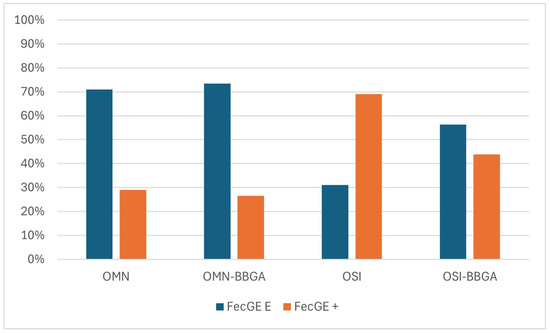
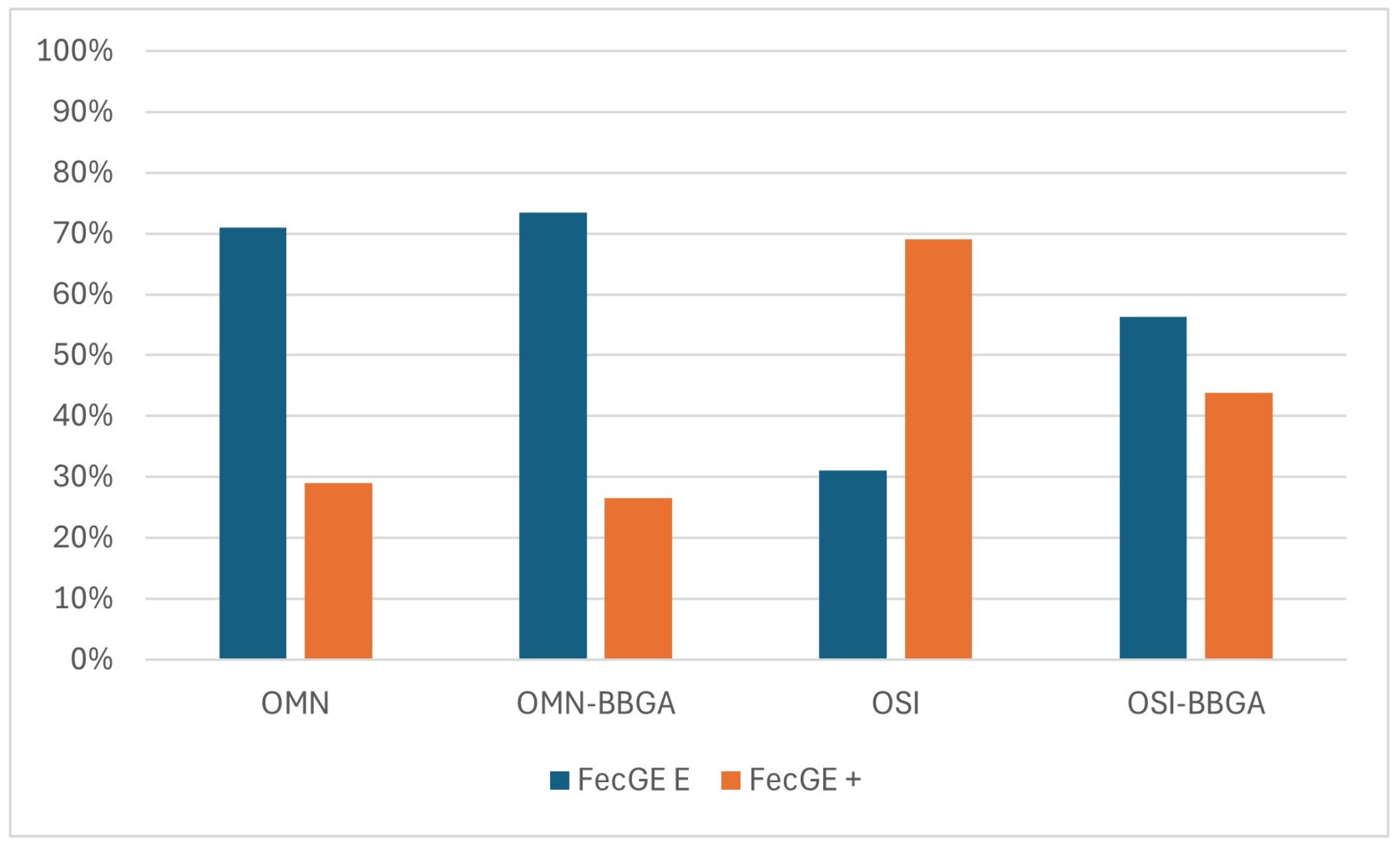
Comparison of Morada Nova and Santa Inês samples conserved in situ versus ex situ revealed that the BBGA germplasm closely resembled the conservation nuclei, with the FecGE mutant allele present in both hair breeds (Figure 1). In Morada Nova, the mutant allele E was found at similarly high frequencies, slightly above 70%, in both populations. In contrast, Santa Inês from the BBGA exhibited a higher frequency of the FecGE allele (56%) compared with the in situ conserved samples (31%), indicating a potential enrichment of the mutant allele in the ex situ germplasm collection.
Figure 1.
Comparison of allelic frequencies (%) of the FecGE (GDF9) between the two most important Brazilian hair sheep genetic resources, conserved in situ at Embrapa’s conservation nuclei and ex situ at the Brazilian Animal Germplasm Bank (BBGA). OMN = Morada Nova (N = 129); OMN-BBGA (N = 32); OSI = Santa Inês (N = 233); OSI-BBGA (N = 16).
3.3. Linkage Disequilibrium Analysis of GDF9
Using the D’ and r2 statistics, linkage disequilibrium (LD) among 10 GDF9 markers (G1, G3, 3655, G4, 3776, FecGE, FecGEII, FecGEI, rs425223128, rs40376560) was assessed for each locally adapted breed separately. LD among the analyzed SNPs varied across breeds but consistently highlighted regions of strong allelic association, especially between FecGEI and FecGEII and between rs40376560 and FecGE across most breeds, as values of r2 > 0.33 are in LD [31]. In the Brazilian Blackbelly and Brazilian Bergamasca, most SNP pairs exhibited high D’ values, indicating strong historical LD, with the highest r2 observed between rs40376560 and FecGE (r2 = 0.88), suggesting this pair as highly predictive. Morada Nova and Santa Inês exhibited similar LD blocks, reflecting selection for reproductive traits, while Crioula showed a mixed LD pattern, with strong associations for G3–FecGEII (r2 = 0.76). Complete D’ and r2 results for the analyzed breeds are provided in Table S3. To visualize allelic correspondence among SNP positions, a multiple alignment of GDF9 sequences including SNP positions used in the LD analysis was generated (Figure S1).
3.4. Coat Color-Related SNPs
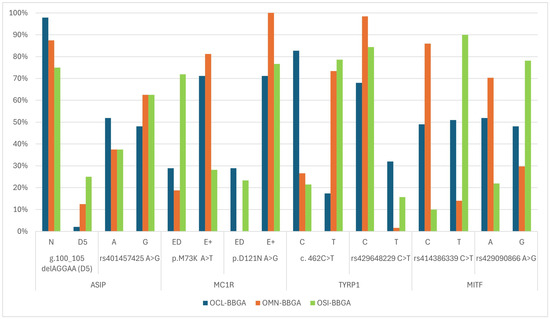
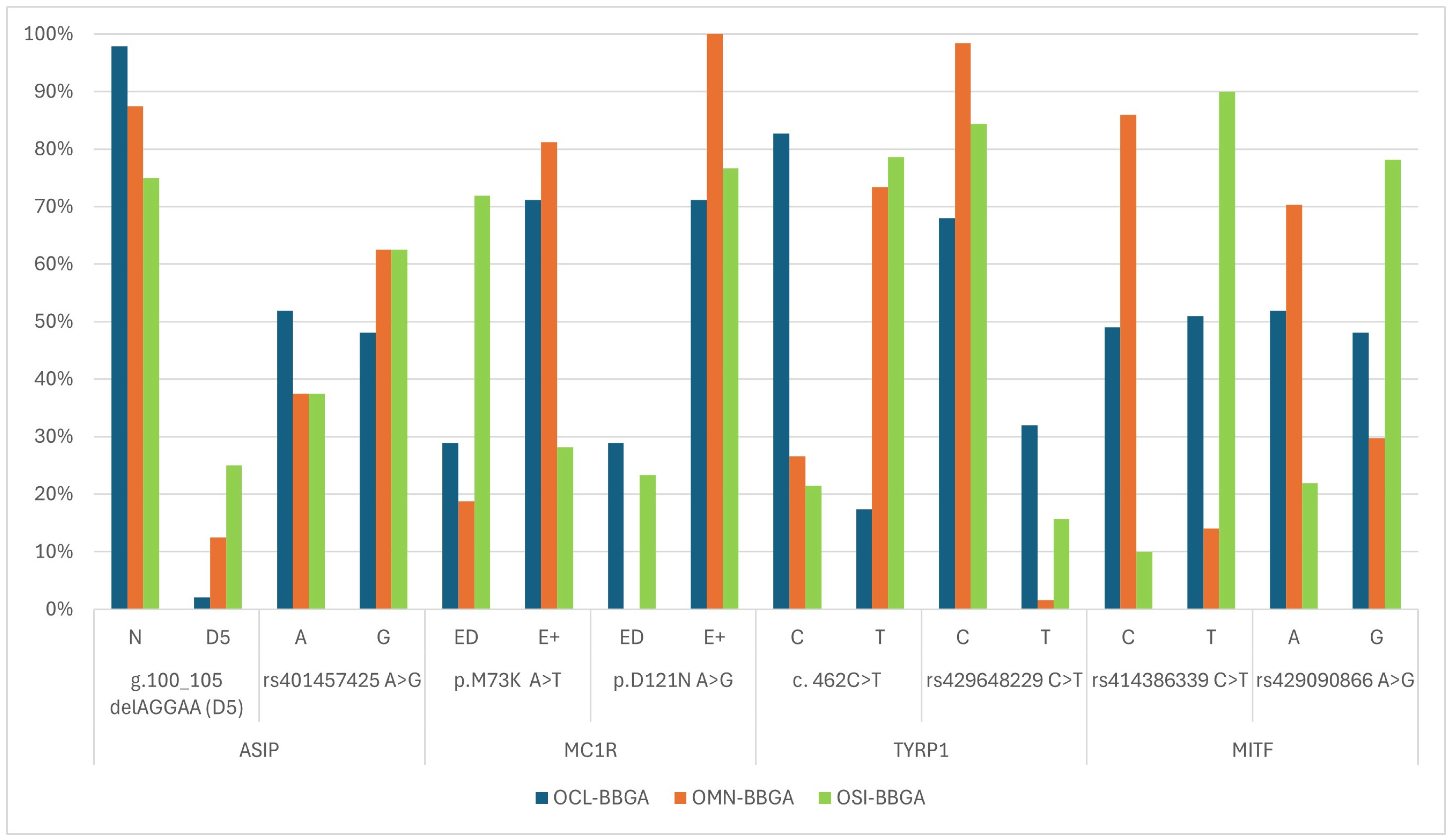
Allele frequency analysis of the ASIP gene (chromosome 13: 63,591,538–63,668,259, ovine reference genome ARS-UI_Ramb_v3.0, NC_056066.1) in in situ samples showed that at locus g.100-105del (D5), located in exon 2, the 5 bp insertion (N) is the most frequent in most breeds, except for Corriedale, a commercial breed characterized by its white wool, which showed a higher frequency (62%) for the deletion (D5) variant (Table 3). In the BBGA sample set, the deletion variant, linked to the dark coat phenotype, was detected at low frequencies in locally adapted Crioula, Morada Nova and Santa Inês (Figure 2).
Table 3.
Allelic frequencies of eight coat color-related SNPs in the genes ASIP, MC1R, TYRP1 and MITF in the main sheep breeds in Brazil.
Figure 2.
Allelic frequencies (%) of eight SNPs in the ASIP, MC1R, TYRP1 and MITF genes in ram samples of the Brazilian Animal Germplasm Bank (BBGA), distributed across the breeds: OCL-BBGA—Crioula (N = 26); OMN-BBGA—Morada Nova (N = 32) and OSI-BGGA—Santa Inês (N = 16).
In the MC1R gene (chromosome 14: 14,251,730–14,252,683; ovine reference genome ARS-UI_Ramb_v3.0, NC_056067.1), two SNPs located in exon 1 were analyzed: p.M73K (codon 73) and p.D121N (codon 121). In both these markers, the E+ allele was the most prevalent among white-coated breeds, being fixed in Brazilian Bergamasca, Corriedale, Hampshire, Pantaneiro, Suffolk, and Texel. Conversely, dark-coated breeds such as Crioula, Damara, Santa Inês, Dorper, and Brazilian Somali exhibited higher frequencies of the Eᴰ allele, consistent with the well-established dominance pattern between these variants (Table 3). In the BBGA, the E+ and E+ alleles at variants p.M73K and p.D121N predominated in the Crioula and Morada Nova. However, in the Santa Inês, the Eᴰ allele (p.M73K A>T), associated with darker pigmentation, had a higher frequency (72%), contrasting with 77% of frequency of allele E+ in the p.M73K (Figure 2).
In the TYRP1 gene (chromosome 2: 81,182,552–81,200,943; ovine reference genome ARS-UI_Ramb_v3.0, NC_056055.1), two SNPs were analyzed: c. 462C>T (exon 1) and rs429648229 C>T (exon 2). The C allele at the c.462C>T locus was the most frequent across ten breeds, except for Brazilian Bergamasca, Damara, Morada Nova, Brazilian Fat-tail, and Santa Inês, where the T allele predominated (Table 3). Similarly, Morada Nova and Santa Inês from the BBGA also had allele T as the most frequent (Figure 2). At the rs429648229 C>T locus, the C allele was fixed in Morada Nova and represented the most frequent variant in nearly all breeds conserved in situ, which can also be observed in the BBGA samples (Figure 2). Genotypic frequencies of the eight SNPs located in ASIP, MC1R, TYRP1 and MITF are available in Table S4.
3.5. Haplotypic Frequencies of Coat Color-Related SNPs
Haplotype frequencies of the MC1R and TYRP1 genes were estimated based on the location of SNPs within their respective genes. As previously mentioned, in the MC1R gene, the variants analyzed were p.M73K and p.D121N. Three distinct haplotypes were identified: Haplotype 1 (E+/E+), associated with the white coat phenotype; Haplotype 2 (E+/Eᴰ); and Haplotype 3 (Eᴰ/Eᴰ), associated with dark fleece (Table 4).
Table 4.
Estimated haplotypic frequencies based on two SNPs in the MC1R gene and two SNPs in the TYRP1 gene across Brazilian sheep breeds.
Haplotype 1 was identified in nearly all breeds, except Dorper, and was fixed in six wool breeds: Brazilian Bergamasca, Corriedale, Hampshire, Pantaneiro, Suffolk, and Texel (Table 4). Haplotype 2 was absent in Brazilian Somali, which was nearly fixed for Haplotype 3 (99%), as well as in Brazilian Bergamasca and Pantaneiro, both fixed for Haplotype 1 (100%). Additionally, Haplotype 2 wasn’t observed in the Crioula, with frequencies split between Haplotypes 1 (49%) and 3 (51%). Haplotype 3 was detected in the Crioula, Dorper, Ile de France, Santa Inês, and Brazilian Somali, but was absent in white-wooled commercial breeds and in the Morada Nova, which, although black-coated individuals are included, does not officially register this phenotype in the breeders’ association.
In the TYRP1 gene, two SNPs were analyzed: c. 462C>T and rs429648229 C>T, and four haplotypes were identified: Haplotype 4 (C/C), Haplotype 5 (C/T), Haplotype 6 (T/C), and Haplotype 7 (T/T), with Haplotype 4 being the most frequent, present in all genotyped breeds (Table 4).
3.6. Association Between Prolificacy and Coat Color
The independence chi-squared test with Monte Carlo simulation revealed statistically significant associations among the analyzed markers. Specifically, the comparison between FecGE and p.M73K A>T yielded X2 = 37.95, p < 0.001 (Bonferroni-adjusted p = 0.0003), P and p.D121N A>G showed X2 = 19.56, p < 0.001 (adjusted p = 0.0012), and the comparison between p.M73K A>T and p.D121N A>G yielded X2 = 68.76, p < 0.001 (adjusted p = 0.0003). These results indicate significant non-random distribution of genotypes among the SNPs.
4. Discussion
Following [32], a stringent threshold (>0.90) was applied to genotype calls, as the manufacturer’s recommendation (>0.75) yielded inconsistent heterozygous calls on the Fluidigm platform. Although this excluded several samples and SNPs with low call rates, it reflects reduced reliability at lower thresholds rather than assay failure. These discrepancies were not attributable to primer design quality, as assessed using the D3 design tool; however, prolonged shipping and suboptimal reagent storage conditions in Brazil may have contributed to reduced performance in some reactions. Additionally, several markers were developed initially using European reference genomes, and mismatches caused by population-specific polymorphisms may have impaired primer annealing and, consequently, call rates and QC values in Brazilian breeds.
As expected for the breeds analyzed, a relatively high proportion of monomorphic markers was detected, particularly in the BMP15 and BMPR1B genes. These genes are mainly associated with prolificacy in sheep of European origin. They are not responsible for the trait in Brazilian locally adapted breeds [15], which explains their limited informativeness in our dataset. Given their limited relevance for autochthonous breeds in the country, markers in these genes should be excluded from future studies. Aligned with a previous study [33], the revised panel will retain only informative, non-linked, and consistently performing loci, thereby improving analytical accuracy and overall robustness. This optimization will also facilitate the transfer of specific trait-associated markers (e.g., coat color) to more widely accessible platforms such as real-time PCR, enhancing applicability for routine genotyping.
GDF9 is an important gene associated with prolificacy in Brazilian sheep. Previously, the FecGE mutation was reported by [13] in Santa Inês animals and posteriorly observed in the Morada Nova breed by [14] and confirmed in both breeds in a subsequent study [34]. Subsequently, the mutation was first reported outside Brazil by [35] in Pelibuey ewes from Mexico, which is also classified as a hair breed. Sheep homozygous for the mutation E/E display a hyperprolific phenotype, with a considerable increase in ovulation rate (82%) and prolificacy (58%) when compared to animals homozygous for the wild type genotype (+/+) [13]. Therefore, FecGE can be strategically used to enhance prolificacy in these hair sheep breeds, as observed in Morada Nova and Santa Inês, considering risks such as elevated inbreeding.
In the present study, in addition to being present in Morada Nova and Santa Inês, the FecGE mutation was found at high frequency in the Brazilian Blackbelly (76%) and at considerable frequencies in the Brazilian Fat-tail (0.43) and the Brazilian Somali (0.30). A previous report documented a high reproductive performance in Brazilian Blackbelly, including the exclusive occurrence of triplet births (3.3%) and the greatest frequency of twins (37%), in contrast to Morada Nova (22%) and Santa Inês (9.5%) [36]. Interestingly, Brazilian Blackbelly is closely related to the Barbados Blackbelly [37], a breed that originated from the Caribbean Sea and historically described as prolific and resilient, despite the lack of empirical support for these traits [38]. Previous investigations in the Barbados Blackbelly reported the absence of Booroola FecB (BMPR1B) and FecXI (BMP15) mutations [39]. Additionally, the 3′ end regions of the GDF9 and BMPR1B genes were analyzed in Blackbelly from Mexico, but no mutations associated with prolificacy were identified [40].
The present findings therefore offer the first direct evidence on the molecular basis of prolificacy in Brazilian Blackbelly. Furthermore, based on reports in other American hair sheep, such as Santa Inês, Morada Nova, and Pelibuey [13,14,35], we hypothesize that FecGE represents the primary mutation influencing prolificacy across hair breeds of the Neotropics. This hypothesis is reinforced by the exclusive occurrence of the FecGE mutation in locally adapted hair sheep, as most wool breeds genotyped here, including Crioula, lacked the E allele. Only Brazilian Bergamasca and Pantaneiro exhibited low residual frequencies, likely due to historical introgression from Santa Inês to improve meat traits [37,41].
Other mutations evaluated in the GDF9 gene include G1, G3, and G4, previously genotyped in Cambridge and Belclare sheep, both European breeds [2]. Whereas G1 and G3 are nonfunctional mutations, G4 results in an amino acid substitution, making this variant potentially functional. However, a recent study in Hu sheep found no significant association with prolificacy [42]. In the present study, the wild-type allele A was the most frequent across all Brazilian locally adapted breeds genotyped, suggesting that it does not explain prolificacy in these breeds. Although some of the studied mutations, such as variants 3655, 3776, and rs425223128, showed low polymorphism in most breeds, further research is essential to clarify the role of these and other GDF9 variants in the prolificacy of Brazilian sheep.
The LD analysis indicated a strong linkage among some GDF9 variants, which is noteworthy, particularly given the importance of the FecGE mutation for prolificacy in Brazilian hair sheep and its association with rs40376560. The strong LD between these SNPs indicates that rs40376560 can serve as a reliable and cost-effective proxy for FecGE genotyping, facilitating future association studies and marker-assisted selection (MAS), especially given the challenges of designing FecGE allele-specific primers for TaqMan assays. Furthermore, while several marker pairs showed D’ = 1 but low r2, they were not interpreted as functionally linked without further validation. Overall, LD patterns differ among breeds, reflecting, in particular, their demographic histories and selective pressures. For example, Morada Nova and Santa Inês exhibit similar LD patterns, likely due to selection for prolificacy.
In the analysis of coat color-related genes, particularly in the TYRP1 gene, the loci c.462C>T (silent mutation) and rs429648229 C>T (mutation with no known effect) do not alter amino acids and therefore do not affect enzymatic activity [43]. Thus, they are unlikely to explain coat color variation in Brazilian breeds. Consistently, an earlier investigation reported no association between 18 SNPs in TYRP1 and coat color parameters in Crioula sheep, an important locally adapted wool breed in Brazil [17]. In the MITF gene, at the rs414386339 C>T locus, the T allele was the most frequent in commercial breeds, whereas allele C predominated in most autochthonous breeds, such as Brazilian Blackbelly, Brazilian Bergamasca, Morada Nova, Pantaneiro, Brazilian Fat-tail, and Santa Inês, a pattern observed in samples of in situ populations and the BBGA germplasm. Although no functional role has yet been demonstrated for this mutation [8], its potential involvement in the white-body/black-head phenotype warrants further investigation, as the T allele was nearly fixed in Dorper, Damara, Hampshire, and Brazilian Somali, all characterized by this pattern. At the rs429090866 A>G locus, previously associated with coat color variation from white to black [8], the G allele was predominant in most breeds, except in Morada Nova and Brazilian Fat-tail, which include white and red varieties as recognized by ARCO.
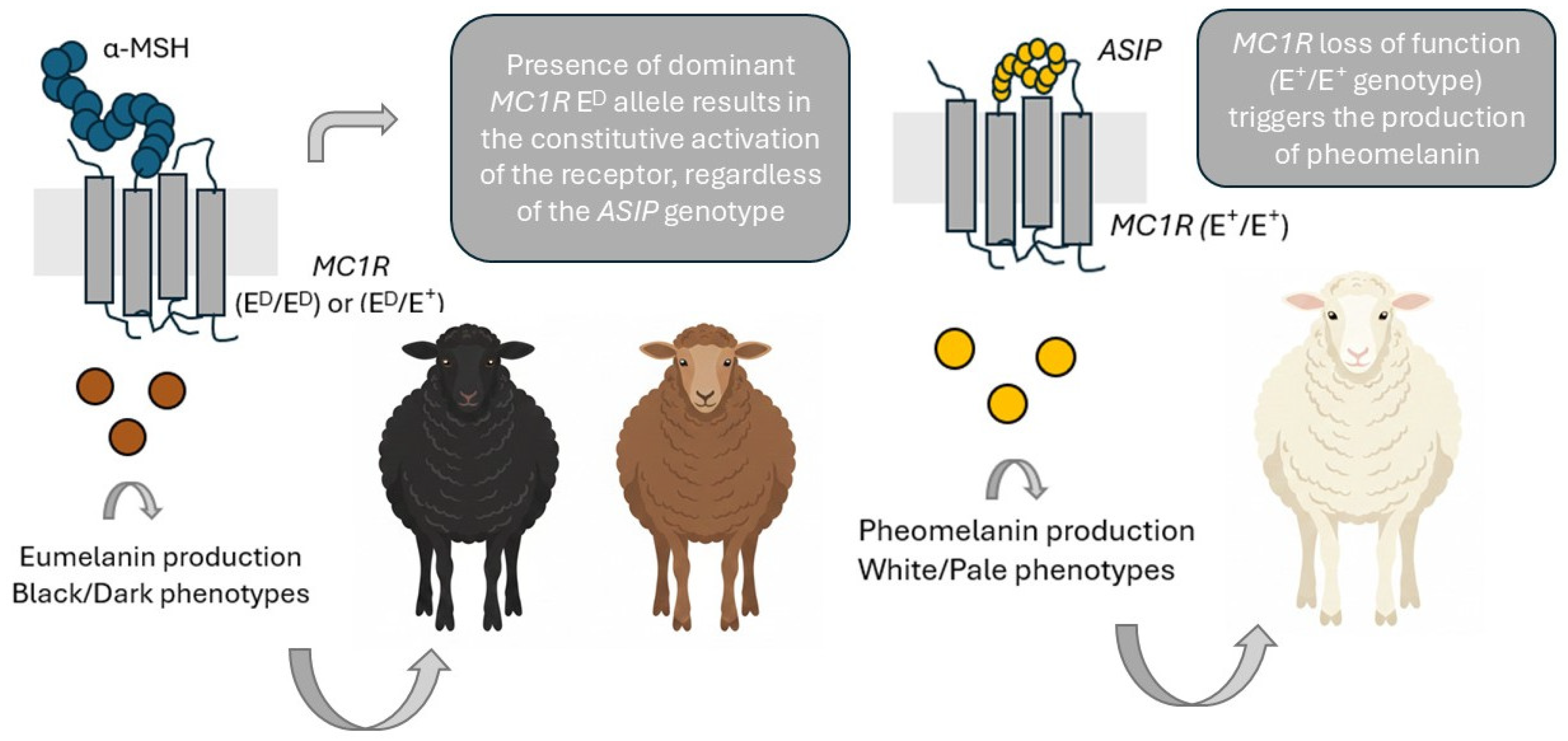
Previously, ASIP gene variants have been linked to recessive black coat color, particularly the D5 deletion [44,45]. However, epistatic interactions between ASIP and MC1R, reported in several sheep breeds [17,18,46,47,48], may explain the high frequency of D5 in Corriedale sheep, where the E+/E+ alleles at MC1R suppress its phenotypic expression. Nevertheless, the 5-bp insertion (N) was the most frequent variant across all breeds, including BBGA samples. A conceptual diagram illustrating the epistatic interaction between ASIP and MC1R is presented in Figure 3. At the rs401457425 A>G locus, the A allele, dominant for white fleece in Finnsheep [8], was generally less frequent, except in Brazilian Blackbelly, Damara, Brazilian Fat-tail, and Brazilian Somali, all hair sheep breeds. In the woolly Crioula, frequencies were balanced for both alleles in both in situ and ex situ conserved samples. Although linked to white fleece in Finnsheep, further studies are needed to clarify its role in Brazilian breeds and its potential contribution to coat color in hair sheep.
Figure 3.
Epistatic interaction between ASIP and MC1R in sheep pigmentation. The dominant MC1R allele (Eᴰ) constitutively activates the receptor and drives eumelanin production regardless of ASIP status. MC1R loss-of-function (E+/E+) results in pheomelanin synthesis. Generally, the presence of the MC1R wildtype allele is required for the observation of ASIP products, demonstrating classical epistasis between the two genes.
In Crioula sheep, ASIP deletions at D5 and D9 were previously reported to have low homozygous frequencies [18]. However, the present study found a higher proportion of D5/D5 animals in this breed, likely due to a larger sample size and methodological differences, given the limited reliability of Fluidigm genotyping for large indels, as noted in the D3 manual, available at https://d3.fluidigm.com/ (accessed on 27 November 2025). Although D5 and D9 deletions are not significantly associated with coat color in Crioula sheep [18], evidence suggests that, together with g.5172T>A and epistatic interactions with MC1R alleles (E+, Eᴰ), they contribute to the breed’s phenotype [17,18]. However, in the present study, given the reliability issues with the D5 indel and the performance problems of g.5172T>A, only the MC1R gene SNPs from the reduced panel were used for the Crioula breed, as they already enable reliable inference of the phenotype in this breed.
In the MC1R gene, previous studies in Crioula sheep identified the dominant ED allele of variants p.M73K and p.D121N as associated with dark fleece. In contrast, the recessive E+ allele is associated with white fleece and occurs only in homozygosity in white individuals [17,49]. Consistently, the present study revealed a predominance of the E+/E+ haplotype across most analyzed breeds, particularly those with predominantly white coats, in both BBGA and in situ samples. In contrast, ED/ED was less frequent and was restricted to Crioula, Dorper, Santa Inês, and Brazilian Somali, breeds that exhibit coat color variation or produce black-headed individuals. Notably, in Crioula sheep, ED/ED (51%) and E+/E+ (49%) were evenly distributed, reflecting the breed’s characteristic phenotypic diversity, with naturally colored fleece ranging from white to black, including gray and brown.
The MC1R gene has previously been identified as a determinant of coat color variation in Santa Inês ewes [50]. In this study, all three described haplotypes (E+/E+, E+/Eᴰ, and Eᴰ/Eᴰ) were observed in the breed, consistent with their recognized phenotypic diversity, as Santa Inês has four officially accepted coat color patterns. These findings reinforce the functional association between MC1R alleles and coat color expressions in this breed. The dominant ED allele predominates in dark breeds [51,52], whereas it is uncommon in colored animals, suggesting the involvement of other genetic factors in coat color regulation [46,51,52,53,54]. In this study, ED was found at low frequency in the Morada Nova, where only the E+/E+ and Eᴰ/E+ haplotypes were detected, the latter being less frequent. This breed has only two ARCO-recognized varieties, red and white. Black-coated animals, though not uncommon in flocks, are generally excluded from registration [55,56], which may explain the presence of the ED allele in Morada Nova.
Several studies have aimed to elucidate the genetic mechanisms of coat color in small ruminants [57,58,59,60,61,62]. However, in the Brazilian context, research on this topic remains scarce, particularly in hair sheep breeds such as Santa Inês and Morada Nova, where environmental adaptation plays a significant role. It’s worth noting that although the sample sizes were sufficient to capture the genetic variability of the major locally adapted breeds (Santa Inês, Morada Nova, and Crioula), commercial breeds represented by fewer individuals (e.g., Damara, N = 10; Texel, N = 14) may lack rare alleles, which should be considered when interpreting the results. In general, germplasm samples preserved in the BBGA retain the genetic diversity observed in populations conserved in situ, reflecting their representativeness for both traits under study. This indicates the effectiveness of the gene bank in capturing allelic variation in locally adapted populations, which can provide further support for future use of these samples in conservation, breeding, and genomic studies.
A significant non-random distribution of genotypes was observed between prolificacy and coat-color-related loci, indicating a statistical association between the analyzed variants in locally adapted hair sheep. However, these results should be interpreted with caution, as the analyses were restricted to genotypic data only; the phenotypic effects of heterozygous genotypes remain unconfirmed for prolificacy, and coat color determination involves additional, untested loci. Notably, there is no established evidence linking coat color genetics directly to prolificacy in sheep, as most pigmentation studies focus on breed identification, wool, or skin traits rather than reproductive performance. Previous phenotypic studies in Mexican and West African hair sheep [63,64] have suggested potential correlations between coat color and reproduction in some populations, yet these associations are likely influenced by environmental and management factors and do not involve specific genetic markers. In the present study, the observed genotypic associations likely reflect population substructure within the five investigated breeds rather than a direct functional link between prolificacy and coat color. Future studies combining genotypic and phenotypic data are required to accurately assess potential functional relationships between these traits.
This study represents the first genetic screening of prolificacy and coat color-related mutations across a wide range of sheep breeds adapted to Brazilian environments. The results provide previously unavailable information on the distribution and relevance of key functional variants, offering a practical genetic framework for national breeding programs and conservation planning. The reduced SNP panel proved generally effective for identifying mutations of interest, supporting its applicability as a targeted tool for marker-assisted selection. Nonetheless, refinement is warranted, including the exclusion of noninformative variants and reassessment of the Fluidigm platform in favor of more robust genotyping alternatives to address the low call rates observed. Overall, this report addresses a critical genomic gap and provides actionable insights to strengthen selection strategies and the management of locally adapted genetic resources.
Refining the panel also has practical value for breed registration and certification, particularly when coat color is a defining breed attribute. The reduced SNP panel could be further validated for certification purposes, as previously demonstrated for coat color markers in sheep [61,65,66,67]. This would enable the inclusion of individuals not yet officially recognized within their respective breeds, while supporting genetic conservation programs and enhancing the commercial value of animal-derived products. In breeds with strict color standards or regulated pattern requirements, such as Crioula or Morada Nova, inaccurate genotyping of ASIP or MC1R variants could lead to misclassification, compromising both pedigree authentication and conservation records. An optimized, population-adjusted marker set will therefore support more reliable verification of color-based eligibility criteria and avoid erroneous exclusion or approval of animals in formal registry processes.
5. Conclusions
- This report highlights the predominant role of the FecGE (GDF9) variant in the prolificacy of Brazilian locally adapted hair sheep, reporting for the first time a high frequency of this mutation in the Brazilian Blackbelly, which provides new insights into the genetic basis of the high prolificacy in this breed.
- Genetic diversity was observed between wool/hair and local/commercial breeds, which exhibited distinct allelic, genotypic, and haplotypic frequencies for the studied markers. This result reflects the phenotypic diversity observed in these breeds and may aid conservation and certification efforts.
- The Brazilian Animal Germplasm Bank seems to retain the genetic diversity found in populations conserved in situ, underscoring its strategic role in conservation efforts.
- The reduced SNP panel effectively genotyped the diversity of Brazilian sheep, confirming which markers are present and segregating in locally adapted breeds. Its applicability could be enhanced by excluding markers of limited relevance.
Supplementary Materials
The following supporting information can be downloaded at: https://www.mdpi.com/article/10.3390/ani16132008/s1, Table S1: Prolificacy and Coat Color-associated markers genotyped in the genes BMPR1B, BMP15, GDF9, ASIP, MC1R, TYRP1 and MITF; Table S2: Genotypic frequencies of 12 SNPs located in BMP15, BMPR1B and GDF9 genes in Brazilian sheep; Table S3: D’ and r2 estimates of linkage disequilibrium among 10 GDF9 SNPs in Brazilian sheep breeds; Figure S1: Multiple sequence alignment of GDF9 gene highlighting the positions of each marker analyzed for linkage disequilibrium; Table S4: Genotypic frequencies of eight SNPs located in the genes ASIP, MC1R, TYRP1 and MITF in the main sheep breeds of Brazil. References [2,8,43,45,51,68,69,70,71,72,73] are cited in the supplementary materials.
Author Contributions
Conceptualization: D.A.d.F., A.R.C., S.R.P. and C.M.; Data Curation: C.S.R., D.A.d.F. and A.R.C.; Methodology: C.S.R. and D.A.d.F.; Formal analysis: C.S.R. and D.A.d.F.; Writing (original draft): C.S.R.; Writing (review and editing): C.S.R., D.A.d.F., H.C.A., K.d.M.S., O.F., S.A.S., R.M.B., A.R.C., J.C.F.M., C.J.H.d.S., S.R.P. and C.M.; Resources: H.C.A., K.d.M.S., O.F., S.A.S., R.M.B., A.R.C., J.C.F.M., C.J.H.d.S. and S.R.P.; Supervision: D.A.d.F., S.R.P. and C.M.; Project administration: A.R.C., S.R.P. and C.M.; Funding Acquisition: H.C.A., K.d.M.S., O.F., S.A.S., R.M.B., A.R.C., J.C.F.M., C.J.H.d.S. and S.R.P. All authors have read and agreed to the published version of the manuscript.
Funding
This research was funded by Fundação de Apoio à Pesquisa do Distrito Federal—FAPDF, project number: 0193.001203/2016. This study was financed in part by the Coordenação de Aperfeiçoamento de Pessoal de Nível Superior—Brasil (CAPES)—Finance Code 001, and by the Conselho Nacional de Desenvolvimento Científico e Tecnológico (CNPq) (grant numbers PDS-10711-2024-7 and 312393/2025-3).
Institutional Review Board Statement
Ethical review and approval were waived for this study because it involved only the analysis of previously collected biological samples obtained from the DNA and tissues bank of the Embrapa Genetic Resources and Biotechnology and the Brazilian Animal Germplasm Bank (BBGA). No animals were handled or sampled specifically for this research.
Informed Consent Statement
Not applicable.
Data Availability Statement
Data available on request due to restrictions.
Conflicts of Interest
Authors Hymerson Costa Azevedo, Kleibe de Moraes Silva, Olivardo Facó, Sandra Aparecida Santos, Ramayana Menezes Braga, Alexandre Rodrigues Caetano, José Carlos Ferrugem Moraes, Carlos José Hoff de Souza and Samuel Rezende Paiva are employed by the Brazilian Agricultural Research Corporation (Embrapa). Whole blood samples from sheep of 15 breeds were accessed from the DNA and tissues bank of the Embrapa Genetic Resources and Biotechnology, located in Brasília, Brazil. Semen samples were assessed from the Brazilian Animal Germplasm Bank (BBGA), also located at the Embrapa Genetic Resources and Biotechnology. The remaining authors declare that the research was conducted in the absence of any commercial or financial relationships that could be construed as a potential conflict of interest.
References
- Galloway, S.M.; McNatty, K.P.; Cambridge, L.M.; Laitinen, M.P.; Juengel, J.L.; Jokiranta, T.S.; McLaren, R.J.; Luiro, K.; Dodds, K.G.; Montgomery, G.W.; et al. Mutations in an oocyte-derived growth factor gene (BMP15) cause increased ovulation rate and infertility in a dosage-sensitive manner. Nat. Genet. 2000, 25, 279–283. [Google Scholar] [CrossRef] [Scilit] [PubMed]
- Hanrahan, J.P.; Gregan, S.M.; Mulsant, P.; Mullen, M.; Davis, G.H.; Powell, R.; Galloway, S.M. Mutations in the Genes for Oocyte-Derived Growth Factors GDF9 and BMP15 are associated with both increased ovulation rate and sterility in Cambridge and Belclare sheep (Ovis aries). Biol. Reprod. 2004, 70, 900–909. [Google Scholar] [CrossRef] [Scilit] [PubMed]
- Mulsant, P.; Lecerf, F.; Fabre, S.; Schibler, L.; Monget, P.; Lanneluc, I.; Pisselet, C.; Riquet, J.; Monniaux, D.; Callebaut, I.; et al. Mutation in bone morphogenetic protein receptor-IB is associated with increased ovulation rate in Booroola Mérino ewes. Proc. Natl. Acad. Sci. USA 2001, 98, 5104–5109. [Google Scholar] [CrossRef] [Scilit]
- Tong, B.; Wang, J.; Cheng, Z.; Liu, J.; Wu, Y.; Li, Y.; Bai, C.; Zhao, S.; Yu, H.; Li, G. Novel variants in GDF9 gene affect promoter activity and litter size in Mongolia sheep. Genes 2020, 11, 375. [Google Scholar] [CrossRef] [Scilit]
- Bennett, D.C.; Lamoreux, M.L. The color loci of mice: A genetic century. Pigment Cell Res. 2003, 16, 333–344. [Google Scholar] [CrossRef] [Scilit]
- Searle, A.G. Comparative Genetics of Coat Colour in Mammals; Logos Press: London, UK, 1968. [Google Scholar]
- Våge, D.I.; Klungland, H.; Lu, D.; Cone, R.D. Molecular and pharmacological characterization of dominant black coat color in sheep. Mamm. Genome 1999, 10, 39–43. [Google Scholar] [CrossRef] [Scilit]
- Li, M.H.; Tiirikka, T.; Kantanen, J. A genome-wide scan study identifies a single nucleotide substitution in ASIP associated with white versus non-white coat-colour variation in sheep (Ovis aries). Heredity 2014, 112, 122–131. [Google Scholar] [CrossRef] [Scilit]
- Mura, M.C.; Cosso, G.; Ouadday, M.; Hosri, C.; Starič, J.; Nehme, M.; Carcangiu, V.; Luridiana, S. Identifying key genetic factors influencing reproductive performance in dairy and meat sheep breeds of the Mediterranean region. Reprod. Domest. Anim. 2025, 60, e70039. [Google Scholar] [CrossRef] [Scilit]
- Wang, J.; Liu, Y.; Guo, S.; Di, R.; Wang, X.; He, X.; Chu, M. Polymorphisms of the BMPR1B, BMP15 and GDF9 fecundity genes in four Chinese sheep breeds. Arch. Anim. Breed. 2024, 67, 51–60. [Google Scholar] [CrossRef] [Scilit]
- Yang, Q.; Chen, J.; Nie, S.; Liu, C.; Deng, H.; He, G. Fine-scale biogeographical ancestry inference in Southeast and East Asians via high-efficiency markers and machine learning approaches. Front. Ecol. Evol. 2025, 13, 1572596. [Google Scholar] [CrossRef] [Scilit]
- Ajafar, M.H.; Kadhim, A.H.; Al-Thuwaini, T.M. The Reproductive Traits of Sheep and Their Influencing Factors. Rev. Agric. Sci. 2022, 10, 82–89. [Google Scholar] [CrossRef] [Scilit]
- Silva, B.D.M.; Castro, E.A.; Souza, C.J.H.; Paiva, S.R.; Sartori, R.; Franco, M.M.; Azevedo, H.C.; Silva, T.A.S.N.; Vieira, A.M.C.; Neves, J.P.; et al. A new polymorphism in the Growth and Differentiation Factor 9 (GDF9) gene is associated with increased ovulation rate and prolificacy in homozygous sheep. Anim. Genet. 2011, 42, 89–92. [Google Scholar] [CrossRef] [Scilit]
- Lacerda, T.S.A.; Caetano, A.R.; Facó, O.; Faria, D.A.F.; McManus, C.M.; Lôbo, R.N.B.; Silva, K.M.; Paiva, S.R. Single marker assisted selection in Brazilian Morada Nova hair sheep community-based breeding program. Small Rumin. Res. 2016, 139, 15–19. [Google Scholar] [CrossRef] [Scilit]
- Holanda, G.M.L.; Oliveira, J.C.; Silva, D.M.F.; Rocha, S.S.N.; Pandolfi, V.; Adrião, M.; Wischral, A. Survey of mutations in prolificacy genes in Santa Inês and Morada Nova sheep. Arq. Bras. Med. Vet. Zootec. 2017, 69, 1047–1053. [Google Scholar] [CrossRef] [Scilit]
- Visser, C.; Retief, A.; Molotsi, A.H. Genetics underlying phenotypic diversity in South African sheep breeds. Small Rumin. Res. 2025, 247, 107499. [Google Scholar] [CrossRef] [Scilit]
- Hepp, D.; Gonçalves, G.L.; Moreira, G.R.; Freitas, T.R.d. Epistatic interaction of the melanocortin 1 receptor and agouti signaling protein genes modulates wool color in the Brazilian Creole sheep. J. Hered. 2016, 107, 544–552. [Google Scholar] [CrossRef] [Scilit] [PubMed]
- Cavalcanti, L.C.G.; Moraes, J.C.F.; Faria, D.A.; McManus, C.M.; Nepomuceno, A.R.; Souza, C.J.H.; Caetano, A.R.; Paiva, S.R. Genetic characterization of coat color genes in Brazilian Crioula sheep from a conservation nucleus. Pesqui. Agropecu. Bras. 2017, 52, 653–662. [Google Scholar] [CrossRef] [Scilit]
- Moreira, G.R.P. Conservation status of Creole sheep flocks in Brazil. Genet. Resour. 2022, 3, 68–74. [Google Scholar] [CrossRef] [Scilit]
- Moraes, J.C.F.; Hoff de Souza, C.J. Descrição da cor da pelagem em um rebanho de ovelhas Crioulas. In Documentos Embrapa Pecuária Sul, n. 114; Embrapa Pecuária Sul: Bagé, Brazil, 2011. [Google Scholar]
- McManus, C.; Louvandini, H.; Gugel, R.; Sasaki, L.C.; Bianchini, E.; Bernal, F.E.; Paiva, S.R.; Paim, T.P. Skin and coat traits in sheep in Brazil and their relation with heat tolerance. Trop. Anim. Health Prod. 2011, 43, 121–126. [Google Scholar] [CrossRef] [Scilit]
- Leite, J.H.G.M.; da Silva, R.G.; Asensio, L.A.B.; de Sousa, J.E.R.; da Silva, W.S.T.; da Silva, W.E.; Façanha, D.A.E. Coat color and morphological hair traits influence on the mechanisms related to heat tolerance in hair sheep. Int. J. Biometeorol. 2020, 64, 2185–2194. [Google Scholar] [CrossRef] [Scilit]
- McManus, C.M.; Paiva, S.R.; Araújo, R.O. Genetics and breeding of sheep in Brazil. Rev. Bras. Zootec. 2010, 39, 236–246. [Google Scholar] [CrossRef] [Scilit]
- Peakall, R.; Smouse, P.E. GenAlEx 6.5: Genetic analysis in Excel. Bioinformatics 2012, 28, 2537–2539. [Google Scholar] [CrossRef] [Scilit]
- Excoffier, L.; Lischer, H.E. Arlequin suite ver 3.5: A new series of programs to perform population genetics analyses under Linux and Windows. Mol. Ecol. Resour. 2010, 10, 564–567. [Google Scholar] [CrossRef] [Scilit] [PubMed]
- Shi, Y.Y.; He, L. SHEsis, a powerful software platform for analyses of linkage disequilibrium, haplotype construction, and genetic association at polymorphism loci. Cell Res. 2005, 15, 97–98. [Google Scholar] [CrossRef] [Scilit] [PubMed]
- Li, Z.; Zhang, Z.; He, Z.; Tang, W.; Li, T.; Zeng, Z.; He, L.; Shi, Y. A partition-ligation-combination-subdivision EM algorithm for haplotype inference with multiallelic markers: Update of the SHEsis. Cell Res. 2009, 19, 519–523. [Google Scholar] [CrossRef] [Scilit]
- Barrett, J.C.; Fry, B.; Maller, J.; Daly, M.J. Haploview: Analysis and visualization of LD and haplotype maps. Bioinformatics 2005, 21, 263–265. [Google Scholar] [CrossRef] [Scilit]
- Pearson, K. On the criterion that a given system of deviations from the probable in the case of a correlated system of variables is such that it can be reasonably supposed to have arisen from random sampling. Philos. Mag. 1900, 50, 157–175. [Google Scholar] [CrossRef] [Scilit]
- R Core Team. R: A Language and Environment for Statistical Computing; R Foundation for Statistical Computing: Vienna, Austria, 2025; Available online: https://www.r-project.org/ (accessed on 27 November 2025).
- Nei, M.; Li, W.H. Mathematical model for studying genetic variation in terms of restriction endonucleases. Proc. Natl. Acad. Sci. USA 1979, 76, 5269–5273. [Google Scholar] [CrossRef] [Scilit]
- Rodrigues, C.S.; de Faria, D.A.; Lacerda, T.S.; Paiva, S.R.; Caetano, A.R.; Blackburn, H.; McManus, C. Lentivirus susceptibility in Brazilian and US sheep with TMEM154 mutations. Genes 2022, 14, 70. [Google Scholar] [CrossRef] [Scilit]
- Panigrahi, M.; Rajawat, D.; Nayak, S.S.; Ghildiyal, K.; Sharma, A.; Jain, K.; Lei, C.; Bhushan, B.; Mishra, B.P.; Dutt, T. Landmarks in the history of selective sweeps. Anim. Genet. 2023, 54, 667–688. [Google Scholar] [CrossRef] [Scilit]
- Pereira, A.H.R.; Silveira, R.M.F.; Carrara, E.R.; de Moraes Silva, K.; Lobo, R.N.B.; de Faria, D.A.; Caetano, A.R.; Paiva, S.R.; Landim, A.V. Assessment of FecGE genotypes on reproductive traits in Brazilian Morada Nova and Santa Inês sheep. Trop. Anim. Health Prod. 2023, 55, 413. [Google Scholar] [CrossRef] [Scilit] [PubMed]
- Muñoz-García, C.; Vaquera-Huerta, H.; Gallegos-Sánchez, J.; Becerril-Pérez, C.M.; Tarango-Arámbula, L.A.; Bravo-Vinaja, Á.; Cortez-Romero, C. Influence of FecGᴱ mutation on the reproductive variables of Pelibuey ewes in the anestrus period. Trop. Anim. Health Prod. 2021, 53, 328. [Google Scholar] [CrossRef] [Scilit] [PubMed]
- Braga, R.M.; Mendonça, C.E.D.A. Considerações Sobre os Ovinos da Raça Brazilian Blackbelly: Aspectos Históricos e Ações de Pesquisa na Embrapa Roraima; Embrapa Roraima: Boa Vista, Brazil, 2018; Available online: http://www.infoteca.cnptia.embrapa.br/infoteca/handle/doc/1100839 (accessed on 2 December 2025).
- Paim, T.P.; Paiva, S.R.; de Toledo, N.M.; Yamaghishi, M.B.; Carneiro, P.L.S.; Facó, O.; de Araújo, A.M.; Azevedo, H.C.; Caetano, A.R.; Braga, R.M.; et al. Origin and population structure of Brazilian hair sheep breeds. Anim. Genet. 2021, 52, 492–504. [Google Scholar] [CrossRef] [Scilit]
- Roslan, M.S.; Mazlishah, M.S.H.; Mamat, N.; Abd Aziz, N.A.; Hashim, N.H.; Mohamad-Fauzi, N. Adaptability of Barbados Blackbelly Rams Towards Elevated Temperature–Humidity Index Assessed Through Reproductive Physiology and Behaviour. Small Rumin. Res. 2025, 253, 107645. [Google Scholar] [CrossRef] [Scilit]
- Davis, G.H.; Balakrishnan, L.; Ross, I.K.; Wilson, T.; Galloway, S.M.; Lumsden, B.M.; Hanrahan, J.P.; Mullen, M.; Mao, X.Z.; Wang, G.L.; et al. Investigation of the Booroola (FecB) and Inverdale (FecXI) mutations in 21 prolific breeds and strains of sheep sampled in 13 countries. Anim. Reprod. Sci. 2006, 92, 87–96. [Google Scholar] [CrossRef] [Scilit]
- López-Ramírez, R.B.; Magaña-Sevilla, H.F.; Zamora-Bustillos, R.; Ramón-Ugalde, J.P.; González-Mendoza, D. Analysis of the 3′ end regions of the GDF9 and BMPR1B genes in Blackbelly sheep from Yucatán, Mexico. Cienc. E Investig. Agrar. 2014, 41, 123–128. [Google Scholar] [CrossRef] [Scilit]
- Vargas Júnior, F.M.; Martins, C.F.; Feijó, G.L.D.; Teixeira, A.; Leonardo, A.P.; Ricardo, H.A.; Fernandes, A.R.M.; Reis, F.A. Evaluation of genotype on fatty acid profile and sensory of meat of indigenous Pantaneiro sheep and Texel or Santa Inês crossbred finished on feedlot. Small Rumin. Res. 2019, 173, 17–22. [Google Scholar] [CrossRef] [Scilit]
- Zhang, Y.; Wang, H.; Li, T.; Zhang, N.; Chen, J.; Yang, H.; Peng, S.; Ma, R.; Wang, D.; Liu, Q.; et al. Association of BMP15 and GDF9 Gene Polymorphisms with Litter Size in Hu Sheep. Genes 2025, 16, 168. [Google Scholar] [CrossRef] [Scilit]
- Deng, W.D.; Xi, D.M.; Gou, X.; Yang, S.L.; Shi, X.W.; Mao, H.M. Pigmentation in black-boned sheep (Ovis aries): Association with polymorphism of the Tyrosinase gene. Mol. Biol. Rep. 2008, 35, 379–385. [Google Scholar] [CrossRef] [Scilit]
- Lu, Z.; Yuan, C.; An, X.; Chen, Z.; Guo, T.; Liu, J. Chromosome-level genome assembly of Guide Black-Fur sheep (Ovis aries). Sci. Data 2024, 11, 711. [Google Scholar] [CrossRef] [Scilit]
- Norris, B.J.; Whan, V.A. A gene duplication affecting expression of the ovine ASIP gene is responsible for white and black sheep. Genome Res. 2008, 18, 1282–1293. [Google Scholar] [CrossRef] [Scilit]
- Fontanesi, L.; Dall’Olio, S.; Beretti, F.; Portolano, B.; Russo, V. Coat colours in the Massese sheep breed are associated with mutations in the agouti signalling protein (ASIP) and melanocortin 1 receptor (MC1R) genes. Animal 2011, 5, 8–17. [Google Scholar] [CrossRef] [Scilit] [PubMed]
- Rochus, C.M.; Westberg Sunesson, K.; Jonas, E.; Mikko, S.; Johansson, A.M. Mutations in ASIP and MC1R: Dominant black and recessive black alleles segregate in native Swedish sheep populations. Anim. Genet. 2019, 50, 712–717. [Google Scholar] [CrossRef] [Scilit] [PubMed]
- Dimov, D.; Kostova, M.; Vuchkov, A.; Dimitrova, I.; Kalaydzhiev, G.; Staykova, G.; Iliev, M.; Bozhilova, M. Genetic polymorphisms in Agouti signaling protein (ASIP) and melanocortin 1 receptor (MC1R) genes and their association with coat color in native Bulgarian sheep breeds. Small Rumin. Res. 2025, 249, 107517. [Google Scholar] [CrossRef] [Scilit]
- Hepp, D.; Gonçalves, G.L.; Moreira, G.R.; Freitas, T.R.; Martins, C.T.; Weimer, T.A.; Passos, D.T. Identification of the e allele at the Extension locus (MC1R) in Brazilian Creole sheep and its role in wool color variation. Genet. Mol. Res. 2012, 11, 2997–3006. [Google Scholar] [CrossRef] [Scilit]
- Jardim, J.G.; Quirino, C.R.; Bartholazzi Junior, A.; Lima, G.R.S.; Ortiz Vega, W.H.; Pacheco, A.; Corrêa, T.d.S.; Barros Freitas, A.C.; David, C.M.G.; Torres Geraldo, A. Variabilidade genética na cor da pelagem em polimorfismos do gene MC1R em ovinos da raça Santa Inês. Rev. Acad. Ciênc. Anim. 2018, 16, 1–12. [Google Scholar] [CrossRef] [Scilit]
- Våge, D.I.; Fleet, M.R.; Ponz, R.; Olsen, R.T.; Monteagudo, L.V.; Tejedor, M.T.; Arruga, M.V.; Gagliardi, R.; Postiglioni, A.; Nattrass, G.S.; et al. Mapping and characterization of the dominant black colour locus in sheep. Pigment Cell Res. 2003, 16, 693–697. [Google Scholar] [CrossRef] [Scilit]
- Royo, L.J.; Alvarez, I.; Arranz, J.J.; Fernández, I.; Rodríguez, A.; Pérez-Pardal, L.; Goyache, F. Differences in the expression of the ASIP gene are involved in the recessive black coat colour pattern in sheep: Evidence from the rare Xalda sheep breed. Anim. Genet. 2008, 39, 290–293. [Google Scholar] [CrossRef] [Scilit]
- Beraldi, D.; McRae, A.F.; Gratten, J.; Slate, J.; Visscher, P.M.; Pemberton, J.M. Development of a linkage map and mapping of phenotypic polymorphisms in a free-living population of Soay sheep (Ovis aries). Genetics 2006, 173, 1521–1537. [Google Scholar] [CrossRef] [Scilit]
- Traoré, A.; Royo, L.J.; Kaboré, A.; Pérez-Pardal, L.; Álvarez, I.; Fernández, I.; Sawadogo, L.; Tamboura, H.H.; Goyache, F. Allelic and genotypic frequencies of ASIP and MC1R genes in four West African sheep populations. Afr. J. Biotechnol. 2012, 11, 14136–14142. [Google Scholar] [CrossRef] [Scilit]
- Muniz, M.M.M.; Caetano, A.R.; McManus, C.; Cavalcanti, L.C.G.; Façanha, D.A.E.; Leite, J.H.G.M.; Facó, O.; Paiva, S.R. Application of genomic data to assist a community-based breeding program: A preliminary study of coat color genetics in Morada Nova sheep. Livest. Sci. 2016, 190, 89–93. [Google Scholar] [CrossRef] [Scilit]
- Shiotisuki, L.; Silva, P.H.T.; Silva, K.M.; Landim, A.V.; Morais, O.R.; Facó, O. The impact of racial pattern on the genetic improvement of Morada Nova sheep. Anim. Genet. Resour. 2016, 58, 73–82. [Google Scholar] [CrossRef] [Scilit]
- Zhang, L.; Sun, F.; Jin, H.; Dalrymple, B.P.; Cao, Y.; Wei, T.; Vuocolo, T.; Zhang, M.; Piao, Q.; Ingham, A.B. A comparison of transcriptomic patterns measured in the skin of Chinese fine and coarse wool sheep breeds. Sci. Rep. 2017, 7, 14301. [Google Scholar] [CrossRef] [Scilit]
- Wu, S.; Li, J.; Ma, T.; Li, J.; Li, Y.; Jiang, H.; Zhang, Q. MiR-27a regulates WNT3A and KITLG expression in Cashmere goats with different coat colors. Anim. Biotechnol. 2021, 32, 205–212. [Google Scholar] [CrossRef] [Scilit] [PubMed]
- Shi, R.; Li, S.; Liu, P.; Zhang, S.; Wu, Z.; Wu, T. Identification of key genes and signaling pathways related to Hetian sheep wool density by RNA-seq technology. PLoS ONE 2022, 17, e0265989. [Google Scholar] [CrossRef] [Scilit] [PubMed]
- Vasu, M.; Ahlawat, S.; Chhabra, P.; Sharma, U.; Arora, R.; Sharma, R.; Mir, M.A.; Singh, M.K. Genetic insights into fiber quality, coat color and adaptation in Changthangi and Muzzafarnagri sheep: A comparative skin transcriptome analysis. Gene 2024, 891, 147826. [Google Scholar] [CrossRef] [Scilit]
- Zhou, W.; Li, X.; Zhang, X.; Zhu, L.; Peng, Y.; Zhang, C.; Han, Z.; Yang, R.; Bai, X.; Wang, Q.; et al. Genome-based analysis of the genetic pattern of black sheep in Qira sheep. BMC Genom. 2025, 26, 114. [Google Scholar] [CrossRef] [Scilit] [PubMed]
- Jemaa, S.B.; Cesarani, A.; Ciani, E.; Mastrangelo, S. Genome-based analysis for the identification of candidate genes associated with skin-photosensitization tolerance in sheep. Vet. J. 2025, 313, 106380. [Google Scholar] [CrossRef] [Scilit]
- Andrade-Montoya, A.; Torres-Hernández, G.; Martínez-Rojero, R.D.; González-Camacho, J.M.; González-Garduño, R.; Arece-García, J. Efecto del color de la capa externa en la edad al primer parto, prolificidad e intervalo entre partos en un rebaño de ovejas de pelo en Campeche, México. Arch. Med. Vet. 2015, 47, 27–31. [Google Scholar] [CrossRef] [Scilit]
- Fadare, O.O.; Olugbemi, T.S.; Adeyemo, A.O.; Falade, O.S.; Akinlua, A.O.; Sonaiya, E.B. Reproductive traits among Black, White and Brown West African hair sheep of Nigeria. Livest. Res. Rural Dev. 2015, 27, 24. Available online: https://www.lrrd.org/lrrd27/2/fada27024.html (accessed on 2 December 2025).
- Negrini, R.; Nicoloso, L.; Crepaldi, P.; Milanesi, E.; Colli, L.; Chegdani, F.; Pariset, L.; Dunner, S.; Leveziel, H.; Williams, J.L.; et al. Assessing SNP markers for assigning individuals to cattle populations. Anim. Genet. 2009, 40, 92–99. [Google Scholar] [CrossRef] [Scilit]
- Zhou, Q.; Cao, C.; Zhang, H.; Liang, Y.; Zhang, X.; Kang, Y.; Fang, W.; Lan, X.; Li, R.; Pan, C. Convergent changes in melanocortin receptor 1 gene are associated with black-headed coat color in sheep. J. Anim. Sci. 2023, 101, skad084. [Google Scholar] [CrossRef] [Scilit]
- Cao, C.; Kang, Y.; Zhou, Q.; Asadollahpour Nanaei, H.; Bo, D.; Liu, P.; Bai, Y.; Li, R.; Jiang, Y.; Lan, X.; et al. Whole-genome resequencing reveals the genomic diversity and signatures of selection in Romanov sheep. J. Anim. Sci. 2023, 101, skad083. [Google Scholar] [CrossRef] [Scilit]
- Souza, C.J.; MacDougall, C.; MacDougall, C.; Campbell, B.K.; McNeilly, A.S.; Baird, D.T. The Booroola (FecB) phenotype is associated with a mutation in the bone morphogenetic receptor type 1B (BMPR1B) gene. J. Endocrinol. 2001, 169, R1–R6. [Google Scholar] [CrossRef] [Scilit] [PubMed]
- Chu, M.; Jia, L.; Zhang, Y.; Jin, M.; Chen, H.; Fang, L.; Di, R.; Cao, G.; Feng, T.; Tang, Q.; et al. Polymorphisms of the coding region of the BMPR-IB gene and their relationship with litter size in sheep. Mol. Biol. Rep. 2011, 38, 4071–4076. [Google Scholar] [CrossRef] [Scilit] [PubMed]
- International Sheep Genomics Consortium; Archibald, A.L.; Cockett, N.E.; Dalrymple, B.P.; Faraut, T.; Kijas, J.W.; Maddox, J.F.; McEwan, J.C.; Oddy, V.H.; Raadsma, H.W.; et al. The sheep genome reference sequence: A work in progress. Anim. Genet. 2010, 41, 449–453. [Google Scholar] [CrossRef] [Scilit] [PubMed]
- Castro, E.A.; Lopez, I.M.R.; Lim, A.; Franco, M.M.; Paiva, S.R.; Souza, C.J.H.; Rumpf, R.; Melo, E.O. Characterization of a new SNP in the growth and differentiation factor 9 (GDF9) gene, specific for the Brazilian Santa Inês sheep. In Proceedings of the 8th World Congress on Genetics Applied to Livestock Production, Belo Horizonte, Brazil, 13–18 August 2006. [Google Scholar]
- Souza, C.J.; McNeilly, A.S.; Benavides, M.V.; Melo, E.O.; Moraes, J.C. Mutation in the protease cleavage site of GDF9 increases ovulation rate and litter size in heterozygous ewes and causes infertility in homozygous ewes. Anim. Genet. 2014, 45, 732–739. [Google Scholar] [CrossRef] [Scilit] [PubMed]
- Gratten, J.; Beraldi, D.; Lowder, B.V.; McRae, A.F.; Visscher, P.M.; Pemberton, J.M.; Slate, J. Compelling evidence that a single nucleotide substitution in TYRP1 is responsible for coat-colour polymorphism in a free-living population of Soay sheep. Proc. R. Soc. B Biol. Sci. 2007, 274, 619–626. [Google Scholar] [CrossRef] [Scilit] [PubMed]

Disclaimer/Publisher’s Note: The statements, opinions and data contained in all publications are solely those of the individual author(s) and contributor(s) and not of MDPI and/or the editor(s). MDPI and/or the editor(s) disclaim responsibility for any injury to people or property resulting from any ideas, methods, instructions or products referred to in the content. |
© 2026 by the authors. Licensee MDPI, Basel, Switzerland. This article is an open access article distributed under the terms and conditions of the Creative Commons Attribution (CC BY) license.