Serum and Urinary Matrix Metalloproteinase-9 Concentrations in Dehydrated Horses
by
 , , , and
Julia N. van Spijk
1,2,
Hsiao-Chien Lo
1,
Roswitha Merle
3,
Ina-Gabriele Richter
4,
Anne Diemar
4,
Sabita D. Stoeckle
1,5,* and
Heidrun Gehlen
1
1
Equine Clinic, Free University of Berlin, 14163 Berlin, Germany
2
Vetsuisse Faculty, Equine Department, University of Zurich, Winterthurerstrasse 260, 8057 Zurich, Switzerland
3
Institute for Veterinary Epidemiology and Biostatistics, Free University of Berlin, 14163 Berlin, Germany
4
Research Centre of Medical Technology and Biotechnology, Department of Cell Biology, 99947 Bad Langensalza, Germany
5
Equine Clinic, University of Leipzig, An den Tierkliniken 11a, 04103 Leipzig, Germany
*
Author to whom correspondence should be addressed.
Animals 2023, 13(24), 3776; https://doi.org/10.3390/ani13243776
Submission received: 31 October 2023
/
Revised: 30 November 2023
/
Accepted: 1 December 2023
/
Published: 7 December 2023
(This article belongs to the Special Issue Equine Internal Medicine)
Simple Summary
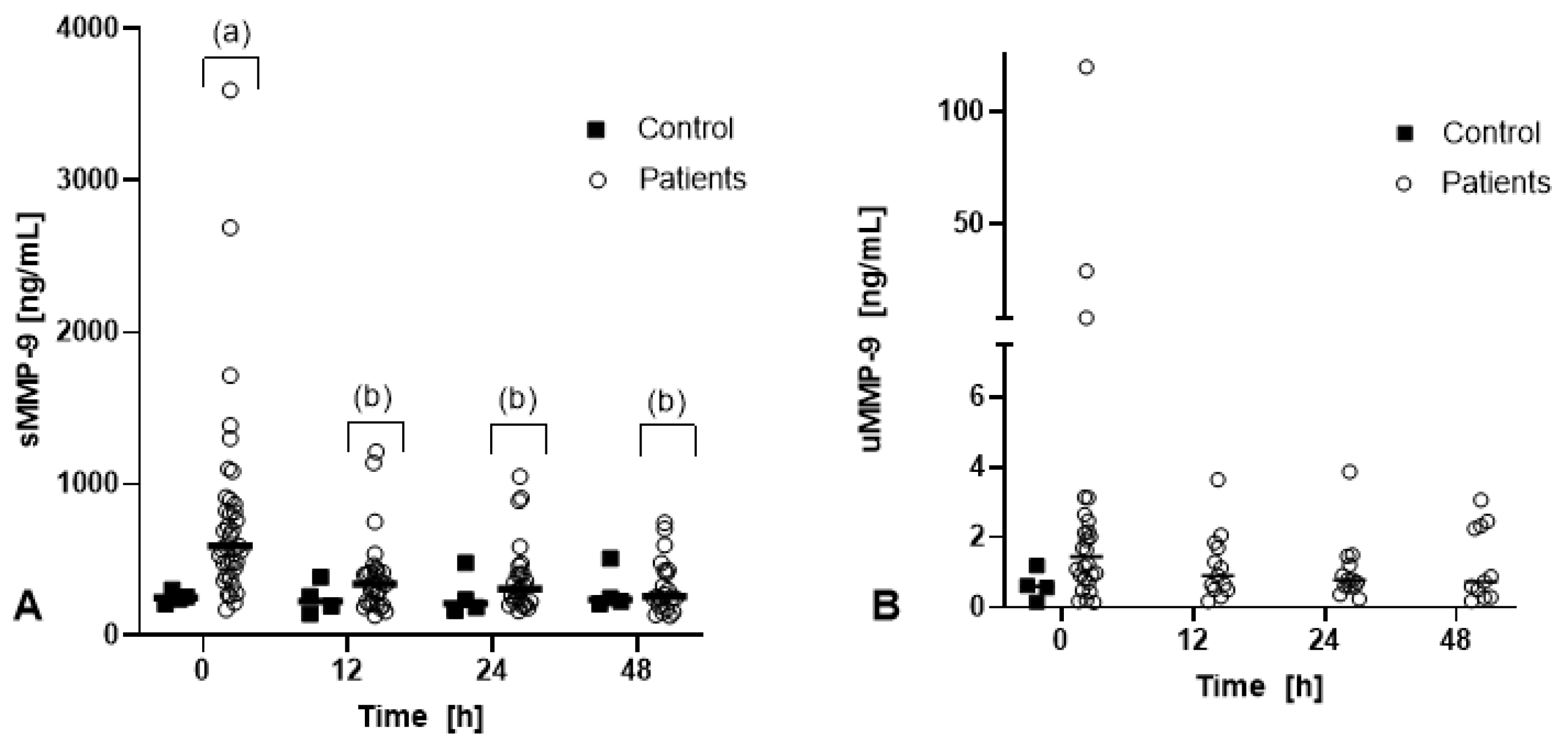
Kidney disease is difficult to diagnose since available laboratory parameters only increase later in time. Matrix metalloproteinase-9 is an enzyme found in renal tissue and increased in human kidney disease. This study evaluated serum MMP-9 (sMMP-9) and urinary MMP-9 (uMMP-9) concentrations in dehydrated horses. Horses with signs consistent with dehydration and four healthy clinic-owned horses were included. Blood and urinary samples for MMP-9 measurements were collected at admission, and after 12 h, 24 h, and 48 h. Furthermore, the serum creatinine, urea, symmetric dimethylarginine (SDMA), urine-specific gravity, urinary protein concentration, fractional sodium excretion, and urinary gamma–glutamyl transferase/creatinine ratio (uGGT/Cr) were measured. Statistical analysis included a repeated measures ANOVA and mixed linear regression model. Overall, 40 dehydrated horses were included (Acute kidney injury 1/40; elevated serum creatinine 7/40; elevated serum SDMA 11/40; elevated uGGT/Cr at presentation 5/28). In dehydrated horses, sMMP-9 concentrations were significantly higher on arrival compared to 12 h, 24 h, and 48 h. In healthy horses, sMMP-9 showed no differences over time or compared to patients. Urinary casts and uGGT/Cr correlated with sMMP-9. Serum urea was associated with uMMP-9/Cr. In conclusion, sMMP-9 was elevated at arrival in dehydrated patients compared to later measurements. Correlations to uGGT/Cr and urinary casts need further evaluation.
Abstract
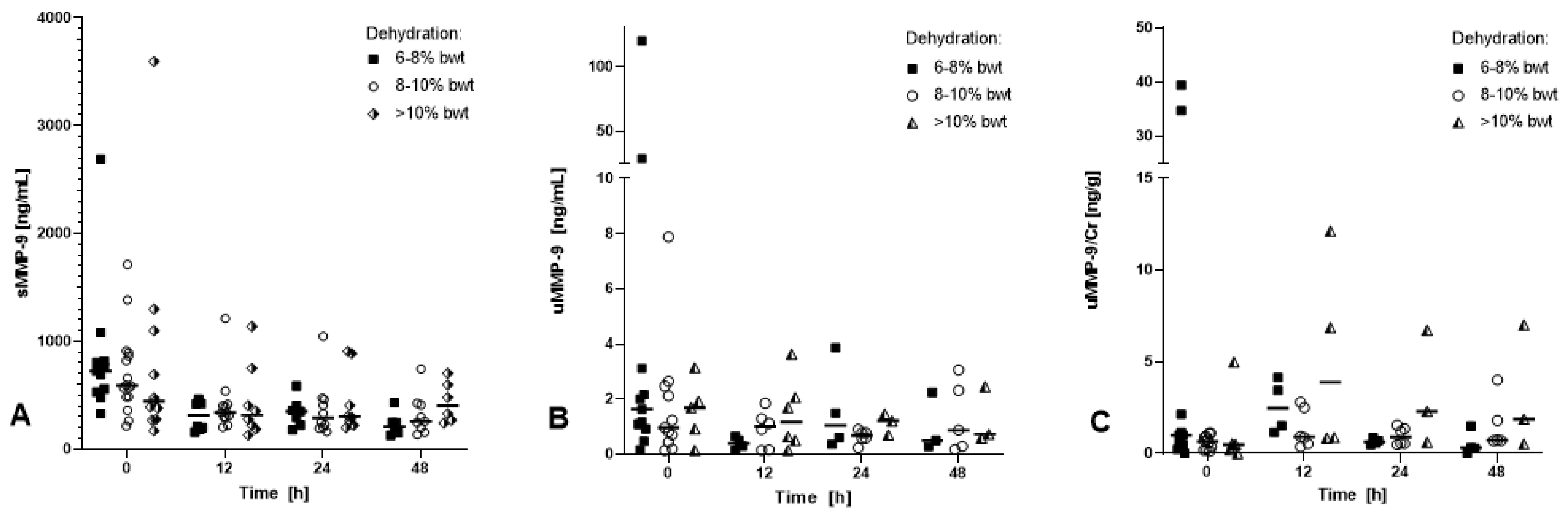
Matrix metalloproteinase-9 is increased in renal tissue in human kidney disease, but its role as a biomarker for kidney disease has not been fully evaluated yet. The aim of this study was to evaluate serum MMP-9 (sMMP-9) and urinary MMP-9 (uMMP-9) concentrations in dehydrated horses. Dehydrated horses were prospectively included. Blood and urinary samples were taken at admission, and after 12, 24, and 48 h (t0, t12, t24, t48), an anti-equine MMP-9 sandwich ELISA was used. Four healthy horses served as the controls. Serum creatinine, urea, symmetric dimethylarginine (SDMA), urine-specific gravity, urinary protein concentration, fractional sodium excretion, and urinary gamma–glutamyl transferase/creatinine ratio (uGGT/Cr) were measured. Statistical analysis included a repeated measures ANOVA and mixed linear regression model. Overall, 40 dehydrated horses were included (mild dehydration 13/40, moderate 16/40, severe 11/40). Acute kidney injury was found in 1/40 horses; 7/40 horses showed elevated serum creatinine, 11/40 horses elevated serum SDMA, and 5/28 elevated uGGT/Cr at presentation. In dehydrated horses, sMMP-9 concentrations were significantly higher on t0 (median: 589 ng/mL, range: 172–3597 ng/mL) compared to t12 (340 ng/mL, 132–1213 ng/mL), t24 (308 ng/mL, 162–1048 ng/mL), and t48 (258 ng/mL, 130–744 ng/mL). In healthy horses, sMMP-9 (239 ng/mL, 142–508 ng/mL) showed no differences over time or compared to patients. uMMP-9 and uMMP-9/creatinine did not differ over time or to the controls. No differences were found between dehydration groups. Urinary casts (p = 0.001; estimate = 135) and uGGT/Cr (p = 0.03; estimate = 6.5) correlated with sMMP-9. Serum urea was associated with uMMP-9/Cr (p = 0.01, estimate 0.9). In conclusion, sMMP-9 was elevated at arrival in dehydrated patients compared to later measurements. Correlations to uGGT/Cr and urinary casts need further evaluation.