

You are currently viewing a new version of our website. To view the old version click .

Microorganisms, Volume 5, Issue 2

June 2017 - 21 articles

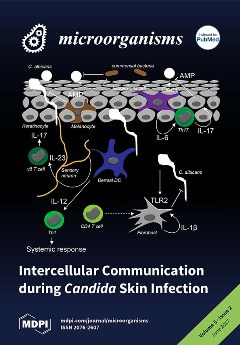
Cover Story: Candida albicans’ interaction with the skin is a complex process involving fungal factors as well as innate and adaptive immune responses. Recent studies have shed light on differences in antifungal responses in the epidermal and dermal compartments. Increasing attention is also being paid to components of the skin microenvironment not traditionally linked to the epithelial barrier function such as sensory neurons, dermal fibroblasts and commensal bacteria. This scheme shows an overview of intercellular communication involved in C. albicans–skin interaction. View this paper
  • Issues are regarded as officially published after their release is announced to the table of contents alert mailing list .
  • You may sign up for email alerts to receive table of contents of newly released issues.
  • PDF is the official format for papers published in both, html and pdf forms. To view the papers in pdf format, click on the "PDF Full-text" link, and use the free Adobe Reader to open them.

Articles (21)

  • Comment
  • Open Access
7 Citations
7,526 Views
3 Pages

A recent article by Palonen et al. describes the effect of butyrolactone I on the expression of a secondary metabolite biosynthesis gene cluster from Aspergillus terreus that shows similarities to fusarubin biosynthesis gene clusters from Fusarium sp...

  • Review
  • Open Access
36 Citations
8,185 Views
16 Pages

While members of the Kingdom Fungi are found across many of the world’s most hostile environments, only a limited number of species can thrive within the human host. The causative agents of the most common invasive fungal infections are Candida albic...

  • Review
  • Open Access
138 Citations
16,417 Views
12 Pages

Interaction of Candida Species with the Skin

  • Andreas Kühbacher,
  • Anke Burger-Kentischer and
  • Steffen Rupp

The human skin is commonly colonized by diverse fungal species. Some Candida species, especially C. albicans, do not only reside on the skin surface as commensals, but also cause infections by growing into the colonized tissue. However, defense mecha...

  • Article
  • Open Access
4 Citations
5,587 Views
14 Pages

Changes in Microbial (Bacteria and Archaea) Plankton Community Structure after Artificial Dispersal in Grazer-Free Microcosms

  • Hera Karayanni,
  • Alexandra Meziti,
  • Sofie Spatharis,
  • Savvas Genitsaris,
  • Claude Courties and
  • Konstantinos A. Kormas

Microbes are considered to have a global distribution due to their high dispersal capabilities. However, our knowledge of the way geographically distant microbial communities assemble after dispersal in a new environment is limited. In this study, we...

  • Review
  • Open Access
84 Citations
10,506 Views
16 Pages

Table Olive Fermentation Using Starter Cultures with Multifunctional Potential

  • Stamatoula Bonatsou,
  • Chrysoula C. Tassou,
  • Efstathios Z. Panagou and
  • George-John E. Nychas

Table olives are one of the most popular plant-derived fermented products. Their enhanced nutritional value due to the presence of phenolic compounds and monounsaturated fatty acids makes olives an important food commodity of the Mediterranean diet....

  • Article
  • Open Access
34 Citations
5,973 Views
24 Pages

Toxin Variability Estimations of 68 Alexandrium ostenfeldii (Dinophyceae) Strains from The Netherlands Reveal a Novel Abundant Gymnodimine

  • Helge Martens,
  • Urban Tillmann,
  • Kirsi Harju,
  • Carmela Dell’Aversano,
  • Luciana Tartaglione and
  • Bernd Krock

Alexandrium ostenfeldii is a toxic dinoflagellate that has recently bloomed in Ouwerkerkse Kreek, The Netherlands, and which is able to cause a serious threat to shellfish consumers and aquacultures. We used a large set of 68 strains to the aim of fu...

  • Review
  • Open Access
100 Citations
14,503 Views
14 Pages

Regulatory and Safety Requirements for Food Cultures

  • Svend Laulund,
  • Anette Wind,
  • Patrick M. F. Derkx and
  • Véronique Zuliani

The increased use of food cultures to ferment perishable raw materials has potentiated the need for regulations to assess and assure the safety of food cultures and their uses. These regulations differ from country to country, all aimed at assuring t...

  • Review
  • Open Access
57 Citations
11,118 Views
17 Pages

From Genome to Phenotype: An Integrative Approach to Evaluate the Biodiversity of Lactococcus lactis

  • Valérie Laroute,
  • Hélène Tormo,
  • Christel Couderc,
  • Muriel Mercier-Bonin,
  • Pascal Le Bourgeois,
  • Muriel Cocaign-Bousquet and
  • Marie-Line Daveran-Mingot

Lactococcus lactis is one of the most extensively used lactic acid bacteria for the manufacture of dairy products. Exploring the biodiversity of L. lactis is extremely promising both to acquire new knowledge and for food and health-driven application...

  • Article
  • Open Access
17 Citations
8,370 Views
17 Pages

Adding Value to Goat Meat: Biochemical and Technological Characterization of Autochthonous Lactic Acid Bacteria to Achieve High-Quality Fermented Sausages

  • Miriam T. Nediani,
  • Luis García,
  • Lucila Saavedra,
  • Sandra Martínez,
  • Soledad López Alzogaray and
  • Silvina Fadda

Quality and safety are important challenges in traditional fermented sausage technology. Consequently, the development of a tailored starter culture based on indigenous microbiota constitutes an interesting alternative. In the present study, spontane...

  • Review
  • Open Access
192 Citations
21,319 Views
30 Pages

Microbial Diversity in Extreme Marine Habitats and Their Biomolecules

  • Annarita Poli,
  • Ilaria Finore,
  • Ida Romano,
  • Alessia Gioiello,
  • Licia Lama and
  • Barbara Nicolaus

Extreme marine environments have been the subject of many studies and scientific publications. For many years, these environmental niches, which are characterized by high or low temperatures, high-pressure, low pH, high salt concentrations and also t...

of 3

Get Alerted

Add your email address to receive forthcoming issues of this journal.

XFacebookLinkedIn
Microorganisms - ISSN 2076-2607