


Abstract
Excessive nitrogen (N) fertilization in maize (Zea mays L.) production causes environmental degradation, particularly in semi-arid regions where high chemical inputs are necessary to maintain crop production. Plant growth-promoting rhizobacteria (PGPR) could reduce the optimal N fertilization doses. This investigation aimed to isolate bacteria, screen them for plant growth-promoting traits, and evaluate their potential effects on maize grain under different chemical N fertilization doses. Isolates Stenotrophomonas maltophilia LIMN and Enterobacter roggenkampii LCMG demonstrated multifunctional growth-promoting traits in vitro, including N2 fixation, indole-3-acetic acid and siderophore production, potassium solubilization, and desiccation tolerance, with E. roggenkampii LCMG also solubilizing inorganic phosphate. A field trial across four chemical N fertilization rates (0, 40, 80, and 120 kg N ha−1) revealed that single bacterial inoculation without N fertilizer matched or exceeded uninoculated controls receiving up to 80 kg of N ha−1 (the standard recommendation). Specifically, S. maltophilia LIMN combined with the recommended rate of 80 kg N ha−1 achieved the maximum grain yield (4601.2 kg DM ha−1), outperforming uninoculated controls (without PGPR) receiving excessive fertilization at 120 kg N ha−1 (3760.4 DM ha−1). Although maize plants benefited from inoculation with S. maltophilia LIMN or E. roggenkampii LCMG, achieving similar or better yields than crops fertilized with high chemical N inputs under stress factors such as deficiency of moisture, low-nutrient soils, and high temperatures, the present study did not test the pathogenicity and biosecurity of S. maltophilia or E. roggenkampii in crops; therefore, the results are not a direct recommendation of their use as biofertilizers before novel studies to assess all the limitations and the potential to reduce N dependency in order to design novel sustainable strategies for crop production.
1. Introduction
The increasing global population, projected to reach 10 billion by 2050, demands more food production [1], especially crops like maize (Zea mays L.), which is vital for human and livestock consumption in developing countries. However, intensive crop production has caused environmental and social problems, including chemical pollution, deforestation, biodiversity loss, and limited access to agricultural technology [2,3]. In semi-arid agricultural regions, maize grain yields are severely constrained by low organic matter content (1.0%), inherent nitrogen (N) and phosphorus (P) deficits, and erratic rainfed moisture regimes. Farmers conventionally rely on high rates of chemical nitrogen (N) fertilizers to overcome these yield barriers. However, this heavy chemical dependence causes severe agroecological degradation: excessive chemical N inputs accelerate soil acidification (pH decline) and base cation depletion, stimulate greenhouse gas emissions (specifically nitrous oxide, N2O), and cause widespread water pollution via nitrate (NO3−) leaching into groundwater and surface aquatic ecosystems [2,3]. At the same time, high chemical fertilizer costs yield diminishing economic returns for resource-limited dryland farmers.
Plant growth-promoting rhizobacteria (PGPR) represent a core biological mechanism for ecological intensification, offering practical opportunities to enhance agronomic nitrogen use efficiency and reduce dependence on chemical N inputs [4,5,6,7]. In the rhizosphere, PGPR enhance plant growth and stress resilience through mechanisms such as biological N2 fixation, phytohormone synthesis (e.g., indole-3-acetic acid, IAA), siderophore-mediated iron sequestration, and inorganic mineral solubilization, thereby promoting plant nutrient uptake [4,5,8,9,10,11,12].
Rhizobacteria can improve soil fertility [10,11,12]. Some PGPR promote plant defense against pathogens, solubilize P, and fix N2 [4,5,6,8,13,14]. Bacterial genera such as Azospirillum, Bacillus, Azotobacter, Rhizobium, Enhydrobacter, and Pseudomonas spp. have been widely studied to improve maize crop yields [15,16,17,18,19,20,21,22,23]. Among plant-associated rhizobacteria, Stenotrophomonas maltophilia and Enterobacter roggenkampii have emerged as promising candidates due to their multifunctional metabolic capabilities: Enterobacter spp. exhibit robust diazotrophic activity, suppress pathogens through specific root exudates [24], improve phosphate solubilization, and promote abiotic stress tolerance mechanisms [25,26,27]; Stenotrophomonas spp. strains stimulate root architectural development via substantial IAA synthesis and produce extracellular hydrolytic enzymes that facilitate nutrient cycling [28,29]. While these isolates display diverse growth-promoting traits, nitrogen remains the primary yield-limiting macronutrient and the most environmentally dynamic chemical input in dryland agriculture. Evaluating these multifunctional traits across a chemical N gradient provides a mechanistic understanding of how biological traits, such as root elongation via auxins, osmotolerance, and mineral solubilization, synergistically improve plant nutrient acquisition and support reduced chemical N dependence [30]. However, a major research gap persists regarding the field-scale validation of isolates of S. maltophilia and E. roggenkampii strains under graded chemical N inputs to determine their precise capacity to replace or reduce chemical N fertilizer requirements in maize plants grown under nutrient-depleted, rainfed semi-arid conditions.
To address this gap, this study evaluated the hypothesis that seed inoculation with isolates of S. maltophilia LIMN and E. roggenkampii LCMG reduces N fertilizer application without compromising maize crop yields. Therefore, the objective was to isolate and characterize PGPR strains and evaluate their effects on maize grain yields under N fertilizer doses in a rainfed semi-arid environment. Demonstrating the N-optimizing capacity of these strains provides critical scientific evidence for designing low-input, resilient cropping systems tailored to climate-vulnerable agricultural regions.
2. Materials and Methods
This study was conducted in two phases: first, in vitro characterization and molecular identification of rhizobacterial isolates, and second, a field evaluation in maize plants across multiple chemical N fertilization levels.
2.1. Rhizobacteria Isolation and Characterization
2.1.1. Soil Sampling, Bacterial Isolation, and Morphological Characterization
The bacterial strains evaluated in this study were originally isolated and characterized during a collaborative research initiative in Chiapas, Southeastern Mexico (15°40′16″ N and 92°55′40″ W; agricultural lowlands/valleys at 500–800 masl within a regional gradient of 279–2755 masl; Köppen Aw climate classification). This is a region recognized for high microbial functional diversity [31]. Rhizosphere soil samples (0–10 cm depth) were collected directly from agroecosystems associated with maize cultivation to recover native isolates of rhizobacteria from intensively managed, low-fertility tropical soils. Specifically, Stenotrophomonas maltophilia LIMN was isolated from the rhizosphere of a maize–Inga vera agroforestry system, whereas Enterobacter roggenkampii LCMG was retrieved from a maize–Canavalia ensiformis intercropping system.
Soil samples were placed in sterile polyethylene bags, transported under cold-chain conditions (4 °C) to the laboratory, and processed immediately for bacterial isolation.
Bacterial isolation was carried out using Soil Extract Medium (SEM) agar to select for rhizosphere-adapted strains. SEM was prepared following Herrero et al. [32], where 10 g of soil was suspended in 100 mL of distilled water (1:1 w/v ratio; 0.1 g soil mL−1 water), stirred continuously for 1 h at 22 °C under aseptic conditions, filtered through Whatman No. 1 paper, and amended with 15.0 g L−1 agar (pH 7.0 ± 0.2).
For bacterial extraction, 2.0 g of root-adherent rhizosphere soil (tightly attached to the active maize root system after removing loose bulk soil by gentle shaking) from each sample was suspended in 18.0 mL of sterile phosphate-buffered saline (PBS; 10 mM K2HPO4/KH2PO4, 0.85% NaCl, pH 7.2). Suspensions were homogenized by vortexing for 3 min and centrifuged at 5000 rpm (2200× g) for 5 min to settle coarse particles. The resulting supernatant was subjected to 10-fold serial dilutions (10−1 to 10−6) in sterile PBS. Aliquots of 100 µL from dilutions 10−4, 10−5, and 10−6 were spread-plated in triplicate onto SEM agar plates under aseptic conditions. Plates were incubated at 30 ± 1 °C for 24–48 h. Distinct single colonies were purified and morphologically characterized based on standardized colony size, margin, elevation, pigmentation, texture, consistency, and optical light reflection on Luria–Bertani (LB) agar (10 g L−1 tryptone, 5 g L−1 yeast extract, 10 g L−1 NaCl, 15 g L−1 agar; pH 7.2) after 24–48 h at 30 °C. Pure cultures were preserved in 20% v/v glycerol broth at −80 °C.
To validate the broader applicability of these bioinoculants, we aimed to test their cosmopolitan potential to promote plant growth outside their native geographic origin, evaluating these strains in the semi-arid, low-fertility highland natural environment of Ojuelos, Jalisco, that served as a rigorous stress to test the potential agro-biotechnological transfer in a contrasting agroecosystem where rainfed maize faces severe compound stress driven by a critical water deficit (48 to 64% below optimal requirements) synergistically combined with high temperatures (>32 °C) and poor soil quality (<1% organic matter), which drastically restricts crop development and yield potential (SMN, CONAGUA, see Data Availability Statement).
2.1.2. Plant Growth-Promoting Traits In Vitro and Strain Selection Criteria
Bacterial strains were isolated and characterized at the National Center for Genetic Resources (CNRG) of the National Institute for Forestry, Agriculture and Livestock Research (INIFAP). Pure cultures were maintained on the Luria–Bertani (LB) medium (10 g L−1 yeast extract, 5 g L−1 peptone, 10 g L−1 NaCl, 15 g L−1 agar). Candidates were subjected to comprehensive in vitro screening across six specific plant growth promotion traits.
Growth capability was assessed on the N-free Winogradsky medium (10.0 g L−1 glucose, 0.5 g L−1 K2HPO4, 0.2 L−1 MgSO4 ∙ 7 H2O, 0.2 g L−1 NaCl, 0.1 g L−1 MnSO4 ∙ 4H2O, 0.01 g L−1 FeSO4 ∙ 7 H2O, 15.0 g L−1 agar; pH 7.2). Isolate cultures were streak-plated and incubated at 30 ± 1 °C for 7 days; sustained growth across three consecutive subcultures on N-free agar was scored based on positive potential diazotrophic or oligonitrophilic capacity (+).
Inorganic phosphate (PO43−) solubilization was assessed on the NBRIP agar medium containing insoluble tricalcium phosphate [Ca3(PO4)2, 5.0 g L−1]. Plates were spot-inoculated with 10 µL of log-phase bacterial culture (approx. 108 CFU mL−1) and incubated at 30 ± 1 °C for 5 days. Phosphate solubilization was detected by visible clear halo zones surrounding colonies.
Potassium (K) solubilization was screened on the modified Alexandrov agar medium (10.0 L−1 glucose, 0.5 g L−1 MgSO4 ∙ 7H2O, 0.1 g L−1 CaCO3, 0.005 g L−1 FeCl3, 2.0 g L−1 Ca3(PO4)2, 15.0 g L−1 agar; pH 7.2) supplemented with potassium aluminosilicate (5.0 g L−1, feldspar powder) as the insoluble K source. Soluble salts were evaluated in parallel as soluble controls (KCl and KNO3). Spot-inoculated plates were incubated at 30 ± 1 °C for 5 days, and clear halo zones resulting from potassium mineral dissolution were measured.
Indole production (IAA) was quantified colorimetrically using the Salkowski reagent. Isolates were cultured in Trypticase Soy Broth (TSB) supplemented with 0.1% w/v L-tryptophan at 30 ± 1 °C for 48 h under continuous shaking (150 rpm). The cell-free supernatant obtained via centrifugation (10,000× g, 10 min) was mixed with the Salkowski reagent (0.5 M FeCl3 in 35% H2SO4) at a 1:2 v/v ratio and incubated in the dark at 25 °C for 30 min. Color development was quantified spectrophotometrically at 530 nm against a standard curve of pure IAA (µg mL−1). For semi-quantitative screening on agar plates, Trypticase Soy Agar (TSA) supplemented with L-tryptophan was flooded with Salkowski reagent, and the resulting pink halo zones were measured.
Siderophore production was evaluated using Chrome Azurol S (CAS) analytical agar plates. Spot-inoculated CAS agar plates were incubated at 30 ± 1 °C for 5 days in the dark. Siderophore production was confirmed by a distinctive color transition from blue to orange-yellow surrounding the bacterial colonies.
To quantify halo-forming efficiency [33], solubilization and production capabilities were mathematically expressed using the Relative Index (RI), evaluated as the Relative Solubilization Index (RSI) or Relative Production Index (RPI) (Equation (1)):
Desiccation and osmotic stress tolerance were evaluated on TSA plates supplemented with sucrose at 3%, 8%, 10%, and 20% w/v to induce graded hydric potentials. Radial colony extension (cm) was recorded after 48 h of incubation at 30 ± 1 °C.
Isolate selection for molecular identification and field trials was based on a cumulative multi-trait scoring system across all six screening criteria. Strains demonstrating high multifunctional PGP profiles (simultaneous diazotrophy, auxin production with RPI ≥ 1.2, siderophore production with RPI ≥ 1.7, mineral solubilization, and radial growth under ≥10% sucrose osmotic stress) were prioritized as candidates displaying the highest plant growth-promoting potential.
2.1.3. Molecular Identification
The molecular identification of the bacterial strains with the highest potential for plant growth promotion was performed through phylogenetic analysis of the 16S rRNA gene. For this purpose, genomic DNA was extracted from the strains, and the 16S rRNA gene was amplified according to Barragán-Nava et al. [34]. Genomic DNA extraction and 16S rRNA gene sequencing were performed by Macrogen Inc. (Seoul, Republic of Korea) using its Standard Sequencing Service. The obtained sequences were visually inspected and edited using BioEdit version 7.2.5. A set of taxonomically related type-strain sequences was retrieved by performing a BLAST (version 2.17.0, NCBI, Bethesda, MD, USA) search. All sequences were aligned using the ClustalW algorithm implemented in MEGA X, which was also used to perform the phylogenetic analysis. The phylogenetic tree was constructed using the Maximum Likelihood method with 1000 bootstrap replicates to assess the statistical support of the tree nodes. Phylogenetic analysis of the 16S rRNA gene confirmed the taxonomic affiliation of the selected strains. Strain LCMG clustered within the genus Enterobacter and showed the closest relationship to Enterobacter roggenkampii (GenBank: OM060606.1), whereas strain LIMN clustered within the genus Stenotrophomonas and was most closely related to Stenotrophomonas maltophilia (GenBank: OM060618.1). The Maximum Likelihood tree, reconstructed under the Tamura–Nei + G + I substitution model, showed high bootstrap support for the major clades, supporting the genus-level identification of both isolates.
2.2. Field Evaluation in Maize
2.2.1. Study Site and Environmental Conditions
The fields were situated in Ojuelos de Jalisco, Jal. (National Center for Disciplinary Research in Family Agriculture (CENID AF), INIFAP), north-central Mexico, located between 21°33′ N and 101°02′ W, corresponding to a semi-arid zone classified as BSh (hot semi-arid) (Köppen classification [31]), with a sandy soil type of low fertility. From June to October 2023, the median, maximum, and minimum temperatures were 25.84, 32.03, and 13.22 °C, with total rainfall of 286 mm irregularly distributed over the five months, according to governmental databases obtained from two nearby meteorological stations (SMN, CONAGUA, see Data Availability Statement).
2.2.2. Soil Physical and Chemical Analysis
The topography is typically characterized by valleys and gentle hills, with soils classified as Haplic Xerosols (associated with Lithosols and Eutric Planosols) and Haplic Phaeozems, with less than 1% of organic matter [35]. However, soil samples from the designated maize fields were tested.
According to NOM-021-RECNAT-2000 [36], soil texture was analyzed using the Bouyoucos hydrometer method, while soil organic matter (SOM) was determined by the oxidation of organic carbon [37]. The N content and available P were analyzed using the micro-Kjendahl [38] and Bray 1 methods [39]. The contents of calcium (Ca2+), magnesium (Mg2+), potassium (K+), and sodium (Na+) were extracted by saturating the cation-exchange sites using a 1 N ammonium acetate solution (NH4C2H3O2, pH 7.0) [40]. Iron (Fe) and manganese (Mn) contents were evaluated using the diethylenetriaminepentacetic acid (DTPA) extraction method [41]. Additionally, boron (B) content was analyzed using the azomethine-H method [42], and sulfur (S) content was determined according to NOM-021-RECNAT-2000 [36]. The cation-exchange capacity (CEC) was calculated from the sum of extracted exchangeable cations (Ca2+, Mg2+, K+, and Na+) [43].
The sandy loam soils (Table 1) had a pH of ~7.5, indicating moderately alkaline conditions. These soils were characterized by low contents of SOM, N, available P, Na, and Cu; medium contents of Ca, Mg, and S; and high contents of K, Mn, and B. The FC had typical values for sandy loam soils with low water retention that limits water availability for plant roots and a PWP. Arenosol/Psamment soil has a sandy texture and rapid drainage.
Table 1.
Characterization of soil (physical and chemical properties) of the experimental site.
After integrating the results of the soil analysis, the site was selected for its contrasting natural environment and the presence of the necessary stress conditions to test PGPR: extremely low organic matter (0.89%), poor water retention (field capacity of 21.10%, permanent wilting point of 10.80%), high bulk density (1.57 g cm−3), slightly alkaline pH (7.58), limited chemical fertility (very low available nitrogen (4.38 ppm), low phosphorus (3.17 ppm), apparent potassium at 463 ppm, iron at 38.41 ppm, and boron at 2.40 ppm) and reduced cation exchange capacity (7.44 meq/100 g with a base saturation of 28.69%).
2.2.3. Plant Material
The tri-lineal intermediate/late hybrid H-391 (INIFAP, Mexico) adapted to the Central–East México regions was used in this study. This hybrid exhibits resistance to root and stalk lodging, good cob health, and a strong overall plant appearance, with resistance to common rust (Puccinia sorghi) and downy mildew (Sclerophthora macrospora) [44].
2.2.4. Experimental Design and Crop Management
The field experiment was conducted in July 2023. All crops were exclusively tested under stress conditions, carefully avoiding confounding variables to accurately assess statistical differences between treatments and the controls. The experimental design was a randomized complete block design (RCBD). Each treatment was randomly assigned to plots (16 m length × 1.6 m width; 2 rows per treatment) within the four blocks (each measuring 16 × 25.6 m) located in the parcel (16 × 153.6 m; total area of 2458 m2). The blocks considered the variability in topography and sun orientation. The distance between rows was 80 cm, and the spacing between plants was 20 cm, resulting in a final crop density of 62,500 plants ha−1. Before seeding, a traditional soil management system that involved manual and minimal tillage was used to prepare the soil. After seeding, the shrubs were manually eliminated.
Table 2 shows the arrangement of the treatments. Doses of 0 (N-0), 40 (N-40), 80 (N-80), and 120 (N-120) kg of N ha−1 were evaluated with the inclusion of S. maltophilia LIMN (S), E. roggenkampii LCMG (E) or the mixture of S + E, or without PGPR inoculation (Control). The N source was agricultural-grade granular urea [CO(NH2)2, 46% N]. Fertilizer dosages were calculated strictly on an elemental N mass basis, corresponding to commercial urea application rates of 0 kg ha−1 (N-0), 86.95 kg ha−1 (N-40), 173.91 kg ha−1 (N-80), and 260.87 kg ha−1 (N-120). For individual experimental plots (25.6 m2), the equivalent commercial urea applied per plot was 0 g, 222.6 g, 445.2 g, and 667.8 g, respectively.
Table 2.
Arrangement of treatments evaluated and their nomenclature.
The selection of these N rates was informed by agronomic standards and the need to establish a functional yield response gradient. Specifically, 0 kg N ha−1 (N-0) serves as the unfertilized baseline control (without PGPR or chemical N) to quantify soil N contribution and the standalone biological effect of bioinoculation; the 40 kg N ha−1 (N-40) rate represented a sub-optimal fertilization level to evaluate bioinoculant efficacy under severe nitrogen limitation. The 80 kg N ha−1 (N-80) dose corresponded to the standard recommended rate for rainfed maize production. Finally, 120 kg N ha−1 (N-120) represented an above-recommended application rate, typical of high-input farming, allowing us to test whether bioinoculation enables yield optimization at recommended or reduced N inputs without relying on excessive chemical fertilization.
Half of the urea doses were applied to the crops immediately after sowing; the remaining doses were applied 35 days later. Chemical phosphorus (P) and potassium (K) fertilizers were intentionally omitted across all experimental units to test the intrinsic biological capability of the bacterial isolates to mobilize inherent soil P and K reserves (463.0 ppm exchangeable K; 3.2 mg kg−1 Bray 1 P) without chemical nutrient masking. Maize seeds were inoculated with PGPR in the field by applying a solution containing 1 × 10⁸ colony-forming units (CFU) mL−1 of S. maltophilia LIMN and E. roggenkampii LCMG at a rate of 1 L ha−1, delivered within a suitable volume of water as a carrier with a field sprayer. Control seeds were sprayed using only the water carrier without PGPR.
Given that Stenotrophomonas maltophilia and members of the genus Enterobacter encompass both plant-associated strains and opportunistic clinical lineages [26,29,45], strict biosafety measures and containment protocols were maintained throughout bacterial handling, inoculum preparation, and field application. All in vitro screening assays and cell suspension preparations were conducted under aseptic conditions inside certified biological safety cabinets. During the preparation of inoculant doses and field seed inoculation, safety precautions were implemented, including the use of nitrile gloves, laboratory coats, eye protection, and protective face masks to prevent direct contact, mucosal exposure, or aerosol inhalation. All biohazardous waste and contaminated materials were fully sterilized by autoclaving (121 °C for 30 min) prior to disposal.
2.2.5. Yield and Agronomic Measurement
At physiological maturity of maize, when the kernels had reached their maximum dry weight and the plant had stopped translocating nutrients, five plants were sampled per treatment in each block (four repetitions), resulting in 320 samples. The following variables were measured: cob diameter (mm), using a standard Truper® digital millimeter Vernier (Mexico City, Mexico); cob length (cm), using a graduated ruler measuring the distance from the base to the apex of the upper cob; grains per row, by counting the number of grains per row of random samples and calculating an average for each experimental unit; cob weight (g), recording the weight of the cob with the help of a digital scale; the number of cobs; grain yield (kg ha−1); the shelled cobs of each plot; and the 100-seed weight (g), by identifying at random one hundred grains of shelled cobs and recording the weight on a digital scale.
2.2.6. Dry Matter Evaluation
After harvesting, the collected samples were oven-dried in a forced-air oven at 60 °C until they reached a constant dry weight (dry matter, DM).
2.3. Statistical Analysis
The analysis was run with SAS statistical software (Statistical Analysis System, V. 9.2, SAS Institute Inc., Cary, NC, USA) [46]. The analysis of variance (ANOVA) considered the RCBD and the fixed effects of the type of PGPR and N doses according to Equation (2). Least squares means (LsMeans) were compared with the least significant difference (LSD) test at p < 0.05.
where Y = cob diameter and length, grains/cob, cobs/plant, cob weight, 100-seed weight, and DM grain yield; Bi = the i-th block; Bacj = the effect of the j-th inclusion of S. maltophilia LIMN and/or E. roggenkampii LCMG; DNK = the effect of the k-th dose of nitrogen; (Bac × DN)jk = interactions among fixed effect factors; ɛijk = random error.
Y = µ + Bi + Bacj + DNk + (Bac × DN)jk + ɛijk
Orthogonal polynomials were used to test the linear, quadratic, and cubic effects using the regression models Yi = β0 + βiTi + ɛi, Yi = β0 + βiTi + βiTj2 + ɛij, and Yi = β0 + βiTi + βjTi2 + βkTi3 + ɛijk, respectively (PROC REG). A Pearson’s linear correlation analysis was performed (PROC CORR).
3. Results
3.1. Bacterial Strains
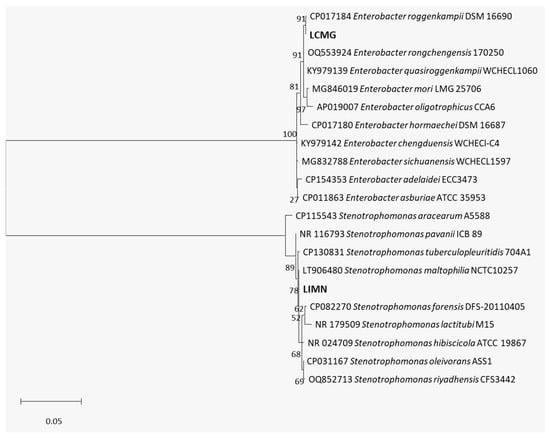
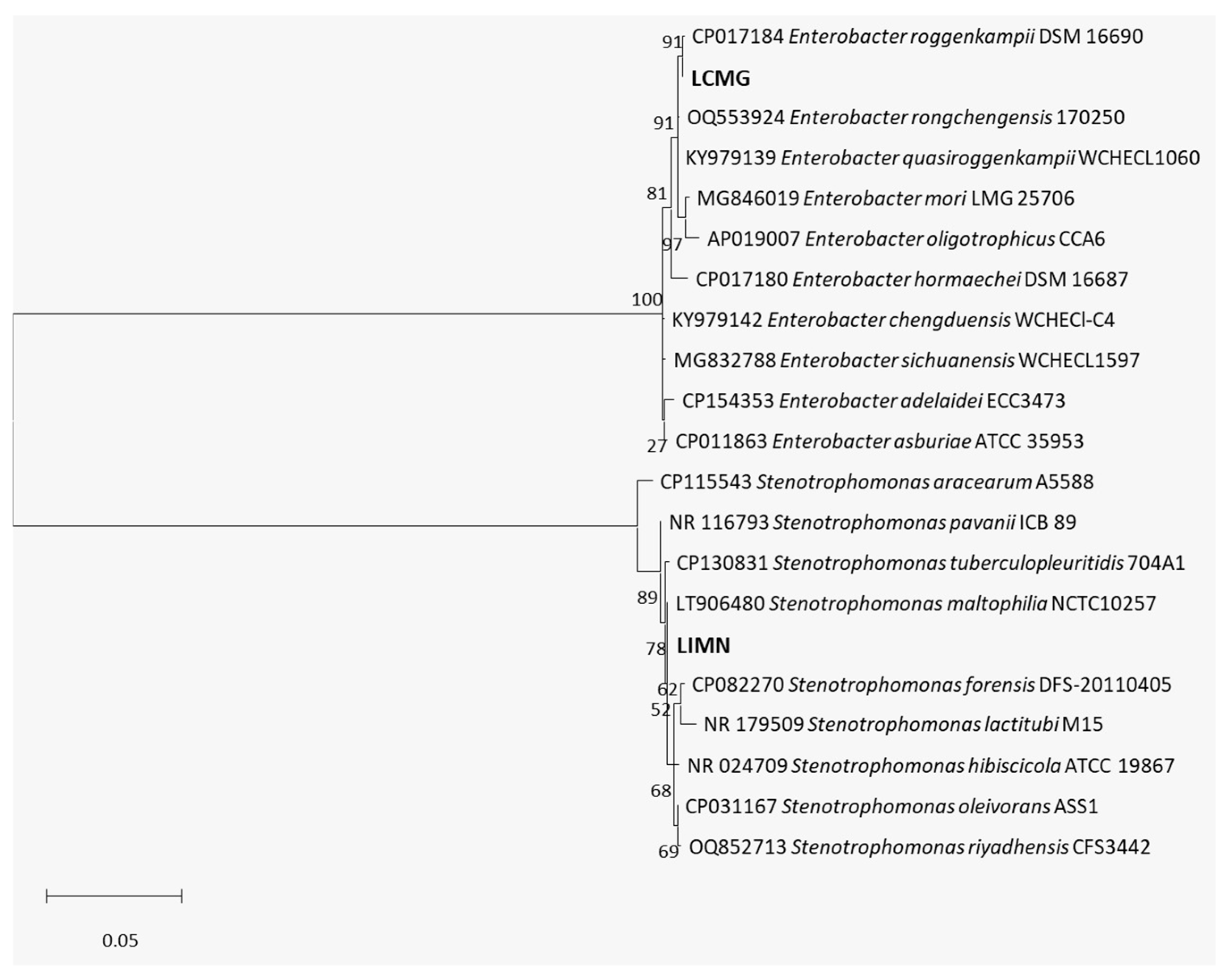
Phylogenetic analysis based on sequence comparison revealed that the isolated strains LCMG and LIMN were successfully identified at the species level (Figure 1). Strain LCMG clustered closely within the Enterobacter clade, showing the highest sequence identity and sharing an immediate common node with E. roggenkampii DSM 16690, supported by a high bootstrap confidence value of 91%. Similarly, strain LIMN was grouped within the Stenotrophomonas clade, forming a distinct, well-supported cluster with S. maltophilia NCTC 10257 (89% bootstrap support). In both cases, the negligible branch lengths separating the isolated strains from their respective reference type strains confirm their phylogenetic placement as E. roggenkampii and S. maltophilia.
Figure 1.
Maximum Likelihood phylogenetic tree based on 16S rRNA gene sequences; the tree was constructed in MEGA X using the Tamura–Nei model with a gamma distribution and a proportion of invariant sites (TN93 + G + I). Bootstrap support values were calculated from 1000 replicates and are shown at the nodes. The scale bar represents 0.05 nucleotide substitutions per site.
3.2. In Vitro Plant Growth Promotion Tests
Table 3 shows that both S. maltophilia LIMN and E. roggenkampii LCMG exhibited several plant growth-promoting traits, including fixing N-free medium, producing siderophores, solubilizing K, synthesizing indoles (IAA), and growing under hydric stress. Additionally, E. roggenkampii LCMG was able to solubilize PO43− (RSI = 1.1), whereas no phosphate solubilization was detected in S. maltophilia LIMN.
Table 3.
Plant growth promotion characterization in vitro of Stenotrophomonas maltophilia and Enterobacter roggenkampii.
The strain of S. maltophilia LIMN showed a significantly higher indole production IAA RPI than E. roggenkampii LCMG (1.8 vs. 1.2), suggesting that S. maltophilia LIMN might act as a PGPR with potential to stimulate cell division, subsequently promoting plant elongation. Potassium solubilization differed according to the potassium source: E. roggenkampii showed a significantly higher RSI with KCl (3.0 vs. 2.1), whereas S. maltophilia LIMN showed a significantly higher RSI with KNO3 (2.7 vs. 1.3). No significant difference was observed in siderophore production RPI between the two strains.
Under hydric stress conditions, S. maltophilia LIMN showed significantly higher (p < 0.05) growth than E. roggenkampii LCMG at 3, 8, 10, and 20% sucrose (Table 3).
3.3. Agronomical Variables and Grain Yield
Table 4 shows the effect of inoculating maize seeds with S. maltophilia LIMN and E. roggenkampii, combined with different N fertilization doses. Overall, cob diameter varied from 39.5 to 42.59 mm; the best averages were shown when S. maltophilia LIMN or E. roggenkampii LCMG was combined with N-0 and N-40 or when S + E was combined with N-80 to N-120 (p < 0.04). There were no significant differences in cob length across treatments.
Table 4.
Stenotrophomonas maltophilia LIMN, Enterobacter roggenkampii LCMG, and N doses affect agronomic variables and maize grain yield.
The grains/row and the cob weight showed the best responses when S. maltophilia LIMN or E. roggenkampii were used without N fertilization (N-0) (averages 89.53 and 89.24 g, respectively), representing a cob weight increase of over 30% compared to the Control N-0 (68.58 g) (p < 0.01). However, the Control and S + E treatments had the best cob weight when the N-120 fertilization dose was applied (76.76 and 84.54 g) (p < 0.01).
The best grain yield was obtained through S. maltophilia LIMN inoculation and the N-80 fertilization dose (4601.2 kg DM ha−1). Although the N-80 and N-120 fertilization doses significantly improved several agronomic parameters, including the number of cobs/plants, the DM 100-seed weight, and the grain yield, which increased (p < 0.002); however, inoculation with S. maltophilia LIMN promoted better grain yield outcomes than Control, E. roggenkampii, and S + E treatments. Specifically, S. maltophilia LIMN provided a 31.9% yield increase over Control N-80 (3487.8 kg DM ha−1) and outperformed by 22.4%. Overall, S. maltophilia LIMN provided an average yield improvement of 19.2% over the Control across fertilization levels (p < 0.003).
3.4. Trends of Grain Yield Across Doses of N Fertilization and PGPR Inoculation and Correlations
Regardless of the effect of PGPR inoculation, the highest cob weights were shown in treatments without N fertilization (Table 5); however, these variables had quadratic or cubic trends, with the worst when 40 to 80 kg N ha−1 was added (p < 0.05).
Table 5.
Trends of agronomic and maize grain yields across N fertilization doses.
The number of cobs/row, the grain yield, and the 100-seed weight had quadratic effects among the N fertilization doses (p < 0.01); therefore, 40 and 80 kg N ha−1 were the optimal fertilization doses.
The individual application of the rhizobacteria S. maltophilia LIMN or E. roggenkampii LCMG, as well as their combined inoculation (Table 6), improved yield compared to those treatments without PGPR (Control) (p < 0.05).
Table 6.
Trends of maize grain yield across the Stenotrophomonas maltophilia LIMN, Enterobacter roggenkampii LCMG, and N fertilization doses.
The treatments S + E and N-0 promoted grain yields similar to Control with N-120. Linear effects of N fertilization doses were observed in the Control and when seeds were inoculated with the S + E mixture (p < 0.05); therefore, for those treatments, the best grain yields were observed when N-120 was applied (3760.42 and 4546.97 kg DM ha−1). However, where maize seeds were inoculated individually with either S. maltophilia LIMN or E. roggenkampii LCMG, N fertilization doses had cubic trends (p < 0.01); for these treatments, the optimal fertilization dose was found to be N-80 (4601.19 and 4134.23 kg DM ha−1), which represents gains of 31.9% and 18.5% over the Control at the same fertilization level.
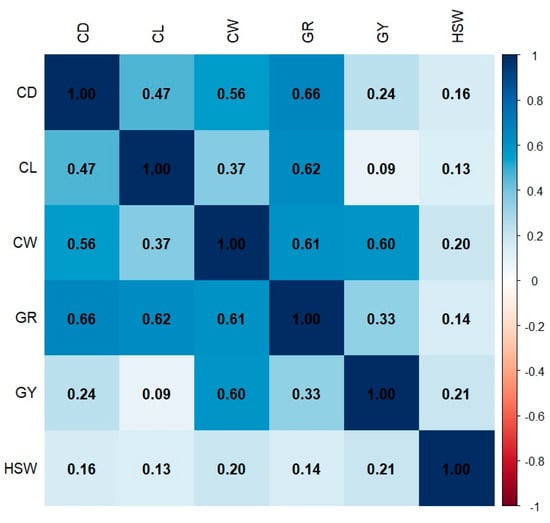
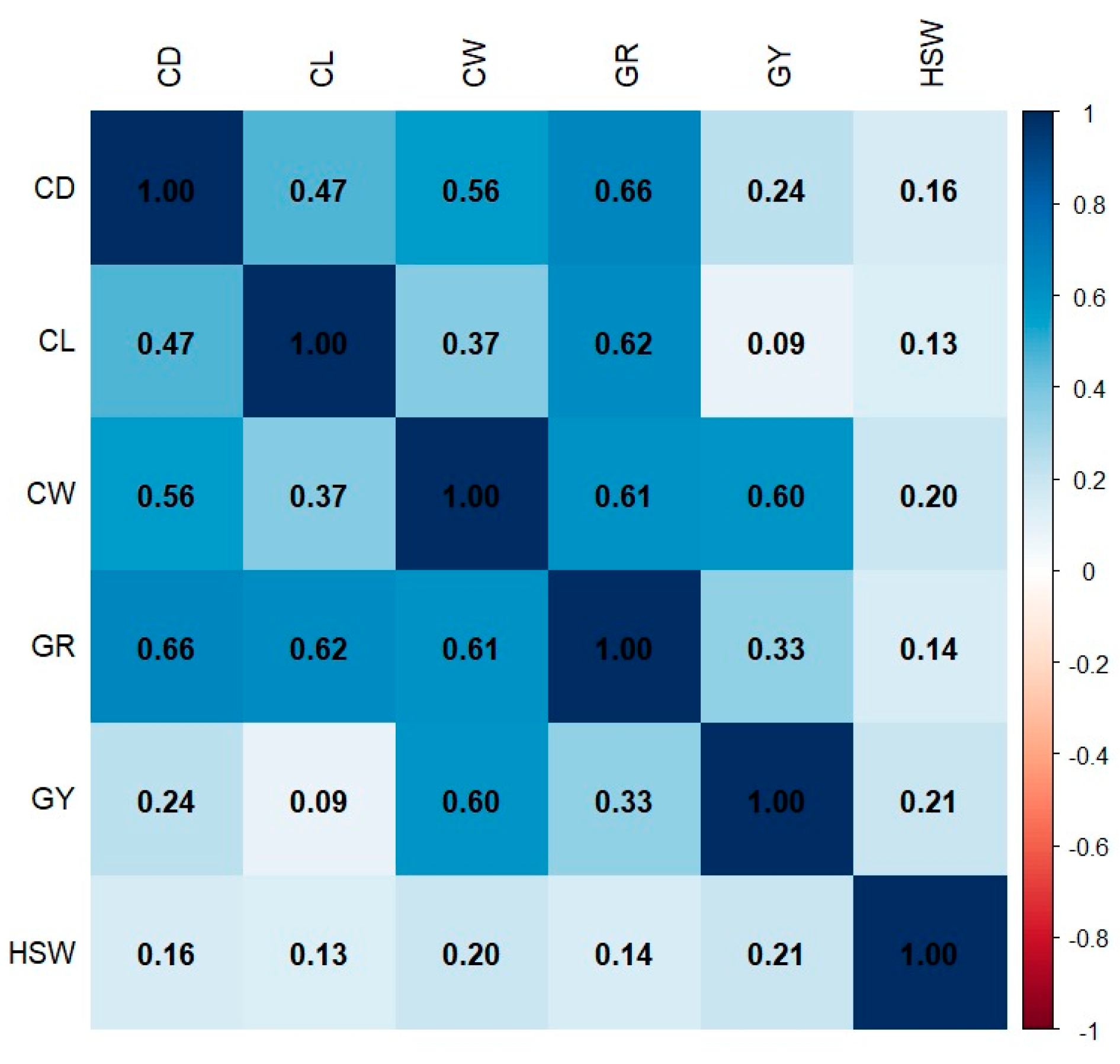
Figure 2 shows the simple correlations between agronomic and yield variables. The number of grains/row (GR) strongly correlated with cob diameter (CD) and length (CL) (r = 0.66 and 0.62; p < 0.0001). However, the cob weight (CW) correlated with the CD and the number of GR (r = 0.56 and 0.61; p < 0.0001).
Figure 2.
Pearson’s correlation among physio-technical and grain yield variables in maize crops fertilized with N and/or treated with plant growth-promoting rhizobacteria. CD: cob diameter, CL: cob length, GR: grains/row, CW: cob weight, GY: grain yield, and HSW: 100-seed weight.
Additionally, CW and cobs per plant significantly correlated with grain yield (r = 0.60 and 0.57; p < 0.0001).
4. Discussion
4.1. Natural Crop Stress Conditions
The experimental sites were intentionally selected due to their diverse natural stress conditions for maize cultivation. Effective soil management to improve limited SOM, N, and P conditions includes chemical fertilizers, organic amendments such as composts, and inoculation with beneficial rhizobacteria [47]. The environmental conditions of the present study represented an extreme, compound abiotic stress scenario for rainfed maize, driven by the synergy of three severe limiting factors: The primary constraint is a critical water deficit, with recorded precipitation at 286.19 mm (up to 64% below optimal requirements), exacerbated by a sandy soil characterized by poor moisture retention and high bulk density (1.57 g cm−3). This drought condition is compounded by thermal stress from average maximum temperatures of 32.03 °C (peaking above 35 °C), which significantly accelerates plant desiccation and reduces the pollen viability. Additionally, the crop faces severe nutritional stress due to highly degraded soil fertility, marked by critically low organic matter (0.89%), severe N (4.38 ppm) and P (3.17 ppm) deficiencies, and a reduced overall nutrient retention capacity. Under normal circumstances, the study area is considered unsuitable for maize farming due to the synergistic impact of drought, extreme heat, and soil degradation diminishing crop yields by 40% to 60%, with even more drastic losses expected if these limitations coincide with the critical flowering stage.
Therefore, inoculation of plants with PGPR increased the plant’s root volume, nutrient uptake, modulation of hormones, and accumulation of stress-related metabolites compared with the controls. In the present study, as in others, PGRP represented an effective strategy to improve crop growth and yield [6,11,12,13,20,48,49,50].
4.2. Role of PGPR in Alleviating Field Stress Conditions
The superior agronomic performance observed for S. maltophilia LIMN and E. roggenkampii LCMG must be interpreted within the compound abiotic stress regime characterizing the experimental environment. Maize production in the study area faced a severe hydrological deficit; under such drought and heat stress, bacterial synthesis of auxins (such as IAA) plays an essential physiological role by stimulating lateral root formation and elongation, thereby expanding the active root surface area and enhancing water and nutrient acquisition from moisture-depleted soil horizons [30].
PGPR increased N availability [18,20,27,51]. Kuan et al. [52] showed that inoculating maize with PGPR strains significantly increased plant N uptake, dry biomass, and yield. In the present study, grain yields were increased when S. maltophilia LIMN and E. roggenkampii LCMG were applied, reducing the optimal dose of N fertilization, showing that PGPR can be as effective as high doses of N fertilization [53,54,55]; additionally, PGPR improved the crop adaptation to water-limited conditions [6,9,56] and high temperatures [20,57]. Therefore, inoculation with PGPR might be a sustainable alternative treatment to mitigate soil degradation and water pollution [58,59,60], and even to improve soil fertility and the composition of the grain’s proteins [61]. In environments with drought, high temperatures, and soil salinity, PGPR can enhance crop tolerance to abiotic stress [10,11,12,13,62,63,64].
Chen et al. [65] found that inoculating maize with Sinorhizobium sp., Bacillus sp., Sphingomonas sp., and Enterobacter sp. strains significantly increased the amount and diversity of beneficial bacteria in the rhizosphere; these changes were positively correlated with a 29% increase in maize grain yield. Similarly, Maulina et al. [66] evaluated the effects of Glutamicibacter nicotianae, Brevibacillus invocatus, and Micrococcus luteus in maize; they reported a significant increase in nutrient uptake, leaf chlorophyll content, net assimilation rate, and crop growth rate compared to the Control. In agreement with these observations, seed biopriming with endophytes like Bacillus tequilensis LRB17 and multi-strain PGPR consortia has been reported to enhance seedling vigor, soil nutrient availability, and grain yield under field conditions [16,18]. Additionally, bacterial inoculation contributes to abiotic stress amelioration, such as salinity tolerance in maize [17], reinforcing its relevance for global maize production systems [2].
A critical bottleneck limits their practical adoption: commercial inoculants frequently show variable or poor performance under open-field rainfed conditions due to the poor environmental adaptability of non-adapted strains [30,59]. Isolates originating from stress-prone environments possess intrinsic physiological traits that enhance rhizosphere persistence and plant functional interactions under abiotic stress [20,56]. S. maltophilia LIMN and E. roggenkampii LCMG solubilized K, contributing to the optimized agronomic output [67]. S. maltophilia LIMN, which showed a higher RPI for IAA, stimulated root development and promoted plant elongation, while E. roggenkampii, which had a better RPI for siderophores, increased iron uptake.
In maize crops, S. maltophilia could increase microbial diversity, showing a synergism with the maize root exudates [25,29], enhancing the biological control of pathogenic fungi [28]. Conversely, Enterobacter sp. might improve maize yield [68] because of its ability to promote plant growth through various mechanisms such as N fixation, P solubilization, and the biocontrol of plant pathogens [24,26].
Siderophores are critical for microorganisms to uptake iron in the form of siderophore–Fe3+ complexes and then translocate it into the cell cytosol, improving agricultural production in iron-deficient soils; siderophores can act as metal-chelating agents to regulate the availability of Fe3+ inside the plant rhizosphere [62,69,70]. Furthermore, IAA is an essential plant auxin that plays a key role in root formation and promotes root hair growth, allowing plants to access more water and nutrients from the soil, which is particularly important during drought conditions [57,63]. Together, these mechanisms explain the superior performance of S. maltophilia LIMN observed in this study. Multi-strain inoculation could show synergistic effects [71,72] on maize crops [16,17], wheat [73], barley [74], and canola [50,72,75]. However, specific strain mixtures must be considered to avoid negative interactions. In this study, the co-inoculation of S. maltophilia LIMN and E. roggenkampii LCMG () did not show additive or synergistic effects on grain yield compared to single inoculations [1]. This lower performance of the mixed inoculum could be attributed to competitive exclusion in the rhizosphere, where both strains compete for limited root exudates and spatial attachment sites on the root surface [30,56]. Additionally, potential signal interference or metabolic antagonism between the two strains may have suppressed their individual growth-promoting capabilities [71].
4.3. Evaluation of Pathogenicity and Biosafety Limitations Prior to Field Scaling
A critical consideration regarding the agricultural deployment of Enterobacter and Stenotrophomonas species relates to biosafety and opportunistic human pathogenicity. While environmental and rhizosphere-associated strains of S. maltophilia and E. roggenkampii frequently harbor multifaceted plant growth-promoting traits [26,29], clinical lineages within these taxonomic groups are recognized opportunistic pathogens capable of causing nosocomial infections in immunocompromised individuals [45,76,77]. Consequently, direct translational adoption or commercial formulation of these bacteria as biofertilizers must be approached with caution until their biosafety has been rigorously established at the strain level.
Another important concern about the bacterial strains evaluated in this study is their taxonomic identity. Stenotrophomonas maltophilia and members of the genus Enterobacter include environmental and plant-associated bacteria, but these groups also contain strains with opportunistic pathogenic potential [45,76,77]. Kumar et al. [29] highlighted the considerable diversity within S. maltophilia, emphasizing the need to distinguish plant-associated strains from clinically relevant lineages based on strain-specific characteristics. A similar consideration applies to E. roggenkampii. Mukharjee et al. [78] reported considerable genetic diversity among E. roggenkampii isolates, with environmental and clinical strains occurring in distinct phylogenetic groups, emphasizing the importance of evaluating characteristics at the strain level. Therefore, identification as E. roggenkampii alone does not establish the biosafety of a strain. In the present study, S. maltophilia LIMN and E. roggenkampii LCMG were isolated from maize rhizosphere soils and subsequently evaluated for their effects on maize under field conditions. Although both strains showed plant growth-promoting traits and affected maize grain yield, these results do not establish their biosafety or exclude strain-specific pathogenic potential. Future investigations should incorporate whole-genome sequencing (WGS) and genomic screening for virulence-associated determinants, antimicrobial resistance (AMR) genes, and mobile genetic elements [26,45,76,77]. Therefore, the observed agronomic effects should be interpreted independently from the biosafety status of these strains, and further strain-level characterization would be required before considering broader agricultural application.
Finally, two main technical limitations of this study should be noted. First, in situ bacterial viability and rhizosphere colonization efficiency were not directly assessed post-inoculation. Second, the field trial was restricted to a single experimental site during one rainfed growing season. Although the observed yield improvements and chemical N reductions demonstrate the functional effects of the inoculated strains under the conditions evaluated, multi-year and multi-location field trials under contrasting soil and climatic conditions are required to account for inter-annual weather fluctuations and determine the consistency of the observed responses. Future research should also incorporate quantitative molecular tools to monitor the persistence, abundance, and rhizosphere colonization efficiency of the inoculated strains under variable field environments.
5. Conclusions
The present results are not a direct recommendation of using S. maltophilia or E. roggenkampii as biofertilizers; studies are first required in order to test variables related to their biosecurity during crop management and after harvest. However, the individual use of S. maltophilia LIMN and E. roggenkampii LCMG, as well as the mixture of S + E without N fertilization, had similar or superior effects on grain yield to the Control with 80 to 120 kg N ha−1; furthermore, S. maltophilia had the strongest overall effect in improving maize yields. These plant growth-promoting rhizobacteria (PGPR) demonstrated potential to optimize chemical N fertilizer requirements for maize in semi-arid regions; however, multi-strain bacterial inoculation must be carefully designed to avoid negative competitive interactions among bacteria, and their consistent efficacy requires validation across diverse production scenarios. Furthermore, the lack of direct verification of bacterial viability and colonization, combined with this study being limited to a single location and season, restricts the generalizability of the results.
Author Contributions
O.G.B., G.C.A., L.X.Z.-M., R.R.S., L.Y.G.R. and I.F.C.D., conceptualization, methodology, and investigation; D.N.T.G. and G.T.E., formal analysis, software, visualization, and draft writing; I.F.C.D., L.X.Z.-M., R.R.S. and G.C.A., resources; R.R.S., funding acquisition; O.G.B., G.C.A. and L.Y.G.R., data curation; D.N.T.G., O.G.B., G.C.A., L.Y.G.R., I.F.C.D. and G.T.E., reviewing and editing; O.G.B., supervision; G.C.A., project administration; D.N.T.G., validation. All authors have read and agreed to the published version of the manuscript.
Funding
The Nature Conservancy supported this study through the INIFAP project 8454534578.
Institutional Review Board Statement
Not applicable.
Informed Consent Statement
Not applicable.
Data Availability Statement
Data collected from the execution of the experimental phases and calculated databases, or a more extensive explanation about experimental designs, can be made available by direct contact with the corresponding authors [chavez.griselda@inifap.gob.mx (G. Chávez Aguilar) and deli.tg@llano.tecnm.mx (D.N. Tirado González)]. However, the overall objective behind the request might be required before sending the information. Information about bacterial strains is available at https://ageconsearch.umn.edu/record/349256/?v=pdf (accessed on 3 September 2026) and https://www.ncbi.nlm.nih.gov/nuccore/OM060618.1 (accessed on 4 September 2026). The agroclimatic databases for the study area were provided by governmental meteorological stations and remain publicly accessible on the official CONAGUA website available at https://smn.conagua.gob.mx/es/climatologia/temperaturas-y-lluvias/resumenes-mensuales-de-temperaturas-y-lluvias (accessed on 4 September 2026).
Acknowledgments
We are grateful to The Nature Conservancy for the financial support to obtain and identify the bacteria used in this study, provided by the project “Development of the agroforestry evaluation of the system maize-inga as an alternative of damaged soils recovery in Frailesca, Chiapas” [I.D. 8454534578, National Research Institute of Forestry, Agricultural, and Livestock (INIFAP)]. The Nature Conservancy is a global organization dedicated to conserving the lands and waters on which all life depends, with innovative approaches to environmental conservation and sustainable practices playing a crucial role in addressing the challenges of climate change and biodiversity loss.
Conflicts of Interest
The authors declare no conflict of interest.
Abbreviations
The following abbreviations are used in this manuscript:
| IAA | Indole-3-acetic acid |
| B | Boron |
| CEC | Cation exchange capacity |
| DM | Dry matter |
| Fe | Iron |
| K | Potassium |
| Mg | Magnesium |
| Mn | Manganese |
| N | Nitrogen |
| Na | Sodium |
| RPI | Relative production index |
| RSI | Relative solubilization index |
| S | Sulfur |
| PGPR | Plant growth-promoting rhizobacteria |
| PWP | Permanent wilting point |
References
- Gu, D.; Andreev, K.; Dupre, M.E. Major trends in population growth around the world. China CDC Wkly. 2021, 3, 604–613. [Google Scholar] [CrossRef] [Scilit]
- Erenstein, O.; Jaleta, M.; Sonder, K.; Mottaleb, K.; Prasanna, B.M. Global maize production, consumption and trade: Trends and R&D implications. Food Secur. 2022, 202, 103–112. [Google Scholar] [CrossRef] [Scilit]
- Boros, A.; Szólik, E.; Desalegn, G.; Tőzsér, D.A. Systematic Review of Opportunities and Limitations of Innovative Practices in Sustainable Agriculture. Agronomy 2025, 15, 76. [Google Scholar] [CrossRef] [Scilit]
- Mesele, E.; Gebreslassie, G.; Yaekob, A.; Semere, T. Molecular Mechanisms of Plant Growth–Promoting Rhizobacteria (PGPR) in Biofertilization and Disease Suppression of Crops. Int. J. Agron. 2026, 2026, 9398708. [Google Scholar] [CrossRef] [Scilit]
- Ehinmitan, E.; Losenge, T.; Mamati, E.; Ngumi, V.; Juma, P.; Siamalube, B. BioSolutions for Green Agriculture: Unveiling the Diverse Roles of Plant Growth-Promoting Rhizobacteria. Int. J. Microbiol. 2024, 2024, 6181491. [Google Scholar] [CrossRef] [Scilit]
- Verma, K.K.; Joshi, A.; Song, X.-P.; Liang, Q.; Xu, L.; Huang, H.; Wu, K.-C.; Seth, C.S.; Arora, J.; Li, Y.-R. Regulatory mechanisms of plant rhizobacteria on plants to the adaptation of adverse agroclimatic variables. Front. Plant Sci. 2024, 15, 1377793. [Google Scholar] [CrossRef] [Scilit]
- Sun, W.; Shahrajabian, M.H.; Soleymani, A. The roles of plant-growth-promoting rhizobacteria (PGPR)-based biostimulants for agricultural production systems. Plants 2024, 13, 613. [Google Scholar] [CrossRef] [Scilit]
- Sun, X.; Tian, X.; Jia, M.; Hu, X.; Zhang, C.; Zhao, L. Phosphate-solubilizing bacteria: A review of diversity, mechanisms, and applications in sustainable agriculture. Front. Microbiol. 2026, 17, 1778470. [Google Scholar] [CrossRef] [Scilit]
- Yang, J.; Tang, M.; Zhao, H. Physiological Mechanisms of Plant Growth-Promoting Rhizobacteria in Enhancing Abiotic Stress Tolerance of Vegetable Crops: A Review. Plants 2026, 15, 686. [Google Scholar] [CrossRef] [Scilit]
- Rashidabad, N.N.; Farhangi-Abriz, S.; Naughton, H.; Hashemi, M. Chapter Five-Deciphering PGPR mechanisms in saline soils: Enhancing plant productivity. Adv. Agron. 2025, 192, 293–340. [Google Scholar] [CrossRef] [Scilit]
- Bhat, M.A.; Kumar, V.; Bhat, M.A.; Wani, I.A.; Dar, F.L.; Farooq, I.; Bhatti, F.; Koser, R.; Rahman, S.; Jan, A.T. Mechanistic insights of the interaction of plant growth-promoting rhizobacteria (PGPR) with plant roots toward enhancing plant productivity by alleviating salinity stress. Front. Microbiol. 2020, 11, 1952. [Google Scholar] [CrossRef] [Scilit]
- Sagar, A.; Rathore, P.; Ramteke, P.W.; Ramakrishna, W.; Reddy, M.S.; Pecoraro, L. Plant growth promoting rhizobacteria, arbuscular mycorrhizal fungi and their synergistic interactions to counteract the negative effects of saline soil on agriculture: Key macromolecules and mechanisms. Microorganisms 2021, 9, 1491. [Google Scholar] [CrossRef] [Scilit]
- Kumawat, K.C.; Sharma, B.; Nagpal, S.; Kumar, A.; Tiwari, S.; Nair, R.M. Plant growth-promoting rhizobacteria: Salt stress alleviators to improve crop productivity for sustainable agriculture development. Front. Plant Sci. 2023, 13, 1101862. [Google Scholar] [CrossRef] [Scilit]
- Kharyal, A.; Vasundhara, A.; Sharma, N.; Kumar, G.; Kumar Shivendu, S.; Gupta, R.; Sharma, R. Phosphate-Solubilizing Microorganisms: Mechanisms and Agricultural Applications. Geomicrobiol. J. 2026, 43, 543–558. [Google Scholar] [CrossRef] [Scilit]
- Gholami, A.; Biyari, A.; Gholipoor, M.; Rahmani, H.A. Growth promotion of maize (Zea mays L.) by plant-growth-promoting rhizobacteria under field conditions. Commun. Soil Sci. Plant Anal. 2012, 43, 1263–1272. [Google Scholar] [CrossRef] [Scilit]
- Swain, S.S.; Ghana, M.; Nayak, S. Improving maize growth through biopriming with seed endophytic. Bacillus tequilensis LRB17. Lett. Appl. Microbiol. 2025, 78, ovaf074. [Google Scholar] [CrossRef] [Scilit]
- Rojas-Tapias, D.; Moreno-Galván, A.; Pardo-Díaz, S.; Obando, M.; Rivera, D.; Bonilla, R. Effect of inoculation with plant growth-promoting bacteria (PGPB) on amelioration of saline stress in maize (Zea mays). Appl. Soil Ecol. 2012, 61, 264–272. [Google Scholar] [CrossRef] [Scilit]
- Kurt, P.O. Field-based evaluation of multi-strain PGPR to improve Zea mays yield and soil nutrient dynamics in semi-arid of Türkiye. Sci. Rep. 2025, 15, 22553. [Google Scholar] [CrossRef] [Scilit]
- Canellas, L.P.; da Silva, S.F.; Olk, D.C.; Olivares, L.F. Foliar application of plant growth-promoting bacteria and humic acid increases maize yields. J. Food Agric. Environ. 2015, 13, 131–138. [Google Scholar]
- Pérez-Montaño, F.; Aparicio, N.; Arenas, F.; Arjona, J.M.; Camacho, M.; Fernández-García, N.; García-Fraile, P.; Goicoechea, N.; Macías-Naranjo, S.; Matías, J.; et al. Emerging crops and plant growth-promoting bacteria (PGPB): A synergistic approach to climate-resilient agriculture. Microbiome 2025, 13, 228. [Google Scholar] [CrossRef] [Scilit]
- Dartora, J.; Guimarães, V.F.; Menezes, C.R.J.; Freiberger, M.B.; Castoldi, G.; Gonçalves, D.V. Maize response to inoculation with strains of plant growth-promoting bacteria. Rev. Bras. Eng. Agrícola Ambient. 2016, 20, 606–611. [Google Scholar] [CrossRef] [Scilit]
- Phour, M.; Sindhu, S.S. Amelioration of salinity stress and growth stimulation of mustard (Brassica juncea L.) by salt-tolerant Pseudomonas species. Appl. Soil Ecol. 2020, 149, 103518. [Google Scholar] [CrossRef] [Scilit]
- Katsenios, N.; Andreou, V.; Sparangis, P.; Djordjevic, N.; Giannoglou, M.; Chanioti, S.; Kasimatis, C.N.; Kakabouki, L.; Leonidakis, D.; Danalatos, N.; et al. Assessment of plant growth promoting bacteria strains on growth, yield and quality of sweet corn. Sci. Rep. 2022, 12, 11598. [Google Scholar] [CrossRef] [Scilit]
- Sachman-Ruíz, B.; Wong-Villarreal, A.; Aguilar-Marcelino, L.; Lozano-Aguirre, L.F.; Espinosa-Zaragoza, S.; Reyes-Reyes, A.L.; Sanzón-Gómez, D.; Mireles-Arriaga, A.I.; Romero-Tirado, R.; Rocha-Martínez, M.K.; et al. Nematicidal, acaricidal and plant growth-promoting activity of Enterobacter endophytic strains and identification of genes associated with these biological activities in the genomes. Plants 2022, 11, 3136. [Google Scholar] [CrossRef] [Scilit]
- Gopi, K.; Jinal, H.N.; Prittesh, P.; Kartik, V.P.; Amaresan, N. Effect of copper-resistant Stenotrophomonas maltophilia on maize (Zea mays) growth, physiological properties, and copper accumulation: Potential for phytoremediation into biofortification. Int. J. Phytoremediat. 2020, 22, 1707161. [Google Scholar] [CrossRef] [Scilit]
- Guo, D.J.; Singh, R.K.; Singh, P.; Li, D.P.; Sharma, A.; Xing, Y.X.; Song, X.P.; Yang, L.T.; Li, Y.R. Complete Genome Sequence of Enterobacter roggenkampii ED5, a Nitrogen Fixing Plant Growth Promoting Endophytic Bacterium with Biocontrol and Stress Tolerance Properties, Isolated from Sugarcane Root. Front. Microbiol. 2020, 11, 580081. [Google Scholar] [CrossRef] [Scilit]
- Guo, D.J.; Li, D.P.; Yang, B.; Verma, K.K.; Singh, R.K.; Singh, P.; Khan, Q.; Sharma, A.; Qin, Y.; Zhang, B.Q.; et al. Effect of endophytic diazotroph Enterobacter roggenkampii ED5 on nitrogen-metabolism-related microecology in the sugarcane rhizosphere at different nitrogen levels. Front. Microbiol. 2023, 14, 1132016, Erratum in Front. Microbiol. 2023, 14, 1290575. [Google Scholar] [CrossRef] [Scilit]
- Molina-Guerrero, C.E.; de la Rosa, G.; González-Castañeda, J.; Sánchez, Y.; Castillo-Michel, H.; Valdez-Vazquez, I.; Balcaza, E.; Salmerón, I. Optimization of culture conditions for production of cellulase by Stenotrophomonas maltophilia. BioResources 2018, 13, 8358–8372. [Google Scholar] [CrossRef] [Scilit]
- Kumar, A.; Rithesh, L.; Kumar, V.; Raghuvanshi, N.; Chaudhary, K.; Abhineet, N.; Pandey, A.K. Stenotrophomonas in diversified cropping systems: Friend or foe? Front. Microbiol. 2023, 14, 1214680. [Google Scholar] [CrossRef] [Scilit]
- Khoso, M.A.; Wagan, S.; Alam, I.; Hussain, A.; Ali, Q.; Saha, S.; Poudel, T.R.; Manghwar, H.; Liu, F. Impact of growth-promoting rhizobacteria (PGPR) on plant nutrition and root characteristics: Current perspective. Plant Stress 2024, 11, 100341. [Google Scholar] [CrossRef] [Scilit]
- Beck, H.E.; Zimmermann, N.E.; McVicar, T.R.; Vergopolan, N.; Berg, A.; Wood, E.F. Present and future Köppen-Geiger climate classification maps at 1-km resolution. Sci. Data 2018, 5, 180214, Erratum in Sci. Data 2020, 7, 274. [Google Scholar] [CrossRef] [Scilit]
- Herrero, J.; Weindorf, D.C.; Castañeda, C. Two fixed ratio dilutions for soils salinity monitoring in Hypersaline wetlands. PLoS ONE 2015, 10, e0126493. [Google Scholar] [CrossRef] [Scilit]
- Afzal, A.; Bano, A. Rhizobium and phosphate solubilizing bacteria improve the yield and phosphorus uptake in wheat (Triticum aestivum). Int. J. Agric. Biol. 2008, 10, 1560–8530. [Google Scholar]
- Reséndiz-Venado, Z.; Zelaya-Molina, L.X.; Chávez-Díaz, I.F.; Chávez-Aguilar, G.; Reynoso-Santos, R.; Cruz-Cárdenas, C.I.; Bautista-Ramírez, E. Rizobacterias promotoras de crecimiento vegetal aisladas de suelos rizosféricos de la región de La Frailesca, Chiapas. Cienc. Y Tecnol. Agropecu. De México 2022, 10, 45–52. [Google Scholar]
- IIEG (Instituto de Información Estadística y Geográfica de Jaliscos). Diagnóstico del Municipio. 2023. Available online: https://iieg.gob.mx/ns/wp-content/uploads/2023/08/Ojuelos-1.pdf (accessed on 5 August 2026).
- DOF (Diario Oficial de la Federación). Resultado de los Estudios Técnicos de Aguas Nacionales Subterráneas del Acuífero Frailesca, Clave 0706, en el Estado de Chiapas, Región Hidrológico-Administrativa Frontera Sur. 2016. Available online: http://www.dof.gob.mx/nota_detalle.php?codigo=5434780&fecha=27/04/2016 (accessed on 4 August 2026).
- Walkley, A.; Black, I.A. An examination of the Degtjareff method for determining soil organic matter, and a proposed modification of the chromic acid titration method. Soil Sci. 1934, 37, 29–38. [Google Scholar] [CrossRef] [Scilit]
- Kjeldahl, J.A. A new method for the determination of nitrogen in organic compounds. Analyst 1883, 8, 22–24. [Google Scholar]
- Bray, R.H.; Kurtz, L.T. Determination of total, soluble, and reactive phosphorus in soils. Soil Sci. 1945, 59, 39–45. [Google Scholar]
- Khorshidi, M.; Lu, N. Determination of Cation Exchange Capacity from Soil Water Retention Curve. J. Eng. Mech. 2017, 143, 04017023. [Google Scholar] [CrossRef] [Scilit]
- Lindsay, W.L.; Norvell, W.A. Development of a DTPA Soil Test for Zinc, Iron, Manganese, & Copper. Soil Sci. Soc. Am. J. 1978, 42, 421–428. [Google Scholar] [CrossRef] [Scilit]
- Baker, D.E.; Amacher, M.C. A simple method for the determination of boron in soils and plants. Soil Sci. Soc. Am. J. 1982, 46, 253–256. [Google Scholar]
- Hendershot, W.H.; Lalande, H.; Duquette, M. Soil reaction and cation exchange capacity. In Soil Sampling and Methods of Analysis; Lewis Publishers: Ririe, ID, USA, 1993; pp. 143–145. [Google Scholar]
- Ramírez-Díaz, J.L.; Alemán de la Torre, I.; Ledesma-Miramontes, A.; Vidal-Martínez, V.A.; Gómez-Montiel, N.O.; Salinas-Moreno, Y.; Peña-Ramos, A.; Briones-Reyes, D.; Ruiz-Ramírez, S.; Arias-Chávez, L.E.; et al. H-391. Híbrido Trilineal de Maíz de Grano Blanco para la Zona Centro Occidente de México; Folleto Técnico No. 3; Campo Experimental Centro-Altos de Jalisco-INIFAP: Tepatitlán de Morelos, Jalisco, Mexico, 2019; 29p. [Google Scholar]
- Said, M.S.; Tirthani, E.; Lesho, E. Stenotrophomonas maltophilia. [Updated 2023 Jun 12]. StatPearls. 2026. Available online: https://www.ncbi.nlm.nih.gov/books/NBK572123/ (accessed on 2 September 2026).
- SAS. Statistical Analysis System SAS/STAT User’s Guide; (Release 9.3); SAS Institute Inc.: Cary, NC, USA, 2013. [Google Scholar]
- Alskankiti, A.; Gill, S. Integrated plant nutrient management for sandy soil using chemical fertilizers, compost, biochar, and biofertilizers. J. Arid Land Stud. 2016, 26, 101–106. [Google Scholar] [CrossRef]
- Imran, A.; Saadalla, M.J.A.; Khan, S.U.; Mirza, M.S.; Malik, S.A.; Hafeez, F.Y. Ochrobactrum sp. Pv2Z2 exhibits multiple traits of plant growth promotion, biodegradation and N-acyl-homoserine-lactone quorum sensing. Ann. Microbiol. 2014, 64, 1797–1806. [Google Scholar] [CrossRef] [Scilit]
- Agami, R.A.; Medani, R.A.; Abd El-Mola, I.A.; Taha, R.S. Exogenous application with plant growth-promoting rhizobacteria (PGPR) or proline induces stress tolerance in basil plants (Ocimum basilicum L.) exposed to water stress. Int. J. Environ. Agric. Res. 2016, 2, 78–92. [Google Scholar]
- Majeed, A.; Muhammad, Z.; Ahmad, H. Plant growth-promoting bacteria: Role in soil improvement, abiotic and biotic stress management of crops. Plant Cell Rep. 2018, 37, 1599–1609. [Google Scholar] [CrossRef] [Scilit]
- Muhammad, H.; Ijaz, M.; Sattar, A.; Ul-Allah, S.; Sher, A.; Asif, M.; Dilshad, M.; Mahmood, K.; Waheed, R.M.; Saqlain, Z.M.; et al. Synergistic effects of PGPRs and fertilizer amendments on improving the yield and productivity of Canola (Brassica napus L.). BMC Plant Biol. 2025, 25, 50. [Google Scholar] [CrossRef] [Scilit]
- Kuan, K.B.; Othman, R.; Rahim, K.A.; Shamsuddin, Z.H. Plant growth-promoting rhizobacteria inoculation to enhance vegetative growth, nitrogen fixation and nitrogen remobilization of maize under greenhouse conditions. PLoS ONE 2016, 11, e0152478. [Google Scholar] [CrossRef] [Scilit]
- Banayo, N.P.M.; Cruz, P.C.S.; Aguilar, E.A.; Badayos, R.B.; Haefele, S.M. Evaluation of biofertilizers in irrigated rice: Effects on grain yield at different fertilizer rates. Agriculture 2012, 2, 73–86. [Google Scholar] [CrossRef] [Scilit]
- Ekin, Z. Integrated use of humic acid and plant growth promoting rhizobacteria to ensure higher potato productivity in sustainable agriculture. Sustainability 2019, 11, 3417. [Google Scholar] [CrossRef] [Scilit]
- Cavite, H.J.M.; Mactal, A.G.; Evangelista, E.V.; Cruz, J.A. Growth and yield response of upland rice to application of plant growth-promoting rhizobacteria. J. Plant Growth Regul. 2021, 40, 494–508. [Google Scholar] [CrossRef] [Scilit]
- Khan, W.; Zhu, Y.; Khan, A.; Zhao, L.; Yang, Y.M.; Wang, N.; Hao, M.; Ma, Y.; Nepal, J.; Ullah, F.; et al. Above-and below-ground feedback loop of maize is jointly enhanced by plant growth-promoting rhizobacteria and arbuscular mycorrhizal fungi in drier soil. Sci. Total Environ. 2024, 917, 170417. [Google Scholar] [CrossRef] [Scilit]
- Ganesh, J.; Hewitt, K.; Devkota, A.R.; Wilson, T.; Kaundal, A. IAA-producing plant growth promoting rhizobacteria from Ceanothus velutinus enhance cutting propagation efficiency and Arabidopsis biomass. Front. Plant Sci. 2024, 15, 1374877. [Google Scholar] [CrossRef] [Scilit]
- Kong, F.; Wu, Y.; Cui, S.; Wang, X.; Wei, G.; Liu, Q.; Lan, T.; Liu, F.; Zhao, B.; Feng, D.; et al. Effect of chemical fertilizer application on maize production in China over the past 15 years: A Meta-analysis. Agronomy 2022, 12, 3005. [Google Scholar] [CrossRef] [Scilit]
- Reid, T.E.; Kavamura, V.N.; Abadie, M.; Torres-Ballesteros, A.; Pawlett, M.; Clark, I.M.; Harris, J.; Mauchline, T.H. Inorganic chemical fertilizer application to wheat reduces the abundance of putative plant growth-promoting rhizobacteria. Front. Microbiol. 2021, 12, 642587. [Google Scholar] [CrossRef] [Scilit]
- Zhao, S.; Meng, Y.; Yang, Z.; Li, B.R.; Li, Y.; Han, H.; Liu, L.; Duan, P.; Chen, Z. Rhizosphere microbiome metagenomics in PGPR-mediated alleviation of combined stress from polypropylene microplastics and CD in hybrid Pennisetum. Front. Microbiol. 2025, 16, 1549043. [Google Scholar] [CrossRef] [Scilit]
- Liu, S.; Cui, S.; Ying, F.; Nasar, J.; Wang, Y.; Gao, Q. Simultaneous improvement of protein concentration and amino acid balance in maize grains by coordination application of nitrogen and sulfur. J. Cereal Sci. 2021, 99, 103189. [Google Scholar] [CrossRef] [Scilit]
- Sun, Y.; Wu, J.; Shang, X.; Xue, L.; Ji, G.; Chang, S.; Niu, J.; Emaneghemi, B. Screening of siderophore-producing bacteria and their effects on promoting the growth of plants. Curr. Microbiol. 2022, 79, 150. [Google Scholar] [CrossRef] [Scilit]
- Ratnanisngsih, H.R.; Noviana, Z.; Dewi, T.K.; Loekito, S.; Wiyono, S.; Gafur, A.; Antonius, S. IAA and ACC deaminase producing-bacteria isolated from the rhizosphere of pineapple plants grown under differ abiotic and biotic stresses. Heliyon 2023, 9, e16306. [Google Scholar] [CrossRef] [Scilit]
- Chieb, M.; Gachomo, E.W. The role of plant growth promoting rhizobacteria in plant drought stress responses. BMC Plant Biol. 2023, 23, 407. [Google Scholar] [CrossRef] [Scilit]
- Chen, L.; Hao, Z.; Li, K.; Sha, Y.; Wang, E.; Sui, X.; Mi, G.; Tian, C.; Chen, W. Effects of growth-promoting rhizobacteria on maize growth and rhizosphere microbial community under conservation tillage in Northeast China. Microb. Biotechnol. 2021, 14, 535–550. [Google Scholar] [CrossRef] [Scilit]
- Maulina, N.M.I.; Suprapta, D.N.; Temaja, I.G.R.M.; Adnyana, I.M.; Suriani, N.L. Rhizobacteria of bali with obvious growth promoting properties on corn (Zea mays L.). Front. Sustain. Food Syst. 2022, 6, 899736. [Google Scholar] [CrossRef] [Scilit]
- Adnan, M. Role of potassium in maize production: A review. Open Access J. Biog. Sci. Res. 2020, 3, 83. [Google Scholar] [CrossRef] [Scilit]
- Hernández, F.; Velásquez, K.; Carreño, C.; Lloclla, H.; Estela, C.; Altamirano, C. Efecto de enterobacterias en el desarrollo vegetativo de Zea mays en invernadero UCV-HACER. Rev. De Investig. Y Cult. 2015, 4, 10–19. [Google Scholar]
- Fernández, S.A.; Pedraza, R.O. The role of siderophores in plant growth-promoting bacteria. In Bacteria in Agrobiology: Crop Productivity; Maheshwari, D., Saraf, M., Aeron, A., Eds.; Springer: Berlin/Heidelberg, Germany, 2013; pp. 265–386. [Google Scholar] [CrossRef] [Scilit]
- Sarude, P.; Rane, M.; Kadam, M.; Chincholkar, S. Role of microbial siderophores in improving crop productivity in wheat. In Bacteria in Agrobiology: Crop Productivity; Springer: Berlin/Heidelberg, Germany, 2013; pp. 287–308. [Google Scholar] [CrossRef] [Scilit]
- Reed, L.; Glick, B.R. The recent use of plant growth-promoting bacteria to promote the growth of agricultural food crops. Agriculture 2023, 13, 1089. [Google Scholar] [CrossRef] [Scilit]
- Silva, A.G.; Shahab, L.M.; Moraes, A.; Moreira, A. Plant growth promoting rhizobacteria increased canola yield and root system. J. Plant Nutr. 2023, 46, 1400–1406. [Google Scholar] [CrossRef] [Scilit]
- Baris, O.; Sahin, F.; Turan, M.; Orhan, F.; Gulluce, M. Use of plant-growth-promoting rhizobacteria (PGPR) seed inoculation as alternative fertilizer inputs in wheat and barley production. Commun. Soil Sci. Plant Anal. 2014, 45, 2457–2467. [Google Scholar] [CrossRef] [Scilit]
- Bechtaoui, N.; Raklami, A.; Tahiri, A.I.; Benidire, L.; El Alaoui, A.; Meddich, A.; Göttfert, M.; Oufdou, K. Characterization of plant growth promoting rhizobacteria and their benefits on growth and phosphate nutrition of faba bean and wheat. Biol. Open 2019, 8, bio043968. [Google Scholar] [CrossRef] [Scilit]
- Artyszak, A.; Gozdowski, D. Application of growth activators and plant growth-promoting rhizobacteria as a method of introducing a “farm to fork” strategy in crop management of winter oilseed. Sustainability 2021, 13, 3562. [Google Scholar] [CrossRef] [Scilit]
- Pinski, A.; Żur, J.; Hasterok, R.; Hupert-Kocurek, K. Comparative Genomics of Stenotrophomonas maltophilia and Stenotrophomonas rhizophila Revealed Characteristic Features of Both Species. Int. J. Mol. Sci. 2020, 21, 4922. [Google Scholar] [CrossRef] [Scilit]
- Davin-Regli, A.; Lavigne, J.-P.; Pagès, J.-M. Enterobacter spp.: Update on Taxonomy, Clinical Aspects, and Emerging Antimicrobial Resistance. Clin. Microbiol. Rev. 2019, 32, e00002-19. [Google Scholar] [CrossRef] [Scilit]
- Mukharjee, S.K.; Hasan, M.F.; Sikdar, B. Whole-genome characterization of halotolerant Enterobacter roggenkampii OSNO4 and its potential for climate-resilient agriculture. PLoS ONE 2026, 21, e0351555. [Google Scholar] [CrossRef] [Scilit]

Disclaimer/Publisher’s Note: The statements, opinions and data contained in all publications are solely those of the individual author(s) and contributor(s) and not of MDPI and/or the editor(s). MDPI and/or the editor(s) disclaim responsibility for any injury to people or property resulting from any ideas, methods, instructions or products referred to in the content. |
© 2026 by the authors. Licensee MDPI, Basel, Switzerland. This article is an open access article distributed under the terms and conditions of the Creative Commons Attribution (CC BY) license.