


Abstract
Contamination of retail foods by Listeria species, compounded by emerging antimicrobial resistance (AMR), presents a critical public health challenge that demands continuous surveillance. This study evaluated prevalence, species distribution, and AMR profiles of Listeria spp. isolated from 861 retail food samples in North Carolina, USA, (2018 and 2020). Isolation and molecular characterization were achieved through selective culturing, multiplex PCR, and antimicrobial susceptibility profiling via disk diffusion. Listeria was detected in 8.48% (73/861) samples, with 68 isolates identified to species level. Non-pathogenic strains predominated, led by L. welshimeri (24.66% of isolates) and L. innocua (21.92%). Pathogenic species (L. monocytogenes; L. ivanovii) represented 17.81% of isolates and were recovered exclusively from raw commodities. Vegetables yielded the most positive samples overall, but raw milk showed the highest individual category prevalence. Processed foods remained largely uncontaminated. Unprocessed foods were 27 times more likely to harbor Listeria than processed alternatives (RR = 27.19; 95% CI: 3.84–192.51. p < 0.0001). Phenotypic resistance was most frequent to Penicillin G (33.82%). Multidrug resistance (MDR) was identified in 64.71% of isolates, encompassing 84.62% of pathogenic and 60.00% of non-pathogenic species. Raw agricultural commodities serve as critical reservoirs for resistant Listeria, emphasizing the need for integrated surveillance frameworks.
1. Introduction
Foodborne diseases remain a major public health challenge globally, with bacterial pathogens contributing substantially to morbidity, mortality and associated economic losses [1]. Among these pathogens, Listeria spp., are especially important because they persist across agricultural environments, food-processing facilities, and retail foods, creating recurring risks throughout the farm-to-retail continuum [2]. The unique physiological resilience of the genus Listeria complicates mitigation strategies across the farm-to-fork continuum. Listeria species are ubiquitous environmental saprophytes capable of surviving under extreme environmental stresses. Notably, these psychrotrophic bacteria can actively proliferate at refrigeration temperatures (4–10 °C), tolerate low pH ranges, and withstand high sodium chloride concentrations. These characteristics allow them to colonize and persist within food processing plant niches, creating persistent reservoirs that can lead to post-processing cross-contamination. While thermal processing effectively eliminates the pathogen, fresh, minimally processed, or post-harvest exposed foods remain highly susceptible to contamination [3]. Furthermore, Listeria spp. readily forms biofilms on food-contact surfaces, including stainless steel equipment, conveyor belts, drains, and packaging systems. Biofilm formation enhances persistence within the food-processing environments and contributes to recurring contamination events despite routine sanitation procedures [4].
The taxonomy of the genus Listeria has expanded over the past two decades with tens of novel species from environmental and agricultural habitats. However, six species—L. monocytogenes, L. ivanovii, L. innocua, L. seeligeri, L. grayi and L. welshimeri, remain of relevance in food microbiology because of their frequent association with food products and food processing environments. Among these, L. monocytogenes is the primary etiological agent in human listeriosis, whereas L. ivanovii is principally associated with veterinary infections (ruminants), although sporadic human infections have also been reported [5,6]. Other species are generally considered non-pathogenic but are frequently recovered from food and environmental sources, where they may indicate contamination pressure, hygiene status, and ecological conditions that support Listeria persistence [6].
L. monocytogenes remains the species of greatest clinical concern because it causes severe invasive disease and high mortality despite relatively low incidence. Temperature-dependent motility may contribute to the environmental fitness of L. monocytogenes, which is non-motile at 37 °C but highly motile at 22–28 °C [7]. Clinical manifestations range from mild gastroenteritis to severe systemic infections, including septicemia, meningitis, encephalitis, maternal–fetal infections, spontaneous abortion, stillbirth, and neonatal disease [8,9]. Mortality may exceed 20–30% among pregnant women, neonates, older adults, and immunocompromised individuals [7]. In the United States, L. monocytogenes remains a priority foodborne pathogen because of its disease burden and continued involvement in recalls and outbreaks [10,11]. It is also included by the Interagency Food Safety Analytics Collaboration among priority pathogens for source attribution and action, along with Campylobacter spp., nontyphoidal Salmonella, and Shiga toxin-producing Escherichia coli (STEC) [12].
Although L. monocytogenes drives most public health concern, non-pathogenic Listeria species are frequently recovered from the same foods and environmental niches [13]. Because these species may share adaptations that promote persistence, their detection can strengthen hygiene assessment, risk interpretation, and understanding of Listeria ecology and transmission within food systems [9,13].
Listeria contamination can occur at multiple points along the food supply chain. Fresh produce, edible fungi (mushrooms), and other raw agricultural commodities may be exposed through soil, irrigation water, manure, wildlife, or other environmental reservoirs [11], whereas meat and dairy products may be contaminated during production, slaughter, milking, processing, transport, or retail handling [14]. Although pasteurization, thermal processing, sanitation, and Hazard Analysis and Critical Control Point (HACCP) systems reduce microbial hazards, post-processing, contamination remains difficult to eliminate [12]. Surveillance across both raw and processed foods is therefore essential for identifying contamination routes and improving control strategies.
Reliable detection remains central to Listeria surveillance because contamination levels may be low and cells can be stressed or injured by processing. Regulatory protocols therefore rely on selective enrichment, plating, and biochemical confirmation [11]. Chromogenic media, including Agar Listeria according to Ottaviani and Agosti (ALOA), improve recovery and differentiation, while multiplex polymerase chain reaction (PCR) enables faster species-level identification for surveillance and epidemiological investigations [15,16].
In addition to contamination concerns, the global emergence of antimicrobial resistance (AMR) among Listeria species has become an increasing public health challenge [17]. Although listeriosis is traditionally treated with β-lactam antibiotics particularly ampicillin or penicillin, often in combination with aminoglycosides, growing reports of resistance to clinically important antimicrobial agents have raised concerns about long-term treatment efficacy [18,19].
Non-pathogenic Listeria species may also serve as environmental reservoirs of phenotypic AMR in food production systems, supporting genus-wide susceptibility monitoring rather than surveillance focused only on L. monocytogenes [2].
Effective control requires coordinated regulatory and industry interventions, including surveillance programs, microbiological standards, environmental monitoring, thermal and non-thermal processing, biological control agents such as nisin, and chemical preservatives. Because performance varies by food matrix, application method, and processing condition, these interventions require continued evaluation under commercial conditions. Despite extensive commodity-specific research, integrated data comparing Listeria species distribution, pathogenicity profiles, and AMR patterns across multiple retail food categories remain limited.
To address this gap this study evaluated the prevalence, species distribution, and phenotypic antimicrobial profiles of Listeria spp. isolated from diverse retail food commodities in North Carolina, USA. Using fifteen clinically and agriculturally relevant antimicrobials, the study assessed susceptibility patterns among pathogenic and environmental strains and generates data to support integrated food safety and One Health surveillance.
Consumer demand for fresh, raw, and ready-to-eat foods has shifted the epidemiology of foodborne listeriosis. Although earlier outbreaks were mainly linked to processed meats and soft cheeses, recent outbreaks increasingly involve fresh produce, including leafy greens, stone fruits, and melons, underscoring vulnerabilities in raw agricultural supply chains where post-harvest kill steps are limited. Environmental monitoring therefore often includes non-pathogenic indicators such as L. innocua, which shares survival niches and growth characteristics with L. monocytogenes without posing the same direct public health risk.
Regional data on Listeria contamination and AMR across diverse retail food streams remain limited. This study therefore aimed to (1) quantify baseline Listeria prevalence in retail foods, (2) characterize genus diversity and species distribution, and (3) assess phenotypic antimicrobial non-susceptibility. By comparing processed and unprocessed commodities, this work identifies potential environmental reservoirs of resistance and informs regional, risk-based food safety surveillance.
2. Materials and Methods
2.1. Sample Collection and Study Design
A cross-sectional surveillance study was conducted to determine the prevalence of Listeria spp. in retail food products sold in North Carolina, USA. Procurement was designed to capture diverse retail sources, targeting commercial grocery stores, supermarkets, farmers’ markets, and open-air retail outlets across four distinct municipalities in North Carolina, USA: Kannapolis, Concord, Greensboro, and Lexington. These sites represented both urban retail environments and rural agricultural supply chains. All individual food items were purchased at random in their original retail packaging or standard vendor containers to accurately represent consumer exposure points. Following procurement, all samples were immediately placed in insulated coolers equipped with pre-chilled ice packs, transported to the laboratory under continuous cold-chain management (<4 °C), and held under refrigeration to ensure processing commenced within 24 h of collection. Sampling was conducted throughout the study period to account for seasonal variation in food availability. To maintain sample independence, duplicate products, defined as items from the same brand and manufacturer lot number, were excluded during each sampling event. Only one sample of a given product was collected from the same farm outlet on any single operating day.
A total of 861 food samples were analyzed. Commodities targeted for sampling included fresh vegetables, edible fungi (mushrooms), raw meat and dairy products. These specific food categories were selected because they represent well-documented reservoirs or vehicles for Listeria contamination. Samples were classified by processing status as unprocessed foods (n = 621), including fresh vegetables, edible mushrooms, raw meat, and raw milk, or processed counterparts (n = 240), including pasteurized milk, cheese, yogurt, and processed meat products. This classification enabled comparison of Listeria prevalence between foods not subjected to pathogen-reduction processing and foods that had undergone commercial processing. After purchase, samples were transported to the laboratory in insulated coolers maintained at <4 °C and processed within 2 h of collection.
2.2. Isolation and Phenotypic Identification of Listeria spp.
Isolation of Listeria species was performed according to standard regulatory enrichment and selective plating methodologies. Depending on the food matrix evaluated, isolation protocols followed the U.S. Food and Drug Administration Bacteriological Analytical Manual (FDA BAM), (for vegetables, edible fungi, and dairy matrices) and the United States Department of Agriculture Food Safety and Inspection Service Microbiology Laboratory Guidebook (USDA-FSIS MLG) (for raw and processed meat matrices).
Samples were homogenized for 1 min using a Seward Stomacher Model 3500 Jumbo Lab Blender (Seward Ltd., West Sussex, UK). Primary enrichment was initiated in Buffered Listeria Enrichment Broth (BLEB; Oxoid, Basingstoke, UK) at 30 °C for 4 h without antibiotics. Subsequently, Listeria Selective Supplement containing acriflavine (10 mg/L), nalidixic acid (40 mg/L), and cycloheximide (50 mg/L) (Sigma-Aldrich, Steinheim, Germany) was then added, and enrichment continued at 30 °C for 44 h.
After enrichment, a loopful of culture was streaked onto Brilliance™ Listeria Selective Agar (Oxoid, Thermo Fisher Scientific, Basingstoke, UK) and Oxford Agar plates (Sigma-Aldrich, Steinheim, Germany), followed by incubation at 35 °C for 48 h. Presumptive positive colonies were selected based on genus-specific phenotypes: those appearing blue-green with opaque halos on the former, and greyish-black to black with black halos on the latter due to esculin hydrolysis.
Colonies with typical morphology were purified by repeated streaking and examined by Gram staining, catalase testing, and molecular confirmation. Catalase testing was performed on overnight cultures using commercial 3% hydrogen peroxide droppers (BBL Catalase Reagent Droppers, BD Diagnostic Systems, Sparks, MD, USA). The immediate evolution of gas bubbles was documented as a positive reaction.
Genomic DNA Extraction and Multiplex PCR Identification of Listeria Species
Genomic DNA was extracted from purified isolates by boiling lysis. A single colony from an overnight culture was suspended in 100 µL of sterile molecular-grade water and heated at 98–100 °C for 10 min. The lysate was stored at −80 °C for 1 h, thawed at room temperature for 5 min, and centrifuged at 12,700 rpm for 5 min. The supernatant was transferred to sterile microcentrifuge tubes and stored at −20 °C until PCR analysis.
Species identification was performed using a multiplex PCR assay adapted from Mazzette et al. [20]. The assay targeted the genus-specific prs gene and species-specific markers for the six classical Listeria species: L. monocytogenes, L. ivanovii, L. innocua, L. seeligeri, L. grayi, and L. welshimeri. Primer sequences, target genes, primer concentrations, and expected amplicon sizes were adopted from Mazza et al. and are provided in Table 1.
Table 1.
Oligonucleotide primer sequences and diagnostic amplicon configurations utilized for multiplex PCR speciation.
Assay specificity and run validity were assessed by including positive and negative controls as independent reactions in each multiplex PCR assay. Genomic DNA from reference strains was prepared separately and added to designated positive-control wells to confirm amplification of the expected genus- and species-specific targets under the same reagent composition, primer pool, reaction volume, and thermal cycling conditions used for the test isolates. Positive-control reactions included L. monocytogenes ATCC 19115, L. ivanovii ATCC 19119, L. innocua ATCC 33090, L. seeligeri ATCC 35967, L. grayi ATCC 19120, and L. welshimeri ATCC 35089. A separate no-template control containing sterile molecular-grade water was included in each assay to monitor contamination. Control reactions were not combined with isolate DNA and were interpreted alongside sample reactions before assigning species-level identifications.
PCR amplification was performed using a modified protocol based on Mazza et al. Reactions contained GoTaq® Green Master Mix (Promega Corporation, Madison, WI, USA), 5× GoTaq® Reaction Buffer supplemented with 25 mM MgCl2, 10 mM dNTPs, and GoTaq® DNA polymerase (5 U/µL). Primers targeting seven loci (synthesized by Invitrogen Corporation, Carlsbad, CA, USA; Table 2) were resuspended to 10 µM. Template DNA from 73 isolates and 6 control organisms were added at 1.5 µL per reaction. All 14 primers (7 forward and 7 reverse) were combined into a 7-plex primer pool, with each primer adjusted to 2 µM, yielding final primer concentrations of 0.1–2 µM in a 25 µL reaction. A bulk master mix for 92 reactions, including 73 isolates, 6 controls, and 13 additional reactions for pipetting overage and dead volume, was prepared on ice to minimize nonspecific primer-dimer formation. The reaction mixture is summarized in Table 2.
Table 2.
The components of PCR master mix used for identification of presumptive Listeria spp.
For each reaction, 23.5 µL of bulk master mix was dispensed into a 96-well plate, followed by 1.5 µL of template DNA, control DNA, or nuclease-free water, for a final volume of 25 µL. Thermal cycling conditions were as follows: initial denaturation at 95 °C for 5 min; 35 cycles of denaturation at 94 °C for 45 s, annealing at 60 °C for 45 s, and extension at 72 °C for 60 s; and final extension at 72 °C for 5 min. Amplicons (10 µL) were separated by electrophoresis on a 1.5% (w/v) agarose gel in 1× TAE buffer containing ethidium bromide at 80 V for 60 min. A 100 bp DNA ladder was loaded in the first and last lanes of each tier to estimate fragment sizes between 201 and 749 bp. Bands were visualized under UV illumination. Isolates positive for prs but negative for all species-specific targets were classified as unidentified Listeria spp.
2.3. Antibiotic Susceptibility Testing
Antimicrobial susceptibility was determined using the Kirby–Bauer disk diffusion method according to Clinical and Laboratory Standards Institute (CLSI) guidelines. Fifteen antimicrobial agents representing nine classes were tested (Table 3). Because CLSI interpretive criteria are not available for Listeria spp., inhibition-zone breakpoints for Staphylococcus spp. and Enterococcus spp. were applied as surrogate criteria, as summarized in Table 3. Staphylococcus aureus ATCC 13301 and methicillin-resistant S. aureus ATCC 700698, recommended in CLSI M100 [21], were used as quality-control organisms. After incubation at 35 °C for 18–24 h, inhibition-zone diameters were measured and interpreted as susceptible, intermediate, or resistant according to CLSI M100 Performance Standards for Antimicrobial Susceptibility Testing [21]. Multidrug resistance was defined as non-susceptibility to at least one antimicrobial agent in three or more antimicrobial categories [22].
Table 3.
Zone of Inhibition Interpretive Criteria for Listeria spp., Based on Surrogate Breakpoints.
2.4. Statistical Analysis
Statistical analyses were performed using GraphPad Prism version 11.0.12 (GraphPad Software, San Diego, CA, USA). Prevalence was calculated for each food subtype and macro-category as the percentage of positive samples among the total number tested in that group. Overall and pairwise differences in bacterial prevalence among food categories and between processed and unprocessed food matrices were evaluated using two-tailed Fisher’s exact tests. Associations were estimated using relative risks, odds ratios, and corresponding 95% confidence intervals. The Relative Risk (RR) was calculated as:
The Odds Ratio (OR) was calculated as:
For antimicrobial susceptibility analyses, resistant and intermediate isolates were grouped as non-susceptible, and isolates non-susceptible to at least one agent in three or more therapeutic classes were classified as multidrug resistant. Statistical significance was set at p < 0.053.
3. Results
3.1. Prevalence and Distribution Listeria Species
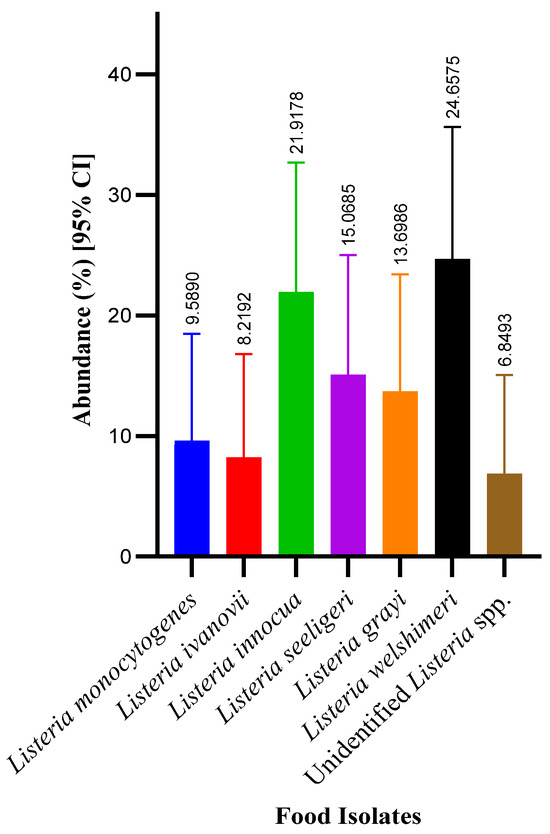
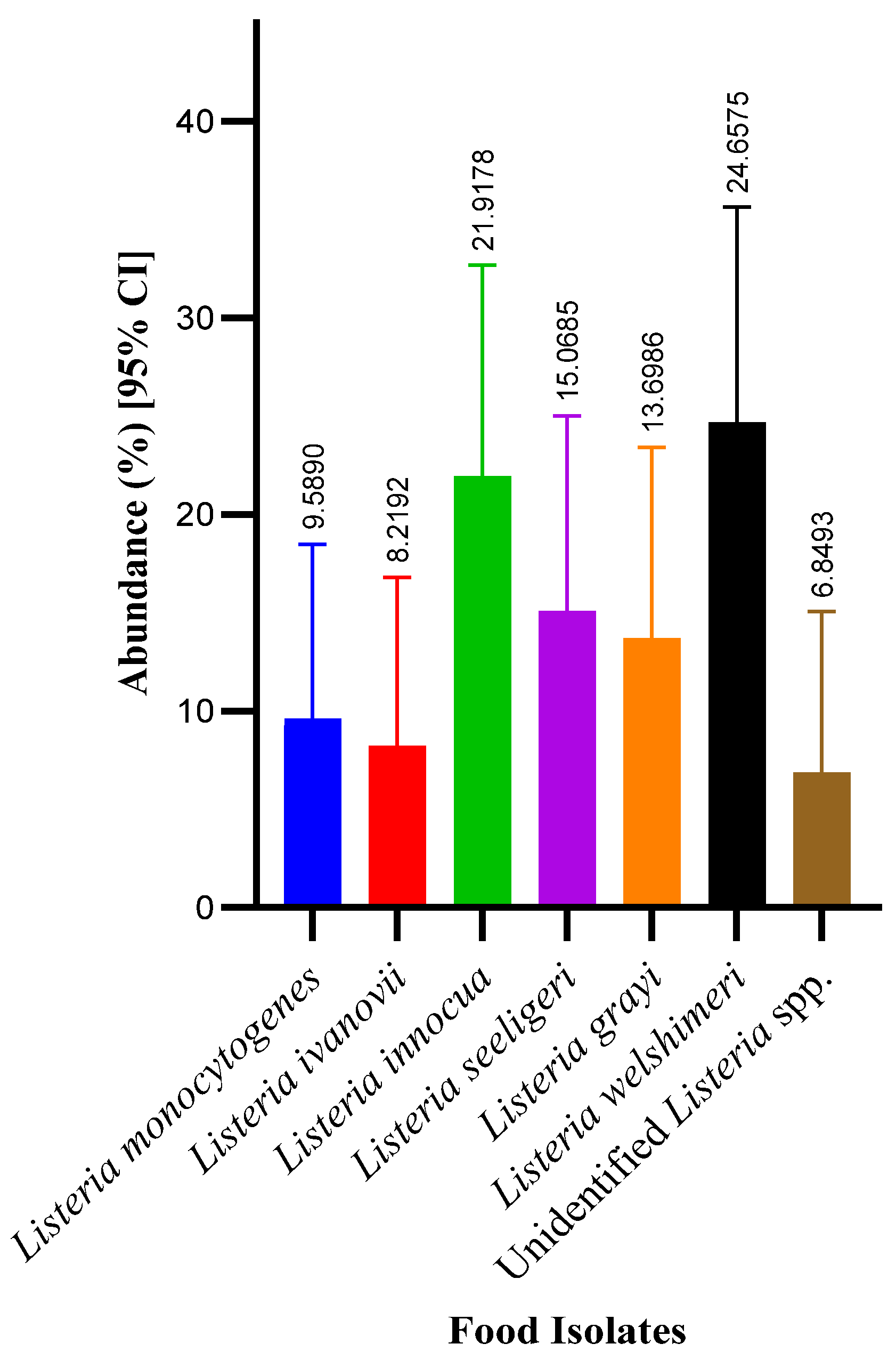
Out of 861 retail and farm-gate food samples analyzed (including vegetables, edible fungi (mushrooms), raw and processed meats, raw and processed dairy), 73 (8.48%) were positive for Listeria spp. Multiplex PCR 68 of these isolates (93.15% to the species level leaving five (6.85% unidentified (Figure 1).
Figure 1.
Species Diversity and Abundance of Isolates (n = 73). Error Bars—95% Confidence Interval.
Among the identified taxa, Listeria welshimeri was recovered most frequently, followed by L. innocua, L. seeligeri and L. grayi (Figure 1). The pathogenic species were notably less common within the total isolate collection with L. monocytogenes and L. ivanovii 8–9% of the recovered genus population. Crucially, all pathogenic isolates were restricted to raw food commodities.
Non-pathogenic environmental species predominated, exhibiting an overall of 6.97% prevalence across sampled foods (Table A2). Conversely, pathogenic species (L. monocytogenes and L. ivanovii) were less frequent, accounting for 17.81% of total isolates and appearing in 1.51% of all evaluated food samples (Table A2).
3.2. Product-Level Distribution of Listeria spp.
Analysis of individual food commodities revealed considerable variation in contamination rates (Table 4). Among fresh vegetable produce, the highest prevalence was observed in kale (22.22%, 8/36), followed by Alfalfa sprouts (17.39%, 4/23), romaine lettuce (16.67%, 6/36) and spinach (13.33%, 8/60). Within the raw meat products, raw pork exhibited the highest prevalence (20.00%, 2/10), followed by ground beef (13.89%, 5/36) and raw chicken (9.52%, 4/42) (Table 4).
Table 4.
Prevalence and Species Distribution of Listeria spp. in Selected Food Categories.
In contrast, recovery of Listeria spp. from processed foods was rare. No Listeria isolates were detected in processed meat products including pork ham, pork sausage, beef hotdogs, and smoked pork (0/39). Similarly, pasteurized milk products and ten of the eleven cheese varieties assessed were free of contamination. The only positive processed food sample was cream cheese, which exhibited a prevalence of 7.14% (1/14) (Table 4 and Table A1).
3.2.1. Effect of Food Processing on Listeria Contamination
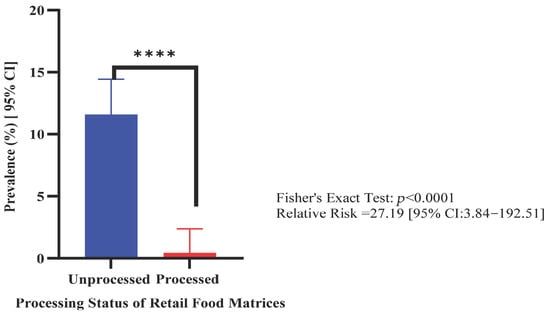
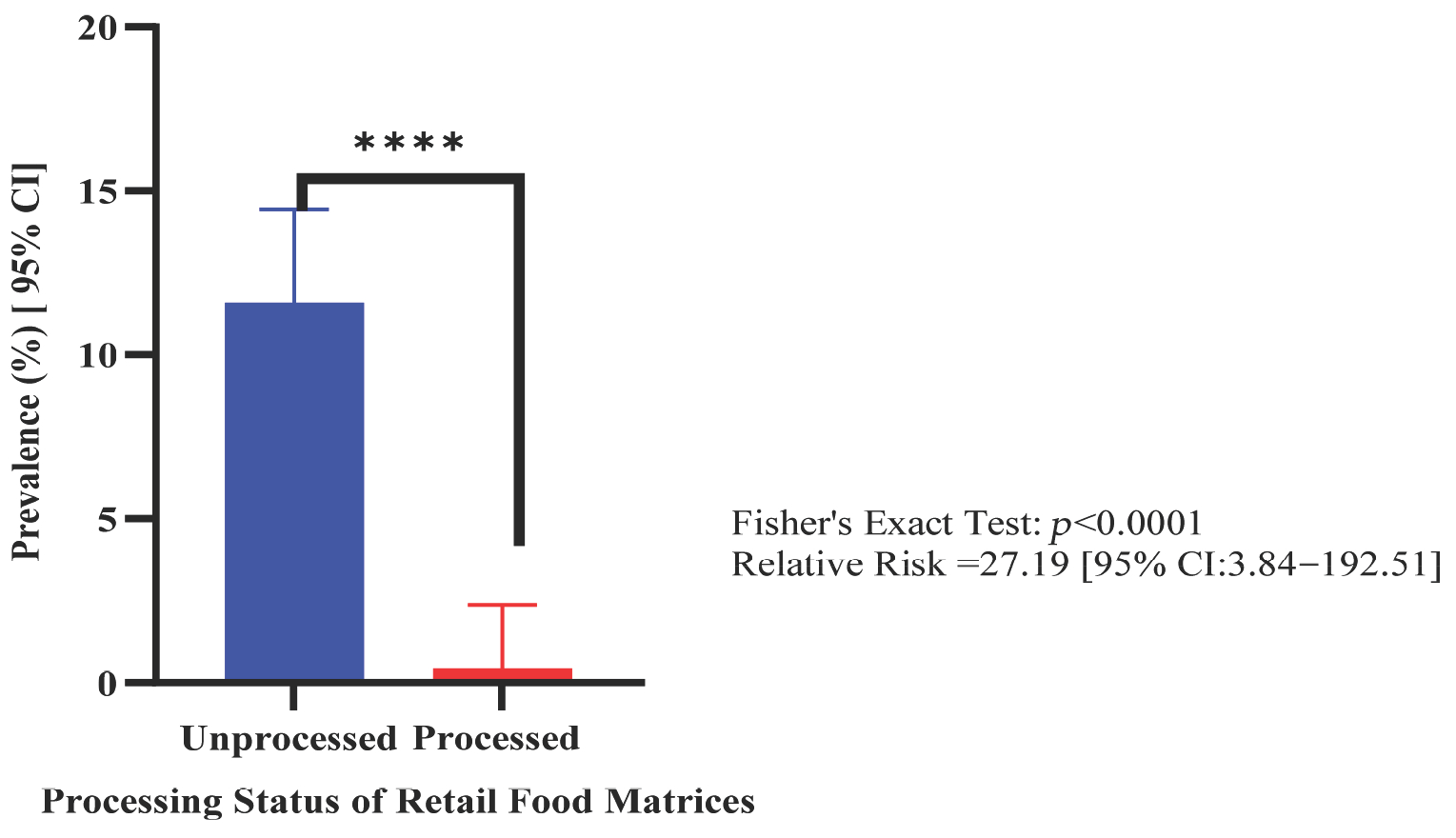
Unprocessed foods exhibited a significantly higher prevalence of Listeria spp., compared to processed alternatives (Fisher’s exact test, p < 0.0001; Figure 2). Risk metrics confirmed a strong positive association between raw processing status and contamination risk. Specifically, unprocessed food matrices were approximately 27 times more likely to harbor the pathogen, demonstrating a pronounced vulnerability to contamination when compared directly to processed items.
Figure 2.
Comparison of Listeria spp. Prevalence and Relative Risk Metrics Retail Food Categories (N = 861). Error bars = 95% Confidence Interval (CI). Statistical analysis was performed using Fisher’s exact test; (****) indicate highly significant difference p < 0.00001.
3.2.2. Prevalence of Listeria spp. Across Major Food Categories
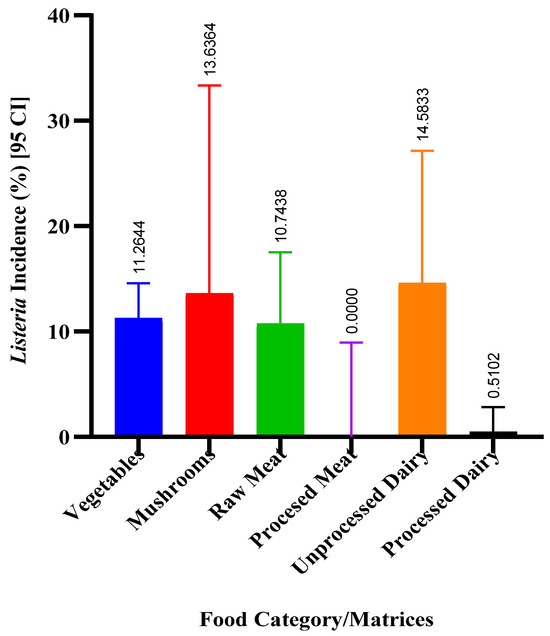
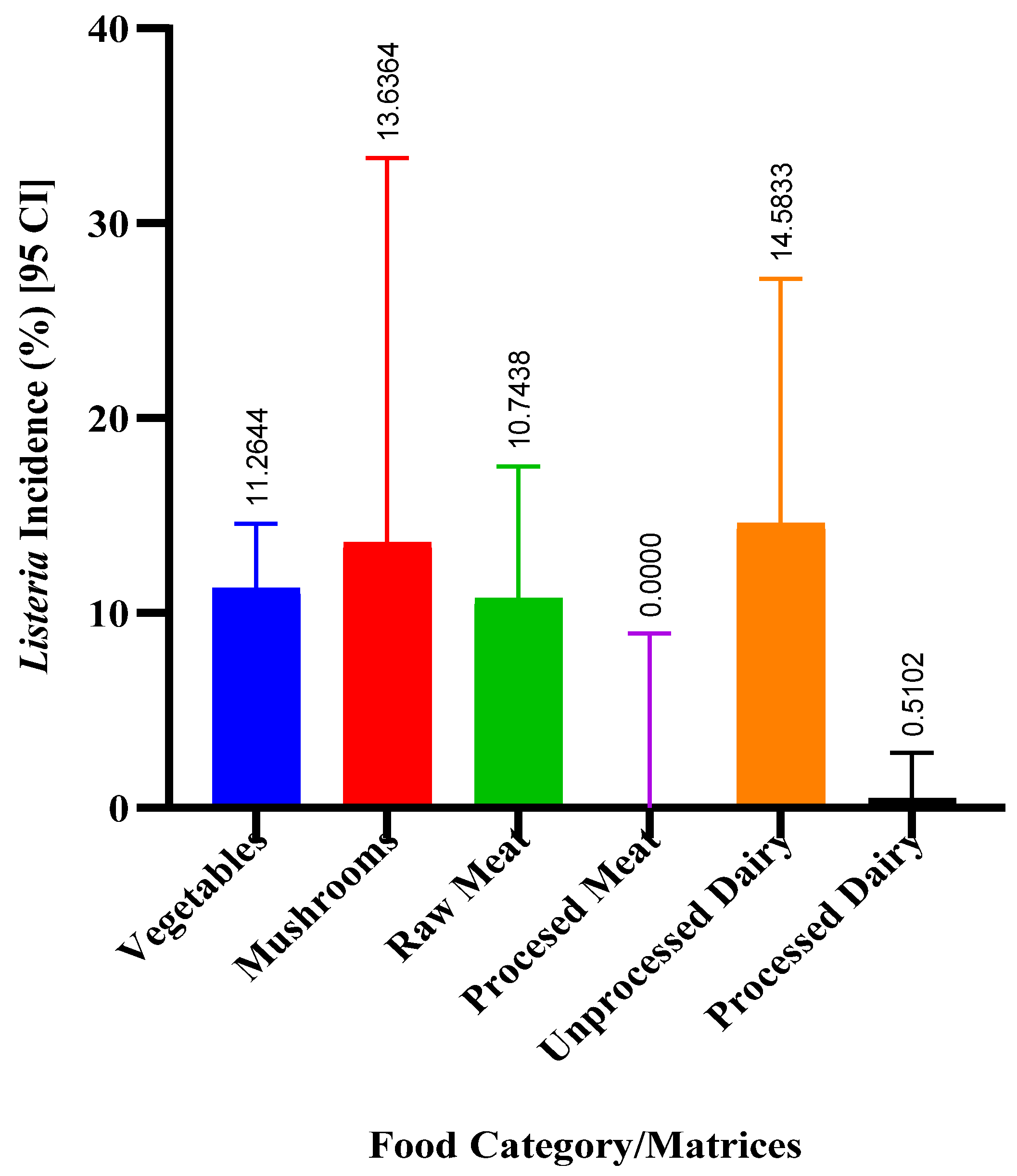
Listeria spp. contamination varied across the evaluated matrices, peaking in raw milk followed by mushrooms, vegetables, and raw meats (Figure 3). Conversely, processed dairy products exhibited a minimal contamination rate, while processed meat products remained entirely free of the pathogen. Pairwise comparisons revealed that the higher prevalence observed in vegetables was statistically significant when contrasted directly against processed dairy products (p = 0.0017; Figure 3).
Figure 3.
Distribution and Baseline Prevalence of Listeria spp. Across Key Retail Food Categories. Error bars represent 95% confidence intervals. Statistical significance was determined at p < 0.05.
When categorized by pathogenic potential, non-pathogenic Listeria species predominated over pathogenic species across the evaluated food matrices (Table A3). Vegetables harbored both groups, though non-pathogenic strains were recovered at a substantially higher frequency than pathogenic ones. Similarly, raw meat was dominated by non-pathogenic species, which occurred at nearly three times the rate of their pathogenic counterparts. In contrast, raw milk exhibited a more balanced distribution, with pathogenic and non-pathogenic species isolated at comparable frequencies. Notably, mushrooms yielded non-pathogenic Listeria exclusively, with no pathogenic species recovered from this matrix (Table A3).
3.3. Overall Antimicrobial Resistance Profile
The evaluated Listeria isolates exhibited variable susceptibility patterns across the tested panel of therapeutic agents (Table 5). Phenotypic resistance was highest for Penicillin G, followed by clindamycin, levofloxacin, and ciprofloxacin. Intermediate susceptibility was most frequently observed for levofloxacin, followed by chloramphenicol. Conversely, tobramycin, tetracycline, and trimethoprim–sulfamethoxazole demonstrated exceptional efficacy, with almost all recovered isolates remaining fully susceptible to these antimicrobials (Table 5).
Table 5.
Overall Phenotypic Distribution and Antibiotic Resistance Profiles of Recovered Listeria Isolates (n = 68).
3.3.1. Species-Specific Antibiotic Resistance Patterns
Species-specific antimicrobial resistance profiles varied considerably across the genus collection (Table A4). All L. monocytogenes isolates remained fully susceptible to amikacin, azithromycin, tetracycline, tobramycin, and trimethoprim–sulfamethoxazole (Table A4). However, phenotypic resistance to penicillin G and levofloxacin was noted within this pathogenic group. Similarly, L. ivanovii exhibited extensive resistance to nitrofurantoin, penicillin G, and levofloxacin (Table A4).
Among the non-pathogenic species, distinct resistance profiles were observed across different taxa (Table A4). L. innocua displayed resistance to kanamycin and penicillin G, while L. welshimeri frequently exhibited intermediate susceptibility to levofloxacin, moxifloxacin, and azithromycin. Notably, L. grayi demonstrated the highest baseline resistance levels among the non-pathogenic isolates, particularly toward penicillin G, clindamycin, and levofloxacin.
3.3.2. Non-Susceptibility Patterns Across Pathogenic and Non-Pathogenic Listeria spp.
When resistant and intermediate strains were pooled into a unified non-susceptible cohort, most tested antimicrobials exhibited comparable profiles between pathogenic and non-pathogenic Listeria isolates (Table 6). Observed variations in non-susceptibility rates for penicillin G, nitrofurantoin, and levofloxacin between the two cohorts were not significantly different (p > 0.05). Conversely, clindamycin non-susceptibility was significantly higher among pathogenic isolates (p = 0.0175; Table 6). In contrast, azithromycin non-susceptibility was restricted exclusively to non-pathogenic isolates (p = 0.0461).
Table 6.
Comparative non-susceptibility/resistance of pathogenic and non-pathogenic Listeria isolates.
3.3.3. Multidrug Resistance Profiles of Listeria Phenotypes
Following established criteria, multidrug resistance (MDR) was defined as non-susceptibility to at least one antimicrobial agent in three or more therapeutic classes (Table 7). More than half of the total isolate collection was classified as MDR, with a higher prevalence observed among pathogenic strains than non-pathogenic counterparts. At the species level, MDR was identified in a clear majority of L. monocytogenes isolates and was universal among all L. ivanovii strains (Table 7).
Table 7.
Distribution of multidrug-resistant phenotypes among classical Listeria isolates (n = 68).
Among the non-pathogenic environmental species, MDR distribution varied significantly by taxon. The phenotype was universal in L. grayi, followed in descending frequency by L. innocua, L. seeligeri, and L. welshimeri (Table 7). Collectively, these findings indicate that while multidrug resistance is widely distributed across the genus, the overall burden remains highest within pathogenic lineages.
4. Discussion
Listeria species remain important foodborne microorganisms because of their ability to persist in diverse environmental niches and contaminate foods throughout the production chain. Among them, L. monocytogenes is the principal human pathogen and a major concern in ready-to-eat (RTE) foods, which are particularly high-risk due to absence of terminal listericidal treatment step and the organisms’ capacity to survive and proliferate under conditions that inhibit many other pathogens [11]. This study investigated the occurrence, species diversity, distribution, and antimicrobial resistance profiles of Listeria spp. recovered from retail and farm-gate foods in North Carolina, USA. Overall, contamination was widespread in raw commodities, particularly vegetables, raw dairy products, and meats, while processed foods showed markedly lower prevalence, highlighting the effectiveness of post-harvest interventions. Although non-pathogenic species predominated, the detection of L. monocytogenes and L. ivanovii in raw food matrices underscores their continued relevance as potential sources of human exposure. Furthermore, the high prevalence of antimicrobial resistance (AMR) and multidrug resistance (MDR) across both pathogenic and environmental Listeria isolates suggests that food production environments may act as important reservoirs of resistance determinants. Collectively, these findings support the need for integrated food safety and AMR surveillance within a One Health framework.
4.1. Diversity and Distribution of Listeria Species in Retail Foods
The adapted multiplex PCR assay identified 68 of 73 presumptive Listeria isolates (93.2%), indicating its suitability for routine species-level identification of classical Listeria species. The five unidentified isolates may represent species outside the multiplex primer panel or isolates with sequence variation that reduced primer binding efficiency, a recognized limitation of targeted molecular assays [23,24]. Similar limitations have been reported previously, supporting the complementary use of higher-resolution approaches such as multi-locus sequence typing (MLST) and whole-genome sequencing (WGS) for comprehensive taxonomic characterization [16]. Differences in identification efficiency may be attributable to variations in sample type, species diversity, primer specificity, and the presence of atypical strains.
The overall prevalence of Listeria spp. in retail and farm-gate foods was 8.48% (73/861), with L. monocytogenes accounting for less than 1% of all samples. Although lower than that reported in several multi-state U.S. surveys, these differences are likely attributable to geographical location, commodity type, sampling design, and environmental conditions [25]. Consistent with previous studies, non-pathogenic Listeria species predominated, reflecting their adaptation to agricultural and food-processing environments [25,26]. Interestingly, L. welshimeri (2.08% prevalence) was the most frequently recovered species, whereas many previous investigations have identified L. innocua as the dominant environmental species but currently at 1.85% [27]. This variation may reflect regional differences in environmental reservoirs, agricultural practices, or food matrices. Nevertheless, the recovery of L. monocytogenes and L. ivanovii from foods intended for human consumption confirms the continued circulation of pathogenic Listeria within the food supply and reinforces the importance of effective surveillance and hygienic practices throughout the farm-to-fork continuum [28]. The high relative frequency of both L. welshimeri and L. innocua in North Carolina retail food channels provides food safety managers with a broader, more statistically robust data pool for tracking sanitation failures and mapping facility harborages before L. monocytogenes colonization can occur. Although L. innocua was not the predominant species in this study, its frequent recovery supports its continued value as an environmental indicator organism. Because L. innocua occupies ecological niches like those of L. monocytogenes, its detection can provide an early indication of sanitation deficiencies before pathogenic Listeria becomes established. Consequently, environmental monitoring programs that include non-pathogenic Listeria species remain an important component of preventive food safety systems [27].
4.2. Impact of Food Processing on Listeria Contamination
Food processing had a pronounced effect on Listeria occurrence. Raw commodities exhibited substantially higher contamination than processed foods, with processing reducing the likelihood of contamination by approximately 27-fold. These findings reinforce raw commodities as primary reservoirs of contamination. In contrast, processed foods showed minimal contamination, with only one positive processed dairy sample and no detections in processed meat, confirming the effectiveness of thermal processing, pasteurization, and HACCP-based interventions [28,29,30].
Fresh vegetables contributed to the largest number of positive samples, with leafy vegetables such as kale and collards showing particularly high contamination frequencies [31,32,33]. Similar observations have been reported globally, where contamination of fresh produce has been associated with irrigation water, soil, manure, wildlife, and post-harvest handling practices [14,34,35,36]. Raw milk exhibited very high prevalence among the commodity groups examined, consistent with studies describing contamination through infected animals, contaminated milking equipment, or environmental exposure during milk production [37]. Because these products are often consumed raw, they present a direct route for exposure. Raw meat contamination (10.74%) was consistent with global retail surveys [38], while relatively higher prevalence observed in pork may reflect contamination during slaughter and carcass processing [39]. Although L. monocytogenes has previously been isolated from mushroom production environments, its absence in mushroom samples in the present study may reflect differences in cultivation practices or local environmental conditions [40,41].
The absence of Listeria from processed meat products and the very low prevalence observed in processed dairy products demonstrate the effectiveness of validated processing interventions. The single positive processed dairy sample likely represents post-processing contamination rather than process failure. Collectively, these findings support strengthening preventive controls within the raw supply chain while maintaining effective environmental monitoring programs to minimize opportunities for post-processing contamination.
4.3. Distribution of Pathogenic and Non-Pathogenic Species
Non-pathogenic Listeria species predominated across all food categories, whereas pathogenic species were recovered exclusively from raw commodities. This distribution agrees with previous reports describing environmental Listeria species as common inhabitants of agricultural ecosystems while pathogenic species occur less frequently but pose substantially greater public health risks [6,42,43].
The detection of L. monocytogenes in fresh vegetables, and raw milk is particularly important because these commodities may be consumed with little or no additional pathogen reduction. The ability of L. monocytogenes to survive refrigeration, tolerate environmental stresses, and persist within food-processing environments further increases its significance as a foodborne pathogen [11,14,36]. Likewise, the occurrence of L. ivanovii, although less frequently associated with human disease, demonstrates that multiple pathogenic Listeria species remain present within the food supply [14,36]. Although L. ivanovii is traditionally classified as a veterinary pathogen causing ruminant abortions, it is increasingly recognized as an opportunistic human pathogen capable of causing severe systemic listeriosis in immunocompromised individuals. Its presence in fresh retail matrices indicates a breakdown in pre-harvest biosecurity, likely driven by animal manure contamination or agricultural runoff bypassing standard Good Agricultural Practices (GAPs). Overall, these findings support risk-based surveillance strategies incorporating commodity-specific hazard analyses together with routine environmental monitoring to identify contamination sources before products reach consumers.
4.4. Antimicrobial Resistance Profiles
The emergence of antimicrobial resistance (AMR) in Listeria species recovered from retail foods threatens standard clinical treatments for human listeriosis. Historically, the genus Listeria has been considered uniformly susceptible to β-lactams and aminoglycosides. Our study on phenotypic antimicrobial susceptibility testing demonstrated resistance to multiple clinically important antimicrobial classes among foodborne Listeria isolates. There was broad reduced susceptibility which was most frequently observed to Penicillin G, levofloxacin, clindamycin, and ciprofloxacin, whereas tetracycline, tobramycin, and trimethoprim–sulfamethoxazole remained highly effective against most isolates. Differences between the resistance profiles observed in this study and those reported elsewhere likely reflect regional variation in antimicrobial usage, agricultural practices, and the composition of circulating Listeria populations [17,44]. The presence of overlapping resistance profiles in non-pathogenic L. innocua and L. welshimeri against clinically vital classes (e.g., fluoroquinolones, macrolides, and aminoglycosides) indicates a shared resistome within food processing microenvironments.
Reduced susceptibility to Penicillin G is of particular concern because β-lactam antibiotics remain the cornerstone of treatment for invasive listeriosis. Although clinically significant resistance remains relatively uncommon, increasing reports of reduced susceptibility among food and environmental isolates suggest that agricultural environments may represent important reservoirs of resistant Listeria [19,44,45,46]. Likewise, reduced susceptibility to fluoroquinolones may indicate antimicrobial selection pressures operating throughout food production systems [47,48].
Resistance profiles differed considerably among species. Listeria ivanovii exhibited the greatest resistance among the pathogenic species, whereas L. grayi displayed the highest resistance burden among the non-pathogenic species. These observations indicate substantial interspecies variability and support the hypothesis that environmental Listeria populations contribute to the persistence and dissemination of antimicrobial resistance within food-production environments [49,50].
Multidrug resistance was common, occurring in 64.71% of all isolates and more frequently among pathogenic species than non-pathogenic species. Although the present study relied solely on phenotypic susceptibility testing, the widespread occurrence of multidrug resistance suggests that food production environments may serve as reservoirs of resistant Listeria [51,52]. Because non-pathogenic Listeria species occupy ecological niches like those of L. monocytogenes, monitoring their antimicrobial resistance profiles may provide valuable insight into resistance selection within food-production environments. Future investigations incorporating whole-genome sequencing will be essential to determine whether these phenotypes result from intrinsic resistance mechanisms, acquisition of resistance genes, or horizontal gene transfer within food-associated microbial communities.
4.5. Study Limitations
Several limitations should be considered when interpreting these findings. First, the surveillance was limited to selected regions of North Carolina and therefore may not represent broader U. S. food supply. Second, the cross-sectional design provides only a temporal snapshot of contamination during the study period. Third, the relatively small number of pathogenic isolates limited the statistical power or species-specific comparisons. Fourth antimicrobial susceptibility was evaluated using phenotypic methods without molecular characterization of resistance genes, serotypes or genomic lineages. Consequently, genetic basis of the observed resistance profiles could not be determined. Finally, several food commodities associated with listeriosis outbreaks, including fruits and Mexican-style soft cheeses, e.g., queso fresco, were not included and will be incorporated into future surveillance studies.
High MDR levels among environmental species further suggest that food production environments may facilitate maintenance and dissemination of resistance determinants [51,52]. The elevated rates of phenotypic Penicillin G resistance observed among the non-pathogenic species, such as L. innocua, suggest that these food-associated strains may act as phenotypic reservoirs of resistance. While existing literature heavily establishes that non-pathogenic Listeria can share resistance determinants via horizontal gene transfer (HGT) within food matrices, no molecular or genomic characterization was performed in the present study to confirm the specific underlying resistance genes or active transfer mechanisms. Therefore, these phenotypic trends warrant future genotypic investigations to confirm the precise genetic elements responsible for this β-lactam resistance.
5. Conclusions
This study provides baseline data on the prevalence, species diversity, and antimicrobial resistance of Listeria spp. in retail and farm-gate foods in some regions in North Carolina, USA. Overall prevalence was 8.55%, with contamination concentrated on raw commodities, particularly milk, vegetables, mushrooms, and meats. Processed foods showed minimal contamination, confirming the effectiveness of post-harvest interventions. Molecular identification revealed a predominance of non-pathogenic species, while pathogenic L. monocytogenes and L. ivanovii were confined to raw foods, underscoring ongoing exposure risks. In addition, widespread antimicrobial resistance and high MDR prevalence across both pathogenic and environmental isolates indicate that food systems may serve as important reservoirs of resistance determinants. These findings highlight the need for continued surveillance of Listeria spp. beyond L. monocytogenes, strengthened farm-to-fork control strategies, and integrated monitoring of antimicrobial resistance within a One Health framework to mitigate foodborne and resistance-related risks.
Author Contributions
Conceptualization, A.B. and L.L.W.; methodology, L.L.W. and A.B.; validation, L.L.W., E.M.A. and S.D.; formal analysis, L.L.W. and E.M.A.; investigation, A.B., J.R.K. and S.D.; data curation, R.R.B.; writing—original draft preparation, L.L.W., A.B. and S.D.; writing—review and editing, L.L.W., A.B. and E.M.A.; supervision, L.L.W.; project administration, L.L.W.; funding acquisition, L.L.W. All authors have read and agreed to the published version of the manuscript.
Funding
This research was funded by the 1890 Capacity Building Grant Program from the United States Department of Agriculture and the National Institute of Food and Agriculture (Project Award No. 2023-38821-39979).
Institutional Review Board Statement
Not applicable.
Informed Consent Statement
Not applicable.
Data Availability Statement
The original contributions presented in this study are included in the article. Further enquiries can be directed at the corresponding author.
Conflicts of Interest
The authors declare no conflicts of interest.
Abbreviations
The following abbreviations are used in this manuscript:
| AMR | Antimicrobial Resistance |
| MDR | Multidrug Resistance |
| TMP-SMX | Trimethoprim–sulfamethoxazole. |
| BLEB | Buffered Listeria Enrichment Broth |
| TAE Buffer | Tris–acetate–EDTA Buffer |
Appendix A
Table A1.
Distribution and Prevalence of Listeria species in fresh produce, meat and dairy samples from farms and retail outlets (n = 861).
Table A2.
Taxonomic Distribution, and Public Health Risk Recovered Listeria Isolates (N = 73).
Table A3.
Pathogenicity Distribution and Prevalence of Listeria Isolates Across Sampled Retail Food Matrices (N = 861).
Table A4.
Itemized phenotypic antimicrobial resistance, intermediate and susceptibility percentage distributions across individual classical Listeria isolates (n = 68).
References
- Yang, Y.; Xu, F.-R.; Zhou, Y.-B.; Hu, L.-Q.; Lu, W.; Zhang, S.-H.; Hu, H.; Huang, X.-R. Epidemiological Characteristics of Foodborne Disease Outbreaks in a Hospital: A 5-Year Retrospective Study. Int. J. Gen. Med. 2025, 18, 1529–1542. [Google Scholar] [CrossRef] [Scilit] [PubMed]
- Mohapi, D.A.; Nkhebenyane, S.J. Listeria monocytogenes and Listeria ivanovii Virulence and Adaptations Associated with Leafy Vegetables from Small-Scale Farm and a Shift of Microbiota to a New Niche at Markets: A Systematic Review. Microorganisms 2025, 14, 76. [Google Scholar] [CrossRef] [Scilit] [PubMed]
- Osek, J.; Wieczorek, K. Why does Listeria monocytogenes survive in food and food-production environments? J. Vet. Res. 2023, 67, 537–544. [Google Scholar] [CrossRef] [Scilit] [PubMed]
- Mazaheri, T.; Cervantes-Huaman, B.R.H.; Bermudez-Caodevila, M.; Ripolles-Avila, C.; Rodriguez-Jerez, J.J. Listeria monocytogenes Biofilms in the Food Industry: Is the Current Hygiene Program Sufficient to Combat the Persistence of the Pathogen? Microorganisms 2021, 9, 181. [Google Scholar] [CrossRef] [Scilit] [PubMed]
- Manyi-Loh, C.E.; Lues, R. Listeria monocytogenes and Listeriosis: The Global Enigma. Foods 2025, 14, 1266. [Google Scholar] [CrossRef] [Scilit] [PubMed]
- Orsi, R.H.; Liao, J.; Carlin, C.R.; Weidmann, M. Taxonomy, ecology, and relevance to food safety of the genus Listeria with a particular consideration of new Listeria species described between 2010 and 2022. MBio 2023, 15, e00938-23. [Google Scholar] [PubMed]
- Kathariou, S.; Kanenaka, R.; Allen, R.D.; Fok, A.K.; Mizumoto, C. Repression of motility and flagellin production at 37 degrees C is stronger in Listeria monocytogenes than in the nonpathogenic species Listeria innocua. Can. J. Microbiol. 1995, 41, 572–577. [Google Scholar] [CrossRef] [Scilit] [PubMed]
- Reis, J.O.; Teixeira, L.A.C.; Cunha-Neto, A.; Castro, V.S.; Figueiredo, E.E.S. Listeria monocytogenes in beef: A hidden risk. Res. Microbiol. 2024, 175, 104215. [Google Scholar] [CrossRef] [Scilit] [PubMed]
- Quereda, J.J.; Moron-Garcia, A.; Palacios-Gorba, C.; Dessaux, C.; Garcia-del Portillo, F.; Pucciarelli, M.G.; Ortega, A.D. Pathogenicity and virulence of Listeria monocytogenes: A trip from environmental to medical microbiology. Virulence 2021, 12, 2509–2545. [Google Scholar] [CrossRef] [Scilit] [PubMed]
- Su, Y.; Liu, A.; Zhu, M.J. Mapping the landscape of listeriosis outbreaks (1998–2023): Trends, challenges, and regulatory responses in the United States. Trends Food Sci. Technol. 2024, 154, 104750. [Google Scholar] [CrossRef] [Scilit]
- D’Ambrosio, G.; Schirone, M.; Paparella, A. Listeria monocytogenes in Ready-to-Eat Foods: Risk Perspectives Across Different Regulatory Systems. Foods 2026, 15, 470. [Google Scholar] [CrossRef] [Scilit] [PubMed]
- Scallan, W.E.J.; Cui, Z.; Tierney, R.; Griffin, P.M.; Hoekstra, R.M.; Payne, D.C.; Rose, E.B.; Devine, C.; Namwase, A.S.; Mirza, S.A.; et al. Foodborne Illness Acquired in the United States—Major Pathogens, 2019. Emerg. Infect. Dis. 2025, 31, 669–677. [Google Scholar] [CrossRef] [Scilit] [PubMed]
- Orsi, R.H.; Wiedmann, M. Characteristics and distribution of Listeria spp., including Listeria species newly described since 2009. Appl. Microbiol. Biotechnol. 2016, 100, 5273–5287. [Google Scholar] [CrossRef] [Scilit] [PubMed]
- Zhu, Q.; Gooneratne, R.; Hussain, M.A. Listeria monocytogenes in Fresh Produce: Outbreaks, Prevalence and Contamination Levels. Foods 2017, 6, 21. [Google Scholar] [CrossRef] [Scilit] [PubMed]
- Law, J.W.-F.; Mutalib, N.-S.A.; Chan, K.-G.; Lee, L.-H. An insight into the isolation, enumeration, and molecular detection of Listeria monocytogenes in food. Front. Microbiol. 2015, 6, 1227. [Google Scholar] [CrossRef] [Scilit] [PubMed]
- Li, F.; Ye, Q.; Chen, M.; Zhang, J.; Xue, L.; Wang, J.; Wu, S.; Zeng, H.; Gu, Q.; Zhang, Y.; et al. Multiplex PCR for the Identification of Pathogenic Listeria in Flammulina velutipes Plant Based on Novel Specific Targets Revealed by Pan-Genome Analysis. Front. Microbiol. 2021, 11, 634255. [Google Scholar] [CrossRef] [Scilit] [PubMed]
- Soltysiuk, M.; Przyborowska, P.; Wiszniewska-Laszczch, A.; Tobolski, D. Prevalence and antimicrobial resistance profile of Listeria spp. isolated from raw fish. BMC Vet. Res. 2025, 21, 333. [Google Scholar] [CrossRef] [Scilit] [PubMed]
- Byathut, A.; Das, M.; Chowdhury, G.; Mukhopadhyay, A.K.; Khati, R.; Das, S.; Ramamorthy, T.; Dolma, K.G. Exploring the prevalence and antibiotic resistance of Listeria of Listeria monocytogenes in diverse food commodities across Sikkim, India. Braz. J. Microbiol. 2026, 57, 23. [Google Scholar]
- Zawiasa, A.; Olejnik-Schmidt, A. Antibiotic Resistance Profiles and Genetic Determinants of Listeria innocua Isolated from Food Sources in Poland. Genes 2025, 16, 1455. [Google Scholar] [CrossRef] [Scilit] [PubMed]
- Mazza, R.; Piras, F.; Ladu, D.; Putzolu, M.; Consolati, S.G.; Mazzette, R. Identification of Listeria spp. strains isolated from meat products and meat production plants by multiplex polymerase chain reaction. Ital. J. Food Saf. 2016, 5, 5498. [Google Scholar]
- Clinical and Laboratory Standards Instititute (CLSI). Performance Standards for Antimicrobial Susceptibility Testing, 26th ed.; CLSI Supplement M100-S26; Clinical and Laboratory Standards Institute (CLSI): Wayne, PA, USA, 2016; pp. 1–204. [Google Scholar]
- Vatopoulos, A.; Weber, J.T.; Monnet, D.L. Multidrug-resistant, extensively drug-resistant and pandrug-resistant bacteria: An international expert proposal for interim standard definitions for acquired resistance. Clin. Microbiol. Infect. 2012, 18, 268–281. [Google Scholar] [CrossRef] [Scilit] [PubMed]
- Jagadeesan, B.; Baert, L.; Wiedmann, M.; Orsi, R.H. Comparative Analysis of Tools and Approaches for Source Tracking Listeria monocytogenes in a Food Facility Using Whole-Genome Sequence Data. Front. Moicrobiol. 2019, 10, 947. [Google Scholar] [CrossRef] [Scilit] [PubMed]
- Sullivan, G.; Orsi, R.H.; Estrada, E.; Strawn, L.; Wiedmann, M. Whole-Genome Sequencing-Based Characterization of Listeria Isolates from Produce Packinghouses and Fresh-Cut Facilities Suggests Both Persistence and Reintroduction of Fully Virulent L. monocytogenes. Appl. Environ. Microbiol. 2022, 88, e01177-22. [Google Scholar] [CrossRef] [Scilit] [PubMed]
- Simmons, C.; Stasiewicz, M.J.; Wright, E.; Warchocki, S.; Roof, S.; Kause, J.R.; Bauer, N.; Wiedmann, M. Listeria monocytogenes and Listeria spp. Contamination Patterns in Retail Delicatessen Establishments in Three U.S. States. J. Food Prot. 2014, 77, 1929–1939. [Google Scholar] [CrossRef] [Scilit] [PubMed]
- Korsak, D.; Szuplewska, M. Characterization of nonpathogenic Listeria species isolated from food and food processing environment. Int. J. Food Microbiol. 2016, 238, 274–280. [Google Scholar] [CrossRef] [Scilit] [PubMed]
- Burnett, J.; Wu, S.T.; Bakker, H.D.; Cook, P.W.; Veenhuizen, D.R.; Hammons, S.R.; Singh, M.; Oliver, H.F. Listeria monocytogenes is prevalent in retail produce environments but Salmonella enterica is rare. Food Control 2020, 113, 107173. [Google Scholar] [CrossRef] [Scilit]
- Ryzhova, E.; Janine, W.; Chantelle, H.D.; Holy, O. Listeria monocytogenes in organic and conventional farming: Epidemiology, risks, and solutions within a One Health framework. One Health 2025, 21, 101173. [Google Scholar] [CrossRef] [Scilit] [PubMed]
- Schoder, D.; Pelz, A.; Paulsen, P. Transmission Scenarios of Listeria monocytogenes on Small Ruminant On-Farm Dairies. Foods 2023, 12, 265. [Google Scholar] [CrossRef] [Scilit] [PubMed]
- Li, X.; Zheng, J.; Zhao, W.; Wu, Y. Prevalence of Listeria monocytogenes in Milk and Dairy Product Supply Chains: A Global Systematic Review and Meta-analysis. Foodborne Pathog. Dis. 2024, 21, 526–535. [Google Scholar] [CrossRef] [Scilit] [PubMed]
- Borena, B.M.; Dilgasa, L.; Gebremedhin, E.Z.; Sarba, E.J.; Marami, L.M.; Kelbesa, K.A.; Tadese, N.D. Listeria Species Occurrence and Associated Risk Factors and Antibiogram of Listeria Monocytogenes in Milk and Milk Products in Ambo, Holeta, and Bako Towns, Oromia Regional State, Ethiopia. Vet. Med. Int. 2022, 2022, 5643478. [Google Scholar] [CrossRef] [Scilit] [PubMed]
- Williams, E.N.; Van Doren, J.M.; Leonard, C.L.; Datta, A.R. Prevalence of Listeria monocytogenes, Salmonella spp., Shiga toxin-producing Escherichia coli, and Campylobacter spp. in raw milk in the United States between 2000 and 2019: A systematic review and meta-analysis. J. Food Prot. 2023, 86, 100014. [Google Scholar] [CrossRef] [Scilit] [PubMed]
- Zhao, Q.; Hu, P.; Li, Q.; Zhang, S.; Li, H.; Chang, J.; Jiang, Q.; Zheng, Y.; Li, Y.; Liu, Z.; et al. Prevalence and transmission characteristics of Listeria species from ruminants in farm and slaughtering environments in China. Emerg. Microbes Infect. 2021, 10, 356–364. [Google Scholar] [CrossRef] [Scilit] [PubMed]
- Troung, H.N.; Garmyn, D.; Gal, L.; Fournier, C.; Sevellec, Y.; Jeandroz, S.; Piveteau, P. Plants as a realized niche for Listeria monocytogenes. MicrobiologyOpen 2021, 10, e1255. [Google Scholar] [CrossRef] [Scilit] [PubMed]
- Sullivan, G.; Wiedmann, M. Detection and Prevalence of Listeria in U.S. Produce Packinghouses and Fresh-Cut Facilities. J. Food Prot. 2020, 83, 1656–1666. [Google Scholar] [CrossRef] [Scilit] [PubMed]
- Weller, D.; Weidmann, M.; Strawn, L.K. Irrigation Is Significantly Associated with an Increased Prevalence of Listeria monocytogenes in Produce Production Environments in New York State. J. Food Prot. 2015, 78, 1132–1141. [Google Scholar] [CrossRef] [Scilit] [PubMed]
- Shaaban, S.I.; Awwad, N.; Nossair, M.; Ayoub, M.; El-Majeed Eid, A. Gene profiling and serotyping of multidrug-resistant Listeria monocytogenes isolated from humans, animals and dairy products. BMC Vet. Res. 2025, 21, 702. [Google Scholar] [CrossRef] [Scilit] [PubMed]
- Zhang, H.; Luo, X.; Aspridou, Z.; Misiou, O.; Dong, P.; Zhang, Y. The Prevalence and Antibiotic-Resistant of Listeria monocytogenes in Livestock and Poultry Meat in China and the EU from 2001 to 2022: A Systematic Review and Meta-Analysis. Foods 2023, 12, 769. [Google Scholar] [CrossRef] [Scilit] [PubMed]
- Matle, I.; Mbatha, K.R.; Madoroba, E. A review of Listeria monocytogenes from meat and meat products: Epidemiology, virulence factors, antimicrobial resistance and diagnosis. Onderstepoort J. Vet. Res. 2020, 87, 1869. [Google Scholar] [CrossRef] [Scilit] [PubMed]
- Tu, T.; Liu, Z.; Li, X.; Guo, C.; Chen, Z.; Wang, H.; Wang, L. Survival of Listeria monocytogenes on growing and harvested Trumpet Royale (Pleurotus eryngii), Alba Clamshell (Hypsizygus tessellatus), and Brown Clamshell (Hypsizygus tessellatus) mushrooms. Food Microbiol. 2025, 130, 104778. [Google Scholar] [CrossRef] [Scilit] [PubMed]
- Viswanath, P.; Murugesan, L.; Knabel, S.J.; Verghese, B.; Chikthimmah, N.; Laborde, L.F. Incidence of Listeria monocytogenes and Listeria spp. in a Small-Scale Mushroom Production Facility. J. Food Prot. 2013, 76, 608–615. [Google Scholar] [CrossRef] [Scilit] [PubMed]
- Townsend, A.; Strawn, L.K.; Chapman, B.J.; Dunn, L.L. A Systematic Review of Listeria Species and Listeria monocytogenes Prevalence, Persistence, and Diversity throughout the Fresh Produce Supply Chain. Foods 2021, 10, 1427. [Google Scholar] [CrossRef] [Scilit] [PubMed]
- Estrada, E.M.; Hamilton, A.M.; Sullivan, G.B.; Wiedmann, M.; Critzer, F.J.; Strawn, L.K. Prevalence, Persistence, and Diversity of Listeria monocytogenes and Listeria Species in Produce Packinghouses in Three U.S. States. J. Food Prot. 2020, 83, 277–286. [Google Scholar] [CrossRef] [Scilit] [PubMed]
- Nikolaou, F.G.; Colobatiu, L.M.; Ciupescu, L.M.; Tabaran, A.; Hategan, A.R.; Mihaiu, R.; Tanassuica, R.; Poenaru, M.M.; Mihaiu, M. Prevalence and Antimicrobial Resistance of Listeria monocytogenes Isolated from Dairy Products in Romania. Antibiotics 2025, 14, 482. [Google Scholar] [CrossRef] [Scilit] [PubMed]
- Moabelo, K.; Gana, J.; Ngoshe, Y.; Moerane, R.; Adesiyun, A. Antimicrobial-Resistant Listeria Species Isolated from Beef and Beef Products Sold in Mpumalanga Province, South Africa. J. Food Prot. 2026, 89, 100767. [Google Scholar] [CrossRef] [Scilit] [PubMed]
- Kiss, R.; Marosi, B.; Petrik, B.; Lakatos, B.; Szabo, B.G. Clinical and microbiological characteristics and follow-up of invasive Listeria monocytogenes infection among hospitalized patients: Real-world experience of 16 years from Hungary. BMC Microbiol. 2024, 24, 324. [Google Scholar] [CrossRef] [Scilit] [PubMed]
- Kozytska, T.; Neubauer, H.; Wareth, G. Listeria ivanovii-an underestimated pathogen in veterinary medicine. Front. Vet. Sci. 2026, 13, 1844936. [Google Scholar] [CrossRef] [Scilit] [PubMed]
- Nyenje, M.E.; Tanih, N.F.; Green, E.; Ndip, R.N. Current Status of Antibiograms of Listeria ivanovii and Enterobacter cloacae Isolated from Ready-to-Eat Foods in Alice, South Africa. Int. J. Environ. Res. Public Health 2012, 9, 3101–3114. [Google Scholar] [CrossRef] [Scilit] [PubMed]
- Bertsch, D.; Muelli, M.; Weller, M.; Uruty, A.; Lacroix, C.; Meile, L. Antimicrobial susceptibility and antibiotic resistance gene transfer analysis of foodborne, clinical, and environmental Listeria spp. isolates including Listeria monocytogenes. MicrobiologyOpen 2014, 3, 118–127. [Google Scholar] [CrossRef] [Scilit] [PubMed]
- Anupama, A.; Pattapulavar, V.; Christopher, J.G. The past, present, future of Listeria monocytogenes: Understanding the molecular pathways, antibiotic resistance and public health implications. Med. Microecol. 2025, 25, 100127. [Google Scholar] [CrossRef] [Scilit]
- Kayode, A.J.; Okoh, A.I. Assessment of multidrug-resistant Listeria monocytogenes in milk and milk product and One Health perspective. PLoS ONE 2022, 17, e270993. [Google Scholar] [CrossRef] [Scilit] [PubMed]
- Wartha, S.; Bretschneider, N.; Dangel, A.; Hobmaier, B.; Hormansdorfer, S.; Huber, I.; Murr, L.; Pavlovic, M.; Sprenger, A.; Wenning, M.; et al. Genetic Characterization of Listeria from Food of Non-Animal Origin Products and from Producing and Processing Companies in Bavaria, Germany. Foods 2023, 12, 1120. [Google Scholar] [CrossRef] [Scilit] [PubMed]

Disclaimer/Publisher’s Note: The statements, opinions and data contained in all publications are solely those of the individual author(s) and contributor(s) and not of MDPI and/or the editor(s). MDPI and/or the editor(s) disclaim responsibility for any injury to people or property resulting from any ideas, methods, instructions or products referred to in the content. |
© 2026 by the authors. Licensee MDPI, Basel, Switzerland. This article is an open access article distributed under the terms and conditions of the Creative Commons Attribution (CC BY) license.