


Abstract
Hatcheries potentially can disseminate Salmonella through poultry production chains. This study describes the investigation and control of persistent Salmonella enterica serovar 13,23:i:- in a UK broiler hatchery. Over four years from 2015 to 2019, a broiler hatchery was sampled intensively seven times, yielding Salmonella from 361 of 2645 samples. The findings assisted biosecurity advice and the targeting both of cleaning and disinfection (C&D) and subsequent sampling rounds. Additional sampling was conducted to assess C&D and monitor antimicrobial resistance, and also among all the supplying breeder flocks. The large majority of the isolates were Salmonella 13,23:i:- and the degree of contamination increased along the process pathway. The egg areas and the setter incubators were the least contaminated, whilst the hatcher cabinets, the chick handling areas, and the waste and external areas yielded Salmonella most frequently. The likely resident serovar 13,23:i:- was not eradicated during this study, but diligent management and C&D enhancements and targeting, plus effective biosecurity, were eventually followed by a substantial reduction in Salmonella contamination. The percentage of positive samples per visit reduced to 2.3% from a mid-study peak of 23%. The antimicrobial resistance was varied, infrequent (detected in 4% of tested isolates), and did not show longitudinal trends. This study shows that long-term Salmonella hatchery contamination may be susceptible to targeted interventions, as informed by repeated sampling, provided that biosecurity is of a high standard and C&D (including biofilm disruption) has been optimised. Importantly, it also illustrates the long timescale over which interventions may be required to reduce resident Salmonella contamination.
1. Introduction
Salmonellosis is one of the most common gastrointestinal infections in humans, with over 77,000 confirmed cases in the European Union (EU) in 2023 [1]. Poultry is an important source for human salmonellosis [2,3,4], with broiler meat and table eggs being major vehicles [1]. Breeding flocks, feed mills and hatcheries act as potential focal points of Salmonella contamination in poultry production [5,6,7,8]. Hatcheries can disseminate Salmonella to commercial flocks [9,10,11,12,13,14], and this role can be amplified by the structure of the industry, with large integrated companies relying on relatively few supplying hatcheries. Hatchery Salmonella strains may contaminate consumer products [15], with risk-based modelling in Canada by Racicot et al. [16] suggesting that up to 4% of poultry meat salmonellosis cases are attributable to contamination from hatcheries.
Chicks can be infected with Salmonella by vertical transmission if the eggs are internally infected by certain serovars (such as Salmonella Enteritidis), by pseudo-vertical transmission if external egg contamination penetrates the shell, or via horizontal transmission during hatching [17,18,19]. To reduce external egg contamination, and thus the risk of Salmonella dissemination within hatcheries, in the United Kingdom (UK), eggs are usually disinfected by fogging before entering first-stage incubators (setters) [20].
Certain Salmonella strains can become resident in a hatchery, persisting as an environmental contaminant over indefinite cycles of egg incubation and hatching. Such contamination is usually focused in areas with surfaces that are difficult to clean and disinfect, such as hatchers and the associated ventilation ducting systems, egg and hatch waste processing areas and hatcher basket wash machines [21,22]. Salmonella can survive for years in materials such as hatcher fluff and dust, and it can persist in the hatchery without further incoming infected eggs [21,22,23]. Certain Salmonella serovars, such as S. Senftenberg, can be very persistent within incubators and the associated ducting, possibly because of their ability to form biofilms or a reduced susceptibility to desiccation or biocides [24,25,26,27]. Once resident, a Salmonella strain can be very difficult to eliminate and may become a long-term source of infection for newly hatched chicks [22,28].
Cox et al. [23] showed that hatching chicks are highly susceptible to Salmonella infection, making hatchery contamination especially risky. Chicks may ingest or inhale contaminated material within the hatchers [23,29] or from other chick processing areas inside the hatchery. Contamination can easily spread between chicks in hatcher baskets and within hatchers via dust, debris and fluff [29]. There may also be longitudinal carryover of Salmonella between hatchings if cleaning and disinfection (C&D) is ineffective. There may be further horizontal transmission during procedures in the chick processing areas. Thus, despite typically very low proportions of Salmonella-positive eggs entering hatcheries (0.01–0.05%), up to 9% of leaving chicks can be colonised by Salmonella [30]. Such chicks are then able to disseminate Salmonella to other batches during transit and when placed on farms [31].
Salmonella control depends upon disinfecting eggs effectively upon entry, although better protection against pseudo-vertical contamination is achieved by sanitising the eggs on the farm as soon after lay as possible [32,33]. Furthermore, there should be multiple barriers to Salmonella entry and spread, including good internal and external biosecurity, with carefully planned unidirectional workflows and air pressure gradients to counter the spread or recycling of contamination, plus thorough and effective C&D programs [20,33,34] validated by sensitive monitoring programs. Alternatively, the centralised process can be replaced by on-farm hatching to reduce the risk of disseminating contamination from different sources [35].
UK strains of Salmonella enterica subsp. enterica serovar 13,23:i:- (S. 13,23:i:-) are thought to be variants of S. Idikan [36], based on whole genome sequencing. S. Idikan is often associated with contaminated feed and mills, and it can also become persistent in hatcheries and on poultry farms [37]. S. 13,23:i:- was first isolated from broilers in the UK in 2009, and it has subsequently become widely established across the poultry industry, especially within the broiler sector [37]. In 2018, it was the most commonly isolated serovar from chickens and from compound poultry feed [38]. However, it does not appear to be widely established in the EU, accounting for less than 2% of Salmonella reports from broiler flocks between 2014 and 2016 [18], all of which were from the UK. Furthermore, it has not been among the top 20 EU broiler serovars in subsequent years [1]. There is also no evidence of its significant involvement in human cases [39,40].
The present report describes a four-year investigation triggered by the isolation from a UK broiler hatchery (via routine monitoring) of a Salmonella serovar of particular relevance to public health. This serovar was not recovered subsequently, and the investigation focused on C&D to address the repeated recovery of a perceived resident serovar, S. 13,23:i:-. Intensive sampling visits highlighted the areas that were particularly susceptible to contamination, enabling better targeting of C&D, as well as informing biocide selection and specific biosecurity advice.
In contrast to the existing Salmonella survey reports, overviews, and investigations, the current work focuses in detail on a hatchery with a particular, multifactorial contamination problem. It illustrates the strategy of detailed and repeated surveys and interventional work that may be needed to effectively suppress or eliminate persistent Salmonella contamination (whether of this serovar or of others) in a particular situation. It additionally demonstrates common ‘problem’ areas and shows that, in a single hatchery, several issues may need to be first identified and then addressed before control is achieved. Additional small studies on Salmonella recovery technique and longitudinal antimicrobial resistance are included.
2. Materials and Methods
2.1. Hatchery Operation
The hatchery was supplied by 60 broiler breeder farms. After being received and sorted, eggs were put in cold storage, where they were fogged daily using a 10% concentration of a proprietary disinfectant (Viroshield, Kilco) containing glutaraldehyde and benzalkonium chloride. They were then incubated for around 18 days in single-stage setters before being transferred into hatcher baskets by machine. These were placed in hatcher incubators in several hatcher rooms and formaldehyde evaporation was employed within hatchers as an antimicrobial measure during hatching. Hatched chicks were manually removed after three to four days and sorted in the chick handling area where, depending on requirements, chicks were sexed, vaccinated and transferred into transport crates for delivery. A macerator adjacent to the egg handling area piped egg waste and hatcher debris into sealed outdoor skips. Used trolleys, egg trays, hatcher baskets and chick delivery baskets were cleaned in separate wash machines.
2.2. Advice and Selection of Disinfectants
A written report with advice on Salmonella control followed each hatchery visit by the Animal and Plant Health Agency (APHA) team. These reports reflected observations made during the visit, the visit results and any changes to management that had been made between visits. The expert advice focused mainly on C&D procedures for equipment and washers, but other potential control measures were also highlighted. Advice was tailored and was responsive to information and observations acquired at the visit, as well as microbiological results, rather than being standardised by intervention protocol or operating procedure.
2.3. Sampling
Intensive sampling visits. There were seven intensive sampling visits between May 2015 and August 2019. Intervals between visits varied from two months to over a year, depending on hatchery events and research funding. Sampling areas included egg reception, sorting and cold storage areas, setter area, egg transfer area, hatchers, chick handling area, tray wash areas, waste processing areas and delivery lorries. Between 351 and 394 samples were collected each time, according to a written protocol that dictated a sequence following the flow of eggs and chicks through the hatchery. The protocol specified what elements to sample with further detail where needed, for example, specifying the removal of covers before sampling drains. Target numbers and locations of swabs were given for key elements such as setters and hatchers, plus all drains present, although some discretion was left to account for changing patterns of usage and ease of access. Specified elements to sample were: floors, walls, doors, drains, trolleys, trays, setters, hatchers (including ventilator extraction corridors) and equipment including for cleaning and personal protection. Floors and drains in access corridors and lobbies of setter and hatcher rooms were explicitly specified. Further details of sampling sites are provided in the Supplementary Data (Table S1).
Additionally, sampling focused on areas where contamination was found during the previous visit. Sampling followed an established protocol, previously used in hatcheries, for sensitive detection of motile Salmonella from environmental sources [14]. Using a clean disposable vinyl glove each time, an area of approximately 0.5 m2 was sampled with a large gauze swab (900 cm2 Readiwipes Dry: Robinson Healthcare Ltd., Worksop, UK) that had been autoclaved in 225 mL of buffered peptone water (BPW, Merck: Merck Millipore, Watford, UK). The swab was replaced in the jar of BPW and returned to the APHA Weybridge laboratory at ambient temperature for culture on the same day.
Special visit. This visit, in March 2018, was to assess the effectiveness of C&D and to compare Salmonella detection from samples collected into differing volumes of BPW. Consequently, it did not follow the all-area sampling approach otherwise adopted. Samples were collected from chick handling areas (40) and waste areas (20), before and after C&D. Sampling was also conducted in duplicate from adjacent 0.5 m2 surfaces in chick handling areas (40 pairs) and from waste and outside areas (40 pairs). One each of these paired swabs came from, and was replaced into, the usual (225 mL) quantity of BPW, whilst the other was moistened with and replaced into only 30 mL of BPW.
Additional samples taken by broiler company management. Sponge swabs from all areas of the hatchery and fluff samples from hatchers were collected by hatchery staff and posted at ambient temperature to APHA Weybridge between 2015 and 2019. These samples were used to monitor antimicrobial resistance amongst Salmonella isolates.
Breeding farms. All 60 breeding flocks supplying eggs to the hatchery during this study were repeatedly sampled on-farm by company field managers between October 2017 and March 2018. For each flock, five pairs of boot swabs (pre-moistened swabs slipped over clean plastic overshoes) were collected, each time using at least 100 shuffled steps over a representative part of the poultry house floor. Dust samples from ledges and other accumulation points across the houses were collected into clean plastic bags using clean disposable gloves. Samples were posted to APHA Weybridge.
2.4. Bacteriological Procedures
Postal samples were placed in 225 mL BPW on receipt and samples transported in 30 mL BPW had 200 mL BPW added. All samples were processed by a modified version of ISO 6579:2017, using pre-enrichment in BPW followed by culture on modified semi-solid Rappaport-Vassiliadis agar and Rambach agar, as previously described [14]. Slide agglutination tests were performed, using polyvalent somatic and flagella antisera, to confirm Salmonella from representative suspect colonies. All positive isolates were serotyped according to the White–Kaufmann–Le Minor Scheme [41].
S. 13,23:i:- isolates from the postal hatchery samples (n = 643) were subjected to disc diffusion tests using ISO-Sensitest agar (Oxoid; Oxoid Ltd., Basingstoke, UK) and discs (Oxoid) containing the following antimicrobials: amikacin 30 µg, amoxycillin/clavulanic acid 30 µg, ampicillin 10 µg, apramycin 15 µg, ceftazidime 30 µg, cefotaxime 30 µg, chloramphenicol 30 µg, ciprofloxacin 1 µg, furazolidone 15 µg, gentamicin 10 µg, nalidixic acid 30 µg, neomycin 10 µg, streptomycin 10 µg, trimethoprim/sulphamethoxazole (1:19) 25 µg, compound sulphonamides 300 µg and tetracycline 10 µg. British Society for Antimicrobial Chemotherapy (BSAC) breakpoints were used. If there was no BSAC breakpoint available, then published breakpoints were used [42].
2.5. Statistical Analysis
Data were assigned to seven broad sample categories: egg area, setter area, hatcher area, chick handling area, tray wash area, waste/outside area and miscellaneous. Analysis by logistic regression examined findings from the different visits separately, identifying which visits and sample categories had the highest odds of yielding positive samples. The model was as follows:
where is the proportion of positive samples, parameter is the relative coefficient for sample category i, is the farm visit j and is a normally distributed error term with mean zero. The equation above can be solved for pi,j to find the proportion of positive samples, assuming that the effects of sample category and visit do not interact. To assess the goodness-of-fit of the model, McFadden’s pseudo-R2 value and Hosmer–Lemeshow goodness-of-fit test were used [43,44].
To compare the two swab methods (in 30 mL or 225 mL of BPW), McNemar’s two-sample paired proportion test [45] was used to determine whether there was a significant difference in the outcomes from the two methods. The Wilson Score Interval [46] was used to estimate the 95% confidence intervals for sensitivity.
All analyses were performed in Stata 15 [47].
3. Results
3.1. Hatchery Visits
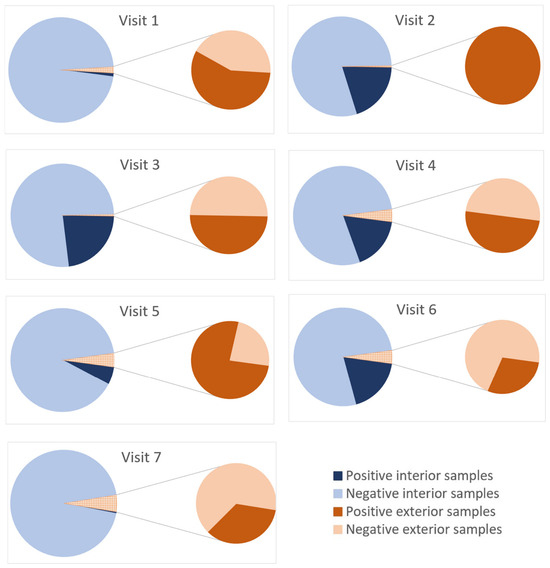
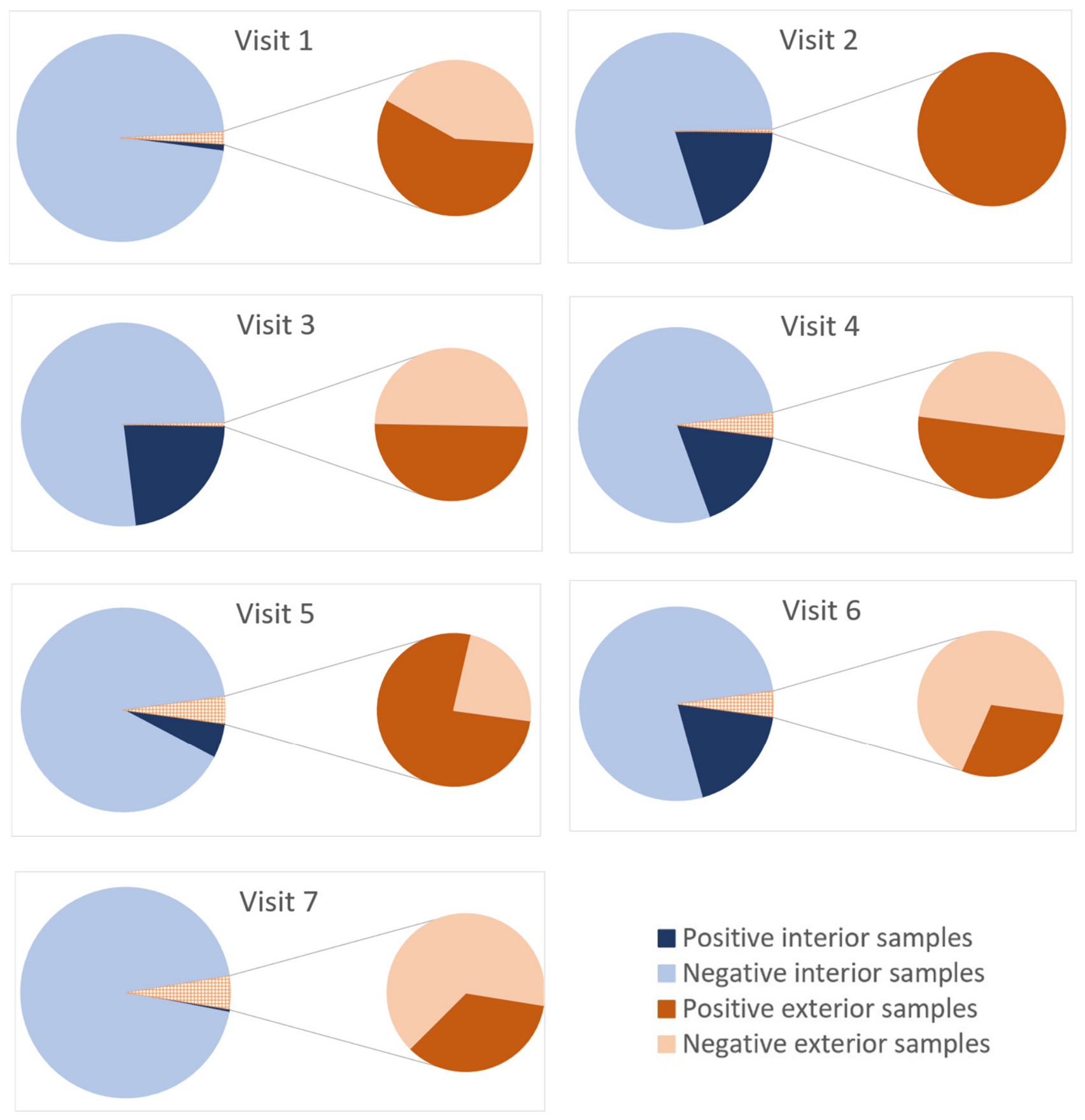
Longitudinal sampling. Of the 2645 samples collected over the seven visits, 361 (13.6%) yielded Salmonella. Between 2.2% and 23.1% of the samples per visit were Salmonella-positive. The findings are illustrated in Figure 1, with the detailed results shown in Table 1. There was a substantial variation over time in the degree of Salmonella contamination for some areas. For example, the waste and external areas were contaminated at all visits, whereas the egg and setter areas yielded no Salmonella on three visits (1, 5 and 7) when the hatchery was less contaminated in general.
Figure 1.
The proportions of samples collected from the interior and exterior parts of the hatchery that were Salmonella-positive at each of the seven hatchery visits.
Table 1.
Salmonella isolations from the hatchery at each visit.
The egg handling areas consistently had the lowest contamination (2.1% of samples positive overall), with no isolations on four occasions. There was progressively greater contamination along the production process: setters (3.6% overall), hatchers (19% overall) and chick handling areas (28% overall). The combined ‘waste and outside’ areas showed the heaviest contamination (58%) of any specific area. At all the visits except for the final one, there was a high proportion of positive samples from the macerator and its surroundings.
The various C&D regimes employed during this study are described below and summarised in Table 2. The first visit (May 2015) followed an intensive clean of the hatchery, with the in-house sampling still yielding sporadic isolations of S. 13,23:i:- from drains. The disinfection regime was long-standing, using disinfectants based on the quaternary ammonium compound (QAC) benzalkonium chloride (BAC) and, intermittently, the oxidizing agent peroxymonosulphate. Both of these disinfectants were being applied at concentrations lower than specified both by the UK Department for Environment, Food and Rural Affairs (i.e., Defra General Orders concentrations, where the test organism is Salmonella Enteritidis) and by their manufacturers. The visit yielded S. 13,23:i:- from eight samples: swabs from a drain and a cleaning tool (the latter classified under Miscellaneous) in the tray wash room and six from the waste areas (macerator plus an external concrete apron accommodating the waste skip).
Table 2.
Summary of cleaning and disinfection regimes during the present study.
Visit 2 was over two years later, in August 2017. Only the BAC-based disinfectant was then in use because of concerns about corrosion from peroxymonosulphate. The BAC-based disinfectant was being used at a low concentration in order to counter the issues of blocked power wash jets and slippery floor surfaces associated with a full-concentration application. S. 13,23:i:- was isolated from all areas, with an overall proportion of 20% positive samples and with the hatcher basket wash (50%) and waste/outside areas (89%) being most heavily contaminated. Subsequently, at Visits 3 (October 2017) and 4 (January 2018), a glutaraldehyde-plus-BAC compound product had replaced the low-concentration BAC disinfectant. The proportion of samples positive for S. 13,23:i:- remained high, around 20%, although locally, the proportions fell substantially between these visits in both the chick handling (77% vs. 34%) and the tray wash (67% vs. 15%) areas.
Visit 5 (July 2018) followed the C&D assessment in March 2018 and a major upgrade of the C&D program, which used a compound disinfectant (glutaraldehyde plus the QAC didecyldimethylammonium chloride) and the additional intermittent application of a peroxymonosulphate disinfectant followed by rinsing. The overall proportion of Salmonella-positive samples had approximately halved to 9%, there were no isolations from the egg or setter areas, and contamination was modest in the hatcher and chick handling areas. However, over a quarter of the tray wash area samples were positive, including some taken from the ‘clean’ section and from the water reservoir of the hatcher basket wash machine. The waste skip and the lorry wash areas remained heavily contaminated.
Visit 6 (November 2018) followed a further deep clean, involving some equipment (including the macerator) being dismantled. There was a resurgence in S. 13,23:i:- throughout the hatchery, with the hatchers and the chick handling areas being notably affected (30% and 60% of samples positive, respectively). All the samples from within and around the macerator were also positive, and there was frequent Salmonella contamination of the floor in the hatcher basket store.
The final visit in August 2019 followed the implementation of a higher peroxymonosulphate disinfectant concentration followed by rinsing. The hatcher basket washer and the loft space above it had also been deep cleaned. The indoor Salmonella contamination had dramatically reduced, with S. 13,23:i:- being isolated once, from the hatcher debris that had accumulated around the chick take-off line, and S. Idikan being recovered from a pair of wellington boots sampled indoors but used outside. S. 13,23:i:- and S. Idikan were isolated from external areas, including puddles around the skip and the lorry parking area and the new waste tank.
A large majority of Salmonella isolates over all the visits (357 of 361) were S. 13,23:i:-. Only two other serovars were identified: S. Give, found once during the first visit on a waste skip outdoors, and S. Idikan during Visit 7 from boots and outdoor puddles.
The logistic regression model (Table 3) suggests a significantly increased risk of Salmonella isolation in the samples from the waste, chick handling, post-hatch cleaning (tray wash) and hatcher areas compared to the setter areas (all p < 0.001). The waste area showed the greatest increase in risk with an odds ratio (OR) of 93.0 (95% CI 51.1–169.2) compared to the setter areas. The egg and miscellaneous areas did not show a significantly different risk compared to the setter areas. All the later visits, apart from the seventh, showed a significantly increased risk of positive Salmonella samples compared to Visit 1, but no clear pattern was observed in terms of the change in risk over time. Visit 7 showed a non-significant reduced risk of Salmonella isolation compared to Visit 1, with an OR of 0.600 (95% CI 0.219–1.644). If the same model is run with Visit 7 as the baseline category (Supplementary Data; Table S2), it is observed that this visit had a significantly lower risk of Salmonella isolation compared to each of Visits 2 through 6 (all p < 0.001).
Table 3.
Multivariable logistic regression analysis of factors ‘Location category’ and ‘Visit number’ associated with the odds of a sample returning a positive Salmonella result.
The pseudo-R2 of 29.1% is low, which is to be expected as this model only included two factors (visit and location), and the Hosmer–Lemeshow goodness-of-fit statistic suggests the model is incomplete (p = 0.002).
Effectiveness of cleaning and disinfection. Before C&D, 22% of the samples yielded S. 13,23:i:-, with the waste area samples being more often positive (9/20) than the chick handling area (4/40). After C&D, only one of the 60 (1.7%) samples yielded Salmonella.
Comparison of swabs transported in different volumes of buffered peptone water. There was a similar frequency of Salmonella recovery from the paired sites with swabs transported in either 30 mL or 225 mL BPW (Table 4). For the 30 mL samples, 39 of 80 samples were positive, versus 35 of 80 for the 225 mL samples, and there were discrepant negative results for one of 40 and five of 40 for the 30 mL and 225 mL volumes, respectively. McNemar’s test of a difference between the two methods was not significant (p = 0.103). Assuming the 40 sites that did not yield Salmonella with either method were genuinely Salmonella-negative, the corresponding sensitivities of detection were 97.5% (95% CI 87.1–99.6%) for the 30 mL samples and 87.5% (95% CI 73.9–94.5%) for the 225 mL samples. Overall, there was a high consensus between the two BPW transport volumes, with 74/80 samples (92.5%, 95% CI 84.6–96.5%) showing agreement.
Table 4.
Classification of 80 samples as positive or negative for Salmonella in 30 mL and 225 mL volumes of BPW.
3.2. Antimicrobial Resistance
Most (96%) of the 643 S. 13,23:i:- postal sample isolates were fully sensitive to all the agents in the panel (Table 5). This proportion varied by year, with the lowest (79%) being in 2017. However, only 34 isolates were tested that year. Nalidixic acid (nal) was the only compound to which resistance was documented in all years. Other resistances showed much more variable occurrence, and neither multi-resistance (resistance to three or more classes of antimicrobials) nor resistance to extended-spectrum cephalosporin drugs was observed.
Table 5.
Numbers of antimicrobial resistant isolates of Salmonella 13,23:i:- from postal samples.
3.3. Breeding Flock Samples
None of the samples (476 sets of boot swabs and 598 dust samples) from the 60 broiler parent breeding flocks yielded Salmonella.
3.4. Advice and Changes to Management
The key advice given was related to C&D and to the operation of the tray washer. The changes to the disinfectants are detailed in the visit results and in Table 2. Other specific advice, following the persistent and frequent isolation of Salmonella from an intended decontamination area (tray washer), was to increase the washer working temperature to above 60 °C, to increase the routine concentration of disinfectant within the machine, to incorporate an acidic wash of the machine at the end of the day, and to avoid recontamination of the washed hatcher baskets by dust from the overhead loft space.
4. Discussion
Salmonella control is a challenge for hatcheries in the UK and elsewhere [10,14,22,48,49,50]. Hatcheries are a potential barrier between the layers of the production pyramid for microbes, but they are also risk sites for the cross-contamination and dissemination of pathogens [12,28]. In the UK and elsewhere, the consolidation of the poultry industry has led to fewer and larger hatcheries, each supplying increased numbers of production flocks [13]. The existing mandatory monitoring of broiler, layer and breeder birds and chick box liner papers for Salmonella (under National Control Programmes in the EU and UK) should quickly allow hatcheries producing chicks carrying regulated serovars to be identified. In the event that this happens, there may be substantial consequent economic and, potentially, supply effects for the industry [51]. Investing in the effective control of all salmonellae in hatcheries reduces this risk, thereby protecting the food chain from all Salmonella serovars.
In the present case, Salmonella was recovered during every visit to a large commercial hatchery. Multifocal Salmonella contamination was revealed during the initial sampling, which was triggered by the isolation of a Salmonella serovar of relevance to public health under routine surveillance (which was not found again), and a longitudinal study of C&D was pursued. Nearly all the isolates were S. 13,23:i:-, and the low contamination within the egg handling areas [22], plus no isolation of S. 13,23:i:- after sensitive sampling in the environments of all the flocks supplying the eggs, indicated that S. 13,23:i:- was very likely a resident rather than a strain that had been recently or repeatedly introduced through contaminated eggs. Two recently surveyed UK hatcheries have also had S. 13,23:i:- isolated during multiple visits, suggesting resident contamination, although some flocks supplying these hatcheries had yielded S. 13,23:i:- [14]. For the present hatchery, the original route for introduction of S. 13,23:i:- is unknown.
As the present work had an interventional aspect, was subject to variation in access according to usage of the setters and the hatchers and was not simply a longitudinal survey, repeat sampling was not performed to a strict template. The samples were focused on perceived problem areas and the sampling was enhanced in some areas from visit to visit, this being informed by the earlier results. Therefore, whilst the proportion of positive samples in an area at any one visit may be regarded as being broadly indicative of the intensity of contamination, there was sampling bias and less can be read into smaller and fluctuating differences over time or between locations. Furthermore, in the absence of extensive molecular genetic characterisation of the isolates, Salmonella clones could not be tracked through the premises. Nonetheless, some consistent and logical patterns were observed.
Surface and equipment contamination increased along the hatchery process pathway, with the lowest proportion of isolations from the egg areas and the setters and the chick handling areas being the most heavily contaminated internal areas. The logistic model gives an indication of the possible comparative range of Salmonella risk in certain areas of the hatchery. However, it should not be considered definitive or generalisable on its own. This is a case study at a single hatchery and, with only two factors, the model is clearly incomplete. The goodness-of-fit statistics confirm that it is a limited model, only explaining 29% of the variation. There may be many other variables not measured in this case study that could affect the likelihood of a particular sample being positive for Salmonella. Nonetheless, previous studies have consistently found a similar pattern of contamination, with the hatchers and the hatchling handling areas often being heavily contaminated [5,7,10,14,22,23,25,26]. This reflects the generation of dust and other contaminants during hatching [29] and its further spread during the processing and handling of the chicks.
During some visits, the hatcher interiors were heavily contaminated despite recent C&D. Hatchers are difficult to clean and disinfect, as chick fluff and dust can be hidden within the air vents, the ducting for the belts that drive the fans, and the plenum corridors [7,10,21,22,26]. During earlier visits (2, 3 and 4), the air vents in the plenum corridors were contaminated. If these ancillary areas are missed during C&D, then the negative pressure and turbulence when restarting the ventilation systems may draw dust in from such areas, which can then cause recontamination even after an apparently effective hatcher C&D [21].
The tray wash areas are also often contaminated with Salmonella [7,22,25,26]. Poorly effective C&D of hatcher baskets and transport crates increases the risk of Salmonella spread through the production chain [7,22,52,53]. There was evidence of resident contamination of the hatcher basket wash machine in this hatchery, as previously reported elsewhere [14]. Following the advised changes in operation and the focused decontamination of the overhead loft area, considerable improvement was observed, with no Salmonella isolated from this area during the final visit.
The waste and exterior areas showed the heaviest contamination during all the visits except one. The macerator was a particular focus of indoors contamination except during the final visit. The waste processing areas were highly contaminated in other UK chicken [14] and duck [25] hatcheries, and they are often close to the hatcher basket washing and storage areas. Most of the samples from the external areas yielded S. 13,23:i:-, and the samples from the skips, the surrounding areas and the puddles around the lorry loading areas were heavily contaminated. These areas are less likely to experience regular C&D, thus posing a potential biosecurity vulnerability for both the export and the import of contamination. As an illustration, S. Idikan was isolated from boots kept on the premises that were stored indoors but used outside. There was also other Salmonella-contaminated mobile equipment, such as cleaning tools, highlighting the need to retain such items within designated areas and to keep them effectively disinfected.
Exterior hatchery contamination poses a biosecurity risk to rearing and breeding farms via vehicles and drivers. Indeed, a second hatchery in the same company yielded S. 13,23:i:- from a swab taken around a waste tank. Whole genome sequencing indicated a high degree of relatedness of four to six core genome single nucleotide polymorphisms (SNPs) between this isolate and those from the study hatchery (unpublished data). Although not conclusive evidence for transfer, this illustrates the risk posed by vehicles, waste containers and personnel moving between such contaminated locations.
Given that one key target of C&D in hatcheries is the control of contamination by Salmonella spp., variations during the study period in C&D (i.e., methods, focus and disinfectants) probably influenced the longitudinal variation in the hatchery’s Salmonella contamination. However, other potential factors, including general management and environmental conditions, were not controlled for. Historically, C&D relied on a BAC-based disinfectant at low concentrations plus regular peroxymonosulphate disinfectant application. This substantially reduced, but did not eliminate, the S. 13,23:i:- contamination. Furthermore, formaldehyde evaporation during hatching did not prevent hatcher contamination, and residual organic matter and biofilm was observed after cleaning. It was suspected that S. 13,23:i:- biofilms were likely to be hindering disinfection [54,55,56,57].
The dramatic increase in contamination observed at the second visit followed the cessation of peroxymonosulphate disinfection (after concerns about corrosion and staff safety), leading to a heavy reliance on a low-concentration BAC-based disinfectant. There had also been a change in management personnel during the two years since the first visit. Contamination remained high at the third visit, despite the hatchery having introduced a glutaraldehyde/BAC disinfectant product. Following an additional visit assessing C&D, a mix of glutaraldehyde-plus-QAC (non-BAC) and oxidizing disinfectants was advised to more effectively address biofilms [58] and, by the rotation of agents, to counter the development of biocide tolerance [59,60,61,62].
However, the Salmonella contamination remained intractable. Dismantling equipment, including the macerator, to facilitate deep C&D may have dislodged dust that contained S. 13,23:i:-, leading to transiently higher contamination during Visit 6. Nonetheless, major improvements to the protocol and the standard of C&D, with a particular focus on the hatcher basket wash facility, culminated in a dramatic reduction in isolation frequency (from 20% to 2.3% of samples) between the sixth and seventh visits.
During the final (seventh) visit, only 0.5% (2/373) of the samples from inside the hatchery yielded Salmonella, and only one of these was S. 13,23:i:-. This came from the waste in the chick take-off area, indicating a much-reduced resident Salmonella and a lowered risk of infection in hatched chicks. The core genomes of the S. Idikan and S. 13,23:i:- isolates from the exterior areas during the final visit were all within a 10 SNP cluster (unpublished data), suggesting that the S. Idikan isolates were derived from resident S. 13,23:i:- strains that had regained the ability to express phase two flagellar antigens.
Resistance to the tested antimicrobial agents was infrequent among the S. 13,23:i:- isolates collected by the hatchery staff over the course of the study, and did not show a strong pattern over more than four years. Only nal resistance was seen every year. A chromosomal topoisomerase mutation is usually responsible for nal resistance in salmonellae, which often also reduces susceptibility to the medically important fluoroquinolone antimicrobials [63,64]. Indeed, there was a single isolate in 2017 that was resistant to both nal and ciprofloxacin. Nonetheless, the isolates in the present study appeared to be more commonly fully susceptible than did contemporaneous Salmonella reported in aggregated data from British poultry [65]. The infrequent, varying resistances among the serial S. 13,23:i:- isolates without antibiotic selection pressures suggests some genetic diversity, possibly influenced by disinfectant pressures and/or the occasional introduction of new strains. Some disinfectants, especially BAC used at low concentrations, can drive both biocide and antimicrobial resistance [66,67,68]. It is prudent to monitor resistance in hatchery microbiota, as studies have shown the transmission of resistant hatchery contaminants to farms [69,70].
The present finding that a 30 mL BPW transport volume for hatchery swabs might yield more sensitive Salmonella detection than 225 mL is supported by similar findings from sampling feed mills (APHA unpublished data). A consistent difference, if it can be confirmed in an independent prospective study, may reflect a lower risk of overgrowth of competing bacteria in the smaller volume before incubation. Such overgrowth may occur when there is an extended time before incubation during long sampling investigations, and/or when ambient temperatures are warm. Therefore, 30 mL BPW swab samples may sometimes provide a more stable sample option, whilst also being less bulky during field investigations.
It was not possible to eliminate the established S. 13,23:i:- during the present study, although when the intensive sampling ended there was a low frequency of Salmonella recovery, and this was exclusively from the waste and external areas. The current work illustrates some particular challenges with environmental Salmonella control in hatcheries. These include the application of some disinfectants at concentrations below those used on farms (typically in order to protect equipment from corrosion and to reduce chemical hazards to staff) and the presence of much equipment with parts that are poorly accessible for C&D. Such equipment also has the potential for the liberation of trapped Salmonella-bearing debris if the equipment is dismantled for decontamination. Further hatchery Salmonella risks include breaches of external biosecurity via frequent egg deliveries and vehicle movements and the constant cycling of equipment around the hatchers and the chick handling areas.
The practical application and performance of disinfectants in specific field situations is subject to many influences that may not be accounted for by laboratory-based licensing tests [71]. Furthermore, some hatchery strains of Salmonella may develop tolerance to QAC-based disinfectants [55]. Therefore, an efficacious protocol may only be arrived at after a multi-stage approach involving field monitoring and attention to cleaning as well as disinfection [72]. The present study offers useful insights in this regard, with evidence that repeated and comprehensive sampling can help to identify the existence and possible causes of inadequate C&D, as well as highlighting localised contamination issues. However, the interpretation of cause and effect in the complex environment of a hatchery is limited in the present case. Following from this, it cannot be known with confidence how generalisable are the findings of this study from a single site. Furthermore, although these investigations did not find evidence of incoming contamination from eggs, in the absence of high-resolution typing of isolates the possibility that external re-contamination was a factor in the observed patterns of contamination cannot be entirely discounted.
There are certain practices that are key factors for hatchery Salmonella control, in addition to identifying and attending to ‘problem areas’. These include strict management to ensure that high biosecurity is maintained, alongside C&D standards sufficient to remove residual organic matter and limit biofilm formation. This approach was demonstrated in the present case, where a low Salmonella risk from incoming eggs and awareness of exterior contamination was combined with stepwise enhancements in the disinfection regime, in addition to focused C&D interventions guided by repeated sampling throughout the premises.
Supplementary Materials
The following supporting information can be downloaded at: https://www.mdpi.com/article/10.3390/microorganisms14081747/s1, Table S1: Details of sampling locations and results; Table S2: Multivariable logistic regression analysis of factors ‘Location’ and ‘Visit number’ associated with the odds of a sample returning a positive Salmonella result.
Author Contributions
Conceptualization, R.D.; methodology, R.D.; validation, R.D. and K.N.; formal analysis, K.N. and C.O.; investigation, R.D. and K.N.; resources, F.M.; data curation, K.N. and C.O.; writing—original draft preparation, K.N.; writing—review and editing, A.W.; visualization, A.W.; supervision, R.D. and F.M.; project administration, C.N.; funding acquisition, R.D. and F.M. All authors have read and agreed to the published version of the manuscript.
Funding
This work was supported by the UK Department for Environment, Food and Rural Affairs (Defra) under project CR2000A.
Institutional Review Board Statement
Ethical review and approval were waived for this study, as the sampling procedures did not involve the handling or relocation of animals, nor did they disrupt routine hatchery operations. Cleaning and disinfection followed standard hatchery protocols, using materials approved and commercially available for animal-production facilities.
Informed Consent Statement
Not applicable.
Data Availability Statement
The original contributions presented in this study are included in the article and the Supplementary Materials. Further inquiries can be directed to the corresponding author.
Acknowledgments
The authors would like to thank the company and hatchery personnel that participated in this study, as well as the laboratory staff at APHA for processing and serotyping the isolates, Virag Patel and Rachel Jinks for the statistical analysis, and Yue Tang and Liljana Petrovska-Holmes for the whole genome sequence analysis.
Conflicts of Interest
The authors declare no conflicts of interest.
References
- EFSA; ECDC. The European Union One Health 2023 Zoonoses report. EFSA J. 2024, 22, e9106. [Google Scholar] [CrossRef] [Scilit] [PubMed]
- Bryan, F.L.; Doyle, M.P. Health risks and consequences of Salmonella and Campylobacter jejuni in raw poultry. J. Food Prot. 1995, 58, 326–344. [Google Scholar] [CrossRef] [Scilit] [PubMed]
- Wang, J.; Vaddu, S.; Bhumanapalli, S.; Mishra, A.; Applegate, T.; Singh, M.; Thippareddi, H. A systematic review and meta-analysis of the sources of Salmonella in poultry production (pre-harvest) and their relative contributions to the microbial risk of poultry meat. Poult. Sci. 2023, 102, 102566. [Google Scholar] [CrossRef] [Scilit] [PubMed]
- Pires, S.M.; Vieira, A.R.; Hald, T.; Cole, D. Source attribution of human salmonellosis: An overview of methods and estimates. Foodborne Pathog. Dis. 2014, 11, 667–676. [Google Scholar] [CrossRef] [Scilit] [PubMed]
- Kim, A.; Lee, Y.J.; Kang, M.S.; Kwag, S.I.; Cho, J.K. Dissemination and tracking of Salmonella spp. in integrated broiler operation. J. Vet. Sci. 2007, 8, 155–161. [Google Scholar] [CrossRef] [Scilit] [PubMed]
- Gosling, R.; Oastler, C.; Nichols, C.; Jackson, G.; Wales, A.D.; Davies, R.H. Investigations into Salmonella contamination in feed mills producing rations for the broiler industry in Great Britain. Vet. Sci. 2022, 9, 307. [Google Scholar] [CrossRef] [Scilit] [PubMed]
- Davies, R.; Breslin, M.; Corry, J.E.; Hudson, W.; Allen, V.M. Observations on the distribution and control of Salmonella species in two integrated broiler companies. Vet. Rec. 2001, 149, 227–232. [Google Scholar] [CrossRef] [Scilit] [PubMed]
- Wierup, M.; Wahlstrom, H.; Lahti, E.; Eriksson, H.; Jansson, D.S.; Odelros, A.; Ernholm, L. Occurrence of Salmonella spp.: A comparison between indoor and outdoor housing of broilers and laying hens. Acta Vet. Scand. 2017, 59, 13. [Google Scholar] [CrossRef] [Scilit] [PubMed]
- Davies, R.; Liebana, E.; Breslin, M. Investigation of the distribution and control of Salmonella enterica serovar Enteritidis PT6 in layer breeding and egg production. Avian Pathol. 2003, 32, 225–237. [Google Scholar] [CrossRef] [Scilit] [PubMed]
- Davies, R.H.; Nicholas, R.A.; McLaren, I.M.; Corkish, J.D.; Lanning, D.G.; Wray, C. Bacteriological and serological investigation of persistent Salmonella enteritidis infection in an integrated poultry organisation. Vet. Microbiol. 1997, 58, 277–293. [Google Scholar] [CrossRef] [Scilit] [PubMed]
- Volkova, V.V.; Bailey, R.H.; Wills, R.W. Salmonella in broiler litter and properties of soil at farm location. PLoS ONE 2009, 4, e6403. [Google Scholar] [CrossRef] [Scilit] [PubMed]
- Wales, A.; Davies, R. Review of hatchery transmission of bacteria with focus on Salmonella, chick pathogens and antimicrobial resistance. Worlds Poult. Sci. J. 2020, 76, 517–536. [Google Scholar] [CrossRef] [Scilit]
- Withenshaw, S.M.; Cawthraw, S.; Gosling, B.; Newton, K.; Oastler, C.E.; Smith, R.P.; Davies, R.H. Risk factor analysis for Salmonella contamination of broiler chicken (Gallus gallus) hatcheries in Great Britain. Prev. Vet. Med. 2021, 196, 105492. [Google Scholar] [CrossRef] [Scilit] [PubMed]
- Oastler, C.E.; Nichols, C.; Newton, K.; Cawthraw, S.; Gosling, R.J.; Martelli, F.; Wales, A.D.; Davies, R.H. Observations on the distribution and control of Salmonella in commercial broiler hatcheries in Great Britain. Zoonoses Public Health 2022, 69, 487–498. [Google Scholar] [CrossRef] [Scilit] [PubMed]
- Bailey, J.S.; Stern, N.J.; Fedorka-Cray, P.; Craven, S.E.; Cox, N.A.; Cosby, D.E.; Ladely, S.; Musgrove, M.T. Sources and movement of Salmonella through integrated poultry operations: A multistate epidemiological investigation. J. Food Prot. 2001, 64, 1690–1697. [Google Scholar] [CrossRef] [Scilit] [PubMed]
- Racicot, M.; Leroux, A.; Ng, S.; Comeau, G.; Quessy, S.G.; Gaucher, M.-L. The Canadian food inspection agency establishment-based risk assessment model for hatcheries: Principles and algorithm. In Proceedings of the IAFP European Symposium on Food Safety, Stockholm, Sweden, 25–27 April 2018. [Google Scholar]
- EFSA. Quantitative estimation of the impact of setting a new target for the reduction of Salmonella in breeding hens of Gallus gallus. EFSA J. 2009, 7, e1036. [Google Scholar] [CrossRef] [Scilit]
- EFSA; BIOHAZ; Koutsoumanis, K.; Allende, A.; Alvarez-Ordóñez, A.; Bolton, D.; Bover-Cid, S.; Chemaly, M.; De Cesare, A.; Herman, L.; et al. Salmonella control in poultry flocks and its public health impact. EFSA J. 2019, 17, e5596. [Google Scholar] [CrossRef] [Scilit] [PubMed]
- Sivaramalingam, T.; McEwen, S.A.; Pearl, D.L.; Ojkic, D.; Guerin, M.T. A temporal study of Salmonella serovars from environmental samples from poultry breeder flocks in Ontario between 1998 and 2008. Can. J. Vet. Res. 2013, 77, 1–11. [Google Scholar] [PubMed]
- McMullin, P.F. Hygiene and microbiological control in hatcheries. Avian Biol. Res. 2009, 2, 93–97. [Google Scholar] [CrossRef] [Scilit]
- Christensen, J.P.; Brown, D.J.; Madsen, M.; Olsen, J.E.; Bisgaard, M. Hatchery-borne Salmonella enterica serovar Tennessee infections in broilers. Avian Pathol. 1997, 26, 155–168. [Google Scholar] [CrossRef] [Scilit] [PubMed]
- Davies, R.H.; Breslin, M.F. Observations on the distribution and control of Salmonella contamination in poultry hatcheries. Br. Poult. Sci. 2004, 45, S12–S14. [Google Scholar] [CrossRef] [Scilit] [PubMed]
- Cox, N.A.; Bailey, J.S.; Mauldin, J.M.; Blankenship, L.C. Presence and impact of Salmonella contamination in commercial broiler hatcheries. Poult. Sci. 1990, 69, 1606–1609. [Google Scholar] [CrossRef] [Scilit] [PubMed]
- Kalily, E.; Hollander, A.; Korin, B.; Cymerman, I.; Yaron, S. Adaptation of Salmonella enterica serovar Senftenberg to linalool and its association with antibiotic resistance and environmental persistence. Appl. Environ. Microbiol. 2017, 83, e03398-16. [Google Scholar] [CrossRef] [Scilit] [PubMed]
- Martelli, F.; Birch, C.; Davies, R.H. Observations on the distribution and control of Salmonella in commercial duck hatcheries in the UK. Avian Pathol. 2016, 45, 261–266. [Google Scholar] [CrossRef] [Scilit] [PubMed]
- Mueller-Doblies, D.; Clouting, C.; Davies, R.H. Investigations of the distribution and persistence of Salmonella and ciprofloxacin-resistant Escherichia coli in turkey hatcheries in the UK. Zoonoses Public Health 2013, 60, 296–303. [Google Scholar] [CrossRef] [Scilit] [PubMed]
- Pedersen, T.B.; Olsen, J.E.; Bisgaard, M. Persistence of Salmonella Senftenberg in poultry production environments and investigation of its resistance to desiccation. Avian Pathol. 2008, 37, 421–427. [Google Scholar] [CrossRef] [Scilit] [PubMed]
- Rothrock, M.J.; Al Hakeem, W.G.; Oladeinde, A.; Looft, T.; Li, X.; Guard, J.Y. Salmonella biomapping of a commercial broiler hatchery. J. Food Prot. 2024, 87, 100347. [Google Scholar] [CrossRef] [Scilit] [PubMed]
- Cason, J.A.; Cox, N.A.; Bailey, J.S. Transmission of Salmonella typhimurium during hatching of broiler chicks. Avian Dis. 1994, 38, 583–588. [Google Scholar] [CrossRef] [Scilit]
- Bailey, J.S.; Cox, N.A.; Berrang, M.E. Hatchery-acquired salmonellae in broiler chicks. Poult. Sci. 1994, 73, 1153–1157. [Google Scholar] [CrossRef] [Scilit] [PubMed]
- Wang, J.; Fenster, D.A.; Vaddu, S.; Bhumanapalli, S.; Kataria, J.; Sidhu, G.; Leone, C.; Singh, M.; Dalloul, R.A.; Thippareddi, H. Colonization, spread and persistence of Salmonella (Typhimurium, Infantis and Reading) in internal organs of broilers. Poult. Sci. 2024, 103, 103806. [Google Scholar] [CrossRef] [Scilit] [PubMed]
- Cox, N.A.; Berrang, M.E.; Cason, J.A. Salmonella penetration of egg shells and proliferation in broiler hatching eggs—A review. Poult. Sci. 2000, 79, 1571–1574. [Google Scholar] [CrossRef] [Scilit] [PubMed]
- Samberg, Y.; Meroz, M. Application of disinfectants in poultry hatcheries. Rev. Sci. Et Tech. (Int. Off. Epizoot.) 1995, 14, 365–380. [Google Scholar] [CrossRef] [Scilit] [PubMed]
- Bennett, B. The importance of biosecurity in the modern day hatchery. Int. Hatch. Pract. 2017, 31, 21–23. [Google Scholar]
- Kustra, K.; Trela, M.; Hejdysz, M.; Kaczmarek, S.; Węsierska, E.; Babuszkiewicz, M.; Lis, M.W. A conventional hatchery vs “on-farm” hatching of broiler chickens in terms of microbiological and microclimatic conditions. Animal 2024, 18, 101223. [Google Scholar] [CrossRef] [Scilit] [PubMed]
- APHA. Salmonella in Animals and Feed in Great Britain 2023; Animal and Plant Health Agency: Addlestone, UK, 2024; p. 307. [Google Scholar]
- APHA. Salmonella in Animals and Feed in Great Britain 2022; Animal and Plant Health Agency: Addlestone, UK, 2023; p. 319. [Google Scholar]
- APHA. Salmonella in Livestock Production in GB, 2018; Animal and Plant Health Agency: Addlestone, UK, 2019; p. 224. [Google Scholar]
- EFSA; ECDC. The European Union One Health 2018 Zoonoses Report. EFSA J. 2019, 17, e5926. [Google Scholar] [CrossRef] [Scilit] [PubMed]
- PHE. Zoonoses Report UK 2017; Public Health England: London, UK, 2018; p. 99. [Google Scholar]
- Grimont, P.; Weill, F. Antigenic Formulae of the Salmonella serovars, 9th ed.; WHO Collaborating Centre for Reference and Research on Salmonella: Paris, France, 2007. [Google Scholar]
- VMD. UK Veterinary Antibiotic Resistance and Sales Surveillance, UK-VARSS, Supplementary Material; UK Veterinary Medicines Directorate: Weybridge, UK, 2018. [Google Scholar]
- Hosmer, D.W.; Lemeshow, S.; Sturdivant, R.X. Applied Logistic Regression, 3rd ed.; John Wiley & Sons: Hoboken, NJ, USA, 2013. [Google Scholar]
- McFadden, D. Quantitative methods for analysing travel behavior of individuals: Some recent developments. In Behavioural Travel Modelling; Hensher, D.A., Stopher, P.R., Eds.; Croom Helm: London, UK, 1979; pp. 279–318. [Google Scholar]
- McNemar, Q. Note on the sampling error of the difference between correlated proportions or percentages. Psychometrika 1947, 12, 153–157. [Google Scholar] [CrossRef] [Scilit] [PubMed]
- Wilson, E.B. Probable inference, the law of succession, and statistical inference. J. Am. Stat. Assoc. 1927, 22, 209–212. [Google Scholar] [CrossRef]
- StataCorp. Stata Statistical Software, version 15; StataCorp LLC: College Station, TX, USA, 2017.
- Ha, J.S.; Seo, K.W.; Kim, Y.B.; Kang, M.S.; Song, C.-S.; Lee, Y.J. Prevalence and characterization of Salmonella in two integrated broiler operations in Korea. Ir. Vet. J. 2018, 71, 3. [Google Scholar] [CrossRef] [Scilit] [PubMed]
- Ren, X.; Li, M.; Xu, C.; Cui, K.; Feng, Z.; Fu, Y.; Zhang, J.; Liao, M. Prevalence and molecular characterization of Salmonella enterica isolates throughout an integrated broiler supply chain in China. Epidemiol. Infect. 2016, 144, 2989–2999. [Google Scholar] [CrossRef] [Scilit] [PubMed]
- Wu, C.; Deng, Y.; Chen, Z.; Peng, J.; Wu, P.; Chen, J.; Chen, P.; Liao, M.; Xu, C.; Zhang, J. Prevalence, antimicrobial resistance and phylogenetic analysis of Salmonella contamination and transmission in yellow-feathered broiler hatcheries in China. Vet. Anim. Sci. 2025, 27, 100428. [Google Scholar] [CrossRef] [Scilit] [PubMed]
- Dunn, A. Hatchery Salmonella Outbreak Raises Supply Concerns. Farmers Weekly, 17 April 2026.
- Corry, J.E.; Allen, V.M.; Hudson, W.R.; Breslin, M.F.; Davies, R.H. Sources of Salmonella on broiler carcasses during transportation and processing: Modes of contamination and methods of control. J. Appl. Microbiol. 2002, 92, 424–432. [Google Scholar] [CrossRef] [Scilit] [PubMed]
- Slader, J.; Domingue, G.; Jorgensen, F.; McAlpine, K.; Owen, R.J.; Bolton, F.J.; Humphrey, T.J. Impact of transport crate reuse and of catching and processing on Campylobacter and Salmonella contamination of broiler chickens. Appl. Environ. Microbiol. 2002, 68, 713–719. [Google Scholar] [CrossRef] [Scilit] [PubMed]
- Joseph, B.; Otta, S.K.; Karunasagar, I.; Karunasagar, I. Biofilm formation by Salmonella spp. on food contact surfaces and their sensitivity to sanitizers. Int. J. Food Microbiol. 2001, 64, 367–372. [Google Scholar] [CrossRef] [Scilit] [PubMed]
- Hussein, A.G.; Gamaleldin, M.A. Evaluation of the tolerance of biofilm forming Salmonella isolated from dead in shell embryos to some disinfectants. Assiut Vet. Med. J. 2024, 70, 303–319. [Google Scholar] [CrossRef] [Scilit]
- Ramesh, N.; Joseph, S.W.; Carr, L.E.; Douglass, L.W.; Wheaton, F.W. Evaluation of chemical disinfectants for the elimination of Salmonella biofilms from poultry transport containers. Poult. Sci. 2002, 81, 904–910. [Google Scholar] [CrossRef] [Scilit] [PubMed]
- Milanov, D.; Ljubojević, D.; Čabarkapa, I.; Karabasil, N.; Velhner, M. Biofilm as risk factor for Salmonella contamination in various stages of poultry production. Eur. Poult. Sci. 2017, 81, 1–14. [Google Scholar] [CrossRef] [Scilit]
- Gosling, R.J.; Mawhinney, I.; Vaughan, K.; Davies, R.H.; Smith, R.P. Efficacy of disinfectants and detergents intended for a pig farm environment where Salmonella is present. Vet. Microbiol. 2017, 204, 46–53. [Google Scholar] [CrossRef] [Scilit] [PubMed]
- Chojecka, A.; Tarka, P.; Kanecki, K.; Nitsch-Osuch, A. Evaluation of the bactericidal activity of didecyl dimethyl ammonium chloride in 2-propanol against Pseudomonas aeruginosa strains with adaptive resistance to this active substance according to European standards. Tenside Surfact. Deterg. 2019, 56, 287–293. [Google Scholar] [CrossRef] [Scilit]
- Aksoy, A.; El Kahlout, K.; Yardimci, H. Comparative evaluation of the effects of binzalkonium chloride, iodine, gluteraldehyde and hydrogen peroxide disinfectants against avian salmonellae focusing on genotypic resistance pattern of the salmonellae serotypes toward benzalkonium chloride. Braz. J. Poult. Sci. 2020, 22. [Google Scholar] [CrossRef] [Scilit]
- Murtough, S.M.; Hiom, S.J.; Palmer, M.; Russell, A.D. Biocide rotation in the healthcare setting: Is there a case for policy implementation? J. Hosp. Infect. 2001, 48, 1–6. [Google Scholar] [CrossRef] [Scilit] [PubMed]
- Russell, A.D. Mechanisms of antimicrobial action of antiseptics and disinfectants: An increasingly important area of investigation. J. Antimicrob. Chemother. 2002, 49, 597–599. [Google Scholar] [CrossRef] [Scilit] [PubMed]
- Griggs, D.J.; Gensberg, K.; Piddock, L.J. Mutations in gyrA gene of quinolone-resistant Salmonella serotypes isolated from humans and animals. Antimicrob. Agents Chemother. 1996, 40, 1009–1013. [Google Scholar] [CrossRef] [Scilit] [PubMed]
- Ryan, M.P.; Dillon, C.; Adley, C.C. Nalidixic acid-resistant strains of Salmonella showing decreased susceptibility to fluoroquinolones in the midwestern region of the Republic of Ireland due to mutations in the gyrA gene. J. Clin. Microbiol. 2011, 49, 2077–2079. [Google Scholar] [CrossRef] [Scilit] [PubMed]
- APHA. Salmonella in Livestock Production in GB, 2019; Animal and Plant Health Agency: Addlestone, UK, 2020; p. 243. [Google Scholar]
- Fernandez Marquez, M.L.; Burgos, M.J.; Pulido, R.P.; Galvez, A.; Lopez, R.L. Biocide tolerance and antibiotic resistance in Salmonella isolates from hen eggshells. Foodborne Pathog. Dis. 2017, 14, 89–95. [Google Scholar] [CrossRef] [Scilit] [PubMed]
- Jutkina, J.; Marathe, N.P.; Flach, C.F.; Larsson, D.G.J. Antibiotics and common antibacterial biocides stimulate horizontal transfer of resistance at low concentrations. Sci. Total Environ. 2018, 616–617, 172–178. [Google Scholar] [CrossRef] [Scilit] [PubMed]
- Maertens, H.; Demeyere, K.; De Reu, K.; Dewulf, J.; Vanhauteghem, D.; Van Coillie, E.; Meyer, E. Effect of subinhibitory exposure to quaternary ammonium compounds on the ciprofloxacin susceptibility of Escherichia coli strains in animal husbandry. BMC Microbiol. 2020, 20, 155. [Google Scholar] [CrossRef] [Scilit] [PubMed]
- Daehre, K.; Projahn, M.; Friese, A.; Semmler, T.; Guenther, S.; Roesler, U.H. ESBL-producing Klebsiella pneumoniae in the broiler production chain and the first description of ST3128. Front. Microbiol. 2018, 9, 2302. [Google Scholar] [CrossRef] [Scilit] [PubMed]
- Projahn, M.; Daehre, K.; Semmler, T.; Guenther, S.; Roesler, U.; Friese, A. Environmental adaptation and vertical dissemination of ESBL-/pAmpC-producing Escherichia coli in an integrated broiler production chain in the absence of an antibiotic treatment. Microb. Biotechnol. 2018, 11, 1017–1026. [Google Scholar] [CrossRef] [Scilit] [PubMed]
- Wales, A.; Gosling, R.J.; Bare, H.L.; Davies, R.H. Disinfectant testing for veterinary and agricultural applications: A review. Zoonoses Public Health 2021, 68, 361–375. [Google Scholar] [CrossRef] [Scilit] [PubMed]
- Maillard, J.-Y.; Pascoe, M. Disinfectants and antiseptics: Mechanisms of action and resistance. Nat. Rev. Microbiol. 2024, 22, 4–17. [Google Scholar] [CrossRef] [Scilit] [PubMed]

Disclaimer/Publisher’s Note: The statements, opinions and data contained in all publications are solely those of the individual author(s) and contributor(s) and not of MDPI and/or the editor(s). MDPI and/or the editor(s) disclaim responsibility for any injury to people or property resulting from any ideas, methods, instructions or products referred to in the content. |
© 2026 by the authors. Licensee MDPI, Basel, Switzerland. This article is an open access article distributed under the terms and conditions of the Creative Commons Attribution (CC BY) license.