


Abstract
The development of dual-acting hybrid antibiotics is a promising strategy to combat the ongoing spread of drug-resistant tuberculosis. Inspired by the structure of the natural dithiolopyrrolone hybrid antibiotic thiomarinol and based on the synergistic effects confirmed by checkerboard assays, we employed a molecular hybridization strategy. The dithiolopyrrolone natural product thiolutin was covalently linked to the pharmacophores of four clinical antitubercular drugs—cycloserine, linezolid, isoniazid, and pyrazinamide—through alkyl linkers of 7–10 carbon atoms via amide condensation, leading to the design and synthesis of 15 novel hybrids. In vitro antitubercular activity evaluation revealed that the cycloserine series exhibited the best activity, with MIC values as low as 1 μg/mL, followed by the isoniazid series. Cytotoxicity assays showed that all cycloserine hybrids had IC50 values > 40 μg/mL against RAW 264.7 mouse macrophages, markedly lower than that of thiolutin alone. Among them, T1-CS and T4-CS displayed the best selectivity indices, achieving an effective reduction in cytotoxicity. This study successfully constructed a class of thiolutin–cycloserine hybrids with low cytotoxicity and high selectivity, providing a valuable molecular template for the discovery of novel antitubercular lead compounds.
1. Introduction
Tuberculosis (TB), caused by Mycobacterium tuberculosis (MTB), continues to pose a serious global public health challenge [1]. First- and second-line anti-TB drugs are currently the mainstay of clinical treatment. However, their long treatment courses and severe toxicities commonly result in poor patient adherence, which accelerates the emergence of drug-resistant MTB strains [2]. Accordingly, it is urgent to develop new therapeutic strategies against tuberculosis [3].
To overcome the inherent limitations of conventional small-molecule drugs, researchers are currently carrying out active explorations along two major directions. One direction focuses on innovations in drug delivery and physical bactericidal approaches [4], leading to the successive development of novel technologies such as nanomaterial-based therapeutic agents [5,6] and biomimetic nanostructured interfaces [7]. These strategies can both disrupt bacterial cell structures through physical actions and achieve targeted delivery of antimicrobial agents. Leveraging the unique physicochemical properties and mechanical bactericidal mechanisms at the nanoscale, these non-chemical sterilization approaches are reliably effective, can circumvent classical bacterial resistance pathways, and offer sustainable solutions for the subsequent application of antimicrobial drugs.
The other direction focuses on the structural remodeling of drug molecules themselves, among which dual-acting hybrid antibiotics represent a highly promising research avenue for combating drug-resistant tuberculosis and other bacterial infections [8]. Such molecules covalently link two pharmacophores with different mechanisms via a metabolically stable linker, presenting a single entity with fixed pharmacokinetic properties and enabling multi-target synergy that enhances antibacterial activity and reduces resistance development [9,10]. Among various hybrid antibiotics, natural products featuring a dithiolopyrrolone (DTP) core have drawn considerable attention due to their unique two-component covalent linkage, offering valuable inspiration for the design of artificial hybrid molecules [11].
Currently, the class of DTP natural products encompasses around 30 known compounds, with thiolutin, holomycin, and aureothricin being among the most representative [12,13]. These members display broad-spectrum bioactivity, ranging from antifungal and anti-tumor effects to antibacterial activity against Gram-positive and Gram-negative bacteria [13,14]. However, DTPs like thiolutin also display cytotoxicity towards eukaryotic cells, which severely limits their direct druggability. Reducing cytotoxicity while preserving the unique antibacterial mechanism of these natural products remains a key challenge in their development. Notably, nature provides a hybrid antibiotic composed of a DTP unit—thiomarinol—which serves as an important example for overcoming the above difficulty.
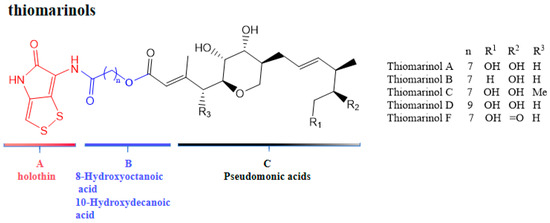
Thiomarinol contains a DTP moiety (holothin, Figure 1A) and a pseudomonic acid analogue (Figure 1C) [15], joined covalently by an 8- or 10-carbon fatty acyl amide bridge (Figure 1B). Although the mechanism of DTP against MTB remains poorly investigated, studies have shown that the DTP unit acts as a “privileged structure”, not only helping the hybrid molecule achieve high intracellular accumulation in bacteria, penetrate the outer membrane of Gram-negative bacteria, and evade efflux pumps, but also extending the antibacterial spectrum of pseudomonic acid from Gram-positive to Gram-negative bacteria [11]. More importantly, thiomarinol retains activity against mupirocin-resistant MRSA, and the rate of resistance development is substantially lower than that for mupirocin. This advantage originates from its dual-action mode: the DTP unit disrupts intracellular metal homeostasis through broad-spectrum chelation of divalent metal ions, while the pseudomonic acid unit targets isoleucyl-tRNA synthetase (IleRS) [16,17,18]. In contrast, single-target antibiotics are prone to resistance via point mutations in the target-encoding gene and often fail to penetrate the complex defense systems of multidrug-resistant bacteria [19].
Figure 1.
Chemical structure of thiomarinol. (A) Holothin, the DTP unit; (B) fatty acyl amide bridge of 8 or 10 carbon atoms; (C) pseudomonic acid analogue (marinolic acid).
Inspired by the above, we first confirmed the synergistic antibacterial effect of thiolutin in combination with isoniazid (INH), cycloserine (CS), apyrazinamide (PZA), linezolid (LZD) against M. tuberculosis H37Ra using checkerboard assays, providing an experimental basis for hybrid design. Using 7–10 carbon alkyl linkers, we then covalently conjugated the DTP scaffold of thiolutin to the pharmacophores of INH, CS, PZA and LZD via amide bonds, generating 15 novel hybrid molecules. Considering biosafety, the attenuated strain H37Ra was employed as the primary model for profiling antimycobacterial activity and mammalian cytotoxicity, with the aim of identifying promising lead compounds and delineating preliminary structure–activity relationships.
2. Materials and Methods
2.1. Chemical Synthesis
The carboxylic acid intermediates T1–T4 (1.0 eq) were dissolved in anhydrous acetonitrile, and DIPEA (3.0 eq) was added as an organic base. The reaction mixture was cooled to 0 °C and stirred for 5 min, then HATU (1.2 eq) was added as a coupling reagent to activate the carboxylic acid group. Stirring was continued at 0 °C for an additional 10 min to ensure complete conversion of the carboxylic acid functionality into the activated ester intermediate.
Subsequently, the corresponding amine coupling partner (cycloserine, linezolid, isoniazid, or 2-aminopyridine, 1.2 eq) was added dropwise to the pre-activated reaction mixture. After the addition was complete, the reaction was allowed to warm to room temperature and stirred continuously for 6–8 h. Upon completion of the reaction, the organic solvent was removed under reduced pressure to afford a crude residue. The crude product was purified by silica gel column chromatography using gradient elution with a dichloromethane–methanol solvent system (100:1 to 5:1), with the specific eluent composition adjusted according to the polarity of each target compound. This general synthetic procedure was applied to all four carboxylic acid intermediates (n = 5, 6, 7, 8); each intermediate was coupled with each of the four amine partners (CS, LZD, INH, and 2AP), ultimately affording a library of 15 target hybrid compounds.
2.1.1. Cycloserine (CS) Series
(R)-N1-(4-methyl-5-oxo-4,5-dihydro-[1,2]dithiolo[4,3-b]pyrrol-6-yl)-N7-(3-oxoisoxazolidin-4-yl)heptanediamide (T1-CS). Yellow solid (37%); Rf = 0.35 (CHCl3/MeOH = 3:1, v/v). 1H NMR (500 MHz, DMSO-d6) δ 1.24 (t, J = 9.3, 6.1 Hz, 2H), 1.50 (m, 4H), 2.12 (t, J = 7.3 Hz, 2H), 2.33 (t, J = 7.4 Hz, 2H), 3.25 (s, 3H), 3.88 (dd, J = 9.8, 8.4 Hz, 1H), 4.49 (t, J = 8.4 Hz, 1H), 4.73 (d, J = 8.9 Hz, 1H), 7.33 (s, 1H), 8.38 (d, J = 7.8 Hz, 1H), 9.95 (s, 1H), 11.49 (s, 1H). 13C NMR (125 MHz, DMSO-d6) δ 172.57, 171.80, 166.20, 135.98, 132.39, 114.78, 110.90, 72.51, 53.92, 34.88, 34.52, 28.13, 27.54, 24.87, 24.84. The HRMS (ESI) spectrum of C16H21N4O5S2 exhibited a peak at m/z 413.0887 for [M + H]+ (calcd. 413.0953). Evaluation by HPLC gave a purity of 97.2% and a retention time of 11.113 min, using a mobile phase consisting of 5% CH3CN in 95% H2O. The NMR and HRMS data for the other CS conjugates T2-CS, T3-CS, and T4-CS were nearly identical to those of T1-CS, showing only incremental methylene signals in the aliphatic region.
2.1.2. Linezolid (LZD) Series
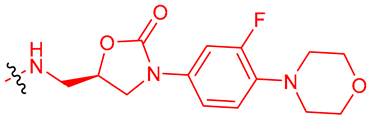
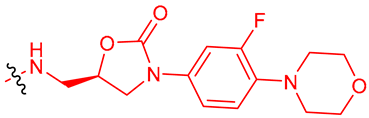
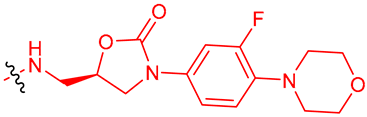
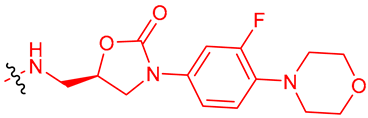
2-butyl-N1-(((R)-3-(3-fluoro-4-morpholinophenyl)-2-oxooxazolidin-5-yl)methyl)-N3-(4-methyl-5-oxo-4,5-dihydro-[1,2]dithiolo[4,3-b]pyrrol-6-yl)malonamide (T1-LZD). Yellow solid (64%); Rf = 0.5 (CHCl3/MeOH = 20:1, v/v). 1H NMR (500 MHz, DMSO-d6) δ 1.17 (m, 2H), 1.48–1.36 (m, 4H), 2.08 (t, J = 8.5 Hz, 2H), 2.27 (t, J = 7.4 Hz, 2H), 2.93 (t, J = 4.6 Hz, 4H), 3.24 (s, 3H), 3.38 (t, J = 5.1 Hz, 1H), 3.45 (dt, J = 14.4, 5.8 Hz, 1H), 3.70 (m, 5H), 4.07 (t, J = 9.0 Hz, 1H), 4.71 (m, 1H), 7.04 (t, J = 9.3 Hz, 1H), 7.15 (dd, J = 8.7, 2.6 Hz, 1H), 7.32 (s, 1H), 7.48 (dd, J = 15.0, 2.5 Hz, 1H), 8.21 (t, J = 6.0 Hz, 1H), 9.92 (s, 1H). 13C NMR (125 MHz, DMSO-d6) δ 173.08, 171.78, 166.18, 154.06, 153.62, 135.97, 135.44, 133.40, 132.35, 119.26, 114.78, 113.95, 110.88, 106.60, 106.39, 71.57, 66.16, 50.71, 50.69, 47.20, 41.26, 35.15, 34.50, 28.17, 27.52, 25.10, 24.83. The HRMS (ESI) spectrum of C27H33FN5O6S2 exhibited a peak at m/z 606.1856 for [M + H]+ (calcd. 606.1763). Evaluation by HPLC gave a purity of 98.4% and a retention time of 18.052 min, using a mobile phase consisting of 5% CH3CN in 95% H2O.The longer-chain LZD analogs T2-LZD, T3-LZD, and T4-LZD gave very similar NMR profiles.
2.1.3. Isoniazid (INH) Series
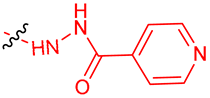
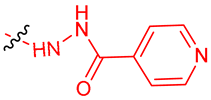
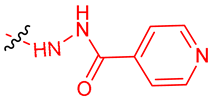
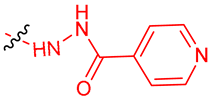
N-(4-Methyl-5-oxo-4,5-dihydro-[1,2]dithiolo[4,3-b]pyrrol-6-yl)-2-(2-isonicotinoylhydrazine-1-carbonyl)hexanamide (T1-INH). Yellow solid (58%); Rf = 0.48 (CHCl3/MeOH = 10:1, v/v). 1H NMR (500 MHz, DMSO-d6) δ 1.38–1.27 (m, 2H), 1.60–1.50 (m, 4H), 2.19 (t, J = 7.4 Hz, 2H), 2.36 (t, J = 7.4 Hz, 2H), 3.25 (s, 3H), 7.34 (s, 1H), 7.83–7.74 (m, 2H), 8.84–8.71 (m, 2H), 9.97 (d, J = 2.3 Hz, 2H), 10.62 (s, 1H). 13C NMR (125 MHz, DMSO-d6) δ 171.80, 171.49, 166.21, 163.93, 150.43, 139.51, 135.99, 132.42, 121.33, 114.80, 110.94, 34.56, 33.16, 28.15, 27.55, 24.84. The HRMS (ESI) spectrum of C19H22N5O4S2 exhibited a peak at m/z 448.1113 for [M + H]+ (calcd. 448.1058). Evaluation by HPLC gave a purity of 95.8% and a retention time of 12.651 min, using a mobile phase consisting of 5% CH3CN in 95% H2O. The remaining INH hybrids T2-INH, T3-INH and T4-INH exhibit similar 1H and 13C NMR spectral features.
2.1.4. 2-Aminopyrazine (2AP) Series
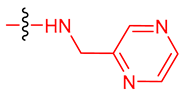
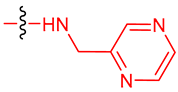
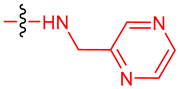
N1-(4-Methyl-5-oxo-4,5-dihydro-[1,2]dithiolo[4,3-b]pyrrol-6-yl)-2-pentyl-N3-(pyrazin-2-ylmethyl)malonamide (T2-2AP). Yellow solid (77%); Rf = 0.66 (CHCl3/MeOH = 30:1, v/v). 1H NMR (500 MHz, DMSO-d6) δ 1.25 (m, 4H), 1.51 (m, 4H), 2.15 (t, J = 7.3 Hz, 2H), 2.33 (t, J = 7.3 Hz, 2H), 3.25 (s, 3H), 4.39 (d, J = 5.7 Hz, 2H), 7.33 (s, 1H), 8.48 (t, J = 5.9 Hz, 1H), 8.60–8.51 (m, 3H), 9.94 (s, 1H). 13C NMR (125 MHz, DMSO-d6) δ 172.55, 171.83, 166.21, 154.46, 143.90, 143.25, 143.12, 135.98, 132.42, 114.78, 110.90, 42.23, 35.19, 34.65, 28.41, 28.36, 27.54, 25.11, 25.00. The HRMS (ESI) spectrum of C19H24N5O3S2 exhibited a peak at m/z 434.1321 for [M + H]+ (calcd. 434.1325). Evaluation by HPLC gave a purity of 97.2% and a retention time of 14.821 min, using a mobile phase consisting of 5% CH3CN in 95% H2O. The other 2AP hybrids T3-2AP and T4-2AP showed analogous spectroscopic features, with full data available in the Supporting Information.
Full characterization information, including NMR and HRMS spectra for each target compound, is provided in the Supporting Materials for reference.
2.2. Biological Experiments
2.2.1. Culture of M. tuberculosis H37Ra and RAW 264.7 Cells
RAW 264.7 cells (Servicebio, Wuhan, China, STCC20020G-1) were maintained in RPMI 1640 medium containing 10% FBS under 37 °C and 5% CO2. For the mycobacterial strain, MTB H37Ra was propagated in Middlebrook 7H9 liquid medium (BD Difco, Sparks, MD, USA, #271310) at the same temperature. The growth medium was fortified with 0.5% glycerol, 0.05% Tween-80, and OADC enrichment. To evaluate MIC, a resazurin-based microplate assay was employed. In detail, a suspension of H37Ra cells in the logarithmic growth phase was prepared using Middlebrook 7H9 broth supplemented as described above (BD BBL, Sparks, MD, USA, #212351).
2.2.2. Microbroth Alamar Blue Assay
MTB H37Ra was cultured in Middlebrook 7H9 broth at 37 °C with static incubation until reaching mid-log phase (OD600 = 0.5), then diluted 500-fold with fresh 7H9 broth to approximately 2 × 10⁵ CFU/mL. Test compounds were dissolved in DMSO to prepare stock solutions and subsequently serially diluted two-fold to generate working solutions. The assay was performed in sterile 96-well flat-bottom microplates, with each well receiving 100 μL of bacterial suspension and 100 μL of compound working solution (final volume 200 μL; final DMSO concentration ≤ 1% v/v). Each plate included a growth control and a sterility control. The plates were sealed and incubated statically at 37 °C for 7 days. Following incubation, 10 μL of 1 mg/mL resazurin solution was added to each well, followed by incubation at 37 °C in the dark for 24 h. Metabolically active bacteria reduce blue resazurin to pink resorufin. The MIC was defined as the lowest compound concentration that retained a blue color upon visual inspection. Each compound concentration was tested in triplicate [20].
2.2.3. Checkerboard Assay for Thiolutin in Combination with Antitubercular Drugs
MTB H37Ra was cultured to the logarithmic growth phase and the bacterial suspension was adjusted to 2 × 10⁵ CFU/mL using Middlebrook 7H9 medium. Thiolutin was dissolved in DMSO and then serially diluted with Middlebrook 7H9 medium to a maximum working concentration of 4 μg/mL. CS, INH, LZD, and 2AP were similarly serially diluted with the medium, with maximum working concentrations of 256 μg/mL, 1 μg/mL, 4 μg/mL, and 1024 μg/mL, respectively. In a 96-well plate, 50 μL of serially diluted thiolutin was added vertically down each column, and 50 μL of serially diluted antitubercular drug was added horizontally across each row. Then 100 μL of the bacterial suspension was added to each well, resulting in final concentrations of each drug at 1/4 of their respective mother liquors, and a total reaction volume of 200 μL. After static incubation at 37 °C for 7 days, 10 μL of 0.1% (w/v) resazurin solution was added to each well, and the plate was incubated at 37 °C for another 24–48 h. Bacterial growth was determined by color change. The fractional inhibitory concentration index (FICI) was calculated as follows [21]:
2.2.4. In Vitro Cytotoxicity Assay
Before compound exposure, cells were plated in 96-well plates at 1 × 10⁴ cells/well and cultured overnight in an incubator. Each compound was first dissolved in DMSO to prepare a 10 μg/μL stock solution, which was then serially diluted 2-fold with complete medium to yield 10 working concentrations (maximum: 512 μg/mL). Cells were treated with these dilutions for 24 h, with solvent and blank controls included. Following the 24 h treatment, 10 μL of CCK-8 reagent (Solarbio, Beijing, China, Cat. No. CA1210) was added to each well, and the plates were incubated at 37 °C for 1 h. Absorbance at 450 nm was measured to determine cell viability. GraphPad 8.0 (GraphPad Software, San Diego, CA, USA) was used to calculate the IC50 for each compound.
3. Results and Discussion
3.1. Checkerboard Synergy Assay
Through checkerboard assays, we identified that thiolutin acts synergistically with INH, CS, and LZD against MTB H37Ra, as evidenced by FICI values of 0.406, 0.188, and 0.344, respectively (Table 1 and Figure S1). Conversely, no synergistic effect was observed for the combination of thiolutin and PZA (FICI = 1.063).
Table 1.
In vitro antitubercular synergistic effects of thiolutin combined with INH, CS, LZD, or PZA against M. tuberculosis H37Ra (MIC in μg/mL).
Upon entering bacterial cells, the disulfide bond of thiolutin is reduced to a dithiol, which chelates divalent metal ions, thereby inhibiting multiple metalloenzymes and disrupting bacterial metal homeostasis. INH inhibits mycolic acid synthesis, CS inhibits peptidoglycan synthesis, and LZD inhibits protein translation [22,23]. The antibacterial activity of these three drugs may be indirectly affected by intracellular metal homeostasis. The metal-chelating activity of thiolutin may reduce bacterial efflux pump activity and interfere with DNA repair or oxidative stress responses [24], thereby enhancing the efficacy of the above drugs against their respective targets, resulting in synergistic effects.
The lack of synergy with PZA may be attributable to the experimental conditions. PZA requires acidic conditions for pyrazinamidase-mediated bioactivation into its antimicrobial metabolite, pyrazinoic acid [25], yet the Middlebrook 7H9 medium used in this study is neutral. The lowest FICI value was observed for the thiolutin-CS combination (0.188), suggesting strong mechanistic complementarity between the two drugs. This result provides a direct rationale for the subsequent design of hybrid molecules in this study.
3.2. Design and Synthesis of Hybrid Molecules
Based on the synergistic effects confirmed by the checkerboard assay (Table 1), we covalently linked thiolutin to antitubercular pharmacophores via alkyl linkers to construct hybrid molecules. Inspired by the natural hybrid antibiotic thiomarinol (Figure 1), the present study employed alkyl linkers of 7–10 carbon atoms to covalently connect the DTP scaffold of thiolutin to the pharmacophores of CS, LZD, INH, and 2AP via amide bonds.
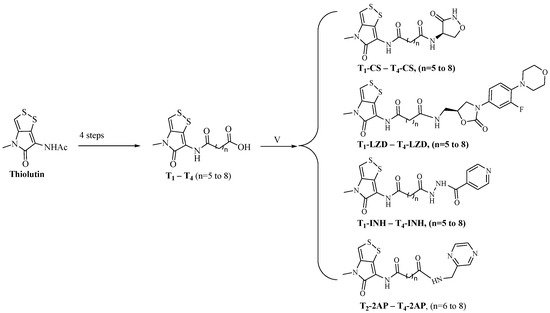
As shown in the synthetic route (Scheme 1), because the DTP unit is unstable under alkaline conditions, we adopted a previously established method [26]. Subsequently, the tert-butyl ester protecting group was deprotected via acid-mediated cleavage, furnishing the free carboxylic acid derivatives T1–T4. Finally, under HATU/DIPEA conditions, each intermediate was coupled with four amine fragments, yielding a total of 15 target hybrid molecules.
Scheme 1.
Preparation of thiolutin–antitubercular hybrids. Steps (I)–(IV): see ref. [26] for the four-step conversion of thiolutin into T1–T4 (n = 5–8). Step (V): CH3CN, HATU, DIPEA, R, RT, with R = cycloserine (CS), linezolid (LZD), isoniazid (INH), 2-aminopyrazine (2AP). The combination of four n values and four R groups gives 15 compounds (one combination failed to yield the desired product).
3.3. Antitubercular Activity, Cytotoxicity, and Structure–Activity Relationship
The antitubercular activity exhibited clear pharmacophore-dependent and linker-length-dependent patterns (Table 2). Regarding the pharmacophore, the activity order was CS series > INH series > 2AP series > LZD series. Among them, the CS hybrids achieved the strongest activity, with MIC values of 2 µg/mL (T1-CS) and 1 µg/mL (T4-CS) representing the lowest observed values. Although the CS and 2AP hybrids exhibited improved activity over their parent pharmacophores, none of the hybrid compounds showed substantially enhanced antitubercular activity relative to thiolutin (MIC = 1 μg/mL). In contrast, the LZD hybrids showed substantially weaker activity, with MIC values ranging from 64 µg/mL to as high as 256 µg/mL, which may be attributed to their molecular weights exceeding 500, thus violating the “rule of five”.
Table 2.
MIC of hybrid derivatives against M. tuberculosis H37Ra and IC50 against RAW 264.7 macrophages.
The influence of linker length varied with the pharmacophore. For the CS series, the best antitubercular activity was observed when the alkyl linker contained 7 carbon atoms or 10 carbon atoms; activity decreased with linker lengths of 8 or 9 carbon atoms. For the INH series, optimal activity was achieved with linkers of 8 or 10 carbon atoms, whereas the LZD series showed a progressive decline in activity as the linker length increased.
All hybrids exhibited IC50 values against RAW 264.7 mouse macrophages ranging from 1.02 to 205.9 μg/mL (Table 2). The CS series displayed the lowest overall cytotoxicity, with all IC50 values > 40 μg/mL; notably, T1-CS had an IC50 of 205.9 μg/mL and T4-CS had an IC50 of 103.2 μg/mL. The selectivity index (SI) was calculated as follows: T1-CS gave an SI of 103.0, T4-CS gave an SI of 103.2, whereas the parent compound thiolutin had an SI of only 1.4. In other words, T1-CS and T4-CS maintained comparable antibacterial activity than the parent compound while increasing the selectivity index by approximately 70-fold, thus achieving markedly reduced cytotoxicity. It has been established that both the antibacterial activity and the cytotoxicity of thiolutin originate from the intracellular reductive activation of its disulfide bond—the molecule enters cells as a prodrug and is reduced to a dithiol that chelates divalent metal ions [27]. It is noteworthy that hybridization of thiolutin with D-cycloserine retained the antimycobacterial activity while substantially reducing cytotoxicity. Dithiolopyrrolones such as thiolutin are recognized as prodrugs that are reduced in cells to generate a potent dithiol-containing zinc chelator [27,28]; the reduced form of thiolutin has been shown to inhibit JAMM domain-containing metalloproteases by chelating the catalytic Zn2+ ion [29]. On this basis, we hypothesize that different pharmacophore structures may influence the cellular uptake efficiency, subcellular distribution, or the rate of disulfide reduction in the hybrid molecules, thereby reducing eukaryotic cytotoxicity while retaining antibacterial activity. The planar, hydrophobic structure of the DTP core may promote membrane permeation, yet the appended isoxazolidinone ring of the cycloserine pharmacophore may limit non-specific accumulation of the hybrids in eukaryotic cells or decrease the efficiency of disulfide reduction in the mammalian reducing environment [28], whereas the unique cell wall structure and intracellular reducing environment of mycobacteria [30,31]—characterized by reductants such as mycothiol and thioredoxins—may allow more efficient activation of the hybrids. Additionally, the cycloserine moiety—known to inhibit alanine racemase (Alr) and D-alanine:D-alanine ligase (Ddl) in the mycobacterial cell wall biosynthesis pathway [32]—may contribute to dual-targeting or facilitate selective accumulation in mycobacteria. However, these mechanistic hypotheses still require further experimental validation, including studies on cellular uptake, reduction potential measurements, and direct target engagement assays.
After comprehensively assessing biological activity and cytotoxicity, T1-CS and T4-CS stand out as the most potential anti-TB hybrid molecules identified herein. The hybrid strategy successfully integrates the broad-spectrum metal-chelating action of thiolutin with the targeted cell-wall synthesis inhibition of CS, achieving multi-target synergistic attack at the single-molecule level while markedly reducing the eukaryotic cytotoxicity of the parent compound through structural modification.
4. Conclusions
Inspired by the natural hybrid antibiotic thiomarinol and based on synergistic effects, this study designed and synthesized 15 novel thiolutin-antitubercular drug hybrids. Among them, the CS hybrids T1-CS and T4-CS maintained excellent antitubercular activity while increasing the selectivity index from 1.4 to approximately 103, achieving markedly reduced cytotoxicity. This hybrid strategy provides a valuable molecular template for the development of novel antitubercular agents with multi-target mechanisms and low cytotoxicity. Both T1-CS and T4-CS can serve as lead compounds warranting further in vivo pharmacodynamic and pharmacokinetic evaluation.
In summary, this study has preliminarily constructed a class of low-toxicity, highly selective thioclase-cycloserine hybrid molecules. However, it should be noted that all antibacterial activity data are from the attenuated strain H37Ra, and its activity against highly virulent strains and clinically resistant strains remains unknown. Furthermore, this study did not investigate the bactericidal effect of the compound in macrophages, and the proposed mechanism hypothesis requires experimental confirmation. Despite these limitations, we observed that while conjugating thioclase with cycloserine did not further enhance its already high antibacterial activity, it did markedly reduce its toxicity to mammalian cells, increasing the selectivity index by approximately 70-fold. Future research will focus on evaluating its activity against resistant strains, validating its intracellular bactericidal ability, and elucidating its mechanism of action.
Supplementary Materials
The following supporting information can be downloaded at https://www.mdpi.com/article/10.3390/microorganisms14081670/s1, All target compounds’ 1H NMR, 13C NMR and high-resolution mass spectra, along with full characterization data of T2-CS, T3-CS, T4-CS, T2-LZD, T3-LZD, T4-LZD, T2-INH, T3-INH, T4-INH, T3-2AP and T4-2AP. Figure S1. Checkerboard synergy assay of thiolutin combined with INH, CS, LZD, and PZA against M. tuberculosis H37Ra.
Author Contributions
Conceptualization, G.H. and C.W.; methodology, Z.S. and S.S.; validation, Z.S., S.S. and Y.M.; formal analysis, Z.S. and S.S.; investigation, Z.S., S.S., X.C. and Y.M.; data curation, Z.S. and S.S.; writing—original draft preparation, Z.S. and S.S.; writing—review and editing, G.H. and C.W.; visualization, X.C. and Y.M.; supervision, G.H. and C.W.; project administration, G.H.; funding acquisition, G.H., C.W. and S.S. All authors have read and agreed to the published version of the manuscript.
Funding
This research was funded by the Xinjiang Leading Talent Program: Science and Technology Innovation Platform Talent Attraction Project (grant number XJRC-2025-BTKJ-YJ-CXPT-229), the Tarim University President Fund (grant number TDZKBS202633), and the Postgraduate Research and Innovation Program of Tarim University (grant number TDBSCX202504).
Institutional Review Board Statement
Not applicable.
Informed Consent Statement
Not applicable.
Data Availability Statement
The original contributions presented in this study are included in the article/Supplementary Material. Further inquiries can be directed to the corresponding authors.
Conflicts of Interest
The authors declare no conflicts of interest.
Abbreviations
The following abbreviations are used in this manuscript:
| TB | Tuberculosis |
| DTP | Dithiolopyrrolone |
| MTB | Mycobacterium tuberculosis |
| IleRS | Isoleucyl-tRNA synthetase |
| INH | Isoniazid |
| CS | Cycloserine |
| LZD | Linezolid |
| PZA | Pyrazinamide |
| FICI | Fractional inhibitory concentration index |
| 2AP | 2-aminopyrazine |
References
- He, H.; Li, W.; Jia, C.; Xu, C.; Meng, X.; Li, Z.; Huang, X.; Zhu, Q.; Fu, L.; Lu, P.; et al. WHO 2025 global tuberculosis report 2025 key data analysis for the world and China. Electron. J. Emerg. Infect. Dis. 2025, 10, 1–9. [Google Scholar]
- Zein-Eddine, R.; Ramuz, M.; Refrégier, G.; Lutzeyer, J.F.; Aleksandrov, A.; Myllykallio, H. Understanding the key challenges in tuberculosis drug discovery: What does the future hold? Expert. Opin. Drug Discov. 2025, 20, 1115–1130. [Google Scholar] [CrossRef] [Scilit] [PubMed]
- Zhang, Y.; Wu, R.; Sun, M.; Li, X.; Fang, R.; Xing, J.; Li, Z.; Wen, Y.; Song, N. Progress of anti-tuberculosis drug targets and novel therapeutic strategies. Front. Microbiol. 2025, 16, 1637254. [Google Scholar] [CrossRef] [Scilit] [PubMed]
- Makabenta, J.M.V.; Nabawy, A.; Li, C.-H.; Schmidt-Malan, S.; Patel, R.; Rotello, V.M. Nanomaterial-based therapeutics for antibiotic-resistant bacterial infections. Nat. Rev. Microbiol. 2021, 19, 23–36. [Google Scholar] [PubMed]
- Tripathy, A.; Sen, P.; Su, B.; Briscoe, W.H. Natural and bioinspired nanostructured bactericidal surfaces. Adv. Colloid. Interface Sci. 2017, 248, 85–104. [Google Scholar] [CrossRef] [Scilit] [PubMed]
- Pellegrino, P.; Farella, I.; De Matteis, V.; Cascione, M.; Villani, S.; Calcagnile, M.; Vincenti, L.; Bianco, A.; Quaranta, F.; Alifano, P. Geometry-driven mechanobactericidal activity on Escherichia coli and fibroblast biocompatibility of PMMA nanostructures fabricated by electron beam lithography. Mater. Today Nano 2026, 34, 100851. [Google Scholar] [CrossRef] [Scilit]
- Alameda, M.T.; Osorio, M.R.; Pedraz, P.; Rodríguez, I. Mechano-Dynamic Analysis of the Bactericidal Activity of Bioinspired Moth-Eye Nanopatterned Surfaces. Adv. Mater. Interfaces 2022, 9, 2200608. [Google Scholar] [CrossRef] [Scilit]
- Rao, N.; Jathar, V.D. Multi-Targeting Drugs to Overcome Multidrug-Resistant Tuberculosis: A Review. Pharm. Chem. J. 2025, 59, 512–528. [Google Scholar] [CrossRef] [Scilit]
- Parkes, A.L.; Bardell-Cox, O.A.; Cain, R.M. The state of the art in dual-acting hybrid antibiotics to combat bacterial resistance. Expert. Opin. Drug Discov. 2025, 20, 1283–1295. [Google Scholar] [CrossRef] [Scilit] [PubMed]
- Kim, B.S. Pioneering strategies for overcoming bacterial drug resistance. J. Microbiol. 2026, 64, e2603100. [Google Scholar] [CrossRef] [Scilit] [PubMed]
- Johnson, R.M.; Li, K.; Chen, X.; Morgan, G.L.; Aubé, J.; Li, B. The Hybrid Antibiotic Thiomarinol A Overcomes Intrinsic Resistance in Escherichia coli Using a Privileged Dithiolopyrrolone Moiety. ACS Infect. Dis. 2024, 10, 582–593. [Google Scholar] [CrossRef] [Scilit] [PubMed]
- Su, L.; Huber, E.M.; Westphalen, M.; Gellner, J.; Bode, E.; Köbel, T.; Grün, P.; Alanjary, M.M.; Glatter, T.; Cirnski, K.; et al. Bode, Isofunctional but Structurally Different Methyltransferases for Dithiolopyrrolone Diversification. Angew. Chem. Int. Ed. 2024, 63, e202410799. [Google Scholar] [CrossRef] [Scilit] [PubMed]
- Qin, Z.; Huang, S.; Yu, Y.; Deng, H. Dithiolopyrrolone natural products: Isolation, synthesis and biosynthesis. Mar. Drugs 2013, 11, 3970–3997. [Google Scholar] [CrossRef] [Scilit] [PubMed]
- Li, B.; Wever, W.J.; Walsh, C.T.; Bowers, A.A. Dithiolopyrrolones: Biosynthesis, synthesis, and activity of a unique class of disulfide-containing antibiotics. Nat. Prod. Rep. 2014, 31, 905–923, Erratum in Nat. Prod. Rep. 2015, 32, 348–349. [Google Scholar] [CrossRef] [Scilit] [PubMed]
- Dunn, Z.D.; Wever, W.J.; Economou, N.J.; Bowers, A.A.; Li, B. Enzymatic basis of “hybridity” in thiomarinol biosynthesis. Angew. Chem. Int. Ed. 2015, 54, 5137–5141. [Google Scholar] [CrossRef] [Scilit] [PubMed]
- Chan, A.N.; Chen, X.; Falco, J.A.; Bak, D.W.; Weerapana, E.; Li, B. Chemoproteomics Reveals Disruption of Metal Homeostasis and Metalloproteins by the Antibiotic Holomycin. ACS Chem. Biol. 2023, 18, 1909–1914. [Google Scholar] [CrossRef] [Scilit] [PubMed]
- Chan, A.N.; Shiver, A.L.; Wever, W.J.; Razvi, S.Z.; Traxler, M.F.; Li, B. Role for dithiolopyrrolones in disrupting bacterial metal homeostasis. Proc. Natl. Acad. Sci. USA 2017, 114, 2717–2722. [Google Scholar] [CrossRef] [Scilit] [PubMed]
- Johnson, R.A.; Chan, A.N.; Ward, R.D.; McGlade, C.A.; Hatfield, B.M.; Peters, J.M.; Li, B. Inhibition of Isoleucyl-tRNA Synthetase by the Hybrid Antibiotic Thiomarinol. J. Am. Chem. Soc. 2021, 143, 12003–12013. [Google Scholar] [CrossRef] [Scilit] [PubMed]
- Silver, L.L. Appropriate Targets for Antibacterial Drugs. Cold Spring Harb. Perspect. Med. 2016, 6, e030239. [Google Scholar] [CrossRef] [Scilit] [PubMed]
- Padmanaban, V.; Bethunaickan, R.; Ranganathan, U.D. Detection of Drug Susceptibility and Drug Interactions in Mycobacterium tuberculosis using Resazurin Microtiter and Checkerboard Assay. J. Vis. Exp. 2025, 24, e67200. [Google Scholar] [CrossRef] [Scilit] [PubMed]
- Cetin, E.S.; Tekeli, A.; Ozseven, A.G.; Us, E.; Aridogan, B.C. Determination of in vitro activities of polymyxin B and rifampin in combination with ampicillin/sulbactam or cefoperazone/sulbactam against multidrug-resistant Acinetobacter baumannii by the E-test and checkerboard methods. Jpn. J. Infect. Dis. 2013, 66, 463–468. [Google Scholar] [CrossRef] [Scilit] [PubMed]
- Chauhan, M.; Barot, R.; Yadav, R.; Joshi, K.; Mirza, S.; Chikhale, R.; Srivastava, V.K.; Yadav, M.R.; Murumkar, P.R. The Mycobacterium tuberculosis Cell Wall: An Alluring Drug Target for Developing Newer Anti-TB Drugs-A Perspective. Chem. Biol. Drug Des. 2024, 104, e14612. [Google Scholar] [CrossRef] [Scilit] [PubMed]
- Edwards, B.D.; Field, S.K. The Struggle to End a Millennia-Long Pandemic: Novel Candidate and Repurposed Drugs for the Treatment of Tuberculosis. Drugs 2022, 82, 1695–1715. [Google Scholar] [CrossRef] [Scilit] [PubMed]
- Qiu, C.; Arora, P.; Malik, I.; Laperuta, A.J.; Pavlovic, E.M.; Ugochukwu, S.; Naik, M.; Kaplan, C.D. Thiolutin has complex effects in vivo but is a direct inhibitor of RNA polymerase II in vitro. Nucleic Acids Res. 2024, 52, 2546–2564. [Google Scholar] [CrossRef] [Scilit] [PubMed]
- Scorpio, A.; Zhang, Y. Mutations in pncA, a gene encoding pyrazinamidase/nicotinamidase, cause resistance to the antituberculous drug pyrazinamide in tubercle bacillus. Nat. Med. 1996, 2, 662–667. [Google Scholar] [CrossRef] [Scilit] [PubMed]
- He, G.; Wu, Z.; Yang, X.; Luo, X.; Zhang, L.; Du, Z.; Li, S.; Wan, C. Design and synthesis of thiolutin derived PSMD14/HDAC dual-target inhibitors against esophageal squamous cell carcinoma. Bioorg. Chem. 2025, 161, 108500. [Google Scholar] [CrossRef] [Scilit] [PubMed]
- Gaballa, A.; Patel, Y.; Helmann, J.D. Reductive activation of the disulfide-containing antibiotic thiolutin is mediated by both bacillithiol and FAD-dependent disulfide reductases. J. Bacteriol. 2025, 207, e0018125. [Google Scholar] [CrossRef] [Scilit] [PubMed]
- Albini, F.; Bormann, S.; Gerschel, P.; Ludwig, V.A.; Neumann, W. Dithiolopyrrolones are Prochelators that are Activated by Glutathione. Chemistry 2023, 29, e202202567. [Google Scholar] [CrossRef] [Scilit] [PubMed]
- Lauinger, L.; Li, J.; Shostak, A.; Cemel, I.A.; Ha, N.; Zhang, Y.; Merkl, P.E.; Obermeyer, S.; Stankovic-Valentin, N.; Schafmeier, T.; et al. Thiolutin is a zinc chelator that inhibits the Rpn11 and other JAMM metalloproteases. Nat. Chem. Biol. 2017, 13, 709–714. [Google Scholar] [CrossRef] [Scilit] [PubMed]
- Batt, S.M.; Minnikin, D.E.; Besra, G.S. The thick waxy coat of mycobacteria, a protective layer against antibiotics and the host’s immune system. Biochem. J. 2020, 477, 1983–2006. [Google Scholar] [CrossRef] [Scilit] [PubMed]
- Reyes, A.M.; Pedre, B.; De Armas, M.I.; Tossounian, M.-A.; Radi, R.; Messens, J.; Trujillo, M. Chemistry and redox biology of mycothiol. Antioxid. Redox Signal. 2018, 28, 487–504. [Google Scholar] [CrossRef] [Scilit] [PubMed]
- Bruning, J.B.; Murillo, A.C.; Chacon, O.; Barletta, R.G.; Sacchettini, J.C. Structure of the Mycobacterium tuberculosis D-alanine:D-alanine ligase, a target of the antituberculosis drug D-cycloserine. Antimicrob. Agents Chemother. 2011, 55, 291–301. [Google Scholar] [CrossRef] [Scilit] [PubMed]

Disclaimer/Publisher’s Note: The statements, opinions and data contained in all publications are solely those of the individual author(s) and contributor(s) and not of MDPI and/or the editor(s). MDPI and/or the editor(s) disclaim responsibility for any injury to people or property resulting from any ideas, methods, instructions or products referred to in the content. |
© 2026 by the authors. Licensee MDPI, Basel, Switzerland. This article is an open access article distributed under the terms and conditions of the Creative Commons Attribution (CC BY) license.