


Abstract
The emergence of plasmid-mediated tigecycline resistance in food-producing animals poses a significant threat to global public health by compromising a last-resort antimicrobial. This study investigated the prevalence, antimicrobial susceptibility profiles, and molecular genetic characteristics of tigecycline-resistant Escherichia coli (E. coli) isolated from broiler cecal samples in the Jinan region of Shandong Province, China, between 2020 and 2024. Antimicrobial susceptibility testing showed that high-level resistance to colistin (87.5%, 14/16), florfenicol (81.3%, 13/15), and enrofloxacin (75.0%, 12/16) was observed. Notably, a single isolate was resistant to meropenem (6.3%, 1/16). Whole-genome sequencing and subsequent in silico analysis demonstrated that all 16 tigecycline-resistant isolates harbored the tigecycline resistance gene tet(X4), the primary determinant of resistance. Molecular typing identified a diverse population structure, with sequence type 224 (ST224) being the dominant clone, accounting for 37.5% (6/16) of the isolates. The genetic milieu of resistance was complex, characterized by the co-existence of tet(X4) with multiple other clinically important resistance genes, including the mobile colistin resistance gene mcr-1 (87.5%, 14/16) and various extended-spectrum β-lactamase genes such as blaCTX-M variants and, critically, blaNDM-5. Furthermore, an array of virulence factor genes was identified, with a particularly high prevalence of the toxin gene astA (68.8%, 11/16) and the bacteriocin gene cma (50.0%, 8/16), indicating pathogenic potential. This convergence of resistance and virulence in a foodborne pathogen highlights an urgent need for continuous One Health surveillance to mitigate the risks posed by these potentially untreatable “superbugs” to both animal and human health.
1. Introduction
The discovery of antibacterial agents constitutes a seminal milestone in the history of human medicine. However, their widespread and frequently irrational use has progressively intensified the challenge of bacterial resistance [1]. As the world’s leading producer of livestock and poultry, China’s animal husbandry sector consumed nearly 100,000 tons of antimicrobials annually prior to the implementation of policies aimed at reducing and prohibiting antibiotic use [2]. Tetracyclines and florfenicol were the most extensively administered classes, a practice that markedly accelerated the emergence of bacterial resistance in food-producing animals. The development of antimicrobial resistance (AMR) in animal-derived bacteria not only threatens the sustainability of the livestock industry but also poses a substantial risk to public health.
Tigecycline, a third-generation tetracycline derivative, exerts its antibacterial activity by binding to the 16S rRNA of the bacterial 30S ribosomal subunit [3]. Tigecycline exhibits a broad spectrum of activity and retains potent efficacy against numerous drug-resistant pathogens, including methicillin-resistant Staphylococcus aureus (MRSA), vancomycin-resistant Enterococci (VRE), extended-spectrum β-lactamase (ESBL)-producing Escherichia coli (E. coli), and carbapenem-resistant Acinetobacter baumannii. Given its robust efficacy against multidrug-resistant (MDR) organisms, tigecycline is widely regarded as a “last-resort” antibiotic for the treatment of infections caused by MDR bacteria. Although approved for clinical use in China in 2012, its application is strictly confined to human medicine and remains explicitly prohibited in livestock and poultry production [4].
Despite its capacity to circumvent classical tetracycline resistance mechanisms, the escalating use of tetracyclines across multiple sectors and the expanded clinical deployment of tigecycline have fostered the emergence of resistance to this last-resort agent [5]. The discovery of plasmid-mediated high-level tigecycline resistance marked a critical turning point: tigecycline-resistant E. coli was first recovered from a porcine sample in 2019, leading to the designation of the resistance-conferring gene as tet(X4) [6]. Subsequently, E. coli strains exhibiting high-level tigecycline resistance were isolated from shrimp samples in 2020 [7]. Since these initial discoveries, tigecycline-resistant E. coli has been successively detected in porcine hosts in China [8], chicken in South Asia [9], and bovine hosts in Europe [10], as well as in retail meat products in China [11]. Furthermore, such resistant strains have been documented between 2020 and 2023 in multiple countries across diverse continents, including the United States, Egypt, Pakistan, and Côte d’Ivoire [12], underscoring the global dimension of this threat.
Parallel to this veterinary and food-chain dissemination, the clinical efficacy of tigecycline has also been increasingly compromised, posing a significant public health threat in China. Since its introduction, clinical reports of tigecycline-resistant “superbugs” have accumulated, and recent multicenter studies reveal that tigecycline-resistant Enterobacteriaceae strains in Chinese hospitals often exhibit multidrug resistance, with tet(A) mutations being a prevalent mechanism [11,13]. A particularly alarming development bridging clinical and environmental reservoirs is the identification of a 193 kb high-risk hybrid plasmid (p193k-tetX4) that harbors tet(X4) alongside other critical resistance genes like mcr and blaNDM [14]. This plasmid family has demonstrated extensive cross-host and cross-border dissemination among humans, animals, and the environment, with a dominant lineage circulating widely in China and beyond. The convergence of clinical resistance mechanisms and the rapid spread of transferable resistance genes such as tet(X4) across various ecosystems underscores the urgent need for coordinated “One Health” surveillance to safeguard the utility of tigecycline.
The widespread dissemination of tigecycline-resistant E. coli throughout the livestock and poultry production chain consequently poses a grave threat to both the horizontal transfer of antimicrobial resistance genes and public health security. Systematic surveillance of resistance patterns and in-depth investigation into the underlying resistance mechanisms of tigecycline-resistant E. coli are therefore of paramount importance. Against this backdrop, the present study investigated the antimicrobial resistance profiles of tigecycline-resistant E. coli isolates recovered from a broiler slaughterhouse in Jinan City, China, between 2020 and 2024. The current resistance status and key molecular genetic characteristics of these isolates were analyzed to provide a scientific basis for effectively curbing the dissemination of resistance determinants and guiding the prudent use of antimicrobials in livestock farming.
2. Materials and Methods
2.1. Samples and Isolates
A total of 600 cecal content samples were collected from five broiler slaughterhouses in Jinan, Shandong Province, China, between 2020 and 2024. Sampling was conducted at approximately equal intervals across the study period, with 120 samples obtained from each slaughterhouse. Cecal contents were aseptically collected immediately after evisceration from randomly selected healthy broiler carcasses on the slaughter line. Each sample (approximately 5 g) was placed into a sterile 50 mL centrifuge tube, transported to the laboratory on ice within 4 h of collection, and processed within 24 h. For E. coli isolation, approximately 1 g of each cecal content sample was enriched in 9 mL of buffered peptone water (Sigma-Aldrich, Shanghai, China) and incubated at 37 °C for 24 h. A loopful of the enriched culture was then streaked onto MacConkey agar (Aobox, Beijing, China) plates and incubated at 37 °C for 24 h. Presumptive E. coli colonies (lactose-fermenting, pink colonies) were picked, and identified using a Bruker MALDI Biotyper system (Bruker Daltonik, Bremen, Germany) with the MBT Compass Library (Revision D) on a Microflex LT mass spectrometer (Bruker Daltonics, Bremen, Germany).
2.2. Antimicrobial Susceptibility Testing
The minimum inhibitory concentrations (MICs) of tigecycline against E. coli isolates were determined using the broth microdilution method, with E. coli ATCC 25922 serving as the quality control strain. Each isolate was tested in triplicate. Tigecycline-resistant isolates were subjected to further antimicrobial susceptibility testing. Results were interpreted according to the breakpoints recommended by the European Committee on Antimicrobial Susceptibility Testing (EUCAST, Version 12.0); the clinical breakpoint for tigecycline is >0.5 mg/L. Antimicrobial agents used in this study were purchased from MeilunBio (Dalian, China) (Table 1).
Table 1.
Breakpoints for antimicrobial susceptibility testing in this study.
2.3. Genomic DNA Extraction of Tigecycline-Resistant E. coli
Purified Tigecycline-resistant E. coli isolates were reactivated and inoculated into 5 mL of LB broth (Oxoid, Shanghai, China), followed by incubation at 37 °C for 18 h. Genomic DNA was extracted from the bacterial cultures using a bacterial genomic DNA extraction and purification kit (TIANGEN, Beijing, China) according to the manufacturer’s instructions.
2.4. MLST Typing, Serotyping, and of Tigecycline-Resistant E. coli
Sequencing was performed using an Illumina Nextera XT library with 2 × 300 bp paired-end reads (BGI, Shenzhen, China), yielding an average of 2,232,425 reads per isolate (63× average coverage). Raw data were assembled using SPAdes (version 3.0). Multilocus sequence types (MLST), plasmid replicon types, serotypes, virulence genes, and antimicrobial resistance genes were identified using MLST 2.0, PlasmidFinder 2.0, SeroTyperFinder 2.0 and ResFinder 3.0, respectively, all available from the Center for Genomic Epidemiology database (http://genomicepidemiology.org/, accessed on 15 March 2026). Plasmids were also analyzed using PLACNETw (https://castillo.dicom.unican.es/upload/, accessed on 15 March 2026).
Parsnp v2.0 was used to align the core genome of ESBL-producing E. coli isolates, to call single nucleotide polymorphisms (SNPs), and to generate a core-genome SNP tree with 1000 bootstrap resamples [15].
2.5. Virulence Gene Distribution of Tigecycline-Resistant E. coli
VirulenceFinder 2.0 available from the Center for Genomic Epidemiology database (http://genomicepidemiology.org/, accessed on 20 March 2026) was hired to detect the virulence gene distribution of Tigecycline-resistant E. coli. A panel of virulence-associated genes was selected based on their established roles in the pathogenesis of extraintestinal pathogenic E. coli (ExPEC) and their prevalence in animal-derived strains. These genes encompass four functional categories critical for adhesion (fimH, fdeC, lpfA, yeh), iron acquisition (irp2, terC, iroN, fyuA), enzyme (gad), Stress tolerance (htrA), and toxin production (hlyE, cma, astA, hha) [16]. Screening these factors aimed to characterize the pathogenic potential of tigecycline-resistant E. coli and explore possible associations between resistance and virulence.
3. Results
3.1. Isolation and Identification of E. coli
A total of 584 presumptive E. coli isolates were recovered from the 600 cecal content samples based on characteristic colony morphology on MacConkey agar. Following MALDI-TOF MS confirmation, 537 E. coli strains were identified as E. coli, yielding a sample-level isolation rate of 89.5% (537/600). The remaining isolates were identified as non-E. coli species and were excluded from subsequent analyses. Among these 537 isolates, 16 (3.0%) were subsequently confirmed as Tigecycline-resistant according to results of antimicrobial susceptible testing.
3.2. Antimicrobial Resistance of Tigecycline-Resistant E. coli Isolates
Antimicrobial susceptibility testing revealed that among the 16 Tigecycline-resistant E. coli isolates, resistance to colistin was most prevalent (87.5%, 14/16). High resistance rates were also observed for florfenicol (81.3%, 13/16), enrofloxacin (75.0%, 12/16), kanamycin (68.8%, 11/16), ceftiofur (62.5%, 10/16), and gentamicin (43.8%, 7/16). In contrast, only one isolate was resistant to meropenem (6.3%, 1/16). The resistance rate for each antimicrobial was defined as the number of resistant isolates divided by the total number of Tigecycline-resistant E. coli isolates (n = 16).
3.3. Characteristics of tet(X4) Gene-Carrying Plasmids
Bioinformatic analysis predicted that all tet(X4) genes were associated with plasmid-derived contigs, which ranged in size from approximately 43 to 152 kb. Based on in silico prediction, putative plasmid replicon types identified among contigs harboring tet(X4) genes included IncX1 (4/16), IncFIA(HI1) (3/16), IncHI1A (3/16), IncHI1B (2/16), IncFIA_I1 (2/16), IncFII_1 (1/16), and IncFIA-IncHI1B (1/16). Additionally, these tet(X4)-carrying plasmid-derived contigs were predicted to carry additional antimicrobial resistance genes, including those conferring resistance to chloramphenicol (floR), sulfonamides (sul1 and sul3), and trimethoprim (dfrA1 and dfrA12).
3.4. MLST Typing, Antimicrobial Resistance Genes, and Virulence Factor Genes of Tigecycline-Resistant E. coli
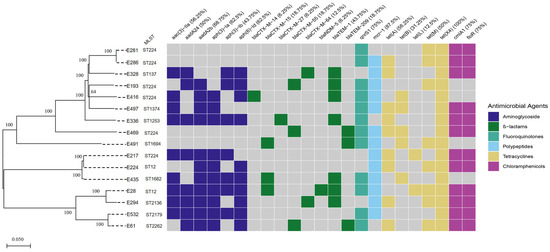
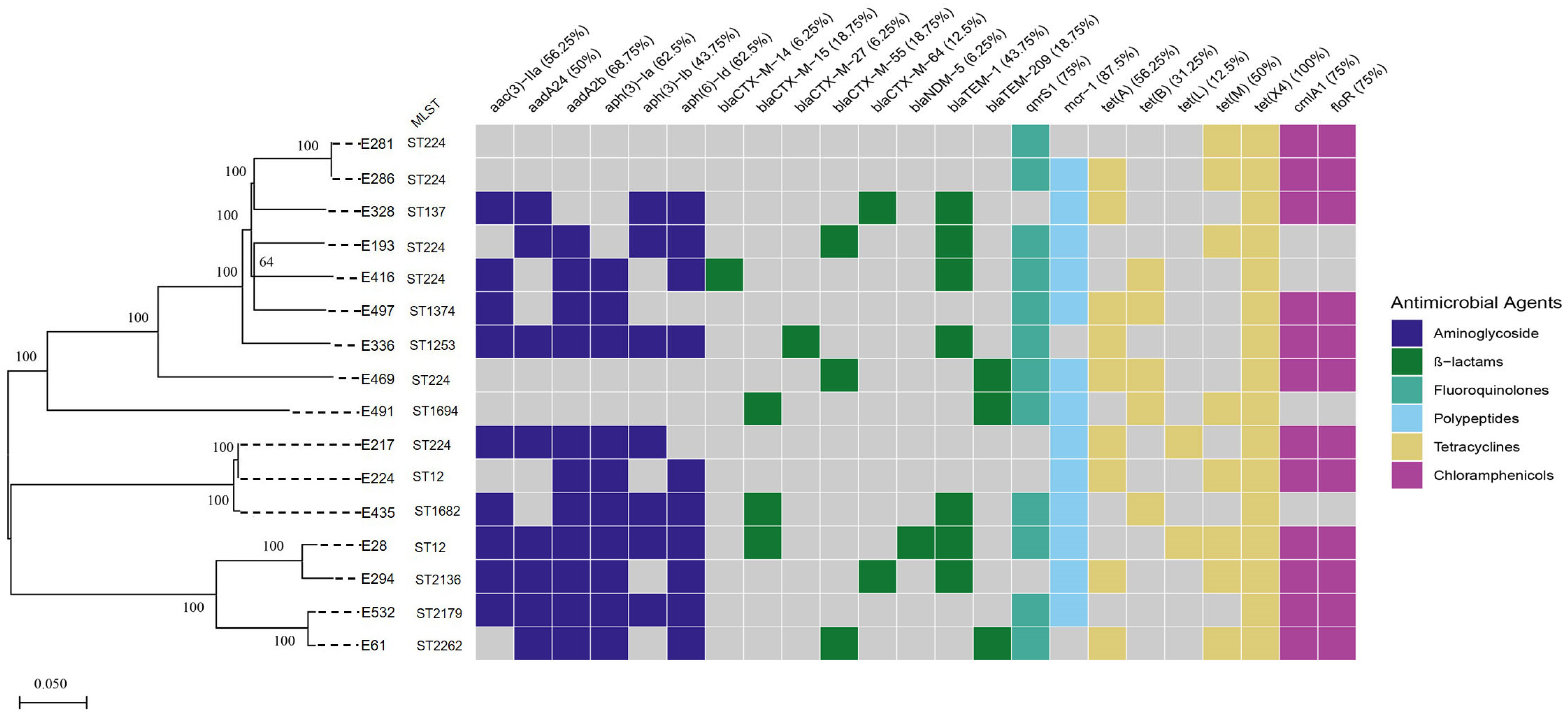
The MLST typing results of the Tigecycline-resistant E. coli isolates revealed diverse sequence types (STs), as shown in Figure 1. Among these, ST224 was the most prevalent, accounting for 37.5% (6/16) of the isolates, followed by ST12, which was detected in 12.5% (2/16) of the isolates. ST37, ST1374, ST1253, ST1694, ST1682, ST2136, ST2179, and ST2262 were each identified in a single isolate.
Figure 1.
Molecular epidemic characteristics of 16 Tigecycline-resistant E. coli isolates. Bar, 0.050 substitutions per nucleotide position.
The tigecycline-resistant E. coli isolates carried a diverse array of antimicrobial resistance genes (Figure 1). Notably, the tet(X4) gene cluster was universally present across all isolates, with a RamR A19V substitution detected in approximately one-third of the strains. High carriage rates (≥75%) were observed for mcr-1, cmlA1, floR, and qnrS1. Various aminoglycoside and β-lactamase resistance determinants were also identified, with aph(3)-Ia, aph(6)-Ib, aadA2b, and blaTEM-1 being the most prevalent among their respective classes. Additionally, quinolone resistance-associated mutations, including GyrA (S83L, D87N), ParC (S80I), and ParE (S458A), were detected.
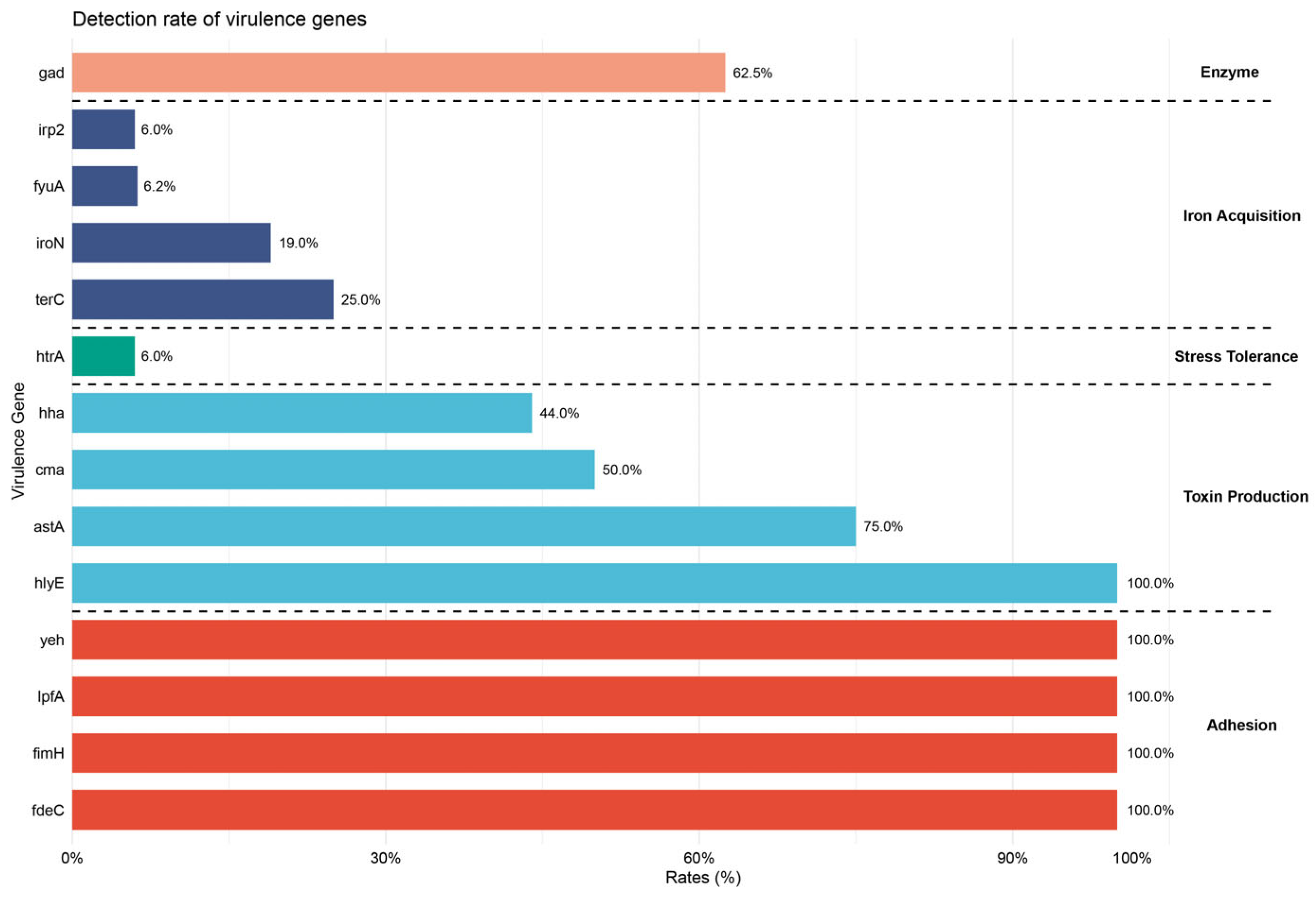
The tigecycline-resistant E. coli isolates also carried multiple virulence factor genes (Figure 2). All strains harbored fdeC, fimH, lpfA, yeh, and hlyE. Among the remaining virulence-associated genes, astA showed the highest prevalence (approaching 70%), followed by cma (present in half of the isolates). Other genes, including irp2, terC, hlyA, iroN, and fyuA, were detected at lower frequencies, ranging from approximately 30% to below 10%.
Figure 2.
Virulence gene distributions among 16 Tigecycline-resistance E. coli isolates.
4. Discussion
In this study, we investigated the prevalence, antimicrobial susceptibility, and molecular characteristics of Tigecycline-resistant E. coli isolated from broiler cecal samples in the Jinan region. The overall E. coli isolation rate of 89.5% is consistent with the high carriage rates commonly reported in poultry, which serve as a significant reservoir for commensal and pathogenic strains [17,18]. The emergence of 16 Tigecycline-resistant isolates, all carrying the tet(X4) gene, is of particular concern. This finding corroborates recent reports on the increasing detection of plasmid-mediated tigecycline resistance in food-producing animals in China, highlighting the rapid dissemination of this novel resistance mechanism [6,19].
Among the 537 E. coli strains isolated from cecal content samples, 16 (3.0%) were confirmed as tigecycline-resistant. This detection rate is notably higher than the 0.65% prevalence reported in a recent study from Yangzhou, China, which screened 618 E. coli isolates from diverse sources including patients, pigs, chickens, and vegetables [20]. The higher prevalence observed in our study may reflect the focused sampling within a poultry slaughterhouse setting, where selective pressures from antimicrobial use in livestock production may facilitate the enrichment of resistant strains. The recovery of tigecycline-resistant E. coli from broiler cecal samples is consistent with previous reports documenting the widespread occurrence of tet(X4)-positive strains in food-producing animals across China [19].
In our study, bioinformatic analysis predicted that all tet(X4) genes were located on plasmid-derived contigs ranging from approximately 43 to 152 kb. The identified plasmid replicon types included IncX1 (4/16), IncFIA(HI1) (3/16), IncHI1A (3/16), IncHI1B (2/16), and others. This diversity of plasmid backbones is consistent with the growing body of literature documenting the presence of tet(X4) on multiple plasmid incompatibility groups, including IncX1, IncFIB, IncFIA, and IncHI1 [21,22]. Notably, IncX1 plasmids have been identified as key vectors for tet(X4) dissemination across different E. coli hosts and geographical regions [23]. The association of tet(X4) with mobile elements such as ISCR2, which is known to facilitate the transposition of adjacent DNA sequences through rolling-circle replication, further enhances the mobility of this resistance gene [24].
The molecular typing data revealed a diverse population structure among the Tigecycline-resistant isolates, with ST224 being the dominant sequence type. The predominance of ST224, which has been previously associated with MDR phenotypes in animals, suggests its potential role as a successful epidemic clone in poultry [25]. The diversity of STs, including ST12, ST37, and others, indicates that the tet(X4) gene is not restricted to a single genetic background but is rather spreading horizontally among different E. coli lineages [23]. This horizontal gene transfer is likely mediated by mobile genetic elements that frequently carry multiple resistance genes, as evidenced by the extensive resistance profiles observed [26,27].
Furthermore, the isolates harbored a considerable array of virulence factor genes, and the high prevalence of enteroaggregative E. coli heat-stable enterotoxin 1 gene (astA, 68.8%) and colicin M gene (cma, 50.0%) among Tigecycline-resistant E. coli is noteworthy. The presence of iron acquisition systems (irp2, fyuA, iroN) and toxins (hlyA) in a subset of isolates indicates their potential to cause extra-intestinal infections in humans. The combination of a highly virulent genetic makeup with an MDR profile in a dominant food-animal clone like ST224 constitutes a substantial threat to both animal health and food safety.
5. Conclusions
In conclusion, this study reveals a high prevalence of tet(X4)-mediated tigecycline resistance in E. coli from broilers in the Jinan region. These isolates are commonly MDR, co-harboring genes conferring resistance to last-resort drugs like polymyxins and carbapenems, and also carry multiple virulence factors. The clonal expansion of ST224 is a key driver of this dissemination. Continuous surveillance of antimicrobial resistance in animal reservoirs is imperative to understand and mitigate the public health risks posed by these pathogens. Effective control measures should be implemented to limit the spread of MDR bacteria in livestock populations, including the targeted depopulation or isolation of colonized animal flocks to prevent onward transmission. Furthermore, strict adherence to on-farm biosecurity protocols is essential to reduce environmental contamination and interrupt transmission pathways within and between production facilities, such as thorough cleaning and disinfection of animal housing, equipment, and transport vehicles.
Author Contributions
Conceptualization, D.Z.; Methodology, R.X., B.L., Y.Z. and C.W.; Validation, Y.Z., B.L., Y.W., C.W. and D.Z.; Formal analysis, R.X. and B.L.; Investigation, R.X., Y.Z. and Y.W.; Data curation, Y.Z., B.L., Y.W. and C.W.; Writing—original draft, R.X.; Writing—review & editing, J.L. and D.Z.; Visualization, Y.W. and C.W.; Supervision, D.Z. and J.L.; Project administration, R.X., B.L., Y.Z., C.W. and Y.W.; Funding acquisition, D.Z., J.L. and Z.W. All authors have read and agreed to the published version of the manuscript.
Funding
This research was funded by National Natural Science Foundation of China (Grant number 31772795; 32473096; 32503098).
Institutional Review Board Statement
The study was conducted in accordance with the Declaration of Helsinki, and approved by the Ethics Committee of Foshan University (protocol code 20220073 and date of 15 October 2025).
Informed Consent Statement
Not applicable.
Data Availability Statement
The data presented in this study are openly available in GenBank at NCBI, reference number PRJNA1464078.
Conflicts of Interest
The authors declare no conflict of interest.
References
- Magana, M.; Pushpanathan, M.; Santos, A.L.; Leanse, L.; Fernandez, M.; Ioannidis, A.; Giulianotti, M.A.; Apidianakis, Y.; Bradfute, S.; Ferguson, A.L.; et al. The value of antimicrobial peptides in the age of resistance. Lancet Infect. Dis. 2020, 20, e216–e230. [Google Scholar] [CrossRef] [Scilit] [PubMed]
- Song, Y.; An, Q.; Chen, S.; Dai, H.; Ma, S.; Wu, C.; Lyu, Y.; Shen, J.; Krüger-Haker, H.; Schwarz, S.; et al. Antimicrobial resistance of pet-derived bacteria in China, 2000–2020. Antimicrob. Agents Chemother. 2025, 69, e0165724. [Google Scholar] [CrossRef] [Scilit]
- Korczak, L.; Majewski, P.; Iwaniuk, D.; Sacha, P.; Matulewicz, M.; Wieczorek, P.; Majewska, P.; Wieczorek, A.; Radziwon, P.; Tryniszewska, E. Molecular mechanisms of tigecycline-resistance among Enterobacterales. Front. Cell Infect. Microbiol. 2024, 14, 1289396. [Google Scholar] [CrossRef] [Scilit]
- Giamarellou, H.; Poulakou, G. Multidrug-resistant Gram-negative infections: What are the treatment options? Drugs 2009, 69, 1879–1901. [Google Scholar] [CrossRef] [Scilit] [PubMed]
- Wang, Z.R.; Li, H.N. The tigecycline resistance mechanisms in Gram-negative bacilli. Front. Cell Infect. Microbiol. 2024, 14, 1471469. [Google Scholar] [CrossRef] [Scilit]
- He, T.; Wang, R.; Liu, D.; Walsh, T.R.; Zhang, R.; Lv, Y.; Ke, Y.; Ji, Q.; Wei, R.; Liu, Z.; et al. Emergence of plasmid-mediated high-level tigecycline resistance genes in animals and humans. Nat. Microbiol. 2019, 4, 1450–1456. [Google Scholar] [CrossRef] [Scilit]
- Liu, Y.Y.; Wang, Y.; Walsh, T.R.; Yi, L.X.; Zhang, R.; Spencer, J.; Doi, Y.; Tian, G.; Dong, B.; Huang, X.; et al. Emergence of plasmid-mediated colistin resistance mechanism MCR-1 in animals and human beings in China: A microbiological and molecular biological study. Lancet Infect. Dis. 2016, 16, 161–168. [Google Scholar] [CrossRef] [Scilit] [PubMed]
- Wang, Q.; Wang, C.Y.; Shoaib, M.; Yao, X.H.; Chen, X.; Qiu, Y.H.; Dai, G.N.; Lin, H.L.; Wang, W.W.; Zhang, J.Y. Novel ST3871 Escherichia coli exhibits diverse transmission modes, carrying the tet(X4) resistance gene. Microbiol. Spectr. 2026, 14, e00521-25. [Google Scholar] [CrossRef] [Scilit]
- Mohsin, M.; Hassan, B.; Martins, W.M.B.S.; Li, R.; Abdullah, S.; Sands, K.; Walsh, T.R. Emergence of plasmid-mediated tigecycline resistance tet(X4) gene in Escherichia coli isolated from poultry, food and the environment in South Asia. Sci. Total Environ. 2021, 787, 147613. [Google Scholar] [CrossRef] [Scilit]
- Kaspersen, H.P.; Brouwer, M.S.; Nunez-Garcia, J.; Cárdenas-Rey, I.; AbuOun, M.; Duggett, N.; Ellaby, N.; Delgado-Blas, J.; Hammerl, J.A.; Getino, M.; et al. Escherichia coli from six European countries reveals differences in profile and distribution of critical antimicrobial resistance determinants within One Health compartments, 2013 to 2020. Euro. Surveill. 2020, 29, 2400295. [Google Scholar] [CrossRef] [Scilit]
- Wang, Q.; Han, Y.Y.; Zhang, T.J.; Chen, X.; Lin, H.; Wang, H.N.; Lei, C.W. Whole-genome sequencing of Escherichia coli from retail meat in China reveals the dissemination of clinically important antimicrobial resistance genes. Int. J. Food Microbiol. 2024, 415, 110634. [Google Scholar] [CrossRef] [Scilit] [PubMed]
- Wang, J.; Wu, H.; Mei, C.Y.; Wang, Y.; Wang, Z.Y.; Lu, M.J.; Pan, Z.M.; Jiao, X. Multiple mechanisms of tigecycline resistance in Enterobacteriaceae from a pig farm, China. Microbiol. Spectr. 2021, 9, e0041621. [Google Scholar] [CrossRef] [Scilit]
- Yan, L.X.; Ma, T.T.; Wang, W.; Cai, Z.; Du, H.; Chen, Z.J.; Han, R.R.; Guo, Y.; Li, G.; Jia, W.; et al. Epidemiology and resistance mechanisms of tigecycline- and carbapenem-resistant Enterobacteriaceae in China: A multicentre genome-based study. Front. Microbiol. 2025, 16, 1582851. [Google Scholar] [CrossRef] [Scilit] [PubMed]
- Li, M.; Zhang, H.; Zhang, W.; Cao, Y.; Sun, B.; Jiang, Q.; Zhang, Y.; Liu, H.; Guo, W.; Chang, C.; et al. One global disseminated 193kb high-risk hybrid plasmid harboring tet(X4), mcr or blaNDM threatening public health. Sci. Total Environ. 2023, 876, 162807. [Google Scholar] [CrossRef] [Scilit]
- Treangen, T.J.; Ondov, B.D.; Koren, S.; Phillippy, A.M. The Harvest suite for rapid core-genome alignment and visualization of thousands of intraspecific microbial genomes. Genome Biol. 2014, 15, 524. [Google Scholar] [CrossRef] [Scilit]
- Ovi, F.; Zhang, L.; Nabors, H.; Jia, L.; Adhikari, P. A compilation of virulence-associated genes that are frequently reported in avian pathogenic Escherichia coli (APEC) compared to other E. coli. J. Appl. Microbiol. 2023, 134, lxad014. [Google Scholar] [CrossRef] [Scilit]
- Roth, N.; Käsbohrer, A.; Mayrhofer, S.; Zitz, U.; Hofacre, C.; Domig, K.J. The application of antibiotics in broiler production and the resulting antibiotic resistance in Escherichia coli: A global overview. Poult. Sci. 2019, 98, 1791–1804. [Google Scholar] [CrossRef] [Scilit]
- Szmolka, A.; Nagy, B. Multidrug resistant commensal Escherichia coli in animals and their impact for public health. Front. Microbiol. 2013, 4, 258. [Google Scholar] [CrossRef] [Scilit]
- Sun, J.; Chen, C.; Cui, C.Y.; Zhang, Y.; Liu, X.; Cui, Z.H.; Ma, X.Y.; Feng, Y.; Fang, L.X.; Lian, X.L.; et al. Plasmid-encoded tet(X) genes that confer high-level tigecycline resistance in Escherichia coli. Nat. Microbiol. 2019, 4, 1457–1464. [Google Scholar] [CrossRef] [Scilit]
- Fan, X.Y.; Jiang, Y.; Wu, H.; Liu, J.; Gu, Q.Y.; Wang, Z.Y.; Sun, L.; Jiao, X.; Li, Q.; Wang, J. Distribution and spread of tigecycline resistance gene tet(X4) in Escherichia coli from different sources. Front. Cell. Infect. Microbiol. 2024, 14, 1399732. [Google Scholar] [CrossRef] [Scilit] [PubMed]
- Li, R.C.; Li, Y.; Peng, K.; Yin, Y.; Liu, Y.; He, T.; Bai, L.; Wang, Z.Q. Comprehensive genomic investigation of tigecycline resistance gene tet(X4)-bearing strains expanding among different settings. Microbiol. Spectr. 2021, 9, e01633-21. [Google Scholar] [CrossRef] [Scilit]
- Li, R.C.; Lu, X.Y.; Peng, K.; Liu, Z.Y.; Li, Y.; Liu, Y.; Xiao, X.; Wang, Z.Q. Deciphering the structural diversity and classification of the mobile tigecycline resistance gene tet(X)-bearing plasmidome among bacteria. mSystems 2020, 5, e00134-20. [Google Scholar] [CrossRef] [Scilit] [PubMed]
- Shao, L.; Wu, C.; Li, C.; He, R.; Chen, G.; Sun, D.; Yang, Y.; Feng, Y.; Zhang, G.; Yan, B.; et al. Genomic characterization revealing the high rate of tet(X4)-positive Escherichia coli in animals associated with successful genetic elements. Front. Microbiol. 2024, 15, 1423352. [Google Scholar] [CrossRef] [Scilit]
- Liu, D.J.; Wang, T.; Shao, D.Y.; Song, H.W.; Zhai, W.S.; Sun, C.T.; Zhang, Y.; Zhang, M.C.; Fu, Y.L.; Zhang, R.; et al. Structural diversity of the ISCR2-mediated rolling-cycle transferable unit carrying tet(X4). Sci. Total Environ. 2022, 826, 154010. [Google Scholar] [CrossRef] [Scilit]
- Reid, C.J.; McKinnon, J.; Djordjevic, S.P. Clonal ST131-H22 Escherichia coli strains from a healthy pig and a human urinary tract infection carry highly similar resistance and virulence plasmids. Microb. Genom. 2019, 5, e000295. [Google Scholar] [CrossRef] [Scilit]
- Partridge, S.R.; Kwong, S.M.; Firth, N.; Jensen, S.O. Mobile genetic elements associated with antimicrobial resistance. Clin. Microbiol. 2018, 31, e00088-17. [Google Scholar] [CrossRef] [Scilit]
- Chen, C.; Wu, X.T.; He, Q.; Chen, L.; Cui, C.Y.; Zhang, Y.; Chen, S.H.; Liao, X.P.; Liu, Y.H.; Sun, J. Complete sequence of a tet(X4)-harboring IncX1 plasmid, pYY76-1-2, in Escherichia coli from a cow sample in China. Antimicrob. Agents Chemother. 2019, 63, e01528-19. [Google Scholar] [CrossRef] [Scilit]
Disclaimer/Publisher’s Note: The statements, opinions and data contained in all publications are solely those of the individual author(s) and contributor(s) and not of MDPI and/or the editor(s). MDPI and/or the editor(s) disclaim responsibility for any injury to people or property resulting from any ideas, methods, instructions or products referred to in the content. |
© 2026 by the authors. Licensee MDPI, Basel, Switzerland. This article is an open access article distributed under the terms and conditions of the Creative Commons Attribution (CC BY) license.