


Abstract
Nitrate-enriched acid rain (NAR)-induced acidification and nitrogen (N) loss threaten the stability of acid-hydrolyzable nitrogen (AHN), a reactive soil organic N pool linked to forest N retention. Biochar (BC) can regulate AHN dynamics by modifying soil microbial communities under NAR stress. However, the underlying mechanisms by which BC regulates key microbial taxa to influence AHN accumulation remain largely unclear. Here, a simulated NAR field experiment in a Quercus acutissima plantation was established. Pyrochar (PC) and hydrochar (HC) derived from Q. acutissima leaf litter were applied to quantify their effects on soil AHN and the structures of abundant and rare microbial communities. Results indicated that PC and HC increased AHN content by 28.2% and 44.2%, respectively, under NAR stress. Moreover, PC significantly increased rare bacterial diversity by 23.8%, while PC and HC significantly enhanced rare fungal diversity by 29.4% and 32.1%, respectively, under NAR stress. PC and HC elevated the network robustness of rare bacteria to 0.687 and 0.699, respectively. Furthermore, rare microbial taxa explained 79.5% of the variation in AHN content. Network complexity and diversity of rare microbes were identified as the dominant predictors promoting AHN accumulation. These findings will provide an ecological basis for using biomass-derived amendments to protect soil ecosystem health under NAR stress.
1. Introduction
Acid rain (AR) is a widespread environmental issue that threatens terrestrial ecosystems [1]. With the acceleration of industrialization, global anthropogenic NOX emissions have increased to 120 Mt NO2 yr−1 [2]. NOX emissions intensify acid deposition, causing more than 12% of global land areas to be exposed to long-term nitrate-enriched AR (NAR) stress [3]. Compared with conventional acid deposition, NAR intensifies soil acidification and profoundly disrupts soil nitrogen (N) cycling processes [4]. Soil organic N (SON) constitutes over 90% of the soil N pool [5]. Acid-hydrolyzable N (AHN) represents a labile fraction of SON that contributes substantially to plant N availability [6]. It mainly includes acid–ammonia N (AN), acid–amino sugar N (ASN), acid–amino acid N (AAN), and acid unidentified N (AUN) [7]. However, NAR exacerbates the mineralization and leaching loss of AHN, thereby weakening the stability of the SON pool [8]. Therefore, effective soil amendment strategies are urgently needed to alleviate AR stress and maintain the N supply function of ecosystems.
Biochar (BC), as an efficient soil amendment material, shows great potential in alleviating soil degradation caused by AR stress and regulating N cycling [9]. Pyrochar (PC) is typically produced by pyrolyzing biomass at 300–700 °C [10]. PC contains abundant alkaline ash [11]. The application of PC can effectively neutralize soil acidity and enhance microbial diversity, thereby promoting the accumulation of SON [12]. Hydrochar (HC) is produced under hydrothermal conditions at 180–350 °C [13]. HC generally retains more partially degraded organic matter and N-containing functional groups and is enriched in soluble organic components [14]. Therefore, HC application affects soil N cycle by increasing the input of labile organic matter, reshaping the microbial community, and regulating the supply of available N [15]. BC drives the accumulation of AHN by regulating soil N cycling processes [16].
The capacity of BC to regulate soil AHN is closely linked to its effects on soil microbial communities (i.e., bacteria and fungi) [17]. Previous studies demonstrated that bacteria were important contributors to AAN formation, and a decrease in the complexity of the bacterial co-occurrence network suppresses AAN accumulation [18]. Meanwhile, amino acid oxidases secreted by fungi have been shown to effectively inhibit ASN turnover [18]. Notably, microbial regulation of SON transformation is not determined solely by taxonomic identity [19]. It is also important to consider the divergent ecological functions of microbial taxa with contrasting relative abundances.
Based on the relative abundance levels, soil microbial communities are typically distinguished as abundant and rare taxa [20]. Abundant microbial taxa strongly influence soil N cycling processes owing to their numerical dominance [21]. However, abundant microbial taxa are susceptible to habitat degradation under severe environmental disturbance, which leads to the loss of community functions [22]. In contrast, rare microbial taxa exhibit higher phylogenetic diversity and metabolic heterogeneity despite their low abundance [23]. Previous studies have shown that rare microbial taxa can establish stable cooperative metabolic networks owing to their unique metabolic potential and strong stress tolerance, thereby improving microbial N use efficiency and promoting soil N accumulation [24]. Consequently, under AR stress, rare microbial taxa are particularly critical for maintaining the stability of ecosystem functions [25]. Existing evidence indicated that BC could increase soil AHN content by regulating soil biotic factors under NAR stress [8]. However, the underlying mechanisms by which BC regulates AHN accumulation via microbial taxa with different abundance levels under NAR stress remain largely unclear. Therefore, this study distinguishes rare and abundant bacterial and fungal taxa, focusing on their differential responses to biochar amendment and their associations with AHN accumulation. We hypothesized that BC would increase soil AHN content by enhancing the diversity and community stability of rare microbial taxa under NAR stress.
Here, a simulated NAR field experiment in a Quercus acutissima plantation was established. PC and HC were synthesized from Q. acutissima leaf litter and applied to quantify their effects on soil AHN and the structures of abundant and rare microbial taxa. This study aimed to: (i) analyze the effects of BC on soil AHN and its fractions under NAR stress; (ii) reveal the differential responses of abundant and rare microbial taxa to BC application under NAR stress; (iii) explore the microbial mechanisms by which BC regulates soil AHN through abundant and rare microbial taxa under NAR stress. This study will provide evidence for a nature-based strategy to protect soil ecosystem health under NAR stress.
2. Materials and Methods
2.1. Preparation and Characterization of PC and HC
PC and HC were derived from Q. acutissima leaf litter. PC was produced by pyrolyzing the leaf litter under limited oxygen conditions. The preparation of HC was conducted following Feng et al. [26]. Briefly, leaf litter was subjected to hydrothermal treatment at 220 °C and 8 MPa for 1 h. After cooling, HC was obtained by separating the solid phase from the liquid phase.
The physicochemical properties of PC and HC were determined and characterized. Surface functional groups were examined by Fourier transform infrared spectrometer (Cary 660, Agilent Technologies, Santa Clara, CA, USA). The elemental binding state was characterized by X-ray photoelectron spectrometer (Escalab 250XI, Thermo Fisher Scientific, Waltham, MA, USA). The pH was quantified by a pH meter (Sartorius GmbH, Göttingen, Germany). Organic carbon (C) and total N (TN) were examined by an elemental analyzer (Vario EL III, Elementar Analysensysteme GmbH, Langenselbold, Germany). Thermogravimetric analysis was performed by a thermogravimetric analyzer (STA 449 F3, NETZSCH-Gerätebau GmbH, Selb, Germany). The specific surface area (SSA), pore diameter, and pore volume were measured using a physical adsorption analyzer (3Flex 5.02, Micromeritics Instrument Corporation, Norcross, GA, USA). The surface appearance of BC was observed with a scanning electron microscope (SEM, ZEISS Sigma 360, Carl Zeiss Microscopy GmbH, Jena, Germany). K, Ca, Fe, and Mn contents were determined using inductively coupled plasma optical emission spectroscopy (ICP-OES, PerkinElmer Optima 8000, PerkinElmer, Waltham, MA, USA).
2.2. Experimental Design and Sample Collection
The field experiment was established at the Yangtze River Delta Farmland Shelterbelt Ecosystem Observation and Research Station in Jiangsu Province, China (32°7′49″ N, 119°12′7″ E). The site is located in a hilly area (Figure S1). The mean annual temperature and precipitation are approximately 15.1 °C and 1184.3 mm. The zonal soil is classified as yellow-brown soil. The experimental forest is a 70-year-old Quercus acutissima plantation.
The experiment employed a completely randomized block design, with a total of 12 independent 3 m × 3 m plots. To prevent interference from surface runoff and lateral seepage of acid rain, PVC barriers were vertically embedded along the boundaries of each plot. Each barrier was 30 cm high and 0.5 cm thick. Four treatments were established, with three replicates for each treatment: no PC or HC application and no NAR spraying (CK), NAR spraying only (AR), NAR spraying combined with PC application (AR-PC), and NAR spraying combined with HC application (AR-HC).
The treatment solution was adjusted to pH 2.5 to simulate NAR. A mixed acid stock solution was formulated using 0.5 mol L−1 H2SO4 and 0.5 mol L−1 HNO3 at an SO42− to NO3− molar ratio of 1:5. The simulated NAR solution was adjusted to pH 2.5 to represent a severe acidification scenario [27]. In June 2021, PC and HC were uniformly distributed over the corresponding treatment plots at a rate of 0.5 kg m−2. The amounts of N input to the soil through different BC amendments are presented in Text S2 and Table S7. During the experimental period, the simulated NAR solution was sprayed onto the AR, AR-PC, and AR-HC plots in the middle of each month. The specific spraying volume was determined according to Feng et al. [8]. Monthly spraying amounts, application volumes, and nitrogen, sulfur, and H+ loadings of simulated acid rain at the experimental plots are provided in Supplementary Table S6. Meanwhile, an equivalent volume of deionized water was sprayed onto the CK plots following the same schedule to control for the effects of water addition.
In June 2022, five soil cores (0–10 cm depth) were collected from each plot using a five-point sampling method and combined into one composite soil sample, with each plot representing an independent biological replicate. Fresh soil samples were sieved through a 2 mm mesh after removing plant roots, litter residues, and gravel. One subsample was refrigerated at 4 °C for soil biochemical analyses. Another subsample was preserved at −80 °C until soil microbial biomass and microbial community structure were analyzed.
2.3. Soil Organic Nitrogen Fractions
The SON fractions were determined using the method following Ren et al. [17]. Briefly, AHN content was measured by steam distillation following Kjeldahl digestion with H2SO4. AN was analyzed by alkaline distillation with MgO. ASN was quantified by steam distillation under alkaline conditions. AAN was determined by ninhydrin oxidation-steam distillation in a phosphate-borate buffer. AUN was obtained by subtracting AN, ASN, and AAN from AHN. Non-hydrolyzable nitrogen (NHN) was calculated as TN minus AHN.
2.4. Soil Biochemical Properties
Soil pH was determined using a pH meter (Sartorius GmbH, Göttingen, Germany). Soil organic carbon (SOC) and TN contents were quantified with an elemental analyzer (Vario EL III, Elementar Analysensysteme GmbH, Langenselbold, Germany). Total phosphorus (TP) was estimated using inductively coupled plasma optical emission spectroscopy (ICP-OES, PerkinElmer Optima 8000, PerkinElmer, Waltham, MA, USA). Dissolved organic carbon (DOC) and dissolved total nitrogen (DTN) were determined using the extraction method with a total organic C analyzer (TOC-VCPH, Shimadzu Corporation, Kyoto, Japan). Microbial biomass carbon (MBC), N (MBN), and phosphorus (MBP) were measured by chloroform fumigation-extraction.
2.5. Soil DNA Extraction and High-Throughput Sequencing
Microbial DNA was extracted from 0.5 g of fresh soil using a FastDNATM Spin Kit for Soil (MP Biomedicals, LLC, Solon, OH, USA). The V3-V4 region of the bacterial 16S rRNA gene was amplified using the primer pair 341F (5′-CCTACGGGNGGCWGCAG-3′) and 806R (5′-GGACTACHVGGGTWTCTAAT-3′). The fungal ITS region was amplified using the primers ITS1F (5′-CTTGGTCATTTAGAGGAAGTAA-3′) and ITS2R (5′-GCTGCGTTCTTCATCGATGC-3′). Bioinformatic processing of the bacterial 16S rRNA gene and fungal ITS amplicon sequences was performed using an OTU-based approach. Paired-end reads were merged using PANDAseq (version 2.11), with a minimum overlap length of 10 bp. Quality filtering was performed using PRINSEQ (version 0.20.4), and sequences with an average quality score below 20 or ambiguous bases accounting for more than 5% of the sequence length were removed (Tables S8 and S9). The filtered sequences were subsequently processed using the DADA2 pipeline implemented in QIIME 2 (version 2021.11) for denoising, error correction, and chimera removal to generate OTU abundance tables. Taxonomic classification of bacterial OTUs was performed using the QIIME 2 classify-sklearn Naive Bayes classifier against the SILVA SSU 138 rRNA database, whereas fungal ITS sequences were classified against the UNITE database (version 10.0). Taxonomic classification was performed using a confidence threshold of 0.7. OTUs that did not meet the confidence threshold at a given taxonomic rank were assigned to the highest taxonomic rank supported by the classifier. The 16S rRNA and ITS gene sequencing data associated with this work were available in the China National Center for Bioinformation (CNCB) database under accession numbers PRJCA063816 and PRJCA059488, respectively.
2.6. Classification of Soil Abundant and Rare Microbial Taxa
Abundant and rare microbial taxa were classified based on their relative abundances, following the method described by Wang et al. [28]. Specifically, abundant microbial taxa were defined as OTUs with relative abundance ≥ 1% across all samples, or OTUs with relative abundance ≥ 1% in some samples and ≥0.01% in the remaining samples. Rare microbial taxa were classified as OTUs with a relative abundance of <0.01% across all samples, or OTUs with a relative abundance < 0.01% in some samples and never reaching 1% in any sample.
2.7. Spatial Estimation and Model Assumptions
The spatial distribution data of AHN content in Shanghai, Jiangsu, Zhejiang, Fujian, Guangdong, Jiangxi, Anhui, Hunan, and Chongqing were obtained from the China high-resolution national soil information grid basic attribute dataset (2010–2018) (http://soil.geodata.cn/data/datadetails.html?dataguid=36810085119113; accessed on 19 June 2026) [29]. This approach assumed consistent treatment responses across regions. The calculation formula is as follows:
where AHNi,j represents the estimated soil AHN content in spatial unit i under treatment j. AHN0,i represents the baseline soil AHN content in spatial unit i, and Rj represents the percentage increase in soil AHN content under the PC or HC treatment relative to the control.
AHNi,j = AHN0,i + AHN0,i × (Rj/100)
The formula for the estimated total nitrogen stock in China’s major acid rain-affected regions is provided in Text S1, and the corresponding data are presented in Figures S6 and S7.
2.8. Statistical Analysis
Statistical analyses were conducted with IBM SPSS Statistics 30.0. Before statistical analysis, the normality of model residuals was assessed using the Shapiro–Wilk test, and homogeneity of variances among treatments was examined using the median-centered Levene’s test (Table S10). Differences among treatments (mean ± SD, n = 3) were evaluated using a linear mixed-effects model, with treatment as a fixed effect and block as a random effect to account for the randomized complete block design. Pairwise comparisons among treatments were performed based on estimated marginal means from the linear mixed-effects model. Denominator degrees of freedom were approximated using the Satterthwaite method, and p-values were adjusted using the Tukey method for multiple comparisons. Mathematical formulation of the linear mixed-effects model.
Yij = μ + Ti + Bj + εij
Yij: The observed value for the i-th treatment in the j-th block. μ: The overall mean. Ti: The fixed effect of treatment. Bj: The random effect of block. εij: The random error term.
Correlation analyses were adjusted using the Benjamini–Hochberg (BH) procedure to control the false discovery rate (FDR). Adjusted p-values below 0.05 were considered statistically significant. The response ratio (RR) (i.e., effect size) of natural logarithmic conversion was used to quantify the responses of soil chemical properties to different treatments. In this study, and are the values of soil chemical properties at different treatments, respectively. RR values were log-transformed for statistical testing.
Microbial datasets were analyzed using R software version 4.4.1. Microbial alpha diversity indices were calculated by the “vegan” package in R. Treatment effects on microbial community composition were assessed using permutational multivariate analysis of variance (PERMANOVA) based on Bray–Curtis dissimilarities. The PERMANOVA model included block and treatment as explanatory factors (model formula: community composition ~ block + treatment), with the block effect accounted for when evaluating treatment effects. Statistical significance was assessed using 9999 permutations. Homogeneity of multivariate dispersions among treatments was further evaluated using PERMDISP based on distances to group centroids, with statistical significance assessed using 9999 permutations. The analysis of microbial co-occurrence networks and the calculation of network topological indices were performed using the “igraph” package in R. OTUs with a summed relative abundance ≥ 0.0005 across all samples and detected in at least three samples were retained for network construction. Pearson correlation analysis was used for microbial co-occurrence network analysis, and associations with r > 0.6 and BH-adjusted p < 0.05 were retained. Undirected weighted networks were constructed using the “igraph” package in R, with edge weights representing absolute correlation coefficients. Isolated nodes were removed before calculating network topological properties. The robustness of a microbial co-occurrence network was defined as the proportion of species remaining in the network after random or targeted node removal [30]. The formula is as follows:
where R represents network robustness, K is the number of random-removal simulations, M is the number of node-removal levels in each simulation, Sjk is the number of nodes in the largest connected component at the j-th removal level in the k-th simulation, and N0 is the total number of nodes in the original network.
Correlation analysis was performed using the “corrplot” package in R to examine the relationships between soil AHN content, abundant and rare microbial taxa, and chemical properties. Correlation analysis was performed using Pearson’s correlation analysis. Linear regression was used to examine the associations between soil AHN content and abundant and rare microbial taxa. The contributions of abundant and rare microbial taxa to soil AHN variation were partitioned by variance partitioning analysis (VPA) using Hellinger-transformed data. Random forest (RF) models were constructed using the “randomForest” package in R to identify the important predictors of soil AHN content. The model was constructed with 500 decision trees, and variable importance was assessed using the percentage increase in mean squared error (%IncMSE). The statistical significance of variable importance was evaluated using the “rfPermute” package with 1000 permutation replicates. Variables were ranked according to their %IncMSE values. All candidate predictor variables were included in the model without prior feature selection. Model performance was evaluated using repeated five-fold cross-validation with 10 repetitions. In each iteration, four folds were used for model training, while the remaining fold was used for validation. Model performance was assessed using the OOB mean squared error (OOB-MSE), root mean squared error (OOB-RMSE), and proportion of variance explained (OOB-R2).
Partial least squares path modeling (PLS-PM) was performed using the “plspm” package in R to reveal the pathways affecting soil AHN content (Table S11). The model consisted of eight variables, with BC as the exogenous variable. Rare bacterial network complexity, rare bacterial diversity, rare fungal network complexity, rare fungal diversity, DTN, and MBN as endogenous variables, and AHN as the final response variable. All constructs were directly represented by measured or calculated values. The sample size was determined by the experimental design, with three independent biological replicates per treatment. Model fit was assessed using the goodness of fit (GoF) index. The significance of path coefficients was evaluated using the bootstrap resampling procedure with 1000 resamples. In each resample, observations were randomly sampled with replacement, and the model was re-estimated. Bootstrap distributions were used to assess the uncertainty and statistical significance of the estimated path coefficients.
3. Results
3.1. Properties and Characterization of BC
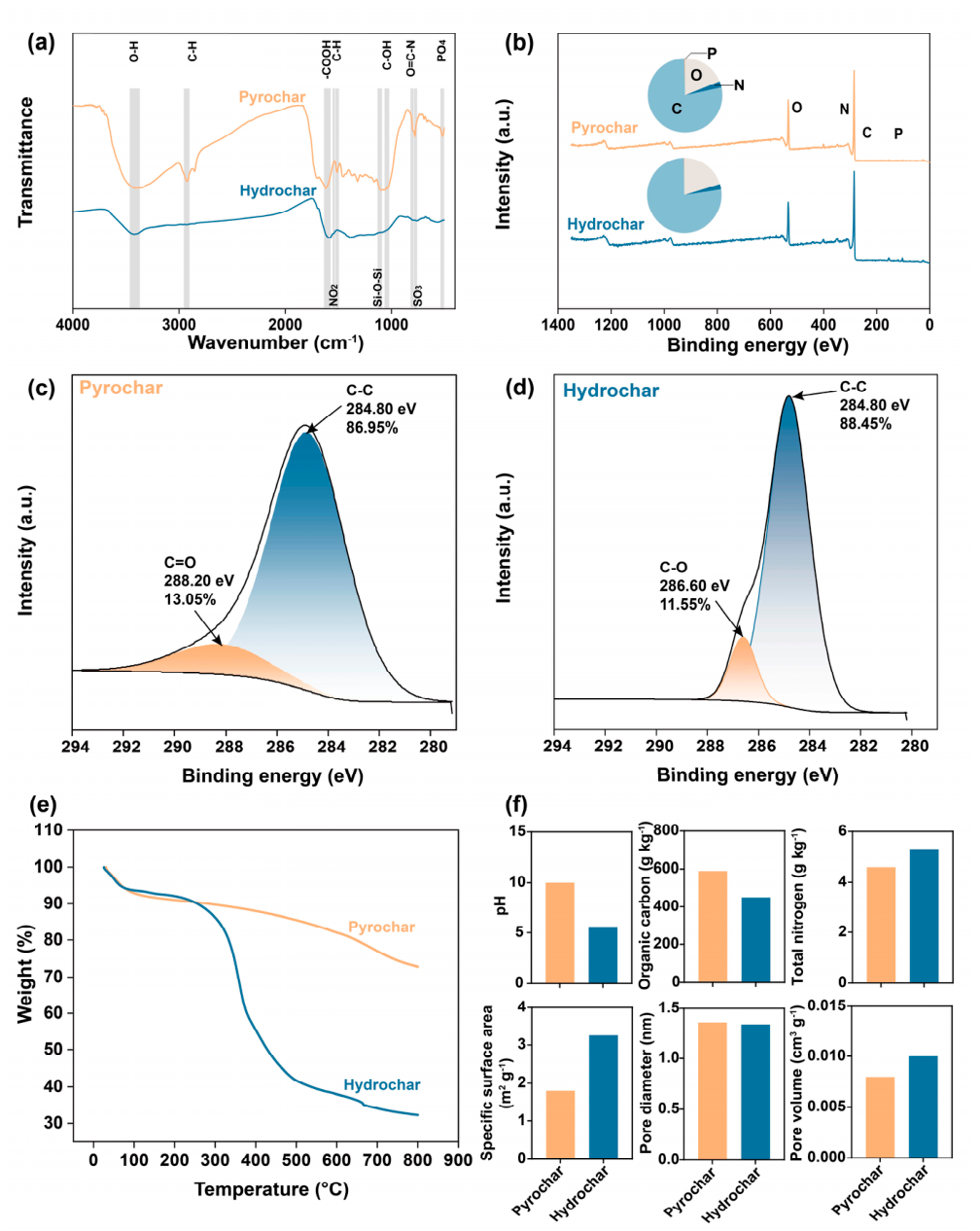
The FTIR spectrum showed C-H related bands at 1493 and 2930 cm−1, together with a C-OH stretching band at 1043 cm−1 (Figure 1a). Figure 1b showed that the surface elemental composition of PC and HC consisted primarily of C (77.3–78.1%), O (18.8–20.2%), N (2.36–2.77%), and p (0.17–0.30%). The relative abundance of C-C bonds on the surface of PC was 86.9%, which was lower than that on the surface of HC (88.5%) (Figure 1c,d). Thermogravimetric analysis showed that the weight loss curve of PC was more gradual than that of HC during heating to 800 °C. The final residual mass of PC was 72.8% at 800 °C, which was higher than that of HC (32.2%) (Figure 1e). Additionally, the pH and organic C content of PC were higher than those of HC. However, the TN content, SSA, and pore volume of HC were higher than those of PC (Figure 1f). HC contained higher concentrations of K, Fe, and Mn than PC (Table S1).
Figure 1.
(a) The Fourier transform infrared spectroscopy (FTIR) spectra of pyrochar and hydrochar. (b) The X-ray photoelectron spectroscopy (XPS) spectra of pyrochar and hydrochar. The pie charts represent the percentage distribution of C, N, O, and P. (c) C1s XPS spectra of pyrochar. (d) C1s XPS spectra of hydrochar. (e) Thermal decomposition (TG) of pyrochar and hydrochar. (f) The physicochemical properties of pyrochar and hydrochar.
3.2. Responses of Soil AHN Fractions to BC Under NAR Stress
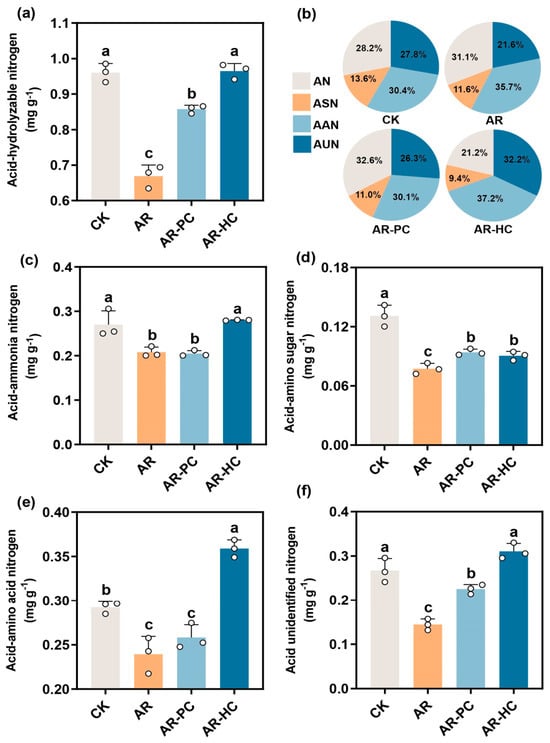
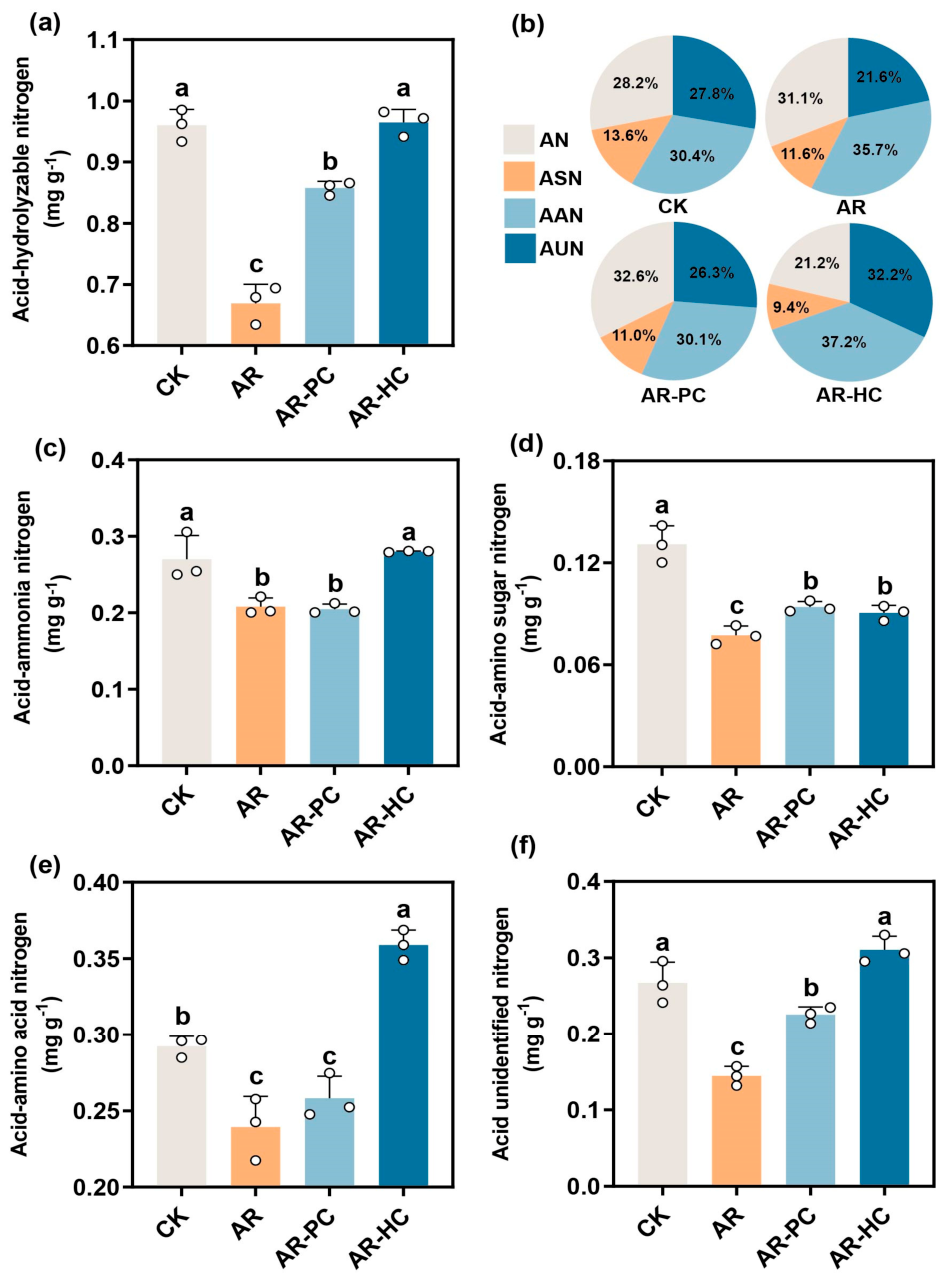
Compared to AR, AR-PC and AR-HC treatments significantly increased soil AHN content by 28.2% and 44.2%, respectively (p < 0.05, Figure 2a). In terms of the proportions of nitrogen fractions, AR-PC increased the proportions of AN and AUN, while AR-HC increased the proportions of AAN and AUN (Figure 2b). Among the individual N fractions, soil AN content was significantly increased by 34.6% under AR-HC relative to AR (p < 0.05, Figure 2c). The AR-PC and AR-HC treatments significantly increased soil ASN content by 21.5% and 17.0%, respectively, compared to the AR treatment (p < 0.05, Figure 2d). AR-HC showed a significant effect on increasing soil AAN content, with a 50.1% increase compared to AR (p < 0.05, Figure 2e). AUN content was higher under AR-PC and AR-HC than under AR, with increases of 29.6% and 31.2%, respectively (p < 0.05, Figure 2f). Compared with the AR-PC treatment, AR-HC treatment significantly increased soil AHN, AN, AAN, and AUN contents by 12.51%, 36.77%, 39.06%, and 37.82%, respectively (p < 0.05, Figure 2). Compared with AR, both AR-PC and AR-HC significantly increased NHN content (p < 0.05, Figure S3).
Figure 2.
Soil acid-hydrolyzable nitrogen (N) contents among all treatments. (a) Acid-hydrolyzable N. (b) Proportion of acid-hydrolyzable N fractions. (c) Acid–ammonia N. (d) Acid–amino sugar N. (e) Acid–amino acid N. (f) Acid unidentified N. AR: acid rain. PC: pyrochar. HC: hydrochar. AR-PC: treatment with PC and AR. AR-HC: treatment with HC and AR. CK: control without PC, HC or AR. Different lowercase letters indicate significant differences among treatments based on pairwise comparisons of estimated marginal means from the linear mixed-effects model, with Tukey-adjusted p-values (p < 0.05).
3.3. Responses of Soil Biochemical Properties to BC Under NAR Stress
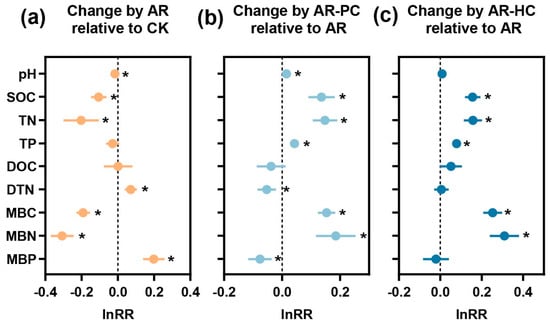
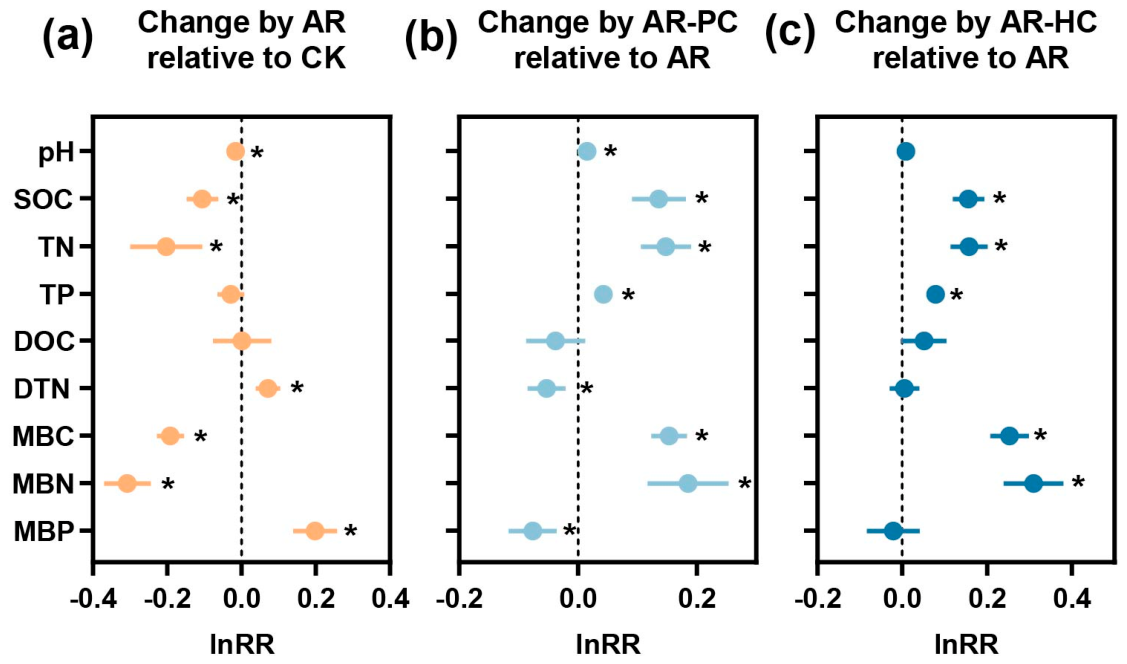
Relative to CK, AR decreased pH, SOC, TN, MBC, and MBN by 3.60%, 21.5%, 37.4%, 35.6%, and 50.7%, respectively (p < 0.05, Figure 3a). Soil pH, SOC, TN, MBC, and MBN were significantly higher under AR-PC than under AR, increasing by 3.50%, 36.8%, 40.6%, 42.3%, and 53.3%, respectively (p < 0.05, Figure 3b). Furthermore, AR-HC treatment demonstrated significant increased the contents of SOC, TN, TP, MBC and MBN, with increases of 43.2%, 43.8%, 19.8%, 78.9% and 104%, respectively, compared to AR (p < 0.05, Figure 3c).
Figure 3.
Change in soil properties by AR relative to CK (a), AR-PC relative to AR (b) and AR-HC relative to AR (c). The vertical lines are drawn at lnRR = 0. Data points show lnRR ± 95% CI and the asterisks (*) indicate significant effects (p < 0.05). AR: acid rain. PC: pyrochar. HC: hydrochar. AR-PC: treatment with PC and AR. AR-HC: treatment with HC and AR. CK: control without PC, HC or AR.
3.4. Responses of Soil Abundant and Rare Microbial Taxa to BC Under NAR Stress
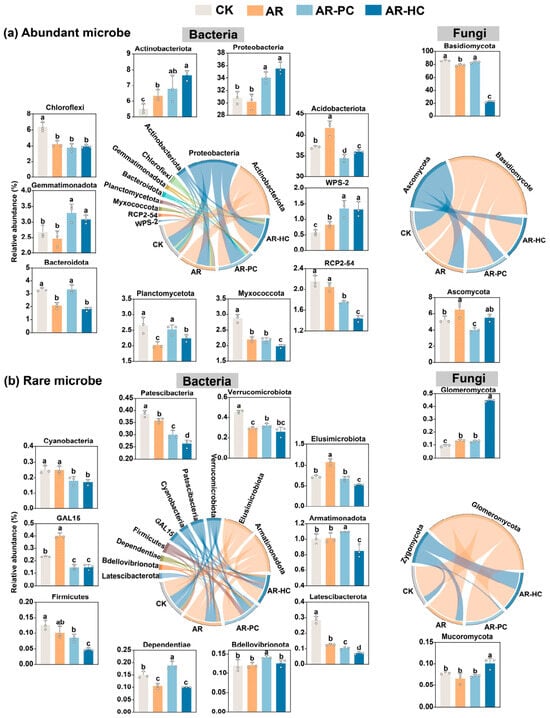
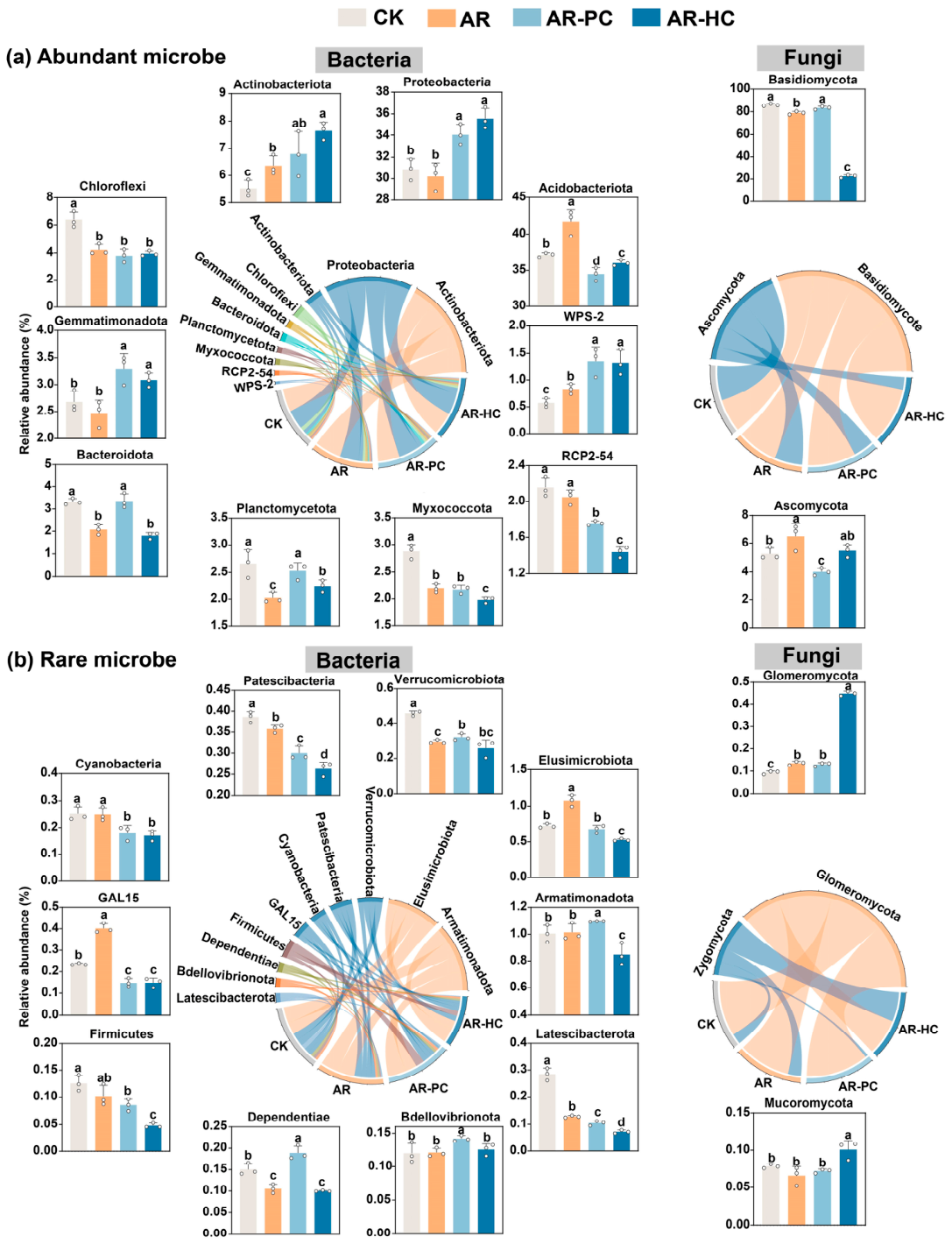
Among abundant bacterial taxa, compared to AR, AR-PC and AR-HC treatments enhanced the relative abundances of Proteobacteria by 12.9% and 17.7%, Gemmatimonadota by 31.1% and 20.9%, Planctomycetota by 24.8% and 11.0%, and WPS-2 by 63.0% and 58.9%, respectively (p < 0.05). However, AR-HC showed significant reduced the relative abundances of Acidobacteriota, Myxococcota, and RCP2-54, which decreased by 13.5%, 9.9%, and 25.0%, respectively (p < 0.05). Among abundant fungal taxa, relative to AR, AR-PC increased the relative abundance of Basidiomycota by 20.9%, but reduced that of Ascomycota by 78.9% (p < 0.05, Figure 4a).
Figure 4.
Relative abundance of abundant and rare microbial taxa at the phylum level among all treatments. (a) Relative abundance of taxa within the abundant microbial phyla. (b) Relative abundance of taxa within the rare microbial phyla. AR: acid rain. PC: pyrochar. HC: hydrochar. AR-PC: treatment with PC and AR. AR-HC: treatment with HC and AR. CK: control without PC, HC or AR. Different lowercase letters indicate significant differences among treatments based on pairwise comparisons of estimated marginal means from the linear mixed-effects model, with Tukey-adjusted p-values (p < 0.05).
Among rare bacterial taxa, relative to AR, AR-HC treatment significantly reduced the relative abundances of Armatimonadota, Elusimicrobiota, Patescibacteria, Cyanobacteria, GAL15, Firmicutes, Bdellovibrionota, and Latescibacterota by 13.5%, 51.3%, 16.3%, 18.3%, 60.1%, 53.1%, 22.1%, and 42.6%, respectively (p < 0.05). Meanwhile, AR-PC treatment showed significant increased the relative abundances of Armatimonadota, Verrucomicrobiota, Dependentiae, and Bdellovibrionota, with increases of 11.8%, 17.4%, 39.5%, and 18.9%, respectively, compared to the AR treatment (p < 0.05). Among rare fungal taxa, AR-HC treatment significantly increased the relative abundances of Glomeromycota and Mucoromycota by 234% and 7.8%, respectively, relative to AR (p < 0.05, Figure 4b).
3.5. Responses of Soil Abundant and Rare Microbial Diversity to BC Under NAR Stress
Among abundant microbial taxa, relative to AR, AR-PC significantly increased the Chao1 index of abundant bacteria by 14.5% (p < 0.05). Compared to AR, AR-PC and AR-HC treatments raised the Chao1 index of abundant fungi by 19.8% and 33.3%, respectively (p < 0.05). Meanwhile, the Shannon index of abundant fungi in the AR-PC and AR-HC treatments was significantly 36.1% and 77.6% higher than in the AR (p < 0.05, Figure 5a). PERMANOVA analysis indicated abundant bacterial communities were significantly separated among treatments (R2 = 0.83, p < 0.001). PERMDISP analysis revealed no significant differences in multivariate dispersion among treatments for abundant bacterial (F = 0.508, p = 0.697) and fungal (F = 0.385, p = 0.789) communities. The AR-PC resulted in a 4.1% increase in the Bray–Curtis dissimilarity of abundant bacteria, relative to AR (p < 0.05). Furthermore, AR-PC treatment significantly increased the Bray–Curtis dissimilarity of abundant fungi by 130% relative to AR (p < 0.05, Figure 5b). For each treatment, Bray–Curtis dissimilarity was calculated from all pairwise comparisons among the three biological replicates to characterize within-treatment differences in abundant microbial community composition. Furthermore, AR-PC treatment significantly increased the Bray–Curtis dissimilarity of abundant fungi by 130% relative to AR (p < 0.05, Figure 5b).
Among rare microbial taxa, compared to AR, AR-PC treatment resulted in significant increases of 23.8% and 4.90% in Chao1 and Shannon indices for rare bacteria, respectively (p < 0.05). Meanwhile, AR-PC and AR-HC treatments enhanced the Chao1 index of rare fungi by 16.2% and 27.3%, respectively (p < 0.05). Rare fungal Shannon index was 29.4% and 32.1% higher under AR-PC and AR-HC than under AR, respectively (p < 0.05, Figure 5c). The PERMANOVA analysis suggested that rare bacterial communities (R2 = 0.56, p < 0.001) and rare fungal communities (R2 = 0.75, p < 0.01) were significantly separated among treatments. PERMDISP analysis revealed no significant differences in multivariate dispersion among treatments for rare bacterial (F = 0.089, p = 0.954) and fungal (F = 1.802, p = 0.245) communities. Rare fungal communities were mainly represented by PCoA1, which explained 75.2% of the variation. In addition, relative to AR, AR-HC treatment significantly decreased the Bray–Curtis dissimilarity of rare fungi by 28.5% (p < 0.05, Figure 5d). For each treatment, Bray–Curtis dissimilarity was calculated from all pairwise comparisons among the three biological replicates to characterize within-treatment differences in rare microbial community composition. In addition, relative to AR, AR-HC treatment significantly decreased the Bray–Curtis dissimilarity of rare fungi by 28.5% (p < 0.05, Figure 5d).
3.6. Responses of Microbial Co-Occurrence Network Complexity to BC Under NAR Stress
Compared to AR, AR-PC and AR-HC treatments enhanced the co-occurrence network complexity of abundant and rare microbial taxa (Tables S2 and S3). For abundant microbial taxa, AR-PC increased the average degree and robustness of abundant bacterial networks to 10.581 and 0.770, respectively, relative to AR. Meanwhile, nodes, edges, and robustness of abundant bacterial networks under AR-HC were higher than under AR. In addition, relative to AR, AR-PC treatment enhanced the network complexity of the abundant fungal taxa, increasing the nodes, edges, and robustness of abundant fungal networks to 45, 132, and 0.673, respectively (Figure 6a).
Figure 5.
The diversity of abundant and rare microbial taxa among all treatments. (a) Abundant microbial alpha diversity. (b) Abundant microbial beta diversity. (c) Rare microbial alpha diversity. (d) Rare microbial beta diversity. AR: acid rain. PC: pyrochar. HC: hydrochar. AR-PC: treatment with PC and AR. AR-HC: treatment with HC and AR. CK: control without PC, HC or AR. Different lowercase letters indicate significant differences among treatments based on pairwise comparisons of estimated marginal means from the linear mixed-effects model, with Tukey-adjusted p-values (p < 0.05).
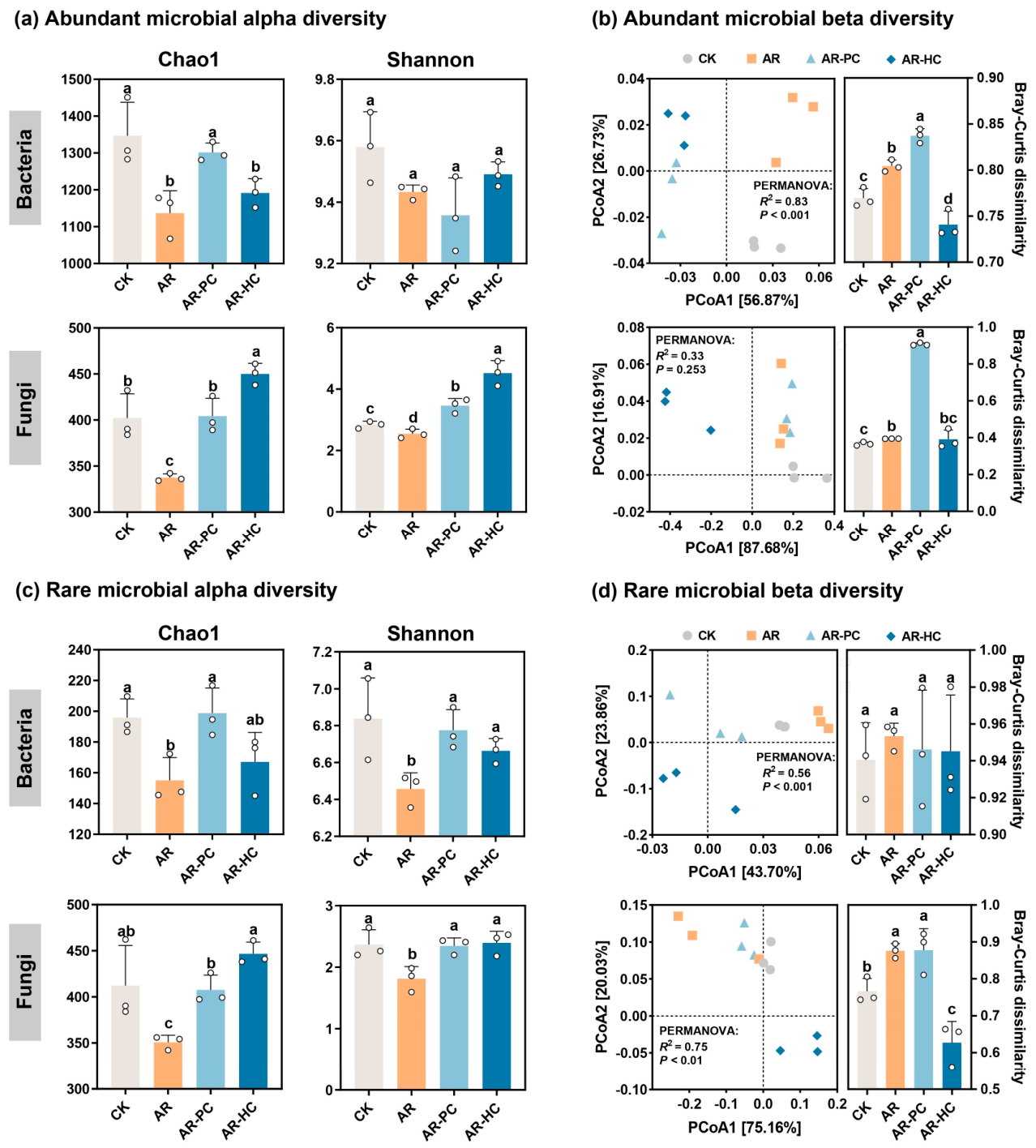
Figure 6.
Co-occurrence networks and topological indices of abundant and rare microbial taxa among all treatments. (a) Co-occurrence networks and topological indices of abundant microbial taxa. (b) Co-occurrence networks and topological indices of rare microbial taxa. AR: acid rain. PC: pyrochar. HC: hydrochar. AR-PC: treatment with PC and AR. AR-HC: treatment with HC and AR. CK: control without PC, HC or AR.
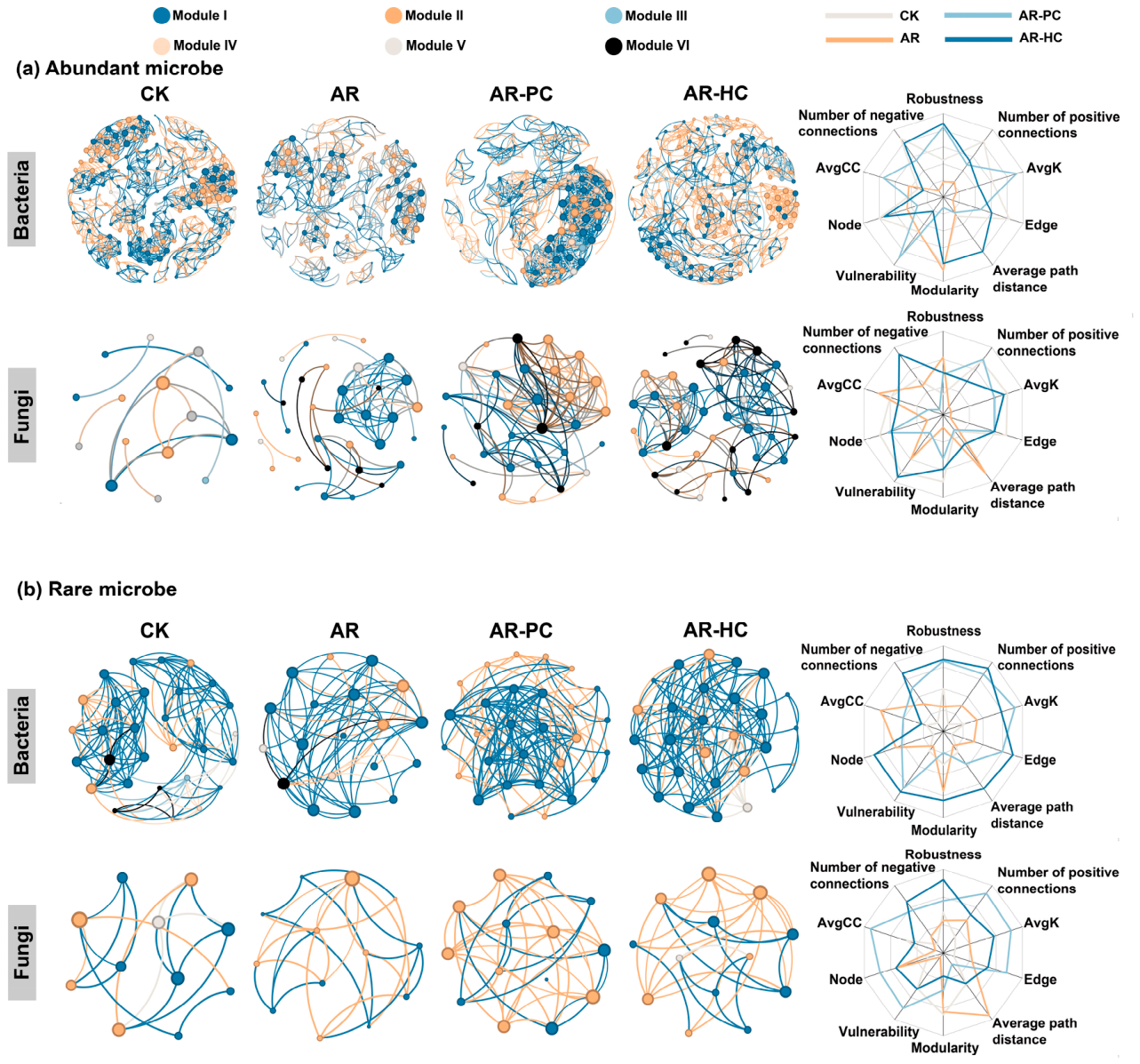
For rare microbial taxa, AR-PC and AR-HC treatments increased the number of nodes in rare bacterial networks to 29 and 28, respectively, relative to AR (Tables S4 and S5). The average degree and robustness of rare bacterial networks under AR-PC and AR-HC were higher than under AR. Meanwhile, AR-PC and AR-HC treatments also improved the topological indices of rare fungal networks. The AR-PC and AR-HC treatments increased the number of nodes to 14 and 13, the number of edges to 39 and 32, the average degree to 5.571 and 4.923, the average clustering coefficient to 0.966 and 0.866, and robustness to 0.424 and 0.381 in rare fungal networks, respectively (Figure 6b).
3.7. Associations of Abundant and Rare Microbial Taxa with Soil AHN Under NAR Stress
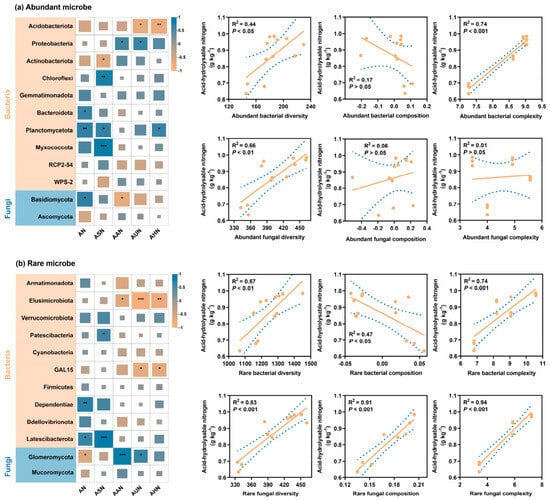
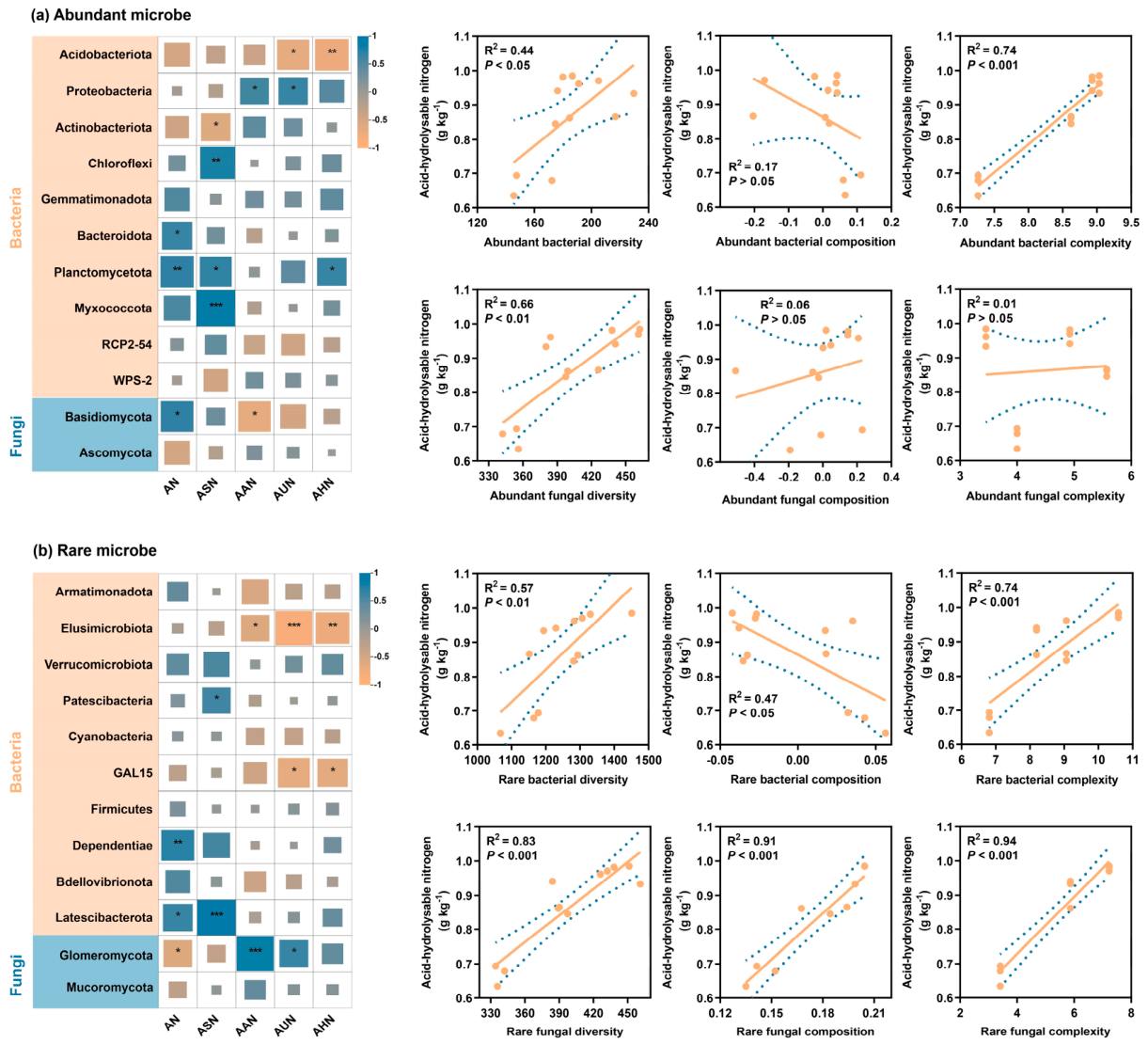
For abundant microbial taxa, soil AN content was significantly influenced by Bacteroidota, Planctomycetota, and Basidiomycota (r = 0.63, 0.71 and 0.69, p < 0.05). Meanwhile, soil ASN was negatively associated with Actinobacteriota (r = −0.61, p < 0.05), but positively related to Chloroflexi, Planctomycetota, and Myxococcota (r = 0.76, 0.86 and 0.39, p < 0.01). Soil AAN and AUN contents were both significantly influenced by Proteobacteria (r = 0.59 and r = 0.61, p < 0.05). Acidobacteriota was negatively associated with soil AUN and AHN, whereas Planctomycetota showed a positive relationship with soil AHN (r = −0.68, −0.72, and 0.61, p < 0.05). Linear regression results showed that soil AHN content was associated with the diversity (R2 = 0.44, p < 0.05) and co-occurrence network complexity (R2 = 0.74, p < 0.001) of abundant bacteria. Meanwhile, soil AHN was positively related to abundant fungal diversity (R2 = 0.66, p < 0.01) (Figure 7a).
Figure 7.
Relationships between soil acid-hydrolyzable nitrogen (AHN) and microbial community. (a) Relationships between soil AHN and abundant microbial phyla. Linear regressions of soil AHN content against the diversity, composition, and co-occurrence network complexity of abundant bacteria and fungi. (b) Relationships between soil AHN and rare microbial phyla. Correlation analysis was performed using Pearson’s correlation analysis. Linear regressions of soil AHN content against the diversity, composition, and co-occurrence network complexity of rare bacteria and fungi. Asterisks (*, ** and ***) indicate significant differences (p < 0.05, <0.01, and <0.001).
For rare microbial taxa, soil AN content was significantly positively correlated with Dependentiae and Latescibacterota, but significantly negatively correlated with Glomeromycota (r = 0.72, 0.63 and −0.60, p < 0.05). Soil ASN content was significantly influenced by Patescibacteria (r = 0.59, p < 0.05) and Latescibacterota (r = 0.88, p < 0.001). Soil AAN and AUN contents were significantly negatively correlated with Elusimicrobiota (r = −0.59 and −0.82, p < 0.05), but significantly positively correlated with Glomeromycota (r = 0.84 and 0.61, p < 0.05). Soil AHN showed negative relationships with Elusimicrobiota and GAL15 (r = −0.74 and −0.65, p < 0.05). Linear regression indicated a positive association between soil AHN and rare bacterial diversity (R2 = 0.57, p < 0.01) and co-occurrence network complexity (R2 = 0.47, p < 0.05). However, soil AHN content showed a significant negative linear correlation with rare bacterial composition (R2 = 0.74, p < 0.001). Soil AHN content was significantly and positively correlated with rare fungal diversity, composition, and co-occurrence network complexity (R2 = 0.83, 0.91, and 0.94, p < 0.001) (Figure 7b).
3.8. Statistical Predictors and Modeled Pathways Associated with Soil AHN Under NAR Stress
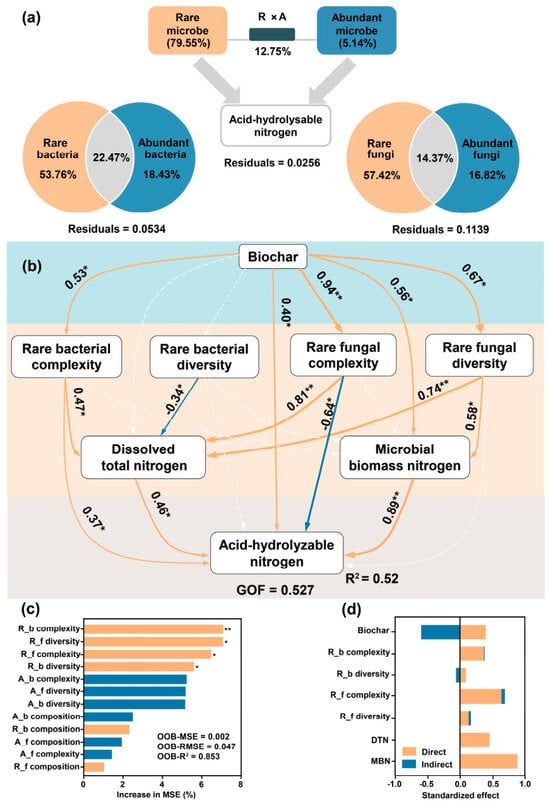
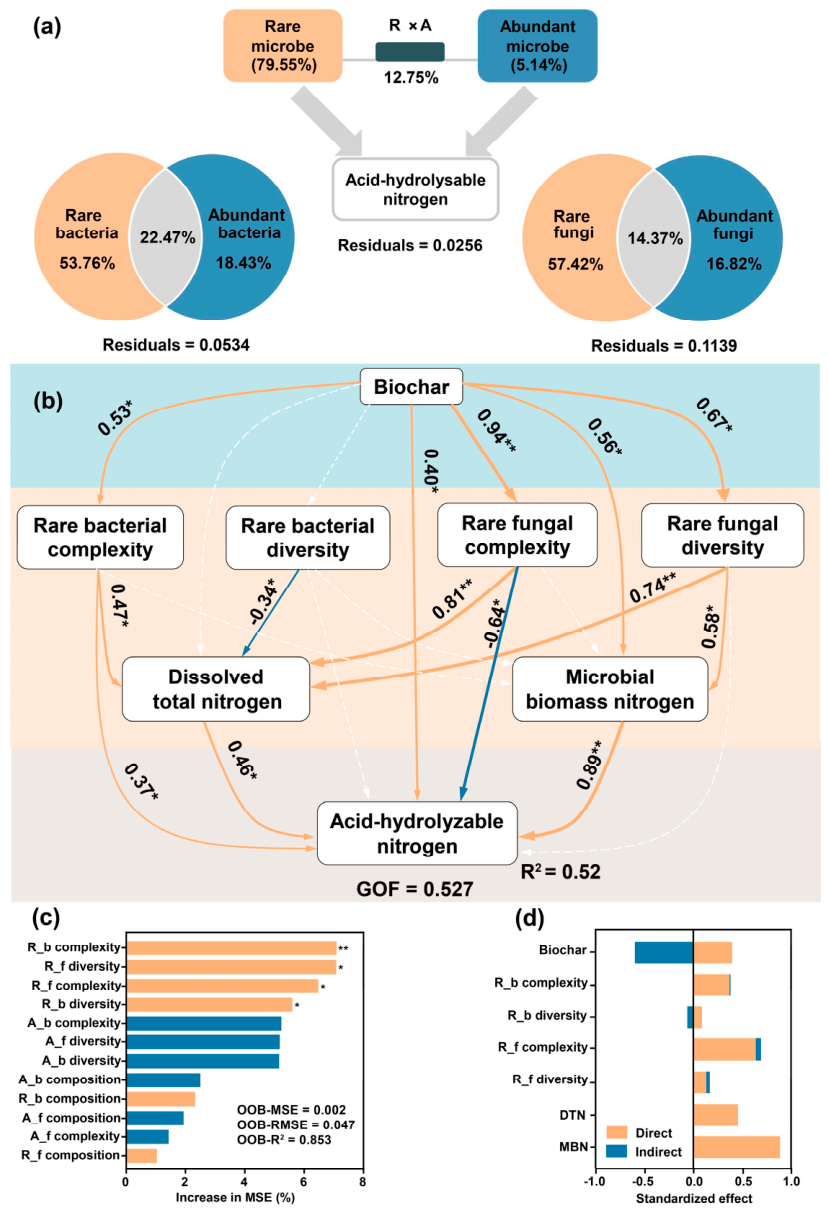
VPA showed that rare and abundant microbial taxa uniquely explained 79.55% and 5.14% of the variation in soil AHN content, respectively, while their shared explanatory fraction accounted for 12.75%. The remaining 2.56% of the variation was unexplained by the model (Figure 8a). Exploratory PLS-PM analysis revealed an associated pathway linking BC, rare bacterial complexity, rare fungal complexity, and rare fungal diversity to soil DON and AHN content (λ = 0.46, p < 0.05). Another associated pathway linked BC and rare fungal diversity to soil MBN and AHN content (λ = 0.89, p < 0.01) (Figure 8b). The RF model exhibited good internal predictive performance, with an OOB-MSE of 0.002, an OOB-RMSE of 0.047 and an OOB-R2 of 0.853. RF models demonstrated that rare bacterial complexity, rare fungal diversity, rare fungal complexity, and rare bacterial diversity were the main predictors of soil AHN content under BC application, with explanatory contributions of 7.10%, 7.08%, 6.48%, and 5.60%, respectively (Figure 8c). Notably, the direct and indirect effects of BC on soil AHN content were 0.40 and 0.60, respectively (Figure 8d).
Figure 8.
Individual and joint variance contributions of soil abundant and rare microorganisms to soil acid-hydrolyzable nitrogen (AHN) (a). Effects of abundant and rare microorganisms on soil AHN, based on partial least squares path modeling (b). Important factors affecting soil AHN (c). Standardized effects of soil abundant and rare microorganisms on soil AHN (d). Orange and blue colors indicate significant positive and negative effects (p < 0.05) between the two variables, respectively. The dashed lines indicate no significant effect (p > 0.05). Asterisks (* and **) indicate significant differences (p < 0.05 and p < 0.01).
4. Discussion
4.1. Effects of BC on Soil AHN Fractions Under NAR Stress
The PC and HC both significantly increased soil AHN content under NAR stress. Among them, AR-HC treatment significantly increased soil AN content, whereas AR-PC treatment showed no significant effect (Figure 2). This may be attributed to preparation-induced differences in BC surface structure [31]. The SSA and pore volume of HC were greater than those of PC (Figure 1) (Figure S2). A larger SSA may facilitate soil AN adsorption, reduce its contact with dehydrogenases, and thereby limit AN consumption through nitrification [32]. At the same time, the well-developed pore structure may provide spatial protection for AN. This protection could reduce NAR-induced leaching losses and thereby favor soil AN accumulation [33,34].
Additionally, AR-HC treatment significantly increased soil AAN content, whereas AR-PC treatment had no significant effect on AAN (Figure 2). Firstly, HC surface contains abundant hydrophilic -OH and -COOH groups (Figure 1). Abundant oxygenated sites may help retain amino acids and other small organic N compounds via hydrogen bonding or complexation [35]. This may reduce the migration loss of AAN under NAR stress. Secondly, HC retained more incompletely carbonized organic components and N-containing functional groups, and had a relatively higher TN content (Figure 1). Thus, HC application may directly provide soil with convertible organic N, thereby promoting the accumulation of AAN [36]. The contribution of amendment-derived N should also be considered when interpreting the greater AHN accumulation under HC. Given the TN contents of PC and HC and their application rate, the estimated N inputs were 2.30 and 2.65 g N m−2.
Thirdly, HC significantly increased soil MBN content (Figure 3). MBN may be converted into stable microbial residues through microbial death and turnover [17]. These residues are enriched in intracellular proteins and cell-wall polymers and may accumulate in soil as ASN and AAN [37,38]. However, as N leaching and microbial necromass content were not directly measured, these potential mechanisms require further experimental verification.
AR-PC treatment significantly increased soil ASN content relative to AR (Figure 2). This result may be related to the alkaline nature of PC (Figure 1). Approximately 50% of the carbonates in PC are retained in the ash fraction [39]. Therefore, PC application can neutralize soil H+ (CO32− + 2H+ → H2O + CO2) [2]. This neutralization may facilitate the deprotonation of functional groups on soil colloid surfaces, increasing negatively charged sites, and enhancing the adsorption and immobilization of amino sugar compounds [40]. Concurrently, reduced soil acidity may weaken acid-catalyzed hydrolysis and lower the risk of amino sugar polymer decomposition, ultimately favoring ASN [14].
4.2. Effects of BC on Abundant and Rare Microbial Community Structures Under NAR Stress
Under NAR stress, BC altered soil microbial community structure and induced contrasting responses between abundant and rare taxa. At the phylum level, HC significantly reduced the relative abundance of the abundant fungal phylum Basidiomycota, while simultaneously increasing the relative abundance of the rare fungal phyla Mucoromycota and Glomeromycota (Figure 4). This finding is consistent with the conclusions of previous studies [41]. The underlying mechanism may be attributed to distinct resource use strategies adopted by different microbial taxa [23]. Basidiomycota, as an abundant taxon, generally consists of K-strategists that preferentially utilize complex C substrates, such as lignin [42]. HC application may increase soil labile organic substrates, thereby weakening the competitive advantage of Basidiomycota [41]. In contrast, Mucoromycota and Glomeromycota, as rare fungal taxa, adopt an r-selected growth strategy [23,36]. Labile organic compounds in HC may stimulate the growth and metabolic activity of these taxa [43].
PC and HC both enhanced the Shannon index of rare bacterial taxa under acid rain stress, but had no significant effect on that of abundant bacterial taxa (Figure 5). This may be related to differences in ecological strategies between abundant and rare microbial taxa. Abundant bacteria have broad ecological niches and strong environmental adaptability, enabling them to remain relatively stable under NAR stress [21,24]. In contrast, the narrow ecological niches of rare bacteria may intensify resource competition among different groups under NAR stress [42,44]. The application of PC and HC may provide available C and N substrates to soil, thereby alleviating competitive pressure among rare bacterial communities [8,10]. The PERMANOVA analysis indicated that rare fungal communities were significantly separated among treatments, whereas abundant fungal communities showed no significant separation (Figure 5). This further confirms that rare microbial taxa respond more strongly to BC application than abundant microbial taxa under NAR stress.
Under NAR stress, PC and HC application increased the robustness of rare bacterial co-occurrence networks (Figure 6). This may be closely related to the high metabolic heterogeneity and functional redundancy characteristic of rare microbial taxa [42]. When exposed to NAR stress, rare microbial taxa may respond rapidly to environmental changes (Figure S5) and utilize the bioavailable nutrients provided by BC (Figure 1). Rare bacterial taxa establish more complex ecological interaction networks [45]. This network effectively reduces NAR-induced environmental stress and maintains community functional stability [25]. However, due to the small sample size, these findings should be considered exploratory only.
4.3. Mechanisms of BC Promoting Soil AHN Accumulation via Regulating Rare Microbes Under NAR Stress
BC application increased soil AHN accumulation and altered rare microbial taxa and microbial consumption of soil N. Correlation analysis showed that soil AHN was negatively associated with rare bacterial phyla, including Elusimicrobiota and GAL15 (Figure 7). Elusimicrobiota has been reported to participate in amino sugar and polysaccharide degradation [21]. BC application reduced the relative abundance of this taxon (Figure 4). This may potentially reflect changes in microbial processes related to soil ASN and AAN dynamics [11]. GAL15 is a typical stress-tolerant taxon [43]. BC application decreased the relative abundance of GAL15 (Figure 4). This shift may be associated with changes in microbial interactions and N substrate utilization, potentially contributing to the observed variation in soil AHN content under NAR stress [41,46].
In addition, soil AHN was positively associated with the diversity and network complexity of rare bacterial and fungal taxa (Figure 7). This may reflect the specialized metabolic niches occupied by rare microbial taxa [25]. BC application enhanced the diversity of rare microorganisms (Figure 5). This may improve the overall resistance of microbial communities to environmental stress, thereby suppressing excessive microbial consumption of AHN fractions under NAR stress [7,41]. At the same time, BC enhanced the connectivity of rare microbial co-occurrence networks (Figure 6), which helps build a more interconnected microbial association network. This synergistic system may raise soil microbial N use efficiency during N transformation and reduce the wasteful consumption of N substrates [47]. Previous studies have observed that rare microorganisms, despite their low abundance, can make disproportionate contributions to ecosystem functioning under environmental stress [48]. However, as microbial N use efficiency and the rates of specific N transformation processes were not directly measured, these potential mechanisms require further experimental verification.
Rare microbial taxa contributed far more to soil AHN content than abundant microbial taxa (Figure 8). This highlights the dominant role of rare microbial taxa in regulating soil AHN. The PLS-PM analysis further revealed exploratory associations between BC application, rare microbial community characteristics, and soil AHN accumulation (Figure 8). On the one hand, BC application increased the complexity of rare bacterial co-occurrence networks (Figure 6). This may strengthen co-occurrence associations among microbial taxa, thereby promoting DTN release and providing more available N substrates for AHN synthesis [49]. On the other hand, BC increased rare fungal diversity (Figure 5). The expansion of fungal hyphal networks may enhance microbial N assimilation capacity and increase soil MBN content [50]. MBN constitutes an important pool of microbial residue N, and its increase may further contribute to soil AHN accumulation [51]. The shared explanatory fraction (12.75%) suggests that rare and abundant microbial taxa may contain overlapping information associated with soil AHN variation. Furthermore, the unexplained variation (2.56%) may reflect unmeasured environmental factors, microbial functional attributes, or other processes not included in the VPA model.
Notably, different AHN fractions were regulated by distinct microbial taxa. AN, ASN, and AAN were mainly regulated by rare microbial taxa, whereas AUN was primarily influenced by abundant microbial taxa (Figure S4). This functional differentiation may stem from differences in metabolic capabilities between the two types of microorganisms [24]. Abundant microorganisms possess more efficient extracellular enzyme systems and can steadily degrade complex macromolecules, such as aromatic compounds [21]. AUN consists primarily of recalcitrant organic N and complex plant residues. Therefore, abundant microorganisms tend to dominate the turnover of recalcitrant AHN fractions, whereas rare microorganisms are mainly associated with the accumulation of labile AHN fractions [52].
4.4. Perspectives and Implications
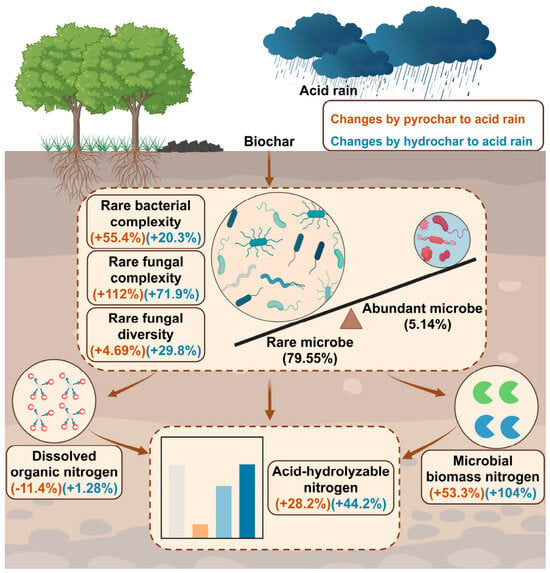
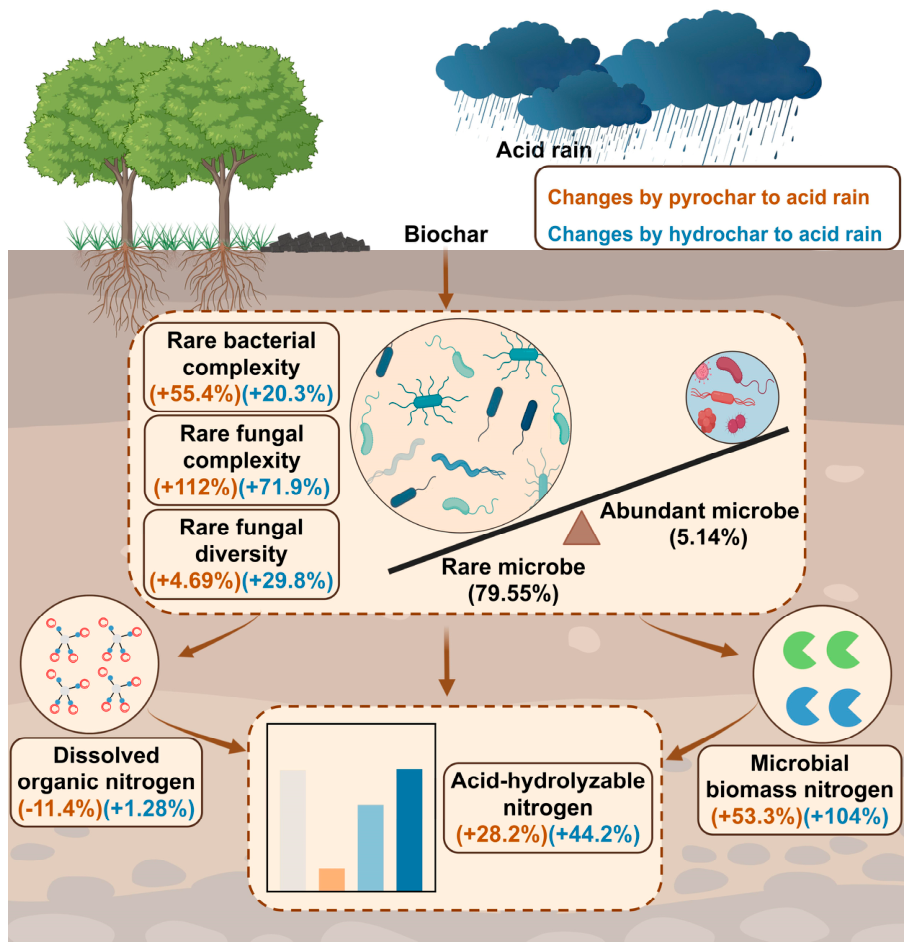
Soil acidification and N leaching induced by intensified NAR are key ecological issues that threaten soil quality and the stability of ecological functions in plantations. Our results demonstrated that PC and HC promoted the accumulation of soil AHN and its fractions under NAR stress by reshaping the rare microbial community structure (Figure 9). This finding provides a microbiological basis for N retention in acidified soils. The results showed that rare bacterial and fungal taxa exhibited strong functional compensatory capacity under NAR stress. Rare microbial network complexity and diversity were potentially involved in soil AHN accumulation. This highlights the critical role of rare microorganisms in maintaining the ecological functions of acidified soils.
Figure 9.
Conceptual diagram of pyrochar and hydrochar amendment effects on soil acid-hydrolyzable nitrogen under acid rain stress.
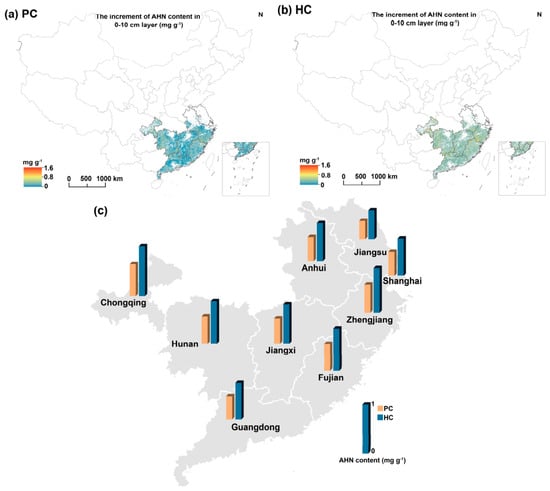
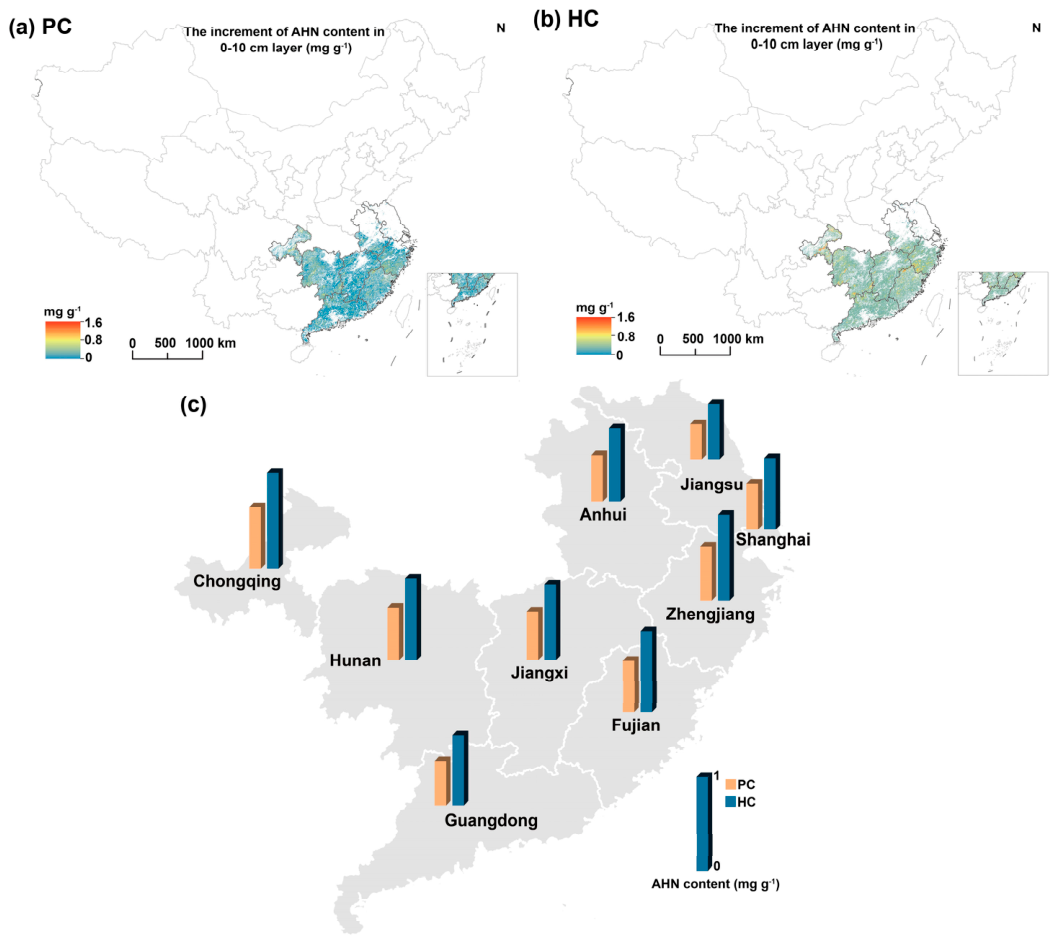
At the regional scale, scenario-based estimates suggested potential increases in AHN content in the 0–10 cm forest soil layer across major acid rain-affected regions of China under BC amendment (Figure 10). Among the two BC types, HC generally showed higher AHN increments than PC across these provinces. The highest average increases were mainly observed in Jiangsu, Zhejiang, Anhui, and Chongqing, indicating that these provinces may have greater potential for BC-mediated improvement of labile soil N pools under AR stress. However, these estimates were extrapolated from a single experimental site and require independent regional validation.
Figure 10.
Spatial distribution of biochar-induced increases in acid-hydrolyzable nitrogen (AHN) in the 0–10 cm forest soil layer across major acid rain-affected regions of China. Panels (a) and (b) show the spatial distribution of AHN increments under PC and HC treatments, respectively. Panel (c) shows the average AHN increments in Shanghai, Jiangsu, Zhejiang, Fujian, Guangdong, Jiangxi, Anhui, Hunan, and Chongqing. PC, pyrochar; HC, hydrochar.
However, this study still has some limitations, and future research should focus on the following aspects. (1) Although BC amendment increased soil AHN accumulation under AR stress, the underlying sources and transformation pathways of AHN remain uncertain. Specifically, the observed increase in AHN may result from the incorporation of BC-derived N, enhanced transformation and retention of native soil N, reduced soil N losses, or a combination of these processes. However, without direct isotope tracing, the relative contributions of these potential pathways cannot be quantitatively distinguished. Therefore, the observed increase in AHN should not be interpreted solely as evidence of enhanced microbial N transformation or retention of native soil N. Future studies should employ 15N isotope labeling to distinguish the contributions of BC-derived and soil-derived N to AHN accumulation and to further elucidate the mechanisms underlying BC-mediated changes in soil N cycling under AR stress. (2) Conduct multi-season and multi-region experiments combining simulated AR stress with BC application to elucidate the spatiotemporal dynamics of rare microorganisms. (3) Integrate metagenomics with DNA stable-isotope probing (DNA-SIP) to reveal the key metabolic pathways through which rare microorganisms participate in AHN formation and transformation. (4) Due to the limited number of independent experimental plots in this study, the random forest model may be susceptible to overfitting.
Several limitations of this study should be acknowledged. (1) The experiment was conducted at a single plantation site, with soil samples collected only from the 0–10 cm layer at one sampling time, limiting the spatial and temporal generalizability of the findings. (2) The limited number of independent biological replicates (n = 3 per treatment) may reduce statistical power and increase uncertainty in the results. Therefore, the observed treatment responses should be interpreted within the scope of the experimental design. Future studies incorporating a complete factorial design and larger sample sizes are needed to further validate these findings. (3) Microbial communities were characterized using 16S rRNA and ITS amplicon sequencing rather than functional metagenomic or metatranscriptomic approaches, limiting the direct assessment of microbial functional activity. (4) The absence of 15N isotope tracing and direct N-leaching measurements limited our ability to identify specific N transformation and retention pathways. (5) Correlation, co-occurrence network, random forest, and PLS-PM analyses primarily revealed statistical associations rather than causal relationships. Therefore, further studies involving multiple sites, soil depths, sampling periods, and direct functional measurements are needed to validate the proposed mechanisms. (6) In addition, the absence of PC-only and HC-only treatments without NAR limits our ability to distinguish the independent effects of BC amendments from their interactions with NAR. Future studies should adopt a full factorial design incorporating different BC amendments (no BC, PC, and HC) under both NAR and non-NAR conditions, with equivalent water inputs across treatments. (6) The simulated NAR treatment at pH 2.5 represents a relatively extreme acidification scenario that differs to some extent from the precipitation acidity commonly encountered under natural environmental conditions. Future studies should incorporate a broader range of acidity levels and acid deposition conditions that more closely reflect real-world environments.
5. Conclusions
Under nitrate-enriched acid rain (NAR) stress, both pyrochar (PC) and hydrochar (HC) enhanced the retention of soil acid-hydrolyzable nitrogen (AHN) and its fractions, including acid–ammonia N (AN), acid–amino sugar N (ASN), acid–amino acid N (AAN), and acid unidentified N (AUN). Notably, HC was more effective than PC in promoting soil AHN accumulation. Both types of biochar (BC) not only increased the diversity of rare microorganisms but also enhanced the complexity and stability of microorganisms. Furthermore, different microbial taxa dominated distinct AHN fractions. Rare microbial taxa were strongly associated with the transformation processes of soil AN, ASN, and AAN, while abundant microbial taxa played a major role in the accumulation of soil AUN. Meanwhile, BC effectively promoted soil AHN accumulation under NAR stress by reshaping the rare microbial community structure. This study identifies rare microorganisms as key biological mediators of N retention under NAR stress and highlights BC as a potential environmental management strategy for mitigating reactive N loss and sustaining ecosystem health in regions affected by NAR.
Supplementary Materials
The following supporting information can be downloaded at: https://www.mdpi.com/article/10.3390/microorganisms14122765/s1, Text S1: Estimated total nitrogen stock in China's major acid rain-affected regions; Text S2: Estimation of nitrogen inputs from biochar (BC) amendments; Figure S1: Research site location of this study; Figure S2: The scanning electron micrographs of pyrochar (PC, a) and hydrochar (HC, b); Figure S3: (a) Soil non-hydrolyzable nitrogen (N) contents among all treatments. (b) Proportion of soil organic N components; Figure S4: Individual and joint variance contributions of soil chemical and biological properties to soil acid–ammonia nitrogen (a), acid–amino sugar nitrogen (b), acid–amino acid nitrogen (c) and acid unidentified nitrogen (d); Figure S5: Relationships between soil biochemical properties and soil microbial community; Figure S6: Soil total nitrogen (N) contents (a) and total N stock (b) among all treatments; Figure S7: Spatial distribution of increments in total nitrogen (TN) stock in the 0-10 cm forest soil layer across China's major acid rain-affected provincial regions, including Shanghai, Jiangsu, Zhejiang, Fujian, Guangdong, Jiangxi, Anhui, Hunan, and Chongqing, based on data from Liu et al.; Table S1: The chemical properties of pyrochar and hydrochar; Table S2: Topological indices of abundant bacterial co-occurrence networks for each treatment; Table S3: Topological indices of abundant fungal co-occurrence networks for each treatment; Table S4: Topological indices of rare bacterial co-occurrence networks for each treatment; Table S5: Topological indices of rare fungal co-occurrence networks for each treatment; Table S6: Monthly spraying amounts, application volumes, and nitrogen, sulfur, and H⁺ loadings of simulated acid rain at the experimental plots; Table S7: TN contents, application rates, and estimated nitrogen inputs of PC and HC; Table S8: Sample information, sequence clustering thresholds, rarefaction depth, and singleton removal for bacterial 16S rRNA gene amplicon sequencing; Table S9: Sample information, sequence clustering thresholds, rarefaction depth, and singleton removal for bacterial ITS rRNA gene amplicon sequencing; Table S10: Results of Shapiro–Wilk normality tests and median-centered Levene′s tests for homogeneity of variances for the variables analyzed by ANOVA; Table S11: Direct Path Coefficients, 95% Confidence Intervals, and Significance Levels in the Partial Least Squares Path Model (PLS-PM).
Author Contributions
Writing—original draft, Data curation, Y.L. (Yuanhao Liu); Investigation, H.Z.; Writing—review & editing, H.H., S.Y., J.L., X.Y., Y.L. (Yonghua Liu), Y.F. (Yanfang Feng) and L.X.; Writing—review & editing, Methodology, Supervision, Conceptualization, Y.F. (Yuanyuan Feng). All authors have read and agreed to the published version of the manuscript.
Funding
This research was funded by the Basic Research Program of Jiangsu (BK20250692); the Natural Science Foundation of China (42607573); the Natural Science Foundation of the Jiangsu Higher Education Institutions of China (25KJB210009); the Shandong Electric Power Engineering Consulting Institute Co., Ltd. Science and Technology Project (100561JX0120260178); the National Positioning Observation and Research Project of Farmland Protection Forest Ecosystem in Changjiang River Delta (2024132088); the Postgraduate Research & Practice Innovation Program of Jiangsu Province (KYCX25_1356 and 26CXJH2098); the Open Research Projects of the Key Laboratory of Agricultural Environment in the Lower Yangtze River Plain, Ministry of Agriculture and Rural Affairs (2025F02). Y.Y. Feng thanks the support of Jiangsu Province Young Science and Technology Talent Support Program (JSTJ-2026-131).
Institutional Review Board Statement
Not applicable.
Informed Consent Statement
Not applicable.
Data Availability Statement
The 16S rRNA and ITS gene sequencing data associated with this work are available in the China National Center for Bioinformation (CNCB) database under accession numbers PRJCA063816 and PRJCA059488, respectively.
Acknowledgments
We sincerely thank Junhao Dong and Hongcheng Lu for their valuable assistance and support during the revision of this manuscript.
Conflicts of Interest
The authors declare no conflicts of interest.
Abbreviations
The following abbreviations are used in this manuscript:
| TLA | Three-letter acronym |
| LD | Linear dichroism |
References
- Newcomb, C.J.; Qafoku, N.P.; Grate, J.W.; Bailey, V.L.; De Yoreo, J.J. Developing a molecular picture of soil organic matter–mineral interactions by quantifying organo–mineral binding. Nat. Commun. 2017, 8, 396, Erratum in Nat. Commun. 2017, 8, 2017. [Google Scholar] [CrossRef] [Scilit] [PubMed]
- Zhang, N.; Xing, J.; Wei, L.; Liu, C.; Zhao, W.; Liu, Z.; Wang, Y.; Liu, E.; Ren, X.; Jia, Z.; et al. The potential of biochar to mitigate soil acidification: A global meta-analysis. Biochar 2025, 7, 49. [Google Scholar] [CrossRef] [Scilit]
- Hu, Y.; Chen, J.; Hui, D.; Wang, Y.-P.; Huang, X.; Hu, M.; Zhu, Y.; Li, Y.; Li, J.; Zhang, D.; et al. Tropical tree-mycorrhizal types show divergent phosphorus adaptive strategies after 12-year simulated acid rain. Soil Biol. Biochem. 2025, 211, 109968. [Google Scholar] [CrossRef] [Scilit]
- Wu, J.; Xiong, X.; Hui, D.; Zhang, H.; Li, J.; Chang, Z.; Zhang, S.; Su, Y.; Li, X.; Zhang, D.; et al. Soil aggregate size distribution mediates microbial responses to prolonged acid deposition in a subtropical forest in south China. Soil Biol. Biochem. 2024, 198, 109544. [Google Scholar] [CrossRef] [Scilit]
- Du, L.; Zhang, Z.; Chen, Y.; Wang, Y.; Zhou, C.; Yang, H.; Zhang, W. Heterogeneous impact of soil acidification on crop yield reduction and its regulatory variables: A global meta-analysis. Field Crops Res. 2024, 319, 109643. [Google Scholar] [CrossRef] [Scilit]
- Bassett, K.R.; Hupperts, S.F.; Jämtgård, S.; Östlund, L.; Fridman, J.; Perakis, S.S.; Gundale, M.J. Rising atmospheric CO2 reduces nitrogen availability in boreal forests. Nature 2026, 650, 629–635. [Google Scholar] [CrossRef] [Scilit] [PubMed]
- Xia, H.; Riaz, M.; Tang, X.; Yan, L.; El-Desouki, Z.; Li, Y.; Wang, X.; Jiang, C. Insight into mechanisms of biochar-fertilizer induced of microbial community and microbiology of nitrogen cycle in acidic soil. J. Environ. Manag. 2023, 336, 117602. [Google Scholar] [CrossRef] [Scilit] [PubMed]
- Feng, Y.; Liu, Y.; Liu, J.; Hu, H.; Zhou, M.; Feng, Y.; Xue, L. Biochar-driven biological regulation dominates acid-hydrolyzable nitrogen accumulation in plantation soils under acid rain stress. Biochar 2026, 8, 55. [Google Scholar] [CrossRef] [Scilit]
- Zhang, Y.; Yan, C.; Wang, T.; Zhang, G.; Bahn, M.; Mo, F.; Han, J. Biochar strategy for long-term N2O emission reduction: Insights into soil physical structure and microbial interaction. Soil Biol. Biochem. 2025, 202, 109685. [Google Scholar] [CrossRef] [Scilit]
- Cao, M.; Lu, Q.; Cui, L.; Wang, G.; Zheng, X.; Wang, D.; Kong, Y.; Tian, Y.; Tang, L.; Zhang, H. Biochar reduces microbial fertilizer-induced microbial community stability by weakening heterogeneous selection in poplar plantation soil. For. Ecol. Manag. 2025, 594, 122956. [Google Scholar] [CrossRef] [Scilit]
- Liu, S.; Cen, B.; Yu, Z.; Qiu, R.; Gao, T.; Long, X. The key role of biochar in amending acidic soil: Reducing soil acidity and improving soil acid buffering capacity. Biochar 2025, 7, 52. [Google Scholar] [CrossRef] [Scilit]
- Xia, H.; Wang, J.; Riaz, M.; Babar, S.; Wang, X.; Xia, X.; Yan, B.; Liu, B.; Jiang, C. Interaction between biochar and nitrogen fertilizer improves nitrogen utilization efficiency, closely connected with rhizosphere microbes involved in nitrogen-cycling. Soil Tillage Res. 2025, 254, 106732. [Google Scholar] [CrossRef] [Scilit]
- Feng, Y.; Sun, H.; Chen, S.; Xie, W.; Jin, H.; Feng, Y.; Poinern, G.E.J.; Xue, L. Aerobic composting with hydrothermal carbonization aqueous phase conditioning: Stabilized active gaseous nitrogen emissions. J. Hazard. Mater. 2025, 486, 137021. [Google Scholar] [CrossRef] [Scilit] [PubMed]
- Daughtridge, R.C.; Nakayama, Y.; Margenot, A.J. Sources of abiotic hydrolysis of chromogenic substrates in soil enzyme assays: Storage, termination, and incubation. Soil Biol. Biochem. 2021, 158, 108245. [Google Scholar] [CrossRef] [Scilit]
- Feng, Y.; Wang, L.; Liu, Y.; Xie, H.; Li, J.; Ji, Y.; He, S.; Zhang, X.; Fu, H.; Feng, Y.; et al. Synergistic NH3 and N2O mitigation in rice paddies via subcritical thermochemical conversion of livestock manure: Unraveling subcritical fecal fertilizer-mediated biochemical pathways. Chem. Eng. J. 2025, 524, 169184. [Google Scholar] [CrossRef] [Scilit]
- Luo, L.; Sun, T.; Pan, Z.; Lv, J.; Peňuelas, J.; Sardans, J.; Xiao, K.Q.; Liu, Z.; Zhu, Y.G. Rethinking organic carbon sequestration in agricultural soils from the elemental stoichiometry perspective. Glob. Change Biol. 2025, 31, e70319. [Google Scholar] [CrossRef] [Scilit] [PubMed]
- Ren, G.; Zhang, X.; Xin, X.; Yang, W.; Zhu, A.; Yang, J.; Li, M. Soil organic carbon and nitrogen fractions as affected by straw and nitrogen management on the North China Plain. Agric. Ecosyst. Environ. 2023, 342, 108248. [Google Scholar] [CrossRef] [Scilit]
- Fu, Y.; Wei, J.; Zhang, Z.; Qi, M.; Zhang, F.; Du, G.; Guo, P.; Liu, M.; Li, X.; Hou, L. Microbial complexity and diversity enhance microbial necromass nitrogen sequestration along a latitudinal gradient. Environ. Sci. Technol. 2026, 60, 8517–8530. [Google Scholar] [CrossRef] [Scilit] [PubMed]
- Chen, M.; Xu, J.; Li, Z.; Li, D.; Wang, Q.; Zhou, Y.; Guo, W.; Ma, D.; Zhang, J.; Zhao, B. Long-term nitrogen fertilization-induced enhancements of acid hydrolyzable nitrogen are mainly regulated by the most vital microbial taxa of keystone species and enzyme activities. Sci. Total Environ. 2023, 874, 162463. [Google Scholar] [CrossRef] [Scilit] [PubMed]
- Zhou, T.; Zang, Y.; Li, Z.; Zhang, Y.; Zhu, K.; Zhang, W.; Zhang, H.; Liu, L.; Wang, Z.; Gu, J.; et al. Controlled-release nitrogen fertilizer and long-term straw return synergistically improve wheat yield and reduced the nitrogen losses by regulating soil microbial communities and soil organic nitrogen components. Field Crops Res. 2025, 334, 110148. [Google Scholar] [CrossRef] [Scilit]
- Pérez-Villanueva, M.E.; Jurburg, S.D.; Malandain, C.; Ghanem, N.; Chatzinotas, A. Soil protist diversity enhances prokaryotic diversity, and regulates dominant prokaryotes and the abundance of key nitrogen cycling genes. Soil Biol. Biochem. 2026, 212, 110014. [Google Scholar] [CrossRef] [Scilit]
- Lavallee, J.M.; Chomel, M.; Alvarez Segura, N.; de Castro, F.; Goodall, T.; Magilton, M.; Rhymes, J.M.; Delgado-Baquerizo, M.; Griffiths, R.I.; Baggs, E.M.; et al. Land management shapes drought responses of dominant soil microbial taxa across grasslands. Nat. Commun. 2024, 15, 29. [Google Scholar] [CrossRef] [Scilit] [PubMed]
- Wang, Y.-F.; Xu, J.-Y.; Liu, Z.-L.; Cui, H.-L.; Chen, P.; Cai, T.-G.; Li, G.; Ding, L.-J.; Qiao, M.; Zhu, Y.-G.; et al. Biological interactions mediate soil functions by altering rare microbial communities. Environ. Sci. Technol. 2024, 58, 5866–5877. [Google Scholar] [CrossRef] [Scilit] [PubMed]
- Hou, Q.; Xia, R.; Yuan, B.; Aqeel, M.; Sun, Y.; Dong, L.; Manan, A.; Li, F.; Deng, Y.; Guo, X.; et al. Divergent community assembly processes and multifunctionality contributions of abundant and rare soil bacteria during a 53-year restoration in the Tengger Desert, China. Commun. Biol. 2025, 8, 1376. [Google Scholar] [CrossRef] [Scilit] [PubMed]
- Cheng, S.; Tang, X.; Huang, X.; Li, Y.; Huang, S.; He, D.; Moreno-Jiménez, E.; Xu, J.; Rillig, M.C.; Dai, Z.; et al. Stressor combinations shift soil microbial communities from rare to unknown taxa and alter genomic strategies. Glob. Change Biol. 2026, 32, e70704. [Google Scholar] [CrossRef] [Scilit] [PubMed]
- Feng, Y.; Tang, Q.; Xie, W.; Yu, J.; Wang, L.; Wang, B.; Xie, H.; Zhang, M.; Bo, L.; Jin, H.; et al. Application of products derived from pyrolysis and hydrothermal carbonization as conditioners for aerobic composting produced multiple beneficial effects: Evaluation based on 10-ton pilot scale trials. Chem. Eng. J. 2025, 505, 159793. [Google Scholar] [CrossRef] [Scilit]
- Li, Y.; Abdo, A.I.; Shi, Z.; Merwad, A.-R.M.A.; Zhang, J. Biochar derived from invasive plants improved the pH, macronutrient availability and biological properties better than liming for acid rain-affected soil. Biochar 2023, 5, 59. [Google Scholar] [CrossRef] [Scilit]
- Wang, J.; Qiu, M.; Shen, Z.; Chen, L.; Ge, Y. Microbial modulation of soil pH: A self-benefiting mechanism exemplified by Bacillus. Soil Biol. Biochem. 2025, 210, 109949. [Google Scholar] [CrossRef] [Scilit]
- Liu, F.; Wu, H.; Zhao, Y.; Li, D.; Yang, J.-L.; Song, X.; Shi, Z.; Zhu, A.X.; Zhang, G.-L. Mapping high resolution National Soil Information Grids of China. Sci. Bull. 2022, 67, 328–340. [Google Scholar] [CrossRef] [Scilit] [PubMed]
- Yuan, M.M.; Guo, X.; Wu, L.; Zhang, Y.; Xiao, N.; Ning, D.; Shi, Z.; Zhou, X.; Wu, L.; Yang, Y.; et al. Climate warming enhances microbial network complexity and stability. Nat. Clim. Change 2021, 11, 343–348. [Google Scholar] [CrossRef] [Scilit]
- Jia, X.; Ma, H.; Yan, W.; Shangguan, Z.; Zhong, Y. Effects of co-application of biochar and nitrogen fertilizer on soil profile carbon and nitrogen stocks and their fractions in wheat field. J. Environ. Manag. 2024, 368, 122140. [Google Scholar] [CrossRef] [Scilit] [PubMed]
- Chu, S.; Chen, D.; Lu, P. Iron-modified hydrochar mitigates N2O emissions in rice soils by inhibiting nitrification and enhancing complete denitrification: Comparative between hydrochar and pyrolyzed char. Chem. Eng. J. 2025, 507, 160739. [Google Scholar] [CrossRef] [Scilit]
- Zhou, M.; Hu, H.; Wang, J.; Wang, X.; Tian, Z.; Deng, W.; Wu, C.; Zhu, L.; Lu, Q.; Feng, Y. Effects of nitric acid rain stress on soil nitrogen fractions and fungal communities in a northern subtropical forest, China. Sci. Total Environ. 2023, 856, 158904. [Google Scholar] [CrossRef] [Scilit] [PubMed]
- Chen, D.; Feng, Y.; Liu, Y.; Hu, J.; Li, S.; Ma, J.; Lu, X.; Jiang, X.; Sun, S.; Yang, Z.; et al. Effects of urea-N and CO2 coupling fertilization on the growth, photosynthesis, yield and anthocyanin content of hydroponic purple cabbage Brassica campestris ssp. Chinensis. Int. J. Agric. Biol. Eng. 2023, 16, 132–141. [Google Scholar] [CrossRef] [Scilit]
- Zhang, W.; Cheng, F.; Chang, M.; Xu, Y.; Li, Y.; Sun, S.; Wang, L.; Xu, L.; Li, Q.; Fang, C.; et al. Surface-interspersed nanoparticles induced cathode-electrolyte interphase enabling stable cycling of high-voltage LiCoO2. Nano Energy 2024, 119, 109031. [Google Scholar] [CrossRef] [Scilit]
- Danczak, R.E.; Johnston, M.D.; Kenah, C.; Slattery, M.; Wrighton, K.C.; Wilkins, M.J. Members of the Candidate Phyla Radiation are functionally differentiated by carbon- and nitrogen-cycling capabilities. Microbiome 2017, 5, 112. [Google Scholar] [CrossRef] [Scilit] [PubMed]
- Du, B.; Kiese, R.; Butterbach-Bahl, K.; Dirnböck, T.; Rennnenberg, H. Consequences of nitrogen deposition and soil acidification in European forest ecosystems and mitigation approaches. For. Ecol. Manag. 2025, 580, 122523. [Google Scholar] [CrossRef] [Scilit]
- Zhao, G.; Li, S.; Ding, X.; Peng, X.; Ahmed, W.; Li, S.; Zhao, Z. Nitrogen allocation to biochemical fractions shapes functional traits and N use efficiency in tobacco cultivars. Eng. Agric. 2026, 13, 26681. [Google Scholar] [CrossRef] [Scilit]
- Arwenyo, B.; Varco, J.J.; Dygert, A.; Brown, S.; Pittman, C.U.; Mlsna, T. Contribution of modified P-enriched biochar on pH buffering capacity of acidic soil. J. Environ. Manag. 2023, 339, 117863. [Google Scholar] [CrossRef] [Scilit] [PubMed]
- Zheng, H.; Wang, Z.; Deng, X.; Herbert, S.; Xing, B. Impacts of adding biochar on nitrogen retention and bioavailability in agricultural soil. Geoderma 2013, 206, 32–39. [Google Scholar] [CrossRef] [Scilit]
- Shi, G.; Li, H.; Fu, Q.; Li, T.; Hou, R.; Chen, Q.; Xue, P. Effects of biochar and compost on the abundant and rare microbial communities assembly and multifunctionality in pesticide-contaminated soil under freeze-thaw cycles. Environ. Pollut. 2024, 362, 125003. [Google Scholar] [CrossRef] [Scilit] [PubMed]
- Wang, Y.; Wang, Z.; Liu, Y. Assembly processes, ecological strategies, and functional potentials of abundant and rare microbial taxa in biological soil crusts from two habitats in arid ecosystems. Eur. J. Soil Biol. 2025, 127, 103786. [Google Scholar] [CrossRef] [Scilit]
- Peng, Z.; Zhang, Y.; Li, X.; Gao, H.; Liu, Y.; An, Y.; Qian, X.; Wei, G.; Jiao, S. Trait-based life history strategies shape bacterial niche breadth. Adv. Sci. 2025, 12, e2405947. [Google Scholar] [CrossRef] [Scilit] [PubMed]
- Wang, X.; Zhou, L.; Fu, Y.; Jiang, Z.; Jia, S.; Song, B.; Liu, D.; Zhou, X. Drought-induced changes in rare microbial community promoted contribution of microbial necromass C to SOC in a subtropical forest. Soil Biol. Biochem. 2024, 189, 109252. [Google Scholar] [CrossRef] [Scilit]
- Jia, L.; Li, Y.; Bol, R.; Wu, D. Bacterial rather than fungal denitrification as a key driver for increased denitrification rate under warming in paddy soil. Nitrogen Cycl. 2026, 2, e017. [Google Scholar] [CrossRef] [Scilit]
- Liu, Y.; Chuai, X.; Xu, Y.; Wen, J.; Li, H.; Lu, J.; Meng, H.; Wang, T. High-resolution carbon footprint tracing within and between China’s two provincial capitals. Carbon Balance Manag. 2026, 21, 37. [Google Scholar] [CrossRef] [Scilit] [PubMed]
- Duan, W.; Yu, X.; Li, X.; Hamel, C.; Yan, J.; Jing, R.; Zhang, S.; Zhao, X.; He, J.; Guan, R.; et al. Multiscale regulation of rhizosphere microorganisms on the spatiotemporal variation of soil amino acid nitrogen during plant succession: A case study from the desert riparian ecosystem. Environ. Sci. Technol. 2025, 59, 21212–21224. [Google Scholar] [CrossRef] [Scilit] [PubMed]
- Rivett, D.W.; Bell, T. Abundance determines the functional role of bacterial phylotypes in complex communities. Nat. Microbiol. 2018, 3, 767–772. [Google Scholar] [CrossRef] [Scilit] [PubMed]
- Kuypers, M.M.M.; Marchant, H.K.; Kartal, B. The microbial nitrogen-cycling network. Nat. Rev. Microbiol. 2018, 16, 263–276. [Google Scholar] [CrossRef] [Scilit] [PubMed]
- Liu, Y.; Ji, M.; Yu, T.; Zaugg, J.; Anesio, A.M.; Zhang, Z.; Hu, S.; Hugenholtz, P.; Liu, K.; Liu, P.; et al. A genome and gene catalog of glacier microbiomes. Nat. Biotechnol. 2022, 40, 1341–1348. [Google Scholar] [CrossRef] [Scilit] [PubMed]
- Sorensen, P.O.; Karaoz, U.; Beller, H.R.; Bill, M.; Bouskill, N.J.; Banfield, J.F.; Chu, R.K.; Hoyt, D.W.; Eder, E.; Eloe-Fadrosh, E.; et al. Multi-omics reveals nitrogen dynamics associated with soil microbial blooms during snowmelt. Nat. Microbiol. 2026, 11, 359–374. [Google Scholar] [CrossRef] [Scilit] [PubMed]
- Xia, Y.; Gao, P.; Lei, W.; Gao, J.; Luo, Y.; Peng, F.; Mou, T.; Zhao, Z.; Zhang, K.; Guggenberger, G.; et al. Covering green manure increases rice yields via improving nitrogen cycling between soil and crops in paddy fields. Agric. Ecosyst. Environ. 2025, 383, 109517. [Google Scholar] [CrossRef] [Scilit]
Disclaimer/Publisher’s Note: The statements, opinions and data contained in all publications are solely those of the individual author(s) and contributor(s) and not of MDPI and/or the editor(s). MDPI and/or the editor(s) disclaim responsibility for any injury to people or property resulting from any ideas, methods, instructions or products referred to in the content. |
© 2026 by the authors. Licensee MDPI, Basel, Switzerland. This article is an open access article distributed under the terms and conditions of the Creative Commons Attribution (CC BY) license.