


Abstract
Bxb1, PhiC31, CinH, and ParA are unidirectional serine recombinases that promote site-specific DNA exchanges between their respective recognition sequences. Here, we present a dual unidirectional recombinase-mediated cassette exchange (RMCE) strategy evaluating these four recombinases in Saccharomyces cerevisiae as a tool for rapid and precise gene stacking. Tagged genome (TAG) lines were developed by homologous recombination at the ura3 locus, with each line carrying recombinase recognition sequences (RRSs) flanking recombinase and selectable marker sequences. RMCE was tested by transformation with the pEXCH1-TGL7 vector, which contains complementary RRSs flanking unique marker sequences. A simple selection strategy, followed by PCR and sequencing, confirmed successful genome targeting in all TAG lines. All four recombinases were functional for RMCE; both Bxb1 and PhiC31 showed robust integration efficiency, and CinH was preferred over ParA for excision. Building on these results, a gene-stacking tool termed stacking RMCE was developed, enabling multiple rounds of sequential genomic targeting at a single locus. Gene stacking was achieved by alternating use of Bxb1 and PhiC31 for integration, combined with an inducible CinH for excision and RMCE completion. Using the stacking RMCE strategy, three expression cassettes of one gene of interest (GOI) under distinct promoters were successfully introduced at the predetermined genomic TAG site. This system provides a precise, irreversible, and directional approach to genomic engineering and gene stacking in S. cerevisiae.
1. Introduction
Site-specific recombinases, first described in bacteria and yeast, carry out DNA rearrangements such as the integration and excision of bacteriophage genomes. Each reaction involves strand cleavage and rejoining between two recognition sites and can functionally integrate, delete or invert a DNA segment with no net gain or loss of nucleotides, depending on the recombinase system. The relative orientation of the sites determines which outcome occurs [1]. Integration followed by excision can be combined to achieve recombinase-mediated cassette exchange (RMCE). Ba and Sun [2] and Wang et al. [3] review recombinase mechanisms and strategies in detail (Supplementary Figure S1).
Recombinases fall into two superfamilies, the tyrosine and serine recombinases, named for the catalytic residue (Tyr or Ser) in the active site [3]. The best-known tyrosine recombinases are Cre-lox [4], FLP-FRT [5] and R-RS [6]. These recombinases utilize two identical recognition sites, meaning the DNA sequences before and after a recombination event are the same, so the reaction is fully reversible. In practice, these bidirectional systems kinetically favor intramolecular excision over intermolecular integration.
Serine recombinases are divided by enzyme size into small and large subfamilies. The small subfamily includes γδ-res [7], CinH-RS2 [8,9] and ParA-MRS [10,11]. Where γδ, CinH and ParA are small serine recombinases, and res, RS2 and MRS are the DNA recognition sites (res sites). Although they act on identical recognition sites, only intramolecular excision is observed, because the conformational constraints of the reaction prevent intermolecular integration [12]. Excision by these enzymes is therefore irreversible.
The large serine subfamily includes phiC31 [13,14], TP901-1 [15] and Bxb1 [9,16]. These enzymes recombine two dissimilar sites, the bacterial (attB—attachment site bacteria) and phage (attP—attachment site phage) sites. Recombination converts them into hybrid attL and attR sites such that the enzyme can no longer recognize the site and recombine. Therefore, these systems can unidirectionally drive integration, excision or inversion but cannot reverse the reaction. Reversal requires a second protein, the cognate excisionase [17,18].
Large serine recombinases are well suited to Saccharomyces cerevisiae, which tolerates a broad range of activity. A systematic comparison of fourteen serine recombinases in a cassette-exchange assay found ten to be active in yeast, including Bxb1 and PhiC31, and all 300 sequenced att junctions were consistent with conservative exchange of the recognition site without gain or loss of nucleotides [19]. Recombinase-mediated integration was approximately ten-fold more efficient than homologous recombination, although that comparison did not include a double-strand break, which can raise homologous recombination efficiency [19]. However, that study only examined integration; the present work combines large serine recombinases for integration with small serine recombinases for excision, to allow repeated cassette exchange at a single locus in the S. cerevisiae genome.
Herein, we examine the four unidirectional serine recombinases, Bxb1, PhiC31, CinH, and ParA, for use in a recombinase-mediated cassette exchange (RMCE) strategy in Saccharomyces cerevisiae. Bxb1 from mycobacteriophage Bxb1 and PhiC31 from bacteriophage phiC31 are large serine recombinases that catalyze irreversible DNA integration, while small serine recombinases CinH from Acinetobacter sp. and ParA from the Escherichia coli RP4 plasmid are used to catalyze irreversible excision between identical, but reusable recognition sites, RS2 and MRS, respectively [8,9,10]. For clarity, the generic term res is used to refer to the RRS for the small serine recombinases.
RMCE is a two-step process whereby a circular vector, containing the gene of interest (GOI) bordered by integration and excision RRS sites, is first introduced at a complementary genomic integration RRS within a predefined tagged genome (TAG) site. Non-essential DNA (e.g., backbone DNA sequence and selectable marker genes), bordered by the excision RRS sites, is then resolved/excised, resulting in cassette exchange [3,20,21,22,23]. Thus, by combining site-specific integration and excision, one achieves GOI integration and removal of non-essential DNA. This system can use a single recombinase, in which case RRS bordering the GOI are often mutated and inverted (for bidirectional recombinases) to make the border RRS incompatible and to reduce non-productive DNA rearrangements [20,24,25,26,27]. Alternatively, two recombinases can be used with respective RRS bordering the GOI for a specific orientation during RMCE [28,29,30].
Seeking to provide a reliable and easy-to-use gene stacking tool, we tested a novel dual unidirectional RMCE strategy in S. cerevisiae that employs two unidirectional serine recombinases. In the unidirectional RMCE strategy described herein, a large serine recombinase (Bxb1 or PhiC31) is employed for site-specific, irreversible integration as the first RMCE step. The system is paired with a small serine recombinase (CinH or ParA) catalyzing site-specific, irreversible excision as the second step. The system can only progress in one direction and must occur as an ordered sequence in which integration by the large serine recombinase precedes excision. This sequence of events is determined by the placement and orientation of the recognition sites. For a unidirectional RMCE event the large serine attB and attP sites are on separate DNA molecules and thus considered an intermolecular reaction or integration event. The small serine recombinases are only capable of intramolecular recombination and therefore must wait until the large serine recombinase has brought the two DNA molecules together. Once integration is complete and the two small serine res sites are on the same DNA molecule and in the same orientation the excision event can proceed completing the unidirectional RMCE sequence (Supplementary Figure S1). This achieves: (a) specific integration at a defined genomic TAG site through recombinase-mediated integration; (b) specific excision of non-essential DNA through recombinase-mediated excision; (c) specific transgene orientation due to the use of two recombinase–RRS systems; (d) irreversible insertion/excision events through the use of unidirectional serine recombinases [3]; and (e) removal of competitive integration events that confound overall targeting rates when two integration-competent recombinases are used simultaneously for RMCE [31]. Bidirectional tyrosine recombinases (e.g., Cre, FLP, R) were avoided due to their inherent reversibility, which reduces recovery of the desired product. While a single unidirectional integrase can be used to drive RMCE when the central dinucleotides of attP and attB are engineered to form orthogonal pairs [32], we chose to use two recombinases with separate site types, which fixes the orientation of the inserted cassette without engineered sites [3,19].
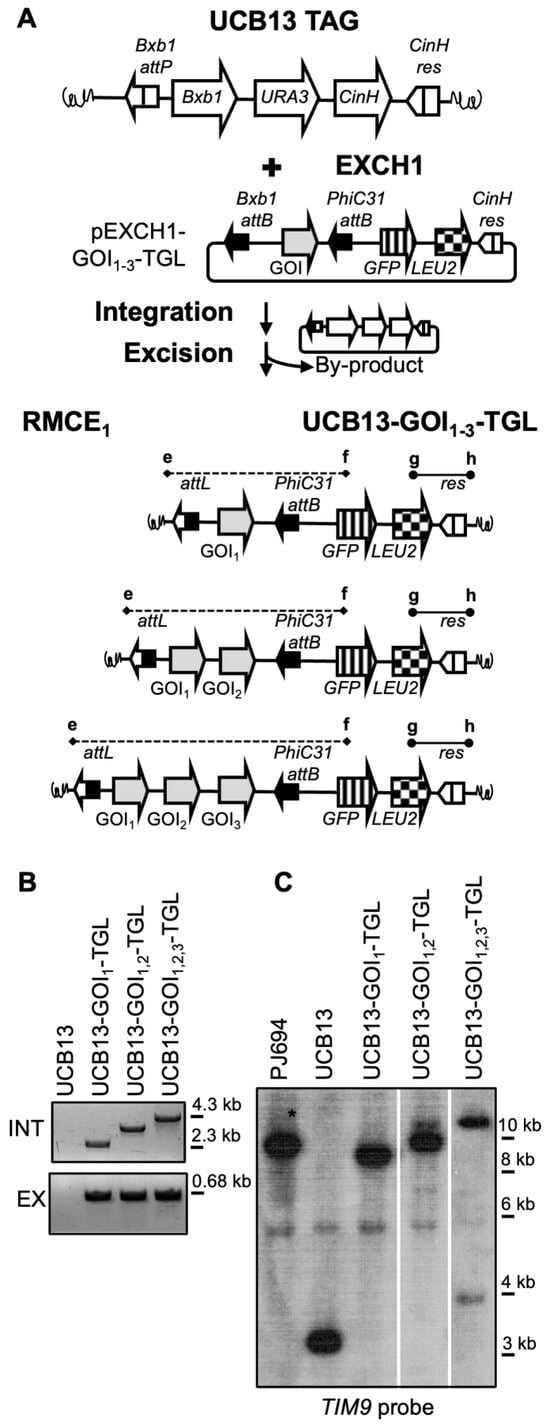
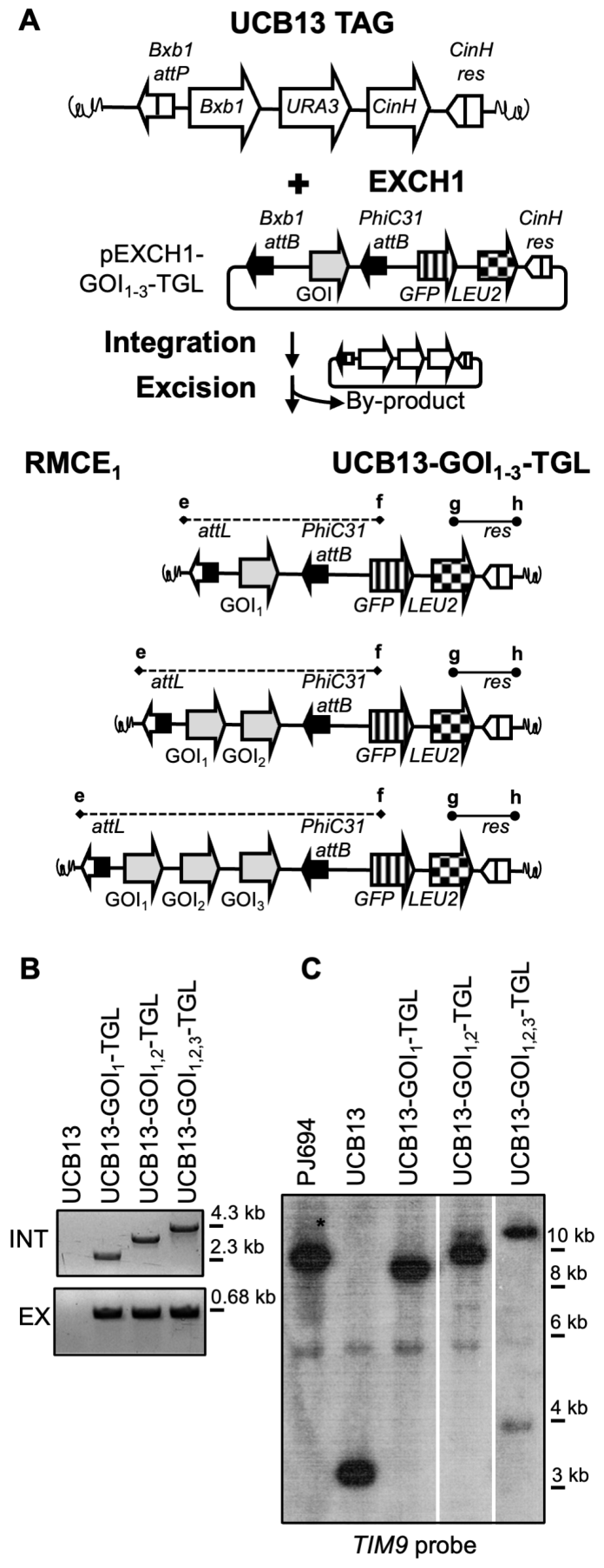
Presented here is a dual unidirectional recombinase RMCE strategy based on for genetic engineering of S. cerevisiae. Our strategy achieves site-specific integration at a predefined TAG site through large serine recombinases, PhiC31 or Bxb1 (Figure 1A and Figure 2A). Non-essential DNA (vector backbone, recombinase genes, and selectable markers) is then removed by a second recombinase—either CinH or ParA—excision-dedicated enzymes of the small serine recombinase family [3]. Two approaches are described: the first is a One-Step RMCE strategy (Figure 2A and Figure 3A), whereby a single targeting event occurs swapping marker genes for the GOI(s); the second is a gene-stacking strategy, referred to as stacking RMCE, that demonstrates the possibility of repeated, sequential genomic insertion events (Figure 4).
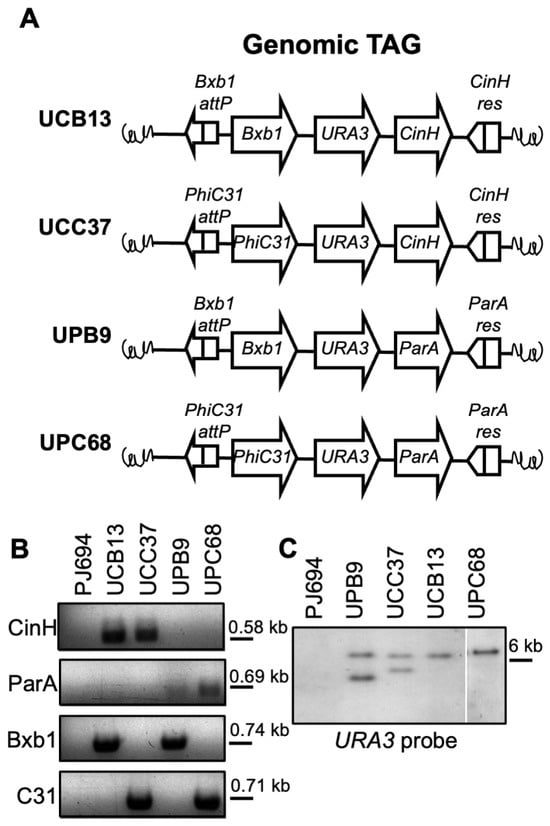
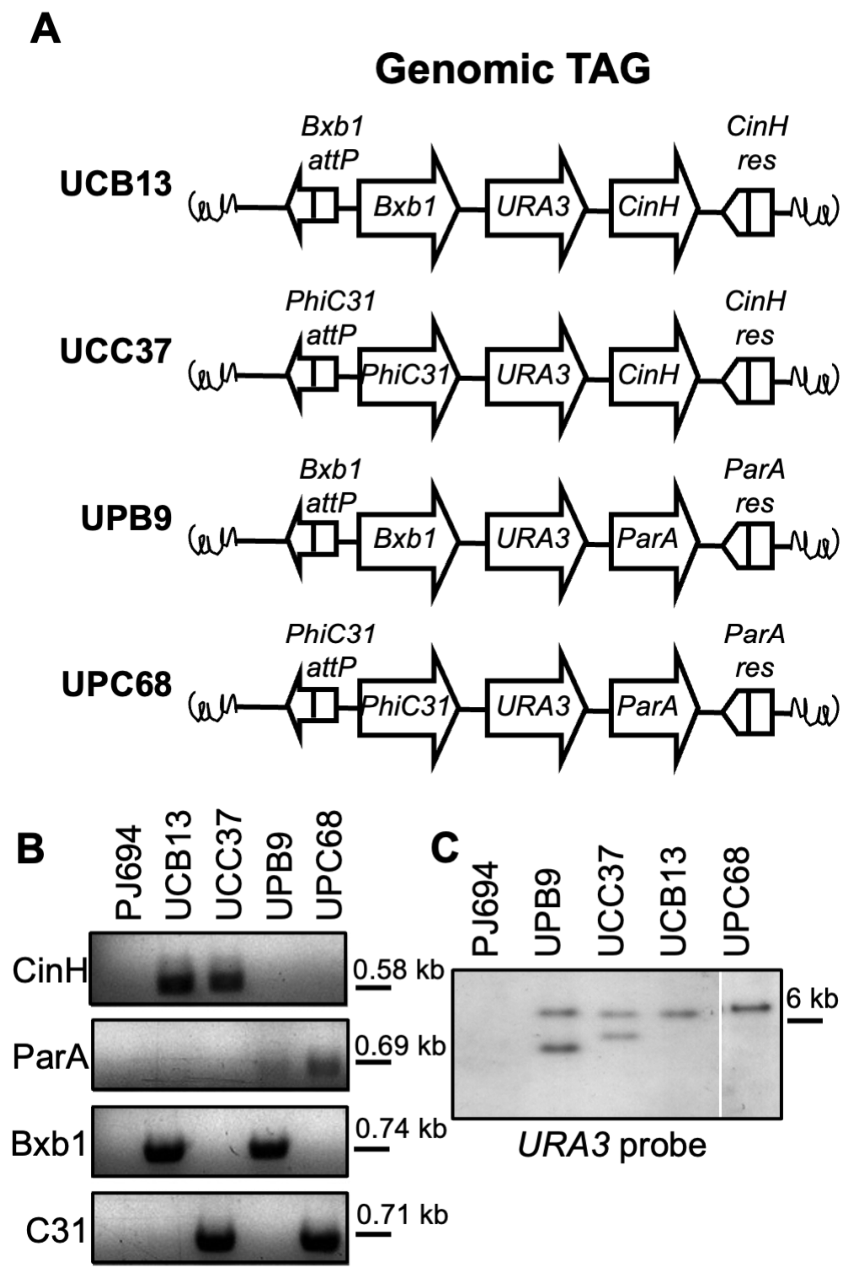
Figure 1.
Characterization of S. cerevisiae tagged genome (TAG) lines for recombinase-mediated cassette exchange (RMCE). S. cerevisiae genomic TAG lines include an integration-competent recombinase (Bxb1 or PhiC31), an excision-specific recombinase (CinH or ParA), a selectable marker (URA3), and individual recombinase recognition sequences (RRS; attP and res) for all recombinases. The EXCH vector brings in the complementary set of RRS and selectable markers during RMCE. (A) Diagram of genomic TAG lines. (B) PCR for Bxb1 (0.74 kb), PhiC31 (0.71 kb), CinH (0.58 kb), and ParA (0.68 kb) recombinases for TAG lines assayed; 0.75 kb marker is indicated. (C) Southern blot assay on TAG lines (SpeI-digested DNA probed for URA3). For UCB13 and UCC37, a 5.93 kb band is expected. For UPB9 and UPC68, a 6.0 kb band is expected; 6 kb marker is indicated. For clarity, gel and blot images have been cropped to remove blank space and unnecessary lanes.
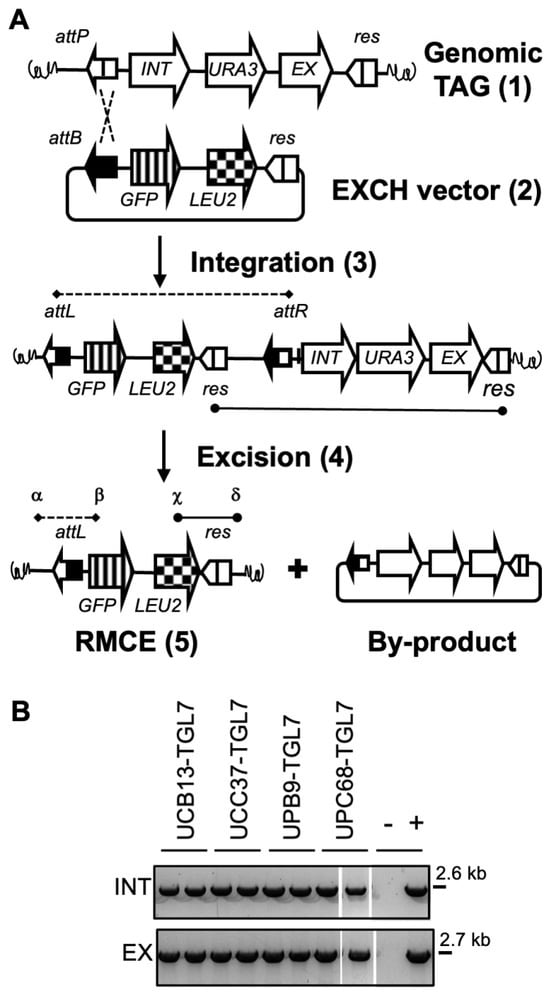
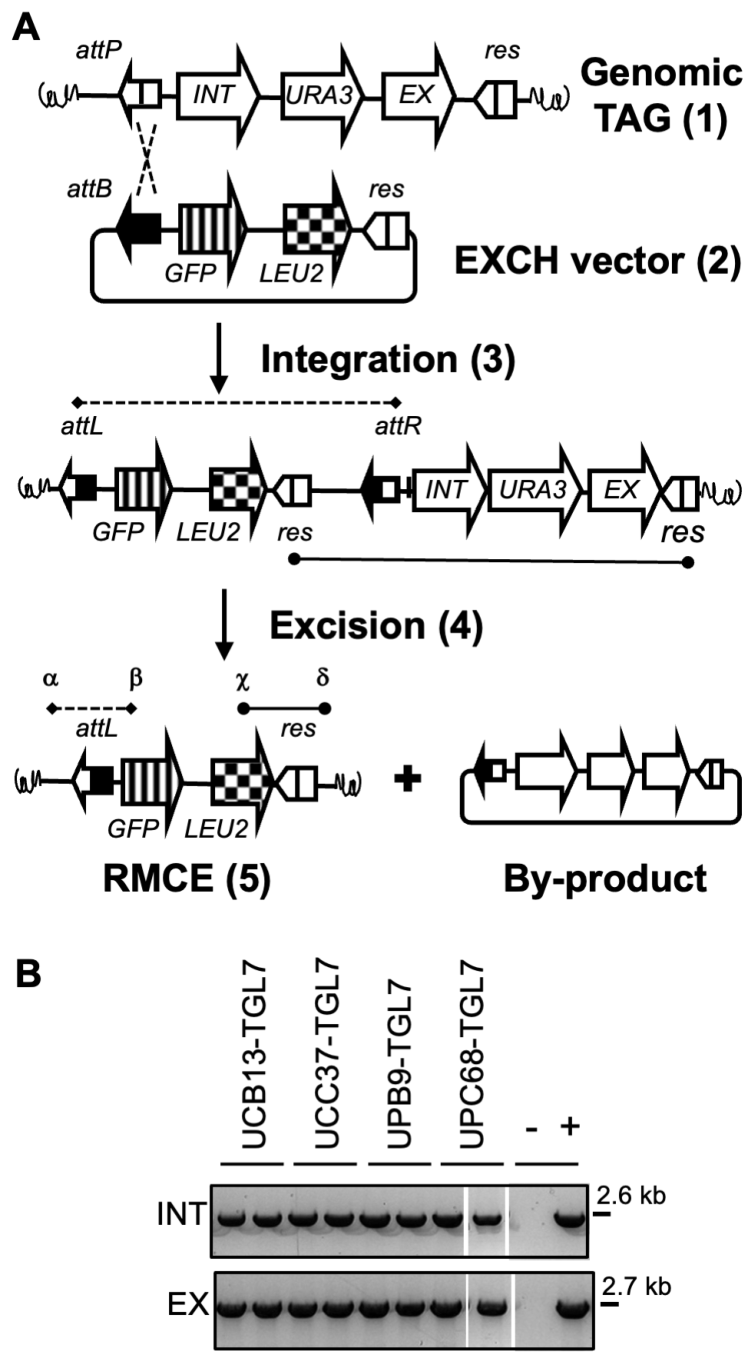
Figure 2.
PCR confirms successful recombinase-mediated cassette exchange (RMCE) in all four tagged genome (TAG) lines. (A) Outline of RMCE with integration (α–β) and excision (χ–δ) PCRs indicated. S. cerevisiae genomic TAG lines (1) were transformed with an EXCH vector (2) and tested for RMCE activity. An integration-competent recombinase (INT; Bxb1 or PhiC31) with paired attP and attB recognition sequences (RRSs) promotes recombinase-mediated integration (3). Then, an excision-specific recombinase (EX; CinH or ParA) with paired res RRSs promotes excision (4), completing the RMCE cycle to give TAG-TGL7 (5). RMCE is indicated by Leu+/GFP+/Ura−. (B) Colonies were sampled from the selection scheme and analyzed for successful integration (INT, α–β primers, ~2.6 kb for integration) and excision (EX, χ–δ primers, 2.7 kb), confirming RMCE in all four TAG lines. Size markers (kb) are indicated. For clarity, gel images have been cropped to remove blank space and unnecessary lanes.
Figure 3.
One-Step recombinase-mediated cassette exchange (RMCE) for integration of one to three genes of interest (GOIs). (A) Outline of RMCE with integration (INT, e–f) and excision (EX, g–h) PCRs indicated. S. cerevisiae UCB13 was transformed with an EXCH1 vector (pEXCH1-GOI1,2,3-TGL7) and tested for RMCE activity. Bxb1 with paired attP and attB sites promotes integration, and CinH with paired res sites promotes excision to produce UCB13-GOI1-TGL7, UCB13-GOI1-GOI2-TGL7, and UCB13-GOI1-GOI2-GOI3-TGL7. RMCE is indicated by Leu+/GFP+/Ura−. (B) PCR with INT (e–f, 2.27 kb for one GOI, 3.17 kb for two GOIs, 4.32 kb for three GOIs) and EX (g–h, 0.68 kb) primers confirms successful RMCE of one to three GOI(s). Size markers (kb) indicated. (C) Southern blot confirms One-Step RMCE events for genomic DNA digested with SacI/AatII and probed with TIM9. Expected products are 3.48 kb for UCB13, 9.92 kb for UCB13-GOI1-TGL7, 11.0 kb for UCB13-GOI1-GOI2-TGL7, and 12.1 kb for UCB13-GOI1-GOI2-GOI3-TGL7. (*) indicates PJ69-4-specific band. For clarity, gel and blot images have been cropped to remove blank space and unnecessary lanes.
Figure 4.
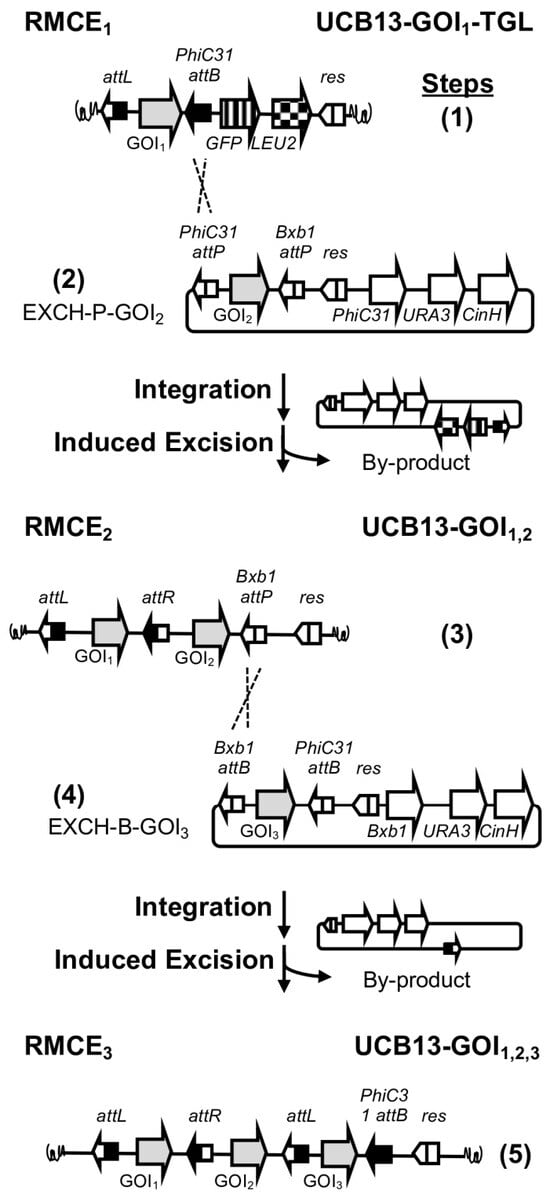
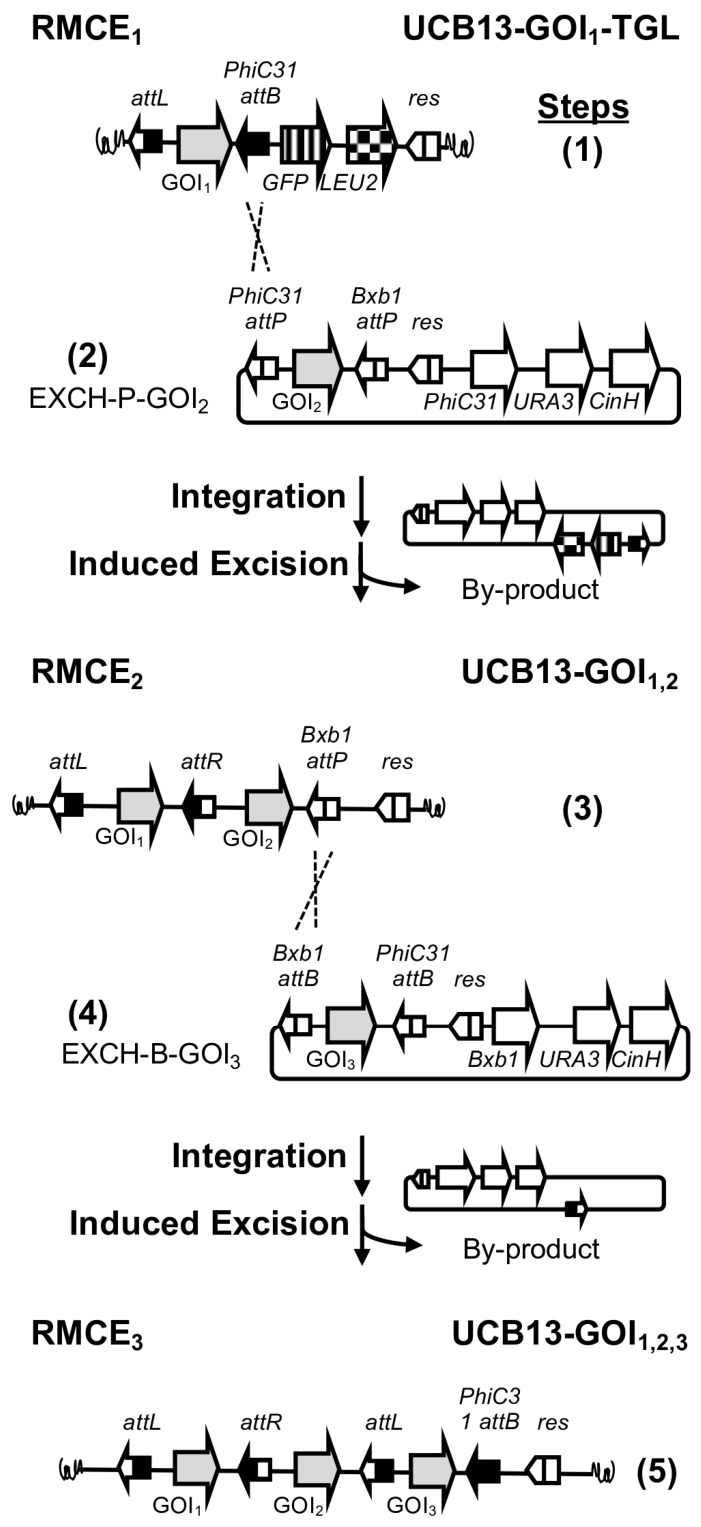
Stacking recombinase-mediated cassette exchange (RMCE) overview. Stacking RMCE alternates the use of Bxb1 and PhiC31 integration-competent recombinases, combined with an inducible CinH excision-specific recombinase, for RMCE of multiple expression cassettes of a single GOI. UCB13-GOI1-TGL7, the product of One-Step RMCE, is used as the starting line (1). After RMCE1, GOI1 is integrated and a PhiC31 RRS is available for downstream RMCE. For RMCE2, the EXCH-P-GOI2 vector encodes PhiC31 and CinH recombinases and carries GOI2 bordered by PhiC31 attP, Bxb1 attP, and res sites (2). Integration is indicated by GFP+/Leu+/Ura+/5FOAS and RMCE completion by GFP−/Leu−/Ura−/5FOAR, producing UCB13-GOI1,2 (3). For RMCE3, the EXCH-B-GOI3 vector encodes Bxb1 and CinH and carries GOI3 bordered by Bxb1 attB, PhiC31 attB, and res sites (4). Integration is indicated by Ura+/5FOAS, and RMCE completion by Ura−/5FOAR, producing UCB13-GOI1,2,3 (5). Alternating use of EXCH-P and EXCH-B allows sequential gene stacking.
Gene-stacking strategies have been described in animal cell cultures and plants that rely on a single integration-competent recombinase and/or utilize the bidirectional Cre recombinase [28,30,33]. These strategies work to varying degrees and have downsides including undesirable integration/excision events and competitive inhibition when two integration-competent recombinases are used simultaneously [31]. We sought to improve upon current strategies by implementing a gene-stacking approach that is unidirectional, irreversible, and precise, toggling between two unidirectional integration-competent recombinases combined with a dedicated unidirectional excision-specific recombinase.
In S. cerevisiae, homologous recombination is often used in genetic engineering and genome modification [34]. Approaches relying on homologous recombination and marker recycling have been used to successfully integrate several GOIs within biochemical pathways [35,36]. However, genetic linkage is incomplete, and positional effects can influence gene expression. Specific targeting vectors need to be built each time a new integration is needed to stack genes. Transformation-associated recombination (TAR) has also been used to develop large heterologous DNA molecules incorporating multiple simultaneous homologous recombination events into YAC vectors [37,38,39]. With stacking RMCE, linkage is complete and positional effects are uniform, making it an attractive alternative technology for metabolic engineering of yeast for bioethanol production and other biopharmaceuticals [39,40,41].
2. Materials and Methods
2.1. DNA Constructs
Constructs were developed using standard cloning protocols [42,43,44]. DNA constructs used in cloning, in development of S. cerevisiae strain PJ69-4 TAG lines, and in described RMCE experiments are listed in Supplementary Table S1. Sequences for the recombinase ORF and recognition sites are provided in Supplementary Figure S2. Images of homologous recombination targeting vectors used to generate the target line are shown in Supplementary Figure S3.
2.2. Development of S. cerevisiae TAG Lines
For homologous recombination at the S. cerevisiae haploid strain PJ69-4 at the ura3 locus, a linear vector was prepared by AscI (NEB, Ipswich, MA, USA) digestion and alkaline phosphatase treatment of precursor plasmids pUCB, pUCC, pUPB, and pUPC (Supplementary Figure S3). For transformations, a lithium acetate protocol was used, modified from the Yeast Protocols Handbook (Clontech) and [45]. Briefly, ~25–50 µL freshly grown S. cerevisiae strain PJ69-4 cells were suspended in 50–100 µL sterile resuspension buffer (0.1 M lithium acetate/10 mM Tris-HCl/1 mM EDTA, pH 7.5–8). A 50 µL cell suspension was mixed with a minimum of 1 µg column-purified (Zymo Research, Irvine, CA, USA) linearized vector plus 100 µg sheared ssDNA carrier and 300 µL sterile transformation buffer (40% polyethylene glycol, Mw 3350/0.1 M lithium acetate/10 mM Tris-HCl/1 mM EDTA, pH 7.5–8). A 30 min pre-incubation at 30 °C and 15 min heat-shock at 42 °C were used for transformations. All reactions were plated on SD(−Ura) medium [1.7 g/L yeast nitrogen base without amino acids and ammonium sulfate (Becton-Dickinson, Franklin Lakes, NJ, USA), 1.92 g/L synthetic dropout supplement without uracil (Sigma-Aldrich, St. Louis, MO, USA), 5 g/L ammonium sulfate, 20 g/L glucose, 16 g/L bacto agar (Becton-Dickinson, Franklin Lakes, NJ, USA)], and colonies were grown for 7 days at 30 °C. Lines were characterized by PCR and Southern blot analysis to confirm cassette presence and integration at the ura3 locus. S. cerevisiae strain PJ69-4 TAG lines are listed in Supplementary Table S2.
2.3. PCR Analysis
Genomic DNA was extracted in 200 mM lithium acetate/1% SDS, as described [46]. DNA was precipitated with an equal volume of 95% ethanol, washed in 70% ethanol, and suspended in 10 mM Tris/0.1 mM EDTA (pH 8). PCR analyses were performed using Phusion polymerase (NEB, Ipswich, MA, USA) with 1 µL genomic DNA in a 20 µL reaction volume. Primers used for PCR and sequencing analyses are listed in Supplementary Table S3.
2.4. Stability Assay
Insert stability was tested without selection in UCB13-TGL7 UCB13-GOI1-TGL7, UCB13-GOI1-GOI2-TGL7, UCB13-GOI1-GOI2-GOI3-TGL7, UCB13-GOI1-GOI2, UCB13-GOI1-GOI2-GOI3 lines. Each strain was inoculated with 1 mL of an overnight culture into 100 mL of nonselective YPD (1:100) and grown at 30 °C with shaking at 250 rpm. A 1% (v/v) aliquot was transferred to fresh YPD every 24 h for three transfers. After the last transfer, cultures were grown for 8 h, for a total of 80 h of nonselective growth (approximately 25 generations). A 50 µL aliquot of the final culture was spread on nonselective YPD plates and incubated at 30 °C for 2–3 days. Genomic DNA was extracted from 10 colonies per strain with lithium acetate/SDS [46]. The entire insert was verified by PCR with primers spanning the left border, cassettes and right border (Supplementary Table S3; Supplementary Figure S9), using DNA from the non-passaged line as a positive control and parent strain PJ69-4 DNA as a negative control.
2.5. RT-qPCR Analysis
Yeast total RNA was isolated from 3 mL of cells harvested at OD600 1.0 using TRIzol Reagent (Invitrogen/Thermo Fisher Scientific, Waltham, MA, USA), following the manufacturer’s suggested protocol. RNaseZap RNase Decontamination Solution (Thermo Fisher Scientific, Waltham, MA, USA, cat. no. AM9780) was used to keep work surfaces and equipment clean. RNA was treated with TURBO DNase and DNase Inactivation Reagent (Thermo Fisher Scientific, Waltham, MA, USA, cat. no. AM2238) according to the manufacturer’s protocol. One-Step RT-qPCR was conducted with iScript one-step RT-PCR Kit and SYBR Green (Bio-Rad, Hercules, CA, USA, cat. no. 170-8893). The QuantStudio 3 Real-Time PCR System with 96-well 0.1 mL block (Applied Biosystems by Thermo Fisher Scientific, Waltham, MA, USA); Design & Analysis Software v2.6.0 (Primary Analysis plugin v1.7.0) used. Primers GOI F60 5’ccaggtgaccaccatcatcacg, GOI R59 5’cattctccagatctagcatgcttatccaa (GOI, amplicon size 146 bp) and ScF1 5’gcgtctaggcgaacaatgttctta, ScR1 5’ccccaaagttgccctctcca (18S rRNA, amplicon size 199 bp) sequences were used. Each 10 µL reaction contained 10 pg total RNA and 300 nM of each primer. Annealing was at 60 °C for 39 cycles. The RT-minus control used RNA from UCB13-GOI1-GOI2-GOI3-TGL7.
Ct values were determined at Stage 2, Step 2 with Design & Analysis Software v2.6.0 using automatic threshold and baseline settings (SYBR reporter; thresholds of 96,048 for 18S and 98,526 for the GOI in fluorescence units; baseline start at cycle 3 with an automatic end cycle), with signal smoothing on. Melt curves were inspected for a single peak per primer pair. Primer efficiencies were determined from a standard curve of UCB13-GOI1-TGL7 RNA (five 10-fold dilutions, three wells each) covering 100 ng to 10 pg total RNA per reaction: slope −3.647, R2 0.999 and efficiency 88.0% for the GOI, and slope −3.395, R2 1.000 and efficiency 97.0% for 18S rRNA. Relative expression was calculated with the efficiency-corrected method of Pfaffl (2001) [47], with UCB13-GOI1-TGL7 as the calibrator. Because the lines were generated by site-specific recombination at a single locus, one RNA was made per line and assayed in three technical replicates; the data are descriptive and no statistical testing was done.
2.6. Southern Blot Analysis
Yeast genomic DNA was extracted from 3 mL of cells harvested at OD600 1.0 using the Gentra Purgene Yeast/Bacteria Kit (Qiagen, Hilden, Germany). For initial analyses of genomic TAG lines, genomic DNA was digested with SpeI (NEB, Ipswich, MA, USA), run on a 0.8% agarose gel in 1× TAE, and transferred to a positively charged nylon membrane [48]. A 32P-labeled CaURA3 probe was prepared using Taq polymerase (Promega, Madison, WI, USA), and Southern blot hybridization was performed as described [49]. For analyses of RMCE events, genomic DNA was digested with SacI/AatII (NEB, Ipswich, MA, USA), run on a 0.8% agarose gel in 1× TAE, and transferred to a positively charged nylon membrane [48]. A 32P-labelled ScTIM9 probe was prepared using Taq polymerase, and Southern blot hybridization was performed as described [49].
2.7. Assessment of RMCE by pEXCH1-TGL7 Transformation of TAG Lines
For transformations, a lithium acetate protocol was used, modified from the Yeast Protocols Handbook (Clontech) and [45]. Briefly, ~25–50 µL freshly grown S. cerevisiae lines (UPB9, UCB13, UCC37, UPC68, and PJ69-4 control) were suspended in 100 µL sterile resuspension buffer (0.1 M lithium acetate/10 mM Tris-HCl/1 mM EDTA, pH 7.5–8). Cell suspensions were divided into 2 × 50 µL aliquots (for DNA and control samples). For each TAG line, a 50 µL cell suspension was mixed with 0.5 µg pEXCH1-TGL7 vector (or buffer control) and 300 µL sterile transformation buffer (40% polyethylene glycol, Mw 3350/0.1 M lithium acetate/10 mM Tris-HCl/1 mM EDTA, pH 7.5–8), then incubated for 30 min at 30 °C and 15 min heat-shock at 42 °C.
Transformations were plated on SD(−Leu) medium [1.7 g/L yeast nitrogen base without amino acids and ammonium sulfate (Becton-Dickinson), 1.6 g/L synthetic dropout supplement without leucine (Sigma-Aldrich), 5 g/L ammonium sulfate, 20 g/L glucose, 16 g/L bacto agar (Becton-Dickinson)] and scored after 3 days growth at 30 °C. Diluted untransformed cells were plated onto YPAD [10 g/L yeast extract, 20 g/L peptone, 20 g/L glucose, 0.075 g/L adenine hemisulfate, 16 g/L bacto agar] and counted after 6 days to assess cell competency.
To assess integration efficiency, all colonies visible above background on SD(−Leu) were counted after 3 days at 30 °C. Data presented in Table 1 were normalized to 1 µg vector per 1.5 × 10⁶ yeast cells (mean ± SEM of three replicates). Differences in colony formation between TAG lines were assessed using the Kruskal–Wallis test (R Project-4.6.2, www.r-project.org).
Table 1.
Integration efficiency in four TAG lines and the PJ69-4 control.
For excision analysis, 55 GFP+ colonies were selected and streaked to SD(−Leu) and 5FOA-supplemented medium [1.7 g/L yeast nitrogen base without amino acids and ammonium sulfate (Becton-Dickinson), 0.77 g/L complete supplement mixture without uracil (MP Biomedicals, Solon, OH, USA), 0.035 g/L uracil (Sigma-Aldrich), 1 g/L 5-fluoroorotic acid (Gold Biotechnology, St. Louis, MO, USA), 5 g/L ammonium sulfate, 20 g/L glucose, 16 g/L bacto agar (Becton-Dickinson)]. Plates were incubated for 3 days at 30 °C. Growth was defined as a lawn of cells above background. Differences in excision efficiency between TAG lines were assessed using Fisher’s exact test (R Project). A subset of colonies with robust growth on 5FOA was streaked again to SD(−Leu), SD(−Ura), and 5FOA plates and DNA was extracted for PCR and sequencing confirmation.
2.8. One-Step RMCE
For One-Step RMCE, a lithium acetate protocol was used to incorporate one to three GOI(s) into S. cerevisiae TAG line UCB13. Freshly grown UCB13 cells were washed and suspended in resuspension buffer (modified from [45]). For each transformation, vector (see Section 2.1) was mixed with a 50 µL cell suspension and 300 µL transformation buffer, then incubated for 30 min at 30 °C and 15 min at 42 °C. Transformations of UCB13 with pEXCH1-GOI1,2,3-TGL7 were plated on SD(−Leu) medium to select for site-specific integration and on 5FOA medium for RMCE. PCR was performed to confirm successful RMCE.
The stacking vector pEXCH-B-GOI1-TGL7 encodes GOI1, Bxb1 (under ADH1 promoter), CinH (under CUP1 promoter), CaURA3, and RRSs. Transformations of UCB13 with pEXCH-B-GOI1-TGL7 were first selected on SD(−Ura/−Cu2+) medium [6.9 g/L yeast nitrogen base without amino acids and copper (ForMedium, Hunstanton, UK), 1.93 g/L synthetic complete without uracil supplement (ForMedium), 20 g/L glucose, 16 g/L bacto agar (Becton-Dickinson)] to select for integration. Plates were incubated at 30 °C and scored at 6–7 days. Excision was induced by streaking cells onto YPAD + 0.5 mM CuSO4 overnight at 30 °C, then onto 5FOA for RMCE completion, yielding UCB13-GOI1-TGL7.
2.9. Stacking RMCE
Stacking RMCE transformations used the same lithium acetate protocol as described above. The S. cerevisiae UCB13 TAG line was used for all stacking RMCE experiments. For stacking RMCE, 0.25–1.25 µg vector (1.25 µg optimal; unpublished observations) was mixed with a 50 µL cell suspension and 300 µL transformation buffer and incubated 30 min at 30 °C and 15 min at 42 °C.
The stacking vector pEXCH-P-GOI2 encodes GOI2, PhiC31 (under the constitutive ADH1 promoter), CinH (under the inducible CUP1 promoter [50,51]), CaURA3, and RRSs for RMCE. The same selection scheme as described above was used for recovery of UCB13-GOI1,2.
The stacking vector pEXCH-B-GOI3 encodes GOI3, Bxb1 (under ADH1 promoter), CinH (under CUP1 promoter), CaURA3, and RRSs. The same selection scheme as described above was used for recovery of UCB13-GOI1,2,3. By alternating use of pEXCH-P and pEXCH-B stacking vectors, additional genes can be stacked at a single locus.
3. Results
3.1. Experimental Strategy
S. cerevisiae genomic TAG lines employing Bxb1, PhiC31, CinH, and ParA were developed to test the described dual unidirectional RMCE strategy. TAG lines were generated by homologous recombination at the S. cerevisiae ura3 genetic locus, with each TAG line carrying a pair of recombinase genes—one for integration, one for excision—and a selectable marker (URA3). RRSs for integration-competent recombinases are located at the 5′ end of TAG cassettes, and RRSs for excision-specific recombinases are at the 3′ end (Figure 1A).
The dual unidirectional RMCE strategy was tested by transformation of all lines with an exchange (EXCH) vector supplying complementary RRSs bordering a GFP reporter and a LEU2 selectable marker cassette (Figure 2A).
Using a selection strategy whereby GFP+/Leu+ replace the Ura+ phenotype, followed by PCR and sequencing confirmation, we show that all recombinase combinations are functional for dual unidirectional RMCE. Additionally, One-Step RMCE was used to introduce one or more GOI(s) as a proof of concept (Figure 3A).
3.2. Development of TAG Lines
TAG lines pair integration (Bxb1 or PhiC31) and excision (CinH or ParA) recombinases previously shown to be active in Schizosaccharomyces pombe [9]. As outlined in Figure 1, each genomic TAG line contains sequences for an integration recombinase (Bxb1 or PhiC31), an excision recombinase (CinH or ParA), and the selectable marker URA3 [52], with recognition sites for integration recombinases (attP) and excision recombinases (res) at the 5′ and 3′ ends, respectively. The four TAG cassettes were introduced into the S. cerevisiae strain PJ69-4 genome by homologous recombination at ura3, resulting in UCB13 (URA3-CinH-Bxb1 #13), UCC37 (URA3-CinH-PhiC31 #37), UPB9 (URA3-ParA-Bxb1 #9), and UPC68 (URA3-ParA-PhiC31 #68) (Figure 1A; [45]). Lines were verified by PCR for recombinase genes (Figure 1B). Southern blot analysis indicated a single TAG cassette disrupting ura3 (~6 kb band, URA3 probe of SpeI-digested DNA) for UCB13 and UPC68, whereas UCC37 and UPB9 harbored a second TAG cassette (Figure 1C). Recombinase expression was detected by Northern blot (Supplementary Figure S4) and functionally tested with a plasmid-based excision assay specific for each enzyme (Supplementary Figure S5), confirming that UCB13, UCC37, UPB9, and UPC68 are suitable for subsequent RMCE experiments. UCC37 and UPB9 carry a second TAG cassette, so copy number differs among the lines (see Section 4).
3.3. Testing TAG Line Functionality with One-Step RMCE
To test RMCE, the EXCH vector pEXCH1-TGL7—where the TGL7 cassette contains the visual reporter GFP [53] and selectable marker LEU2 [54] bordered by attB sites for Bxb1 and PhiC31, and res sites for CinH and ParA—was introduced into S. cerevisiae TAG lines by lithium acetate transformation (Figure 2A, Steps 1–2; Supplementary Figure S6; [45]). This provided an RMCE insertion cassette size of 4.22 kb. A simple selection strategy was used to assess the two RMCE steps: integration and excision (Figure 2A, Steps 3–5). Integration events were identified by a GFP+/Leu+ phenotype (Supplementary Figure S7). The parental strain PJ69-4 showed a very low rate of random integration, indicating that the majority of integration events in TAG lines are site-specific (Table 1). The second RMCE step—recombinase-mediated excision—was identified by a 5-fluoroorotic acid-resistant (5FOAR) phenotype resulting from cassette exchange and loss of URA3 [55]. In a subset of Leu+/GFP+/5FOAR colonies, RMCE completion was confirmed by PCR and sequencing.
TAG lines transformed with pEXCH1-TGL7 were plated on Leu− medium and scored for Leu prototrophy after 3 days of growth. Table 1 lists normalized colony counts for the average of three experimental replicates. The TGL7 cassette consists of constitutively expressed eGFP and LEU2 cassettes with a total RMCE insertion size of 4216 bp. Numerous Leu+ colonies were recovered for all TAG lines, while PJ69-4 consistently had no or very few colonies on SD(−Leu), confirming site-specific integration in TAG lines. There was no significant difference in Leu+ colony formation among the four TAG lines (Kruskal–Wallis test, K = 6.3846, df = 3, p = 0.09433). A robust GFP+ phenotype was observed for the majority of colonies (Supplementary Figure S7). Thus, Bxb1 and PhiC31 are both robust integration recombinases in S. cerevisiae.
To select for complete RMCE events, 55 colonies for each TAG line were streaked from Leu− plates to Leu− and 5FOA media (Table 2). On Leu− medium, all transformed TAG colonies showed robust growth and were GFP+, confirming stable genomic integration. For TAG lines containing CinH, 22/55 (UCB13) or 21/55 (UCC37) colonies showed robust growth on 5FOA, indicating excision efficiency of 38–40% (Table 2). For TAG lines containing ParA, robust 5FOA growth was reduced to 3/55 (UPB9) or 9/55 (UPC68) colonies, an efficiency of 5–16% (Table 2). Fisher’s exact test revealed no significant difference between UCB13 and UCC37, but a significant difference between UCB13 and the ParA-containing lines (Table 2). Regardless of the presence of an additional TAG cassette in UCC37 and UPB9, CinH showed higher excision frequencies than the ParA-containing lines under the conditions tested in S. cerevisiae.
Table 2.
Excision efficiency in four TAG lines.
3.4. Molecular Confirmation of One-Step RMCE Events
A subset of colonies with robust growth on 5FOA was re-streaked to Leu−, Ura− and 5FOA plates. Genomic DNA was extracted from at least ten colonies per line and PCR assayed for site-specific integration and excision (Figure 2B). PCR products from three colonies per line were sequenced and the recognition sites were intact (Supplementary Figure S8).
Precise integration was achieved with either Bxb1 or PhiC31 (Figure 2B), with no significant difference among the four lines (Table 1; Kruskal–Wallis test). Both CinH and ParA catalyzed precise excision events, but CinH exhibited greater excision efficiency (Table 2; Fisher’s exact test), confirming successful RMCE events in all TAG lines.
3.5. An Application for One-Step RMCE in S. cerevisiae
UCB13 gave the highest mean colony count (Table 1), so it was used for the proof-of-concept experiments. As a proof of concept, one, two, or three copies of a GOI—each under a unique promoter/terminator cassette—were incorporated at the UCB13 TAG site by One-Step RMCE (Figure 3A). GOI1 was expressed by the Leucine 2 promoter & terminator (LEU2p, LEU2t) cassette and with a total size of 1.28 kb. GOI2 is transcribed by the alcohol dehydrogenase 1 (ADH1p, ADH1t) cassette at 1.10 kb, GOI3 uses the TEF1 promoter (TEF1p, translation elongation factor 1-alpha) and the CYC1 terminator (CYC1t, cytochrome c isoform 1) with a size of 1.10 kb. The pEXCH1-TGL7 vector (RMCE insertion cassette 4.22 kb) was modified to carry one (pEXCH1-GOI1-TGL7; RMCE insertion cassette 5.50 kb), two (pEXCH1-GOI1,2-TGL7; RMCE insertion cassette 6.60 kb), or three (pEXCH1-GOI1,2,3-TGL7; RMCE insertion cassette 7.70 kb) GOI(s) bordered by Bxb1 (attB) and CinH (res) recognition sites, in addition to GFP and LEU2 selectable markers (Figure 3A; EXCH1). These constructs were transformed into UCB13 TAG and RMCE events were examined for genomic integrity and stability.
Leu+/5FOAR colonies were selected, and GFP+ status was verified by fluorescence microscopy (Supplementary Figure S7). PCR and Southern analyses confirmed One-Step RMCE for UCB13-GOI1-TGL7, UCB13-GOI1-GOI2-TGL7, and UCB13-GOI1-GOI2-GOI3-TGL7 (Figure 3B,C). Additionally, UCB13-GOI1-TGL7 served as the initial line for stacking RMCE (see Section 3.6).
3.6. Stacking RMCE: A Method for Sequential Transgene Addition to the S. cerevisiae Genome
Expanding on the One-Step RMCE protocol, we developed stacking RMCE, in which GOIs can be added to the S. cerevisiae genome sequentially. Stacking RMCE alternates the use of Bxb1 and PhiC31 for multiple GOI integration events, combined with an inducible form of CinH for excision and RMCE completion (Figure 4). The first round uses S. cerevisiae line UCB13-GOI1-TGL7 (developed by One-Step RMCE; Figure 3A) as the target for sequential stacking of GOI2 and GOI3. One-Step RMCE constructs are suitable for stacking RMCE, as the vectors carry an additional PhiC31 attB 3′ to the GOI(s) (Figure 3A; EXCH1). Supplementary Figure S1, Step A, details the One-Step RMCE event and detailed schematic.
Gene stacking is achieved by alternating two additional EXCH vectors (EXCH-P and EXCH-B). With the EXCH-P vector, PhiC31 attP and CinH res are used for integration and excision, respectively, and a Bxb1 attP is included 3′ to GOI2 for the next stacking round (Figure 4; EXCH-P-GOI2, RMCE insertion cassette 1.32 kb). Integration is driven by PhiC31 between the 5′ attP site in EXCH-P and the genomic TAG (Figure 4; Steps 1–2). CinH-induced resolution between res sites leaves the second GOI followed by a functional attP (Bxb1) and res sites (Figure 4; Step 3, RMCE2). See Supplementary Figure S1 Step B for a detailed schematic representation of the EXCH-P RMCE Stacking event. With EXCH-B, Bxb1 attB and CinH res are used for integration and excision of GOI3, with PhiC31 attB included 3′ to GOI3 for subsequent stacking (Figure 4, Steps 3–5; EXCH-B-GOI3, RMCE insertion cassette 1.38 kb). See Supplementary Figure S1 Step C for a schematic representation of the EXCH-B RMCE Stacking event. Alternating use of EXCH-P and EXCH-B vectors is expected to allow for continuous sequential gene stacking, with three rounds demonstrated.
Integration recombinase genes (Bxb1 and PhiC31) are under the constitutive ADH1 promoter, while the excision recombinase CinH is under the Cu2+-inducible CUP1 promoter [50,51]. To select for integration while inhibiting excision, colonies were first selected on Ura−/Cu− medium. Ura+ prototrophs were then streaked onto YPAD + 0.5 mM CuSO4 and incubated overnight to induce excision before selection on 5FOA for RMCE completion. Typically, 10–100 integration colonies were recovered from Ura−/Cu− medium.
3.7. Stacking RMCE: pEXCH-P-GOI2 Transformation
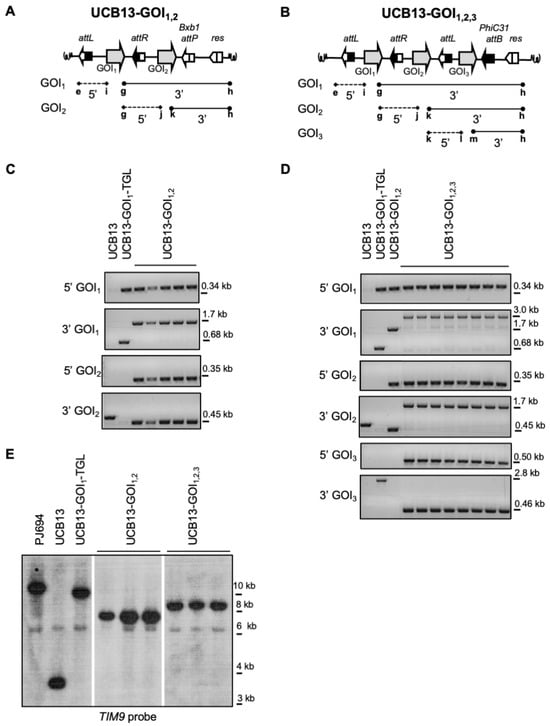
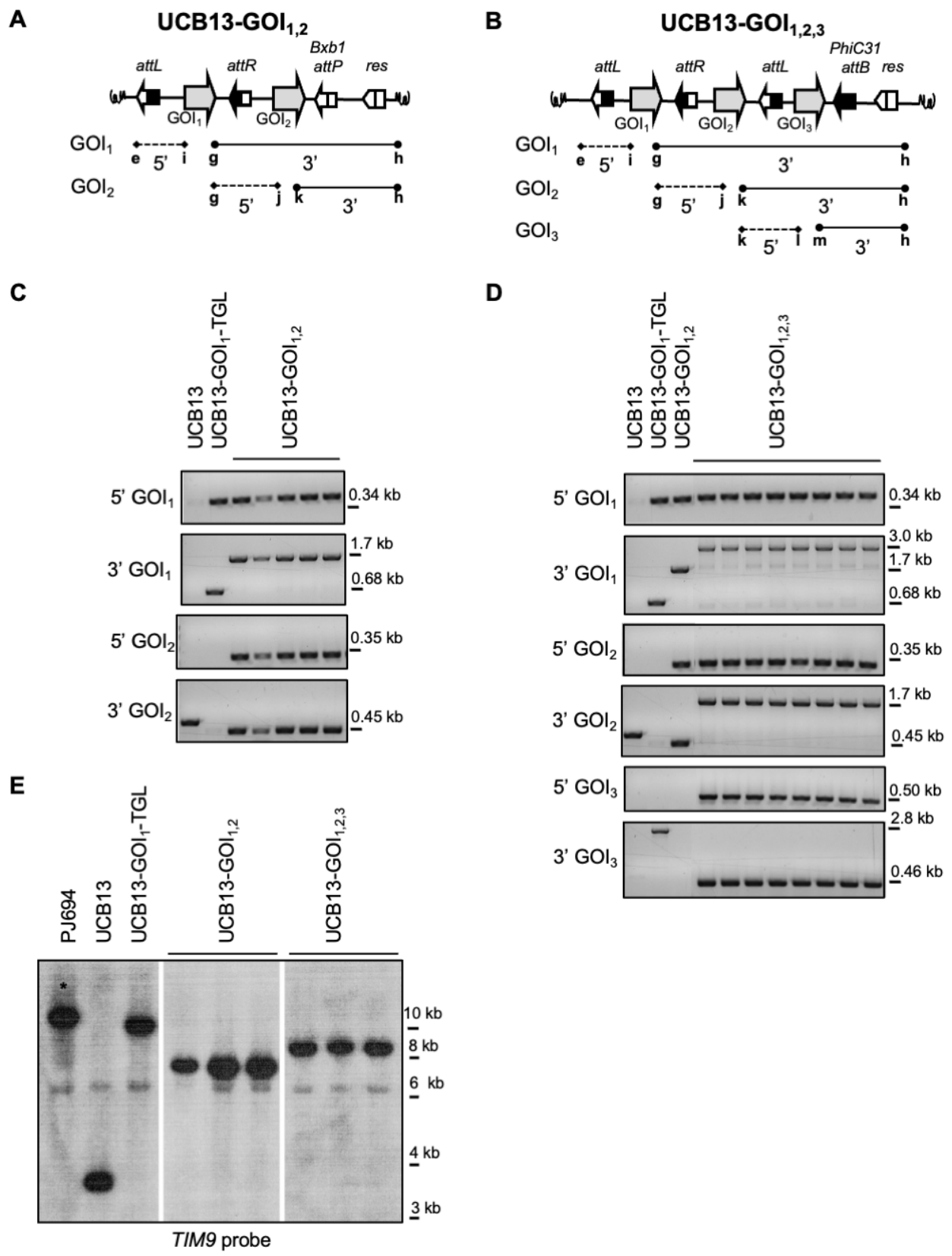
In the first gene-stacking event, pEXCH-P-GOI2 was transformed into UCB13-GOI1-TGL7, yielding UCB13-GOI1-GOI2 (Figure 4; Steps 1–3; Supplementary Figure S1 Step B). With pEXCH-P-GOI2 integration, yeast became Ura+/5FOA-sensitive (5FOAS) and maintained Leu+/GFP+; upon excision and RMCE completion, cells became Leu−/GFP−/Ura−/5FOAR. Complete RMCE events occurred in 46.1 ± 3.7% (mean ± SD; n = 3; Supplementary Table S4) of the integration colonies analyzed, as assessed by Leu−/5FOAR phenotype, GFP− fluorescence (microscopy), and PCR (Figure 5C).
Figure 5.
Stacking recombinase-mediated cassette exchange (RMCE) of unique expression cassettes for GOI2 and GOI3. (A) Diagram of UCB13-GOI1,2 with PCR primers for GOI1 5′ (e–i), GOI1 3′ (g–h), GOI2 5′ (g–j), and GOI2 3′ (k–h) junctions. (B) Diagram of UCB13-GOI1,2,3 with PCR primers for GOI1 5′ (e–i), GOI1 3′ (g–h), GOI2 5′ (g–j), GOI2 3′ (k–h), GOI3 5′ (k–l), and GOI3 3′ (m–h) junctions. (C) For UCB13-GOI1,2 lines, 5′ GOI1 (0.34 kb), 3′ GOI1 (1.77 kb), 5′ GOI2 (0.35 kb), and 3′ GOI2 (0.45 kb) PCRs confirm junction integrity and successful RMCE of GOI2 downstream of GOI1. (D) For UCB13-GOI1,2,3 lines, 5′ GOI1 (0.34 kb), 3′ GOI1 (3.04 kb), 5′ GOI2 (0.35 kb), 3′ GOI2 (1.74 kb), 5′ GOI3 (0.50 kb), and 3′ GOI3 (0.46 kb) PCRs confirm junction integrity for all three GOIs. Size markers (kb) are indicated. (E) Southern blot confirms stacking RMCE events for genomic DNA digested with SacI/AatII and probed with TIM9. Expected products are 3.48 kb for UCB13, 9.92 kb for UCB13-GOI1-TGL7, 7.10 kb for UCB13-GOI1,2, and 8.38 kb for UCB13-GOI1,2,3. (*) indicates PJ69-4-specific band; ~6 kb background band present. For clarity, gel and blot images have been cropped to remove blank space and unnecessary lanes.
PCRs confirmed 5’ and 3’ junction integrity for both GOI1 and GOI2 (Figure 5C; UCB13-GOI1-GOI2). The size shift for the 3′ GOI1 PCR (comparing UCB13-GOI1-TGL7 at 0.68 kb to UCB13-GOI1-GOI2 at 1.77 kb) indicated successful RMCE of GOI2 downstream of GOI1. A subset of colonies was sequenced at recognition site junctions to confirm site-specific integration and excision (Supplementary Figure S8). Southern blots were done as an additional assessment (Figure 5E).
3.8. Stacking RMCE: pEXCH-B-GOI3 Transformation
In the next stacking round, UCB13-GOI1-GOI2 was transformed with pEXCH-B-GOI3 to yield UCB13-GOI1-GOI2-GOI3 (Figure 4; Steps 3–5). Integration of GOI3 was selected on Ura−/Cu− medium; excision was induced by overnight growth on YPAD + 0.5 mM CuSO4, and complete RMCE events were selected on 5FOA. Colonies from the RMCE events were analyzed by PCR (Figure 5B,D) and demonstrated a 63.9 ± 5.2% (mean ± SD; n = 3; Supplementary Table S4) rate of completion. Several colonies were sequenced across RRSs, confirming the conservative site-specific nature of RMCE events (Supplementary Figure S8).
3.9. Southern Analysis Confirms Stacking RMCE
To assess gene-stacking events and genomic integrity at the TAG site, Southern analyses were performed (Figure 5E). A probe specific to the genomic region immediately 3′ to the S. cerevisiae ura3 locus (the TIM9 locus) was used. By SacI/AatII digestion and TIM9 detection, all stacking RMCE events were distinguishable. Parental strain PJ69-4 produced a band >10 kb; UCB13 and UCB13-GOI1-TGL7 produced 3.5 kb and 9.9 kb bands, respectively. For stacking RMCE events, expected products were 7.1 kb for UCB13-GOI1-GOI2 and 8.4 kb for UCB13-GOI1-GOI2-GOI3 (Figure 5E), serving as final confirmation of sequential stacking RMCE events.
3.10. Stability of RMCE Lines
To determine the stability of the stacked cargo within the yeast genome, all RMCE recombined strains plus UCB13-TGL7 were serially subcultured in nonselective YPD broth medium for a period of 80 h. A 1% (v/v) aliquot of each culture was passaged into fresh YPD every 24 h. After three passages (72 h), the last passage was grown for 8 h, giving 80 h of continuous nonselective growth. Therefore, a 1:100 dilution at 80 h is about 25 doublings. Aliquots of the final culture were then plated on nonselective YPD agar, and ten colonies were randomly selected from each strain for validation with genomic PCR. PCR results spanning the inserted region, shown in Supplementary Figure S9, demonstrate that all ten colonies for each strain were positive for the presence of RMCE-inserted DNA.
3.11. RT-qPCR Confirms Expression in RMCE Lines
RT-qPCR showed that GOI transcript was detectable in all five RMCE-generated lines and absent from the parental UCB13 strain, confirming that the signal derives from the integrated cassettes (Table 3). It should be noted that GOI1, GOI2 and GOI3 are the same coding sequence but transcribed by three different promoters. Relative to the single-cassette line UCB13-GOI1-TGL7, the two-cassette lines accumulated roughly 28- to 31-fold more GOI transcript and the three-cassette lines roughly 70- to 82-fold more. Transcript abundance therefore increased with cassette number but far more steeply than the cassette count alone would predict. This is consistent with the cassettes being driven by different promoters, so that adding a second or third cassette adds both a copy and a stronger promoter. Because all lines were generated by site-specific recombination into the same defined locus, genomic position effects are expected to be minimal, and the differences are more plausibly attributed to cassette composition than to insertion site. Lines with the same cassette number differed by less than 3-fold (UCB13-GOI1-GOI2-TGL7 vs. UCB13-GOI1-GOI2, UCB13-GOI1-GOI2-GOI3-TGL7 vs. UCB13-GOI1-GOI2-GOI3). These differences were not interpreted, since they depend on the 18S reference and cannot be separated from variation in RNA input. The data come from one RNA preparation per line (three technical replicates) and are descriptive and statistical comparison was not made. Because the primers amplify the GOI sequence shared by all cassettes, the assay measures total transcript, not the output of individual cassettes. The 18S Ct varied among the RMCE lines (18.4–20.9), so Table 3 reports GOI-only fold changes. Normalizing to 18S widened the differences but did not change the ranking (Supplementary Figure S10). These results show that the stacked lines transcribe the GOI and that total transcript rose with cassette number, but they do not quantify expression.
Table 3.
RT-qPCR relative expression in five RMCE lines and the parental UCB13.
The GOI primer pair is 88% efficient and the 18S pair 97% efficient, so the 2−ΔΔCt method for relative quantification [56] which assumes 100% efficiency for both would overstate the differences. Values compare RMCE lines with each other; they are not absolute GOI:18S ratios. Efficiencies come from a separate standard-curve run. Therefore, results presented are descriptive of activity rather than providing a quantitative absolute value of expression. See Supplementary Figure S10 for RT-qPCR raw data.
4. Discussion
Here we show that a pair of unidirectional serine recombinases can drive recombinase-mediated cassette exchange (RMCE) in S. cerevisiae, and that the same enzymes can be reused to stack cassettes at one locus. Earlier RMCE systems relied on one or two bidirectional recombinases and were limited by reversibility and non-productive reactions [24,25,28,29,30]. Bxb1, PhiC31, CinH and ParA had each been shown to work separately in S. pombe [9]. What is new is their combination: a large serine integrase for irreversible integration, a small serine recombinase for irreversible excision, and alternating Bxb1 and PhiC31 so that each round uses a fresh pair of sites. A related pairing was developed for Agrobacterium [57,58]; this is its first use in yeast.
Bxb1 and PhiC31 gave similar numbers of Leu+ colonies (p = 0.094, n = 3), which does not by itself show that they are equivalent. CinH demonstrated greater excision frequency than ParA (38–40% versus 5–16% of colonies) under conditions provided. The founder lines differ in TAG copy number, because UCC37 and UPB9 carry a second TAG cassette, but CinH outperformed ParA in both one-copy and two-copy lines, so copy number does not explain the difference.
Two stacking rounds added a cassette in 46.1 ± 3.7% and 63.9 ± 5.2% of integrants (mean ± SD, n = 3), and PCR and Southern analysis confirmed the expected structures. The largest insert exchanged was 7.70 kb. A size limit for integration did not appear to be reached. Related systems that stacked 10 and 11 cassettes of 2.2–4.8 kb into a 28 and 37 kb locus, respectively; refs. [57,59] suggest that vector construction, not recombinase activity, is more likely to set the limit. Three rounds are shown here. Further rounds are expected to be possible but have not been tested.
GOI transcript rose with cassette number: 28–31-fold with two cassettes and 70–82-fold with three, relative to one (GOI-only, efficiency-corrected). The cassettes carry different promoters, so these data show that stacked cassettes remain active, not what each contributes. They come from one RNA preparation per line and one reference gene, and protein was not measured. RMCE strains were checked for transgene stability and grown with serial passages on non-selective media for 80 h or approximately 25 generations. Ten colonies per strain tested positive for presence of the transgene by PCR.
Integration by homologous recombination [34,35,36] needs a targeting vector, and usually a marker, for each locus. CRISPR-assisted platforms now offer more: EasyClone-MarkerFree gives marker-free, multiplex integration at validated sites [59,60], and CRISPR-based cassette swapping allows integrated cassettes to be exchanged or removed, at the cost of a barcode and a targeting template for each event [61]. These systems place genes at many sites and need no pre-installed landing pad. Stacking RMCE gives up that flexibility in return for a single defined locus, where every cassette shares the same chromosomal context, and for steps that need neither homology arms nor repair of a Cas9 break. The approaches could be combined, as in PrimeStack, where prime editing places a Bxb1 site in the rice genome and Bxb1 then integrates a 5.3 kb cassette in 43–45% of plants [62]. That figure scores plants with a detectable integration and is not directly comparable to this study.
This method has limits. First and foremost, a TAG line must be built by homologous recombination or a CRISPR assisted variation. All cassettes accumulate at one site, so total insert size, expression and the reuse of promoters and terminators within the insert (LEU2, ADH1, TEF1 and CYC1 elements are used more than once) could limit stability or expression at higher cassette numbers. The next steps are to test more rounds and larger inserts, to measure protein and growth, and to build landing pads so that the system can be used in other strains.
5. Conclusions
In summary, we tested the unidirectional serine recombinases Bxb1, PhiC31, CinH, and ParA in a novel RMCE strategy in S. cerevisiae for precise integration and excision at a predetermined genomic TAG site. Using a simple selection strategy, RMCE events were reliably identified and confirmed by PCR and sequencing. Bxb1, PhiC31, CinH and ParA were all active for RMCE in S. cerevisiae. Bxb1 and PhiC31 gave similar integration, and CinH excised more efficiently than ParA. One to three expression cassettes of a single GOI were inserted into the yeast genome in a site-specific manner at the TAG site using One-Step RMCE. Finally, Stacking RMCE, which relies on the alternating use of Bxb1 and PhiC31 for integration paired with CinH for excision was demonstrated for sequential gene stacking in S. cerevisiae, with GOIs successfully integrated at the UCB13 genomic TAG site. RT-qPCR demonstrated that transcript levels increased with cassette number, and the inserts were retained after about 25 doublings without selection. Stacking RMCE is a precise, irreversible method for adding cassettes to a defined locus in yeast; more rounds, larger inserts and protein-level analysis remain to be tested.
Supplementary Materials
The following supporting information can be downloaded at https://www.mdpi.com/article/10.3390/microorganisms14122739/s1. Figure S1: Recombinase mechanisms and RMCE strategies; Figure S2: Recombinase ORF and recognition site sequences; Figure S3: Maps of homologous recombination targeting the URA3 gene plasmids pUCB, pUCC, pUPB, and pUPC; Figure S4: Northern blot analysis of total RNA from yeast lines confirms presence of recombinase transcripts; Figure S5: Recombinase activity plasmid-based excision assay; Figure S6: Maps of RMCE exchange plasmids; Figure S7: GFP+/Leu+ colonies indicate integration events for S. cerevisiae TAG lines transformed with pEXCH-TGL7; Figure S8: Sequence results for att and res sites following RMCE exchange; Figure S9: Yeast RMCE exchange gene stability assay and PCR results; Figure S10: RT-qPCR raw data and interpretation; Table S1: DNA constructs used in cloning, development of S. cerevisiae TAG lines, and described RMCE experiments; Table S2: S. cerevisiae strain PJ69-4 TAG lines; Table S3: Primers used for PCR and sequencing analyses; Table S4: Stacking RMCE colony count and efficiency estimation. Reference [63] is cited in the supplementary materials.
Author Contributions
Conceptualization, J.G.T.; Methodology, S.K.H., M.S. and J.G.T.; Investigation, S.K.H., S.M.C.C. and M.S.; Formal Analysis, S.K.H. and M.S.; Resources, J.G.T.; Writing—Original Draft Preparation, S.K.H. and J.G.T.; Writing—Review and Editing, S.K.H., S.M.C.C., M.S. and J.G.T.; Supervision, J.G.T.; Project Administration, J.G.T.; Funding Acquisition, J.G.T. All authors have read and agreed to the published version of the manuscript.
Funding
This research was funded by USDA-ARS (project number 2030-21220-003-000D) and USDA-NIFA BRAG (grant number 2010-33522-21773).
Institutional Review Board Statement
Not applicable.
Informed Consent Statement
Not applicable.
Data Availability Statement
The data presented in this study are available on request from the corresponding author due to reasons of proprietary IP.
Acknowledgments
The authors gratefully acknowledge the USDA-ARS and USDA-NIFA BRAG programs for funding. The authors thank R. Chan for technical assistance, and members of the J. Thomson laboratory for critical comments and helpful discussions in preparation of this manuscript.
Conflicts of Interest
The authors declare no conflicts of interest.
Abbreviations
The following abbreviations are used in this manuscript:
| 5FOA | 5-fluoroorotic acid |
| ADH1 | alcohol dehydrogenase 1 (promoter and terminator, ADH1p and ADH1t) |
| att | attachment site (attB, bacterial; attP, phage) |
| Ct | cycle threshold |
| CYC1 | cytochrome c isoform 1 (terminator, CYC1t) |
| EXCH | exchange vector |
| GFP | green fluorescent protein |
| GOI | gene of interest |
| LEU2 | β-isopropylmalate dehydrogenase gene, leucine biosynthesis (promoter and terminator, LEU2p and LEU2t) |
| Leu | leucine |
| ORF | open reading frame |
| PCR | polymerase chain reaction |
| res | resolvase recognition site (RS2, CinH; MRS, ParA) |
| RMCE | recombinase-mediated cassette exchange |
| RRS | recombinase recognition sequence |
| RT-qPCR | reverse transcription quantitative PCR |
References
- Grindley, N.D.; Whiteson, K.L.; Rice, P.A. Mechanisms of site-specific recombination. Annu. Rev. Biochem. 2006, 75, 567–605. [Google Scholar] [CrossRef] [Scilit] [PubMed]
- Ba, F.; Sun, Q. Site-specific recombinases and their essential role in synthetic biology. Biotechnol. Adv. 2026, 92, 109005. [Google Scholar] [CrossRef] [Scilit] [PubMed]
- Wang, Y.; Yau, Y.Y.; Perkins-Balding, D.; Thomson, J.G. Recombinase technology: Applications and possibilities. Plant Cell Rep. 2011, 30, 267–285. [Google Scholar] [CrossRef] [Scilit] [PubMed]
- Sauer, B.; Henderson, N. Targeted insertion of exogenous DNA into the eukaryotic chromosome by the Cre recombinase. New Biol. 1990, 2, 441–449. [Google Scholar] [PubMed]
- Golic, K.G.; Lindquist, S. The FLP recombinase of yeast catalyzes site-specific recombination in the Drosophila genome. Cell 1989, 59, 499–509. [Google Scholar] [CrossRef] [Scilit] [PubMed]
- Onouchi, H.; Yokoi, K.; Machida, C.; Matsuzaki, H.; Oshima, Y.; Matsuoka, K.; Nakamura, K.; Machida, Y. Operation of an efficient site-specific recombination system of Zygosaccharomyces rouxii in tobacco cells. Nucleic Acids Res. 1991, 19, 6373–6378. [Google Scholar] [CrossRef] [Scilit] [PubMed]
- Schwikardi, M.; Dröge, P. Site-specific recombination in mammalian cells catalyzed by γδ resolvase mutants: Implications for the topology of episomal DNA. FEBS Lett. 2000, 471, 147–150. [Google Scholar] [CrossRef] [Scilit] [PubMed]
- Kholodii, G. The shuffling function of resolvases. Gene 2001, 269, 121–130. [Google Scholar] [CrossRef] [Scilit] [PubMed]
- Thomson, J.G.; Ow, D.W. Site-specific recombination systems for the genetic manipulation of eukaryotic genomes. Genesis 2006, 44, 465–476. [Google Scholar] [CrossRef] [Scilit] [PubMed]
- Gerlitz, M.; Hrabak, O.; Schwab, H. Partitioning of broad-host-range plasmid RP4 is a complex system involving site-specific recombination. J. Bacteriol. 1990, 172, 6194–6203. [Google Scholar] [CrossRef] [Scilit] [PubMed]
- Thomson, J.G.; Yau, Y.Y.; Blanvillain, R.; Chiniquy, D.; Thilmony, R.; Ow, D.W. ParA resolvase catalyzes site-specific excision of DNA from the Arabidopsis genome. Transgenic Res. 2009, 18, 237–248, Correction in Transgenic Res. 2011, 20, 219. [Google Scholar] [CrossRef] [Scilit] [PubMed]
- Mouw, K.W.; Rowland, S.J.; Gajjar, M.M.; Boocock, M.R.; Stark, W.M.; Rice, P.A. Architecture of a serine recombinase–DNA regulatory complex. Mol. Cell 2008, 30, 145–155. [Google Scholar] [CrossRef] [Scilit] [PubMed]
- Thomason, L.C.; Calendar, R.; Ow, D.W. Gene insertion and replacement in Schizosaccharomyces pombe mediated by the Streptomyces bacteriophage phiC31 site-specific recombination system. Mol. Genet. Genom. 2001, 265, 1031–1038. [Google Scholar] [CrossRef] [Scilit] [PubMed]
- Rubtsova, M.; Kempe, K.; Gils, A.; Ismagul, A.; Weyen, J.; Gils, M. Expression of active Streptomyces phage phiC31 integrase in transgenic wheat plants. Plant Cell Rep. 2008, 27, 1821–1831. [Google Scholar] [CrossRef] [Scilit] [PubMed]
- Stoll, S.; Ginsburg, D.S.; Calos, M.P. Phage TP901-1 site-specific integrase functions in human cells. J. Bacteriol. 2002, 184, 3657–3663. [Google Scholar] [CrossRef] [Scilit] [PubMed]
- Kim, A.I.; Ghosh, P.; Aaron, M.A.; Bibb, L.A.; Jain, S.; Hatfull, G.F. Mycobacteriophage Bxb1 integrates into the Mycobacterium smegmatis groEL1 gene. Mol. Microbiol. 2003, 50, 463–473. [Google Scholar] [CrossRef] [Scilit] [PubMed]
- Thorpe, H.M.; Wilson, S.E.; Smith, M.C. Control of directionality in the site-specific recombination system of the Streptomyces phage phiC31. Mol. Microbiol. 2000, 38, 232–241. [Google Scholar] [CrossRef] [Scilit] [PubMed]
- Ghosh, P.; Wasil, L.R.; Hatfull, G.F. Control of phage Bxb1 excision by a novel recombination directionality factor. PLoS Biol. 2006, 4, e186. [Google Scholar] [CrossRef] [Scilit] [PubMed]
- Xu, Z.; Brown, W.R. Comparison and optimization of ten phage encoded serine integrases for genome engineering in Saccharomyces cerevisiae. BMC Biotechnol. 2016, 16, 13. [Google Scholar] [CrossRef] [Scilit] [PubMed]
- Schlake, T.; Bode, J. Use of mutated FLP recognition target (FRT) sites for the exchange of expression cassettes at defined chromosomal loci. Biochemistry 1994, 33, 12746–12751. [Google Scholar] [CrossRef] [Scilit] [PubMed]
- Seibler, J.; Bode, J. Double-reciprocal crossover mediated by FLP-recombinase: A concept and an assay. Biochemistry 1997, 36, 1740–1747. [Google Scholar] [CrossRef] [Scilit] [PubMed]
- Seibler, J.; Schubeler, D.; Fiering, S.; Groudine, M.; Bode, J. DNA cassette exchange in ES cells mediated by FLP recombinase: An efficient strategy for repeated modification of tagged loci by marker-free constructs. Biochemistry 1998, 37, 6229–6234. [Google Scholar] [CrossRef] [Scilit] [PubMed]
- Turan, S.; Zehe, C.; Kuehle, J.; Qiao, J.; Bode, J. Recombinase-mediated cassette exchange (RMCE)—A rapidly-expanding toolbox for targeted genomic modifications. Gene 2013, 515, 1–27, Correction in Gene 2013, 520, 77. [Google Scholar] [CrossRef] [Scilit] [PubMed]
- Belteki, G.; Gertsenstein, M.; Ow, D.W.; Nagy, A. Site-specific cassette exchange and germline transmission with mouse ES cells expressing phiC31 integrase. Nat. Biotechnol. 2003, 21, 321–324. [Google Scholar] [CrossRef] [Scilit] [PubMed]
- Li, Z.; Xing, A.; Moon, B.P.; McCardell, R.P.; Mills, K.; Falco, S.C. Site-specific integration of transgenes in soybean via recombinase-mediated DNA cassette exchange. Plant Physiol. 2009, 151, 1087–1095. [Google Scholar] [CrossRef] [Scilit] [PubMed]
- Louwerse, J.D.; van Lier, M.C.; van der Steen, D.M.; de Vlaam, C.M.; Hooykaas, P.J.; Vergunst, A.C. Stable recombinase-mediated cassette exchange in Arabidopsis using Agrobacterium tumefaciens. Plant Physiol. 2007, 145, 1282–1293. [Google Scholar] [CrossRef] [Scilit] [PubMed]
- Nanto, K.; Yamada-Watanabe, K.; Ebinuma, H. Agrobacterium-mediated RMCE approach for gene replacement. Plant Biotechnol. J. 2005, 3, 203–214. [Google Scholar] [CrossRef] [Scilit] [PubMed]
- Lauth, M.; Spreafico, F.; Dethleffsen, K.; Meyer, M. Stable and efficient cassette exchange under non-selectable conditions by combined use of two site-specific recombinases. Nucleic Acids Res. 2002, 30, e115. [Google Scholar] [CrossRef] [Scilit] [PubMed]
- Xu, Z.; Lee, N.C.; Dafhnis-Calas, F.; Malla, S.; Smith, M.C.; Brown, W.R. Site-specific recombination in Schizosaccharomyces pombe and systematic assembly of a 400 kb transgene array in mammalian cells using the integrase of Streptomyces phage phiBT1. Nucleic Acids Res. 2008, 36, e9. [Google Scholar] [CrossRef] [Scilit] [PubMed]
- Dafhnis-Calas, F.; Xu, Z.; Haines, S.; Malla, S.K.; Smith, M.C.; Brown, W.R. Iterative in vivo assembly of large and complex transgenes by combining the activities of phiC31 integrase and Cre recombinase. Nucleic Acids Res. 2005, 33, e189. [Google Scholar] [CrossRef] [Scilit] [PubMed]
- Malchin, N.; Molotsky, T.; Yagil, E.; Kotlyar, A.B.; Kolot, M. Molecular analysis of recombinase-mediated cassette exchange reactions catalyzed by integrase of coliphage HK022. Res. Microbiol. 2008, 159, 663–670. [Google Scholar] [CrossRef] [Scilit] [PubMed]
- Snoeck, N.; De Mol, M.L.; Van Herpe, D.; Goormans, A.; Maryns, I.; Coussement, P.; Peters, G.; Beauprez, J.; De Maeseneire, S.L.; Soetaert, W. Serine integrase recombinational engineering (SIRE): A versatile toolbox for genome editing. Biotechnol. Bioeng. 2019, 116, 364–374. [Google Scholar] [CrossRef] [Scilit] [PubMed]
- Huang, J.; Ghosh, P.; Hatfull, G.F.; Hong, Y. Successive and targeted DNA integrations in the Drosophila genome by Bxb1 and phiC31 integrases. Genetics 2011, 189, 391–395. [Google Scholar] [CrossRef] [Scilit] [PubMed]
- Hegemann, J.H.; Heick, S.B.; Pohlmann, J.; Langen, M.M.; Fleig, U. Targeted gene deletion in Saccharomyces cerevisiae and Schizosaccharomyces pombe. Methods Mol. Biol. 2014, 1163, 45–73. [Google Scholar] [CrossRef] [Scilit] [PubMed]
- Mikkelsen, M.D.; Buron, L.D.; Salomonsen, B.; Olsen, C.E.; Hansen, B.G.; Mortensen, U.H.; Halkier, B.A. Microbial production of indolylglucosinolate through engineering of a multi-gene pathway in a versatile yeast expression platform. Metab. Eng. 2012, 14, 104–111. [Google Scholar] [CrossRef] [Scilit] [PubMed]
- Jensen, N.B.; Strucko, T.; Kildegaard, K.R.; David, F.; Maury, J.; Mortensen, U.H.; Forster, J.; Nielsen, J.; Borodina, I. EasyClone: Method for iterative chromosomal integration of multiple genes in Saccharomyces cerevisiae. FEMS Yeast Res. 2014, 14, 238–248. [Google Scholar] [CrossRef] [Scilit] [PubMed]
- Kouprina, N.; Larionov, V. Selective isolation of genomic loci from complex genomes by transformation-associated recombination cloning in the yeast Saccharomyces cerevisiae. Nat. Protoc. 2008, 3, 371–377. [Google Scholar] [CrossRef] [Scilit] [PubMed]
- Gibson, D.G.; Benders, G.A.; Andrews-Pfannkoch, C.; Denisova, E.A.; Baden-Tillson, H.; Zaveri, J.; Stockwell, T.B.; Brownley, A.; Thomas, D.W.; Algire, M.A.; et al. Complete chemical synthesis, assembly, and cloning of a Mycoplasma genitalium genome. Science 2008, 319, 1215–1220. [Google Scholar] [CrossRef] [Scilit] [PubMed]
- Siddiqui, M.S.; Thodey, K.; Trenchard, I.; Smolke, C.D. Advancing secondary metabolite biosynthesis in yeast with synthetic biology tools. FEMS Yeast Res. 2012, 12, 144–170. [Google Scholar] [CrossRef] [Scilit] [PubMed]
- Liu, L.; Redden, H.; Alper, H.S. Frontiers of yeast metabolic engineering: Diversifying beyond ethanol and Saccharomyces. Curr. Opin. Biotechnol. 2013, 24, 1023–1030. [Google Scholar] [CrossRef] [Scilit] [PubMed]
- Nielsen, J.; Larsson, C.; van Maris, A.; Pronk, J. Metabolic engineering of yeast for production of fuels and chemicals. Curr. Opin. Biotechnol. 2013, 24, 398–404. [Google Scholar] [CrossRef] [Scilit] [PubMed]
- Sambrook, J.; Russell, D.W. Blunt-ended cloning into plasmid vectors. Cold Spring Harb. Protoc. 2006, 2006, pdb.prot3921. [Google Scholar] [CrossRef] [Scilit] [PubMed]
- Sambrook, J.; Russell, D.W. Cloning PCR products by addition of restriction sites to the termini of amplified DNA. Cold Spring Harb. Protoc. 2006, 2006, pdb.prot3835. [Google Scholar] [CrossRef] [Scilit] [PubMed]
- Sambrook, J.; Russell, D.W. Blunt-end cloning of PCR products. Cold Spring Harb. Protoc. 2006, 2006, pdb.prot3830. [Google Scholar] [CrossRef] [Scilit] [PubMed]
- Gietz, R.D.; Woods, R.A. Yeast transformation by the LiAc/SS carrier DNA/PEG method. Methods Mol. Biol. 2006, 313, 107–120. [Google Scholar] [CrossRef] [Scilit] [PubMed]
- Lõoke, M.; Kristjuhan, K.; Kristjuhan, A. Extraction of genomic DNA from yeasts for PCR-based applications. BioTechniques 2011, 50, 325–328. [Google Scholar] [CrossRef] [Scilit] [PubMed]
- Pfaffl, M.W. A new mathematical model for relative quantification in real-time RT-PCR. Nucleic Acids Res. 2001, 29, e45. [Google Scholar] [CrossRef] [Scilit] [PubMed]
- Sambrook, J.; Russell, D.W. Southern blotting: Capillary transfer of DNA to membranes. Cold Spring Harb. Protoc. 2006, 2006, pdb.prot4040. [Google Scholar] [CrossRef] [Scilit] [PubMed]
- Sambrook, J.; Russell, D.W. Southern hybridization of radiolabeled probes to nucleic acids immobilized on membranes. Cold Spring Harb. Protoc. 2006, 2006, pdb.prot4044. [Google Scholar] [CrossRef] [Scilit] [PubMed]
- Butt, T.R.; Sternberg, E.J.; Gorman, J.A.; Clark, P.; Hamer, D.; Rosenberg, M.; Crooke, S.T. Copper metallothionein of yeast, structure of the gene, and regulation of expression. Proc. Natl. Acad. Sci. USA 1984, 81, 3332–3336. [Google Scholar] [CrossRef] [Scilit] [PubMed]
- Koller, A.; Valesco, J.; Subramani, S. The CUP1 promoter of Saccharomyces cerevisiae is inducible by copper in Pichia pastoris. Yeast 2000, 16, 651–656. [Google Scholar] [CrossRef] [Scilit]
- Losberger, C.; Ernst, J.F. Sequence and transcript analysis of the C. albicans URA3 gene encoding orotidine-5′-phosphate decarboxylase. Curr. Genet. 1989, 16, 153–158. [Google Scholar] [CrossRef] [Scilit] [PubMed]
- Cormack, B.P.; Bertram, G.; Egerton, M.; Gow, N.A.; Falkow, S.; Brown, A.J. Yeast-enhanced green fluorescent protein (yEGFP): A reporter of gene expression in Candida albicans. Microbiology 1997, 143, 303–311. [Google Scholar] [CrossRef] [Scilit] [PubMed]
- Andreadis, A.; Hsu, Y.P.; Hermodson, M.; Kohlhaw, G.; Schimmel, P. Yeast LEU2—Repression of mRNA levels by leucine and primary structure of the gene product. J. Biol. Chem. 1984, 259, 8059–8062. [Google Scholar] [CrossRef] [Scilit]
- Boeke, J.D.; Trueheart, J.; Natsoulis, G.; Fink, G.R. 5-Fluoroorotic acid as a selective agent in yeast molecular genetics. Methods Enzymol. 1987, 154, 164–175. [Google Scholar] [CrossRef] [Scilit] [PubMed]
- Livak, K.J.; Schmittgen, T.D. Analysis of relative gene expression data using real-time quantitative PCR and the 2−ΔΔCT method. Methods 2001, 25, 402–408. [Google Scholar] [CrossRef] [Scilit] [PubMed]
- Collier, R.; Thomson, J.G.; Thilmony, R. A versatile and robust Agrobacterium-based gene stacking system generates high-quality transgenic Arabidopsis plants. Plant J. 2018, 95, 573–583. [Google Scholar] [CrossRef] [Scilit] [PubMed]
- Hathwaik, L.T.; Horstman, J.; Thomson, J.G.; Thilmony, R. Efficient gene stacking in rice using the GAANTRY system. Rice 2021, 14, 17. [Google Scholar] [CrossRef] [Scilit] [PubMed]
- Jessop-Fabre, M.M.; Jakočiūnas, T.; Stovicek, V.; Dai, Z.; Jensen, M.K.; Keasling, J.D.; Borodina, I. EasyClone-MarkerFree: A vector toolkit for marker-less integration of genes into Saccharomyces cerevisiae via CRISPR-Cas9. Biotechnol. J. 2016, 11, 1110–1117. [Google Scholar] [CrossRef] [Scilit] [PubMed]
- Babaei, M.; Sartori, L.; Karpukhin, A.; Abashkin, D.; Matrosova, E.; Borodina, I. Expansion of EasyClone-MarkerFree toolkit for Saccharomyces cerevisiae genome with new integration sites. FEMS Yeast Res. 2021, 21, foab027. [Google Scholar] [CrossRef] [Scilit] [PubMed]
- Butti, P.; Bellusci, F.; Brambilla, E.; Branduardi, P. Genomically integrated cassettes swapping: Bringing modularity to the strain level in Saccharomyces cerevisiae. FEMS Yeast Res. 2025, 25, foaf032. [Google Scholar] [CrossRef] [Scilit] [PubMed]
- Sánchez, E.; Sedeek, K.; Butt, H.; Mahfouz, M. PrimeStack editors enable efficient and site-specific integration of large multigene cargos in plants. PLoS Biol. 2026, 24, e3003778. [Google Scholar] [CrossRef] [Scilit] [PubMed]
- James, P.; Halladay, J.; A Craig, E. Genomic Libraries and a Host Strain Designed for Highly Efficient Two-Hybrid Selection in Yeast. Genetics 1996, 144, 1425–1436. [Google Scholar] [CrossRef] [Scilit] [PubMed]

Disclaimer/Publisher’s Note: The statements, opinions and data contained in all publications are solely those of the individual author(s) and contributor(s) and not of MDPI and/or the editor(s). MDPI and/or the editor(s) disclaim responsibility for any injury to people or property resulting from any ideas, methods, instructions or products referred to in the content. |
© 2026 by the authors. Licensee MDPI, Basel, Switzerland. This article is an open access article distributed under the terms and conditions of the Creative Commons Attribution (CC BY) license.