


Abstract
To reduce grazing pressure on grasslands, China has implemented ecological migration and pastoral urbanization programs that encourage herders to settle in towns and diversify their livelihoods. However, the expansion of these towns introduces a new form of anthropogenic disturbance through land conversion, impervious surfaces, altered hydrology, and intensified human activity, all of which can affect the grasslands surrounding them. Yet, studies on soil microbial community responses along pastoral urbanization intensity gradients remain scarce. In this study, we selected New Barag Right Banner in Inner Mongolia as the study area and established four urbanization levels—no urbanization (NUG), low urbanization (LUG), medium urbanization (MUG), and high urbanization (HUG)—based on the proportion of impervious surface area. Combining plant community surveys, soil physicochemical property measurements, and high-throughput sequencing, we analyzed the variation characteristics and associated factors of soil bacterial and fungal communities along the urban size gradient. The results showed that (1) microbial communities changed significantly in species composition and functional guilds, with MUG and HUG diverging most from NUG, while LUG remained similar to NUG. (2) Bacterial and fungal communities exhibited different response patterns to increasing town size, with fungal communities being more sensitive to pastoral urbanization than bacterial communities. The bacterial response was characterized by a decrease in bacteria associated with nutrient cycling and a significant increase in the abundance of stress-tolerant taxa. The fungal response mainly manifested as a decrease in the abundance of saprotrophic fungi and an increase in plant pathogenic fungi. (3) Mantel tests and Pearson correlations show that soil physicochemical properties and plant community attributes were significantly associated with microbial community composition and predicted functional guilds. These associations provide a basis for future hypothesis-driven studies to examine the underlying mechanisms. Within the sampled locations, this study describes the observed patterns of soil bacterial and fungal communities along the pastoral urbanization gradient in a typical steppe region of Inner Mongolia, offering a reference for further assessment of the ecological effects of pastoral urbanization. Given the single-site, single-campaign design and the limited number of composite samples (n = 5 per urbanization level), the findings should be considered site-specific and require validation across multiple sites and seasons.
1. Introduction
Grasslands are among the most widespread terrestrial ecosystems and provide essential functions, including biodiversity conservation, carbon sequestration, soil and water conservation, and livestock production [1]. However, many grasslands worldwide are being degraded by climate change and increasing human disturbance, resulting in losses of plant diversity, soil fertility, and ecosystem functioning [2,3]. This problem is particularly pronounced in China, where a large proportion of natural grasslands had already experienced some degree of degradation by the beginning of this century [4,5]. To reduce grazing pressure and promote regional development, ecological migration and pastoral urbanization programs have been implemented in several pastoral regions of China. These programs encourage pastoral populations to settle in towns and diversify their livelihoods, thereby reducing direct human and livestock pressure on surrounding grasslands [6]. These programs are designed to reduce grazing pressure, but town expansion is itself an ecological process that generates additional disturbances. The towns established under these programs continue to expand, and this expansion introduces a different form of anthropogenic disturbance into grassland landscapes [7]. Land conversion, increased resource use, impervious surfaces, and intensified human activities may alter both vegetation and soil environments in grasslands surrounding these towns [7,8,9]. Thus, pastoral urbanization is not simply a grazing-management measure. It is a land-use transition that may alleviate grazing pressure while simultaneously creating urban-edge environmental filters on grassland ecosystems [6,7]. However, its belowground ecological consequences remain poorly understood.
Urban expansion can influence grassland ecosystems through simultaneous changes in vegetation and soil conditions [10]. Pastoral urbanization can reduce grassland habitat area and connectivity, alter plant community composition, decrease litter and root inputs, modify soil water and nutrient availability, increase the risk of plant disease, and ultimately lead to the loss of grassland ecosystem functions [7,10,11,12]. Increasing impervious surfaces and urban water use may modify local hydrological conditions and soil water availability, which are particularly important in water-limited grasslands [8,9]. Inputs associated with human activities may also alter soil nutrient availability and pH, while repeated disturbance can modify soil physical conditions [13,14,15]. These changes are unlikely to occur independently. Rather, shifts in plant communities and soil properties may jointly modify the quantity and quality of resources available belowground and impose multiple environmental filters on soil biota [16]. Changes in vegetation can influence belowground carbon inputs through litter and roots, whereas altered soil moisture, nutrient availability, and pH directly constrain microbial growth and resource use [17]. Understanding belowground responses is therefore important for evaluating how pastoral urbanization influences grassland ecosystem functioning. However, urbanization in pastoral grassland areas is generally characterized by relatively small scales, with natural grasslands as the surrounding matrix and anthropogenic disturbance patterns distinct from those in large cities [12,18]. Consequently, how grassland soil microbial communities respond to the urbanization process remains largely unexplored.
Soil microorganisms are central to plant–soil interactions and regulate major ecosystem processes, including organic matter decomposition and nutrient cycling [19,20]. Their relatively rapid responses to changes in resource availability and soil conditions also make microbial communities sensitive indicators of environmental disturbance [20,21,22,23]. Studies in urban green spaces, agricultural soils, and forests have shown that urbanization can alter microbial diversity and community composition [24,25]. However, pastoral urbanization differs substantially from urbanization in large metropolitan regions. Pastoral towns are generally small, remain embedded within extensive natural or semi-natural grasslands, and form relatively distinct gradients in the intensity of land use and human activity [26]. Microbial responses observed in large urban systems may therefore not be directly applicable to these grassland landscapes. Moreover, bacteria and fungi may respond differently to such environmental changes because they differ in resource acquisition strategies, associations with plants, and sensitivity to edaphic conditions [27]. Comparing their responses may therefore provide insight into how different components of the belowground community are reorganized under pastoral urbanization.
Town size provides a useful spatial gradient for examining these responses because larger pastoral towns are generally associated with greater land conversion, resource demand, and intensity of human activity [12,28]. These differences may strengthen environmental filtering of adjacent grassland soils and lead to systematic changes in microbial communities. Yet it remains unclear whether bacterial and fungal diversity and community composition vary consistently along a pastoral town size gradient, whether the two microbial groups show similar or contrasting patterns, and how these patterns are associated with concurrent changes in vegetation and soil properties. Community composition alone may also provide an incomplete picture of microbial responses. Changes in predicted functional groups can provide complementary information on potential shifts in ecological strategies and community organization. Integrating taxonomic composition and functional groups with vegetation and soil characteristics may therefore provide a more comprehensive understanding of belowground community responses to pastoral urbanization.
Here, we investigated grassland soil bacterial and fungal communities along a pastoral urbanization intensity gradient in New Barag Right Banner, Hulunbuir, China. The gradient was characterized using the proportion of impervious surface within defined spatial units, and plant communities, soil physicochemical properties, and soil bacterial and fungal communities were assessed across the gradient. We addressed three questions: (1) How do bacterial and fungal alpha diversity, community composition, and predicted functional guilds vary along the pastoral urbanization intensity gradient? (2) Do bacterial and fungal communities show different response patterns to pastoral urbanization? (3) How are soil bacterial and fungal communities associated with soil physicochemical properties and plant community attributes across the gradient? We hypothesized that: (1) bacterial and fungal community diversity, composition and functional guilds will shift systematically along the pastoral urbanization gradient; (2) bacterial and fungal communities would exhibit different response patterns, with fungal communities showing stronger compositional separation and more pronounced shifts in predicted functional guilds than bacterial communities; and (3) soil physicochemical properties and plant community attributes would be significantly associated with bacterial and fungal community composition and predicted functional guilds, but these associations were expected to be correlative rather than causal.
By linking aboveground vegetation, soil environments, and belowground microbial communities, this study provides preliminary, site-specific insights into the associations between pastoral urbanization and grassland ecosystems, which can guide future hypothesis-driven research. This study has several limitations that should be acknowledged, including its single-site, single-campaign space-for-time design, and mixed topsoil sampling without horizon separation or key soil physical measurements, so the proposed mechanisms remain hypotheses rather than demonstrated processes.
2. Materials and Methods
2.1. Study Sites
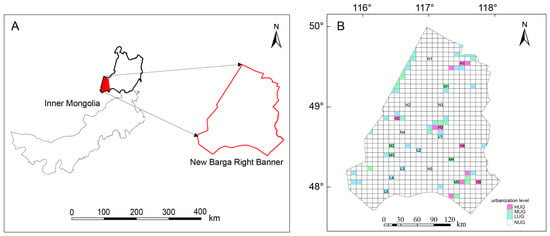
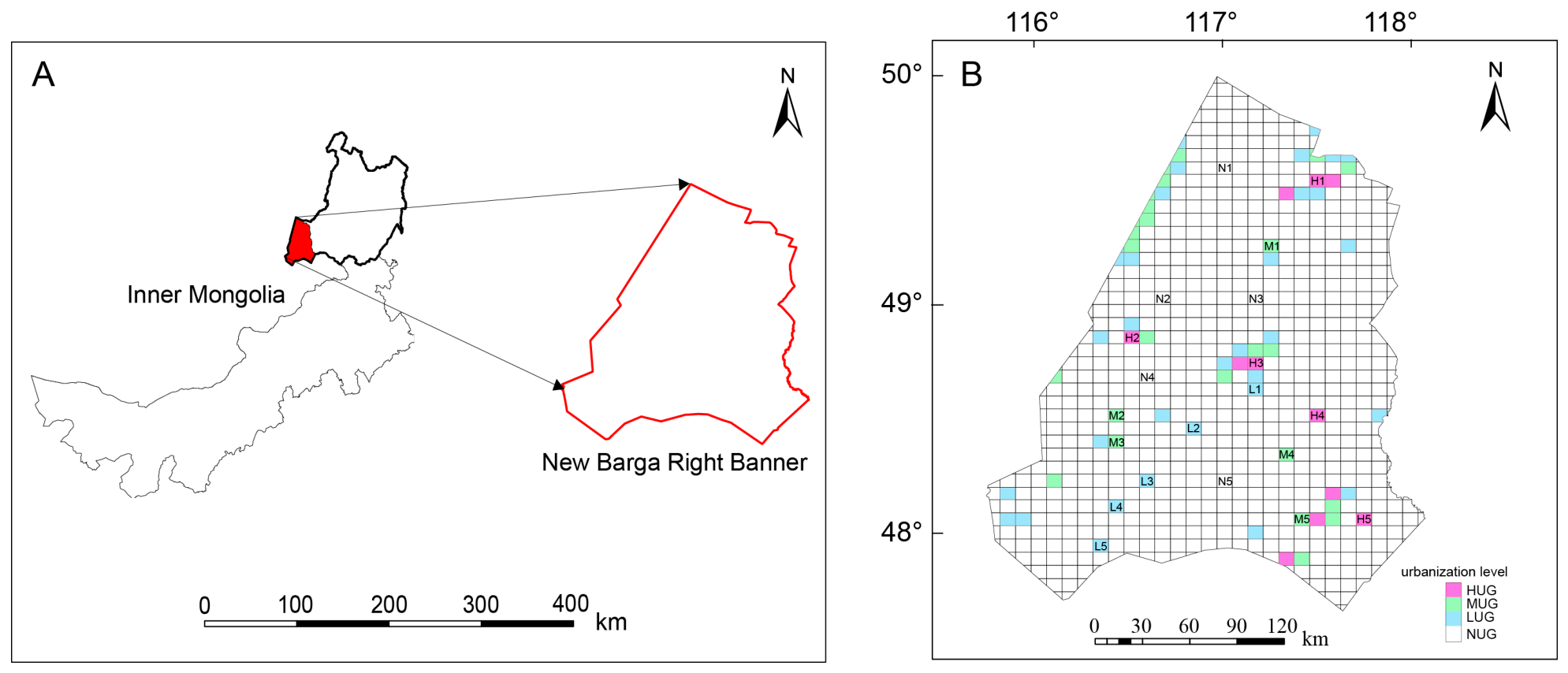
The study site is located in Xin Barag Right Banner, Hulunbuir City, Inner Mongolia, China, at approximately 47°36′00″–49°50′0″ N and 115°31′00″–117°43′00″ E (Figure 1A). This area belongs to the temperate typical steppe. The mean annual temperature is 1.6 °C, and the mean annual precipitation is 243.9 mm, with most rainfall occurring from June to August. The annual evaporation is 2000 mm, and the annual evaporation rate is 8.2. The average annual wind speed is 33 m·s−1.
Figure 1.
The location of the research site (A) and the sample design in no-urbanization grasslands (NUG, N1-5, white squares), low-urbanization grasslands (LUG, L1-5, blue squares), medium-urbanization grasslands (MUG, M1-5, green squares), and high-urbanization grasslands (HUG, H1-5, red squares) (B).
The representative vegetation communities are Stipa krylovii steppe and Leymus chinensis steppe, and the dominant soil type is chestnut soil. The parent material of the chestnut calcareous soils in the study area is dominated by Quaternary aeolian loess and loess-like silt deposits, rather than undifferentiated Quaternary sediments; local fluvial and lacustrine intercalations occur within the broader Quaternary succession. The topography and landforms belong to the Hulunbuir fault-depression basin. The overall terrain is higher in the northwest and lower in the southeast, with an average elevation of 600–800 m. The landforms are mainly denudational, shallowly dissected low mountains and hills and denudational-accumulational undulating high plains. As of 2021, the region had a permanent resident population of 38,358, of which 25,206 were urban residents.
2.2. Sample Design
Xin Barag Right Banner was divided into 771 cells of 5 km × 5 km. Land use information within each grid was extracted using ArcGIS 10.5, and the urbanization ratio was calculated accordingly. The land use data were obtained from the MCD12Q1 product provided by NASA (Washington, DC, USA), with a spatial resolution of 500 m. The proportion of impervious surface within each grid was used as the urbanization rate [29,30], calculated using the following formula
where Ci is the urbanization rate, Ca is the impervious surface within the grid, and Ta is the total area of the grid.
Ci = (Ca/Ta) × 100%
Based on the urbanization rate, four urbanization levels, each represented by five grids with no grazing disturbance, were selected: no urbanization (NUG; Ci = 0), low urbanization (LUG; 0 < Ci ≤ 5%), medium urbanization (MUG; 5% < Ci ≤ 10%), and high urbanization (HUG; Ci > 10%) (Figure 1B). To focus on the effects of pastoral towns on surrounding grasslands, sampling in LUG, MUG, and HUG was restricted to natural grasslands surrounding the impervious surface within each selected grid. In each of these grids, five 5 m × 5 m plots were established in natural grassland at a consistent distance (100 m) from the nearest building edge, along four cardinal directions (east, south, west, and north) plus one randomly selected direction. For NUG, where no impervious surface was present, five 5 m × 5 m plots were randomly placed in natural grassland within the selected grid to represent non-urbanized background conditions. According to the preliminary visit and investigation, the grasslands included in the selected grid have been prohibited from grazing for more than 5 years, which eliminates the disturbance of grazing.
2.3. Plant Community Survey and Soil Sample Collection
Plant community survey and soil sample collection were conducted in July 2024. All plant species observed in each plot were identified based on the Flora of China and Flora of Inner Mongolia, and the number of individuals of each species was recorded for calculating plant species richness and the Shannon index. Soil samples were collected from the surface layer at the four corners and the center of each quadrat using a soil auger, with five cores (5 cm in diameter and 20 cm in depth) taken per quadrat. This surface soil approximately corresponds to the upper part of the humus horizon (A horizon) of a typical chestnut soil profile (A–Bk–Ck). Samples collected from the same grid were thoroughly mixed, yielding a total of 20 soil samples. Each soil sample was then divided into three portions: the first portion was stored at 4 °C for determination of soil water content (SWC) and pH; the second portion was air-dried and stored for analysis of soil element contents; and the third portion was stored at −80 °C for high-throughput sequencing of soil microorganisms.
2.4. Soil Physicochemical Property Analysis
Water content (SWC) was quantified by mass loss after oven-drying fresh soil to constant weight. pH was recorded in soil-water slurries with a Sartorius PB-10 m (Sartorius, Göttingen, Germany). Total N (TN) and organic C (TOC) were determined on a Vario Max CN analyzer (Elementar, Hessentag, Germany). Total phosphorus (TP) was determined using the ammonium molybdate method. Soil samples were ignited in a muffle furnace and then digested with hydro-chloric acid to convert all forms of phosphorus into soluble orthophosphate. A chromogenic reagent composed of ammonium molybdate, potassium antimony tartrate, sulfuric acid, and ascorbic acid was used to react with soluble orthophosphate for TP determination. Ammonium acetate solution was used as the extractant to extract available potassium from the soil, and the available potassium content was then measured using flame atomic absorption spectrometry.
2.5. Soil Microbial Sequencing and Bioinformatics Analysis
Soil microbial DNA extraction, amplicon sequencing, and bioinformatic processing followed the procedures described by Fang et al. [14]. Briefly, 0.5 g fresh soil was weighed from each sample, and total genomic DNA was extracted from these fresh soils; bacterial and fungal communities were characterized by amplification of the bacterial 16S rRNA gene region and fungal ITS region, respectively. Amplicons were sequenced using the QIIME v1.9.0 platform. Raw sequences were subjected to quality filtering, merging, chimera removal, and taxonomic assignment following the pipeline described in Fang et al. [14]. Sequences were clustered into operational taxonomic units (OTUs) at 97% sequence similarity. Taxonomic classifications were performed against the SILVA 138.1 SSU Ref NR99 full-length database and UNITE database. Bacterial and fungal alpha diversity was characterized using OTU richness, Shannon index, and Simpson index. Microbial potential functional groups were inferred using FAPROTAX 1.2.4 for bacteria and FUNGuild (https://www.funguild.org/, accessed on 8 September 2026) for fungi. Only functional assignments meeting the predefined confidence criteria were retained for subsequent analyses.
2.6. Statistical Analysis
All statistical analyses were performed in R version 4.2.2. Differences in plant diversity, soil physicochemical properties, microbial alpha-diversity indices, relative abundances of dominant microbial taxa, and relative abundances of microbial functional groups among the four urbanization levels were assessed using one-way analysis of variance (ANOVA). Assumptions of normality and homogeneity of variance were evaluated before analysis. When significant differences were detected, post hoc multiple comparisons were performed using Tukey’s HSD test. Variables that did not meet ANOVA assumptions were analyzed using the corresponding non-parametric test. Differences in bacterial and fungal community composition among urbanization levels were evaluated using Bray–Curtis dissimilarities and visualized by Principal Coordinates Analysis (PCoA). Statistical differences in community composition were tested using permutational multivariate analysis of variance (PERMANOVA). Plant community composition was compared among urbanization levels using hierarchical clustering based on standardized (Z-score-transformed) species abundances. Relationships between environmental variables and bacterial and fungal community composition were assessed using Mantel tests based on distance metrics. Co-occurrence networks were constructed separately for bacterial and fungal communities. OTUs with relative abundances > 0.5% were retained. Pairwise associations were calculated using Spearman’s rank correlations, and associations with |r| > 0.6 and p < 0.05 were retained as network edges. Network topological properties, including node number, edge number, average degree, average path length, positive correlation, and negative correlation, were calculated using the “psych” package (R 4.5.2). These networks were visualized using the Fruchterman-Reingold algorithm (Gephi 0.9.2).
3. Results
3.1. Changes in Soil Properties and Plant Communities Along the Urbanization Gradient
The soil water content (SWC), total organic carbon (TOC), and total nitrogen (TN) contents in NUG and LUG were significantly higher than those in MUG and HUG (p < 0.05), while pH and total phosphorus (TP) content were significantly lower than those in MUG and HUG (p < 0.05). No significant difference in available potassium (AK) content was observed among the grasslands (Table 1).
Table 1.
Soil physicochemical properties in no-urbanization grasslands (NUG), low-urbanization grasslands (LUG), medium-urbanization grasslands (MUG), and high-urbanization grasslands (HUG). Soil water content (SWC), total organic carbon (TOC), total nitrogen (TN), total phosphorus (TP), pH, and available potassium (AK) are expressed as means ± standard deviations. Letters (a, b) indicate significant differences between different grasslands (Tukey HSD test, p < 0.05). n = 5 per level.
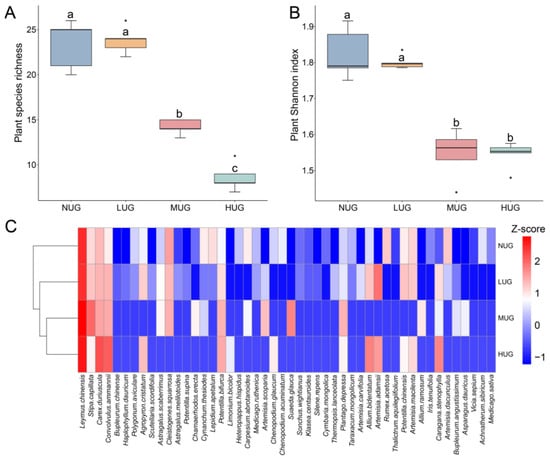
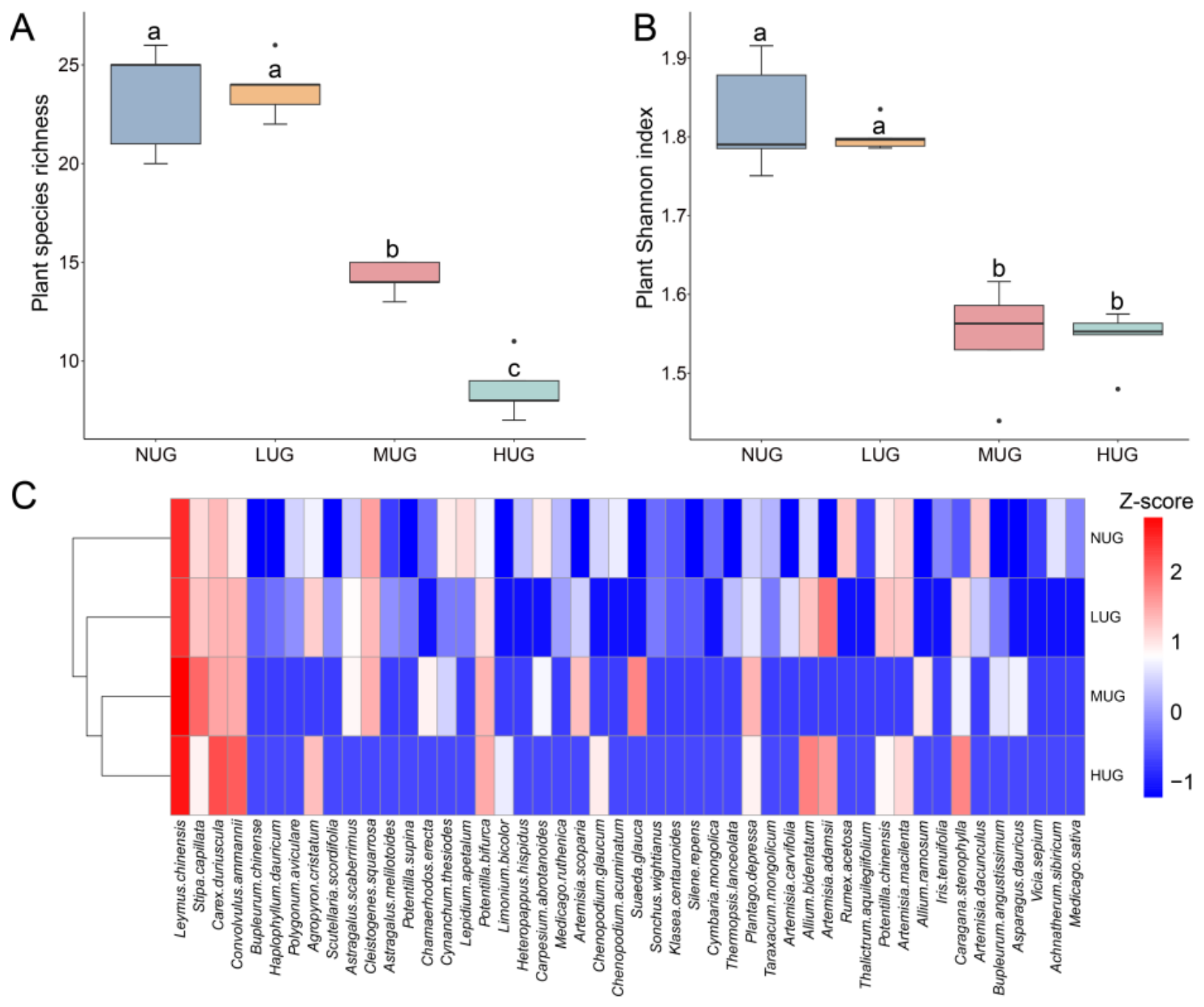
The plant species richness and plant Shannon index in HUG and MUG were significantly lower than those in NUG and LUG (p < 0.05; Figure 1A,B). Cluster analysis showed that HUG and MUG clustered together as one group, which then separated from LUG and NUG (Figure 2C). Leymus chinensis, Stipa capillata, Carex duriuscula, and Convolvulus.ammannii were the dominant species in all grasslands (Figure 2C).
Figure 2.
Plant species richness (A), Shannon index (B), and cluster analysis (C) of no-urbanization grasslands (NUG), low-urbanization grasslands (LUG), medium-urbanization grasslands (MUG), and high-urbanization grasslands (HUG). Z-scores represent the standardized mean abundance of each plant species. n = 5 per level. The lowercase letters (a, b, c) on the bar chart indicate significant differences between different grasslands (p < 0.05).
3.2. Bacterial and Fungal Diversity
The OTU number of bacteria in HUG was significantly higher than that in NUG and LUG (p < 0.05), while no significant differences were observed in other bacterial and fungal alpha diversity indices among plots along the urbanization gradient (p > 0.05) (Table 2).
Table 2.
The alpha diversity of bacteria and fungi in no-urbanization grasslands (NUG), low-urbanization grasslands (LUG), medium-urbanization grasslands (MUG), and high-urbanization grasslands (HUG). OTU number, Shannon index, and Simpson index are expressed as means ± standard deviations. Letters (a, b) indicate significant differences between different grasslands (Tukey HSD test, p < 0.05). n = 5 per level.
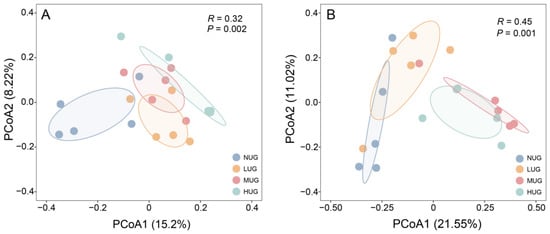
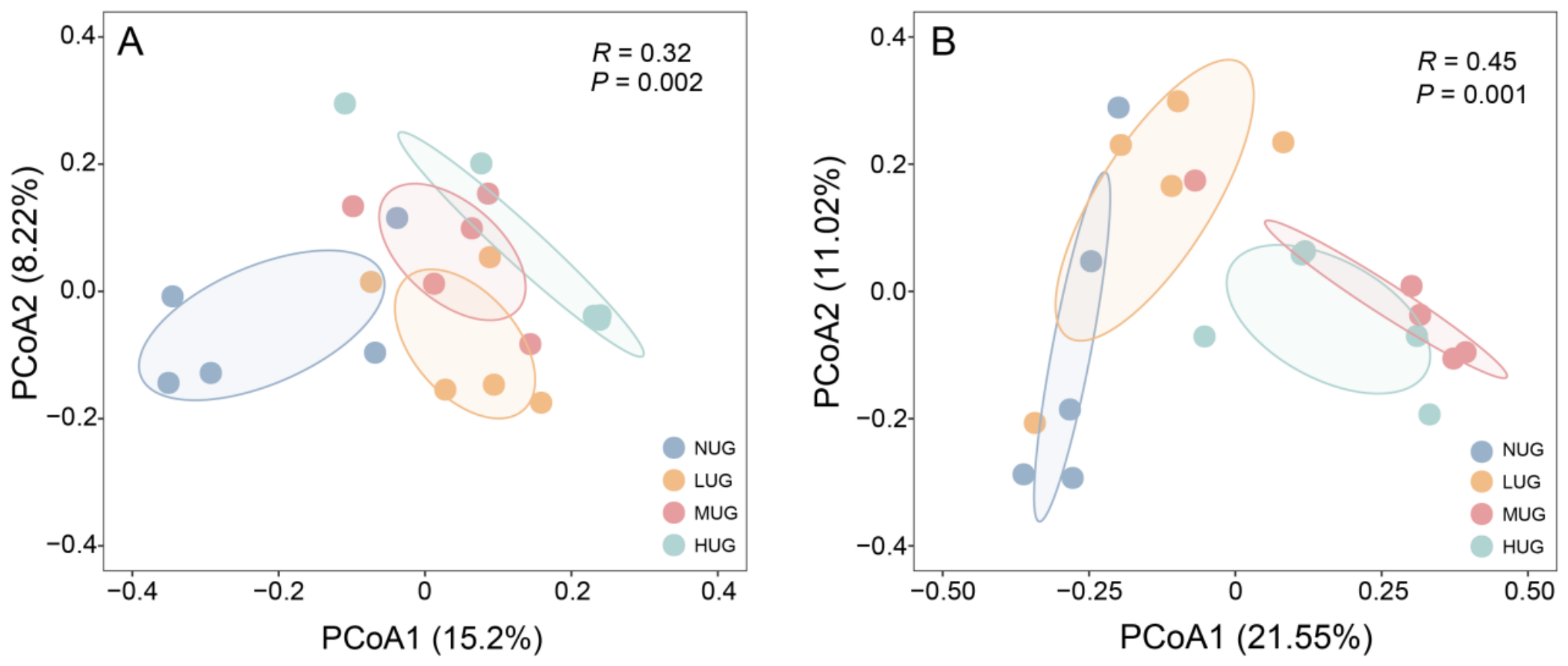
PCoA analysis based on Bray–Curtis distance showed that both bacterial and fungal communities across different urbanization gradients exhibited clear separation trends along the coordinate axes. In the bacterial communities, NUG samples clustered at the left end of the PCoA1 axis, while samples from the other groups were distributed at the right end of the PCoA1 axis. PERMANOVA test results indicated that the urbanization gradient had a significant effect on community composition (R = 0.34, p = 0.002), explaining 23.42% of the total variation (Figure 3A). In the fungal communities, NUG and LUG samples clustered at the left end of the PCoA1 axis, while samples from the other groups were distributed at the right end of the PCoA1 axis. PERMANOVA test results indicated that the urbanization gradient had a significant effect on community composition (R = 0.45, p = 0.001), explaining 32.57% of the total variation (Figure 3B).
Figure 3.
Principal coordinate analysis (PCoA) of bacteria (A) and fungi (B) under different urbanization gradients using Bray–Curtis distance. Points in different colors represent samples from different urbanization gradients, and ellipses indicate the clustering areas of samples in each group. n = 5 per level.
3.3. Changes in Bacterial and Fungal Composition and Predicted Functional Guilds
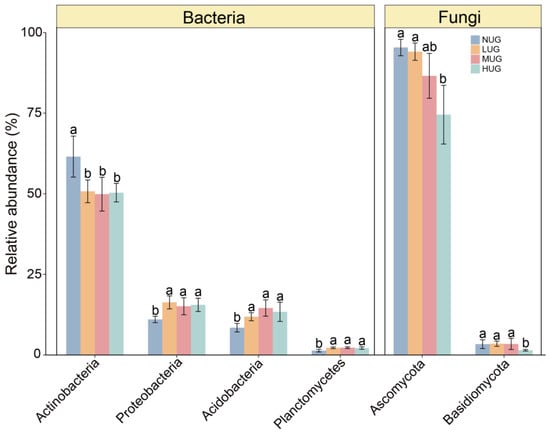
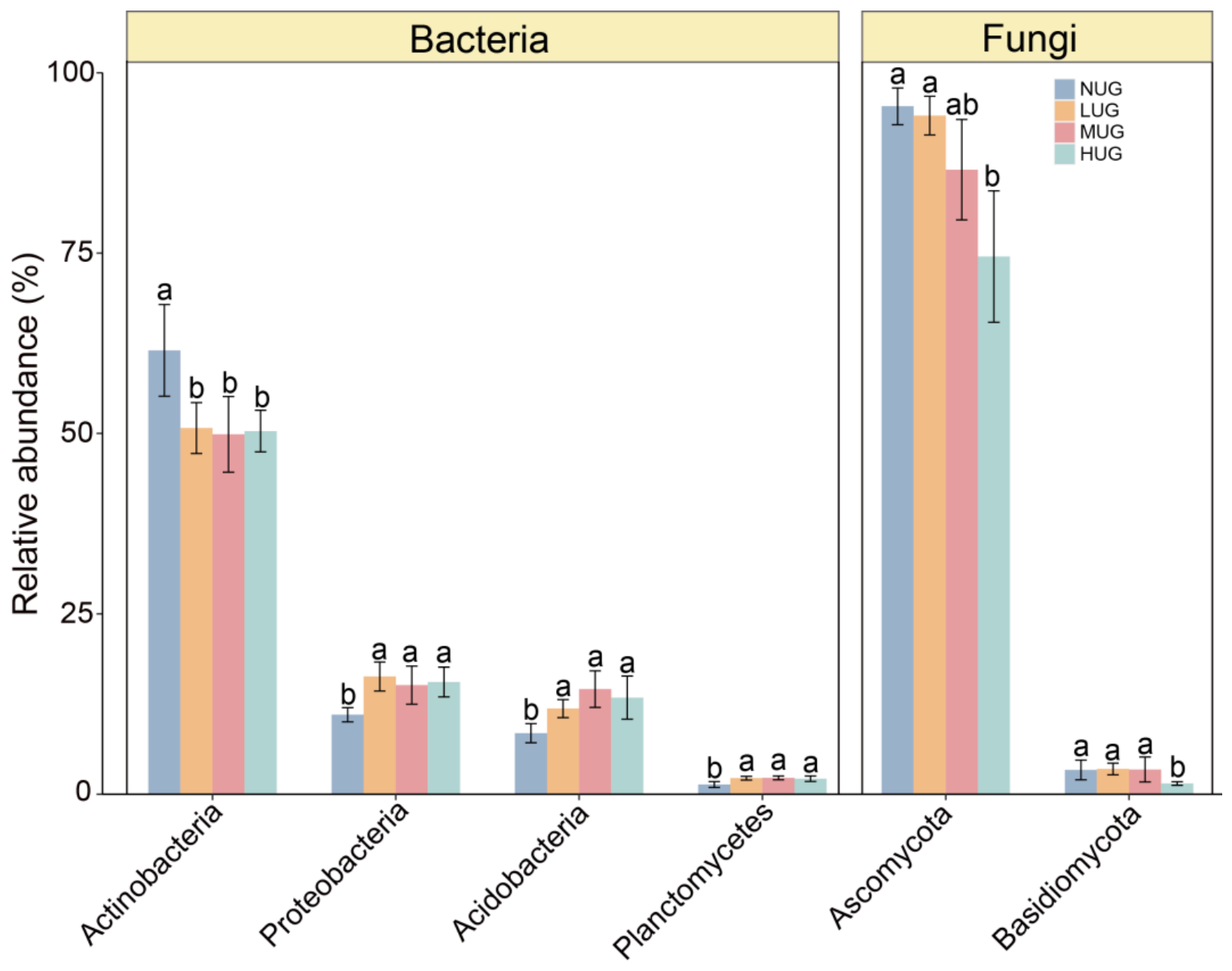
In the bacterial communities, the abundance of Actinobacteria in NUG was significantly higher than that in the other grasslands, while the abundances of Proteobacteria, Acidobacteria, and Planctomycetes were lower than those in the other grasslands (p < 0.05; Figure 4). In the fungal communities, the abundances of Ascomycota and Basidiomycota in HUG were significantly lower than those in NUG and LUG (p < 0.05; Figure 4).
Figure 4.
The relative abundance of the dominant phyla of bacteria and fungi in no-urbanization grasslands (NUG), low-urbanization grasslands (LUG), medium-urbanization grasslands (MUG), and high-urbanization grasslands (HUG). The relative abundances of the dominant phyla are expressed as means ± standard deviations. The lowercase letters (a, b) on the bar chart indicate significant differences between different grasslands (p < 0.05). n = 5 per level.
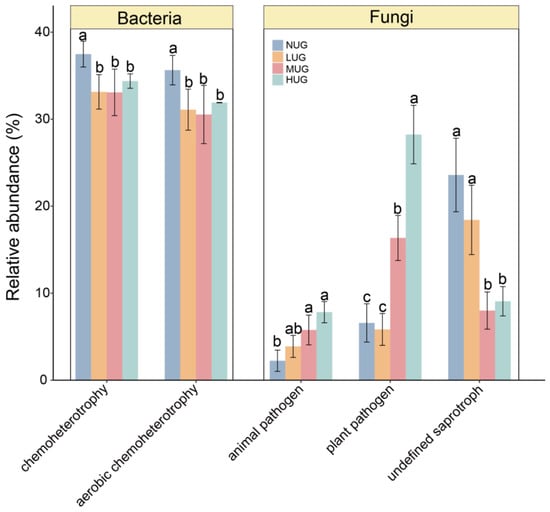
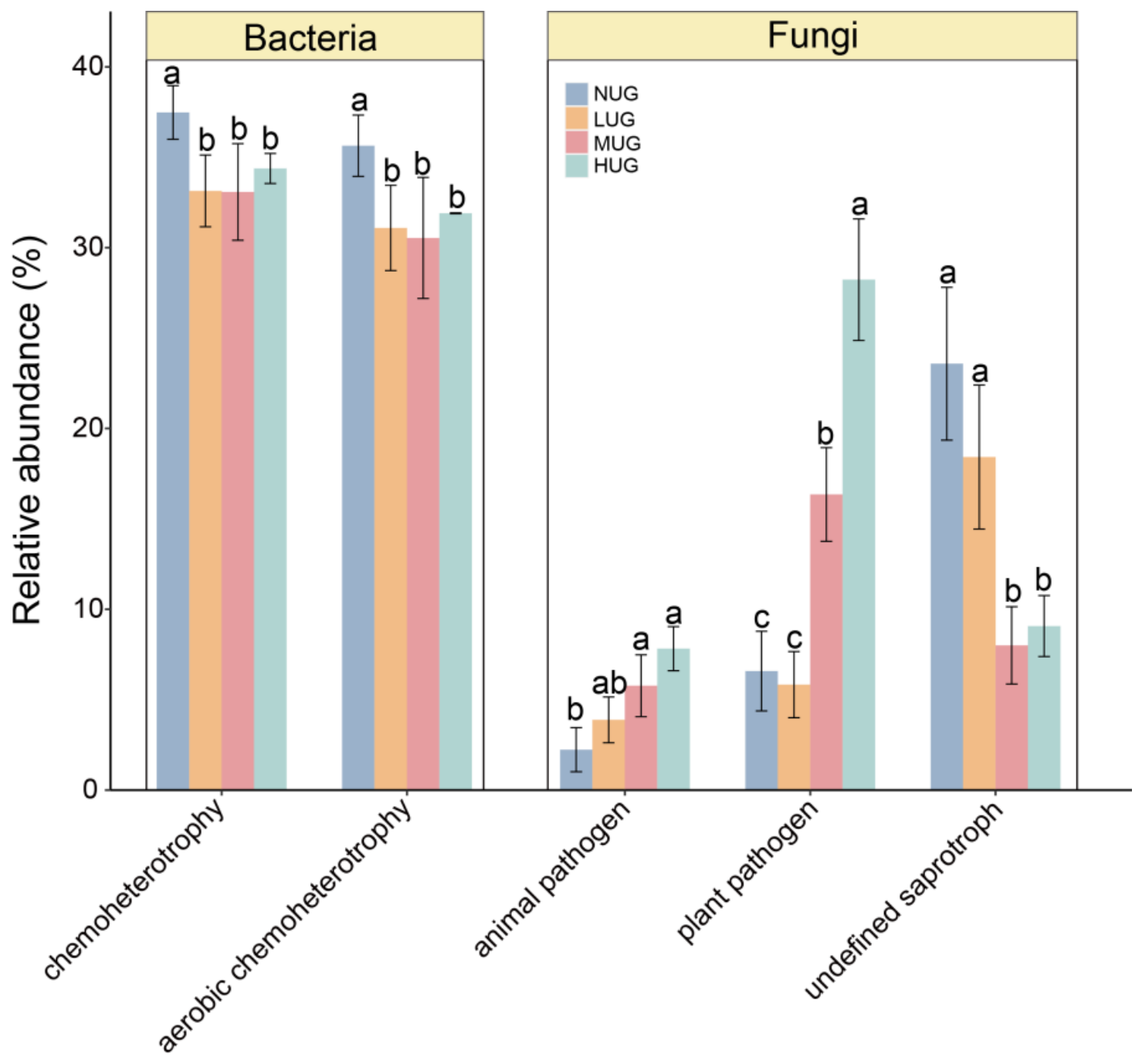
In the bacterial predicted functional guilds, the abundances of chemoheterotrophy and aerobic chemoheterotrophy in NUG were significantly higher than those in the other grasslands (p < 0.05; Figure 5). In the fungal predicted functional guilds, the abundance of animal pathogens in NUG was significantly lower than that in MUG and HUG; the abundance of plant pathogens in NUG and LUG was significantly lower than that in MUG and HUG; and the abundance of undefined saprotrophs was significantly higher than that in MUG and HUG (p < 0.05; Figure 5). n = 5 per level.
Figure 5.
The predicted relative abundance of bacterial and fungal functional guilds in no-urbanization grasslands (NUG), low-urbanization grasslands (LUG), medium-urbanization grasslands (MUG), and high-urbanization grasslands (HUG). The relative abundances of the predicted functional guilds are expressed as means ± standard deviations. The lowercase letters (a, b) on the bar chart indicate significant differences between different grasslands (p < 0.05). n = 5 per level.
3.4. The Co-Occurrence Networks of Bacteria and Fungi
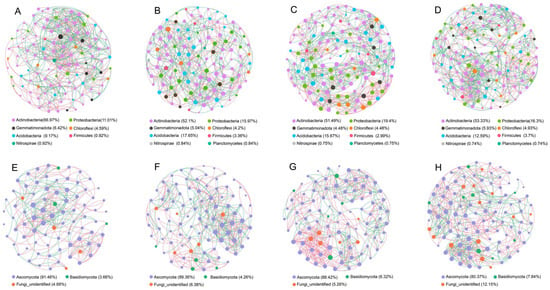
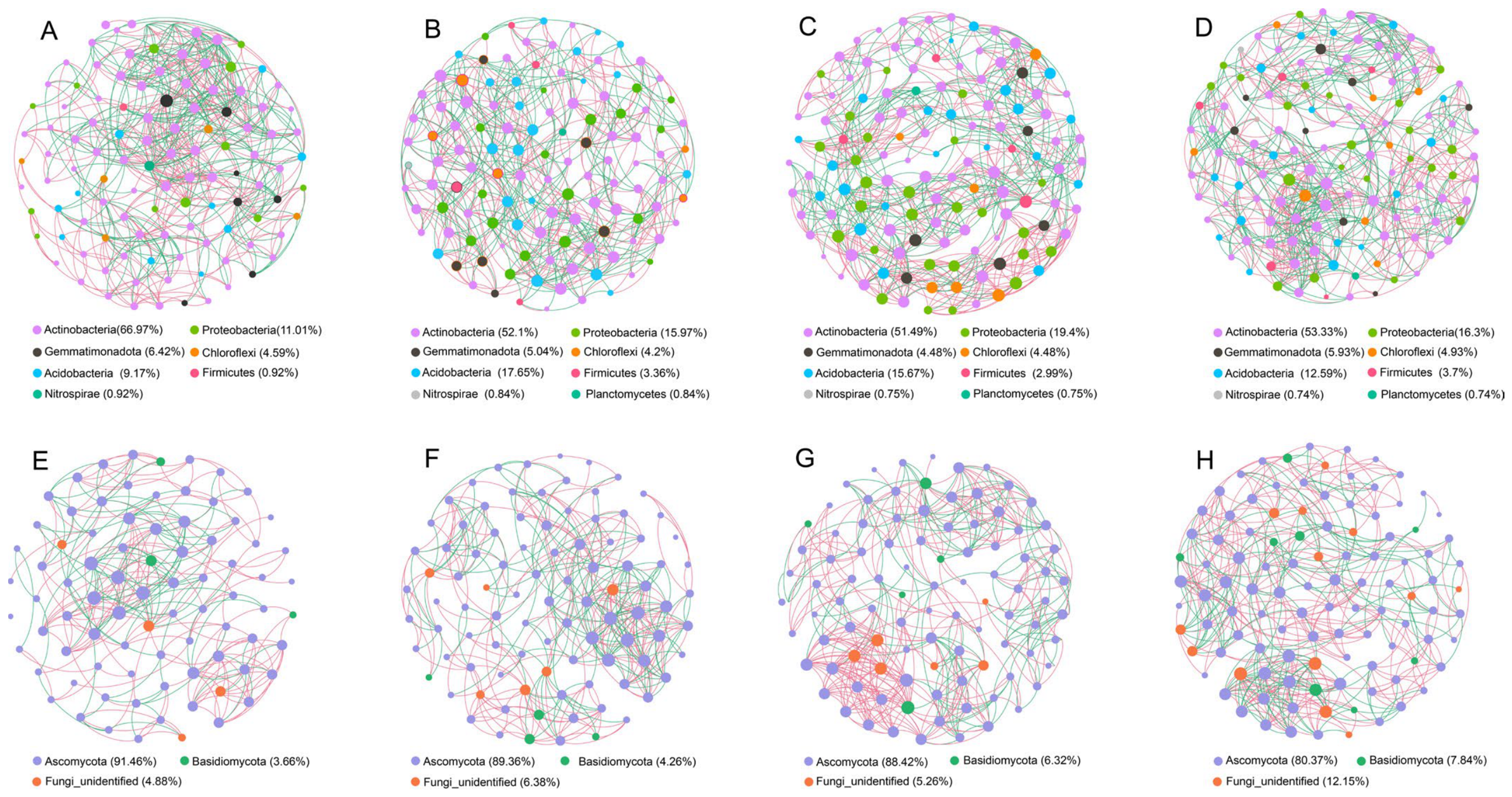
In the bacterial communities, compared with NUG, the networks of LUG, MUG, and HUG exhibited higher node numbers and average path coefficients, as well as lower edge numbers and average degrees (Table 3; Figure 6A–D). In the fungal communities, compared with NUG, the networks of LUG, MUG, and HUG showed higher node numbers, edge numbers, and average degrees, along with lower positive correlations (Table 3; Figure 6E–H). Overall, the complexity of soil bacterial community networks decreases, while the complexity of soil fungal community networks increases.
Table 3.
The co-occurrence network topological characteristics of soil bacterial and fungal communities, including node number, edge number, average degree, average path length, and the proportion of positive and negative correlations. n = 5 per level.
Figure 6.
The co-occurrence networks of bacteria and fungi in no-urbanization grasslands (UNG), (A,E), low-urbanization grasslands (LUG), (B,F), medium-urbanization grasslands (MUG), (C,G), and high-urbanization grasslands (HUG), (D,H). Red lines and green lines indicate positive and negative correlations respectively. n = 5 per level.
3.5. Associations of Microbial Communities with Soil and Vegetation
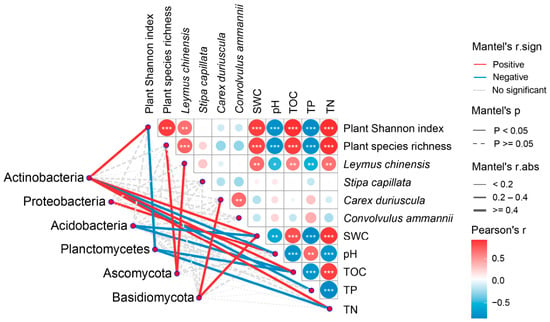
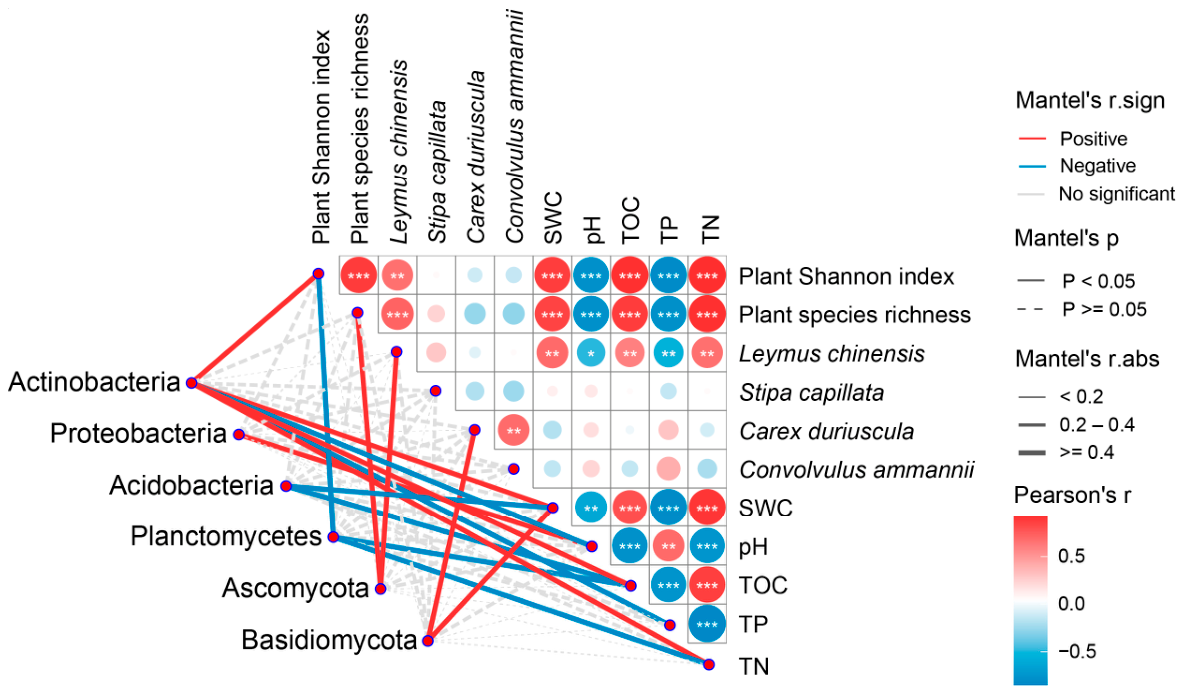
Plant species richness, plant Shannon index, and the abundance of Leymus chinensis were all significantly positively correlated with SWC, TOC, and TN, and significantly negatively correlated with pH and TP (Figure 7). The abundance of Actinobacteria was significantly positively correlated with plant Shannon index, SWC, TOC, and TN, and significantly negatively correlated with pH and TP. The abundance of Proteobacteria was significantly positively correlated with pH. The abundance of Acidobacteria was significantly negatively correlated with SWC and TOC. The abundance of Planctomycetes was significantly negatively correlated with plant Shannon index, TOC, and TN. The abundance of Ascomycota was positively correlated with plant species richness and the abundance of Leymus chinensis. The abundance of Basidiomycota was positively correlated with SWC and the abundance of Carex duriuscula (Figure 7).
Figure 7.
Mantel test on the correlations among plant diversity, dominant plant species abundance, soil properties, and soil bacteria and fungi phyla in no-urbanization grasslands (NUG), low-urbanization grasslands (LUG), medium-urbanization grasslands (MUG), and high-urbanization grasslands (HUG). * p < 0.05, ** p < 0.01, and *** p < 0.001. n = 5 per level.
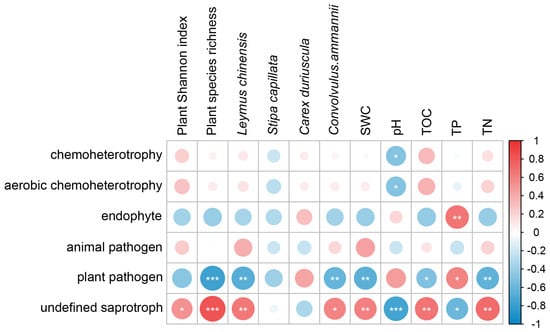
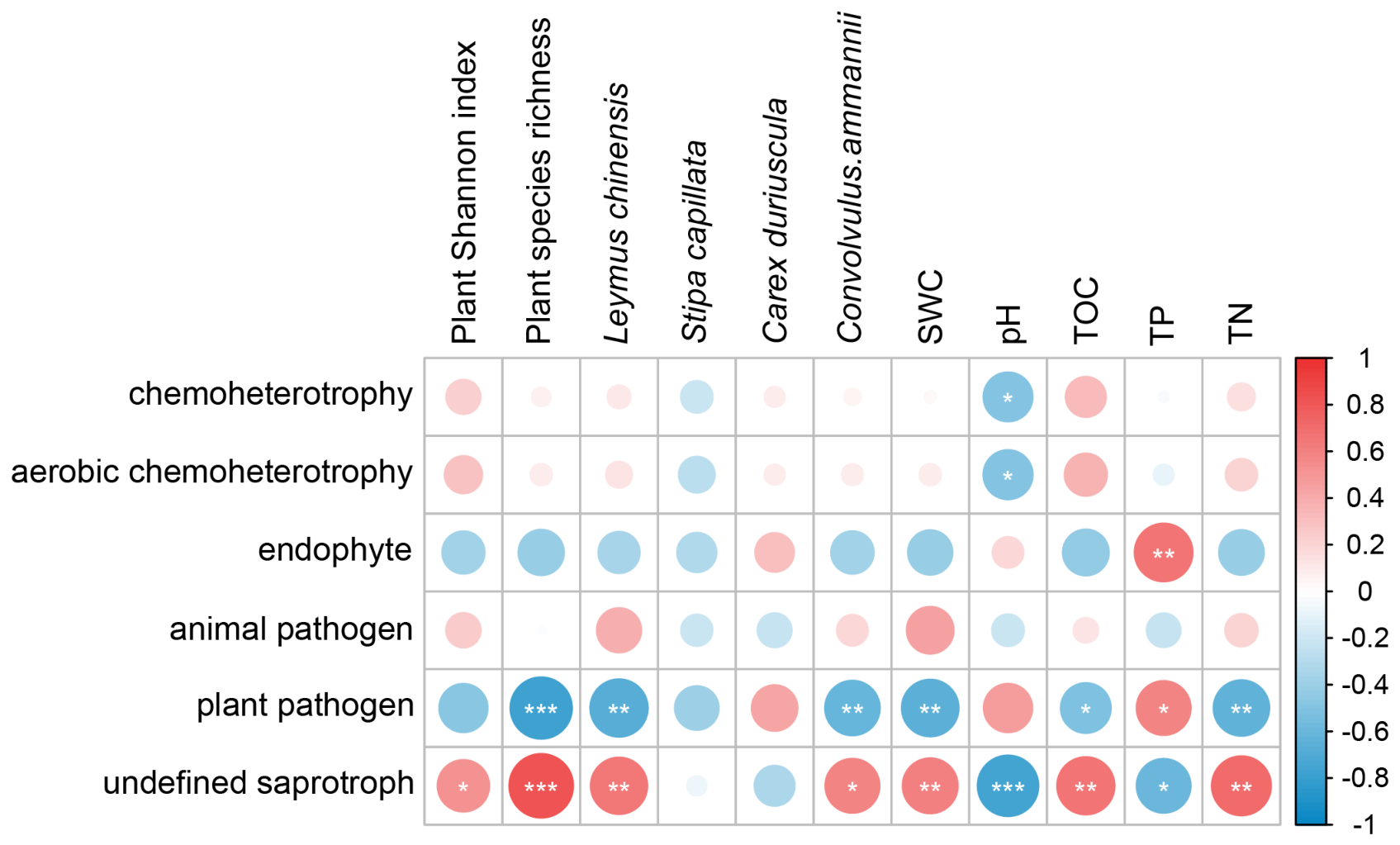
In bacterial functional guilds, pH was negatively correlated with the abundance of chemoheterotroph and aerobic chemoheterotroph bacteria (p < 0.05; Figure 8). In fungal functional guilds, TP was positively correlated with the abundance of endophyte fungi; plant species richness, the abundance of Leymus chinensis, Convolvulus.ammannii, SWC, TOC, and TN were negatively or positively correlated with the abundance of plant pathogen and undefined saprotroph fungi functions, respectively (p < 0.05; Figure 8). TP was positively or negatively correlated with the abundance of plant pathogen and undefined saprotroph fungi functions (p < 0.05; Figure 8). Plant Shannon index and pH were positively or negatively correlated with the abundance of undefined saprotroph fungi functions, respectively (p < 0.05; Figure 8).
Figure 8.
Pearson correlations of bacterial and fungal predicted functional guilds with plant diversity, the relative abundance of dominant plants, and soil physicochemical properties. Significance levels: * p < 0.05, ** p < 0.01, and *** p < 0.001. n = 5 per level.
4. Discussion
This study examined the response patterns of grassland soil bacterial and fungal communities along a pastoral urbanization gradient and tested three questions. Soil properties and plant communities changed markedly along the urbanization gradient. SWC, TOC, and TN were significantly higher in NUG and LUG than in MUG and HUG, whereas pH and TP were significantly higher in MUG and HUG. These patterns are consistent with the environmental changes often associated with urban expansion, including increased impervious surface area, altered hydrological conditions, greater resource use, and intensified human disturbance [8,9,13,14,15]. Plant species richness and the Shannon index were significantly lower in MUG and HUG than in NUG and LUG, and cluster analysis separated MUG and HUG from NUG and LUG. Although the same dominant species, such as Leymus chinensis, Stipa capillata, Carex duriuscula, and Convolvulus ammannii, occurred across the gradient, their relative abundances shifted. These results indicate that medium and high levels of pastoral urbanization can reduce plant diversity and reorganize plant community composition, likely through habitat fragmentation, altered soil water and nutrient availability, and changes in plant–soil interactions [7,11,31]. The separation of MUG and HUG from NUG and LUG also suggests a threshold-like response, in which microbial and plant communities change most strongly once urbanization reaches a certain scale.
Alpha diversity showed limited and group-specific responses, whereas community composition was much more sensitive. Bacterial OTU number was significantly higher in HUG than in NUG and LUG, but bacterial Shannon and Simpson indices did not differ significantly among urbanization levels, and fungal alpha diversity indices also showed no significant differences. The PCoA results based on Bray–Curtis distance revealed clear compositional separation along the urbanization gradient. These patterns indicate that both bacterial and fungal communities underwent systematic turnover along the town-size gradient, supporting the first hypothesis. At the same time, the stronger separation and higher explained variation for fungi support the second hypothesis, namely that fungal communities are more sensitive to pastoral urbanization than bacterial communities. Fungi are more tightly coupled with plants, and their dependence on litter and roots makes them more prone to functional guild differentiation and community reorganization under resource-limited conditions [32]. Therefore, the results of PCoA analysis indicated that urbanization has a stronger effect on fungal community composition than on bacterial community composition, and that fungi are more sensitive to urbanization; however, this sensitivity does not necessarily equate to decline and may also manifest as adaptive reorganization of community composition and functional structure [33].
In bacterial communities, the relative abundance of Actinobacteria was significantly higher in NUG than in the other grasslands, while Proteobacteria, Acidobacteria, and Planctomycetes increased with urbanization. Actinobacteria are important decomposers and nitrogen-fixing taxa in grassland soils [34,35], and their decline is consistent with the decreases in SWC, TOC, and TN. Proteobacteria are fast-growing and often favored by high pH and high phosphorus conditions [36,37], which may explain their increase in MUG and HUG. Acidobacteria are typically oligotrophic and often increase as soil organic matter declines [38,39], whereas Planctomycetes can tolerate drought and poor nutrient conditions [40]. In fungal communities, Ascomycota and Basidiomycota were significantly lower in HUG than in NUG and LUG. Ascomycota and Basidiomycota are key fungi involved in organic matter decomposition and nutrient transformation in soil, and their reduced abundance may directly affect soil nutrient cycling [41]. These changes collectively indicate a shift toward taxa adapted to drier, more alkaline, and nutrient-poor conditions, reflecting a deterioration in soil environmental quality under pastoral urbanization.
The functional guild results further revealed that pastoral urbanization altered soil ecosystem functions, not only taxonomic composition. In bacterial communities, the abundances of chemoheterotrophic and aerobic chemoheterotrophic bacteria were significantly higher in NUG than in the other grasslands. These groups are major transformers of soil organic matter [42], and their decline suggests a weakened potential ecological strategy for carbon transformation under urbanization. In fungal communities, the abundance of undefined saprotrophs decreased with increasing urbanization, while plant pathogenic and animal pathogenic fungi increased. Saprotrophic fungi are key drivers of litter decomposition and nutrient mineralization [43,44,45]; their decline may reduce soil nutrient availability. In contrast, the increase in plant pathogenic fungi implies a higher risk of plant disease [46,47,48]. These functional shifts indicate that medium and high urbanization levels can reshape the functional landscape of soil ecosystems, with potential consequences for nutrient cycling and plant health.
Co-occurrence network analysis corroborates the above views from the perspective of community interactions: with increasing town size, the number of edges and average degree of bacterial networks continuously decreased, and the network structure became simplified; in contrast, the node number, edge number, and average degree of fungal networks all increased, and the network structure became more complex. The simplification of bacterial networks may be related to enhanced environmental filtering—urbanization deteriorates soil conditions, allowing only a few tolerant taxa to survive, thereby reducing synergistic and competitive relationships among species [49]. The reasons for the increased complexity of fungal networks may be twofold: on the one hand, the niche differentiation between pathogenic fungi and saprotrophic fungi under resource-limited conditions intensifies interspecific interactions; on the other hand, fungal hyphae can efficiently acquire nutrients and have strong environmental adaptability, allowing fungal communities to maintain high connectivity in heterogeneous environments [50]. The opposite response patterns of bacterial and fungal networks suggest that the two groups have different adaptive strategies to urbanization disturbance.
Mantel tests showed that soil physicochemical properties were significantly associated with bacterial and fungal community composition along the pastoral urbanization gradient. SWC, TOC, and TN decreased significantly with increasing town size, while pH and TP increased. TOC, TN, and SWC were positively correlated with Actinobacteria, Ascomycota, and Basidiomycota, whereas pH and TP were positively correlated with Proteobacteria, Acidobacteria, and Planctomycetes. These relationships indicate that soil water, carbon, nitrogen, pH, and phosphorus co-varied with the composition of bacterial and fungal communities. Pearson correlations further showed that decreases in SWC, TOC, and TN, together with increases in pH and TP, were associated with shifts in predicted plant pathogenic and saprotrophic fungal guilds, which in turn co-varied with plant diversity and dominant species abundance. Plant pathogenic fungi were negatively correlated with plant diversity and dominant species abundance, whereas undefined saprotrophs were positively correlated with these plant attributes. These results are consistent with previous findings that soil moisture and nutrient availability are associated with saprotrophic fungal growth and activity [51,52], whereas high pH and high phosphorus environments may be associated with pathogenic fungi [53,54,55]. However, these analyses are correlative, and the present sampling design does not allow causal pathways or mediating effects to be established.
The coordinated changes between plant and microbial communities also suggest aboveground–belowground associations. On the one hand, urban expansion may be associated with microbial functional changes, especially a reduction in saprotrophic fungi and an increase in pathogenic fungi, which may co-vary with plant decline through reduced nutrient availability and increased disease risk [17,46,56]. On the other hand, reduced plant diversity and shifts in dominant species may lower the quantity and quality of litter, thereby co-varying with organic-matter-dependent soil microorganisms and further plant community changes [31,57,58]. These patterns are consistent with aboveground–belowground coupling, but they should be interpreted as associations rather than demonstrated causal mechanisms. These findings also have management implications: rationally controlling the scale of pastoral urbanization and avoiding large-scale concentrated construction may help maintain soil microbial diversity and ecological functions in grasslands.
It should be noted that this observational study was based on a single sampling campaign conducted at one site, and its functional predictions were derived from amplicon data. Functional predictions based on amplicon sequencing, such as those generated by FAPROTAX and FUNGuild, reflect only potential functions and do not represent the actual functional activity of bacteria and fungi; therefore, their definitive functions still require further verification using techniques such as qPCR-based quantification of functional genes, metagenomic sequencing, and metatranscriptomic sequencing. The spatial autocorrelation between samples in the same grid may underestimate the standard error, and grid mean or mixed models can only partially alleviate this problem but cannot completely eliminate it. This study sampled the 0–20 cm topsoil and did not separate soil horizons. Therefore, the horizon-specific effects of pastoral urbanization on soil genesis, topsoil thickness, compaction, erosion, and carbonate horizon depth remain unresolved. The measured soil physicochemical properties only include SWC, pH, SOC, TN, TP, and AK, and the roles of soil density, compaction, and carbonate horizon depth in regulating microbial taxonomic composition could not be quantified. We predict that urban expansion may alter these processes through impervious surface cover, altered hydrology, and increased surface pressure, but these mechanisms require future testing with profile description and horizon-specific sampling. The follow-up work will adopt a nested design of multiple banners, multiple independent towns/grids, with each urbanization intensity containing multiple independent towns, and multiple plots set up for each town. The conclusions will be verified by combining spatial variance decomposition or spatial mixing models. Therefore, the generalizability of the conclusions deserves further verification through multi-season, multi-site, and more comprehensive studies.
Overall, this study systematically revealed the response characteristics of soil microbial communities along the pastoral urban scale gradient, finding that under medium and high urbanization levels, microbial community composition and functional guilds all underwent significant changes, with fungal communities showing more sensitive responses than bacterial communities, and soil physicochemical properties being the primary drivers of microbial community changes. These findings provide microbiological evidence for assessing the ecological effects of pastoral urbanization and also offer references for pastoral urban planning and grassland ecological conservation—namely, that appropriately controlling urban scale and avoiding large-scale concentrated construction are of great significance for maintaining soil microbial diversity and ecological functions in grasslands.
5. Conclusions
This study revealed the ecological response characteristics of grassland soil properties and soil microbial communities along the urbanization gradient of the studied typical steppe pastoral region of Inner Mongolia. The results showed that soil properties and soil microbial communities underwent significant changes in composition and functional guilds along the urbanization gradient, with the most pronounced changes occurring under medium and high urbanization levels. The response magnitude of fungal communities was greater than that of bacterial communities across these aspects, indicating higher sensitivity of fungi. Soil physicochemical properties were the primary drivers of microbial community changes, while plant community changes co-occurred with microbial community shifts, and the PLS-PM results were consistent with a hypothesized association pathway in which changes in soil properties were associated with plant community decline through their associations with predicted microbial functional guilds. These findings emphasize the importance of soil physicochemical properties and soil microorganisms in regulating underground reactions and suggest that the assessment of soil health in the studied typical steppe pastoral region of Inner Mongolia should combine soil physicochemical properties with microbial indicators. Therefore, rationally controlling the scale of pastoral urbanization and avoiding large-scale concentrated construction are of great significance for maintaining soil properties, soil microbial diversity and ecological functions in grasslands.
Author Contributions
Conceptualization, M.F.; methodology, G.W., J.H., G.L. and M.F.; software, G.W., J.H., G.L. and M.F.; validation, J.H., G.L. and M.F.; formal analysis, G.W.; investigation, G.W. and M.F.; resources, G.W.; data curation, G.W.; writing—original draft preparation, G.W.; writing—review and editing, G.W. and M.F.; visualization, G.W. and M.F.; supervision, M.F.; project administration, M.F.; funding acquisition, M.F. All authors have read and agreed to the published version of the manuscript.
Funding
This work is supported financially by the Chizhou University High-Level Talent Research Startup Fund (CZ2025YJRC96, CZ2025YJRC99) and the Open Project of Anhui Province Key Laboratory of Wetland Ecosystem Protection and Restoration, Anhui University.
Institutional Review Board Statement
Not applicable.
Informed Consent Statement
Not applicable.
Data Availability Statement
The original contributions presented in this study are included in the article. Further inquiries can be directed to the corresponding author.
Conflicts of Interest
The authors declare no conflicts of interest.
References
- Bengtsson, J.; Bullock, J.M.; Egoh, B.; Everson, C.; Everson, T.; O’Connor, T.; O’Farrell, P.J.; Smith, H.G.; Lindborg, R. Grasslands—More important for ecosystem services than you might think. Ecosphere 2019, 10, e02582. [Google Scholar] [CrossRef] [Scilit]
- Bardgett, R.D.; Bullock, J.M.; Lavorel, S.; Manning, P.; Schaffner, U.; Ostle, N.; Chomel, M.; Durigan, G.; Fry, E.L.; Johnson, D.; et al. Combatting global grassland degradation. Nat. Rev. Earth Environ. 2021, 2, 720–735. [Google Scholar] [CrossRef] [Scilit]
- Török, P.; Brudvig, L.A.; Kollmann, J.; Price, J.N.; Tóthmérész, B. The present and future of grassland restoration. Restor. Ecol. 2021, 29, e13378. [Google Scholar] [CrossRef] [Scilit]
- Hao, L.; Sun, G.; Liu, Y.Q.; Liu, Y.Q.; Gao, Z.Q.; He, J.J.; Shi, T.T.; Wu, B.J. Effects of precipitation on grassland ecosystem restoration under grazing exclusion in Inner Mongolia, China. Landsc. Ecol. 2014, 29, 1657–1673. [Google Scholar] [CrossRef] [Scilit]
- Liu, M.; Dries, L.; Heijman, W.; Huang, J.K.; Zhu, X.Q.; Hu, Y.N.; Chen, H.B. The impact of ecological construction programs on grassland conservation in Inner Mongolia, China. Land Degrad. Dev. 2018, 2, 326–336. [Google Scholar] [CrossRef] [Scilit]
- Gongbuzeren; Li, W.J.; Li, Y.P. The role of community cooperative institutions in building rural-urban linkages under urbanization of pastoral regions in China. Front. Sustain. Food Syst. 2021, 5, 612207. [Google Scholar] [CrossRef] [Scilit]
- Batunacun; Nendel, C.; Hu, Y.F.; Lakes, T. Land-use change and land degradation on the Mongolian Plateau from 1975 to 2015—A case study from Xilingol, China. Land Degrad. Dev. 2018, 29, 1595–1606. [Google Scholar] [CrossRef] [Scilit]
- Valtanen, H.M.; Sillanpää, N.; Setälä, H.M. Key factors affecting urban runoff pollution under cold climatic conditions. J. Hydrol. 2015, 529, 1578–1589. [Google Scholar] [CrossRef] [Scilit]
- Taka, M.; Kokkonen, T.; Kuoppamäki, K.; Niemi, T.; Sillanpää, N.; Valtanen, M.; Warsta, L.; Setälä, H. Spatio-temporal patterns of major ions in urban stormwater under cold climate. Hydrol. Process. 2017, 31, 1564–1577. [Google Scholar] [CrossRef] [Scilit]
- Ruas, R.B.; Costa, L.M.S.; Bered, F. Urbanization driving changes in plant species and communities—A global view. Glob. Ecol. Conserv. 2022, 38, e02243. [Google Scholar] [CrossRef] [Scilit]
- Hou, Y.C.; Li, J.S.; Li, G.; Qi, W. Negative effects of urbanization on plants: A global meta-analysis. Ecol. Evol. 2023, 13, e9894. [Google Scholar] [CrossRef] [Scilit]
- Yao, H.F.; Li, Z.P.; Geisen, S.; Qiao, Z.H.; Breed, M.F.; Sun, X. Degree of urbanization and vegetation type shape soil biodiversity in city parks. Sci. Total Environ. 2023, 899, 166437. [Google Scholar] [CrossRef] [Scilit]
- Civerolo, K.; Hogrefe, C.; Lynn, B.; Rosenthal, J.; Ku, J.; Solecki, W.; Cox, J.; Small, C.; Rosenzweig, C.; Goldberg, R.; et al. Estimating the effects of increased urbanization on surface meteorology and ozone concentrations in the New York City metropolitan region. Atmos. Environ. 2007, 41, 1803–1818. [Google Scholar] [CrossRef] [Scilit]
- Ash, C.; Jasny, B.R.; Roberts, L.; Stone, R.; Sugden, A.M. Reimagining cities. Science 2008, 319, 739. [Google Scholar] [CrossRef] [Scilit]
- Chen, J.Q.; Wang, X.R.; Tang, W.; Shi, B.Y.; Zhao, Y.; Xie, Y.; Chai, L.Z.; Yu, X.Y. Differences in soil properties of urban road green space and its effects on spontaneous plants. Soil Sci. Soc. Am. J. 2025, 89, e70135. [Google Scholar] [CrossRef] [Scilit]
- Li, H.Y.; Qiu, Y.Z.; Yao, T.; Han, D.R.; Gao, Y.M.; Zhang, J.G.; Ma, Y.C.; Zhang, H.R.; Yang, X.L. Nutrients available in the soil regulate the changes of soil microbial community alongside degradation of alpinemeadows in the northeast of the Qinghai-Tibet plateau. Sci. Total Environ. 2021, 792, 148363. [Google Scholar] [CrossRef] [Scilit]
- Fang, M.C.; Lu, G.; Zhang, S.P.; Liang, W. Urbanized lands degrade surrounding grasslands by deteriorating the interactions between plants and soil microbiome. Front. Microbiol. 2025, 15, 1505916. [Google Scholar] [CrossRef] [Scilit]
- Gao, D.D.; Zhang, N.; Liu, S.G.; Ning, C.; Wang, X.Y.; Feng, S.L. Urbanization imprint on soil bacterial communities in forests and grasslands. Forests 2023, 14, 38. [Google Scholar] [CrossRef] [Scilit]
- Bardgett, R.D.; van der Putten, W.H. Belowground biodiversity and ecosystem functioning. Nature 2014, 515, 505–511. [Google Scholar] [CrossRef] [Scilit]
- Coban, O.; De Deyn, G.B.; van der Ploeg, M. Soil microbiota as game-changers in restoration of degraded lands. Science 2022, 375, 990. [Google Scholar] [CrossRef] [Scilit]
- Liu, J.; Jia, X.Y.; Yan, W.M.; Zhong, Y.Q.W.; Shangguan, Z.P. Changes in soil microbial community structure during long-term secondary succession. Land Degrad. Dev. 2020, 31, 1151–1166. [Google Scholar] [CrossRef] [Scilit]
- Wu, X.F.; Yang, J.J.; Ruan, H.; Wang, S.N.; Yang, Y.R.; Naeem, I.; Wang, L.; Liu, L.; Wang, D.L. The diversity and co-occurrence network of soil bacterial and fungal communities and their implications for a new indicator of grassland degradation. Ecol. Indic. 2021, 129, 107989. [Google Scholar] [CrossRef] [Scilit]
- Oyunchimeg, M.; Burmaajav, B.; Enkhjargal, A.; Tsegmed, S.; Suvd, B.; Oyun-Erdene, O.; Zolzaya, D.; Otgonbayar, D.; Oyunchimeg, D.U.; Azjargal, L.; et al. Soil microbial contamination and its impact on child diarrheal disease incidence in Ulaanbaatar. Geogr. Environ. Sustain. 2019, 12, 243–251. [Google Scholar] [CrossRef] [Scilit]
- Hu, Y.H.; Dou, X.L.; Li, J.Y.; Li, F. Impervious surfaces alter soil bacterial communities in urban areas: A case study in Beijing, China. Front. Microbiol. 2018, 9, 226. [Google Scholar] [CrossRef] [Scilit]
- Zhang, W.W.; Han, J.G.; Wu, H.B.; Zhong, Q.C.; Liu, W.; He, S.W.; Zhang, L. Diversity patterns and drivers of soil microbial communities in urban and suburban park soils of Shanghai, China. PeerJ 2021, 9, e11231. [Google Scholar] [CrossRef] [Scilit]
- Liu, S.L.; Li, T.; Liu, B.; Xu, C.Y.; Zhu, Y.; Xiao, L.J. Grassland vegetation decline is exacerbated by drought and can be mitigated by soil improvement in Inner Mongolia, China. Sci. Total Environ. 2024, 908, 168464. [Google Scholar] [CrossRef] [Scilit]
- Wang, C.W.; Liu, Z.K.; Yu, W.Y.; Ye, X.H.; Ma, L.N.; Wang, R.Z.; Huang, Z.Y.; Liu, G.F. Grassland degradation has stronger effects on soil fungal community than bacterial community across the semi-arid region of northern China. Plan. Theory 2022, 11, 3488. [Google Scholar] [CrossRef] [Scilit]
- Ren, Q.; He, C.Y.; Huang, Q.X.; Shi, P.J.; Zhang, D.; Güneralp, B. Impacts of urban expansion on natural habitats in global drylands. Nat. Sustain. 2022, 5, 869–878. [Google Scholar] [CrossRef] [Scilit]
- Thomlinson, J.R.; Rivera, L.Y. Suburban growth in Luquillo, Puerto Rico: Some consequences of development on natural and semi-natural systems. Landsc. Urban Plan. 2000, 49, 15–23. [Google Scholar] [CrossRef] [Scilit]
- Wang, Y.Q.; Zhang, X.S. A dynamic modelling approach to simulating socioeconomic effects on landscape changes. Ecol. Model. 2001, 140, 141–162. [Google Scholar] [CrossRef] [Scilit]
- Wardle, D.A.; Bardgett, R.D.; Klironomos, J.N.; Setälä, H.; van der Putten, W.H.; Wall, D.H. Ecological linkages between aboveground and belowground biota. Science 2004, 304, 1629–1633. [Google Scholar] [CrossRef] [Scilit]
- Kumar, A.; Rog, I.; Klironomos, J. Rethinking plasticity in fungal resilience and ecosystem functioning. Trends Ecol. Evol. 2026, 41, 904–907. [Google Scholar] [CrossRef] [Scilit]
- Chen, J.; Shi, Z.M.; Liu, S.; Zhang, M.M.; Cao, X.W.; Chen, M.; Xu, G.X.; Xing, H.S.; Li, F.F.; Feng, Q.H. Altitudinal variation influences soil Fungal community composition and diversity in alpine-gorge region on the eastern Qinghai-Tibetan Plateau. J. Fungi 2022, 8, 807. [Google Scholar] [CrossRef] [Scilit]
- Francioli, D.; Schulz, E.; Lentendu, G.; Wubet, T.; Buscot, F.; Reitz, T. Mineral vs. organic amendments: Microbial community structure, activity and abundance of agriculturally relevant microbes are driven by long-term fertilization strategies. Front. Microbiol. 2016, 7, 1446. [Google Scholar] [CrossRef] [Scilit]
- Meng, H.S.; Wang, S.B.; Zhang, J.; Wang, X.Y.; Qiu, C.; Hong, J.P. Effects of coal-derived compound fertilizers on soil bacterial community structure in coal mining subsidence areas. Front. Microbiol. 2023, 14, 1187572. [Google Scholar] [CrossRef] [Scilit]
- Liu, J.J.; Sui, Y.Y.; Yu, Z.H.; Shi, Y.; Chu, H.Y.; Jin, J.; Liu, X.B.; Wang, G.H. High throughput sequencing analysis of biogeographical distribution of bacterial communities in the black soils of northeast China. Soil Biol. Biochem. 2014, 70, 113–122. [Google Scholar] [CrossRef] [Scilit]
- Yun, Y.; Wang, H.M.; Man, B.Y.; Xiang, X.; Zhou, J.P.; Qiu, X.; Duan, Y.; Engel, A.S. The Relationship between pH and Bacterial Communities in a Single Karst Ecosystem and Its Implication for Soil Acidification. Front. Microbiol. 2016, 7, 1955. [Google Scholar] [CrossRef] [Scilit]
- Liu, J.J.; Sui, Y.Y.; Yu, Z.H.; Yao, Q.; Shi, Y.; Chu, H.Y.; Jin, J.; Liu, X.B.; Wang, G.H. Diversity and distribution patterns of acidobacterial communities in the black soil zone of northeast China. Soil Biol. Biochem. 2016, 95, 212–222. [Google Scholar] [CrossRef] [Scilit]
- Kim, M.; Boldgiv, B.; Singh, D.; Chun, J.; Lkhagva, A.; Adams, J.M. Structure of soil bacterial communities in relation to environmental variables in a semi-arid region of Mongolia. J. Arid Environ. 2013, 89, 38–44. [Google Scholar] [CrossRef] [Scilit]
- Xie, L.L.; Li, W.T.; Pang, X.Y.; Liu, Q.H.; Yin, C.Y. Soil properties and root traits are important factors driving rhizosphere soil bacterial and fungal community variations in alpine Rhododendron nitidulum shrub ecosystems along an altitudinal gradient. Sci. Total Environ. 2022, 864, 161048. [Google Scholar] [CrossRef] [Scilit]
- Zheng, H.P.; Yang, T.J.; Bao, Y.Z.; He, P.P.; Yang, K.M.; Mei, X.L.; Wei, Z.; Xu, Y.C.; Shen, Q.R.; Banerjee, S. Network analysis and subsequent culturing reveal keystone taxa involved in microbial litter decomposition dynamics. Soil Biol. Biochem. 2021, 157, 108230. [Google Scholar] [CrossRef] [Scilit]
- Zheng, Y.F.; Cao, X.W.; Zhou, Y.N.; Li, Z.; Yang, Y.Z.; Zhao, D.L.; Li, Y.Q.; Xu, Z.C.; Zhang, C.S. Effect of planting salt-tolerant legumes on coastal saline soil nutrient availability and microbial communities. J. Environ. Manag. 2023, 345, 118574. [Google Scholar] [CrossRef] [Scilit]
- Jin, W.; Wang, Y.; Sun, H.; Yuan, Z.L. A survey of the potential ectomycorrhizal fungi associated with nursery seedlings of seven species of exotic quercus in China. J. Sustain. For. 2020, 40, 357–370. [Google Scholar] [CrossRef] [Scilit]
- Chen, L.; Swenson, N.; Ji, N.N.; Mi, X.C.; Ren, H.B.; Guo, L.D.; Ma, K.P. Differential soil fungus accumulation and density dependence of trees in a subtropical forest. Science 2019, 366, 124–128. [Google Scholar] [CrossRef] [Scilit]
- Liu, S.G.; Garcia-Palacios, P.; Tedersoo, L.; Guirado, E.; van der Heijden, M.G.A.; Wagg, C.; Chen, D.; Wang, Q.K.; Wang, J.T.; Singh, B.K.; et al. Phylotype diversity within soil fungal functional groups drives ecosystem stability. Nat. Ecol. Evol. 2022, 6, 900–909. [Google Scholar] [CrossRef] [Scilit]
- Seabloom, E.W.; Kinkel, L.; Borer, E.T.; Hautier, Y.; Montgomery, R.A.; Tilman, D. Food webs obscure the strength of plant diversity effects on primary productivity. Ecol. Lett. 2017, 20, 505–512. [Google Scholar] [CrossRef] [Scilit]
- Allan, E.; van Ruijven, J.; Crawley, M.J. Foliar fungal pathogens and grassland biodiversity. Ecology 2010, 91, 2572–2582. [Google Scholar] [CrossRef]
- Fisher, M.C.; Henk, D.A.; Briggs, C.J.; Brownstein, J.S.; Madoff, L.C.; McCraw, S.L.; Gurr, S.J. Emerging fungal threats to animal, plant and ecosystem health. Nature 2012, 484, 186–194. [Google Scholar] [CrossRef] [Scilit]
- de Vries, F.T.; Griffiths, R.I.; Bailey, M.; Craig, H.; Girlanda, M.; Gweon, H.S.; Hallin, S.; Kaisermann, A.; Keith, A.M.; Kretzschmar, M.; et al. Soil bacterial networks are less stable under drought than fungal networks. Nat. Commun. 2018, 9, 3033. [Google Scholar] [CrossRef] [Scilit]
- Chen, W.Q.; Wang, J.Y.; Chen, X.; Meng, Z.X.; Xu, R.; Duoji, D.Z.; Zhang, J.H.; He, J.; Wang, Z.G.; Chen, J.; et al. Soil microbial network complexity predicts ecosystem function along elevation gradients on the Tibetan Plateau. Soil Biol. Biochem. 2022, 172, 108766. [Google Scholar] [CrossRef] [Scilit]
- Manzoni, S.; Schimel, J.P.; Porporato, A. Responses of soil microbial communities to water stress: Results from a meta-analysis. Ecology 2012, 93, 930–938. [Google Scholar] [CrossRef] [Scilit]
- Zhang, X.F.; Zhou, S.M.; Guo, J.Y.; Giehl, R.F.H.; Xu, X.D.; Yuan, L.X.; Zhang, F.S.; Bennett, M.J.; von Wirén, N.; Jia, Z.T. A feedback regulatory loop by MAPK–CCA1 engages auxin signalling to stimulate root foraging for nitrate. Nat. Plants 2026, 12, 600–616, Erratum in Nat Plants. 2026, 12, 897. https://doi.org/10.1038/s41477-026-02290-z. [Google Scholar] [CrossRef] [Scilit]
- Elgharably, A.; Marschner, P. Microbial activity and biomass and N and P availability in a saline sandy loam amended with inorganic N and lupin residues. Eur. J. Soil. Biol. 2011, 47, 310–315. [Google Scholar] [CrossRef] [Scilit]
- Yang, L.; Zhao, S.Q.; Liu, S.G. A global analysis of urbanization effects on amphibian richness: Patterns and drivers. Glob. Environ. Change 2022, 73, 102476. [Google Scholar] [CrossRef] [Scilit]
- Zhang, Y.Y.; Su, J.Q.; Liao, H.; Breed, M.F.; Yao, H.F.; Shangguan, H.Y.; Li, H.Z.; Sun, X.; Zhu, Y.G. Increasing antimicrobial resistance and potential human bacterial pathogens in an invasive land snail driven by urbanization. Environ. Sci. Technol. 2023, 57, 12. [Google Scholar] [CrossRef] [Scilit]
- Smith, A.P.; Marin-Spiotta, E.; Balser, T. Successional and seasonal variations in soil and litter microbial community structure and function during tropical postagricultural forest regeneration: A multiyear study. Glob. Change Biol. 2015, 21, 3532–3547. [Google Scholar] [CrossRef] [Scilit]
- Wu, G.L.; Ren, G.H.; Dong, Q.M.; Dong, Q.M.; Shi, J.J.; Wang, Y.L. Above- and belowground response along degradation gradient in an alpine grassland of the Qinghai-Tibetan Plateau. CLEAN Soil Air Water 2014, 4, 319–323. [Google Scholar] [CrossRef] [Scilit]
- Li, Y.B.; Bezemer, T.M.; Yang, J.J.; Lu, X.T.; Li, X.Y.; Liang, W.J.; Han, X.G.; Li, Q. Changes in litter quality induced by N deposition alter soil microbial communities. Soil Biol. Biochem. 2019, 130, 33–42. [Google Scholar] [CrossRef] [Scilit]

Disclaimer/Publisher’s Note: The statements, opinions and data contained in all publications are solely those of the individual author(s) and contributor(s) and not of MDPI and/or the editor(s). MDPI and/or the editor(s) disclaim responsibility for any injury to people or property resulting from any ideas, methods, instructions or products referred to in the content. |
© 2026 by the authors. Licensee MDPI, Basel, Switzerland. This article is an open access article distributed under the terms and conditions of the Creative Commons Attribution (CC BY) license.