


Abstract
Translating large-scale motion datasets into robust, deployable humanoid controllers is a critical challenge in engineering informatics, primarily due to the scarcity of high-quality annotations, the risk of mode collapse in conditional generation, and the strict constraints of onboard computing hardware. This paper presents a deployable two-stage learning system that maps clip-level motion datasets to a single-policy multi-skill controller and its deployable counterpart. We adopt coarse one-hot skill labels that can be assigned automatically at the clip level with negligible manual effort, enabling scalable dataset construction. To prevent conditional discriminators from ignoring skill conditions, we inject mismatched (transition, label) pairs and introduce a condition-aware loss that explicitly penalizes incorrect transition–label associations, improving controllability and mitigating mode collapse. For real-world deployment, we further propose a two-stage training strategy: a privileged teacher policy is first trained in simulation and then distilled into a student policy that relies on stacked historical proprioceptive observations, ensuring robustness against sensing noise and latency without relying on external state estimation. Extensive evaluations in simulation and on real hardware demonstrate improved skill coverage, transition coverage, realism, and training efficiency across heterogeneous embodiments. With the onboard computer of a Unitree G1 robot, the distilled policy runs at 100 Hz with 15–25 ms latency, confirming the system’s engineering feasibility.
1. Introduction
Humanoid robots are rapidly evolving into general-purpose platforms capable of navigating and interacting within human-centric environments, showing immense potential in diverse applications ranging from teleoperated manipulation [1,2] and agile athletic maneuvering [3,4,5] to expressive social interaction [6,7]. However, learning deployable humanoid controllers from large motion datasets remains challenging. Humanoid robots are increasingly expected to execute long-horizon, collaborative, and multi-skill behaviors in unstructured environments [8], evolving into embodied agents capable of dexterous manipulation [9]. This makes motion control not only a learning problem but also an engineering problem: a deployable controller must expose an explicit skill interface, remain controllable under frequent skill switching, and operate reliably under onboard sensing and compute constraints. Recent advances have demonstrated robust whole-body humanoid control in real-world settings, including learning-based locomotion and sports-like dynamic skills [1,2,3,4,5,6,7,10,11,12,13]. Large-scale motion datasets provide a promising source of demonstrations, yet translating heterogeneous motion clips into a single deployable policy remains challenging. In particular, deployable learning systems must address three coupled issues: (i) scalable data-to-skill interfaces under weak supervision (e.g., clip-level skill tags rather than dense labels), (ii) multi-skill behavior coverage without collapsing to a few dominant modes, and (iii) sim-to-real deployment under partial observability and hardware latency.
Learning-based humanoid control commonly relies on reinforcement learning (RL) with carefully designed task- and tracking-related objectives. While effective, such reward engineering is often brittle when scaling to diverse skill libraries, and it can be costly to tune across embodiments and environments [14]. Imitation learning provides an attractive alternative by leveraging expert demonstrations directly. Among them, adversarial imitation learning frameworks such as Generative Adversarial Imitation Learning (GAIL) avoid explicit trajectory tracking losses by matching occupancy measures between expert and learner through a discriminator [15]. In physics-based character and locomotion control, adversarial formulations have enabled learning from large unstructured motion collections, e.g., Adversarial Motion Priors (AMPs) [16] and skill-embedding approaches such as Adversarial Skill Embeddings (ASEs) [17], which emphasize reusability and controllability of learned motion representations. More recently, conditional generative formulations have been explored to enable directable behavior synthesis, including CALM [18] and conditional adversarial skill embeddings (C·ASE) [19]. These advances suggest a scalable route to multi-skill control, but they also expose a recurring engineering failure mode: conditional collapse or mode collapse, in which the conditional discriminator becomes insensitive to the intended skill condition, resulting in degraded controllability and imbalanced coverage across skills.
From a system perspective, conditional insensitivity is particularly harmful for humanoids because high-level task execution typically requires frequent skill selection and transitions (e.g., walk–turn–stop–recover), and the controller must respond to simple interface commands (skill IDs or high-level directives) predictably. When the discriminator learns to only separate real versus generated transitions while ignoring the condition, the policy may produce visually plausible motions but fail to obey the requested skill, and the learned transition distribution can become overly concentrated. This motivates training strategies that explicitly bind conditions to transitions during adversarial learning, improving controllability by design, rather than by post hoc heuristics.
Deployment further compounds these issues. Many simulation-trained policies depend on privileged signals that are unavailable or unreliable on real robots, such as accurate global velocity estimates. Meanwhile, sim-to-real gaps arise from imperfect modeling of dynamics, contact, sensing noise, and latency. Prior work has shown that domain randomization can improve robustness by exposing policies to variability [20], and dynamics randomization has enabled the successful transfer of controllers trained purely in simulation to physical systems [21]. For bipedal locomotion, sim-to-real transfer has also been studied via system identification and policy conditioning [22]. However, for real humanoid deployment, it is often necessary to redesign observations and training procedures so that the final policy depends only on signals that can be stably estimated onboard and can tolerate runtime delays.
In this paper, we present HAML, a deployable learning system that converts clip-level motion datasets into a single-policy multi-skill controller and a deployable distilled policy. Our system uses a scalable clip-level skill interface (e.g., one-hot IDs assigned per clip) and targets robust multi-skill coverage under condition switching. To mitigate conditional collapse in adversarial imitation, we propose a condition-aware discriminator training scheme that injects mismatched (transition, label) pairs and optimizes an auxiliary condition-aware objective, which explicitly penalizes incorrect transition–label associations. This mechanism strengthens the discriminator’s sensitivity to skill conditions, improving controllability and alleviating mode collapse in large skill libraries. For deployment, we further introduce a two-stage training strategy: a privileged teacher policy is trained in simulation using RL optimization (e.g., PPO-style updates [23]), and then distilled into a student policy that relies on stacked historical proprioceptive observations, reducing the dependence on global velocity estimation and improving tolerance to sensing imperfections. We validate the proposed system in simulation and on real hardware, and we report system-level runtime and latency to demonstrate real-time feasibility.
Contributions. Our main contributions are threefold: (1) a scalable data-to-skill learning system for single-policy humanoid multi-skill control under clip-level supervision; (2) a condition-aware adversarial training mechanism that improves skill controllability and mitigates conditional/mode collapse; and (3) a deployment-oriented two-stage distillation procedure using historical proprioception, together with comprehensive simulation and real-robot evaluations that include system runtime characteristics. The project page are available online: https://vsislab.github.io/haml/ (accessed on 15 March 2026).
2. Related Work
This section reviews the prior work most relevant to building deployable multi-skill humanoid controllers from motion datasets, with an emphasis on (i) adversarial imitation for physics-based characters, (ii) conditional/multi-skill formulations and skill representations, and (iii) sim-to-real considerations for legged deployment.
2.1. Imitation Learning for Physics-Based Character and Humanoid Control
Physics-based character control has benefited from combining large motion datasets with learning-based policies. A first class of methods follows tracking-based or goal-conditioned formulations. DeepMimic demonstrated that reference-motion tracking can reproduce diverse skills from motion clips but typically requires carefully designed tracking objectives and reward shaping for different motion families [24]. Subsequent work further improved flexibility through scalable behavior control, hierarchical planning, masked motion inpainting, and more general motion representations [25,26,27,28,29,30]. These methods provide an important non-adversarial route to multi-skill humanoid control under structured supervision.
Another important class is adversarial imitation learning, in which expert and learner behaviors are matched through a discriminator, rather than explicit trajectory tracking losses. In physics-based character control, this line has led to AMP and ASE, which show that adversarial objectives can scale to broad motion collections while enabling reusable motion representations [16,17]. More recently, conditional adversarial formulations such as CALM and C·ASE have been explored to enable directable multi-skill behavior generation through explicit conditions or latent interfaces [18,19]. Compared with tracking-based formulations, these adversarial methods reduce the dependence on manually designed per-skill tracking objectives, but they also expose a characteristic failure mode in multi-skill settings, namely conditional collapse. This issue directly motivates the present work.
2.2. Multi-Skill and Conditional Control: Representations and Failure Modes
Multi-skill control requires not only realistic motion generation but also controllability under an explicit interface (e.g., skill IDs, latent codes, or task commands). Skill-embedding approaches such as ASE [17] aim to learn reusable latent spaces that capture diverse behaviors, while conditional generative models target directable behaviors through explicit conditions. CALM [18] and conditional adversarial skill embeddings (C·ASE) [19] explore conditional formulations to improve directability and skill composition [26,27,31,32]. However, conditional adversarial learning is known to suffer from mode/conditional collapse, where the generator concentrates on a small subset of modes or the discriminator becomes insensitive to the conditional input, degrading controllability and coverage. Similar controllability issues have been observed in conditional character control and transition learning, motivating stronger condition-binding objectives and more structured priors [18,19,29,30,33]. Although our focus is control, rather than image generation, this failure mode is conceptually related to collapse phenomena observed in GAN training and commonly diagnosed using distributional metrics such as the Fréchet Inception Distance (FID) [34,35,36,37,38]. These observations motivate training mechanisms that explicitly enforce condition sensitivity and transition–condition consistency, rather than relying on conditions being used implicitly.
2.3. Sim-to-Real Transfer and Deployment Constraints for Legged Robots
Deploying learned policies on real humanoids requires robustness to modeling errors, sensing noise, and latency. Domain randomization [20] and dynamics randomization [21] are widely used to improve transfer by exposing policies to variability during training. For biped locomotion, the sim-to-real transfer has been studied using policy design and training strategies tailored to real-world constraints [22]. More broadly, agile legged locomotion has been achieved by learning in simulation and transferring to hardware. Recent approaches in engineering informatics have also explored digital twin-driven reinforcement learning to handle adaptive task allocation and reduce the reality gap [39], highlighting the importance of robust control objectives and training curricula [40]. High-throughput simulators such as Isaac Gym enable large-scale RL training for robotic control by accelerating physics simulation on GPUs [41]. In this context, a practical deployable learning system must align the final policy’s observation space with reliable onboard signals, often favoring proprioceptive and history-based inputs over privileged global state estimates [42,43].
2.4. Positioning of This Work
In contrast to prior conditional adversarial character-control methods that may still exhibit conditional insensitivity under large skill libraries, we target a deployable learning system that (i) supports scalable clip-level skill interfaces, (ii) mitigates conditional collapse by explicitly binding transitions to conditions during discriminator training, and (iii) produces a deployable student policy through distillation under realistic onboard sensing constraints. For this reason, our quantitative comparisons focus on representative conditional adversarial baselines, which are the most relevant references for evaluating the proposed condition-aware adversarial design.
In practical humanoid deployment, reliable skill switching and reduced dependence on precise sensing are particularly important, because real platforms must operate under sensing uncertainty, latency, and limited onboard computation. In this sense, the proposed framework is not only a scalable learning system for multi-skill control but also a deployment-oriented design that improves the usability of learned policies on real humanoid robots.
3. Method
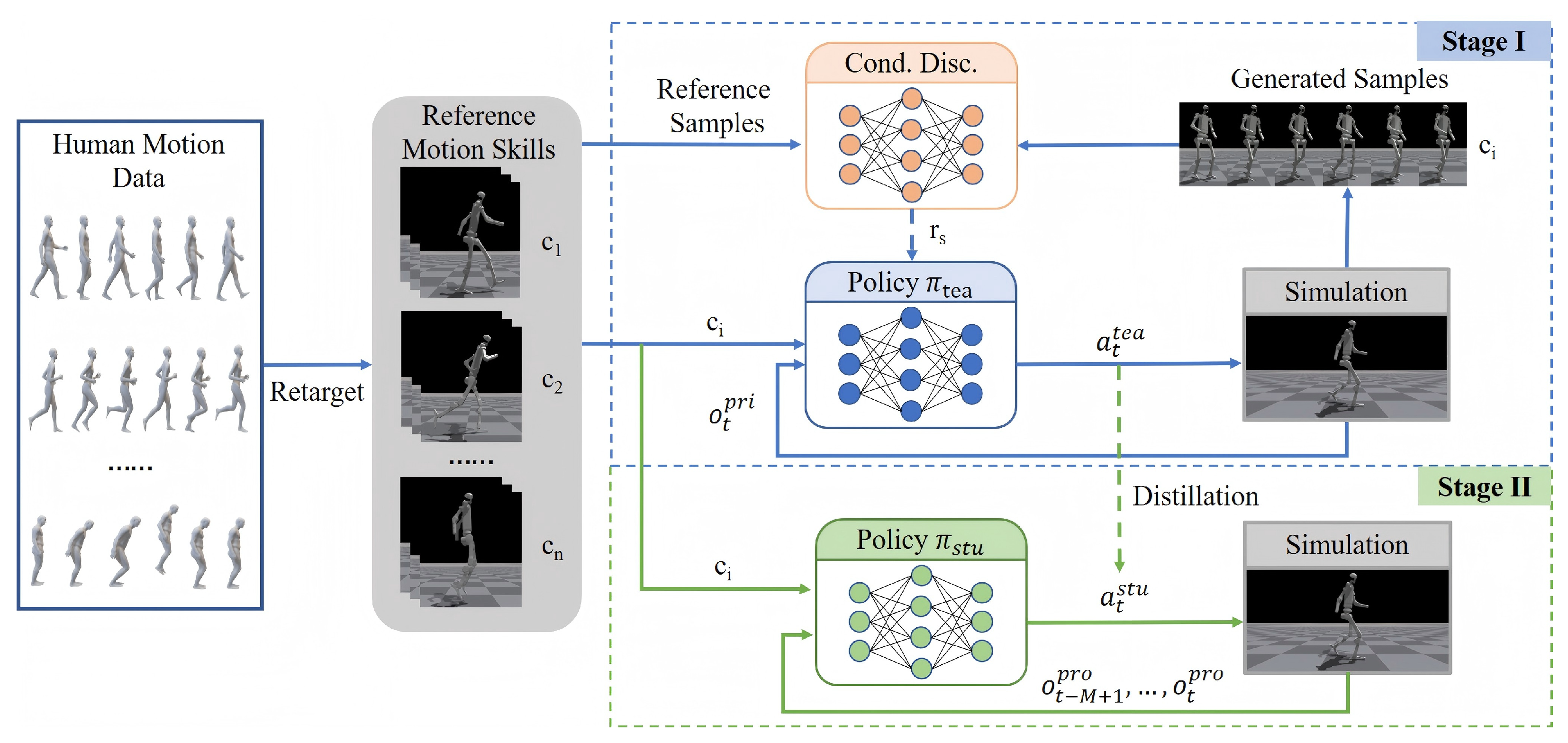
This section presents HAML, a two-stage learning system that converts clip-level labeled motion demonstrations into a single multi-skill humanoid controller and a deployable policy for real-world execution. The method is motivated by a practical observation in sim-to-real robotics: privileged simulation signals can substantially improve learning stability and peak performance, but a deployed humanoid controller must rely only on onboard-available sensing under latency and noise. To reconcile these two requirements, HAML separates training into a privileged teacher stage and a deployment-oriented student stage. Stage I learns a high-quality multi-skill teacher policy with conditional adversarial imitation, while Stage II distills the teacher into a student policy whose observation interface matches real robot constraints and is augmented with history stacking for robustness. An overview of the proposed two-stage learning system is shown in Figure 1.
Figure 1.
Overview of HAML as a deployable two-stage learning system. Stage I learns a privileged teacher policy via conditional adversarial multi-skill imitation from clip-level labeled motions. We strengthen condition sensitivity using mismatched transition–label pairs and a condition-aware objective, alleviating conditional collapse and improving controllability. Stage II distills the teacher into a deployable student policy that uses only onboard observations with historical proprioception stacking for robust real-time execution.
HAML targets scalable multi-skill control with a minimal annotation burden. Instead of requiring dense trajectory alignment or per-skill tracking reward engineering, each demonstration clip is assigned a single semantic skill label. The resulting control interface is compact and intuitive: a higher-level scheduler provides a discrete skill command, and the policy executes the corresponding behavior. The main challenge is that conditional multi-skill learning can degrade as the skill library grows. In adversarial imitation settings, the discriminator may become weakly sensitive to the condition input and focus primarily on realism classification. For control, this manifests as reduced compliance under online skill switching and partial collapse toward a subset of behaviors, even when motion realism remains visually plausible. HAML addresses this failure mode by enforcing explicit transition–label binding during discriminator training and by aligning the final policy interface with deployment realities.
3.1. Problem Formulation and Clip-Level Skill Interface
We model humanoid control as a Markov Decision Process , where denotes the state space, denotes the action space, represents the transition dynamics, is the instantaneous reward, and is the discount factor. A discrete skill condition, , is provided as an explicit command, where K is the number of skills. At each step, the policy receives an observation, , derived from the state and outputs an action conditioned on the skill label:
The objective is to maximize the expected discounted return:
The demonstration dataset consists of motion clips that have been preprocessed, such that each clip corresponds to one semantic skill. This clip-level labeling is scalable: it avoids dense frame-level annotations, and it supports adding new skills by appending new labeled clips [44]. Each clip is assigned one unique label, c, and can be treated as a set of expert transitions for that skill. However, the minimal label interface makes controllability a first-order requirement. When the skill command changes online, the same physical state may be expected to produce different behaviors. A functional multi-skill controller must, therefore, couple the label input to distinct control strategies, rather than treating it as auxiliary information.
3.2. Two-Stage Learning System Overview
HAML separates learning into two complementary stages. Stage I focuses on acquiring a high-quality multi-skill teacher in simulation. The teacher uses a privileged observation, , that may include simulator-only signals, such as richer kinematic states, more accurate velocities, or contact information. Privileged inputs simplify optimization and help the teacher achieve stronger performance with fewer iterations. The teacher is optimized using PPO [23] with an imitation-style reward provided by a conditional discriminator trained on motion transitions following adversarial imitation principles [15]. The discriminator is explicitly encouraged to be condition-sensitive through a transition–label binding objective based on mismatched pairs, which improves controllability and mitigates conditional collapse.
Stage II focuses on deployability. A real humanoid controller cannot reliably rely on privileged simulation signals. Instead, the deployed policy must operate with onboard-available observation dominated by proprioception (IMU, joint encoders, previous actions) and should remain robust to latency, noise, and dynamics mismatch. Stage II distills the teacher into a student policy that matches the teacher actions while operating on the deployable interface. History stacking provides a temporal context that helps compensate for partial observability and improves execution stability.
3.3. Stage I: Conditional Adversarial Multi-Skill Teacher Learning
Stage I learns a privileged teacher policy in simulation. Rather than designing a separate tracking objective for each skill, we derive an imitation-style reward from a conditional discriminator. This reward provides a scalable training signal across skills and encourages the policy to reproduce the distribution of expert motion transitions.
The teacher is optimized using PPO [23], which is stable in high-dimensional continuous control. At a high level, Stage I alternates between updating the discriminator to distinguish expert transitions from policy transitions under the same condition and updating the teacher policy to maximize the discriminator-derived style reward while respecting physical regularizers. Two design choices are critical for scalable multi-skill learning: the discriminator consumes a short transition context to capture temporal patterns, and the discriminator is trained with explicit condition-aware binding using mismatched transition–label pairs.
3.3.1. Transition Context Representation
Motion skills often differ primarily in temporal evolution, rather than instantaneous pose. For example, different gait patterns can share similar joint configurations but differ in the timing of leg swing and contact phases. Discriminating expert realism and skill identity from a single-step state pair is, therefore, unreliable. To provide temporal evidence, we feed the discriminator a short transition context of length N.
Let denote the simulator state at time t. We form a transition context:
The conditional discriminator is defined as:
where denotes discriminator parameters. The discriminator outputs the probability that the transition context is sampled from the expert motion distribution under condition c. In our implementation, we use as a robust default, which provides a sufficient temporal context while keeping discriminator optimization stable. We evaluate sensitivity to N in the experiments to confirm that the choice does not require per-task tuning.
3.3.2. Conditional Adversarial Objective and Style Reward
Let denote the distribution of expert transition contexts extracted from the motion dataset, and let denote the distribution induced by the current teacher policy. The discriminator is trained to classify expert contexts as positive and policy contexts as negative, conditioned on the same skill label. We use a conditional classification loss:
The teacher policy receives an imitation-style reward derived from the discriminator output. Following standard adversarial imitation practice [15], we define:
which increases when the discriminator judges the transition context as expert-like under the intended condition. This reward eliminates the need for explicit per-skill tracking losses, which is important for scaling to many skills.
3.3.3. Condition-Aware Binding via Mismatched Transition–Label Pairs
In large skill libraries, the discriminator may become condition-insensitive and focus on separating expert versus generated transitions without using the label. This behavior undermines controllability because the skill command is the primary control interface. To explicitly bind the transition pattern to its label, HAML injects mismatched transition–label pairs into discriminator training.
Given an expert transition context, , with its correct label, c, we sample an incorrect label, , and construct a mismatched pair, . The discriminator is expected to classify mismatched pairs as negative. We implement this with a condition-aware loss:
where is sampled uniformly from . Unlike Equation (5), which encourages expert-versus-policy separation under a fixed condition, Equation (7) explicitly penalizes incorrect label associations for expert transitions. This encourages the discriminator to learn condition-dependent features and improves the functional meaning of the skill command.
This binding mechanism can be interpreted as converting the discriminator into a dual-purpose evaluator. It remains a realism classifier, but it also acts as a consistency validator that checks whether the observed transition context matches the requested skill label. This property is essential for online switching, where a scheduler depends on predictable, label-consistent responses. The same failure mode of condition-insensitivity has been reported in conditional adversarial multi-skill character control, and condition-aware objectives have been shown to be effective for maintaining controllability under large skill libraries [18,19]. HAML adopts this principle and specializes it to scalable humanoid control with clip-level skill commands.
3.3.4. Regularization and Full Discriminator Objective
Adversarial training can become unstable when the discriminator becomes overly confident. A saturated discriminator yields vanishing gradients for the policy reward, which can slow down or destabilize learning. To stabilize optimization, we apply a gradient penalty and weight decay.
The gradient penalty discourages overly sharp decision boundaries:
and weight decay reduces overfitting:
where denotes discriminator parameters. The gradient penalty and weight decay terms in Equations (8) and (9) are used to stabilize adversarial optimization and prevent discriminator overfitting.
The full discriminator objective is:
Unless otherwise stated, we use , , and , which provides stable training across tasks.
3.3.5. Teacher Optimization with PPO
The teacher policy is optimized using PPO [23]. At each iteration, the policy is rolled out in simulation under randomly sampled skill labels, and the PPO update maximizes a clipped surrogate objective with advantage estimation. The reward combines the discriminator-derived imitation term and physically motivated regularizers:
The regularizers are introduced for engineering robustness. In multi-skill control, the policy may exploit the imitation reward by generating motions that satisfy discriminator realism but are physically brittle. Regularizers constrain such degenerate solutions and improve stability across skills and transitions. We include penalties that discourage excessive joint velocities and accelerations, which reduces high-frequency oscillations and improves contact stability. We penalize abrupt action changes through an action-rate term, which promotes smoother control and reduces tracking error under PD control.
We discourage excessive actuation effort through torque or energy penalties, which improves execution stability and practical operating margins in real-world deployment. Similar to intrinsic reward mechanisms designed to improve stable human–robot interaction in industrial settings, these regularizers act as stabilizers that constrain the policy within a feasible operating region and reduce physically brittle behaviors. We also penalize foot slippage to reduce unrealistic ground interactions that often appear when a policy focuses on pose realism but ignores contact consistency. These terms are standard in legged control engineering and serve as stabilizers, rather than task-specific rewards.
Random state initialization is used in Stage I to improve learning efficiency at scale. Each episode starts from a simulator state sampled from the reference dataset, while the initial skill label is sampled independently. This broadens the initial-state distribution and exposes the policy to diverse configurations. It also encourages early experience with skill switching because the initial state and label can be mismatched, which increases the training coverage of transition-relevant regimes. In practice, this strategy accelerates the acquisition of rare skills and reduces the need for manual curricula.
3.4. Stage II: Deployment-Oriented Teacher–Student Distillation
Stage I produces a high-performance teacher policy but may rely on privileged simulator signals. Stage II distills the teacher into a deployable student policy that operates with onboard-available observations. This stage is motivated by practical deployment constraints. Humanoid robots operate under sensing noise, delays, imperfect state estimation, and dynamics mismatch. A policy that depends on accurate global velocity or full-body states may fail when such signals are unavailable or unreliable.
Stage II addresses these constraints by restricting the observation interface and by providing temporal context through history stacking. The student is trained to imitate the teacher actions, thereby transferring multi-skill behaviors and transition patterns to a policy that is compatible with deployment.
3.4.1. Deployable Observation Interface
The deployable observation is dominated by proprioception. It includes the base orientation information represented through projected gravity, base angular velocity from the IMU, joint positions and velocities from encoders, the previous action, and the discrete skill command. These signals remain reliable during dynamic motions and do not require external perception systems.
Restricting the observation interface has two practical benefits. First, it avoids reliance on signals that are difficult to estimate precisely in real time, such as global linear velocity. Second, it reduces the discrepancy between the simulation and the real robot, since onboard sensing is explicitly modeled during training. This design complements sim-to-real techniques such as domain randomization and dynamics randomization [20,21] by ensuring that the policy interface itself matches deployment realities.
3.4.2. History Stacking for Partial Observability
Even with a careful observation design, the deployed controller remains partially observable. Contact states, velocity trends, and external disturbances cannot be captured fully at a single time step. To improve robustness, the student receives a history stack of the most recent M observations:
History stacking provides a temporal context that allows the student to infer latent motion trends from recent sensor readings. This is a lightweight solution that avoids introducing a separate recurrent module or explicit state estimator, and it remains compatible with real-time control. In our implementation, we use , which provides sufficient temporal information while keeping the input dimensionality manageable.
3.4.3. Distillation Objective and Training Strategy
The student is trained to match the teacher actions under the same skill condition. Let and denote teacher and student actions. We minimize an action regression loss:
The expectation is computed over states visited by the teacher during simulation rollouts. This formulation transfers the multi-skill behaviors learned in Stage I into a controller compatible with deployment observations. Distillation is typically more stable than learning a deployable policy from scratch, because the teacher already provides coherent action targets that encode the correct skill response and transition dynamics.
During distillation, we employ a default initialization strategy, rather than fully random state initialization. This reduces early-stage distribution shift under partial observations. In practice, the student is trained primarily on teacher rollouts to ensure that the training distribution covers stable, expert-like behaviors. After convergence, the student is evaluated in a closed loop to confirm that it maintains stability under its own actions and under online skill switching.
3.5. Low-Level Control Interface
Both teacher and student output target joint angles. Motor torques are computed through a PD controller:
where and denote measured joint positions and velocities, and are PD gains. This position-based action interface is widely adopted in legged robot learning because it provides robust tracking and simplifies actuation constraints. To reduce high-frequency oscillations and improve stability, the policy output can be smoothed by a low-pass filter before PD tracking. This is particularly beneficial when executing rapid skill transitions that may otherwise induce abrupt command changes.
3.6. Embodiment Adaptation and Interface Specification
HAML is designed to support heterogeneous embodiments by decoupling the learning objective from robot-specific interface definitions. The two-stage learning process remains unchanged, while each robot provides its own observation and action specification and motion retargeting module.
In Stage I, privileged observations can include richer simulator information to facilitate learning. In Stage II, observations are restricted to deployable signals. This separation ensures that the final student policy is compatible with onboard sensing across embodiments. The action space remains joint-angle targets, which makes the controller compatible with PD tracking across different robots.
For each robot, the engineering requirements include defining the actuated joints and their limits, constructing the observation vectors for teacher and student, and retargeting reference motion clips to the robot morphology. Once these components are specified, the same training procedure can be applied without redesigning skill-specific objectives. This is important for scalable system development, in which new skills or new robots may be introduced over time.
3.7. Implementation Details and Hyperparameters
All networks (teacher policy and value function, discriminator, and student policy) are implemented as shallow multi-layer perceptrons (MLPs) with ReLU activations. Stage I uses widths for the teacher, value function, and discriminator. Stage II uses widths for the student. This choice provides a favorable trade-off between expressiveness and runtime efficiency, and it aligns with the requirement that the final policy should execute in real time.
We use the Adam optimizer for all networks. For PPO, the discount factor is , generalized advantage estimation uses , and the PPO clipping threshold is . The teacher learning rate is , and the student learning rate is . The discriminator batch size is 512. PPO uses a large minibatch size of 32,768, which stabilizes updates under high-dimensional action spaces.
Key hyperparameters associated with conditional binding and deployability are set as follows. The discriminator transition length is , and the student history length is . In the discriminator loss in Equation (10), we use , , and . These values provide stable performance across tasks without per-skill tuning.
The two-stage separation between privileged learning and deployment-oriented design complements sim-to-real robustness techniques such as domain randomization [20] and dynamics randomization [21]. Since the final student policy is trained on a deployable observation interface, additional robustness tools such as sensor-noise injection and latency modeling can be incorporated in Stage II without modifying the Stage I adversarial objective.
3.8. Training Procedure
Algorithm 1 summarizes the overall training procedure. Stage I alternates discriminator and teacher updates. At each iteration, expert transitions are sampled from the reference dataset and policy transitions are collected by rolling out the teacher. Mismatched transition–label pairs are constructed by pairing expert transitions with incorrect labels to enforce condition sensitivity. Stage II then distills the trained teacher into a student using deployable observations and history stacking.
| Algorithm 1 Training procedure of HAML. |
|
4. Experiments and Results
This section evaluates HAML in both simulation and real-world deployment. We focus on three aspects: (i) multi-skill coverage and transition stability under condition switching, (ii) robustness and scalability as the skill library grows, and (iii) real-time feasibility including control frequency and end-to-end latency. To complement the quantitative evaluation, we provide supplementary videos that include representative rollouts in simulation and real-world deployments, covering both long-horizon execution and online skill switching.
We conduct experiments across multiple robots and tasks. The reference motion clips are retargeted and organized into clip-level skill categories [45]. Table 1 reports the per-task dataset statistics used in our evaluation. We compare HAML against representative conditional multi-skill baselines and report distribution-level realism, skill coverage, transition coverage, and diversity.
Table 1.
Task-wise skill composition and motion durations of the retargeted reference motion clips used in the experiments.
4.1. Experimental Settings
4.1.1. Robots and Tasks
We evaluate HAML on a set of legged platforms that cover different morphologies and actuation configurations, including BRUCE [46], AlienGo [47], Unitree H1 [48], and Unitree G1 [49]. The task suite includes both short-horizon skills (e.g., reactive locomotion snippets) and longer-horizon skills that require sustained coordination. This diversity provides a realistic stress test for conditional controllability under skill switching.
The reference motion dataset used in this work is constructed from retargeted motion data. Specifically, the source motions are obtained from the CMU Mocap dataset and an additional specialized motion dataset. To build a scalable clip-level skill library, we first preprocess the raw motion sequences by cropping them so that each clip contains only one semantic skill. A unique clip-level skill label is then assigned to each clip, and the labeled clips are retargeted to the corresponding robot embodiment to form the reference dataset used for training. Therefore, the expert data used in our experiments are organized as task-dependent collections of labeled motion clips grouped by skill category, rather than as isolated single demonstrations.
Each task corresponds to a set of clip-level skills, and each clip contains one semantic skill used as the command condition during training and evaluation. Table 1 summarizes the task-wise skill composition and motion durations of the retargeted reference motion clips used in different experiments. In addition to the regular task settings listed in Table 1, we also construct a larger-scale benchmark, H1-Hard, for scalability analysis, whose detailed statistics are reported separately in Table 2.
Table 2.
Detailed statistics of the motion capture dataset used in challenging tasks, H1-Hard.
4.1.2. Domain Randomization
To improve sim-to-real transfer, we apply domain randomization during training. Table 3 lists the domain randomization settings we used for the Unitree G1 humanoid robot. The randomization consists of three parts: dynamics randomization, observation randomization, and external perturbation. Dynamics randomization varies physical parameters such as terrain friction, link mass, inertia, and controller gains. Observation randomization adds delay and noise to the deployable observations used by the student policy, including joint states and IMU-related measurements. External perturbation injects sampled force disturbances to randomly selected body parts during training. In our implementation, dynamics randomization and external perturbation are applied in both training stages, whereas observation randomization is used in Stage II to better match deployable sensing conditions.
Table 3.
Randomization parameters used for the Unitree G1 Humanoid Robot in simulation.
4.1.3. Policy Execution Interface
All methods are evaluated under the same low-level control interface. The policy outputs target joint angles, and torques are generated by PD tracking, as described in Equation (14). To ensure a fair comparison, we keep the action space definition and the PD controller consistent across methods on the same robot. For real-world evaluation, the deployed controller operates with onboard sensing and the student observation interface described in Stage II.
4.1.4. Baselines
We compare HAML to conditional multi-skill baselines that represent common design choices in physics-based character control and legged imitation learning. The key baselines include:
CAMP. This baseline follows an AMP-style adversarial imitation formulation and appends the one-hot skill condition as part of the policy input. A conditional discriminator is trained to provide a style reward, and PPO is used for policy optimization. CAMP represents a direct extension of AMP [16] to multi-skill settings without explicit transition–label binding. For fairness, CAMP uses the same hyperparameter configuration as HAML, and the shared settings are summarized in Table 4. The two methods differ mainly in the conditional discriminator objective and the corresponding style reward formulation.
Table 4.
Shared hyperparameter settings of HAML and CAMP.
CALM. This baseline uses a latent motion representation and an additional motion encoder to model multi-skill behaviors in a structured manner. We evaluate CALM [18] under its standard pre-training stage for controllability and skill-conditioned motion generation, following its public implementation. To make the comparison reproducible, we use the same hyperparameter settings reported by the baseline codebase.
In all experiments, we keep the training budget and simulator conditions consistent across methods unless otherwise stated. When a baseline provides a public implementation, we follow its default settings and only adjust robot-specific interface definitions to match the evaluation environment. For reproducibility, the key method-specific settings used for CALM are summarized in Table 5, while the shared hyperparameter settings of HAML and CAMP are summarized in Table 4.
Table 5.
Key hyperparameter settings of CALM used in our experiments.
4.2. Evaluation Metrics
A deployable multi-skill controller must satisfy both distribution-level realism and condition-level controllability. Accordingly, we report four complementary categories of metrics.
4.2.1. Distribution-Level Realism
We evaluate distribution-level realism using Fréchet Inception Distance (FID) [34] on robot motion features. To capture both pose distribution and transition dynamics, we report two variants:
FID on motion states (). This metric compares the feature distribution of individual motion states between generated trajectories and reference clips.
FID on motion transitions (). This metric compares the feature distribution of transition pairs (or short transition contexts) and is more sensitive to dynamic consistency.
For each method, we collect 100,000 samples from policy rollouts and 100,000 samples from the reference dataset, and we compute the corresponding FID values.
4.2.2. Skill Controllability and Coverage
To measure whether the skill command is functionally meaningful, we evaluate filtered skill coverage, , and skill transition coverage, .
Filtered skill coverage (). We roll out 2000 trajectories with a fixed horizon of 400 steps while keeping the skill condition constant. For each trajectory, we infer the executed skill category by matching the generated motion transitions to the reference dataset. Let denote the number of generated trajectories matched to the i-th reference skill, K the number of skill categories, and N the number of collected trajectories. The i-th skill is counted as covered only if
where is the filtering rate. In our experiments, we set to reduce chance matches. The final filtered skill coverage score is computed as the fraction of skill categories that satisfy the above criterion.
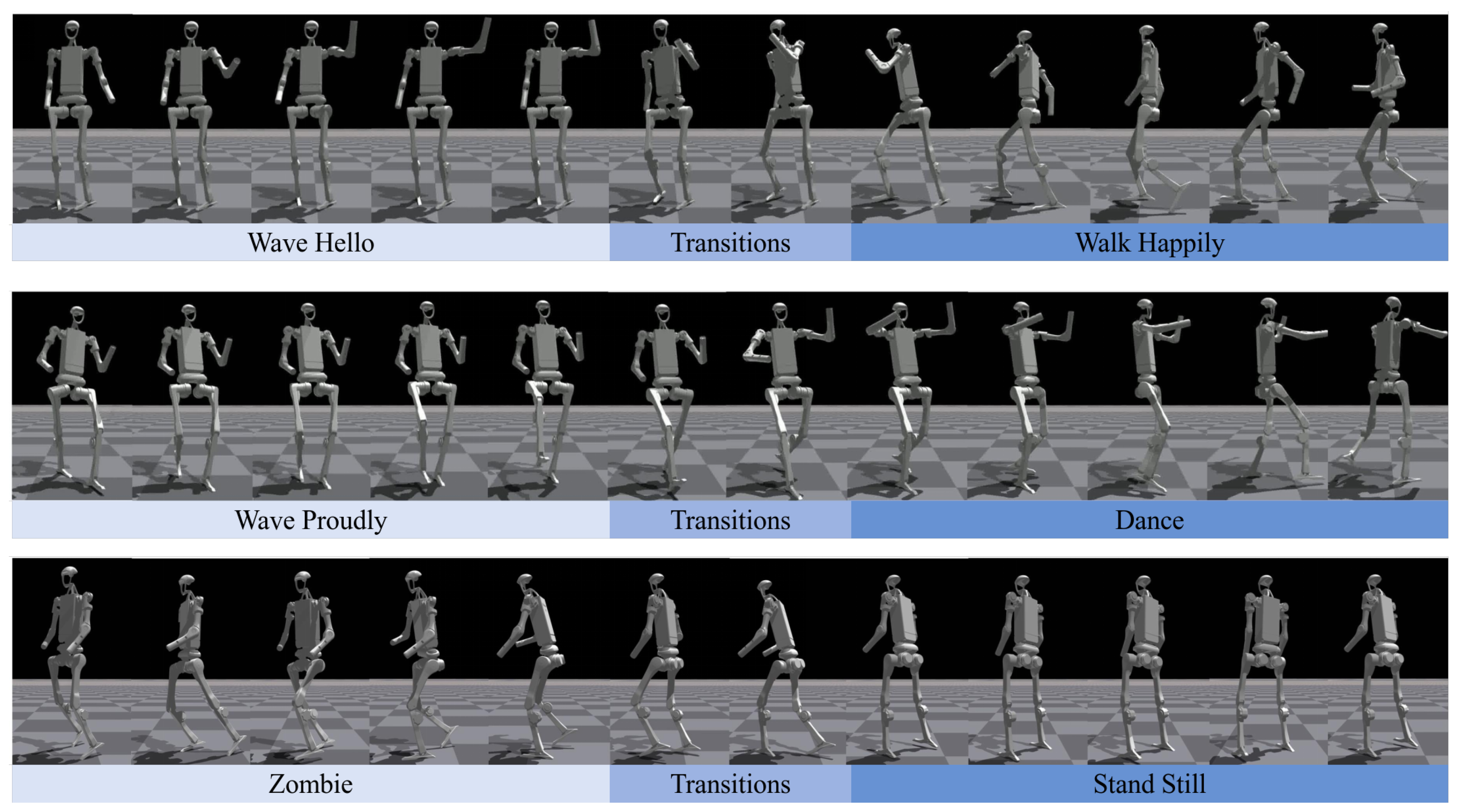
Skill transition coverage (). We roll out 2000 trajectories with a horizon of 200 steps and switch the skill condition at step 100. We match the pre-switch and post-switch segments separately to infer the realized transition. The transition coverage score measures how well a policy follows commanded skill changes, and it directly reflects controllability under switching. Qualitative examples of online skill switching and the resulting transition behaviors are visualized in Figure 2.
Figure 2.
Snapshots of the motion sequences generated by HAML, which enables flexible transitions between different motion skills. Skill labels (e.g. wave hello, walk happily, dance, etc.) are provided.
These two metrics are designed to quantify both steady-state skill compliance and switching behavior under the same evaluation protocol. The transition coverage score is computed as
which measures how reliably the policy follows online skill-switching commands.
4.2.3. Diversity
A multi-skill policy should avoid collapsing to a small subset of motion patterns. We report Average Pairwise Distance (APD), which measures the diversity among generated trajectories by computing pairwise distances over motion states. Higher APD indicates more varied motion generation, while extremely high APD may suggest instability. We interpret APD jointly with coverage metrics to distinguish meaningful diversity from uncontrolled exploration.
4.3. Matching and Inference Protocol
Coverage metrics require inferring which reference skill a generated segment corresponds to. We perform transition-level matching using a nearest-neighbor criterion over reference motion transitions. Given a generated transition pair , we search over reference motions m and compute:
The transition-level nearest-neighbor matching rule in Equation (15) is applied consistently to infer executed skills and compute coverage-related metrics.
The inferred skill label is the label associated with the best-matched reference motion, . This protocol is used consistently across methods for both steady-state coverage and transition coverage evaluation.
To reduce spurious matches, we apply the threshold-based filtering rule defined above when computing . This results in the filtered coverage metric , which better reflects functional controllability compared with raw matching statistics. The same matching and filtering procedure is applied to all baselines and HAML.
4.4. Results in Simulated Environments
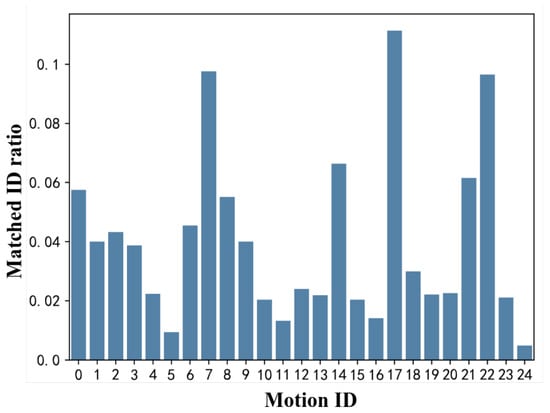
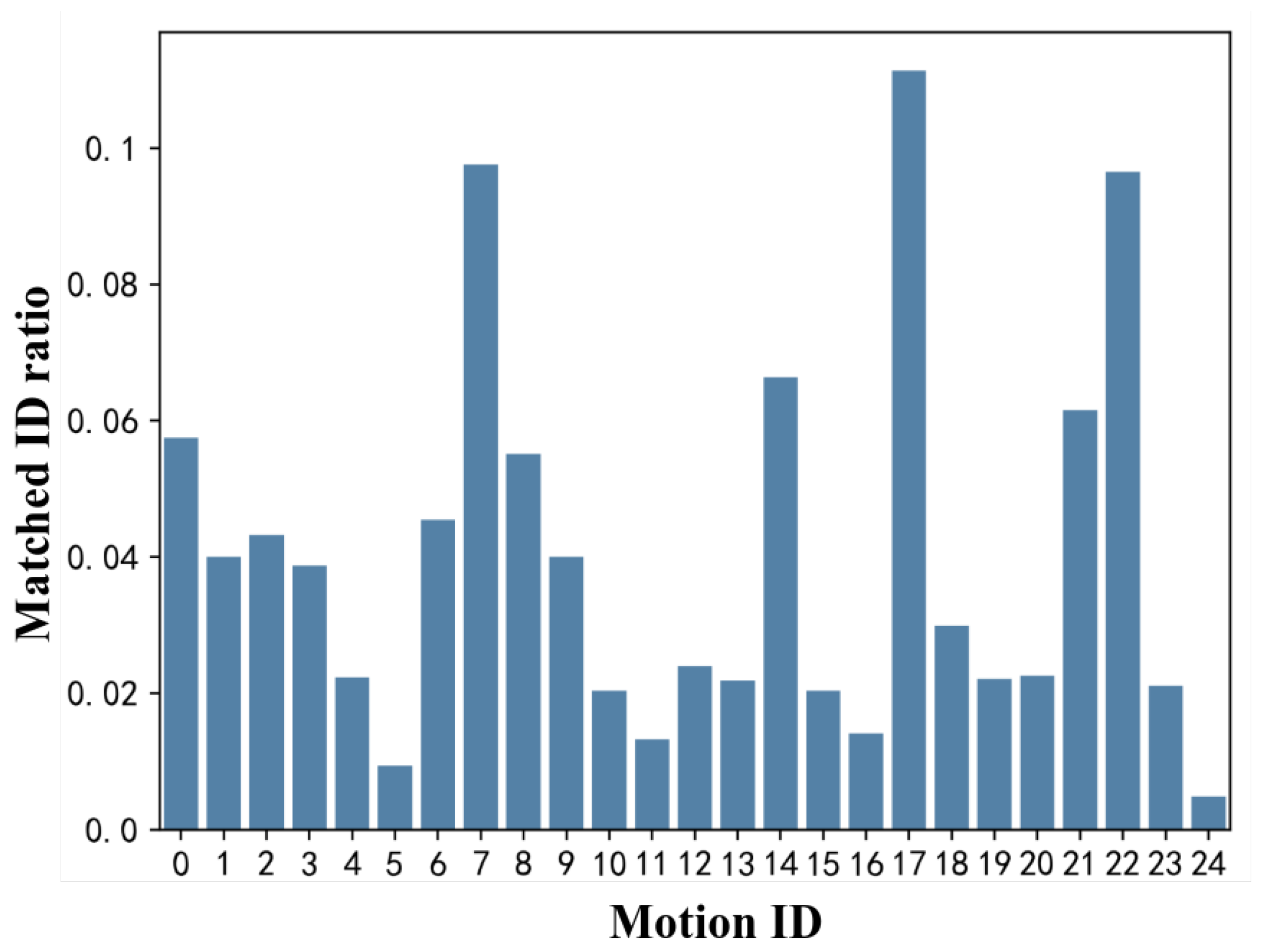
We further visualize skill coverage on a larger-scale scalability task, denoted as H1-Hard, to illustrate scalability and switching stability under an expanded skill library (Figure 3). The detailed reference motion set used in H1-Hard is summarized in Table 2. Table 6 summarizes quantitative results across robots and tasks. Overall, HAML achieves favorable trade-offs between distribution-level realism and multi-skill controllability. Compared with direct conditional adversarial baselines, HAML consistently improves skill coverage and transition coverage, indicating that the learned policy responds more reliably to online switching. These gains are achieved without sacrificing motion realism, as reflected by comparable or improved FID scores in most tasks. We further report end-to-end runtime statistics in Table 7, including policy inference and control-loop execution, to reflect the practical responsiveness of each method.
Figure 3.
Coverage of motion skills on the H1-Hard scalability task. The vertical axis reports the proportion of matched motion IDs corresponding to each reference skill in the captured motion trajectories.
Table 6.
Quantitative evaluation of multi-skill learning methods on different tasks.
Table 7.
Policy deployment runtime on different hardware platforms.
The improvements are particularly pronounced in tasks with larger skill libraries, where conditional collapse becomes more likely. In such regimes, baselines that treat the skill label as a passive input may generate realistic motions but fail to realize diverse skills or follow switching commands. In contrast, HAML maintains stronger label compliance due to its condition-aware binding objective, which forces the discriminator to validate transition–label consistency.
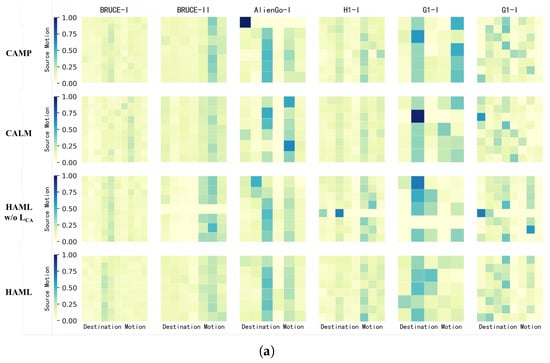
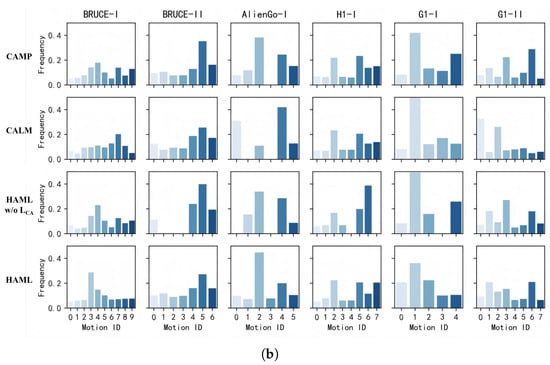
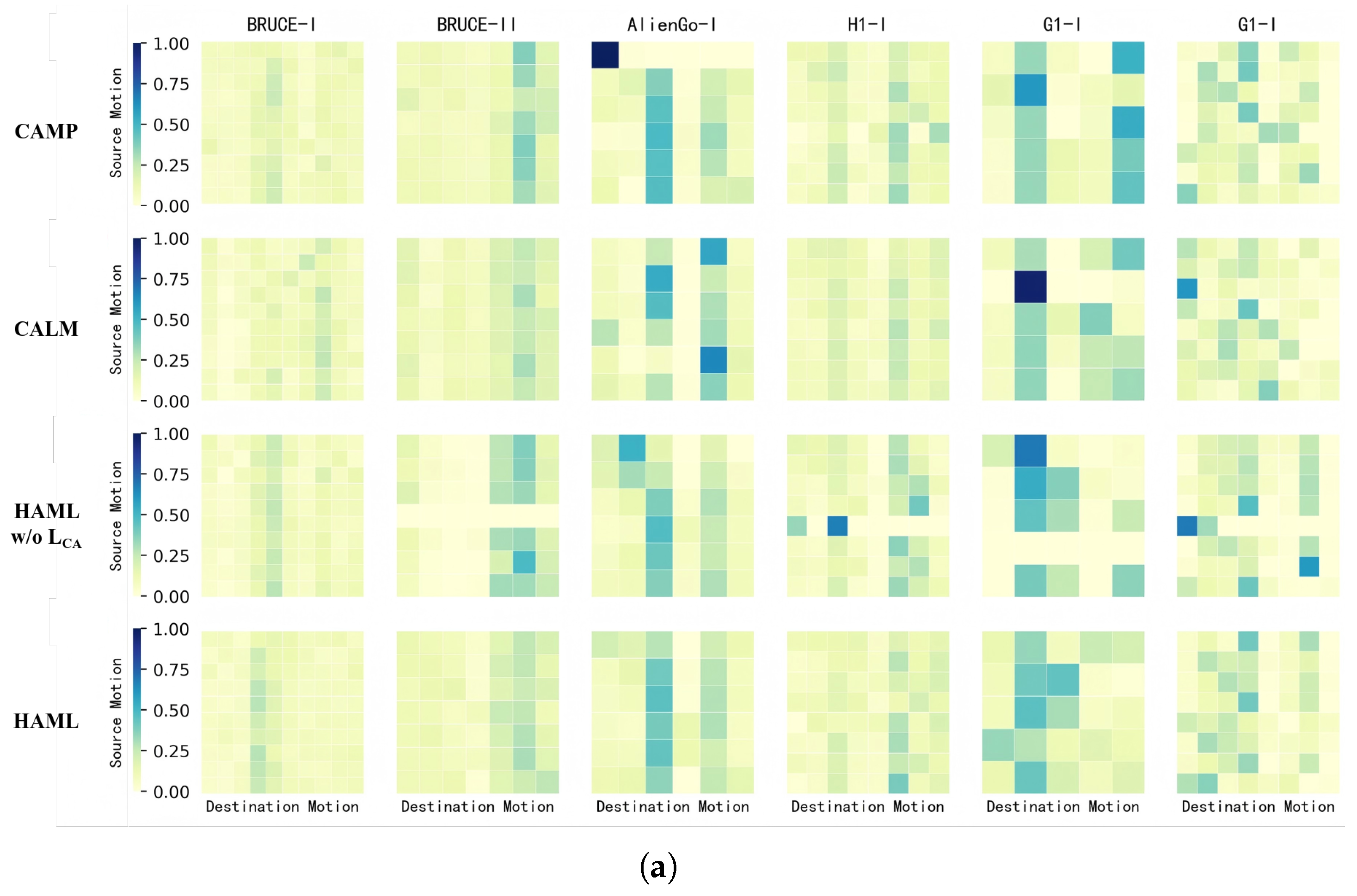
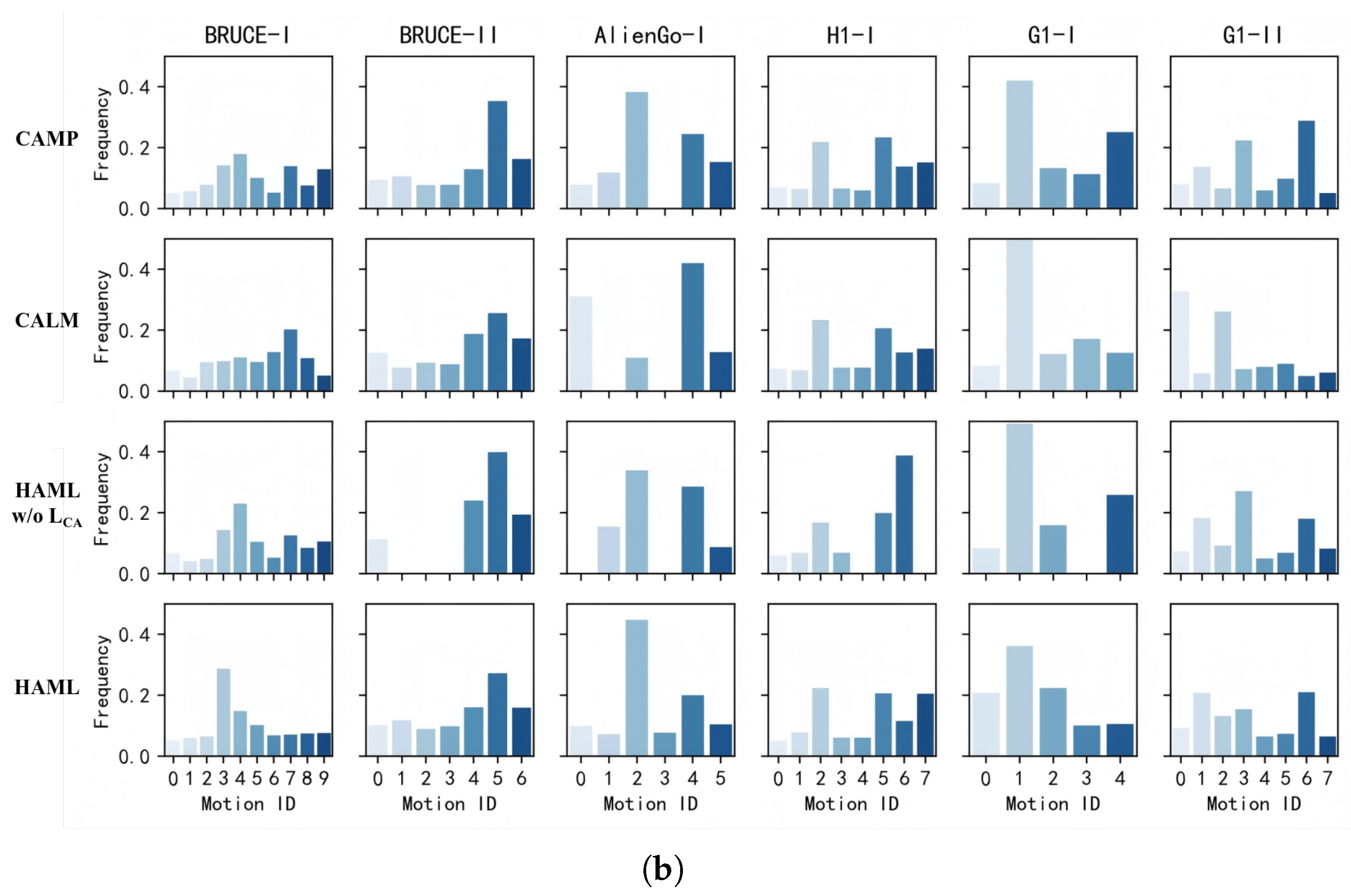
To provide more detailed evidence beyond aggregated scores, Figure 4 visualizes the distribution of per-skill coverage and transition coverage across tasks. This distribution-level view highlights not only the mean performance but also the stability of skill execution across different categories. HAML exhibits fewer missing skills and fewer failed transitions, which indicates more uniform controllability under clip-level commands.
Figure 4.
Distribution-level evaluation of multi-skill controllability. (a) Per-skill filtered coverage distribution across tasks; (b) skill transition coverage distribution across tasks.
4.5. Real-World Validation
The real-world experiments in this work are designed to validate deployability, stable execution, and online skill switching for representative multi-skill behaviors on the Unitree G1 platform. We emphasize that the tested hardware skills mainly focus on deployable motions such as standing, walking, waving, and handshaking, rather than highly dynamic and strongly coupled whole-body maneuvers. Therefore, the present results should be interpreted as evidence of engineering feasibility under the tested conditions, rather than as a complete verification of robustness across the full range of humanoid skills.
We deploy the distilled student policy on a physical humanoid platform to validate real-world feasibility. In real execution, the policy operates solely on onboard-available observations and uses history stacking as described in Stage II. The controller runs in a closed loop with the onboard control system at 100 Hz. Aligning with integrated validation platforms used for sensor interactions and hardware-in-the-loop simulation [50], our deployment setup ensures that the distilled policy can be rigorously tested under realistic sensing latency (15–25 ms) and noise. All experiments are performed on Unitree G1 with onboard computer [49].
The reported hardware performance should be interpreted together with the deployment-oriented training design described in Section 3. In particular, the student policy is trained on a deployable observation interface, while Stage II remains compatible with sensor-noise injection and latency modeling. Therefore, the 100 Hz control rate and 15–25 ms end-to-end latency are not evaluated in an idealized transfer setting but under a design that explicitly considers common sources of execution uncertainty.
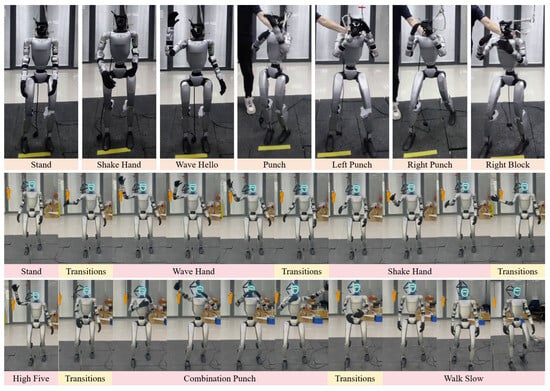
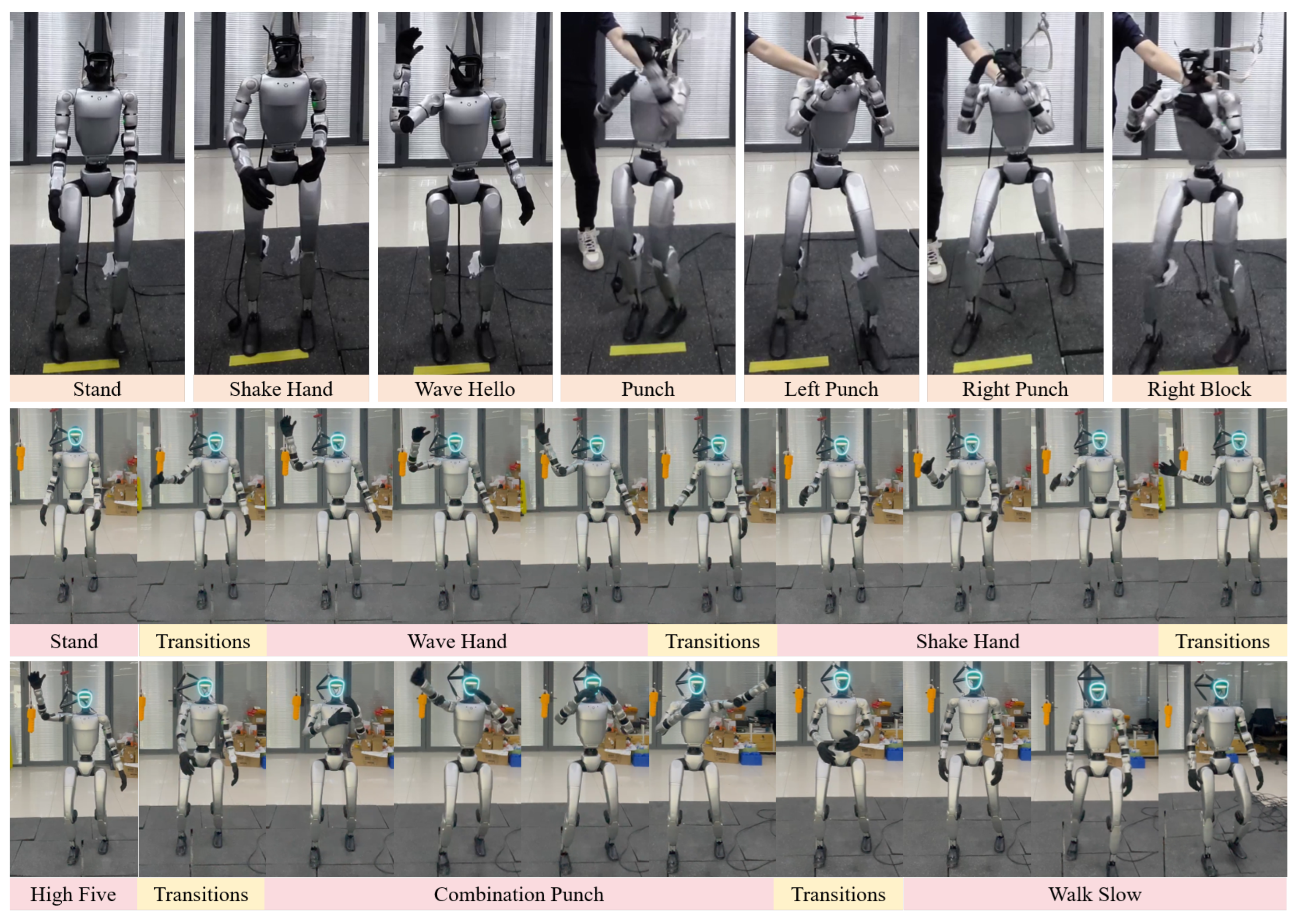
The real-world evaluation focuses on two aspects. First, the student policy should reproduce key multi-skill behaviors observed in simulation while maintaining stable balance and contact interactions. Second, the policy should support online switching without requiring manual resets or per-skill tuning. We observe that the student executes the tested skills with stable posture and smooth transitions, and the behavior remains consistent across repeated trials. These results confirm that the two-stage design, which separates privileged teacher learning from deployable student distillation, is effective for bridging the sim-to-real gap under practical sensing constraints. Representative real-robot rollouts are shown in Figure 5. These results indicate that the proposed framework can support online skill switching on a physical humanoid platform without relying on highly precise external state estimation, which is important for onboard deployment in realistic operating conditions. We note that the reported real-world results are intended to evaluate deployability and empirical robustness under the tested conditions. They should not be interpreted as evidence of compliance with industrial safety standards or as a substitute for formal safety certification.
Figure 5.
HAML demonstrates the learning of versatile humanoid motion skills and the flexibility in switching between them in real-world deployments.
At the same time, the present manuscript does not yet provide a fully factorized quantitative ablation that isolates the individual effects of sensing the noise magnitude, delay level, and disturbance intensity on hardware performance. Therefore, the current real-world results should be interpreted as evidence of deployability and empirical robustness under the tested conditions, rather than as a complete robustness characterization for all disturbance regimes.
4.6. Ablation and Sensitivity Analyses
We conduct ablation studies to isolate the contributions of key design components. The first ablation removes the condition-aware binding loss in Equation (7) and trains the teacher with only the conditional classification objective in Equation (5). This variant tends to show reduced skill coverage and weaker switching performance, especially in tasks with larger skill libraries. The result supports the hypothesis that explicit transition–label binding mitigates condition-insensitivity in the discriminator and improves controllability.
The second ablation studies the transition context length N in the discriminator input. Short contexts may be insufficient to capture temporal signatures for certain skills, while overly long contexts can make the discriminator overly strict and hinder adversarial optimization. Table 8 reports the sensitivity to the transition context length N, indicating that provides a robust operating point across tasks, yielding stable coverage and transition behavior without requiring per-task tuning.
Table 8.
Ablation on the motion transition length N.
The third ablation evaluates the effect of history stacking length M during student distillation. Short histories can reduce the student’s ability to infer latent trends under partial observability, whereas very long histories increase input dimensionality and may slow training. The history stacking length M is another practically important design choice in Stage II. Short histories may be insufficient to compensate for partial observability, whereas overly long histories increase input dimensionality and runtime overhead. In this work, we empirically set as a practical default based on deployment considerations.
4.7. Extensibility to Additional Task Commands
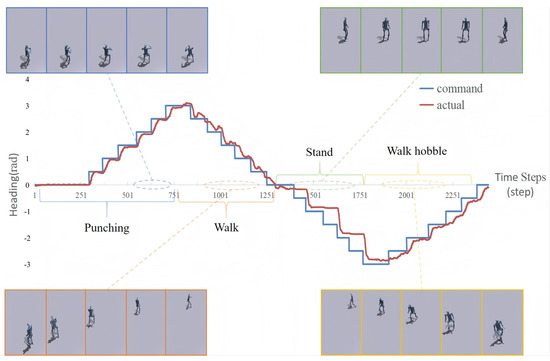
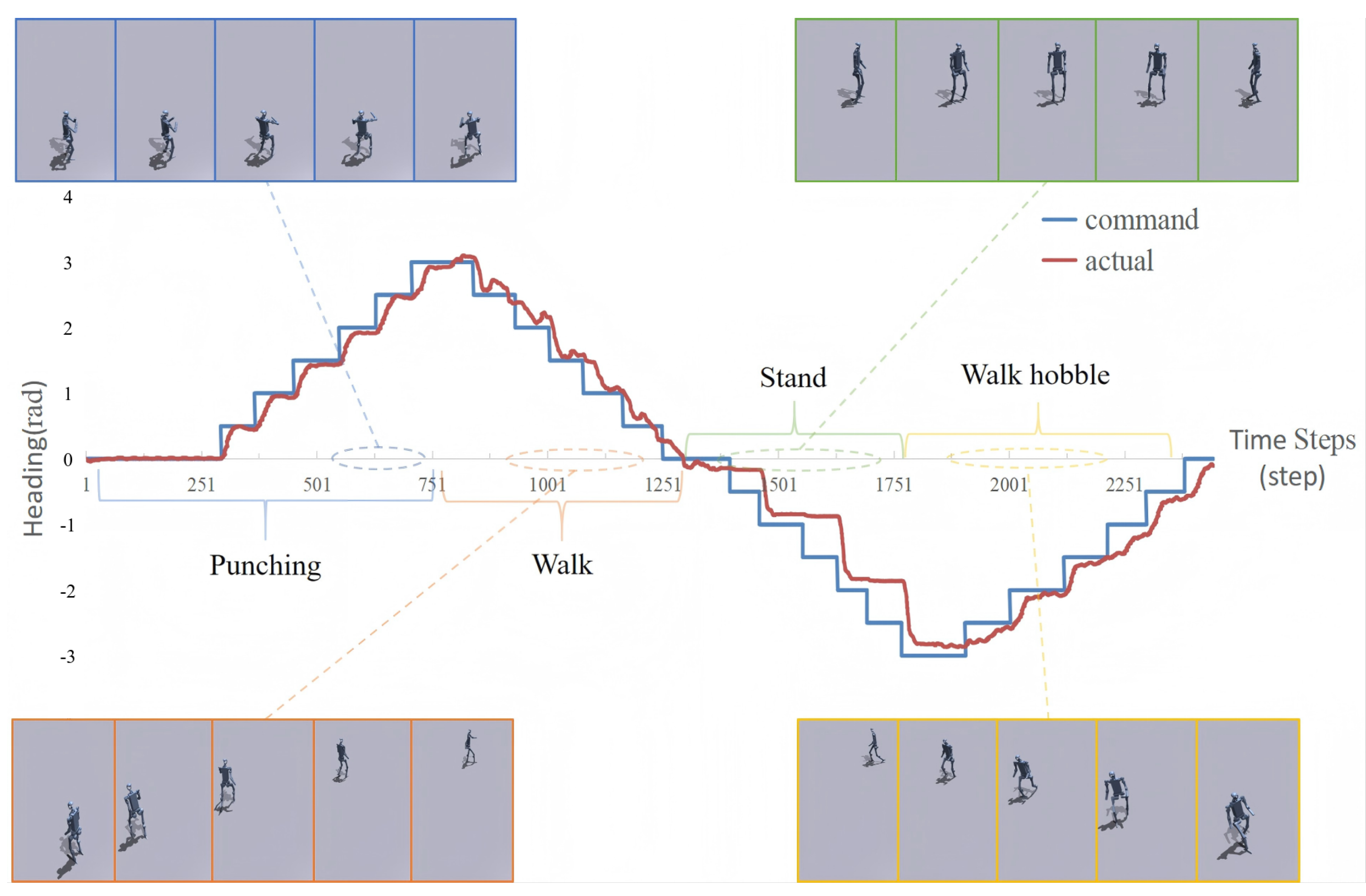
Beyond discrete skill labels, HAML can incorporate additional task commands by augmenting the policy input and introducing lightweight shaping terms. As an example, we include a target heading command, , for locomotion control and define a heading-tracking reward:
where , and . Figure 6 shows that the controller can track heading commands while preserving stable skill switching behavior, indicating that the proposed framework can support richer command interfaces without altering the core two-stage learning framework.
Figure 6.
Extensibility of HAML to additional task commands. The policy tracks target heading commands while preserving stable multi-skill switching behaviors.
5. Conclusions
This paper has presented HAML, a scalable two-stage learning system for deployable multi-skill humanoid control from clip-level labeled motion demonstrations. The proposed approach first learns a conditional adversarial teacher policy in simulation, enabling the acquisition of diverse skills without per-skill tracking reward engineering. To preserve controllability under large skill libraries and frequent online switching, we introduced a condition-aware binding objective that explicitly enforces transition–label consistency during discriminator training. The resulting teacher is then distilled into a student policy that operates with onboard-available observations and history stacking, bridging the gap between privileged simulation learning and real-world execution.
Extensive evaluations across multiple robots and task suites demonstrated that HAML achieves competitive distribution-level realism while providing stronger filtered skill coverage and higher transition coverage compared with representative conditional multi-skill baselines. Real-world experiments further validated that the distilled student can execute multi-skill behaviors stably and supports smooth skill switching under practical sensing constraints.
The present study also faced several limitations. Although the real-world experiments verify deployability, stable execution, and online skill switching for representative behaviors, they do not yet constitute an exhaustive hardware evaluation over highly dynamic and strongly coupled whole-body skills. A further limitation is that, although sensing delay, observation noise, and external perturbations are explicitly modeled during training, the present manuscript does not yet provide a standalone quantitative analysis that disentangles the contribution of each factor to real-world performance. As a result, the current experiments support engineering feasibility under the tested conditions, but they should not be interpreted as a complete validation of robustness across the full range of humanoid motions. Extending the framework to more dynamic, contact-rich, and strongly coupled real-world skills will, therefore, be an important direction for future work.
Author Contributions
Conceptualization, X.F. and H.L.; methodology, X.F.; software, X.F. and Y.C.; validation, X.F., H.L. and W.T.; formal analysis, W.T.; investigation, H.L.; resources, X.L.; data curation, H.L.; writing—original draft preparation, X.F. and H.L.; writing—review and editing, X.F. and Y.C.; visualization, H.L.; supervision, X.L.; project administration, X.L.; funding acquisition, X.L. All authors have read and agreed to the published version of the manuscript.
Funding
This research was funded by the Major Research Program of Shandong Province under Grant 2024CXGC010212.
Institutional Review Board Statement
Not applicable.
Informed Consent Statement
Not applicable.
Data Availability Statement
The original contributions presented in this study are included in the article. Further inquiries can be directed to the corresponding author.
Conflicts of Interest
The authors declare no conflicts of interest.
References
- He, T.; Luo, Z.; Xiao, W.; Zhang, C.; Kitani, K.; Liu, C.; Shi, G. Learning Human-to-Humanoid Real-Time Whole-Body Teleoperation. In Proceedings of the IEEE/RSJ International Conference on Intelligent Robots and Systems (IROS), Abu Dhabi, United Arab Emirates, 14–18 October 2024; pp. 8944–8951. [Google Scholar]
- He, T.; Luo, Z.; He, X.; Xiao, W.; Zhang, C.; Zhang, W.; Kitani, K.M.; Liu, C.; Shi, G. OmniH2O: Universal and Dexterous Human-to-Humanoid Whole-Body Teleoperation and Learning. In Proceedings of the Conference on Robot Learning (CoRL), Munich, Germany, 6–9 November 2024. [Google Scholar]
- Zhuang, Z.; Fu, Z.; Wang, J.; Atkeson, C.G.; Schwertfeger, S.; Finn, C.; Zhao, H. Robot Parkour Learning. In Proceedings of the Conference on Robot Learning (CoRL), Atlanta, GA, USA, 6–9 November 2023. [Google Scholar]
- Haarnoja, T.; Moran, B.; Lever, G.; Huang, S.H.; Tirumala, D.; Humplik, J.; Wulfmeier, M.; Tunyasuvunakool, S.; Siegel, N.Y.; Hafner, D.; et al. Learning Agile Soccer Skills for a Bipedal Robot with Deep Reinforcement Learning. Sci. Robot. 2024, 9, eadi8022. [Google Scholar] [CrossRef] [Scilit]
- Li, Z.; Peng, X.B.; Abbeel, P.; Levine, S.; Berseth, G.; Sreenath, K. Reinforcement Learning for Versatile, Dynamic, and Robust Bipedal Locomotion Control. Int. J. Robot. Res. 2025, 44, 840–888. [Google Scholar] [CrossRef] [Scilit]
- Cheng, X.; Ji, Y.; Chen, J.; Yang, R.; Yang, G.; Wang, X. Expressive Whole-Body Control for Humanoid Robots. In Proceedings of the Robotics: Science and Systems (RSS), Delft, The Netherlands, 15–19 July 2024. [Google Scholar]
- Ji, M.; Peng, X.; Liu, F.; Li, J.; Yang, G.; Cheng, X.; Wang, X. ExBody2: Advanced Expressive Humanoid Whole-Body Control. arXiv 2024, arXiv:2412.13196. [Google Scholar] [CrossRef] [Scilit]
- Li, R.; Zou, Z. Enhancing construction robot learning for collaborative and long-horizon tasks using generative adversarial imitation learning. Adv. Eng. Inform. 2023, 58, 102140. [Google Scholar] [CrossRef] [Scilit]
- You, H.; Zhou, T.; Zhu, Q.; Ye, Y.; Du, J. Embodied AI for dexterity-capable construction Robots: DEXBOT framework. Adv. Eng. Inform. 2024, 62, 102572. [Google Scholar] [CrossRef] [Scilit]
- Rodriguez, D.; Behnke, S. DeepWalk: Omnidirectional Bipedal Gait by Deep Reinforcement Learning. In Proceedings of the IEEE International Conference on Robotics and Automation (ICRA), Xi’an, China, 30 May–5 June 2021; pp. 3033–3039. [Google Scholar] [CrossRef] [Scilit]
- Radosavovic, I.; Xiao, T.; Zhang, B.; Darrell, T.; Malik, J.; Sreenath, K. Real-World Humanoid Locomotion with Reinforcement Learning. Sci. Robot. 2024, 9, eadi9579. [Google Scholar] [CrossRef] [Scilit] [PubMed]
- Zhang, C.; Xiao, W.; He, T.; Shi, G. WoCoCo: Learning Whole-Body Humanoid Control with Sequential Contacts. In Proceedings of the Conference on Robot Learning (CoRL), Munich, Germany, 6–9 November 2024. [Google Scholar]
- Xue, Y.; Dong, W.; Liu, M.; Zhang, W.; Pang, J. A Unified and General Humanoid Whole-Body Controller for Fine-Grained Locomotion. arXiv 2025, arXiv:2502.03206. [Google Scholar] [CrossRef] [Scilit]
- Escontrela, A.; Peng, X.B.; Yu, W.; Zhang, T.; Iscen, A.; Goldberg, K.; Abbeel, P. Adversarial Motion Priors Make Good Substitutes for Complex Reward Functions. In Proceedings of the IEEE/RSJ International Conference on Intelligent Robots and Systems (IROS), Kyoto, Japan, 23–27 October 2022; pp. 25–32. [Google Scholar]
- Ho, J.; Ermon, S. Generative Adversarial Imitation Learning. In Proceedings of the Advances in Neural Information Processing Systems (NeurIPS), Barcelona, Spain, 5–10 December 2016. [Google Scholar]
- Peng, X.B.; Ma, Z.; Abbeel, P.; Levine, S.; Kanazawa, A.; Fidler, S. AMP: Adversarial Motion Priors for Stylized Physics-Based Character Control. ACM Trans. Graph. (TOG) 2021, 40, 144. [Google Scholar] [CrossRef] [Scilit]
- Peng, X.B.; Guo, Y.; Halper, L.; Levine, S.; Fidler, S. ASE: Large-Scale Reusable Adversarial Skill Embeddings for Physically Simulated Characters. ACM Trans. Graph. (TOG) 2022, 41, 94. [Google Scholar] [CrossRef] [Scilit]
- Tessler, C.; Kasten, Y.; Guo, Y.; Mannor, S.; Chechik, G.; Peng, X.B. CALM: Conditional Adversarial Latent Models for Directable Virtual Characters. In Proceedings of the ACM SIGGRAPH, Los Angeles, CA, USA, 6–10 August 2023; pp. 1–9. [Google Scholar]
- Dou, Z.; Chen, X.; Fan, Q.; Komura, T.; Wang, W. C·ASE: Learning Conditional Adversarial Skill Embeddings for Physics-Based Characters. In Proceedings of the ACM SIGGRAPH Asia, Sydney, NSW, Australia, 12–15 December 2023; pp. 1–11. [Google Scholar]
- Tobin, J.; Fong, R.; Ray, A.; Schneider, J.; Zaremba, W.; Abbeel, P. Domain Randomization for Transferring Deep Neural Networks from Simulation to the Real World. In Proceedings of the IEEE/RSJ International Conference on Intelligent Robots and Systems (IROS), Vancouver, BC, Canada, 24–28 September 2017; pp. 23–30. [Google Scholar] [CrossRef] [Scilit]
- Peng, X.B.; Andrychowicz, M.; Zaremba, W.; Abbeel, P. Sim-to-Real Transfer of Robotic Control with Dynamics Randomization. In IEEE International Conference on Robotics and Automation (ICRA); IEEE: Piscataway, NJ, USA, 2018; pp. 1–8. [Google Scholar]
- Duan, H.; Pandit, B.; Gadde, M.S.; van Marum, B.; Dao, J.; Kim, C.; Fern, A. Learning Vision-Based Bipedal Locomotion for Challenging Terrain. arXiv 2023, arXiv:2309.14594. [Google Scholar] [CrossRef] [Scilit]
- Schulman, J.; Wolski, F.; Dhariwal, P.; Radford, A.; Klimov, O. Proximal Policy Optimization Algorithms. arXiv 2017, arXiv:1707.06347. [Google Scholar] [CrossRef] [Scilit]
- Peng, X.B.; Kanazawa, A.; Toyer, S.; Abbeel, P.; Levine, S.; Van de Panne, M. DeepMimic: Example-Guided Deep Reinforcement Learning of Physics-Based Character Skills. ACM Trans. Graph. (TOG) 2018, 37, 143:1–143:14. [Google Scholar] [CrossRef] [Scilit]
- Won, J.; Gopinath, D.; Hodgins, J. A Scalable Approach to Control Diverse Behaviors for Physically Simulated Characters. ACM Trans. Graph. (TOG) 2020, 39, 33:1–33:12. [Google Scholar] [CrossRef] [Scilit]
- Wang, Y.; Zhao, Q.; Yu, R.; Zeng, A.; Lin, J.; Luo, Z.; Tsui, H.W.; Yu, J.; Li, X.; Chen, Q.; et al. SkillMimic: Learning Reusable Basketball Skills from Demonstrations. In Proceedings of the IEEE/CVF Conference on Computer Vision and Pattern Recognition (CVPR), Seattle, WA, USA, 16–22 June 2024. [Google Scholar]
- Zhang, H.; Yuan, Y.; Makoviychuk, V.; Guo, Y.; Fidler, S.; Peng, X.B.; Fatahalian, K. Learning Physically Simulated Tennis Skills from Broadcast Videos. ACM Trans. Graph. (TOG) 2023, 42, 95. [Google Scholar] [CrossRef] [Scilit]
- Tessler, C.; Guo, Y.; Nabati, O.; Chechik, G.; Peng, X.B. MaskedMimic: Unified Physics-Based Character Control Through Masked Motion Inpainting. arXiv 2024, arXiv:2409.14393. [Google Scholar] [CrossRef] [Scilit]
- Zhu, Q.; Zhang, H.; Lan, M.; Han, L. Neural Categorical Priors for Physics-Based Character Control. ACM Trans. Graph. (TOG) 2023, 42, 178. [Google Scholar] [CrossRef] [Scilit]
- Luo, Z.; Cao, J.; Merel, J.; Winkler, A.; Huang, J.; Kitani, K.M.; Xu, W. Universal Humanoid Motion Representations for Physics-Based Control. In Proceedings of the International Conference on Learning Representations (ICLR), Vienna, Austria, 7–11 May 2024. [Google Scholar]
- Tang, A.; Hiraoka, T.; Hiraoka, N.; Shi, F.; Kawaharazuka, K.; Kojima, K.; Okada, K.; Inaba, M. HumanMimic: Learning Natural Locomotion and Transitions for Humanoid Robot via Wasserstein Adversarial Imitation. In Proceedings of the IEEE International Conference on Robotics and Automation (ICRA), Yokohama, Japan, 13–17 May 2024; pp. 13107–13114. [Google Scholar]
- Zhang, Q.; Cui, P.; Yan, D.; Sun, J.; Duan, Y.; Han, G.; Zhao, W.; Zhang, W.; Guo, Y.; Zhang, A.; et al. Whole-Body Humanoid Robot Locomotion with Human Reference. In Proceedings of the IEEE/RSJ International Conference on Intelligent Robots and Systems (IROS), Abu Dhabi, United Arab Emirates, 14–18 October 2024; pp. 11225–11231. [Google Scholar]
- Zhang, Z.; Bashkirov, S.; Yang, D.; Shi, Y.; Taylor, M.; Peng, X.B. ADD: Physics-Based Motion Imitation with Adversarial Differential Discriminators. arXiv 2025, arXiv:2505.04961. [Google Scholar] [CrossRef] [Scilit]
- Heusel, M.; Ramsauer, H.; Unterthiner, T.; Nessler, B.; Hochreiter, S. GANs Trained by a Two Time-Scale Update Rule Converge to a Local Nash Equilibrium. Adv. Neural Inf. Process. Syst. (NeurIPS) 2017, 30, 6627–6638. [Google Scholar]
- Goodfellow, I.J.; Pouget-Abadie, J.; Mirza, M.; Xu, B.; Warde-Farley, D.; Ozair, S.; Courville, A.; Bengio, Y. Generative Adversarial Nets. In Proceedings of the Advances in Neural Information Processing Systems (NeurIPS), Montreal, QC, Canada, 8–13 December 2014. [Google Scholar]
- Gulrajani, I.; Ahmed, F.; Arjovsky, M.; Dumoulin, V.; Courville, A. Improved Training of Wasserstein GANs. In Proceedings of the Advances in Neural Information Processing Systems (NeurIPS), Long Beach, CA, USA, 4–9 December 2017. [Google Scholar]
- Mescheder, L.; Geiger, A.; Nowozin, S. Which Training Methods for GANs Do Actually Converge? In Proceedings of the International Conference on Machine Learning (ICML), Stockholm, Sweden, 10–15 July 2018; pp. 3481–3490. [Google Scholar]
- Menéndez, M.L.; Pardo, J.A.; Pardo, L.; Pardo, M.C. The Jensen-Shannon Divergence. J. Frankl. Inst. 1997, 334, 307–318. [Google Scholar] [CrossRef] [Scilit]
- Lee, D.; Lee, S.H.; Masoud, N.; Krishnan, M.; Li, V.C. Digital twin-driven deep reinforcement learning for adaptive task allocation in robotic construction. Adv. Eng. Inform. 2022, 53, 101710. [Google Scholar] [CrossRef] [Scilit]
- Hwangbo, J.; Lee, J.; Dosovitskiy, A.; Bellicoso, C.D.; Tsounis, V.; Koltun, V.; Hutter, M. Learning Agile and Dynamic Motor Skills for Legged Robots. Sci. Robot. 2019, 4, eaau5872. [Google Scholar] [CrossRef] [Scilit] [PubMed]
- Makoviychuk, V.; Wawrzynski, P.; Guo, Y.; Lu, M.; Storey, J.; Macklin, M.; Hoeller, D.; Rudin, N.; Allshire, A.; Handa, A.; et al. Isaac Gym: High Performance GPU Based Physics Simulation for Robot Learning. arXiv 2021, arXiv:2108.10470. [Google Scholar] [CrossRef] [Scilit]
- He, T.; Xiao, W.; Lin, T.; Luo, Z.; Xu, Z.; Jiang, Z.; Kautz, J.; Liu, C.; Shi, G.; Wang, X.; et al. HOVER: Versatile Neural Whole-Body Controller for Humanoid Robots. arXiv 2024, arXiv:2410.21229. [Google Scholar] [CrossRef] [Scilit]
- Mao, J.; Zhao, S.; Song, S.; Shi, T.; Ye, J.; Zhang, M.; Geng, H.; Malik, J.; Guizilini, V.; Wang, Y. Learning from Massive Human Videos for Universal Humanoid Pose Control. arXiv 2024, arXiv:2412.14172. [Google Scholar] [CrossRef] [Scilit]
- Chane-Sane, E.; Schmid, C.; Laptev, I. Goal-Conditioned Reinforcement Learning with Imagined Subgoals. In Proceedings of the International Conference on Machine Learning (ICML), Virtual, 18–24 July 2021; pp. 1430–1440. [Google Scholar]
- Carnegie Mellon University. CMU Motion Capture Database; Carnegie Mellon University: Pittsburgh, PA, USA, 2003; Available online: http://mocap.cs.cmu.edu/ (accessed on 17 January 2026).
- Westwood Robotics. Westwood Robotics BRUCE Humanoid Robot; Westwood Robotics: Westwood, MA, USA, 2024; Available online: https://www.westwoodrobotics.io/bruce/ (accessed on 17 January 2026).
- Unitree Robotics. Unitree AlienGo Quadruped Robot; Unitree Robotics: Hangzhou, China, 2024; Available online: https://www.unitree.com/cn/aliengo (accessed on 17 January 2026).
- Unitree Robotics. Unitree H1 Bipedal Robot; Unitree Robotics: Hangzhou, China, 2024; Available online: https://www.unitree.com/cn/H1 (accessed on 17 January 2026).
- Unitree Robotics. Unitree G1 Bipedal Robot; Unitree Robotics: Hangzhou, China, 2024; Available online: https://www.unitree.com/cn/G1 (accessed on 17 January 2026).
- Ergan, S.; Zou, Z.; Bernardes, S.; Zuo, F.; Ozbay, K. Developing an integrated platform to enable hardware-in-the-loop for synchronous VR, traffic simulation and sensor interactions. Adv. Eng. Inform. 2022, 51, 101476. [Google Scholar] [CrossRef] [Scilit]

Disclaimer/Publisher’s Note: The statements, opinions and data contained in all publications are solely those of the individual author(s) and contributor(s) and not of MDPI and/or the editor(s). MDPI and/or the editor(s) disclaim responsibility for any injury to people or property resulting from any ideas, methods, instructions or products referred to in the content. |
© 2026 by the authors. Licensee MDPI, Basel, Switzerland. This article is an open access article distributed under the terms and conditions of the Creative Commons Attribution (CC BY) license.