


Abstract
This paper investigates the asymptotic formation tracking control problem for heterogeneous multi-agent systems (HMASs) subject to external disturbances and time-varying actuator faults. A comprehensive model incorporating these uncertainties is formulated to capture realistic engineering scenarios. To ensure robustness and adaptability, an integral sliding surface is constructed, followed by a rigorous analysis of the formation tracking error dynamics. A variable-gain disturbance observer is proposed to estimate the lumped disturbance and fault-induced input error using measured velocity and commanded input effectively. Leveraging information from neighboring agents and the leader, a distributed adaptive sliding mode fault-tolerant controller is synthesized. By utilizing the Lyapunov stability theorem, sufficient conditions for asymptotic tracking under smooth feedback are rigorously derived. Theoretical analysis demonstrates that under the proposed adaptive fault-tolerant control protocol, all follower agents asymptotically achieve the desired formation as . Numerical simulations are provided to validate the effectiveness and robustness of the proposed approach.
1. Introduction
Multi-agent systems (MASs) are distributed systems composed of multiple autonomous agents that collaborate with each other through communication networks. With the advancement of artificial intelligence and networking technologies, MASs have exhibited broad application prospects in fields such as robot formation [1], unmanned aerial vehicle (UAV) swarms [2], smart grids [3], and environmental monitoring [4,5]. Their core advantage lies in the ability to achieve global cooperative objectives through local information interaction, accomplishing complex tasks that are difficult for a single agent to handle, such as cooperative search [6], distributed perception [7], and collaborative control [8,9]. For a mobile team, changing loads or wind can act as disturbances, while reduced motor or drive effectiveness changes the applied control input. Maintaining coordination under these different mechanisms provides the practical motivation for this study. However, MASs encounter numerous challenges in practical applications: communication delays, parameter uncertainties, nonlinear dynamics, and cyber-attacks can all degrade system performance and even destabilize the system. To address these challenges, researchers have proposed various control strategies, including event-triggered control, sliding mode control, and fuzzy adaptive control, to improve the robustness, security, and resource efficiency of the system.
In recent years, the integration of intelligent optimization methods, such as adaptive dynamic programming (ADP), has further propelled research advancements in performance optimization and secure cooperation within MASs [10]. In particular, the study of HMASs holds significant importance in advancing the capabilities of MASs. Unlike homogeneous systems where all agents are identical, heterogeneous systems consist of agents with different dynamics, capabilities, or functions, which provide greater flexibility and adaptability in real-world applications. For instance, in robotic swarm applications [11], heterogeneous agents with different sensors and processing powers can handle different tasks simultaneously, improving the system’s overall efficiency and effectiveness. This heterogeneity enables the system to tackle more complex and diverse tasks, enhancing robustness and fault tolerance. Nevertheless, the inherent heterogeneity of agents in HMASs introduces additional challenges, such as increased coordination complexity and information inconsistency among heterogeneous agents [12]. Specifically, each agent must adapt to its unique dynamic constraints while ensuring harmonious operation with other agents to achieve the desired global cooperative objective. More critically, the presence of external disturbances (e.g., environmental noise or abrupt system changes) and actuator faults (e.g., motor-drive degradation or control input degradation) can significantly deteriorate the performance and undermine the stability of MASs. This issue becomes more prominent in heterogeneous settings, where different agents may exhibit distinct responses to such adverse factors [13]. Since external disturbances are inevitable in real-world operating environments, the design of advanced control strategies that can guarantee the stability and desired performance of MASs (especially HMASs) under both internal uncertainties (e.g., actuator faults) and external disturbances is of paramount importance for practical implementations. To surmount these aforementioned challenges, recent research efforts have focused on developing advanced fault-tolerant control (FTC) strategies and disturbance rejection mechanisms, including sliding mode control, adaptive control [14], and robust control techniques [15], which are capable of addressing both actuator faults and external disturbances simultaneously [16]. The primary objective of these approaches is to ensure that MASs can maintain their intended functionality and stable operation even under adverse operating conditions. Additionally, intelligent algorithms, such as ADP [17], are being extensively explored to enhance the performance optimization capability of MASs in the presence of disturbances, while concurrently improving the coordination efficiency and adaptive capacity of the system in dynamic and uncertain environments.
The consensus of MASs has become an important research topic, which has attracted great attention from researchers in many subjects such as control, mathematics and artificial intelligence, especially in swarm systems [18] and distributed sensor networks [19]. Various forms of distributed control protocols have been provided by robotics and control research teams. Saber and Murray [20] put forward a general hierarchy to solve the consensus problems of multi-agent systems for a single integrator. Ren and Beard [21] studied the consensus problem with a directed weighted graph and pointed out that under certain conditions, the system can achieve consensus. Li et al. [22] studied mean-square output consensus of heterogeneous multi-agent systems with multiplicative noises in dynamics and measurements. In the latest research, researchers have focused on switching directed networks [23,24], time delays [25,26], topologies [27], and consensus control with disturbance [28,29]. Various types of control theories are adopted in the control of the multi-agent system, such as distributed tracking control and leader-following control. Compared with the above control methods, sliding mode control is more stable under internal and external interferences. Additionally, it is superior in its application in dealing with the uncertainties of the system and its simplified realization [30]. In [31], predefined-time fault-tolerant consensus tracking was studied for multiple flexible robotic manipulators with prescribed performance. The present simulations concern single-input single-output (SISO) agents. The work in [32] studies finite-time formation control of second-order agents with relative-state constraints using a barrier-function sliding mode approach. In [33,34], consensus problems involving noises, unmodeled dynamics, or disturbances are investigated. Time delay and uncertainties are the most serious problems in the application of the MASs in fields like unmanned vehicle control and aircraft [35,36]. Many studies have focused on solving such problems. In [37], researchers employ the Lyapunov stability theory and linear matrix inequality (LMI) technique to deal with the uncertainties. In [38], the impulsive consensus of multi-agent nonlinear systems with control gain error was further studied. In [39], the sliding surface was designed to maximize the calculable set of admissible delays. In [40,41], delayed full-state feedback control was used to deal with the occasional time delay [42].
HMASs are more common in practical engineering scenarios, where agents usually differ in their dynamics, structures, and physical constraints [43]. In such systems, actuators and communication components often operate under harsh or uncertain environments, which can easily lead to performance degradation or partial failures due to factors such as component aging, external disturbances, overload, or mechanical wear [44]. As a result, the study of FTC for HMASs has attracted increasing attention, since ensuring reliable coordination despite these actuator faults is crucial for maintaining system safety and performance. Because the dynamics of agents are not identical, the fixed-time control methods developed for homogeneous MASs cannot be directly applied to HMASs [45]. To address this issue, the internal model principle has been introduced, and controllers for each agent have been designed based on global information [46]. For example, fixed-time output consensus of continuous-time linear HMASs has been achieved by tracking the output of an active leader, where the controllers are constructed using signum terms or power terms. However, this class of methods neglects the actual information exchanged among agents and their neighbors [47] and cannot estimate the settling time of each agent. These limitations significantly reduce their practicality in real distributed HMASs, especially under actuator faults and uncertainties.
Based on the above, the problem of formation tracking control with actuator failures and external disturbances in networked HMASs is considered, and an adaptive sliding mode fault-tolerant control protocol is designed based on a variable-gain disturbance observer. Compared to the fixed-time consensus controller designed in [46,47], the external disturbance and actuator faults are considered and the variable gain disturbance observer and adaptive sliding mode fault-tolerant formation tracking control strategy are designed. The resulting scheme is evaluated using matched no-observer and fixed-gain ablations. The main results in this paper can be summarized as follows:
- A variable-gain disturbance observer is proposed that uses a prescribed positive time-varying gain, a positive scheduled bandwidth, and a bounded output to provide implementable lumped-input compensation.
- An adaptive integral sliding mode control strategy is designed that incorporates an integral term to support asymptotic tracking and an adaptive law to adjust robustness bounds online, enabling effective compensation for both external disturbances and partial actuator failures.
- The established control framework is extended to HMASs with known unequal nominal input gains and a reference available to every follower. Lyapunov stability analysis is conducted, which proves that the smooth adaptive closed loop remains bounded and the physical formation errors tend to zero asymptotically.
This paper comprises six sections. The mathematical preliminaries of MASs and HMASs subject to actuator failure models are proposed in Section 2. In Section 3, the adaptive integral sliding surface is designed and the formation error is analyzed; meanwhile, a variable gain disturbance observer is constructed to estimate the external disturbances. Furthermore, the adaptive integral sliding fault-tolerant control laws are designed and the stability of the systems under the proposed protocol is also analyzed. To verify the effectiveness of the obtained theories, the numerical simulations are shown in Section 4. The parameter conditions, residual errors, and physical limitations are discussed in Section 5. Finally, the conclusions are condensed in Section 6.
2. Preliminaries and Model Formulation
This section introduces the communication graph, comparison results, and fault model used in the subsequent analysis.
2.1. Mathematical Preliminaries
In MASs, the communication topology among agents can be described by an undirected graph , where denotes the set of agents (0 is the leader, and are followers), and represents the communication edges. Define Laplacian matrix , with elements satisfying , if , otherwise ; the weights satisfy ; leader adjacency matrix , where if follower i can directly obtain information from the leader, otherwise ; and composite matrix , which is a positive definite matrix () for the fixed undirected, reference-pinned graph in Assumption 4. Indeed, for .
Lemma 1.
The differential inequality examined in this lemma is fundamental to the analysis of dynamical systems subject to persistent disturbances or modeling uncertainties. It formalizes the concept of exponential convergence towards a compact set, a property central to the framework of Input-to-State Stability (ISS). Consider a non-negative function often serving as a Lyapunov function candidate. If its time derivative satisfies
then the trajectory of is analytically bounded by
Remark 1.
This result delineates a key trade-off: the convergence rate is governed by the scalar α, while the ultimate steady-state bound is determined by the ratio . It thus provides a quantitative description of how system dynamics dominate over external inputs, ensuring that the state remains ultimately bounded within a well-defined region.
Lemma 2.
While asymptotic stability guarantees convergence over an infinite time horizon, many control applications require system trajectories to reach equilibrium in finite time, a property that often enhances robustness and precision. This lemma provides a sufficient condition for such finite-time convergence, extending the classical Lyapunov stability theory. For the nonlinear system , assume the zero set is invariant and solutions exist up to the stated hitting time. Suppose there exists a positive definite function such that its time derivative along the system trajectories satisfies
then converges to 0 in finite time, and the convergence time satisfies
The settling time estimate is of paramount importance for controller design, as it allows engineers to a priori compute a worst-case convergence time based on initial conditions, thereby verifying the system’s transient performance specifications. Here, is the exponent in the differential inequality.
Proof.
While , we have
Integration it gives (4). □
Lemma 3.
A uniformly continuous function satisfying converges to zero.
Proof.
Otherwise uniform continuity supplies disjoint intervals of a common positive length on which the norm exceeds a fixed positive value, contradicting integrability. □
Assumption 1.
Define position compensation and velocity compensation , which satisfy . The functions are twice continuously differentiable.
Assumption 2.
The derivative of the external disturbance is bounded, i.e., ( is a constant). For the complete closed-loop result, additionally assume for some finite, possibly unknown D.
Remark 2.
This assumption on the boundedness of the disturbance variation rate is standard in robust and adaptive control theory. The derivative condition alone limits the rate of change without bounding the disturbance magnitude; the additional magnitude bound is imposed separately for the tracking theorem. This is a physically reasonable assumption for many practical systems, as it corresponds to disturbances that cannot change with infinite speed, thus ensuring that the control law can be designed to compensate for their effects within a finite bandwidth.
Assumption 3.
There exists an unknown constant such that almost everywhere. Thus, each scalar channel retains positive control authority.
Assumption 4.
The follower graph is fixed and undirected, , and each follower receives the leader reference. The signals are bounded and available. Measurements are noise-free and feedback is continuous-time. Hard actuator saturation is not included.
2.2. Formula and Modeling
The MASs with one leader and n followers are considered. The analysis is specialized to , as in the simulations. The dynamics of the leader are given by
where is the position of the leader, is the velocity of the leader, and are bounded as specified above; a constant nonzero leader velocity does not imply bounded . The dynamics of the followers are given by
here, is a known nominal input gain, with possibly unequal masses . This is the specific heterogeneity included in the model. Here, , denote the position and velocity of thei-th follower. The applied actuator input is
where is the actuator fault factor, satisfying , is the external disturbance, which satisfies Assumption 2. Only partial effectiveness loss is covered, complete loss, lock-in-place, and sign reversal are not claimed compensable. All followers may be partially degraded simultaneously if each retains the uniform positive authority.
Define position and velocity deviation vectors to describe the state difference between followers and the leader:
Based on the communication topology (Laplacian matrix L, leader adjacency matrix B), define composite consensus errors
where . is the neighbor set of the i-th follower. The form of is consistent with that of , reflecting the consensus deviation at the velocity level.
3. Main Results
This section first analyzes the basic and integral sliding variables, then constructs an implementable observer and proves the stability of the corresponding smooth adaptive closed loop.
3.1. Sliding Surface Design and Convergence Analysis
To ensure the convergence of and , a sliding mode surface is defined as follows
where is a constant gain used to adjust the error convergence rate.
Theorem 1.
If Assumption 1 holds and H is fixed and nonsingular, then for the sliding mode surface designed by (11), the consensus errors will converge to 0 when the sliding mode variable reaches and remains on the sliding mode surface .
Proof.
Construct a Lyapunov function
for any , and if and only if .
By differentiating using Assumption 1 and Equation (6), and substituting , the following relation is obtained:
When the system enters the sliding mode state (), the following relation is obtained from the definition of the sliding mode surface:
The closed-loop dynamics of the position error are obtained by substitution into :
the first-order linear system has an eigenvalue , showing a convergence trend. The following derivative is obtained by differentiating and substituting (15):
since , , and if and only if , which satisfies the asymptotic stability condition. As , .By combining this result with (14), the limit is obtained. Thus, all consensus errors converge to 0 asymptotically, completing the proof. More explicitly, for on the invariant manifold, . Unless , this is not exact finite-time tracking. □
3.2. Integral Sliding Surface Design and Error Convergence Analysis
To enhance the robustness and adaptability of the control system against uncertainties and disturbances, an integral sliding mode surface is constructed as follows:
where denotes the proposed sliding vector. The basic sliding variable is defined as
where and represent the state and velocity error vectors, respectively, and is a feedback gain.
The positive surface gains and are chosen as follows:
where is a constant integral gain. Adaptation is assigned to the robust controller gains below, rather than to a surface gain that can vanish.
Theorem 2.
For the sliding mode surface described by (17), all consensus errors will converge to 0 provided is maintained for every .
Proof.
Select the quadratic function of the basic sliding mode variable
then and if and only if . In the sliding mode state , the sliding mode surface is rewritten as
Both sides are differentiated with respect to t, and the product rule is applied:
and the following relation is obtained:
since (by (19)), the scalar inverse exists. Rearranging gives
For the constant positive gains in (19), and . Thus, the division is valid throughout the analysis. Let
then . The following derivative is obtained by differentiating and substituting :
From Lemma 1, taking and , the following bound is obtained:
when , , that is, . By combining with (13), the relation is obtained. The complete solution is . Since decays exponentially, the convolution tends to zero; when , it is proportional to . Finally, . This completes the proof. □
3.3. Error Bound Analysis for Variable Gain Disturbance Observer
To accurately estimate and compensate for the lumped disturbance and fault-induced input error, a variable-gain disturbance observer is developed. The observer employs a filtered reconstruction with bounded output and a time-varying gain , which sets the filtering bandwidth. The structure is designed as follows
here, is the observer state, is the output bound, and is the lumped unknown input. Thus, . The observer uses measured velocity and commanded input, not the unknown applied input. Its gain is prescribed in time:
where the bandwidth parameters satisfy
The raw output may be initialized at zero by choosing . The controller-facing output satisfies . The gain is not described as error-adaptive, and no separate identification of and is claimed.
Theorem 3.
For the observer in (28), . The raw output is bounded whenever is bounded. If additionally is absolutely continuous and , then, with ,
Proof.
Differentiating and substituting (28) gives
This is a stable scalar filter. Subtracting and using an integrating factor gives (31). □
The derivative condition is needed only for the stated estimation-error bound. It is not an assumption required by the complete tracking theorem below. Filtering lag and bounded-output bias are permitted; exact or finite-time disturbance reconstruction is not claimed.
3.4. Design of Adaptive Sliding Mode Fault-Tolerant Controller
Due to the actuator faults in the system, an adaptive method is used to adjust a robustness bound. Combined with the above content, the following adaptive sliding mode fault-tolerant controller is designed:
Each node forms from its own and neighboring q signals. No global graph inverse enters the control law. The nominal and adaptive gains are
here, , and are positive constants. The scalar adapts a conservative uncertainty-compensation gain; it is not the physical fault factor. The constant 1 is a unit acceleration scale in normalized variables. In dimensional notation, a fixed scale can be used in and ; the numerical implementation uses . No fixed floor on , adaptive-gain clipping, or actuator clipping is imposed.
Theorem 4.
For the heterogeneous multi-agent system, by designing the adaptive sliding mode fault-tolerant controller in (33), under the conditions that Assumptions 1–4 hold, this adaptive sliding mode fault-tolerant controller can ensure that the closed-loop errors, controller and observer states, and commanded inputs remain bounded, and the physical position and velocity errors converge to zero asymptotically.
Proof.
Construct a composite Lyapunov function
where is a constant comparison value used only in the analysis. Neither D nor is required by the controller. Writing , one has .
The sliding mode term is . Since is a constant symmetric matrix, the following derivative is obtained:
The exact error and surface derivatives are
where products involving diagonal actuator factors and the hyperbolic tangent are componentwise. No exchange of H with R is used. The derivative of the complete Lyapunov function is
here, weight is constant, so there is no omitted time derivative of an instantaneous fault norm.
For a scalar s, . Moreover, . Since , , and , each surface contribution is bounded by
Consequently, S and are bounded and S is absolutely integrable. Set . The identities
give bounded through stable linear filters. Bounded r and then give bounded . Therefore, is bounded by (40), so S is uniformly continuous. Lemma 3 yields . Applying the same stable filters in (45) to the input tending to zero gives .
Finally is bounded. The observer filter (32) gives bounded raw output, and is bounded because is bounded. These estimates prevent finite escape and establish forward completeness. Adaptive gains have finite limits, without requiring fault-parameter identification. The proof does not substitute an upper bound on into a negative inequality to claim finite-time convergence. □
4. Simulation Results
To verify the effectiveness of the proposed adaptive integral sliding mode control scheme, numerical simulations are conducted on a second-order error system subject to external disturbances. The position error and velocity error are considered, and the basic sliding variable is defined as . Based on this variable, the integral sliding surface is constructed according to (17), where the surface gains are , , and the controller robustness gains are updated online.
The initial conditions are set as and . The control parameters are chosen as , , , , and . To alleviate numerical chattering, a hyperbolic tangent function is employed to approximate the discontinuous sign function, with the positive width in (36), , and . The external disturbance is selected as . The total simulation time is with an output interval of . The scalar example uses a stationary zero reference, unit nominal input gain, and , with defined below. The observer parameters are the same as in the four-follower example.
To validate the proposed adaptive integral sliding mode control strategy with a time-varying gain disturbance observer, numerical simulations are conducted on a heterogeneous multi-agent system comprising one leader and four followers. The communication topology is defined by the Laplacian matrix L and leader adjacency matrix B:
The composite matrix is positive definite, satisfying the connectivity requirement. Its eigenvalues are approximately 1, , 3, and . The known masses are , so differs between followers. This is the modeled input-gain heterogeneity.
The first-order dynamics of the leader are given by with and (constant velocity). Followers are governed by second-order dynamics , , where and denote position and velocity, respectively. Initial states of followers are set as and . The desired offsets are , with , , and . These are distinct formation offsets with consistent derivatives.
External disturbances are designed as to mimic environmental perturbations. Actuator faults are introduced for followers 2 and 3 using one-based indices, with
The other fault factors are zero. The profiles are nonnegative and describe partial effectiveness loss. They satisfy and ; these bounds are used for analysis, not supplied to the controller.
Control parameters are tuned as , , , , , , , , , , and , satisfying the stability conditions. The simulation runs for 20 s with an output interval of .
Both programs implement (28)–(36) and the same reference derivatives. Integration uses Radau with relative tolerance , absolute tolerance , and maximum internal step s. The output interval is not a digital sample-and-hold period. A refined run uses tolerances and and maximum step s. There is no hard actuator clipping or adaptive-gain clipping in this model.
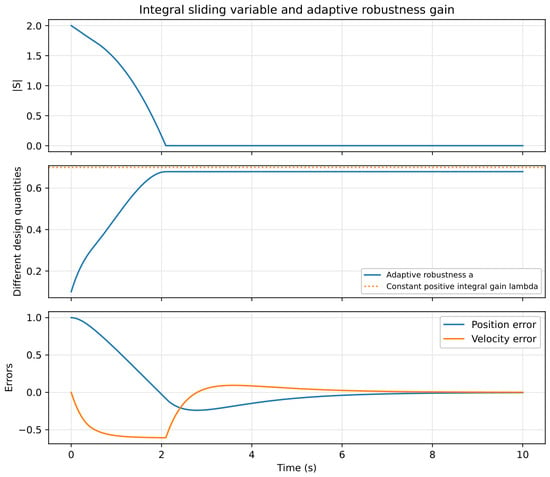
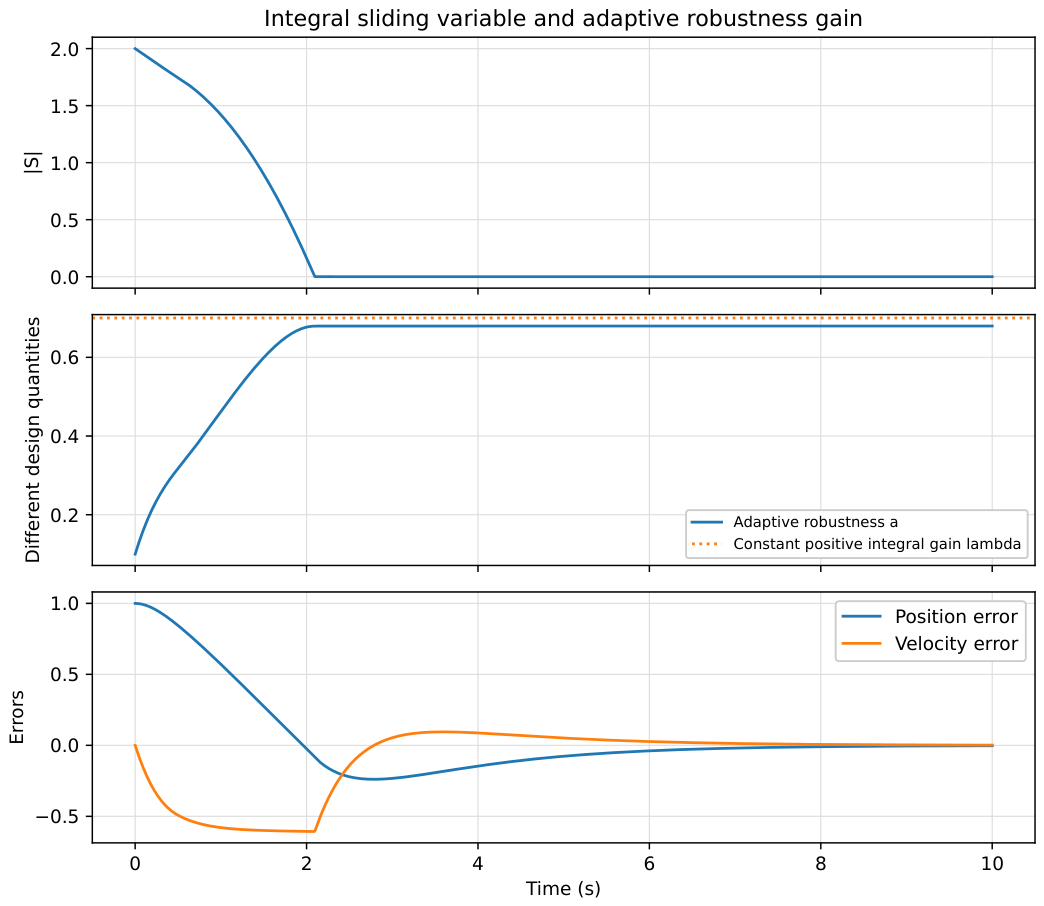
Figure 1 depicts the evolution of the adaptive integral sliding variable . The scalar program uses positive constant integral coefficients and an adaptive robustness gain; the latter is not a physical fault estimate. Its position RMS over 8-10 s is 0.005568 m. The final gain sample is evaluated by the same equations, rather than left at an initialized zero.
Figure 1.
The integral variable, adaptive robustness gain, and errors of the scalar example.
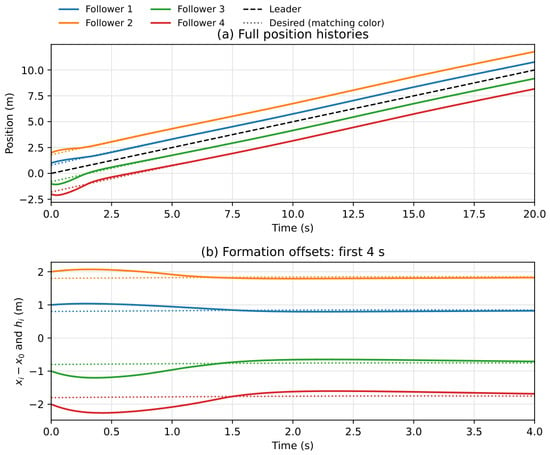
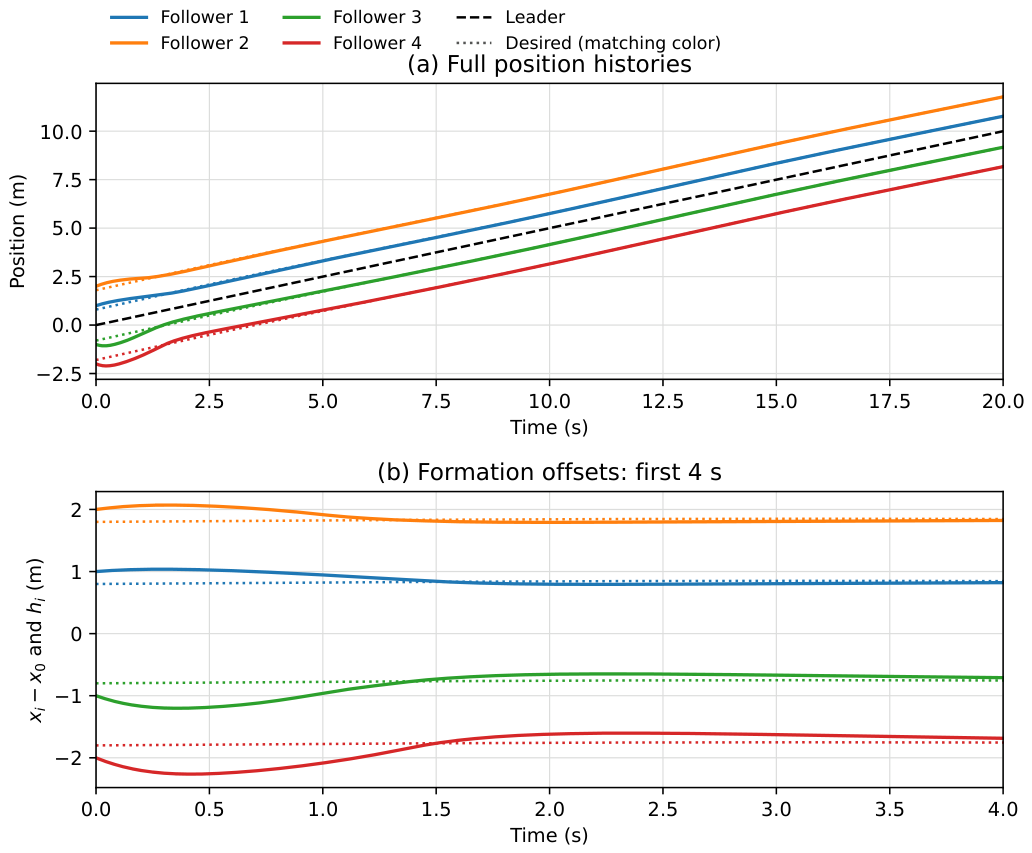
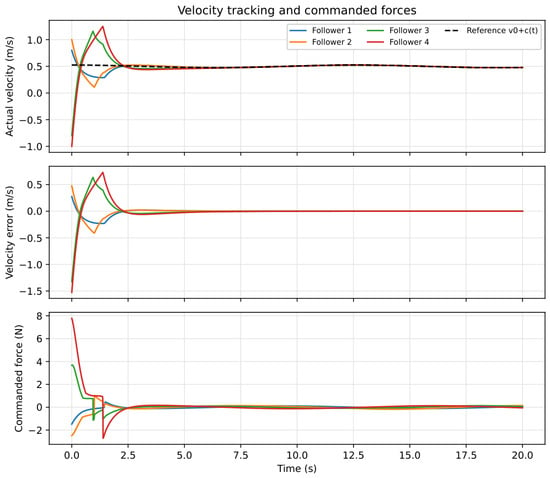
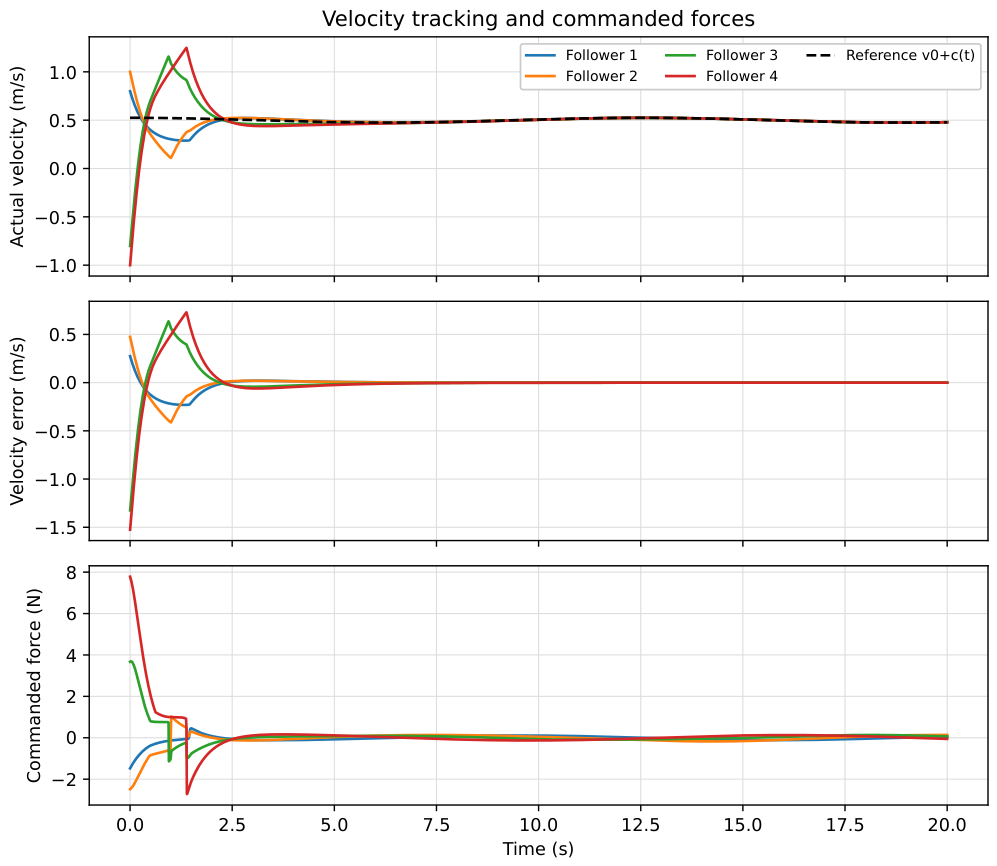
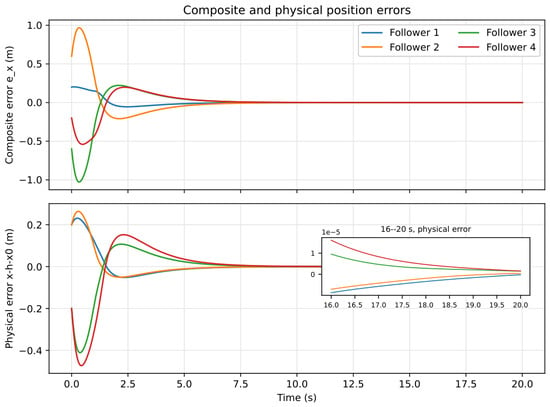
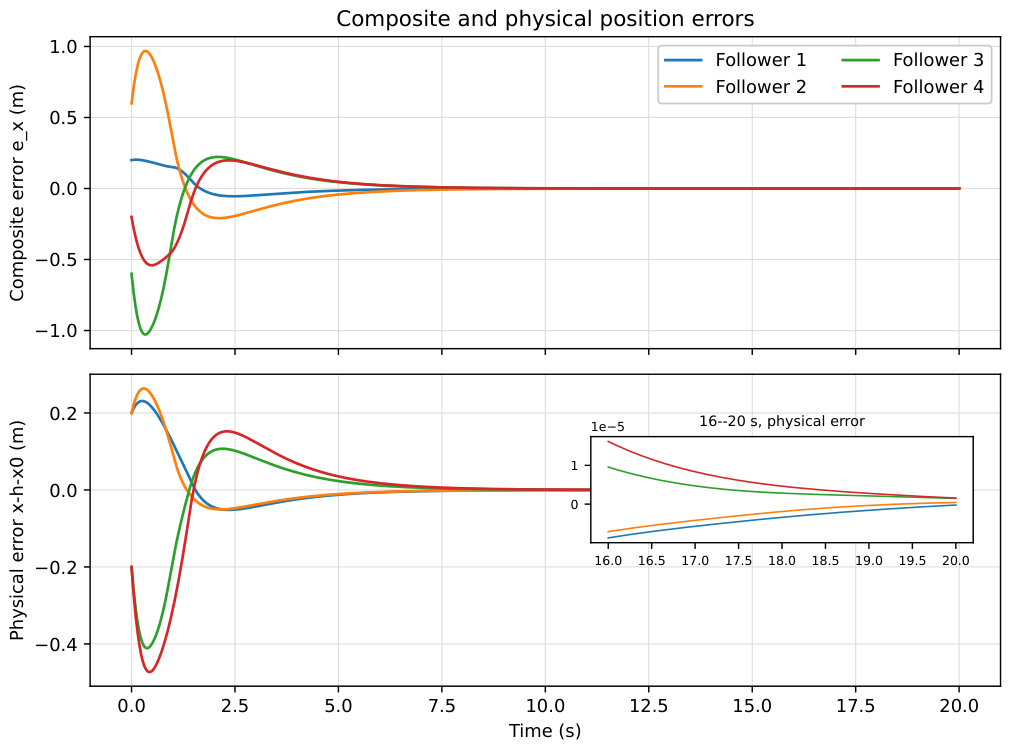
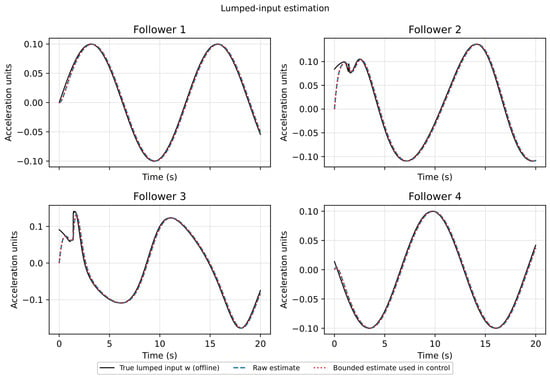
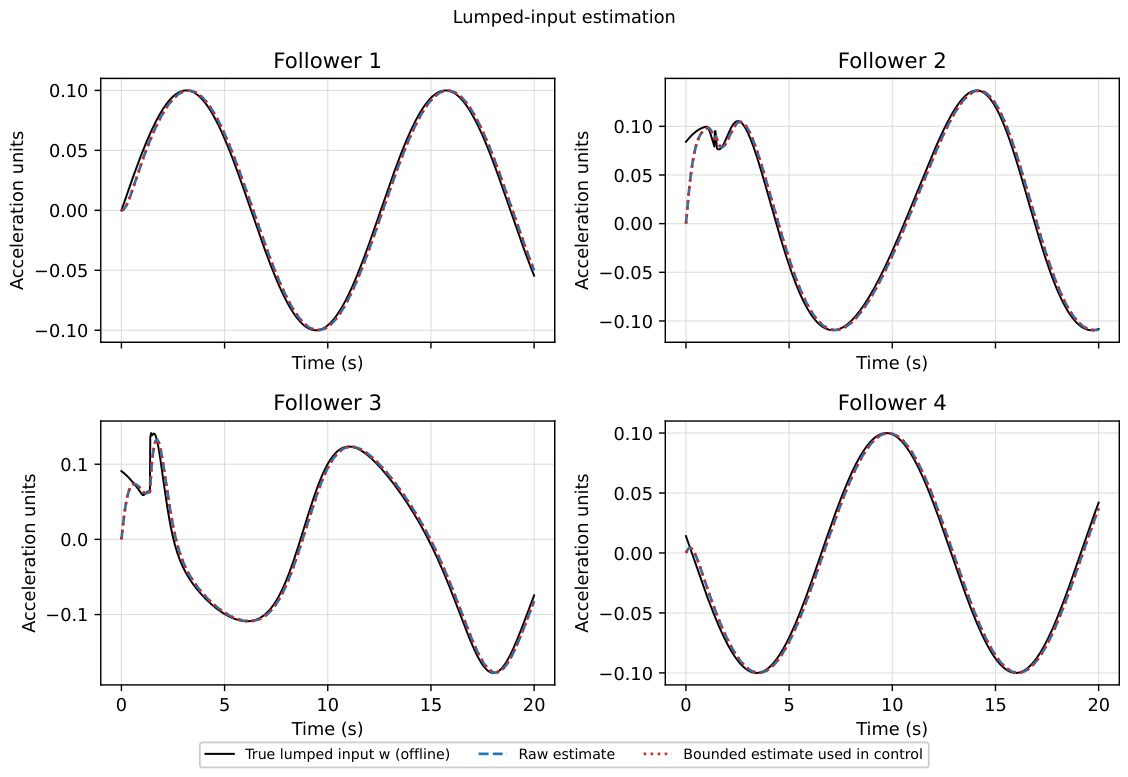
Figure 2 depicts the position trajectories of the agents, from which it can be observed that all followers approach their distinct desired formation positions in spite of initial position deviations. Figure 3 illustrates velocity tracking relative to , together with commanded forces. As shown in Figure 4, the physical position tracking errors converge to a neighborhood near zero, which is quantified using finite-window RMS rather than described as exact finite-time elimination. Figure 5 presents a comparison between the true lumped unknown input and its estimated value for followers 1–4, using the actual target only for offline evaluation.
Figure 2.
Position tracking: leader-follower formation with distinct desired offsets under actuator faults and disturbances. Upper: full position histories. Lower: offsets relative to the leader over 0–4 s, with dotted desired offsets.
Figure 3.
Velocity tracking: actual and reference velocities, tracking errors, and commanded input forces.
Figure 4.
Position error convergence: integral sliding mode surface performance. The upper panel shows composite ; the lower panel shows physical , with a 16–20 s inset.
Figure 5.
Lumped-input estimation: time-varying gain observer tracking with nonzero filtering lag and possible bounded-output bias.
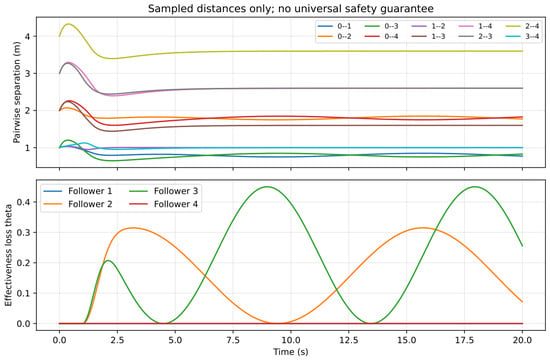
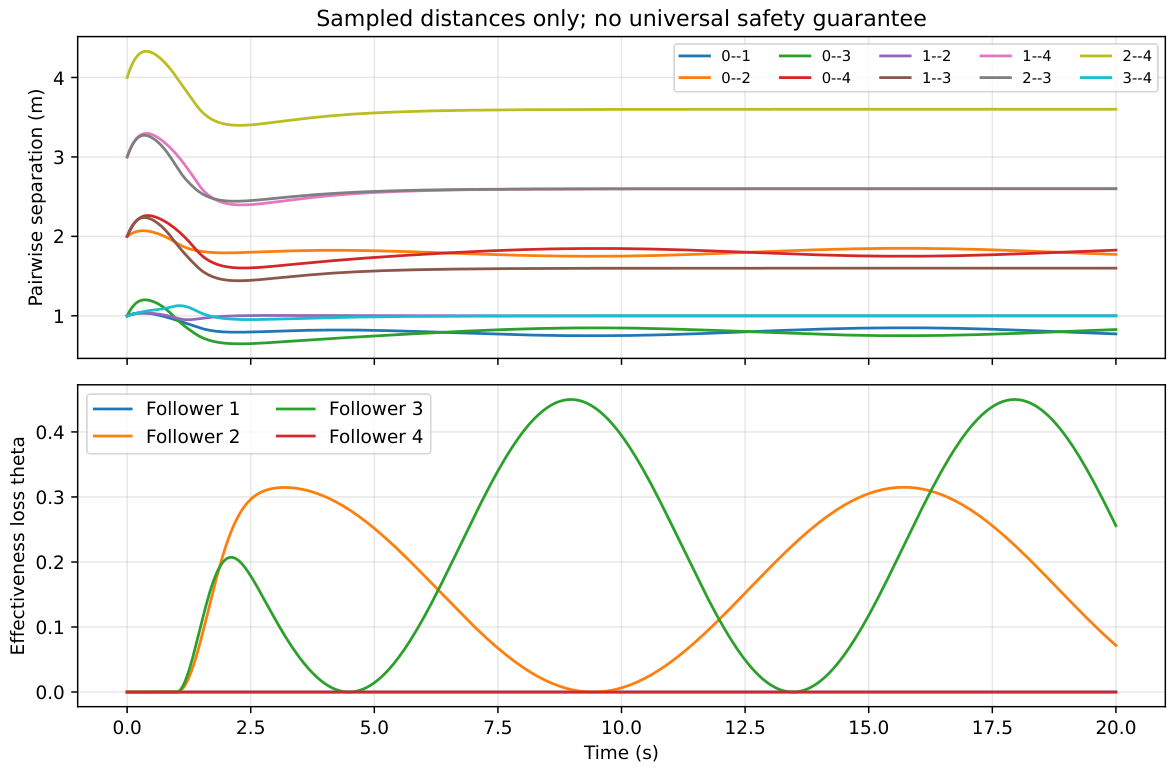
For 16–20 s, the per-agent physical position RMS values are m in Figure 6, and the aggregate is m in Table 1. The raw lumped-observer RMS values are approximately . Peak commanded force is 7.781 N, so this run is not a demonstration under a 5 N limit. Tightening the integration settings changes physical position-error curves by at most m at common output times. The maximum transient physical position-error magnitude is 0.473 m, compared with an initial magnitude of 0.2 m. All followers enter and remain within ±0.01 m at subsequent output samples from 6.82 s through 20 s; this is a finite-horizon sampled statistic, not a theoretical settling-time guarantee.
Figure 6.
Same-time pairwise distances, including the leader, and the partial-loss histories. This is a sampled diagnostic, not a global collision-avoidance guarantee.
Table 1.
Matched ablations: aggregate physical RMS over 16–20 s.
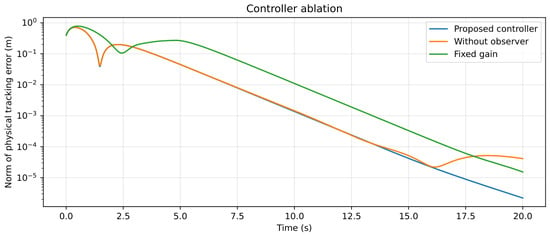
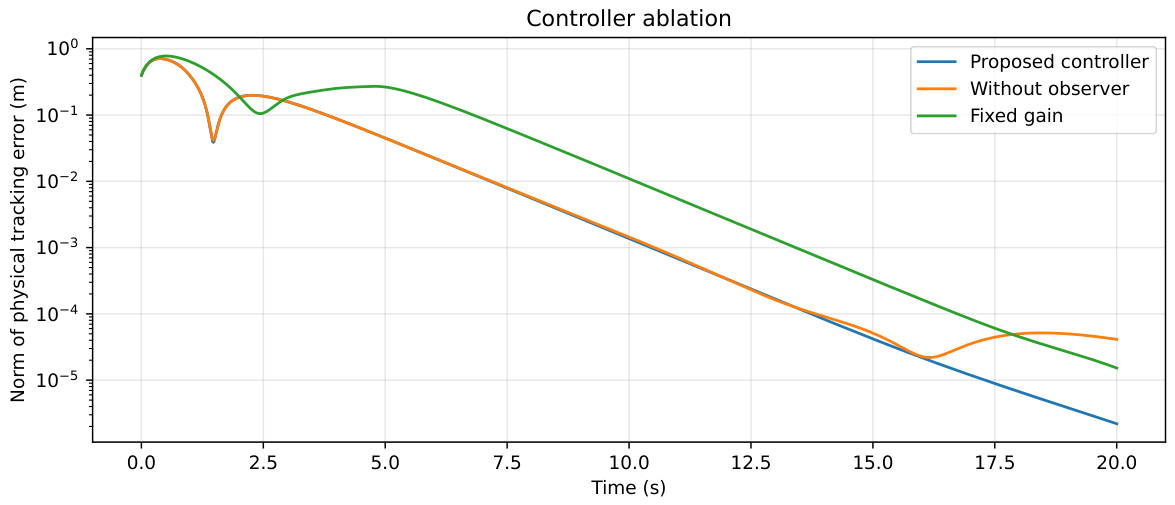
Matched ablations retain the same graph, plant, reference, initial states, faults, disturbances, and solver. The no-observer case sets the control-facing estimate to zero; the fixed-gain case keeps ; the no-fault case sets , as shown in Figure 7.
Figure 7.
Matched no-observer and fixed-gain ablations on the same plant.
The adaptive observer-assisted run reduces aggregate final-window position RMS relative to the first two ablations in this example, without uniform improvement for every follower or every metric. Additional fault-level runs, without retuning, are reported as Table 2.
Table 2.
Fault-level runs with the same controller settings. The limit is a profile parameter, not a maximum compensability boundary.
These are tested partial-loss profiles, not a demonstrated maximum fault boundary.
5. Discussion
The chosen graph satisfies the symmetric positive-definiteness condition. Positive k and make the error filters stable; positive and c give adaptation and the negative term in (43). Positive give an integrable smoothing budget, and the output bound M protects the controller without assuming exact observer convergence. The complete tracking theorem uses a disturbance magnitude bound; a disturbance derivative bound alone is insufficient. The gain schedule is used in the implemented observer at every solver evaluation.
Finite-window residual errors and observer lag must not be confused with exact asymptotic limits. The raw observer is a filter of the combined disturbance and actuator-induced input error. Bounded output can add bias. A fixed smoothing floor, measurement noise, actuator saturation, or digital sample-and-hold would require an extension of the current ideal continuous-feedback result. The present solver output spacing is not a deployment sampling-rate guarantee.
The position plots are one-dimensional position versus time, not planar paths. All ten simultaneous pairwise distances, including the leader, were checked in the new example. The minimum sampled separation is approximately m. Distinct desired offsets replace the common-target example, but no collision-avoidance constraint or arbitrary-initial-condition safety theorem is claimed. Agent size and physical input limits must be included before interpreting this example as a safe hardware deployment.
The model permits simultaneous partial degradation of every follower provided each channel retains uniformly positive effectiveness. It does not include complete failure, lock-in-place, or sign reversal. The fault tests at are not a proof of a largest tolerable fault. The heterogeneity is specifically known nominal input-gain differences; arbitrary heterogeneous nonlinear dynamics and unknown masses are not included. Every follower receives the reference, as stated in Assumption 4.
6. Conclusions
This paper focuses on addressing the formation control problem of HMASs subject to time-varying external disturbances and actuator faults. To accurately estimate the lumped disturbance and fault-induced input error affecting the HMAS, the variable gain disturbance observer is designed. Furthermore, to achieve robust formation tracking under actuator faults, an adaptive integral sliding mode fault-tolerant control strategy is proposed. Under the proposed control framework, the HMASs asymptotically achieve the desired formation configuration. Simulation results demonstrate that the proposed control strategy reduces the aggregate final-window tracking RMS relative to the specified no-observer and fixed-gain ablations in the tested example.
Author Contributions
All authors contributed to this work. Conceptualization, W.W. (Wenjie Wang), X.L. and C.W.; methodology, T.Z., X.L. and X.Z.; software, W.W. (Wenjie Wang), H.F. and H.R.; validation, X.L. and X.Z.; writing—original draft, H.R., T.Z. and W.W. (Wu Wei); writing—review and editing, H.R., T.Z., C.W. and H.F. All authors have read and agreed to the published version of the manuscript.
Funding
This work was supported by the National Natural Science Foundation of China under Grants 62603215, 12601862, the Zhejiang Provincial Natural Science Foundation LQN25F030011, and the Fundamental Research Funds for the Provincial Universities of Zhejiang under Grant GK259909299001-033.
Data Availability Statement
The data that support the findings of this study are available on request from the corresponding author. The data are not publicly available due to privacy or ethical restrictions.
Conflicts of Interest
The authors declare no conflict of interest. Author Huixin Feng was employed by the State Grid Zhejiang Electric Power Co., Ltd., Jinyun County Power Supply Company. The remaining authors declare that the research was conducted in the absence of any commercial or financial relationships that could be construed as a potential conflict of interest.
References
- Hou, Q.; Dong, J. Cooperative output regulation of MASs with a novel parameter convergence condition and prescribed-time event-triggered observers and its application to robot formation. IEEE Trans. Autom. Sci. Eng. 2025, 22, 4168–4179. [Google Scholar] [CrossRef] [Scilit]
- Xue, Y.; Chen, W. Multi-agent deep reinforcement learning for UAVs navigation in unknown complex environment. IEEE Trans. Intell. Veh. 2023, 9, 2290–2303. [Google Scholar] [CrossRef] [Scilit]
- Chreim, B.; Esseghir, M.; Merghem-Boulahia, L. Energy management in residential communities with shared storage based on multi-agent systems: Application to smart grids. Eng. Appl. Artif. Intell. 2023, 126, 106886. [Google Scholar] [CrossRef] [Scilit]
- Mei, J.; Ye, R.; Xiang, Z.; Hu, J.; Wang, W. A Direct Data-Driven Intermittent Control and Learning via Lyapunov-Guided Attraction Region Estimation with Neural Feedback Loop Design. IEEE Trans. Autom. Sci. Eng. 2026, 23, 6504–6519. [Google Scholar] [CrossRef] [Scilit]
- Du, Z.; Xie, X.; Qu, Z.; Hu, Y.; Stojanovic, V. Dynamic event-triggered consensus control for interval type-2 fuzzy multi-agent systems. IEEE Trans. Circuits Syst. I Regul. Pap. 2024, 71, 3857–3866. [Google Scholar] [CrossRef] [Scilit]
- Sun, S.; Zhang, H.; Zhang, J.; Zhang, K. Fault estimation and tolerant control for discrete-time multiple delayed fuzzy stochastic systems with intermittent sensor and actuator faults. IEEE Trans. Cybern. 2020, 51, 6213–6225. [Google Scholar] [CrossRef] [Scilit] [PubMed]
- Guo, G.; Tan, H.; Feng, Y.; Wang, Y. Event-triggered super-twisting fixed-time consensus control for networked nonlinear multi-agent systems with disturbance. IEEE Trans. Autom. Sci. Eng. 2025, 22, 11920–11932. [Google Scholar] [CrossRef] [Scilit]
- Zhu, G.; Zhang, X.; Li, H.; Zhang, X.; Su, C.-Y. Finite time prescribed performance adaptive consensus control for nonlinear multi-agent systems and its application. IEEE Trans. Autom. Sci. Eng. 2025, 22, 22484–22496. [Google Scholar] [CrossRef] [Scilit]
- Yin, J.; Sun, J.; Ma, G.; Ran, G. Indirect fault estimation and active fault-tolerant control for spacecraft. Actuators 2026, 15, 258. [Google Scholar] [CrossRef] [Scilit]
- Zhang, L.; Li, H.; Zhang, H.; Xie, L. Asymptotically optimal distributed consensus of heterogeneous multi-agent systems. IEEE Trans. Autom. Control 2026, 71, 4089–4096. [Google Scholar] [CrossRef] [Scilit]
- Sader, M.; Wu, F.; Liu, Z.; Chen, Z. Distributed fuzzy fault-tolerant consensus of leader-follower multi-agent systems with mismatched uncertainties. J. Syst. Eng. Electron. 2021, 32, 1031–1040. [Google Scholar] [CrossRef] [Scilit]
- Liu, Y.; Wu, X.; Long, J.; Wang, W. Event-triggered distributed adaptive leaderless consensus of uncertain heterogenous nonlinear multi-agent systems. IEEE Trans. Circuits Syst. II Express Briefs 2024, 71, 2694–2698. [Google Scholar] [CrossRef] [Scilit]
- Chen, J.; Wang, Y.; Wang, F. H∞ Control for multi-agent systems under two-way amplify-and-forward relay networks: The event-trigger case. Complex Syst. Stab. Control 2026, 2, 6. [Google Scholar] [CrossRef] [Scilit]
- Cao, L.; Chi, C.; Yumuk, E.; Ionescu, C.-M.; Liu, G.-P. Coordinated control of distributed multi-agent systems using event-triggered predictive control strategy. In Proceedings of the 2023 2nd Conference on Fully Actuated System Theory and Applications (CFASTA), Qingdao, China, 14–16 July 2023; pp. 378–383. [Google Scholar]
- Liu, X.; Lu, Q.; Zhao, X.; Zhang, B.; Wei, W. Consensus tracking of networked stochastic multi-agent systems with adaptive fault-tolerant control under random topology switching. J. Syst. Sci. Complex. 2026, 39, 2206–2226. [Google Scholar] [CrossRef] [Scilit]
- Xu, Y.; Zhang, Y.; Zhang, J.-F. Leader-following adaptive tracking control for a class of uncertain discrete-time nonlinear multi-agent systems under event-triggered communication. J. Syst. Sci. Complex. 2025, 38, 756–781. [Google Scholar] [CrossRef] [Scilit]
- Gao, Z.; Zhao, N.; Zong, G.; Zhao, X. Secure consensus control for constrained multi-agent systems against intermittent denial-of-service attacks: An adaptive dynamic programming method. IEEE J. Emerg. Sel. Top. Circuits Syst. 2024, 14, 705–716. [Google Scholar] [CrossRef] [Scilit]
- Gu, H.; Liu, K.; Zhu, G.; Lü, J. Leader-following consensus of stochastic dynamical multi-agent systems with fixed and switching topologies under proportional-integral protocols. Asian J. Control 2023, 25, 662–676. [Google Scholar] [CrossRef] [Scilit]
- Lu, A.-Y.; Yang, G.-H. Distributed consensus control for multi-agent systems under denial-of-service. Inf. Sci. 2018, 439, 95–107. [Google Scholar] [CrossRef] [Scilit]
- Olfati-Saber, R.; Murray, R.M. Consensus problems in networks of agents with switching topology and time-delays. IEEE Trans. Autom. Control 2004, 49, 1520–1533. [Google Scholar] [CrossRef] [Scilit]
- Ren, W.; Beard, R.W. Consensus seeking in multiagent systems under dynamically changing interaction topologies. IEEE Trans. Autom. Control 2005, 50, 655–661. [Google Scholar] [CrossRef] [Scilit]
- Li, B.; Luo, S.; Jiang, Y. Mean-square output consensus of heterogeneous multi-agent systems with multiplicative noises in dynamics and measurements. J. Syst. Sci. Complex. 2023, 36, 2364–2381. [Google Scholar] [CrossRef] [Scilit]
- Zhou, H.; Xiang, Z.; Wang, W.; Mei, J.; Wang, B. Deep neural network-based robust MPC with state-dependent intermittent mechanism for unknown nonlinear systems. Neurocomputing 2026, 697, 134245. [Google Scholar] [CrossRef] [Scilit]
- Liu, X.; Deng, F.; Wei, W.; Wan, F. Formation tracking control of networked systems with time-varying delays and sampling under fixed and Markovian switching topology. IEEE Trans. Control Netw. Syst. 2022, 9, 601–612. [Google Scholar] [CrossRef] [Scilit]
- Ma, J.; Yu, X.; Liu, L.; Ji, H.; Feng, G. Global cooperative output regulation of linear multiagent systems with limited bandwidth. IEEE Trans. Control Netw. Syst. 2022, 9, 1017–1028. [Google Scholar] [CrossRef] [Scilit]
- Sakthivel, R.; Parivallal, A.; Kaviarasan, B.; Lee, H.; Lim, Y. Finite-time consensus of Markov jumping multi-agent systems with time-varying actuator faults and input saturation. ISA Trans. 2018, 83, 89–99. [Google Scholar] [CrossRef] [Scilit] [PubMed]
- Luo, S.; Xu, J.; Liang, X. Mean-square consensus of heterogeneous multi-agent systems with time-varying communication delays and intermittent observations. IEEE Trans. Circuits Syst. II Express Briefs 2021, 69, 184–188. [Google Scholar] [CrossRef] [Scilit]
- Peng, J.-H.; Zhang, K. Consensus of linear multi-agent system with unknown input lime-varying delay by linear lime-varying protocol. Complex Syst. Stab. Control 2026, 2, 5. [Google Scholar] [CrossRef] [Scilit]
- Liu, Y.; Su, H. Second-order consensus for multiagent systems with switched dynamics and sampled position data. IEEE Trans. Syst. Man Cybern. Syst. 2021, 52, 4129–4137. [Google Scholar] [CrossRef] [Scilit]
- Wang, J.; Yan, Y.; Liu, Z.; Chen, C.L.P.; Zhang, C.; Chen, K. Finite-time consensus control for multi-agent systems with full-state constraints and actuator failures. Neural Netw. 2023, 157, 350–363. [Google Scholar] [CrossRef] [Scilit] [PubMed]
- He, C.; Martinez, A.; Ni, B.; Jain, D.K.; Jiang, Y.; Zubov, D.; Li, Y.; Wang, X. Predefined-time fault-tolerant consensus tracking control for multiple flexible robotic manipulator systems with prescribed perfomance. Complex Syst. Stabiliy Control 2025, 1, 7. [Google Scholar] [CrossRef] [Scilit]
- Yang, J.; Cao, G.; Chen, W.; Zhang, W. Finite-time formation control of second-order linear multi-agent systems with relative state constraints: A barrier function sliding mode control approach. IEEE Trans. Circuits Syst. II Express Briefs 2021, 69, 1253–1256. [Google Scholar] [CrossRef] [Scilit]
- Zou, W.; Xiang, Z.; Ahn, C.K. Mean square leader–following consensus of second-order nonlinear multiagent systems with noises and unmodeled dynamics. IEEE Trans. Syst. Man Cybern. Syst. 2018, 49, 2478–2486. [Google Scholar] [CrossRef] [Scilit]
- Wen, H.; Liang, Z.; Zhou, H.; Yao, B.; Mao, Z.; Lian, L. Distributed adaptive consensusprotocol for heterogeneous nonlinear uncertain multi-agent system with disturbance. Int. J. Robust Nonlinear Control 2024, 34, 1475–1492. [Google Scholar] [CrossRef] [Scilit]
- Kao, Y.; Xie, J.; Wang, C.; Reza, H. A sliding mode approach to H∞ non-fragile observer-based control design for uncertain Markovian neutral-type stochastic systems. Automatica 2015, 52, 218–226. [Google Scholar] [CrossRef] [Scilit]
- Zhang, P.; Zhang, J.; Yang, J.; Gao, S. Resilient event-triggered adaptive cooperative fault-tolerant tracking control for multiagent systems under hybrid actuator faults and communication constraints. IEEE Trans. Aerosp. Electron. Syst. 2022, 59, 3021–3037. [Google Scholar] [CrossRef] [Scilit]
- Manfredi, S. Robust scalable stabilisability conditions for large-scale heterogeneous multi-agent systems with uncertain nonlinear interactions: Towards a distributed computing architecture. Int. J. Control 2016, 89, 1203–1213. [Google Scholar] [CrossRef] [Scilit]
- Ma, T.; Zhang, L.; Zhao, F.; Gu, Z.; Xu, Y. Impulsive consensus of multi-agent nonlinear systems with control gain error. Neurocomputing 2016, 171, 293–298. [Google Scholar] [CrossRef] [Scilit]
- Chen, W.-H.; Xu, W.; Zheng, W.-X. Sliding-mode-based impulsive control for a class of time-delay systems with input disturbance. Automatica 2024, 164, 111633. [Google Scholar] [CrossRef] [Scilit]
- Mei, J.; Jian, H.; Li, Y.; Wang, W.; Li, D. Deep neural networks-based output-dependent intermittent control for a class of uncertain nonlinear systems. Chaos Solitons Fractals 2024, 185, 114999. [Google Scholar] [CrossRef] [Scilit]
- Cai, Y.; Zhang, H.; Zhang, J.; Wang, W. Fixed-time leader-following/containment consensus for a class of nonlinear multi-agent systems. Inf. Sci. 2021, 555, 58–84. [Google Scholar] [CrossRef] [Scilit]
- Zhang, J.; Lyu, M.; Shen, T.; Liu, L.; Bo, Y. Sliding mode control for a class of nonlinear multi-agent system with time delay and uncertainties. IEEE Trans. Ind. Electron. 2018, 65, 865–875. [Google Scholar] [CrossRef] [Scilit]
- Chen, J.; Wang, Y.; Wang, F. Observer-based finite-horizon H∞ consensus control of multi-agent systems under multi-round-robin scheduling. Intell. Control 2026, 2, 3. [Google Scholar] [CrossRef] [Scilit]
- Hao, L.; Zhan, X.; Wu, J.; Han, T.; Yan, H. Bipartite finite time and fixed time output consensus of heterogeneous multiagent systems under state feedback control. IEEE Trans. Circuits Syst. II Express Briefs 2021, 68, 2067–2071. [Google Scholar] [CrossRef] [Scilit]
- Jiang, D.; Wen, G.; Peng, Z.; Wang, J.-L.; Huang, T. Fully distributed pull-based event-triggered bipartite fixed-time output control of heterogeneous systems with an active leader. IEEE Trans. Cybern. 2023, 53, 3089–3100. [Google Scholar] [CrossRef] [Scilit] [PubMed]
- Zhang, H.; Duan, J.; Wang, Y.; Gao, Z. Bipartite fixed-time output consensus of heterogeneous linear multiagent systems. IEEE Trans. Cybern. 2020, 51, 548–557. [Google Scholar] [CrossRef] [Scilit] [PubMed]
- Li, H.; Li, X. Distributed fixed-time consensus of discrete-time heterogeneous multi-agent systems via predictive mechanism and Lyapunov approach. IEEE Trans. Circuits Syst. II Express Briefs 2024, 71, 321–325. [Google Scholar] [CrossRef] [Scilit]

Disclaimer/Publisher’s Note: The statements, opinions and data contained in all publications are solely those of the individual author(s) and contributor(s) and not of MDPI and/or the editor(s). MDPI and/or the editor(s) disclaim responsibility for any injury to people or property resulting from any ideas, methods, instructions or products referred to in the content. |
© 2026 by the authors. Licensee MDPI, Basel, Switzerland. This article is an open access article distributed under the terms and conditions of the Creative Commons Attribution (CC BY) license.