


Abstract
Animal tuberculosis in cattle (TB) has been controlled in many European countries through long-standing eradication programs, yet sporadic breakdowns continue to occur in officially tuberculosis-free (OTF) areas, challenging the sustainability of disease freedom. This study aimed to identify and quantify herd-level and area-level risk factors associated with TB occurrence in Italian OTF regions in order to support risk-based surveillance strategies. A national longitudinal open-cohort study was conducted using data from the Italian Veterinary Information System, including approximately 300,000 herd–year observations from 2022 to 2025. The outcome was the occurrence of at least one TB breakdown per herd–year, analyzed using a discrete-time hazard modeling approach based on a binomial generalized linear mixed model with province-level random effects. The incidence of TB remained very low but increased over time, and significant spatial clustering was observed. Higher TB risk was associated with larger herd size, a previous history of TB, non-OTF herd status, proximity to recent breakdowns, number of animals purchased, transhumance practices, and a shorter time since acquisition of OTF status at provincial level. These findings highlight that, even in disease-free contexts, TB risk is heterogeneous and driven by identifiable factors, supporting the refinement of targeted, risk-based surveillance to maintain OTF status over time.
1. Introduction
Animal tuberculosis in cattle (TB) is a chronic infectious disease caused by members of the Mycobacterium tuberculosis complex (MTBC), most notably Mycobacterium bovis and Mycobacterium caprae [1,2]. The infection typically evolves slowly, with a prolonged incubation period and often limited or absent clinical signs, while granulomatous lesions may develop primarily in the respiratory tract and associated lymph nodes [2]. Beyond its animal health and productivity impacts, TB remains relevant for public health because of the zoonotic potential of M. bovis, even though human disease is now relatively rare in the European Union (EU) context [1,2].
In the EU, long-standing eradication programs based on testing and removal of infected animals have markedly reduced TB prevalence, and extensive territories have achieved officially tuberculosis-free (OTF) status under EU legislation [2]. Nevertheless, the disease can persist or re-emerge through complex mechanisms that include residual infection, reintroductions via animal movements, and local ecological drivers, making sustained freedom particularly challenging in low-incidence or low-prevalence areas [2,3,4,5,6,7]. In fact, TB risk is shaped by factors operating at multiple levels—animal, herd, and area—and by the interaction between biological and non-biological determinants [2,3,7]. Among the most consistently reported drivers are cattle movements [5,6] and contacts with infected neighboring farms [4]. Additional determinants include changes in farming structure (e.g., increasing farm size and evolving husbandry practices) and the potential contribution of other domestic species and local wildlife population dynamics, whose relative importance may vary across epidemiological situations and over the course of control programs [7,8]. This context dependency is particularly relevant in regions with very low prevalence, where breakdowns are sporadic, transmission chains are short, and the marginal contribution of specific risk pathways may differ from endemic settings [9].
In low-incidence or disease-free areas, the efficiency of blanket surveillance strategies can decrease, while costs and operational burden increase; consequently, risk-based approaches have been proposed to better target surveillance toward herds and areas more likely to harbor infection [10,11]. In Italy, TB epidemiology has historically shown marked heterogeneity among territories, and EU has listed multiple Italian regions and provinces among OTF areas (Commission Implementing Regulation EU 2021/620). Italy has implemented a risk-based surveillance program in disease-free territories under current national provisions, which includes annual controls of all herds classified at higher risk according to predefined criteria. This activity is implemented alongside permanent slaughterhouse surveillance, which has consistently proved to be a key component in areas with a low TB incidence [12,13,14].
In this scenario, robust identification and prioritization of the most relevant risk factors becomes essential to optimize risk-based surveillance. Risk factors derived from endemic contexts or from other countries may not fully translate to Italian OTF regions because of differences in cattle demographics, production systems, movement patterns, and ecological interfaces. Therefore, generating evidence tailored to the Italian disease-free setting is critical to support surveillance planning and to maintain OTF status over time.
Following the entry into force of the EU Animal Health Law in April 2021, the definition of a confirmed TB case was revised. In Italy, herds were previously classified as infected based on positive tuberculin skin test results alone; currently, confirmation also requires the detection of tuberculous lesions and/or positive direct tests for MTBC (PCR or culture). For this reason, the present study included only TB breakdowns notified between 2022 and 2025. The aim of this study is to identify and evaluate the main risk factors associated with TB occurrence in OTF regions of Italy. By clarifying which drivers are most relevant in the Italian context, this work seeks to support the refinement of risk-based surveillance and contribute to the long-term sustainability of TB eradication in Italy.
2. Materials and Methods
2.1. Study Design and Population
A national longitudinal open-cohort study was conducted to identify risk factors for TB breakdowns in herds located in Italian OTF provinces, as classified on 31 December 2025. Data on bovine herds (cattle and buffalo) and TB breakdowns were obtained from the Italian Veterinary Information System portal (https://www.vetinfo.it/ accessed on 27 February 2026), managed by the Italian Ministry of Health. The unit of analysis was the herd–year pair over the period 2022–2025. Herds were considered at risk in year t if, by 31 December of the previous year (t − 1), there were no TB breakdowns, maintained a bovine population greater than zero, and belonged to one of the following production types: dairy, beef-fattening, beef-breeding, or mixed.
2.2. Outcome and Predictors
The outcome variable was defined as the occurrence of at least one TB breakdown during the observation year and was treated as a binary variable (0; 1). To ensure an appropriate temporal sequence between exposure and outcome, all covariates were measured with a one-year lag (t − 1). The predictors included the following groups of variables:
- •
- Structural and management factors: Production type, management system, herd size, and animal movements (entries, exits, and slaughter rates).
- •
- Spatial context: Presence of TB breakdowns and number of bovine herds within a 2 km radius of each herd.
- •
- Disease history: Current herd health status and a binary indicator of TB occurrence within the previous five years (t − 1 to t − 5).
2.3. Statistical Analysis
Data were analyzed using a discrete-time hazard modeling approach implemented through a binomial generalized linear mixed model (GLMM) with a complementary log–log (cloglog) link function. This approach is particularly appropriate for modeling event occurrence in discrete follow-up intervals and provides a discrete-time analog of a continuous-time proportional hazards model [15,16].
Random intercepts were initially included at both herd and provincial levels to account for repeated measurements and unexplained territorial heterogeneity. Since the estimated herd-level variance resulted close to zero, a more parsimonious model including only province-level random effects was adopted. Multicollinearity among covariates was assessed using variance inflation factors (VIFs) and no evidence of problematic collinearity was detected (Supplementary Materials).
Model estimates are presented as discrete hazard ratios (HRs) with corresponding 95% Wald confidence intervals. In survival analysis, the HR quantifies the relative risk over time; specifically, it represents, within a defined follow-up period, the ratio of the hazard of an event in herds with a given factor compared with those without it. The variables N_Purchased, N_Sold and N_Herds_2 km were modeled on a log(1 + x) scale to account for non-linearity; therefore, the corresponding hazard ratio represents the effect of approximately a 2.7-fold increase in the original variable values. All statistical analyses were performed in R using the lme4 and tidyverse packages [17,18]. Figures were generated using ggplot2. Collinearity diagnostics were assessed using the performance package [19].
3. Results
About 300,000 herd–year pairs over the period 2022–2025 were analyzed in the study (Table 1). The variables investigated and the relative frequencies are shown in Table 2.
Table 1.
Annual incidence of Bovine Tuberculosis in officially tuberculosis-free regions. Italy, 2022–2025.
Figure 1.
Hazard ratio estimates and corresponding 95% confidence intervals for the variables investigated. OTF provinces in Italy, 2022–2025. Full description of variables is reported in Table 2.
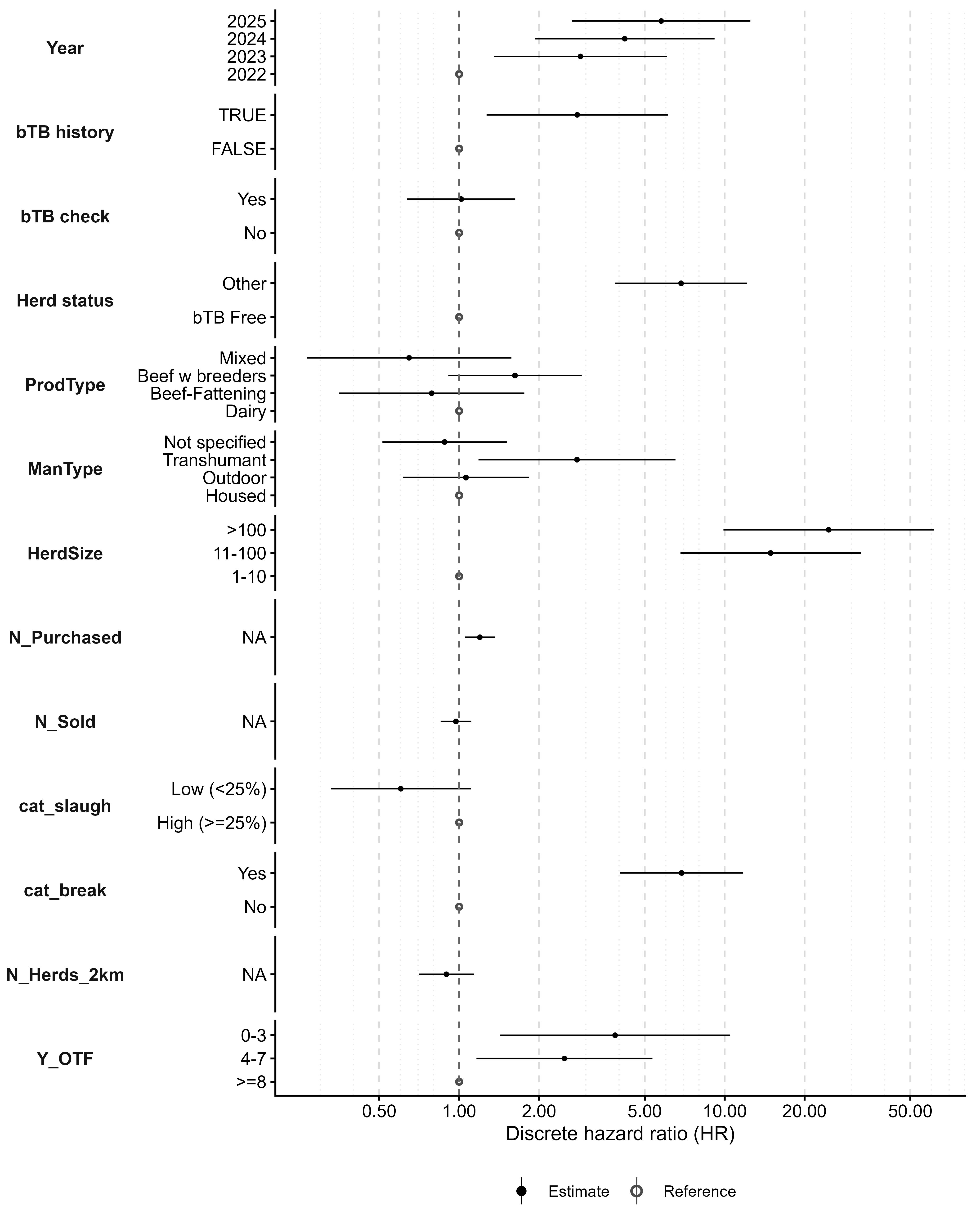
Table 2.
Variables investigated in officially tuberculosis-free regions. Italy, 2022–2025.
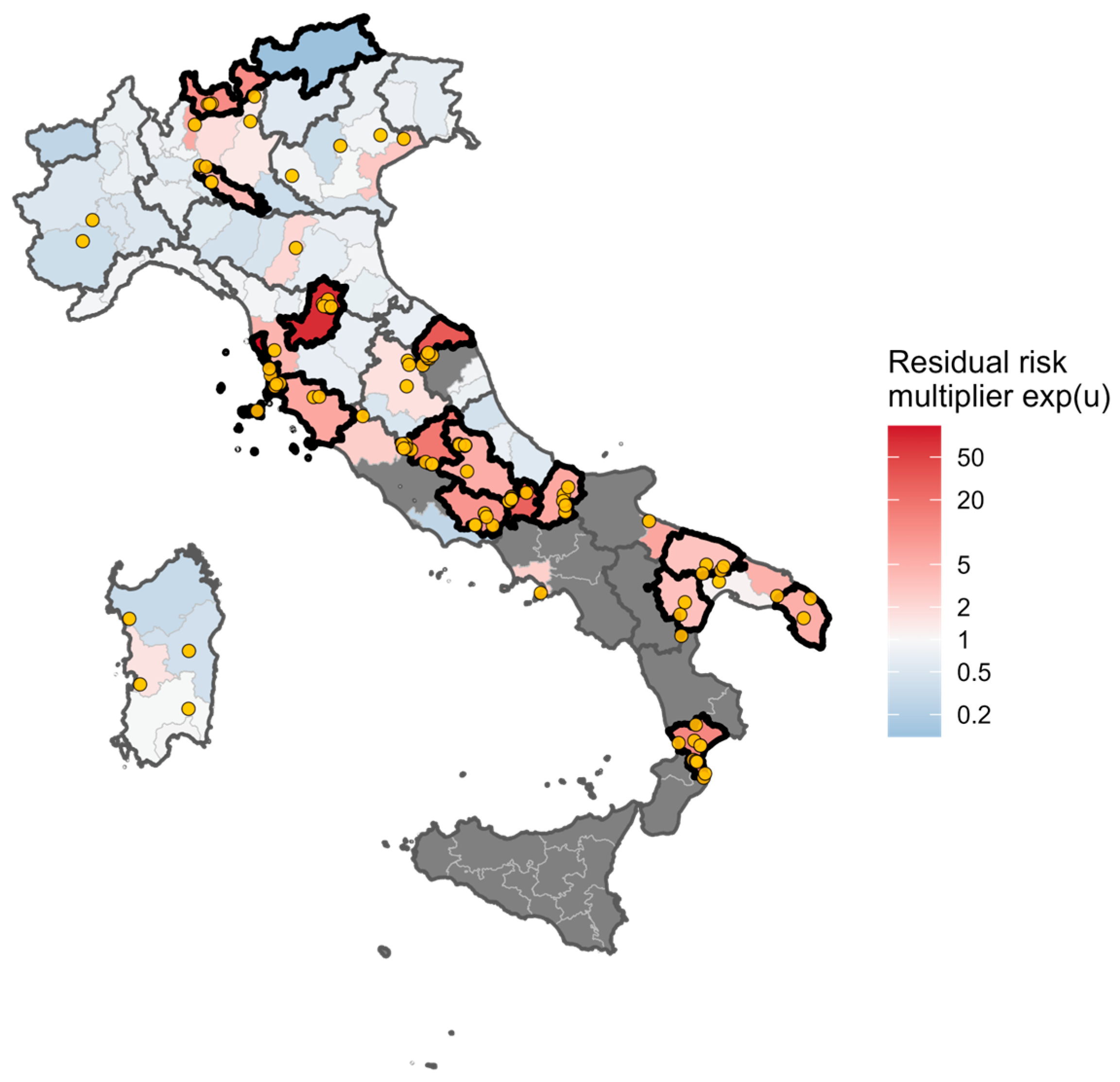
During the 2022–2025 period, the incidence of TB progressively increased in disease-free provinces, reaching 0.06% by the end of 2025 (Table 1). Breakdowns appeared to be clustered at the provincial level (Figure 2), and the number of years since the acquisition of OTF status was also associated with the incidence of disease breakdowns. Compared with provinces that had maintained OTF status for more than seven years, provinces that had obtained OTF status less than three years earlier showed higher incidence rates (hazard ratio [HR] 3.96; 95% CI: 1.47–10.71), as did those that had been OTF for four to seven years (HR 2.43; 95% CI: 1.13–5.19).
Figure 2.
Provincial residual heterogeneity in TB breakdown risk in OTF provinces (2022–2025). Colors represent the province-level random intercept from the discrete-time hazard model (binomial GLMM with a complementary log–log link function), expressed as a residual risk multiplier exp(u) relative to the average province (exp(u) = 1). Provinces outlined in black have conditional 95% confidence intervals for exp(u) that do not include 1. Yellow points indicate the 126 herd–year TB breakdowns that occurred during the study period. Non-OTF provinces are gray.
Model results for the other variables investigated are reported in Table 2 and Figure 1. The distribution of nearby herds (within 2 km) was skewed, with median values of 10 (IQR: 5–19) for non-breakdown herd years and 6.5 (IQR: 3–11) for breakdown herd years.
Factors positively associated with TB incidence included herd size, the presence of a breakdown within a 2 km radius (HR 7.09; 95% CI: 4.14–12.15), a history of disease in the previous five years (HR 3.31; 95% CI: 1.52–7.25), and the absence of officially tuberculosis-free herd status (HR 6.95; 95% CI: 3.87–12.46).
Among herd management-related factors, the number of bovine animals purchased in the previous year (HR 1.20; 95% CI: 1.05–1.36) and the practice of transhumance (HR 2.51; 95% CI: 1.07–5.91) were identified as risk factors.
4. Discussion
To our knowledge, only a limited number of studies have investigated the factors associated with the occurrence of bovine TB in Italy, and even fewer have national relevance [20,21,22,23]. This investigation made it possible to identify those factors that are significant in Italian OTF zones.
Herd size has been frequently reported as a herd-level factor associated with the occurrence of TB, although its effect may vary according to the epidemiological context [5,24,25], also in low-incidence zones [23,26]. In this study, medium-sized (11–100 animals) and large herds (>100 animals) were at higher risk compared with small holdings, suggesting that the increase in risk is not limited to very large production systems but may emerge once a certain level of herd complexity is reached. The estimated hazard ratios were associated with wide confidence intervals, likely reflecting the small number of TB breakdowns, particularly within the reference group. This suggests limited precision in estimating the magnitude of the association, although its direction appears consistent. Larger herds are likely to experience higher internal contact rates and a greater probability of pathogen introduction through animal movements, which are recognized drivers of between-herd transmission [11,26]. Herd size is generally interpreted as a composite risk indicator, reflecting both biological processes related to transmission and operational aspects of testing and detection, rather than as an isolated causal factor.
Proximity to a confirmed TB breakdown was identified as a significant herd-level risk factor. This finding is consistent with several investigations showing that herds located close to infected holdings experience a higher probability of infection, reflecting short-range spread through direct or indirect contacts, shared pasture use, environmental contamination, or wildlife-mediated transmission [3,4,23,27]. Spatial clustering of breakdowns has been consistently reported in both endemic and officially tuberculosis-free regions [4,21,23], where re-emergence of infection is frequently driven by local rather than long-distance transmission processes. From a disease control perspective, these findings further support the relevance of spatially targeted approaches to TB surveillance and control. Testing of neighboring herds should be considered not only within the framework of annual risk-based surveillance planning, but also as a component of breakdown investigations following the detection of a new case of infection. Herds located in close proximity to recent breakdowns may warrant enhanced monitoring or the implementation of additional biosecurity measures, even in the absence of clear epidemiological links.
The presence of a random effect at the provincial level also seems to support the existence of local risk factors. In each TB breakdown, an epidemiological investigation is conducted [22], which sometimes identifies other related infected herds located at short distances, but not necessarily contiguous. These infection clusters reveal the presence of indirect links between breakdowns that were not accounted for in our study.
Also, a previous history of disease in the herd was associated with an increased risk of TB. This finding is consistent with several studies: Adkin et al. [26] identify herd history of TB breakdowns (years since the last episode) as the strongest predictor of future risk, while Bessell et al. [5] show that a previous history of TB breakdowns significantly increases the likelihood of subsequent breakdowns, particularly in high-incidence settings. Residual persistence, reinfections, or structural vulnerabilities that have not been fully resolved are often associated with the re-emergence of disease in herds that have been disease-free for only a few years [3,28], especially in Italy [22].
Transhumance, which involves seasonal movement to other regions—sometimes on foot—and grazing were associated with a higher risk of TB than other herd management types. This practice increases the likelihood of both direct and indirect contacts between herds and with the surrounding environment. This interpretation is consistent with several studies, which highlight the role of pasture use, local contacts and environmental exposure as important drivers of TB transmission, particularly in extensive or semi-extensive production systems [3,4,27,29]. Case–control studies conducted in officially tuberculosis-free (OTF) contexts in France emphasize local grazing contacts, shared pastures and other management-related factors as key determinants of infection, supporting the hypothesis that exposure at pasture may outweigh other risk factors in these settings [4].
In our study, no association was found between production type and an increased risk of TB, suggesting that the sporadic occurrence of TB in OTF areas is attributable to other factors. In fact, studies based on risk-based surveillance frameworks or modeling approaches in low-prevalence or OTF regions tend to highlight different drivers, such as animal movements, herd size and characteristics of the surveillance system, rather than production type per se. These studies primarily identify movements and herd size as the main determinants of TB risk, reflecting the dominant role of introduction pathways in low-incidence contexts [11,20,24,25]. Within this framework, production type may act as a proxy for underlying management characteristics—such as grazing, contact structure or biosecurity—rather than as an independent risk factor.
Bessell et al. [24] recommend annual testing of herds with a slaughter rate of <25% within risk-based surveillance frameworks, as these herds have a lower probability of infection detection through slaughterhouse surveillance. However, in the present study, a low slaughter rate (<25%) was not associated with a higher risk of TB.
In our study, incoming animal movements were associated with the occurrence of a TB breakdown. However, it should be noted that our analysis only considered whether animals had been introduced in the previous year. The introduction of infected animals may have occurred also in earlier years, which was not captured by our model. Animal movements, particularly in disease-free areas, are undoubtedly an important risk factor to consider; however, in Italian OTF areas the introduction of breeding animals is permitted only if they originate from OTF areas or countries, which substantially reduces the risk of disease introduction. This restriction does not apply to fattening herds, in which sporadic cases of TB are occasionally detected.
The TB eradication strategy in the EU is based on a test-and-cull approach and on the progressive assignment of disease-free status, first to herds and subsequently to territories. While the criteria for granting disease-free status to herds have essentially remained unchanged (two consecutive negative cervical tuberculin tests performed six months apart on all animals aged more than 42 days), since 2021, the criteria for assigning officially tuberculosis-free (OTF) status to an area have become less stringent. Previously, at least 99.9% of herds were required to be disease-free for seven consecutive years; currently, it is sufficient to have 99.8% of herds disease-free and an annual herd-level incidence below 0.1% for three consecutive years. Finally our study showed that the occurrence of TB was higher in herds that did not have TB-free status in the previous year, and in provinces that had acquired OTF status for less than seven years. This result may be related to residual infection persisting in the area, likely associated with the limited sensitivity of diagnostic tests, particularly in low-incidence settings [30].
5. Conclusions
Our findings support the inclusion of herd size, spatial proximity to a TB breakdown, a history of disease, and grazing among the variables used for risk-based surveillance and control strategies in the OTF regions of Italy. However, this type of surveillance is not recommended in zones that have acquired disease-free status for less than three years, in which it is advisable to continue annual testing of at least all herds with breeding animals.
Supplementary Materials
The following supporting information can be downloaded at https://www.mdpi.com/article/10.3390/pathogens15060636/s1; Text S1: Simplified R syntax of the final mixed-effect model; Table S1: Full fixed-effect estimates; Table S2: Variance components of the random effects; Table S3: Model fit statistics; Table S4: Variance inflation factors (VIFs) for fixed-effect predictors; Figure S1: Correlation matrix of the fixed-effect estimates.
Author Contributions
Conceptualization, M.T. and G.G.; methodology, G.G.; software, G.G.; validation and formal analysis, G.G. and S.C.; data curation, M.T. and G.G.; writing—original draft preparation, M.T.; writing—review and editing, G.G., S.S., S.C., M.O. and M.B.B.; project administration, M.B.B. All authors have read and agreed to the published version of the manuscript.
Funding
This research was funded by the Italian Ministry of Health, project code IZSLER PRC2023002, grant number (CUP) E53C23002170006.
Institutional Review Board Statement
The study was conducted exclusively using data generated within the framework of veterinary official control activities in bovine herds and made available through the Italian Veterinary Information System portal.
Informed Consent Statement
Not applicable.
Data Availability Statement
The authors do not have permission from the institution that funded the project to share farm-level data due to privacy concerns.
Conflicts of Interest
The authors declare no conflicts of interest. The funder had no role in the design of the study; in the collection, analyses, or interpretation of data; in the writing of the manuscript; or in the decision to publish the results.
Abbreviations
The following abbreviations are used in this manuscript:
| TB | Animal tuberculosis in cattle |
| EU | European Union |
| HR | Hazard Ratio |
| MTBC | Mycobacterium tuberculosis complex |
| OTF | Officially tuberculosis-free |
References
- WOAH. Mammalian Tuberculosis (Infection with Mycobacterium Tuberculosis Complex). In Manual of Diagnostic Tests and Vaccines for Terrestrial Animals; WOAH: Paris, France, 2022. [Google Scholar]
- EFSA. Panel on Animal Health and Welfare (AHAW) Assessment of Listing and Categorisation of Animal Diseases within the Framework of the Animal Health Law (Regulation (EU) No 2016/429): Bovine Tuberculosis. EFSA J. 2017, 15, e04959. [Google Scholar] [CrossRef] [Scilit]
- Humblet, M.-F.; Boschiroli, M.L.; Saegerman, C. Classification of Worldwide Bovine Tuberculosis Risk Factors in Cattle: A Stratified Approach. Vet. Res. 2009, 40, 50. [Google Scholar] [CrossRef] [Scilit]
- Marsot, M.; Béral, M.; Scoizec, A.; Mathevon, Y.; Durand, B.; Courcoul, A. Herd-Level Risk Factors for Bovine Tuberculosis in French Cattle Herds. Prev. Vet. Med. 2016, 131, 31–40. [Google Scholar] [CrossRef] [Scilit] [PubMed]
- Bessell, P.R.; Orton, R.; White, P.C.L.; Hutchings, M.R.; Kao, R.R. Risk Factors for Bovine Tuberculosis at the National Level in Great Britain. BMC Vet. Res. 2012, 8, 51. [Google Scholar] [CrossRef] [Scilit]
- Gates, M.C.; Volkova, V.V.; Woolhouse, M.E. Risk Factors for Bovine Tuberculosis in Low Incidence Regions Related to the Movements of Cattle. BMC Vet. Res. 2013, 9, 225. [Google Scholar] [CrossRef] [Scilit] [PubMed]
- Skuce, R.A.; Allen, A.R.; McDowell, S.W.J. Herd-Level Risk Factors for Bovine Tuberculosis: A Literature Review. Vet. Med. Int. 2012, 2012, 621210. [Google Scholar] [CrossRef] [Scilit]
- Broughan, J.M.; Judge, J.; Ely, E.; Delahay, R.J.; Wilson, G.; Clifton-Hadley, R.S.; Goodchild, A.V.; Bishop, H.; Parry, J.E.; Downs, S.H. A Review of Risk Factors for Bovine Tuberculosis Infection in Cattle in the UK and Ireland. Epidemiol. Infect. 2016, 144, 2899–2926. [Google Scholar] [CrossRef] [Scilit] [PubMed]
- EFSA. Panel on Animal Health and Welfare (AHAW) Statement on a Conceptual Framework for Bovine Tuberculosis. EFSA J. 2014, 12, 3711. [Google Scholar] [CrossRef] [Scilit]
- FAO. Risk-Based Disease Surveillance—A Manual for Veterinarians on the Design and Analysis of Surveillance for Demonstration of Freedom from Disease; FAO Animal Production and Health Manual; Food and Agriculture Organization of The United Nations: Rome, Italy, 2014. [Google Scholar]
- VanderWaal, K. Optimal Surveillance Strategies for Bovine Tuberculosis in a Low-Prevalence Country. Sci. Rep. 2017, 7, 4140. [Google Scholar] [CrossRef] [Scilit]
- Pascual-Linaza, A.V.; Gordon, A.W.; Stringer, L.A.; Menzies, F.D. Efficiency of Slaughterhouse Surveillance for the Detection of Bovine Tuberculosis in Cattle in Northern Ireland. Epidemiol. Infect. 2017, 145, 995–1005. [Google Scholar] [CrossRef] [Scilit]
- Gomez-Buendia, A.; Triguero-Ocaña, R.; Pozo, P.; Muñoz-Mendoza, M.; Alvarez-Fidalgo, M.; Mourelo, J.; Romero, B.; Alvarez, J. Abattoir Surveillance: Identifying Risk Factors Associated with Bovine Tuberculosis Lesion Detection in a Low Prevalence Region. Prev. Vet. Med. 2026, 246, 106710. [Google Scholar] [CrossRef] [Scilit]
- Aragão, B.B.; de Carvalho, V.C.; de Lima, L.G.G.S.; da Costa, R.H.S.; Júnior, J.E.M. Retrospective Epidemiological Surveillance of Bovine Tuberculosis in a Slaughterhouse in Northeastern Brazil. Trop. Anim. Health Prod. 2026, 58, 238. [Google Scholar] [CrossRef] [Scilit]
- Austin, P.C. A Tutorial on Multilevel Survival Analysis: Methods, Models and Applications. Int. Stat. Rev. 2017, 85, 185–203. [Google Scholar] [CrossRef] [Scilit]
- Lin, J.-H.; Lee, W.-C. Complementary Log Regression for Sufficient-Cause Modeling of Epidemiologic Data. Sci. Rep. 2016, 6, 39023. [Google Scholar] [CrossRef] [Scilit] [PubMed]
- Bates, D.; Mächler, M.; Bolker, B.; Walker, S. Fitting Linear Mixed-Effects Models Using Lme4. J. Stat. Softw. 2015, 67, 1–48. [Google Scholar] [CrossRef] [Scilit]
- Wickham, H.; Averick, M.; Bryan, J.; Chang, W.; McGowan, L.; François, R.; Grolemund, G.; Hayes, A.; Henry, L.; Hester, J.; et al. Welcome to the Tidyverse. J. Open Source Softw. 2019, 4, 1686. [Google Scholar] [CrossRef] [Scilit]
- Lüdecke, D.; Ben-Shachar, M.; Patil, I.; Waggoner, P.; Makowski, D. Performance: An R Package for Assessment, Comparison and Testing of Statistical Models. J. Open Source Softw. 2021, 6, 3139. [Google Scholar] [CrossRef] [Scilit]
- Marangon, S.; Martini, M.; Dalla Pozza, M.; Neto, F. A Case-Control Study on Bovine Tuberculosis in the Veneto Region (Italy). Prev. Vet. Med. 1998, 34, 87–95. [Google Scholar] [CrossRef] [Scilit] [PubMed]
- Giusti, A.; Carbonetta, L.; Fratini, F.; Spatola, G.; Panerai, F.; Pardini, S.; Cianti, L.; Armani, A. An Overview of a Re-Emerging Disease in Italy: Bovine Tuberculosis Outbreaks in Cattle from MTBC-Free Territories. Pathogens 2024, 13, 962. [Google Scholar] [CrossRef] [Scilit] [PubMed]
- Tamba, M.; Galletti, G.; Loda, D.; Salvato, S.; De Nardi, M.; Boniotti, M.B. Bovine Tuberculosis Source Attribution Using Decision Tree Analysis: Breakdown Investigations in Italy (2022–2023). Front. Vet. Sci. 2025, 12, 1609526. [Google Scholar] [CrossRef] [Scilit]
- Gargano, F.; Brunetti, R.; Tamba, M.; Galletti, G.; Baldi, L.; De Carlo, E.; Paciello, O.; Iovane, G.; Ottaiano, M. Association between Risk Factors and the Occurrence of Bovine Tuberculosis in Cattle and Buffalo Herds: Evidence from a Multivariate Analysis (2017–2023)—Campania Regione. Front. Vet. Sci. 2026, 13, 1781339. [Google Scholar] [CrossRef] [Scilit]
- Bessell, P.R.; Orton, R.; O’Hare, A.; Mellor, D.J.; Logue, D.; Kao, R.R. Developing a Framework for Risk-Based Surveillance of Tuberculosis in Cattle: A Case Study of Its Application in Scotland. Epidemiol. Infect. 2013, 141, 314–323. [Google Scholar] [CrossRef] [Scilit] [PubMed]
- Salvador, L.C.M.; Deason, M.; Enright, J.; Bessell, P.R.; Kao, R.R. Risk-Based Strategies for Surveillance of Tuberculosis Infection in Cattle for Low-Risk Areas in England and Scotland. Epidemiol. Infect. 2018, 146, 107–118. [Google Scholar] [CrossRef] [Scilit]
- Adkin, A. Development of Risk-Based Trading Farm Scoring System to Assist with the Control of Bovine Tuberculosis in Cattle in Eng-land and Wales. Prev. Vet. Med. 2016, 123, 32–38. [Google Scholar] [CrossRef] [Scilit]
- Denny, G.O.; Wilesmith, J.W. Bovine Tuberculosis in Northern Ireland: A Case-Control Study of Herd Risk Factors. Vet. Rec. 1999, 144, 305–310. [Google Scholar] [CrossRef] [Scilit]
- Karolemeas, K.; McKinley, T.J.; Clifton-Hadley, R.S.; Goodchild, A.V.; Mitchell, A.; Johnston, W.T.; Conlan, A.J.K.; Donnelly, C.A.; Wood, J.L.N. Recurrence of Bovine Tuberculosis Breakdowns in Great Britain: Risk Factors and Prediction. Prev. Vet. Med. 2011, 102, 22–29. [Google Scholar] [CrossRef] [Scilit]
- Pozo, P.; Isla, J.; Asiain, A.; Navarro, D.; Gortázar, C. Contribution of Herd Management, Biosecurity, and Environmental Factors to the Risk of Bovine Tuberculosis in a Historically Low Prevalence Region. Animal 2024, 18, 101105. [Google Scholar] [CrossRef] [Scilit] [PubMed]
- de la Rua-Domenech, R.; Goodchild, A.T.; Vordermeier, H.M.; Hewinson, R.G.; Christiansen, K.H.; Clifton-Hadley, R.S. Ante Mortem Diagnosis of Tuberculosis in Cattle: A Review of the Tuberculin Tests, Gamma-Interferon Assay and Other Ancillary Diagnostic Techniques. Res. Vet. Sci. 2006, 81, 190–210. [Google Scholar] [CrossRef] [Scilit] [PubMed]
Disclaimer/Publisher’s Note: The statements, opinions and data contained in all publications are solely those of the individual author(s) and contributor(s) and not of MDPI and/or the editor(s). MDPI and/or the editor(s) disclaim responsibility for any injury to people or property resulting from any ideas, methods, instructions or products referred to in the content. |
© 2026 by the authors. Licensee MDPI, Basel, Switzerland. This article is an open access article distributed under the terms and conditions of the Creative Commons Attribution (CC BY) license.