


You are currently viewing a new version of our website. To view the old version click .

Pathogens, Volume 11, Issue 10

October 2022 - 152 articles

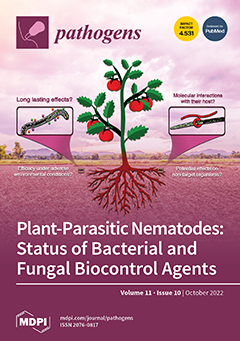
Cover Story: Plant-parasitic nematodes (PPNs) are among the most notorious and underrated threats to food security and plant health worldwide, compromising crop yields and causing billions of dollars of losses annually. Chemical control strategies rely heavily on synthetic chemical nematicides to reduce PPN population densities, but their use is being progressively restricted due to environmental and human health concerns, so alternative control methods are urgently needed. Here, we review the potential of bacterial and fungal agents to suppress the most important PPNs, namely Aphelenchoides besseyi, Bursaphelenchus xylophilus, Ditylenchus dipsaci, Globodera spp., Heterodera spp., Meloidogyne spp., Nacobbus aberrans, Pratylenchus spp., Radopholus similis, Rotylenchulus reniformis, and Xiphinema index. View this paper
  • Issues are regarded as officially published after their release is announced to the table of contents alert mailing list .
  • You may sign up for email alerts to receive table of contents of newly released issues.
  • PDF is the official format for papers published in both, html and pdf forms. To view the papers in pdf format, click on the "PDF Full-text" link, and use the free Adobe Reader to open them.

Articles (152)

  • Article
  • Open Access
9 Citations
4,286 Views
20 Pages

Powassan Virus Induces Structural Changes in Human Neuronal Cells In Vitro and Murine Neurons In Vivo

  • Jacob Nelson,
  • Lorenzo Ochoa,
  • Paula Villareal,
  • Tiffany Dunn,
  • Ping Wu,
  • Gracie Vargas and
  • Alexander N. Freiberg

21 October 2022

Powassan virus (POWV) is a tick-borne flavivirus (TBFV) that can cause severe encephalitis in humans with a case–fatality rate as high as 11%. Patients who survive severe encephalitic disease can develop long-term neurological sequelae that can...

  • Communication
  • Open Access
3 Citations
2,337 Views
8 Pages

Prevalence of Toxoplasma gondii Antibodies and Risk Factor Investigation in Portuguese Veterinarians: A Matched Case–Control Study

  • Daniela Almeida,
  • Sérgio Santos-Silva,
  • Maria Aires Pereira,
  • Carla Santos,
  • Cristina Mega,
  • Catarina Coelho,
  • Carmen Nóbrega,
  • Fernando Esteves,
  • Rita Cruz and
  • Helena Vala
  • + 1 author

21 October 2022

(1) Background: Toxoplasma gondii is a widespread zoonotic agent that greatly impacts Public Health, being responsible for one of the most important parasitic zoonosis worldwide. T. gondii has a heteroxenous life cycle, with cats being the definitive...

  • Article
  • Open Access
15 Citations
4,388 Views
9 Pages

Antimicrobial Resistance and Virulence Factors of Proteus mirabilis Isolated from Dog with Chronic Otitis Externa

  • Jun Kwon,
  • Myoung-Hwan Yang,
  • Hyoung-Joon Ko,
  • Sang-Guen Kim,
  • Chul Park and
  • Se-Chang Park

21 October 2022

Otitis externa is among the most prevalent diseases in dogs. If the underlying cause is not addressed, bacterial reinfection becomes frequent, necessitating antibiotic administration for an extended period of time. Prolonged treatment promotes the em...

  • Article
  • Open Access
4 Citations
3,676 Views
11 Pages

Evidence of Dirofilaria immitis in Felids in North-Eastern Italy

  • Marika Grillini,
  • Antonio Frangipane di Regalbono,
  • Cinzia Tessarin,
  • Paola Beraldo,
  • Rudi Cassini,
  • Erica Marchiori and
  • Giulia Simonato

20 October 2022

Dirofilaria immitis is a mosquito-borne nematode, causing heartworm (HW) disease in wild and domestic canids. HW can also affect felids with different clinical patterns from asymptomatic pictures to sudden death, making the monitoring and diagnosis c...

  • Article
  • Open Access
8 Citations
4,651 Views
13 Pages

Inflammatory Response in Caco-2 Cells Stimulated with Anisakis Messengers of Pathogenicity

  • Ilaria Bellini,
  • Daniela Scribano,
  • Meysam Sarshar,
  • Cecilia Ambrosi,
  • Antonella Pizzarelli,
  • Anna Teresa Palamara,
  • Stefano D’Amelio and
  • Serena Cavallero

20 October 2022

Background: Anisakis spp. third-stage larvae (L3) are the causative agents of human zoonosis called anisakiasis. The accidental ingestion of L3 can cause acute and chronic inflammation at the gastric, intestinal, or ectopic levels. Despite its releva...

  • Article
  • Open Access
7 Citations
3,403 Views
13 Pages

Mammalian and Avian Larval Schistosomatids in Bangladesh: Molecular Characterization, Epidemiology, Molluscan Vectors, and Occurrence of Human Cercarial Dermatitis

  • Sharmin Shahid Labony,
  • Md. Shahadat Hossain,
  • Takeshi Hatta,
  • Anita Rani Dey,
  • Uday Kumar Mohanta,
  • Ausraful Islam,
  • Md. Shahiduzzaman,
  • Muhammad Mehedi Hasan,
  • Md. Abdul Alim and
  • Naotoshi Tsuji
  • + 1 author

20 October 2022

Schistosomiasis is a neglected tropical disease (NTD) caused by blood flukes (Schistosoma spp.). Schistosomatids affect a wide array of vertebrate hosts, including humans. In the present study, multiple species of schistosomatids were identified by i...

  • Commentary
  • Open Access
11 Citations
4,282 Views
6 Pages

CRISPR-Based Diagnostics: A Potential Tool to Address the Diagnostic Challenges of Tuberculosis

  • Yong Qi,
  • Kun Li,
  • Yuxi Li,
  • Donglin Guo,
  • Jing Xu,
  • Yuexi Li and
  • Wenping Gong

20 October 2022

Tuberculosis (TB) is an infectious disease caused by Mycobacterium tuberculosis, which infects more than 23% of the world’s population. With the emergence of drug-resistant TB (DR-TB) and latent TB infection (LTBI), rapid diagnosis of DR-TB and...

  • Communication
  • Open Access
6 Citations
2,632 Views
10 Pages

High Rates of Detection and Molecular Characterization of Porcine Adenovirus Serotype 5 (Porcine mastadenovirus C) from Diarrheic Pigs

  • Kerry Gainor,
  • Yussaira Castillo Fortuna,
  • Angeline Steny Alakkaparambil,
  • Wendy González,
  • Yashpal Singh Malik and
  • Souvik Ghosh

20 October 2022

Since the first report on isolation of porcine adenovirus serotype 5 (PAdV-5, species Porcine mastadenovirus C (PAdV-C)) from pigs with respiratory illness in Japan in 1987, PAdV-5 have been detected in a few fecal samples from healthy pigs and in so...

  • Article
  • Open Access
31 Citations
32,843 Views
15 Pages

20 October 2022

Feline infectious peritonitis (FIP) is a complex and historically fatal disease, though recent advances in antiviral therapy have uncovered potential treatments. A newer therapeutic option, unlicensed molnupiravir, is being used as a first-line thera...

of 16

Get Alerted

Add your email address to receive forthcoming issues of this journal.

XFacebookLinkedIn
Pathogens - ISSN 2076-0817