


Abstract
Cultural memory in classical poetry is carried not by isolated words but through textual relations, interpretive traditions, and paratextual frames. Taking “Nanshan” (南山) in the Shijing (詩經) as a mnemonic node, this study examines how its cultural memory is reconstructed in four English translations by James Legge, Arthur Waley, Bernhard Karlgren, and Xu Yuanchong. A small corpus of eleven Shijing poems containing these mountain expressions was compiled, yielding forty-four poem–translator records. The analysis combines manual coding, checked through independent second coding of a subset of records, with descriptive statistics and close case studies across five dimensions: naming strategy, spatial function, cultural memory strategy, poetic reconstruction, and paratextual mediation. The results show that geographical renderings such as “southern hill(s)” and “Southern Mountain” predominate, but they do not necessarily erase cultural memory; conversely, phonetic or proper-name retention does not automatically preserve it. More specifically, the visibility of Nanshan’s affective, political-ritual, auspicious, and agrarian associations depends on the interaction of translated names with poetic context, titles, notes, classification, selection, and verse form. Translating classical poetic imagery, the study argues, involves not merely retaining culture-specific names but rebuilding the interpretive conditions under which cultural memory can be recognized in the target language.
1. Introduction
The Shijing (Book of Poetry) is the earliest anthology of Chinese poetry and a foundational source of the Chinese poetic tradition. From the Han dynasty onward, after entering the Confucian canon, it helped shape, over many centuries, education, political culture, and the literati tradition of premodern China (Nylan 2001, pp. 13–17). Its meanings were never fixed at the moment of composition; they were repeatedly reinterpreted and reactivated through generations of recitation, commentary, moral instruction, and circulation (Van Zoeren 1991, pp. 45–65). The reception history of the Shijing is therefore not only a history of literary reading but also one through which canonical meaning and cultural memory have continually been generated. Within this process, recurrent natural images serve as an important medium linking textual experience to later cultural cognition, and “Nanshan” (南山, the Southern Mountain) is among the most telling. Across different poems, it refers at once to a concrete mountain landscape and to associations with ritual order, political ethics, marriage, and affective experience, so that its meaning extends well beyond that of a place name. When Nanshan is rendered in English as “Southern Hills,” “South Mountain,” or otherwise, what changes is not only its verbal form but also, potentially, the cultural memory associated with the image. This study takes four English translations of the Shijing as its object and asks how different translators reconstruct the meaning of Nanshan and how these choices shape the presence of its cultural memory in an English-language context.
The cultural meanings that accrued to the Shijing through long practices of recitation, commentary, and instruction can be further understood within the theory of cultural memory developed by Jan Assmann and Aleida Assmann (J. Assmann 2008, 2011; Assmann and Czaplicka 1995; A. Assmann 2008, 2011). That framework holds that the past does not persist into the present unmediated; rather, it is selected, organized, and transmitted by cultural communities through texts, rituals, images, institutions, and their interpretive practices. In a literary context, cultural memory can be understood as collective cultural experience mediated through literary works, with both historical depth and affective force. Culture and translation stand in a symbiotic relation, since translated texts depend on cultural memory to become complete (Luo 2014, p. 41). Seen in this light, Nanshan in the Shijing can be treated as a mnemonic cue: not a fixed cultural content awaiting faithful transfer into English, but a cultural sign that acquires its mnemonic function through the canonical text, the commentarial tradition, and poetic form. English translation moves this image into a new linguistic and interpretive environment and thereby alters the conditions under which its associated cultural links can be made visible and recognizable. Translating Nanshan, then, involves not only the linguistic conversion of a name but also the reorganization of its cultural memory in the target-language context.
Existing scholarship on the English translation of the Shijing has centered largely on translation strategies (Li 2016; Zhang and Wen 2021) and on the cross-cultural interpretation of culture-specific elements (Zhang 2022), while also addressing poetic and aesthetic representation, translators’ subjectivity, and canonical dissemination (Y. Wang 2016; Yan 2017). Some studies further consider how a translator’s outlook, position, and aims of cultural transmission shape the resulting text (Chen and Zhu 2021). English-language scholarship has likewise illuminated the historical and interpretive contexts surrounding these translations. Girardot (2002), for example, situates Legge’s work within a scholarly missionary project, while Saussy (1993) and Yu (1987) illuminate the hermeneutics of imagery in the Chinese poetic and commentarial tradition. These studies provide a basis for understanding the textual features and cultural orientations of Shijing translations, yet because they typically take a whole translation, a translator, or a taxonomy of strategies as the unit of comparison, the way a single recurrent image accumulates and shifts meaning across poems and versions tends to fall outside their frame. Although Nanshan recurs throughout the Shijing and connects with natural space, social order, affective experience, and successive layers of interpretation, its sustained presence across English translations and the cross-lingual reconstruction of its cultural memory remain underexamined.
Research on translation and memory, meanwhile, has argued that translation is not merely a conduit for existing memory but participates in the selection, reorganization, and cross-cultural movement of memory (Brownlie 2016; Deane-Cox and Spiessens 2022). Much of this work has focused on war, trauma, colonial experience, and national memory (Deane-Cox and Spiessens 2022; Jünke and Schyns 2022; Rzepa 2018), with limited attention to the mnemonic function of classical poetic imagery in translation. Nanshan offers a concrete point at which these two lines of inquiry meet: it is at once a poetic image that recurs in the Shijing and is rendered variously by different translators, and a carrier of cultural memory shaped through the canonical text, the commentarial tradition, and historical interpretation.
Against this gap, the study examines four representative English translations of the Shijing: Legge (1876), Waley ([1937] 1960), Karlgren ([1950] 1974), and Xu (2021a, 2021b). Produced in distinct scholarly and poetic settings, they present, respectively, a classicist-exegetical, a literary, a philological, and an aesthetic-poetic orientation, and together they provide a sample with sufficient internal tension to compare how the Nanshan image travels across languages. The analysis asks how Nanshan is rendered in different poems and how the translated name and paratextual information jointly shape the display of its cultural memory. Three questions guide the discussion. First, how do the four translations treat the naming of Nanshan and the lines in which it appears, and what do their renderings share or not share? Second, how do translators use context, poem titles, notes, and other paratextual material to present the historical experience, social ideas, and interpretive traditions linked to Nanshan? Third, how do these choices shape the textual and paratextual conditions under which Nanshan’s cultural memory is selected, weakened, foregrounded, or reorganized in the translations?
Through a small corpus that allows lateral comparison across poems and translations, together with close case studies, the study aims to show that the cultural memory of Nanshan is not stored in the word itself but depends on canonical, textual, and paratextual frames for its activation. What translation changes is less the sheer quantity of cultural information retained or lost than the textual position and interpretive conditions that Nanshan acquires in the target text. Lexical foreignness does not guarantee the continuity of cultural memory, and geographical rendering does not necessarily interrupt it. The visibility of cultural memory therefore depends on the overall relation among the translated name, poetic context, title, notes, selection, and verse form.
2. Theoretical Framework: Cultural Memory and the Translation of Nanshan
2.1. Cultural Memory
The theory of cultural memory offers a productive vantage point for understanding how certain recurrent signs in classical texts acquire durable cultural meanings. Halbwachs’s ([1925] 1992) account of collective memory shows that remembering is not the isolated preservation of the past by individuals but is organized within social frameworks. Building on this, Jan Assmann distinguishes communicative memory from cultural memory: the former rests on everyday interaction and lived experience, while the latter secures the transgenerational transmission of the past through relatively stable media such as texts, rituals, images, institutions, and specialized interpreters (J. Assmann 2008, 2011; Assmann and Czaplicka 1995). Aleida Assmann, considering canon, archive, writing, place, and institution, further shows that cultural memory does not preserve the past in its entirety; through selection, preservation, and reactivation, it allows certain elements of the past to keep entering the meaning structures of a cultural community (A. Assmann 2008, 2011).
This framework bears directly on Nanshan. As a spatial name that recurs in the Shijing, Nanshan is not merely a natural landscape or geographical referent, nor is it a cultural sign with a single fixed meaning. Across different poems, it enters different semantic structures and affective relations. These connections are not produced automatically by the name Nanshan but depend on particular poems, syntactic relations, textual structure, and the interpretive frameworks formed by successive commentaries. The mnemonic function of Nanshan, in other words, is not sealed within the word but activated within textual relations and interpretive traditions.
The present study treats Nanshan as a textual cue for cultural memory. For Chinese readers familiar with the Shijing and its commentarial tradition, Nanshan may evoke mountain space as well as particular historical experiences, social ideas, and affective structures. When Nanshan is translated into English, these textual relations and cultural associations are also placed within a new linguistic environment. Target-language readers do not, as a rule, share the same familiarity with the canonical status, commentarial tradition, and intertextual knowledge accumulated around the Shijing in Chinese culture, and so cultural memory does not carry over automatically in translation. What translation alters is not only the linguistic form of the name Nanshan but also the conditions under which this spatial name can be recognized and understood in the target text. The problem of translating Nanshan is therefore not reducible to the linguistic conversion of a place name or a natural object; it belongs to the mechanisms by which cultural memory is generated and displayed in a classical text.
2.2. Nanshan as a Mnemonic Node in the Shijing
In the Shijing, Nanshan first denotes an actual mountain space, but its cultural meaning does not stop at geographical information. Across different poems it is linked in turn with affective space, with political and ritual order, with wishes for longevity, and with agrarian and sacrificial activity, and it thereby carries distinct textual functions.
The first concerns the relation between mountain space and individual feeling. The affective force of mountain space emerges through the actions and experiences attached to it, as longing, waiting, or grief becomes spatially articulated through climbing, gathering, looking out, and separation. Mountains in early Chinese culture could carry broader sacred, cosmological, and survival-related associations (Ye 1996), but here their affective significance takes shape through specific relations between landscape and human experience. “Caochong” (草蟲, Grasshoppers) offers a concentrated example of how Nanshan takes part in the expression of longing. The poem twice describes the speaker “climbing that southern hill (陟彼南山),” each time linked to gathering ferns or bracken and to waiting for the “noble one (君子).” What appears first is a concrete sequence of action: the speaker ascends Nanshan and gathers plants there, yet never meets the person longed for. As the acts of “climbing” and “gathering” recur, ascent ceases to be mere spatial movement and comes to correspond to a sustained waiting; the mountain becomes the site where longing keeps recurring. It does not by itself symbolize parting or grief, but the figure’s actions upon it lend the space an affective charge (Cheng and Jiang 2017, pp. 38–40).
The second is the relation between mountain space and political-ritual order. “Zhongnan “ (終南) repeatedly asks “what is there on Zhongnan (終南何有),” describing first the trees and plants of the mountain and then the robes, bearing, and jade pendants of the noble one (Cheng and Jiang 2017, pp. 373–74). The cultural function of the mountain forms through two shifts. The luxuriance and height of Zhongnan are first turned into a foil for the human figure; the figure’s dress and pendants then lead the natural scene toward political identity and ritual order. What the poem presents is not an abstract “majesty” but a continuous relation among mountain, dress, and status. The political standing of the noble one is confirmed not through evaluative language alone but through visible external forms. Zhongnan thus takes part in constructing the image of the ruler, connecting natural space with a ritualized political order.
The third is the relation between mountain space and blessing, temporal continuity, and agrarian order. “Tianbao” (天保, Heaven Protects) places “the constancy of the moon,” “the rising of the sun,” “the longevity of the southern hill,” and “the luxuriance of pine and cypress” in sequence, forming a set of images of growth, stability, and continuity (Cheng and Jiang 2017, pp. 489–94). “The longevity of the southern hill” later became a fairly stable expression of birthday blessing that remains in use, which indicates that cultural memory does not arise from a single occurrence within one poem. The line was cited again and again in canonical recitation and later linguistic practice, so that the association between Nanshan and long life gradually gained a cultural resonance extending beyond the original poem.
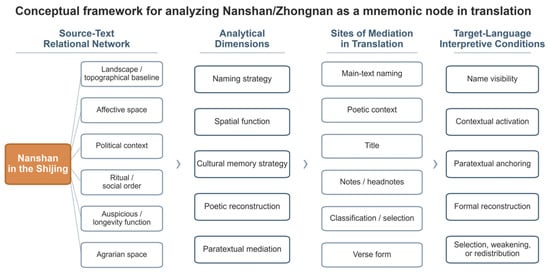
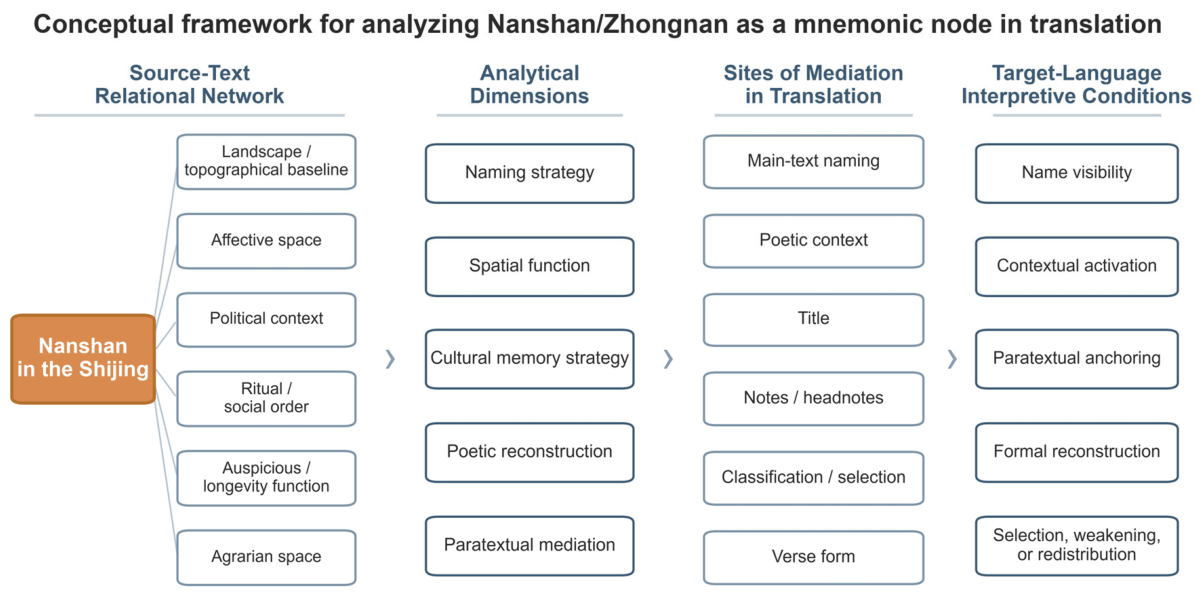
Across these poems, the cultural significance of the mountain takes shape through the situations in which it appears. Climbing, gathering, dress, ritual practice, blessing, and cultivation connect mountain space with different forms of human experience and social life. These associations are further reinforced or reshaped through later commentary and reception. In the Chinese context, then, Nanshan in the Shijing exceeds the simple depiction of an actual mountain and becomes a symbol within cultural memory, bearing affective and social meaning. What this study calls the “cultural memory of Nanshan” refers chiefly to these cultural connections, formed in the text of the Shijing and continually interpreted within canonical transmission and the commentarial tradition. Nanshan keeps its basic function as a mountain referent while remaining able, in different poems, to connect with affective, political, ritual, and celebratory experience. Figure 1 sets out the analytical model that follows from this account: the source-text relational network is examined through five dimensions, redistributed across several sites of mediation, and realized as a set of interpretive conditions in the target language, so that cultural memory is reconstructed through the joint action of name, context, paratext, and poetic form rather than transferred as a fixed content.
Figure 1.
Conceptual framework for analyzing Nanshan as a mnemonic node in translation.
3. Corpus and Methodology
3.1. Corpus and Selection of Translations
The study takes as its object those poems in the Shijing that contain Nanshan or the historically related mountain name Zhongnan1. Chinese text and traditional annotation follow Cheng and Jiang (2017) throughout. On this basis, four English translations, by Legge (1876), Waley ([1937] 1960), Karlgren ([1950] 1974), and Xu (2021a, 2021b), were selected as comparative material. Two considerations informed the selection. First, the four hold a prominent place in the history of Shijing translation and correspond, respectively, to the paths of canonical interpretation, literary rendering, philological study, and poetic re-creation. Second, they differ markedly in textual form and paratextual arrangement, which makes them suitable for examining how the cultural memory of Nanshan is redistributed across the main text, titles, notes, the structure of the selection, and verse form.
More concretely, Legge’s translation includes verse renderings, argument headnotes, and fairly detailed notes, and it preserves a good deal of exegetical and historical explanation; Waley selects and regroups the poems of the Shijing and renders them mainly in a fairly natural form of modern English verse; Karlgren juxtaposes the Chinese original, a transcription, and an English translation, with close attention to words, syntax, and textual correspondence; and Xu’s bilingual edition reinforces aesthetic effect through rhyme, rhythm, and regular lines. These differences allow the study to examine naming choices, context, paratextual explanation, and poetic reconstruction at once, rather than comparing only the lexical equivalence of “nan shan”.
3.2. Coding and Analytical Procedure
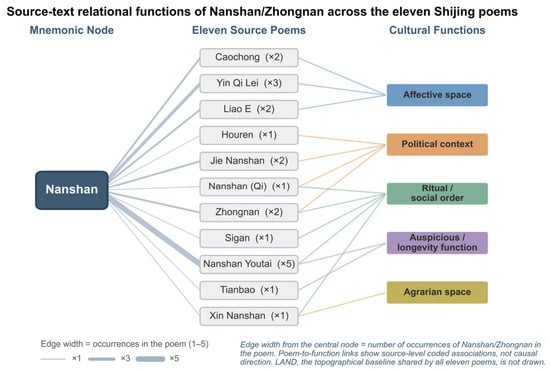
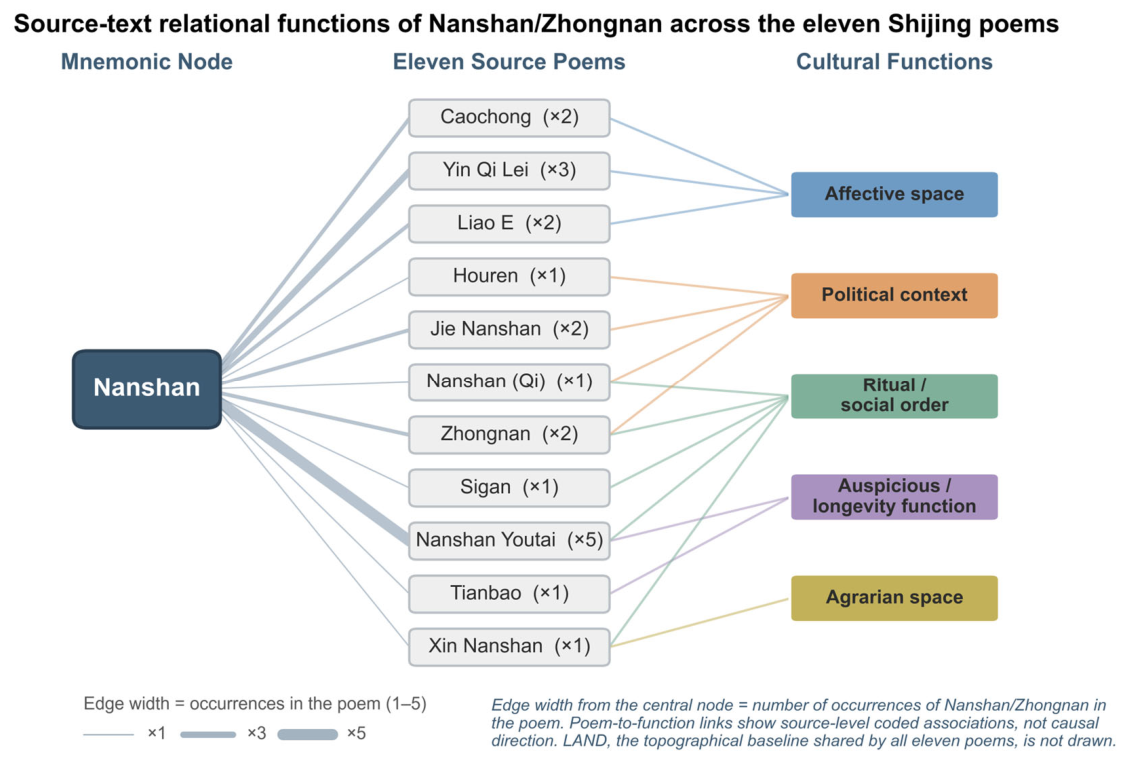
The basic unit for comparison and counting is the poem–translator pair, with the specific position of Nanshan within each poem serving as a supplementary reference for judging the source context. The corpus comprises eleven Shijing poems containing Nanshan or Zhongnan. Where the expression occurs more than once in a poem, the occurrences are merged into a single poem-level record, so that the counts weight poems equally; the number of occurrences per poem is documented separately and displayed in Figure 2. Each of the four translations supplies eleven records, for a total of forty-four translation records. Where a poem was not included in a translation (Waley’s “Jie Nanshan”), its record position was retained and the status documented.
Figure 2.
Source-text relational functions of Nanshan/Zhongnan across the eleven Shijing poems. Edge width from the central node to each poem indicates the number of occurrences of Nanshan/Zhongnan in that poem. Links from poems to cultural functions indicate source-level coded associations, not causal direction. LAND, the topographical baseline shared by all eleven poems, is not drawn as a separate function.
The study combines manual coding with descriptive statistics. The coding scheme rests methodologically on qualitative content analysis and draws on cultural memory theory, research on the translation of culture-specific items, poetry translation studies, and paratext studies. Qualitative content analysis stresses processing textual material on the basis of clearly defined units of analysis, category definitions, and coding rules, and it improves the clarity, stability, and verifiability of coding standards through trial coding and category revision (Saldaña 2021; Schreier 2012). Following this procedure, a set of translation examples was first annotated and trial-coded; the code definitions were then revised in light of the preliminary results; and finally all poem–translator records were formally coded. Uncertain cases were re-examined against the source context, the surrounding translation, and the relevant paratexts, with the basis for each decision retained in the coding table.
The corpus was first coded in full by the first author. To assess coding stability, the second author independently coded a stratified subset of twelve poem–translator records (27% of the corpus: three poems across all four translators, covering affective, political, and agrarian–ritual functions), using only the codebook and the translation evidence. Across the double-coded subset, label-level agreement was 98.2% overall (Naming Strategy 100%, Spatial Function 100%, Cultural Memory Strategy 97.4%, Poetic Reconstruction 96.6%, Paratextual Mediation 98.2%). The six disagreements traced to three sources and were resolved through discussion: the inclusion criterion for RHY was clarified (rhyme as the driver of syntactic reorganization, not the mere presence of end-rhyme); translators’ poem-level footnotes were uniformly counted under NOTE/HEAD; and the operationalization of REDIST was made explicit. The first author then re-examined the full corpus under the clarified criteria. Following this reconciliation, REDIST was applied where a title or note carries a name or cultural anchoring that the main-text rendering no longer does: Legge’s five poems with transliterated titles above geographical main-text renderings, and Xu’s “Zhongnan” and “Xin Nanshan,” whose titles and endnotes re-anchor the mountain’s historical identity. The second coding and the reconciliation record accompany the coding tables in the Supplementary Materials. Given the small corpus and the interpretive, multi-label design, the counts serve as descriptive support for the qualitative reading. Applied across all forty-four poem–translator records, the coding provides a common basis for comparison across poems and translators and reduces reliance on isolated examples. The resulting patterns make recurring differences in naming, cultural-memory strategy, poetic reconstruction, and paratextual mediation easier to trace across the corpus. They also bring into view cases in which cultural information is redistributed between the main text and the paratext.
The five coding dimensions at the level of the translation follow from the composite character of the object and from the theoretical questions at issue. Because Nanshan is first of all an expression with the properties of a place name and a culture-specific item, Naming Strategy is used to examine how translators handle its proper-name quality, geographical reference, and cultural-identifying function; this dimension draws mainly on Aixelá’s (Aixelá 1996) discussion of culture-specific items, adjusted for the translation of place names and proper names. Since Nanshan carries functions of natural landscape, affective space, political context, ritual order, celebratory longevity, and agrarian space across different poems, Spatial Function is used to compare whether the translation preserves or reorganizes these spatial and cultural functions. Because the study is concerned with how the cultural memory carried by Nanshan is conveyed in English, Cultural Memory Strategy is used to mark the ways in which the relevant cultural connections are retained, explained, naturalized, aestheticized, weakened, or redistributed; this dimension draws on the account of texts, tradition, and transgenerational transmission in cultural memory theory (J. Assmann 2011). Since translating the Shijing is not simply semantic conversion, and translators reconstruct poetic experience through rhythm, rhyme, syntax, compression, expansion, and scenic intensification, Poetic Reconstruction is used to examine how they reorganize poetic form and poetic experience, following poetry translation studies on verse form, rhythm, meter, and formal transformation (Holmes [1969] 1988; Lefevere 1975). Finally, because titles, notes, argument headnotes, grouping, and statements of non-inclusion also shape readers’ understanding of Nanshan’s cultural meaning, Paratextual Mediation is used to examine how information beyond the main text takes part in the display of these cultural connections; this dimension follows Genette’s ([1987] 1997) theory of the paratext and Batchelor’s (2018) work on translation paratexts. The five dimensions thus correspond to naming, spatial function, cultural memory, poetic form, and paratextual mediation, and together they render the transformation of the Nanshan image across the four translations.
Coding was multi-label and divided into a source level and a translation level. The source level uses two fields, Source Function and Source Image/Spatial Function: the first records a description of Nanshan’s context in the original poem, while the second marks its principal spatial and cultural functions with the codes LAND, AFF, POL, RIT, AUSP, and AGR, corresponding respectively to natural landscape, affective space, political context, ritual order, celebratory or longevity function, and agrarian space (see Table A1 for the code abbreviations). Because several of these functions can be felt at once, labels are assigned according to what a poem does with the mountain rather than on the response it invites. Where a figure’s actions on the mountain involve climbing, gathering, waiting, or mourning, the record is coded AFF; where the mountain is the term of a comparison, as in the wish that a life last like the longevity of the southern hill, it is coded AUSP; and where it is tied to a title, a robe, an offering, or an office, it is coded POL or RIT. Since Nanshan has a composite function in many poems, the source level generally uses a combination of labels to capture its multiple semantic relations within a given poem.
4. Analysis
4.1. Overall Patterns in the Coding Results
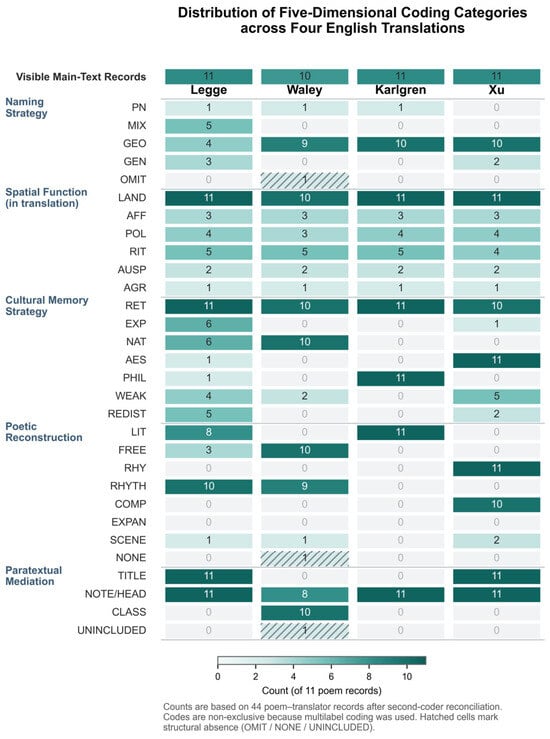
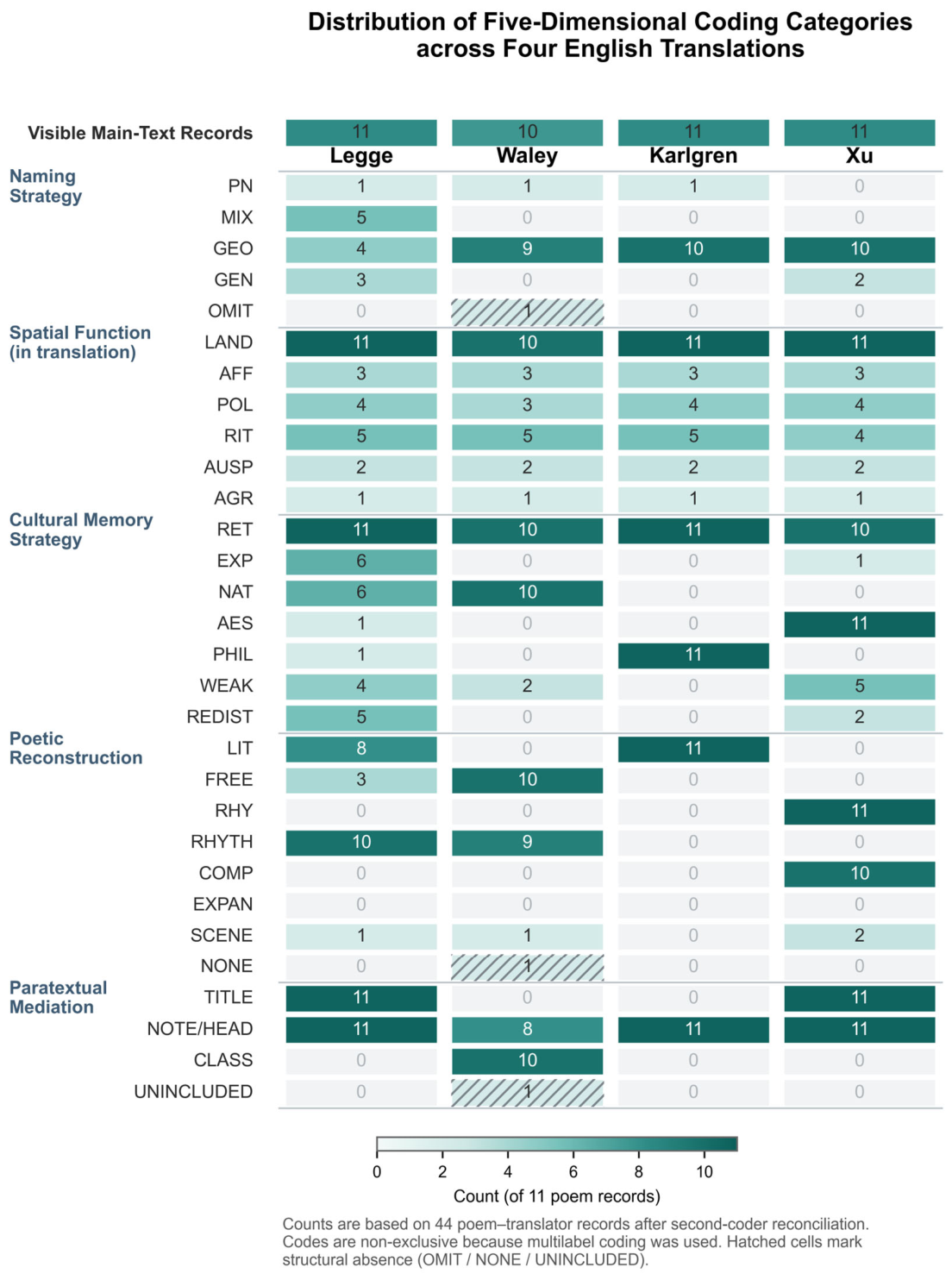
Figure 3 shows a convergence in how the four translations name Nanshan. Under Naming Strategy, GEO occurs thirty-three times, the highest frequency among the naming codes, which indicates that translators generally treat the expression as an ordinary mountain term carrying directional information rather than retaining it in the main text as a transliterated proper name. On entering English, Nanshan appears first as a geographical mountain landscape that English readers can grasp directly, not automatically as a cultural place name with canonical intertextual weight. Geographical naming, however, does not in itself mean the disappearance of cultural memory; it shows only that the proper-name quality and cultural-identifying function of the rendering have been reduced. Whether the affective, political, or ritual meanings associated with Nanshan persist has to be judged in relation to the poem.
Figure 3.
Distribution of five-dimensional coding categories across the four translations, after second-coder reconciliation. Cell shading and the central integer give the count among the eleven poem records; the top band reports main-text-visible records. Codes are non-exclusive (multilabel coding). Hatched cells mark structural absence (OMIT/NONE/UNINCLUDED).
A second overall feature is that the visibility of the mountain landscape is fairly stable, whereas the display of its composite cultural functions is uneven. Under Spatial Function, LAND holds a high proportion across all four translations, showing that Nanshan is recognized and reproduced first as a natural landscape or geographical space. RIT, POL, and AFF also appear in some number, indicating that Nanshan is not only a natural image but also a bearer of ritual, political, and affective functions. Yet the presence of a mountain image in the translation does not guarantee that these connections are equally clear: readers may recognize a mountain without recognizing the composite cultural function it carries in a given poem. Under the Cultural Memory Strategy, the high frequency of RET shows that most translations retain Nanshan and some of its contextual links, but this retention is neither complete nor uniform. Because coding is multi-label, RET can co-occur with NAT, AES, EXP, WEAK, or REDIST, which means that a single translation may keep the mountain image or the basic syntactic relations while naturalizing the expression, intensifying its poetic form, or weakening its historical and ritual background. REDIST itself appears in seven records: five in Legge, where a transliterated title preserves the proper name above a geographical main text, and two in Xu, where the title and endnote re-anchor the mountain’s historical identity. These are precisely the cases in which the burden of cultural memory shifts from the poetic line to the paratext. Change in cultural memory under translation cannot therefore be reduced to “retention” or “loss”; one must ask which relations are continued, which become harder to recognize, and which are moved outside the main text.
A third overall feature is that the retention of cultural memory is not concentrated at a single textual level but combines with different translational means. The main differences among the four translators lie in their memory strategies, modes of poetic reconstruction, and uses of paratext. Poem-level notes are in fact widespread: Legge, Karlgren, and Xu each attach a note or headnote to all eleven poems, and Waley to eight of his ten included poems (NOTE/HEAD = 11/8/11/11), so the contrast lies less in whether notes are used than in their kind and weight. Legge’s notes take the form of extended argument headnotes and exegetical glosses, combining strong retention with literal rendering, rhythmic reconstruction, and explicit explanation, and supplementing historical and institutional background beyond the main text. Karlgren’s notes are philological, maintaining cultural information chiefly through retention, close attention to word sense, syntax, and correspondence with the original. Xu’s notes are brief thematic endnotes that accompany a strong use of titles, while the image itself is reorganized into rhymed and compressed verse. Waley works differently again. He relies less on annotation than on arrangement: his footnotes are short and mostly locational, while the poems are regrouped under thematic headings that tell the reader in advance what kind of song is coming. The imagery and its affective relations are carried in a fairly natural English idiom, and what shapes their reception is chiefly the company each poem keeps.
Beyond naming, notes, and titles, non-inclusion within a selection also affects the visibility of Nanshan’s cultural memory in English. Table 1 shows that, of the eleven relevant records in Waley’s translation, ten are visible in the main text while one—“Jie Nanshan”—is not included at all: it belongs to the political laments Waley states he set aside. The exclusion is small in number but not neutral in kind, since “Jie Nanshan” is the poem in which the mountain is most directly bound to political remonstrance; its absence thins precisely the political strand of the image in his selection. Non-inclusion is thus not merely a lack of material but a weakening of memory produced by the structure of the selection. Through strong literary editing and classification, Waley’s translation offers English readers a more accessible route into the Shijing, yet the same editing quietly filters which of Nanshan’s cultural contexts a reader can encounter.
Table 1.
Corpus composition and main-text visibility across the four translations.
4.2. Redistribution Through Paratexts in Two Representative Cases
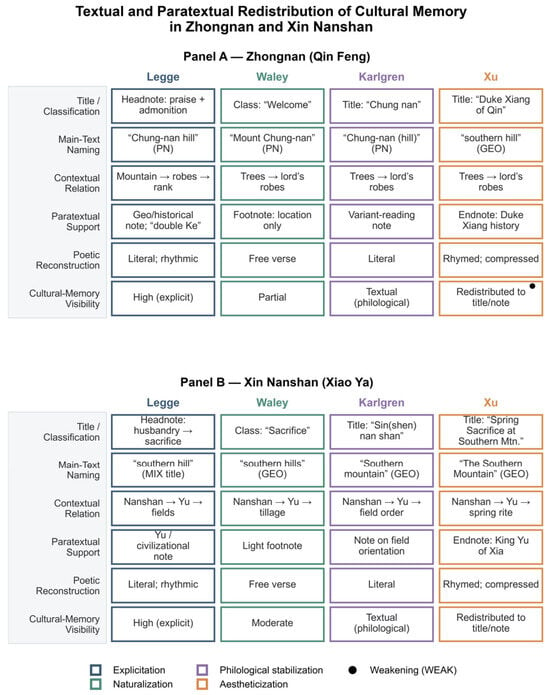
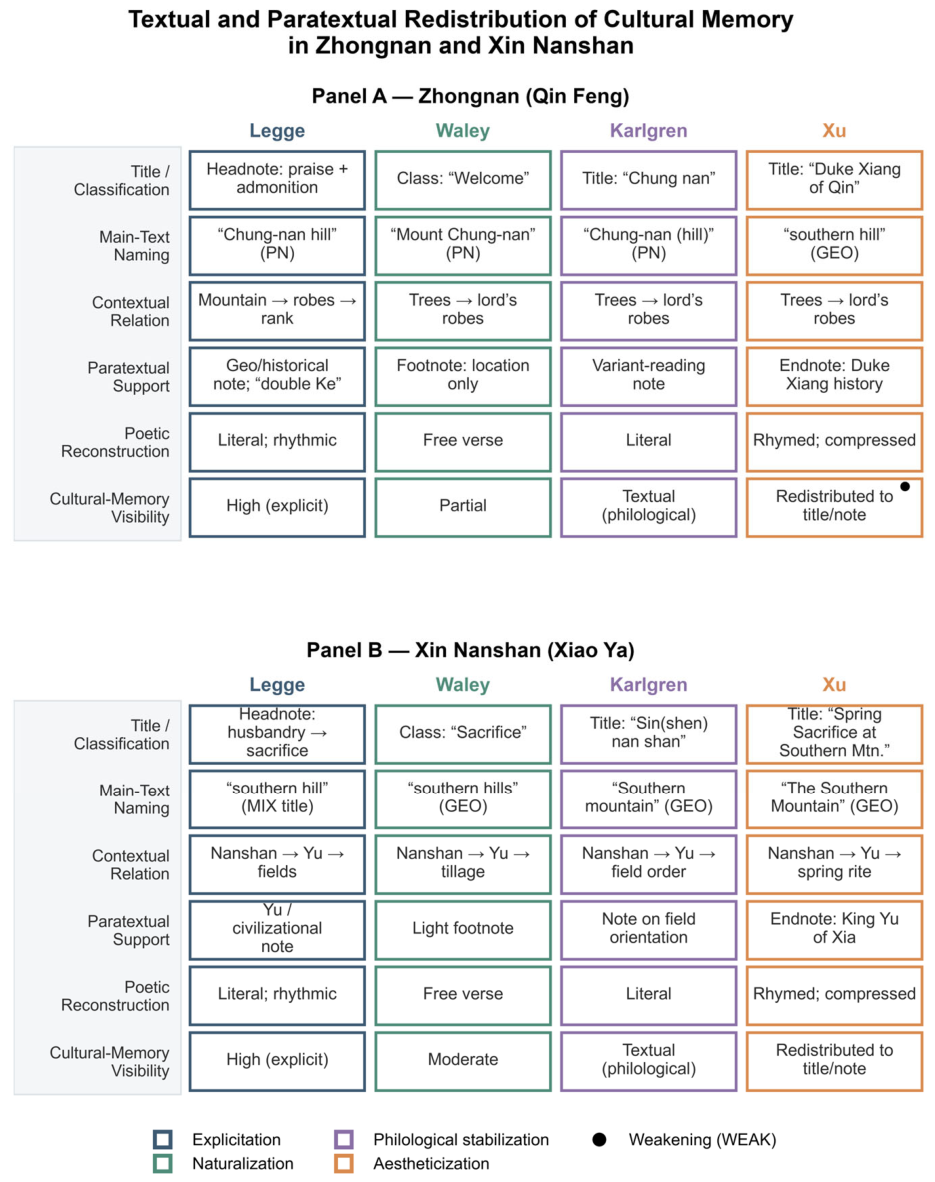
The coding results indicate that Nanshan is most often handled as a geographical mountain expression across the four translations. The rendered name alone, however, does not fully account for how cultural memory is displayed. A closer look at paratextual material shows that titles, argument headnotes, notes, grouping, prefatory remarks, and the scope of the selection often change the interpretive position of Nanshan in the target text, so that cultural memory is redistributed between the main text and the paratext. Genette treats the paratext as the “threshold” of reading, shaping how readers enter a text and in what interpretive direction (Genette [1987] 1997). In a translation context, Batchelor likewise notes that a translation’s paratext not only introduces the text but takes part in constructing the relation between the translation and the source culture (Batchelor 2018). From this angle, the English rendering of Nanshan occurs not only within the poetic line but also within the interpretive frame the translation sets around the poem. Against this background, “Zhongnan” and “Xin Nanshan” provide two contrasting cases, representing political-ritual and agrarian-sacrificial contexts, respectively, through which the relation between the main text and paratext can be compared across the four translations. Figure 4 compares the two cases across the four translations along parallel rows, from title and naming to cultural-memory visibility.
Figure 4.
Textual and paratextual redistribution of cultural memory in Zhongnan (Panel (A)) and Xin Nanshan (Panel (B)). Each cell summarizes the coding for one poem–translator pair; border color marks the dominant mediation orientation, and a black dot marks weakening, and arrows indicate the relational sequence among the elements summarized within a cell.
“Zhongnan”, from the Songs of Qin, places the mountain alongside the dress and bearing of a noble figure, linking the landscape to political and ritual status. In the later interpretive tradition, this figure is associated with Duke Xiang of Qin, giving the poem an additional historical frame for understanding the mountain image. In the main text, Legge renders the name as “Chung-nan hill,” Waley as “Mount Chung-nan,” Karlgren as “Chung-nan (hill),” and Xu as “southern hill.” All four retain the mountain reference, yet these renderings alone do not explain its association with the Qin ruler and ritual order. That connection is established mainly through the paratext.
Legge and Xu both use the paratext to strengthen the link between Zhongnan and the identity of the Qin ruler, though by different means. Legge’s paratext most clearly places the mountain image within a frame of political geography and ritual status. He glosses the poem as “CELEBRATING THE GROWING OPULENCE OF SOME RULER OF TS’IN, AND ADMONISHING, WHILE PRAISING, HIM” (Legge 1876, p. 160), that is, praise carrying admonition. This headnote first changes the reader’s judgment of the poem’s nature: the mountain, dress, and figure are no longer natural scenery and description alone but bear on the rise and political virtue of the Qin ruler. Legge then explains the geographical and historical position of Zhongnan: “Chung-nan was the most famous mountain in the old demesne of Chow, lying south of the old capital of Haou” (Legge 1876, p. 160); and he notes that it later passed to Qin because “king P’ing granted to duke Seang the old possessions of Chow” (Legge 1876, p. 161). These remarks make Zhongnan both a famous mountain within the old Zhou domain and a geographical marker of the formation of Qin political space. In Legge’s translation, then, Zhongnan is not only a natural landscape but the historical background against which the Qin ruler gains territory, receives investiture, and establishes his standing. In a later note, Legge explains the term fu (黻) as “the double Ke”, noting that it is “one of the symbols of rank, embroidered on the robes of the king and feudal lords” (Legge 1876, p. 161), leading the description of dress in the main text toward the ritual hierarchy of status. The noble one on Zhongnan is thus not an ordinary visitor but a figure whose identity is confirmed through robes, pendants, and mountain space; landscape and ceremonial dress are joined, and Zhongnan becomes the space in which the ruler’s identity is seen and confirmed.
Xu’s paratext likewise directs “Zhongnan” toward the historical narrative of the Qin ruler’s identity, but concentrates on thematic cues in the title and notes. Xu replaces the source title Zhongnan with the explicating English title “Duke Xiang of Qin”, shifting the title’s focus from the mountain to the historical ruler. A note explains that the poem “celebrated the dignity of Duke Xiang of Qin, the first of Qin lords recognized as a prince of the kingdom,” and recounts how he became a feudal lord after escorting King Ping amid the Western Rong turmoil following the death of King You, and through the grant he received. The note ends by observing that, on his way back to Qin, Duke Xiang passed “the Southern Mountain 25 km south of the capital (modern Xi’an)” (Xu 2021a, pp. 270–71), so that the geographical sense of Zhongnan is absorbed into the narrative of political identity. Compared with Legge, Xu’s main-text “southern hill” is more geographical and less proper-name-like, yet his paratext, through the title “Duke Xiang of Qin” and a fairly explicit historical note, resituates Zhongnan within the political scene of Duke Xiang’s investiture and return.
These two treatments show that the proper-name character of a rendering and the visibility of its cultural memory do not always vary together. Legge keeps Chung-nan in the main text and the title, while Xu uses southern hill in the main text, yet both strengthen the link between Zhongnan and the Qin ruler’s identity through the paratext. The difference is that Legge attends more to the continuity among geographical, historical, and institutional explanations, whereas Xu foregrounds the human theme and the political narrative directly. The former makes Zhongnan a junction of Zhou–Qin geography and ritual status; the latter makes it part of the political image of Duke Xiang.
Waley and Karlgren are more restrained. Waley places the poem in the “Welcome” class and, in a footnote, states only that Mount Chung-nan lies “South of Hsi-an Fu, Shensi” (Waley [1937] 1960, p. 190). The note supplies a basic geographical location but does not develop the Zhou–Qin transfer of power, Duke Xiang’s investiture, or ritual dress and rank; and the classification “Welcome” directs the poem more toward the scene of welcoming a ruler than toward historical explanation. Karlgren’s paratext consists chiefly of the title “Chung nan” and a textual-variant note (Karlgren [1950] 1974, p. 84) pointing out the variant substitution of certain words in the second stanza. His handling maintains stability at the level of text and wording but does not, as with Legge or Xu, place Zhongnan explicitly within a narrative of political geography. In “Zhongnan,” then, differences in the paratext directly affect how far the cultural memory of Zhongnan is displayed: some translations read it as a node of Zhou–Qin political space and ritual status, while others mainly preserve its geographical location or textual form.
“Xin Nanshan” (信南山) shows how the paratext can reconnect Nanshan with memories of agriculture, sacrifice, and the origins of civilization. The poem opens, “Truly that southern mountain, it was Yu (禹) who brought it under order (信彼南山,維禹甸之),” and moves on to land management, the division of fields, agricultural production, offerings of food and wine, and ancestral sacrifice, forming a continuous structure that runs from Yu’s ordering of the land to the order of sacrifice2. Nanshan here is thus not merely a natural landform but a space that enters agricultural production and ritual practice.
The four translations present this structure with different emphases. Legge glosses the poem as “HUSBANDRY TRACED TO ITS FIRST AUTHOR; DETAILS ABOUT IT, GOING ON TO THE SUBJECT OF SACRIFICES TO ANCESTORS” and, in a note, links Yu with the opening of the land and the origins of civilization (Legge 1876, p. 255), connecting Nanshan with Yu’s ordering of the soil, the opening of territory, and agrarian order, so that it becomes a spatial node in a narrative of civilizational origin. Waley’s main text preserves the relation between Nanshan and Yu, but his paratext, mainly through the “Sacrifice” classification, leads the reader to understand the poem in terms of sacrificial function. Karlgren’s paratext shows its philological orientation: he gives the title as “Sin(shen) nan shan,” keeping the sound and sense of the title, and explains in a note the field orientation involved in “nan dong qi mu (南東其畝),” observing that the ridges and boundaries might run north–south or east–west and citing the Zuozhuan (左傳) to gloss tung as “extending eastward” (Karlgren [1950] 1974, p. 85). This note appears to treat only a local sense of the words, yet it bears materially on the cultural memory of Nanshan, since the core of “Xin Nanshan” is not an abstract praise of natural mountains but the reinforcement of a spatial order in which land is divided, managed, and cultivated. Xu, through the title “Spring Sacrifice at the Foot of the Southern Mountain,” places Nanshan directly within a spring sacrificial scene, and a note explains that “this sacrificial ode traced husbandry to its first author, King Yu of Xia” (Xu 2021b, pp. 210–11), linking the spring sacrifice, the origin of agriculture, and Yu of Xia. Here too, the cultural memory of Nanshan in “Xin Nanshan” is not settled by a rendering such as “southern hill(s)” or “Southern Mountain” on its own.
5. Discussion
5.1. Beyond Retention and Loss: Relational Cultural Memory and Interpretive Conditions
The analysis in Section 4 indicates that the English translation of Nanshan cannot be summed up as “retention” or “loss.” Traditional research on the translation of cultural words often asks whether cultural information is preserved in the translation or diminished through generalization, substitution, domestication, or omission. Such analysis helps describe surface change and is especially suited to identifying how culture-specific items are handled in the target language. Newmark’s (1988) discussion of cultural words likewise reflects an emphasis on lexical units and methods of transfer. For a recurrent image in the Shijing, however, judging the degree of preservation from the angle of lexical transfer alone cannot fully account for the shifts in meaning across translations.
The cultural meaning of Nanshan develops through the relations surrounding the image in different poems. Its associations with affective, political, ritual, and other forms of experience arise from these contexts rather than from the mountain itself. Instead, the recurrent spatial cue becomes meaningful through relations that differ from poem to poem. It is bound up with the function of the poem in which it appears, the actions of the figures, the combination of images, the sociocultural context, the commentarial tradition, and the titles, notes, and verse form of the translation. The unit of analysis for the translation of cultural memory should therefore not be confined to an isolated cultural word but should extend to the whole formed by “word–context–paratext–verse form.” Tymoczko (1999) has observed that translation has a metonymic character: a translation can present only some of the associations of the source text and source culture. On this view, the English rendering of Nanshan does not reproduce a complete cultural meaning but selects, foregrounds, or reorganizes a number of cultural relations in the target text.
This appears first in the fact that transliteration or proper-name retention does not necessarily secure the continuity of cultural memory. Forms such as Nanshan, Nan Shan, or Chung-nan can preserve the foreignness of the source name and make readers aware that it comes from another language and tradition. Yet formal strangeness does not by itself generate the conditions for understanding. Lacking poetic context, headnote, or note, a transliterated name may be only a foreign-sounding word or place name, unable to activate the cultural relations it forms across different poems. The preservation of lexical form is thus a possible, not a sufficient, condition for the continuity of cultural memory. Correspondingly, geographical rendering does not necessarily mean the loss of cultural memory. Renderings such as “southern hill(s)” and “Southern Mountain” do weaken the proper-name quality of Nanshan and bring it closer to a natural-landscape expression familiar to target readers, but in a given poem the cultural function may persist through context and paratext. In “Xin Nanshan,” where Nanshan is linked with Yu, land management, and sacrificial practice, the memory of civilizational opening and ritual can still be displayed through poetic relations even when the rendering is geographical; in “Liao E “(蓼莪), where Nanshan is joined with fierce winds, the death of parents, and the hardship of service, the mountain image still takes part in the grief activated by the poem’s context. Whether cultural memory is visible thus depends not entirely on whether the rendering keeps the source form but on whether the translation preserves or rebuilds a recognizable network of relations for the name.
Whether this network can be recognized in the target language depends further on the interpretive conditions the translation establishes—poetic context, title, headnote, notes, grouping, scope of selection, juxtaposition with the original, and verse form. Hermans’s (1988) discussion of proper-name translation reminds us that a proper name in translation is not only a matter of formal conversion but of how the name gains a recognizable position in the target text. Appiah’s (1993) “thick translation” likewise shows that translation can, through notes and accompanying explanation, bring a text into a fuller cultural context. For Nanshan, cultural memory is not borne by any single rendering but activated in the joint working of these interpretive conditions. The analysis in Section 4 thus suggests that the effect of a translation choice should not be judged at the level of the rendered name alone. The same image may be placed on different reading paths in different translations, and the visibility of its cultural memory depends on whether the rendered name, context, paratext, and verse form can work together.
The domestication–foreignization framework, accordingly, can describe the surface cultural distance of a translation but is not sufficient to judge the effect on cultural memory. Venuti’s ([1995] 2008) discussion of domestication and foreignization brings out the relations among target-language fluency, cultural difference, and translatorial visibility. In the case of Nanshan, however, formal foreignization may preserve the name without activating its cultural function, while formal domestication may weaken the name’s specificity yet still maintain its links with poetic context, commentarial tradition, and verse form. Explanatory notes can restore historical and institutional background but may turn the poetic image more into an object of scholarly exposition; rhyme, rhythm, and poetic reconstruction may compress philological information yet carry forward the affective intensity and ritual momentum of the poem. The discussion of the English rendering of Nanshan should therefore not stop at a choice among transliteration, sense-translation, domestication, and foreignization, but turn to how a translation builds accessible, connectable, and interpretable conditions of reading for the image.
5.2. Translation as the Remediation of Cultural Memory
Translating a classic is not only cross-lingual transcription but also a remediation of cultural memory. It does not move the same mnemonic content intact into another language; through new textual forms, reading institutions, and interpretive devices, it lets the past be preserved, organized, and recognized in new ways. Bolter and Grusin’s (1999) account of remediation holds that a new medium does not simply replace an old one but reabsorbs and reorganizes existing media forms. Cultural memory research has likewise noted that the continuity of memory depends on processes of media transfer and re-presentation, in which mnemonic content is reselected, rearranged, and reinterpreted within a new media environment (Erll and Rigney 2009). On this view, the English translation of the Shijing does not carry the Chinese classic’s Nanshan directly into English but rebuilds, in the target language, the formal conditions under which the image can be understood and remembered.
In the source culture, Nanshan performs its mnemonic function through the canonical status of the Shijing, the commentarial tradition, educational use, later citation, and the cultural knowledge of Chinese readers. An English translation cannot transplant this whole mnemonic environment intact. Translators can only reorganize the reader’s route toward the canonical image through target-language titles, notes, verse form, grouping, scope of selection, and textual layout. The four translations should therefore be seen as four different target-language mnemonic media, placing Nanshan within the distinct frames of canonical interpretation, literary reading, philological study, and aesthetic dissemination.
In this sense, translating a classic conveys not only mnemonic content but the conditions under which a cultural sign performs its mnemonic function. By selecting which poems enter the target language, which cultural relations are explained, which themes are foregrounded by titles or classification, and which formal features are reconstructed, a translation takes part in producing the canonical image in the target language. Damrosch (2003) observes that a literary work, on entering the circulation of world literature, gains a new mode of existence in a new linguistic and cultural environment. The cross-lingual movement of Nanshan reflects a similar process: it no longer belongs solely to the image system internal to the Chinese classic but is reorganized, across translations, into an object that English readers can read, study, appreciate, or interpret. These are claims about the conditions the translations provide; how actual readers take up such conditions remains an empirical question beyond the scope of this study.
6. Conclusions
This study has taken Nanshan in the Shijing as its object and compared how the image is rendered in four English translations. The cultural memory of Nanshan, the analysis finds, is not carried by the rendered name alone. Although the four translations generally use geographical expressions such as “southern hill(s),” “Southern Mountain,” and “South Mountain,” geographical naming does not necessarily interrupt cultural meaning, nor does transliteration or proper-name retention automatically secure its continuity. Across different poems, Nanshan enters structures of affective, political-ritual, celebratory, agrarian-sacrificial, and filial-mournful meaning, and the effect of its English rendering depends on how a translation reorganizes these relations through context, title, notes, selection, and verse form. The differences among the four translations are therefore not only differences in naming strategy but also differences in how cultural memory is placed and recognized in the target language.
On the basis of the overall coding and the representative cases, the study argues that the cultural memory of a classical poetic image is relational and frame-dependent. What matters in translating cultural memory is not simply preserving a cultural name but rebuilding, for that name, the textual relations and interpretive conditions that can support its cultural connections. Evaluating the English rendering of Nanshan should thus not be confined to surface strategies such as transliteration, sense-translation, domestication, or foreignization, but should further examine how the rendered name, context, paratext, structure of selection, and verse form together constitute the interpretive conditions of its cultural memory.
The theoretical contribution lies in extending the unit of analysis in the study of cultural memory translation from the isolated cultural word to a meaning structure formed jointly by text and paratext. For a canonical text such as the Shijing, translation does not carry cultural content sealed within words directly into another language but reorganizes the conditions under which a cultural sign is understood and remembered in the target language. A translation both disseminates the original and takes part in forming the canonical image in the target language.
The study has limits. It concentrates on the single set of mountain expressions around Nanshan, so its conclusions cannot be extended directly to all place names, natural images, or the translation of classical Chinese poetry in general. It examines only four representative English translations and does not include other translational paths such as those of Pound or Jennings. It attends to the textual conditions a translation provides rather than to how target readers actually understand and remember these images. Future work might combine other types of images, more translations, and materials such as reviews, the history of selections, teaching materials, and reader reception in order to examine the actual dissemination, interpretation, and memory formation of Shijing translations in the English-speaking world.
Supplementary Materials
The following supporting information can be downloaded at: https://www.mdpi.com/article/10.3390/h15090136/s1. File S1: The coding workbook (codebook, 44-record coding table, source-occurrence layer, and statistics) and the second-coder table with the reconciliation record.
Author Contributions
Conceptualization, Y.W.; methodology, Y.W.; validation, C.G. (independent second coding); formal analysis, Y.W.; investigation, Y.W.; data curation, Y.W. and C.G.; writing—original draft preparation, Y.W.; writing—review and editing, Y.W. and C.G. All authors have read and agreed to the published version of the manuscript.
Funding
This research was funded by the Shaanxi Federation of Social Sciences Circles 2025 Key Research Project on International Communication Capacity Building, “A Study of the Translation of Shaanxi Folk Culture in the Context of International Communication Capacity Building” (Grant No. 2025HZ0860).
Institutional Review Board Statement
Not applicable. The study analyzes published translations and involves no human participants.
Informed Consent Statement
Not applicable.
Data Availability Statement
The code abbreviations are provided in Appendix A. The codebook, the full coding table, the second-coder table with the reconciliation record, and the derived counts are provided in the Supplementary Materials.
Conflicts of Interest
The authors declare no conflicts of interest.
Appendix A. Code Abbreviations
Table A1.
Code abbreviations used in the five-dimensional coding scheme.
Notes
| 1 | The relationship between the names Zhongnan and Nanshan is supported by both traditional commentary and the historical geography of the Chang’an–Guanzhong region. Cheng and Jiang (2017, p. 373), whose edition is used throughout this study, gloss Zhongnan as a mountain “also known as Nanshan” (終南,山名,亦名南山). The Song-dynasty Chang’an zhi, compiled by Song Minqiu, similarly describes Zhongnan as a general designation for the mountains south of Chang’an (蓋終南,南山之總名) and cites the earlier Guanzhong ji, which records Zhongnan as “also called Nanshan” (終南山,一名南山) (Song and Li 2013, vol. 11, pp. 359–60). Gu Zuyu’s Dushi fangyu jiyao further notes that the Shijing refers to the mountain as both Zhongnan and Nanshan and discusses Zhongnan and Qinling within the same regional geographical tradition (Gu 2005, vol. 52, p. 2459). Modern local-gazetteer material likewise describes Zhongnan as “abbreviated as Nanshan” and as part of the Qinling range (Xi’an Municipal Local Chronicles Compilation Committee 2020), while Z. Wang (2025, pp. 5–17) traces the historical shift in regional naming from Nanshan toward Qinling and highlights the importance of Nanshan in the geographical imagination of Zhou–Qin civilization. |
| 2 | Yu (禹), the sage-king credited in Chinese tradition with taming the floods and founding the Xia dynasty. |
References
- Aixelá, Javier Franco. 1996. Culture-Specific Items in Translation. In Translation, Power, Subversion. Edited by Román Álvarez and María Carmen-África Vidal. Clevedon: Multilingual Matters, pp. 52–78. [Google Scholar]
- Appiah, Kwame Anthony. 1993. Thick Translation. Callaloo 16: 808–19. [Google Scholar] [CrossRef] [Scilit]
- Assmann, Aleida. 2008. Canon and Archive. In Cultural Memory Studies: An International and Interdisciplinary Handbook. Edited by Astrid Erll and Ansgar Nünning. Berlin and New York: De Gruyter, pp. 97–107. [Google Scholar] [CrossRef] [Scilit]
- Assmann, Aleida. 2011. Cultural Memory and Western Civilization: Functions, Media, Archives. Cambridge: Cambridge University Press. [Google Scholar]
- Assmann, Jan. 2008. Communicative and Cultural Memory. In Cultural Memory Studies: An International and Interdisciplinary Handbook. Edited by Astrid Erll and Ansgar Nünning. Berlin and New York: De Gruyter, pp. 109–18. [Google Scholar] [CrossRef] [Scilit]
- Assmann, Jan. 2011. Cultural Memory and Early Civilization: Writing, Remembrance, and Political Imagination. Cambridge: Cambridge University Press. [Google Scholar] [CrossRef] [Scilit]
- Assmann, Jan, and John Czaplicka. 1995. Collective Memory and Cultural Identity. New German Critique 65: 125–33. [Google Scholar] [CrossRef] [Scilit]
- Batchelor, Kathryn. 2018. Translation and Paratexts. London and New York: Routledge. [Google Scholar] [CrossRef] [Scilit]
- Bolter, Jay David, and Richard Grusin. 1999. Remediation: Understanding New Media. Cambridge, MA: MIT Press. [Google Scholar]
- Brownlie, Siobhan. 2016. Mapping Memory in Translation. London: Palgrave Macmillan. [Google Scholar] [CrossRef] [Scilit]
- Chen, Kefang, and Yiyi Zhu. 2021. Fei wenben mudi dui shige fanyi de yingxiang yanjiu—Yi Shijing de liang ge Yingyi ben wei li [Impact of Non-Textual Purposes on Poem Translation: An Analysis of Two English Versions of the Shijing]. Journal of Beijing International Studies University 43: 50–63. [Google Scholar] [CrossRef]
- Cheng, Junying, and Jianyuan Jiang. 2017. Shijing zhuxi [Annotations and Analyses of the Book of Songs]. Beijing: Zhonghua Book Company. [Google Scholar]
- Damrosch, David. 2003. What Is World Literature? Princeton: Princeton University Press. [Google Scholar]
- Deane-Cox, Sharon, and Anneleen Spiessens, eds. 2022. The Routledge Handbook of Translation and Memory. London and New York: Routledge. [Google Scholar] [CrossRef] [Scilit]
- Erll, Astrid, and Ann Rigney, eds. 2009. Mediation, Remediation, and the Dynamics of Cultural Memory. Berlin and New York: De Gruyter. [Google Scholar] [CrossRef] [Scilit]
- Genette, Gérard. 1997. Paratexts: Thresholds of Interpretation. Translated by Jane E. Lewin. Cambridge: Cambridge University Press. First published 1987. [Google Scholar]
- Girardot, Norman J. 2002. The Victorian Translation of China: James Legge’s Oriental Pilgrimage. Berkeley: University of California Press. [Google Scholar]
- Gu, Zuyu. 2005. Dushi fangyu jiyao [Essentials of Historical Geography]. Collated by Hejin Shi and Cijun He. Beijing: Zhonghua Book Company. [Google Scholar]
- Halbwachs, Maurice. 1992. On Collective Memory. Edited and Translated by Lewis A. Coser. Chicago: University of Chicago Press. First published 1925. [Google Scholar]
- Hermans, Theo. 1988. On Translating Proper Names, with Reference to De Witte and Max Havelaar. In Modern Dutch Studies: Essays in Honour of Professor Peter King. Edited by Michael J. Wintle. London: Athlone Press, pp. 11–24. [Google Scholar]
- Holmes, James S. 1988. Forms of Verse Translation and the Translation of Verse Form. In Translated! Papers on Literary Translation and Translation Studies. Amsterdam: Rodopi, pp. 23–33. First published 1969. [Google Scholar]
- Jünke, Claudia, and Désirée Schyns. 2022. Translating Trauma in the Literary Text: Violent Pasts in Mathias Énard’s Zone and Its English and German Versions. In The Routledge Handbook of Translation and Memory. Edited by Sharon Deane-Cox and Anneleen Spiessens. London and New York: Routledge, pp. 231–49. [Google Scholar] [CrossRef] [Scilit]
- Karlgren, Bernhard, trans. 1974. The Book of Odes: Chinese Text, Transcription and Translation. Stockholm: Museum of Far Eastern Antiquities. First published 1950. [Google Scholar]
- Lefevere, André. 1975. Translating Poetry: Seven Strategies and a Blueprint. Assen: Van Gorcum. [Google Scholar]
- Legge, James, trans. 1876. The She King, or the Book of Ancient Poetry. London: Trübner. [Google Scholar]
- Li, Juan. 2016. Zhongguo gudai yixiang zai Shijing Yingyi ben zhong de fanyi celüe [Translation Strategies of Ancient Chinese Imagery in English Translations of the Shijing]. Yuwen Jianshe 27: 65–66. [Google Scholar] [CrossRef]
- Luo, Xuanmin. 2014. Wenhua jiyi yu fanyi yanjiu [Cultural Memory and Translation Studies]. Foreign Languages in China 11: 41–44. [Google Scholar] [CrossRef]
- Newmark, Peter. 1988. A Textbook of Translation. New York: Prentice Hall. [Google Scholar]
- Nylan, Michael. 2001. The Five “Confucian” Classics. New Haven: Yale University Press. [Google Scholar]
- Rzepa, Joanna. 2018. Translation, Conflict and the Politics of Memory: Jan Karski’s Story of a Secret State. Translation Studies 11: 315–32. [Google Scholar] [CrossRef] [Scilit]
- Saldaña, Johnny. 2021. The Coding Manual for Qualitative Researchers, 4th ed. London: Sage. [Google Scholar]
- Saussy, Haun. 1993. The Problem of a Chinese Aesthetic. Stanford: Stanford University Press. [Google Scholar]
- Schreier, Margrit. 2012. Qualitative Content Analysis in Practice. London: Sage. [Google Scholar]
- Song, Minqiu, and Haowen Li. 2013. Chang’an zhi; Chang’an zhi tu [Gazetteer of Chang’an; Maps of the Gazetteer of Chang’an]. Collated by Deyong Xin and Jie Lang. Xi’an: Sanqin Publishing House. [Google Scholar]
- Tymoczko, Maria. 1999. Translation in a Postcolonial Context: Early Irish Literature in English Translation. Manchester: St. Jerome. [Google Scholar]
- Van Zoeren, Steven. 1991. Poetry and Personality: Reading, Exegesis, and Hermeneutics in Traditional China. Stanford: Stanford University Press. [Google Scholar]
- Venuti, Lawrence. 2008. The Translator’s Invisibility: A History of Translation, 2nd ed. London and New York: Routledge. First published 1995. [Google Scholar]
- Waley, Arthur, trans. 1960. The Book of Songs: The Ancient Chinese Classic of Poetry. New York: Grove Press. First published 1937. [Google Scholar]
- Wang, Yanhua. 2016. Jingdian de fanyi yu chuanbo—Shijing zai Yingguo de jingdianhua lujing tanxi [Translation and Dissemination of Classics: The Canonization Path of the Shijing in the UK]. Shanghai Journal of Translators 2: 78–83, 95. [Google Scholar]
- Wang, Zijin. 2025. “Qinling” mingyi shuo [On the Meaning of “Qinling”]. Journal of Northwest University (Philosophy and Social Sciences Edition) 55: 5–17. [Google Scholar] [CrossRef]
- Xi’an Municipal Local Chronicles Compilation Committee. 2020. Xi’an shizhi (1991–2010): Di san juan, Jingji (shang) [Xi’an gazetteer (1991–2010): Vol. 3, Economy (Part 1)]. Xi’an: Shaanxi People’s Publishing House. [Google Scholar]
- Xu, Yuanchong, trans. 2021a. Shijing: Feng [The Book of Poetry: Songs]. Beijing: China Translation and Publishing House. [Google Scholar]
- Xu, Yuanchong, trans. 2021b. Shijing: Ya [The Book of Poetry: Odes and Epics]. Beijing: China Translation and Publishing House. [Google Scholar]
- Yan, Min. 2017. Fanyi meixue shijiao xia Xu Yuanchong Shijing Yingyi ben fenxi [A Study of Xu Yuanchong’s Translation of the Book of Poetry: A Translation Aesthetics Approach]. Master’s thesis, Xi’an International Studies University, Xi’an, China. [Google Scholar]
- Ye, Shuxian. 1996. Shijing de wenhua chanshi [The Book of Songs: A Cultural Hermeneutics]. Wuhan: Hubei People’s Publishing House. [Google Scholar]
- Yu, Pauline. 1987. The Reading of Imagery in the Chinese Poetic Tradition. Princeton: Princeton University Press. [Google Scholar]
- Zhang, Guangfa, and Jun Wen. 2021. Hanyu gushi Yingyi celüe tixi zhi dongtaixing yanjiu—Yi Legge yi Shijing wei li [A Dynamic Study of the Strategy System for the English Translation of Ancient Chinese Poetry: The Case of James Legge’s Translation of the Shijing]. Foreign Language and Literature 37: 95–104. [Google Scholar]
- Zhang, Qing. 2022. Kuawenhua chuanbo shijiao xia de Alianbi Shijing yu wenhua quanshi yanjiu [A Study of the Interpretation of Jade Culture in Allen’s Book of Songs from a Cross-Cultural Communication Perspective]. Master’s thesis, Chongqing Jiaotong University, Chongqing, China. [Google Scholar] [CrossRef]

Disclaimer/Publisher’s Note: The statements, opinions and data contained in all publications are solely those of the individual author(s) and contributor(s) and not of MDPI and/or the editor(s). MDPI and/or the editor(s) disclaim responsibility for any injury to people or property resulting from any ideas, methods, instructions or products referred to in the content. |
© 2026 by the authors. Licensee MDPI, Basel, Switzerland. This article is an open access article distributed under the terms and conditions of the Creative Commons Attribution (CC BY) license.