


Abstract
In 2002, the students in my Performing Shakespeare seminar at Davidson College encountered many interpretive challenges when they mounted a full production of Love’s Labor’s Lost. Several cruces, they learned, came down to performance choices significant enough to determine either the audience’s engagement with a play that seems even more remote than most Shakespeare works or the larger interpretation of the play. Such cruces include the dense punning in 3.1 among Don Armado, Moth, and Costard; the verbal match among Berowne, the King, and the lords over Rosaline’s attractions and Berowne’s lengthy following speech rationalizing the men’s breaking of their oath (4.3.210 ff.); the Princess’s interaction with, first, the Forester and then Costard in 4.1.1-55; and the humbling of Don Armado in 5.2.666-710 and his response to it in 717-19 and 866-76. During the students’ rehearsal period, members of the Royal Shakespeare Company, in residence on campus at the time, worked with them on some of the challenges within such passages, several of which also claim attention in Shakespearean literary criticism. Excerpts from the students’ journals, as well as performance choices from selected professional productions, elucidate each crux, providing historical context. Ultimately, both performance and understanding of Love’s Labor’s come alive in these cruces, which continue over centuries to prompt readers’ and audiences’ thinking long after an individual production is past. If some of the cruces are insoluble, they are quintessentially theatrical.
1. Avaunt, perplexity!
Love’s Labor’s Lost is a “talk-y” play, an observation often made about the work of G. B. Shaw. Almost nothing happens: four men attempt to woo four ladies, who teasingly resist them until the King of France, the father of one of the ladies, is reported dead. The eight characters disperse, possibly to meet up again in a year and entertain the possibility of marriage. Atypical of Shakespearean comedy, in the end “Jack hath not Jill.”1 This relative lack of action is unusual for Shakespeare, who takes only the occasional risk of merely narrating what happened rather than enacting what is happening—Oliver’s story of Orlando’s ordeal in As You Like It, for example, or Prospero’s narration to Miranda of his exile in The Tempest. Add to the play’s stagnancy the topical references and jokes, and actors have a challenge on their hands. Layered over everything else are the typically big Shakespearean questions—in this case, for instance, what kind of comedy Love’s Labor’s Lost is, if it is a comedy at all.
Obstinately opaque language and humor now lost to modern audiences bedevil the performance of repartee between Moth, Don Armado, and, later, Costard, in 3.1. How does a troupe of contemporary actors make sense of the scene’s dense punning? How can the characters understand one another, and how can they reach the audience, to whom the words plantain, salvo, l’envoy, and possibly enfranchise will likely seem foreign? This is but one of many performance cruces that the Davidson College students in my Performing Shakespeare seminar encountered when they produced the play in the spring semester of 2002. In that same semester, the Royal Shakespeare Company (RSC) established a two-week residency at Davidson, where the inauguration of a new college theater occasioned their presentation of The Merchant of Venice. The presence on campus of so many knowledgeable actors, directors, and theatrical technicians corresponded with my students’ work on Love’s Labor’s: many of the visiting RSC members came to our rehearsals and worked with my students on staging various passages in the play. Reviewing the journals my students kept during the semester (Performing Shakespeare 2002), as well as watching the video of the production itself (Love’s Labor’s Lost 2002), I came across innumerable remembrances of how the company’s education specialists and actors helped the students grasp the play’s humor and the meaning of what they were saying in a play “whose language is at times almost impossible to understand,” as Arden editor Woudhuysen (1998, p. 1) remarks.
My Performing Shakespeare course, a seminar I offered every two or three years during the span of 1983 through 2007, was modeled on an Elizabethan acting company. Students collaborated as an ensemble on every aspect of the production: set design and construction, casting, music and dancing, publicity, costumes—the works. The style of performance stemmed largely from Original Practices—direct address to the audience, no dark or dim lighting, and minimal stage set. The semester opened with classroom discussion of the play, eventually informed by copious critical readings; about a third of the way through the semester, the students transitioned into rehearsals—the main educational component of the course—in preparation for five public performances at semester’s end. The central pedagogical premise of the class was that using a Shakespeare text as a script for actors is an unsurpassable approach to learning a play. Moreover, as I explained to my students on the first day, Performing Shakespeare was foremost a course in the building of community. That concept came into focus as class members needed to rely on one another to put together an audience-worthy production, as they had to take risks and perform unfamiliar tasks, and as they worked on their characters’ onstage interaction.2
My own preparation for the class involved pre-registration meetings with small groups of students interested in the course to prepare them for the time and dedication they would need to conjure and to alert them to differences between the kind of performance we’d be pursuing and those they’d taken part in through the Theater Department’s offerings. I’d also taught the play several times in my upper-division Shakespeare survey and sorted through piles of critical readings about the play to choose the ones most likely to spark productive debate about performance issues. Those readings selected clustered around issues like gender—Erikson’s (1981) “The Failure of Relationship in Love’s Labor’s Lost,” Breitenberg’s (1996) Anxious Masculinity in Early Modern England, and Thompson’s (1997) “‘Errors and Labors’: Feminism in Early Shakespearean Comedy”—and the play’s genre and tone—Graziani’s (1986) “M. Marcadé and the Dance of Death” and McLay’s (1967) “The Dialogues of Spring and Winter: A Key to the Unity of Love’s Labour’s Lost.” Other readings concerned specific performances of Love’s Labors, like Hodgdon’s (1988) “Rehearsal Process as Critical Practice: John Barton’s 1978 Love’s Labour’s Lost”; still others, like Styan’s (1967) Shakespeare’s Stagecraft, instructed students in theater history, including the attributes of Original Practices. Barton’s (1984) Playing Shakespeare helped with the difficulties of the language and scanning the verse, as well as connecting the language and verse to physical action. (See attached syllabus for the course.)
Many of the titles I included in 2002 would naturally be replaced twenty-some years later, and students today are generally reluctant to devote the kind of time and immersion in a project like this one, requiring hours and hours of extra time outside of class. Students are spread thinner these days in an effort to assemble a résumé they hope will sell them to employers.3 Productions are, by contrast to both book lists and student culture, ageless. They traverse generations to coalesce into stage history of this or that play, contributing to the collective lore about performance choices. In 1988, Barbara Hodgdon returned to John Barton’s 1978 production of Love’s Labor’s because it was a landmark. The cover of Gilbert’s (1996) limited stage history of the play is from the same production, and she includes a chapter on Peter Brook’s renowned, Watteau-inspired Royal Shakespeare Company production, with Glenda Jackson as the Princess, in 1946. Hence, though this class mounted their production over two decades ago, the take-aways generally stand the test of time.
The group who undertook Love’s Labor’s Lost was an especially able one, suitable for a play with notoriously difficult language and a slender plot. Rehearsals and sessions with the RSC sifted out several performance cruces, including the elusive punning in 3.1. More than one student acknowledged in their journals that performance of that heady wordplay had to begin with the actors’ understanding every word possible. (Some few words escape even editors’ deciphering.) Then comes the task of conveying the meaning to the audience. The students who performed this scene won their fair share of laughs because their characters, particularly Armado, accompanied the delivery of their lines with extravagant gestures, nearly all of them deriving from the play’s text. They avoided such cheap tricks as yelling their lines and indulging in extraneous gymnastics; they privileged organic actions.4
One student’s journal recounts how help from members of the RSC “gave me a new realization of what Costard is doing in 3.1.” Not only is he competing with Don Armado for the audience’s attention; he is also the conduit to the audience. Noting that Costard appears in every scene but one, the student explained that Costard “follows the action, and the action changes when he makes an entrance.” Hence, the student playing Costard began to “play out to the audience at every possible opportunity,” especially in 3.1, where he included the audience in the humor aimed at Armado. Most important, the student reported, once he understood what he was saying and discovered “how my character should be moving,” he began “to enjoy a scene that I never really liked before.” Video of the performance shows how clearly the actors illustrated salvo and l’envoy in their interchanges without being pedantic. They accomplished what Luscombe (2014), director of the RSC’s 2014 production of Love’s Labor’s, pinpoints as a prime objective of staging comedy, “to help the actors free the comedy from the page, and to make lines funny when they often seem to depend on footnotes to be fully comprehensible” (Love’s Labour’s Lost 2014).
Successful delivery of the humor in 3.1, which occurs relatively early in the play because the first two acts are short, makes or breaks the scene and thus the claim on an audience’s engagement. Either the audience will follow the dialogue with delight, or their eyes will glaze over in incomprehension. A second performance crux that this essay will explore is the lengthy verbal match among Berowne, the King, and the lords over Rosaline’s attractions and Berowne’s similarly lengthy speech that follows, rationalizing the men’s breaking of their oath in 4.3 (210 ff.). Particularly difficult because of its extended speeches and its relative lack of action, the scene tends toward inertness, threatening to flat-line. Here again, successful performance of the scene is crucial to the entire play’s reception. Mismanagement can result in losing the audience.
The two additional cruces of Love’s Labor’s that this essay will consider have far-reaching effects on the play’s meaning, tone, and genre. The Princess’s interaction with, first, the Forester and then Costard in the first fifty-five lines of 4.1 helps to determine her broader characterization, most particularly whether her royalty leads to snobbery or she sweeps aside her highness to reveal her humanity. This aspect of her characterization affects how the audience perceives her interactions with Boyet, the players in the presentation of the Nine Worthies, and even the courtly men and the women of her court. How peevish or good-humored is she?
Finally, the humbling of Don Armado in 5.2.666-710 and his response to it in 717-19 and 867-76 persists as perhaps the most crucial cite of disagreement about the play. Whether Don Armado rises above his and other characters’ folly and sets a moral example in a play that lacks any other uncontested ethical behavior is an ongoing question that causes a binary divide among productions and audiences alike. How this passage is rendered accounts for the play’s final tone. My students’ rehearsals excavated these salient cruces, which anyone who has undertaken a production of Love’s Labor’s will recognize and which are often the focus of literary criticism of the play as well.
Although each crux I have mentioned has long-range implications, the list is not exhaustive. Love’s Labor’s seemingly teems with obstacles to contemporary performance—for example, how to cope with the introduction of the eccentric Holofernes and Nathaniel very late in the play (4.2) and integrate them into the dramatic structure. Who are these characters? What the dickens are they saying to each other and to Dull, who, despite the pedant’s and curate’s self-flattery and despite his name, is smarter than they are? Is Holofernes competing for Jacquenetta’s approval in taking over the reading of the letter from Nathaniel (in addition to lording his presumed intellectual and literary superiority over Nathaniel) (4.2.120-41)? I bring up this instance of a crux that I’m not analyzing here simply to illustrate the abundance of such instances in the play.5
Discussing countless such matters formed the basis of Performing Shakespeare’s teaching and learning. The rehearsal room was the classroom. As an ensemble who took responsibility for every aspect of the production, the students made decisions about every key aspect of their performance that they identified at the time; rehearsal often paused while students talked about how performance was influencing interpretation. This approach to performance is essentially counter not only to a typical college production, but also to just about any professional or amateur production, in which a director takes over every aspect of interpretation. As their guide—a role for which seven previous iterations of the course had prepared me well—I helped them with the language’s literal meaning and steered them toward asking profitable questions, but I did not impose interpretations of crucial questions. At first, students with experience in theatrical productions shied away from talking about other actors’ choices; they’d been taught that an actor’s role is that person’s sacred possession alone. But once everyone in the class became comfortable with the model of studying the play, they could treat acting a role as a vehicle for exploring the play not under someone else’s direction, but with a group. The students thus left the class having memorized the play, as well as having immersed themselves in the play’s substance. They had earned ownership.
My students’ often astute commentary about these cruces in their journals is now more deeply informed for me by over twenty years of continuing to teach the play, writing about it, and observing and reading about other productions of it.6 Some of them, most especially the Princess’s characterization, have continued to evolve in my thinking long after the course itself concluded. Each one is its own work in progress, however much the students contributed to their and my understanding at the time. My next consideration will be the scene my students and I found to be the single most intractable of all to stage satisfactorily, 4.3.
2. Some salve for perjury
I have yet to see a staging of the first part of 4.3, during which the men overhear one another confessing their love, that isn’t a hit. And why not? It shares the delicious dramatic irony that perennially delights audiences viewing similar scenes in Much Ado about Nothing—where Benedick and Beatrice, by turns, are duped by their friends—and Twelfth Night—where Malvolio is made a fool out of swallowing Maria’s forged letter. The action in this segment of 4.3 needs little help, though it can lend itself to slapstick. Gilbert (1996) recounts director Michael Kahn’s serial directions to Dumaine, outfitted like a Beatle for a 1968 production: “violently throws music on floor,” “‘whips’ mike cord,” “puts his free hand inside [his] open kaftan … and runs it sensuously over his body,” and “moves” his “hand … inside costume to groin” (80-81).
Once the hypocritically self-righteous Berowne has been outed for composing his own letter to Rosalind, however, the scene becomes more complicated. What purpose does the extensive mockery of Rosalind serve (ll. 225-77)? How does the actor playing Berowne hold an audience’s interest over the very long speech—fifty-three lines—in which he justifies all four men’s oath-breaking?
While at first glance the competition among the men to denigrate Rosalind seems irrelevant to the scene, its presence is in fact logical. It responds to Berowne’s attempt to bury his transgression after having given the other three men excessive grief over theirs. He downplays the shame of being caught for letter-writing by blithely asserting that all four men have simply behaved naturally: “We cannot cross the cause why we were born;/Therefore of all hands must we be forsworn” (4.3.214-15). The King, however, isn’t inclined to let Berowne off so easily after he’s berated the other men to an extreme and torn up his verses to Rosaline (4.3.195 s.d.). Knowing full well the answer to his question already, the King responds to Berowne, “What, did these rent lines show some love of thine?” (216), prompting Berowne to respond to the effect that any man with Rosalind in his sight couldn’t help but express his love: “‘Did they?’ quoth you! Who sees the heavenly Rosaline/That …/Bows not his vassal head and, stricken blind,/Kisses the base ground with obedient breast?” (4.3.217-21). Here, instead of portraying himself as the others’ equal in terms of his vulnerability, Berowne singles himself out as the exception, the one with more cause than the others to have crushed his oath. Now he’s in trouble. The other three men are out to put him in his place by discrediting Rosalind, whose attractions he advances as the excuse for his weak will.
Berowne holds his own well as the King and the other two lords find multiple ways to disparage Rosalind’s dark complexion, comparing her coloring to an unwashed face and the sole of a shoe (4.3.268-69, 273).7 When Dumaine takes the joking a step in the direction of bawdiness, referring to the street’s bird’s-eye view up Rosalind’s skirt, the King calls off the “chat” about her and commands Berowne to show his solidarity with the group: “now prove/Our loving lawful and our faith not torn” (4.3.276-77, 280-81). Berowne’s elaborate response is not only longer than modern audiences are used to enduring, but also repetitive and composed more of rhetorical smoke than substance. Its central message—that, since women’s eyes are pedagogically superior to books, “It is religion to be thus forsworn”—has already made its first appearance in 1.1, where it hints of adolescent romanticism: “Study me how to please the eye indeed/By fixing it upon a fairer eye” (1.1.80-81). The theme’s protraction in 4.3 threatens to induce nodding heads. What’s more, the speech lacks an engaging narrative arc that other Shakespearean set pieces provide—for instance, Boyet’s speech about overhearing the men prepare to arrive as Muscovites (5.2.89-125). How can the four actors avoid deadening stasis in 4.3 without cutting the speech?
My students’ journals reveal that, after weeks of working on this problem, the concluding portion of 4.3 became a resounding success of their production. One reason several students cited was the “spontaneity” of the speech’s performance. “[Berowne’s] delivery became crystal clear as he was making it up as he went along,” wrote one student. “I think a set piece like this one lends itself particularly well to discovering it as you go along.” Observed another student, “What ultimately saved this scene and made it one of the strongest in the entire play is the degree of spontaneity the men employed.” As John Barton observes in his chapter on performing “Set Speeches and Soliloquies,” “It’s so easy to play a kind of summary of a speech and not to discover it line by line as it is spoken” (86).8
This student also commented that, in the absence of narrative in Berowne’s speech, he and the other men needed to identify brief actions to accompany all manner of the speech’s elements. “Although the men first shied away from bold stage movements,” the student wrote, “the scene only became engaging when the men began to rely more heavily on actions rather than their words.” Inspired by the RSC’s Darren Tunstall (Tunstall 2002), whose 2002 performance of Launcelot Gobbo’s comic soliloquy in 2.2 of The Merchant of Venice was a tour de force and who worked with the students in rehearsals, the King, Dumaine, and Longaville sought out gestures similar to Tunstall’s for Gobbo that kept the audience attuned, delighted, and laughing. A step-ladder that Berowne had perched on to eavesdrop and on which a basket of apples sat became a versatile stage property. “The success of the scene derived from its playfulness and unpredictable antics,” remarked a student. “As the men jumped into the audience, ate apples ridiculously, and became engrossed in their grunting, pre-game-like cheers, their spontaneity drove the scene.” These gestures, rather than being imposed on the script, arose organically from the script—in particular as reactions to Berowne’s rallying cries—and the actors used them to involve the audience in the scene and to take the audience with them.
The men’s antics, moreover, grew out of the opportunities the play provides them for characterizing themselves individually and as a bonded group. “The disproportionately long amount of time the men spend on stage in [1.1, as well as in 4.3],” wrote one student, “allows for substantial character development not allotted to the women.” Said another journal entry, “Before the RSC workshops, the camaraderie in Berowne’s speech looked like a bunch of stereo and headphone wires jumbled up together in the form of words on a page—camaraderie as [an abstract] concept and not a series of actions. … What they taught [us] was the accumulation of feelings and emotions within the lines to the buildup of one overall effect.” In other words, workshops with the RSC showed the students that Berowne’s long speech does not come out of nowhere, but is preceded by a progression that injects it with energy and purpose.
3. O, Short-lived pride!
What is the purpose of 4.1 and what is its tone? Why “must” the Princess attempt to kill a deer (4.1.8)? What do the scene’s first few lines, in which the Princess asks if she’s seen the King ride by, contribute, and why does the horseman, who Boyet doubts was the King, remain unidentified (4.1.1-3)? Is the Princess using her status to bully the Forester, however gently, or is she, rather, lowering herself in status to joke with the Forester as a virtual, if temporary, equal? What is the significance of class difference in this passage?
Gilbert (1996) recounts John Barton’s charming 1978 rendition of the scene’s opening in which the Princess—normally bespectacled, as is her less than glamorous counterpart, the King—runs onstage without her glasses to inquire about the horseman’s identity. When she discovers it wasn’t the King, “she puts her glasses on, … implying that she has been trying to manage without them in case she should meet the King” (99). Although in Barton’s production she was no more a beauty than the King was a heart-throb, the apparent love at first sight “of these two slightly clumsy and unromantic-looking people,” says Gilbert, “becomes very touching” (98). This Princess, played by Carmen Du Sautoy, hardly comes across as royal and elitist, but is, much rather, human and even approaching common. As idiosyncratic as this rendering may seem, it aligns with other suggestions in the scene that the Princess, initially humble, is humbled further as the scene progresses.
Most notably, Costard follows up the interchange between the Forester and the Princess with blatant (and hilarious) insults to the Princess’s body, which, after all, is a boy’s. She brings on his most offensive comment herself when she plays with him verbally, as she has already done with the Forester. When Costard tries to figure out which woman is the Princess—“Which is the greatest lady, the highest?”—she retorts, “The thickest and the tallest,” setting him up to respond, “An your waist, mistress, were as slender as my wit,/One o’ these maids’ girdles for your waist should be fit./Are you not the chief woman? You are the thickest here” (4.1.46-51).
He puts himself down for his “slender wit” as he also asserts the Princess’s thick waist, thus shrinking the distance between the two created by class. She quickly changes the subject: “What’s your will, sir?” (4.1.52). In addition, just before 4.1 begins, Berowne self-effacingly submits that, in loving Rosaline, he pursues a lowly, plain “Joan” (3.1.200). It is another mockery of class. The exchange between the Princess and the Forester at the opening of 4.1, then, is book-ended by several instances of humility, the Princess’s included.
The Princess’s ambivalence toward hunting the deer fits this cumulative characterization. As a royal, she “must” take part in the hunt, although she’d rather show “mercy” toward the deer (4.1.8, 24). (Another possible reading of the scene’s opening three lines would reflect this royal obligation: if the King is out hunting vigorously, she should also display her royalty by shooting a deer, thus drawing a parallel between the King’s hunt for “fame” and her own (1.1.1, 4.1.32).) In the back-and-forth that follows the Forester’s pointing out the “stand” where she “may make the fairest shoot,” the Princess takes the lead, punning on “fairest” to pertain to her beauty (4.1.11-12). At this point, the Forester could smile obediently, look down, and drop the topic. Although the Forester asks her “pardon” for confusing her about the meaning of “fair,” however, he does not back down from his original intent. “I meant not so,” he says, affirming that he meant no flattery (4.1.13).
Upon the Princess’s further provocation, the Forester changes direction and accepts her meaning—“Yes, madam, fair”—only to give her the upper hand and be rebuffed again: “Nay, never paint me now” (4.1.14-16). When she rewards him with money for being her “good … glass,” she may be showing appreciation for his honesty or condescending to him, purchasing his good will as Henry V tries to buy off Williams with a glove full of crowns (4.1.18-19; Henry V (Shakespeare 1977), 4.8.59-62). In either case, the Princess goes on to deprecate herself in good humor. She admits that she’s hunting merely for “fame,” a motive that has already taken some hard knocks when attached to the men’s opening oath, and expresses a preference for subduing a man over a deer (4.1.24-40). All told, if viewed from the angle of the script’s words alone, the Princess appears more modest than arrogant. Her long speech about her ambivalence toward hunting reveals keen self-scrutiny and moral awareness (4.1.24-35).
As performance demonstrates, the dynamic of the passage is complicated by its internal audience, comprising the Princess’s three ladies and Boyet. Her interchange with both the Forester and Costard, therefore, may include an element of self-conscious performance, even showing off. While her enjoyment of playing publicly with the Forester is likely, Costard may fluster her. Is she noticeably affronted, or does she take Costard’s gibe in stride?
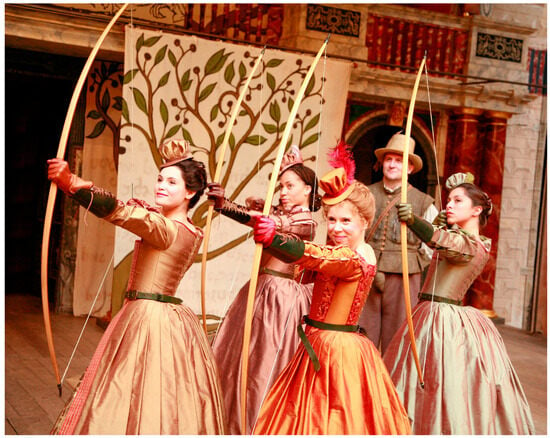
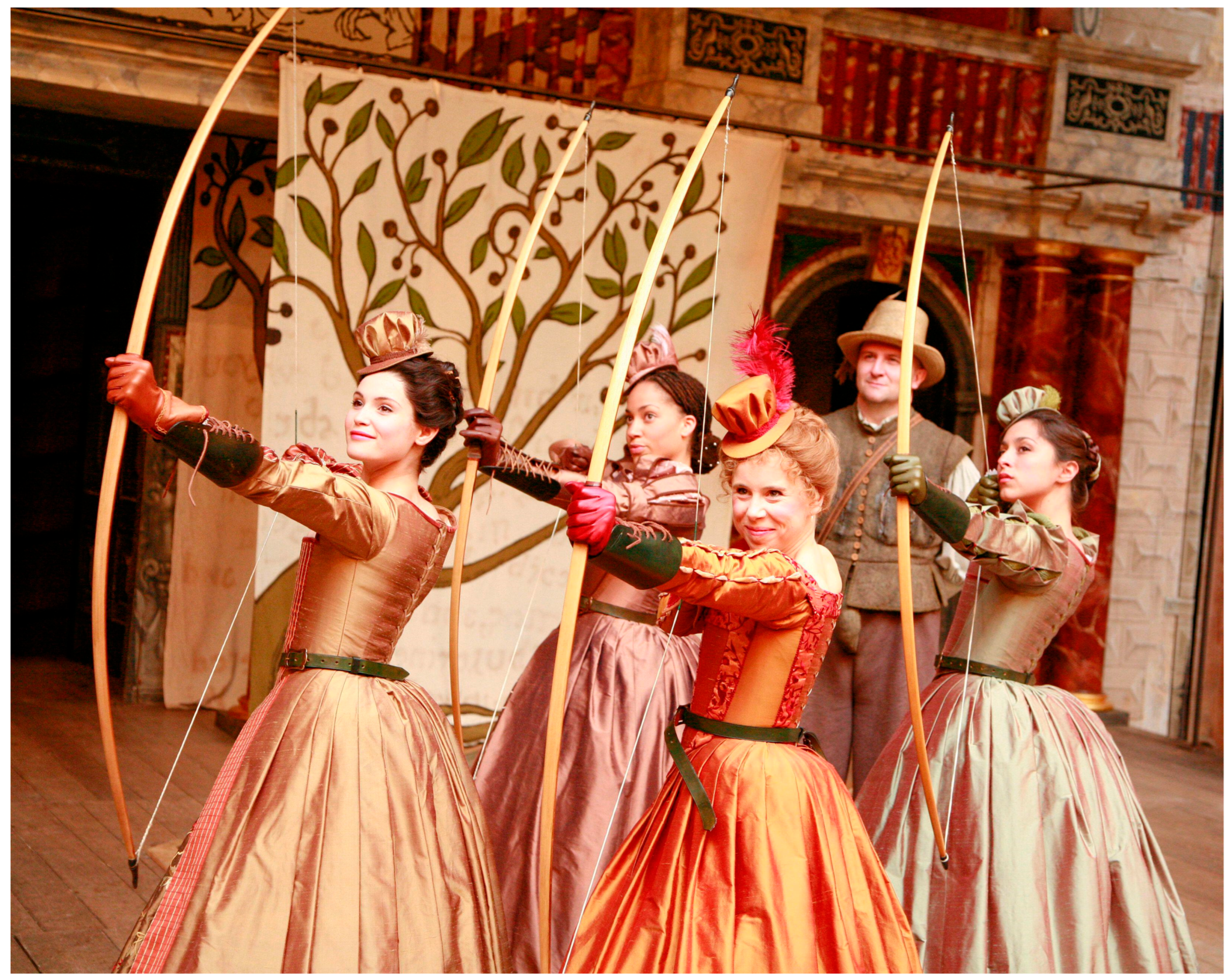
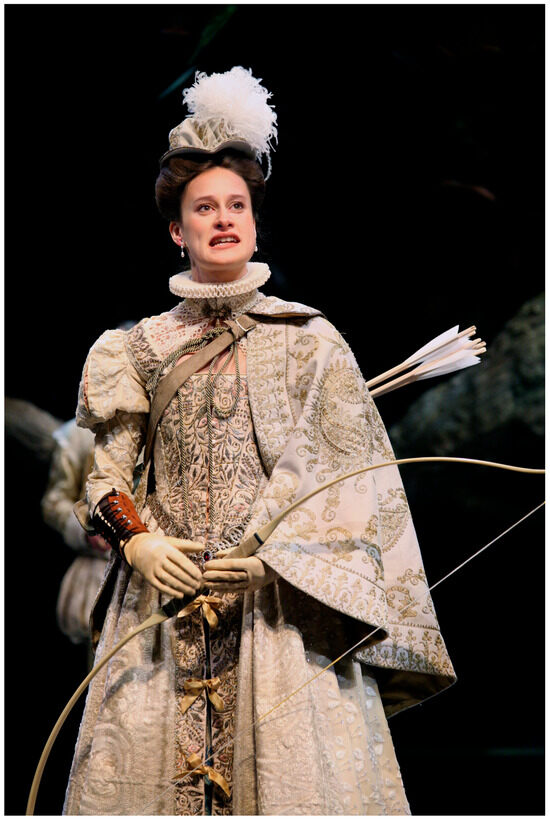
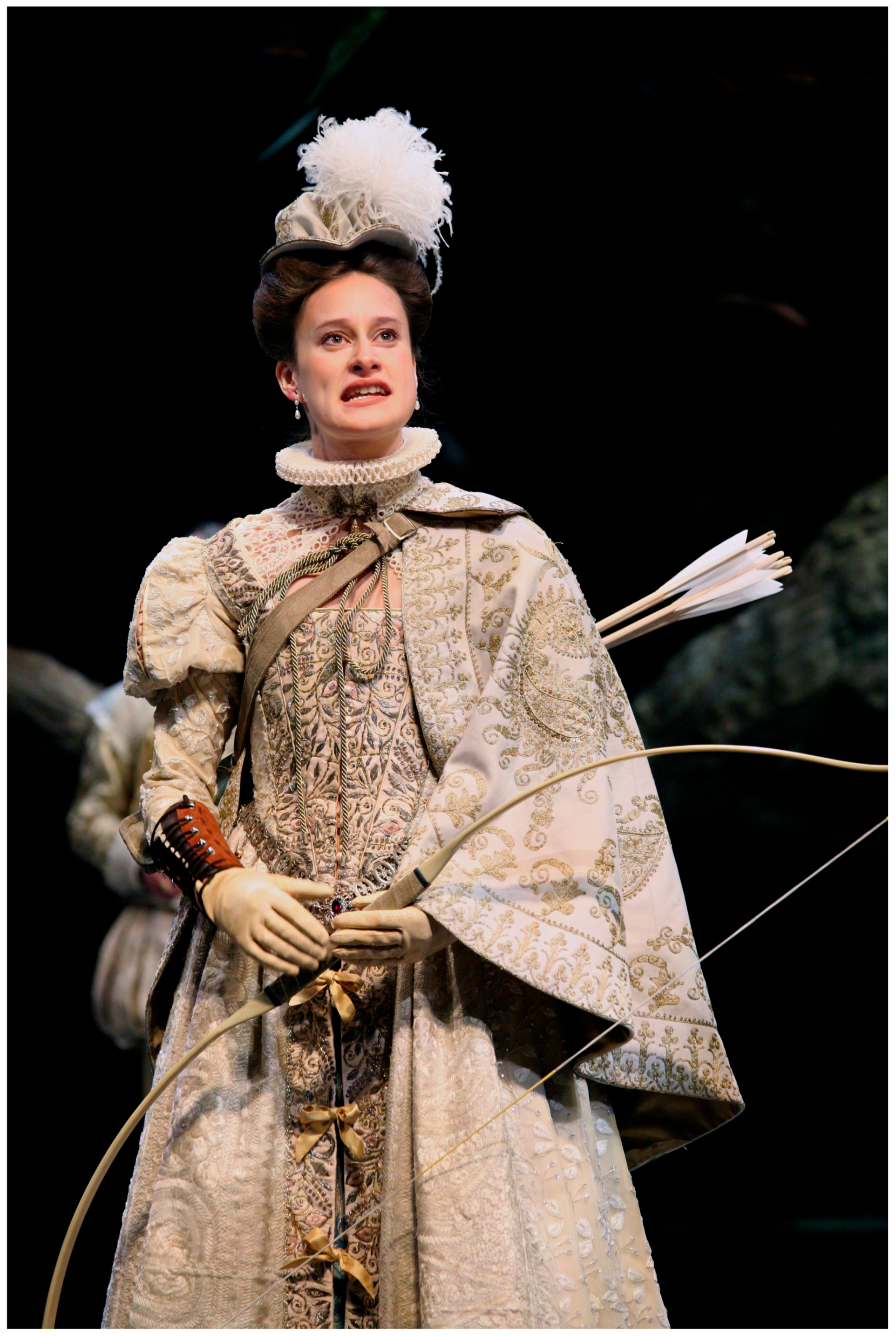
The answer to that question, as well as to the formula for the passage as a whole, depends upon, first, the response of the Princess’s internal audience to her exchanges with the Forester and Costard and, second, the degree of the Princess’s self-deprecation. On one end of the spectrum, the 2009 production of Love’s Labor’s at Shakespeare’s Globe (Dir. Dominic Dromgoole) featured a self-assured Princess, played by Michelle Terry, who displayed few misgivings about scrambling the Forester’s brain with her quick comebacks (Love’s Labour’s Lost 2009). Indeed, her smug expression suggested she intended to intimidate him with her play on “fair” (4.1.11-12). He was relieved when she gave him money (4.1.18). She, in turn, was visibly offended by Costard’s remark about her waist. She and her ladies wielded their bows and arrows like experienced hunters—even choreographed dancers—in the performance and in promotional photographs of the scene. These courtly women acted as a single coalition, whether setting themselves up against the King and his lords or the lone Forester (see Figure 1). In contrast, the photograph of Mariah Gale’s Princess in the RSC’s 2008 production, directed by Gregory Doran, indicates her distress. Her face betrays comical discomfort, and her hands awkwardly grasp a bow that she appears willing to let drop at the first opportunity (see Figure 2). Gale’s solitary Princess seems to lack as much conviction and self-possession as Terry’s squad appears to claim.9
Figure 1.
Love’s Labor’s Lost, the Princess, 4.1, played by Michelle Terry, Shakespeare’s Globe, 2009. Donald Cooper, Alamy Stock Photo. Reproduced with permission from Donald Cooper/Alamy.
Figure 2.
Love’s Labor’s Lost, the Princess, 4.1, played by Mariah Gale, RSC, 2008. Photo by Ellie Kurttz © RSC.
The degree to which the Princess behaves generously toward other characters, linked to the degree of her humility versus her elitism, is a question running throughout the play. The same monarch who graciously responds to the Nine Worthies’ performance with lines like “Great thanks, great Pompey” and “Speak, brave Hector, we are much delighted” also turns her back on Moth in “contempt” as he tries to recite his speech to her and her ladies, frustrating him and hurting his feelings (5.2.553, 662, 149, 158-74). She repeatedly rises above the frays among her ladies, encouraging them to keep their comments playful, and yet engineers the mockery of the lords with what can seem a streak of meanness: “We are wise girls to mock our lovers so” and “The effect of my intent is to cross theirs./…/And mock for mock is only my intent” (5.2.29, 46, 58, 138-40). She relies on Boyet in conducting state business, even as she has no difficulty calling him out for schmoozing and for egotism: “Good Lord Boyet, my beauty, though but mean,/Needs not the painted flourish of your praise” and “All pride is willing pride, and yours is so” (2.1.160-65, 36).10
Further ambiguity surrounds the Princess’s disposition toward the King. Although her claim not to have interpreted the men’s wooing as serious may appear questionable, disingenuous, her rejection of the King’s marriage proposal on grounds that he has a poor record in oath-keeping is apt (5.2.771-78, 782-88). Her dismay at being unable to follow the King’s speech just after she’s learned of her father’s death seems especially sensitive to his feelings: “I understand you not. My griefs are double” (5.2.746). At the same time, her motive for overriding the King’s refusal to allow the performance of the Nine Worthies is cruelly condescending to the players:
In other words, she wants the presentation of the Nine Worthies to proceed because the actors’ ineptitude will be laughable. This sentiment recalls her motive for putting out Moth: “I make no doubt/The rest will e’er come in, if he be out./There’s no such sport as sport by sport o’erthrown” (5.2.151-53).That sport best pleases that doth least know howWhere zeal strives to content and the contentsDies in the zeal of that which it presents;Their form confounded makes most form in mirth,When great things labouring perish in their birth.(5.2.514-18)
Montrose (1977) has observed a “quite ruthless one-upmanship” among the French ladies and cautions against idealizing the Princess: “There has been a consistent [critical] attempt to endow the Princess with a normative function in the world of the play or to associate her with some ideal that is presumed to be Shakespeare’s. The roles that the Princess does enact in the play are both more complex and more ambivalent than the play’s critics usually perceive” (543). How the Princess comes across with the Forester in 4.1 can be viewed as one of many similar instances of her characterization that accrue throughout the play to flesh out her overall, consistent character. Or it can be seen as a crucial site of her characterization that informs her performance in other scenes, helping to tease out complication that defies consistency.
When I say that Michelle Terry’s Princess in the 2009 Globe production wasn’t likeable, I do not intend to disparage her interpretation of the role (or Dromgoole’s direction) but, rather, to affirm her reading of the part as one option substantiated by the script, an option not every audience member will approve. But her performance, at least to this viewer, was detached from the audience. Her Princess was mischievous without charm, without concern for other characters’ feelings. She seemed immature, out to please herself, often delivering lines that mocked other characters with a satisfied smirk.11 In contrast, Ruby Joy’s Princess in the Stratford, Ontario Festival production, directed by John Caird in 2015, channeled Barton’s 1978 RSC production in which the Princess wore unglamourous glasses and in 2.1 promptly fell in love with a mutually enamored King (Love’s Labour’s Lost 2015). She also took Costard’s reference to her thick waist in stride, as did the RSC’s Leah Whitaker in the 2014 production.
The student who played the Princess in our 2002 production, a trained soprano who has gone on to sing and act professionally, joyfully delivered some of her lines almost as if she was singing them. When she responded to her ladies’ descriptions of their male counterparts in 2.1 with “God bless my ladies! Are they all in love …?” and when she asked, “But, Katherine, what was sent to you from fair Dumaine?” she spoke in lilting cadences (2.1.77, 5.2.47). Together with her broad smile and the gracefulness of a dancer, her musical voice characterized her as fun-loving and attuned to others’ feelings. Audience members commented to us afterwards about the pleasure of her delivery. When she teased the Forester, she turned her partly drawn bow and arrow toward him not to intimidate him, but in obvious playfulness. He, in turn, played along.
This student developed the role independently as I was still becoming fully aware of other options; some bias on my part is therefore likely and prone to minimize the darker side of the character. Even so, in the utopian theatrical world of my fantasy, I lean toward a portrayal of the Princess that makes the possibility of passion for the King a real possibility, even if delayed. If that choice does not fully rescue the romantic-comic tenor of the play, it at least provides a (perhaps welcome) glimmer of romantic-comic potential among the men and women. Maybe such a glimpse is one of false hope; maybe a sarcastic Princess, especially one who shares her wit with the audience by breaking the fourth wall, supplies its own satisfaction. But too much sarcasm and too little good will in this character’s makeup can flip a romantic comedy manqué into an “antic” or a bitter satire (5.1.138).
4. The naked truth
Although incontestably an eccentric throughout Love’s Labor’s, Don Armado arrives at a crossroads in the end where he, alone of the male characters, may have matured into a character willing to keep a promise. The crux of the matter lies in his line “For mine own part, I breathe free breath. I have seen the day of wrong through the little hole of discretion and I will right myself like a soldier” (5.2.717-19). Is Don Armado saying that he plans to avenge Costard’s public exposure of his paternity and, by extension, his lack of a shirt (5.2.668-73, 705-06)? Or is he speaking about recovering from his embarrassment to “right” himself honorably by accepting responsibility for impregnating Jaquenetta? These two completely opposed readings are famously (as famously as these things go) represented in two editions of the play. Woudhuysen glosses Armado’s meaning as the former; Evans (1974; 5.2.722-25 n.) adopts the latter reading in The Riverside Shakespeare. Eric Rasmussen (Rasmussen 2008) offers both options in the RSC edition. Related to the question of the Princess’s disposition toward other characters—particularly her inferiors—what Armado means in his final lines can sway the play’s entire vision.
Some productions have broken out into a brawl between Costard, who announces Jacquenetta’s pregnancy, and Armado, who Costard asserts is the child’s father. Peter Brook’s 1946 production staged a slapstick fight, complete with a water pistol that Costard pointed at his challenger (Gilbert 1996, p. 50).12 Whether or not an actual altercation breaks out, Marcadé’s entrance interrupts all action and shifts attention away from the Nine Worthies and onto the grieving Princess (5.2.710). Armado’s line in question immediately follows Marcadé’s entrance, which, together with his public humiliation, conceivably prompts his about-face. If an ensuing fight is indicated, then so is chaos, and Armado’s story concludes with an indeterminacy consistent with the four lovers’ stories. (How the reference in his line to “discretion” can be read as referring to avenging himself and how doing so would afford him “free breath” are other questions. But let those pass.) If, however, the unlikeliest character in the play to establish an example sets aside his claim to personal injury and dedicates himself to supporting Jacquenetta for three years, he surpasses his social superiors, who have not yet arrived at such a mature choice.13 The reading of Armado’s line that puts another’s welfare before his own thus deepens a play that can come across as so much froth, a comedy of manners without substantial social implications.
Other directors have explicitly adopted this perspective. John Caird, for instance, commented in his program notes that Armado is the only character “ready to make a commitment.” The student who played Armado in the Performing Shakespeare production agreed.
After the arrival of Marcadé, [Armado] understands there are things more important in the world [than revenge], like love, which he sees only in the face of death. Thus, when he “rights” himself by marrying Jaquenetta, he is acting on his newfound knowledge …. Armado instantly understands the meaning of Marcadé’s entrance, whereas it takes the [other] men several lines to fully comprehend the realities of death in the romantic world.
While Marcadé’s grim news may well precipitate a moral shift in Armado, the humbling revelation that Armado wears Jaquenetta’s “dishclout” instead of a shirt signals his unwavering commitment even before he learns of the pregnancy (5.2.708-10). Moth’s statement that Armado keeps the dishcloth “next his heart for a favour” suggests that he and Jaquenetta have exchanged favors as courting couples do—such gifts (although humbler) as the King and his men have bestowed on the Princess and her ladies—signifying an approach to commitment. If, on the other hand, for means “in place of,” the gist of the line would be that Jaquenetta has intended no such message toward Armado, who has merely snagged a poor excuse for a love token from an unsuspecting woman and, pathetically, wears it in place of a respectable favor.
Where the final view of Armado is concerned, both the performance and the understanding of Jacquenetta are wild cards. Is Armado truly the father of her child? As Kehler (1990) has explained at length, the audience has no indication that he has had sex with her, whereas she certainly seems to have been intimate with Costard (49). The play also suggests repeatedly that Jaquenetta is sexually indiscriminate (50), and many productions have portrayed her—for laughs—as cartoonishly promiscuous.14 Chaste she surely is not, but the degree of her wantonness can determine whether Armado is utterly foolish or within admirable bounds to be her “votary” (5.2.871). Her intelligence, too, is an open question. Her initial exchange with Armado may come across as shallow or, as the lines below intimate, witty beyond expectation.
Some women in the role have picked up on Jacquenetta’s wit in these lines—for example, Jennifer Mogbock in Caird’s (2015) production.
| Armado | Maid— |
| Jaquenetta | Man. |
| Armado | I will visit thee at the lodge. |
| Jaquenetta | That’s hereby. |
| Armado | I know where it is situate. |
| Jaquenetta | Lord, how wise you are! |
| Armado | I will tell thee wonders. |
| Jaquenetta | With that face? |
| Armado | I love thee. |
| Jaquenetta | So I heard you say. (1.2.127-36) |
Our production’s Jacquenetta remarked in her journal, “Although Jacquenetta is ostracized in this scholarly aristocratic world for being a promiscuous country wench, she is arguably the most powerful woman in this play, because she is able to penetrate and disrupt the vows of the King’s men.” She adds, provocatively, “As Marcadé brings death into Navarre’s court, Jacquenetta’s pregnancy brings life.” Jacquenetta’s characterization, a mini-crux in its own right, includes elements of rustic näiveté, open sexuality, and shrewdness. Our production foregrounded the latter two, although with a shrewdness so shrewd that neither the characters nor the audience were sure they were being played with. Advertising her attractions, this student actor spoke lines like those above with a straight face and enough self-consciousness to bait a willing audience’s participation in her manipulations of Armado, Holofernes, and Nathaniel. She joined Costard and Dull in possessing more intelligence than she revealed outright.
Armado’s choice to “hold the plough for her sweet love three year” is humbling not only in that it ignores the class and gender biases surrounding her, but, even more, because it embodies the quality of unconditional love (5.2.871-72). True, Armado may be flattering himself about being the child’s father, but another, more satisfying perspective is that the child’s paternity is less important to Armado than dedication to the woman. In a play concerned urgently with the nature of “world-without-end” commitment, Armado’s final grounding emerges unexpectedly as a model (5.2.783). Together with a Princess who, even occasionally, steps off her high horse to commune with ordinary subjects like the Forester, Armado discriminates between pretention and “honest kersey” (5.2.413).
* * *
Tellingly, all the passages considered here are among many omitted in the anonymous 1762 adaptation of Love’s Labor’s, The Students (Anonymous 1762), which is one of few traces of the play’s existence in the eighteenth century. Gone are most of the punning between Armado and Moth, the Princess’s exchange with the Forester, the entirety of 4.3, the pageant of the Nine Worthies, and, with it, Armado’s humbling. The play has been streamlined into a much shorter, more conventional romantic comedy, ending with a quadruple marriage. “Jack hath his Jill,” declares Biron (Berowne) (81). Most, if not all, of the original play’s bafflement, which emerged when my students worked on their production, has therefore vanished. The same goes for The Students. As a play empty of questions about interpretation and staging, it lost its audience’s interest and receded into a past about which no one cares, except for the play’s distant relationship to Shakespeare’s.
Love’s Labor’s remains in today’s theater because it yields so much to be contended with. If it is a play relatively seldom performed, it is a play whose performance copiously repays effort. Rehearsals unearth and isolate site-specific performance challenges more effectively than any study based on reading alone. Once identified, those passages avail themselves of close reading from actors’ viewpoints, often shedding light on a play’s more sweeping concerns—in this case, its representation of class, the degree of its closure, its final tone and genre, and simply what its words mean and how they can be conveyed clearly to the contemporary ear. Performance cannot resolve all perplexity, nor, ideally, should it. Rather, it can coax more thoughtful, informed engagement with a piece of theater whose ability to elude complete understanding lies at the heart of its eternal allure. It keeps audiences coming back to the theater and leaving the theater enwrapped in contemplation.
| English 452 | Performing Shakespeare | Professor Lewis |
| Spring 2002 | Chambers 328 |
- TEXTS
- Required:Barton, John, Playing Shakespeare (Methuen).Brown, John Russell, Free Shakespeare.Shakespeare, William, Love’s Labor’s Lost, New Arden Edition. (Yes, you MUST have this edition!)Styan, J. L., Shakespeare’s Stagecraft (Cambridge UP).A coursepack of critical readings on Love’s Labors, which you will get from me.Supplemental:You will also need to do research in the library for both parts of the course. On reserve for English 352 (Shakespeare) are several bibliographies and books about aspects of Shakespeare’s works, life, and times (see attached list). These reserve books will, without fail, serve as the starting point for answering your questions about all manner of topics.
- COURSE REQUIREMENTS
- First and foremost, a cooperative and willing spirit.
- At least one performing role in Love’s Labor’s Lost and at least one official role in staging the play. Everyone, that is, will work together on both acting and staging the play.
- A journal, which you keep throughout the semester, in which you record daily (or several times weekly) your intellectual responses to the course content. At the end of the semester, you will edit this journal down to an essential 15 pages, revise those pages, and turn in both the longer and the shorter drafts. The final revised draft, moreover, must be submitted in duplicate. Ultimately, your journal should represent to you and to me the core of your intellectual experience in English 452.You will receive a separate handout further explaining my expectations of your journal.
- Various other exercises—including the leading of class discussion and the casting of the play—to be explained further.
- GRADING
Obviously, a course like this one makes grading obsolete. But come May, I’m going to have to submit a grade for each of you anyway. Those grades will be based in large part on the attitude you bring to and sustain throughout the semester, but your grade will also depend largely on the quality of your oral participation in and leadership of class discussion, as well as your written assignments. Example: No one, no matter how wonderful he or she is, can receive an A in the seminar without receiving an A on the journal. And I’ll grade the journal as rigorously as I would any seminar paper in English for both form and content.
- Class Schedule
The course will last for approximately fourteen weeks. The first four will be spent in seminar, studying the play, stage history, and acting Shakespeare. The fifth will be a transition week, in which we gradually turn our attention to the production. Seven and a half more weeks (omitting a week for spring break in early March and providing for Easter Break) will bring us up to opening on Friday, April 19. You should strive to see the relationship between the seminar and the rehearsal parts of the course—both are, in some sense, “academic,” as well as “practical.”
- PART ONE OF THE COURSE: SEMINAR (Classes meet Tuesday and Thursday, 1:00–2:30, unless otherwise indicated, in Chambers 123)
- Week 1:January 14
| Tuesday, January 15: | Introduction to the course |
| Thursday, January 17: | Free Shakespeare as the anchor of the course |
| Read Free Shakespeare | |
| Read coursepack, Sedaris |
- Week 2:January 21
| Tuesday, January 22: | Love’s Labor’s Lost, first discussion and free-for-all |
| Read Love’s Labor’s Lost |
| Wednesday, January 23 | Pot luck supper, Professor Lewis’s house, 6:00 |
| Thursday, January 24: | Love’s Labor’s, critical discussion of the play generally, its tone, its genre, its closure |
| Read Styan, chs. 1, 2 | |
| Read coursepack: Barton, McLay, Graziani, Mangan, Smidt |
- Week 3:January 28
| Tuesday, January 29: | Love’s Labor’s, critical discussion of gender |
| Read coursepack: Thompson, Erikson, Kehler, Breittenberg, Osborne |
| Wednesday, January 30: | Field report from students |
| Acting workshop | |
| Read Barton, chs. 1, 2 |
| Thursday, January 31: | Love’s Labor’s, critical discussion of staging |
| Read coursepack: Skura, Brook, Harvey, Steele, Billington, Hodgdon, Barnes, Freedman |
2:30: trip to Duke Performance Hall; meet with Anne Taylor
- Week 4:February 4
| Tuesday, February 5: | Read Styan, chs. 3–5, omitting pp. 115–23 |
| Read Barton, chs. 3–4 | |
| Supplementary reports on Elizabethan acting, audiences, and music/dance |
| Wednesday, February 6: | Readings for casting |
| **1:30–?** |
| Thursday, February 7: | Read Styan, chs. 6–7 |
| Read Barton, chs. 5, 11 |
| Friday, February 8: | Casting sheets due in my office, 5:00 |
| Cast and crew will be posted on my office door, Mon., Feb. 11 |
- Week 5:February 11
| Tuesday, February 12: | Where do we go from here? Some crucial questions and what to expect in rehearsals |
| Thursday, February 17: | Read through of Love’s Labor’s |
| **1:00–? ** |
- PART TWO OF THE COURSE: PRODUCTION (Rehearsals in the Chambers Gallery, unless otherwise noted/announced. Move to Duke Performance Hall on Monday, April 15.)Week 6:February 18: Rough blocking
| Monday, February 18: | Block Act I |
| Tuesday, February 19: | Block Acts II, III |
| Wednesday, February 20: | Block Act IV-V.i, plus |
| Thursday, February 21: | Block remainder of Act V |
| Friday, February 22: | Royal Shakespeare Company, workshop introducing voice |
| (meet 1:00–3:30) | and movement |
- Be prepared to spend as much as three hours per day in class. We’ll proceed as efficiently as possible.
**Friday, February 22, Journals due for a once-over, 12:00 NOON**
- Week 7:February 25
| Monday, February 25: | Run Acts I-III |
| Tuesday, February 26: | Royal Shakespeare Company, work on comedy, gags |
| Wednesday, February 27: | Run Acts IV-V |
| Thursday, February 28: | Royal Shakespeare company, scene work |
- Be prepared to spend as much as three hours per day in class.
Week of March 4–8: SPRING BREAK—Have fun! Study blocking, lines!
- Weeks 8–10:March 11–29Rehearse every M, W, 1:30–4:30; every T, Th, 1:00–4:00.Beginning on Monday, March 18, you must know your lines! All of them. No exceptions. You will not be able to cram for this assignment. You will need to work far, far in advance to get them down in time and accurately.
- Weekend of March 23:
| Saturday, March 23: | All day rehearsal, 9:30-? |
| Sunday, March 24: | Be on call for spot work |
- April 1, 2: EASTER BREAK
- Weeks 11–12:April 3–12Resume rehearsal schedule as outlined for weeks 8–10.Weekend of April 5: Sewing party one night this weekend (TBA) at Professor Lewis’s houseMonday, April 15: Move into Duke Performance Hall.
- Week 13:April 15
| Monday, April 15: | Complete run through, beginning at 1:30 |
| Tuesday, April 16: | Same, beginning at 1:00 |
| Wednesday, April 17: | First dress rehearsal, 7:00– |
| Thursday, April 18: | Second and final dress rehearsal with live audience, 2:00– |
| Performances: | Friday, April 19 | 7:30 |
| Saturday, April 20 | 7:30 | |
| Sunday, April 21 | 2:00 | |
| Monday, April 22 | 7:30 | |
| Tuesday, April 23 | 7:30 |
| Strike set | Wednesday, April 24 | as early as possible, until finished |
- After this, the course is concluded. Final journals are due in my office on Monday, May 6, 10:00.
Funding
The research received no external funding.
Data Availability Statement
No new data was created for this study. Data sharing is not applicable to this article.
Acknowledgments
Thanks to Victoria Cholmondeley (RSC), Amber James (American Shakespeare Center), Drew Lichtenberg (Shakespeare Theatre Company), and Christine Schindler (Stratford, Ontario, Stratford Festival) for their help with archival research.
Conflicts of Interest
The author declares no conflict of interest.
Notes
| 1 | All references to Love’s Labor’s Lost (Shakespeare 1998) are to the Arden edition, ed. Woudhuysen (1998). |
| 2 | I have written about this class for two essay collections, “Performing Shakespeare: The Outward Bound of the English Department” (Lewis 1999) and “Students Stage Shrew! The Theater as Classroom” (Lewis 2013). |
| 3 | In lieu of a full-scale production, teachers can help students mount individual scenes or make a production more manageable, as, for instance, preparing a radio broadcast of a play. For that project, students can read, rather than memorize, their lines and need to invest far less in the trappings of a complete production. |
| 4 | In the mostly accomplished Stratford, Ontario Festival production directed by John Caird in 2015, Dumaine performed multiple, gratuitous gymnastics in 4.3, reaping laughter for its own sake, rather than from the play. |
| 5 | At the risk of overkill, I’d add to the long list the passage in 5.2.10-46, where the ladies seem to goad and attack each other until the Princess breaks up the quarreling. How playful versus how threatening is this exchange? A reading of the larger play’s tone is at stake. |
| 6 | In 2007, I published the critical article “‘We know what we know’: Reckoning in Love’s Labor’s Lost” (Lewis 2007). |
| 7 | Maisano (2023) makes a compelling case that, because Rosaline is a Black woman, such slurs are racist. |
| 8 | As the attached syllabus suggests by exhorting students to learn their lines completely and on time, just being able to recite the speeches is a huge hurdle for amateur actors of Shakespeare. (This was the first Shakespeare play most of my students had undertaken, and some hadn’t acted on stage before at all.) To transition from recitation to naturalism, in which the language and accompanying action seem fresh and spur-of-the-moment, is another giant leap. Not even all professional actors achieve it. |
| 9 | Because information about this production of Love’s Labour’s Lost (2008), which isn’t on film, is difficult to access remotely, I’m drawing some inferences from the photographic gallery online. https://www.rsc.org.uk/loves-labours-lost/past-productions/other-productions (accessed on 23 July 2026). |
| 10 | The Princess’s ambiguous treatment of Boyet reflects (and is perhaps in reaction to) his own changeability. As the student who played Boyet in our production noted in his journal, “He is entirely fickle, befriending whoever happens to be slandering someone else at the time.” |
| 11 | The entire production seemed to be going for comedy, often slapstick, without thought to the play’s more serious underlying issues. |
| 12 | The 2014 RSC production, directed by Christopher Luscombe, cut Armado’s line about his nonexistent shirt and let a mêlée erupt, engaging everyone on stage. |
| 13 | Armado’s humbling would seem all the more significant in view of how his boasting reflects, in particular, the King’s self-inflation. One student’s journal read, “Armado’s ridiculous bragging mirrors the King’s foolish design to defeat ‘cormorant devouring time’” (1.1.4). |
| 14 | See, for example, the 2009 Globe production. |
References
- Anonymous. 1762. The Students. A Comedy. Altered From Shakespeare’s Love’s Labour’s Lost, and Adapted to the Stage, Gale ECCO Print Editions, 2018. [Google Scholar]
- Barton, John. 1984. Playing Shakespeare. New York: Methuen. [Google Scholar]
- Breitenberg, Mark. 1996. Anxious Masculinity in Early Modern England. Cambridge Studies in Renaissance Literature and Culture, Series Number 10. Cambridge: Cambridge UP. [Google Scholar]
- Caird, John. 2015. Programme Notes for Love’s Labour’s Lost. Stratford, Ontario Shakespeare Festival. Available online: https://www.stratfordfestival.ca/WhatsOn/PlaysAndEvents/Production/Loves-Labours-Lost (accessed on 23 July 2026).
- Erikson, Peter B. 1981. The Failure of Relationship between Men and Woman in Love’s Labor’s Lost. Women’s Studies 9: 65–81. [Google Scholar]
- Evans, G. Blakemore, ed. 1974. The Riverside Shakespeare. Boston: Houghton Mifflin. [Google Scholar]
- Gilbert, Miriam. 1996. Love’s Labour’s Lost. Shakespeare in Performance Series. Manchester: Manchester University Press. [Google Scholar]
- Graziani, René. 1986. M. Marcadé and the Dance of Death: Love’s Labor’s Lost, v.ii.705-11. Review of English Studies 37: 392–95. [Google Scholar]
- Hodgdon, Barbara. 1988. Rehearsal Process as Critical Practice: John Barton’s 1978 Love’s Labour’s Lost. Theatre History Studies 8: 11–34. rpt. in Ghostly Fragments: Essays on Shakespeare and Performance. Edited by Richard Abel and Peter Holland. Ann Arbor: University of Michigan Press, chap. 2. [Google Scholar]
- Kehler, Dorothea. 1990. Jacquenetta’s Baby’s Father: Recovering Paternity in Love’s Labor’s Lost. Renaissance Papers, 45–54. [Google Scholar]
- Lewis, Cynthia. 1999. Performing Shakespeare: The Outward Bound of the English Department. In Teaching Shakespeare Through Performance. Edited by Milla Cozart Riggio. New York: MLA, pp. 295–306. [Google Scholar]
- Lewis, Cynthia. 2007. “We know what we know”: Reckoning in Love’s Labor’s Lost. Studies in Philology 105: 171–90, Reprinted in 2009. William Shakespeare: Comedies. Edited by Harold Bloom. New York: Chelsea House, pp. 171–90. [Google Scholar]
- Lewis, Cynthia. 2013. Students Stage Shrew! The Theater as Classroom. In Approaches to Teaching Shakespeare’s The Taming of the Shrew. Edited by Margaret Dupuis and Grace Tiffany. New York: MLA, pp. 149–55. [Google Scholar]
- Love’s Labor’s Lost. 2002. [video recording], Performing Shakespeare Seminar (English 452), Davidson College.
- Love’s Labour’s Lost. 2008. [photo gallery], Dir. Greogory Doran, Royal Shakespeare Company. Available online: https://www.rsc.org.uk/loves-labours-lost/past-productions/other-productions (accessed on 23 July 2026).
- Love’s Labour’s Lost. 2009. [video recording], Shakespeare’s Globe, Dir. Dominic Dromgoole.
- Love’s Labour’s Lost. 2014. [video recording], Royal Shakespeare Company, Dir. Christopher Luscombe.
- Love’s Labour’s Lost. 2015. [video recording], Stratford, Ontario Festival, Dir. John Caird.
- Luscombe, Christopher. 2014. A Labour of Love. Available online: https://www.rsc.org.uk/loves-labours-lost/past-productions/christopher-luscombe-2014-production (accessed on 16 June 2024).
- Maisano, Scott. 2023. Against Editing “Whitely”: Restoring Shakespeare’s Interracial Comedic Couple to Love’s Labour’s Lost. Renaissance Drama 51: 55–88. [Google Scholar] [CrossRef] [Scilit] [PubMed]
- McLay, Catherine M. 1967. The Dialogues of Spring and Winter: A Key to the Unity of Love’s Labour’s Lost. Shakespeare Quarterly 18: 119–27. [Google Scholar] [CrossRef] [Scilit]
- Montrose, Louis A. 1977. “Sport by sport o’erthrown”: Loves’ Labour’s Lost and the Politics of Play. Texas Studies in Literature and Language 18: 528–52. [Google Scholar]
- Performing Shakespeare. 2002. Seminar (English 452), Davidson College, journals by students.
- Rasmussen, Eric, ed. 2008. Love’s Labour’s Lost. Hampshire: Macmillan. [Google Scholar]
- Shakespeare, William. 1977. Henry V. Edited by John H. Walter. Bungay: Richard Clay (The Chaucer Press), Ltd., First performed 1598. [Google Scholar]
- Shakespeare, William. 1998. Love’s Labour’s Lost. Edited by H. R. Woudhuysen. Walton-on-Thames: Thomas Nelson, First performed 1595. [Google Scholar]
- Styan, John L. 1967. Shakespeare’s Stagecraft. Cambridge: Cambridge University Press. [Google Scholar]
- Thompson, Ann. 1997. “Errors” and “Labors”: Feminism in Early Shakespearean Comedy. In Shakespeare’s Sweet Thunder: Essays on the Early Comedies. Edited by Michael Collins. Newark: University of Delaware Press, pp. 90–101. [Google Scholar]
- Tunstall, Darren. 2002. Performance in The Merchant of Venice. Stratford-upon-Avon: Royal Shakespeare Company. [Google Scholar]
- Woudhuysen, H. R., ed. 1998. Love’s Labour’s Lost. Walton-on-Thames: Thomas Nelson. [Google Scholar]
Disclaimer/Publisher’s Note: The statements, opinions and data contained in all publications are solely those of the individual author(s) and contributor(s) and not of MDPI and/or the editor(s). MDPI and/or the editor(s) disclaim responsibility for any injury to people or property resulting from any ideas, methods, instructions or products referred to in the content. |
© 2026 by the author. Licensee MDPI, Basel, Switzerland. This article is an open access article distributed under the terms and conditions of the Creative Commons Attribution (CC BY) license.