


Abstract
Professional placement is a central component of early childhood pre-service teachers’ professional learning and identity formation; however, it is also a context in which a sense of belonging is unevenly experienced. This study explores how early childhood pre-service teachers experience, construct, and perceive belonging during professional placements, with particular attention to identity, prior experiences, institutional contexts, mentorship, perceptions of support and structural inequalities. Drawing on a qualitative multi-case study design, the study utilises student reflections, field notes, and semi-structured interviews to examine how belonging is constructed, disrupted, or withheld within professional placement settings. The data were thematically analysed using a reflexive thematic analysis approach. The findings demonstrate that belonging is relational, dynamic, and contextually constructed through everyday interactions in placement settings. Pre-service teachers experienced a sense of belonging when they felt valued, welcomed, included, trusted, and meaningfully engaged in practice. In contrast, exclusionary practices and inconsistent relational support undermined their confidence and professional identity formation. Mentorship emerged as a critical factor in professional belonging, being and becoming. Affirming and scaffolded mentoring fosters confidence, agency, teacher efficacy, and a sustained commitment to the profession. Conversely, deficit-oriented mentoring constrained participation and professional growth by limiting opportunities for engagement, feedback, and identity development. Professional identity formation was thus relational, shaped through participation and engagement within practice contexts. Institutional inequalities further mediated access to belonging, although strengths-based mentoring approaches helped to mitigate these challenges. This study adapts the Early Years Learning Framework concepts of “belonging, being, and becoming” as a conceptual framework for understanding pre-service teacher’s professional placement experiences. It positions professional placement as a relational arena for pre-service teachers’ identity formation and professional growth. It offers a lens for advancing more equitable and inclusive initial teacher education (ITE) practices in Australia and beyond.
1. Introduction
Professional placement is a core component of initial teacher education (ITE) programs in Australia and indeed globally (Dewhurst et al. 2020), designed to support pre-service teachers in relating tertiary education-based learning to real-world professional practice in early childhood education and care (ECEC) settings. Through engagement in early childhood environments, pre-service teachers gain pedagogical knowledge and relational skills with children, educators, families, and other stakeholders and develop professional identities that are fundamental to effective teaching practices in their future roles (Zhao and Zhang 2017). Indisputably, placement experiences play a significant role in supporting pre-service teachers in developing a sense of belonging, being and becoming within the profession and their professional trajectories (Dewhurst et al. 2020; Zhao and Zhang 2017). The triad, “belonging, being and becoming”, forms the core of the Australian Early Years Learning Framework (Australian Government Department of Education 2022). It is used in this study to provide a lens on the experiences of pre-service early childhood teachers during placement, highlighting a synergy between the necessity of psychological safety and belonging in higher education and the experiences of young children.
Kaarby and Lindboe (2016) note that professional experiences are variable across settings. These variations may be attributed to several factors, including mentor support effectiveness (Miller et al. 2016; Morrissey and Nolan 2015; Nicolas et al. 2025; Nolan 2017), the quality of the mentor—pre-service teacher relationship (Ambrosetti and Dekkers 2010; Myles et al. 2006; Uusimaki 2013), workplace culture (Kaarby and Lindboe 2016), level of educator engagement (Du Plessis and Razmjoee 2025), and gender differences (Cruickshank et al. 2021). While some pre-service teachers on placement experience inclusive and supportive environments, others report limited access to meaningful participation, inconsistent supervision, or marginalisation within the placement setting (Cheruvu et al. 2015; Iyer and Reese 2013; Kupila et al. 2017; Quinones et al. 2020; Spooner-Lane et al. 2009). These variations in experiences are particularly concerning given their potential impact on pre-service teachers’ emotional wellbeing, professional identity formation, future career pathways, and long-term retention in the early childhood education and care (ECEC) workforce (Canobi et al. 2024).
Studies have explored the role of professional experience in teacher learning and pedagogical knowledge; however, less attention has been given to how a sense of belonging, being and becoming is experienced and nurtured across diverse early childhood placement contexts (Dewhurst et al. 2020). ECEC is a high priority for policymakers, academics, and universities due to its critical importance for children’s learning and development (Baxter 2013; Nuttall et al. 2024). In response to this policy focus, Australian universities are enrolling larger numbers of local and international students in early childhood ITE programs (Quinones et al. 2020). As these students enter a sector experiencing a range of pressures (Mills et al. 2024; Thorpe et al. 2020), it is important to understand how belonging intersects with the process of being and becoming for them as pre-service teachers in early education settings. Conceptualising professional placement as a relational and socially situated place (Massing 2016; Zheng et al. 2024) allows for deeper insight into how pre-service teachers negotiate participation, identity, wellbeing, and inclusiveness within ECEC communities of practice.
This project aimed to address a need for diversity and retention in the ECEC workforce. By bringing culturally and linguistically diverse (CALD) students together to create networks and provide mutual support; by better preparing students for the workforce in Australia; and by preparing the workplace for CALD students, the project aims to create a more positive work experience, resulting in increased commitment and retention.
The project involved four academics completing approximately 800 visits to 250 pre-service teachers on placement across more than 400 services over a two-year period. Using case studies, the study explores early childhood pre-service teachers’ sense of belonging during their professional placement experiences in ECEC settings in Victoria, Australia.
The major aims of this study are:
- To explore ECEC pre-service teachers’ sense of belonging during professional placement in different ECEC settings in Victoria, Australia;
- To examine how placement experiences shape pre-service teachers’ sense of being and emerging professional identity;
- To analyse the experiences of belonging (or not belonging) that support and inhibit pre-service teachers’ success in their ECEC placements.
2. Methodology
2.1. Research Design and Data Sources
This study employed a qualitative case study design to explore ECEC pre-service teachers’ sense of belonging during their professional placement. Case study methodology is particularly suited to exploring contemporary phenomena within their real-world contexts and generating an in-depth understanding of participants’ experiences (Yin 2018). The study was situated within a broader placement project developed iteratively in response to program needs. Members of the research team were involved in implementing the project and documented project activities and reflections on issues as they emerged. These reflections informed subsequent project activities and contributed contextual information to the case studies.
Multiple qualitative data sources informed the case study analysis. These included: project documentation, such as records of placement-related activities; reflective field notes and observations recorded by members of the research team; and semi-structured interviews. As members of the research team were collectively involved in the design and implementation of the project, they maintained ongoing reflective records of the project activities, participant engagement, challenges and emerging issues. These records provided contextual information that informed the interpretation of the findings and the development of a rich understanding of pre-service teachers’ experiences of belonging during placement.
2.2. An Overview of the Participants of the Study
The study was situated within the Early Childhood Education program at Victoria University, which comprises three bachelor-level programs and one postgraduate diploma program. The broader placement project involved 250 pre-service teachers from diverse domestic and international backgrounds, including 180 bachelor students and 70 postgraduate diploma students. Most participants were female (n = 230), reflecting national workforce trends in early childhood education (Australian Government Department of Education 2024). The cohort was also culturally and linguistically diverse, with 163 participants reporting English as an additional language, seven identifying as living with a disability, and two identifying as Aboriginal and/or Torres Strait Islander. Although the broader project involved 250 participants, this study focused on six purposively selected pre-service teachers. Consistent with a qualitative case study design, the small sample enabled an in-depth exploration of participants’ experiences of belonging during professional placement.
2.3. Data Collection
Data were collected through semi-structured interviews with pre-service teachers conducted during and after their professional experience placements. The interviews provided participants with opportunities to reflect on their experiences within ECEC settings, including interactions with teacher mentors, children, families, and other educators, as well as their perceptions of inclusion, participation, and professional learning. The questions were open-ended and designed to elicit narratives about participants’ sense of belonging, identity development, and challenges encountered during placement. The study also drew on placement reports, project team reflection notes, and field notes recorded during placement visits. Each source contributed a different perspective on the placement experience. Interviews captured the perspectives of pre-service teachers and mentors; field notes documented contextual information, observations and matters raised during placement visits; researcher reflection notes recorded emerging issues and interpretations; and placement reports and assessment records provided mentors’ formal assessments of students’ practice and placement outcomes. When considered together, these sources provided a detailed and contextually grounded account of each student’s placement experience.
These data sources were analysed together rather than in isolation, allowing the research team to develop comprehensive case narratives and triangulate interpretations across multiple forms of evidence.
For this study, six case studies were purposively selected using a maximum variation sampling strategy (Patton 2015), whereby cases were selected to represent diverse placement experiences and participant characteristics relevant to the study aims. Selection was based on the availability of sufficiently detailed information across multiple data sources, as well as the capacity of the cases to provide variation in course enrolment, domestic or international student status, reported mentoring experiences, placement challenges and outcomes, and experiences of belonging. The number of cases was limited to six to allow detailed within-case analysis whilst retaining sufficient variation for cross-case comparison.
The cases consist of five female students and one male student, broadly reflecting the gender composition of the wider project cohort, and four undergraduate and two postgraduate students, consistent with the participant allocation approved for the project. International students were over-represented in the case study sample compared with the wider project sample, which was predominantly domestic. This was an analytical rather than a representative decision. Although international students constituted a relatively small proportion of project participants, project data indicated that they were disproportionately represented among students requiring interventions following placement difficulties and reporting challenges to their sense of belonging. The six selected cases reflected both positive and challenging placement experiences and structural barriers. This diversity enabled rich cross-case analysis and strengthened the analytical depth of the study.
2.4. Participant Profiles
To provide context for the case analysis, brief profiles of the six participants are presented below. All participant names used in the reporting of findings are pseudonyms to maintain confidentiality and anonymity.
Mim is an international male pre-service teacher enrolled in the Graduate Diploma in Early Childhood Education course. Throughout his placement, he demonstrated strong reflective capacity, openness to feedback, and engagement with mentoring and stakeholders. He actively sought to understand Australian culture and contexts as part of his developing sense of belonging. His teaching philosophy emphasises empathy, children’s rights, inclusion and culturally responsive teaching practices. His placement experiences highlight the importance of supportive mentorship, cultural inclusion and reflective practice in fostering professional identity formation and a sense of belonging.
Lima is a domestic pre-service teacher enrolled in the Bachelor of Early Childhood Education course. Her placement experiences reflect significant personal and professional growth. She began her placement as a tentative student but gradually developed into a confident and capable pre-service teacher through mentoring and placement experiences. She was supported by her mentor, who modelled reflective practice and provided scaffolding through feedback. A supportive mentoring relationship and congenial placement environment played a vital role in strengthening her pedagogical competence, sense of belonging and professional identity.
Viola is an international pre-service teacher enrolled in the Bachelor of Early Childhood Education course. She was described by her placement mentor as polite and respectful in her interactions with children, educators, and families. However, she did not meet the expected professional standards for this stage of her placement. Her placement experience highlighted tensions related to cultural differences, workplace expectations, and interpretations of professional behaviour. Her quieter disposition and culturally influenced approaches were sometimes interpreted as passive or lacking in independence. Her experience underscores the importance of culturally safe mentoring and scaffolded support in enabling international pre-service teachers to navigate placement demands and develop confidence.
Emily is an international pre-service teacher enrolled in the Graduate Diploma in Early Childhood Education course. She encountered significant barriers in securing placement opportunities. Prior to her placement, she contacted approximately forty ECEC services and visited fifteen, with most of them declining her requests. In some instances, she encountered explicit deficit assumptions regarding the Graduate Diploma course and international early childhood pre-service teachers. Despite these challenges, she demonstrated strong persistence, resilience, and commitment to entering the ECEC profession. Development of a working relationship with her mentor enabled a shift in perception, with Emily’s professionalism and capabilities increasingly recognised. The mentor’s later support (including offering employment and professional learning opportunities) illustrates the transformative potential of relationship-building.
Amelia is a domestic pre-service teacher enrolled in the Bachelor of Early Childhood Education course, with a declared disability. She experienced two unsuccessful placements where concerns were raised regarding communication, documentation, and professional practice. Despite these challenges, she persisted and was committed to improvement. Through targeted university support and positive mentoring relationships, Amelia strengthened her confidence, reflective practice, and professional skills. By her final placement, mentors recognised her warm relationships with children, effective observation practices, and growing capacity as an emerging early childhood teacher.
Laura is a pre-service teacher enrolled in the Bachelor of Early Childhood Education course. Laura’s placement journey highlighted both her vulnerability and her remarkable perseverance. From the outset, she presented as a sensitive and conscientious pre-service teacher who felt feedback deeply, often becoming overwhelmed when expectations were perceived as unclear or environments felt uncomfortable. Early in her placement, it became evident that she was struggling to find her confidence. However, Laura spoke openly about her concerns and showed a genuine desire to grow. During her final placement, Laura was paired with a mentor who approached Laura with patience and empathy. Her mentor created a nurturing space where Laura could experiment, make mistakes, and build her confidence slowly and authentically.
2.5. Data Analysis
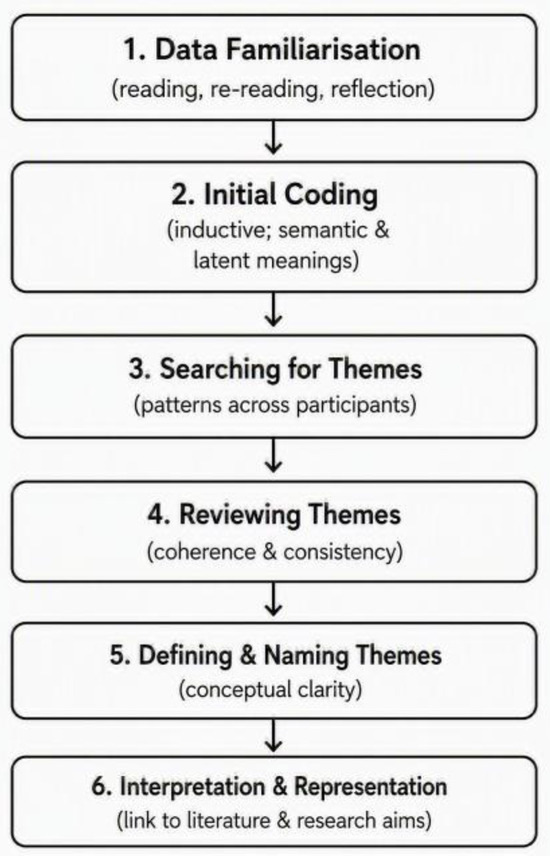
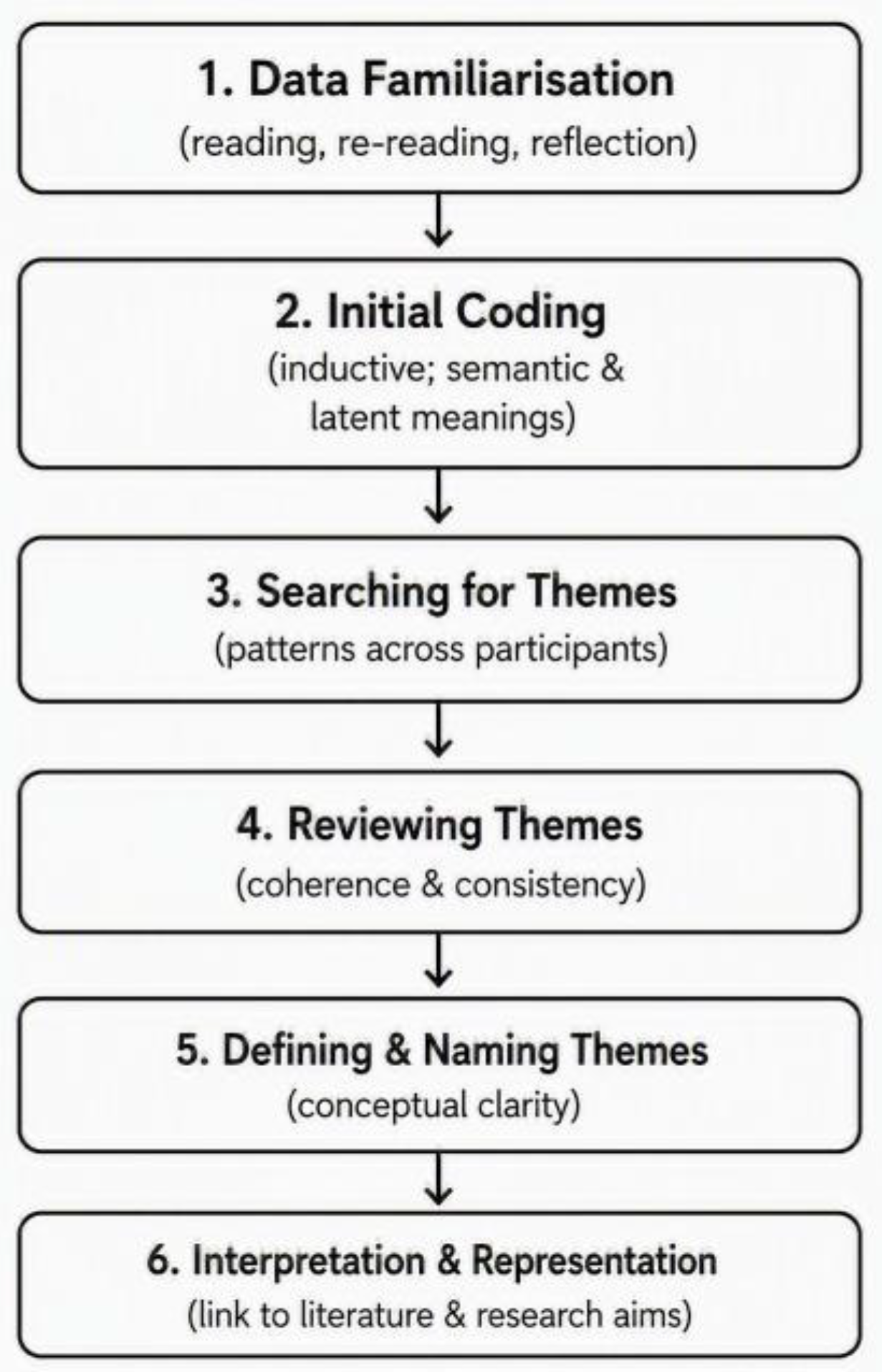
Data were analysed using reflexive thematic analysis, guided by Braun and Clarke (2019). This approach was selected for its suitability in identifying meanings across qualitative datasets while explicitly recognising the interpretive and reflexive role of the researcher in knowledge production. The analytic process was inductive, involving movement back and forth across six interconnected phases rather than following a linear sequence. The six-phase reflexive thematic analysis process is presented in Figure 1.
Figure 1.
The analysis process. Adapted from Braun and Clarke (2019) and created by the authors.
- Data familiarization
For each selected case, the available interview transcripts, placement reports, researcher reflection notes, and placement visit field notes were brought together and read repeatedly to develop familiarity with the data. The different sources were examined alongside one another to identify points of convergence and divergence and to consider how participants’ accounts related to the placement context and mentors’ formal assessments. Initial observations and reflective notes were documented throughout this process. These notes subsequently informed coding decisions and theme development.
- 2.
- Generating initial codes
Inductive coding was conducted across the entire dataset using a line-by-line approach. Initial codes captured semantic and latent meanings associated with participants’ experiences of belonging, mentoring, identity formation, cultural inclusion, communication, emotional wellbeing, resilience, confidence, participation, and professional learning. Examples of early codes included feeling, welcomed, mentor validation, cultural adjustment, fear of judgement, professional recognition, communication barriers, and seeking support. Coding remained flexible and iterative, with codes refined, merged, expanded, or discarded as understanding of the dataset deepened.
- 3.
- Searching for themes
Following initial coding, related codes were grouped into broader categories based on conceptual similarity and shared meaning. For example, codes such as mentor encouragement, being recognised, feeling valued, and inclusion in team activities were clustered under preliminary interpretations of belonging and professional recognition. Similarly, codes relating to unclear expectations, anxiety, communication difficulties, and lack of support were grouped under broader concepts associated with emotional safety and participation. An example of how initial codes were progressively developed into broader categories and themes is presented in Table 1. Themes were then developed through iterative comparison of patterns within and across cases.
Table 1.
An example of developing codes into themes.
- 4.
- Reviewing and refining themes
Emerging themes were reviewed to ensure coherence, consistency, and alignment with participants’ narratives. Themes were refined through comparison between cases and across different forms of data.
- 5.
- Defining and naming themes
Themes were refined and clearly defined to reflect the relational, contextual, and developmental dimensions of pre-service teachers’ experiences during the placement. Final themes included belonging, mentorship, emotional safety, cultural identity, resilience, professional becoming, and structural inequities.
- 6.
- Interpretation and representation
The final stage of theme development involved interpreting the themes in relation to the study aims and literature on professional placement, belonging, mentoring, and teacher identity formation in ECEC.
2.6. Researcher Positionality and Reflexivity and Trustworthiness
The research team comprised early childhood teachers, teacher educators, placement specialists and researchers with extensive experience mentoring, supervising and supporting pre-service teachers. Their perspectives were influenced by their own migrant or multicultural family histories. Some were the first in their families to attend university, while others brought personal or professional experiences of neurodiversity. Their familiarity with early childhood education and professional placement gave them an insider perspective. However, they remained outsiders to the particular cultural backgrounds and placement experiences of individual participants.
These positions sensitised the researchers to issues of belonging, relationships, cultural inclusion and mentoring but could also lead them to interpret participants’ experiences through established professional expectations. Researcher reflection notes and regular collaborative discussions were used to examine these assumptions and consider how researchers’ experiences influenced the interpretation of cases and the development of themes. These discussions drew on collaborative autoethnographic practices, allowing the researchers to interrogate their experiences collectively and consider alternative interpretations (Chang et al. 2013).
To enhance trustworthiness, the study employed several strategies, including prolonged engagement with the dataset, reflexive memo writing, iterative theme refinement, team-based discussion of emerging interpretations, and the use of multiple data sources. These processes supported analytic transparency and strengthened the credibility and dependability of the findings.
3. Result
3.1. Theme 1: Belonging as Relational, Dynamic, and Contextually Constructed
Across the case studies, belonging emerged as a relational and contextually negotiated experience shaped through interactions with mentors, educators, children, families, and placement communities. Pre-service teachers’ sense of belonging developed when they experienced recognition, welcoming, inclusion, trust, encouragement, and meaningful participation within placement settings. Conversely, exclusionary practices, limited relational continuity, and deficit assumptions undermined pre-service teachers’ sense of belonging, confidence, and professional identity.
Mim’s experiences demonstrate how belonging developed gradually through reciprocal relationships with mentors and other educators. His repeated communication with mentors, openness to feedback, and active participation in learning circles (these were university-run experiences aimed at providing support and space for reflective practice while pre-service teachers were on placement) resulted in his increasing recognition as a valued member of the profession. His enthusiasm about being offered casual employment opportunities during placement—“one more amazing part—they plan to give me casual work”—symbolised not only workplace success but also professional acceptance and validation. Similarly, Lima’s sustained exposure to supportive placement environments enabled her to move from a “shy and nervous” pre-service teacher toward becoming a confident and capable educator.
For international pre-service teachers such as Mim and Viola, belonging also involved cultural and social inclusion. Mim intentionally engaged with local cultural practices, such as learning local terminology (e.g., discussing Australian sports), while Viola described how multicultural and accepting educators, and families from different ethnicities, helped her feel “at home” within the ECEC centre’s community. These experiences suggest that belonging extended beyond participation in teaching tasks to include cultural recognition, relational acceptance, and social connection.
In contrast, Emily’s experience highlights how belonging can be denied through exclusionary attitudes. Her repeated rejection from placement centres and discriminatory comments by centre managers regarding international pre-service teachers (e.g., “Hated postgraduate students”) undermined her sense of professional identity and love of the profession before placement had even commenced. Similarly, Amelia’s earlier placements, characterised by limited mentor engagement and being assigned to different groups of children rather than consistently staying with the same children, contributed to feelings of instability and disconnection. Lima also described heightened anxiety and uncertainty when relationships with educators at her placement centre felt unsafe.
Importantly, belonging was shown to be fluid and relationally dependent. Lima repeatedly explained that her confidence fluctuated depending on whether supportive mentors were present, demonstrating that belonging was continually negotiated through everyday interactions. These findings suggest that belonging during placement is co-constructed through recognition, emotional safety, participation, and supportive professional relationships with mentors, educators, and other stakeholders, rather than achieved simply through physical presence within a placement setting.
3.2. Theme 2: Mentorship as a Transformative Catalyst for Professional Identity Formation
Mentorship emerged as one of the most significant influences on pre-service teachers’ experiences of belonging, being and becoming during their placement. Effective mentoring relationships were characterised by relational trust, explicit modelling, constructive feedback, emotional responsiveness and support, and scaffolded participation. Such mentoring fostered confidence, reflective capacity, professional agency, teacher efficacy, and teacher identity development. In contrast, limited or deficit-oriented mentoring often reinforced insecurity, exclusion, and lack of confidence.
Mim’s case illustrates the transformative impact of affirming mentorship. Mentors provided ongoing encouragement, constructive guidance, and opportunities for reflective dialogue that supported his transition from student teacher to a confident and capable pre-service teacher. Mim was thrilled to relay to researchers how one mentor “gave more beyond expectation and recognised my work.” His continued engagement with mentors reflected the enduring influence of these relationships on his emerging professional identity. Similarly, Laura’s placement mentor approached her with patience, empathy, and unwavering belief in her potential, while gradually scaffolding her toward independence in planning, implementation, and reflection. This enabled Laura to develop both competence and self-assurance as an educator—“My mentor turned out to be very supportive and understanding. This makes me feel more confident and a bit more talkative as well because I am usually very quiet”.
Lima’s experience similarly highlights the importance of emotionally attuned mentoring. Her mentor created a supportive and nurturing environment and consistently modelled high-quality practice, demonstrating professionalism and reflective pedagogy where she could build her confidence. Through patience and reassurance, her mentor helped Lima connect with the pleasure of working with children, and Lima gradually developed confidence in her abilities. Amelia’s later placements, at a further two ECEC centres, also demonstrate how supportive mentors can facilitate remarkable professional growth through explicit modelling of observation, planning, supervision, and communication practices. Amelia later told researchers that she now “talks to the families” and was “helping with transitions”—aspects of practice she reported having limited opportunities to undertake during her earlier placements.
In contrast, ineffective mentoring practices often constrained pre-service teacher development. Amelia’s earlier placements focused heavily on deficits without sufficient modelling or developmental scaffolding, while Emily encountered mentors whose preconceived assumptions positioned postgraduate and international pre-service teachers as professionally inferior. Viola’s initial quietness was similarly interpreted as passivity rather than uncertainty, with one mentor noting “she did not demonstrate initiative or independence” and was “passive during group routines”, reflecting how mentor perceptions can shape pre-service teacher experiences and opportunities for participation.
Importantly, several cases demonstrate that mentoring relationships are dynamic and capable of transformation. Collectively, the findings suggest that mentorship has the capacity either to reproduce exclusionary discourses or to promote pre-service teacher belonging, confidence, and professional becoming.
3.3. Theme 3: Professional Identity Formation Through Participation, Reflection, and Relational Practice
The findings demonstrate that professional identity formation is an ongoing and relational process shaped through participation in placement communities, reflective engagement, and mentoring relationships. Pre-service teachers developed their sense of “being” and “becoming” not only through performing teaching tasks at their placement but also through relationships and lived experiences within authentic practice contexts.
Laura’s progression from a hesitant student to a confident pre-service teacher reflects how placement experiences strengthened her professional confidence. She reflected, “I’ve also been more active during placement and interacting with the children much better. It just takes time for me to get comfortable.” Her later account of obtaining consent from families “all on my own” further indicated her growing independence and confidence in professional communication. Similarly, Mim’s philosophy statements demonstrated an evolving pedagogical identity grounded in empathy, advocacy, belonging, and culturally responsive practice. His reflections on children’s rights, community engagement, and holistic development illustrate how placement experiences enabled the integration of theory and practice.
For several pre-service teachers, identity formation involved movement from passive participation toward active professional engagement. Viola initially described “waiting for instructions” because she was uncertain how to participate within the placement environment. Through support meetings and mentor guidance, she gradually repositioned herself as an active contributor and “facilitator for learning.” Likewise, Lima progressed from anxiety and self-doubt toward taking responsibility for activities, inquiry projects, and group leadership. Amelia’s development, from struggling with communication and documentation to confidently implementing observation-led planning, further demonstrates this process of professional becoming. When asked what was going well during a later placement, she said, “making engaging experiences with the children”, adding, “They are interacting with me. They love me storytelling.”
Reflective practice emerged as a central mechanism supporting identity development. Learning circles, mentor discussions, placement visits, and reflective dialogue enabled pre-service teachers to critically examine challenges, evaluate their practice, and develop strategies for improvement. Mim’s decision to openly discuss a supervision mistake involving a child left outside demonstrates ethical reflection, accountability, and an emerging professional identity grounded in responsibility and lifelong learning. Similarly, Lima’s reflections on growing confidence reveal how reflective engagement supported emotional and professional growth.
The findings suggest that professional identity development is neither linear nor individualistic. Pre-service teachers’ confidence and sense of competence fluctuated depending on relationships, placement contexts, and experiences of support or exclusion. Professional becoming, therefore, involved navigating vulnerability, uncertainty, relational negotiation, and ongoing reflection within complex placement environments.
3.4. Theme 4: Emotional Safety, Communication, and the Development of Professional Confidence
The findings highlight the significant role of emotional safety, communication, and relational trust in supporting pre-service teacher participation, confidence, and learning during placement. Pre-service teachers were more likely to engage meaningfully, take initiative, and develop professional confidence when placement environments were emotionally supportive and communication expectations were clear.
Lima’s case particularly demonstrates how emotionally unsafe environments can inhibit participation and confidence. Unclear expectations and uncomfortable interactions with educators heightened her anxiety and uncertainty. However, consistent communication, mediation, and mentor support gradually restored her sense of trust and emotional safety. As her confidence increased, she became more active in the classroom, more comfortable interacting with families, and more willing to assume professional responsibilities.
Similarly, Amelia and Viola initially struggled with communication and self-advocacy. Amelia had trouble seeking clarification and expressing concerns, while Viola’s quiet personality and unfamiliarity with workplace expectations led others to interpret her behaviour as disengagement. Support strategies therefore focused on building confidence through explicit guidance around relational participation and communication. Viola was encouraged to engage in small everyday interactions with children, educators, and families and to ask proactive questions such as “What can I do?” and “When can I help?” These strategies helped her become more confident, engaged, and connected within the placement environment.
The findings also reveal that communication practices are culturally and relationally situated. International pre-service teachers such as Mim and Viola actively worked to understand Australian communication styles, local terminology, and cultural expectations. Mim’s reflections on the importance of understanding local culture demonstrate awareness that culturally responsive communication is integral to professional belonging and effective teaching practice.
Overall, the findings suggest that emotional safety and explicit communication support are essential for fostering pre-service teacher confidence, participation, and professional engagement during placement.
3.5. Theme 5: Structural Inequities, Deficit Discourses, and the Importance of Strengths-Based Support
The data reveal that placement experiences are shaped not only by interpersonal relationships with mentors and other stakeholders (e.g., educators, centre managers) but also by broader structural inequities and deficit discourses affecting access, equity, participation, and professional recognition. International pre-service teachers often encountered barriers linked to cultural assumptions, placement accessibility, financial pressures, and institutional practices.
Emily’s experience of contacting approximately forty centres and visiting fifteen prior to gaining a placement illustrates the significant effort required for some pre-service teachers to secure placement opportunities. Her experiences suggest that assumptions about Graduate Diploma and international pre-service teachers, alongside broader placement capacity pressures within the sector, positioned her as professionally “othered” before placement participation had even commenced. Similarly, Mim discussed visa-related assumptions in which international pre-service teachers were perceived as pursuing ECEC primarily for migration purposes rather than professional commitment. These deficit narratives undermined pre-service teacher identity and contributed to experiences of marginalisation.
Amelia’s earlier placements also reflected deficit-oriented approaches, where mentor reports focused heavily on shortcomings without adequate developmental scaffolding. Viola’s uncertainty and quietness risked being interpreted as incompetence rather than as part of the adjustment process associated with entering a new professional and cultural environment.
However, several cases also demonstrate the importance of strengths-based and relationally responsive approaches. Mim emerged as a powerful counter-narrative to frequent negative stereotypes associated with male international pre-service teachers (Hedlin et al. 2018), demonstrating academic capability, empathy, and strong commitment to children and families. Amelia’s later mentors increasingly recognised her warmth, responsiveness, and reflective growth, while supportive interventions helped reveal Viola’s strengths in relationship-building and adaptability.
University support structures also functioned as protective and enabling mechanisms. Initiatives such as placement visits, learning circles, support meetings, social events, and regular communication created continuity of support and reinforced pre-service teacher resilience, confidence, and persistence. These supports balanced emotional reassurance with high professional expectations, enabling pre-service teachers to feel both supported and accountable.
The findings highlight the importance of culturally safe, equitable, and strengths-based placement environments that recognise pre-service teachers’ diversity as an asset rather than a deficit. They also underscore the need for universities and placement providers to implement more inclusive mentoring and placement systems that actively support pre-service teacher wellbeing, participation, engagement, and professional growth as a confident educator with higher degrees of teacher efficacy.
4. Discussion
This study explores how ECEC pre-service teachers experience belonging during their professional placement as part of their ITE program, and how these experiences shape emerging professional identity, participation, sense of wellbeing and success within ECEC settings. The findings highlight that belonging for pre-service teachers is not an individual attribute or a fixed outcome of placement participation. Rather, it is a relationally constructed, context-based, and continuously negotiated experience shaped through interactions with mentors, educators, children, families, and institutional systems. This aligns with communities of practice theory, which conceptualises learning and identity formation as a socially constructed process that is shaped through relationships, participation, engagement and access to professional practice (Allen et al. 2021; Wenger 1998) and is consistent with Australian policy expectations regarding professional standards and high-quality professional experience in ITE (Australian Institute for Teaching and School Leadership 2024).
A central contribution of this study is the conceptualisation of belonging as inseparable from professional becoming. Across the case studies, pre-service teachers’ sense of belonging directly influenced their confidence, communication, engagement, identity formation, and certainly their teaching efficacy. Where belonging was experienced through recognition, empathy, trust, and inclusion, pre-service teachers demonstrated increased agency, resilience, and readiness to engage in pedagogical practice. Conversely, where belonging was undermined by exclusionary attitudes, limited mentoring, or deficit positioning, pre-service teachers experienced uncertainty, emotional distress, and reduced participation, as found in other studies (Chaaban and Nguyen 2025).
4.1. Belonging as a Precondition for Learning and Identity Formation
The findings reinforce and extend existing literature on teacher identity formation by demonstrating that belonging operates as a foundational condition for professional learning during placement (Dewhurst et al. 2020). Mim and Laura illustrate how sustained relational engagement fosters both emotional security and professional confidence. Laura, for example, explained how speaking with her mentor eased her placement-related anxiety: “I was feeling quite stressed and overwhelmed in the morning about my placement requirements, but then after I spoke to my mentor I felt more calm.” Their experiences demonstrate that belonging is not simply social integration but also professional validation—where pre-service teachers are recognised as emerging educators with legitimate contributions to make. This aligns with recent research demonstrating that pre-service teachers’ identity development is deeply shaped by recognition, trust, respect and effective participation and engagement with placement communities (Allen et al. 2025).
In contrast, Emily’s experience highlights how early exclusion can disrupt identity formation before it meaningfully begins. The rejection of postgraduate and international pre-service teachers reflects broader systemic assumptions that position certain cohorts as less legitimate. This finding aligns with studies identifying placement systems as sites of implicit gatekeeping practices in teacher education placements but also extends it by showing how such exclusion operates at both institutional and interpersonal levels (Huang and Wang 2024).
Importantly, belonging was found to be dynamic rather than stable. Lima’s fluctuating confidence depending on mentor presence demonstrates how belonging is continually produced and reproduced through everyday relational conditions. This challenges static conceptualisations of belonging and instead positions it as an ongoing, negotiated achievement within professional practice contexts (Weiß et al. 2023).
4.2. Mentorship as a Site of Inclusion and Exclusion
The study highlights mentorship as the most influential mediating factor in shaping pre-service teacher experiences of belonging and professional identity. Effective mentorship characterised by modelling, scaffolding, emotional responsiveness, constructive feedback, and strengths-based support enabled pre-service teachers to transition from peripheral participation toward confident professional engagement. This finding corresponds with research emphasising that high-quality mentoring relationships are key to pre-service teachers’ learning, which enables effective participation in professional practice (Hudson 2013).
Mim, Laura, Lima, Amelia, Emily, and Viola all demonstrate how high-quality mentoring supports gradual identity development. The mentors in these contexts acted as mediators and catalysts of professional socialisation, supporting pre-service teachers not only through instructional guidance but also by affirming their professional standing as emerging teachers. Such relational mentoring has been shown to strengthen professional identity formation through modelling and shared practice experiences (Izadinia 2014).
However, the findings also show that mentorship can reproduce exclusion when guided by deficit assumptions or limited pedagogical engagement. Emily’s experience demonstrates how preconceived beliefs about postgraduate and international pre-service teachers can undermine learning opportunities and reinforce marginalisation. Similarly, early placement experiences for Amelia illustrate how limited feedback and operationally focused environments can reduce mentoring to task delegation rather than developmental support.
A key insight is that mentoring relationships, like belonging, are not static; they are capable of transformation. The shift in Emily’s mentor teacher’s perception of her demonstrates that sustained relational engagement can challenge deficit assumptions and reconfigure professional recognition. Emily later commented that her sense of belonging was “helped by communicating with the mentor. It has been very helpful for me to see things in practice. I am Japanese and there had been previous students who were Japanese and the children had learned a song in Japanese, and they sing it for me. I feel very included.” This finding is significant for teacher education because it suggests that mentorship is both a pedagogical and ethical practice with the potential to either reproduce or disrupt inequity.
4.3. Professional Identity as Relational and Situated Becoming
The findings strongly support the view that professional identity formation is an ongoing, relational, and situated process rather than a linear developmental trajectory. Pre-service teachers moved through cycles of uncertainty, participation, reflection, and increased responsibility, shaped by the quality of their relational environments. This finding aligns with research indicating that professional identity evolves over time through placement experiences and reflective practice rather than developing as a linear endpoint (Dai et al. 2026; Pishghadam et al. 2022).
Across cases, identity formation was supported when pre-service teachers were given opportunities to participate meaningfully in authentic practice, receive feedback, and reflect on their experiences. Viola’s transition from “waiting for instructions” to viewing herself as a “facilitator for learning” illustrates how professional identity develops when pre-service teachers are positioned as active contributors to the learning process rather than passive recipients of knowledge. This finding reflects evidence that professional identity develops through interaction with teaching contexts and professional communities (Akkerman and Meijer 2011).
Similarly, Mim’s philosophy statement reflects deep integration of theory, cultural awareness, and ethical practice, illustrating how identity development is shaped through both academic and experiential learning. These findings reinforce the importance of reflective practice as a mechanism for meaning-making, enabling pre-service teachers to critically interpret their experiences and construct a coherent professional self. Consistent with this, research undertaken by Pandey and Mohanty (2025) highlights that reflection fosters self-awareness, alignment of beliefs and practice, and professional growth, particularly when embedded in authentic learning experiences. However, identity formation was also shown to be fragile and context-sensitive. Pre-service teachers’ confidence and sense of competence fluctuated depending on mentor presence, relational dynamics, and emotional safety. This suggests that professional becoming is not only developmental but also deeply contingent on environmental conditions. Such findings correspond with evidence that sense of belonging and professional identity are socially constructed and shaped by the interaction of personal, relational, and institutional factors (Bukor 2015).
4.4. Emotional Safety, Communication, and Participation
Emotional safety emerged as a critical condition enabling pre-service teacher engagement and learning. When pre-service teachers felt emotionally secure, they were more likely to participate actively, take initiative, and engage in reflective practice. When emotional safety was compromised, participation was reduced and anxiety increased. Contemporary research has shown that emotionally supportive placement environments strengthen pre-service teachers’ confidence, teacher efficacy, professional resilience, and agency (Woolcott et al. 2024). On the other hand, emotionally unsafe or highly evaluative environments can increase anxiety, inhibit participation, and undermine professional identity formation and sense of belonging.
Lima’s case provides particularly strong evidence of how emotional support and relational intervention can restore confidence and re-enable participation. The role of academics in mediating relationships and providing consistent communication was central to rebuilding trust and stability. This finding is consistent with research that highlights the critical role of relational mentoring and emotionally responsive placement that promote pre-service teachers’ wellbeing and professional growth (Mahony et al. 2020).
Communication also emerged as both a skill and a cultural practice. Pre-service teachers who struggled with communication—particularly around help-seeking and self-advocacy—were often misinterpreted as disengaged. Previous research by Nuttall and Ortlipp (2012) involving CALD pre-service teachers similarly indicates that communication differences are often misinterpreted within placement assessment contexts. The use of structured support strategies, such as prompting simple interactional scripts (“What can I do?”), was shown to be effective in scaffolding confidence and participation.
For international pre-service teachers, communication was further complicated by cultural adaptation. Mim and Viola’s experiences demonstrate that professional communication in ECEC settings is culturally embedded and requires explicit support to navigate effectively. Uusimaki and Swirski’s (2016) research on cross-cultural placement experiences similarly highlights that pre-service teachers must negotiate unfamiliar cultural norms, relational expectations, and emotional responses while simultaneously developing professional competence.
4.5. Structural Inequities and the Need for Systemic Reform
A significant contribution of this study is its identification of structural inequities shaping pre-service teacher placement experiences. Access to placements, financial pressures, workload demands, and deficit discourses disproportionately affected international, postgraduate, and vulnerable pre-service teachers. These findings reinforce critical perspectives in teacher education that argue placement experiences are shaped not only by individual capacity but also by broader institutional and sociocultural conditions (Mahony et al. 2020).
Emily’s extensive efforts to secure placement highlight systemic inefficiencies and inequities in placement allocation. Similarly, assumptions about international pre-service teachers’ motivations reflect broader societal discourses that undermine professional legitimacy. Amelia’s experiences further demonstrate how pre-service teachers with disabilities may encounter additional barriers when placement expectations, communication practices, and support structures are not sufficiently responsive to individual needs. These findings align with critical perspectives in teacher education that emphasise the need to address structural barriers rather than focusing solely on individual capability. Previous Australian studies with CALD ECEC pre-service teachers similarly identified how placement systems frequently overlook linguistic and cultural diversity, instead framing difference as a deficit to be remediated (Nuttall and Ortlipp 2012; Ortlipp and Nuttall 2011).
Importantly, the study also highlights the value of university-based support systems as protective structures. Initiatives such as placement visits, learning circles, and targeted retention strategies played a crucial role in sustaining pre-service teachers’ engagement, confidence, and wellbeing. Consistent with this, research by Woolcott et al. (2024) and Zhang et al. (2025) indicates that relationally responsive and emotionally supportive initial teacher education practices are essential in helping pre-service teachers navigate placement-related stress and identity uncertainty. However, the findings of this current study further suggest that such supports are most effective when complemented by inclusive and relationally responsive mentoring within placement settings. Taken together, these findings underscore the need for more equitable, culturally safe, strengths-based placement systems that recognise diversity as an asset and provide sustained relational support for pre-service teachers across professional experience contexts.
4.6. Theoretical Contribution and Relevance Across Contexts
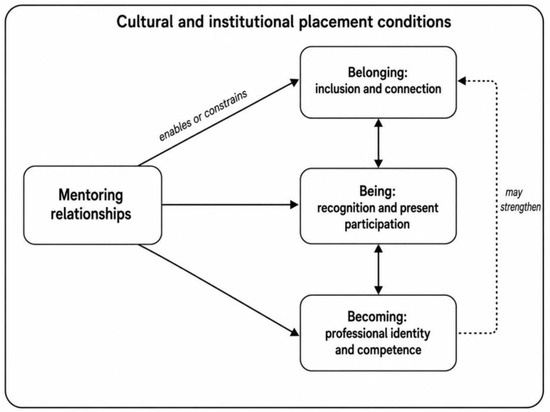
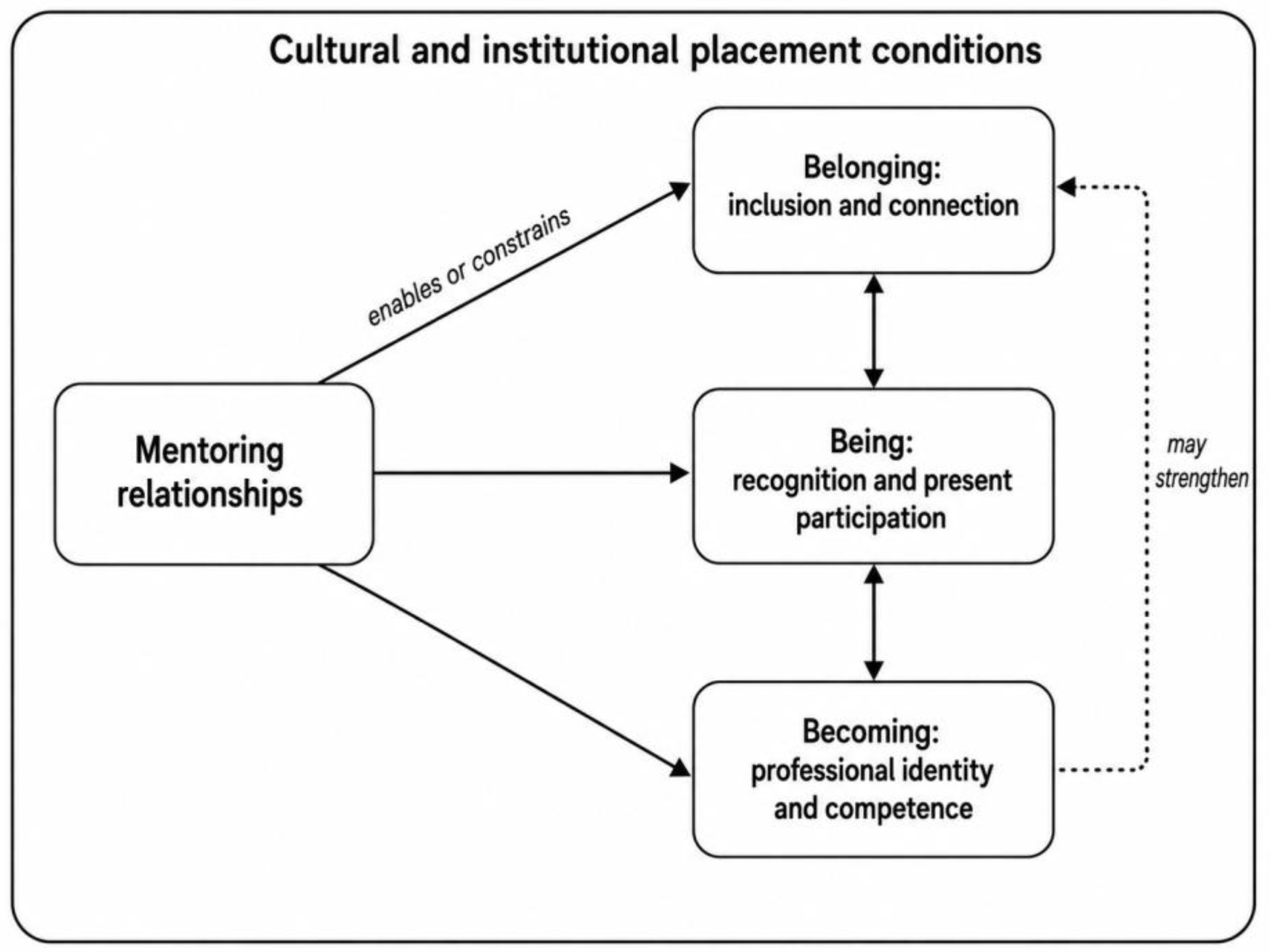
The Early Years Learning Framework understands children’s lives through the interconnected ideas of belonging, being and becoming (Australian Government Department of Education 2022). Previous research has examined pre-service teachers’ sense of belonging during professional placement and its relationship with participation and professional learning (Dewhurst et al. 2020; Zheng et al. 2024). Building on this work, the present study brings the three EYLF dimensions of belonging, being and becoming together as a framework for understanding professional placement. This study adapts these concepts to pre-service teachers’ professional placement. Within this adapted framework, belonging refers to inclusion and connection to the placement community. Being concerns being recognised and able to participate as an emerging teacher in the present, while becoming describes the continuing development of professional identity and competence. Rather than treating belonging solely as an individual feeling, the framework understands it as something created through mentoring relationships and placement conditions. The theoretical contribution of this adaptation is to explain how mentoring and placement conditions influence professional identity through recognition and access to participation. These dimensions influence one another rather than occurring in a fixed sequence. Belonging supports participation, which contributes to professional identity development. As that identity develops, a pre-service teacher’s sense of belonging may also grow. Exclusion or limited opportunities to participate can disrupt this process. Mentoring plays a central role, but placement conditions also affect whether pre-service teachers are recognised and included. Figure 2 illustrates these relationships.
Figure 2.
Adapted belonging, being and becoming framework for pre-service teachers’ professional placement. Note: Developed by the authors using the concepts of belonging, being and becoming from the Australian Government Department of Education (2022). The solid two-way arrows show that the dimensions influence one another. The dotted arrow indicates that developing professional identity may, in turn, strengthen belonging.
Although developed from placements in Victoria, the framework may also be useful in other contexts. However, it would need to reflect local expectations of professional competence and mentoring rather than being applied unchanged.
4.7. Ethical and Equity Implications of the Belonging, Being and Becoming Framework
The findings also raise ethical questions about how the belonging, being and becoming framework is understood and applied. Belonging is not inherently equitable, as students may be accepted only when they conform to dominant cultural and professional norms (Nuttall and Ortlipp 2012; Ortlipp and Nuttall 2011). The experiences of Viola, Emily and Amelia show how cultural difference or disability can be interpreted through established expectations of professional behaviour. Being therefore requires recognition of who pre-service teachers already are, rather than only who they are expected to become. Becoming also raises the question of who defines professional competence. By understanding belonging as something created through mentoring relationships and placement conditions, rather than as an individual attribute, the framework can challenge deficit explanations and draw attention to unequal opportunities for participation. However, it could reproduce inequity if used to judge how successfully students adapt to existing norms. Its ethical application therefore requires belonging to be treated as a shared institutional responsibility.
5. Limitations of the Study
Several limitations should be considered when interpreting the findings. First, the study was conducted within a single Australian university and therefore reflects the contextual characteristics of one initial teacher education program. While the findings may resonate with similar professional placement contexts, caution should be exercised when transferring them to other institutional, cultural, or national settings, where expectations of mentoring, communication and professional participation differ. Second, although the broader project involved 250 pre-service teachers, this paper focuses on six purposively selected case studies. This approach prioritises depth and contextual understanding rather than breadth or generalisability. Third, the selected cases represent diverse experiences; however, they cannot capture the full range of perspectives present within the larger participant cohort. Finally, the findings are interpreted through a qualitative and reflexive lens, recognising that alternative interpretations may emerge from the same dataset. Despite these limitations, the study provides rich insight into the relational and contextual dimensions of belonging during ECEC professional placements.
6. Recommendations
Drawing on the findings and the proposed belonging, being and becoming framework, the following recommendations position professional placement as a relational and developmental space in which pre-service teachers experience recognition (belonging), professional presence (being) and identity formation (becoming).
6.1. Strengthen Mentorship for Belonging, Being and Becoming
Mentorship practices should intentionally foster pre-service teachers’ sense of belonging (experiencing inclusion within the learning community), their being (feeling recognised and active participants in the present), and their becoming (developing professional identity and competence). Structured mentor preparation should therefore emphasise relational pedagogy, cultural responsiveness, and strengths-based feedback. However, this preparation should be supported through appropriate time and resources so that responsibility for addressing structural inequities does not fall solely on individual mentors. Mentoring frameworks should explicitly incorporate modelling, observation, scaffolded participation, and reflective dialogue to support pre-service teachers’ developmental trajectories.
6.2. Embed Belonging as Foundational to Being and Becoming
Belonging should be positioned as a core outcome of professional placement, underpinning pre-service teachers’ capacity for being and becoming. However, it should not become an assessable attribute of the pre-service teacher or be equated with conformity to dominant workplace norms. Placement frameworks should explicitly recognise belonging as a condition for meaningful participation, identity formation, and professional learning. Placement settings should adopt intentional strategies (e.g., inclusive induction practices, relational engagement, and recognition of contributions) to move beyond task-oriented involvement towards genuine integration into the professional community.
6.3. Promote Culturally Responsive Practices to Support Situated Being and Belonging
Cultural safety is central to enabling pre-service teachers to experience authentic being and belonging within diverse placement contexts. Placement systems should provide targeted support for international, postgraduate, and CALD pre-service teachers, particularly in securing equitable placement opportunities. However, support should be informed by students’ expressed needs rather than assumptions based on their cultural background or enrolment status.
6.4. Strengthen University-Placement Partnerships to Sustain Becoming
Sustained collaboration between universities and placement sites is essential for supporting pre-service teachers’ professional becoming. Integrated support structures (e.g., regular visits and structured communication channels) may create continuity between theoretical learning and practice-based experiences. However, their purpose should be communicated clearly so that students experience this contact as relational support rather than additional monitoring.
6.5. Develop Communication and Advocacy to Support Professional Being
Supporting pre-service teachers’ professional being requires explicit attention to communication and advocacy skills. Pre-service teachers should be taught strategies for help-seeking, negotiating feedback, and engaging in professional dialogue with mentors and others as part of their developmental learning. However, developing these capabilities does not mean responsibility for managing inequitable placement conditions should fall to the student. Mentors, placement settings, and universities must also provide safe and responsive processes through which concerns can be raised.
6.6. Address Structural Inequities to Enable Equitable Belonging
Structural factors that constrain pre-service teachers’ access to high-quality placements undermine opportunities for belonging and, consequently, being and becoming. Placement allocation processes should therefore be critically reviewed to reduce systemic barriers, particularly for pre-service teachers who experience repeated rejection from services.
6.7. Promote Strengths-Based Evaluation to Support Becoming and Belonging
Evaluation and feedback play a central role in shaping pre-service teachers’ professional becoming and sense of belonging. Strengths-based approaches should be prioritised, but they should not minimise legitimate concerns about practice or the standards students are expected to meet. Mentors should be supported to balance constructive critique with explicit recognition of pre-service teachers’ progress and capabilities. Shifting from deficit-oriented reporting towards developmental narratives enables pre-service teachers to see themselves as ECEC emerging professionals.
Author Contributions
Conceptualization, M.A.; Methodology, M.A.; Validation, T.E.; Investigation, T.E., L.D., A.M. and G.M.; Resources, T.E., L.D., A.M. and G.M.; Data curation, T.E. and L.D. Writing—original draft, M.A. and T.E.; Writing—review & editing, M.-R.M.; Visualization, L.D.; Project administration, T.E. and L.D. All authors have read and agreed to the published version of the manuscript.
Funding
This research received no external funding.
Institutional Review Board Statement
The study was conducted in accordance with the Declaration of Helsinki, and approved by the Victoria University Human Research Ethics Committee (protocol code HRE25-064 ; date 19 June 2025).
Informed Consent Statement
Informed consent was obtained from all subjects involved in the study.
Data Availability Statement
The original contributions presented in this study are included in the article. Further inquiries can be directed to the corresponding author.
Acknowledgments
The authors would like to thank the pre-service teachers and mentor teachers who generously shared their time and experiences as participants in this study.
Conflicts of Interest
The authors declare no conflicts of interest.
References
- Akkerman, Sanne F., and Paulien C. Meijer. 2011. A dialogical approach to conceptualizing teacher identity. Teaching and Teacher Education 27: 308–19. [Google Scholar] [CrossRef] [Scilit]
- Allen, Kelly-Ann, Fiona Longmuir, Megan G. Thorn, Ebony Melzak, Emily Berger, Beatriz Gallo Cordoba, Michael Phillips, and Andrea Reupert. 2025. What facilitates a sense of belonging amongst Australian teachers? Educational Review 77: 2459190. [Google Scholar] [CrossRef] [Scilit]
- Allen, Kelly-Ann, Kate C. Fortune, and Gökmen Arslan. 2021. Testing the social-ecological factors of school belonging in native-born, first-generation, and second-generation Australian students: A comparison study. Social Psychology of Education 24: 835–56. [Google Scholar] [CrossRef] [Scilit]
- Ambrosetti, Angelina, and John Dekkers. 2010. The interconnectedness of the roles of mentors and mentees in pre-service teacher education mentoring relationships. Australian Journal of Teacher Education 35: 42–55. [Google Scholar] [CrossRef] [Scilit]
- Australian Government Department of Education. 2022. Belonging, Being and Becoming: The Early Years Learning Framework for Australia (Version 2). Available online: https://www.acecqa.gov.au/sites/default/files/2023-01/EYLF-2022-V2.0.pdf (accessed on 18 June 2026).
- Australian Government Department of Education. 2024. 2024 Early Childhood Education and Care National Workforce Census: National Report. Commonwealth of Australia. Available online: https://www.education.gov.au/download/19099/2024-early-childhood-education-and-care-national-workforce-census-report/40926/document/pdf (accessed on 16 July 2026).
- Australian Institute for Teaching and School Leadership. 2024. Australian Professional Experience Guidelines. Available online: https://www.aitsl.edu.au/prepare-to-be-a-teacher/prepare-for-practice/australian-professional-experience-guidelines (accessed on 27 May 2026).
- Baxter, Jennifer. 2013. Child Care Participation and Maternal Employment Trends in Australia (Research Report No. 26). Melbourne: Australian Institute of Family Studies. [Google Scholar]
- Braun, Virginia, and Victoria Clarke. 2019. Reflecting on reflexive thematic analysis. Qualitative Research in Sport, Exercise, and Health 11: 589–97. [Google Scholar] [CrossRef] [Scilit]
- Bukor, Emese. 2015. Exploring teacher identity from a holistic perspective: Reconstructing and reconnecting personal and professional selves. Teachers and Teaching 21: 305–27. [Google Scholar] [CrossRef] [Scilit]
- Canobi, Katherine H., Patricia Eadie, Lisa Murray, Penny Levickis, Jane Page, and Laura McFarland. 2024. Profiles of professional wellbeing and turnover intentions among Australian early childhood educators. Early Education and Development 35: 1063–79. [Google Scholar] [CrossRef] [Scilit]
- Chaaban, Youmen, and Hoa Thi Mai Nguyen. 2025. Exploring pre-service teachers’ professional experiences through the lens of boundary crossing: An Australian case study. Australian Journal of Education 69: 25–43. [Google Scholar] [CrossRef] [Scilit]
- Chang, Heewon, Faith Wambura Ngunjiri, and Kathy-Ann C. Hernandez, eds. 2013. Collaborative Autoethnography. Walnut Creek: Left Coast Press. [Google Scholar]
- Cheruvu, Ranita, Mariana Souto-Manning, Tara Lencl, and Marisa Chin-Calubaquib. 2015. Race, isolation, and exclusion: What early childhood teacher educators need to know about the experiences of pre-service teachers of color. The Urban Review 47: 237–65. [Google Scholar] [CrossRef] [Scilit]
- Cruickshank, Vaughan, Martin Kerby, and Margaret Baguley. 2021. How do pre-service male primary teachers cope with gender-related challenges? Australian Journal of Teacher Education 46: 74–89. [Google Scholar] [CrossRef] [Scilit]
- Dai, Yu, Xinyue Yang, and Dong Li. 2026. The formation of pre-service ECE teachers’ professional identity: The roles of self-efficacy, learning motivation, and engagement. Acta Psychologica 265: 106625. [Google Scholar] [CrossRef] [Scilit]
- Dewhurst, Yvonne, Michelle Ronksley-Pavia, Griffith University, and Donna Pendergast. 2020. Preservice teachers’ sense of belonging during practicum placements. Australian Journal of Teacher Education (Online) 45: 17–33. [Google Scholar] [CrossRef] [Scilit]
- Du Plessis, Anna Elizabeth, and Maryam Razmjoee. 2025. Barriers to Preservice teachers’ engagement during professional experience placement through the lens of industry partners. Education Sciences 15: 1575. [Google Scholar] [CrossRef] [Scilit]
- Hedlin, Maria, Magnus Åberg, and Caroline Johansson. 2018. Fun guy and perpetrator: An interview study of how men are positioned within early childhood education and care. Education Inquiry 10: 95–115. [Google Scholar] [CrossRef] [Scilit]
- Huang, Xianhan, and Chan Wang. 2024. Pre-service teachers’ professional identity transformation: A positioning theory perspective. Professional Development in Education 50: 174–91. [Google Scholar] [CrossRef] [Scilit]
- Hudson, Peter. 2013. Mentoring as professional development: ‘growth for both’ mentor and mentee. Professional Development in Education 39: 771–83. [Google Scholar] [CrossRef] [Scilit]
- Iyer, Radha, and Martin Reese. 2013. Ensuring student success: Establishing a community of practice for culturally and linguistically diverse preservice teachers. Australian Journal of Teacher Education 38: 27–40. [Google Scholar] [CrossRef] [Scilit][Green Version]
- Izadinia, Mahsa. 2014. Teacher educators’ identity: A review of literature. European Journal of Teacher Education 37: 426–41. [Google Scholar] [CrossRef] [Scilit]
- Kaarby, Karen Marie Eid, and Inger Marie Lindboe. 2016. The workplace as learning environment in early childhood teacher education: An investigation of work-based education. Higher Education Pedagogies 1: 106–20. [Google Scholar] [CrossRef] [Scilit][Green Version]
- Kupila, Paivi, Tuulikki Ukkonen-Mikkola, and Kyllikki Rantala. 2017. Interpretations of mentoring during early childhood education mentor training. Australian Journal of Teacher Education 42: 36–49. [Google Scholar] [CrossRef] [Scilit]
- Mahony, Linda, Leigh Disney, Sara Griffiths, Helen Hazard, and Georgie Nutton. 2020. Straddling the divide: Early years preservice teachers’ experiences working within dual policy contexts. Australasian Journal of Early Childhood 45: 183–96. [Google Scholar] [CrossRef] [Scilit]
- Massing, Christine. 2016. Authoring professional identities: Immigrant and refugee women’s experiences in an early childhood teacher education program. Journal of Childhood Studies 40. [Google Scholar] [CrossRef] [Scilit][Green Version]
- Miller, Melinda, Amanda McFadden, and Ann Heirdsfield. 2016. Preparing culturally and linguistically diverse preservice early childhood teachers for field experience. Student Success 7: 33. [Google Scholar] [CrossRef] [Scilit]
- Mills, Martin, Lisa van Leent, Terri Bourke, Craig Wood, Simone White, Matthew Readette, and Reece Mills. 2024. Teacher shortages: A social justice perspective on an Australian teacher education policy. Teaching Education 36: 1–17. [Google Scholar] [CrossRef] [Scilit]
- Morrissey, Anne-Marie, and Andrea Nolan. 2015. Just another meeting?: Investigating mentoring for early childhood teachers in Victoria. Australasian Journal of Early Childhood 40: 40–48. [Google Scholar] [CrossRef] [Scilit]
- Myles, Johanne, Liying Cheng, and Hong Wang. 2006. Teaching in elementary school: Perceptions of foreign-trained teacher candidates on their teaching practicum. Teaching and Teacher Education 22: 233–45. [Google Scholar] [CrossRef] [Scilit]
- Nicolas, Edith, Cristina Guarrella, and Parian Madanipour. 2025. A university—Stakeholder collaborative approach to designing early childhood mentor teacher training. International Journal of Qualitative Methods 24: 16094069251342. [Google Scholar] [CrossRef] [Scilit]
- Nolan, Andrea. 2017. Effective mentoring for the next generation of early childhood teachers in Victoria, Australia. Mentoring & Tutoring: Partnership in Learning 25: 272–90. [Google Scholar] [CrossRef] [Scilit]
- Nuttall, Joce, and Michelle Ortlipp. 2012. Practicum assessment of culturally and linguistically diverse early childhood pre-service teachers. European Early Childhood Education Research Journal 20: 47–60. [Google Scholar] [CrossRef] [Scilit]
- Nuttall, Joce, Linda Henderson, Elizabeth Wood, and Jenny Martin. 2024. Leadership in Early Childhood Education. Cham: Springer Nature. [Google Scholar]
- Ortlipp, Michelle, and Joce Nuttall. 2011. Supervision and assessment of the early childhood practicum: Experiences of pre-service teachers who speak English as a second language and their supervising teachers. Australasian Journal of Early Childhood 36: 87–94. [Google Scholar] [CrossRef] [Scilit]
- Pandey, Pranay, and Pragyan Mohanty. 2025. Role of reflective practice in teacher identity formation: A qualitative perspective. International Journal of Research and Scientific Innovation 12: 1250–57. [Google Scholar] [CrossRef] [Scilit]
- Patton, Michael Quinn. 2015. Qualitative Research & Evaluation Methods, 4th ed. New York: Sage Publications. [Google Scholar]
- Pishghadam, Reza, Jawad Golzar, and Mir Abdullah Miri. 2022. A new conceptual framework for teacher identity development. Frontiers in Psychology 13: 876395. [Google Scholar] [CrossRef] [Scilit]
- Quinones, Gloria, Corine Rivalland, and Hilary Monk. 2020. Mentoring positioning: Perspectives of early childhood mentor teachers. Asia-Pacific Journal of Teacher Education 48: 338–54. [Google Scholar] [CrossRef] [Scilit]
- Spooner-Lane, Rebecca, Donna Tangen, and Marilyn Campbell. 2009. The complexities of supporting Asian international pre-service teachers as they undertake practicum. Asia-Pacific Journal of Teacher Education 37: 79–94. [Google Scholar] [CrossRef] [Scilit]
- Thorpe, Karen, Elena Jansen, Victoria Sullivan, Susan Irvine, and Paula McDonald. 2020. Identifying predictors of retention and professional wellbeing of the early childhood education workforce in a time of change. Journal of Educational Change 21: 623–47. [Google Scholar] [CrossRef] [Scilit]
- Uusimaki, Liisa. 2013. Empowering pre-service teacher supervisors’ perspectives: A relational-cultural approach towards mentoring. Australian Journal of Teacher Education 38: 45–58. [Google Scholar] [CrossRef] [Scilit]
- Uusimaki, Liisa, and Teresa Swirski. 2016. Cross-cultural “distance”, “friction” and “flow”: Exploring the experiences of pre-service teachers on international practicum. Asia Pacific Journal of Education 36: 425–36. [Google Scholar] [CrossRef] [Scilit]
- Weiß, Julia Katharina, Matthias Bottling, and Tobias Kärner. 2023. Professional identification in the beginning of a teacher’s career: A longitudinal study on identity formation and the basic psychological need for autonomy in VET teacher training. Frontiers in Psychology 14: 1196473. [Google Scholar] [CrossRef] [Scilit]
- Wenger, Etienne. 1998. Communities of Practice: Learning, Meaning, and Identity. Cambridge: Cambridge University Press. [Google Scholar]
- Woolcott, Geoff, Robert Whannell, Margaret Marshman, Linda Galligan, Tony Yeigh, and Taryn Axelsen. 2024. Exploring pre-service teachers’ affective-reflective skills: The effect of variations of a novel self-evaluation protocol. Asia-Pacific Journal of Teacher Education 52: 126–54. [Google Scholar] [CrossRef] [Scilit]
- Yin, Robert K. 2018. Case Study Research and Applications. Thousand Oaks: Sage, vol. 6, pp. 200–24. [Google Scholar]
- Zhang, Limin, Yitong Chen, Wenhui Zhong, and Lianjiang Jiang. 2025. Becoming a teacher, coexisting with emotions: A follow-up study on emotion regulation of ECE student teachers in teaching internship context in China. The Asia-Pacific Education Researcher 35: 143–58. [Google Scholar] [CrossRef] [Scilit]
- Zhao, Hongyu, and Xiaohui Zhang. 2017. The influence of field teaching practice on pre-service teachers’ professional identity: A mixed methods study. Frontiers in Psychology 8: 1264. [Google Scholar] [CrossRef] [Scilit]
- Zheng, Haoran, Anne Keary, and Julie Faulkner. 2024. Professional experience of Chinese international pre-service teachers in Australia’s early childhood education: Professional learning and belonging. Asia-Pacific Journal of Teacher Education 52: 560–73. [Google Scholar] [CrossRef] [Scilit]

Disclaimer/Publisher’s Note: The statements, opinions and data contained in all publications are solely those of the individual author(s) and contributor(s) and not of MDPI and/or the editor(s). MDPI and/or the editor(s) disclaim responsibility for any injury to people or property resulting from any ideas, methods, instructions or products referred to in the content. |
© 2026 by the authors. Licensee MDPI, Basel, Switzerland. This article is an open access article distributed under the terms and conditions of the Creative Commons Attribution (CC BY) license.