


Abstract
Our study provides a comparison of childcare attitudes in Hungary and Finland. One of Finland’s best-known social characteristics is its progressive and egalitarian approach to childcare, an important aspect of which is the equal sharing of roles and responsibilities between men and women. In contrast, post-socialist Hungary is more characterized by its acceptance of traditional gender roles and family models. The aim of this study is to provide a quantitative comparative analysis of attitudes towards sharing childcare responsibilities and the roles of parents (mothers and fathers) within families in Hungary and Finland, along the dimensions of traditional and egalitarian family models. Data from the 2022 module of the International Social Survey Programme “Family and Changing Gender Roles” with Hungarian (N = 1027) and Finnish (N = 1250) respondents were analyzed regarding attitudes towards division of work within the family, gender roles and childcare perceptions, with a focus on the views on fathers’ participation in family and household tasks. The main results show that in Hungary traditional attitudes towards women’s and men’s roles in the family are present, whereas Finnish respondents clearly reject traditional gender roles, indicating support for the egalitarian family model. Although we found some differences between various sociodemographic groups in this regard, the Finnish population’s attitudes towards parental roles are more homogeneous compared to the Hungarian sample, which seems to be polarized. Our results show that three main factors emerged during the principal component analysis: in the Hungarian sample, two distinct parental role groups emerged (financial responsibility and emotional-educational roles), whereas in the Finnish sample, a more unified, integrated perception of parental roles was identified. Based on regression analyses, demographic variables explain the differences in attitudes only to a limited extent. The roles of fathers with young children within the family reflect a caring pattern of active involvement in the child’s life in both countries. However, the traditional role of the father in providing financial security for the family is still an important expectation in Hungarian society, whereas in the Finnish population this is less emphasized. This research contributes to the understanding of differences in childcare, the effects and differences in family support policies in Scandinavian Finland and post-socialist Hungary, also suggests measures for a more equal distribution of childcare responsibilities.
1. Introduction
Our study aims to compare attitudes towards the sharing of childcare responsibilities and the role of parents within the family along the dimensions of the traditional and egalitarian family models in Hungary and Finland. The novelty of our study lies in the fact that a comparative analysis of the ISSP 2022 family and variable gender module has not yet been carried out for the two countries under study. It is important to see how two different societies think about childcare, based on the most recent data.
To examine how contrasting welfare state regimes shape public perceptions of parental roles, this study compares Finland and Hungary as exemplary cases of the Scandinavian social-democratic model and the Central and Eastern European post-socialist model, respectively. One of Finland’s best-known social features is its progressive and egalitarian approach to childcare, supported by family policies that actively encourage equal sharing of roles between parents through non-transferable, father-specific parental leave (i.e., the ‘daddy quota’). In contrast, while the Hungarian family support system formally allows fathers to stay at home under the same conditions as mothers, it relies on long, transferable leave periods that—in the absence of reserved paternal quotas beyond a brief ten-day entitlement—functionally reinforce a mother-centered caregiving model. Comparing these two distinct institutional frameworks provides a clear foundation for investigating how institutional incentives and socio-cultural contexts influence public attitudes toward fathers’ involvement and shared childcare responsibilities. Analyzing attitudes toward fathers’ involvement thus serves as a critical indicator for evaluating how far the broader transition toward shared, dual-carer parental roles has progressed for both mothers and fathers.
According to an exploratory analysis of the 2017 European Values Study on family values, a very small proportion of the population in Northern European countries believes that work is the responsibility of men, while women are responsible for taking care of the family and home. In contrast, the population of Central and Eastern European countries, including Hungary, is much more likely to accept the traditional division of roles between men and women. In Hungary, 47.75% of the population agrees with this traditional model, which strictly divides gender responsibilities by assigning the male breadwinner role to men and domestic, caregiving duties to women (Pátkainé 2022). However, the expectations surrounding paternal roles have become more complex in Hungary in recent decades: now there is a demand for fathers to play a more active role in their children’s lives, and the solely breadwinner father is gradually being replaced by a father who is able and willing to care for his children.
However, the traditional role of fathers has also changed in Hungary in recent decades: now there is a demand for fathers to play a more active role in their children’s lives, and the breadwinner father is gradually being replaced by a father who is able and willing to care for his children (Drjenovszky and Sztáray Kézdy 2021; Nagy et al. 2023). This has resulted in dual role expectations for fathers: providing care and ensuring the financial security of the family (Makay and Spéder 2018).
The historical arc of changes in attitudes in Hungary (Spéder 2023) confirms this duality: while state socialism officially promoted full female labor participation—creating a double burden for women without fundamentally altering domestic expectations—the post-communist democratic transition of 1989/1990 triggered a shift toward liberalized family models and gender equality. However, by the 2010s, alongside modernization trends, a re-traditionalization of family policy and gender ideology re-strengthened the traditional, male-breadwinner and female-caregiver role division.
Our research aims to provide a comparative analysis of attitudes towards childcare responsibilities and parenting roles in Finland and Hungary based on the ISSP 2022 database. Our research question focuses on what significant differences there are in the attitudes of the Finnish and Hungarian populations regarding the sharing of childcare tasks in light of the latest (2022) data.
While our study primarily relies on a research question driven approach to explore patterns and cross-country differences rather than testing formal hypotheses, we clearly structure our analytical process to delineate the role of each variable in answering the main research question. The primary goal is to examine how attitudes vary across different social groups and to map the underlying dimensions of childcare perceptions in two distinct welfare contexts.
As a theoretical framework of our study, we present the main characteristics of the change in parental roles and the results of the most important international comparative studies, with special regard to the differences between two European regions, the Scandinavian countries and the post-socialist countries. Subsequently, the characteristics of Finland and Hungary are described in the context of family policy.
Following the presentation of the methodology and sample of our research, we present the results of the comparative analysis of Hungarian and Finnish data in the 2022 wave of the ISSP and draw our conclusions according to the criteria outlined in the theoretical framework.
2. Theoretical Framework
2.1. Hungary and Finland
Finland is a Northern European country, a Scandinavian welfare state with 5.5 million inhabitants and Hungary is a Central and Eastern European country, with 9.7 million inhabitants (EUROSTAT 2023). Both countries are members of the European Union and the OECD.
According to data from the OECD Family Database for 2023 (PF2.1. Parental leave systems), the family support systems in Hungary and Finland both offer a wide range of options for parents, but the models in the two countries follow different logics, especially about elements that encourage the sharing of parental responsibilities. Hungary offers one of the longest combined paid maternity and parental benefits in the OECD: mothers are entitled to 24 weeks of maternity leave. Following this, a total of 136 weeks of parental leave is available until the child reaches the age of three. A crucial feature of the Hungarian system is that this long-term parental leave is fully transferable and can be freely shared between parents; fathers are entitled to claim it under the same conditions as mothers. However, beyond a specific ten-day period of paternity leave, the system lacks non-transferable, father-specific leave (a ‘daddy quota’). Consequently, although the legal framework allows for an equal sharing of childcare, the absence of reserved paternal quotas, combined with social and economic factors, often results in a mother-centered practice. This structure may, in the long term, reinforce the traditional gender division of care tasks despite the formal eligibility of both parents. In contrast, Finland combines relatively short maternity leave (6.7 weeks) with extremely long paid parental and home care leave totaling 154 weeks, of which both mothers and fathers receive a significant portion, determined on an individual basis. Fathers are entitled to three weeks of paid paternity leave and an additional 13.2 weeks of parental leave reserved exclusively for them, giving them a total of 16.2 weeks of paid leave dedicated to fathers—significantly more than in Hungary. Although the Finnish system offers relatively low wage compensation for long periods of home care, the non-transferable entitlement for fathers strongly encourages more equal use between the sexes. Overall, both countries provide generous leave and benefit systems but with different philosophies: Hungary supports long periods of stay-at-home care, primarily taken up by mothers, while Finland aims to share parental responsibility through non-transferable leave reserved for fathers. This difference may also be decisive in shaping attitudes and practices towards childcare.
According to Saarikallio-Torp et al. (2025), Finland is a fairly egalitarian country, with family policies that support the dual-earner, dual-caregiver family model, but the division of childcare responsibilities remains gendered.
Finland exemplifies the Nordic welfare model with extensive support for gender equality and work–family reconciliation, whereas Hungary has adopted a family policy framework that places stronger emphasis on family support, traditional family values and demographic objectives.
Support for traditional gender roles and family models, such as the male breadwinner and female homemaker, has remained high. However, there has been an increase in support for gender role equality, particularly in terms of labor division within the family and the reduction in income gaps. This mixed pattern highlights the complex nature of attitudinal change, where modernization may occur alongside the persistence of traditional values.
According to OECD time balance research (OECD 2023), women in Hungary spend significantly more time, an average of 1.7 h, whereas men spend 0.6 h a day on primary childcare. The difference is significant both in primary care tasks (feeding, bathing, supervision) and in related household tasks (e.g., housework related to the child). The gender gap is one of the highest among OECD countries.
An important background to this pattern is the previously analyzed Hungarian family support system: the long parental leave (which lasts up to 3 years), which mothers mainly use, also institutionally strengthens mothers’ stay at home and the traditional division of care tasks. Since the non-transferable leave reserved for fathers is short and has a low wage supplement, the time expenditure of men also remains low.
Compared to the OECD average, Finland shows a much more balanced time expenditure, with women spending an average of 1.2 h and men 0.7 h per day on primary childcare (OECD 2023). Although women still provide slightly more primary childcare, the difference is significantly smaller than in the countries of Central and Eastern Europe. Finnish men regularly and above average participate in tasks around the child, especially in joint activities and everyday routine tasks.
2.2. Changing Parental Roles and Attitudes Toward Sharing Childcare Roles
Examining childcare attitudes inherently requires a holistic view of parental capabilities, encompassing both maternal and paternal responsibilities. While much of the recent literature highlights paternal involvement as a benchmark for gender equality, these shifts directly reshape expectations regarding mothers’ roles and the overall division of family labor. While the traditional family model sees the man as the breadwinner and the woman as responsible for domestic tasks and care, the egalitarian family model promotes an equal sharing of breadwinning and caregiving roles between the sexes (Kroska 2007; Davis and Greenstein 2009). According to Goldscheider (2000) and McDonald (2000), the first stage of the gender revolution involved women’s large-scale entry into education and paid employment. The second stage refers to the more equal sharing of unpaid domestic work and childcare between women and men, a transition that has progressed unevenly across countries and remains incomplete in many societies. This theoretical perspective suggests that attitudes toward childcare responsibilities are an important indicator of the extent to which the second stage of the gender revolution has advanced.
However, recent cross-national research emphasizes that gender attitudes cannot be fully understood through a simple, one-dimensional dichotomy of traditional versus egalitarian models. Begall et al. (2023), examining data from 36 European countries, highlight the multidimensional nature of gender ideologies. They demonstrate that over 60% of individuals hold complex, multidimensional views—such as intensive motherhood, neo-traditional, or choice-egalitarian patterns—which helps explain the “stalled gender revolution” across different societal contexts. Building on this European perspective, Schäfer et al. (2024) show that gender attitudes are also deeply intertwined with broader socio-cultural divides across Europe, revealing marked regional differences in attitudinal ambivalence and polarization between Western Europe and Central and Eastern Europe (CEE).
The increasing expectation that fathers should be involved in both household tasks and childcare reflects a shift away from traditional gender norms toward a more egalitarian understanding of family life. In traditional families, the mother typically takes on the primary role in childcare and housework, while the father is the main breadwinner (Peplau 1983).
Driven by rising female labor force participation, evolving family policies, and changing cultural norms, public perceptions of paternal roles have shifted significantly. These socio-economic transformations have fostered a new model of active fatherhood, where fathers are increasingly expected to engage directly in their children’s daily care. This active paternal involvement enhances family well-being and child development by creating a positive emotional environment and fostering more egalitarian family dynamics (Lee 2024). Over the past few decades, the amount of time parents dedicate to childcare has increased significantly (Bianchi et al. 2012). This increase is particularly pronounced among middle-class families with higher educational levels (Guryan et al. 2008; Ramey and Ramey 2010), a pattern closely linked to the rise of ‘intensive parenting’ norms. Middle-class and highly educated parents increasingly view childcare not merely as routine daily care, but as a deliberate investment in their children’s cognitive and emotional development (Kalil et al. 2012). This class-specific shift has reshaped public expectations surrounding parenthood by transforming the normative definition of fatherhood: for highly educated fathers, active, developmental, and emotionally engaged involvement in childcare has become a central social expectation rather than an optional role (Gracia and Ghysels 2017). The process of becoming a parent is clearly an important gendered milestone in the decision-making process regarding the division of household work and care responsibilities (Dribe and Stanfors 2009).
Furthermore, childcare is generally considered more rewarding and enjoyable than housework, especially by men (Sullivan 2013). However, this distinction remains gendered: while mothers often manage routine, less flexible tasks (e.g., changing diapers and preparing daily meals), fathers tend to engage more in interactive or leisure activities (Bianchi et al. 2006; Roeters et al. 2009). This shift may reflect broader societal changes and a potential transformation in traditional gender roles, as fathers’ growing engagement continues to reshape the division of labor within households.
Childrearing is influenced by gender norms and ideas about fatherhood and motherhood and are shaped by societal expectations. Men and women, socialized into distinct gender roles, tend to act in ways that conform to these roles (West and Zimmerman 1987).
Drawing on ISSP data from 41 countries, Picanço et al. (2024) emphasize that cultural and institutional contexts strongly shape normative views on gender roles, with cross-national variation being wider in gender values than in actual practices. From a regional perspective, Northern European countries stand out for their egalitarian gender values and broader societal support for shared family responsibilities, whereas Central and Eastern European societies, including Hungary, express more conservative views regarding family and gender roles.
Altintas and Sullivan (2017) also highlight the stark differences between countries in terms of fathers’ involvement in caregiving. Altintas and Sullivan’s (2017) study examined 15 countries and classified the participating countries into four regime categories based on the analysis. In Nordic countries (Denmark, Sweden, Finland, and Norway), fathers consistently show the highest levels of involvement in domestic tasks and childcare. In contrast, southern European countries such as Italy, Spain, and Israel started with low levels of paternal involvement but have seen gradual increases over time. In corporate countries such as France and Germany, paternal engagement began at higher levels but exhibited little change. The liberal regimes of the United States, Canada, and the United Kingdom show a pattern of dichotomy: in these countries, fathers are either highly involved or completely absent, with those who do participate gradually reach levels similar to the Nordic countries. Based on the list of countries included in the study, the post-socialist/Middle Eastern European region is not widely represented since the Eastern European presence in the study was limited to a single post-socialist country, Slovenia, which the authors classified as belonging to the corporatist cluster. Therefore, the study’s direct empirical evidence is limited to the post-socialist region as unit.
As Esping-Andersen (2009) argues in his thesis of the ‘incomplete revolution,’ the transition to egalitarianism has reached a plateau even in Nordic societies. Although institutional reforms in countries like Finland have successfully integrated women into the workforce, the complementary shift in men’s domestic roles has been slower, leading to a stabilization—or a temporary halt—in the progress toward full gender equality. This observation suggests that, despite progressive policy efforts to promote paternal involvement, the pace of change toward more egalitarian gender role attitudes has slowed down. More precisely, although Finnish family policy has provided structural incentives for fathers to engage in caregiving, the ideological shift in public attitudes appears to have reached a plateau, reflecting the advanced but now more stable state of gender egalitarianism in Nordic societies.
He (2023) also points out that, although the political goals were forward-looking, gender differences in caregiving and housework still persist in the private sphere, in family preferences and in practice, meaning that there is a “significant gap” between the reform and actual social behavior.
Both Hungary and Finland offer contrasting contexts for the study of family attitudes and gender equality. These contrasting contexts provide valuable insights into how different societal structures and policies shape attitudes toward family life and fertility.
The comparison between Hungary and Finland further illustrates how differing social contexts and policy environments influence attitudes toward family life, and gender roles.
Our research question is therefore: what trends, differences and similarities can be found in attitudes towards the sharing of childcare roles in Hungary and Finland? To the best of our knowledge, no previous study has examined this question using recent data on attitudes.
3. Method
3.1. Data Collection and Participants
To investigate what trends, differences and similarities can be found in attitudes towards the sharing of childcare roles in Hungary and Finland, we used data from the Family and Changing Gender Roles V module of the International Social Survey Program (2022; ISSP Research Group 2025). The International Social Survey Program (ISSP) is an international comparative survey providing insights into social attitudes and opinions. Founded in 1984 by its original members—Australia, Germany, Great Britain, and the USA—the ISSP has since expanded to include members from diverse cultures worldwide. Currently, 44 countries, mainly in Europe, are members of the ISSP. The first survey of the “Family and Changing Gender Roles” module, conducted in 1988, played a prominent role in the international comparative study of attitudes towards families. Adapting to societal changes, subsequent modules have broadened the research focus from the initial survey to include men’s roles in the family. The 2022 module now allows for the study of changes in family attitudes, such as men’s participation in family and household work, and opinions on childbearing and policy measures (Medgyesi 2024).
To evaluate cross-national patterns, data were drawn from the standardized ISSP 2022 dataset made available through the GESIS Data Archive (ISSP Research Group 2025). Both national surveys employed rigorous, multi-stage probability sampling designs to ensure national representativeness for the adult population aged 18 and older.
In Hungary, the target population comprised permanent residents aged 18 and above. Data collection (N = 1027) was conducted via face-to-face Computer-Assisted Personal Interviews (CAPI) using a multi-stage stratified random sampling procedure based on national population registers. To correct for minor sample deviations from official population statistics (such as age, gender, education, and settlement structure), official ISSP post-stratification sampling weights (WEIGHT) provided in the dataset were applied in all descriptive and inferential analyses.
In Finland, the survey target population included non-institutionalized Finnish residents aged 15 to 74 (restricted to respondents aged 18+ for cross-national comparability in this study, N = 1250). The Finnish survey utilized a nationwide random sample drawn from the Population Information System (Väestötietojärjestelmä). Data collection was administered as a self-completion mixed-mode survey combining Computer-Assisted Web Interviewing (CAWI) and mail-back paper questionnaires (PAPI). To adjust for non-response bias across sociodemographic strata, the national weighting factor provided by the Finnish ISSP team was applied.
The main sociodemographic characteristics of the weighted Hungarian and Finnish samples are presented in Table 1.
Table 1.
Samples from the Hungarian and Finnish data collection of the ISSP module “Family and changing gender roles” (2022).
The gender and age proportions are similar in the samples from both countries, but the Finnish sample has a much higher proportion of higher education and a lower proportion of secondary education than the Hungarian sample. The Finnish population has a lower proportion of people living in small towns and villages compared to the Hungarian population.
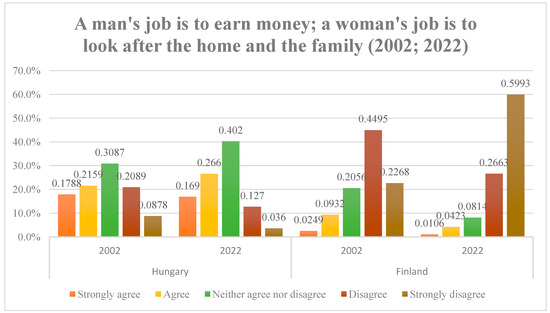
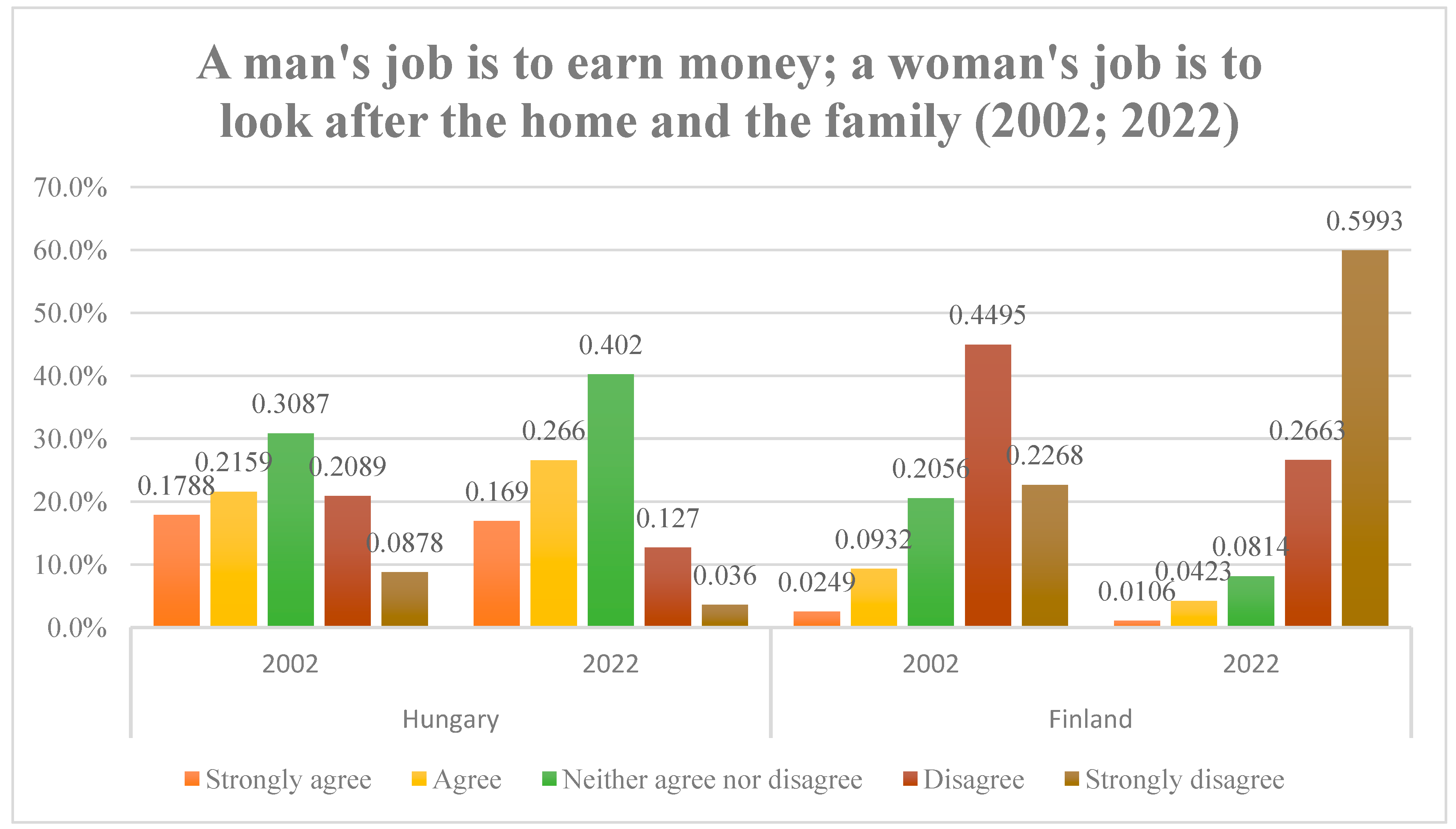
To contextualize the stability and change of gender role attitudes over time (as presented in Figure 1), we also incorporated repeated cross-sectional data from the earlier 2002 ISSP ‘Family and Changing Gender Roles III’ module for both Hungary (N = 1023) and Finland (N = 1253). These independent probability samples used identical questionnaire items (R 1f) and followed comparable nationally representative sampling frames as the 2022 wave.
Figure 1.
Man’s job is to earn money; woman’s job is to look after the home and family; Hungary (N = 1010); Finland (N = 1142).
3.2. Variables
The explanatory variables (gender, age, educational attainment, type of settlement, subjective financial situation, and parenthood) were selected based on previous research identifying these sociodemographic characteristics as important correlates of attitudes towards gender roles and family responsibilities. In our study, we analysed the responses to the following questions (dependent variables) of the ISSP 2022 data collection on “family and changing gender roles” along the main sociodemographic variables measuring demographic differences (gender, age, education, type of settlement, subjective financial situation and having a child) as independent variables:
- ▪
- A man’s job is to earn money; a woman’s job is to look after the home and family. (R1 f)
- ▪
- How much responsibility should men and women take for the home and family? (N 2a)
- ▪
- How are mothers and fathers suited to caring for their children? (N 2b)
- ▪
- In a family with a five-year-old child, which parent should provide for the family’s financial security? (N 7a)
- ▪
- In a family with a five-year-old child, which parent should look after the child on a daily basis? (N 7b)
- ▪
- In a family with a five-year-old, which parent should play with the child and take part in the child’s leisure activities? (N 7c)
- ▪
- In a family with a five-year-old child, which parent should teach the child to behave? (N 7d)
- ▪
- In a family with a five-year-old, which parent should take the time to listen to the child and give advice when they have problems? (N 7e)
- ▪
- In a family with a five-year-old child, which parent should be a role model for the child? (N 7f)
The selection of these dependent variables was justified by their direct measurement of childcare attitudes within the ISSP “Family and Changing Gender Roles” module, as well as by previous research on gender roles and family attitudes. The inclusion of sociodemographic independent variables (gender, age, educational attainment, type of settlement, subjective financial situation, and parenthood) was not intended to build a full explanatory model, but rather to examine whether attitudes differ systematically across various social groups.
Respondents could rate the statement or answer the questions on a scale of 1 to 5. On a five-point scale, the two extreme values for question R 1f are: 1—strongly agree, 5—strongly disagree; for question N 2a: 1—women should take much more responsibility, 5—men should take much more responsibility; for question N 2b: 1—mothers are much more capable, 5—fathers are much more capable. Also, for N 7 sub-questions, respondents were asked to answer questions on a scale of 1 to 5, with the two extremes being 1—mainly for the mother, 5—mainly for the father. For each sociodemographic variable, it was necessary to aggregate individual values. For the regression analyses, age was categorized into three subgroups based on year of birth (young: under 30, middle-aged: 31–64, elderly: over 65). The main rationale for categorizing age rather than treating it as a continuous variable was to examine potential attitudinal differences related to distinct stages of the life course, specifically capturing young adults, active working-age individuals, and older respondents. However, we acknowledge that treating age as a categorical variable results in a loss of information and statistical power compared to continuous modeling (e.g., non-linear quadratic terms), which serves as an alternative approach for future research. Furthermore, regarding parent status, the differences observed across groups are interpreted purely as descriptive sociodemographic variations rather than causal impacts of becoming a parent.
Regarding the type of settlement, for the Hungarian data, four groups (big city, metropolitan area, small town, village) were analyzed, none of the Hungarian respondents live on a farm. For the Finnish data, five groups (big city, metropolitan area, small town, village, farm) were analyzed. The subjective financial situation variable includes the following values: living without problems; getting along well with their schedule; just getting by on their monthly income; having financial problems from month to month; living between deprivations.
Except the first question as a repeating question (R 1f), all questions are new items in the ISSP 2022 data collection wave. Table 2 shows the number, mean and standard deviation of responses to the survey questions. Due to the violation of normality, robust tests for normality were performed on the variables. Robust non-parametrical tests used were Mann–Whitney and Kruskal–Wallis tests. Significant results were determined at 95% confidence intervals. Since the examined variables measured attitudes on a Likert scale, which are ordinal in nature, the assumptions of classical parametric procedures (t-test, ANOVA) were not met. Normality was assessed by using the Kolmogorov–Smirnov test, and significant deviations were observed in all cases (p < 0.001). Therefore, we applied non-parametric, rank-based tests, which are less sensitive to violations of normality and potential outliers. Differences between two groups were tested by using the Mann–Whitney U test, whereas comparisons among three or more groups were conducted with the Kruskal–Wallis test.
Table 2.
Descriptive Statistics.
Second, to reduce dimensionality and uncover the latent dimensions behind the childcare attitude items (N 7a–N 7f), Principal Component Analysis (PCA) was conducted. We chose an exploratory PCA approach over Confirmatory Factor Analysis (CFA) because our primary objective was not to test or validate a pre-defined theoretical measurement model, but to explore empirical dimensions and summarize inter-correlated survey items into composite indicators for cross-national comparison. While CFA would allow for a formal evaluation of model fit and latent structure testing—representing a valuable direction for future research—PCA was the most suitable data-reduction method for our exploratory purposes. Following PCA, linear regression was conducted to examine the relationships between selected dependent and independent variables. Model assumptions were carefully verified.
4. Results
4.1. Gender Roles and Responsibility for Home and Family
To measure attitudes towards gender roles, we used the responses to the statement: “It is men’s role to earn money, and women’s role to look after the home and family.”
Based on the data in Figure 1, it appears that the proportion of Hungarian respondents who agree with this statement has increased slightly between 2002 and 2022, with 43.5% believing that “It is the man’s job to earn money and the woman’s job to take care of the home and family,” while only 5.3% of Finnish respondents agree with this statement in 2022. This reflects a stronger adherence to traditional family models in Hungary, contrasted with the rejection of such models in Finland. Additionally, 40.2% of Hungarian respondents hold mixed views, whereas Finnish responses in 2022 show a clear trend toward disagreement (86.5%).
Regarding the statement that “it is the man’s role to earn money and look after the home and family,” Finnish sample reveals a gender-based difference (Table 3): men’s agreement (Mean rank = 540.84) significantly differs from women’s (Mean rank = 670.43) [p = 0.000, Z = −7.25]. Women agree less with this traditional role division, though both groups generally reject the statement.
Table 3.
Mean ranks and test statistics by demographic and socioeconomic factors: “A man’s job is to earn money; a woman’s job is to look after the home and the family”.
In both countries, people with children are more likely to agree with this statement. In the Hungarian sample, the group of those with children (mean rank = 539.14) is significantly different (p = 0.006, Z = −2.722) from the group without children (mean rank = 592.96) in the Finnish sample, the group of those with children (mean rank = 583.47) is also significantly different (p = 0.000; Z = −4.234) from the group without children (mean rank = 661.83).
In Hungary, educational level significantly impacts responses (p = 0.001). Those with primary education level (mean rank = 424.77; 318.45) are more in agreement with the traditional role division compared to both those with secondary education (525.68) and tertiary education (416.80). In Finland, similar trends are observed, with significant differences between educational groups. In the Finnish sample, the group with primary education (mean rank = 336.52) agrees more (p = 0.031) with the statement compared to the group with secondary education (mean rank = 366.44). 12), the primary education group (mean rank = 363.18) is also more in agreement (p = 0.000) with the statement, and the secondary education group (mean rank = 408.95) is also more in agreement (p = 0.001) with the statement compared to the tertiary education group (mean rank = 457.38). It seems that the lower the level of education, the more Finnish respondents agree with the statement, whereas higher education correlates with weaker agreement with traditional gender roles.
Age differences among Finnish respondents also show significance. Older respondents (mean rank = 224.78) are less likely (p = 0.001) to reject the traditional roles compared to younger (mean rank = 262.79). The group of elderly respondents (mean rank = 447.89) also differs (p = 0.001) from the group of middle-aged respondents (mean rank = 505.37), with the former group agreeing more than the latter.
Only the Hungarian sample shows significant differences between groups by type of settlement. Both the group of people living around a big city, the group of people living in small towns and the group of people living in villages agree more with the statement about traditional gender roles compared to the group of people living in big cities.
We found significant differences between the groups in terms of subjective financial situation only in the Hungarian sample. The group living from month to month (mean rank = 63.22) agreed more (p = 0.022) with the statement measuring traditional gender roles compared to the group living without problems (mean rank = 81.16). The former group (mean rank = 272.23) also agrees more (p = 0.002) with the above question compared to the group of those who get along well with the schedule (mean rank = 329.39). The group of people living between deprivations (mean rank = 194.39) is also more in agreement (p = 0.043) with the statement compared to the group of people who get along well with their schedule (mean rank = 276.60). The month-to-month living group (mean rank = 236.53) also shows agreement with the statement (p = 0.028) compared to those in the just getting by group (mean rank = 271.44).
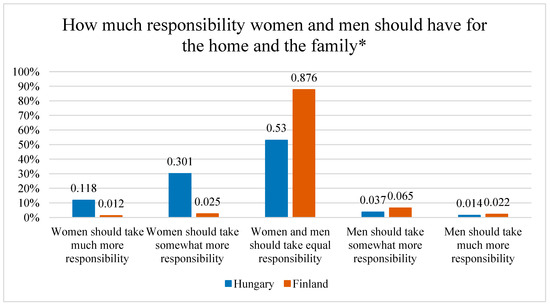
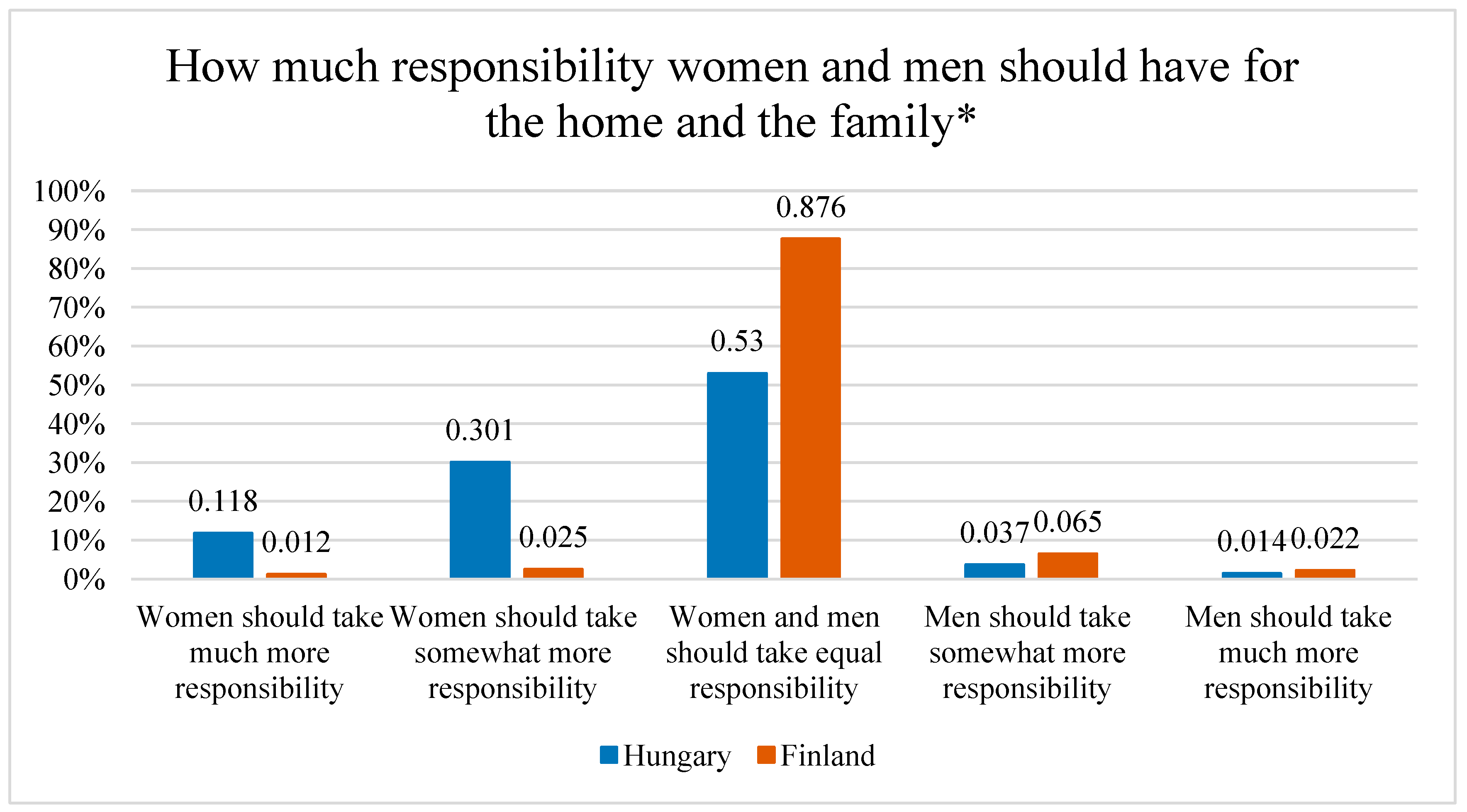
Attitudes towards sharing responsibility for home and family were explored in the question in Figure 2.
Figure 2.
How much responsibility should women and men take for the home and family (%), Hungary (N = 1009); Finland (N = 1142). * p < 0.001.
This analysis aligns with the concept of an egalitarian family model, as both Finnish and Hungarian data indicate support for equal distribution of familial responsibilities. However, Finns express significantly higher agreement (87.6%) with shared responsibilities compared to Hungarians. In the Hungarian sample, 41.9% lean towards greater female responsibility, and only 5.1% support primary male responsibility, whereas in Finland, the trend is reversed, with 3.7% favoring female responsibility and 8.7% male responsibility.
The mean ranks and test statistics across demographic and socioeconomic subgroups regarding responsibility for the home and family are presented in Table 4. There is a significant difference by type of settlement in the Hungarian sample, with those living in large cities (mean rank = 380.89) agreeing more (p = 0.000) with women’s empowerment compared to those living in small towns (mean rank = 437.69). The former (mean rank = 331.59) also agrees more (p = 0.000) with women’s sense of responsibility compared to those living in villages (mean rank = 385.70).
Table 4.
Mean ranks and test statistics by demographic and socioeconomic factors: “How much responsibility women and men should have for the home and the family”.
Based on the results of the post hoc test, the Hungarian sample also shows a difference between the members of each group in terms of subjective financial situation. Those living without problems (mean rank = 171.23) agree more (p = 0.011) with women’s responsibility to get by financially compared to their group (mean rank = 228.58). Those living without worries (mean rank = 55.52) are more supportive (p = 0.043) of women taking responsibility compared to the group of those living month to month (mean rank = 71.27). The getting by group (mean rank = 456.09) is more in agreement (p = 0.003) with the statement of just getting by financially compared to their group (mean rank = 504.61).
In contrast, Finnish respondents show no significant differences across sociodemographic variables, reflecting a more homogeneous perspective on shared family responsibilities.
4.2. Perception of Parental Competencies and Responsibilities of Parents Raising Young Children Within the Family
A particularly important aspect of the role of parents within the family is the question of how competent mothers and fathers are to care for their children.
The analysis reveals significant differences in attitudes towards parental suitability for childcare between Hungarian and Finnish respondents. Among Hungarians, 58.6% consider mothers more suitable for childcare, with negligible support for fathers (0.6%). In contrast, only 19.8% of Finnish view mothers as more suitable, and agreement on fathers’ suitability is similarly low (0.3%). A notable proportion of respondents endorse equal suitability of both parents, with 40.7% of Hungarians and a much higher 79.9% of Finns favoring this egalitarian view.
The question does not specify the child’s age, but prior research indicates that lower paternal self-efficacy is common in early childhood, when fathers feel less competent compared to mothers prior to their child’s greater independence. Engaging in caregiving for a baby within the first three months of life fosters the development of parenting self-efficacy, enhances maternal support for the fathering role, and encourages greater involvement during the first year (Tremblay and Pierce 2011). However, these benefits are significantly diminished when caregiving begins after the child reaches five months of age (Tremblay and Pierce 2011).
The mean ranks and test statistics by demographic and socioeconomic factors regarding parental suitability are presented in Table 5. In the Finnish sample, men tend to agree with the suitability of women (p = 0.000), while women show an attitude supporting the suitability of both parents.
Table 5.
Mean ranks and test statistics by demographic and socioeconomic factors: “How well mothers and fathers are suited to look after their children”.
A significant difference between the groups with and without children can be seen in the samples for both countries. The group with no children is more in favor of equal parental fitness than the group with children, which is in favor of women’s fitness.
Also, the group with primary education (mean rank = 330.82) favors the mother’s suitability (p = 0.001) compared to the group with tertiary education (mean rank = 383.77). In the Finnish sample, there is only a significant difference between primary and tertiary education, with tertiary education (mean rank = 423.56) being more supportive of equal suitability of both parents (p = 0.002) compared to the lower education group (mean rank = 386.85).
The difference by subjective financial situation is only visible in the Finnish sample, with the group of those living without problems (mean rank = 178.28) agreeing more with the mother’s responsibility (p = 0.019) than the group living month-to-month (mean rank = 212.26), who probably support the equal suitability of both parents due to financial necessity. Those living without worries (mean rank = 162.82) also agree more (p = 0.036) with maternal suitability compared to the group living between worries (mean rank = 191.05). The “just getting by financially” group (mean rank = 323.86) also more strongly agrees (p = 0.024) with maternal fitness compared to the “living month to month group” (mean rank = 347.80).
These findings collectively suggest a stronger inclination toward egalitarian attitudes in Finland compared to Hungary, influenced by education and gender.
The following are the results of the analysis of the responses to the questions on the roles within the family of parents of a five-year-old child (N 7a–f). The questions examined are:
- ▪
- Which parent should provide for the family’s financial security? (N 7a)
- ▪
- Which parent should take care of the child on a daily basis? (N 7b)
- ▪
- Which parent should play with the child and participate in the child’s leisure activities? (N 7c)
- ▪
- Which parent should teach the child to behave? (N 7d)
- ▪
- Which parent should take time to listen to the child and give advice when he/she has problems? (N 7e)
- ▪
- Which parent should be a role model for the child? (N 7f)
The variables of N 7a–N 7f (“parental engagement”) were examined by Principal Component Analysis (PCA). The PCA was applied to reveal the underlying dimensions of childcare attitudes and summarize the information content of items N 7a through N 7f. The exploratory factor extraction demonstrated clear cross-cultural differences in how parental roles are structured in the two societies.
Sampling adequacy and data suitability for factor analysis were confirmed across samples. For the Hungarian subsample, the Kaiser–Meyer–Olkin (KMO) measure was 0.801, and Bartlett’s test of sphericity was statistically significant (Χ2(15) = 1949.71, p < 0.001). In the Finnish subsample, the KMO measure was 0.830 with Bartlett’s test yielding Χ2(15) = 5807.97, p < 0.001$. For the combined sample, the KMO measure reached 0.832 (Χ2(15) = 10,583.33, p < 0.001$).
In the Hungarian subsample, a two-factor solution emerged based on Varimax rotation, explaining a total of 69.73% of the variance. Factor 1 (Relational/Educational engagement) accounted for 47.04% of the variance post-rotation, with strong loadings on items N 7c (0.767), N 7d (0.830), N 7e (0.840), and N 7f (0.798). Factor 2 (Financial and daily care provision) accounted for 22.69% of the variance post-rotation, driven primarily by item N 7a (−0.882) and item N 7b (0.710). Conversely, in the Finnish subsample, only a single unidimensional factor was extracted (explaining 65.51% of the total variance; loadings ranging from 0.520 for N 7a to 0.928 for N 7d), as the second component did not exceed the eigenvalue cutoff of 1 (eigenvalue = 0.904).
Based on the combined sample (Hungarian and Finnish data combined), only one factor can be identified. However, in the Hungarian subsample, 2 factors were distinguished based on the rotated factor matrix (with Varimax rotation); these two factors are separated according to financial responsibility and emotional and educational roles (such as playing, teaching, listening, and role model). The Finnish subsample can be interpreted as factor 1, which suggests that Finns see parental roles more as a unit. All this shows a culturally different factor structure, that is, parental roles are interpreted differently in the two cultures. The results of the linear regression based on the above 3 factors are shown in Table 6.
Table 6.
Sharing childcare responsibilities (Hungary, Finland 2022): negative value → more of a maternal task, positive value → more of a paternal task, value close to 0 → more of a shared parental task.
The regression results and model fit metrics are summarized in Table 6. Both Hungarian regression models were statistically significant overall: the emotional and educational roles model (F(13, 1006) = 2.58, p = 0.0016, R2 = 0.0593) and the financial security model (F(13, 1006) = 3.35, p < 0.0001, R2 = 0.0594) explained approximately 6% of the variance in attitudes. In contrast, the combined model for Finland was not statistically significant (F(14, 1121) = 1.02, p = 0.4335, R2 = 0.0172), indicating that socio-demographic predictors do not strongly differentiate parental role perceptions in Finland.
The table above shows three different attitudes towards parenting roles based on the data collected by the two countries:
- ▪
- Emotional and educational tasks (Hungary, “Factor 1”)
- ▪
- Creating financial security (Hungary “Factor 2”)
- ▪
- Unified Parenting Concept (Finland “Factor 3”)
The figures show the direction in which certain socio-demographic characteristics (e.g., gender, age, and educational attainment) influence maternal, paternal or joint parental preferences, i.e., whether respondents consider certain childcare tasks to be more of a maternal, paternal or joint parental role. A negative value shows that the performance of certain childcare tasks should be interpreted as a maternal task, a positive value as a paternal task, and a value close to 0 should be interpreted as a joint parental task. Values highlighted in bold are those where the correlation is statistically reliable.
In the Hungarian subsample embodying emotional and nurturing roles (Factor 1), women interpret the performance of emotional/nurturing tasks as more of a mother’s task; however, older women see these tasks as a paternal role (or less as a female role). Those who are financially disadvantaged see these tasks as a maternal role, as do those who raise children. The model explains about 6% of the variance in attitudes, which is not uncommon in sociological research, but it should be emphasized that variables can only predict attitudes to a small extent.
In the Hungarian subsample of financial responsibility (Factor 2), those with secondary education see financial responsibility more as a father’s role, as opposed to those with lower education. Those with higher education also interpret these tasks more as a father’s role. Those living in villages or rural municipalities also consider it a father’s task to take care of the family’s financial security, compared to those living in cities. Even those in the most difficult financial situation tend to identify the above question as a father’s role. And those raising children tend to associate financial responsibility with the role of mothers compared to those without children. Those who belong to the reference values (e.g., men, young people, people with lower education, people living in the city, without financial problems, and childless) see it as a mother’s task to take care of the financial security of the family. The model also explains about 6% of the variance in attitudes; the variables can only slightly predict attitude.
In the Finnish sample embodying a unified conception of parental roles (Factor 3), the explanatory power of the model is small (2%), that is, the given variables do not explain well what influences the distribution of parental roles. Age and settlement type show the strongest, albeit only the almost significant relationship: the agreement between middle-aged people and those living in the countryside/farms points more in the direction of the paternal role. Gender, education, financial situation and number of children do not show a significant relationship with role types. Since the model is not significant overall, we see trends rather than definite correlations.
To sum up, it can be seen that three main factors were distinguished during the main component analysis: in the Hungarian sample, two different parental role groups (financial responsibility and emotional-educational roles) were distinguished, whereas in the Finnish sample, a more uniform, integrated conception of parental role could be identified. The variance explained is low for all three factors, suggesting that cultural or attitudinal factors may influence perceptions of parental roles more than demographic variables. All this indicates a cultural difference between the two countries in the interpretation of parental responsibilities. Based on regression analyses, demographic variables explain the differences in attitudes only to a limited extent. In Hungary, emotional and educational roles are considered more of a maternal task by women, the elderly and the disadvantaged, while financial responsibility appears as a paternal role, primarily among those with higher education, those living in villages and those in need. In the Finnish sample, the significance of the variables is low, the equal conception of parental roles is dominant, and only slight tendencies can be observed along age and place of residence.
5. Discussion
The present study, which compares Hungarian and Finnish childcare attitudes based on data from the International Social Survey Program’s (ISSP) 2022 “Family and Changing Gender Roles” module, reinforces and deepens previous research findings that highlight marked differences in gender role perceptions between post-socialist and Nordic welfare states. According to the findings of the quantitative analysis, the different cultural and institutional embeddedness of the two countries under study fundamentally determines the relationship to the division of parental responsibilities.
5.1. The Traditional and Polarized Hungarian Model
Our results clearly confirm the previous finding (e.g., Picanço et al. 2024; Pátkainé 2022), according to which the traditional concept of gender roles is still strongly present in Hungary. A significant number of respondents (43.5%) agree with the statement that the man’s job is to earn money, while the woman’s job is to take care of the home and family. This way of thinking is also reflected in the results of the factor analysis, where in the Hungarian sample, parental roles were separated along two distinct dimensions: emotional-nurturing roles (Factor 1) and financial responsibility (Factor 2). The role of creating financial security has traditionally been linked to men, especially among those with higher education and those living in villages. On the other hand, emotional and nurturing tasks are seen more as maternal tasks by women, the elderly and those with a disadvantaged financial situation.
However, Hungarian society is not unified. Similarly to Spéder’s (2023) previous analysis, our research revealed a polarized pattern of attitudes: in addition to traditional views, there is also a social layer that supports the liberalization of gender roles. The low variance explained by demographic variables in the Hungarian sample suggests that differences in attitudes are shaped by cultural and value factors that are deeper than the socio-demographic background. In Hungary, the long, mother-centered family support framework, combined with historical and cultural norms around the male-breadwinner model, creates a strong baseline expectation that broadly spans across different social strata. Consequently, structural background variables (such as education or income) only modestly differentiate these deeply ingrained normative views. Instead of clear-cut sociodemographic divisions, gender role attitudes in Hungary appear to be structured along broader ideological and value-based lines, resulting in a generalized polarization that cuts across demographic categories. It is important to note that among those raising children, financial responsibility also seems to be more prone to “feminization”, which, according to regression results—which appear less emphatically in descriptive statistics—may reflect the constraints of real family functioning, where mothers with young children are also forced to take financial responsibility.
Our results confirm the observation of Drjenovszky and Sztáray Kézdy (2021) and Makay and Spéder (2018) that Hungarian fathers continue to be subject to a dual expectation: the expectation of both the role of caregiver and the expectation of the role of breadwinner. This duality in attitudes is also closely related to the structure of Hungarian family policy (Sztáray Kézdy 2024). Long parental leave, largely taken by mothers, also institutionally strengthens the traditional division of labor (OECD Family Database 2023), which may also explain the persistence of attitudes.
5.2. The Egalitarian and Homogeneous Finnish Model
By contrast, in Finland, commitment to the egalitarian family model is dominant and homogeneous. The vast majority of Finnish respondents (86.5%) reject the claim about traditional gender roles and 87.6% support the equal sharing of family responsibilities. According to the main component analysis, parental roles are interpreted as a uniform, integrated factor (Factor 3) in the Finnish sample, which indicates that the distinction between tasks is less pronounced. This pattern of attitudes is consistent with the finding of Altintas and Sullivan (2017) that the Nordic countries have the highest levels of involvement of fathers in childcare and household tasks.
The low explanatory power of the regression analysis in the Finnish sample (only 2%) confirms that egalitarian norms are so embedded that sociodemographic variables (gender, education, financial status) have little influence on the perception of parental roles. This reflects a stable, high level of gender equality, although in line with Esping-Andersen’s (2009) observations, it can be assumed that the pace of change in attitudes may slow down at some point.
5.3. Methodological Limitations and Future Directions
A methodological limitation of our measurement approach stems from the choice of Principal Component Analysis (PCA) for composite variable creation. While PCA allowed us to reduce dimensionality and identify empirical attitudinal patterns empirically, it does not allow for a formal test of measurement model fit. A Confirmatory Factor Analysis (CFA) framework in future studies could explicitly test whether these observed indicators conform to pre-specified latent constructs and evaluate cross-national measurement invariance. Furthermore, a substantive limitation of the standardized ISSP dataset is the lack of detailed information on the age of respondents’ children. Because parents’ gender-role attitudes and caregiving practices can evolve depending on whether children are infants, school-aged, or young adults, future research should incorporate granular data on children’s age to better capture these life-course dynamics.
6. Conclusions
The marked differences between the two countries are mostly explained by the logic of family policy systems and differences in cultural norms. The Finnish system, which includes non-transferable quotas for fathers (about 16 weeks of paid leave) (He 2023; Dobrotić et al. 2024), clearly encourages the active participation of fathers and a more balanced sharing of care responsibilities. On the other hand, the Hungarian system does not encourage fathers to stay at home with a father quota or other means.
This is also supported by data from the OECD (2023): the difference in care time between Hungarian women and men is one of the highest among OECD countries, while Finnish time expenditure is much more balanced.
Nevertheless, similar to He’s (2023) research in Finland, our results suggest that even the progressive Finnish institutional environment has not completely eliminated gender-based differences in the home sphere. Although the competence of parents is seen as equal, which shows an integrated understanding of parental roles, elements of family policy—such as home care support—still tend to maintain traditional roles (Nisén et al. 2023).
In conclusion, our research clearly highlights that attitudes towards childcare roles are deeply embedded in the socio-cultural context. Our findings contribute to a deeper understanding of the impact of family support policies in Finland and post-socialist Hungary and provide a basis for measures to reduce gender inequalities. Our results confirm that gender role perceptions and opinions about the family model are deeply rooted in the social context and are not determined solely by socio-demographic characteristics. Therefore, in further research, it would be worthwhile to examine deeper cultural dimensions, norms and value systems. The research is relevant for family policy decision-making from a practical point of view. The Hungarian system, which supports long, mother-centered parental leave, in addition to the lack of a paternal quota, institutionally strengthens the traditional division of labor.
By contrast, the Finnish model successfully encourages more balanced care patterns with non-transferable leave for fathers. The proposed measures for a more equal gender distribution should take into account cultural embeddedness in both countries: in Finland, they should facilitate the practical implementation of existing normative equality, and in Hungary, they should promote the dismantling of traditional attitudes, and the introduction of institutional changes to encourage paternal involvement (e.g., non-transferable paternal quotas).
The limitation of the study is that the ISSP data were primarily used to examine attitudes, not actual time use or practical decision-making patterns. Although the Time Use data and the Family Policy Comparisons supported the interpretation of attitudes, future research would be worthwhile to explore family dynamics and parents’ decision-making mechanisms in a deeper and more comprehensive way in the two countries studied, with special regard to changes in the division of roles after childbearing. In addition, structural modelling of the impact of cultural and economic factors (e.g., female employment and the pay gap) behind attitudes towards gender roles can further increase the explanatory power.
In summary, the ISSP data from 2022 clearly demonstrate that family policy frameworks and social norms closely interact with perceptions of childcare responsibilities, resulting in two radically different perceptions of parenting roles in the two countries studied.
Author Contributions
Conceptualization, A.O. and É.S.K. and Z.D.; methodology, A.O.; validation, A.O., É.S.K. and Z.D.; formal analysis, A.O.; investigation, A.O.; writing—original draft preparation, A.O. and É.S.K.; writing—review and editing, A.O. and É.S.K. and Z.D.; visualization, A.O.; supervision, É.S.K. All authors have read and agreed to the published version of the manuscript.
Funding
This research received no external funding.
Institutional Review Board Statement
Not applicable for studies not involving humans or animals.
Informed Consent Statement
Not applicable. for studies not involving humans.
Data Availability Statement
GESIS-Suche: International Social Survey Programme: Family and Changing Gender Roles V-ISSP 2022. Principal Investigator/Authoring Entity, Institution: ISSP Research Group. Publication year: 2025. DOI: 10.4232/5.ZA10000.2.0.0. Study number: ZA10000.
Conflicts of Interest
The authors declare no conflicts of interest. The funders had no role in the design of the study; in the collection, analyses, or interpretation of data; in the writing of the manuscript; or in the decision to publish the results.
References
- Altintas, Evrim, and Oriel Sullivan. 2017. Trends in fathers’ contribution to housework and childcare under different welfare policy regimes. Social Politics: International Studies in Gender, State & Society 24: 81–108. [Google Scholar] [CrossRef] [Scilit]
- Begall, Katia, Daniela Grunow, and Sandra Buchler. 2023. Multidimensional gender ideologies across Europe: Evidence from 36 countries. Gender & Society 37: 177–207. [Google Scholar] [CrossRef] [Scilit]
- Bianchi, Suzanne M., John P. Robinson, and Melissa A. Milkie. 2006. Changing Rhythms of American Family Life. New York: Russell Sage Foundation. [Google Scholar]
- Bianchi, Suzanne M., Liana C. Sayer, Melissa A. Milkie, and John P. Robinson. 2012. Housework: Who did, does or will do it, and how much does it matter? Social Forces 91: 55–63. [Google Scholar] [CrossRef] [Scilit] [PubMed]
- Davis, Shannon N., and Theodore N. Greenstein. 2009. Gender Ideology: Components, Predictors, and Consequences. Annual Review of Sociology 35: 87–105. [Google Scholar] [CrossRef] [Scilit]
- Dobrotić, Ivana, Sonja Blum, Gayle Kaufmann, Alison Koslowski, Peter Moss, and Marie Valentova, eds. 2024. International Review of Leave Policies and Research 2024. Available online: https://osf.io/preprints/osf/2frts_v1 (accessed on 11 January 2026).
- Dribe, Martin, and Maria Stanfors. 2009. Does parenthood strengthen a traditional household division of labor? Evidence from Sweden. Journal of Marriage and Family 71: 33–45. [Google Scholar] [CrossRef] [Scilit]
- Drjenovszky, Zsófia, and Éva Sztáray Kézdy. 2021. Kisgyermekes szülők a munkaerőpiacon: Otthonlévő apák–Dolgozó anyák (I. rész), Otthonlévő apák tapasztalatai. Új Munkaügyi Szemle 2: 31–42. [Google Scholar]
- Esping-Andersen, Gosta. 2009. Families and the revolution in women’s roles. In The Incomplete Revolution: Adapting to Women’s New Roles. Cham: Springer, pp. 19–54. [Google Scholar]
- EUROSTAT. 2023. Available online: https://ec.europa.eu/eurostat/databrowser/view/demo_gind/default/table?lang=en&category=demo.demo_ind (accessed on 11 January 2026).
- Goldscheider, Frances K. 2000. Men, children and the future of the family in the third millennium. Futures 32: 525–38. [Google Scholar] [CrossRef] [Scilit]
- Gracia, Pablo, and Joris Ghysels. 2017. Educational inequalities in parental care time: Cross-national evidence from Belgium, Denmark, Spain, and the United Kingdom. Social Science Research 63: 166–80. [Google Scholar] [CrossRef] [Scilit] [PubMed]
- Guryan, Jonathan, Erik Hurst, and Melissa Kearney. 2008. Parental education and parental time with children. Journal of Economic Perspectives 22: 23–46. [Google Scholar] [CrossRef] [Scilit]
- He, Yiqian. 2023. Gender Equality, Parenthood and the Nordic Welfare State: Finnish Childcare. Policy 18: 355–73. [Google Scholar]
- ISSP Research Group. 2025. International Social Survey Programme: Family and Changing Gender Roles V—ISSP 2022 (GESIS Data Archive, Cologne. ZA10000 Data file Version 2.0.0). Available online: https://www.gesis.org/en/issp/data-and-documentation/family-and-changing-gender-roles/2022 (accessed on 11 January 2026). [CrossRef]
- Kalil, Ariel, Rebecca Ryan, and Michael Corey. 2012. Diverging destinies: Maternal education and the developmental gradient in time with children. Demography 49: 1361–83. [Google Scholar] [CrossRef] [Scilit] [PubMed]
- Kroska, Amy. 2007. Gender Ideology and Gender Role Ideology. In The Blackwell Encyclopedia of Sociology. Edited by George Ritzer. Malden: Blackwell Publishing, pp. 1867–69. [Google Scholar]
- Lee, Young-Eun. 2024. Childcare sharing and family happiness: Analyzing parental and child well-being in the actor-partner interdependence model. Frontiers in Public Health 12: 1361998. [Google Scholar] [CrossRef] [Scilit] [PubMed]
- Makay, Zsuzsanna, and Zsolt Spéder. 2018. Apaság: A férfiak gyermekvállalása és családi szerepei. In Demográfiai Portré 2018: Jelentés a Magyar Népesség Helyzetéről. Edited by Monostori Judit, Őri Péter and Spéder Zsolt. Budapest: KSH Népességtudományi Kutatóintézet, pp. 65–82. [Google Scholar]
- McDonald, Peter. 2000. Gender equity in theories of fertility transition. Population and Development Review 26: 427–39. [Google Scholar] [CrossRef] [Scilit]
- Medgyesi, Márton. 2024. Módszertani bevezetés. KAPOCS 3–4: 7–13. [Google Scholar] [CrossRef] [Scilit]
- Nagy, Tímea, Horváth-Varga Anikó, and Hannos Gábor. 2023. Fókuszban az apák. A kiskorú gyermeket nevelő férfiak szerepe a háztartásban. In Család–Érték–Tér: Tanulmányok a Családi Értékekről. Edited by Pári András and Gyorgyovich Miklós. Budapest: Kopp Mária Intézet a Népesedésért és a Családokért, pp. 37–55. [Google Scholar]
- Nisén, Jessica, Anni Erlandsson, and Marika Jalovaara. 2023. Gendered Relationship of Childbearing with Earnings Accumulated by Midlife in Two Nordic Welfare States. Journal of Family and Economic Issues 46: 685–707. [Google Scholar] [CrossRef] [Scilit]
- OECD. 2023. OECD Time Use Database. OECD Gender Data Portal. Available online: https://www.oecd.org/gender/data/oecd-time-use-database.htm (accessed on 11 January 2026).
- OECD Family Database. 2023. Organisation for Economic Co-Operation and Development. Available online: https://www.oecd.org/els/family/database.htm (accessed on 11 January 2026).
- Pátkainé, Bende Anna. 2022. Értékek, attitűdök és vélemények a családról a European Values Study 2017-es eredményeinek tükrében. Kapocs 5: 13–22. [Google Scholar]
- Peplau, Letitia Anne. 1983. Roles and gender. In Close Relationships. Edited by Harold Kelley, Ellen Berscheid, Andrew Christensen, John Harvey, Ted Huston, George Levinger, Evie McClintock, Letitia Peplau and Donald Petersen. New York: Freeman & Company, vol. 6, pp. 220–64. [Google Scholar]
- Picanço, Felícia, Maira Covre-Sussai, Isadora Vianna Sento-Sé, and Clara Araújo. 2024. Always the women? Values and housework division in a comparative perspective. Cadernos de Pesquisa 54: e10796. [Google Scholar] [CrossRef] [Scilit]
- Ramey, Garey, and Valerie A. Ramey. 2010. The Rug Rat Race. In Brookings Papers on Economic Activity. Baltimore: The Johns Hopkins University, pp. 129–76. [Google Scholar]
- Roeters, Anne, Tanja Van de Lippe, and Esther Kluwer. 2009. Parental work demands and the frequency of child-related routine and interactive activities. Journal of Marriage and Family 71: 1193–1204. [Google Scholar] [CrossRef] [Scilit]
- Saarikallio-Torp, Miia, Johanna Lammi-Taskula, Anneli Miettinen, Johanna Närvi, and Ella Sihvonen. 2025. Gender role attitudes, perceptions of parenthood and father’s parental leave use in Finland. In Caring Fathers in the Global Context. Bristol: Policy Press, pp. 212–30. [Google Scholar]
- Schäfer, Ines, Yassine Khoudja, and Daniela Grunow. 2024. Gender attitudes and the new cultural divide in Europe. Social Science Research 122: 103042. [Google Scholar] [CrossRef] [Scilit] [PubMed]
- Spéder, Zsolt. 2023. Gender role expectations in Hungary: 1988–2022. Hungarian Sociology Review 14: 303–28. [Google Scholar]
- Sullivan, Oriel. 2013. What do we learn about gender by analyzing housework separately from child care? Some considerations from time-use evidence. Journal of Family Theory and Review 5: 72–84. [Google Scholar] [CrossRef] [Scilit]
- Sztáray Kézdy, Éva. 2024. A magyar családtámogatási rendszer az apák szemszögéből. In Kutatás, képzés, közösség: A Károli Gáspár Református Egyetem Szociológia Tanszékének jubileumi tanulmánykötete. Edited by Zsófia Drjenovszky, Éva Sztáray Kézdy and Emőke Török. Budapest: L’Harmattan Kiadó, Károli Gáspár Református Egyetem, 222p, pp. 27–46. [Google Scholar]
- Tremblay, Sandra, and Tamarha Pierce. 2011. Perceptions of fatherhood: Longitudinal reciprocal associations within the couple. Canadian Journal of Behavioural Science/Revue Canadienne des Sciences du Comportement 43: 99. [Google Scholar] [CrossRef] [Scilit]
- West, Candace, and Don H. Zimmerman. 1987. Doing gender. Gender & Society 1: 125–51. [Google Scholar] [CrossRef] [Scilit]

Disclaimer/Publisher’s Note: The statements, opinions and data contained in all publications are solely those of the individual author(s) and contributor(s) and not of MDPI and/or the editor(s). MDPI and/or the editor(s) disclaim responsibility for any injury to people or property resulting from any ideas, methods, instructions or products referred to in the content. |
© 2026 by the authors. Licensee MDPI, Basel, Switzerland. This article is an open access article distributed under the terms and conditions of the Creative Commons Attribution (CC BY) license.