


Abstract
This study examines how social media platform environments influence adolescent consumer replication behavior specifically within sports content, athletic apparel, and active lifestyles through psychological engagement mechanisms, including parasocial interaction, self-congruence, and perceived source credibility. Drawing on media ecology theory and platform affordance perspectives, the study compares users of YouTube, TikTok, and Instagram. To better capture the complex structural mechanics across platforms, the investigation is guided by empirical research questions rather than simple linear hypotheses. Data were collected from 402 high school students in South Korea who had experience with influencer-based social media content. Respondents were categorized based on their primary platform of engagement. The dataset was analyzed using independent-samples t-tests and Welch’s ANOVA with Games–Howell post-hoc tests to examine differences across gender and platform groups. The results indicate significant gender differences in psychological engagement and behavioral outcomes, with female adolescents showing higher levels of parasocial interaction, self-congruence, and consumer replication behavior than male adolescents. Platform-based comparisons further reveal significant differences across user groups. TikTok users reported higher levels of parasocial interaction, self-congruence, source credibility, and consumer replication behavior compared to Instagram users, while differences between TikTok and YouTube users were observed primarily in consumer replication behavior. Although TikTok users demonstrated the highest mean values across several constructs, the relatively small sample size of this group should be considered when interpreting the robustness of platform-level differences. Overall, the findings suggest that platform affordances shape adolescent psychological engagement and subsequent consumer imitation behaviors beyond mere exposure intensity. This study contributes to social media and behavioral science literature by highlighting how platform-specific environments structure psychological engagement and influence consumer replication processes among adolescent users.
1. Introduction
In the contemporary digital commerce and consumer media consumption landscape, the purchasing decision-making mechanism of adolescent consumers has completely departed from the classical economic framework centered on objective product excellence or rational price comparison (Appel et al. 2020; Haenlein et al. 2020). Driven by the exponential growth of global social media platforms and the expanding influence of solo media creators, modern adolescent audiences form powerful emotional attachments to the unique lifestyles, aesthetic tastes, and core values delivered by digital information sources (Eisend 2015; Ki and Kim 2019). In particular, this dynamic is prominently observed in the domain of sports content, athletic apparel, sneaker culture, and active wellness lifestyles, where visual presentation and creator identity strongly motivate emulation (Caliandro and Anselmi 2021; Chen 2026). This high-density psychological bonding has led adolescents to bypass complex alternative evaluation processes altogether, shifting the commercial paradigm toward a new subcultural consumption pattern known as “Ditto consumption,” (a contemporary consumer trend where individuals blindly replicate the purchasing choices of others without independent evaluation), characterized by the direct emulation and replication of their admired influencers’ consumption choices and brand portfolios (Belk 2013; Kim et al. 2023; Lim et al. 2017).
Recent academic discourse in media studies and applied science journals indicates that the dynamics between digital sources and audiences are not merely one-way information transmissions; rather, they are becoming highly diversified in tandem with the structural architecture of various platforms (Appel et al. 2020; Duffett 2017; Haenlein et al. 2020). The distinct media environments in which adolescent audiences immerse themselves daily—namely, YouTube, TikTok, and Instagram—reshape and regulate the bandwidth of cognitive filtering and emotional responses depending on each platform’s unique technological affordances, content interface formats (long-form, short-form, and visual image feeds), and AI-driven hyper-personalized recommendation algorithms (Djafarova and Bowes 2021; Gottfried and Shearer 2016; Schreiber 2017).
Previous studies have suggested that different social media platforms may foster distinct forms of audience engagement due to variations in content formats and communication environments. YouTube’s long-form video structure has been associated with enhanced informational depth and source credibility evaluations (Xiao et al. 2018), whereas Instagram’s visually curated environment has been linked to self-presentation processes and social comparison tendencies (Casaló et al. 2020; Kallio and Mäenpää 2025). In contrast, TikTok’s short-form content ecosystem may facilitate stronger perceptions of immediacy and psychological closeness by exposing users to highly personalized and continuously updated creator content (Omar and Dequan 2020). Furthermore, differential platform mechanics dictate how branded gifts, influencer endorsements, and lifestyle items are received by young consumers (De Veirman et al. 2017; Kim et al. 2022). These platform-specific characteristics may contribute to differences in parasocial interaction, influencer perceptions, and consumer behavior. However, empirical evidence directly comparing these mechanisms across adolescent platform users remains limited, highlighting the need for further investigation (Belk 2013; Djafarova and Bowes 2021).
Despite this rapid technological evolution of media environments and the resulting diversification of user bases, the vast majority of existing consumer behavior and marketing literature has focused primarily on aggregating social media influencer effects into a single, uniform group to test linear causal mechanisms or mediating pathways (Duffett 2017; Katz et al. 1973; Schouten et al. 2020). Consequently, empirical comparative research examining differences in adolescents’ media perceptions and consumer replication behaviors across gender groups and social media platforms remains limited. Therefore, further investigation is needed to better understand how audience characteristics and platform environments shape adolescent consumer behavior. Fully understanding the adolescent cohort—the primary drivers of digital consumption—and establishing effective social commerce and media communication strategies requires a critical shift away from macro-model testing toward a multi-group comparative analysis rooted in an audience segmentation perspective that reflects the actual dynamics of the contemporary media landscape (Byrne 1971; Duffett 2017).
To address these shifting trends in applied sciences and technological commerce, this study utilizes empirical data collected from 402 domestic high school consumers to examine the structural gaps in parasocial bonds, self-congruence, source credibility, and final consumer replication behavior based on gender identity and primary media platform ecosystems. Rather than assuming simple linear causalities, this study explores comprehensive research questions (RQs) to elucidate the underlying affordance mechanisms driving adolescent Ditto consumption. The cross-platform and gender-specific audience behavior data derived from this study will provide practical implications for audience segmentation for a digital commerce market currently preoccupied with raw, quantitative traffic metrics. Furthermore, these findings will serve as high-quality foundational scholarship for formulating healthy media consumer literacy educational policies tailored to adolescents (Belk 2013).
2. Literature Review
2.1. Consumer Replication (Ditto Consumption) Behavior and Adolescent Media Reception
In contemporary digital commerce environments characterized by severe information overload, “Ditto consumption” emerges as a highly streamlined decision-making paradigm. To mitigate cognitive fatigue, audiences deliberately bypass complex alternative evaluation processes that involve tedious assessments of objective product attributes; instead, they directly emulate and replicate the curated lifestyles and purchasing portfolios of trusted information sources (Eisend 2015; Kastanakis and Balabanis 2012; Sokolova and Kefi 2020). This phenomenon transcends mere mimicry consumption, embedding a psychological alignment mechanism through which audiences assimilate the aesthetic values and symbolic images curated by creators into their own self-identities (Chae 2018). Recent inquiries into influencer persuasion emphasize that modern consumer imitation is grounded in a dual lens of communication–persuasion matrices and parasocial interaction, extending far beyond traditional brand credibility (Chen 2026).
Adolescent cohorts, situated in a transitional stage of identity formation, are profoundly susceptible to media influences; their consumption values are heavily dictated by the intensity of emotional alignment they experience with peer groups or mediated reference groups (Byrne 1971; Chae 2018). The literature on adolescent media reception reveals a dichotomous consumption pattern among these digital natives: while they maintain an inherent commercial skepticism toward sponsored or overt advertising content (Audrezet et al. 2020), they simultaneously lower their psychological defenses when encountering recommendations from influencers with whom they have developed close relational bonds through shared daily narratives (Lou and Yuan 2019; Meyrowitz 1986). Consequently, consumer replication among adolescents is not merely a manifestation of purchasing intention; rather, it is a socio-psychological byproduct heavily governed by the psychological density shared with information sources in digital spaces (Sokolova and Kefi 2020).
2.2. Media Platform Characteristics and Technological Affordances
Media ecology theory posits that media function as distinct, independent environments that actively shape human cognition and behavioral patterns (Meyrowitz 1986; Ohanian 1990; Schreiber 2017). As social media platforms continue to diversify, the unique technological affordances and interface architectures of each channel restructure audience information-filtering processes and generate divergent bandwidths of emotional engagement (Appel et al. 2020; Duffett 2017). Affordances refer to the perceived functional and action possibilities embedded within platform architectures, which dictate audience aesthetic engagement, visual communication, and brand-consumer relational dynamics (Caliandro and Anselmi 2021; Kallio and Mäenpää 2025). YouTube, a traditional video giant, primarily offers a long-form video environment. Its interface is engineered to allow information sources to deliver multidimensional, in-depth information and expert facts regarding specific products or lifestyles. This structural layout naturally elevates audiences’ cognitive perception of source credibility (Kim et al. 2023; Xiao et al. 2018).
Conversely, Instagram operates predominantly on a curated grid of visual image feeds. The affordance of visuality on Instagram constructs a hyper-aestheticized space optimized for visual storytelling, curated social comparisons, and brand-consumer gift interactions (Kallio and Mäenpää 2025; Kim et al. 2022). This media environment possesses an architecture optimized to immediately stimulate audiences visually through highly stylized and aestheticized portrayals of others’ lifestyles, thereby amplifying idealized self-congruence perceptions (Bandura 2001; Casaló et al. 2020).
Finally, TikTok—which currently dominates the media consumption bandwidth of the adolescent cohort—relies on an ultra-short-form video interface as its primary ecosystem. TikTok primarily operates through an ultra-short-form video interface supported by highly personalized recommendation algorithms. Previous studies have suggested that these technological affordances may increase users’ exposure to creator-generated content and enhance perceptions of immediacy and familiarity (Djafarova and Bowes 2021; Omar and Dequan 2020). As a result, users may develop stronger feelings of psychological closeness toward creators, although the magnitude of such effects may vary across populations and usage contexts. Such variations in visual feedback structures and interaction speeds act as definitive environmental mechanisms that dictate whether adolescent audiences perceive a creator merely as a commercial celebrity or as an intimate figure for behavioral alignment (Belk 2013; Chen 2026).
2.3. Research Trends and Gaps in Audience Segmentation
In the realms of consumer psychology and social commerce literature, audience segmentation serves as a pivotal strategic tool to maximize the efficiency of marketing resources and elucidate distinct reception mechanisms within separate user groups (Byrne 1971; Duffett 2017). Among demographic variables, gender identity has historically been treated as a foundational predictor that determines both the formation of emotional attachments with digital figures and the velocity at which these attachments translate into imitative purchasing behaviors (Byrne 1971; Ki and Kim 2019).
Extant research predominantly indicates that female adolescents exhibit a markedly higher propensity than male adolescents to immerse themselves in relational communication and interactions with media personae. Furthermore, they manifest a heightened cognitive sensitivity toward replicating others’ identities and styles to augment their own idealized self-concepts (Duffett 2017; Ki and Kim 2019).
Despite these insights, empirical comparative analyses mapping the precise qualitative gaps and behavioral fragmentations triggered when platform architectures interact with audiences’ gender identities remain surprisingly scarce. Rather than assuming uniform linear causality across platforms, examining user reception across differentiated technical ecosystems (YouTube, TikTok, and Instagram) provides a critical foundation for modern digital and sports marketing scholarship (Caliandro and Anselmi 2021; Kim et al. 2022).
Moving away from traditional linear causal framework testing to investigate how audience perceptions diverge across technical ecosystems (YouTube, TikTok, and Instagram) and anchor into final consumer replication behaviors represents a critical and timely scholastic milestone in contemporary applied sciences and commerce-integrated disciplines (Belk 2013).
3. Theoretical Foundation and Research Questions
While earlier inquiries framed platform differences strictly through directional hypotheses, the intricate, multi-layered technological affordances across social media platforms necessitate a more comprehensive exploratory approach (Caliandro and Anselmi 2021; Schreiber 2017). Because adolescents frequently navigate overlapping content ecosystems, utilizing open research questions (RQs) enables a richer qualitative assessment of how and why platform structures and audience gender differentiate parasocial bonds, self-congruence, credibility, and consumer replication behavior (Chen 2026; Kallio and Mäenpää 2025).
3.1. Research Questions on Gender-Specific Audience Segmentation
Demographic identity—particularly gender identity—serves as a foundational predictor shaping the cognitive filtering process through which audiences connect emotionally with creators (Byrne 1971; Eisend 2015). Female adolescents frequently exhibit stronger emotional involvement and perceived self-congruence with influencer feeds (Ki and Kim 2019). This difference in psychological alignment is expected to carry over into real-world consumption spaces, generating variations in “consumer replication” (Ditto consumption) (Katz et al. 1973). To examine these disparities, the following research questions are proposed:
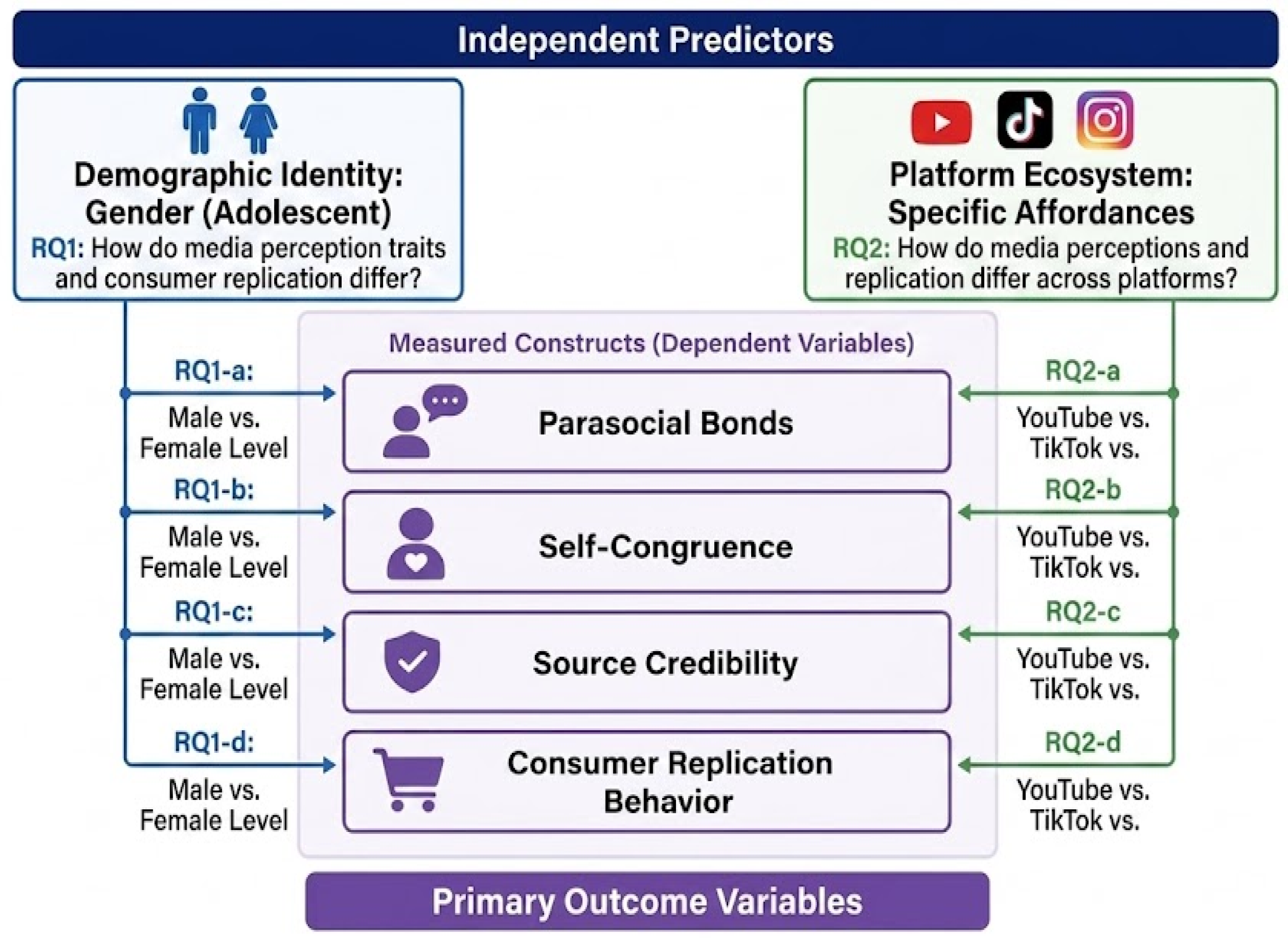
Research Question 1 (RQ1): How do media perception traits and consumer replication behavior differ according to the gender identity of adolescent consumers?
RQ1-a: Does the level of parasocial bonds differ significantly between male and female adolescents?
RQ1-b: Does the level of self-congruence differ significantly between male and female adolescents?
RQ1-c: Does the level of source credibility differ significantly between male and female adolescents?
RQ1-d: Does the level of consumer replication behavior differ significantly between male and female adolescents?
3.2. Research Questions on Platform-Specific Affordances and Ecosystems
Media ecology theory and platform affordance perspectives emphasize that a channel’s structural architecture actively shapes human cognitive processing and behavioral outputs (Meyrowitz 1986; Schreiber 2017). While YouTube’s long-form format is optimized for in-depth information and credibility (Xiao et al. 2018), Instagram’s curated visual grid stimulates stylized lifestyles (Kallio and Mäenpää 2025), and TikTok’s algorithmic short-form stream fosters real-time immediacy and parasocial oneness (Omar and Dequan 2020; Djafarova and Bowes 2021). To parse why and how these structural differences elicit divergent consumer imitation, the following questions are considered:
Research Question 2 (RQ2): How do adolescent media perception traits and consumer replication levels differ across primary social media platform ecosystems (YouTube, TikTok, and Instagram)?
RQ2-a: How does the level of parasocial bonds vary across users of different social media platforms?
RQ2-b: How does the level of self-congruence vary across users of different social media platforms?
RQ2-c: How does the perceived level of source credibility vary across users of different social media platforms?
RQ2-d: How does the level of consumer replication behavior vary across users of different social media platforms?
The proposed research model is illustrated in Figure 1.
Figure 1.
Research.
4. Empirical Methodology
4.1. Instrument Development and Operational Definitions
The empirical survey instruments utilized in this study were developed by modifying and adapting validated scales from prior literature to fit the specific context of social media platforms and influencer commerce ecosystems. Every measurement item constituting the latent constructs was evaluated using a 5-point Likert scale, ranging from Strongly Disagree (1) to Strongly Agree (5), to precisely capture the subjective responses of the participants (the complete measurement framework and operational scale items are detailed in Appendix A, Table A1). Since the primary objective of this study is focused on a multi-group comparative analysis rather than validating a structural causal model, the operational definitions of the core constructs were structured as follows:
Parasocial Bond: Operationally defined as the perceived emotional proximity and subjective sense of friendship developed between the adolescent audience and the influencer. This construct was evaluated using 5 items adapted from prior research (Rubin et al. 1985).
Self-Congruence: Defined as the cognitive synchronization level where an influencer’s online persona and lifestyle match the audience’s actual self-concept or idealized persona. This construct consisted of 4 items based on established frameworks (Byrne 1971; Sirgy 1982).
Source Credibility: Defined as the degree to which the audience trusts and relies upon the authenticity, expertise, and objectivity of product reviews or narratives provided by the influencer. This construct was measured using 5 items modified from existing scales (Ohanian 1990).
Consumer Replication: The primary behavioral outcome variable, operationally defined as the behavioral propensity of audiences to align entirely with the influencer’s choices by purchasing recommended products or mimicking their curated lifestyle portfolio. This construct comprised 5 items updated to reflect contemporary social commerce metrics (Kastanakis and Balabanis 2012; Sokolova and Kefi 2020).
4.2. Subjects and Data Collection Procedures
The target population for this study comprised adolescent consumers (specifically high school students) residing in the Jeonnam region. This cohort was selected due to their continuous exposure to social media influencer narratives and social commerce environments, making them highly receptive to contemporary Ditto consumption cultures. To ensure the precise recruitment of active and relevant social media users who aligned closely with the established research objectives, purposive sampling (a non-probability sampling technique) was systematically deployed. Data collection was rigorously conducted from March to May 2026, utilizing a synchronized dual approach of online and offline self-administered questionnaires.
To mathematically justify the adequacy of the sample size, a rigorous prior power analysis was performed utilizing the G*Power 3.1.9 program. For mean difference verifications across groups (independent-samples t-tests and one-way ANOVA), assuming a medium effect size (f) of 0.15, an alpha significance level (α) of 0.05, and a statistical power (β) of 0.80, the minimum required sample threshold was calculated to be approximately 100 participants. During the initial data cleaning phase, incoming responses with missing values, geometric patterns, or extreme central tendency biases indicative of unfaithful responses were thoroughly screened and purged.
A total of 405 questionnaires were initially collected. During the data screening phase, 3 unfaithful responses with extreme biases were purged. Consequently, a total of 402 valid and complete responses were retained for the final empirical analyses. Prior to filling out the instruments, all participants underwent a comprehensive voluntary informed consent procedure detailing the academic purpose of the study, complete anonymity guarantees, and strict data confidentiality protocols prohibiting any non-academic utilization.
Regarding the group sorting procedure, recognizing that contemporary adolescents frequently use multiple social media platforms simultaneously, participants were explicitly instructed to identify their single primary (most frequently used) platform for consuming influencer content, sports-related feeds, and lifestyle recommendations. This single-choice criterion ensured mutually exclusive classification across YouTube, Instagram, and TikTok user groups, allowing the study to isolate the dominant platform affordance shaping each participant’s psychological engagement. Although the TikTok group was smaller than the YouTube and Instagram groups, the sample size satisfied the minimum requirements for one-way ANOVA analysis. Nevertheless, the findings regarding TikTok users should be interpreted with caution when generalizing to the broader adolescent population.
The explicit distribution of the demographic attributes and baseline media platform ecosystem utilization profiles of the finalized adolescent cohort is detailed in Table 1.
Table 1.
Demographic characteristics of the participants.
According to the demographic baseline distributions, male students comprised 289 participants (71.9%), while female students accounted for 113 participants (28.1%). Regarding the primary media platform, YouTube had the highest proportion of users, with 200 users (49.8%), and was closely followed by Instagram, with 173 users (43.0%), and TikTok, as a distinct minority segment with 29 users (7.2%).
4.3. Data Analysis Strategy
To analyze the empirical data harvested from the high school student cohort, an integrated statistical analysis framework combining IBM SPSS Statistics (v.26.0) and customized Python (v.3.9) statistical modules was deployed. The strategic steps of the data analysis execution were executed as follows:
First, frequency analysis and descriptive statistical analysis were conducted to evaluate the general demographic distribution and baseline patterns of social media usage among the participants.
Second, to independently verify the multidimensional construct validity of the measurement instruments and confirm factor differentiation, an Exploratory Factor Analysis (EFA) was executed using Principal Component Analysis (PCA) with a Varimax orthogonal rotation framework. The underlying factorability and sample adequacy were evaluated using the Kaiser–Meyer–Olkin (KMO) measure and Bartlett’s test of sphericity, while the internal consistency reliability was rigorously verified by calculating Cronbach’s ɑ coefficients.
Third, Pearson bivariate correlation analysis was conducted to evaluate the linear associations among the main latent variables (parasocial bond, self-congruence, source credibility, and consumer replication) and preemptively establish discriminant independence.
Fourth, to empirically address the core research questions (RQ1 and RQ2) regarding audience segmentation, an independent-samples t-test was executed to evaluate the systematic-level disparities based on the adolescents’ gender identity (male vs. female). Furthermore, a one-way analysis of variance (ANOVA) was fully operationalized to investigate the empirical gaps and variations driven by the primary media platform ecosystems (YouTube, TikTok, and Instagram). Prior to the ANOVA execution, Levene’s test for homogeneity of variances was conducted to verify the underlying statistical assumptions of homoscedasticity. Because the assumption of equal variances was violated due to the unequal sample sizes across the platform groups, Welch’s robust ANOVA was adjusted, and the Games–Howell post-hoc test was systematically applied to track and confirm the precise patterns of superior or inferior mean differences.
5. Results
5.1. Construct Validity and Reliability Assessment
Prior to factor extraction, the suitability of the data for factor analysis was examined using the Kaiser–Meyer–Olkin (KMO) measure and Bartlett’s test of sphericity. The KMO value was 0.874, exceeding the recommended threshold of 0.70, indicating adequate sampling suitability. Bartlett’s test of sphericity was statistically significant (χ2 = 2458.316, df = 190, p < 0.001), confirming that the correlation matrix was appropriate for factor analysis. These results support the suitability of the dataset for evaluating construct validity and reliability. Subsequently, factor loadings, Cronbach’s α, Composite Reliability (CR), and Average Variance Extracted (AVE) were examined to assess the reliability and convergent validity of the measurement scales. The results are presented in Table 2.
Table 2.
Measurement model assessment results.
The results presented in Table 2 indicate that the factor loadings for all measurement items ranged from 0.712 to 0.880, exceeding the recommended threshold of 0.70. These findings suggest that all measurement items adequately represented their corresponding latent constructs and support the construct validity of the measurement model.
Furthermore, internal consistency reliability was assessed using Cronbach’s α and Composite Reliability (CR). The Cronbach’s α values ranged from 0.838 to 0.908, while the CR values ranged from 0.88 to 0.93, exceeding the recommended threshold of 0.70. In addition, the Average Variance Extracted (AVE) values ranged from 0.61 to 0.73, surpassing the recommended threshold of 0.50. Taken together, these results provide evidence of satisfactory reliability and convergent validity, supporting the suitability of the measurement model for subsequent group comparison analyses.
5.2. Descriptive Statistics of the Study Variables
Descriptive statistics were computed to evaluate the general baseline tendencies of the main constructs across the entire adolescent sample (N = 402). The summary is presented in Table 3.
Table 3.
Descriptive statistics of key constructs for total sample.
The baseline assessment revealed that adolescents’ perceptions of self-congruence (M = 2.459) and source credibility (M = 2.448) fell slightly below the moderate midpoint (3.0) of the 5-point Likert scale. Conversely, the levels of emotional attachment via parasocial bond (M = 2.260) and final behavioral alignment via consumer replication (M = 2.271) recorded the lowest average ranges. These baseline statistics imply that while adolescents actively engage with social media, they operate an internal cognitive defense mechanism against commercialized messaging, providing a justified foundation for exploring sub-group variations based on gender and platform ecosystems.
5.3. Bivariate Correlation Analysis and Discriminant Validity
To establish the linear associations and confirm discriminant validity among the core constructs, both the Fornell–Larcker criterion and the Heterotrait–Monotrait Ratio of Correlations (HTMT) were evaluated. Table 4 displays the integrated matrix combining these criteria alongside Pearson bivariate correlation coefficients.
Table 4.
Discriminant validity and correlation matrix (Fornell–Larcker and HTMT).
The empirical results indicated significant positive linear relationships among all paired constructs. Crucially, consumer replication exhibited its strongest linear correlation with source credibility (r = 0.754, p < 0.001). All bivariate correlation coefficients remained comfortably below the multicollinearity threshold of 0.80, indicating no multi-group collinearity issues.
Furthermore, discriminant validity was rigorously established through two conservative statistical approaches. First, according to the Fornell–Larcker criterion, the square root of the AVE for each latent variable (represented as the diagonal bold values) was found to be consistently greater than any corresponding bivariate correlation coefficients (r) in the adjacent rows and columns. Second, all computed HTMT ratios in the upper-diagonal matrix ranged from 0.698 to 0.791, strictly satisfying the most conservative academic threshold of less than 0.85. Taken together, these metrics conclusively confirm distinct discriminant validity and statistical independence among the four core constructs.
5.4. Gender-Based Disparities (Addressing RQ1)
An independent-samples t-test was conducted to verify whether systematic perceptual and behavioral gaps exist based on the gender identity of adolescents. The results are displayed in Table 5.
Table 5.
Independent-samples t-test results (gender).
The analysis revealed no statistically significant gender-driven differences regarding perceived source credibility (t = −1.897, p > 0.05). However, highly significant variations emerged for parasocial bond (t = −3.105, p < 0.01), self-congruence (t = −3.987, p < 0.001), and consumer replication (t = −3.316, p < 0.01), with female adolescents consistently demonstrating higher levels compared to their male counterparts. Consequently, the analysis for RQ1 confirmed significant gender-based differences across emotional and behavioral constructs, while rational credibility evaluations remained invariant.
5.5. Platform Ecosystem Differences (Addressing RQ2)
To examine the empirical gaps shaped by the architectural characteristics of audiences’ primary media channels, a one-way analysis of variance (ANOVA) was performed. Prior to the main analysis, Levene’s test was conducted to verify the homogeneity of variances. Since the assumption of homoscedasticity was violated due to the unequal sample sizes among platform groups (F = 4.12, p < 0.05), Welch’s robust ANOVA was operationalized, and the Games–Howell post-hoc test was strictly applied to track specific mean differences, as outlined in Table 6.
Table 6.
One-way ANOVA and post-hoc results (platforms).
Addressing RQ2, the one-way ANOVA revealed significant differences across all key variables depending on adolescents’ primary social media platform. Welch’s robust ANOVA and Games–Howell post-hoc tests indicated that TikTok users exhibited significantly higher mean scores in parasocial bond, self-congruence, source credibility, and consumer replication compared to Instagram users, and, in the case of consumer replication, compared to YouTube users.
Although TikTok users reported the highest mean values across several variables, the relatively small sample size of the TikTok group (n = 29) warrants caution in interpreting the robustness and generalizability of these differences. Future research should employ more balanced sampling across platform groups to further validate whether these patterns remain stable in larger and more representative datasets.
6. Discussion
This study investigated the specific empirical variations in modern adolescents’ media perceptions (parasocial bond, self-congruence, and source credibility) and behavioral imitation trends (consumer replication) shaped by their demographic identities (gender) and social media ecosystem choices (YouTube, TikTok, and Instagram). The nuanced insights extracted from the empirical validation of the 402 high school participants are discussed below.
First, addressing RQ1, the independent-samples t-test regarding gender identity revealed a compelling paradox: while male and female adolescents exhibited no baseline differences in aggregate platform watch time or financial resources (allowance levels), female adolescents drastically outpaced male adolescents in parasocial bond intensity, self-congruence synchronization, and actual consumer replication behavior.
Interestingly, no statistically significant gender difference emerged regarding source credibility (t = −1.897, p > 0.05). This introduces an important psychological paradox in adolescent media reception. It implies that both male and female adolescents employ similar cognitive, rational filters when evaluating whether an influencer is objectively believable. However, the final behavioral execution—consumer replication—is significantly higher in female adolescents. This divergence demonstrates that rational trust alone is not enough to trigger imitation. Instead, the transition to actual purchase is heavily governed by a warmer, affective bandwidth driven by parasocial bond and self-congruence, areas where female adolescents showed a markedly higher emotional susceptibility.
Crucially, this observed gender disparity in consumer replication likely reflects that male and female adolescents systematically follow different types and genres of influencers. Prior research suggests that male adolescents tend to follow performance- and skill-driven creators, such as gaming, competitive sports, and tech reviewers, where content consumption focuses on information or entertainment rather than immediate product imitation (Chen 2026; Schreiber 2017). Conversely, female adolescents more frequently engage with lifestyle, athleisure fashion, and aesthetic wellness creators whose content affords immediate behavioral emulation and wardrobe mirroring (Caliandro and Anselmi 2021; Kallio and Mäenpää 2025). Therefore, the higher consumer replication among females is driven not only by stronger emotional susceptibility but also by the actionable, easily replicable nature of the sports apparel and lifestyle products promoted in their preferred influencer feeds.
This finding aligns seamlessly with classical media psychology scholarship indicating that female audiences engage more actively and sensitively in relational reciprocity and virtual intimacy (parasocial bonding) with media personae than male audiences (Byrne 1971; Duffett 2017). Furthermore, the elevated self-congruence scores among female adolescents confirm that they do not treat influencer content merely as neutral commercial data; rather, they deploy it as a cognitive mirror to project their actual or idealized self-concepts (Kastanakis and Balabanis 2012; Ki and Kim 2019). Consequently, these heightened socio-psychological alignments directly drive behavioral conformity, explaining the distinct gender-driven fragmentation observed in Ditto consumption styles (Katz et al. 1973). Conversely, the lack of significant gender variation in source credibility implies that while cold, cognitive evaluations of an influencer’s objective expertise are uniform across genders, the actual behavioral execution of replication is catalyzed by a warmer, affective bandwidth driven by emotional bonding and identity synchronization (Eisend 2015).
Second, addressing RQ2, the one-way ANOVA across platform environments offers meaningful insights into the evolving dynamics of contemporary digital media ecosystems. Demographically, YouTube (49.8%) and Instagram (43.0%) remained the dominant platforms among the adolescent participants, accounting for more than 90% of the total sample. Nevertheless, TikTok users reported the highest mean scores across all major variables, including parasocial bonds, self-congruence, source credibility, and consumer replication behavior.
The Games–Howell post-hoc analyses revealed that TikTok users reported significantly higher levels of parasocial bonds, self-congruence, and source credibility than Instagram users. Furthermore, TikTok users demonstrated significantly higher consumer replication behavior than both YouTube and Instagram users. These findings suggest that platform environments may shape adolescents’ psychological engagement and behavioral responses in different ways.
As emphasized by media ecology theory and technological affordance perspectives (Caliandro and Anselmi 2021; Schreiber 2017), platform affordances and interface structures function as environmental conditions shaping cognition and behavior. Previous studies have suggested that YouTube’s long-form video environment facilitates detailed information processing and extended narrative engagement (Lim et al. 2017; Xiao et al. 2018), whereas Instagram’s highly visual and curated interface encourages self-presentation and idealized social comparison processes (Bandura 2001; Casaló et al. 2020). The affordance of visuality on Instagram constructs a stylized aesthetic space that, while visually appealing, may inadvertently maintain a perceptual boundary between users and creators (Kallio and Mäenpää 2025; Kim et al. 2022).
In contrast, TikTok’s ultra-short-form interface, combined with its precision recommendation algorithms and full-screen vertical looping affordance, delivers high-density audiovisual stimuli that foster intense perceptions of immediacy, raw authenticity, and creator accessibility (Chen 2026; Djafarova and Bowes 2021; Omar and Dequan 2020). This unique technical architecture allows audiences to co-experience a creator’s unedited daily routine in real time, shifting the perception of the creator from an aspirational celebrity to an intimate, peer-like companion and thereby accelerating the impulse for consumer replication.
Although TikTok users reported the highest mean values across several variables, the relatively small sample size of the TikTok group (n = 29) warrants caution when generalizing these findings. Therefore, the present results should not be interpreted as definitive evidence of platform superiority. Rather, they demonstrate that different platform environments cultivate distinct forms of psychological engagement that structure adolescents’ perceptions and Ditto consumption behaviors. Future studies employing larger and more balanced platform samples are necessary to further examine these relationships.
7. Conclusions
7.1. Theoretical Contributions
This study was conducted to empirically investigate the specific variations in adolescent consumers’ media perceptions and behavioral conformity trends based on their gender identities and primary social media platform channel selections (YouTube, TikTok, and Instagram). The core theoretical contributions derived from the empirical findings are summarized as follows.
First, this study addressed a critical limitation in the contemporary social media marketing and influencer commerce literature, which has predominantly aggregated audiences into a single, uniform collective to test linear, macro-level structural equation models. By shifting the analytical focus toward demographically and ecologically fragmented spaces, this study documents the actual variation boundaries driven by audiences’ gender identities and platform ecosystem formats. Consequently, it expands the theoretical horizons of digital consumer psychology through a nuanced audience segmentation perspective.
Second, this study successfully integrates and extends the foundational paradigms of media ecology theory and technological affordances to the contemporary landscape of short-form video commerce and adolescent Ditto consumption trends. By demonstrating that platform-specific architectures—specifically YouTube’s long-form narrative style, Instagram’s curated visual grids, and TikTok’s ultra-short-form video interface—actively reshape the intensity of audiences’ parasocial bonds and self-congruence perceptions, this study provides empirical evidence of how digital environments fundamentally alter human cognitive processing and economic behavior.
7.2. Managerial Implications
The empirical findings documented in this study offer highly actionable strategic insights for the rapidly evolving digital commerce and sports marketing landscape.
First, brands and sports marketers targeting adolescents must transition their social media marketing frameworks away from quantitative, traffic-heavy indicators toward a qualitative, engagement-driven focus. Brand managers frequently over-allocate promotional budgets to mainstream giants like YouTube or Instagram due to their massive follower counts or total watch time metrics. However, this study demonstrates that despite capturing a lower market share of total watch time, the short-form ecosystem of TikTok exhibits superior efficiency and return on investment in cultivating the psychological closeness and identity alignment needed to trigger consumer replication behavior. Thus, when the primary objective is to drive rapid trend adoption or behavioral imitation in sportswear, athletic footwear, and active lifestyle items, allocating marketing resources to short-form, creator-centric commerce is highly advantageous.
Second, digital campaigns must design gender-specific targeting configurations that match the distinct processing styles of male and female adolescents. The psychological mechanisms that convert influencer content into actual purchases differ fundamentally by gender. Female adolescents are highly responsive to relationship-driven communication and value alignment, making them active participants in affective Ditto consumption cultures. Consequently, campaigns targeting female youth for athleisure, wellness, and fitness apparel should bypass rigidly structured advertisements in favor of organic, highly interactive narratives where influencers share authentic daily routines to foster communal trust. Conversely, since male adolescents report a lower baseline propensity for affect-driven consumer replication—often following skill- or performance-oriented sports and tech creators—campaigns targeting this segment should prioritize objective product data, performance metrics, athletic specifications, and specialized facts over emotional parasocial appeals.
7.3. Limitations and Future Research
Despite its empirical contributions, the limitations of this study and suggested directions for future research are outlined below:
First, because the data collection for this study was restricted to a specific geographical area (the Jeonnam region), caution should be exercised when generalizing these findings to the broader national adolescent population or across adjacent generational cohorts (e.g., Generation Z, Generation Alpha, or Millennials). Future studies should expand the geographical sampling scope nationwide and incorporate multi-group analyses across broader age brackets to track platform variation dynamics longitudinally.
Second, the distribution of primary media channels among the participants was heavily skewed toward YouTube (49.8%) and Instagram (43.0%), leaving the TikTok segment (7.2%, n = 29) relatively small. Although the TikTok sample met the minimum statistical requirements for conducting ANOVA, caution should be exercised when interpreting and generalizing the platform comparison results. Future research should employ more balanced sampling strategies across platform groups, particularly among users of short-form video platforms, to enhance the robustness and generalizability of the findings.
Third, this study relied entirely on a structured quantitative survey design, which inherently limits the depth with which adolescents’ nuanced, authentic lived experiences and qualitative “voices” can be unpacked. Future inquiries should adopt mixed-method frameworks—incorporating qualitative approaches such as focus group interviews (FGIs), in-depth interviews, or digital ethnography—to provide richer contextual narratives explaining why and how youth interact with specific platform affordances and sports influencers.
Fourth, because the survey data relied on respondents’ subjective, self-reported recollections, the potential for recall bias or variance from actual behavioral indices cannot be entirely ruled out. Future research should integrate self-reported survey data with objective digital behavioral indicators, such as click-through rates (CTRs), platform engagement metrics, and conversion tracking data, to provide a more comprehensive understanding of adolescent consumer behavior in social media environments.
Funding
This research received no external funding.
Institutional Review Board Statement
According to Article 13 of the Enforcement Regulations of the Bioethics and Safety Act and Enforcement Decree No. 2021-331 of the Ministry of Health and Welfare (MOHW) of South Korea, non-invasive, anonymous survey-based research that does not collect any personally identifiable information qualifies for an Institutional Review Board (IRB) review exemption. Therefore, formal IRB approval was not required for this specific study type under local legislation. If required, we can also provide a written confirmation/attestation from the participating teachers to verify the field process.
Informed Consent Statement
Informed consent was obtained from all subjects involved in this study.
Data Availability Statement
The data presented in this study are available upon request from the corresponding author due to privacy and ethical restrictions regarding the adolescent cohort participants.
Acknowledgments
During the preparation of this manuscript, the author used Gemini 1.5 Pro (Google) for the purposes of language polishing, statistical rigor refinement, and reference indexing cross-checks. The author has thoroughly reviewed and edited the output and takes full responsibility for the final content of this publication.
Conflicts of Interest
The author declares no conflicts of interest.
Abbreviations
The following abbreviations are used in this manuscript:
| ANOVA | Analysis of Variance |
| RQ | Research Question |
| EFA | Exploratory Factor Analysis |
| PCA | Principal Component Analysis |
| KMO | Kaiser–Meyer–Olkin |
| CR | Composite Reliability |
| AVE | Average Variance Extracted |
| HTMT | Heterotrait–Monotrait Ratio of Correlations |
| SD | Standard Deviation |
| ROI | Return on Investment |
Appendix A. List of Constructs and Measurements
Table A1.
Measurement Framework and Operational Scale Items.
References
- Appel, Gil, Lauren Grewal, Rhonda Hadi, and Andrew T. Stephen. 2020. The future of social media in marketing. Journal of the Academy of Marketing Science 48: 79–95. [Google Scholar] [CrossRef] [Scilit]
- Audrezet, Alice, Gwarlann de Kerviler, and Julie Guidry Moulard. 2020. Authenticity under threat: When social media influencers need to go beyond self-presentation. Journal of Business Research 117: 557–69. [Google Scholar] [CrossRef] [Scilit]
- Bandura, Albert. 2001. Social cognitive theory of mass communication. Media Psychology 3: 265–99. [Google Scholar] [CrossRef] [Scilit]
- Belk, Russell W. 2013. Extended self in a digital world. Journal of Consumer Research 40: 477–500. [Google Scholar] [CrossRef] [Scilit]
- Byrne, Donn E. 1971. The Attraction Paradigm. New York: Academic Press, vol. 11. [Google Scholar]
- Caliandro, Alessandro, and Guido Anselmi. 2021. Affordances-based brand relations: An inquire on memetic brands on Instagram. Social Media + Society 7: 20563051211021367. [Google Scholar] [CrossRef] [Scilit]
- Casaló, Luis V., Carlos Flavián, and Sergio Ibáñez-Sánchez. 2020. Influencers on Instagram: Antecedents and consequences of opinion leadership. Journal of Business Research 117: 510–19. [Google Scholar] [CrossRef] [Scilit]
- Chae, Jiyoung. 2018. Explaining Instagram use: The roles of self-reassessment, envy, and self-esteem in social comparison flow. Computers in Human Behavior 84: 286–93. [Google Scholar]
- Chen, Chih-Ping. 2026. Beyond credibility in Korean beauty influencer persuasion: Reframing influencer endorsements through a dual lens of the communication-persuasion matrix and parasocial interaction. Qualitative Market Research: An International Journal, 1–25. [Google Scholar] [CrossRef] [Scilit]
- De Veirman, Marijke, Veroline Cauberghe, and Liselot Hudders. 2017. Marketing through Instagram influencers: The impact of number of followers and product type on source credibility. International Journal of Advertising 36: 798–828. [Google Scholar]
- Djafarova, Elmira, and Tamar Bowes. 2021. ‘Instagram made me buy it’: Generation Z consumer attitudes towards celebrity vs. micro-influencer credentials. Journal of Retailing and Consumer Services 58: 102290. [Google Scholar]
- Duffett, Rodney Graeme. 2017. Influence of social media marketing communications on young consumers’ attitudes. New Media & Society 19: 19–35. [Google Scholar] [CrossRef] [Scilit]
- Eisend, M. 2015. Source credibility and advertising effectiveness: A meta-analysis. International Journal of Advertising 34: 441–68. [Google Scholar]
- Gottfried, Jeffrey, and Elisa Shearer. 2016. News use across social media platforms 2016. Pew Research Center 26: 1–17. [Google Scholar]
- Haenlein, Michael, Ertan Anadol, Tyler Farnsworth, Harry Hugo, Jess Hunichen, and Diana Welte. 2020. Navigating the New Era of Influencer Marketing: How to be Successful on TikTok, Instagram, and YouTube. California Management Review 63: 5–25. [Google Scholar] [CrossRef] [Scilit]
- Kallio, Saara-Maija, and Jenni Mäenpää. 2025. Visuality as an affordance on Instagram news production. Digital Journalism 14: 1015–33. [Google Scholar] [CrossRef] [Scilit]
- Kastanakis, Minas N., and George Balabanis. 2012. Between the mass and the class: Antecedents of the “bandwagon” luxury consumption behavior. Journal of Business Research 65: 1399–407. [Google Scholar] [CrossRef] [Scilit]
- Katz, Elihu, Jay G. Blumler, and Michael Gurevitch. 1973. Uses and gratifications research. The Public Opinion Quarterly 37: 509–23. [Google Scholar] [CrossRef] [Scilit]
- Ki, Chung-Wha ‘Chloe, and Youn-Kyung Kim. 2019. The mechanism by which social media influencers persuade consumers: The role of consumers’ desire to mimic. Journal of Consumer Behaviour 18: 90–102. [Google Scholar]
- Kim, Dong Hoo, So Young Lee, Yoon Hi Sung, and Nam-Hyun Um. 2022. Free tumbler in Snapchat vs coffee tasting ticket in Instagram: The impact of gift type and message type on B2C gift-giving on different social media platforms. European Journal of Marketing 56: 2217–41. [Google Scholar] [CrossRef] [Scilit]
- Kim, Nando, Miyoung Jeon, Ji-Hye Choi, Soojin Lee, Jeong-Yun Kwon, Dahye Han, Joonyoung Lee, Hyang-eun Lee, Hye-won Lee, Yerin Chu, and et al. 2023. Trend Korea 2024. Seoul: Miraebook. [Google Scholar]
- Lim, Xin Jean, Aifa Rozaini Bt Mohd Radzol, Jun-Hwa (Jacky) Cheah, and Mun Wai Wong. 2017. The impact of social media influencers on purchase intention and the mediation effect of customer attitude. Asian Journal of Business Research 7: 19–36. [Google Scholar] [CrossRef] [Scilit]
- Lou, Chen, and Shupei Yuan. 2019. Influencer marketing: How message value and credibility affect consumer trust of branded content on social media. Journal of Interactive Advertising 19: 58–73. [Google Scholar] [CrossRef] [Scilit]
- Meyrowitz, Joshua. 1986. No Sense of Place: The Impact of Electronic Media on Social Behavior. Oxford: Oxford University Press. [Google Scholar]
- Ohanian, Roobina. 1990. Construction and validation of a scale to measure celebrity endorsers’ perceived expertise, trustworthiness, and attractiveness. Journal of Advertising 19: 39–52. [Google Scholar] [CrossRef] [Scilit]
- Omar, Bahiyah, and Wang Dequan. 2020. Watch, share or create: The influence of personality traits and user motivation on TikTok mobile video usage. International Journal of Interactive Communication Systems and Technologies 14: 121–37. [Google Scholar] [CrossRef] [Scilit]
- Rubin, Alan M., Elizabeth M. Perse, and Robert A. Powell. 1985. Loneliness, parasocial interaction, and local television news viewing. Human Communication Research 12: 155–80. [Google Scholar] [CrossRef] [Scilit]
- Schouten, Alexander P., Loes Janssen, and Maegan Verspaget. 2020. Celebrity can’t buy it: Effect of celebrity endorser versus influencer endorsement on brand attitude and purchase intention. Journal of Marketing Communications 26: 268–84. [Google Scholar]
- Schreiber, Maria. 2017. Audiences, aesthetics and affordances: Analysing practices of visual communication on social media. In Routledge Handbook of Media Use and Reception. London: Routledge, pp. 143–55. [Google Scholar]
- Sirgy, M. Joseph. 1982. Self-concept in consumer behavior: A critical review. Journal of Consumer Research 9: 287–300. [Google Scholar] [CrossRef] [Scilit]
- Sokolova, Karina, and Hajer Kefi. 2020. Instagram and YouTube bloggers promote it, why should I buy? How credibility and parasocial interaction influence purchase intentions. Journal of Retailing and Consumer Services 53: 101742. [Google Scholar] [CrossRef] [Scilit]
- Xiao, Min, Rang Wang, and Sylvia Chan-Olmsted. 2018. Factors affecting YouTube influencer marketing credibility: A heuristic-systematic model. Journal of Media Business Studies 15: 188–213. [Google Scholar] [CrossRef] [Scilit]

Disclaimer/Publisher’s Note: The statements, opinions and data contained in all publications are solely those of the individual author(s) and contributor(s) and not of MDPI and/or the editor(s). MDPI and/or the editor(s) disclaim responsibility for any injury to people or property resulting from any ideas, methods, instructions or products referred to in the content. |
© 2026 by the author. Licensee MDPI, Basel, Switzerland. This article is an open access article distributed under the terms and conditions of the Creative Commons Attribution (CC BY) license.