


Abstract
Affective and Sexual Education (ASE) is becoming prominent in the educational field. The objective was to investigate teachers’ training in ASE, its practical application, and its impact on students’ psychosocial well-being. To this end, a qualitative study was conducted using inductive content analysis. Through convenience sampling, 11 teachers from Spain participated, completing an open-ended questionnaire via Google Forms. The data were analyzed using thematic coding in Atlas.ti 9. The results are organized into two themes (Teacher Competence and Pedagogical Practice, and Psychosocial Impact and School Climate), subdivided into four subthemes (Teacher Training in ASE, Teaching Practice in ASE, Psychosocial Aspects and ASE, and School Climate and ASE). The findings regarding teacher training needs and the positive impact on students’ holistic development and the school climate are discussed. The need for a collaborative approach with families and the structural and social barriers to its implementation are highlighted.
1. Introduction
Initial and continuing professional development in ASE significantly influences both daily classroom practice and students’ psychosocial development (Guzmán Mora 2026). Strengthening the synergy between teacher training and psychosocial outcomes is therefore essential. The current educational system often prioritizes homogeneity, a structural factor that may inadvertently hinder students’ holistic development (Gómez-Gómez 2023).
Addressing these gaps is vital for transforming school community life. Adolescents increasingly demand comprehensive education that respects classroom diversity, fosters self-awareness, and provides tools for establishing healthy interpersonal boundaries (Mañas and González 2022).
Defining ASE is a necessary starting point. The International Planned Parenthood Federation (2006) characterizes ASE as a model for sexuality and relationship education tailored to the developmental stages and cultural contexts of students. It emphasizes the provision of objective, scientifically rigorous information. The United Nations Educational, Scientific and Cultural Organization (2010) expanded this definition, asserting that such education empowers individuals to critically examine personal attitudes, develop communication skills, and mitigate health risks. The World Health Organization (World Health Organization 2023) reinforces that this learning process should begin at age five, as it remains a shared responsibility among educators, families, and healthcare professionals.
However, implementing these international guidelines within the Spanish context faces structural and ideological hurdles. Current legislation (LOMLOE, 2020) mandates the integration of ASE as a cross-curricular component alongside emotional and health education, aligning with the 2030 Agenda’s Sustainable Development Goals (SDGs). These goals underscore shared priorities such as gender equality, public health, and human rights. Mañas and González (2022) note that ASE directly supports SDGs 3, 4, and 5, which focus on healthy lives, inclusive education, and gender equality (Spanish Network of the Global Compact n.d.). Despite this legal framework, Spain lacks a dedicated ASE curriculum. Implementation is frequently left to the discretion of individual teachers or autonomous communities, often relegating the subject to secondary education and neglecting its affective and relational dimensions (Díaz-Tejerina et al. 2024; Fedele et al. 2025; García-Vázquez et al. 2024; Seiler-Ramadas et al. 2021).
Existing literature reveals a critical deficit regarding faculty attitudes toward affective-sexual diversity. Sexist prejudices and homonegativity persist among both in-service teachers and undergraduate students (Lara-Garrido et al. 2022; González et al. 2024; Robinson and Ferfolja 2002). Furthermore, research consistently highlights significant training gaps in both terminology and methodology, which complicate the integration of ASE into school projects (Díaz-Tejerina et al. 2024; Fernández Hawrylak et al. 2022). Gender-based discrepancies regarding the appropriate age to introduce this content further underscore the need for standardized training (Díaz-Tejerina et al. 2024).
Mañas Olmo et al. (2023) observe that while families and educators recognize the necessity of ASE training, they often disagree on responsibility and coordination. Collaborative frameworks involving the educational community, families, and external support services—such as social and health care providers—are essential to bridge these gaps (Perez Rubiano and Fuentes Doria 2023).
Scholarly suggestions for improvement are often grounded in practical experience. Fernández Hawrylak et al. (2022) argued for the establishment of protocols to foster inclusion, while Díaz-Tejerina et al. (2024) advocated for Social and Emotional Learning (SEL) courses as accessible alternatives to regional programs. ASE curricula are recognized for their potential to improve health outcomes, cultivate respectful school environments, and eradicate violence. Ultimately, González et al. (2024) emphasized the urgency of reforming initial teacher education to integrate affective-sexual, bodily, and gender diversity, thereby ensuring safe, non-discriminatory environments for future generations.
Despite these proposals, a research gap persists regarding how active teachers perceive the direct impact of their training—or lack thereof—on students’ psychosocial progress. Previous studies have primarily identified training deficiencies or negative attitudes, yet few have linked daily practice to the holistic benefits of ASE. This study addresses this gap by offering an integrated analysis that connects teachers’ self-perceived competencies, curricular realities, and the psychosocial impact of their pedagogical practice.
The general objective of this study is to gather information regarding teacher training in ASE, its classroom application, and teachers’ perceptions of its impact on psychosocial development and school community life. Specific objectives include: (a) identifying teachers’ training and self-perceived competencies; (b) describing the current integration of ASE into the curriculum; (c) detailing the link between ASE and students’ psychosocial factors; (d) comparing the role of ASE as a preventive tool for school coexistence; and (e) identifying implementation barriers and training needs. These objectives provide the basis for the following research questions: How do teachers perceive their training and their ability to implement ASE? How do they believe ASE impacts students’ psychosocial development and school community life?
2. Materials and Methods
2.1. Design
This study utilized a qualitative approach to examine teacher training in ASE within Spain. A qualitative content analysis design was adopted, as it provides a robust framework for drawing inferences from textual data and identifying underlying thematic patterns (Weber 1990; Hecker and Kalpokas n.d.). This methodology facilitates the systematic organization and categorization of data, thereby elucidating teachers’ perceptions and emerging conceptual themes. Furthermore, compared to ethnographic or observational approaches, content analysis via open-ended questionnaires is less intrusive. By requiring no direct intervention within the participants’ professional environments, this design fosters a more candid and uninhibited expression of their personal experiences (Hecker and Kalpokas n.d.).
2.2. Participants
Data collection was conducted in the province of Almería and the Region of Murcia, Spain. This geographic selection was purposeful, as teachers from different universities possess varied backgrounds in initial teacher education. Furthermore, the significant variations between these two regions regarding curricular specifications, institutional projects, and continuing education programs are fundamental to understanding the landscape of ASE training.
The sample comprised 11 teachers selected via convenience sampling, accounting for diversity in professional experience, educational stages, and school types. Although the sample size is modest, it is well-suited for a qualitative design centered on open-ended inquiries, as it prioritizes interpretive richness and discursive depth (Tracy 2021). Participants were recruited through the researchers’ professional networks, with initial contacts facilitating access to the final sample. To maintain research integrity, investigators ensured they held no direct professional or personal affiliations with the participants.
Regarding the sample, 9.1% (n = 1) were male (mean age 33 years), and 90.9% (n = 10) were female (mean age 30.4 years), with a total mean age of 30.63 years (range 24–33). Regarding experience, 54.5% (n = 6) reported 1 to 5 years, 27.3% (n = 3) reported less than 1 year, and 18.2% (n = 2) reported 6 to 10 years. Regarding educational level, 45.5% (n = 5) taught in primary school, 36.4% (n = 4) in preschool, and 18.2% (n = 2) in secondary school. Finally, 54.5% (n = 6) worked at public schools, and 45.5% (n = 5) at subsidized schools (Table 1).
Table 1.
Sample Characteristics.
2.3. Data Collection
Data were collected using an open-ended questionnaire administered to teachers across preschool, primary, and secondary education levels. The instrument aimed to elicit detailed information regarding their training, professional experience, perceptions, and the challenges they encounter in implementing ASE. Due to the professional and personal constraints of the participants, Google Forms was utilized as a practical alternative to face-to-face interviews. Data collection was conducted between December 2025 and January 2026.
The research adhered to ethical standards approved by the Bioethics Committee of the University of Almería (Reference: UALBIO2025/038). Prior to completing the questionnaire, participants were required to review and accept the terms of the study on a dedicated landing page, which ensured that participation remained voluntary, anonymous, and strictly confidential.
The questionnaire was designed to address the training received—both initial and ongoing—on ASE and how participants apply it in the classroom. In addition, questions were posed focusing on the relationship between ASE and the well-being of the student body and school life. The questions are structured around the following key themes: (a) personal assessment of ASE in the curriculum of the educational stage; (b) main challenges or barriers preventing the implementation of ASE; (c) initial and ongoing training, useful content and tools, as well as their implementation in daily practice; (d) difficulties and challenges with students; (e) disruptive experiences resulting from the absence or lack of ASE in the school; and (f) the role of the family within the framework of ASE.
2.4. Data Analysis
Data processing began with an immersion phase that involved a general reading, followed by coding and analysis using the qualitative software Atlas.ti 9. This processing was carried out in accordance with the stages outlined by Miles and Huberman (1984) and Rodríguez Sabiote et al. (2005), with particular emphasis on the analytical stage, which consisted of data reduction, organization, transformation, and content formulation and verification.
The coding process followed an inductive approach, as categories and codes emerged directly from the data, facilitating the identification of core concepts and their interrelations. Data saturation was achieved through a comparative analysis of educational stages, work contexts, and teacher involvement profiles; by the ninth participant, patterns and challenges consistently recurred, and no further categories or dimensions emerged within the Atlas.ti 9 software.
To ensure research rigor, consensus and consistency were established through a three-step validation process. First, the two principal investigators conducted a comparative analysis and data triangulation by cross-referencing new codes with those previously identified. Subsequently, a third researcher reviewed the consistency of the codes, categories, and themes to resolve any discrepancies. Finally, member checking was performed; preliminary findings were shared with the participants to confirm that the researchers’ interpretations accurately reflected their professional realities and experiences.
To ensure scientific rigor and quality, the research design, analysis, and reporting adhered to the Consolidated Criteria for Reporting Qualitative Research (COREQ; Tong et al. 2007). Specifically, the study addressed methodological and theoretical orientation (Item 9), sampling strategy (Item 10), and sample description (Item 16). Furthermore, the instrument was validated through a standardized question guide (Item 17), the assessment of data saturation (Item 22), and transcript verification (Item 23). The analysis and presentation of results strictly conformed to COREQ guidelines (Items 24–28 and 29–32, respectively).
The robustness of the interpretations was further grounded in two established methodological frameworks. First, the criteria of reliability, replicability, and validity proposed by Goetz and LeCompte (1988) were applied. Second, the study incorporated the principles of credibility, applicability, consistency, and neutrality as defined by Guba and Lincoln (1981) and Erickson (1989) for qualitative inquiry.
3. Results
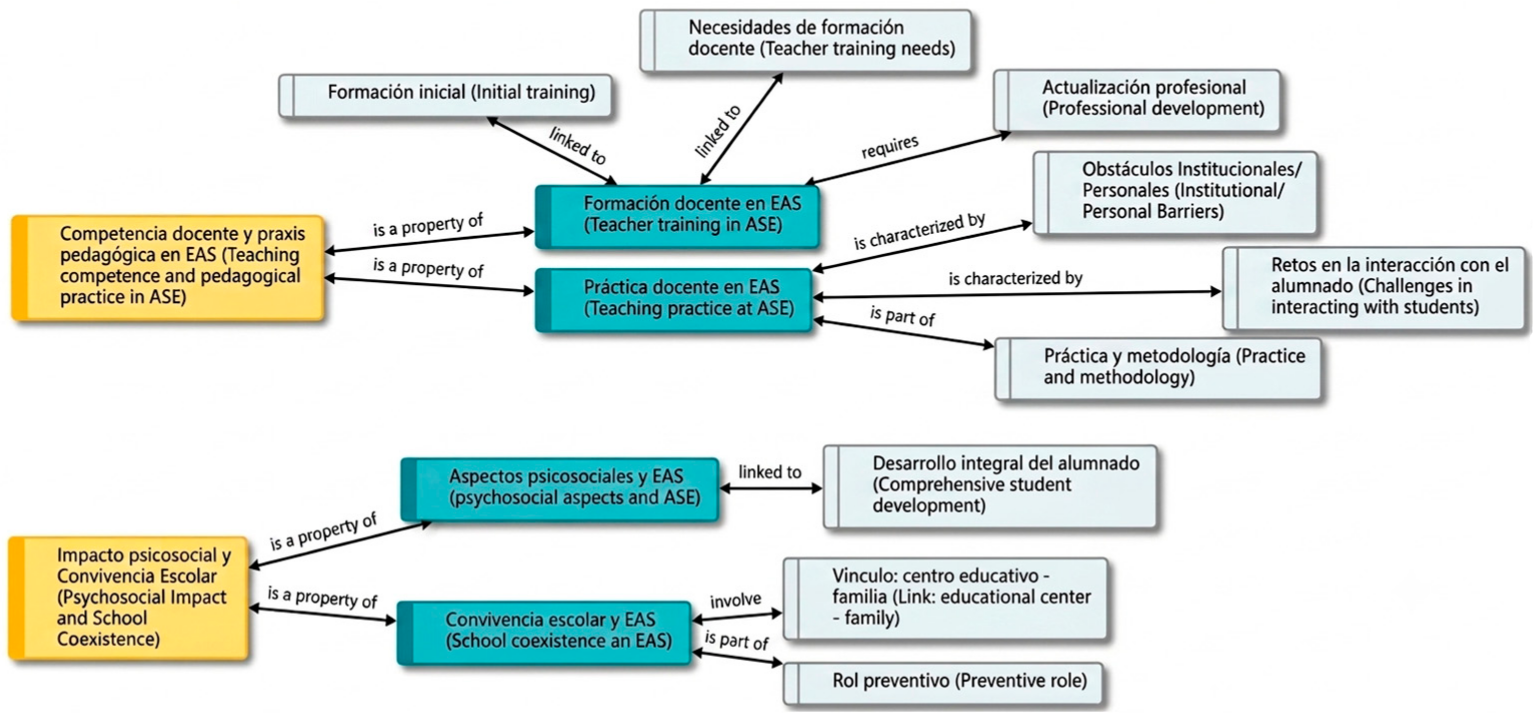
To visualize the conceptual structure of the findings, Table 2 and Figure 1 present the network of nodes generated using Atlas.ti 9 (Figure 1). Both resources include the themes and categories and their respective codes—which emerged and were identified following the coding process—providing an overview of the relationships among the analyzed themes. In Table 2, the frequency of themes is presented for descriptive purposes only. As can be seen, two main themes were identified (Teacher Competence and Pedagogical Practice in ASE and Psychosocial Impact and School Coexistence), which are broken down into four categories or subthemes: Teacher Training in ASE, Teaching Practice in ASE, Psychosocial Aspects and ASE, and School Coexistence and ASE.
Table 2.
Themes, Categories, Codes, and Associated Coding Percentages.
Figure 1.
Emerging categories and codes. Note. Network of nodes including the themes, categories, and their respective codes, in Spanish and English.
3.1. Teacher Competence and Pedagogical Practice in ASE
This section integrates the categories of Teacher Training and Pedagogical Practice concerning ASE. The former examines initial education, professional development, and identified training needs, while the latter analyzes current pedagogical practice, accounting for institutional obstacles, student-related challenges, and the methodological approaches employed in the classroom.
3.1.1. Teacher Training in ASE
Regarding initial and specific training for teachers in ASE, 90.9% (n = 10) reported not having received any training, while 9.1% (n = 1) did. In this regard, the tenth participant stated that the training was provided as part of the master’s program through content:
Related to violence and harassment/bullying—covering various motives, characteristics, consequences, profiles, etc.(P10)
This result is linked to their personal assessment of Affective and Sexual Education in the curriculum of the educational stage in which they work. 36.4% (n = 4) consider it to be of little relevance, and 9.1% (n = 1) consider it to be of no relevance at all. In contrast, 27.3% (n = 3) state that it is quite relevant, 9.1% (n = 1) specify that it is somewhat relevant, and 18.2% (n = 2) indicate that it is very relevant.
Therefore, regarding ongoing training on ASE, 72.7% (n = 8) of the teaching staff indicated that they had not received any training. Meanwhile, 27.3% (n = 3) indicated that they had received such training. The continuing education received has focused on aspects of coeducation (P7, P11) and, according to P10, on:
Theoretical content on equality, sexism, violence, and cyberbullying, as well as homophobic bullying. Notable topics include concepts, definitions, data and statistics on cases, educational resources, protocols, and projects…(P10)
Acknowledging these training gaps, participants identified specific professional development needs tailored to their respective educational stages:
In secondary education, the emphasis lies in managing disruptive behaviors to maintain a harmonious school environment. Somes participants highlighted the necessity for: “strategies to prevent, detect, and intervene in conflicts, such as sexual harassment, gender-based violence, and homophobia,” (P2) as well as “fostering self-awareness and empathy through the simulation of real-life scenarios” (P3).
From the perspective of elementary education, the focus shifts toward anatomy, development, and personal safety. There is a demand for training on:
Setting personal boundaries, understanding bodily autonomy, and valuing relationships with peers and family.(P5)
Furthermore, educators expressed a need for tools to support students through their:
Psychological, social, and physiological transitions, helping them mitigate risks such as low self-esteem, anxiety, and confusion.(P6)
These requirements are complemented by a need for training on “gender, emotional management, and equality” (P8, P9).
In early childhood education, teachers prioritize emotional development and family engagement. The fourth and seventh participants identified a need for training in “emotional support, affective-sexual development, and respect for one’s own body,” (P4) combined with “pedagogical strategies for conflict prevention, student guidance, and parent collaboration” (P7). Additionally, a participant emphasized the importance of training to “identify early signs of bullying among young children” (P11).
Overall, the findings reveal a widespread lack of conceptual and methodological clarity regarding the dimensions and benefits of ASE. The tenth participant summarized the requirements for a comprehensive training program as follows:
Defining ASE, its core dimensions, and its benefits for students; developing implementation strategies adapted to different educational stages (early childhood, elementary, and secondary); and learning to manage this education effectively in collaboration with families, faculty, and students.(P10)
3.1.2. Teaching Practices in ASE
Regarding the frequency with which they incorporate ASE content into their classes, 63.6% (n = 7) indicate that they do so rarely. Meanwhile, 18.2% (n = 2) report doing so a few times a month, and 18.2% (n = 2) indicate that they never do so. Regarding this application and integration of ASE into the daily routine of schools by teachers, some participants state that “I have not carried out any projects” (P3, P11) or “any activities” (P6, P9).
In practice, ASE is reduced to specific, one-off interventions in response to unforeseen incidents. A participant explains that she only addresses it:
When a conflict arises in the classroom related to the topic, and I do so through a conversation with the students, where I try to help them understand the context of the situation.(P5)
Similarly, the second participant report, having held a:
Discussion with two students, on two separate occasions, about respect, boundaries, and not invading others’ personal space.(P2)
Other occasional approaches are limited to “celebrating special occasions” (P4), conducting “an emotions management workshop with an external psychologist” (P8), or addressing topics related to “the human body, through its different parts” (P1) or “through stories and conversations” (P7). One exception is observed in P10’s classroom, where the teacher draws on their training to implement and integrate these approaches on an ongoing basis:
Throughout the school year, I have an “emotions corner” in the classroom where students can go whenever they need to, to self-regulate and manage their emotions. In this corner, there are cushions, a sensory bottle, storybooks, a pop-it toy, a stress ball… as well as a keychain with relaxation techniques.(P10)
Regarding teachers’ perceptions of the absence or lack of ASE at their school and the emergence of psychosocial problems, 45.5% (n = 5) stated that there is a connection, to some extent. In contrast, 36.4% (n = 4) have not observed such a connection, and 18.2% (n = 2) are unsure whether to confirm these occurrences.
This lack of integration is attributed to institutional and personal obstacles. Teachers consistently identify three barriers: a lack of time in the curriculum (P1, P3, P4, P8), a shortage of teaching resources (P1, P5, P11), and resistance from families (P2, P6, P9, P11). Added to this are the teachers’ own attitudinal limitations, associated with “personal discomfort” (P11) and the existence of “many taboos surrounding the topic” (P5). A participant summarizes the situation by noting that ASE “continues to be undervalued, and its implementation in schools is complex” (P10).
In addition to these institutional and personal obstacles are the challenges teachers must face in their interactions with students. According to some participants, these challenges stem from a “lack of maturity regarding ASE” (P1, P4, P11). In the classroom, this immaturity manifests itself through “laughter” (P3, P8) and “inappropriate comments” (P7), sometimes resulting in a combination of both factors along with “silence or passivity” (P2, P5, P6, P9, and P10).
3.2. Psychosocial Impact and School Climate
This section examines the psychosocial dimensions and the role of the school community in ASE, exploring the intersection of ASE with holistic student development, proactive preventive measures, and the synergy between schools and families.
3.2.1. Psychosocial Aspects and ASE
In the social sphere, teachers agree that ASE contributes to and supports students’ emotional and social development—that is, their holistic development (P5, P10). When exploring the social-emotional benefits, most respondents emphasize that this subject fosters the development of empathy. Likewise, a positive impact is identified on the development of self-concept, self-awareness, self-esteem, mutual respect, and emotion regulation (P3, P4, P6, P7, P9, P11).
A participant maintains that ASE facilitates “awareness of one’s own body and respect for others’ bodies, tolerance, norms, and boundaries” (P2). Similarly, the seventh participant argues that this subject helps students “get to know themselves, respect themselves, and communicate in a healthy way” (P7), which in turn “promotes social relationships based on respect, equality, and decision-making.” According to the tenth participant, these skills foster a “positive educational environment free of prejudice and conflict” (P10).
The characteristics of the cultural context and the students’ age also influence this perception. In elementary school, the eighth participant emphasizes the fragility of self-esteem at these ages, noting that ASE:
Helps students continue to build their identity and open their minds, since sometimes, due to cultural factors, certain topics are off-limits.(P8)
For this reason, it is emphasized that any intervention must be “coherent” and “continuous” (P7), requiring teachers to first understand “the reasons behind many issues related to this topic” and to adapt the topic to the age of their students (P5).
3.2.2. School Coexistence and ASE
This section discusses findings regarding ASE as a preventive measure, positioning it as an essential tool for mitigating conflicts and fostering a healthier school environment. It further addresses the role of families and the complexities of managing communication within the school–family relationship.
Teachers predominantly associate the implementation of ASE with the promotion of core values, such as equal rights (P8), tolerance and fairness (P3), respect for diversity (P4), and social awareness (P6). In the view of the first participant, ASE:
Would help foster respect for others… Many psychological problems would be avoided, and everyone would know how to put themselves in a classmate’s shoes, showing respect and support.(P1)
A lack of information is frequently identified as a primary catalyst for conflict. The fifth participant reflects that:
Conflicts often arise from students’ lack of knowledge. If there is no knowledge, it is not possible to identify the source of the problem, nor is it possible to prevent or resolve conflicts and improve relationships.(P5)
Complementing this, the second participant notes that ASE:
Provides students with a sense of security through real-world, practical learning, fosters respect for diversity, and prevents peer violence.(P2)
While simultaneously helping to normalize topics that adolescents often perceive as taboo. Another participant summarizes this preventive role by stating:
It helps prevent conflicts by fostering respect, assertive communication, and the peaceful resolution of disagreements. It also improves the school environment by promoting empathy, equality, and the rejection of violence, bullying, and discrimination.(P7)
Another participant further underscores the social impact of ASE in the current landscape:
Sexuality Education is key to eradicating the causes of discrimination and harassment—including cyberbullying—based on sexual orientation or gender identity. Furthermore, it promotes essential values, attitudes, and skills. Its integration would protect LGBTIQ+ students and help stem the rise in bullying cases that are currently damaging adolescents’ mental health.(P10)
This preventive role, as identified by educators across various levels and contexts, necessitates collaborative efforts between teachers, the school administration, and the broader community, including families. A participant asserts that “the family is fundamental in ASE as the primary emotional reference point” (P4) and that the school’s educational and preventive mission requires communication that is “clear, respectful, and coordinated” (P4). However, resistance persists due to prevailing cultural contexts; the eighth participant notes that, given the specific profile of their school, families remain “very reluctant to discuss this topic” (P8).
To address the need for familial involvement, the third participant suggests the implementation of “training courses for parents” (P3), while the fifth participant emphasizes the school’s role in guiding this process:
Families and the school need to work together to improve the effectiveness of communication. The school must help families understand that ASE is approached differently at various developmental stages. Consequently, families need to be open to change and refrain from making judgments based solely on their own personal beliefs. ASE is far more comprehensive than many realize.(P5)
Educators also highlight the necessity for families to demonstrate a “positive attitude” and interest in the students’ learning (P6). Furthermore, it is essential to foster an “atmosphere of trust… to convey values and support development” (P9) grounded in “normality” (P11). A participant summarizes this synergy, noting that communication should be managed by “informing, listening, and collaborating openly and constructively” (P7). Finally, the tenth participant concludes that, as the family is the student’s primary point of reference:
We must work together actively and collaboratively… through open communication, while actively avoiding prejudices and taboos.(P10)
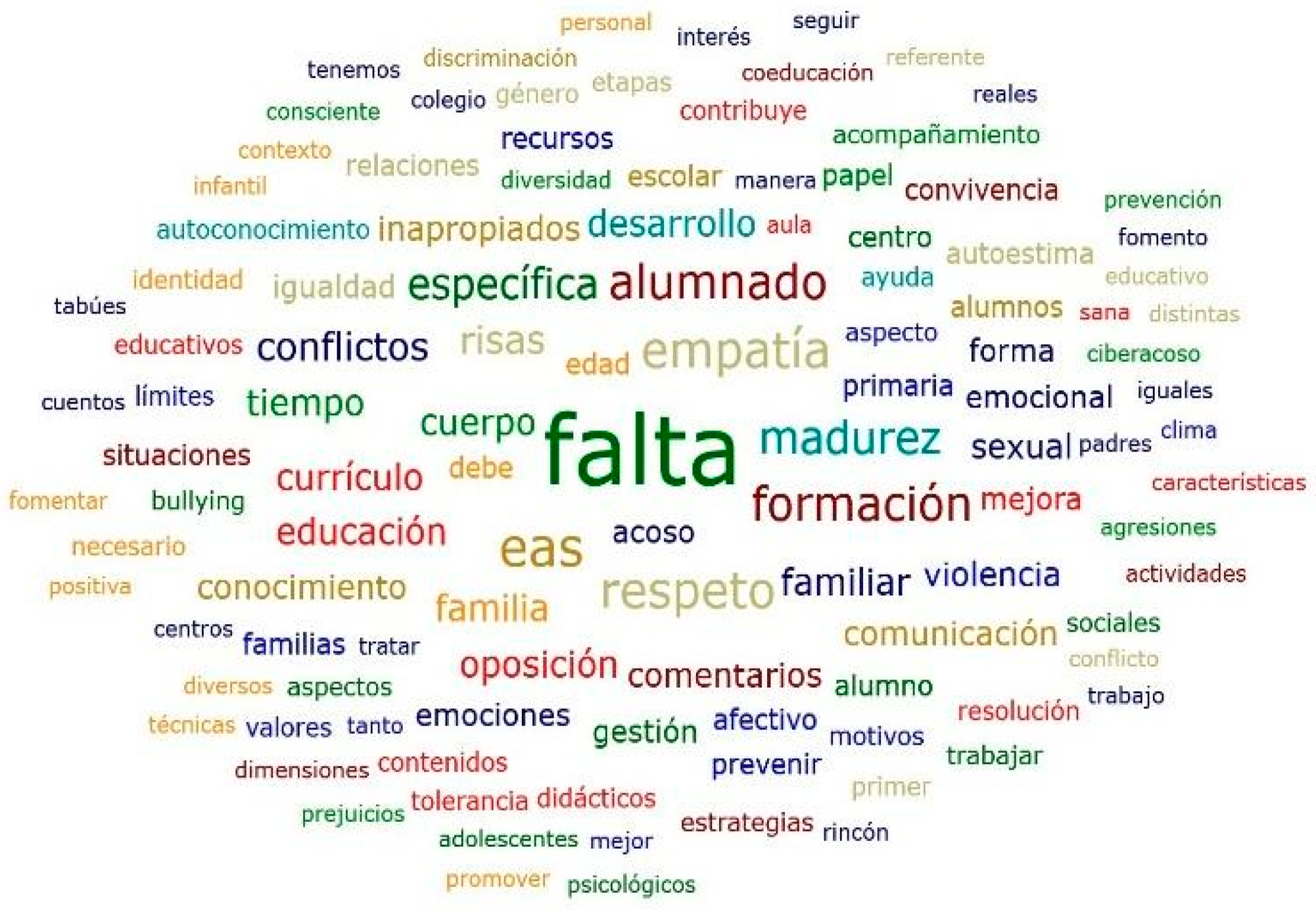
Finally, the data analysis resulted in a word cloud (Figure 2), which reveals the predominance of the term lack (falta), followed by training (formación), students (alumnado), and core values such as empathy (empatía) and respect (respeto). (Note: Terms appear in Spanish, the native language of the participants.) These results confirm a direct link between the deficiency in teacher training and its impact on students, which hinders the development of empathetic and respectful individuals within today’s social context.
Figure 2.
Research keyword cloud. Note. Word cloud created from participants’ contributions.
4. Discussion
The objective of this study was to explore the training, practice, and perceived benefits of Affective-Sexual Education among active teachers. The findings were organized into two main themes, “Teacher Competence and Pedagogical Practice in ASE” and “Psychosocial Impact and School Climate,” which address the research questions initially posed.
First, regarding how teachers perceive their training and their ability to implement Affective-Sexual Education in the classroom, exploratory results suggest that initial and continuing teacher training is anecdotal and, in any case, strictly linked to theoretical content. Specifically, training in this subject varies depending on the university, curriculum, specialization, educational institution, and individual teachers’ interests or motivation toward it. This gap aligns with those highlighted internationally by Acosta-Buralli (2022) and Cantarelli et al. (2025), who point to the absence of ASE in university curricula, which limits training for its implementation. A lack of familiarity with Affective and Sexual Education (ASE) is closely linked to the low relevance teachers assign to this content. Although teachers are capable of identifying their students’ socio-emotional needs, the undervaluation of ASE’s importance poses a serious obstacle to its implementation in the classroom.
The substantial shortcomings observed in ASE training among teachers suggest a structural disconnect between policy expectations and teachers’ actual preparedness. This discrepancy could explain why ASE continues to depend largely on the individual initiative and interest of teachers (Díaz-Tejerina et al. 2024), despite its recognition at the legislative level (Organic Law 3/2020).
Without a solid foundation of knowledge and skills, teachers cannot adapt SEI content to the diverse contexts and educational stages of their students. Furthermore, the difficulties identified in the sample are consistent with the findings of Lara-Garrido et al. (2022) and Robinson and Ferfolja (2002), which document teachers’ rejection of affective-sexual diversity and the prevalence of sexist and homophobic attitudes.
On the other hand, the second theme that emerged from the interviews concerned how teachers believe that ASE impacts students’ psychosocial development and school life. In the participants’ view, this educational shortfall negatively impacts students’ holistic development, as well as their relationships with their environment and peers. This harms students by preventing them from interacting positively with one another and from fully appreciating the richness of existing diversity. This reality is directly linked to the demands of adolescents, as documented in institutional reports (Mañas and González 2022), which call for affective-sexual education in schools.
To address this situation, the teachers in this study highlighted the need to develop competencies at three levels: cognitive (through basic concepts, dimensions of sexuality, and the legal framework); procedural (through classroom strategies, age-appropriate curriculum adaptation, and intervention techniques); and socio-emotional (through identity management, empathy, self-awareness, and communication with families). Specifically, in upper grades, their needs center on how to manage disruptive situations that hinder school harmony through the use of experiential methodologies that foster self-awareness; whereas in lower grades, these topics focus on empathy, conflict resolution, physical development, identity, and equality… This finding aligns with the studies by Fernández Hawrylak et al. (2022) and Díaz-Tejerina et al. (2024), who point out that the main barriers in Spanish schools stem from teachers’ conceptual and methodological shortcomings in addressing coeducation and sexual diversity.
In light of the literature, an appropriate sex education program allows it to be adapted to the context, needs, characteristics, and ages of the students. In this way, it complies with the guidelines set forth by the International Planned Parenthood Federation (2006), which emphasizes adapting instruction to the students’ age. Furthermore, this training enables students to develop holistically, fostering values and attitudes, communication skills, and decision-making (United Nations Educational, Scientific and Cultural Organization 2010), while promoting safe school environments that protect students’ mental health and academic performance (Amadori et al. 2025).
Second, the results suggest a structural tension between the regulatory framework and the reality of the teachers analyzed. Although the LOMLOE (2020) promotes the cross-curricular integration of ASE alongside emotional education, the findings corroborate those of Díaz-Tejerina et al. (2024), showing that its actual implementation ultimately depends on the teacher’s willingness or sensitivity. As a result of this gap in training and competencies, the teachers participating in the study do not integrate ASE into daily classroom life. Instead, they address it on an ad hoc basis in response to conflicts that could have been prevented if ASE had a continuous and meaningful presence. Similarly, traditional pedagogical resources such as celebrating special days or holding isolated external workshops—while they do have advantages for student development—result in certain content being relegated to specific days rather than being integrated across the curriculum throughout the academic year. This obscures the countless benefits they provide for students’ holistic development.
This lack of integration directly influences the sample’s negative perception of the absence or deficiency of ASE at their school and the emergence of psychosocial problems, suggesting that it may be due to a lack of training and integration of ASE into the school’s daily life. When ASE is limited to one-off interventions, classroom dynamics are hindered by various reactions such as inappropriate comments, laughter, silence, or passivity, confirming that these teachers’ lack of training and competencies in ASE results in a lack of pedagogical tools to adapt the content.
Within these implementation dynamics, a significant finding has been the low level of male participation. In line with González et al. (2024), it is observed that the persistence of biases during the initial training phase acts as a factor contributing to teachers’ reluctance to engage in research on ASE. The notable predominance of women in this study, linked to their greater openness, suggests a “feminization” of affective-sexual education and the management of social interaction. Furthermore, the lack of training and gender disparities generate disagreements on key aspects of the subject, which aligns with the warnings issued by the World Health Organization (2023).
Beyond the gender imbalance observed in the sample, these results must be interpreted within a broader international context. Although women make up the majority of the teaching staff in many education systems, they remain a minority in school leadership positions. This reality is particularly relevant because various international reports show that schools led by women tend to develop practices that are more inclusive, collaborative, and focused on student well-being (United Nations Educational, Scientific and Cultural Organization 2010). From this perspective, the demands expressed by teachers in this study highlight that the effective implementation of ASE does not depend solely on individual teacher training, but also on institutional leadership and the organizational support that schools receive. That is why the findings extend beyond the context of southeastern Spain and connect to an international challenge: the need to promote inclusive school organizations that foster the effective integration of Affective-Sexual Education at all educational levels.
Finally, according to the participants and the guidelines of the World Health Organization (World Health Organization 2023), family involvement is considered essential to the success of ASE. Because this knowledge constitutes a shared competency, the discussions reaffirm the need for coordinated efforts and open communication between the home and the school (Perez Rubiano and Fuentes Doria 2023). However, conservative attitudes toward sexuality and a lack of understanding among some families about what EAS entails are clear obstacles to family-school collaboration. Teachers identified resistance and family taboos regarding these topics, which hinder their normal integration into educational practice. In this context, achieving a genuine, open, and active partnership between families and schools requires that teachers feel supported by their colleagues and school administrators. Therefore, the effective implementation of EAS depends on schools establishing coordinated strategies, rather than leaving it up to individual teachers to deliver the content in the classroom, adapt it to the students’ needs, and engage families.
It is important to note some limitations that arose during the conduct of the study. First, the sample size was small. A larger sample would have allowed for the exploration of a greater variety of experiences across the three educational stages analyzed. However, it should be noted that data saturation was reached after the ninth participant, as no new categories or relevant themes emerged. Nevertheless, it was decided to include three additional teachers as a verification measure and to ensure the consistency of the findings.
Second, although the composition of the sample reflects the reality of the analyzed context (in which female professionals are in the majority), the presence of a single male teacher among ten female teachers represents a significant gender bias, as it prevents an exploration of potential resistance and perspectives that male teachers might have contributed to the research.
This study has certain limitations regarding its temporal and contextual scope. Data were collected between late 2025 and early 2026 from teachers at educational institutions in southern Spain. This specific focus may limit the generalizability of the findings to other educational settings characterized by different institutional or cultural conditions.
Finally, it should be noted that the presence of the themes listed in Table 2 merely reflects the frequency with which the corresponding codes were applied; it does not indicate the conceptual importance of those themes. The frequency of code application depends on the coding strategy, the length of the coded excerpts, and the diversity of codes assigned within a single excerpt.
Future research should incorporate subject-area teachers to explore how they integrate ASE into their respective disciplines. Finally, while the use of a Google Form was requested by the participants, this tool hindered a deeper exploration of certain nuances and precluded the capture of nonverbal interactions. Although the form facilitated expression on complex and sensitive topics, future studies should prioritize face-to-face interviews. This approach would allow for the collection of richer data and enable the researcher to further explore specific insights as they emerge during the dialogue.
5. Conclusions
This study confirms that training in ASE is a critical determinant of students’ psychosocial development and the overall school climate. However, the findings reveal a profound perception of professional insufficiency among teachers; this lack of adequate preparation fosters professional insecurity and leaves educators without the essential tools required to manage complex classroom realities effectively.
The results highlight a significant disconnect between current legislative mandates and actual pedagogical practice. Despite these structural barriers, there is a clear consensus regarding the positive impact of ASE on holistic development and psychosocial progress.
The implementation of these programs faces persistent challenges, primarily the lack of dedicated curricular time, a scarcity of instructional resources, and resistance from families rooted in cultural taboos or conflicting personal beliefs. Therefore, the successful institutionalization of ASE necessitates a genuine shared responsibility and the establishment of clear, proactive communication channels between schools and families.
In conclusion, the participants emphasize an urgent need for reform in teacher training. They advocate for a transition from purely theoretical models toward the provision of practical pedagogical strategies. Furthermore, they call for the establishment of systemic, protected spaces within the curriculum to ensure that schools function as safe, inclusive environments, effectively shielded from discrimination.
Author Contributions
Conceptualization, D.R.C., A.L.d.l.R. and Á.M.M.; methodology, D.R.C. and Á.M.M.; software, D.R.C.; validation, D.R.C. and Á.M.M.; formal analysis, D.R.C.; investigation, Á.M.M.; resources, D.R.C.; data curation, D.R.C.; writing—original draft preparation, D.R.C.; writing—review and editing, D.R.C., A.L.d.l.R. and Á.M.M.; visualization, D.R.C.; supervision, D.R.C., A.L.d.l.R. and Á.M.M.; project administration, A.L.d.l.R. and Á.M.M. All authors have read and agreed to the published version of the manuscript.
Funding
This research received no external funding.
Institutional Review Board Statement
The study was conducted in accordance with the Declaration of Helsinki, The study was conducted in accordance with the Declaration of Helsinki, and approved by the Institutional Review Board of University of Almería (protocol code UALBIO2025/038, 8 March 2025), for studies involving humans.
Informed Consent Statement
Informed consent was obtained from all subjects involved in the study.
Data Availability Statement
The data that support the findings of this study are available from the corresponding author upon reasonable request.
Conflicts of Interest
The authors declare no conflicts of interest.
Abbreviations
The following abbreviations are used in this manuscript:
| ASE | Affective and Sexual Education |
| LOMLOE | Organic Law 3/2020, of December 29, which modifies Organic Law 2/2006, of May 3, on Education |
| WHO | World Health Organization |
References
- Acosta-Buralli, Karen. 2022. Comprehensive Sex Education in Argentinian teacher training institutes. Maskana 13: 30–35. [Google Scholar] [CrossRef] [Scilit]
- Amadori, Alberto, Francesca Sangiuliano Intra, Livia Taverna, and Antonella Brighi. 2025. Systematic Review of Intervention and Prevention Programs to Tackle Homophobic Bullying at School: A Socio-emotional Learning Skills Perspective. International Journal of Bullying Prevention 7: 309–25. [Google Scholar] [CrossRef] [Scilit]
- Cantarelli, Natalia, Laura Galazzi, and Carolina Mamilovich. 2025. ¿Podría suceder que no tuviéramos cuerpo? I(nte) rrupciones corporales en la formación docente en filosofía, una puerta de entrada para la Educación Sexual Integral. Polifonías. Revista de Educación 14: 111–37. [Google Scholar] [CrossRef] [Scilit]
- Díaz-Tejerina, David, Jaime Barrio Cortés, José Miguel Carrasco Gimeno, and Francisco Javier Fernández-Río. 2024. Affective-sexual education: Teacher perceptions in the Principality of Asturias (Spain). GénEroos 2: 5–23. [Google Scholar] [CrossRef] [Scilit]
- Erickson, Frederick. 1989. Qualitative research methods on teaching. In Research in Teaching II: Qualitative and Observational Methods. Edited by Merlin C. Wittrock. East Lansing: Paidós, pp. 195–301. [Google Scholar]
- Fedele, Maddalena, Juan-José Boté-Vericad, Carolina Martín-Piñol, and Concha Fuentes Moreno. 2025. Young people’s affective-sexual education: The gap between the ‘affective’ and the ‘sexual’ dimensions in formal and non-formal/informal educational settings. International Journal of Adolescence and Youth 30: 2441308. [Google Scholar] [CrossRef] [Scilit]
- Fernández Hawrylak, María, Laura Alonso Martínez, Elena Sevilla Ortega, and Mª Elena Ruiz Ruiz. 2022. Inclusion of sexual diversity in educational centers from the teachers’ perspective: A qualitative study. International Journal of Education for Social Justice 11: 81–97. [Google Scholar] [CrossRef] [Scilit]
- García-Vázquez, José, Laura Ruiz-Azcona, Amada Pellico-López, and María Paz-Zulueta. 2024. Characteristics of emotional and sexuality education programs in the Spanish school population. Heliyon 10: e39368. [Google Scholar] [CrossRef] [Scilit] [PubMed]
- Goetz, Judith Preissle, and Margaret Diane LeCompte. 1988. Ethnography and Qualitative Design in Educational Research. Madrid: Morata. [Google Scholar]
- González, Daniel González, Gloria Álvarez Bernardo, Adrián S. Lara Garrido, Elisa Coral Pintor Peláez, and Ana Belén García Berbén. 2024. Homonegativity in the Initial Training of Would-be Teachers. Latin American Journal of Inclusive Education 18: 131–43. [Google Scholar] [CrossRef] [Scilit]
- Gómez-Gómez, Maria Isabel. 2023. De la Homogeneidad a la Diversidad en la Escuela. Revista Docentes 2.0 16: 37–42. [Google Scholar] [CrossRef] [Scilit]
- Guba, Egon G., and Yvonna S. Lincoln. 1981. Effective Evaluation. San Francisc: Jossey-Bass. [Google Scholar]
- Guzmán Mora, Leidy Alexandra. 2026. Modelo de enseñanza y nivel de conocimiento sobre la educación integral en sexualidad (EIS) en el ámbito primario en una institución pública ubicada en un entorno rural de la ciudad de El Guabo-El Oro-Ecuador. Doctoral thesis, Universidad Nacional de La Plata, La Plata, Argentina. [Google Scholar] [CrossRef] [Scilit]
- Hecker, Jörg, and Neringa Kalpokas. n.d. The Ultimate Guide to Qualitative Research—Part 2: Qualitative Data Processing. Berlin: ATLAS.ti. [Google Scholar]
- International Planned Parenthood Federation. 2006. Framework for Comprehensive Sexuality Education. Available online: https://www.ippf.org/sites/default/files/ippf_framework_for_comprehensive_sexuality_education.pdf (accessed on 23 January 2026).
- Lara-Garrido, Adrián Salvador, Gloria Álvarez-Bernardo, and Ana Belén García-Berbén. 2022. “…do you remember your first aggression for being LGTB?”: An analysis of LGTB people’s testimonies in the #MeQueer movement. OBETS: Journal of Social Sciences 17: 303–20. [Google Scholar] [CrossRef] [Scilit]
- LOMLOE. 2020. Organic Law 3/2020, of December 29, which modifies Organic Law 2/2006, of May 3, on Education (LOMLOE). Official State Gazette, 340, of December 30, 2020. pp. 122868–953. Available online: https://www.boe.es/boe/dias/2020/12/30/pdfs/BOE-A-2020-17264.pdf (accessed on 23 January 2026).
- Mañas, Moisés, and Blas González. 2022. Affective-sexual education in educational centers: Regarding a study with teachers in training. REIDOCREA 11: 355–67. [Google Scholar]
- Mañas Olmo, Moisés, Blas González Alba, and Pablo Cortés González. 2023. Affective-sexual education as a crossroad in the relationship with family and school. Cadernos de Pesquisa 53: e10087. [Google Scholar] [CrossRef] [Scilit]
- Miles, Matthew B., and A. Michael Huberman. 1984. Qualitative Data Analysis: A Sourcebook of New Methods. Michigan: Sage Publications. [Google Scholar]
- Perez Rubiano, Maria Alicia, and Deivi David Fuentes Doria. 2023. Exploring Borders: Educating in Sexuality for an Inclusive and Respectful Society. Latin American Journal of Scientific, Critical and Emancipatory Education. Available online: https://zenodo.org/records/14590616 (accessed on 30 January 2026).
- Robinson, Kerry H., and Tania Ferfolja. 2002. A reflection of resistance: Discourses of heterosexism and homophobia in teacher training classrooms. Journal of Gay & Lesbian Social Services 14: 55–64. [Google Scholar] [CrossRef] [Scilit]
- Rodríguez Sabiote, Clemente, Oswaldo Lorenzo Quiles, and Lucía Herrera Torres. 2005. Theory and practice of qualitative data analysis: General process and quality criteria. International Journal of Social Sciences and Humanities-SOCIOTAM 15: 133–54. [Google Scholar]
- Seiler-Ramadas, Radhika, Igor Grabovac, Roman Winkler, and Thomas Ernst Dorner. 2021. Applying Emotional Literacy in Comprehensive Sex Education for Young People. American Journal of Sexuality Education 16: 480–500. [Google Scholar] [CrossRef] [Scilit]
- Spanish Network of the Global Compact. n.d. Sustainable Development Goals. Madrid: Spanish Network of the Global Compact. [Google Scholar]
- Tong, Allison, Peter Sainsbury, and Jonathan Craig. 2007. Consolidated criteria for reporting qualitative research (COREQ): A 32-item checklist for interviews and focus groups. International Journal for Quality in Health Care 19: 349–57. [Google Scholar] [CrossRef] [Scilit] [PubMed]
- Tracy, Sarah. 2021. Calidad cualitativa: Ocho pilares para una investigación cualitativa de calidad. Márgenes, Revista de Educación de la Universidad de Málaga 2: 173–201. [Google Scholar] [CrossRef] [Scilit]
- United Nations Educational, Scientific and Cultural Organization [UNESCO]. 2010. International Technical Guidance on Sexuality Education: An Evidence-Informed Approach for Schools, Teachers and Health Educators. Available online: https://unesdoc.unesco.org/ark:/48223/pf0000183281 (accessed on 19 December 2025).
- Weber, Robert Philip. 1990. Basic Content Analysis, 2nd ed. Thousand Oaks: Sage Publications, Inc. [Google Scholar]
- World Health Organization. 2023. Comprehensive Sexuality Education. Available online: https://www.who.int/news-room/questions-and-answers/item/comprehensive-sexuality-education (accessed on 19 December 2025).

Disclaimer/Publisher’s Note: The statements, opinions and data contained in all publications are solely those of the individual author(s) and contributor(s) and not of MDPI and/or the editor(s). MDPI and/or the editor(s) disclaim responsibility for any injury to people or property resulting from any ideas, methods, instructions or products referred to in the content. |
© 2026 by the authors. Licensee MDPI, Basel, Switzerland. This article is an open access article distributed under the terms and conditions of the Creative Commons Attribution (CC BY) license.