
The Role of Culture in Education and the Social Environment: A Multilevel Analysis of Social Group Problems—A Systematic Review of the Findings of World Scientists



Abstract
1. Introduction
2. Methods
- (1)
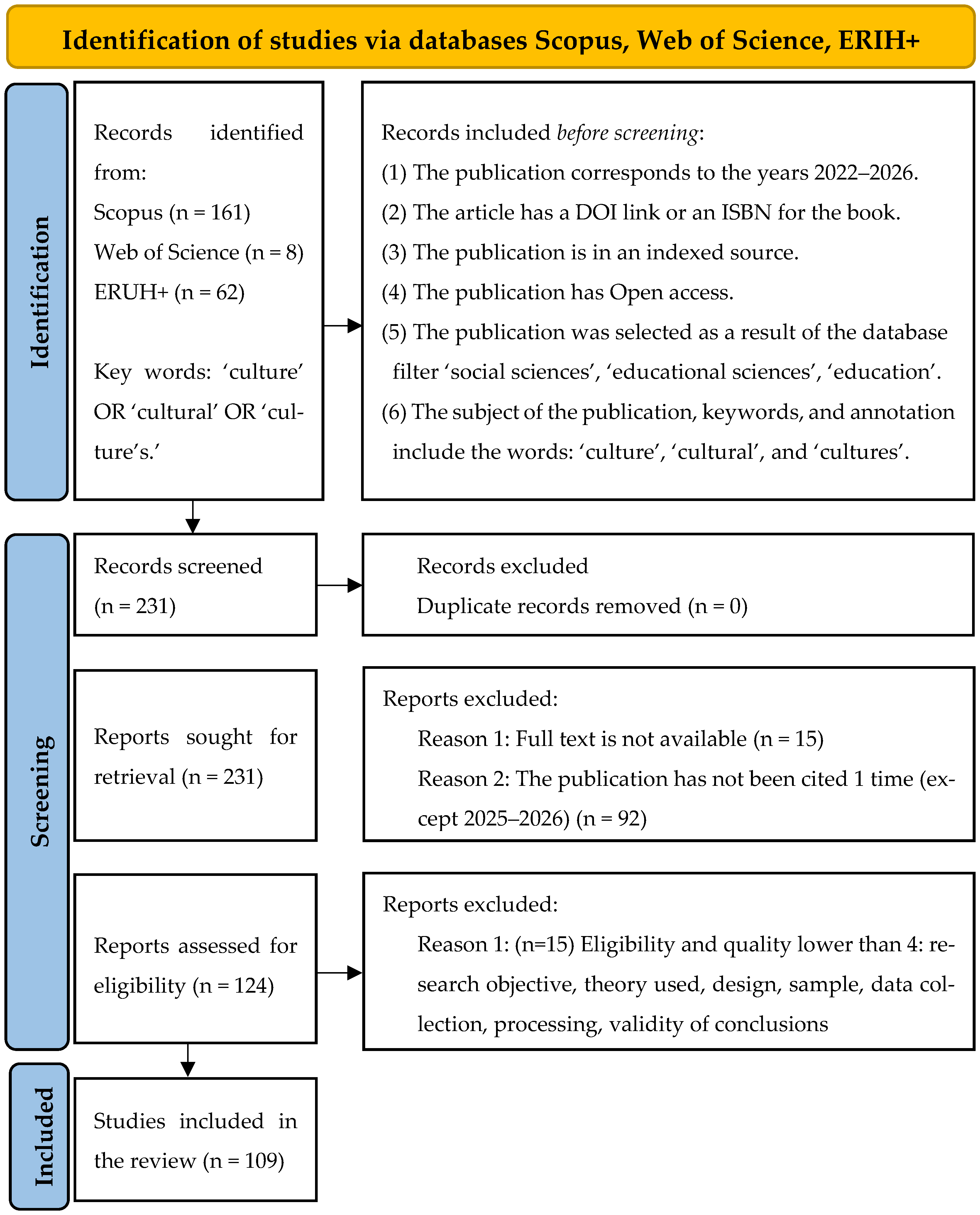
- The publication corresponds to the years 2022–2026 (the last 5 years);
- (2)
- The article has a DOI link or an ISBN for the book;
- (3)
- The publications are in an indexed source;
- (4)
- The publication is open access;
- (5)
- The publication was selected as a result of the database filter ‘social sciences’, ‘educational sciences’, ‘education’, etc.;
- (6)
- The subject of the publication, keywords in the annotation include the words: ‘culture’, ‘cultural’, ‘cultures’, ‘culture’s’, ‘cultures’, etc.
- (1)
- The publication is not available for full-text review (the author’s scientific institution does not subscribe to the website where the article is posted, so it cannot be obtained, despite the open-access status) (n = 15).
- (2)
- The publication has not been cited 1 time (except for 2025–2026) (n = 92) (The exception for the last two years is justified by the fact that the Journal Impact Factor calculates citations based on articles published in the previous two years; the citation process includes the following stages: publication discovery, use in the development of new research, manuscript preparation, peer review, and publication within 18–24 months).
3. Results
3.1. Bibliometric Trends
3.2. Thematic Synthesis by Social Group
3.3. The Most Current Cross-Disciplinary Construct: Cultural Intelligence
4. Discussion
4.1. Correlation of Research Results with the Introduction’s Content
4.2. Problems with Explanations of the Meanings of the Term “Culture”
4.3. The Most Current Concept of “Cultural Intelligence” in Education in the Context of Social Groups
4.4. Summary of the Discussion
5. Conclusions
- Unity in constructs, but not in theory—the authors agree on the general meaning of cultural intelligence, but its structuring and interpretation differ.
- Multilevel nature—cultural intelligence is used at different levels: individual, collective, and societal.
- Most studies emphasize cultural intelligence as a dynamic phenomenon, the development of which can be promoted by learning and interacting with other cultures and the people representing them.
- The relationship of cultural intelligence with other constructs is pronounced—especially with emotional intelligence, identity, motivation, social learning, cultural competence, cultural literacy, cultural capital, and social capital. However, their analysis goes beyond the limits of the study.
- (1)
- Lack of conceptual unity in definitions of concepts;
- (2)
- Different measurement approaches;
- (3)
- Insufficient transfer and adaptation of theories from other disciplines in educational sciences.
Funding
Institutional Review Board Statement
Informed Consent Statement
Data Availability Statement
Acknowledgments
Conflicts of Interest
Abbreviations
| UN | United Nations |
| UNESCO | United Nations Educational, Scientific, and Cultural Organisations |
| CORDIS | Community Research and Development Information Service |
| EK | European Commission |
| HORIZON | The European Union’s Horizon Europe programme |
| DIALLS | Dialogue and Argumentation for Cultural Literacy Learning in Schools |
| CliVie | Cultural Literacies’ Value In Europe |
| ToC | Theory of change |
| SROI | The Social Return on Investment |
| OECD | Organisation for Economic Co-operation and Development |
| PRISMA | Preferred Reporting Items for Systematic Reviews and Meta-Analyses |
| ISBN | International Standard Book Number |
Appendix A

| No. | Autor | Year | Title of Article | Design | Social Groups | Context | Conclusions | Quality |
|---|---|---|---|---|---|---|---|---|
| 1. | Abugasea Heidt and Svrcek | 2025 | Reframing Education for Multilinguals: Honoring Students’ Linguistic, Literacy, and Cultural Assets | Qualitative, theoretical | Multilingual students | To transform the knowledge of multilingual student education, reorienting it from a deficit approach to one that recognizes and utilizes students’ linguistic, literacy, and cultural competence. | A humble teacher who allows students to fully express their multicultural identity and utilize their multilingual competencies and cultural values will pave the way for them to succeed both in and out of the classroom. | 4 |
| 2. | Alkar | 2025 | The multicultural personality and ethnocentrism tendencies of pre-service teachers in Türkiye | Qualitative, empirical | Prospective social studies teachers | Multicultural personalities and ethnocentrism tendencies of Turkish prospective teachers with a holistic framework: (a) curiosity about different cultures, (b) feelings towards different societies, (c) difficulties of cultural adaptation, and (d) self-culture in personal stories. The concept of cultural intelligence is used in the context of multicultural personality traits, intercultural sensitivity, and psychological well-being. | Teachers did not support living outside one’s culture because anxiety appeared in the dimensions of flexibility and emotional balance. Commitment to ethnic traditions and customs is a self-sufficiency approach. | 4 |
| 3. | Aloni and Veugelers | 2024 | Ecohumanism, democratic culture, and activist pedagogy: Attending to what the known demands of us | Qualitative, theoretical | Multilingual students | A new value education paradigm that addresses the key challenges for a sustainable future for young people proposes transformative and empowering educational strategies in the context of global environmental, political, social, health, and cultural risks. Three concepts (a) Ecohumanism as a value education paradigm—combining humanistic concerns for human dignity, social justice and democracy with ecological concerns for climate stability, biodiversity and environmental sustainability; (b) education for democratic personality and holistic and transformative democratic culture; and (c) a threefold concept of activist pedagogy that focuses on developing personal agency, promoting political literacy and agency and engaging students in experiential, holistic and active teaching and learning experiences. | In the context of a multidimensional crisis, the idea of a sustainable future, as well as humanization and dehumanization, is the driving force in the development of ecohumanist activism pedagogy. | 4 |
| 4. | Anlimachie et al. | 2025 | Enacting culturally responsive pedagogy for rural schooling in Ghana: A school-community-based enquiry | Qualitative, empirical, quasi-experiment | 20 students (6th grade), 4 teacher—co-researchers, 22 parents of students, school principal. | Teachers’ cultural capital, including: (1) sociocultural knowledge of their students’ backgrounds, (2) development of local cultural competencies, and (3) building a culture of school-home collaboration, contributed to success in the rural school. | Culturally appropriate pedagogy has emerged as a new strategy for improving educational outcomes in underserved communities. Rural students’ aspirations and priorities for school success were largely influenced by their immediate environment, embedded cultural capital, and significant social others, especially their families and teachers. | 5 |
| 5. | Anuas et al. | 2024 | The challenges of implementing culture-based teaching in remedial education: analyses and recommendations | Quantitative, empirical, | 252 language teachers | Teachers’ perceptions of the challenges of implementing culture-based teaching for language literacy development in remedial education. | Four main problems: (1) teaching materials, (2) curricula, (3) teacher knowledge, and 4) time allocation. The current curriculum does not emphasize cultural elements in remedial education. Cultural teaching cannot be implemented effectively due to the insufficient knowledge of teachers. The preparation of teaching materials and the implementation of content are time-consuming compared to traditional pedagogical approaches. Remedial education should ensure comprehensive, culturally based teaching. | 5 |
| 6. | Baker et al. | 2023 | Understanding the moral of the story: Collaborative interpretation of visual narratives | Qualitative, empirical, case study | 90 students (9th and10th grades) | Promoting moral thinking and cultural literacy in young people through the curriculum. Interpreting visual narratives through six layers: from reconstructing the intentions of the characters using semiotic symbolism to expressing the moral of the story clearly using the conceptualization of three core European values (empathy, inclusion, and tolerance). | Asking middle school students to interpret carefully selected wordless texts can be a means of engaging them in moral thinking, in addition to existing approaches based on the study of games and/or moral dilemmas. | 5 |
| 7. | Bećirović | 2023 | The Relationship Between Cooperative Learning, Cultural Intelligence, EFL Motivation, and Students’ Performance: A Structural Equation Modeling Approach | Quantitative, empirical | 211 students (7th and 9th grade) | Correlation between learning motivation, interpersonal relationships, cultural intelligence, and academic performance of high school students. | Engaging students in cooperative learning significantly impacts students’ cultural intelligence, which is essential for successful collaboration. | 5 |
| 8. | Braden et al. | 2025 | Revolutionary love: Centering the full humanity of children in the literacy curriculum | Qualitative, empirical | 4 for K–5 (elementary) teachers | How teachers implement literacy pedagogies that engage students despite limited literacy skills. The teachers involved in the study were part of a team of educators focused on implementing culturally responsive pedagogies in primary school classrooms. | The contribution of educators is essential in implementing the content of the state education curriculum in the learning process. Teachers feel limited in their ability to adapt lessons to the diverse needs of their students. | 4 |
| 9. | Busch and Rajwade | 2024 | Conceptualizing community scientific literacy: Results from a systematic literature review and a Delphi method survey of experts | Quantitative, systematic review | Community experts | Acquiring scientific literacy at the individual, community, and societal levels. | Guided by the theory of cultural-historical activity, inductive and deductive analysis, seven elements of scientific literacy and their constituent characteristics were obtained. | 5 |
| 10. | Bücker and Korzilius | 2024 | Developing and validating a team cultural intelligence scale | Quantitative, empirical | 541 students: individual and multicultural team | Using a social cognitive framework, the study describes the further development of the Team Cultural Intelligence Scale and a six-step validation procedure that measures the abilities required for cross-cultural teams. | The study emphasizes the irreplaceable contribution of the team to the development of the collective and the organization. It is very important for multicultural teams to use the strengths of each individual, shifting the dynamics of team members towards mutual learning and interdependence in creativity, which leads to innovation. | 5 |
| 11. | Cabrera-Martínez et al. | 2023 | Social uses, socioeconomic benefits, and indicators in cultural heritage: A correlational study | Quantitative, empirical | 401 university students | University students’ opinions: cultural heritage assessment, accessibility, national identity, and social equality. The study validates the social capital heritage research scale. | The correlation of the impact of cultural heritage with identity and social capital is moderate, as other influencing factors than simple student attendance frequency must be taken into account. What is important is the student’s education, motivation, emotional involvement, family values, and historical, sociopolitical context. | 4 |
| 12. | Chansaengsee | 2024 | STEAM approach for improving 21st-century skills of multicultural students attending inclusive classroom | Qualitative, empirical, quasi-experiment | 16 students (6th grade) + 3 students with autism | Inclusive education is an environment where general education and special needs students learn together, and where collaboration with teachers and parents allows for the development of communication, cooperation, and socio-cultural awareness. | STEAM as a project-based, integrated approach can improve both learning outcomes and achievement, as well as communication, collaboration, socio-cultural awareness, and skill sets in an inclusive classroom. | 4 |
| 13. | Chao | 2025 | Advancing Our Understanding of Cultural Competence: An Affective Learning Processes (ALPs) Model | Qualitative, theoretical | Students | The Affective Learning Processes model for the development of cultural competence, which explains how affect (emotions) influences learning in intercultural situations. Cultural competence generally refers to the ability to manage intercultural relationships. It enables individuals to function effectively in diverse cultural environments. The concept of cultural intelligence focuses on how to promote positive cooperation in collective work, effectively build a multicultural team, and improve its performance. | Cultural competence encompasses two distinct states: (a) relationship building and (b) relationship prevention or preventive maintenance. Affect-driven outcome expectations: joy or anxiety, anger structure attention, learning, and strategies chosen. | 4 |
| 14. | Chappell and Hetherington | 2024 | Creative pedagogies in digital STEAM practices: Natural, technological, and cultural entanglements for powerful learning and activism | Qualitative, empirical | Students (7–15 years old) | The context of ocean literacy explores the integration of the natural, cultural, and technological environments through which the cognitive process occurs. | Creative pedagogy and digital technologies (AR/VR) can enhance students’ social engagement and responsibility, promote behavioral and attitudinal change. Creative learning is conceptualized as a nature-culture-technology nexus, rather than a nature-culture binary. The task of educators is to shift from authoritative teaching to engaging students in the cognitive process. | 4 |
| 15. | Chen and Chen | 2025 | Cultural sustainability through social networks: a moderated mediation model exploring the psychological dimensions of cultural dissemination | Quantitative, empirical cross-sectional | 1200 social media users | Research context: The role of social media diversity in promoting cultural sustainability. Participants’ cultural interaction diversity on these platforms, level of cultural empathy, cultural adaptability, and sustainability of cultural practices were assessed. | The results highlight the potential of social media as a tool for cultural preservation and adaptation in the context of globalization. Educators and trainers can integrate the results of this study into curricula and professional development programs to improve cultural empathy and adaptability among students and staff. | 5 |
| 16. | Coelho | 2024 | Using FREPA to encourage critical intercultural reflections: A case study of intercultural competence in EFL textbooks for grades 3 and 4 in central Portugal | Mixed methods | Students | In terms of learning resources, it has been said that the cultural content provided in English as a foreign language textbooks is often superficial and mainly fact-based, focuses only on knowledge levels, and does not use a reflective approach, contrary to recent language research referenced in educational guidelines. | The results suggest that most of the content analyzed is unlikely to foster deep critical reflection on intercultural interaction, as its approach is based on the exchange of facts. It is therefore argued that policymakers, textbook authors, and publishers would benefit from more extensive training in critical cultural understanding. | 4 |
| 17. | Cong-Lem | 2025 | Intercultural communication in second/foreign language education over 67 years: A bibliometric review | Quantitative, systematic review | Theoretical concepts (second language education concept) | Professional development of educators on culturally responsive materials and intercultural competence-focused learning outcomes in language education. | Digitally mediated learning (telecollaboration, e-learning) is emerging as a significant trend that allows intercultural experiences to be developed even without physical mobility. | 5 |
| 18. | Da Silva Teixeira and Klein | 2024 | The Development of Cultural Intelligence (CQ) in Situated Learning | Qualitative, empirical, netnography | 12 Bachelor of Management students | The study aims to investigate how situated learning contributes to the development of cultural intelligence during international experiences. | The main findings show that cultural intelligence develops primarily through situational learning in everyday activities and interactions with locals and foreigners of different nationalities. | 5 |
| 19. | Davaei et al. | 2022 | The influence of cultural intelligence and emotional intelligence on conflict occurrence and performance in global virtual teams | Quantitative, empirical | 810 Bachelor’s and Master’s degree business students. | The study investigates how cultural intelligence (CQ) and emotional intelligence (EQ) influence the occurrence of interpersonal, task, and process conflicts. | Team members’ cognitive quality and emotional feeling reduce the occurrence of three different types of intra-group conflict | 5 |
| 20. | Del Carmen Mardones et al. | 2024 | Instrument to Evaluate Intercultural Competence in Pedagogy Students | Quantitative, empirical, nonexperimental | 521 pedagogy students | The current educational reality involves developing intercultural competence during and after training to influence educational practices that promote positive classroom interactions with culturally and linguistically diverse students. Based on the intercultural competence pyramid model, the cultural intelligence scale is translated, operationalized, and constructed for use by teacher education students. | It is important to integrate intercultural interaction into higher education transversally. | 5 |
| 21. | Del-Olmo-Ibáñez et al. | 2023 | Perception of future Spanish primary education teachers on their multicultural and multilingual competencies and the sustainability of the educational system | Quantitative, empirical | 116 prospective primary school teachers | Research objective: to assess prospective primary school teachers’ self-awareness of their role in integrating international students into school and society; to determine how much importance they attach to multiculturalism and multilingualism to develop the communicative competence of their international students | Without language and cultural literacy, the sustainability of the education system is impossible. The majority of respondents recognize communicative competence as a critical factor for academic success and social inclusion. | 4 |
| 22. | Dervin | 2025 | Intercultural self-defence: A resource book for students, teachers and researchers | Quantitative, systematic review Book | Theoretical philosophy for students and teachers | In a multicultural context, the idea of self-defense is a critical landmark in intercultural communication education and research, revealing limitations that can distort understanding and hinder development. | Ignoring language in intercultural research/education is not innocent: it can have ethical and sociopolitical consequences (exclusion, lack of inclusion of minority voices, inappropriate policies). | 4 |
| 23. | Dias | 2022 | Thinker, Learner, and Practitioner: Using an Insider’s Lens to Explore Critical, Cultural, and Global Consciousness Through Multicultural Literature | Qualitative, empirical, case-study | 12 students (13–14 age) | A class study that explored the potential of multicultural literature to expand adolescents’ worldviews and shape their perceptions as global citizens. | The concepts of time, space, place, and identity detail a deliberate and purposeful pedagogy as learners interact with literacy both within and outside the classroom community. | 5 |
| 24. | Díaz-Pacheco et al. | 2025 | Intercultural sensitivity of teachers towards the immigrant community: A mixed research with three public schools | Mixed methods | 102 teachers | As a result of the rapid increase in immigration, traditional pedagogical training in Chilean public schools is inadequate. Teachers’ attitudes, representations, and emotional positions towards immigrant students significantly affect: academic performance, well-being, social inclusion, and the sustainability of the education system. | The findings show that the participating teachers have a moderate-to-high degree of intercultural sensitivity, with the most highly valued dimensions being commitment and enjoyment in interaction. | 5 |
| 25. | Effendi | 2023 | Strategy for the Principal’s Transformational Leadership Approach in Strengthening the Character of Indonesian Students | Qualitative, empirical, case-study | 3 principals, 3 senior teachers, 5 parents, 2 school council/committee representatives, 1 school superintendent | Cultural, humanistic, and nationalistic approaches to school principals’ support for transformational leadership, outlining three frameworks for character development. | Indonesian principals in inclusive, character-building schools should prioritize cultural values, spirituality, and nationalism, as this significantly enhances students’ character development. | 4 |
| 26. | El-Gabry | 2026 | From awareness to understanding: translating mental health literacy into inclusive and empathic practice | Quantitative, systematic review | Theoretical concept for teachers | Mental health literacy (MHL) encompasses both cognitive and cultural aspects. Low MHL contributes to stigma, reinforcing misconceptions, social distancing, and discrimination, discouraging help-seeking. In education, MHL goes beyond knowledge to include empathy, emotional intelligence, and inclusiveness. | Reducing stigma is not possible without empathy, cultural awareness, and inclusive pedagogy. Educational institutions are social communities where emotional intelligence and compassion are built. | 4 |
| 27. | Erstad et al. | 2023 | Reading in the digital age. Differences and commonalities across research approaches | Qualitative, theoretical | Theoretical concept for teachers | Reading is a cornerstone of education, influenced by culture and tradition. Different definitions of reading persist across disciplines and theoretical paradigms. | Different perspectives on reading can overcome the simplistic dichotomy of print and digital reading in today’s public discussions and promote a more nuanced understanding of literacy. | 4 |
| 28. | Fernández-García | 2024 | Musical input and a multiliteracies approach to facilitate intercultural EFL learning | Qualitative, theoretical | Theoretical concept for teachers | Incorporating multilingual pedagogy into language learning programs with musical elements. Traditional language teaching approaches reduce culture to factual information, underdeveloping intercultural communicative competence, and rarely using multimodal and affective resources to promote empathy, critical thinking, and cultural sensitivity. | Creating meaningful learning in language classes is a priority in a multicultural context. It is necessary to meet the needs of students to make realistic connections in today’s digital world. The principles of multilingual pedagogy are an effective tool for promoting the development of intercultural skills among learners of English as a foreign language. | 4 |
| 29. | Ferreira et al. | 2025 | Greek astromythology: Intersections between mythology, history, and modern astronomy education | Quantitative, systematic review | Theoretical concept for teachers | A comparative assessment of the interaction between Greek astromythology and astronomy education as an interdisciplinary and cross-cultural contribution. | The use of mythology as a historical and cultural aspect of visible constellations and planets can make a significant contribution to scientific literacy and teaching, especially in introductory astronomy courses typically designed for primary and secondary schools. Exploring this interaction at the school level can also contribute to the reflection, implementation, and evaluation of consistent teaching and learning indicators towards critical education. | 4 |
| 30. | Ge et al. | 2024 | Video-streamed Intangible Cultural Heritage, Ethnic Perceptions, and Cross-cultural Competence in China | Quantitative, empirical | Theoretical concept for teachers | The ability of Chinese ethnic minority-related video streaming content to improve intercultural competence and perceptions of ethnic minority communities among Chinese ethnic majority users. | Intercultural attitudes and skills served as positive predictors of participants’ affinity towards ethnic minorities, suggesting that more favorable intercultural attitudes and skills contribute to greater sympathy towards ethnic minorities. | 5 |
| 31. | Ghaemi and Boroushaki | 2025 | Culturally responsive teaching in diverse classrooms: A framework for teacher preparation programs | Mixed-methods | 150 prospective teachers, 15 faculty members, and 10 program administrators | The importance of culturally responsive teaching (CRT) in heterogeneous classrooms offers a comprehensive framework for teacher development programs designed to enhance effective teaching for diverse student groups. | The cultural competence of teachers should be improved, emphasizing the need for a continuous focus on social justice, equity, and culturally sustainable pedagogy, promoting equality literacy and critical self-reflection to ensure that educators are prepared to address the needs of diverse learners. | 5 |
| 32. | Griffith and Lim | 2024 | Teaching intercultural communicative competence in the foreign language classroom | Qualitative, theoretical | Theoretical concept for teachers | The main reasons for teaching culture in language lessons and how cultural training and understanding contribute to intercultural communicative competence and the role of teachers in teaching culture in language lessons. | The teacher’s task is to find appropriate and suitable materials and to develop meaningful tasks that engage the student while promoting deeper intercultural understanding.
| 4 |
| 33. | Guerra Ayala et al. | 2025 | Social isolation among indigenous college students in Peru: The role of language, culture, and acculturation | Quantitative, empirical | 202 students of the university | Cultural differences between indigenous communities and urban university environments, and the historical and institutional marginalization of indigenous people. | Psychological acculturation significantly reduces isolation and increases the explanatory power of the model to 85.6%. Gender, cultural affiliation (Quechua/Aymara), and academic performance have no statistically significant effects. Acculturation acts as a protective factor, but it does not mean loss of identity. | 5 |
| 34. | Gutiérrez-Santiuste and Ritacco-Real | 2023 | Intercultural communicative competence in higher education through telecollaboration: typology and development | Mixed-methods | 20 students of the university | Intercultural communicative competence is understood as an individual’s ability to adapt communication and behavior effectively and appropriately when interacting in an intercultural context. | Behavioral communication is the dominant learning process. It is followed by affective and, finally, cognitive communication. | 5 |
| 35. | Guzmán-Rodríguez et al. | 2023 | Individual characteristics on multicultural team performance: Does the role played by leaders and team members matter? | Quantitative, empirical | 304 company members, 111 leaders | The impact of individual characteristics such as cultural sensitivity, adaptability, cohesiveness, and cultural diversity on the performance of a multicultural team | There is a positive relationship between cultural sensitivity, adaptability, cohesion and team performance. Cultural diversity did not show a significant effect on team performance. Leaders and participants had different perceptions of the factors that affect team performance. | 4 |
| 36. | Gyensare et al. | 2025 | Fostering assigned expatriates’ thriving at work through cultural intelligence and local embeddedness: The role of relational attachment | Quantitative, empirical | 234 company members | How cultural intelligence helps you achieve local inclusion. Challenges before going abroad. | Cultural intelligence promotes local inclusion, which in turn promotes work productivity and the creation of a sense of belonging. | 5 |
| 37. | Hackett et al. | 2023 | The effectiveness of Collaborative Online International Learning (COIL) on intercultural competence development in higher education | Qualitative, empirical, quasi-experiment | 108 students of the university | Self-assessed intercultural competence of university students. Measurements with the Cultural Intelligence Scale and the Multicultural Personality Questionnaire. | The effectiveness of Collaborative Online International Learning (COIL) has been proven and confirmed. | 5 |
| 38. | Han et al. | 2022 | Facilitating Cross-Cultural Adaptation: A Meta-Analytic Review of Dispositional Predictors of Expatriate Adjustment | Quantitative, systematic review | expatriates on work assignment | A meta-analytic review of cultural empathy, flexibility, cognitive intelligence, and emotional intelligence in expatriate adaptation. | Various cultural variables (cultural distance, cultural tension, gender inequality in the host country) affect relationships. Sociocultural factors may mitigate some of these effects. | 5 |
| 39. | Hattan et al. | 2025 | Exploring the Power and Possibility of Contextually Relevant Social Studies–Literacy Integration | Mixed-methods | 92 students (1st grade) 6 teachers | Development of first graders’ social studies knowledge and reading skills using an integrated learning unit jointly developed and implemented by a teacher and researcher in the context of a rural community. | Vocabulary can be a powerful bridge to cultural and content knowledge when local and community knowledge is the focus of lessons and texts, demonstrating that contextually appropriate integration of social studies and literacy is a promising practice for building content knowledge and interest in first-grade classrooms. | 5 |
| 40. | Hodgson and Harris | 2022 | The Genealogy of “Cultural Literacy” | Qualitative, theoretical | Theoretical concept for teachers, policy makers | Cultural literacy is used as a normative and hegemonic tool to define a “common national culture”—this contradicts the reality of contemporary multicultural and multilingual societies. | The idea of a “common culture” is not neutral; it creates exclusion rather than inclusion. In modern society, culture is plural, dynamic, and full of conflicts; cultural literacy cannot be reduced to a single list of knowledge. | 4 |
| 41. | Jerinic-Ivic et al. | 2025 | Intercultural competence in the context of intercultural service encounters: A multilevel and dynamic approach | Qualitative, empirical, case-study | Language teachers like company | A multi-level and dynamic approach to the analysis of intercultural competence to understand how its components operate at the individual and collective levels. | Not only the “right people”, but team practices (information flow, coordination, shared responsibility between phases) are crucial. | 5 |
| 42. | Jurásek and Wawrosz | 2023a | How Does Self-Efficacy in Communication Affect the Relationship Between Intercultural Experience, Language Skills, and Cultural Intelligence | Quantitative, empirical, cross-sectional study | 109 students of the university | Cultural intelligence related to travel experience, intensity of social contacts, and foreign language skills. | Cultural intelligence is a multidimensional sociomental construct that allows a person to effectively explore and understand different cultures for the benefit of the entire organization. | 5 |
| 43. | Jurásek and Wawrosz | 2023b | What Makes People Abroad Satisfied? The Role of Cultural Intelligence, Cultural Identity, and Culture Shock | Quantitative, empirical, cross-sectional study | 180 students of the university | Cultural intelligence (CQ) is the ability to function effectively in different cultural contexts; CQ is structured into 4 dimensions: metacognitive, cognitive, motivational, and behavioral. | Culture shock mediates the relationship between CQ and life satisfaction (CQ reduces culture shock; culture shock reduces satisfaction). Cultural identity does not mediate the relationship between CQ and life satisfaction. | 5 |
| 44. | Juzwik | 2025 | White Christian nationalism, biblical proof-texting, and literacy curriculum and instruction | Qualitative, theoretical | Theoretical concept for teachers | The professional role of teachers in the White Christian Nationalist movement and the need for educators to have a deeper understanding of the ideology of this movement and its impact on literacy. | Recommendations for literary literacy education: In teacher education, deliberately include depictions of ethno-religious nationalism in text selection to promote critical understanding. | 4 |
| 45. | Kačāne et al. | 2023 | Youth and Intergenerational Transmission of Cultural Intelligence in Latvia, Spain, and Turkey | Qualitative, empirical, case-study | 31 family cases (10 in Latvia, 10 in Catalonia/ Spain, 11 in Turkey), 97 participants (young people, parents, grandparents). | The process of formation of cultural intelligence of young people (14–25), openness to intergroup communication, analyzing everyday interaction in neighborhoods, experiences with cultural diversity, forms of participation, and the role of intergenerational relations in this process | Openness and experience with diversity are crucial for young people’s adaptability in intergroup communication; broader intercultural experiences can help reduce stereotypes and improve communication. Cultural capital more often functions as a mechanism of social differentiation, while CQ develops through acquiring and using intercultural knowledge in everyday practices. | 5 |
| 46. | Kalyuga | 2026 | Evolutionary Perspective on Intelligence in Natural and Artificial Information Processing Systems | Qualitative, theoretical | Theoretical concept for teachers, policy makers | Intelligence as an emergent, natural information processing system, which, as it moves from biological to cultural evolution through the 3 stages, requires another element in the cognitive architecture: a clearly expressed intention to learn (motivation). | Personality is fundamentally dependent on accumulated cultural knowledge, which provides motivation for learning, perceptual and cognitive means for survival. Signs of cultural intelligence: reading intentions, social learning and communication as cognitive skills. But habits, which can be called traditions, reflect a persistent level of tradition, which does not yet constitute culture as such, which is complex and its degree of complexity is related to the memory capacity of the brain. | 5 |
| 47. | Karpava and Ringblom | 2023 | Cultural and Linguistic Capital of Second-Generation Migrants in Cyprus and Sweden | Qualitative, empirical, narrative study | 20 students of high school | All resources and values can be described as linguistic and cultural capital, which can provide migrants with certain advantages in their new country of settlement. Heritage language and knowledge of another culture are important components of this linguistic and cultural capital. | Storytelling proved to be an effective method of narrative research, providing deeper insight into the complex process of language development and support, offering participants the opportunity to reflect on their own personalities, language, and culture. | 4 |
| 48. | Kellberg et al. | 2023 | Fostering students’ willingness to act pro-environmentally through an identity-oriented socio-scientific exhibition on the energy transition | Qualitative, empirical, quasi-experiment | 185 students (8th–10th grade) | Successful communication of the importance of and increased participation in the global energy transition to carbon-free energy sources depends on the entire society, including the socio-cultural identities and personal values of all those involved. | Providing students with a wide range of opportunities for identity work outside the school context fosters their willingness to act globally, and that contemporary social science museum exhibitions are thus a useful way to supplement formal education. | 4 |
| 49. | Kersting et al. | 2025 | From founding voices to future visions: Languages and literacies in science education | Qualitative, theoretical | Theoretical concept for teachers, policy makers | Science education; languages and literacy; science literacy; multimodality; multilingualism | Languages and literacy, understood in their multimodal and plural forms, continue to play a crucial role in science education research and practice. | 4 |
| 50. | Ketemaw et al. | 2024 | Managing Diversity and Multi-Cultural Collaboration: A Systematic Review | Quantitative, systematic review | Theoretical concept for teachers, policy makers | The structure of cultural intelligence from cognitive, normative and symbolic components that play a crucial role in interpreting and understanding events so that multicultural teams thrive, adopting innovations and solving problems through the exchange of knowledge and opinions. | The link between perceived inclusion in a work group and the growth of cultural intelligence is stronger for people who perceive greater cultural diversity. | data |
| 51. | Kokubun et al. | 2025a | Cultural and emotional intelligence correlate with healthy lifestyles | Quantitative empirical, cross-sectional | Members of the public (30–79 years old) | Cultural intelligence is closely related to social and emotional intelligence and a healthy lifestyle. | There is little research on the relationship between cultural intelligence and a healthy lifestyle. | 5 |
| 52. | Kokubun et al. | 2025b | The brain that understands different cultures: MRI-measured brain structure correlates with cultural intelligence | Quantitative empirical, cross-sectional | 310 adults (22–83 years old) | Brain gray matter volume across the brain, in specific regions related to Metacognitive, Motivational, and Behavioral Cultural Intelligence. | Correlations between the behavioral dimension of cultural intelligence (including verbal, nonverbal, culturally appropriate words, tone, gestures, facial expressions, and body language) and the entire brain, frontal, limbic, occipital, and parietal, while the motivational dimension (expressed positive, objective evaluation) correlates with the subcortical brain. In turn, the metacognitive and behavioral dimensions correlate with task performance. | 5 |
| 53. | Koro and Hagger-Vaughan | 2025 | Collaborative curriculum making at a local level: The Culture and Language Integrated Classrooms (CLiC) project | Qualitative, empirical, case-study | 7 teachers of language | Teachers experience a tension between their belief in the importance of the cultural dimension and the daily opportunity to implement it under the pressure of prescriptive curriculum and assessment. | More holistic formative assessment tools are needed that can map progress in the intercultural learning dimension. The connection between language and culture must be strengthened. | 5 |
| 54. | Kung et al. | 2022 | Mixed Reactions to Multicultural (vs. Colorblind) Diversity Approach Signals: A Lay Theories of Culture Perspective | Quantitative, empirical, experimental | 96 +169 students of the university; 199 adults | Individuals’ cultural mindset and reactions to organizational signals about a multicultural approach to diversity. | A fixed cultural mindset is negatively related to organizational attractiveness, ethnocentrism is a self-defense mechanism that mediates negative reactions. | 4 |
| 55. | Leonido et al. | 2023 | Art education: Two decades of creation, evaluation, and application of an interdisciplinary method of artistic literacy | Qualitative, theoretical | Theoretical concept for art teachers | Visual/general arts education lacks systematic, regular, active and interdisciplinary methods that consistently link different art fields to each other and to other fields of knowledge. | The MILMESA program promotes active participation of students in the construction of knowledge in curricula and at the same time interacts with institutions and their interlocutors to apply differentiating factors. MILMESA can be used in any field of artistic cultural pedagogy, as its matrix provides for interaction with other areas of art, which in turn integrate into other areas of knowledge. | 5 |
| 56. | Li and Wei | 2024 | Building cultural confidence: A framework for cross-cultural communication in foreign language education | Mixed-methods | 77 students of university | Improving cultural self-awareness in foreign language education through targeted interventions. Cultural self-awareness theory. Cultural integration in language curricula using role-playing methods in interventions. | A culturally focused intervention significantly improved students’ cultural self-awareness and related indicators. | 5 |
| 57. | Lubińska | 2024 | Aiming high in heritage language education: The case of de jure policy for complementary Polish State Schools abroad | Qualitative, theoretical | Theoretical concept for teachers, policy makers | The Polish government educational opportunities for Polish immigrants and their descendants. | The Polish language and culture are positioned as both a right and a resource for cultural pluralism and multilingualism. | 4 |
| 58. | Lähdesmäki | 2022 | Attributes Of Democratic Culture As Represented In Young Children’s Drawings | Qualitative, empirical | 125 children (5–6 years old) | Cultural literacy context. Knowledge about democratic education at an early age and creative teaching tools for acquiring it. | Pedagogical insight: drawing in peer groups is a multimodal process of dialogue, where “dialogic chains of thought” also occur visually; teachers should recognize this as real training in democratic participation. | 5 |
| 59. | Lähdesmäki et al. | 2022 | Learning Cultural Literacy through Creative Practices in Schools: Cultural and Multimodal Approaches to Meaning-Making | Qualitative, empirical | 1906 children, students (5–15 years old) | The role of dialogue and creativity in the process of learning cultural literacy. | Even very young children are able to deal with complex and abstract ideas/emotions if learning is dialogic and creative. | 5 |
| 60. | Ma and Lucietto | 2024 | Cross-cultural communication across STEM disciplines | Qualitative, theoretical | Theoretical concept for teachers, policy makers | Cultural intelligence, as intercultural knowledge, is also crucial for effective communication in a global context for STEM students to expand their scientific capacity and effectiveness. | Different cultures have different communication styles. There is a high-context culture with indirect language and situational cues and a low-context culture with direct language that influences communication style to become culturally competent STEM professionals. | 4 |
| 61. | Maplethorpe and Jang | 2024 | Growing Our Roots: Exploring the Home Language and Literacy Environment within the Context of Indigenous Ways of Knowing | Qualitative, empirical | Community-based; 22 grandparents, adults and children, teacher | Preschool level. Children’s early language and literacy development, in relation to cultural traditions, identity, community, and intergenerational experiences/trauma. | Oral traditions, storytelling, picture book viewing, and conversations are important for children’s language development in a cultural context. | 5 |
| 62. | Masunungure and Maguvhe | 2025 | Barriers to teaching in culturally and linguistically diverse classrooms in mainstream secondary schools: data | Qualitative, empirical | 12 teachers of high school | Teachers’ difficulties in creating culturally responsive classrooms that provide equal opportunities. | Meaningful and sustainable learning depends on teachers having sufficient knowledge and using culturally and linguistically diverse strategies. Culturally responsive pedagogy is characterized by teachers who are committed to cultural competence and who position themselves as both facilitators and learners. | 4 |
| 63. | Mammadov and Wald | 2025 | The Role of Cultural Intelligence and Emotional Intelligence in the Internationalization of SMEs: Does Global Mindset Matter? | Quantitative, empirical, cross-sectional | 399 small business managers | The impact of managers’ cultural intelligence and emotional intelligence on the degree of internationalization. | In an international context, cultural intelligence, emotional intelligence, and global thinking are essential cognitive competencies. | 4 |
| 64. | McMyler | 2022 | Towards an epistemology of cultural learning | Qualitative, theoretical | Theoretical concept for teachers, policy makers | Philosophy of cultural learning. The collective cultural heritage of Australian Aboriginal people as the knowledge and skills by which a representative of the people can be identified. | Cultural learning promotes—the development of a social epistemology (cultural intelligence hypothesis) that individual and group-level dynamics operate in tandem, mutually influencing each other in a way that promotes cultural transfer that is not only accurate and reliable, but also flexible, broad-based, and of sufficient magnitude to preserve, accumulate, and transmit knowledge over time. | 4 |
| 65. | Mills et al. | 2025 | Multimodal Language Rights and Indigenous Totemic Identity: Cross-Cultural Participatory Research | Qualitative, empirical, longitudinal | 5 teachers, 115 students (5–12 years old) | Australian Aboriginal identity and cultural heritage. Student identity and related space-time configurations in multimodal language practices. | Educational inequality increases when the system fails to incorporate knowledge about cultural forms of communication. Multimodal language rights must be recognized so that students can legitimately combine oral, visual, musical, and dance traditions with modern digital formats. | 5 |
| 66. | Moffett | 2025 | What is a society? Building an interdisciplinary perspective and why that is important | Qualitative, theoretical | Theoretical concept for society | Interdisciplinary discourse of history and social sciences. The microclimate of social societies in which an individual of a species is accepted and recognized in a group according to the characteristics determined by its identity markers: specific gestures, rituals, manner of dressing, and perception of common belonging. | The larger the social group, the more the needs of each of its individuals are met. Cultural intelligence encompasses cultural complexity, social learning, and the importance of social complexity in the context of its formation. | 4 |
| 67. | Mosanya and Kwiatkowska | 2023 | New Ecological Paradigm and third culture kids: Multicultural identity configurations, global mindset, and values as predictors of environmental worldviews | Quantitative, empirical, cross-sectional | 399 students (21 years old) | Cultural intelligence in the context of contact and diversity, global thinking, cultural flexibility, cosmopolitanism, and a broadened worldview. The sense of identity, relationships with other students whose parents live an internationally mobile lifestyle. | Children of internationally mobile parents develop a hybrid identity that is not based on the culture of either their parents or the host country, which over time creates a problem with the formation of a sense of belonging. | 5 |
| 68. | Nigar and Kostogriz | 2024 | Navigating affective and sensory fluidity in plurilingual and intercultural pedagogies in English language and literacy classrooms | Qualitative, empirical, hermeneutic phenomenology, narrative enquiry | 16 English teachers | The interaction of affect and productive pedagogical practices in English language and literacy classrooms. | Teacher self-doubt, determination, empathy directly impact pedagogy and teacher professional development. Inclusive environments that support the dimension of global citizenship must be created. Cultural responsiveness: authenticity, humor, empathy + creative approaches (sensory engagement, aesthetics, visualization, translanguaging) create deeper engagement and more meaningful learning experiences. | 4 |
| 69. | Okken et al. | 2022 | The relationship between intercultural teaching competence and school and classroom level characteristics | Quantitative, empirical, cross-sectional | 155 primary school teachers | Cultural intelligence in teachers’ ability to respond to the challenges of intercultural learning environments in their work with students. Research context: educational effectiveness research factors that promote five dimensions of intercultural learning competence: openness, classroom management, enriched lesson design, social initiative, and storytelling. | The five dimensions are aspects of teacher behavior, which include openness, cultural intelligence, intercultural competence, differentiation and communication strategies, student-centered teaching approach, and general classroom management skills to create a safe learning environment and trust as a core competency. A significant relationship was found at the classroom level, but not at the school level. | 5 |
| 70. | Oliveira and Gillanders | 2024 | Cultural and arts education in focus according to the perceptions of future teachers | Mixed-methods | 107 prospective teachers | Primary school teachers’ perceptions of the importance of cultural and artistic education. Identifying discrepancies between beliefs and actions. | Primary school teachers have low cultural participation, as they rarely visit museums, exhibitions and theatres. More active participation is observed in concerts. | 4 |
| 71. | Orphanidou et al. | 2024 | Cultural heritage for sustainable education amidst digitalisation | Quantitative, systematic review | 820 students | Interlinking cultural heritage, skills, competences, and digitalization within a sustainable education framework. Digital and cultural heritage competences of young people—for a new, hybrid learning model that connects digital skills with digital cultural heritage. | Students have uneven digital literacy and habits of using digital tools, low understanding of tangible and intangible cultural heritage. This threatens the formation of a dimension of identity and belonging in the personality. Cultural heritage in education is not a “duty”, but a tool, if used purposefully. Therefore, a new pedagogical approach to digital cultural heritage is needed. | 4 |
| 72. | Osborn and Karandikar | 2023 | Practice-based knowledge perspectives of cultural competence in social work | Qualitative, empirical, cross-sectional, descriptive | 10 social workers | Cultural competence skills are based on professional and personal experiences, especially in situations with cultural differences. | A broad understanding of culture as part of an open stance—culture is perceived very broadly—beyond ethnicity and race. It includes the environment, family, identities, organizations, etc. Cultural competence is a dynamic, reflexive, and organizationally conditioned process, not a list of skills to be learned once. | 4 |
| 73. | Peng | 2024 | Enhancing cross-cultural well-being: a mixed methods study on critical thinking, cultural intelligence, and eudaimonic well-being in arts students’ cultural identity development | Mixed-methods | 65 students | The concept of cultural intelligence in the context of emotional intelligence. Cultural intelligence and its four factors: metacognitive, cognitive, motivational, and behavioral. Dimensions of a multidimensional model of well-being: self-acceptance, life purpose, personal growth, positive relationships, autonomy, and environmental management. | Critical thinking, cultural intelligence, and well-being interact and influence individuals’ perceptions of themselves and their cultural identity, which is multidimensional because it encompasses a combination of social and psychological attributes. This perspective emphasizes the pursuit of a meaningful and fulfilling life, highlighting self-actualization, personal growth, and the pursuit of virtue and excellence. | 5 |
| 74. | Pickard | 2025 | Moving to Belong: A Qualitative Study of Culturally Responsive Dance for Adolescent Motivation and Physical Activity using the COM-B Framework | Qualitative, empirical, interpretative | 89 students (12–16 years old) | A culturally responsive dance program, integrated into the context of school programs, influences adolescents’ motivation for physical activity, participation, psychosocial factors (belonging, self-confidence, emotional regulation), and behavior change patterns. | A culturally responsive, school-based dance intervention created a sense of belonging, recognition, and equity, especially for gender and cultural minorities, and can significantly increase adolescents’ motivation and participation in physical activity, while also supporting psychosocial well-being. | 4 |
| 75. | Presbitero et al. | 2025 | Employee engagement and retention in multicultural work groups: The interplay of employee and supervisory cultural intelligence | Quantitative, empirical, longitudinal | 170 employees, 161 employees (representatives of cultural minorities). | The interaction between employee and manager cultural intelligence. How does it affect work engagement and intention to stay in multicultural work groups? | A manager’s cultural intelligence positively influences employee engagement and also influences intention to stay at work. | 5 |
| 76. | Randel and Alexandra | 2024 | From cultural intelligence to workgroup inclusion through synchrony preference and perceived workgroup similarity | Qualitative, empirical, longitudinal | 420 employees | Social Identity Theory: How cultural intelligence influences perceptions of work group inclusion, considering the human tendency to adapt one’s behavior, pace, and communication rhythm to others in interpersonal interactions to create coherent and fluid collaboration and similarity in work style, culture, or ethnicity | Inclusion is promoted more by shared work practices and a similar work style than by a common cultural background. Collaboration should be structured in such a way that people find a common rhythm of work and harmony in their work style. Cultural intelligence as an ability allows individuals to recognize, adapt to, and utilize cultural diversity. | 5 |
| 77. | Ratka-Pauler et al. | 2024 | The role of parents’ beliefs regarding their children’s literacy acquisition | Qualitative, empirical | 25 parents (1st grades) | Parents’ beliefs about shared literacy activities in the family with preschool children using the Theory of Planned Behavior. | Parents’ motivation is influenced by intrinsic values: joy, autonomy, creativity, and child development benefits, rather than a direct orientation to school requirements. Literacy activities are perceived as a social and emotional ritual, not just as an educational activity. | 4 |
| 78. | Ratri et al. | 2025 | Fostering cultural competence: Developing an English syllabus for young learners in the Indonesian EFL context | Mixed-methods | 27 students (4th grade); teachers, experts | A 4th-grade English syllabus that integrates local culture to simultaneously strengthen students’ identity and improve English language acquisition. | The developed syllabus serves as teaching guidelines in a situation where there is no nationally mandated syllabus, and is designed as familiar content based on the local cultural context. The integration of local culture helps to simultaneously (a) maintain identity and (b) increase motivation and participation, as the learning content is familiar to students. | 5 |
| 79. | Redondo-Sama et al. | 2025 | Leading schools through dialogue: the role of principals in schools as Learning Communities | Qualitative, empirical | 11 school principals | Essential aspects of educational leadership that promote progress through dialogic leadership in the face of educational challenges. The actions of a school principal who deeply values the knowledge of others and draws on the cultural intelligence of families and students. | Dialogic leadership improves student academic performance, strengthens social cohesion, fosters sense-making, and a shared “educational dream.” Leadership is grounded in evidence, enthusiasm, and a moral purpose—to provide “the best education for all children.” | 4 |
| 80. | Renn et al. | 2024 | Fostering educator buy-in of language and literacy in the science classroom | Qualitative, empirical, descriptive | 15 teachers of STEM | Integration of literacy in science teaching. The content of the module for university educators, integrated into three science education methods courses, is developed based on three main principles: linguistic understanding, critical language awareness, and pedagogical modeling. | Effective teacher preparation programs should provide educators not only with language knowledge, but also with specific information about local language variations and community norms. | 4 |
| 81. | Richter et al. | 2023 | Reviewing half a century of measuring cross-cultural competence: Aligning theoretical constructs and empirical measures | Quantitative, systematic review | 160 experts | A comprehensive review of how intercultural competence has been measured over the past fifty years to more accurately align theoretical constructs and empirical measurements. | There is a significant theory-measurement discrepancy: instruments with different names often measure similar dimensions, but sometimes the same name hides different content. This hinders the accumulation of knowledge. The most significant dimensions in measuring intercultural competence have been identified: open-mindedness/openness, respectfulness, cross-cultural motivation, and social/behavioral flexibility. | 5 |
| 82. | Robinson-Pant | 2023 | Education for rural development: Forty years on | Qualitative, empirical, field research | Community-based; 40 students, teachers, community persons | An alternative perspective on the relationship between education and social change. Theoretical framework—social transformations and unplanned/incidental learning, other actors, and the impact of digital communication on everyday life. | The dominant discourse often equates education with teaching and social change with planned development interventions. | 4 |
| 83. | Rodriguez Leon | 2023 | Sensing and configuring the world with text: Bringing neo-Vygotskian thinking into dialogue with more-than-human literacies in early childhood | Qualitative, empirical, field research, ethnographic | Community-based; children (3–4 years old) | To place neo-Vygotskyan thinking in dialogue with more-than-human literacies and, based on vignettes obtained through ethnography, to understand the “in-between-ness” between the child and the socio-material environment in moments of encounter with the text, to see how subjectively and relationally constructed experiences, the child’s orientation/intentionality, and possible transformations are created in micro-moments. | Different children experience the same literary activity differently, as the event is refracted through the prism of their experience. Intentionality is not a fixed property; it is formed in an event where the child subjectively perceives socio-material signals and “configures” what to do next. | 4 |
| 84. | Rutt and Mumba | 2023 | Examining preservice science teachers’ implementation of language- and literacy-integrated science through a cultural-historical activity theory lens | Qualitative, empirical | 3 future high school science teachers | How and why three prospective science teachers implement (or do not implement) language- and literacy-integrated science teaching in linguistically diverse classrooms, analyzing the contextual factors that support or limit this implementation using Cultural-Historical Activity Theory. | As schools become more linguistically diverse and standards require greater attention to how language is used, it is becoming imperative that all secondary school science teachers be trained in how to teach in linguistically diverse classrooms. | 5 |
| 85. | Romero and Bobkina | 2024 | Towards a stance de-centring model for the foreign language classroom: Training 21st-century agents of change | Qualitative, theoretical | Theoretical model for teachers | Pedagogical approaches in foreign language lessons. Teachers should actively engage learners in reflective analysis to recognize and respect different cultural perspectives. Classroom activities should encourage self-reflection and discussions about cultural biases and assumptions. Educators can use communication accommodation theory, cultural intelligence theory (Earley and Ang 2003), or Hofstede’s cultural dimensions theory (Hofstede 2001). | The foreign language classroom can become an environment to systematically drive the transition from ethnocentrism to ethnorelativism, developing awareness-empathy-action, and thus cultivating “agents of change” in hybrid societies. | 4 |
| 86. | Rüschenpöhler et al. | 2024 | Secondary school teachers’ beliefs about the role of culture in chemistry class and their ways of considering and engaging in it | Qualitative, empirical | 7 chemistry teachers | What role do public high school chemistry teachers attribute to culture in the teaching and learning process of chemistry? | Teachers often have a high cultural awareness in general school life, but they often perceive chemistry lessons as a space where culture has little or “near zero” influence. This creates tension, uncertainty and the potential for discriminatory practices. | 4 |
| 87. | Sacco et al. | 2025 | Culture and creativity, skills building, and growth: What have we missed? | Quantitative, empirical, cross-sectional | Adults (16–65 years old) | Culture and creativity—an undervalued growth factor related to the development of skills (problem solving, literacy, numeracy) and socially sustainable growth. | Culture and creativity should be perceived as a factor of socially sustainable growth that can simultaneously affect both the “supply side” (skills/productivity) and the “demand side” (change in pro-social attitudes and behavior). | 4 |
| 88. | Sadrnia and Shahnazari | 2023 | Predicting Translation Students’ Cultural Intelligence through Different Types of Creativity | Quantitative empirical, correlation, regression | 103 students (19–36 years old) | Cultural intelligence in the context of language translation. The main types of creativity that can predict the cultural intelligence of translators in intercultural interaction. | Multiple regression analysis revealed that among the various components of creativity, academic, self-esteem, and artistic creativity were the best predictors of cultural intelligence in translation students. | 5 |
| 89. | Saputra et al. | 2023 | Nationalism Education In Elementary School: A Systematic Literature Review | Quantitative, systematic review | Theoretical concept for primary school teachers, policy makers | Nationalist education in primary school: Impact on students. | Nationalist education in primary school is a deliberate action of educational institutions that forms students’ understanding, knowledge and attitudes to “love and defend the country”, and is implemented through: Jerinic-Ivics, social sciences/humanities, literature, character education, innovations. | 4 |
| 90. | Semião et al. | 2023 | Teachers’ perspectives on students’ cultural diversity: A systematic literature review | Quantitative, systematic review | Theoretical concept for teachers, policy makers | Teachers’ concepts of students’ cultural diversity and inclusive practices in the school environment | Teachers perceive diversity as a challenge, especially linguistic barriers, behavioral difficulties, and the influence of family context. But diversity can be an added value that enriches learning and coexistence. Typical inclusive practices: differentiation, translation of materials, creating a safe environment for bilingualism, individual support, digital tools, family involvement, student voice, etc. | 4 |
| 91. | Shih | 2024 | Culturally responsive curriculum: A systematic overview | Quantitative, systematic review | Theoretical concept for teachers, policy makers | The essence of a culturally responsive curriculum: origins, theoretical foundations, main features, benefits, and implementation principles—in the context of Taiwanese education. | The curriculum should integrate cultural themes, flexible teaching strategies, diversified assessment forms, and culturally sensitive teacher-student interactions; in Taiwan, this is also linked to multicultural policies and cultural recognition of indigenous/new immigrant families. | 4 |
| 92. | Sinclair | 2025 | Exploring the Effects of Culturally Responsive Instruction on Reading Comprehension, Language Comprehension, and Decoding with Bayesian Multilevel Models | Quantitative, empirical, quasi-experiment | 263 students (1st–3rd grade) | Structured literacy instruction and culturally responsive pedagogy. Is there a transfer of knowledge and skills from localized, personalized curriculum to standardized tests? | All three groups improved in all three skills over the course of the study (10 weeks), which means that the control conditions had a positive effect on the students. | 5 |
| 93. | Slors | 2023 | Explaining the Cultural Evolution of Large-Scale Collaboration: Conventionality as an Alternative for Collective Intentionality | Qualitative, theoretical | Theoretical philosophy | The cultural intelligence hypothesis (cultural intelligence) studies large-scale cultural evolution in collective intentionality (collaboration within a larger group) in the context of the genesis of history. | The emergence of complex societies can best be understood in terms of the human tendency toward what is called “conventionality”: a set of non-strategic attitudes that stabilize and standardize human interactions so that role divisions, institutions, norms, and conventions can emerge as group-level phenomena. | 4 |
| 94. | Sousa et al. | 2023 | Assessing Cultural Intelligence and Its Antecedents in the Portuguese Higher Education Context | Quantitative, empirical | 445 university students in STEM | level of cultural intelligence and its origins in a Portuguese engineering higher education institution. | Portuguese institutions have an interesting level of understanding of other people’s cultural preferences. Institutional leaders should try to promote Erasmus programs or similar practices that promote intercultural learning and student cooperation. | 5 |
| 95. | Stein et al. | 2025 | Culturally responsive-sustaining education and student engagement: A call to integrate two fields for educational change | Quantitative, systematic review | Theoretical concept for teachers | Educational challenges: student mental health crisis, growing inequality, ability to engage in learning. An approach that is psychologically sound and socially just is needed. New York State Education Department Culturally Responsive-Sustaining Education Framework. | Engagement research focuses on measurable indicators (behavior, participation, achievements), risking ignoring the context of power/racism/inequality; while Culturally Responsive-Sustaining Education helps to understand engagement also as a matter of justice and identity. | 4 |
| 96. | Stephenson and Patel | 2025 | Activating (oracy) embodied-dialogic and cultural literacies through drama worldbuilding pedagogy across the primary curriculum | Mixed-methods | 34 teachers and 1080 children (7–9 years old), 5 artist-educators; also school management and community | Imaginative, culturally relevant learning using Drama Worldbuilding and translanguaging approaches. Communication and cultural literacy, which contribute to the creation of transdisciplinary, localized learning content, influence student learning. Physical literacy ect. in language learning. | Drama Worldbuilding creates a dialogic space where communication is collective, and where the importance is not accuracy but shared meaning-making. Students develop a sense of self-identity, engagement, socio-emotional dispositions, communication confidence, and the ability to resolve conflicts. Preferred language learning framework—“Cultural Literacies and Embodied-Dialogic Learning Framework.” | 4 |
| 97. | Sternberg et al. | 2023 | Cultural Intelligence Deployed in One’s Own vs. in a Different Culture: The Same or Different? data | Quantitative, empirical, correlation | 148 students of the university, 20 years old | Higher education. Cultural intelligence measurements with maximal, high internal consistency performance (assesses an individual’s problem-solving abilities), typical performance (openness to experience, the ability to navigate cultural environments), and fluid intelligence tests. | It is meaningful to measure intercultural competence as both an attitude/disposition and an ability, as they provide complementary information. | 5 |
| 98. | Sternberg et al. | 2022 | Cultural Intelligence: What Is It and How Can It Effectively Be Measured? | Quantitative, empirical, correlation | 114 students of the university | Maximum performance cultural intelligence tests: (1) an individual’s cultural intelligence in another culture; (2) an individual’s cultural intelligence when receiving a stranger in the context of their own culture. | Cultural intelligence in both contexts is the same construct. | 5 |
| 99. | Straub et al. | 2025 | Beyond The Snapshot: Fostering Cultural Literacy In The Classroom With Photovoice | Qualitative, empirical, participatory action research | 36 students 6th grade | The effectiveness of the Photovoice workshop as a pedagogical strategy. Sample—36 gifted 6th-grade students (aged 11 to 12 years). | The Photovoice + cyanotype workshop promoted students’ cultural literacy by helping them add meaning to the abstract concept of culture through visual storytelling and discussions. | 5 |
| 100. | Tesfaye et al. | 2025 | Exploring cultural intelligence and academic self-efficacy among teacher trainees in a context of intra-cultural diversity | Quantitative, empirical, cross-sectional | 167 students of college | The level of cultural intelligence of Ethiopian teacher trainees, its relationship with demographic variables (gender and urban-rural dimension) in the context of international diversity. | The included demographic variables do not affect the level of cultural intelligence. There is a significant and weak correlation between cultural intelligence and academic self-efficacy. Pre-service teachers need intercultural experience and cultural intelligence training. | 5 |
| 101. | Tiawati et al. | 2023 | How the language competence of international students is culturally oriented when learning Indonesian language | Qualitative, empirical, case-study | Students, teachers | The connection between learning Indonesian and cultural awareness, for promoting intercultural understanding and communication, and developing students’ communicative competence. | Integrating culture into language teaching is essential for developing effective communication in a foreign language and reducing misunderstandings. | 4 |
| 102. | Urgun et al. | 2025 | Exploring the impact of cross-cultural training on cultural competence and cultural intelligence: a narrative systematic literature review | Quantitative, narrative systematic review | Theoretical concept for teachers of sports | Physical training strategies from various fields to determine the most effective approaches to developing cultural competence and cultural intelligence in sport. | Conclusion: Sports-adapted programs that address cultural and sports-related knowledge, skills, and communication can help coaches navigate cultural differences. | 5 |
| 103. | Van Meerkerk, | 2025 | Networker and intermediary: The role of the culture coordinator in schools | Qualitative, empirical, case-study | 7 teachers— School coordinators of culture | The role of the Netherlands school cultural coordinator in the pedagogical process, arts and cultural education policy. | The implementation of art and cultural activities by the school cultural organizer depends on the support, permission, and funding of the principal. The content of school activities is influenced more by internal than external influences. If the content of art/cultural education is based on the activities of a single cultural coordinator and the favor of the principal, then the system is structurally weak. | 5 |
| 104. | Vázquez-Parra et al. | 2023 | Cultural Imaginaries and Complex Thinking: Impact of Cultural Education on the Development of Perceived Achievement of Complex Thinking in Undergraduates | Quantitative correlation, descriptive | 64 students | Measuring the perceived achievement of complex thinking competence in a group of university students taking a course on Mexican cultural education. | Cultural training correlates with students’ achievement of complex thinking competence and its sub-competences: systemic, scientific, critical, and innovative. | 5 |
| 105. | Villatoro Moral et al. | 2026 | Medieval-Themed Video Games For History Teaching: A Systematic Review | Quantitative, systematic review | Theoretical concept for teachers | Medieval-themed video games in history teaching. Pedagogical approaches, game types and representations, opportunities and limitations for promoting culturally critical and historically reflective learning. | There is great potential for the development of cultural literacy if video games are used as objects of analysis in the pedagogical process and teaching is structured, reflective, and mediated under the guidance of the teacher. Currently, the pedagogical use of educational video games is fragmentary, without a consistent connection to learning objectives and the development of historical thinking. | 5 |
| 106. | Xiao and Yoon | 2024 | A post-occupancy evaluation of the space utilization of cultural heritage in children’s education | Mixed-methods | 183 students (7–14 years old) | The physical preservation, revitalization, and educational impact of Chinese cultural heritage on children. Six elements of assessment: preservation of historical context, improvement of environmental quality, completion of infrastructure, achievement of educational goals, children’s participation in activities, and sustainable development. | The physical quality of the space is high, but the educational potential is not fully utilized. Strengths: restoration of historical elements, infrastructure. Weaknesses: active participation of children, regularity and creativity of educational activities, depth of cultural narratives (historical events, folklore). Experts and children’s assessments differ: experts focus on authenticity and preservation, children on interactivity, safety, accessibility, and play elements. Sustainable cultural heritage transmission requires: integrating children’s voices in planning, interdisciplinary cooperation, and a systematic evaluation framework. | 5 |
| 107. | Xu et al. | 2025 | Culture-DPACK: A TPACK scale for evaluating Chinese language teachers’ perceptions of integrated literacies | Mixed-methods | 91 teachers, professors | The Culture-DPACK scale (a self-assessment instrument) measures Chinese language teachers’ perceptions of their competencies in integrating literacy: digital, pedagogical, and cultural literacy. The lack of cultural dimensions in the TPACK scales limits their applicability to language learning, creating the need for a new, more comprehensive measurement tool. | In addition to Chinese language education, the Culture-DPACK model applies to various disciplines, emphasizing multiple literacy skills. These literacy skills are essential for multilingual and interdisciplinary education. | 5 |
| 108. | Zhang et al. | 2024 | Factors influencing students’ reading literacy in Morocco: A multilevel analysis | Quantitative, meta-analysis | 5800 students | Student, family, and school-level factors influencing Moroccan students’ reading proficiency using a multilevel approach consistent with the nested structure of PISA data. | About 40.5% of the variation in reading proficiency is explained by school-level factors. The most significant student-level factors: metacognitive strategies (understanding and remembering), reading self-concept, expected professional status, teacher support and adaptive teaching, and duration of early childhood education. Family socio-economic status is not statistically significant, which can be explained by the language environment at home as a stronger factor. Significant school-level factors: school location (urban vs. rural), private/public school, proportion of highly educated teachers. | 5 |
| 109. | Zheng and Guo | 2024 | Constructing the early-stage framework of cultural identity enlightenment in kindergarten heritage education | Mixed-methods | 48 children (4–6 years old), 26 teachers | How heritage education promotes the formation of cultural identity in 3–6-year-old children. | An early cultural identity “enlightenment” framework for heritage education has been developed to help teachers avoid fragmented activities and serve as a formative assessment tool (based on observed children’s expressions). | 5 |
References
- Abugasea Heidt, Marium, and Natalie Sue Svrcek. 2025. Reframing Education for Multilinguals: Honoring Students’ Linguistic, Literacy, and Cultural Assets. Language and Literacy 27: 253–73. [Google Scholar] [CrossRef]
- Ahson, Kemal. 2024. Critical Review of the Literature for the Theoretical Framework. Project No. 101132285. Helsinki: Cultural Literacies’ Value in Europe (CLiViE). Available online: https://www.clivieproject.eu/_files/ugd/68d286_3f3727c964844403920d47ee58918246.pdf (accessed on 2 May 2024).
- Alkar, Elif. 2025. The multicultural personality and ethnocentrism tendencies of pre-service teachers in Türkiye. International Journal of Educational Development 114: 103248. [Google Scholar] [CrossRef]
- Aloni, Nimrod, and Wiel Veugelers. 2024. Ecohumanism, democratic culture, and activist pedagogy: Attending to what the known demands of us. Educational Philosophy and Theory 56: 592–604. [Google Scholar] [CrossRef]
- Ang, Soon, and Linn Van Dyne, eds. 2008. Handbook of Cultural Intelligence: Theory, Measurement, and Applications, 1st ed. New York: Routledge. [Google Scholar] [CrossRef]
- Ang, Soon, and Linn Van Dyne. 2015. Conceptualization of Cultural Intelligence: Definition, Distinctiveness, and Nomological Network. In Handbook of Cultural Intelligence. Edited by Soon Ang and Linn Van Dyne. New York: Routledge, pp. 21–33. Available online: https://culturalq.com/wp-content/uploads/2016/06/Ang-Van-Dyne-Rockstuhl-2015.pdf (accessed on 20 April 2015).
- Ang, Soon, Linn Van Dyne, Christine Koh, Kok-Yee Ng, Klaus J. Templer, Cheryl Tay, and N. Anand Chandrasekar. 2007. Cultural Intelligence: Its Measurement and Effects on Cultural Judgment and Decision Making, Cultural Adaptation, and Task Performance. Management and Organization Review 3: 335–71. [Google Scholar] [CrossRef]
- Anlimachie, Moses Ackah, Might Kojo Abreh, Daniel Yaw Acheampong, Badu Samuel, Stephen Alluake, and Deborah Newman. 2025. Enacting Culturally Responsive Pedagogy for Rural Schooling in Ghana: A School-Community-Based Enquiry. Pedagogy, Culture and Society 33: 141–59. [Google Scholar] [CrossRef]
- Anuas, Salehuddin Al As, Nurfaradilla Mohamad Nasri, and Aliza Alias. 2024. The Challenges of Implementing Cultural-Based Teaching in Remedial Education: Analyses and Recommendations. International Journal of Evaluation and Research in Education 13: 1840–49. [Google Scholar] [CrossRef]
- Baker, Michael J., Gwen Pallarès, Talli Cedar, Noa Brandel, Lucas Bietti, Baruch Schwarz, and Françoise Détienne. 2023. Understanding the Moral of the Story: Collaborative Interpretation of Visual Narratives. Learning, Culture and Social Interaction 39: 100700. [Google Scholar] [CrossRef]
- Bećirović, Senad. 2023. The Relationship Between Cooperative Learning, Cultural Intelligence, EFL Motivation, and Students’ Performance: A Structural Equation Modeling Approach. SAGE Open 13: 21582440231208975. [Google Scholar] [CrossRef]
- Bowers, Chet A. 1974. Cultural Literacy for Freedom: An Existential Perspective on Teaching, Curriculum, and School Policy. Eugene: Elan Publishing. [Google Scholar]
- Braden, Eliza, Michele Myers, Natasha Thornton, Sanjuana Rodriguez, and Kamania Wynter-Hoyte. 2025. Revolutionary Love: Centering the Full Humanity of Children in the Literacy Curriculum. Reading Research Quarterly 60: e592. [Google Scholar] [CrossRef]
- Bruner, Jerome. 1996. The Culture of Education. Cambridge, MA and London: Harvard University Press. [Google Scholar]
- Busch, K. C., and Aparajita Rajwade. 2024. Conceptualizing Community Scientific Literacy: Results from a Systematic Literature Review and a Delphi Method Survey of Experts. Science Education 108: 1231–68. [Google Scholar] [CrossRef]
- Bücker, Joost, and Hubert Korzilius. 2024. Developing and Validating a Team Cultural Intelligence Scale. Applied Psychology 73: 1386–415. [Google Scholar] [CrossRef]
- Cabrera-Martínez, Alejandra-María, Juan-José Igartua-Perosanz, and Antonino Vidal-Ortega. 2023. Social Uses, Socioeconomic Benefits and Indicators in Cultural Heritage: A Correlational Study. HiSTOReLo. Revista de Historia Regional y Local 15: 282–312. [Google Scholar] [CrossRef]
- Chansaengsee, Sovaritthon. 2024. STEAM Approach for Improving 21st Century Skills of Multicultural Students Attending Inclusive Classroom. Kasetsart Journal of Social Sciences 45: 11–20. [Google Scholar] [CrossRef]
- Chao, Melody M. 2025. Advancing Our Understanding of Cultural Competence: An Affective Learning Processes (ALPs) Model. Psychological Inquiry 36: 159–79. [Google Scholar] [CrossRef]
- Chappell, Kerry, and Lindsay Hetherington. 2024. Creative Pedagogies in Digital STEAM Practices: Natural, Technological and Cultural Entanglements for Powerful Learning and Activism. Cultural Studies of Science Education 19: 77–116. [Google Scholar] [CrossRef]
- Chen, Ruolei, and Xujia Chen. 2025. Cultural Sustainability through Social Networks: A Moderated Mediation Model Exploring the Psychological Dimensions of Cultural Dissemination. Frontiers in Psychology 15: 1514693. [Google Scholar] [CrossRef] [PubMed]
- Coelho, Daniela. 2024. Using FREPA to Encourage Critical Intercultural Reflections: A Case Study of Intercultural Competence in EFL Textbooks for Grades 3 and 4 in Central Portugal. Teaching English Language 18: 283–315. [Google Scholar] [CrossRef]
- Cong-Lem, Ngo. 2025. Intercultural Communication in Second/Foreign Language Education over 67 Years: A Bibliometric Review. Journal of Intercultural Communication Research 54: 1–21. [Google Scholar] [CrossRef]
- Da Silva Teixeira, Kézia Andrade, and Amarolinda Zanela Klein. 2024. The Development of Cultural Intelligence (CQ) in Situated Learning. SAGE Open 14: 21582440241288056. [Google Scholar] [CrossRef]
- Davaei, Mahboobeh, Marjaana Gunkel, Valerio Veglio, and Vas Taras. 2022. The Influence of Cultural Intelligence and Emotional Intelligence on Conflict Occurrence and Performance in Global Virtual Teams. Journal of International Management 28: 100969. [Google Scholar] [CrossRef]
- Del Carmen Mardones, Tricia, Michelle Francois Paulet, Juan Eduardo Ortiz, Elisabet Díaz, and Marcela Romero. 2024. Instrument to Evaluate Intercultural Competence in Pedagogy Students. Education Sciences 14: 381. [Google Scholar] [CrossRef]
- Del-Olmo-Ibáñez, María-Teresa, María-Fernanda Medina-Beltrán, and José Rovira-Collado. 2023. Perception of Future Spanish Primary Education Teachers on Their Multicultural and Multilingual Competencies and the Sustainability of the Educational System. Sustainability 15: 13123. [Google Scholar] [CrossRef]
- Deng, Jie, Tara Marshall, and Toshie Imada. 2025. Cultural Intelligence, Acculturation, Adaptation and Emotional Displays of Other-Condemning Emotions and Self-Conscious Emotions among Chinese International Students in the UK. International Journal of Intercultural Relations 105: 102157. [Google Scholar] [CrossRef]
- Dervin, Fred. 2025. Intercultural Self-Defence: A Resource Book for Students, Teachers and Researchers. Abingdon and New York: Routledge. [Google Scholar] [CrossRef]
- Dias, Dany. 2022. Thinker, Learner, and Practitioner: Using an Insider’s Lens to Explore Critical, Cultural, and Global Consciousness Through Multicultural Literature. Language and Literacy 24: 41–59. [Google Scholar] [CrossRef]
- Díaz-Pacheco, César, Claudio Vergara-Reyes, and María Leonor Conejeros-Solar. 2025. Intercultural Sensitivity of Teachers towards the Immigrant Community: A Mixed Research with Three Public Schools. Revista Española de Pedagogía 83: 399–415. [Google Scholar] [CrossRef]
- Earley, P. Christopher, and Soon Ang. 2003. Cultural Intelligence: Individual Interactions Across Cultures. Stanford: Stanford University Press. [Google Scholar]
- Earley, P. Christopher, Soon Ang, and Joo-Seng Tan. 2006. CQ: Developing Cultural Intelligence at Work. Stanford: Stanford University Press. [Google Scholar]
- Effendi, Yulius Rustan. 2023. Strategy for the Principal’s Transformational Leadership Approach in Strengthening the Character of Indonesian Students. Pedagogika/Pedagogy 151: 5–33. [Google Scholar] [CrossRef]
- El-Gabry, Dina Aly. 2026. From Awareness to Understanding: Translating Mental Health Literacy into Inclusive and Empathic Practice. BJPsych International 23: 1–3. [Google Scholar] [CrossRef] [PubMed]
- Erstad, Ola, Natalia Ingebretsen Kucirkova, Anne Mangen, Pål Aarsand, and Marte Blikstad-Balas. 2023. Reading in the Digital Age: Differences and Commonalities across Research Approaches. Nordic Journal of Digital Literacy 18: 272–86. [Google Scholar] [CrossRef]
- European Commission. 2024. Cultural Literacies’ Value in Europe (CLiViE). Horizon Europe Project (2024–2027), Grant Agreement No. 101132285. Miami Lakes: CORDIS. [Google Scholar] [CrossRef]
- European Commission, and Ursula von der Leyen. 2024. Europe’s Choice: Political Guidelines for the Next European Commission 2024–2029. Strasbourg: European Commission. Available online: https://commission.europa.eu/document/download/e6cd4328-673c-4e7a-8683-f63ffb2cf648_en?filename=Political%20Guidelines%202024-2029_EN.pdf (accessed on 18 July 2024).
- Fernández-García, Antonio. 2024. Musical Input and a Multiliteracies Approach to Facilitate Intercultural EFL Learning. International Journal of English Studies 24: 1–19. [Google Scholar] [CrossRef]
- Ferreira, Marcello, Marcos Orso da Fonseca, Michel Corci Batista, Olavo Leopoldino da Silva Filho, and Alexandre Strapasson. 2025. Greek Astromythology: Intersections between Mythology, History, and Modern Astronomy Education. Frontiers in Education 10: 1431336. [Google Scholar] [CrossRef]
- Ge, Lan, Filippo Gilardi, Thomas William Whyke, and Kenneth C. C. Yang. 2024. Video-Streamed Intangible Cultural Heritage, Ethnic Perceptions, and Cross-Cultural Competence in China. Journal of Ethnic and Cultural Studies 11: 97–123. [Google Scholar] [CrossRef] [PubMed]
- Ghaemi, Hamed, and Noushin Boroushaki. 2025. Culturally Responsive Teaching in Diverse Classrooms: A Framework for Teacher Preparation Programs. Australian Journal of Applied Linguistics 8: 102433. [Google Scholar] [CrossRef]
- Griffith, W. I., and Hye-Yeon Lim. 2024. Teaching Intercultural Communicative Competence in the Foreign Language Classroom. MEXTESOL Journal 48: 1–10. [Google Scholar] [CrossRef]
- Guerra Ayala, Margit Julia, Carlos Antonio Valdivia Laura, Hania Nancy Bernedo Perez, Apolinar Florez Lucana, Rildo Raul Tapia Condori, and Emma Lourdes Durand-Gómez. 2025. Social Isolation among Indigenous College Students in Peru: The Role of Language, Culture, and Acculturation. Frontiers in Sociology 10: 1597952. [Google Scholar] [CrossRef] [PubMed]
- Gutiérrez-Santiuste, Elba, and Maximiliano Ritacco-Real. 2023. Intercultural Communicative Competence in Higher Education through Telecollaboration: Typology and Development. Education and Information Technologies 28: 13885–912. [Google Scholar] [CrossRef] [PubMed]
- Guzmán-Rodríguez, Laura Esmeralda, Amaia Arizkuren-Eleta, Tanuja Agarwala, and Mar Bornay-Barrachina. 2023. Individual Characteristics on Multicultural Team Performance: Does the Role Played by Leaders and Team Members Matter? Frontiers in Psychology 14: 1281422. [Google Scholar] [CrossRef] [PubMed]
- Gyensare, Michael Asiedu, Priyanka Jain, Eric Adom Asante, Samuel Adomako, Kwame Simpe Ofori, and Yocabel Hayford. 2025. Fostering Assigned Expatriates’ Thriving at Work through Cultural Intelligence and Local Embeddedness: The Role of Relational Attachment. Journal of International Management 31: 101222. [Google Scholar] [CrossRef]
- Hackett, Simone, Jeroen Janssen, Pamela Beach, Melanie Perreault, Jos Beelen, and Jan van Tartwijk. 2023. The Effectiveness of Collaborative Online International Learning (COIL) on Intercultural Competence Development in Higher Education. International Journal of Educational Technology in Higher Education 20: 5. [Google Scholar] [CrossRef] [PubMed]
- Han, Yu, Greg J. Sears, Wendy A. Darr, and Yun Wang. 2022. Facilitating Cross-Cultural Adaptation: A Meta-Analytic Review of Dispositional Predictors of Expatriate Adjustment. Journal of Cross-Cultural Psychology 53: 1054–96. [Google Scholar] [CrossRef] [PubMed]
- Hattan, Courtney, Jennie Baumann, Meghan M. Parkinson, and Deborah MacPhee. 2025. Exploring the Power and Possibility of Contextually Relevant Social Studies–Literacy Integration. Education Sciences 15: 1401. [Google Scholar] [CrossRef]
- Hodgson, John, and Ann Harris. 2022. The Genealogy of ‘Cultural Literacy’. Changing English 29: 382–95. [Google Scholar] [CrossRef]
- Hofstede, Geert. 2001. Culture’s Consequences: Comparing Values, Behaviors, Institutions, and Organizations Across Nations, 2nd ed. Thousand Oaks: Sage Publications. 596p. [Google Scholar] [CrossRef]
- Jerinic-Ivic, Zorana, Sabrina Loufrani, and Djamila Elidrissi. 2025. Intercultural Competence in the Context of Intercultural Service Encounters: A Multilevel and Dynamic Approach. European Management Journal 43: 850–64. [Google Scholar] [CrossRef]
- Jurásek, Miroslav, and Petr Wawrosz. 2023a. How Does Self-Efficacy in Communication Affect the Relationship Between Intercultural Experience, Language Skills, and Cultural Intelligence? SAGE Open 13: 21582440231211687. [Google Scholar] [CrossRef]
- Jurásek, Miroslav, and Petr Wawrosz. 2023b. What Makes People Abroad Satisfied? The Role of Cultural Intelligence, Cultural Identity, and Culture Shock. Social Sciences 12: 126. [Google Scholar] [CrossRef]
- Jurs, Pāvels, and Dina Bethere, eds. 2025. Izglītības vērtības transformācija [Transformation of Educational Values]. Rīga: RTU Izdevniecība. [Google Scholar] [CrossRef]
- Juzwik, Mary, Rebecca Witte, Kevin Burke, and Esther Prins. 2025. White Christian Nationalism, Biblical Proof-Texting, and Literacy Curriculum and Instruction. Reading Research Quarterly 60: e571. [Google Scholar] [CrossRef]
- Kačāne, Ilze, Yıldırım Şentürk, and Marta Rovira Martínez. 2023. Youth and Intergenerational Transmission of Cultural Intelligence in Latvia, Spain, and Turkey. Open Cultural Studies 7: 20220183. [Google Scholar] [CrossRef]
- Kalyuga, Slava. 2026. Evolutionary Perspective on Intelligence in Natural and Artificial Information Processing Systems. Evolutionary Behavioral Sciences 20: 29–52. [Google Scholar] [CrossRef]
- Karpava, Sviatlana, and Natalia Ringblom. 2023. Cultural and Linguistic Capital of Second-Generation Migrants in Cyprus and Sweden. Open Cultural Studies 7: 20220177. [Google Scholar] [CrossRef]
- Kellberg, Sarah, Jeffrey Nordine, Melanie Keller, and Doris Lewalter. 2023. Fostering Students’ Willingness to Act Pro-Environmentally through an Identity-Oriented Socio-Scientific Exhibition on the Energy Transition. Frontiers in Education 8: 1081633. [Google Scholar] [CrossRef]
- Kersting, Magdalena, Kristina Danielsson, Eduardo Fleury Mortimer, Clas Olander, Christina Siry, and Kok-Sing Tang. 2025. From Founding Voices to Future Visions: Languages and Literacies in Science Education. International Journal of Science Education 47: 1923–40. [Google Scholar] [CrossRef]
- Ketemaw, Adissu, Zerihun Ayenew, and Shimels Zewde. 2024. Managing Diversity and Multi-Cultural Collaboration: A Systematic Review. SAGE Open 14: 21582440241273933. [Google Scholar] [CrossRef]
- Kokubun, Keisuke, Kiyotaka Nemoto, and Yoshinori Yamakawa. 2025a. Cultural and Emotional Intelligence Correlate with Healthy Lifestyles. Acta Psychologica 255: 104854. [Google Scholar] [CrossRef] [PubMed]
- Kokubun, Keisuke, Kiyotaka Nemoto, and Yoshinori Yamakawa. 2025b. The Brain That Understands Different Cultures: MRI-Measured Brain Structure Correlates with Cultural Intelligence. Acta Psychologica 255: 105166. [Google Scholar] [CrossRef] [PubMed]
- Koro, Ruth, and Lesley Hagger-Vaughan. 2025. Collaborative Curriculum Making at a Local Level: The Culture and Language Integrated Classrooms (CLiC) Project—Integrating Linguistic and Cultural Learning in the Day-to-Day Practices of Language Teachers. Language Learning Journal. Advance online publication. [Google Scholar] [CrossRef]
- Kung, Franki Y. H., Justin P. Brienza, and Melody M. Chao. 2022. Mixed Reactions to Multicultural (vs. Colorblind) Diversity Approach Signals: A Lay Theories of Culture Perspective. Journal of Experimental Psychology: Applied 29: 162–78. [Google Scholar] [CrossRef] [PubMed]
- Kūle, Maija, and Rihards Kūlis. 1998. Filosofija [Philosophy]. Rīga: Zvaigzne ABC. [Google Scholar]
- Lähdesmäki, Tuuli. 2022. Attributes of Democratic Culture as Represented in Young Children’s Drawings. Social Sciences & Humanities Open 6: 100272. [Google Scholar] [CrossRef]
- Lähdesmäki, Tuuli, Jūratė Baranova, Susanne C. Ylönen, Aino-Kaisa Koistinen, Katja Mäkinen, Vaiva Juškiene, and Irena Zaleskiene. 2022. Learning Cultural Literacy through Creative Practices in Schools: Cultural and Multimodal Approaches to Meaning-Making. Cham: Palgrave Macmillan. [Google Scholar] [CrossRef]
- Leonido, Levi, Antonino Pereira, Liliana Mendes, João Bartolomeu Rodrigues, and Elsa Maria Gabriel Morgado. 2023. Art Education: Two Decades of Creation, Evaluation, and Application of an Interdisciplinary Method of Artistic Literacy. Education Sciences 13: 589. [Google Scholar] [CrossRef]
- Li, Ming, and Lei Wei. 2024. Building Cultural Confidence: A Framework for Cross-Cultural Communication in Foreign Language Education. International Journal of Cognitive Informatics and Natural Intelligence 18: 1–15. [Google Scholar] [CrossRef]
- Lubińska, Dorota. 2024. Aiming High in Heritage Language Education: The Case of De Jure Policy for Complementary Polish State Schools Abroad. International Journal of Bilingual Education and Bilingualism 27: 427–42. [Google Scholar] [CrossRef]
- Ma, Taejung, and Anne M. Lucietto. 2024. Cross-Cultural Communication across STEM Disciplines. Frontiers in Education 9: 1373558. [Google Scholar] [CrossRef]
- Mammadov, Avaz, and Andreas Wald. 2025. The Role of Cultural Intelligence and Emotional Intelligence in the Internationalization of SMEs: Does Global Mindset Matter? Management International Review 65: 115–44. [Google Scholar] [CrossRef]
- Maplethorpe, Lois, and Eunice Eunhee Jang. 2024. Growing Our Roots: Exploring the Home Language and Literacy Environment within the Context of Indigenous Ways of Knowing. Language and Literacy 26: 96–122. [Google Scholar] [CrossRef]
- Masunungure, Appolonia, and Mbulaheni O. Maguvhe. 2025. Barriers to Teaching in Culturally and Linguistically Diverse Classrooms in Mainstream Secondary Schools. Journal for Multicultural Education 19: 1–13. [Google Scholar] [CrossRef]
- Matusov, Eugene, and Ana Marjanovic-Shane. 2017. Many Faces of the Concept of Culture (and Education). Culture & Psychology 23: 309–36. [Google Scholar] [CrossRef]
- McMyler, Benjamin. 2022. Towards an Epistemology of Cultural Learning. Philosophical Issues 32: 304–19. [Google Scholar] [CrossRef]
- Mezirow, Jack. 2009. An Overview of Transformative Learning. In Contemporary Theories of Learning: Learning Theorists in Their Own Words. Edited by Knud Illeris. London: Routledge, pp. 90–105. [Google Scholar]
- Mills, Kathy A., Katherine Doyle, and Lesley Friend. 2025. Multimodal Language Rights and Indigenous Totemic Identity: Cross-Cultural Participatory Research. Journal of Language, Identity & Education 24: 449–67. [Google Scholar] [CrossRef]
- Moffett, Mark W. 2025. What Is a Society? Building an Interdisciplinary Perspective and Why That’s Important. Behavioral and Brain Sciences 48: e51. [Google Scholar] [CrossRef] [PubMed]
- Mosanya, Magdalena, and Anna Kwiatkowska. 2023. New Ecological Paradigm and Third Culture Kids: Multicultural Identity Configurations, Global Mindset, and Values as Predictors of Environmental Worldviews. International Journal of Psychology 58: 103–15. [Google Scholar] [CrossRef] [PubMed]
- Nigar, Nashid, and Alex Kostogriz. 2024. Navigating Affective and Sensory Fluidity in Plurilingual and Intercultural Pedagogies in English Language and Literacy Classrooms. Australian Journal of Language and Literacy 47: 379–401. [Google Scholar] [CrossRef]
- Okken, Grada, Ellen P. W. A. Jansen, Wiecher Hermen Adriaan Hofman, and Robert J. Coelen. 2022. The Relationship between Intercultural Teaching Competence and School and Classroom Level Characteristics. Intercultural Education 33: 193–210. [Google Scholar] [CrossRef]
- Oliveira, Mónica, and Carol Gillanders. 2024. Cultural and Arts Education in Focus According to the Perceptions of Future Teachers. European Public and Social Innovation Review 9: 333. [Google Scholar] [CrossRef]
- Organisation for Economic Co-Operation and Development (OECD). 2019. OECD Skills Strategy Latvia: Assessment and Recommendations. Paris: OECD Publishing. [Google Scholar] [CrossRef]
- Organisation for Economic Co-Operation and Development (OECD). 2024. OECD Future of Education and Skills 2030: OECD Learning Compass 2030. Paris: OECD Publishing. Available online: https://www.oecd.org/en/data/tools/oecd-learning-compass-2030.html (accessed on 10 July 2026).
- Orphanidou, Yianna, Leonidas Efthymiou, and George Panayiotou. 2024. Cultural Heritage for Sustainable Education amidst Digitalisation. Sustainability 16: 1540. [Google Scholar] [CrossRef]
- Osborn, Preston R., and Sharvari Karandikar. 2023. Practice-Based Knowledge Perspectives of Cultural Competence in Social Work. Journal of Ethnic & Cultural Diversity in Social Work 32: 285–97. [Google Scholar] [CrossRef]
- Page, Matthew J., Joanne E. McKenzie, Patrick M. Bossuyt, Isabelle Boutron, Tammy C. Hoffmann, Cynthia D. Mulrow, Larissa Shamseer, Jennifer M. Tetzlaff, Elie A. Akl, Sue E. Brennan, and et al. 2021. The PRISMA 2020 Statement: An Updated Guideline for Reporting Systematic Reviews. BMJ 372: n71. [Google Scholar] [CrossRef] [PubMed]
- Pavītola, Linda, Lāsma Latsone, and Dace Stieģele. 2025. Izglītības kā vērtības izpratne un transformācija kultūras kontekstā [Understanding and Transformation of Education as a Value in the Cultural Context]. In Izglītības vērtības transformācija [Transformation of Educational Values]. Edited by Pāvels Jurs and Dace Bethere. Rīga: RTU Izdevniecība, pp. 79–85. [Google Scholar] [CrossRef]
- Peng, Yue. 2024. Enhancing Cross-Cultural Well-Being: A Mixed Methods Study on Critical Thinking, Cultural Intelligence, and Eudaimonic Well-Being in Arts Students’ Cultural Identity Development. Frontiers in Psychology 15: 1425929. [Google Scholar] [CrossRef] [PubMed]
- Pickard, Angela. 2025. Moving to Belong: A Qualitative Study of Culturally Responsive Dance for Adolescent Motivation and Physical Activity Using the COM-B Framework. International Sports Studies 47: 55–70. [Google Scholar] [CrossRef]
- Presbitero, Alfred, Yuka Fujimoto, and Weng Marc Lim. 2025. Employee Engagement and Retention in Multicultural Work Groups: The Interplay of Employee and Supervisory Cultural Intelligence. Journal of Business Research 186: 115012. [Google Scholar] [CrossRef]
- Randel, Amy E., and Valerie Alexandra. 2024. From Cultural Intelligence to Workgroup Inclusion through Synchrony Preference and Perceived Workgroup Similarity. Journal of World Business 59: 101490. [Google Scholar] [CrossRef]
- Ratka-Pauler, Anna, Lisa Birnbaum, and Stephan Kröner. 2024. The Role of Parents’ Beliefs Regarding Their Children’s Literacy Acquisition. Frontiers in Education 9: 1330091. [Google Scholar] [CrossRef]
- Ratri, Devinta Puspita, Sri Rachmajanti, Mirjam Anugerahwati, Ekaning Dewanti Laksmi, and Agus Gozali. 2025. Fostering Cultural Competence: Developing an English Syllabus for Young Learners in the Indonesian EFL Context with Emphasis on Local Culture to Maintain Students’ Identity. Cogent Education 12: 2440177. [Google Scholar] [CrossRef]
- Redondo-Sama, Gisela, Shiza Khaqan, Teresa Morlà-Folch, and Ariadna Munté-Pascual. 2025. Leading Schools through Dialogue: The Role of Principals in Schools as Learning Communities. Journal of New Approaches in Educational Research 14: 12. [Google Scholar] [CrossRef]
- Renn, Jennifer, Annie Laurie Duguay, and Laura J. Wright. 2024. Fostering Educator Buy-In of Language and Literacy in the Science Classroom. Education Sciences 14: 683. [Google Scholar] [CrossRef]
- Richter, Nicole Franziska, Christopher Schlaegel, Vasyl Taras, Ilan Alon, and Allan Bird. 2023. Reviewing Half a Century of Measuring Cross-Cultural Competence: Aligning Theoretical Constructs and Empirical Measures. International Business Review 32: 102122. [Google Scholar] [CrossRef]
- Riga Technical University. 2025. Science Guide: Guidelines for Researchers. Riga: Riga Technical University. Available online: https://www.rtu.lv (accessed on 1 October 2025).
- Robinson-Pant, Anna. 2023. Education for Rural Development: Forty Years On. International Journal of Educational Development 96: 102702. [Google Scholar] [CrossRef]
- Rodriguez Leon, Lucy. 2023. Sensing and Configuring the World with Text: Bringing Neo-Vygotskian Thinking into Dialogue with More-than-Human Literacies in Early Childhood. Discourse 44: 253–68. [Google Scholar] [CrossRef]
- Romero, Elena D., and Jelena Bobkina. 2024. Towards a Stance De-Centring Model for the Foreign Language Classroom: Training 21st-Century Agents of Change. Thinking Skills and Creativity 54: 101603. [Google Scholar] [CrossRef]
- Rutt, Alexis A., and Frackson Mumba. 2023. Examining Preservice Science Teachers’ Implementation of Language- and Literacy-Integrated Science through a Cultural-Historical Activity Theory Lens. Science Education 107: 773–809. [Google Scholar] [CrossRef]
- Rüschenpöhler, Lilith, Marlon Schneider, and Silvija Markic. 2024. Secondary School Teachers’ Beliefs about the Role of Culture in Chemistry Class and Their Ways of Considering and Engaging in It. Journal of Chemical Education 101: 4083–92. [Google Scholar] [CrossRef]
- Sacco, Pier Luigi, Piotr Białowolski, and Dorota Weziak-Białowolska. 2025. Culture and Creativity, Skills Building, and Growth: What Have We Missed? Humanities and Social Sciences Communications 12: 236. [Google Scholar] [CrossRef]
- Sadrnia, Pouria, and Mohammadtaghi Shahnazari. 2023. Predicting Translation Students’ Cultural Intelligence through Different Types of Creativity. Hikma. Revista de Traducción 22: 9–36. [Google Scholar] [CrossRef]
- Saputra, Bherrio Dwi, Mukhamad Murdiono, and Entoh Tohani. 2023. Nationalism Education in Elementary School: A Systematic Literature Review. International Journal of Evaluation and Research in Education 12: 739–49. [Google Scholar] [CrossRef]
- Semião, Daniela, Maria João Mogarro, Filipe Brás Pinto, Maria José D. Martins, Nelson Santos, Otilia Sousa, Amélia Marchão, Isabel Pimenta Freire, Lucio Lord, and Luís Tinoca. 2023. Teachers’ Perspectives on Students’ Cultural Diversity: A Systematic Literature Review. Education Sciences 13: 1215. [Google Scholar] [CrossRef]
- Shih, Yi-Huang. 2024. Culturally Responsive Curriculum: A Systematic Overview. Edelweiss Applied Science and Technology 8: 6917–25. [Google Scholar] [CrossRef]
- Silniece, Sanita, and Kristīne Mārtinsone. 2016. Sistemātiskie pārskati. In Pētniecība: Teorija un prakse. Edited by Kristīne Mārtinsone, Anita Pipere and Daiga Kamerāde. Rīga: Raka, pp. 478–93. [Google Scholar]
- Sinclair, Jeanne. 2025. Exploring the Effects of Culturally Responsive Instruction on Reading Comprehension, Language Comprehension, and Decoding with Bayesian Multilevel Models. Education Sciences 15: 1560. [Google Scholar] [CrossRef]
- Slors, Marc. 2023. Explaining the Cultural Evolution of Large-Scale Collaboration: Conventionality as an Alternative for Collective Intentionality. Review of Philosophy and Psychology 15: 933–53. [Google Scholar] [CrossRef]
- Sousa, Marina, Eunice Fontão, Isabel Machado, Jorge Mendonça, José Rodrigues, and Carlos Freitas. 2023. Assessing Cultural Intelligence and Its Antecedents in the Portuguese Higher Education Context. Education Sciences 13: 546. [Google Scholar] [CrossRef]
- Stein, Kristy Cooper, Courtney Mauldin, Joanne E. Marciano, and Tara Kintz. 2025. Culturally Responsive-Sustaining Education and Student Engagement: A Call to Integrate Two Fields for Educational Change. Journal of Educational Change 26: 29–55. [Google Scholar] [CrossRef]
- Stephenson, Lisa, and Namrata Patel. 2025. Activating (Oracy) Embodied-Dialogic and Cultural Literacies through Drama Worldbuilding Pedagogy across the Primary Curriculum. L1–Educational Studies in Language and Literature 25: 1–42. [Google Scholar] [CrossRef]
- Sternberg, Robert J., Caleb Co, Ilaria Siriner, Arezoo Soleimani-Dashtaki, and Chak Haang Wong. 2023. Cultural Intelligence Deployed in One’s Own vs. in a Different Culture: The Same or Different? Journal of Intelligence 11: 212. [Google Scholar] [CrossRef] [PubMed]
- Sternberg, Robert J., Ilaria Siriner, Jaime Oh, and Chak Haang Wong. 2022. Cultural Intelligence: What Is It and How Can It Effectively Be Measured? Journal of Intelligence 10: 54. [Google Scholar] [CrossRef] [PubMed]
- Straub, Eva, Jon Cox, and Anna Slatinská. 2025. Beyond the Snapshot: Fostering Cultural Literacy in the Classroom with Photovoice. Social Sciences & Humanities Open 12: 102063. [Google Scholar] [CrossRef]
- Tesfaye, Wondimagegn, Wondifraw Dejene, and Adamu Assefa. 2025. Exploring Cultural Intelligence and Academic Self-Efficacy among Teacher Trainees in a Context of Intra-Cultural Diversity. Acta Psychologica 253: 104718. [Google Scholar] [CrossRef] [PubMed]
- Tiawati, Refa Lina, Azman Bin Bidin, and Suria Baba. 2023. How the Language Competence of International Students Is Culturally Oriented When Learning Indonesian Language. Studies in Media and Communication 11: 80–89. [Google Scholar] [CrossRef]
- UNESCO. 2025. Outcome Document: UNESCO MONDIACULT 2025 World Conference on Cultural Policies and Sustainable Development (30 September–1 October 2025, Barcelona City). Paris: UNESCO. Available online: https://www.unesco.org/sites/default/files/medias/fichiers/2025/09/EN_MONDIACULT_Outcome_Document%20Final%2027.09.25.pdf?hub=171169 (accessed on 27 September 2025).
- Urgun, Deniz, Johanna Seidel, Eleni Vangeli, Mario Borges, and Rita F. de Oliveira. 2025. Exploring the Impact of Cross-Cultural Training on Cultural Competence and Cultural Intelligence: A Narrative Systematic Literature Review. Frontiers in Psychology 16: 1511788. [Google Scholar] [CrossRef] [PubMed]
- Valsiner, Jaan, Carolin Demuth, Brady Wagoner, and Bo Allesøe Christensen. 2021. The Future of Cultural Psychology: An Interview with Jaan Valsiner. Europe’s Journal of Psychology 17: 322–29. [Google Scholar] [CrossRef] [PubMed]
- Van Meerkerk, Edvin. 2025. Networker and Intermediary: The Role of the Culture Coordinator in Schools. Arts Education Policy Review 126: 1–11. [Google Scholar] [CrossRef]
- Vázquez-Parra, José Carlos, Berenice Alfaro-Ponce, Juan Bacilio Guerrero-Escamilla, and Luisa Morales-Maure. 2023. Cultural Imaginaries and Complex Thinking: Impact of Cultural Education on the Development of Perceived Achievement of Complex Thinking in Undergraduates. Social Sciences 12: 272. [Google Scholar] [CrossRef]
- Villatoro Moral, Sofía, Neus Serra Vives, and Miquel Àngel Capellà Galmés. 2026. Medieval-Themed Video Games for History Teaching: A Systematic Review. Electronic Journal of e-Learning 24: 45–60. [Google Scholar] [CrossRef]
- Xiao, Wei, and Jae-Eun Yoon. 2024. A Post Occupancy Evaluation of the Space Utilization of Cultural Heritage in Children’s Education: A Case Study of Wuhan’s Historical Districts, China. Buildings 14: 2682. [Google Scholar] [CrossRef]
- Xu, Yue, Zheng Liang Zhang, and Chishing Lai. 2025. Culture-DPACK: A TPACK Scale for Evaluating Chinese Language Teachers’ Perceptions of Integrated Literacies. Education and Information Technologies. Advance online publication. [Google Scholar] [CrossRef]
- Zhang, Fengjuan, Chao Jin, and Chunhong Fan. 2024. Factors Influencing Students’ Reading Literacy in Morocco: A Multilevel Analysis. Humanities and Social Sciences Communications 11: 1314. [Google Scholar] [CrossRef]
- Zheng, Ran, and Liangjing Guo. 2024. Constructing the Early-Stage Framework of Cultural Identity Enlightenment in Kindergarten Heritage Education. Sustainability 16: 9402. [Google Scholar] [CrossRef]


| Title of Publication | Autor(s) | Year of Publication | Number of Citations |
|---|---|---|---|
| 1. The effectiveness of Collaborative Online International Learning (COIL) on intercultural competence development in higher education. | Hackett et al. | 2023 | 163 |
| 2. The influence of cultural intelligence and emotional intelligence on conflict occurrence and performance in global virtual teams. | Davaei et al. | 2022 | 60 |
| 3. Facilitating Cross-Cultural Adaptation: A Meta-Analytic Review of Dispositional Predictors of Expatriate Adjustment. | Han et al. | 2022 | 37 |
| 4. Cultural Intelligence: What Is It and How Can It Effectively Be Measured? | Sternberg et al. | 2022 | 25 |
| 5. Reviewing half a century of measuring cross-cultural competence: Aligning theoretical constructs and empirical measures. | Richter et al. | 2023 | 23 |
| 6. Cultural heritage for sustainable education amidst digitalisation. | Orphanidou et al. | 2024 | 22 |
| 7. Intercultural communicative competence in higher education through telecollaboration: typology and development. | Gutiérrez-Santiuste and Ritacco-Real | 2023 | 20 |
| 8. Enacting culturally responsive pedagogy for rural schooling in Ghana: A school-community-based enquiry | Anlimachie et al. | 2025 | 18 |
| 9. Nationalism Education In Elementary School: A Systematic Literature Review. | Saputra et al. | 2023 | 18 |
| 10. Learning Cultural Literacy through Creative Practices in Schools: Cultural and Multimodal Approaches to Meaning-Making. | Lähdesmäki et al. | 2022 | 17 |
| 11. Practice-based knowledge perspectives of cultural competence in social work. | Osborn and Karandikar | 2023 | 17 |
| 12. Teachers’ perspectives on students’ cultural diversity: A systematic literature review. | Semião et al. | 2023 | 17 |
| 13. Cultural Imaginaries and Complex Thinking: Impact of Cultural Education on the Development of Perceived Achievement of Complex Thinking in Undergraduates. | Vázquez-Parra et al. | 2023 | 17 |
| 14. New Ecological Paradigm and third culture kids: Multicultural identity configurations, global mindset, and values as predictors of environmental worldviews. | Mosanya and Kwiatkowska | 2023 | 14 |
| 15. Education for rural development: Forty years on. | Robinson-Pant | 2023 | 14 |
Disclaimer/Publisher’s Note: The statements, opinions and data contained in all publications are solely those of the individual author(s) and contributor(s) and not of MDPI and/or the editor(s). MDPI and/or the editor(s) disclaim responsibility for any injury to people or property resulting from any ideas, methods, instructions or products referred to in the content. |
© 2026 by the authors. Licensee MDPI, Basel, Switzerland. This article is an open access article distributed under the terms and conditions of the Creative Commons Attribution (CC BY) license.
Share and Cite
Lodiņa, S.; Jurs, P. The Role of Culture in Education and the Social Environment: A Multilevel Analysis of Social Group Problems—A Systematic Review of the Findings of World Scientists. Soc. Sci. 2026, 15, 505. https://doi.org/10.3390/socsci15080505
Lodiņa S, Jurs P. The Role of Culture in Education and the Social Environment: A Multilevel Analysis of Social Group Problems—A Systematic Review of the Findings of World Scientists. Social Sciences. 2026; 15(8):505. https://doi.org/10.3390/socsci15080505
Chicago/Turabian StyleLodiņa, Solvita, and Pāvels Jurs. 2026. "The Role of Culture in Education and the Social Environment: A Multilevel Analysis of Social Group Problems—A Systematic Review of the Findings of World Scientists" Social Sciences 15, no. 8: 505. https://doi.org/10.3390/socsci15080505
APA StyleLodiņa, S., & Jurs, P. (2026). The Role of Culture in Education and the Social Environment: A Multilevel Analysis of Social Group Problems—A Systematic Review of the Findings of World Scientists. Social Sciences, 15(8), 505. https://doi.org/10.3390/socsci15080505